BEHCET DISEASE
Dr Marhamah,Medical officer of Ophthalmology Department
HRPII Kota Bharu Malaysia
Behcet Disease@ syndrome was named in
1937 after the Turkish dermatologist
who first described the triple
symptoms : apthous ulcer, genital ulcer and
Uveitis
• Behçet disease is an inflammatory disorder - vasculitis of
small and large arteries and/or veins ---> Arterial and venous
thrombosis
• Typically affects patients from eastern Mediterranean region
and Japan. Most common along the silk route from the
Mediterranean to China
• Strongly associated with human Leucocyte antigen
• Man >female with more severe symptoms
• Peak of onset is at 30s , but can be of any age
Diagnostic criteria of Behcets Disease
**More sensitive, specific and accurate.
Pathophysiology
• Theories behind the pathogenesis of Behçet disease currently suggest
an autoimmune etiology.
• In genetically predisposed individuals, exposure to an infectious agent
or an environmental antigen triggers the autoimmune response.
• Exposure to an infectious agent may trigger a cross-reactive immune
response. (Infectious triggers)
Potential Infectious Etiology of Behçet's Disease
Volume 2012 |Article ID 595380 | https://doi.org/10.1155/2012/595380
Massimiliano et al
Bacteria Virus
Streptococcal sanguinis herpes simplex virus-1
Saccharomyces cerevisiae hepatitis C virus
mycobacteria parvovirus B19
Borrelia burgdorferi cytomegalovirus
Helicobacter pylori Epstein-Barr virus
Escherichia coli varicella zoster virus
Staphylococcus aureus
Mycoplasma fermentans
• folliculitis
• Erythema nodosum
• Acne like exanthem
• pyoderma gangrenosum
Additional features
1.
• Aneurysm of the pulmonary and/or systemic arterial system
• Coronary artery disease, cardiomyopathy and valvular disease
• venous thrombosis which may involve superficial or deep veins, vena
cava , portal hepatic veins and cerebral sinuses
2. occurs in 50% of patients- mild and involve large esp
kneesespecially in the knees, ankles, wrists, and elbows. usually lasts a
few weeks and does not cause permanent damage to the joints.
3. Skin hypersensitivity ( )
4. - rare. May involve the esophagus stomach or intestines
5. - occur in 5 % of patients and mainly
involve the brainstem although meningoencephalitis and spinal cord
may occur
• 90% of men patients and 70% of women
• Typically occurs within 2 years of oral ulcerations, may delay up to 14
years.
• 10% of case - presented with ocular inflammation
• usu bilateral
• Typically presents during the 3rd and 4th decades
• The severity is due to the explosive and recurrent nature of the
uveitis, which can lead to permanent, often irreversible, ocular tissue
damage
• 25% of patients - severe vision loss.
• The entire uveal tract is at risk of inflammation -nongranulomatous
necrotizing obliterative vasculitis
CLINICAL FEATURES
• Hypopyon in 25% of cases
• Anterior uveitis: redness, tearing, pain,
photophobia, and blurry vision.
• Posterior Uveitis
• Inflammatory complications - relapsing and
recurrent nature of the disease
• posterior synechiae,
• iris bombe,
• angle-closure glaucoma- late feature associated
with the relapses. .
Cataracts, keratic precipitates, episcleritis,
scleritis, conjunctival ulcers, and corneal immune
ring opacities - less common findings
Posterior Uveitis
• Vitritis: severe and persistent
• Retinitis :
• Transient and heal without scar in acute
stage
• mimick virus induced lesion
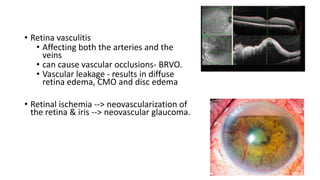
• Retina vasculitis
• Affecting both the arteries and the
veins
• can cause vascular occlusions- BRVO.
• Vascular leakage - results in diffuse
retina edema, CMO and disc edema
• Retinal ischemia --> neovascularization of
the retina & iris --> neovascular glaucoma.
Occlusive vasculitis
- Extensive retina haemorrhage
- Perivascular sheathing at superior quadrant
END STAGE:
• characterized by optic atrophy
• vascular occlusion
• gliotic sheathing
• vitreous remarkably clear
• optic papillitis or a progressive optic
atrophy secondary to the vasculitis
affecting the arterioles supplying the
optic nerve.
• Ocular inflammatory findings and
sequelae are more common in males.
LAB TEST
• no pathognomonic laboratory tests for its diagnosis- diagnosis is
made based on clinical findings.
• ESR, CRP, circulating serum immune complexes, and other markers of
inflammation may be elevated during active disease-nonspecific
findings and not diagnostic.
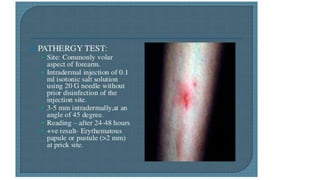
• One helpful diagnostic aid is the pathergy test
Management
• Goal: treating the acute disease along with controlling the chronic
inflammation and preventing relapses.
• Corticosteroids : for acute disease with a quick shift to use of
immunosuppressive therapy: for control of active disease and
maintenance of remission.
• Prednisone doses of 1.5mg/kg/day (with taper) are most beneficial
for controlling acute inflammation.
• Resistance to systemic corticosteroids with long-term use, as well as
side effects of high dose steroids limit their usefulness for extended
periods.
• Chronic inflammation and relapses of ocular inflammation have a
dual approach with systemic corticosteroids combined with
immunomodulatory therapy (IMT), which is essential.
Treatment for posterior uveitis
1. : shorten the duration of an inflammatory episodes
2. - suitable for long term therapy,not acute phase.
3. - effective and rapid acting but associated with
nephrotoxicity esp at higher dose (> 5mg/kg/day)
4. - effective for musocutaneuous lesion and
ocular disease that resistant to high dose steroids.
• s/effect flu like symptoms, hair loss, itchy and depression
5. Biological blockers- -- treatment for retinal vasculitis
• A multi-specialty approach- an ophthalmology, rheumatology,
dermatology, and primary care.
• The treatments are aimed at controlling symptoms, limiting
recurrences and relapses, and maintaining health prior to irreversible
damage from the disease.
• Patients should be made aware of the signs and symptoms ocular BD
can present with, and educated to promptly be seen by a healthcare
provider, as the acute and explosive nature of the disease makes the
early initiation of treatment imperative for better long term
outcomes.
Cataract/VR Operation in Uveitic (BD) patients
• Careful pre-operative evaluation is necessary for all patients with chronic
inflammation.
• Mild cataracts and or other mild visual opacities - observed first
• significant risks of severe postoperative inflammation with subsequent visual loss
from inflammatory sequelae.
• Operation only for significant cataract - at least 3 months without intraocular
inflammation (AC quiet).
• Vitreoretinal surgery -performed once the inflammation stable (not increased in
frequency and severity)
• Topical steroids regimen increased or oral steroid supplementation
should be considered prior to operation-To avoid and prevent the risk
of an acute explosive relapse in the immediate post-op period.
• PREOP COUNSELLING: retinal vascular occlusions and chronic
macular edema- may cause poor post op visual outcome
• Post-operative inflammation should be treated aggressively as there
can be a component of ocular BD manifestations which can be
confused for the expected inflammation seen after common
procedures.
• Strict medication adherence and follow ups should be described to
the patients.
Prognosis
• Behçet’s disease is characterized by its chronic recur and remissions
course.
• Visual prognosis-difficult to predict-because of the relapsing nature of
BD
• Vision loss is the greatest cause of morbidity in BD patients - 25%
• These typically smore severe when the patients are young, male, and
of Middle Eastern or Far Eastern descent- with poor visual outcome.
• The most common causes for significant visual
disability worldwide are due to
• macular edema
• occlusive retinal vasculitis
• optic atrophy and
• glaucoma
• Patients will likely require complex medical and/or
surgical interventions for the complications:
macular edema glaucoma retinal
detachments
cataracts neovascularization of the retina, optic disc and
iris (which can lead to neovascular glaucoma
vitreous
hemorrhages
• Ocular and neurologic lesions will generally continue to
progress without aggressive therapy.
• In some cases, they may improve with IMT but not fully
reversible.
• Regional variations, especially BD patients found in Turkey
and Japan, are most likely to suffer progressive vision loss.
• Early initiation of IMT and suppression of recurrences is
believed to be the best strategy for maintaining useable
vision, avoiding severe vision loss, and limiting the
complications of systemic disease.
references
• Kanski 7th edition
• eyewiki AAO
• Nussenblatt RB. Uveitis in Behçet’s disease. Int Rev Immunol. 1997;
14:67–79.
• Kaçmaz RO, et al. Ocular inflammation in Beçhet disease: incidence
of ocular complications and loss of visual acuity. Am J Ophthalmol.
2008;146:828–836
• Yazici H, et al. Influence of age of onset and patient’s sex on the
prevalence and severity of manifestations of Behçet’s syndrome. Ann
Rheum Dis. 1984;43:783–789.
• https://www.hindawi.com/journals/pri/2012/595380/

Behcet disease (2)

  • 1.
    BEHCET DISEASE Dr Marhamah,Medicalofficer of Ophthalmology Department HRPII Kota Bharu Malaysia
  • 2.
    Behcet Disease@ syndromewas named in 1937 after the Turkish dermatologist who first described the triple symptoms : apthous ulcer, genital ulcer and Uveitis
  • 3.
    • Behçet diseaseis an inflammatory disorder - vasculitis of small and large arteries and/or veins ---> Arterial and venous thrombosis • Typically affects patients from eastern Mediterranean region and Japan. Most common along the silk route from the Mediterranean to China • Strongly associated with human Leucocyte antigen • Man >female with more severe symptoms • Peak of onset is at 30s , but can be of any age
  • 4.
    Diagnostic criteria ofBehcets Disease
  • 6.
  • 7.
    Pathophysiology • Theories behindthe pathogenesis of Behçet disease currently suggest an autoimmune etiology. • In genetically predisposed individuals, exposure to an infectious agent or an environmental antigen triggers the autoimmune response. • Exposure to an infectious agent may trigger a cross-reactive immune response. (Infectious triggers)
  • 8.
    Potential Infectious Etiologyof Behçet's Disease Volume 2012 |Article ID 595380 | https://doi.org/10.1155/2012/595380 Massimiliano et al Bacteria Virus Streptococcal sanguinis herpes simplex virus-1 Saccharomyces cerevisiae hepatitis C virus mycobacteria parvovirus B19 Borrelia burgdorferi cytomegalovirus Helicobacter pylori Epstein-Barr virus Escherichia coli varicella zoster virus Staphylococcus aureus Mycoplasma fermentans
  • 9.
    • folliculitis • Erythemanodosum • Acne like exanthem • pyoderma gangrenosum
  • 10.
    Additional features 1. • Aneurysmof the pulmonary and/or systemic arterial system • Coronary artery disease, cardiomyopathy and valvular disease • venous thrombosis which may involve superficial or deep veins, vena cava , portal hepatic veins and cerebral sinuses 2. occurs in 50% of patients- mild and involve large esp kneesespecially in the knees, ankles, wrists, and elbows. usually lasts a few weeks and does not cause permanent damage to the joints.
  • 11.
    3. Skin hypersensitivity( ) 4. - rare. May involve the esophagus stomach or intestines 5. - occur in 5 % of patients and mainly involve the brainstem although meningoencephalitis and spinal cord may occur
  • 12.
    • 90% ofmen patients and 70% of women • Typically occurs within 2 years of oral ulcerations, may delay up to 14 years. • 10% of case - presented with ocular inflammation • usu bilateral • Typically presents during the 3rd and 4th decades
  • 13.
    • The severityis due to the explosive and recurrent nature of the uveitis, which can lead to permanent, often irreversible, ocular tissue damage • 25% of patients - severe vision loss. • The entire uveal tract is at risk of inflammation -nongranulomatous necrotizing obliterative vasculitis
  • 14.
    CLINICAL FEATURES • Hypopyonin 25% of cases • Anterior uveitis: redness, tearing, pain, photophobia, and blurry vision. • Posterior Uveitis • Inflammatory complications - relapsing and recurrent nature of the disease • posterior synechiae, • iris bombe, • angle-closure glaucoma- late feature associated with the relapses. .
  • 15.
    Cataracts, keratic precipitates,episcleritis, scleritis, conjunctival ulcers, and corneal immune ring opacities - less common findings
  • 16.
    Posterior Uveitis • Vitritis:severe and persistent • Retinitis : • Transient and heal without scar in acute stage • mimick virus induced lesion
  • 17.
    • Retina vasculitis •Affecting both the arteries and the veins • can cause vascular occlusions- BRVO. • Vascular leakage - results in diffuse retina edema, CMO and disc edema • Retinal ischemia --> neovascularization of the retina & iris --> neovascular glaucoma.
  • 18.
  • 19.
    - Extensive retinahaemorrhage - Perivascular sheathing at superior quadrant
  • 20.
    END STAGE: • characterizedby optic atrophy • vascular occlusion • gliotic sheathing • vitreous remarkably clear • optic papillitis or a progressive optic atrophy secondary to the vasculitis affecting the arterioles supplying the optic nerve. • Ocular inflammatory findings and sequelae are more common in males.
  • 21.
    LAB TEST • nopathognomonic laboratory tests for its diagnosis- diagnosis is made based on clinical findings. • ESR, CRP, circulating serum immune complexes, and other markers of inflammation may be elevated during active disease-nonspecific findings and not diagnostic. • One helpful diagnostic aid is the pathergy test
  • 24.
    Management • Goal: treatingthe acute disease along with controlling the chronic inflammation and preventing relapses. • Corticosteroids : for acute disease with a quick shift to use of immunosuppressive therapy: for control of active disease and maintenance of remission. • Prednisone doses of 1.5mg/kg/day (with taper) are most beneficial for controlling acute inflammation.
  • 25.
    • Resistance tosystemic corticosteroids with long-term use, as well as side effects of high dose steroids limit their usefulness for extended periods. • Chronic inflammation and relapses of ocular inflammation have a dual approach with systemic corticosteroids combined with immunomodulatory therapy (IMT), which is essential.
  • 26.
    Treatment for posterioruveitis 1. : shorten the duration of an inflammatory episodes 2. - suitable for long term therapy,not acute phase. 3. - effective and rapid acting but associated with nephrotoxicity esp at higher dose (> 5mg/kg/day) 4. - effective for musocutaneuous lesion and ocular disease that resistant to high dose steroids. • s/effect flu like symptoms, hair loss, itchy and depression 5. Biological blockers- -- treatment for retinal vasculitis
  • 27.
    • A multi-specialtyapproach- an ophthalmology, rheumatology, dermatology, and primary care. • The treatments are aimed at controlling symptoms, limiting recurrences and relapses, and maintaining health prior to irreversible damage from the disease. • Patients should be made aware of the signs and symptoms ocular BD can present with, and educated to promptly be seen by a healthcare provider, as the acute and explosive nature of the disease makes the early initiation of treatment imperative for better long term outcomes.
  • 28.
    Cataract/VR Operation inUveitic (BD) patients • Careful pre-operative evaluation is necessary for all patients with chronic inflammation. • Mild cataracts and or other mild visual opacities - observed first • significant risks of severe postoperative inflammation with subsequent visual loss from inflammatory sequelae. • Operation only for significant cataract - at least 3 months without intraocular inflammation (AC quiet). • Vitreoretinal surgery -performed once the inflammation stable (not increased in frequency and severity)
  • 29.
    • Topical steroidsregimen increased or oral steroid supplementation should be considered prior to operation-To avoid and prevent the risk of an acute explosive relapse in the immediate post-op period. • PREOP COUNSELLING: retinal vascular occlusions and chronic macular edema- may cause poor post op visual outcome
  • 30.
    • Post-operative inflammationshould be treated aggressively as there can be a component of ocular BD manifestations which can be confused for the expected inflammation seen after common procedures. • Strict medication adherence and follow ups should be described to the patients.
  • 31.
    Prognosis • Behçet’s diseaseis characterized by its chronic recur and remissions course. • Visual prognosis-difficult to predict-because of the relapsing nature of BD • Vision loss is the greatest cause of morbidity in BD patients - 25% • These typically smore severe when the patients are young, male, and of Middle Eastern or Far Eastern descent- with poor visual outcome.
  • 32.
    • The mostcommon causes for significant visual disability worldwide are due to • macular edema • occlusive retinal vasculitis • optic atrophy and • glaucoma • Patients will likely require complex medical and/or surgical interventions for the complications: macular edema glaucoma retinal detachments cataracts neovascularization of the retina, optic disc and iris (which can lead to neovascular glaucoma vitreous hemorrhages
  • 33.
    • Ocular andneurologic lesions will generally continue to progress without aggressive therapy. • In some cases, they may improve with IMT but not fully reversible. • Regional variations, especially BD patients found in Turkey and Japan, are most likely to suffer progressive vision loss. • Early initiation of IMT and suppression of recurrences is believed to be the best strategy for maintaining useable vision, avoiding severe vision loss, and limiting the complications of systemic disease.
  • 34.
    references • Kanski 7thedition • eyewiki AAO • Nussenblatt RB. Uveitis in Behçet’s disease. Int Rev Immunol. 1997; 14:67–79. • Kaçmaz RO, et al. Ocular inflammation in Beçhet disease: incidence of ocular complications and loss of visual acuity. Am J Ophthalmol. 2008;146:828–836 • Yazici H, et al. Influence of age of onset and patient’s sex on the prevalence and severity of manifestations of Behçet’s syndrome. Ann Rheum Dis. 1984;43:783–789. • https://www.hindawi.com/journals/pri/2012/595380/