A GUIDE TO BEHAVIORAL HEALTH
Important information about your behavioral
healthcare options in Central Texas
SETON.NET/BEHAVIORALHEALTH
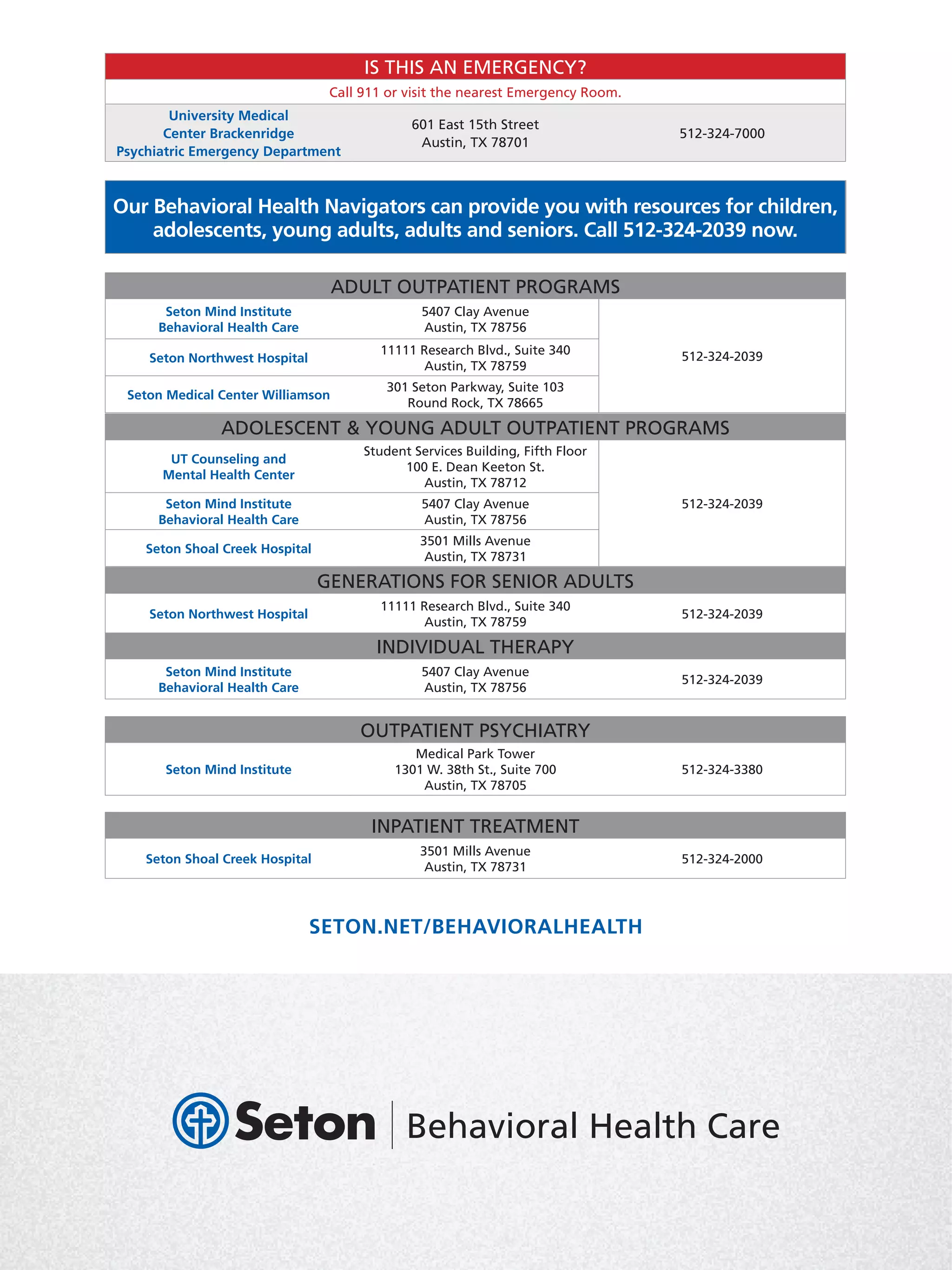
ADULT OUTPATIENT PROGRAMS
Seton Mind Institute
Behavioral Health Care
5407 Clay Avenue
Austin, TX 78756
512-324-2039Seton Northwest Hospital
11111 Research Blvd., Suite 340
Austin, TX 78759
Seton Medical Center Williamson
301 Seton Parkway, Suite 103
Round Rock, TX 78665
ADOLESCENT & YOUNG ADULT OUTPATIENT PROGRAMS
UT Counseling and
Mental Health Center
Student Services Building, Fifth Floor
100 E. Dean Keeton St.
Austin, TX 78712
512-324-2039Seton Mind Institute
Behavioral Health Care
5407 Clay Avenue
Austin, TX 78756
Seton Shoal Creek Hospital
3501 Mills Avenue
Austin, TX 78731
GENERATIONS FOR SENIOR ADULTS
Seton Northwest Hospital
11111 Research Blvd., Suite 340
Austin, TX 78759
512-324-2039
OUTPATIENT PSYCHIATRY
Seton Mind Institute
Medical Park Tower
1301 W. 38th St., Suite 700
Austin, TX 78705
512-324-3380
INDIVIDUAL THERAPY
Seton Mind Institute
Behavioral Health Care
5407 Clay Avenue
Austin, TX 78756
512-324-2039
INPATIENT TREATMENT
Seton Shoal Creek Hospital
3501 Mills Avenue
Austin, TX 78731
512-324-2000
IS THIS AN EMERGENCY?
Call 911 or visit the nearest Emergency Room.
University Medical
Center Brackenridge
Psychiatric Emergency Department
601 East 15th Street
Austin, TX 78701
512-324-7000
Our Behavioral Health Navigators can provide you with resources for children,
adolescents, young adults, adults and seniors. Call 512-324-2039 now.
At Seton Behavioral Health Care, we offer support and programs to lead you through life’s challenges.
We hope this educational guide helps you understand the resources available to provide healing and
restoration for you or your loved ones. At Seton we provide healthcare that thinks with its heart. We
believe in showing everyone the dignity and respect they deserve while providing the best care possible.
Welcome to Humancare.
Understanding Behavioral Health
What is Behavioral Health?
• How you think, feel and act when faced with life’s difficulties
• How you see yourself, your life and the other people in your life
• Your emotional well-being and attitude
Why do I need this booklet?
• You think you need help, but you are not sure what type of help you need
• You want to take steps to change the way you think, feel and act, but you want to know what to expect
from the different types of treatment
• You think a friend or family member may need help, but you are not sure what to do or how to help
Do I need help?
You might need support and help if you notice these things:
• You feel sad, nervous, overwhelmed or stressed and you do not know how to cope with these feelings
• You have struggles at work, school or with your friends or family
• You use drugs or alcohol to cope
• Your family and friends are worried about you
• You experience angry outbursts and may feel out of control at times
How do I get help?
• Read this booklet to find out which “level of care” is right for you or a family member
• Reach out and ask questions
• Call one of our Behavioral Health Navigators at 512-324-2039
What if I don’t have insurance?
• Please refer to the “Helpful Information” section of this guide for more information on payment
• Call a Behavioral Health Navigator at 512-324-2039
Depression
CALL A BEHAVIORAL HEALTH NAVIGATOR MONDAY THROUGH FRIDAY AT 512-324-2039.
What is a Behavioral Health Navigator?
• Behavioral Health Navigators are licensed behavioral health clinicians who help you connect with services
based on your needs
• You may meet with a Behavioral Health Navigator in a hospital, clinic or talk with them on the phone
• Behavioral Health Navigators can help you:
	 - Understand what kind of behavioral healthcare you need
	 - Find and get connected to behavioral health resources in your community
	 - Problem-solve issues that may be getting in the way of you getting the care you need
• When you speak with a Behavioral Health Navigator, he or she will help figure out what you need and
follow up with you to make sure you were able to connect with the resources you were given
• There are many different types of resources such as individual therapists, residential treatment, support
groups and others that you will learn about in another section of this guide
• Behavioral Health Navigators can assist you with getting help for many different problems such as:
	 - Depression
	 - Anxiety or worry
	 - Medication questions
	 - Relationship problems
	 - Drug or alcohol use
	 - Suicidal thoughts
	 - Problems with work or school
	 - Finding help for friends or family members,
including children
How do I talk to a Behavioral Health Navigator?
• Many behavioral healthcare settings and hospitals employ Behavioral Health Navigators
• If your healthcare team feels you could benefit from talking to a Behavioral Health Navigator, it may refer
you directly
• Ask your doctor, clinic, or hospital for a referral to a Behavioral Health Navigator
• Call 512-324-2039 to speak with a Navigator, Monday through Thursday 8:30 a.m. - 6:15 p.m. and
Friday 8:30 a.m. - 5 p.m.
How can I help someone who needs behavioral healthcare?
• Refer to the Helpful Information section at this end of this booklet
Inpatient Services
Outpatient Services
Navigator
Emergency Services
N
E
S
W
What is “level of care?”
• “Level of care” is a medical term that
describes different types of treatment such
as hospital care, office visits with a doctor
or therapist, or support group meetings
• The choice and/or combination of
treatment you may need depends on what
is going on with you, how it affects your
life and what is available in your area
• A doctor or therapist will help you decide
what you need
INPATIENT
Detox
Acute
Psychiatric
Hospitalization
PartialHospitalizationProgram
Support
Groups
Residential
Treatm
ent
Individual
Therapy/
Counseling
Psychiatry
Psychiatric
Emergency
Department
IntensiveOutpatientProgram
OUTPATIENT
CALL A BEHAVIORAL HEALTH NAVIGATOR MONDAY THROUGH FRIDAY AT 512-324-2039.
OUTPATIENTTREATMENT
What is a Partial Hospitalization Program (PHP)?
A Partial Hospitalization Program, or day hospital, is a very structured day program that provides several
hours of therapy and skill building groups each day. You will participate in a daily routine in a PHP, but you
will go back home each night.
Things you may be wondering about PHPs
How will I get there?
• Many PHPs offer transportation to and from the program
• Some insurance companies provide rides for medical appointments
What will my day at a PHP be like?
• PHPs typically meet Monday through Friday for about six hours
(usually 9 a.m. to 3 p.m.)
• Some PHPs offer transportation and meals, but this can vary by program
How long does a PHP last?
• PHPs can last from one to six months, or as little as one week
• Before you finish the program, your treatment team will help you
make a plan for your ongoing care and will make sure you have all
the information you need, such as important phone numbers and
medication information
Inpatient Services
Outpatient Services
OUTPATIENT TREATMENT
What is Outpatient Treatment?
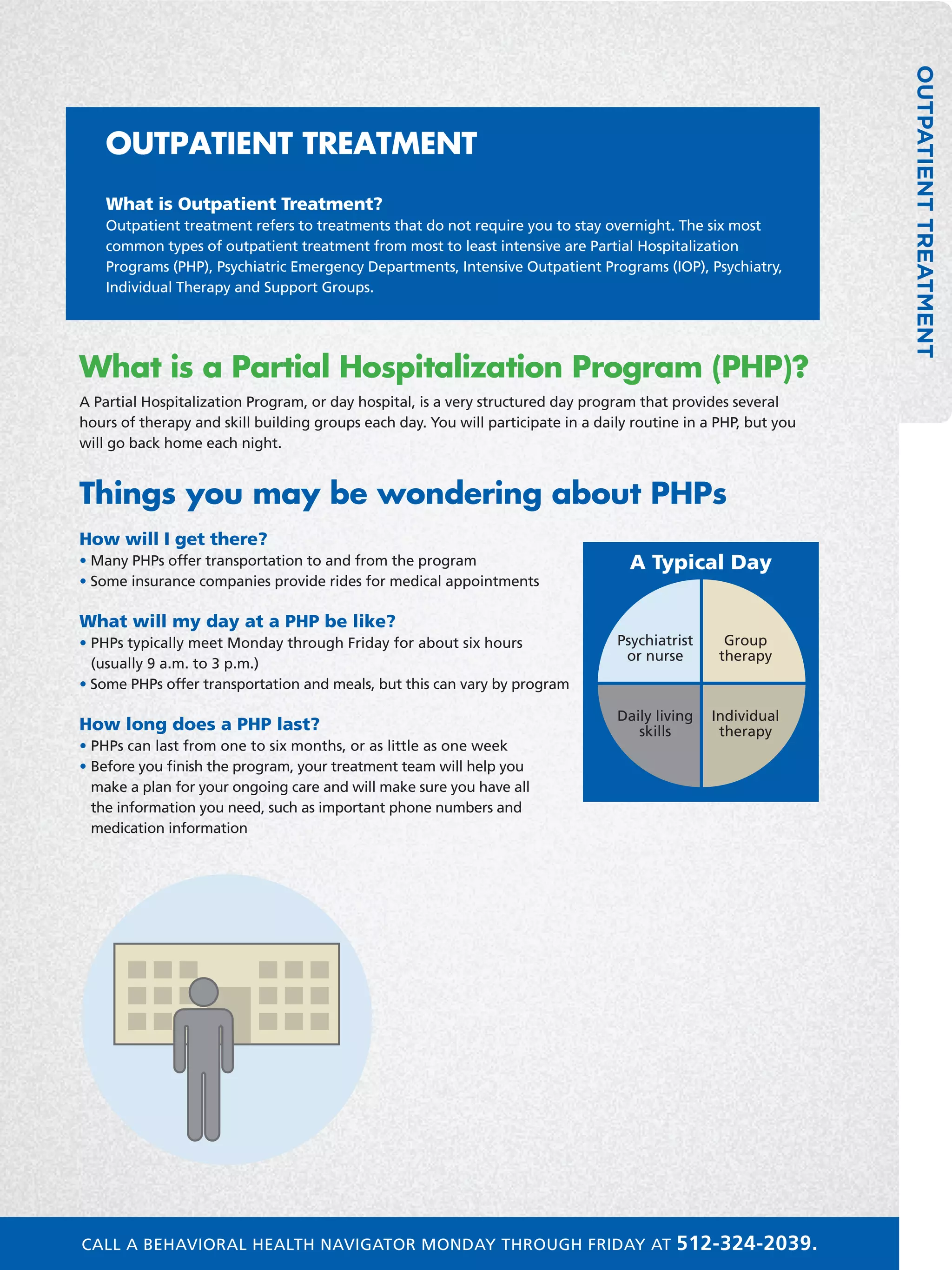
Outpatient treatment refers to treatments that do not require you to stay overnight. The six most
common types of outpatient treatment from most to least intensive are Partial Hospitalization
Programs (PHP), Psychiatric Emergency Departments, Intensive Outpatient Programs (IOP), Psychiatry,
Individual Therapy and Support Groups.
Individual
therapy
Group
therapy
Psychiatrist
or nurse
Daily living
skills
A Typical Day
CALL A BEHAVIORAL HEALTH NAVIGATOR MONDAY THROUGH FRIDAY AT 512-324-2039.
What is a Psychiatric Emergency Department?
A Psychiatric Emergency Department (Psych ED) is an emergency facility designed specifically for behavioral
health emergencies.
Things you may be wondering about a
psychiatric emergency department
How will I get there?
• Patients can come for treatment to a Psychiatric Emergency Department as they would any hospital
emergency room
• In some circumstances patients will be transferred to the Psych ED by a regular hospital emergency room or
by the police department
What will my experience in the Psych ED be like?
• You will be in the care of medical experts, all with psychiatric experience
• You may be given medications while in the Psych ED or you may be given prescriptions when you leave
• The Psych ED staff will give you referrals or appointments for outpatient treatment or help you move to
some type of inpatient treatment depending on your needs
How long will I stay at a Psych ED?
• How long you stay at a Psych ED depends on what your needs are; you may be evaluated and leave within
a few hours or you may need to stay longer if you are waiting to transfer to an acute psychiatric hospital or
residential treatment center
What is an Intensive Outpatient Program (IOP)?
An Intensive Outpatient Program is a group therapy program for people with many different types of issues
including depression, anxiety and drug or alcohol use. You may be a good fit for an IOP if you are just getting
out of the hospital or if you have tried other kinds of treatments and they have not worked for you.
Things you may be
wondering about IOPs
How will I get there?
• Transportation is not typically provided to get to and from
an IOP; you will need to be able to transport yourself, get a
ride, access medical transportation through your insurance
or use public transportation to attend an IOP
What will my session at an IOP be like?
• Most IOPs provide only group therapy, but some programs
include individual therapy or skill-coaching sessions
• The first step to getting started in most IOP programs is to
call the program to schedule an intake appointment
How long does an IOP last?
• IOPs typically meet three to five days a week for three to four hours a day over the course of five to eight weeks
• Most IOPs hold meetings during the day or evening
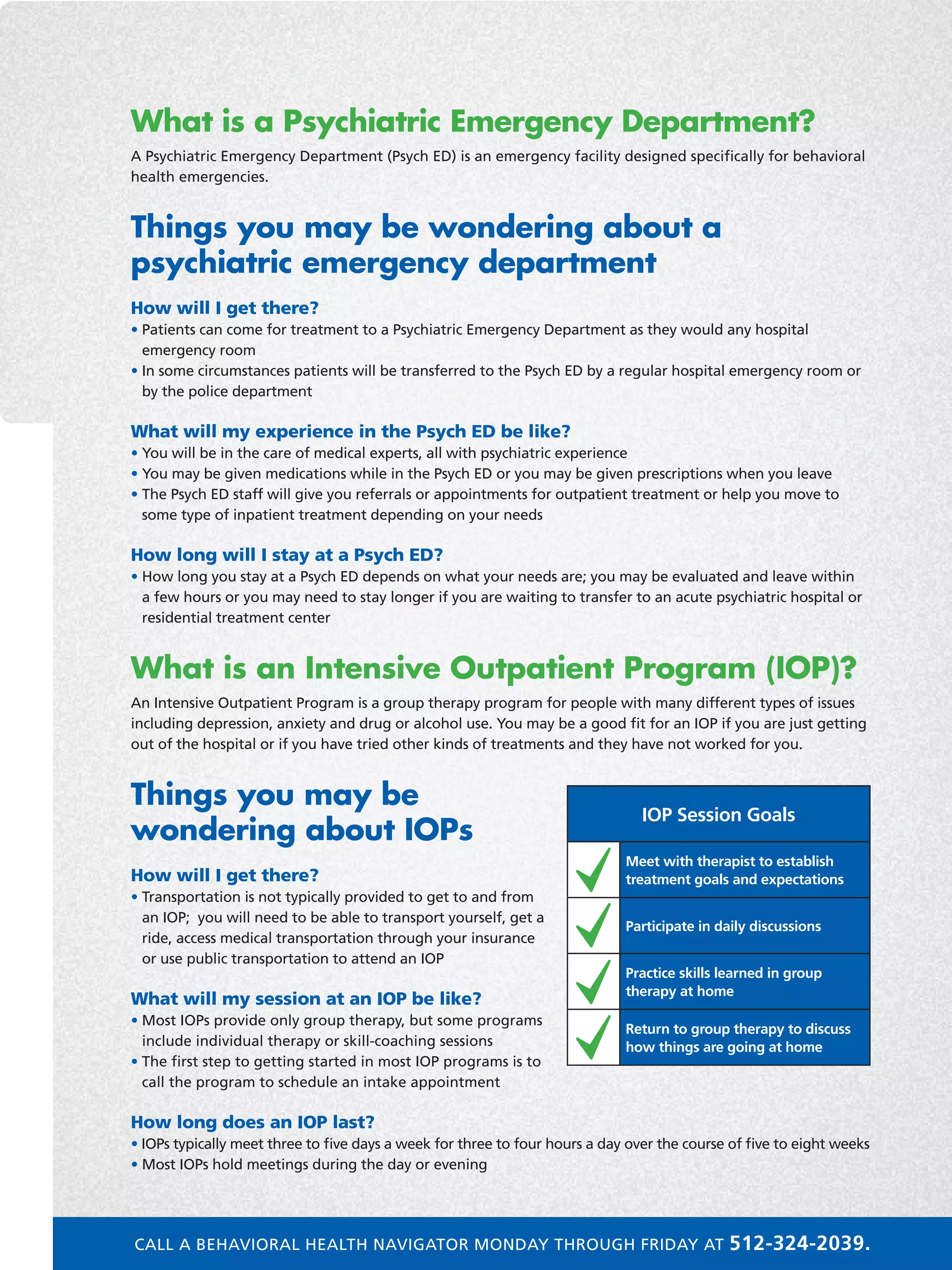
IOP Session Goals
Meet with therapist to establish
treatment goals and expectations
Participate in daily discussions
Practice skills learned in group
therapy at home
Return to group therapy to discuss
how things are going at home
CALL A BEHAVIORAL HEALTH NAVIGATOR MONDAY THROUGH FRIDAY AT 512-324-2039.
What is a Psychiatrist?
A psychiatrist is a doctor who specializes in mental health and emotional issues. Psychiatrists are licensed by
individual states as physicians to practice medicine. “Board Certified” psychiatrists have passed the national
exam given by the American Board of Psychiatry and Neurology. Psychiatrists may specialize in different issues
or different age groups, such as children and adolescents, and provide evaluations and treatment that may
include therapy and medications.
Things you may be wondering about seeing a
psychiatrist
How do I find a psychiatrist?
• If you have insurance, call the customer service number on the back of your insurance card or go to the
company’s website to get a list of providers in your network
• Call or search online for the Texas Medical Board and ask for a referral
• If you have a primary care doctor, ask him or her for a referral to a psychiatrist
• Many psychiatrists also advertise on a website called www.psychologytoday.com; this website has a “find a
therapist” tool that lets you search for providers by location, insurance or specialty
• If you are a student, try the school’s counseling or health center; someone there may be able to suggest off-
campus referrals
What if I cannot get an appointment?
• It can take anywhere from one week to three or four months to get an appointment with a psychiatrist as a
new patient
• If the psychiatrists you have called have waiting lists, ask to be put on the list to be called if an appointment
becomes available
• Put your name on several waiting lists and call regularly to find out if there have been any cancellations
• Ask your primary care physician about prescribing you medication while you are waiting for an appointment
with a psychiatrist
• If you are experiencing a psychiatric emergency and you are in the Austin area, please go to the Psychiatric
Emergency Room at University Medical Center Brackenridge; otherwise, please go to your nearest hospital
emergency room
What will my appointments with a psychiatrist be like?
• The first appointment with a psychiatrist is an initial assessment and usually lasts about an hour
• After this appointment you will have follow-up appointments on a regular basis as determined by your
psychiatrist
How long will I need to see a psychiatrist?
• You will likely need to see a psychiatrist for as long as you are being prescribed psychiatric medications
• Some primary care doctors will prescribe some psychiatric medications, which may allow you to stop seeing a
psychiatrist
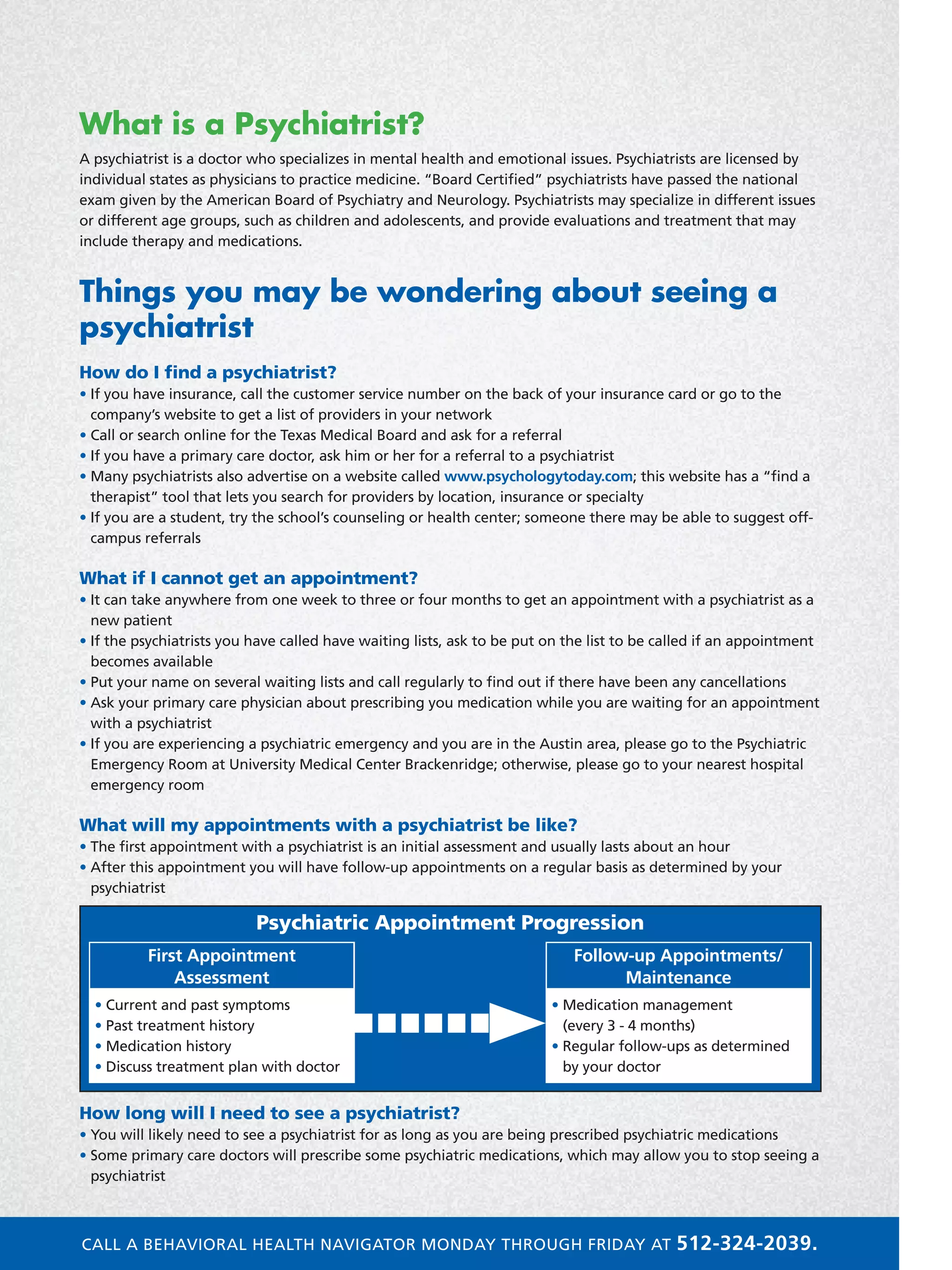
First Appointment
Assessment
• Current and past symptoms
• Past treatment history
• Medication history
• Discuss treatment plan with doctor
Follow-up Appointments/
Maintenance
• Medication management
(every 3 - 4 months)
• Regular follow-ups as determined
by your doctor
Psychiatric Appointment Progression
CALL A BEHAVIORAL HEALTH NAVIGATOR MONDAY THROUGH FRIDAY AT 512-324-2039.
What is Individual Therapy or Counseling?
Individual therapy is a general term for helping to improve behavioral health by talking with a psychiatrist,
psychologist or other mental health provider; another term for this is “talk therapy.”
Things you may be wondering about counseling
How do I find a therapist?
• Call the number on the back of your insurance card and ask for a list of providers
• Look into community clinics in your area
• Many therapists advertise on a website called
www.psychologytoday.com; this website has a “find a therapist” tool that lets you search for providers by
location, insurance or specialty
• If someone you know sees a therapist they like,
try them out or ask the therapist for a referral to
someone they recommend
• Call a therapist you may think you want to see;
most therapists offer a 20-minute free phone
consultation
• If you are employed, and your employer has an
Employee Assistance Program (EAP), call the EAP for
referrals
• If you are a student, go to the school’s counseling
or health center; someone there may be able to
suggest off-campus referrals
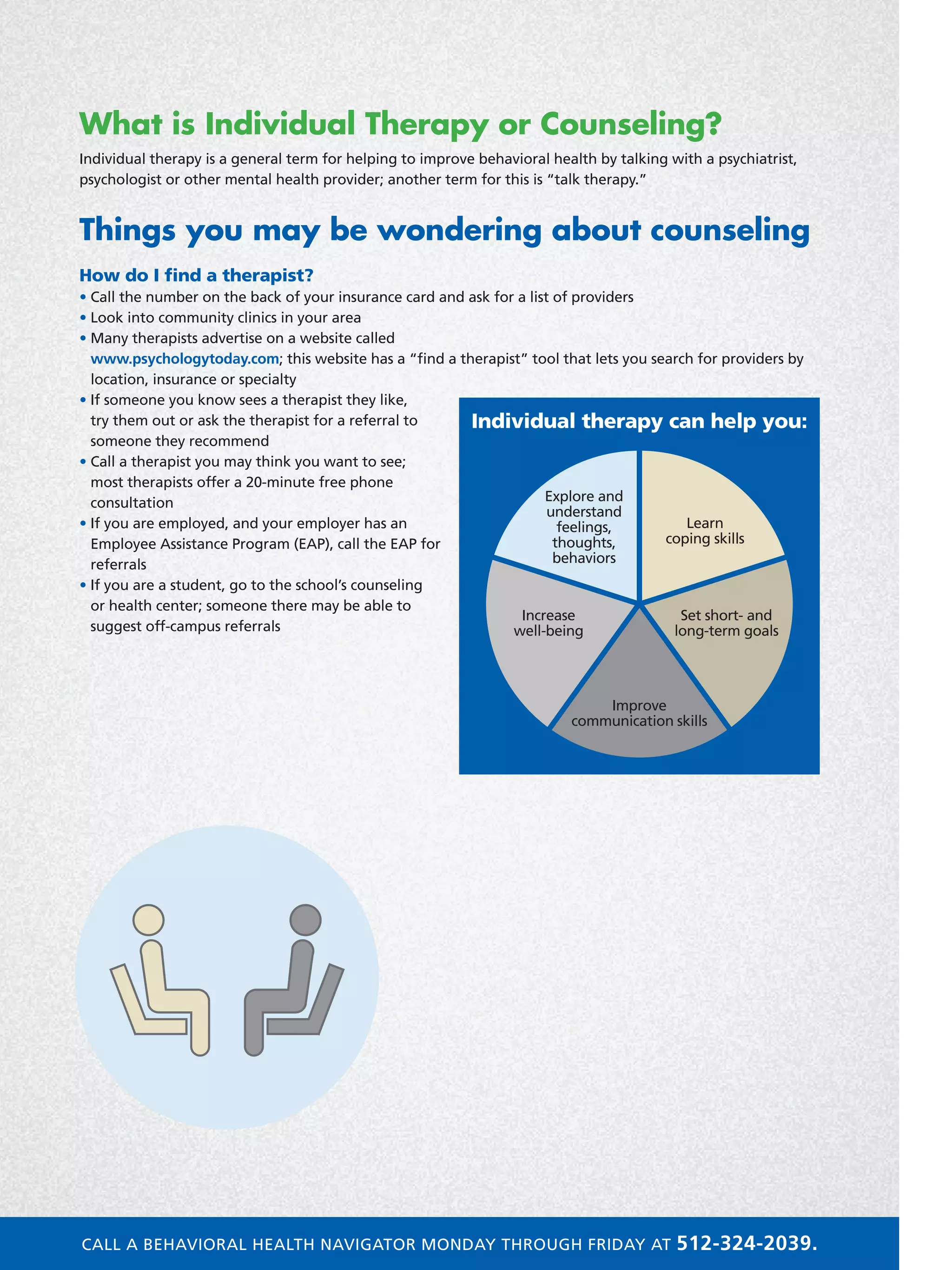
Individual therapy can help you:
Explore and
understand
feelings,
thoughts,
behaviors
Learn
coping skills
Improve
communication skills
Set short- and
long-term goals
Increase
well-being
CALL A BEHAVIORAL HEALTH NAVIGATOR MONDAY THROUGH FRIDAY AT 512-324-2039.
What will my appointments with a therapist be like?
• At the first meeting with a therapist you will fill out paperwork, learn what to expect at future
appointments, get to know the therapist, and you will have a chance to ask questions
• Therapy should be a safe place for you to work with your therapist; everything you talk about with your
therapist will be kept private unless there is a life or death situation or you give written permission to share
information with someone
• You may want to attend three sessions to determine if you and your therapist are a good fit
• Do not worry if you are not comfortable with the first therapist you meet with; it may take a few tries to
find someone who is a good fit
How long does therapy last?
• Sessions are usually 45 to 50 minutes long and may happen weekly or more often if needed
• Therapy can be short-term, lasting only a few weeks or months, or long-term, lasting a year or more
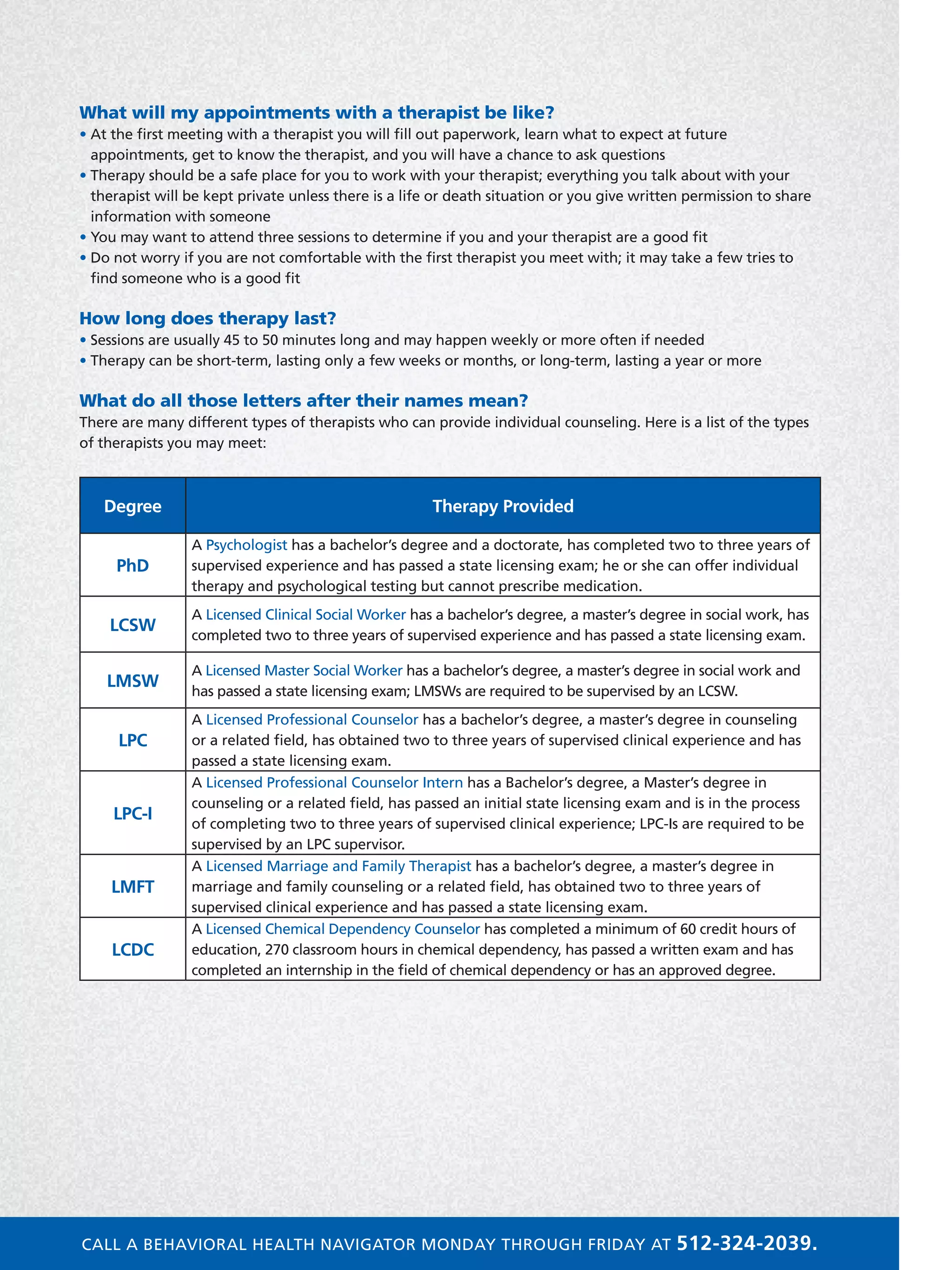
What do all those letters after their names mean?
There are many different types of therapists who can provide individual counseling. Here is a list of the types
of therapists you may meet:
Degree Therapy Provided
PhD
A Psychologist has a bachelor’s degree and a doctorate, has completed two to three years of
supervised experience and has passed a state licensing exam; he or she can offer individual
therapy and psychological testing but cannot prescribe medication.
LCSW
A Licensed Clinical Social Worker has a bachelor’s degree, a master’s degree in social work, has
completed two to three years of supervised experience and has passed a state licensing exam.
LMSW
A Licensed Master Social Worker has a bachelor’s degree, a master’s degree in social work and
has passed a state licensing exam; LMSWs are required to be supervised by an LCSW.
LPC
A Licensed Professional Counselor has a bachelor’s degree, a master’s degree in counseling
or a related field, has obtained two to three years of supervised clinical experience and has
passed a state licensing exam.
LPC-I
A Licensed Professional Counselor Intern has a Bachelor’s degree, a Master’s degree in
counseling or a related field, has passed an initial state licensing exam and is in the process
of completing two to three years of supervised clinical experience; LPC-Is are required to be
supervised by an LPC supervisor.
LMFT
A Licensed Marriage and Family Therapist has a bachelor’s degree, a master’s degree in
marriage and family counseling or a related field, has obtained two to three years of
supervised clinical experience and has passed a state licensing exam.
LCDC
A Licensed Chemical Dependency Counselor has completed a minimum of 60 credit hours of
education, 270 classroom hours in chemical dependency, has passed a written exam and has
completed an internship in the field of chemical dependency or has an approved degree.
CALL A BEHAVIORAL HEALTH NAVIGATOR MONDAY THROUGH FRIDAY AT 512-324-2039.
What is a Support Group?
A support group is a group of people who share a common health concern or interest. Behavioral health or
substance abuse support groups usually focus on a specific situation or condition, such as alcoholism, drug
addiction, bipolar disorder, or depression. There are also groups for family members of someone struggling
with these same issues. Support groups are not the same as group therapy sessions and do not need to be run
by a licensed therapist.
Things you may be wondering about support
groups
How do I find a support group?
• Search the internet for support groups in your area related to the issue you are experiencing
• Contact a state or national organization, such as NAMI (National Alliance on Mental Illness) or Alcoholics
Anonymous, devoted to your condition or situation and ask about local support groups
• Ask your psychiatrist or therapist, or contact your community center, church, mosque, synagogue or temple
• The support group you choose will depend on what is available in your community
What can I expect from a support group?
• You will meet people with problems similar to yours
• Members of a support group share their personal experiences and offer emotional comfort and moral support
• Members of a support group may also offer practical advice and tips to help you cope with your situation
Group
CALL A BEHAVIORAL HEALTH NAVIGATOR MONDAY THROUGH FRIDAY AT 512-324-2039.
INPATIENTTREATMENT
What is an Acute Psychiatric Hospital?
A psychiatric hospital is a place for people in crisis who may need safety monitoring and assessment as well as
therapy and medication management. As being in the hospital interrupts daily life and is expensive, it should
only be used when you need 24-hour care to keep you safe.
Things you may be wondering about psychiatric
hospitalization
How will I get there and what will happen when I do?
• You may be brought to the hospital or a psychiatric emergency room by a friend or family member, by an
ambulance or mental health deputy, or you may be able to drive yourself to the hospital
	 - DO NOT drive yourself if you have been using drugs or alcohol; get a ride with a family member,
friend or cab
	 - Some psychiatric hospitals require you to go to a psychiatric emergency department first
• When you arrive you will go through a process called “intake” in which you will meet with hospital staff
such as nurses, social workers and doctors or other medical providers
• You will be asked to place your belongings in a secure place for safety reasons so you should write down
important phone numbers and keep your driver’s license/ID card and insurance cards with you
• You will be asked to fill out different types of paperwork including:
	 - Medical history forms
	 - Consent for treatment forms (so the hospital can care for you)
	 - Release of information forms (so the hospital staff can talk to your family and friends or your doctor
or therapist)
	 - Insurance and billing forms
• These forms can be confusing so feel free to ask questions
• If you do not need acute psychiatric hospitalization, the staff will give you information on other treatment
options before you leave
INPATIENT TREATMENT
What is Inpatient Treatment?
• Inpatient Treatment is the highest level of care for people experiencing serious behavioral health
issues, such as:
	 - Being unable to function in your home, community, school or work
	 - Substance abuse or addiction
	 - Thoughts of harming yourself and/or someone else
	 - Having difficulty with reality, such as hearing voices or seeing things
• The three common types of inpatient treatment are acute psychiatric hospitalization, substance
dependence detox, and residential treatment for substance abuse, mental health issues, or both.
• Inpatient treatment requires you to stay during the day and night at a hospital or facility for a
period of time.
CALL A BEHAVIORAL HEALTH NAVIGATOR MONDAY THROUGH FRIDAY AT 512-324-2039.
What will my stay in the hospital be like?
• There will be visiting hours
• You will have access to a phone to make and receive calls
• Most hospitals will give you a code for your family and friends to use when calling and visiting to protect
your privacy
• You will be included in creating your treatment plan, determining what your goals are while in the hospital
and how the staff will help you meet those goals
• The psychiatrist may prescribe new medication or adjust the dosage of your current medication; medication
cannot be given to you without your permission unless it is an emergency
• You will have access to therapy groups and other types of treatment as well
• Before you leave the hospital a social worker will meet with you to make a plan and additional
appointments for continuing your treatment when you get home
How long does a stay in a psychiatric hospital last?
• Most hospital stays are only long enough to resolve the most urgent issues, and usually last from a few days
to a few weeks
• The average psychiatric inpatient stay is three to five days
Inpatient Services
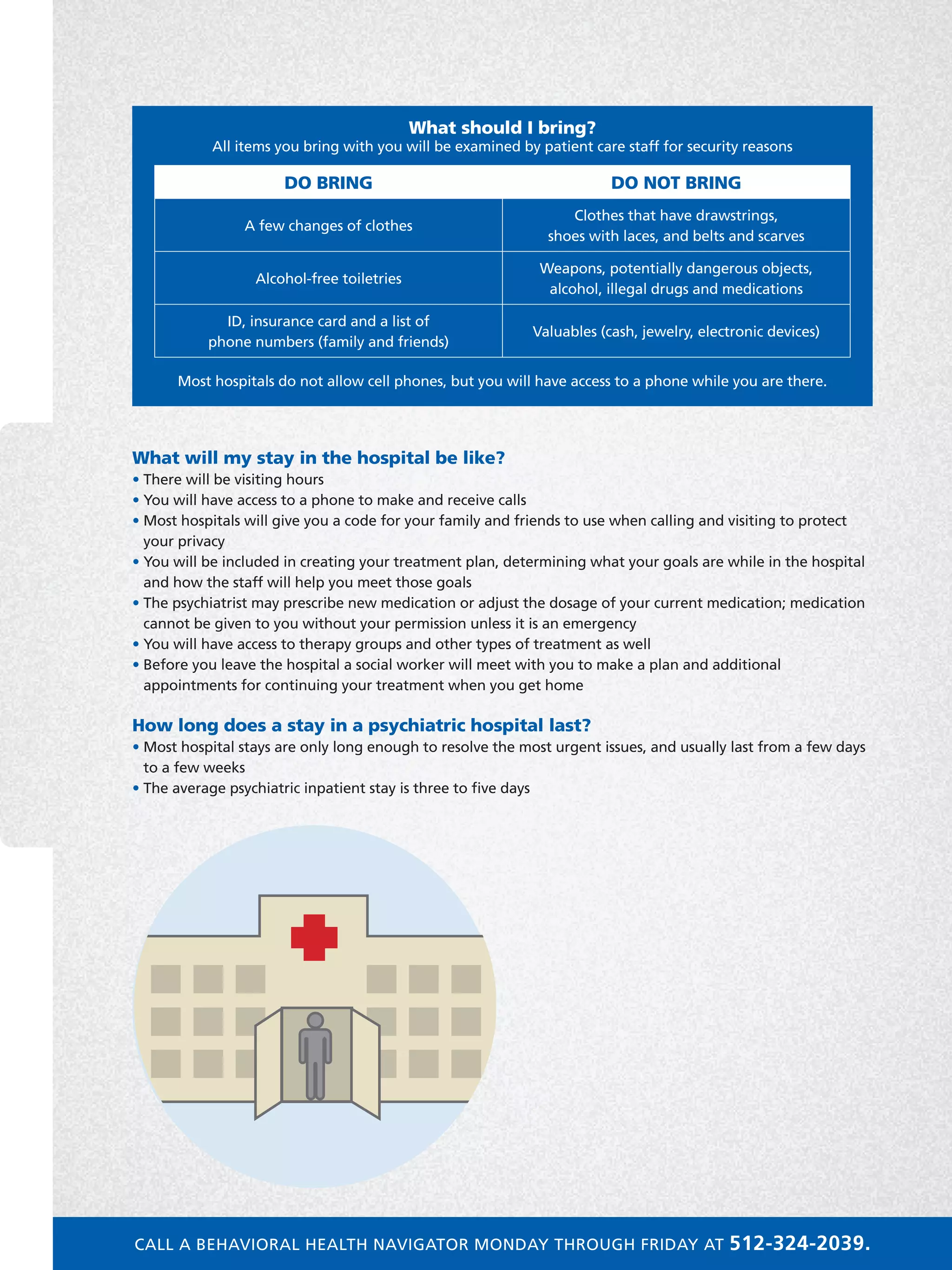
What should I bring?
All items you bring with you will be examined by patient care staff for security reasons
DO BRING DO NOT BRING
A few changes of clothes
Clothes that have drawstrings,
shoes with laces, and belts and scarves
Alcohol-free toiletries
Weapons, potentially dangerous objects,
alcohol, illegal drugs and medications
ID, insurance card and a list of
phone numbers (family and friends)
Valuables (cash, jewelry, electronic devices)
Most hospitals do not allow cell phones, but you will have access to a phone while you are there.
CALL A BEHAVIORAL HEALTH NAVIGATOR MONDAY THROUGH FRIDAY AT 512-324-2039.
What is Detox?
When you make the decision to stop drinking or using drugs you may need medical detox to stop safely.
Depending on the drug you are addicted to it can be extremely dangerous and even life threatening to try
and stop on your own. Acute detox is usually done in a hospital or residential facility where the staff are
trained to monitor and treat your symptoms.
Things you may be wondering about detox
How will I get there?
• Often people come from an emergency room after being checked by a doctor; the emergency room staff
will arrange for your transportation
• DO NOT drive yourself if you have been using drugs or alcohol; get a ride with a family member, friend or
cab
What can I expect?
• Detoxing can be uncomfortable, but your doctors will do everything they can to make you as comfortable as
possible
• It is safest if you are completely honest about what substances you have been using, as well as how much
and how often, so that your doctor and nurses can give you the right medication to make your detox as
comfortable as possible
• You may need additional support once you leave the hospital; your treatment team will help you identify
your options
How long does it take to detox?
• The time needed to detox can be different for each person and may depend on the substance used and
medical issues you may have
• On average, the stay is three to five days; you may not be fully detoxed or comfortable, but you will be safe
to return home or to go to a residential treatment facility
What happens after I detox?
• An acute hospital stay for detox is just the first step in your treatment; most of the work to learn how to live
your life sober is done in other settings, such as at a residential treatment facility or in a support group
• Your treatment team will help you plan the next steps
CALL A BEHAVIORAL HEALTH NAVIGATOR MONDAY THROUGH FRIDAY AT 512-324-2039.
What is a Residential Treatment Center or Facility?
There are times when individuals have been to an acute psychiatric hospital and need more long-term care
before starting outpatient treatment. Most often, residential treatment is for people with an addiction who
need inpatient structure and support to stay sober after detox.
Things you may be wondering about residential
treatment
How will I get there?
• You may go straight to a residential treatment center from a psychiatric hospital or detox facility, or you
might be admitted directly to residential treatment
• You may be brought to a residential treatment center by a friend or family member, or you may be able to
drive yourself
• If you are going to a residential treatment center from the hospital, the hospital may arrange for
transportation for you
• Just like an acute psychiatric hospital, you will be asked to place your belongings in a secure place for safety
reasons so you should write down important phone numbers and addresses and keep your driver’s license or
ID card and insurance cards with you
How do I prepare for residential treatment?
• You will need to plan to stay for anywhere from 14 to 90 days or more
• Contact the facility to ask for a list of items you can and cannot bring or look on the facility’s website for
this information
• If you are employed, you should either apply for FMLA or file for short-term disability with your employer
before you go
What can I expect?
• Residential treatment provides clinical support and education about addiction and behavioral health
• You will have opportunities to practice new skills in a
supportive environment to manage potential triggers
for relapse and symptoms of behavioral health issues
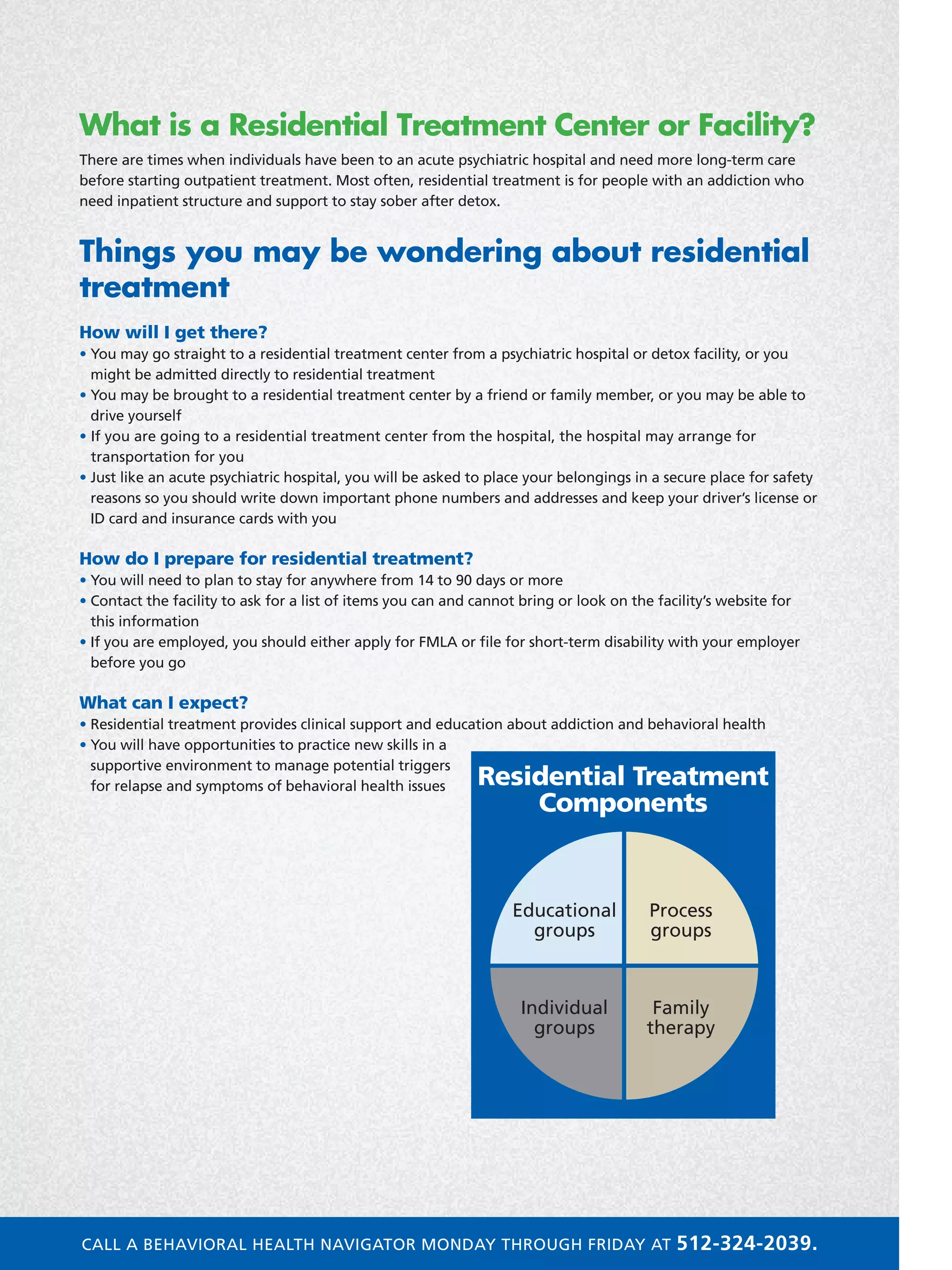
Family
therapy
Process
groups
Educational
groups
Individual
groups
Residential Treatment
Components
CALL A BEHAVIORAL HEALTH NAVIGATOR MONDAY THROUGH FRIDAY AT 512-324-2039.
HELPFULINFORMATION
HELPFUL INFORMATION
The following information will help you understand payment requirements, learn how to get the
most out of treatment and learn how to help a loved one who may need treatment.
Doin
Getting the Most Out of Treatment
• Attend scheduled appointments
• Be open and honest with your providers
• Participate actively and practice the things you are learning
• Follow up with your doctor’s or therapist’s recommendations
• Take your medication as prescribed
• Bring up your questions or concerns
• Learn about making healthy choices to reduce the chance of a crisis, including changes to your sleep, diet,
exercise and relationships
• Sign a release of information form for your family and friends to get them involved in your care
CALL A BEHAVIORAL HEALTH NAVIGATOR MONDAY THROUGH FRIDAY AT 512-324-2039.
How Can I Help Someone Needing Behavioral
Healthcare?
You can help a loved one experiencing behavioral health issues in many ways:
Recognize a crisis
If you are concerned that someone is at risk of hurting themselves or someone else and they are not willing to
get help, you can call 911 and ask for a mental health officer; these are police who are trained to help people
in a mental health crisis and they can assess the situation and assist someone in getting the help they need.
Provide support
Listen to them and encourage them to get the help they need. Let them know that getting help is important
and a healthy step toward wellness.
Respect confidentiality
In order to get information about a family member or friend’s treatment, they will need to sign a consent
for release of information that gives their doctor or therapist permission to talk to you; discuss this with your
loved one before and during their treatment.
Coordinate care and payment for treatment
• If you are a family member or close friend of someone who is in inpatient care, you may be asked to
coordinate with the hospital or facility providing this care during treatment and at discharge
• Dealing with an insurance company when you are having, or have just had, a behavioral health crisis can
be stressful; one way to be supportive may be to help your loved one get information about what their
insurance will cover and how much they will owe for their treatment
Take care of yourself
Find support for yourself; options include talking to a therapist or finding a support group, such as NAMI or
Al-Anon.
CALL A BEHAVIORAL HEALTH NAVIGATOR MONDAY THROUGH FRIDAY AT 512-324-2039.
Paying For Treatment
OUTPATIENT TREATMENT
If you have insurance
• Partial Hospitalization Programs (PHP) and Intensive
Outpatient Programs (IOP):
	 - Many programs bill you when you finish the
program; if you can’t pay all at once you
can ask about payment plan options before
starting treatment
	 - Your insurance plan may cover these
treatments; the staff will talk to you about
your coverage before you start treatment
• Psychiatrists and therapists:
	 - Expect to pay your co-pay at each appointment
	 - If your insurance is not accepted you may still
get reimbursed from your insurance company if you have Out-of-Network Reimbursement Benefits;
call the customer service number on your insurance card to find out if your insurance company will
pay you back
	 - If your employer offers an Employee Assistance Program (EAP) you may be able to get a certain
number of free sessions with a therapist
	 - If you have questions or concerns about payment, you should discuss them with your therapist or
psychiatrist
• Average co-pay costs for outpatient treatment:
	 - PHP: approximately $25 - $100 a day
	 - IOP: approximately $25 - $80 a day
	 - Psychiatrists: approximately $15 - 60 per session
	 - Therapists: approximately $10 - $60 per session
	 - Support groups: most are free
If you are uninsured:
• Partial Hospitalization Programs (PHP) and Intensive Outpatient Programs (IOP):
	 - Many programs bill you when you finish the program; if you can’t pay all at once you can ask about
payment plan options before starting treatment
	 - Ask if the program offers financial assistance
	 - Remember to inquire about payment options BEFORE starting treatment
	 - The average daily cost can range from $300 - 400 per day without insurance
• Psychiatrists:
	 - Initial evaluations usually cost between $250 - $350 and follow-ups are $100 to $200 for 30- to
60-minute sessions
	 - Payment is expected at each appointment
	 - Remember to inquire about payment options BEFORE starting treatment
CALL A BEHAVIORAL HEALTH NAVIGATOR MONDAY THROUGH FRIDAY AT 512-324-2039.
• Therapists:
	 - Some therapists offer sessions at a lower rate called “sliding scale fees”; ask about this when you
schedule an appointment
	 - In bigger cities there are often non-profit agencies that offer counseling services for the uninsured or
underinsured
	 - For referrals in Central Texas, contact 211 or a Seton Behavioral Health Navigator at 512-324-2039
• Uninsured financial help:
	 - If you are uninsured and cannot pay the full fee to see a psychiatrist or therapist, most communities have
state or city funded agencies or Community Mental Health Centers (CMHC) that may be able to help
	 - To find a CMHC, call 211 or search online
	 - In some cities, you can find non-profit agencies that offer counseling services
	 - Be aware that you may have to go through a screening process and these agencies may have waiting lists
	 - These clinics often take Medicare, Medicaid, MAP (Travis County) and marketplace insurance plans
	 - For referrals or more information about services in Central Texas, contact 211 or a Seton Behavioral
Health Navigator at 512-324-2039
INPATIENT TREATMENT
If you have insurance
• Acute inpatient treatment is often covered or partially covered by insurance, including Medicare; you have
the right to know what will be covered and what you will have to pay
• The hospital or facility will help check your insurance coverage before you are admitted; this is a good time
to ask about payment plans
• Many insurance companies require “pre-certification,” which means that the hospital staff will give your
insurance company information about why you need treatment to make sure your hospital stay will be
covered
• Contact customer service at your insurance company to seek answers to the following important treatment
questions:
	 - What facilities are in-network? What facilities are out-of-network? What is the difference in cost?
	 - Are there limits on how long I can be in the hospital or in residential treatment? Are there limits on
how often I can be in the hospital or in residential treatment?
	 - Am I required to use a facility that is “accredited?” (Accreditation means the treatment facility meets
the standards of the accrediting group; you can check to see if the facility is accredited at
http://findtreatment.samhsa.gov/locator/home.)
• Average co-pay:
	 - Psychiatric Emergency Room: approximately $100 per visit
	 - Acute hospitalization, including detox: approximately $175 - $750 per day (some insurance
companies may pay a percentage of the co-pay after you have reached your out of pocket maximum;
some may also limit the number of days they will pay for in a year, ranging from five to 30 days)
	 - Residential treatment: approximately $175 - $750 per day
If you are uninsured
• Many communities in Texas have options for financial support or community-based detox programs; in Central
Texas OSAR (Outreach, Screening, Assessment and Referral) can be reached by calling 1-877-9-NO-DRUG
• Some psychiatric hospitals and residential facilities will offer options for financial assistance for the needed
treatment
• Most hospitals or facilities will also have an option for private pay, meaning that you do not have to have or
use insurance to cover the costs
CALL A BEHAVIORAL HEALTH NAVIGATOR MONDAY THROUGH FRIDAY AT 512-324-2039.
A GUIDE TO BEHAVIORAL HEALTH
Important information about your behavioral
healthcare options in Central Texas
SETON.NET/BEHAVIORALHEALTH
ADULT OUTPATIENT PROGRAMS
Seton Mind Institute
Behavioral Health Care
5407 Clay Avenue
Austin, TX 78756
512-324-2039Seton Northwest Hospital
11111 Research Blvd., Suite 340
Austin, TX 78759
Seton Medical Center Williamson
301 Seton Parkway, Suite 103
Round Rock, TX 78665
ADOLESCENT  YOUNG ADULT OUTPATIENT PROGRAMS
UT Counseling and
Mental Health Center
Student Services Building, Fifth Floor
100 E. Dean Keeton St.
Austin, TX 78712
512-324-2039Seton Mind Institute
Behavioral Health Care
5407 Clay Avenue
Austin, TX 78756
Seton Shoal Creek Hospital
3501 Mills Avenue
Austin, TX 78731
GENERATIONS FOR SENIOR ADULTS
Seton Northwest Hospital
11111 Research Blvd., Suite 340
Austin, TX 78759
512-324-2039
OUTPATIENT PSYCHIATRY
Seton Mind Institute
Medical Park Tower
1301 W. 38th St., Suite 700
Austin, TX 78705
512-324-3380
INDIVIDUAL THERAPY
Seton Mind Institute
Behavioral Health Care
5407 Clay Avenue
Austin, TX 78756
512-324-2039
INPATIENT TREATMENT
Seton Shoal Creek Hospital
3501 Mills Avenue
Austin, TX 78731
512-324-2000
IS THIS AN EMERGENCY?
Call 911 or visit the nearest Emergency Room.
University Medical
Center Brackenridge
Psychiatric Emergency Department
601 East 15th Street
Austin, TX 78701
512-324-7000
Our Behavioral Health Navigators can provide you with resources for children,
adolescents, young adults, adults and seniors. Call 512-324-2039 now.

Behavioral_Health_Access_Guide_Final

  • 1.
    A GUIDE TOBEHAVIORAL HEALTH Important information about your behavioral healthcare options in Central Texas SETON.NET/BEHAVIORALHEALTH ADULT OUTPATIENT PROGRAMS Seton Mind Institute Behavioral Health Care 5407 Clay Avenue Austin, TX 78756 512-324-2039Seton Northwest Hospital 11111 Research Blvd., Suite 340 Austin, TX 78759 Seton Medical Center Williamson 301 Seton Parkway, Suite 103 Round Rock, TX 78665 ADOLESCENT & YOUNG ADULT OUTPATIENT PROGRAMS UT Counseling and Mental Health Center Student Services Building, Fifth Floor 100 E. Dean Keeton St. Austin, TX 78712 512-324-2039Seton Mind Institute Behavioral Health Care 5407 Clay Avenue Austin, TX 78756 Seton Shoal Creek Hospital 3501 Mills Avenue Austin, TX 78731 GENERATIONS FOR SENIOR ADULTS Seton Northwest Hospital 11111 Research Blvd., Suite 340 Austin, TX 78759 512-324-2039 OUTPATIENT PSYCHIATRY Seton Mind Institute Medical Park Tower 1301 W. 38th St., Suite 700 Austin, TX 78705 512-324-3380 INDIVIDUAL THERAPY Seton Mind Institute Behavioral Health Care 5407 Clay Avenue Austin, TX 78756 512-324-2039 INPATIENT TREATMENT Seton Shoal Creek Hospital 3501 Mills Avenue Austin, TX 78731 512-324-2000 IS THIS AN EMERGENCY? Call 911 or visit the nearest Emergency Room. University Medical Center Brackenridge Psychiatric Emergency Department 601 East 15th Street Austin, TX 78701 512-324-7000 Our Behavioral Health Navigators can provide you with resources for children, adolescents, young adults, adults and seniors. Call 512-324-2039 now.
  • 2.
    At Seton BehavioralHealth Care, we offer support and programs to lead you through life’s challenges. We hope this educational guide helps you understand the resources available to provide healing and restoration for you or your loved ones. At Seton we provide healthcare that thinks with its heart. We believe in showing everyone the dignity and respect they deserve while providing the best care possible. Welcome to Humancare. Understanding Behavioral Health What is Behavioral Health? • How you think, feel and act when faced with life’s difficulties • How you see yourself, your life and the other people in your life • Your emotional well-being and attitude Why do I need this booklet? • You think you need help, but you are not sure what type of help you need • You want to take steps to change the way you think, feel and act, but you want to know what to expect from the different types of treatment • You think a friend or family member may need help, but you are not sure what to do or how to help Do I need help? You might need support and help if you notice these things: • You feel sad, nervous, overwhelmed or stressed and you do not know how to cope with these feelings • You have struggles at work, school or with your friends or family • You use drugs or alcohol to cope • Your family and friends are worried about you • You experience angry outbursts and may feel out of control at times How do I get help? • Read this booklet to find out which “level of care” is right for you or a family member • Reach out and ask questions • Call one of our Behavioral Health Navigators at 512-324-2039 What if I don’t have insurance? • Please refer to the “Helpful Information” section of this guide for more information on payment • Call a Behavioral Health Navigator at 512-324-2039 Depression CALL A BEHAVIORAL HEALTH NAVIGATOR MONDAY THROUGH FRIDAY AT 512-324-2039.
  • 3.
    What is aBehavioral Health Navigator? • Behavioral Health Navigators are licensed behavioral health clinicians who help you connect with services based on your needs • You may meet with a Behavioral Health Navigator in a hospital, clinic or talk with them on the phone • Behavioral Health Navigators can help you: - Understand what kind of behavioral healthcare you need - Find and get connected to behavioral health resources in your community - Problem-solve issues that may be getting in the way of you getting the care you need • When you speak with a Behavioral Health Navigator, he or she will help figure out what you need and follow up with you to make sure you were able to connect with the resources you were given • There are many different types of resources such as individual therapists, residential treatment, support groups and others that you will learn about in another section of this guide • Behavioral Health Navigators can assist you with getting help for many different problems such as: - Depression - Anxiety or worry - Medication questions - Relationship problems - Drug or alcohol use - Suicidal thoughts - Problems with work or school - Finding help for friends or family members, including children How do I talk to a Behavioral Health Navigator? • Many behavioral healthcare settings and hospitals employ Behavioral Health Navigators • If your healthcare team feels you could benefit from talking to a Behavioral Health Navigator, it may refer you directly • Ask your doctor, clinic, or hospital for a referral to a Behavioral Health Navigator • Call 512-324-2039 to speak with a Navigator, Monday through Thursday 8:30 a.m. - 6:15 p.m. and Friday 8:30 a.m. - 5 p.m. How can I help someone who needs behavioral healthcare? • Refer to the Helpful Information section at this end of this booklet Inpatient Services Outpatient Services Navigator Emergency Services N E S W What is “level of care?” • “Level of care” is a medical term that describes different types of treatment such as hospital care, office visits with a doctor or therapist, or support group meetings • The choice and/or combination of treatment you may need depends on what is going on with you, how it affects your life and what is available in your area • A doctor or therapist will help you decide what you need INPATIENT Detox Acute Psychiatric Hospitalization PartialHospitalizationProgram Support Groups Residential Treatm ent Individual Therapy/ Counseling Psychiatry Psychiatric Emergency Department IntensiveOutpatientProgram OUTPATIENT CALL A BEHAVIORAL HEALTH NAVIGATOR MONDAY THROUGH FRIDAY AT 512-324-2039.
  • 4.
    OUTPATIENTTREATMENT What is aPartial Hospitalization Program (PHP)? A Partial Hospitalization Program, or day hospital, is a very structured day program that provides several hours of therapy and skill building groups each day. You will participate in a daily routine in a PHP, but you will go back home each night. Things you may be wondering about PHPs How will I get there? • Many PHPs offer transportation to and from the program • Some insurance companies provide rides for medical appointments What will my day at a PHP be like? • PHPs typically meet Monday through Friday for about six hours (usually 9 a.m. to 3 p.m.) • Some PHPs offer transportation and meals, but this can vary by program How long does a PHP last? • PHPs can last from one to six months, or as little as one week • Before you finish the program, your treatment team will help you make a plan for your ongoing care and will make sure you have all the information you need, such as important phone numbers and medication information Inpatient Services Outpatient Services OUTPATIENT TREATMENT What is Outpatient Treatment? Outpatient treatment refers to treatments that do not require you to stay overnight. The six most common types of outpatient treatment from most to least intensive are Partial Hospitalization Programs (PHP), Psychiatric Emergency Departments, Intensive Outpatient Programs (IOP), Psychiatry, Individual Therapy and Support Groups. Individual therapy Group therapy Psychiatrist or nurse Daily living skills A Typical Day CALL A BEHAVIORAL HEALTH NAVIGATOR MONDAY THROUGH FRIDAY AT 512-324-2039.
  • 5.
    What is aPsychiatric Emergency Department? A Psychiatric Emergency Department (Psych ED) is an emergency facility designed specifically for behavioral health emergencies. Things you may be wondering about a psychiatric emergency department How will I get there? • Patients can come for treatment to a Psychiatric Emergency Department as they would any hospital emergency room • In some circumstances patients will be transferred to the Psych ED by a regular hospital emergency room or by the police department What will my experience in the Psych ED be like? • You will be in the care of medical experts, all with psychiatric experience • You may be given medications while in the Psych ED or you may be given prescriptions when you leave • The Psych ED staff will give you referrals or appointments for outpatient treatment or help you move to some type of inpatient treatment depending on your needs How long will I stay at a Psych ED? • How long you stay at a Psych ED depends on what your needs are; you may be evaluated and leave within a few hours or you may need to stay longer if you are waiting to transfer to an acute psychiatric hospital or residential treatment center What is an Intensive Outpatient Program (IOP)? An Intensive Outpatient Program is a group therapy program for people with many different types of issues including depression, anxiety and drug or alcohol use. You may be a good fit for an IOP if you are just getting out of the hospital or if you have tried other kinds of treatments and they have not worked for you. Things you may be wondering about IOPs How will I get there? • Transportation is not typically provided to get to and from an IOP; you will need to be able to transport yourself, get a ride, access medical transportation through your insurance or use public transportation to attend an IOP What will my session at an IOP be like? • Most IOPs provide only group therapy, but some programs include individual therapy or skill-coaching sessions • The first step to getting started in most IOP programs is to call the program to schedule an intake appointment How long does an IOP last? • IOPs typically meet three to five days a week for three to four hours a day over the course of five to eight weeks • Most IOPs hold meetings during the day or evening IOP Session Goals Meet with therapist to establish treatment goals and expectations Participate in daily discussions Practice skills learned in group therapy at home Return to group therapy to discuss how things are going at home CALL A BEHAVIORAL HEALTH NAVIGATOR MONDAY THROUGH FRIDAY AT 512-324-2039.
  • 6.
    What is aPsychiatrist? A psychiatrist is a doctor who specializes in mental health and emotional issues. Psychiatrists are licensed by individual states as physicians to practice medicine. “Board Certified” psychiatrists have passed the national exam given by the American Board of Psychiatry and Neurology. Psychiatrists may specialize in different issues or different age groups, such as children and adolescents, and provide evaluations and treatment that may include therapy and medications. Things you may be wondering about seeing a psychiatrist How do I find a psychiatrist? • If you have insurance, call the customer service number on the back of your insurance card or go to the company’s website to get a list of providers in your network • Call or search online for the Texas Medical Board and ask for a referral • If you have a primary care doctor, ask him or her for a referral to a psychiatrist • Many psychiatrists also advertise on a website called www.psychologytoday.com; this website has a “find a therapist” tool that lets you search for providers by location, insurance or specialty • If you are a student, try the school’s counseling or health center; someone there may be able to suggest off- campus referrals What if I cannot get an appointment? • It can take anywhere from one week to three or four months to get an appointment with a psychiatrist as a new patient • If the psychiatrists you have called have waiting lists, ask to be put on the list to be called if an appointment becomes available • Put your name on several waiting lists and call regularly to find out if there have been any cancellations • Ask your primary care physician about prescribing you medication while you are waiting for an appointment with a psychiatrist • If you are experiencing a psychiatric emergency and you are in the Austin area, please go to the Psychiatric Emergency Room at University Medical Center Brackenridge; otherwise, please go to your nearest hospital emergency room What will my appointments with a psychiatrist be like? • The first appointment with a psychiatrist is an initial assessment and usually lasts about an hour • After this appointment you will have follow-up appointments on a regular basis as determined by your psychiatrist How long will I need to see a psychiatrist? • You will likely need to see a psychiatrist for as long as you are being prescribed psychiatric medications • Some primary care doctors will prescribe some psychiatric medications, which may allow you to stop seeing a psychiatrist First Appointment Assessment • Current and past symptoms • Past treatment history • Medication history • Discuss treatment plan with doctor Follow-up Appointments/ Maintenance • Medication management (every 3 - 4 months) • Regular follow-ups as determined by your doctor Psychiatric Appointment Progression CALL A BEHAVIORAL HEALTH NAVIGATOR MONDAY THROUGH FRIDAY AT 512-324-2039.
  • 7.
    What is IndividualTherapy or Counseling? Individual therapy is a general term for helping to improve behavioral health by talking with a psychiatrist, psychologist or other mental health provider; another term for this is “talk therapy.” Things you may be wondering about counseling How do I find a therapist? • Call the number on the back of your insurance card and ask for a list of providers • Look into community clinics in your area • Many therapists advertise on a website called www.psychologytoday.com; this website has a “find a therapist” tool that lets you search for providers by location, insurance or specialty • If someone you know sees a therapist they like, try them out or ask the therapist for a referral to someone they recommend • Call a therapist you may think you want to see; most therapists offer a 20-minute free phone consultation • If you are employed, and your employer has an Employee Assistance Program (EAP), call the EAP for referrals • If you are a student, go to the school’s counseling or health center; someone there may be able to suggest off-campus referrals Individual therapy can help you: Explore and understand feelings, thoughts, behaviors Learn coping skills Improve communication skills Set short- and long-term goals Increase well-being CALL A BEHAVIORAL HEALTH NAVIGATOR MONDAY THROUGH FRIDAY AT 512-324-2039.
  • 8.
    What will myappointments with a therapist be like? • At the first meeting with a therapist you will fill out paperwork, learn what to expect at future appointments, get to know the therapist, and you will have a chance to ask questions • Therapy should be a safe place for you to work with your therapist; everything you talk about with your therapist will be kept private unless there is a life or death situation or you give written permission to share information with someone • You may want to attend three sessions to determine if you and your therapist are a good fit • Do not worry if you are not comfortable with the first therapist you meet with; it may take a few tries to find someone who is a good fit How long does therapy last? • Sessions are usually 45 to 50 minutes long and may happen weekly or more often if needed • Therapy can be short-term, lasting only a few weeks or months, or long-term, lasting a year or more What do all those letters after their names mean? There are many different types of therapists who can provide individual counseling. Here is a list of the types of therapists you may meet: Degree Therapy Provided PhD A Psychologist has a bachelor’s degree and a doctorate, has completed two to three years of supervised experience and has passed a state licensing exam; he or she can offer individual therapy and psychological testing but cannot prescribe medication. LCSW A Licensed Clinical Social Worker has a bachelor’s degree, a master’s degree in social work, has completed two to three years of supervised experience and has passed a state licensing exam. LMSW A Licensed Master Social Worker has a bachelor’s degree, a master’s degree in social work and has passed a state licensing exam; LMSWs are required to be supervised by an LCSW. LPC A Licensed Professional Counselor has a bachelor’s degree, a master’s degree in counseling or a related field, has obtained two to three years of supervised clinical experience and has passed a state licensing exam. LPC-I A Licensed Professional Counselor Intern has a Bachelor’s degree, a Master’s degree in counseling or a related field, has passed an initial state licensing exam and is in the process of completing two to three years of supervised clinical experience; LPC-Is are required to be supervised by an LPC supervisor. LMFT A Licensed Marriage and Family Therapist has a bachelor’s degree, a master’s degree in marriage and family counseling or a related field, has obtained two to three years of supervised clinical experience and has passed a state licensing exam. LCDC A Licensed Chemical Dependency Counselor has completed a minimum of 60 credit hours of education, 270 classroom hours in chemical dependency, has passed a written exam and has completed an internship in the field of chemical dependency or has an approved degree. CALL A BEHAVIORAL HEALTH NAVIGATOR MONDAY THROUGH FRIDAY AT 512-324-2039.
  • 9.
    What is aSupport Group? A support group is a group of people who share a common health concern or interest. Behavioral health or substance abuse support groups usually focus on a specific situation or condition, such as alcoholism, drug addiction, bipolar disorder, or depression. There are also groups for family members of someone struggling with these same issues. Support groups are not the same as group therapy sessions and do not need to be run by a licensed therapist. Things you may be wondering about support groups How do I find a support group? • Search the internet for support groups in your area related to the issue you are experiencing • Contact a state or national organization, such as NAMI (National Alliance on Mental Illness) or Alcoholics Anonymous, devoted to your condition or situation and ask about local support groups • Ask your psychiatrist or therapist, or contact your community center, church, mosque, synagogue or temple • The support group you choose will depend on what is available in your community What can I expect from a support group? • You will meet people with problems similar to yours • Members of a support group share their personal experiences and offer emotional comfort and moral support • Members of a support group may also offer practical advice and tips to help you cope with your situation Group CALL A BEHAVIORAL HEALTH NAVIGATOR MONDAY THROUGH FRIDAY AT 512-324-2039.
  • 10.
    INPATIENTTREATMENT What is anAcute Psychiatric Hospital? A psychiatric hospital is a place for people in crisis who may need safety monitoring and assessment as well as therapy and medication management. As being in the hospital interrupts daily life and is expensive, it should only be used when you need 24-hour care to keep you safe. Things you may be wondering about psychiatric hospitalization How will I get there and what will happen when I do? • You may be brought to the hospital or a psychiatric emergency room by a friend or family member, by an ambulance or mental health deputy, or you may be able to drive yourself to the hospital - DO NOT drive yourself if you have been using drugs or alcohol; get a ride with a family member, friend or cab - Some psychiatric hospitals require you to go to a psychiatric emergency department first • When you arrive you will go through a process called “intake” in which you will meet with hospital staff such as nurses, social workers and doctors or other medical providers • You will be asked to place your belongings in a secure place for safety reasons so you should write down important phone numbers and keep your driver’s license/ID card and insurance cards with you • You will be asked to fill out different types of paperwork including: - Medical history forms - Consent for treatment forms (so the hospital can care for you) - Release of information forms (so the hospital staff can talk to your family and friends or your doctor or therapist) - Insurance and billing forms • These forms can be confusing so feel free to ask questions • If you do not need acute psychiatric hospitalization, the staff will give you information on other treatment options before you leave INPATIENT TREATMENT What is Inpatient Treatment? • Inpatient Treatment is the highest level of care for people experiencing serious behavioral health issues, such as: - Being unable to function in your home, community, school or work - Substance abuse or addiction - Thoughts of harming yourself and/or someone else - Having difficulty with reality, such as hearing voices or seeing things • The three common types of inpatient treatment are acute psychiatric hospitalization, substance dependence detox, and residential treatment for substance abuse, mental health issues, or both. • Inpatient treatment requires you to stay during the day and night at a hospital or facility for a period of time. CALL A BEHAVIORAL HEALTH NAVIGATOR MONDAY THROUGH FRIDAY AT 512-324-2039.
  • 11.
    What will mystay in the hospital be like? • There will be visiting hours • You will have access to a phone to make and receive calls • Most hospitals will give you a code for your family and friends to use when calling and visiting to protect your privacy • You will be included in creating your treatment plan, determining what your goals are while in the hospital and how the staff will help you meet those goals • The psychiatrist may prescribe new medication or adjust the dosage of your current medication; medication cannot be given to you without your permission unless it is an emergency • You will have access to therapy groups and other types of treatment as well • Before you leave the hospital a social worker will meet with you to make a plan and additional appointments for continuing your treatment when you get home How long does a stay in a psychiatric hospital last? • Most hospital stays are only long enough to resolve the most urgent issues, and usually last from a few days to a few weeks • The average psychiatric inpatient stay is three to five days Inpatient Services What should I bring? All items you bring with you will be examined by patient care staff for security reasons DO BRING DO NOT BRING A few changes of clothes Clothes that have drawstrings, shoes with laces, and belts and scarves Alcohol-free toiletries Weapons, potentially dangerous objects, alcohol, illegal drugs and medications ID, insurance card and a list of phone numbers (family and friends) Valuables (cash, jewelry, electronic devices) Most hospitals do not allow cell phones, but you will have access to a phone while you are there. CALL A BEHAVIORAL HEALTH NAVIGATOR MONDAY THROUGH FRIDAY AT 512-324-2039.
  • 12.
    What is Detox? Whenyou make the decision to stop drinking or using drugs you may need medical detox to stop safely. Depending on the drug you are addicted to it can be extremely dangerous and even life threatening to try and stop on your own. Acute detox is usually done in a hospital or residential facility where the staff are trained to monitor and treat your symptoms. Things you may be wondering about detox How will I get there? • Often people come from an emergency room after being checked by a doctor; the emergency room staff will arrange for your transportation • DO NOT drive yourself if you have been using drugs or alcohol; get a ride with a family member, friend or cab What can I expect? • Detoxing can be uncomfortable, but your doctors will do everything they can to make you as comfortable as possible • It is safest if you are completely honest about what substances you have been using, as well as how much and how often, so that your doctor and nurses can give you the right medication to make your detox as comfortable as possible • You may need additional support once you leave the hospital; your treatment team will help you identify your options How long does it take to detox? • The time needed to detox can be different for each person and may depend on the substance used and medical issues you may have • On average, the stay is three to five days; you may not be fully detoxed or comfortable, but you will be safe to return home or to go to a residential treatment facility What happens after I detox? • An acute hospital stay for detox is just the first step in your treatment; most of the work to learn how to live your life sober is done in other settings, such as at a residential treatment facility or in a support group • Your treatment team will help you plan the next steps CALL A BEHAVIORAL HEALTH NAVIGATOR MONDAY THROUGH FRIDAY AT 512-324-2039.
  • 13.
    What is aResidential Treatment Center or Facility? There are times when individuals have been to an acute psychiatric hospital and need more long-term care before starting outpatient treatment. Most often, residential treatment is for people with an addiction who need inpatient structure and support to stay sober after detox. Things you may be wondering about residential treatment How will I get there? • You may go straight to a residential treatment center from a psychiatric hospital or detox facility, or you might be admitted directly to residential treatment • You may be brought to a residential treatment center by a friend or family member, or you may be able to drive yourself • If you are going to a residential treatment center from the hospital, the hospital may arrange for transportation for you • Just like an acute psychiatric hospital, you will be asked to place your belongings in a secure place for safety reasons so you should write down important phone numbers and addresses and keep your driver’s license or ID card and insurance cards with you How do I prepare for residential treatment? • You will need to plan to stay for anywhere from 14 to 90 days or more • Contact the facility to ask for a list of items you can and cannot bring or look on the facility’s website for this information • If you are employed, you should either apply for FMLA or file for short-term disability with your employer before you go What can I expect? • Residential treatment provides clinical support and education about addiction and behavioral health • You will have opportunities to practice new skills in a supportive environment to manage potential triggers for relapse and symptoms of behavioral health issues Family therapy Process groups Educational groups Individual groups Residential Treatment Components CALL A BEHAVIORAL HEALTH NAVIGATOR MONDAY THROUGH FRIDAY AT 512-324-2039.
  • 14.
    HELPFULINFORMATION HELPFUL INFORMATION The followinginformation will help you understand payment requirements, learn how to get the most out of treatment and learn how to help a loved one who may need treatment. Doin Getting the Most Out of Treatment • Attend scheduled appointments • Be open and honest with your providers • Participate actively and practice the things you are learning • Follow up with your doctor’s or therapist’s recommendations • Take your medication as prescribed • Bring up your questions or concerns • Learn about making healthy choices to reduce the chance of a crisis, including changes to your sleep, diet, exercise and relationships • Sign a release of information form for your family and friends to get them involved in your care CALL A BEHAVIORAL HEALTH NAVIGATOR MONDAY THROUGH FRIDAY AT 512-324-2039.
  • 15.
    How Can IHelp Someone Needing Behavioral Healthcare? You can help a loved one experiencing behavioral health issues in many ways: Recognize a crisis If you are concerned that someone is at risk of hurting themselves or someone else and they are not willing to get help, you can call 911 and ask for a mental health officer; these are police who are trained to help people in a mental health crisis and they can assess the situation and assist someone in getting the help they need. Provide support Listen to them and encourage them to get the help they need. Let them know that getting help is important and a healthy step toward wellness. Respect confidentiality In order to get information about a family member or friend’s treatment, they will need to sign a consent for release of information that gives their doctor or therapist permission to talk to you; discuss this with your loved one before and during their treatment. Coordinate care and payment for treatment • If you are a family member or close friend of someone who is in inpatient care, you may be asked to coordinate with the hospital or facility providing this care during treatment and at discharge • Dealing with an insurance company when you are having, or have just had, a behavioral health crisis can be stressful; one way to be supportive may be to help your loved one get information about what their insurance will cover and how much they will owe for their treatment Take care of yourself Find support for yourself; options include talking to a therapist or finding a support group, such as NAMI or Al-Anon. CALL A BEHAVIORAL HEALTH NAVIGATOR MONDAY THROUGH FRIDAY AT 512-324-2039.
  • 16.
    Paying For Treatment OUTPATIENTTREATMENT If you have insurance • Partial Hospitalization Programs (PHP) and Intensive Outpatient Programs (IOP): - Many programs bill you when you finish the program; if you can’t pay all at once you can ask about payment plan options before starting treatment - Your insurance plan may cover these treatments; the staff will talk to you about your coverage before you start treatment • Psychiatrists and therapists: - Expect to pay your co-pay at each appointment - If your insurance is not accepted you may still get reimbursed from your insurance company if you have Out-of-Network Reimbursement Benefits; call the customer service number on your insurance card to find out if your insurance company will pay you back - If your employer offers an Employee Assistance Program (EAP) you may be able to get a certain number of free sessions with a therapist - If you have questions or concerns about payment, you should discuss them with your therapist or psychiatrist • Average co-pay costs for outpatient treatment: - PHP: approximately $25 - $100 a day - IOP: approximately $25 - $80 a day - Psychiatrists: approximately $15 - 60 per session - Therapists: approximately $10 - $60 per session - Support groups: most are free If you are uninsured: • Partial Hospitalization Programs (PHP) and Intensive Outpatient Programs (IOP): - Many programs bill you when you finish the program; if you can’t pay all at once you can ask about payment plan options before starting treatment - Ask if the program offers financial assistance - Remember to inquire about payment options BEFORE starting treatment - The average daily cost can range from $300 - 400 per day without insurance • Psychiatrists: - Initial evaluations usually cost between $250 - $350 and follow-ups are $100 to $200 for 30- to 60-minute sessions - Payment is expected at each appointment - Remember to inquire about payment options BEFORE starting treatment CALL A BEHAVIORAL HEALTH NAVIGATOR MONDAY THROUGH FRIDAY AT 512-324-2039.
  • 17.
    • Therapists: -Some therapists offer sessions at a lower rate called “sliding scale fees”; ask about this when you schedule an appointment - In bigger cities there are often non-profit agencies that offer counseling services for the uninsured or underinsured - For referrals in Central Texas, contact 211 or a Seton Behavioral Health Navigator at 512-324-2039 • Uninsured financial help: - If you are uninsured and cannot pay the full fee to see a psychiatrist or therapist, most communities have state or city funded agencies or Community Mental Health Centers (CMHC) that may be able to help - To find a CMHC, call 211 or search online - In some cities, you can find non-profit agencies that offer counseling services - Be aware that you may have to go through a screening process and these agencies may have waiting lists - These clinics often take Medicare, Medicaid, MAP (Travis County) and marketplace insurance plans - For referrals or more information about services in Central Texas, contact 211 or a Seton Behavioral Health Navigator at 512-324-2039 INPATIENT TREATMENT If you have insurance • Acute inpatient treatment is often covered or partially covered by insurance, including Medicare; you have the right to know what will be covered and what you will have to pay • The hospital or facility will help check your insurance coverage before you are admitted; this is a good time to ask about payment plans • Many insurance companies require “pre-certification,” which means that the hospital staff will give your insurance company information about why you need treatment to make sure your hospital stay will be covered • Contact customer service at your insurance company to seek answers to the following important treatment questions: - What facilities are in-network? What facilities are out-of-network? What is the difference in cost? - Are there limits on how long I can be in the hospital or in residential treatment? Are there limits on how often I can be in the hospital or in residential treatment? - Am I required to use a facility that is “accredited?” (Accreditation means the treatment facility meets the standards of the accrediting group; you can check to see if the facility is accredited at http://findtreatment.samhsa.gov/locator/home.) • Average co-pay: - Psychiatric Emergency Room: approximately $100 per visit - Acute hospitalization, including detox: approximately $175 - $750 per day (some insurance companies may pay a percentage of the co-pay after you have reached your out of pocket maximum; some may also limit the number of days they will pay for in a year, ranging from five to 30 days) - Residential treatment: approximately $175 - $750 per day If you are uninsured • Many communities in Texas have options for financial support or community-based detox programs; in Central Texas OSAR (Outreach, Screening, Assessment and Referral) can be reached by calling 1-877-9-NO-DRUG • Some psychiatric hospitals and residential facilities will offer options for financial assistance for the needed treatment • Most hospitals or facilities will also have an option for private pay, meaning that you do not have to have or use insurance to cover the costs CALL A BEHAVIORAL HEALTH NAVIGATOR MONDAY THROUGH FRIDAY AT 512-324-2039.
  • 18.
    A GUIDE TOBEHAVIORAL HEALTH Important information about your behavioral healthcare options in Central Texas SETON.NET/BEHAVIORALHEALTH ADULT OUTPATIENT PROGRAMS Seton Mind Institute Behavioral Health Care 5407 Clay Avenue Austin, TX 78756 512-324-2039Seton Northwest Hospital 11111 Research Blvd., Suite 340 Austin, TX 78759 Seton Medical Center Williamson 301 Seton Parkway, Suite 103 Round Rock, TX 78665 ADOLESCENT YOUNG ADULT OUTPATIENT PROGRAMS UT Counseling and Mental Health Center Student Services Building, Fifth Floor 100 E. Dean Keeton St. Austin, TX 78712 512-324-2039Seton Mind Institute Behavioral Health Care 5407 Clay Avenue Austin, TX 78756 Seton Shoal Creek Hospital 3501 Mills Avenue Austin, TX 78731 GENERATIONS FOR SENIOR ADULTS Seton Northwest Hospital 11111 Research Blvd., Suite 340 Austin, TX 78759 512-324-2039 OUTPATIENT PSYCHIATRY Seton Mind Institute Medical Park Tower 1301 W. 38th St., Suite 700 Austin, TX 78705 512-324-3380 INDIVIDUAL THERAPY Seton Mind Institute Behavioral Health Care 5407 Clay Avenue Austin, TX 78756 512-324-2039 INPATIENT TREATMENT Seton Shoal Creek Hospital 3501 Mills Avenue Austin, TX 78731 512-324-2000 IS THIS AN EMERGENCY? Call 911 or visit the nearest Emergency Room. University Medical Center Brackenridge Psychiatric Emergency Department 601 East 15th Street Austin, TX 78701 512-324-7000 Our Behavioral Health Navigators can provide you with resources for children, adolescents, young adults, adults and seniors. Call 512-324-2039 now.