1
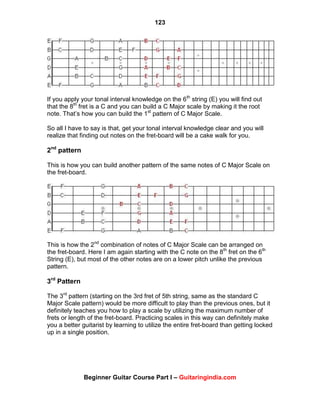
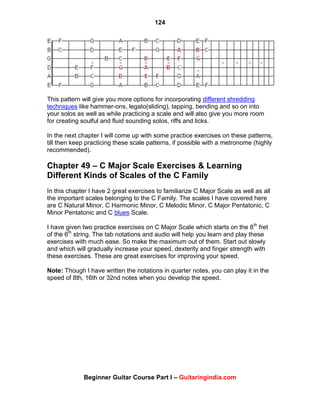
Beginner Guitar Course Part I – Guitaringindia.com
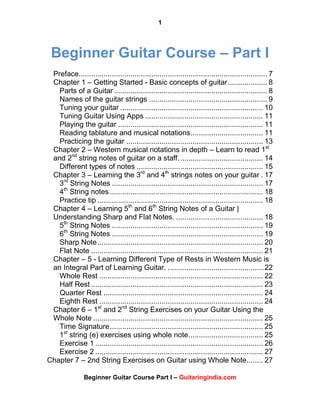
Beginner Guitar Course – Part I
Preface........................................................................................... 7
Chapter 1 – Getting Started - Basic concepts of guitar................... 8
Parts of a Guitar.......................................................................... 8
Names of the guitar strings ......................................................... 9
Tuning your guitar ..................................................................... 10
Tuning Guitar Using Apps ......................................................... 11
Playing the guitar ...................................................................... 11
Reading tablature and musical notations................................... 11
Practicing the guitar .................................................................. 13
Chapter 2 – Western musical notations in depth – Learn to read 1st
and 2nd
string notes of guitar on a staff......................................... 14
Different types of notes ............................................................. 15
Chapter 3 – Learning the 3rd
and 4th
strings notes on your guitar . 17
3rd
String Notes ......................................................................... 17
4th
String notes.......................................................................... 18
Practice tip ................................................................................ 18
Chapter 4 – Learning 5th
and 6th
String Notes of a Guitar |
Understanding Sharp and Flat Notes. .......................................... 18
5th
String Notes ......................................................................... 19
6th
String Notes ......................................................................... 19
Sharp Note................................................................................ 20
Flat Note ................................................................................... 21
Chapter – 5 - Learning Different Type of Rests in Western Music is
an Integral Part of Learning Guitar. .............................................. 22
Whole Rest ............................................................................... 22
Half Rest ................................................................................... 23
Quarter Rest ............................................................................. 24
Eighth Rest ............................................................................... 24
Chapter 6 – 1st
and 2nd
String Exercises on your Guitar Using the
Whole Note .................................................................................. 25
Time Signature.......................................................................... 25
1st
string (e) exercises using whole note.................................... 25
Exercise 1 ................................................................................. 26
Exercise 2 ................................................................................. 27
Chapter 7 – 2nd String Exercises on Guitar using Whole Note........ 27
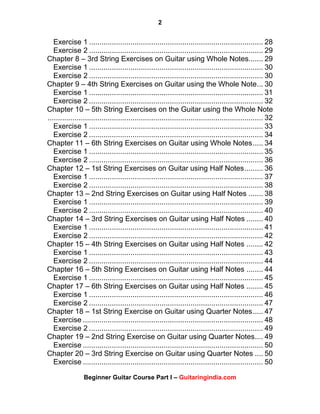
2
Beginner Guitar Course Part I – Guitaringindia.com
Exercise 1 .................................................................................... 28
Exercise 2 .................................................................................... 29
Chapter 8 – 3rd String Exercises on Guitar using Whole Notes....... 29
Exercise 1 .................................................................................... 30
Exercise 2 .................................................................................... 30
Chapter 9 – 4th String Exercises on Guitar using the Whole Note... 30
Exercise 1 .................................................................................... 31
Exercise 2 .................................................................................... 32
Chapter 10 – 5th String Exercises on the Guitar using the Whole Note
........................................................................................................ 32
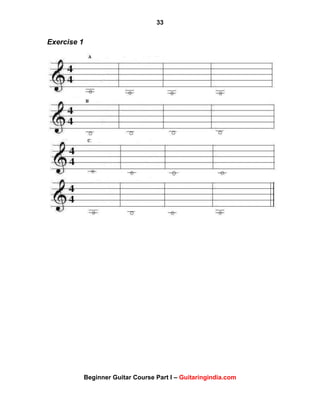
Exercise 1 .................................................................................... 33
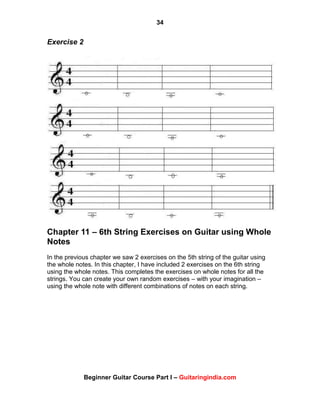
Exercise 2 .................................................................................... 34
Chapter 11 – 6th String Exercises on Guitar using Whole Notes..... 34
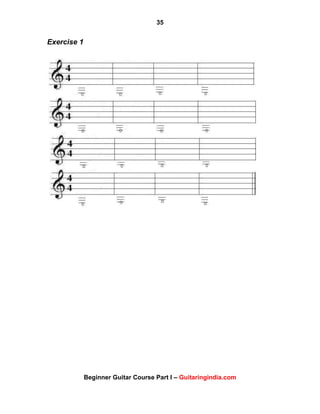
Exercise 1 .................................................................................... 35
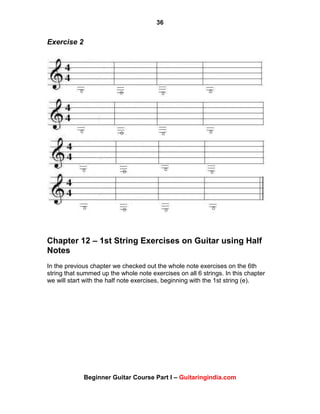
Exercise 2 .................................................................................... 36
Chapter 12 – 1st String Exercises on Guitar using Half Notes......... 36
Exercise 1 .................................................................................... 37
Exercise 2 .................................................................................... 38
Chapter 13 – 2nd String Exercises on Guitar using Half Notes ....... 38
Exercise 1 .................................................................................... 39
Exercise 2 .................................................................................... 40
Chapter 14 – 3rd String Exercises on Guitar using Half Notes ........ 40
Exercise 1 .................................................................................... 41
Exercise 2 .................................................................................... 42
Chapter 15 – 4th String Exercises on Guitar using Half Notes ........ 42
Exercise 1 .................................................................................... 43
Exercise 2 .................................................................................... 44
Chapter 16 – 5th String Exercises on Guitar using Half Notes ........ 44
Exercise 1 .................................................................................... 45
Chapter 17 – 6th String Exercises on Guitar using Half Notes ........ 45
Exercise 1 .................................................................................... 46
Exercise 2 .................................................................................... 47
Chapter 18 – 1st String Exercise on Guitar using Quarter Notes..... 47
Exercise ....................................................................................... 48
Exercise 2 .................................................................................... 49
Chapter 19 – 2nd String Exercise on Guitar using Quarter Notes.... 49
Exercise ....................................................................................... 50
Chapter 20 – 3rd String Exercise on Guitar using Quarter Notes .... 50
Exercise ....................................................................................... 50
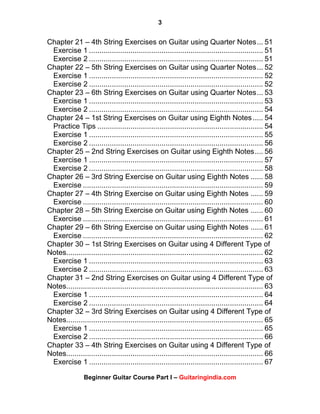
3
Beginner Guitar Course Part I – Guitaringindia.com
Chapter 21 – 4th String Exercises on Guitar using Quarter Notes... 51
Exercise 1 .................................................................................... 51
Exercise 2 .................................................................................... 51
Chapter 22 – 5th String Exercises on Guitar using Quarter Notes... 52
Exercise 1 .................................................................................... 52
Exercise 2 .................................................................................... 52
Chapter 23 – 6th String Exercises on Guitar using Quarter Notes... 53
Exercise 1 .................................................................................... 53
Exercise 2 .................................................................................... 54
Chapter 24 – 1st String Exercises on Guitar using Eighth Notes..... 54
Practice Tips ................................................................................ 54
Exercise 1 .................................................................................... 55
Exercise 2 .................................................................................... 56
Chapter 25 – 2nd String Exercises on Guitar using Eighth Notes.... 56
Exercise 1 .................................................................................... 57
Exercise 2 .................................................................................... 58
Chapter 26 – 3rd String Exercise on Guitar using Eighth Notes ...... 58
Exercise ....................................................................................... 59
Chapter 27 – 4th String Exercise on Guitar using Eighth Notes ...... 59
Exercise ....................................................................................... 60
Chapter 28 – 5th String Exercise on Guitar using Eighth Notes ...... 60
Exercise ....................................................................................... 61
Chapter 29 – 6th String Exercise on Guitar using Eighth Notes ...... 61
Exercise ....................................................................................... 62
Chapter 30 – 1st String Exercises on Guitar using 4 Different Type of
Notes............................................................................................... 62
Exercise 1 .................................................................................... 63
Exercise 2 .................................................................................... 63
Chapter 31 – 2nd String Exercises on Guitar using 4 Different Type of
Notes............................................................................................... 63
Exercise 1 .................................................................................... 64
Exercise 2 .................................................................................... 64
Chapter 32 – 3rd String Exercises on Guitar using 4 Different Type of
Notes............................................................................................... 65
Exercise 1 .................................................................................... 65
Exercise 2 .................................................................................... 66
Chapter 33 – 4th String Exercises on Guitar using 4 Different Type of
Notes............................................................................................... 66
Exercise 1 .................................................................................... 67
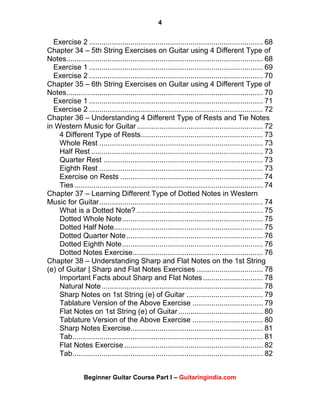
4
Beginner Guitar Course Part I – Guitaringindia.com
Exercise 2 .................................................................................... 68
Chapter 34 – 5th String Exercises on Guitar using 4 Different Type of
Notes............................................................................................... 68
Exercise 1 .................................................................................... 69
Exercise 2 .................................................................................... 70
Chapter 35 – 6th String Exercises on Guitar using 4 Different Type of
Notes............................................................................................... 70
Exercise 1 .................................................................................... 71
Exercise 2 .................................................................................... 72
Chapter 36 – Understanding 4 Different Type of Rests and Tie Notes
in Western Music for Guitar............................................................. 72
4 Different Type of Rests........................................................... 73
Whole Rest ............................................................................... 73
Half Rest ................................................................................... 73
Quarter Rest ............................................................................. 73
Eighth Rest ............................................................................... 73
Exercise on Rests ..................................................................... 74
Ties........................................................................................... 74
Chapter 37 – Learning Different Type of Dotted Notes in Western
Music for Guitar............................................................................... 74
What is a Dotted Note? ............................................................. 75
Dotted Whole Note.................................................................... 75
Dotted Half Note........................................................................ 75
Dotted Quarter Note.................................................................. 76
Dotted Eighth Note.................................................................... 76
Dotted Notes Exercise............................................................... 76
Chapter 38 – Understanding Sharp and Flat Notes on the 1st String
(e) of Guitar | Sharp and Flat Notes Exercises ................................ 78
Important Facts about Sharp and Flat Notes............................. 78
Natural Note.............................................................................. 78
Sharp Notes on 1st String (e) of Guitar ..................................... 79
Tablature Version of the Above Exercise .................................. 79
Flat Notes on 1st String (e) of Guitar......................................... 80
Tablature Version of the Above Exercise .................................. 80
Sharp Notes Exercise................................................................ 81
Tab............................................................................................ 81
Flat Notes Exercise ................................................................... 82
Tab............................................................................................ 82
5
Beginner Guitar Course Part I – Guitaringindia.com
Chapter 39 – Introduction to Guitar Scales | Building Major Scales |
Learning C Major Scale................................................................... 82
What is a scale in Western Music?............................................ 83
Understanding 2 Kinds of Scales .............................................. 83
Learning C Major Scale on Guitar ............................................. 83
C Major Scale Notated on the Staff ........................................... 84
Names of Scale Degrees .......................................................... 84
C Major Scale on Tab................................................................ 85
Chromatic Scales – Building a Chromatic Scale from C Major
Scale......................................................................................... 85
Chromatic Scale Notation on the Key of C ................................ 85
Tab for Chromatic Scale on C Major ......................................... 86
Chapter 40 – Building the 3 Principal Chords from the Key of C Major
Diatonic Scale on Guitar.................................................................. 87
Tonic Chord – C Major .............................................................. 87
Tab Notation of C Major Chord.................................................. 88
Sub-Dominant Chord – F Major................................................. 88
Tab Notation of F Major Chord.................................................. 89
Dominant Chord – G7 ............................................................... 89
Tab Notation for G7 Chord ........................................................ 91
Formula for Building a Major Chord........................................... 91
Chapter 41 – Practicing the Principal Chords and Scale in the Key of
C on Guitar...................................................................................... 92
Practice Tips ............................................................................. 92
Exercise 1 – Practicing the 3 Principal Chords.......................... 93
Slash Notation of Chords .......................................................... 93
Exercise 2 – Practicing Arpeggios of the 3 Principal Chords ..... 94
Exercise 3 – Practicing the Scale.............................................. 96
Chapter 42 – Learning A Natural Minor Scale and it‟s 3 Principal
Chords on Guitar............................................................................. 97
Relative Minor Scale ................................................................. 97
A Natural Minor Scale (as per the above formula)..................... 98
Tab for A Natural Minor Scale ................................................... 99
The 3 Principal Chords in “A” Natural Minor Scale .................... 99
Am Chord.................................................................................. 99
Tab for Am Chord.................................................................... 100
Dm Chord................................................................................ 100
Tab for Dm Chord ................................................................... 101
E7 Chord................................................................................. 101
6
Beginner Guitar Course Part I – Guitaringindia.com
Tab for E7 Chord..................................................................... 102
Chapter 43 – Practicing the 3 Principal Chords and A Natural Minor
Scale on Guitar ............................................................................. 102
Practice Tip............................................................................. 102
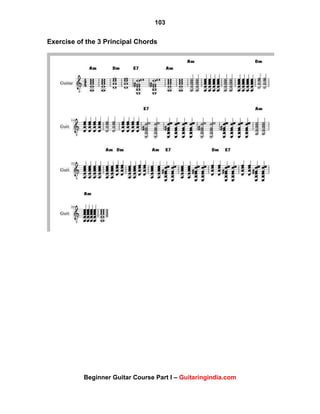
Exercise of the 3 Principal Chords .......................................... 103
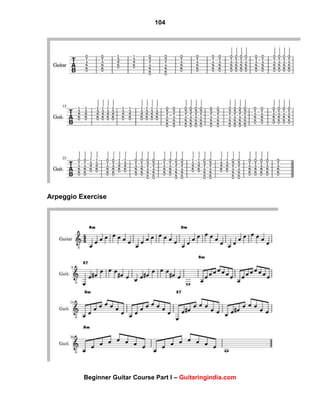
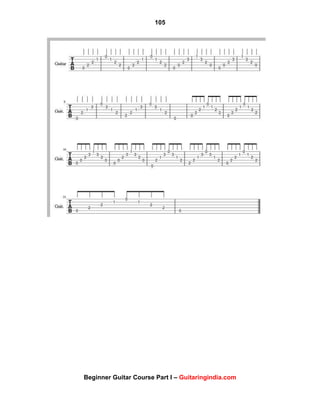
Arpeggio Exercise................................................................... 104
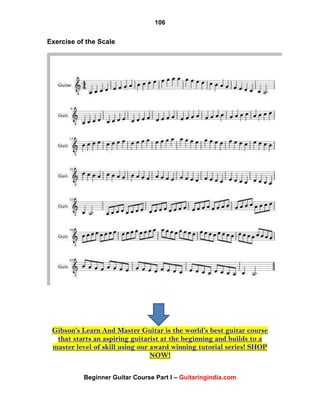
Exercise of the Scale............................................................... 106
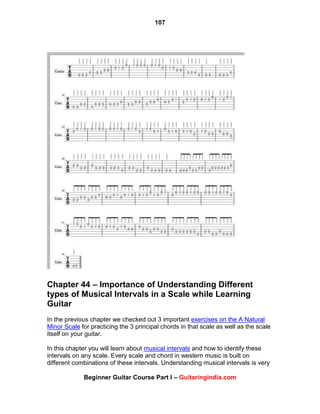
Chapter 44 – Importance of Understanding Different types of Musical
Intervals in a Scale while Learning Guitar...................................... 107
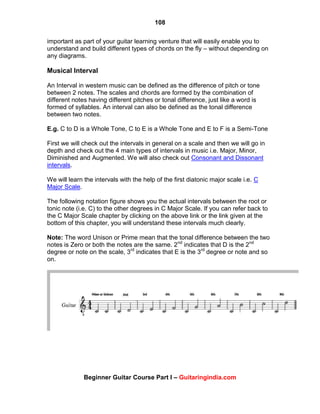
Musical Interval ....................................................................... 108
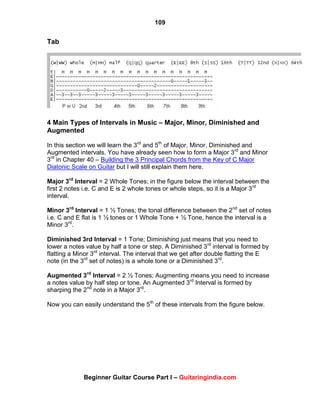
Tab.......................................................................................... 109
4 Main Types of Intervals in Music – Major, Minor, Diminished
and Augmented....................................................................... 109
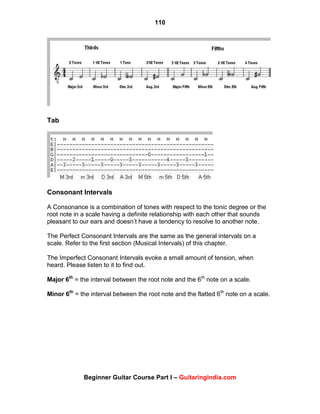
Tab.......................................................................................... 110
Consonant Intervals ................................................................ 110
Tab.......................................................................................... 111
Dissonant Intervals.................................................................. 111
Tab.......................................................................................... 112
Chapter 45 – Understanding Different Types of Minor Scales in
Western Music while Learning Guitar............................................ 112
Harmonic Minor Scale............................................................. 112
Tab.......................................................................................... 113
Melodic Minor Scale................................................................ 113
Tab.......................................................................................... 114
Mixed or Combined Minor Scale ............................................. 114
Tab.......................................................................................... 114
Hungarian or Gypsy Minor Scale............................................. 114
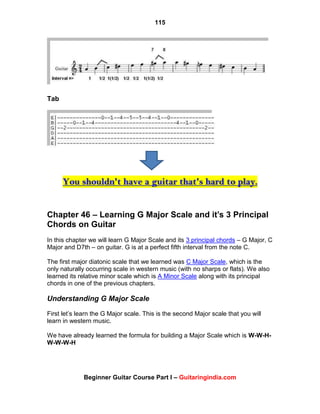
Tab.......................................................................................... 115
Chapter 46 – Learning G Major Scale and it‟s 3 Principal Chords on
Guitar ............................................................................................ 115
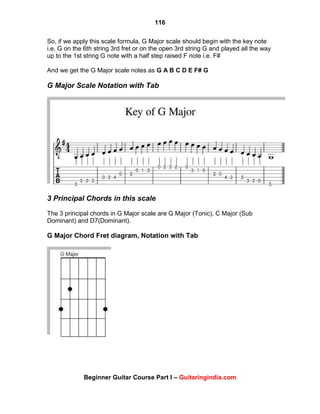
Understanding G Major Scale .................................................... 115
G Major Scale Notation with Tab................................................ 116
3 Principal Chords in this scale .................................................. 116
G Major Chord Fret diagram, Notation with Tab ...................... 116
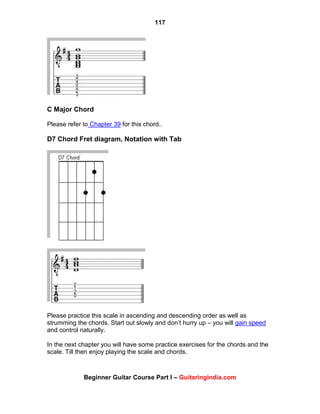
C Major Chord......................................................................... 117
D7 Chord Fret diagram, Notation with Tab .............................. 117
Chapter 47 – Exercises of Principal Chords and Scale on the Key of
G Major on Guitar.......................................................................... 118
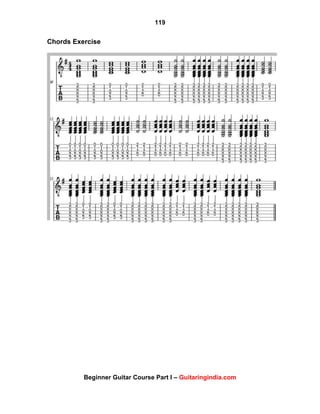
Chords Exercise...................................................................... 119
7
Beginner Guitar Course Part I – Guitaringindia.com
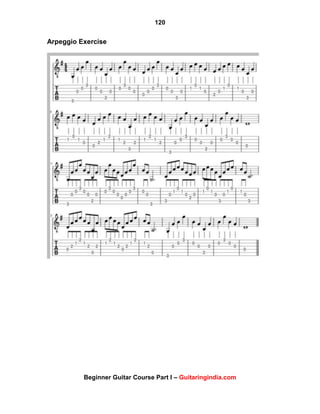
Arpeggio Exercise................................................................... 120
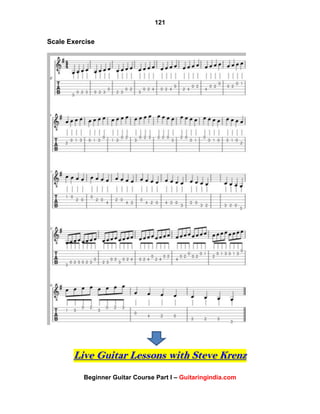
Scale Exercise ........................................................................ 121
Chapter 48 – Understanding the 3 Different Patterns of C Major Scale
on the Guitar Fret-Board ............................................................... 122
1st
Pattern................................................................................ 122
2nd
pattern ............................................................................... 123
3rd
Pattern ............................................................................... 123
Chapter 49 – C Major Scale Exercises & Learning Different Kinds of
Scales of the C Family .................................................................. 124
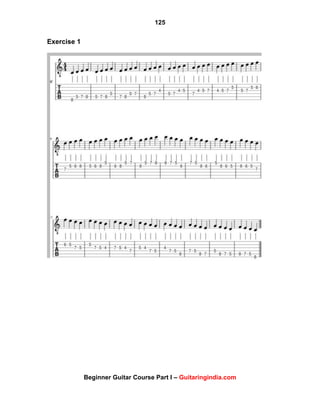
Exercise 1 ............................................................................... 125
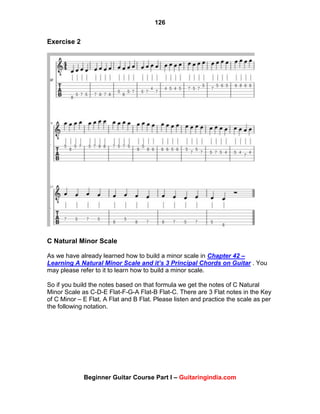
Exercise 2 ............................................................................... 126
C Natural Minor Scale ............................................................. 126
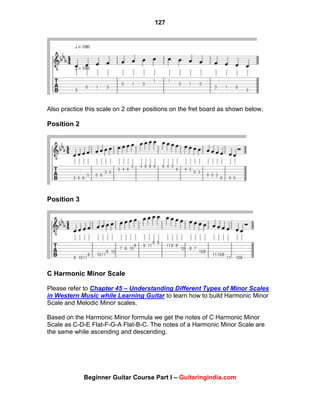
Position 2 ................................................................................ 127
Position 3 ................................................................................ 127
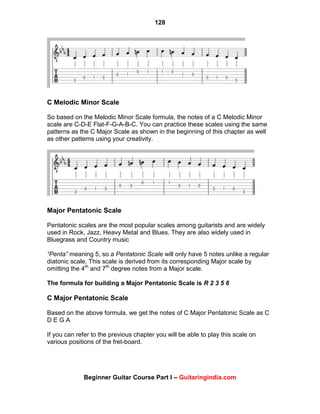
C Harmonic Minor Scale ......................................................... 127
C Melodic Minor Scale ............................................................ 128
Major Pentatonic Scale ........................................................... 128
C Major Pentatonic Scale........................................................ 128
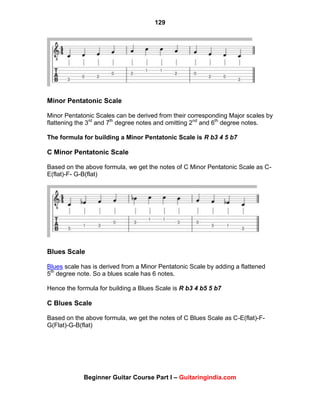
Minor Pentatonic Scale ........................................................... 129
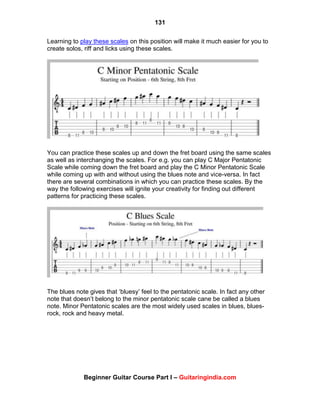
C Minor Pentatonic Scale........................................................ 129
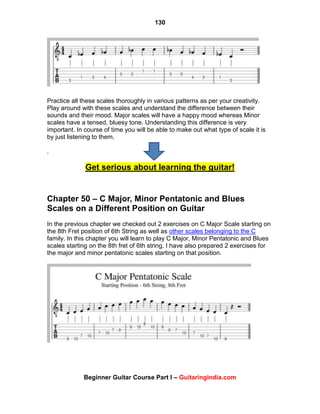
Blues Scale............................................................................. 129
C Blues Scale.......................................................................... 129
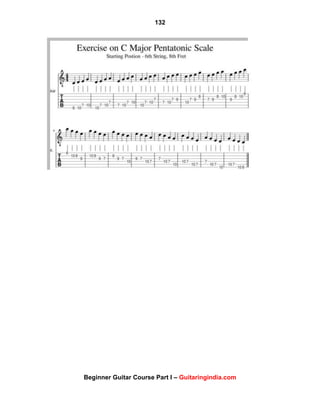
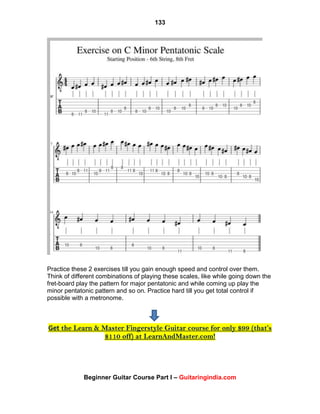
Chapter 50 – C Major, Minor Pentatonic and Blues Scales on a
Different Position on Guitar ........................................................... 130
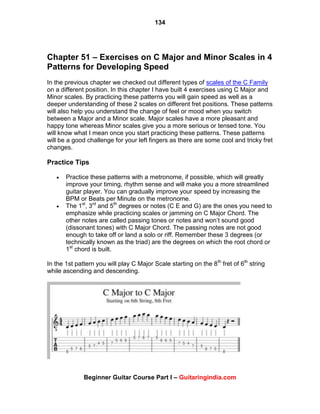
Chapter 51 – Exercises on C Major and Minor Scales in 4 Patterns
for Developing Speed.................................................................... 134
Practice Tips ........................................................................... 134
Chapter 52 – Learning to play the A Natural Minor Scale in Different
Patterns on Guitar ......................................................................... 136
Chapter 53 – Learning to Play Different Type of Scales of the A
Family on Guitar............................................................................ 138
Feedback and Comments ....................................................... 142
Preface
Though many people dream of becoming an expert guitar player, most of them
fail to accomplish it and sadly their dreams remain just a dream for ever. The
8
Beginner Guitar Course Part I – Guitaringindia.com
reasons are many – it may be due to lack of sustained interest, hard work,
consistency or due to unavailability of an affordable and systematic course.
The internet has a lot of information on learning guitar, but they are all scattered
all over and not systematically arranged which is absolutely useless for
beginners.
Learning guitar should be a continuous and systematic process especially in the
beginning stages otherwise it is hard to sustain the interest and build a solid
foundation. I do agree that there are sites that have arranged their lessons in a
systematic format - for beginners, but, they are either incomplete or not that easy
to follow.
This guitar course has some useful guitar lessons capable of lifting you up from
an absolute beginner to a much confident guitar player with a good foundation
capable of playing chords, scales and songs.
Since this is a one man effort you might not find my course to be of immaculate
quality as a paid guitar course online. But I will always strive to make this as
perfect and easy to follow as possible for you. I am sure you will find this course
helpful to get started with your dream of becoming a killer guitar player.
Chapter 1 – Getting Started - Basic concepts of guitar
Parts of a Guitar
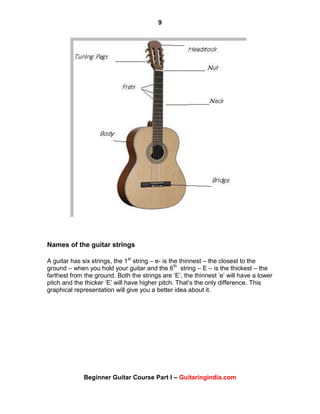
Before you begin to learn guitar you must know your guitar. Here I have shown
an acoustic guitar. An electric guitar will have additional parts than this like pick-
ups, tremolo arm (whammy bar), and volume, pick up and tone controls. But to
start with you just need to know the parts of an acoustic guitar. This picture will
give you a good idea about the different parts of the guitar. I need not explain
much here as it is self-explanatory.
9
Beginner Guitar Course Part I – Guitaringindia.com
Names of the guitar strings
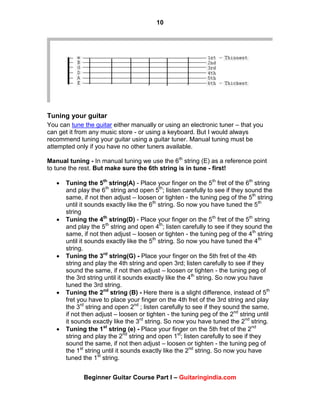
A guitar has six strings, the 1st
string – e- is the thinnest – the closest to the
ground – when you hold your guitar and the 6th
string – E – is the thickest – the
farthest from the ground. Both the strings are „E‟, the thinnest „e‟ will have a lower
pitch and the thicker „E‟ will have higher pitch. That‟s the only difference. This
graphical representation will give you a better idea about it.
10
Beginner Guitar Course Part I – Guitaringindia.com
Tuning your guitar
You can tune the guitar either manually or using an electronic tuner – that you
can get it from any music store - or using a keyboard. But I would always
recommend tuning your guitar using a guitar tuner. Manual tuning must be
attempted only if you have no other tuners available.
Manual tuning - In manual tuning we use the 6th
string (E) as a reference point
to tune the rest. But make sure the 6th string is in tune - first!
 Tuning the 5th
string(A) - Place your finger on the 5th
fret of the 6th
string
and play the 6th
string and open 5th
; listen carefully to see if they sound the
same, if not then adjust – loosen or tighten - the tuning peg of the 5th
string
until it sounds exactly like the 6th
string. So now you have tuned the 5th
string
 Tuning the 4th
string(D) - Place your finger on the 5th
fret of the 5th
string
and play the 5th
string and open 4th
; listen carefully to see if they sound the
same, if not then adjust – loosen or tighten - the tuning peg of the 4th
string
until it sounds exactly like the 5th
string. So now you have tuned the 4th
string.
 Tuning the 3rd
string(G) - Place your finger on the 5th fret of the 4th
string and play the 4th string and open 3rd; listen carefully to see if they
sound the same, if not then adjust – loosen or tighten - the tuning peg of
the 3rd string until it sounds exactly like the 4th
string. So now you have
tuned the 3rd string.
 Tuning the 2nd
string (B) - Here there is a slight difference, instead of 5th
fret you have to place your finger on the 4th fret of the 3rd string and play
the 3rd
string and open 2nd
; listen carefully to see if they sound the same,
if not then adjust – loosen or tighten - the tuning peg of the 2nd
string until
it sounds exactly like the 3rd
string. So now you have tuned the 2nd
string.
 Tuning the 1st
string (e) - Place your finger on the 5th fret of the 2nd
string and play the 2nd
string and open 1st
; listen carefully to see if they
sound the same, if not then adjust – loosen or tighten - the tuning peg of
the 1st
string until it sounds exactly like the 2nd
string. So now you have
tuned the 1st
string.
11
Beginner Guitar Course Part I – Guitaringindia.com
Tuning Guitar Using Apps
These days you can easily tune your guitar using smart phone apps. The one
that I use is named Chromatic Guitar Tuner which can be downloaded from Play
Store or App Store.
Playing the guitar
Guitar can be played using a plectrum or pick – a small triangular plastic piece –
or using your fingertips.
Reading tablature and musical notations
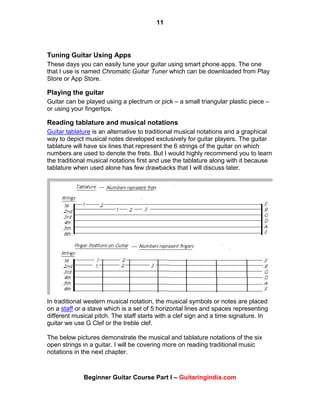
Guitar tablature is an alternative to traditional musical notations and a graphical
way to depict musical notes developed exclusively for guitar players. The guitar
tablature will have six lines that represent the 6 strings of the guitar on which
numbers are used to denote the frets. But I would highly recommend you to learn
the traditional musical notations first and use the tablature along with it because
tablature when used alone has few drawbacks that I will discuss later.
In traditional western musical notation, the musical symbols or notes are placed
on a staff or a stave which is a set of 5 horizontal lines and spaces representing
different musical pitch. The staff starts with a clef sign and a time signature. In
guitar we use G Clef or the treble clef.
The below pictures demonstrate the musical and tablature notations of the six
open strings in a guitar. I will be covering more on reading traditional music
notations in the next chapter.
12
Beginner Guitar Course Part I – Guitaringindia.com
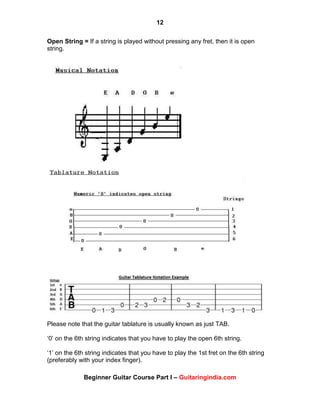
Open String = If a string is played without pressing any fret, then it is open
string.
Please note that the guitar tablature is usually known as just TAB.
„0‟ on the 6th string indicates that you have to play the open 6th string.
„1‟ on the 6th string indicates that you have to play the 1st fret on the 6th string
(preferably with your index finger).
13
Beginner Guitar Course Part I – Guitaringindia.com
„2‟ on the 5th string indicates that you have to play the 2nd fret on the 5th string
(preferably with your middle finger).
„3‟ on the 6th string indicates that you have to play the 3rd fret on the 6th string
(preferably with your ring finger).
If you encounter „4‟ on any string on a TAB, then 4th fret of that string must be
played (pinky finger is recommended if the previous note was on the 1st or 2nd
or 3rd fret of the same string or any of the adjacent strings).
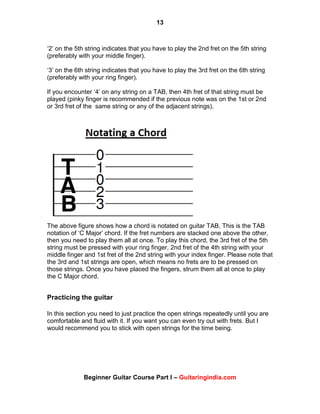
The above figure shows how a chord is notated on guitar TAB. This is the TAB
notation of „C Major‟ chord. If the fret numbers are stacked one above the other,
then you need to play them all at once. To play this chord, the 3rd fret of the 5th
string must be pressed with your ring finger, 2nd fret of the 4th string with your
middle finger and 1st fret of the 2nd string with your index finger. Please note that
the 3rd and 1st strings are open, which means no frets are to be pressed on
those strings. Once you have placed the fingers, strum them all at once to play
the C Major chord.
Practicing the guitar
In this section you need to just practice the open strings repeatedly until you are
comfortable and fluid with it. If you want you can even try out with frets. But I
would recommend you to stick with open strings for the time being.
14
Beginner Guitar Course Part I – Guitaringindia.com
Chapter 2 – Western musical notations in depth – Learn to read
1st
and 2nd
string notes of guitar on a staff.
In the 1st chapter we saw a brief introduction to musical notations and also
denoting the open string notes - of a guitar - on a staff. In this chapter we will
learn western musical notations in detail.
As we have discussed in the earlier chapter, in traditional music notation the
notes are placed on a staff. The lower pitched notes will appear on the lower
lines or spaces of the staff and high pitched ones on the higher lines and spaces.
That‟s all you need to know now.
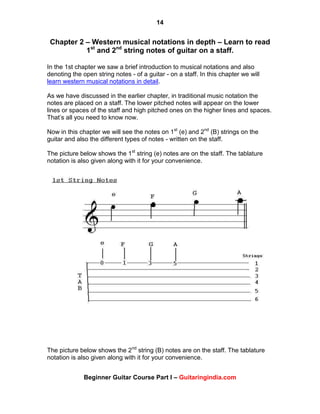
Now in this chapter we will see the notes on 1st
(e) and 2nd
(B) strings on the
guitar and also the different types of notes - written on the staff.
The picture below shows the 1st
string (e) notes are on the staff. The tablature
notation is also given along with it for your convenience.
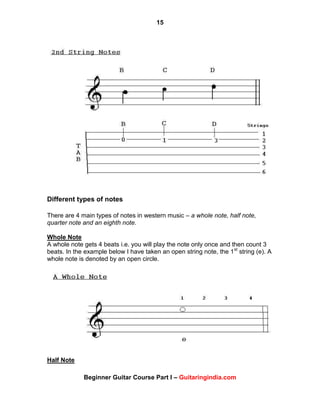
The picture below shows the 2nd
string (B) notes are on the staff. The tablature
notation is also given along with it for your convenience.
15
Beginner Guitar Course Part I – Guitaringindia.com
Different types of notes
There are 4 main types of notes in western music – a whole note, half note,
quarter note and an eighth note.
Whole Note
A whole note gets 4 beats i.e. you will play the note only once and then count 3
beats. In the example below I have taken an open string note, the 1st
string (e). A
whole note is denoted by an open circle.
Half Note
16
Beginner Guitar Course Part I – Guitaringindia.com
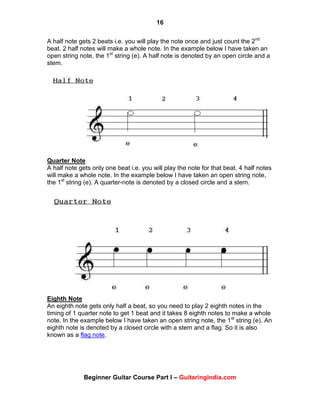
A half note gets 2 beats i.e. you will play the note once and just count the 2nd
beat. 2 half notes will make a whole note. In the example below I have taken an
open string note, the 1st
string (e). A half note is denoted by an open circle and a
stem.
Quarter Note
A half note gets only one beat i.e. you will play the note for that beat. 4 half notes
will make a whole note. In the example below I have taken an open string note,
the 1st
string (e). A quarter-note is denoted by a closed circle and a stem.
Eighth Note
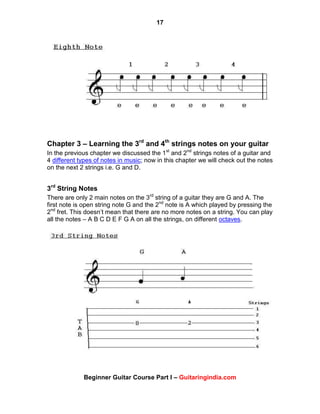
An eighth note gets only half a beat, so you need to play 2 eighth notes in the
timing of 1 quarter note to get 1 beat and it takes 8 eighth notes to make a whole
note. In the example below I have taken an open string note, the 1st
string (e). An
eighth note is denoted by a closed circle with a stem and a flag. So it is also
known as a flag note.
17
Beginner Guitar Course Part I – Guitaringindia.com
Chapter 3 – Learning the 3rd
and 4th
strings notes on your guitar
In the previous chapter we discussed the 1st
and 2nd
strings notes of a guitar and
4 different types of notes in music; now in this chapter we will check out the notes
on the next 2 strings i.e. G and D.
3rd
String Notes
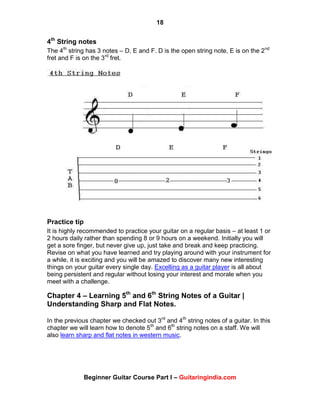
There are only 2 main notes on the 3rd
string of a guitar they are G and A. The
first note is open string note G and the 2nd
note is A which played by pressing the
2nd
fret. This doesn‟t mean that there are no more notes on a string. You can play
all the notes – A B C D E F G A on all the strings, on different octaves.
18
Beginner Guitar Course Part I – Guitaringindia.com
4th
String notes
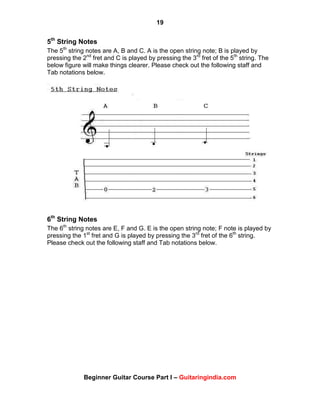
The 4th
string has 3 notes – D, E and F. D is the open string note, E is on the 2nd
fret and F is on the 3rd
fret.
Practice tip
It is highly recommended to practice your guitar on a regular basis – at least 1 or
2 hours daily rather than spending 8 or 9 hours on a weekend. Initially you will
get a sore finger, but never give up, just take and break and keep practicing.
Revise on what you have learned and try playing around with your instrument for
a while, it is exciting and you will be amazed to discover many new interesting
things on your guitar every single day. Excelling as a guitar player is all about
being persistent and regular without losing your interest and morale when you
meet with a challenge.
Chapter 4 – Learning 5th
and 6th
String Notes of a Guitar |
Understanding Sharp and Flat Notes.
In the previous chapter we checked out 3rd
and 4th
string notes of a guitar. In this
chapter we will learn how to denote 5th
and 6th
string notes on a staff. We will
also learn sharp and flat notes in western music.
19
Beginner Guitar Course Part I – Guitaringindia.com
5th
String Notes
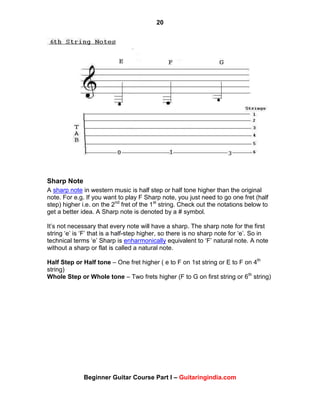
The 5th
string notes are A, B and C. A is the open string note; B is played by
pressing the 2nd
fret and C is played by pressing the 3rd
fret of the 5th
string. The
below figure will make things clearer. Please check out the following staff and
Tab notations below.
6th
String Notes
The 6th
string notes are E, F and G. E is the open string note; F note is played by
pressing the 1st
fret and G is played by pressing the 3rd
fret of the 6th
string.
Please check out the following staff and Tab notations below.
20
Beginner Guitar Course Part I – Guitaringindia.com
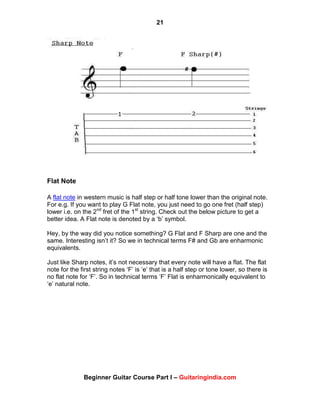
Sharp Note
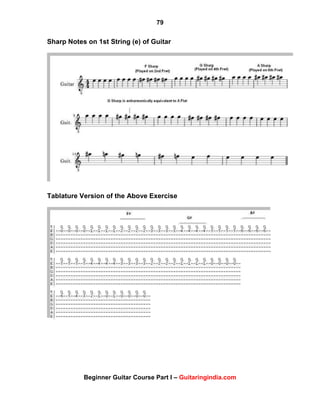
A sharp note in western music is half step or half tone higher than the original
note. For e.g. If you want to play F Sharp note, you just need to go one fret (half
step) higher i.e. on the 2nd
fret of the 1st
string. Check out the notations below to
get a better idea. A Sharp note is denoted by a # symbol.
It‟s not necessary that every note will have a sharp. The sharp note for the first
string „e‟ is „F‟ that is a half-step higher, so there is no sharp note for „e‟. So in
technical terms „e‟ Sharp is enharmonically equivalent to „F‟ natural note. A note
without a sharp or flat is called a natural note.
Half Step or Half tone – One fret higher ( e to F on 1st string or E to F on 4th
string)
Whole Step or Whole tone – Two frets higher (F to G on first string or 6th
string)
21
Beginner Guitar Course Part I – Guitaringindia.com
Flat Note
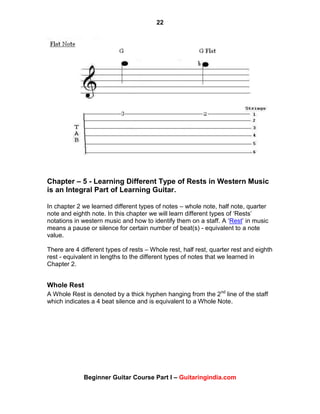
A flat note in western music is half step or half tone lower than the original note.
For e.g. If you want to play G Flat note, you just need to go one fret (half step)
lower i.e. on the 2nd
fret of the 1st
string. Check out the below picture to get a
better idea. A Flat note is denoted by a „b‟ symbol.
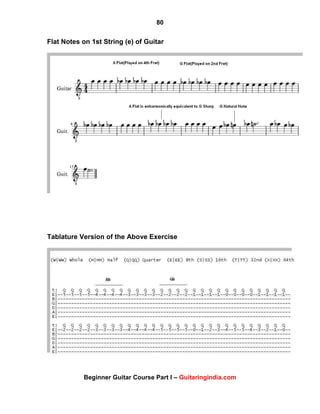
Hey, by the way did you notice something? G Flat and F Sharp are one and the
same. Interesting isn‟t it? So we in technical terms F# and Gb are enharmonic
equivalents.
Just like Sharp notes, it‟s not necessary that every note will have a flat. The flat
note for the first string notes „F‟ is „e‟ that is a half step or tone lower, so there is
no flat note for „F‟. So in technical terms „F‟ Flat is enharmonically equivalent to
„e‟ natural note.
22
Beginner Guitar Course Part I – Guitaringindia.com
Chapter – 5 - Learning Different Type of Rests in Western Music
is an Integral Part of Learning Guitar.
In chapter 2 we learned different types of notes – whole note, half note, quarter
note and eighth note. In this chapter we will learn different types of „Rests‟
notations in western music and how to identify them on a staff. A „Rest‟ in music
means a pause or silence for certain number of beat(s) - equivalent to a note
value.
There are 4 different types of rests – Whole rest, half rest, quarter rest and eighth
rest - equivalent in lengths to the different types of notes that we learned in
Chapter 2.
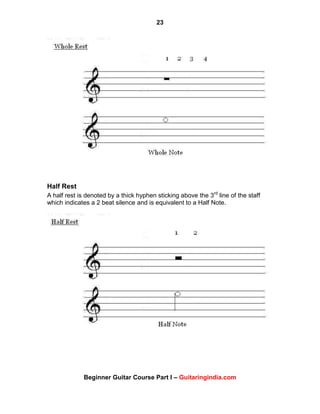
Whole Rest
A Whole Rest is denoted by a thick hyphen hanging from the 2nd
line of the staff
which indicates a 4 beat silence and is equivalent to a Whole Note.
23
Beginner Guitar Course Part I – Guitaringindia.com
Half Rest
A half rest is denoted by a thick hyphen sticking above the 3rd
line of the staff
which indicates a 2 beat silence and is equivalent to a Half Note.
24
Beginner Guitar Course Part I – Guitaringindia.com
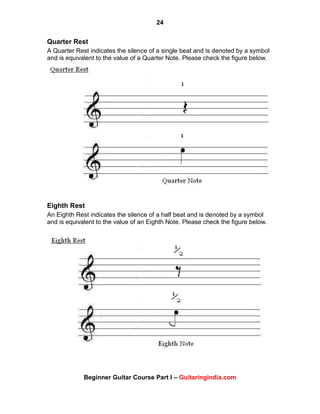
Quarter Rest
A Quarter Rest indicates the silence of a single beat and is denoted by a symbol
and is equivalent to the value of a Quarter Note. Please check the figure below.
Eighth Rest
An Eighth Rest indicates the silence of a half beat and is denoted by a symbol
and is equivalent to the value of an Eighth Note. Please check the figure below.
25
Beginner Guitar Course Part I – Guitaringindia.com
Chapter 6 – 1st
and 2nd
String Exercises on your Guitar Using the
Whole Note
In this chapter you will learn the 4/4 time signature. I have also given 2 exercises
to practice on the first string using the whole note.
Time Signature
Time signature is denoted next to the treble clef sign (which indicates that the
notes are of higher pitch). The 4/4 time signature is the most widely used time
signature in western music. There are many other forms of time signatures – 3/4,
2/4, 6/8 and so on, but I will just discuss 4/4 here. I will be discussing other
commonly used time signatures in the future chapters.
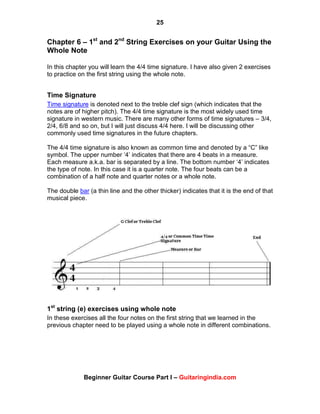
The 4/4 time signature is also known as common time and denoted by a “C” like
symbol. The upper number „4‟ indicates that there are 4 beats in a measure.
Each measure a.k.a. bar is separated by a line. The bottom number „4‟ indicates
the type of note. In this case it is a quarter note. The four beats can be a
combination of a half note and quarter notes or a whole note.
The double bar (a thin line and the other thicker) indicates that it is the end of that
musical piece.
1st
string (e) exercises using whole note
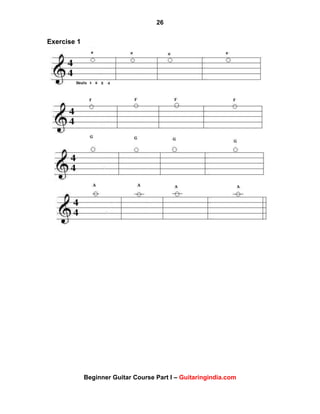
In these exercises all the four notes on the first string that we learned in the
previous chapter need to be played using a whole note in different combinations.
26
Beginner Guitar Course Part I – Guitaringindia.com
Exercise 1
27
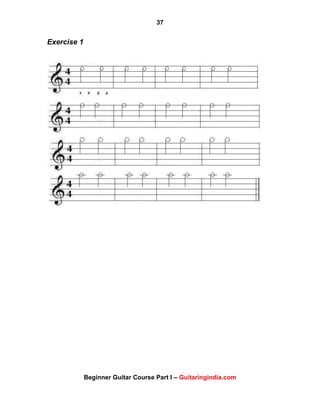
Beginner Guitar Course Part I – Guitaringindia.com
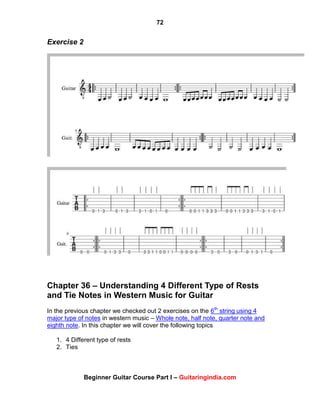
Exercise 2
Practice tip: Always start off playing any exercise on your guitar in a slow and
steady manner, and never hurry up for gaining speed. It will make your playing
imperfect and sloppy. Your focus should always be on getting full control, speed
will follow automatically.
Chapter 7 – 2nd String Exercises on Guitar using Whole
Note
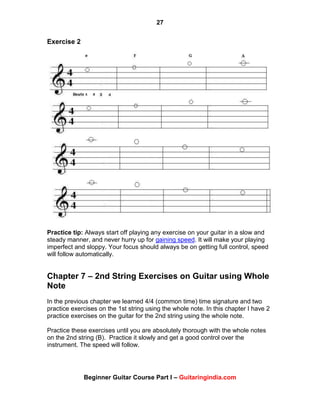
In the previous chapter we learned 4/4 (common time) time signature and two
practice exercises on the 1st string using the whole note. In this chapter I have 2
practice exercises on the guitar for the 2nd string using the whole note.
Practice these exercises until you are absolutely thorough with the whole notes
on the 2nd string (B). Practice it slowly and get a good control over the
instrument. The speed will follow.
28
Beginner Guitar Course Part I – Guitaringindia.com
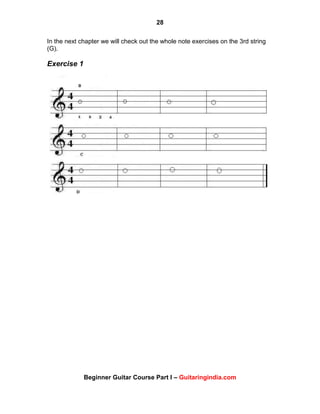
In the next chapter we will check out the whole note exercises on the 3rd string
(G).
Exercise 1
29
Beginner Guitar Course Part I – Guitaringindia.com
Exercise 2
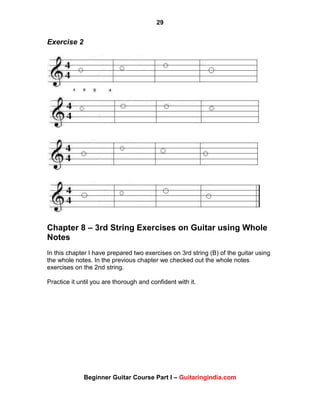
Chapter 8 – 3rd String Exercises on Guitar using Whole
Notes
In this chapter I have prepared two exercises on 3rd string (B) of the guitar using
the whole notes. In the previous chapter we checked out the whole notes
exercises on the 2nd string.
Practice it until you are thorough and confident with it.
30
Beginner Guitar Course Part I – Guitaringindia.com
Exercise 1
Exercise 2
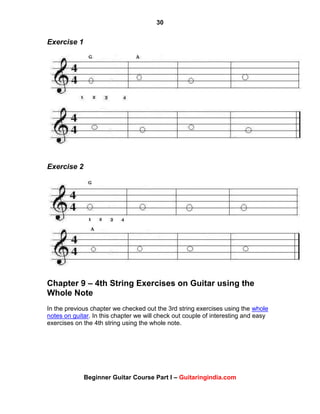
Chapter 9 – 4th String Exercises on Guitar using the
Whole Note
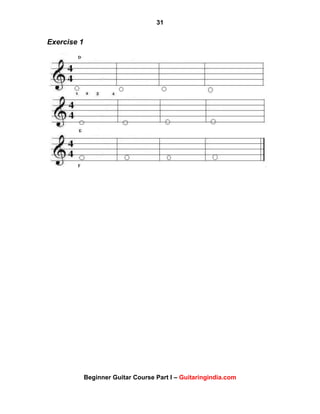
In the previous chapter we checked out the 3rd string exercises using the whole
notes on guitar. In this chapter we will check out couple of interesting and easy
exercises on the 4th string using the whole note.
31
Beginner Guitar Course Part I – Guitaringindia.com
Exercise 1
32
Beginner Guitar Course Part I – Guitaringindia.com
Exercise 2
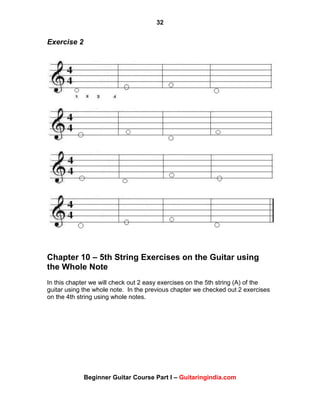
Chapter 10 – 5th String Exercises on the Guitar using
the Whole Note
In this chapter we will check out 2 easy exercises on the 5th string (A) of the
guitar using the whole note. In the previous chapter we checked out 2 exercises
on the 4th string using whole notes.
33
Beginner Guitar Course Part I – Guitaringindia.com
Exercise 1
34
Beginner Guitar Course Part I – Guitaringindia.com
Exercise 2
Chapter 11 – 6th String Exercises on Guitar using Whole
Notes
In the previous chapter we saw 2 exercises on the 5th string of the guitar using
the whole notes. In this chapter, I have included 2 exercises on the 6th string
using the whole notes. This completes the exercises on whole notes for all the
strings. You can create your own random exercises – with your imagination –
using the whole note with different combinations of notes on each string.
35
Beginner Guitar Course Part I – Guitaringindia.com
Exercise 1
36
Beginner Guitar Course Part I – Guitaringindia.com
Exercise 2
Chapter 12 – 1st String Exercises on Guitar using Half
Notes
In the previous chapter we checked out the whole note exercises on the 6th
string that summed up the whole note exercises on all 6 strings. In this chapter
we will start with the half note exercises, beginning with the 1st string (e).
37
Beginner Guitar Course Part I – Guitaringindia.com
Exercise 1
38
Beginner Guitar Course Part I – Guitaringindia.com
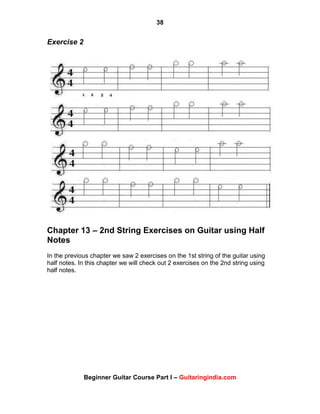
Exercise 2
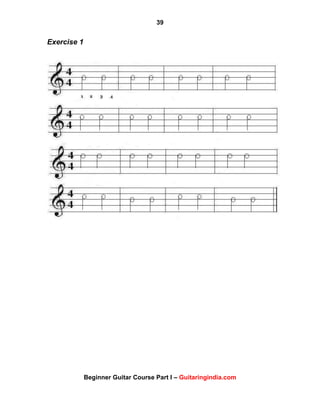
Chapter 13 – 2nd String Exercises on Guitar using Half
Notes
In the previous chapter we saw 2 exercises on the 1st string of the guitar using
half notes. In this chapter we will check out 2 exercises on the 2nd string using
half notes.
39
Beginner Guitar Course Part I – Guitaringindia.com
Exercise 1
40
Beginner Guitar Course Part I – Guitaringindia.com
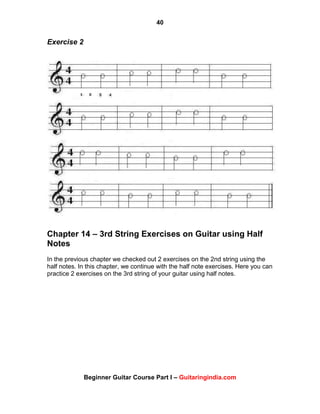
Exercise 2
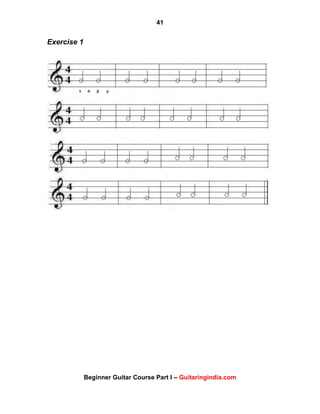
Chapter 14 – 3rd String Exercises on Guitar using Half
Notes
In the previous chapter we checked out 2 exercises on the 2nd string using the
half notes. In this chapter, we continue with the half note exercises. Here you can
practice 2 exercises on the 3rd string of your guitar using half notes.
41
Beginner Guitar Course Part I – Guitaringindia.com
Exercise 1
42
Beginner Guitar Course Part I – Guitaringindia.com
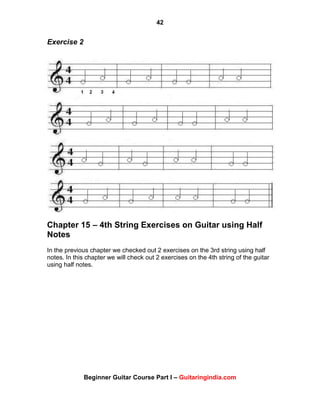
Exercise 2
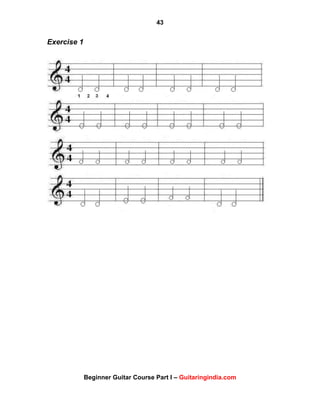
Chapter 15 – 4th String Exercises on Guitar using Half
Notes
In the previous chapter we checked out 2 exercises on the 3rd string using half
notes. In this chapter we will check out 2 exercises on the 4th string of the guitar
using half notes.
43
Beginner Guitar Course Part I – Guitaringindia.com
Exercise 1
44
Beginner Guitar Course Part I – Guitaringindia.com
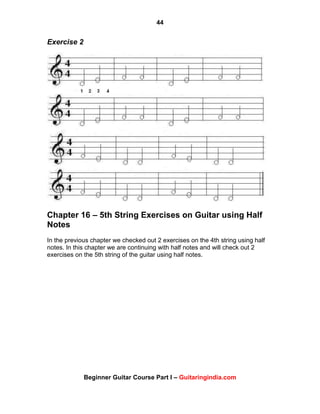
Exercise 2
Chapter 16 – 5th String Exercises on Guitar using Half
Notes
In the previous chapter we checked out 2 exercises on the 4th string using half
notes. In this chapter we are continuing with half notes and will check out 2
exercises on the 5th string of the guitar using half notes.
45
Beginner Guitar Course Part I – Guitaringindia.com
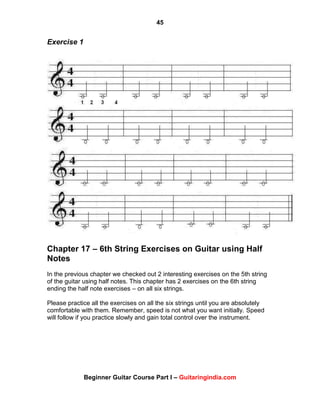
Exercise 1
Chapter 17 – 6th String Exercises on Guitar using Half
Notes
In the previous chapter we checked out 2 interesting exercises on the 5th string
of the guitar using half notes. This chapter has 2 exercises on the 6th string
ending the half note exercises – on all six strings.
Please practice all the exercises on all the six strings until you are absolutely
comfortable with them. Remember, speed is not what you want initially. Speed
will follow if you practice slowly and gain total control over the instrument.
46
Beginner Guitar Course Part I – Guitaringindia.com
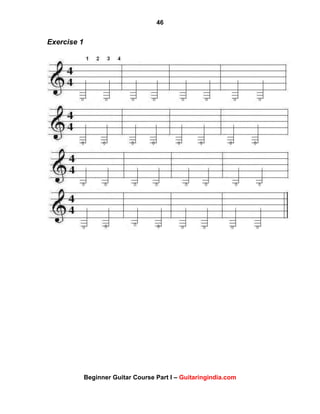
Exercise 1
47
Beginner Guitar Course Part I – Guitaringindia.com
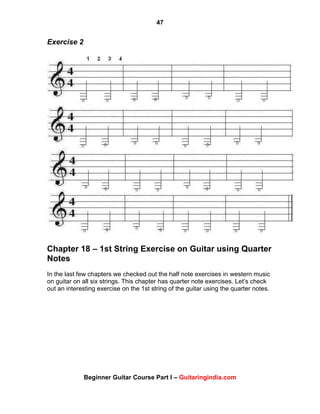
Exercise 2
Chapter 18 – 1st String Exercise on Guitar using Quarter
Notes
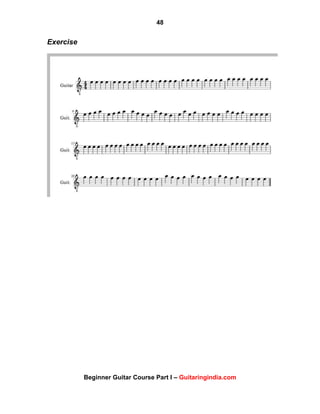
In the last few chapters we checked out the half note exercises in western music
on guitar on all six strings. This chapter has quarter note exercises. Let‟s check
out an interesting exercise on the 1st string of the guitar using the quarter notes.
48
Beginner Guitar Course Part I – Guitaringindia.com
Exercise
49
Beginner Guitar Course Part I – Guitaringindia.com
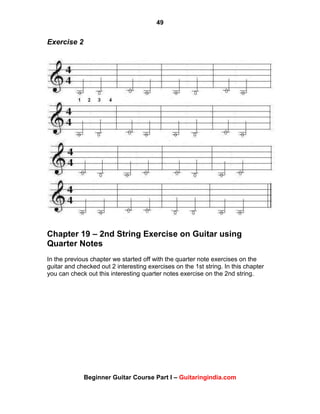
Exercise 2
Chapter 19 – 2nd String Exercise on Guitar using
Quarter Notes
In the previous chapter we started off with the quarter note exercises on the
guitar and checked out 2 interesting exercises on the 1st string. In this chapter
you can check out this interesting quarter notes exercise on the 2nd string.
50
Beginner Guitar Course Part I – Guitaringindia.com
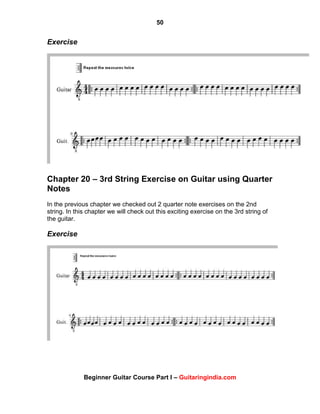
Exercise
Chapter 20 – 3rd String Exercise on Guitar using Quarter
Notes
In the previous chapter we checked out 2 quarter note exercises on the 2nd
string. In this chapter we will check out this exciting exercise on the 3rd string of
the guitar.
Exercise
51
Beginner Guitar Course Part I – Guitaringindia.com
Chapter 21 – 4th String Exercises on Guitar using
Quarter Notes
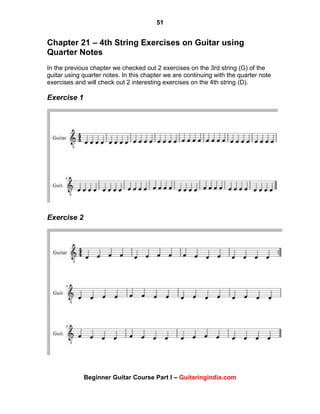
In the previous chapter we checked out 2 exercises on the 3rd string (G) of the
guitar using quarter notes. In this chapter we are continuing with the quarter note
exercises and will check out 2 interesting exercises on the 4th string (D).
Exercise 1
Exercise 2
52
Beginner Guitar Course Part I – Guitaringindia.com
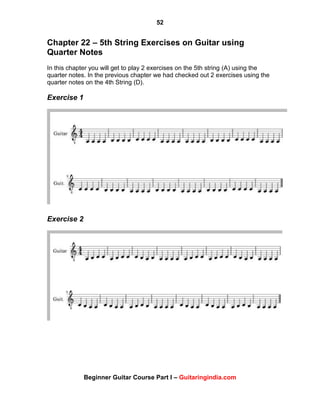
Chapter 22 – 5th String Exercises on Guitar using
Quarter Notes
In this chapter you will get to play 2 exercises on the 5th string (A) using the
quarter notes. In the previous chapter we had checked out 2 exercises using the
quarter notes on the 4th String (D).
Exercise 1
Exercise 2
53
Beginner Guitar Course Part I – Guitaringindia.com
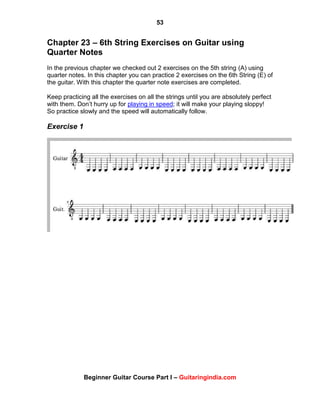
Chapter 23 – 6th String Exercises on Guitar using
Quarter Notes
In the previous chapter we checked out 2 exercises on the 5th string (A) using
quarter notes. In this chapter you can practice 2 exercises on the 6th String (E) of
the guitar. With this chapter the quarter note exercises are completed.
Keep practicing all the exercises on all the strings until you are absolutely perfect
with them. Don‟t hurry up for playing in speed; it will make your playing sloppy!
So practice slowly and the speed will automatically follow.
Exercise 1
54
Beginner Guitar Course Part I – Guitaringindia.com
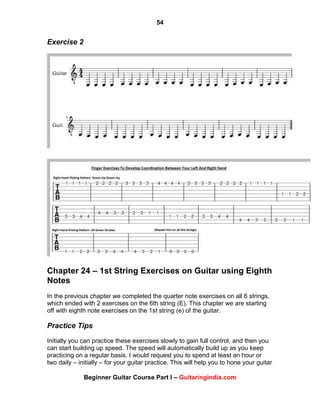
Exercise 2
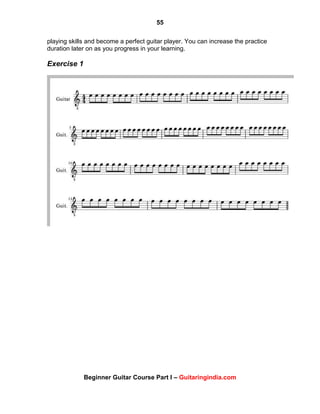
Chapter 24 – 1st String Exercises on Guitar using Eighth
Notes
In the previous chapter we completed the quarter note exercises on all 6 strings,
which ended with 2 exercises on the 6th string (E). This chapter we are starting
off with eighth note exercises on the 1st string (e) of the guitar.
Practice Tips
Initially you can practice these exercises slowly to gain full control, and then you
can start building up speed. The speed will automatically build up as you keep
practicing on a regular basis. I would request you to spend at least an hour or
two daily – initially – for your guitar practice. This will help you to hone your guitar
55
Beginner Guitar Course Part I – Guitaringindia.com
playing skills and become a perfect guitar player. You can increase the practice
duration later on as you progress in your learning.
Exercise 1
56
Beginner Guitar Course Part I – Guitaringindia.com
Exercise 2
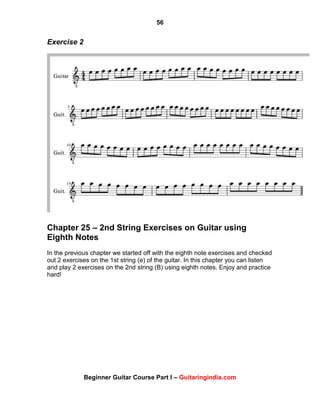
Chapter 25 – 2nd String Exercises on Guitar using
Eighth Notes
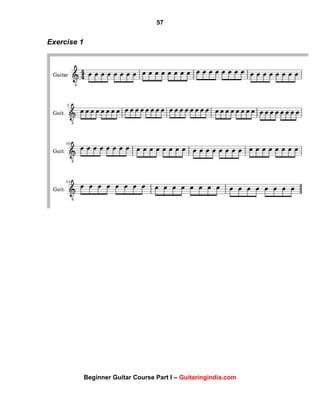
In the previous chapter we started off with the eighth note exercises and checked
out 2 exercises on the 1st string (e) of the guitar. In this chapter you can listen
and play 2 exercises on the 2nd string (B) using eighth notes. Enjoy and practice
hard!
57
Beginner Guitar Course Part I – Guitaringindia.com
Exercise 1
58
Beginner Guitar Course Part I – Guitaringindia.com
Exercise 2
Chapter 26 – 3rd String Exercise on Guitar using Eighth
Notes
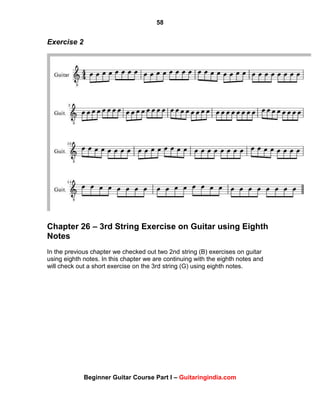
In the previous chapter we checked out two 2nd string (B) exercises on guitar
using eighth notes. In this chapter we are continuing with the eighth notes and
will check out a short exercise on the 3rd string (G) using eighth notes.
59
Beginner Guitar Course Part I – Guitaringindia.com
Exercise
Chapter 27 – 4th String Exercise on Guitar using Eighth
Notes
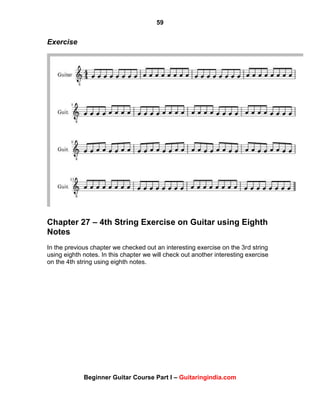
In the previous chapter we checked out an interesting exercise on the 3rd string
using eighth notes. In this chapter we will check out another interesting exercise
on the 4th string using eighth notes.
60
Beginner Guitar Course Part I – Guitaringindia.com
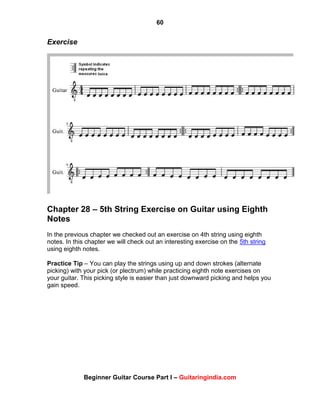
Exercise
Chapter 28 – 5th String Exercise on Guitar using Eighth
Notes
In the previous chapter we checked out an exercise on 4th string using eighth
notes. In this chapter we will check out an interesting exercise on the 5th string
using eighth notes.
Practice Tip – You can play the strings using up and down strokes (alternate
picking) with your pick (or plectrum) while practicing eighth note exercises on
your guitar. This picking style is easier than just downward picking and helps you
gain speed.
61
Beginner Guitar Course Part I – Guitaringindia.com
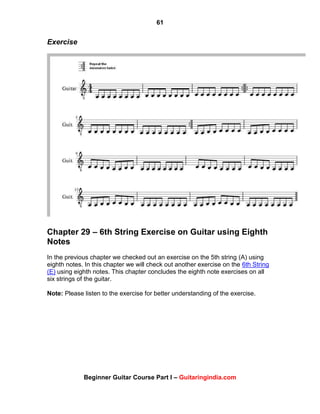
Exercise
Chapter 29 – 6th String Exercise on Guitar using Eighth
Notes
In the previous chapter we checked out an exercise on the 5th string (A) using
eighth notes. In this chapter we will check out another exercise on the 6th String
(E) using eighth notes. This chapter concludes the eighth note exercises on all
six strings of the guitar.
Note: Please listen to the exercise for better understanding of the exercise.
62
Beginner Guitar Course Part I – Guitaringindia.com
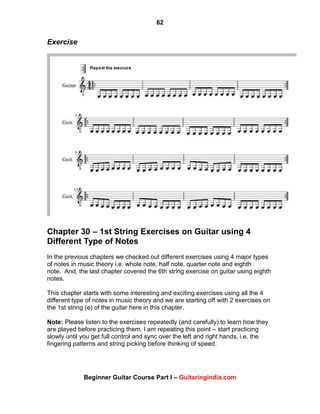
Exercise
Chapter 30 – 1st String Exercises on Guitar using 4
Different Type of Notes
In the previous chapters we checked out different exercises using 4 major types
of notes in music theory i.e. whole note, half note, quarter note and eighth
note. And, the last chapter covered the 6th string exercise on guitar using eighth
notes.
This chapter starts with some interesting and exciting exercises using all the 4
different type of notes in music theory and we are starting off with 2 exercises on
the 1st string (e) of the guitar here in this chapter.
Note: Please listen to the exercises repeatedly (and carefully) to learn how they
are played before practicing them. I am repeating this point – start practicing
slowly until you get full control and sync over the left and right hands, i.e. the
fingering patterns and string picking before thinking of speed.
63
Beginner Guitar Course Part I – Guitaringindia.com
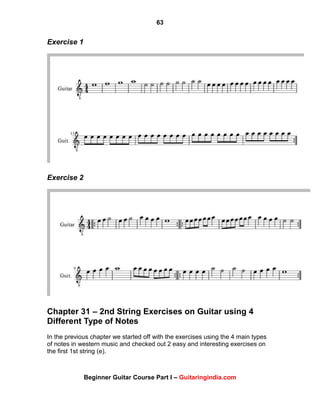
Exercise 1
Exercise 2
Chapter 31 – 2nd String Exercises on Guitar using 4
Different Type of Notes
In the previous chapter we started off with the exercises using the 4 main types
of notes in western music and checked out 2 easy and interesting exercises on
the first 1st string (e).
64
Beginner Guitar Course Part I – Guitaringindia.com
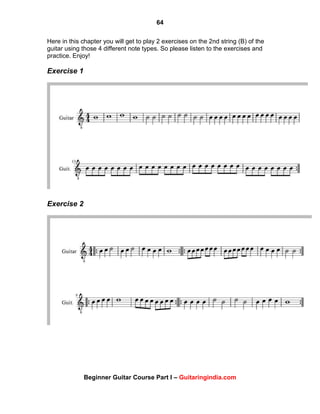
Here in this chapter you will get to play 2 exercises on the 2nd string (B) of the
guitar using those 4 different note types. So please listen to the exercises and
practice. Enjoy!
Exercise 1
Exercise 2
65
Beginner Guitar Course Part I – Guitaringindia.com
Chapter 32 – 3rd String Exercises on Guitar using 4
Different Type of Notes
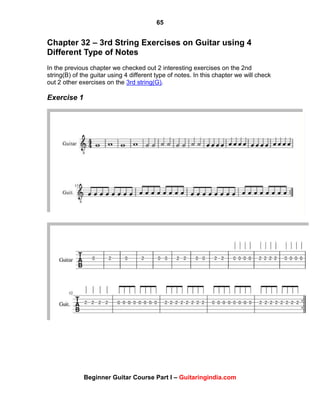
In the previous chapter we checked out 2 interesting exercises on the 2nd
string(B) of the guitar using 4 different type of notes. In this chapter we will check
out 2 other exercises on the 3rd string(G).
Exercise 1
66
Beginner Guitar Course Part I – Guitaringindia.com
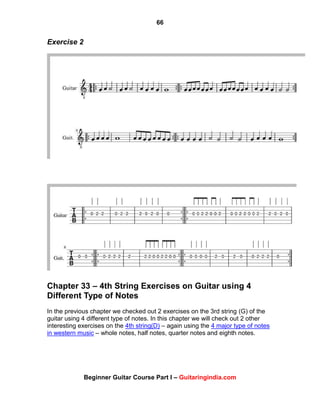
Exercise 2
Chapter 33 – 4th String Exercises on Guitar using 4
Different Type of Notes
In the previous chapter we checked out 2 exercises on the 3rd string (G) of the
guitar using 4 different type of notes. In this chapter we will check out 2 other
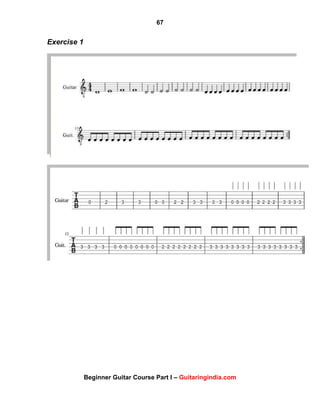
interesting exercises on the 4th string(D) – again using the 4 major type of notes
in western music – whole notes, half notes, quarter notes and eighth notes.
67
Beginner Guitar Course Part I – Guitaringindia.com
Exercise 1
68
Beginner Guitar Course Part I – Guitaringindia.com
Exercise 2
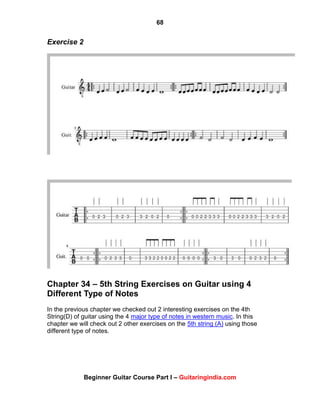
Chapter 34 – 5th String Exercises on Guitar using 4
Different Type of Notes
In the previous chapter we checked out 2 interesting exercises on the 4th
String(D) of guitar using the 4 major type of notes in western music. In this
chapter we will check out 2 other exercises on the 5th string (A) using those
different type of notes.
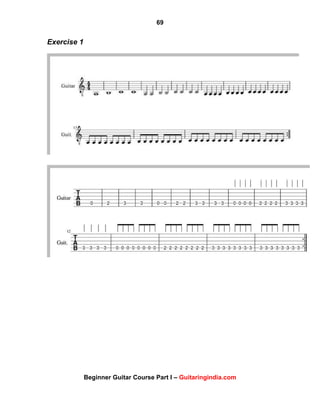
69
Beginner Guitar Course Part I – Guitaringindia.com
Exercise 1
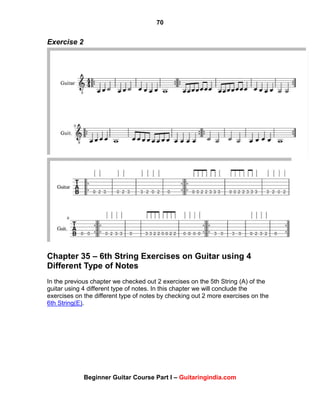
70
Beginner Guitar Course Part I – Guitaringindia.com
Exercise 2
Chapter 35 – 6th String Exercises on Guitar using 4
Different Type of Notes
In the previous chapter we checked out 2 exercises on the 5th String (A) of the
guitar using 4 different type of notes. In this chapter we will conclude the
exercises on the different type of notes by checking out 2 more exercises on the
6th String(E).
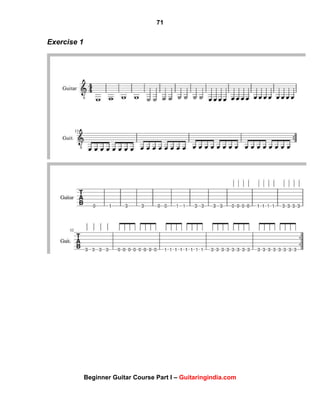
71
Beginner Guitar Course Part I – Guitaringindia.com
Exercise 1
72
Beginner Guitar Course Part I – Guitaringindia.com
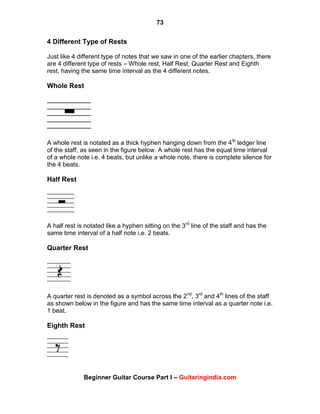
Exercise 2
Chapter 36 – Understanding 4 Different Type of Rests
and Tie Notes in Western Music for Guitar
In the previous chapter we checked out 2 exercises on the 6th
string using 4
major type of notes in western music – Whole note, half note, quarter note and
eighth note. In this chapter we will cover the following topics
1. 4 Different type of rests
2. Ties
73
Beginner Guitar Course Part I – Guitaringindia.com
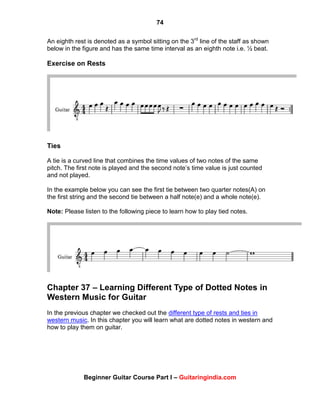
4 Different Type of Rests
Just like 4 different type of notes that we saw in one of the earlier chapters, there
are 4 different type of rests – Whole rest, Half Rest, Quarter Rest and Eighth
rest, having the same time interval as the 4 different notes.
Whole Rest
A whole rest is notated as a thick hyphen hanging down from the 4th
ledger line
of the staff, as seen in the figure below. A whole rest has the equal time interval
of a whole note i.e. 4 beats, but unlike a whole note, there is complete silence for
the 4 beats.
Half Rest
A half rest is notated like a hyphen sitting on the 3rd
line of the staff and has the
same time interval of a half note i.e. 2 beats.
Quarter Rest
A quarter rest is denoted as a symbol across the 2nd
, 3rd
and 4th
lines of the staff
as shown below in the figure and has the same time interval as a quarter note i.e.
1 beat.
Eighth Rest
74
Beginner Guitar Course Part I – Guitaringindia.com
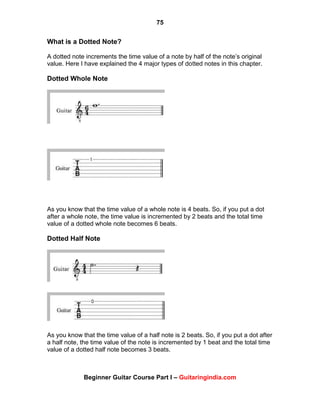
An eighth rest is denoted as a symbol sitting on the 3rd
line of the staff as shown
below in the figure and has the same time interval as an eighth note i.e. ½ beat.
Exercise on Rests
Ties
A tie is a curved line that combines the time values of two notes of the same
pitch. The first note is played and the second note‟s time value is just counted
and not played.
In the example below you can see the first tie between two quarter notes(A) on
the first string and the second tie between a half note(e) and a whole note(e).
Note: Please listen to the following piece to learn how to play tied notes.
Chapter 37 – Learning Different Type of Dotted Notes in
Western Music for Guitar
In the previous chapter we checked out the different type of rests and ties in
western music. In this chapter you will learn what are dotted notes in western and
how to play them on guitar.
75
Beginner Guitar Course Part I – Guitaringindia.com
What is a Dotted Note?
A dotted note increments the time value of a note by half of the note‟s original
value. Here I have explained the 4 major types of dotted notes in this chapter.
Dotted Whole Note
As you know that the time value of a whole note is 4 beats. So, if you put a dot
after a whole note, the time value is incremented by 2 beats and the total time
value of a dotted whole note becomes 6 beats.
Dotted Half Note
As you know that the time value of a half note is 2 beats. So, if you put a dot after
a half note, the time value of the note is incremented by 1 beat and the total time
value of a dotted half note becomes 3 beats.
76
Beginner Guitar Course Part I – Guitaringindia.com
Dotted Quarter Note
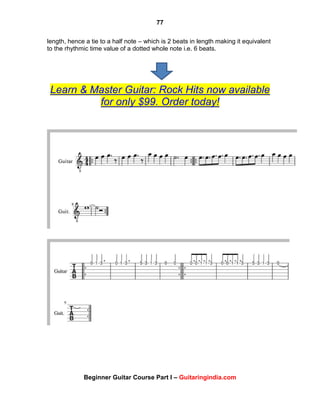
As you know that the time value of a quarter-note is 1 beat. So, if you put a dot
after a quarter-note, the time value of the note is incremented by ½ beat and the
total time value of a dotted quarter note becomes 1 and ½ beats.
Dotted Eighth Note
As you know that the time value of an eighth note is ½ beat. So, if you put a dot
after an eighth note, the time value of the note is incremented by ¼ beat and the
total time value of a dotted eighth note becomes ¾ beat.
Dotted notes are not restricted to just these 4 type of notes, you can create
dotted notes out of any note type.
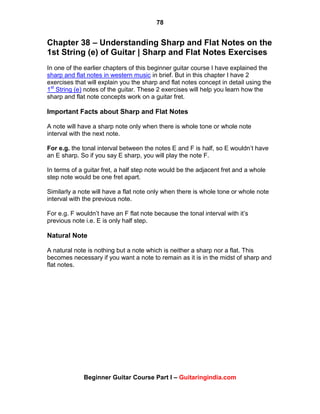
Dotted Notes Exercise
You might be wondering why there is a tie from the whole note to the half note
towards the end of the exercise, right? But don‟t be confused, the tied whole note
is actually a dotted whole note. Since the exercise is on 4/4 (time signature), a
single measure cannot accommodate a dotted whole note – which is six beats in
77
Beginner Guitar Course Part I – Guitaringindia.com
length, hence a tie to a half note – which is 2 beats in length making it equivalent
to the rhythmic time value of a dotted whole note i.e. 6 beats.
Learn & Master Guitar: Rock Hits now available
for only $99. Order today!
78
Beginner Guitar Course Part I – Guitaringindia.com
Chapter 38 – Understanding Sharp and Flat Notes on the
1st String (e) of Guitar | Sharp and Flat Notes Exercises
In one of the earlier chapters of this beginner guitar course I have explained the
sharp and flat notes in western music in brief. But in this chapter I have 2
exercises that will explain you the sharp and flat notes concept in detail using the
1st
String (e) notes of the guitar. These 2 exercises will help you learn how the
sharp and flat note concepts work on a guitar fret.
Important Facts about Sharp and Flat Notes
A note will have a sharp note only when there is whole tone or whole note
interval with the next note.
For e.g. the tonal interval between the notes E and F is half, so E wouldn‟t have
an E sharp. So if you say E sharp, you will play the note F.
In terms of a guitar fret, a half step note would be the adjacent fret and a whole
step note would be one fret apart.
Similarly a note will have a flat note only when there is whole tone or whole note
interval with the previous note.
For e.g. F wouldn‟t have an F flat note because the tonal interval with it‟s
previous note i.e. E is only half step.
Natural Note
A natural note is nothing but a note which is neither a sharp nor a flat. This
becomes necessary if you want a note to remain as it is in the midst of sharp and
flat notes.
79
Beginner Guitar Course Part I – Guitaringindia.com
Sharp Notes on 1st String (e) of Guitar
Tablature Version of the Above Exercise
80
Beginner Guitar Course Part I – Guitaringindia.com
Flat Notes on 1st String (e) of Guitar
Tablature Version of the Above Exercise
81
Beginner Guitar Course Part I – Guitaringindia.com
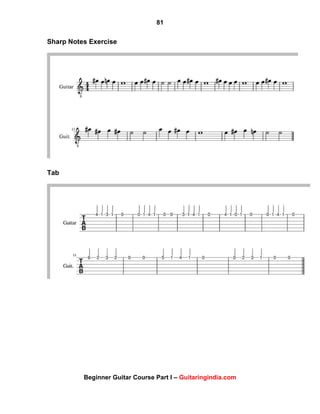
Sharp Notes Exercise
Tab
82
Beginner Guitar Course Part I – Guitaringindia.com
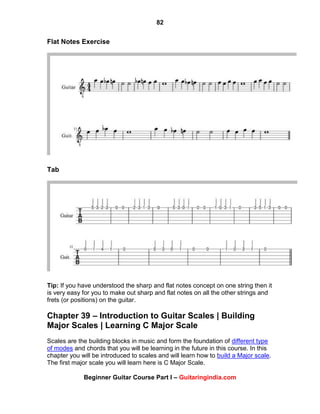
Flat Notes Exercise
Tab
Tip: If you have understood the sharp and flat notes concept on one string then it
is very easy for you to make out sharp and flat notes on all the other strings and
frets (or positions) on the guitar.
Chapter 39 – Introduction to Guitar Scales | Building
Major Scales | Learning C Major Scale
Scales are the building blocks in music and form the foundation of different type
of modes and chords that you will be learning in the future in this course. In this
chapter you will be introduced to scales and will learn how to build a Major scale.
The first major scale you will learn here is C Major Scale.
83
Beginner Guitar Course Part I – Guitaringindia.com
What is a scale in Western Music?
Scales can be defined as a succession of tones, consisting of the notes
belonging to a key, starting and ending with the key note. Scales are also known
as the alphabet of music.
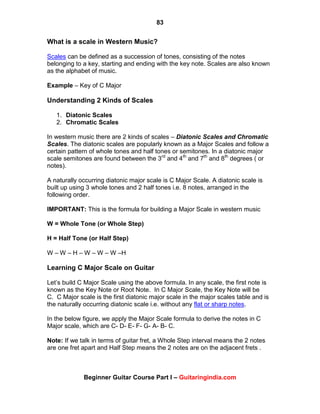
Example – Key of C Major
Understanding 2 Kinds of Scales
1. Diatonic Scales
2. Chromatic Scales
In western music there are 2 kinds of scales – Diatonic Scales and Chromatic
Scales. The diatonic scales are popularly known as a Major Scales and follow a
certain pattern of whole tones and half tones or semitones. In a diatonic major
scale semitones are found between the 3rd
and 4th
and 7th
and 8th
degrees ( or
notes).
A naturally occurring diatonic major scale is C Major Scale. A diatonic scale is
built up using 3 whole tones and 2 half tones i.e. 8 notes, arranged in the
following order.
IMPORTANT: This is the formula for building a Major Scale in western music
W = Whole Tone (or Whole Step)
H = Half Tone (or Half Step)
W – W – H – W – W – W –H
Learning C Major Scale on Guitar
Let‟s build C Major Scale using the above formula. In any scale, the first note is
known as the Key Note or Root Note. In C Major Scale, the Key Note will be
C. C Major scale is the first diatonic major scale in the major scales table and is
the naturally occurring diatonic scale i.e. without any flat or sharp notes.
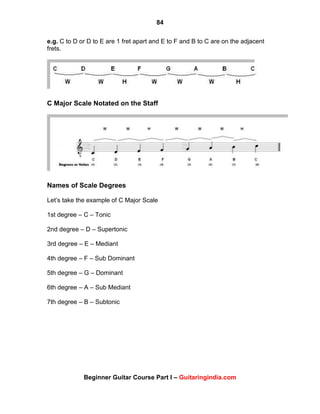
In the below figure, we apply the Major Scale formula to derive the notes in C
Major scale, which are C- D- E- F- G- A- B- C.
Note: If we talk in terms of guitar fret, a Whole Step interval means the 2 notes
are one fret apart and Half Step means the 2 notes are on the adjacent frets .
84
Beginner Guitar Course Part I – Guitaringindia.com
e.g. C to D or D to E are 1 fret apart and E to F and B to C are on the adjacent
frets.
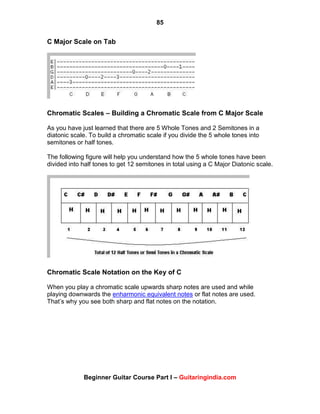
C Major Scale Notated on the Staff
Names of Scale Degrees
Let‟s take the example of C Major Scale
1st degree – C – Tonic
2nd degree – D – Supertonic
3rd degree – E – Mediant
4th degree – F – Sub Dominant
5th degree – G – Dominant
6th degree – A – Sub Mediant
7th degree – B – Subtonic
85
Beginner Guitar Course Part I – Guitaringindia.com
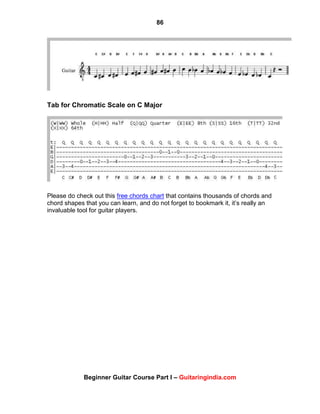
C Major Scale on Tab
Chromatic Scales – Building a Chromatic Scale from C Major Scale
As you have just learned that there are 5 Whole Tones and 2 Semitones in a
diatonic scale. To build a chromatic scale if you divide the 5 whole tones into
semitones or half tones.
The following figure will help you understand how the 5 whole tones have been
divided into half tones to get 12 semitones in total using a C Major Diatonic scale.
Chromatic Scale Notation on the Key of C
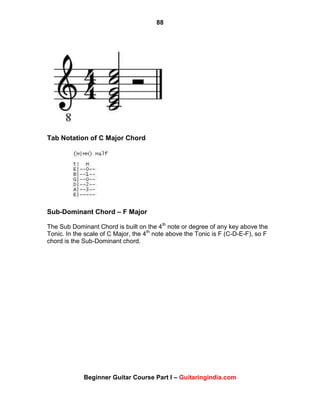
When you play a chromatic scale upwards sharp notes are used and while
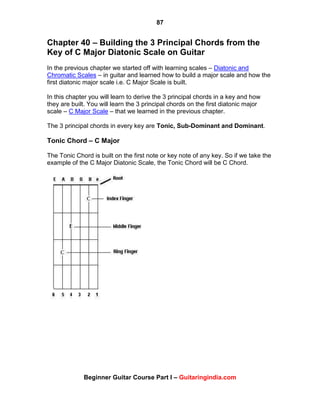
playing downwards the enharmonic equivalent notes or flat notes are used.
That‟s why you see both sharp and flat notes on the notation.
86
Beginner Guitar Course Part I – Guitaringindia.com
Tab for Chromatic Scale on C Major
Please do check out this free chords chart that contains thousands of chords and
chord shapes that you can learn, and do not forget to bookmark it, it‟s really an
invaluable tool for guitar players.
87
Beginner Guitar Course Part I – Guitaringindia.com
Chapter 40 – Building the 3 Principal Chords from the
Key of C Major Diatonic Scale on Guitar
In the previous chapter we started off with learning scales – Diatonic and
Chromatic Scales – in guitar and learned how to build a major scale and how the
first diatonic major scale i.e. C Major Scale is built.
In this chapter you will learn to derive the 3 principal chords in a key and how
they are built. You will learn the 3 principal chords on the first diatonic major
scale – C Major Scale – that we learned in the previous chapter.
The 3 principal chords in every key are Tonic, Sub-Dominant and Dominant.
Tonic Chord – C Major
The Tonic Chord is built on the first note or key note of any key. So if we take the
example of the C Major Diatonic Scale, the Tonic Chord will be C Chord.
88
Beginner Guitar Course Part I – Guitaringindia.com
Tab Notation of C Major Chord
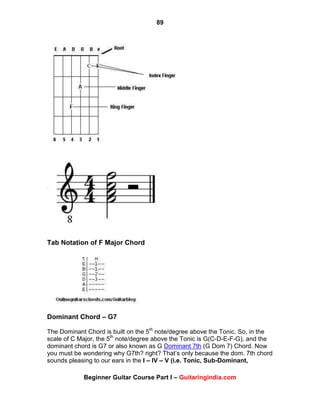
Sub-Dominant Chord – F Major
The Sub Dominant Chord is built on the 4th
note or degree of any key above the
Tonic. In the scale of C Major, the 4th
note above the Tonic is F (C-D-E-F), so F
chord is the Sub-Dominant chord.
89
Beginner Guitar Course Part I – Guitaringindia.com
Tab Notation of F Major Chord
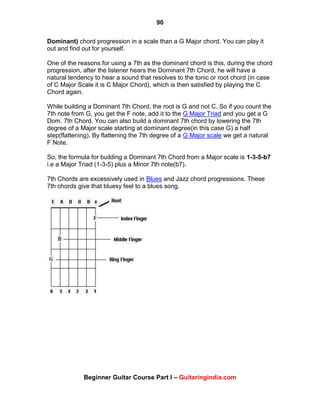
Dominant Chord – G7
The Dominant Chord is built on the 5th
note/degree above the Tonic. So, in the
scale of C Major, the 5th
note/degree above the Tonic is G(C-D-E-F-G), and the
dominant chord is G7 or also known as G Dominant 7th (G Dom 7) Chord. Now
you must be wondering why G7th? right? That‟s only because the dom. 7th chord
sounds pleasing to our ears in the I – IV – V (i.e. Tonic, Sub-Dominant,
90
Beginner Guitar Course Part I – Guitaringindia.com
Dominant) chord progression in a scale than a G Major chord. You can play it
out and find out for yourself.
One of the reasons for using a 7th as the dominant chord is this, during the chord
progression, after the listener hears the Dominant 7th Chord, he will have a
natural tendency to hear a sound that resolves to the tonic or root chord (in case
of C Major Scale it is C Major Chord), which is then satisfied by playing the C
Chord again.
While building a Dominant 7th Chord, the root is G and not C. So if you count the
7th note from G, you get the F note, add it to the G Major Triad and you get a G
Dom. 7th Chord. You can also build a dominant 7th chord by lowering the 7th
degree of a Major scale starting at dominant degree(in this case G) a half
step(flattening). By flattening the 7th degree of a G Major scale we get a natural
F Note.
So, the formula for building a Dominant 7th Chord from a Major scale is 1-3-5-b7
i.e a Major Triad (1-3-5) plus a Minor 7th note(b7).
7th Chords are excessively used in Blues and Jazz chord progressions. These
7th chords give that bluesy feel to a blues song.
91
Beginner Guitar Course Part I – Guitaringindia.com
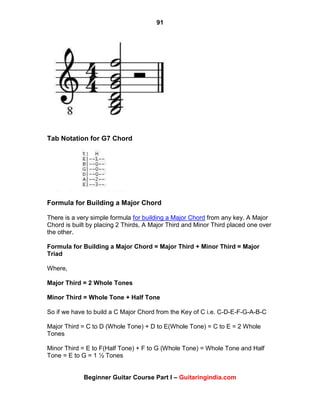
Tab Notation for G7 Chord
Formula for Building a Major Chord
There is a very simple formula for building a Major Chord from any key. A Major
Chord is built by placing 2 Thirds, A Major Third and Minor Third placed one over
the other.
Formula for Building a Major Chord = Major Third + Minor Third = Major
Triad
Where,
Major Third = 2 Whole Tones
Minor Third = Whole Tone + Half Tone
So if we have to build a C Major Chord from the Key of C i.e. C-D-E-F-G-A-B-C
Major Third = C to D (Whole Tone) + D to E(Whole Tone) = C to E = 2 Whole
Tones
Minor Third = E to F(Half Tone) + F to G (Whole Tone) = Whole Tone and Half
Tone = E to G = 1 ½ Tones
92
Beginner Guitar Course Part I – Guitaringindia.com
And, we get a C Major Triad (or the C Major Chord) è C – E – G , so the 3 notes
of a C Major Chord is C,E and G.
Chapter 41 – Practicing the Principal Chords and Scale
in the Key of C on Guitar
In the previous chapter we learned how to build the Tonic, Sub-dominant and
Dominant Chords on any key and learned how to build the 3 principal chords on
the key of C.
In this chapter I have 3 interesting exercises for you that will allow you to practice
the 3 principal chords – Tonic, Sub-Dominant and Dominant chords, *Arpeggios
and the C Major scale itself.
*Arpeggios – playing out the notes of a chord individually.
Practice Tips
You must always practice in a tempo that you are comfortable with and then
gradually increase the speed. Don‟t hurry up and try to push yourself to the limit,
it will only make your playing sloppy.
Guitar Tuner - It‟s good to buy a simple guitar tuner from a music store that will
help you tune your guitar with ease and keep it in perfect tuning.
Metronome - Metronome is a small device that emits a ticking sound on a
regular interval based on a preset Beats-Per-Minute (BPM) setting. It is really
helpful and highly recommended to practice the exercises with a metronome. It
makes your playing more streamlined and perfect by forcing you to stay in the
preset BPM. By the way, there is no need to go for a complex metronome; a
simple one would be just fine. It is also better to buy one that produces a Ticking
or Clicking sound rather than the Beeps which becomes really irritating later on
while practicing. In this age of smart phones, I prefer using a smartphone app.
93
Beginner Guitar Course Part I – Guitaringindia.com
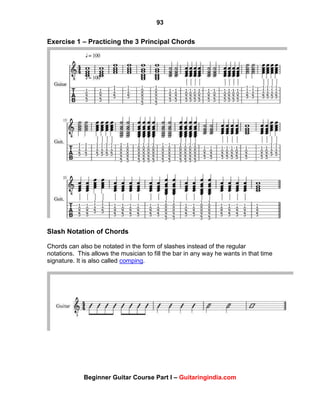
Exercise 1 – Practicing the 3 Principal Chords
Slash Notation of Chords
Chords can also be notated in the form of slashes instead of the regular
notations. This allows the musician to fill the bar in any way he wants in that time
signature. It is also called comping.
94
Beginner Guitar Course Part I – Guitaringindia.com
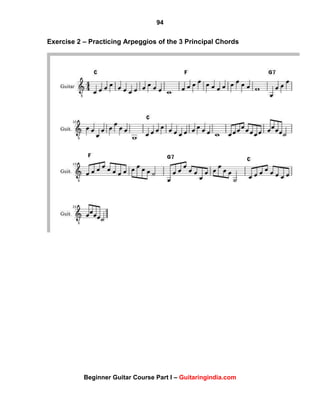
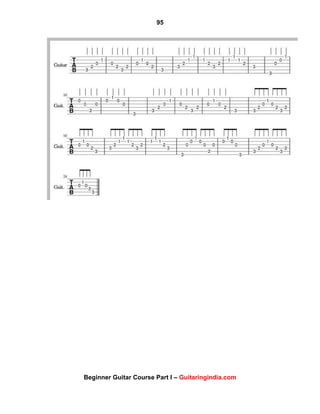
Exercise 2 – Practicing Arpeggios of the 3 Principal Chords
95
Beginner Guitar Course Part I – Guitaringindia.com
96
Beginner Guitar Course Part I – Guitaringindia.com
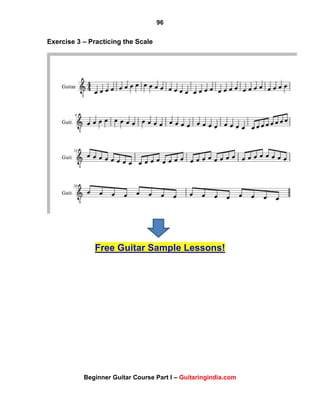
Exercise 3 – Practicing the Scale
Free Guitar Sample Lessons!
97
Beginner Guitar Course Part I – Guitaringindia.com
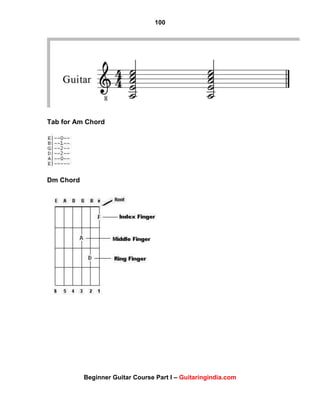
Chapter 42 – Learning A Natural Minor Scale and it’s 3
Principal Chords on Guitar
In the previous chapter we covered 3 different exercises – using the 3 principal
chords and the scale itself – using the first diatonic major scale i.e. C Major
Scale. In this chapter we will learn the relative minor scale of C Major Scale and
the 3 principal chords in that scale.
Relative Minor Scale
A Relative Minor scale is built on the 6th
degree or note of a major scale and it
shares the same notes as its parent Major scale. In the case of C Major Scale,
the 6th
degree (C-D-E-F-G-A) or note is A, so the relative minor scale of C Major
Scale is A Minor. The specialty of A Natural Minor scale is that it doesn‟t have
any sharp or flat notes in the scale.
It is interesting to note that there is only one type of Major Scale in western music
that is a Major Diatonic Scale and all major scales follow the same tonal pattern
of a Diatonic Scale, but there are 5 different types of minor scales in western
98
Beginner Guitar Course Part I – Guitaringindia.com
music – Natural, Harmonic, Melodic, Mixed or Combined and Hungarian
(Gypsy). But in this chapter we will only learn the Natural Minor Scale. The rest
will be covered in the future chapters.
First we will check out the formula for building a natural minor scale and then we
will see the notes in that scale.
W => Whole Tone
H => Half Tone
Formula for building natural minor scales is W-H-W-W-H-W-W
A Natural Minor Scale (as per the above formula)
From the above notation you can learn the tonal intervals on the A Natural Minor
Scale as per the formula.
A – B is a Whole Tone
B – C is a Half Tone
C – D is a Whole Tone
D – E is a Whole Tone
E – F is a Half Tone
F – G is a Whole Tone
G – A is a Whole Tone
99
Beginner Guitar Course Part I – Guitaringindia.com
Tab for A Natural Minor Scale
The 3 Principal Chords in “A” Natural Minor Scale
You can refer to Chapter 40 to see how you can build the 3 principal chords –
Tonic, Sub-Dominant and Dominant Chords – from a scale as well as building a
Major Chord from it.
Formula for Building a Minor Chord - Any Minor chord can be built by placing
a Minor Third over a Major Third.
The 3 Principal Chords on the scale of Natural A Minor are A Minor (Am), D
Minor (Dm) and E7
Am Chord
100
Beginner Guitar Course Part I – Guitaringindia.com
Tab for Am Chord
Dm Chord
101
Beginner Guitar Course Part I – Guitaringindia.com
Tab for Dm Chord
E7 Chord
102
Beginner Guitar Course Part I – Guitaringindia.com
Tab for E7 Chord
Chapter 43 – Practicing the 3 Principal Chords and A
Natural Minor Scale on Guitar
In the previous chapter we checked out the A Natural Minor scale and the 3
Principal Chords on that scale. In this chapter there are 3 exercises that will help
you practice the 3 principal chords and the notes of that key.
Practice Tip
 When you are practicing the chords it‟s recommended to use UP and
DOWN strokes while you strum the chords. For that keep your right
shoulder, elbow and wrist loose enough to get that easy up and down
motion for strumming
 Always focus on control and never be in a hurry to speed up your
exercise. Speed will easily follow when you have full control over a riff or
an exercise. The control comes through slow, systematic and regular
practice.
 Playing along with a Metronome is highly beneficial and will transform you
a streamlined and perfect guitarist. A simple metronome is enough for you
to practice, but ensure that it produces a clicking sound than Beeps.
103
Beginner Guitar Course Part I – Guitaringindia.com
Exercise of the 3 Principal Chords
104
Beginner Guitar Course Part I – Guitaringindia.com
Arpeggio Exercise
105
Beginner Guitar Course Part I – Guitaringindia.com
106
Beginner Guitar Course Part I – Guitaringindia.com
Exercise of the Scale
Gibson’s Learn And Master Guitar is the world’s best guitar course
that starts an aspiring guitarist at the beginning and builds to a
master level of skill using our award winning tutorial series! SHOP
NOW!
107
Beginner Guitar Course Part I – Guitaringindia.com
Chapter 44 – Importance of Understanding Different
types of Musical Intervals in a Scale while Learning
Guitar
In the previous chapter we checked out 3 important exercises on the A Natural
Minor Scale for practicing the 3 principal chords in that scale as well as the scale
itself on your guitar.
In this chapter you will learn about musical intervals and how to identify these
intervals on any scale. Every scale and chord in western music is built on
different combinations of these intervals. Understanding musical intervals is very
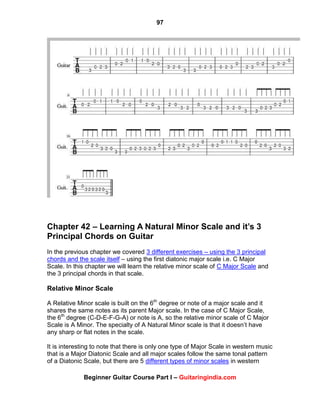
108
Beginner Guitar Course Part I – Guitaringindia.com
important as part of your guitar learning venture that will easily enable you to
understand and build different types of chords on the fly – without depending on
any diagrams.
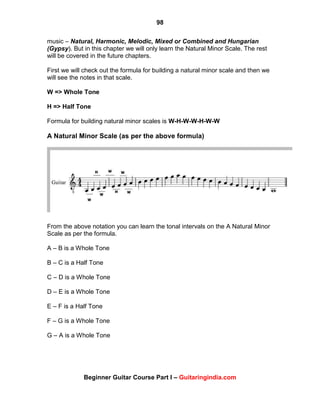
Musical Interval
An Interval in western music can be defined as the difference of pitch or tone
between 2 notes. The scales and chords are formed by the combination of
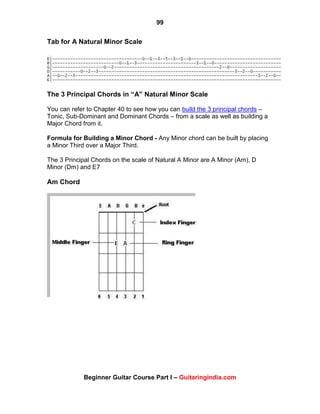
different notes having different pitches or tonal difference, just like a word is
formed of syllables. An interval can also be defined as the tonal difference
between two notes.
E.g. C to D is a Whole Tone, C to E is a Whole Tone and E to F is a Semi-Tone
First we will check out the intervals in general on a scale and then we will go in
depth and check out the 4 main types of intervals in music i.e. Major, Minor,
Diminished and Augmented. We will also check out Consonant and Dissonant
intervals.
We will learn the intervals with the help of the first diatonic major scale i.e. C
Major Scale.
The following notation figure shows you the actual intervals between the root or
tonic note (i.e. C) to the other degrees in C Major Scale. If you can refer back to
the C Major Scale chapter by clicking on the above link or the link given at the
bottom of this chapter, you will understand these intervals much clearly.
Note: The word Unison or Prime mean that the tonal difference between the two
notes is Zero or both the notes are the same. 2nd
indicates that D is the 2nd
degree or note on the scale, 3rd
indicates that E is the 3rd
degree or note and so
on.
109
Beginner Guitar Course Part I – Guitaringindia.com
Tab
4 Main Types of Intervals in Music – Major, Minor, Diminished and
Augmented
In this section we will learn the 3rd
and 5th
of Major, Minor, Diminished and
Augmented intervals. You have already seen how to form a Major 3rd
and Minor
3rd
in Chapter 40 – Building the 3 Principal Chords from the Key of C Major
Diatonic Scale on Guitar but I will still explain them here.
Major 3rd
Interval = 2 Whole Tones; in the figure below the interval between the
first 2 notes i.e. C and E is 2 whole tones or whole steps, so it is a Major 3rd
interval.
Minor 3rd
Interval = 1 ½ Tones; the tonal difference between the 2nd
set of notes
i.e. C and E flat is 1 ½ tones or 1 Whole Tone + ½ Tone, hence the interval is a
Minor 3rd
.
Diminished 3rd Interval = 1 Tone; Diminishing just means that you need to
lower a notes value by half a tone or step. A Diminished 3rd
interval is formed by
flatting a Minor 3rd
interval. The interval that we get after double flatting the E
note (in the 3rd
set of notes) is a whole tone or a Diminished 3rd
.
Augmented 3rd
Interval = 2 ½ Tones; Augmenting means you need to increase
a notes value by half step or tone. An Augmented 3rd
Interval is formed by
sharping the 2nd
note in a Major 3rd
.
Now you can easily understand the 5th
of these intervals from the figure below.
110
Beginner Guitar Course Part I – Guitaringindia.com
Tab
Consonant Intervals
A Consonance is a combination of tones with respect to the tonic degree or the
root note in a scale having a definite relationship with each other that sounds
pleasant to our ears and doesn‟t have a tendency to resolve to another note.
The Perfect Consonant Intervals are the same as the general intervals on a
scale. Refer to the first section (Musical Intervals) of this chapter.
The Imperfect Consonant Intervals evoke a small amount of tension, when
heard. Please listen to it to find out.
Major 6th
= the interval between the root note and the 6th
note on a scale.
Minor 6th
= the interval between the root note and the flatted 6th
note on a scale.
111
Beginner Guitar Course Part I – Guitaringindia.com
Tab
Dissonant Intervals
A Dissonance is a combination of tones with respect to the tonic degree or the
root note in a scale having a definite relationship with each other that sounds
tensed to our ears and have a strong tendency to resolve into a consonance.
Please listen to it to find out.
Major 2nd
Interval = There is an interval of 1 Whole Tone between the root note
and the second note.
Minor 2nd
Interval = There is an interval of ½ Tone between the root note and
the second note.
Major 7th
Interval = interval between the root note and the 7th
note in a scale.
Minor 7th
Interval = interval between the root note and the flatted 7th
note in
scale.
Augmented Prime or Aug. Unison Interval = the second note in that set is
sharped, in this case C Sharp.
Augmented 2nd
= the 2nd
note in the scale is sharped to get an Aug. 2nd
interval.
Augmented 4th
= the 4th
note in the scale is sharped to get an Aug. 4th
interval.
112
Beginner Guitar Course Part I – Guitaringindia.com
Augmented 5th
= the 5th
note in the scale is sharped to get an Aug. 5th
interval.
Augmented 6th
= the 6th
note in the scale is sharped to get an Aug. 6th
interval.
Tab
Chapter 45 – Understanding Different Types of Minor
Scales in Western Music while Learning Guitar
In Chapter 42 we learned how to build a Natural Minor scale with the help of the
relative minor scale of C Major Scale which is A Natural Minor. In this chapter I
am going to elaborate on the different types of Minor Scales mentioned in
Chapter 42 – Harmonic, Melodic, Mixed or Combined and Hungarian Minor
Scales with the help of A Natural Minor scale itself.
Harmonic Minor Scale
Harmonic Minor Scale was born when musicians felt that the interval between
leading 7th
note and the Tonic 8th
note was not pleasant enough for the human
ears as they were more used to listening to a half step interval between the 7th
and 8th
note as on a Major Scale. So the 7th
note or the leading tone of a natural
minor scale was raised a half step and called it a Harmonic Minor Scale.
In the scale of A Natural Minor, the 7th
note G was raised a half step to G Sharp.
The raised leading tone or 7th
note is called an “Accidental” as the Sharp is not
indicated as part of the scale or signature and is placed only before individual
113
Beginner Guitar Course Part I – Guitaringindia.com
notes. So, if the 7th
note is natural in the signature then the accidental is a sharp
and if the 7th
note is a flat in the signature, then the accidental is a natural or if
the 7th
note is a sharp in the signature, then the accidental is a double sharp.
Harmonic Minor scale is the same while descending.
Tab
Melodic Minor Scale
Melodic minor scale shares the same tonal intervals of a major scale with a small
difference. It differs from a major scale because the half step interval occurs
between the 2nd
and 3rd
degrees of the scale instead of 3rd
and 4th
. This form of
the minor scale is extremely pleasant to hear.
The descending notes of a Melodic Minor scale are natural.
114
Beginner Guitar Course Part I – Guitaringindia.com
Tab
Mixed or Combined Minor Scale
Mixed or Combined Minor scale is a melodic minor while ascending and
harmonic minor scale while descending.
Tab
Hungarian or Gypsy Minor Scale
Hungarian Minor Scale is formed by raising the 4th
degree of a Harmonic Minor
Scale by a half step. There are 2 one and a half step intervals in this scale, one
between the 3rd
and 4th
degrees and the other between 7th
and 8th
degrees. This
scale is the same while ascending and descending.
Harmonic and Melodic minor scales are the favorite scales amongst most
musicians and guitarists.
115
Beginner Guitar Course Part I – Guitaringindia.com
Tab
You shouldn't have a guitar that's hard to play.
Chapter 46 – Learning G Major Scale and it’s 3 Principal
Chords on Guitar
In this chapter we will learn G Major Scale and its 3 principal chords – G Major, C
Major and D7th – on guitar. G is at a perfect fifth interval from the note C.
The first major diatonic scale that we learned was C Major Scale, which is the
only naturally occurring scale in western music (with no sharps or flats). We also
learned its relative minor scale which is A Minor Scale along with its principal
chords in one of the previous chapters.
Understanding G Major Scale
First let‟s learn the G Major scale. This is the second Major scale that you will
learn in western music.
We have already learned the formula for building a Major Scale which is W-W-H-
W-W-W-H
116
Beginner Guitar Course Part I – Guitaringindia.com
So, if we apply this scale formula, G Major scale should begin with the key note
i.e. G on the 6th string 3rd fret or on the open 3rd string G and played all the way
up to the 1st string G note with a half step raised F note i.e. F#
And we get the G Major scale notes as G A B C D E F# G
G Major Scale Notation with Tab
3 Principal Chords in this scale
The 3 principal chords in G Major scale are G Major (Tonic), C Major (Sub
Dominant) and D7(Dominant).
G Major Chord Fret diagram, Notation with Tab
117
Beginner Guitar Course Part I – Guitaringindia.com
C Major Chord
Please refer to Chapter 39 for this chord..
D7 Chord Fret diagram, Notation with Tab
Please practice this scale in ascending and descending order as well as
strumming the chords. Start out slowly and don‟t hurry up – you will gain speed
and control naturally.
In the next chapter you will have some practice exercises for the chords and the
scale. Till then enjoy playing the scale and chords.
118
Beginner Guitar Course Part I – Guitaringindia.com
Chapter 47 – Exercises of Principal Chords and Scale on
the Key of G Major on Guitar
In the previous chapter we checked out the G Major Scale and the 3 principal
chords on guitar. In this chapter you have 3 exercises to practice those chords
and the scale.
The first exercise will get you started with the strumming of the 3 principal chords
on this scale, the second one is an arpeggio exercise which will teach you to
arpeggiate the chords‟ notes and the third one is for practicing the scale notes in
a particular pattern.
Important: Please listen to these exercises first – to get an idea and then
start practicing.
Practice these exercises in slow speed and gradually increase the tempo. I would
highly recommend using a metronome which will streamline your playing. You
can try out this free online Metronome to start with.
By the way you can think of different patterns and improvise these exercises as
per your creativity.
119
Beginner Guitar Course Part I – Guitaringindia.com
Chords Exercise
120
Beginner Guitar Course Part I – Guitaringindia.com
Arpeggio Exercise
121
Beginner Guitar Course Part I – Guitaringindia.com
Scale Exercise
Live Guitar Lessons with Steve Krenz
122
Beginner Guitar Course Part I – Guitaringindia.com
Chapter 48 – Understanding the 3 Different Patterns of C
Major Scale on the Guitar Fret-Board
This chapter will teach you how to find out and play the C Major Scale on
different positions of the fret-board, in different patterns. The key to finding
different patterns of the same scale on the fret-board is to have a basic
understanding of the tonal intervals which I have covered in one of the earlier
chapters. But here I am again going to explain the tonal intervals in brief for your
convenience.
I am using the notes from A to A (as seen in the above fig.) to explain you the
tonal intervals with respect to the guitar fret-board. As you already know that the
intervals between B to C and E to F are semi-tones or half steps which mean
these notes are on adjacent frets on the fret-board and the intervals between all
the other notes are a whole tone or a whole step which means that these notes
are one fret apart. Please check out the positions of these notes on the guitar fret
board in the following diagram.
Tip: Please note that the 12th
fret is one octave above the open string or has the
high pitch note of the open string. If you check out the following fret diagram you
will understand that the 12th
fret with 2 dotted inlays is also a G.
Now it must be crystal clear for you, how the tonal intervals get interpreted into
the frets on the fret-board.
1st
Pattern
Let‟s check out the first pattern of C Major Scale. The patterns are colored in
RED.
123
Beginner Guitar Course Part I – Guitaringindia.com
If you apply your tonal interval knowledge on the 6th
string (E) you will find out
that the 8th
fret is a C and you can build a C Major scale by making it the root
note. That‟s how you can build the 1st
pattern of C Major Scale.
So all I have to say is that, get your tonal interval knowledge clear and you will
realize that finding out notes on the fret-board will be a cake walk for you.
2nd
pattern
This is how you can build another pattern of the same notes of C Major Scale on
the fret-board.
This is how the 2nd
combination of notes of C Major Scale can be arranged on
the fret-board. Here I am again starting with the C note on the 8th
fret on the 6th
String (E), but most of the other notes are on a lower pitch unlike the previous
pattern.
3rd
Pattern
The 3rd
pattern (starting on the 3rd fret of 5th string, same as the standard C
Major Scale pattern) would be more difficult to play than the previous ones, but it
definitely teaches you how to play a scale by utilizing the maximum number of
frets or length of the fret-board. Practicing scales in this way can definitely make
you a better guitarist by learning to utilize the entire fret-board than getting locked
up in a single position.
124
Beginner Guitar Course Part I – Guitaringindia.com
This pattern will give you more options for incorporating different shredding
techniques like hammer-ons, legato(sliding), tapping, bending and so on into
your solos as well as while practicing a scale and will also give you more room
for creating soulful and fluid sounding solos, riffs and licks.
In the next chapter I will come up with some practice exercises on these patterns,
till then keep practicing these scale patterns, if possible with a metronome (highly
recommended).
Chapter 49 – C Major Scale Exercises & Learning
Different Kinds of Scales of the C Family
In this chapter I have 2 great exercises to familiarize C Major Scale as well as all
the important scales belonging to the C Family. The scales I have covered here
are C Natural Minor, C Harmonic Minor, C Melodic Minor, C Major Pentatonic, C
Minor Pentatonic and C blues Scale.
I have given two practice exercises on C Major Scale which starts on the 8th
fret
of the 6th
string. The tab notations and audio will help you learn and play these
exercises with much ease. So make the maximum out of them. Start out slowly
and which will gradually increase your speed, dexterity and finger strength with
these exercises. These are great exercises for improving your speed.
Note: Though I have written the notations in quarter notes, you can play it in the
speed of 8th, 16th or 32nd notes when you develop the speed.
125
Beginner Guitar Course Part I – Guitaringindia.com
Exercise 1
126
Beginner Guitar Course Part I – Guitaringindia.com
Exercise 2
C Natural Minor Scale
As we have already learned how to build a minor scale in Chapter 42 –
Learning A Natural Minor Scale and it’s 3 Principal Chords on Guitar . You
may please refer to it to learn how to build a minor scale.
So if you build the notes based on that formula we get the notes of C Natural
Minor Scale as C-D-E Flat-F-G-A Flat-B Flat-C. There are 3 Flat notes in the Key
of C Minor – E Flat, A Flat and B Flat. Please listen and practice the scale as per
the following notation.
127
Beginner Guitar Course Part I – Guitaringindia.com
Also practice this scale on 2 other positions on the fret board as shown below,
Position 2
Position 3
C Harmonic Minor Scale
Please refer to Chapter 45 – Understanding Different Types of Minor Scales
in Western Music while Learning Guitar to learn how to build Harmonic Minor
Scale and Melodic Minor scales.
Based on the Harmonic Minor formula we get the notes of C Harmonic Minor
Scale as C-D-E Flat-F-G-A Flat-B-C. The notes of a Harmonic Minor Scale are
the same while ascending and descending.
128
Beginner Guitar Course Part I – Guitaringindia.com
C Melodic Minor Scale
So based on the Melodic Minor Scale formula, the notes of a C Melodic Minor
scale are C-D-E Flat-F-G-A-B-C. You can practice these scales using the same
patterns as the C Major Scale as shown in the beginning of this chapter as well
as other patterns using your creativity.
Major Pentatonic Scale
Pentatonic scales are the most popular scales among guitarists and are widely
used in Rock, Jazz, Heavy Metal and Blues. They are also widely used in
Bluegrass and Country music
“Penta” meaning 5, so a Pentatonic Scale will only have 5 notes unlike a regular
diatonic scale. This scale is derived from its corresponding Major scale by
omitting the 4th
and 7th
degree notes from a Major scale.
The formula for building a Major Pentatonic Scale is R 2 3 5 6
C Major Pentatonic Scale
Based on the above formula, we get the notes of C Major Pentatonic Scale as C
D E G A
If you can refer to the previous chapter you will be able to play this scale on
various positions of the fret-board.
129
Beginner Guitar Course Part I – Guitaringindia.com
Minor Pentatonic Scale
Minor Pentatonic Scales can be derived from their corresponding Major scales by
flattening the 3rd
and 7th
degree notes and omitting 2nd
and 6th
degree notes.
The formula for building a Minor Pentatonic Scale is R b3 4 5 b7
C Minor Pentatonic Scale
Based on the above formula, we get the notes of C Minor Pentatonic Scale as C-
E(flat)-F- G-B(flat)
Blues Scale
Blues scale has is derived from a Minor Pentatonic Scale by adding a flattened
5th
degree note. So a blues scale has 6 notes.
Hence the formula for building a Blues Scale is R b3 4 b5 5 b7
C Blues Scale
Based on the above formula, we get the notes of C Blues Scale as C-E(flat)-F-
G(Flat)-G-B(flat)
130
Beginner Guitar Course Part I – Guitaringindia.com
Practice all these scales thoroughly in various patterns as per your creativity.
Play around with these scales and understand the difference between their
sounds and their mood. Major scales will have a happy mood whereas Minor
scales have a tensed, bluesy tone. Understanding this difference is very
important. In course of time you will be able to make out what type of scale it is
by just listening to them.
.
Get serious about learning the guitar!
Chapter 50 – C Major, Minor Pentatonic and Blues
Scales on a Different Position on Guitar
In the previous chapter we checked out 2 exercises on C Major Scale starting on
the 8th Fret position of 6th String as well as other scales belonging to the C
family. In this chapter you will learn to play C Major, Minor Pentatonic and Blues
scales starting on the 8th fret of 6th string. I have also prepared 2 exercises for
the major and minor pentatonic scales starting on that position.
131
Beginner Guitar Course Part I – Guitaringindia.com
Learning to play these scales on this position will make it much easier for you to
create solos, riff and licks using these scales.
You can practice these scales up and down the fret board using the same scales
as well as interchanging the scales. For e.g. you can play C Major Pentatonic
Scale while coming down the fret board and play the C Minor Pentatonic Scale
while coming up with and without using the blues note and vice-versa. In fact
there are several combinations in which you can practice these scales. By the
way the following exercises will ignite your creativity for finding out different
patterns for practicing these scales.
The blues note gives that „bluesy‟ feel to the pentatonic scale. In fact any other
note that doesn‟t belong to the minor pentatonic scale cane be called a blues
note. Minor Pentatonic scales are the most widely used scales in blues, blues-
rock, rock and heavy metal.
132
Beginner Guitar Course Part I – Guitaringindia.com
133
Beginner Guitar Course Part I – Guitaringindia.com
Practice these 2 exercises till you gain enough speed and control over them.
Think of different combinations of playing these scales, like while going down the
fret-board play the pattern for major pentatonic and while coming up play the
minor pentatonic pattern and so on. Practice hard till you get total control if
possible with a metronome.
Get the Learn & Master Fingerstyle Guitar course for only $99 (that’s
$110 off) at LearnAndMaster.com!
134
Beginner Guitar Course Part I – Guitaringindia.com
Chapter 51 – Exercises on C Major and Minor Scales in 4
Patterns for Developing Speed
In the previous chapter we checked out different types of scales of the C Family
on a different position. In this chapter I have built 4 exercises using C Major and
Minor scales. By practicing these patterns you will gain speed as well as a
deeper understanding of these 2 scales on different fret positions. These patterns
will also help you understand the change of feel or mood when you switch
between a Major and a Minor scale. Major scales have a more pleasant and
happy tone whereas Minor scales give you a more serious or tensed tone. You
will know what I mean once you start practicing these patterns. These patterns
will be a good challenge for your left fingers as there are some cool and tricky fret
changes.
Practice Tips
 Practice these patterns with a metronome, if possible, which will greatly
improve your timing, rhythm sense and will make you a more streamlined
guitar player. You can gradually improve your speed by increasing the
BPM or Beats per Minute on the metronome.
 The 1st
, 3rd
and 5th
degrees or notes (C E and G) are the ones you need to
emphasize while practicing scales or jamming on C Major Chord. The
other notes are called passing tones or notes and won‟t sound good
(dissonant tones) with C Major Chord. The passing notes are not good
enough to take off or land a solo or riff. Remember these 3 degrees (or
technically known as the triad) are the degrees on which the root chord or
1st
chord is built.
In the 1st pattern you will play C Major Scale starting on the 8th
fret of 6th
string
while ascending and descending.
135
Beginner Guitar Course Part I – Guitaringindia.com
In the 2nd pattern you will play C Major Scale while going up the scale but you
will switch to C Minor Scale while coming down. The flat notes that you see are
the 3 flat notes of C Minor Scale – E flat, A Flat and B Flat. You will be playing on
the same position. This is a great exercise for building speed as well as knowing
the change in tone or mood when you switch from a Major Scale to a Minor. You
might find it difficult initially, but you will soon get used to it. So practice hard on
it.
Please watch the videos to get an idea on the fingering.
In the 3rd pattern you will play the C Major Scale in two different fret positions
while going up the scale and while coming down. When you come down the
scale you will make use of the higher frets.
In the 4th
pattern you will be playing C Major Scale while going up the scale
starting on the 8th
fret of 6th
string and will be switching over to C Minor Scale
using the higher frets while coming down. This pattern might be more challenging
than previous 3 patterns, so practice hard. Believe me, it‟s well worth your efforts!
136
Beginner Guitar Course Part I – Guitaringindia.com
Chapter 52 – Learning to play the A Natural Minor Scale
in Different Patterns on Guitar
In the previous chapter we checked out 4 different patterns using C Major and C
Minor Scales to develop speed and synchronization of hands. In this chapter we
will check out how we can play the A Natural Minor scale in 4 different patterns
(on 2 different positions).
The first pattern uses the lower frets to form the A Natural Minor scale. Practice
this scale up and down. The emphasis should be given to the 1st
3rd
and 5th
degrees of the scale. I.e. A, C and E notes.
The second pattern starts on the same position but uses the higher frets to form
the A Natural minor scale.
137
Beginner Guitar Course Part I – Guitaringindia.com
The third pattern is a bit different. In this pattern you need to slide your index
finger from 5th
to 7th
fret on the 5th
string and from 7th
to 9th
fret on the 4th
string.
This pattern uses a linear motion on the fret board and uses the maximum
number of frets on the 4th
and 5th
strings.
The fourth pattern starts on a different position on the fret board, i.e. on the 12th
fret of the 5th
string and it follows the same pattern as the regular A Natural Minor
Scale which starts on the 5th
open string (A).
Free Guitar Sample Lessons!
138
Beginner Guitar Course Part I – Guitaringindia.com
In the next chapter I will be coming up with different scales of the A Family, i.e. A
Major, Pentatonic and Blues Scales. Till then keep practicing these patterns (if
possible with a metronome) until you can play them fluidly in a decent speed. In
the next step, you can think of developing more and more speed until you
become a seasoned shredder.
Chapter 53 – Learning to Play Different Type of Scales of
the A Family on Guitar
In this chapter you will learn to play the A Major Scale in 3 different fingering
patterns (or positions) on the fret-board as well as you will also learn A Major,
Minor Pentatonic Scales on 2 different positions and also the A Blues Scale. In
the previous chapter we checked out A Natural Minor scale on different positions.
First we will check out the A Major Scale. This scale consists of 3 sharp notes –
C Sharp, F Sharp and G Sharp. By the way you can play any scale on the guitar
using different combination of frets and positions on the fret board. But here I will
be showing only 3 different patterns of the A Major Scale. First you will learn the
open position notes or the original position of a scale (which will have some open
string notes).
Note: All the patterns used in this chapter are in the same octave and in
standard tuning – EADGBE.
139
Beginner Guitar Course Part I – Guitaringindia.com
The 2nd
position uses a different fingering pattern and mostly utilizes the lower
frets.
The 3rd
position makes use of the higher frets.
The next 3 scales that you will learn in the A Family are A Major Pentatonic,
Minor Pentatonic and Blues scales. I have described about these scales in detail
in one of the previous chapters – “C Major Practice Exercises & Learning
140
Beginner Guitar Course Part I – Guitaringindia.com
Different Kinds of Scales of the C Family”. You may check out this chapter to
learn the formula to build them.
Now you can check out how to play the A Major Pentatonic Scale on the open
position as well as on another position on the fret board, which starts on the 5th
fret of the 6th
string which is more suitable for playing licks and solos
141
Beginner Guitar Course Part I – Guitaringindia.com
A Minor Pentatonic Scale is also first played on the open position and then on a
different position perfect for soloing.
The A Blues Scale is nothing but the A Minor Pentatonic Scale with an added
“blues” note (D Sharp).
142
Beginner Guitar Course Part I – Guitaringindia.com
Practice these scale patterns up and down the fret board until you get used to the
fingering as well as the mood of each scale. Please try to emphasize on the 1st
,
3rd
and 5th
notes while practice the major and minor scales, as these are the
notes which forms the major and minor chords.
With this we come to the end of the first part of my beginner guitar course.
So keep practicing all the concepts and exercises given in this part of the course
and have fun.
Please visit my site to find the link to the 2nd
part of this guitar course.
Feedback and Comments
Please send in your queries, comments and feedback at
deepakeapen@guitaringindia.com
You can find more useful and
interesting guitar learning tips at my
site http://guitaringindia.com

Beginner Guitar Course - Part 1

  • 1.
    1 Beginner Guitar CoursePart I – Guitaringindia.com Beginner Guitar Course – Part I Preface........................................................................................... 7 Chapter 1 – Getting Started - Basic concepts of guitar................... 8 Parts of a Guitar.......................................................................... 8 Names of the guitar strings ......................................................... 9 Tuning your guitar ..................................................................... 10 Tuning Guitar Using Apps ......................................................... 11 Playing the guitar ...................................................................... 11 Reading tablature and musical notations................................... 11 Practicing the guitar .................................................................. 13 Chapter 2 – Western musical notations in depth – Learn to read 1st and 2nd string notes of guitar on a staff......................................... 14 Different types of notes ............................................................. 15 Chapter 3 – Learning the 3rd and 4th strings notes on your guitar . 17 3rd String Notes ......................................................................... 17 4th String notes.......................................................................... 18 Practice tip ................................................................................ 18 Chapter 4 – Learning 5th and 6th String Notes of a Guitar | Understanding Sharp and Flat Notes. .......................................... 18 5th String Notes ......................................................................... 19 6th String Notes ......................................................................... 19 Sharp Note................................................................................ 20 Flat Note ................................................................................... 21 Chapter – 5 - Learning Different Type of Rests in Western Music is an Integral Part of Learning Guitar. .............................................. 22 Whole Rest ............................................................................... 22 Half Rest ................................................................................... 23 Quarter Rest ............................................................................. 24 Eighth Rest ............................................................................... 24 Chapter 6 – 1st and 2nd String Exercises on your Guitar Using the Whole Note .................................................................................. 25 Time Signature.......................................................................... 25 1st string (e) exercises using whole note.................................... 25 Exercise 1 ................................................................................. 26 Exercise 2 ................................................................................. 27 Chapter 7 – 2nd String Exercises on Guitar using Whole Note........ 27
  • 2.
    2 Beginner Guitar CoursePart I – Guitaringindia.com Exercise 1 .................................................................................... 28 Exercise 2 .................................................................................... 29 Chapter 8 – 3rd String Exercises on Guitar using Whole Notes....... 29 Exercise 1 .................................................................................... 30 Exercise 2 .................................................................................... 30 Chapter 9 – 4th String Exercises on Guitar using the Whole Note... 30 Exercise 1 .................................................................................... 31 Exercise 2 .................................................................................... 32 Chapter 10 – 5th String Exercises on the Guitar using the Whole Note ........................................................................................................ 32 Exercise 1 .................................................................................... 33 Exercise 2 .................................................................................... 34 Chapter 11 – 6th String Exercises on Guitar using Whole Notes..... 34 Exercise 1 .................................................................................... 35 Exercise 2 .................................................................................... 36 Chapter 12 – 1st String Exercises on Guitar using Half Notes......... 36 Exercise 1 .................................................................................... 37 Exercise 2 .................................................................................... 38 Chapter 13 – 2nd String Exercises on Guitar using Half Notes ....... 38 Exercise 1 .................................................................................... 39 Exercise 2 .................................................................................... 40 Chapter 14 – 3rd String Exercises on Guitar using Half Notes ........ 40 Exercise 1 .................................................................................... 41 Exercise 2 .................................................................................... 42 Chapter 15 – 4th String Exercises on Guitar using Half Notes ........ 42 Exercise 1 .................................................................................... 43 Exercise 2 .................................................................................... 44 Chapter 16 – 5th String Exercises on Guitar using Half Notes ........ 44 Exercise 1 .................................................................................... 45 Chapter 17 – 6th String Exercises on Guitar using Half Notes ........ 45 Exercise 1 .................................................................................... 46 Exercise 2 .................................................................................... 47 Chapter 18 – 1st String Exercise on Guitar using Quarter Notes..... 47 Exercise ....................................................................................... 48 Exercise 2 .................................................................................... 49 Chapter 19 – 2nd String Exercise on Guitar using Quarter Notes.... 49 Exercise ....................................................................................... 50 Chapter 20 – 3rd String Exercise on Guitar using Quarter Notes .... 50 Exercise ....................................................................................... 50
  • 3.
    3 Beginner Guitar CoursePart I – Guitaringindia.com Chapter 21 – 4th String Exercises on Guitar using Quarter Notes... 51 Exercise 1 .................................................................................... 51 Exercise 2 .................................................................................... 51 Chapter 22 – 5th String Exercises on Guitar using Quarter Notes... 52 Exercise 1 .................................................................................... 52 Exercise 2 .................................................................................... 52 Chapter 23 – 6th String Exercises on Guitar using Quarter Notes... 53 Exercise 1 .................................................................................... 53 Exercise 2 .................................................................................... 54 Chapter 24 – 1st String Exercises on Guitar using Eighth Notes..... 54 Practice Tips ................................................................................ 54 Exercise 1 .................................................................................... 55 Exercise 2 .................................................................................... 56 Chapter 25 – 2nd String Exercises on Guitar using Eighth Notes.... 56 Exercise 1 .................................................................................... 57 Exercise 2 .................................................................................... 58 Chapter 26 – 3rd String Exercise on Guitar using Eighth Notes ...... 58 Exercise ....................................................................................... 59 Chapter 27 – 4th String Exercise on Guitar using Eighth Notes ...... 59 Exercise ....................................................................................... 60 Chapter 28 – 5th String Exercise on Guitar using Eighth Notes ...... 60 Exercise ....................................................................................... 61 Chapter 29 – 6th String Exercise on Guitar using Eighth Notes ...... 61 Exercise ....................................................................................... 62 Chapter 30 – 1st String Exercises on Guitar using 4 Different Type of Notes............................................................................................... 62 Exercise 1 .................................................................................... 63 Exercise 2 .................................................................................... 63 Chapter 31 – 2nd String Exercises on Guitar using 4 Different Type of Notes............................................................................................... 63 Exercise 1 .................................................................................... 64 Exercise 2 .................................................................................... 64 Chapter 32 – 3rd String Exercises on Guitar using 4 Different Type of Notes............................................................................................... 65 Exercise 1 .................................................................................... 65 Exercise 2 .................................................................................... 66 Chapter 33 – 4th String Exercises on Guitar using 4 Different Type of Notes............................................................................................... 66 Exercise 1 .................................................................................... 67
  • 4.
    4 Beginner Guitar CoursePart I – Guitaringindia.com Exercise 2 .................................................................................... 68 Chapter 34 – 5th String Exercises on Guitar using 4 Different Type of Notes............................................................................................... 68 Exercise 1 .................................................................................... 69 Exercise 2 .................................................................................... 70 Chapter 35 – 6th String Exercises on Guitar using 4 Different Type of Notes............................................................................................... 70 Exercise 1 .................................................................................... 71 Exercise 2 .................................................................................... 72 Chapter 36 – Understanding 4 Different Type of Rests and Tie Notes in Western Music for Guitar............................................................. 72 4 Different Type of Rests........................................................... 73 Whole Rest ............................................................................... 73 Half Rest ................................................................................... 73 Quarter Rest ............................................................................. 73 Eighth Rest ............................................................................... 73 Exercise on Rests ..................................................................... 74 Ties........................................................................................... 74 Chapter 37 – Learning Different Type of Dotted Notes in Western Music for Guitar............................................................................... 74 What is a Dotted Note? ............................................................. 75 Dotted Whole Note.................................................................... 75 Dotted Half Note........................................................................ 75 Dotted Quarter Note.................................................................. 76 Dotted Eighth Note.................................................................... 76 Dotted Notes Exercise............................................................... 76 Chapter 38 – Understanding Sharp and Flat Notes on the 1st String (e) of Guitar | Sharp and Flat Notes Exercises ................................ 78 Important Facts about Sharp and Flat Notes............................. 78 Natural Note.............................................................................. 78 Sharp Notes on 1st String (e) of Guitar ..................................... 79 Tablature Version of the Above Exercise .................................. 79 Flat Notes on 1st String (e) of Guitar......................................... 80 Tablature Version of the Above Exercise .................................. 80 Sharp Notes Exercise................................................................ 81 Tab............................................................................................ 81 Flat Notes Exercise ................................................................... 82 Tab............................................................................................ 82
  • 5.
    5 Beginner Guitar CoursePart I – Guitaringindia.com Chapter 39 – Introduction to Guitar Scales | Building Major Scales | Learning C Major Scale................................................................... 82 What is a scale in Western Music?............................................ 83 Understanding 2 Kinds of Scales .............................................. 83 Learning C Major Scale on Guitar ............................................. 83 C Major Scale Notated on the Staff ........................................... 84 Names of Scale Degrees .......................................................... 84 C Major Scale on Tab................................................................ 85 Chromatic Scales – Building a Chromatic Scale from C Major Scale......................................................................................... 85 Chromatic Scale Notation on the Key of C ................................ 85 Tab for Chromatic Scale on C Major ......................................... 86 Chapter 40 – Building the 3 Principal Chords from the Key of C Major Diatonic Scale on Guitar.................................................................. 87 Tonic Chord – C Major .............................................................. 87 Tab Notation of C Major Chord.................................................. 88 Sub-Dominant Chord – F Major................................................. 88 Tab Notation of F Major Chord.................................................. 89 Dominant Chord – G7 ............................................................... 89 Tab Notation for G7 Chord ........................................................ 91 Formula for Building a Major Chord........................................... 91 Chapter 41 – Practicing the Principal Chords and Scale in the Key of C on Guitar...................................................................................... 92 Practice Tips ............................................................................. 92 Exercise 1 – Practicing the 3 Principal Chords.......................... 93 Slash Notation of Chords .......................................................... 93 Exercise 2 – Practicing Arpeggios of the 3 Principal Chords ..... 94 Exercise 3 – Practicing the Scale.............................................. 96 Chapter 42 – Learning A Natural Minor Scale and it‟s 3 Principal Chords on Guitar............................................................................. 97 Relative Minor Scale ................................................................. 97 A Natural Minor Scale (as per the above formula)..................... 98 Tab for A Natural Minor Scale ................................................... 99 The 3 Principal Chords in “A” Natural Minor Scale .................... 99 Am Chord.................................................................................. 99 Tab for Am Chord.................................................................... 100 Dm Chord................................................................................ 100 Tab for Dm Chord ................................................................... 101 E7 Chord................................................................................. 101
  • 6.
    6 Beginner Guitar CoursePart I – Guitaringindia.com Tab for E7 Chord..................................................................... 102 Chapter 43 – Practicing the 3 Principal Chords and A Natural Minor Scale on Guitar ............................................................................. 102 Practice Tip............................................................................. 102 Exercise of the 3 Principal Chords .......................................... 103 Arpeggio Exercise................................................................... 104 Exercise of the Scale............................................................... 106 Chapter 44 – Importance of Understanding Different types of Musical Intervals in a Scale while Learning Guitar...................................... 107 Musical Interval ....................................................................... 108 Tab.......................................................................................... 109 4 Main Types of Intervals in Music – Major, Minor, Diminished and Augmented....................................................................... 109 Tab.......................................................................................... 110 Consonant Intervals ................................................................ 110 Tab.......................................................................................... 111 Dissonant Intervals.................................................................. 111 Tab.......................................................................................... 112 Chapter 45 – Understanding Different Types of Minor Scales in Western Music while Learning Guitar............................................ 112 Harmonic Minor Scale............................................................. 112 Tab.......................................................................................... 113 Melodic Minor Scale................................................................ 113 Tab.......................................................................................... 114 Mixed or Combined Minor Scale ............................................. 114 Tab.......................................................................................... 114 Hungarian or Gypsy Minor Scale............................................. 114 Tab.......................................................................................... 115 Chapter 46 – Learning G Major Scale and it‟s 3 Principal Chords on Guitar ............................................................................................ 115 Understanding G Major Scale .................................................... 115 G Major Scale Notation with Tab................................................ 116 3 Principal Chords in this scale .................................................. 116 G Major Chord Fret diagram, Notation with Tab ...................... 116 C Major Chord......................................................................... 117 D7 Chord Fret diagram, Notation with Tab .............................. 117 Chapter 47 – Exercises of Principal Chords and Scale on the Key of G Major on Guitar.......................................................................... 118 Chords Exercise...................................................................... 119
  • 7.
    7 Beginner Guitar CoursePart I – Guitaringindia.com Arpeggio Exercise................................................................... 120 Scale Exercise ........................................................................ 121 Chapter 48 – Understanding the 3 Different Patterns of C Major Scale on the Guitar Fret-Board ............................................................... 122 1st Pattern................................................................................ 122 2nd pattern ............................................................................... 123 3rd Pattern ............................................................................... 123 Chapter 49 – C Major Scale Exercises & Learning Different Kinds of Scales of the C Family .................................................................. 124 Exercise 1 ............................................................................... 125 Exercise 2 ............................................................................... 126 C Natural Minor Scale ............................................................. 126 Position 2 ................................................................................ 127 Position 3 ................................................................................ 127 C Harmonic Minor Scale ......................................................... 127 C Melodic Minor Scale ............................................................ 128 Major Pentatonic Scale ........................................................... 128 C Major Pentatonic Scale........................................................ 128 Minor Pentatonic Scale ........................................................... 129 C Minor Pentatonic Scale........................................................ 129 Blues Scale............................................................................. 129 C Blues Scale.......................................................................... 129 Chapter 50 – C Major, Minor Pentatonic and Blues Scales on a Different Position on Guitar ........................................................... 130 Chapter 51 – Exercises on C Major and Minor Scales in 4 Patterns for Developing Speed.................................................................... 134 Practice Tips ........................................................................... 134 Chapter 52 – Learning to play the A Natural Minor Scale in Different Patterns on Guitar ......................................................................... 136 Chapter 53 – Learning to Play Different Type of Scales of the A Family on Guitar............................................................................ 138 Feedback and Comments ....................................................... 142 Preface Though many people dream of becoming an expert guitar player, most of them fail to accomplish it and sadly their dreams remain just a dream for ever. The
  • 8.
    8 Beginner Guitar CoursePart I – Guitaringindia.com reasons are many – it may be due to lack of sustained interest, hard work, consistency or due to unavailability of an affordable and systematic course. The internet has a lot of information on learning guitar, but they are all scattered all over and not systematically arranged which is absolutely useless for beginners. Learning guitar should be a continuous and systematic process especially in the beginning stages otherwise it is hard to sustain the interest and build a solid foundation. I do agree that there are sites that have arranged their lessons in a systematic format - for beginners, but, they are either incomplete or not that easy to follow. This guitar course has some useful guitar lessons capable of lifting you up from an absolute beginner to a much confident guitar player with a good foundation capable of playing chords, scales and songs. Since this is a one man effort you might not find my course to be of immaculate quality as a paid guitar course online. But I will always strive to make this as perfect and easy to follow as possible for you. I am sure you will find this course helpful to get started with your dream of becoming a killer guitar player. Chapter 1 – Getting Started - Basic concepts of guitar Parts of a Guitar Before you begin to learn guitar you must know your guitar. Here I have shown an acoustic guitar. An electric guitar will have additional parts than this like pick- ups, tremolo arm (whammy bar), and volume, pick up and tone controls. But to start with you just need to know the parts of an acoustic guitar. This picture will give you a good idea about the different parts of the guitar. I need not explain much here as it is self-explanatory.
  • 9.
    9 Beginner Guitar CoursePart I – Guitaringindia.com Names of the guitar strings A guitar has six strings, the 1st string – e- is the thinnest – the closest to the ground – when you hold your guitar and the 6th string – E – is the thickest – the farthest from the ground. Both the strings are „E‟, the thinnest „e‟ will have a lower pitch and the thicker „E‟ will have higher pitch. That‟s the only difference. This graphical representation will give you a better idea about it.
  • 10.
    10 Beginner Guitar CoursePart I – Guitaringindia.com Tuning your guitar You can tune the guitar either manually or using an electronic tuner – that you can get it from any music store - or using a keyboard. But I would always recommend tuning your guitar using a guitar tuner. Manual tuning must be attempted only if you have no other tuners available. Manual tuning - In manual tuning we use the 6th string (E) as a reference point to tune the rest. But make sure the 6th string is in tune - first!  Tuning the 5th string(A) - Place your finger on the 5th fret of the 6th string and play the 6th string and open 5th ; listen carefully to see if they sound the same, if not then adjust – loosen or tighten - the tuning peg of the 5th string until it sounds exactly like the 6th string. So now you have tuned the 5th string  Tuning the 4th string(D) - Place your finger on the 5th fret of the 5th string and play the 5th string and open 4th ; listen carefully to see if they sound the same, if not then adjust – loosen or tighten - the tuning peg of the 4th string until it sounds exactly like the 5th string. So now you have tuned the 4th string.  Tuning the 3rd string(G) - Place your finger on the 5th fret of the 4th string and play the 4th string and open 3rd; listen carefully to see if they sound the same, if not then adjust – loosen or tighten - the tuning peg of the 3rd string until it sounds exactly like the 4th string. So now you have tuned the 3rd string.  Tuning the 2nd string (B) - Here there is a slight difference, instead of 5th fret you have to place your finger on the 4th fret of the 3rd string and play the 3rd string and open 2nd ; listen carefully to see if they sound the same, if not then adjust – loosen or tighten - the tuning peg of the 2nd string until it sounds exactly like the 3rd string. So now you have tuned the 2nd string.  Tuning the 1st string (e) - Place your finger on the 5th fret of the 2nd string and play the 2nd string and open 1st ; listen carefully to see if they sound the same, if not then adjust – loosen or tighten - the tuning peg of the 1st string until it sounds exactly like the 2nd string. So now you have tuned the 1st string.
  • 11.
    11 Beginner Guitar CoursePart I – Guitaringindia.com Tuning Guitar Using Apps These days you can easily tune your guitar using smart phone apps. The one that I use is named Chromatic Guitar Tuner which can be downloaded from Play Store or App Store. Playing the guitar Guitar can be played using a plectrum or pick – a small triangular plastic piece – or using your fingertips. Reading tablature and musical notations Guitar tablature is an alternative to traditional musical notations and a graphical way to depict musical notes developed exclusively for guitar players. The guitar tablature will have six lines that represent the 6 strings of the guitar on which numbers are used to denote the frets. But I would highly recommend you to learn the traditional musical notations first and use the tablature along with it because tablature when used alone has few drawbacks that I will discuss later. In traditional western musical notation, the musical symbols or notes are placed on a staff or a stave which is a set of 5 horizontal lines and spaces representing different musical pitch. The staff starts with a clef sign and a time signature. In guitar we use G Clef or the treble clef. The below pictures demonstrate the musical and tablature notations of the six open strings in a guitar. I will be covering more on reading traditional music notations in the next chapter.
  • 12.
    12 Beginner Guitar CoursePart I – Guitaringindia.com Open String = If a string is played without pressing any fret, then it is open string. Please note that the guitar tablature is usually known as just TAB. „0‟ on the 6th string indicates that you have to play the open 6th string. „1‟ on the 6th string indicates that you have to play the 1st fret on the 6th string (preferably with your index finger).
  • 13.
    13 Beginner Guitar CoursePart I – Guitaringindia.com „2‟ on the 5th string indicates that you have to play the 2nd fret on the 5th string (preferably with your middle finger). „3‟ on the 6th string indicates that you have to play the 3rd fret on the 6th string (preferably with your ring finger). If you encounter „4‟ on any string on a TAB, then 4th fret of that string must be played (pinky finger is recommended if the previous note was on the 1st or 2nd or 3rd fret of the same string or any of the adjacent strings). The above figure shows how a chord is notated on guitar TAB. This is the TAB notation of „C Major‟ chord. If the fret numbers are stacked one above the other, then you need to play them all at once. To play this chord, the 3rd fret of the 5th string must be pressed with your ring finger, 2nd fret of the 4th string with your middle finger and 1st fret of the 2nd string with your index finger. Please note that the 3rd and 1st strings are open, which means no frets are to be pressed on those strings. Once you have placed the fingers, strum them all at once to play the C Major chord. Practicing the guitar In this section you need to just practice the open strings repeatedly until you are comfortable and fluid with it. If you want you can even try out with frets. But I would recommend you to stick with open strings for the time being.
  • 14.
    14 Beginner Guitar CoursePart I – Guitaringindia.com Chapter 2 – Western musical notations in depth – Learn to read 1st and 2nd string notes of guitar on a staff. In the 1st chapter we saw a brief introduction to musical notations and also denoting the open string notes - of a guitar - on a staff. In this chapter we will learn western musical notations in detail. As we have discussed in the earlier chapter, in traditional music notation the notes are placed on a staff. The lower pitched notes will appear on the lower lines or spaces of the staff and high pitched ones on the higher lines and spaces. That‟s all you need to know now. Now in this chapter we will see the notes on 1st (e) and 2nd (B) strings on the guitar and also the different types of notes - written on the staff. The picture below shows the 1st string (e) notes are on the staff. The tablature notation is also given along with it for your convenience. The picture below shows the 2nd string (B) notes are on the staff. The tablature notation is also given along with it for your convenience.
  • 15.
    15 Beginner Guitar CoursePart I – Guitaringindia.com Different types of notes There are 4 main types of notes in western music – a whole note, half note, quarter note and an eighth note. Whole Note A whole note gets 4 beats i.e. you will play the note only once and then count 3 beats. In the example below I have taken an open string note, the 1st string (e). A whole note is denoted by an open circle. Half Note
  • 16.
    16 Beginner Guitar CoursePart I – Guitaringindia.com A half note gets 2 beats i.e. you will play the note once and just count the 2nd beat. 2 half notes will make a whole note. In the example below I have taken an open string note, the 1st string (e). A half note is denoted by an open circle and a stem. Quarter Note A half note gets only one beat i.e. you will play the note for that beat. 4 half notes will make a whole note. In the example below I have taken an open string note, the 1st string (e). A quarter-note is denoted by a closed circle and a stem. Eighth Note An eighth note gets only half a beat, so you need to play 2 eighth notes in the timing of 1 quarter note to get 1 beat and it takes 8 eighth notes to make a whole note. In the example below I have taken an open string note, the 1st string (e). An eighth note is denoted by a closed circle with a stem and a flag. So it is also known as a flag note.
  • 17.
    17 Beginner Guitar CoursePart I – Guitaringindia.com Chapter 3 – Learning the 3rd and 4th strings notes on your guitar In the previous chapter we discussed the 1st and 2nd strings notes of a guitar and 4 different types of notes in music; now in this chapter we will check out the notes on the next 2 strings i.e. G and D. 3rd String Notes There are only 2 main notes on the 3rd string of a guitar they are G and A. The first note is open string note G and the 2nd note is A which played by pressing the 2nd fret. This doesn‟t mean that there are no more notes on a string. You can play all the notes – A B C D E F G A on all the strings, on different octaves.
  • 18.
    18 Beginner Guitar CoursePart I – Guitaringindia.com 4th String notes The 4th string has 3 notes – D, E and F. D is the open string note, E is on the 2nd fret and F is on the 3rd fret. Practice tip It is highly recommended to practice your guitar on a regular basis – at least 1 or 2 hours daily rather than spending 8 or 9 hours on a weekend. Initially you will get a sore finger, but never give up, just take and break and keep practicing. Revise on what you have learned and try playing around with your instrument for a while, it is exciting and you will be amazed to discover many new interesting things on your guitar every single day. Excelling as a guitar player is all about being persistent and regular without losing your interest and morale when you meet with a challenge. Chapter 4 – Learning 5th and 6th String Notes of a Guitar | Understanding Sharp and Flat Notes. In the previous chapter we checked out 3rd and 4th string notes of a guitar. In this chapter we will learn how to denote 5th and 6th string notes on a staff. We will also learn sharp and flat notes in western music.
  • 19.
    19 Beginner Guitar CoursePart I – Guitaringindia.com 5th String Notes The 5th string notes are A, B and C. A is the open string note; B is played by pressing the 2nd fret and C is played by pressing the 3rd fret of the 5th string. The below figure will make things clearer. Please check out the following staff and Tab notations below. 6th String Notes The 6th string notes are E, F and G. E is the open string note; F note is played by pressing the 1st fret and G is played by pressing the 3rd fret of the 6th string. Please check out the following staff and Tab notations below.
  • 20.
    20 Beginner Guitar CoursePart I – Guitaringindia.com Sharp Note A sharp note in western music is half step or half tone higher than the original note. For e.g. If you want to play F Sharp note, you just need to go one fret (half step) higher i.e. on the 2nd fret of the 1st string. Check out the notations below to get a better idea. A Sharp note is denoted by a # symbol. It‟s not necessary that every note will have a sharp. The sharp note for the first string „e‟ is „F‟ that is a half-step higher, so there is no sharp note for „e‟. So in technical terms „e‟ Sharp is enharmonically equivalent to „F‟ natural note. A note without a sharp or flat is called a natural note. Half Step or Half tone – One fret higher ( e to F on 1st string or E to F on 4th string) Whole Step or Whole tone – Two frets higher (F to G on first string or 6th string)
  • 21.
    21 Beginner Guitar CoursePart I – Guitaringindia.com Flat Note A flat note in western music is half step or half tone lower than the original note. For e.g. If you want to play G Flat note, you just need to go one fret (half step) lower i.e. on the 2nd fret of the 1st string. Check out the below picture to get a better idea. A Flat note is denoted by a „b‟ symbol. Hey, by the way did you notice something? G Flat and F Sharp are one and the same. Interesting isn‟t it? So we in technical terms F# and Gb are enharmonic equivalents. Just like Sharp notes, it‟s not necessary that every note will have a flat. The flat note for the first string notes „F‟ is „e‟ that is a half step or tone lower, so there is no flat note for „F‟. So in technical terms „F‟ Flat is enharmonically equivalent to „e‟ natural note.
  • 22.
    22 Beginner Guitar CoursePart I – Guitaringindia.com Chapter – 5 - Learning Different Type of Rests in Western Music is an Integral Part of Learning Guitar. In chapter 2 we learned different types of notes – whole note, half note, quarter note and eighth note. In this chapter we will learn different types of „Rests‟ notations in western music and how to identify them on a staff. A „Rest‟ in music means a pause or silence for certain number of beat(s) - equivalent to a note value. There are 4 different types of rests – Whole rest, half rest, quarter rest and eighth rest - equivalent in lengths to the different types of notes that we learned in Chapter 2. Whole Rest A Whole Rest is denoted by a thick hyphen hanging from the 2nd line of the staff which indicates a 4 beat silence and is equivalent to a Whole Note.
  • 23.
    23 Beginner Guitar CoursePart I – Guitaringindia.com Half Rest A half rest is denoted by a thick hyphen sticking above the 3rd line of the staff which indicates a 2 beat silence and is equivalent to a Half Note.
  • 24.
    24 Beginner Guitar CoursePart I – Guitaringindia.com Quarter Rest A Quarter Rest indicates the silence of a single beat and is denoted by a symbol and is equivalent to the value of a Quarter Note. Please check the figure below. Eighth Rest An Eighth Rest indicates the silence of a half beat and is denoted by a symbol and is equivalent to the value of an Eighth Note. Please check the figure below.
  • 25.
    25 Beginner Guitar CoursePart I – Guitaringindia.com Chapter 6 – 1st and 2nd String Exercises on your Guitar Using the Whole Note In this chapter you will learn the 4/4 time signature. I have also given 2 exercises to practice on the first string using the whole note. Time Signature Time signature is denoted next to the treble clef sign (which indicates that the notes are of higher pitch). The 4/4 time signature is the most widely used time signature in western music. There are many other forms of time signatures – 3/4, 2/4, 6/8 and so on, but I will just discuss 4/4 here. I will be discussing other commonly used time signatures in the future chapters. The 4/4 time signature is also known as common time and denoted by a “C” like symbol. The upper number „4‟ indicates that there are 4 beats in a measure. Each measure a.k.a. bar is separated by a line. The bottom number „4‟ indicates the type of note. In this case it is a quarter note. The four beats can be a combination of a half note and quarter notes or a whole note. The double bar (a thin line and the other thicker) indicates that it is the end of that musical piece. 1st string (e) exercises using whole note In these exercises all the four notes on the first string that we learned in the previous chapter need to be played using a whole note in different combinations.
  • 26.
    26 Beginner Guitar CoursePart I – Guitaringindia.com Exercise 1
  • 27.
    27 Beginner Guitar CoursePart I – Guitaringindia.com Exercise 2 Practice tip: Always start off playing any exercise on your guitar in a slow and steady manner, and never hurry up for gaining speed. It will make your playing imperfect and sloppy. Your focus should always be on getting full control, speed will follow automatically. Chapter 7 – 2nd String Exercises on Guitar using Whole Note In the previous chapter we learned 4/4 (common time) time signature and two practice exercises on the 1st string using the whole note. In this chapter I have 2 practice exercises on the guitar for the 2nd string using the whole note. Practice these exercises until you are absolutely thorough with the whole notes on the 2nd string (B). Practice it slowly and get a good control over the instrument. The speed will follow.
  • 28.
    28 Beginner Guitar CoursePart I – Guitaringindia.com In the next chapter we will check out the whole note exercises on the 3rd string (G). Exercise 1
  • 29.
    29 Beginner Guitar CoursePart I – Guitaringindia.com Exercise 2 Chapter 8 – 3rd String Exercises on Guitar using Whole Notes In this chapter I have prepared two exercises on 3rd string (B) of the guitar using the whole notes. In the previous chapter we checked out the whole notes exercises on the 2nd string. Practice it until you are thorough and confident with it.
  • 30.
    30 Beginner Guitar CoursePart I – Guitaringindia.com Exercise 1 Exercise 2 Chapter 9 – 4th String Exercises on Guitar using the Whole Note In the previous chapter we checked out the 3rd string exercises using the whole notes on guitar. In this chapter we will check out couple of interesting and easy exercises on the 4th string using the whole note.
  • 31.
    31 Beginner Guitar CoursePart I – Guitaringindia.com Exercise 1
  • 32.
    32 Beginner Guitar CoursePart I – Guitaringindia.com Exercise 2 Chapter 10 – 5th String Exercises on the Guitar using the Whole Note In this chapter we will check out 2 easy exercises on the 5th string (A) of the guitar using the whole note. In the previous chapter we checked out 2 exercises on the 4th string using whole notes.
  • 33.
    33 Beginner Guitar CoursePart I – Guitaringindia.com Exercise 1
  • 34.
    34 Beginner Guitar CoursePart I – Guitaringindia.com Exercise 2 Chapter 11 – 6th String Exercises on Guitar using Whole Notes In the previous chapter we saw 2 exercises on the 5th string of the guitar using the whole notes. In this chapter, I have included 2 exercises on the 6th string using the whole notes. This completes the exercises on whole notes for all the strings. You can create your own random exercises – with your imagination – using the whole note with different combinations of notes on each string.
  • 35.
    35 Beginner Guitar CoursePart I – Guitaringindia.com Exercise 1
  • 36.
    36 Beginner Guitar CoursePart I – Guitaringindia.com Exercise 2 Chapter 12 – 1st String Exercises on Guitar using Half Notes In the previous chapter we checked out the whole note exercises on the 6th string that summed up the whole note exercises on all 6 strings. In this chapter we will start with the half note exercises, beginning with the 1st string (e).
  • 37.
    37 Beginner Guitar CoursePart I – Guitaringindia.com Exercise 1
  • 38.
    38 Beginner Guitar CoursePart I – Guitaringindia.com Exercise 2 Chapter 13 – 2nd String Exercises on Guitar using Half Notes In the previous chapter we saw 2 exercises on the 1st string of the guitar using half notes. In this chapter we will check out 2 exercises on the 2nd string using half notes.
  • 39.
    39 Beginner Guitar CoursePart I – Guitaringindia.com Exercise 1
  • 40.
    40 Beginner Guitar CoursePart I – Guitaringindia.com Exercise 2 Chapter 14 – 3rd String Exercises on Guitar using Half Notes In the previous chapter we checked out 2 exercises on the 2nd string using the half notes. In this chapter, we continue with the half note exercises. Here you can practice 2 exercises on the 3rd string of your guitar using half notes.
  • 41.
    41 Beginner Guitar CoursePart I – Guitaringindia.com Exercise 1
  • 42.
    42 Beginner Guitar CoursePart I – Guitaringindia.com Exercise 2 Chapter 15 – 4th String Exercises on Guitar using Half Notes In the previous chapter we checked out 2 exercises on the 3rd string using half notes. In this chapter we will check out 2 exercises on the 4th string of the guitar using half notes.
  • 43.
    43 Beginner Guitar CoursePart I – Guitaringindia.com Exercise 1
  • 44.
    44 Beginner Guitar CoursePart I – Guitaringindia.com Exercise 2 Chapter 16 – 5th String Exercises on Guitar using Half Notes In the previous chapter we checked out 2 exercises on the 4th string using half notes. In this chapter we are continuing with half notes and will check out 2 exercises on the 5th string of the guitar using half notes.
  • 45.
    45 Beginner Guitar CoursePart I – Guitaringindia.com Exercise 1 Chapter 17 – 6th String Exercises on Guitar using Half Notes In the previous chapter we checked out 2 interesting exercises on the 5th string of the guitar using half notes. This chapter has 2 exercises on the 6th string ending the half note exercises – on all six strings. Please practice all the exercises on all the six strings until you are absolutely comfortable with them. Remember, speed is not what you want initially. Speed will follow if you practice slowly and gain total control over the instrument.
  • 46.
    46 Beginner Guitar CoursePart I – Guitaringindia.com Exercise 1
  • 47.
    47 Beginner Guitar CoursePart I – Guitaringindia.com Exercise 2 Chapter 18 – 1st String Exercise on Guitar using Quarter Notes In the last few chapters we checked out the half note exercises in western music on guitar on all six strings. This chapter has quarter note exercises. Let‟s check out an interesting exercise on the 1st string of the guitar using the quarter notes.
  • 48.
    48 Beginner Guitar CoursePart I – Guitaringindia.com Exercise
  • 49.
    49 Beginner Guitar CoursePart I – Guitaringindia.com Exercise 2 Chapter 19 – 2nd String Exercise on Guitar using Quarter Notes In the previous chapter we started off with the quarter note exercises on the guitar and checked out 2 interesting exercises on the 1st string. In this chapter you can check out this interesting quarter notes exercise on the 2nd string.
  • 50.
    50 Beginner Guitar CoursePart I – Guitaringindia.com Exercise Chapter 20 – 3rd String Exercise on Guitar using Quarter Notes In the previous chapter we checked out 2 quarter note exercises on the 2nd string. In this chapter we will check out this exciting exercise on the 3rd string of the guitar. Exercise
  • 51.
    51 Beginner Guitar CoursePart I – Guitaringindia.com Chapter 21 – 4th String Exercises on Guitar using Quarter Notes In the previous chapter we checked out 2 exercises on the 3rd string (G) of the guitar using quarter notes. In this chapter we are continuing with the quarter note exercises and will check out 2 interesting exercises on the 4th string (D). Exercise 1 Exercise 2
  • 52.
    52 Beginner Guitar CoursePart I – Guitaringindia.com Chapter 22 – 5th String Exercises on Guitar using Quarter Notes In this chapter you will get to play 2 exercises on the 5th string (A) using the quarter notes. In the previous chapter we had checked out 2 exercises using the quarter notes on the 4th String (D). Exercise 1 Exercise 2
  • 53.
    53 Beginner Guitar CoursePart I – Guitaringindia.com Chapter 23 – 6th String Exercises on Guitar using Quarter Notes In the previous chapter we checked out 2 exercises on the 5th string (A) using quarter notes. In this chapter you can practice 2 exercises on the 6th String (E) of the guitar. With this chapter the quarter note exercises are completed. Keep practicing all the exercises on all the strings until you are absolutely perfect with them. Don‟t hurry up for playing in speed; it will make your playing sloppy! So practice slowly and the speed will automatically follow. Exercise 1
  • 54.
    54 Beginner Guitar CoursePart I – Guitaringindia.com Exercise 2 Chapter 24 – 1st String Exercises on Guitar using Eighth Notes In the previous chapter we completed the quarter note exercises on all 6 strings, which ended with 2 exercises on the 6th string (E). This chapter we are starting off with eighth note exercises on the 1st string (e) of the guitar. Practice Tips Initially you can practice these exercises slowly to gain full control, and then you can start building up speed. The speed will automatically build up as you keep practicing on a regular basis. I would request you to spend at least an hour or two daily – initially – for your guitar practice. This will help you to hone your guitar
  • 55.
    55 Beginner Guitar CoursePart I – Guitaringindia.com playing skills and become a perfect guitar player. You can increase the practice duration later on as you progress in your learning. Exercise 1
  • 56.
    56 Beginner Guitar CoursePart I – Guitaringindia.com Exercise 2 Chapter 25 – 2nd String Exercises on Guitar using Eighth Notes In the previous chapter we started off with the eighth note exercises and checked out 2 exercises on the 1st string (e) of the guitar. In this chapter you can listen and play 2 exercises on the 2nd string (B) using eighth notes. Enjoy and practice hard!
  • 57.
    57 Beginner Guitar CoursePart I – Guitaringindia.com Exercise 1
  • 58.
    58 Beginner Guitar CoursePart I – Guitaringindia.com Exercise 2 Chapter 26 – 3rd String Exercise on Guitar using Eighth Notes In the previous chapter we checked out two 2nd string (B) exercises on guitar using eighth notes. In this chapter we are continuing with the eighth notes and will check out a short exercise on the 3rd string (G) using eighth notes.
  • 59.
    59 Beginner Guitar CoursePart I – Guitaringindia.com Exercise Chapter 27 – 4th String Exercise on Guitar using Eighth Notes In the previous chapter we checked out an interesting exercise on the 3rd string using eighth notes. In this chapter we will check out another interesting exercise on the 4th string using eighth notes.
  • 60.
    60 Beginner Guitar CoursePart I – Guitaringindia.com Exercise Chapter 28 – 5th String Exercise on Guitar using Eighth Notes In the previous chapter we checked out an exercise on 4th string using eighth notes. In this chapter we will check out an interesting exercise on the 5th string using eighth notes. Practice Tip – You can play the strings using up and down strokes (alternate picking) with your pick (or plectrum) while practicing eighth note exercises on your guitar. This picking style is easier than just downward picking and helps you gain speed.
  • 61.
    61 Beginner Guitar CoursePart I – Guitaringindia.com Exercise Chapter 29 – 6th String Exercise on Guitar using Eighth Notes In the previous chapter we checked out an exercise on the 5th string (A) using eighth notes. In this chapter we will check out another exercise on the 6th String (E) using eighth notes. This chapter concludes the eighth note exercises on all six strings of the guitar. Note: Please listen to the exercise for better understanding of the exercise.
  • 62.
    62 Beginner Guitar CoursePart I – Guitaringindia.com Exercise Chapter 30 – 1st String Exercises on Guitar using 4 Different Type of Notes In the previous chapters we checked out different exercises using 4 major types of notes in music theory i.e. whole note, half note, quarter note and eighth note. And, the last chapter covered the 6th string exercise on guitar using eighth notes. This chapter starts with some interesting and exciting exercises using all the 4 different type of notes in music theory and we are starting off with 2 exercises on the 1st string (e) of the guitar here in this chapter. Note: Please listen to the exercises repeatedly (and carefully) to learn how they are played before practicing them. I am repeating this point – start practicing slowly until you get full control and sync over the left and right hands, i.e. the fingering patterns and string picking before thinking of speed.
  • 63.
    63 Beginner Guitar CoursePart I – Guitaringindia.com Exercise 1 Exercise 2 Chapter 31 – 2nd String Exercises on Guitar using 4 Different Type of Notes In the previous chapter we started off with the exercises using the 4 main types of notes in western music and checked out 2 easy and interesting exercises on the first 1st string (e).
  • 64.
    64 Beginner Guitar CoursePart I – Guitaringindia.com Here in this chapter you will get to play 2 exercises on the 2nd string (B) of the guitar using those 4 different note types. So please listen to the exercises and practice. Enjoy! Exercise 1 Exercise 2
  • 65.
    65 Beginner Guitar CoursePart I – Guitaringindia.com Chapter 32 – 3rd String Exercises on Guitar using 4 Different Type of Notes In the previous chapter we checked out 2 interesting exercises on the 2nd string(B) of the guitar using 4 different type of notes. In this chapter we will check out 2 other exercises on the 3rd string(G). Exercise 1
  • 66.
    66 Beginner Guitar CoursePart I – Guitaringindia.com Exercise 2 Chapter 33 – 4th String Exercises on Guitar using 4 Different Type of Notes In the previous chapter we checked out 2 exercises on the 3rd string (G) of the guitar using 4 different type of notes. In this chapter we will check out 2 other interesting exercises on the 4th string(D) – again using the 4 major type of notes in western music – whole notes, half notes, quarter notes and eighth notes.
  • 67.
    67 Beginner Guitar CoursePart I – Guitaringindia.com Exercise 1
  • 68.
    68 Beginner Guitar CoursePart I – Guitaringindia.com Exercise 2 Chapter 34 – 5th String Exercises on Guitar using 4 Different Type of Notes In the previous chapter we checked out 2 interesting exercises on the 4th String(D) of guitar using the 4 major type of notes in western music. In this chapter we will check out 2 other exercises on the 5th string (A) using those different type of notes.
  • 69.
    69 Beginner Guitar CoursePart I – Guitaringindia.com Exercise 1
  • 70.
    70 Beginner Guitar CoursePart I – Guitaringindia.com Exercise 2 Chapter 35 – 6th String Exercises on Guitar using 4 Different Type of Notes In the previous chapter we checked out 2 exercises on the 5th String (A) of the guitar using 4 different type of notes. In this chapter we will conclude the exercises on the different type of notes by checking out 2 more exercises on the 6th String(E).
  • 71.
    71 Beginner Guitar CoursePart I – Guitaringindia.com Exercise 1
  • 72.
    72 Beginner Guitar CoursePart I – Guitaringindia.com Exercise 2 Chapter 36 – Understanding 4 Different Type of Rests and Tie Notes in Western Music for Guitar In the previous chapter we checked out 2 exercises on the 6th string using 4 major type of notes in western music – Whole note, half note, quarter note and eighth note. In this chapter we will cover the following topics 1. 4 Different type of rests 2. Ties
  • 73.
    73 Beginner Guitar CoursePart I – Guitaringindia.com 4 Different Type of Rests Just like 4 different type of notes that we saw in one of the earlier chapters, there are 4 different type of rests – Whole rest, Half Rest, Quarter Rest and Eighth rest, having the same time interval as the 4 different notes. Whole Rest A whole rest is notated as a thick hyphen hanging down from the 4th ledger line of the staff, as seen in the figure below. A whole rest has the equal time interval of a whole note i.e. 4 beats, but unlike a whole note, there is complete silence for the 4 beats. Half Rest A half rest is notated like a hyphen sitting on the 3rd line of the staff and has the same time interval of a half note i.e. 2 beats. Quarter Rest A quarter rest is denoted as a symbol across the 2nd , 3rd and 4th lines of the staff as shown below in the figure and has the same time interval as a quarter note i.e. 1 beat. Eighth Rest
  • 74.
    74 Beginner Guitar CoursePart I – Guitaringindia.com An eighth rest is denoted as a symbol sitting on the 3rd line of the staff as shown below in the figure and has the same time interval as an eighth note i.e. ½ beat. Exercise on Rests Ties A tie is a curved line that combines the time values of two notes of the same pitch. The first note is played and the second note‟s time value is just counted and not played. In the example below you can see the first tie between two quarter notes(A) on the first string and the second tie between a half note(e) and a whole note(e). Note: Please listen to the following piece to learn how to play tied notes. Chapter 37 – Learning Different Type of Dotted Notes in Western Music for Guitar In the previous chapter we checked out the different type of rests and ties in western music. In this chapter you will learn what are dotted notes in western and how to play them on guitar.
  • 75.
    75 Beginner Guitar CoursePart I – Guitaringindia.com What is a Dotted Note? A dotted note increments the time value of a note by half of the note‟s original value. Here I have explained the 4 major types of dotted notes in this chapter. Dotted Whole Note As you know that the time value of a whole note is 4 beats. So, if you put a dot after a whole note, the time value is incremented by 2 beats and the total time value of a dotted whole note becomes 6 beats. Dotted Half Note As you know that the time value of a half note is 2 beats. So, if you put a dot after a half note, the time value of the note is incremented by 1 beat and the total time value of a dotted half note becomes 3 beats.
  • 76.
    76 Beginner Guitar CoursePart I – Guitaringindia.com Dotted Quarter Note As you know that the time value of a quarter-note is 1 beat. So, if you put a dot after a quarter-note, the time value of the note is incremented by ½ beat and the total time value of a dotted quarter note becomes 1 and ½ beats. Dotted Eighth Note As you know that the time value of an eighth note is ½ beat. So, if you put a dot after an eighth note, the time value of the note is incremented by ¼ beat and the total time value of a dotted eighth note becomes ¾ beat. Dotted notes are not restricted to just these 4 type of notes, you can create dotted notes out of any note type. Dotted Notes Exercise You might be wondering why there is a tie from the whole note to the half note towards the end of the exercise, right? But don‟t be confused, the tied whole note is actually a dotted whole note. Since the exercise is on 4/4 (time signature), a single measure cannot accommodate a dotted whole note – which is six beats in
  • 77.
    77 Beginner Guitar CoursePart I – Guitaringindia.com length, hence a tie to a half note – which is 2 beats in length making it equivalent to the rhythmic time value of a dotted whole note i.e. 6 beats. Learn & Master Guitar: Rock Hits now available for only $99. Order today!
  • 78.
    78 Beginner Guitar CoursePart I – Guitaringindia.com Chapter 38 – Understanding Sharp and Flat Notes on the 1st String (e) of Guitar | Sharp and Flat Notes Exercises In one of the earlier chapters of this beginner guitar course I have explained the sharp and flat notes in western music in brief. But in this chapter I have 2 exercises that will explain you the sharp and flat notes concept in detail using the 1st String (e) notes of the guitar. These 2 exercises will help you learn how the sharp and flat note concepts work on a guitar fret. Important Facts about Sharp and Flat Notes A note will have a sharp note only when there is whole tone or whole note interval with the next note. For e.g. the tonal interval between the notes E and F is half, so E wouldn‟t have an E sharp. So if you say E sharp, you will play the note F. In terms of a guitar fret, a half step note would be the adjacent fret and a whole step note would be one fret apart. Similarly a note will have a flat note only when there is whole tone or whole note interval with the previous note. For e.g. F wouldn‟t have an F flat note because the tonal interval with it‟s previous note i.e. E is only half step. Natural Note A natural note is nothing but a note which is neither a sharp nor a flat. This becomes necessary if you want a note to remain as it is in the midst of sharp and flat notes.
  • 79.
    79 Beginner Guitar CoursePart I – Guitaringindia.com Sharp Notes on 1st String (e) of Guitar Tablature Version of the Above Exercise
  • 80.
    80 Beginner Guitar CoursePart I – Guitaringindia.com Flat Notes on 1st String (e) of Guitar Tablature Version of the Above Exercise
  • 81.
    81 Beginner Guitar CoursePart I – Guitaringindia.com Sharp Notes Exercise Tab
  • 82.
    82 Beginner Guitar CoursePart I – Guitaringindia.com Flat Notes Exercise Tab Tip: If you have understood the sharp and flat notes concept on one string then it is very easy for you to make out sharp and flat notes on all the other strings and frets (or positions) on the guitar. Chapter 39 – Introduction to Guitar Scales | Building Major Scales | Learning C Major Scale Scales are the building blocks in music and form the foundation of different type of modes and chords that you will be learning in the future in this course. In this chapter you will be introduced to scales and will learn how to build a Major scale. The first major scale you will learn here is C Major Scale.
  • 83.
    83 Beginner Guitar CoursePart I – Guitaringindia.com What is a scale in Western Music? Scales can be defined as a succession of tones, consisting of the notes belonging to a key, starting and ending with the key note. Scales are also known as the alphabet of music. Example – Key of C Major Understanding 2 Kinds of Scales 1. Diatonic Scales 2. Chromatic Scales In western music there are 2 kinds of scales – Diatonic Scales and Chromatic Scales. The diatonic scales are popularly known as a Major Scales and follow a certain pattern of whole tones and half tones or semitones. In a diatonic major scale semitones are found between the 3rd and 4th and 7th and 8th degrees ( or notes). A naturally occurring diatonic major scale is C Major Scale. A diatonic scale is built up using 3 whole tones and 2 half tones i.e. 8 notes, arranged in the following order. IMPORTANT: This is the formula for building a Major Scale in western music W = Whole Tone (or Whole Step) H = Half Tone (or Half Step) W – W – H – W – W – W –H Learning C Major Scale on Guitar Let‟s build C Major Scale using the above formula. In any scale, the first note is known as the Key Note or Root Note. In C Major Scale, the Key Note will be C. C Major scale is the first diatonic major scale in the major scales table and is the naturally occurring diatonic scale i.e. without any flat or sharp notes. In the below figure, we apply the Major Scale formula to derive the notes in C Major scale, which are C- D- E- F- G- A- B- C. Note: If we talk in terms of guitar fret, a Whole Step interval means the 2 notes are one fret apart and Half Step means the 2 notes are on the adjacent frets .
  • 84.
    84 Beginner Guitar CoursePart I – Guitaringindia.com e.g. C to D or D to E are 1 fret apart and E to F and B to C are on the adjacent frets. C Major Scale Notated on the Staff Names of Scale Degrees Let‟s take the example of C Major Scale 1st degree – C – Tonic 2nd degree – D – Supertonic 3rd degree – E – Mediant 4th degree – F – Sub Dominant 5th degree – G – Dominant 6th degree – A – Sub Mediant 7th degree – B – Subtonic
  • 85.
    85 Beginner Guitar CoursePart I – Guitaringindia.com C Major Scale on Tab Chromatic Scales – Building a Chromatic Scale from C Major Scale As you have just learned that there are 5 Whole Tones and 2 Semitones in a diatonic scale. To build a chromatic scale if you divide the 5 whole tones into semitones or half tones. The following figure will help you understand how the 5 whole tones have been divided into half tones to get 12 semitones in total using a C Major Diatonic scale. Chromatic Scale Notation on the Key of C When you play a chromatic scale upwards sharp notes are used and while playing downwards the enharmonic equivalent notes or flat notes are used. That‟s why you see both sharp and flat notes on the notation.
  • 86.
    86 Beginner Guitar CoursePart I – Guitaringindia.com Tab for Chromatic Scale on C Major Please do check out this free chords chart that contains thousands of chords and chord shapes that you can learn, and do not forget to bookmark it, it‟s really an invaluable tool for guitar players.
  • 87.
    87 Beginner Guitar CoursePart I – Guitaringindia.com Chapter 40 – Building the 3 Principal Chords from the Key of C Major Diatonic Scale on Guitar In the previous chapter we started off with learning scales – Diatonic and Chromatic Scales – in guitar and learned how to build a major scale and how the first diatonic major scale i.e. C Major Scale is built. In this chapter you will learn to derive the 3 principal chords in a key and how they are built. You will learn the 3 principal chords on the first diatonic major scale – C Major Scale – that we learned in the previous chapter. The 3 principal chords in every key are Tonic, Sub-Dominant and Dominant. Tonic Chord – C Major The Tonic Chord is built on the first note or key note of any key. So if we take the example of the C Major Diatonic Scale, the Tonic Chord will be C Chord.
  • 88.
    88 Beginner Guitar CoursePart I – Guitaringindia.com Tab Notation of C Major Chord Sub-Dominant Chord – F Major The Sub Dominant Chord is built on the 4th note or degree of any key above the Tonic. In the scale of C Major, the 4th note above the Tonic is F (C-D-E-F), so F chord is the Sub-Dominant chord.
  • 89.
    89 Beginner Guitar CoursePart I – Guitaringindia.com Tab Notation of F Major Chord Dominant Chord – G7 The Dominant Chord is built on the 5th note/degree above the Tonic. So, in the scale of C Major, the 5th note/degree above the Tonic is G(C-D-E-F-G), and the dominant chord is G7 or also known as G Dominant 7th (G Dom 7) Chord. Now you must be wondering why G7th? right? That‟s only because the dom. 7th chord sounds pleasing to our ears in the I – IV – V (i.e. Tonic, Sub-Dominant,
  • 90.
    90 Beginner Guitar CoursePart I – Guitaringindia.com Dominant) chord progression in a scale than a G Major chord. You can play it out and find out for yourself. One of the reasons for using a 7th as the dominant chord is this, during the chord progression, after the listener hears the Dominant 7th Chord, he will have a natural tendency to hear a sound that resolves to the tonic or root chord (in case of C Major Scale it is C Major Chord), which is then satisfied by playing the C Chord again. While building a Dominant 7th Chord, the root is G and not C. So if you count the 7th note from G, you get the F note, add it to the G Major Triad and you get a G Dom. 7th Chord. You can also build a dominant 7th chord by lowering the 7th degree of a Major scale starting at dominant degree(in this case G) a half step(flattening). By flattening the 7th degree of a G Major scale we get a natural F Note. So, the formula for building a Dominant 7th Chord from a Major scale is 1-3-5-b7 i.e a Major Triad (1-3-5) plus a Minor 7th note(b7). 7th Chords are excessively used in Blues and Jazz chord progressions. These 7th chords give that bluesy feel to a blues song.
  • 91.
    91 Beginner Guitar CoursePart I – Guitaringindia.com Tab Notation for G7 Chord Formula for Building a Major Chord There is a very simple formula for building a Major Chord from any key. A Major Chord is built by placing 2 Thirds, A Major Third and Minor Third placed one over the other. Formula for Building a Major Chord = Major Third + Minor Third = Major Triad Where, Major Third = 2 Whole Tones Minor Third = Whole Tone + Half Tone So if we have to build a C Major Chord from the Key of C i.e. C-D-E-F-G-A-B-C Major Third = C to D (Whole Tone) + D to E(Whole Tone) = C to E = 2 Whole Tones Minor Third = E to F(Half Tone) + F to G (Whole Tone) = Whole Tone and Half Tone = E to G = 1 ½ Tones
  • 92.
    92 Beginner Guitar CoursePart I – Guitaringindia.com And, we get a C Major Triad (or the C Major Chord) è C – E – G , so the 3 notes of a C Major Chord is C,E and G. Chapter 41 – Practicing the Principal Chords and Scale in the Key of C on Guitar In the previous chapter we learned how to build the Tonic, Sub-dominant and Dominant Chords on any key and learned how to build the 3 principal chords on the key of C. In this chapter I have 3 interesting exercises for you that will allow you to practice the 3 principal chords – Tonic, Sub-Dominant and Dominant chords, *Arpeggios and the C Major scale itself. *Arpeggios – playing out the notes of a chord individually. Practice Tips You must always practice in a tempo that you are comfortable with and then gradually increase the speed. Don‟t hurry up and try to push yourself to the limit, it will only make your playing sloppy. Guitar Tuner - It‟s good to buy a simple guitar tuner from a music store that will help you tune your guitar with ease and keep it in perfect tuning. Metronome - Metronome is a small device that emits a ticking sound on a regular interval based on a preset Beats-Per-Minute (BPM) setting. It is really helpful and highly recommended to practice the exercises with a metronome. It makes your playing more streamlined and perfect by forcing you to stay in the preset BPM. By the way, there is no need to go for a complex metronome; a simple one would be just fine. It is also better to buy one that produces a Ticking or Clicking sound rather than the Beeps which becomes really irritating later on while practicing. In this age of smart phones, I prefer using a smartphone app.
  • 93.
    93 Beginner Guitar CoursePart I – Guitaringindia.com Exercise 1 – Practicing the 3 Principal Chords Slash Notation of Chords Chords can also be notated in the form of slashes instead of the regular notations. This allows the musician to fill the bar in any way he wants in that time signature. It is also called comping.
  • 94.
    94 Beginner Guitar CoursePart I – Guitaringindia.com Exercise 2 – Practicing Arpeggios of the 3 Principal Chords
  • 95.
    95 Beginner Guitar CoursePart I – Guitaringindia.com
  • 96.
    96 Beginner Guitar CoursePart I – Guitaringindia.com Exercise 3 – Practicing the Scale Free Guitar Sample Lessons!
  • 97.
    97 Beginner Guitar CoursePart I – Guitaringindia.com Chapter 42 – Learning A Natural Minor Scale and it’s 3 Principal Chords on Guitar In the previous chapter we covered 3 different exercises – using the 3 principal chords and the scale itself – using the first diatonic major scale i.e. C Major Scale. In this chapter we will learn the relative minor scale of C Major Scale and the 3 principal chords in that scale. Relative Minor Scale A Relative Minor scale is built on the 6th degree or note of a major scale and it shares the same notes as its parent Major scale. In the case of C Major Scale, the 6th degree (C-D-E-F-G-A) or note is A, so the relative minor scale of C Major Scale is A Minor. The specialty of A Natural Minor scale is that it doesn‟t have any sharp or flat notes in the scale. It is interesting to note that there is only one type of Major Scale in western music that is a Major Diatonic Scale and all major scales follow the same tonal pattern of a Diatonic Scale, but there are 5 different types of minor scales in western
  • 98.
    98 Beginner Guitar CoursePart I – Guitaringindia.com music – Natural, Harmonic, Melodic, Mixed or Combined and Hungarian (Gypsy). But in this chapter we will only learn the Natural Minor Scale. The rest will be covered in the future chapters. First we will check out the formula for building a natural minor scale and then we will see the notes in that scale. W => Whole Tone H => Half Tone Formula for building natural minor scales is W-H-W-W-H-W-W A Natural Minor Scale (as per the above formula) From the above notation you can learn the tonal intervals on the A Natural Minor Scale as per the formula. A – B is a Whole Tone B – C is a Half Tone C – D is a Whole Tone D – E is a Whole Tone E – F is a Half Tone F – G is a Whole Tone G – A is a Whole Tone
  • 99.
    99 Beginner Guitar CoursePart I – Guitaringindia.com Tab for A Natural Minor Scale The 3 Principal Chords in “A” Natural Minor Scale You can refer to Chapter 40 to see how you can build the 3 principal chords – Tonic, Sub-Dominant and Dominant Chords – from a scale as well as building a Major Chord from it. Formula for Building a Minor Chord - Any Minor chord can be built by placing a Minor Third over a Major Third. The 3 Principal Chords on the scale of Natural A Minor are A Minor (Am), D Minor (Dm) and E7 Am Chord
  • 100.
    100 Beginner Guitar CoursePart I – Guitaringindia.com Tab for Am Chord Dm Chord
  • 101.
    101 Beginner Guitar CoursePart I – Guitaringindia.com Tab for Dm Chord E7 Chord
  • 102.
    102 Beginner Guitar CoursePart I – Guitaringindia.com Tab for E7 Chord Chapter 43 – Practicing the 3 Principal Chords and A Natural Minor Scale on Guitar In the previous chapter we checked out the A Natural Minor scale and the 3 Principal Chords on that scale. In this chapter there are 3 exercises that will help you practice the 3 principal chords and the notes of that key. Practice Tip  When you are practicing the chords it‟s recommended to use UP and DOWN strokes while you strum the chords. For that keep your right shoulder, elbow and wrist loose enough to get that easy up and down motion for strumming  Always focus on control and never be in a hurry to speed up your exercise. Speed will easily follow when you have full control over a riff or an exercise. The control comes through slow, systematic and regular practice.  Playing along with a Metronome is highly beneficial and will transform you a streamlined and perfect guitarist. A simple metronome is enough for you to practice, but ensure that it produces a clicking sound than Beeps.
  • 103.
    103 Beginner Guitar CoursePart I – Guitaringindia.com Exercise of the 3 Principal Chords
  • 104.
    104 Beginner Guitar CoursePart I – Guitaringindia.com Arpeggio Exercise
  • 105.
    105 Beginner Guitar CoursePart I – Guitaringindia.com
  • 106.
    106 Beginner Guitar CoursePart I – Guitaringindia.com Exercise of the Scale Gibson’s Learn And Master Guitar is the world’s best guitar course that starts an aspiring guitarist at the beginning and builds to a master level of skill using our award winning tutorial series! SHOP NOW!
  • 107.
    107 Beginner Guitar CoursePart I – Guitaringindia.com Chapter 44 – Importance of Understanding Different types of Musical Intervals in a Scale while Learning Guitar In the previous chapter we checked out 3 important exercises on the A Natural Minor Scale for practicing the 3 principal chords in that scale as well as the scale itself on your guitar. In this chapter you will learn about musical intervals and how to identify these intervals on any scale. Every scale and chord in western music is built on different combinations of these intervals. Understanding musical intervals is very
  • 108.
    108 Beginner Guitar CoursePart I – Guitaringindia.com important as part of your guitar learning venture that will easily enable you to understand and build different types of chords on the fly – without depending on any diagrams. Musical Interval An Interval in western music can be defined as the difference of pitch or tone between 2 notes. The scales and chords are formed by the combination of different notes having different pitches or tonal difference, just like a word is formed of syllables. An interval can also be defined as the tonal difference between two notes. E.g. C to D is a Whole Tone, C to E is a Whole Tone and E to F is a Semi-Tone First we will check out the intervals in general on a scale and then we will go in depth and check out the 4 main types of intervals in music i.e. Major, Minor, Diminished and Augmented. We will also check out Consonant and Dissonant intervals. We will learn the intervals with the help of the first diatonic major scale i.e. C Major Scale. The following notation figure shows you the actual intervals between the root or tonic note (i.e. C) to the other degrees in C Major Scale. If you can refer back to the C Major Scale chapter by clicking on the above link or the link given at the bottom of this chapter, you will understand these intervals much clearly. Note: The word Unison or Prime mean that the tonal difference between the two notes is Zero or both the notes are the same. 2nd indicates that D is the 2nd degree or note on the scale, 3rd indicates that E is the 3rd degree or note and so on.
  • 109.
    109 Beginner Guitar CoursePart I – Guitaringindia.com Tab 4 Main Types of Intervals in Music – Major, Minor, Diminished and Augmented In this section we will learn the 3rd and 5th of Major, Minor, Diminished and Augmented intervals. You have already seen how to form a Major 3rd and Minor 3rd in Chapter 40 – Building the 3 Principal Chords from the Key of C Major Diatonic Scale on Guitar but I will still explain them here. Major 3rd Interval = 2 Whole Tones; in the figure below the interval between the first 2 notes i.e. C and E is 2 whole tones or whole steps, so it is a Major 3rd interval. Minor 3rd Interval = 1 ½ Tones; the tonal difference between the 2nd set of notes i.e. C and E flat is 1 ½ tones or 1 Whole Tone + ½ Tone, hence the interval is a Minor 3rd . Diminished 3rd Interval = 1 Tone; Diminishing just means that you need to lower a notes value by half a tone or step. A Diminished 3rd interval is formed by flatting a Minor 3rd interval. The interval that we get after double flatting the E note (in the 3rd set of notes) is a whole tone or a Diminished 3rd . Augmented 3rd Interval = 2 ½ Tones; Augmenting means you need to increase a notes value by half step or tone. An Augmented 3rd Interval is formed by sharping the 2nd note in a Major 3rd . Now you can easily understand the 5th of these intervals from the figure below.
  • 110.
    110 Beginner Guitar CoursePart I – Guitaringindia.com Tab Consonant Intervals A Consonance is a combination of tones with respect to the tonic degree or the root note in a scale having a definite relationship with each other that sounds pleasant to our ears and doesn‟t have a tendency to resolve to another note. The Perfect Consonant Intervals are the same as the general intervals on a scale. Refer to the first section (Musical Intervals) of this chapter. The Imperfect Consonant Intervals evoke a small amount of tension, when heard. Please listen to it to find out. Major 6th = the interval between the root note and the 6th note on a scale. Minor 6th = the interval between the root note and the flatted 6th note on a scale.
  • 111.
    111 Beginner Guitar CoursePart I – Guitaringindia.com Tab Dissonant Intervals A Dissonance is a combination of tones with respect to the tonic degree or the root note in a scale having a definite relationship with each other that sounds tensed to our ears and have a strong tendency to resolve into a consonance. Please listen to it to find out. Major 2nd Interval = There is an interval of 1 Whole Tone between the root note and the second note. Minor 2nd Interval = There is an interval of ½ Tone between the root note and the second note. Major 7th Interval = interval between the root note and the 7th note in a scale. Minor 7th Interval = interval between the root note and the flatted 7th note in scale. Augmented Prime or Aug. Unison Interval = the second note in that set is sharped, in this case C Sharp. Augmented 2nd = the 2nd note in the scale is sharped to get an Aug. 2nd interval. Augmented 4th = the 4th note in the scale is sharped to get an Aug. 4th interval.
  • 112.
    112 Beginner Guitar CoursePart I – Guitaringindia.com Augmented 5th = the 5th note in the scale is sharped to get an Aug. 5th interval. Augmented 6th = the 6th note in the scale is sharped to get an Aug. 6th interval. Tab Chapter 45 – Understanding Different Types of Minor Scales in Western Music while Learning Guitar In Chapter 42 we learned how to build a Natural Minor scale with the help of the relative minor scale of C Major Scale which is A Natural Minor. In this chapter I am going to elaborate on the different types of Minor Scales mentioned in Chapter 42 – Harmonic, Melodic, Mixed or Combined and Hungarian Minor Scales with the help of A Natural Minor scale itself. Harmonic Minor Scale Harmonic Minor Scale was born when musicians felt that the interval between leading 7th note and the Tonic 8th note was not pleasant enough for the human ears as they were more used to listening to a half step interval between the 7th and 8th note as on a Major Scale. So the 7th note or the leading tone of a natural minor scale was raised a half step and called it a Harmonic Minor Scale. In the scale of A Natural Minor, the 7th note G was raised a half step to G Sharp. The raised leading tone or 7th note is called an “Accidental” as the Sharp is not indicated as part of the scale or signature and is placed only before individual
  • 113.
    113 Beginner Guitar CoursePart I – Guitaringindia.com notes. So, if the 7th note is natural in the signature then the accidental is a sharp and if the 7th note is a flat in the signature, then the accidental is a natural or if the 7th note is a sharp in the signature, then the accidental is a double sharp. Harmonic Minor scale is the same while descending. Tab Melodic Minor Scale Melodic minor scale shares the same tonal intervals of a major scale with a small difference. It differs from a major scale because the half step interval occurs between the 2nd and 3rd degrees of the scale instead of 3rd and 4th . This form of the minor scale is extremely pleasant to hear. The descending notes of a Melodic Minor scale are natural.
  • 114.
    114 Beginner Guitar CoursePart I – Guitaringindia.com Tab Mixed or Combined Minor Scale Mixed or Combined Minor scale is a melodic minor while ascending and harmonic minor scale while descending. Tab Hungarian or Gypsy Minor Scale Hungarian Minor Scale is formed by raising the 4th degree of a Harmonic Minor Scale by a half step. There are 2 one and a half step intervals in this scale, one between the 3rd and 4th degrees and the other between 7th and 8th degrees. This scale is the same while ascending and descending. Harmonic and Melodic minor scales are the favorite scales amongst most musicians and guitarists.
  • 115.
    115 Beginner Guitar CoursePart I – Guitaringindia.com Tab You shouldn't have a guitar that's hard to play. Chapter 46 – Learning G Major Scale and it’s 3 Principal Chords on Guitar In this chapter we will learn G Major Scale and its 3 principal chords – G Major, C Major and D7th – on guitar. G is at a perfect fifth interval from the note C. The first major diatonic scale that we learned was C Major Scale, which is the only naturally occurring scale in western music (with no sharps or flats). We also learned its relative minor scale which is A Minor Scale along with its principal chords in one of the previous chapters. Understanding G Major Scale First let‟s learn the G Major scale. This is the second Major scale that you will learn in western music. We have already learned the formula for building a Major Scale which is W-W-H- W-W-W-H
  • 116.
    116 Beginner Guitar CoursePart I – Guitaringindia.com So, if we apply this scale formula, G Major scale should begin with the key note i.e. G on the 6th string 3rd fret or on the open 3rd string G and played all the way up to the 1st string G note with a half step raised F note i.e. F# And we get the G Major scale notes as G A B C D E F# G G Major Scale Notation with Tab 3 Principal Chords in this scale The 3 principal chords in G Major scale are G Major (Tonic), C Major (Sub Dominant) and D7(Dominant). G Major Chord Fret diagram, Notation with Tab
  • 117.
    117 Beginner Guitar CoursePart I – Guitaringindia.com C Major Chord Please refer to Chapter 39 for this chord.. D7 Chord Fret diagram, Notation with Tab Please practice this scale in ascending and descending order as well as strumming the chords. Start out slowly and don‟t hurry up – you will gain speed and control naturally. In the next chapter you will have some practice exercises for the chords and the scale. Till then enjoy playing the scale and chords.
  • 118.
    118 Beginner Guitar CoursePart I – Guitaringindia.com Chapter 47 – Exercises of Principal Chords and Scale on the Key of G Major on Guitar In the previous chapter we checked out the G Major Scale and the 3 principal chords on guitar. In this chapter you have 3 exercises to practice those chords and the scale. The first exercise will get you started with the strumming of the 3 principal chords on this scale, the second one is an arpeggio exercise which will teach you to arpeggiate the chords‟ notes and the third one is for practicing the scale notes in a particular pattern. Important: Please listen to these exercises first – to get an idea and then start practicing. Practice these exercises in slow speed and gradually increase the tempo. I would highly recommend using a metronome which will streamline your playing. You can try out this free online Metronome to start with. By the way you can think of different patterns and improvise these exercises as per your creativity.
  • 119.
    119 Beginner Guitar CoursePart I – Guitaringindia.com Chords Exercise
  • 120.
    120 Beginner Guitar CoursePart I – Guitaringindia.com Arpeggio Exercise
  • 121.
    121 Beginner Guitar CoursePart I – Guitaringindia.com Scale Exercise Live Guitar Lessons with Steve Krenz
  • 122.
    122 Beginner Guitar CoursePart I – Guitaringindia.com Chapter 48 – Understanding the 3 Different Patterns of C Major Scale on the Guitar Fret-Board This chapter will teach you how to find out and play the C Major Scale on different positions of the fret-board, in different patterns. The key to finding different patterns of the same scale on the fret-board is to have a basic understanding of the tonal intervals which I have covered in one of the earlier chapters. But here I am again going to explain the tonal intervals in brief for your convenience. I am using the notes from A to A (as seen in the above fig.) to explain you the tonal intervals with respect to the guitar fret-board. As you already know that the intervals between B to C and E to F are semi-tones or half steps which mean these notes are on adjacent frets on the fret-board and the intervals between all the other notes are a whole tone or a whole step which means that these notes are one fret apart. Please check out the positions of these notes on the guitar fret board in the following diagram. Tip: Please note that the 12th fret is one octave above the open string or has the high pitch note of the open string. If you check out the following fret diagram you will understand that the 12th fret with 2 dotted inlays is also a G. Now it must be crystal clear for you, how the tonal intervals get interpreted into the frets on the fret-board. 1st Pattern Let‟s check out the first pattern of C Major Scale. The patterns are colored in RED.
  • 123.
    123 Beginner Guitar CoursePart I – Guitaringindia.com If you apply your tonal interval knowledge on the 6th string (E) you will find out that the 8th fret is a C and you can build a C Major scale by making it the root note. That‟s how you can build the 1st pattern of C Major Scale. So all I have to say is that, get your tonal interval knowledge clear and you will realize that finding out notes on the fret-board will be a cake walk for you. 2nd pattern This is how you can build another pattern of the same notes of C Major Scale on the fret-board. This is how the 2nd combination of notes of C Major Scale can be arranged on the fret-board. Here I am again starting with the C note on the 8th fret on the 6th String (E), but most of the other notes are on a lower pitch unlike the previous pattern. 3rd Pattern The 3rd pattern (starting on the 3rd fret of 5th string, same as the standard C Major Scale pattern) would be more difficult to play than the previous ones, but it definitely teaches you how to play a scale by utilizing the maximum number of frets or length of the fret-board. Practicing scales in this way can definitely make you a better guitarist by learning to utilize the entire fret-board than getting locked up in a single position.
  • 124.
    124 Beginner Guitar CoursePart I – Guitaringindia.com This pattern will give you more options for incorporating different shredding techniques like hammer-ons, legato(sliding), tapping, bending and so on into your solos as well as while practicing a scale and will also give you more room for creating soulful and fluid sounding solos, riffs and licks. In the next chapter I will come up with some practice exercises on these patterns, till then keep practicing these scale patterns, if possible with a metronome (highly recommended). Chapter 49 – C Major Scale Exercises & Learning Different Kinds of Scales of the C Family In this chapter I have 2 great exercises to familiarize C Major Scale as well as all the important scales belonging to the C Family. The scales I have covered here are C Natural Minor, C Harmonic Minor, C Melodic Minor, C Major Pentatonic, C Minor Pentatonic and C blues Scale. I have given two practice exercises on C Major Scale which starts on the 8th fret of the 6th string. The tab notations and audio will help you learn and play these exercises with much ease. So make the maximum out of them. Start out slowly and which will gradually increase your speed, dexterity and finger strength with these exercises. These are great exercises for improving your speed. Note: Though I have written the notations in quarter notes, you can play it in the speed of 8th, 16th or 32nd notes when you develop the speed.
  • 125.
    125 Beginner Guitar CoursePart I – Guitaringindia.com Exercise 1
  • 126.
    126 Beginner Guitar CoursePart I – Guitaringindia.com Exercise 2 C Natural Minor Scale As we have already learned how to build a minor scale in Chapter 42 – Learning A Natural Minor Scale and it’s 3 Principal Chords on Guitar . You may please refer to it to learn how to build a minor scale. So if you build the notes based on that formula we get the notes of C Natural Minor Scale as C-D-E Flat-F-G-A Flat-B Flat-C. There are 3 Flat notes in the Key of C Minor – E Flat, A Flat and B Flat. Please listen and practice the scale as per the following notation.
  • 127.
    127 Beginner Guitar CoursePart I – Guitaringindia.com Also practice this scale on 2 other positions on the fret board as shown below, Position 2 Position 3 C Harmonic Minor Scale Please refer to Chapter 45 – Understanding Different Types of Minor Scales in Western Music while Learning Guitar to learn how to build Harmonic Minor Scale and Melodic Minor scales. Based on the Harmonic Minor formula we get the notes of C Harmonic Minor Scale as C-D-E Flat-F-G-A Flat-B-C. The notes of a Harmonic Minor Scale are the same while ascending and descending.
  • 128.
    128 Beginner Guitar CoursePart I – Guitaringindia.com C Melodic Minor Scale So based on the Melodic Minor Scale formula, the notes of a C Melodic Minor scale are C-D-E Flat-F-G-A-B-C. You can practice these scales using the same patterns as the C Major Scale as shown in the beginning of this chapter as well as other patterns using your creativity. Major Pentatonic Scale Pentatonic scales are the most popular scales among guitarists and are widely used in Rock, Jazz, Heavy Metal and Blues. They are also widely used in Bluegrass and Country music “Penta” meaning 5, so a Pentatonic Scale will only have 5 notes unlike a regular diatonic scale. This scale is derived from its corresponding Major scale by omitting the 4th and 7th degree notes from a Major scale. The formula for building a Major Pentatonic Scale is R 2 3 5 6 C Major Pentatonic Scale Based on the above formula, we get the notes of C Major Pentatonic Scale as C D E G A If you can refer to the previous chapter you will be able to play this scale on various positions of the fret-board.
  • 129.
    129 Beginner Guitar CoursePart I – Guitaringindia.com Minor Pentatonic Scale Minor Pentatonic Scales can be derived from their corresponding Major scales by flattening the 3rd and 7th degree notes and omitting 2nd and 6th degree notes. The formula for building a Minor Pentatonic Scale is R b3 4 5 b7 C Minor Pentatonic Scale Based on the above formula, we get the notes of C Minor Pentatonic Scale as C- E(flat)-F- G-B(flat) Blues Scale Blues scale has is derived from a Minor Pentatonic Scale by adding a flattened 5th degree note. So a blues scale has 6 notes. Hence the formula for building a Blues Scale is R b3 4 b5 5 b7 C Blues Scale Based on the above formula, we get the notes of C Blues Scale as C-E(flat)-F- G(Flat)-G-B(flat)
  • 130.
    130 Beginner Guitar CoursePart I – Guitaringindia.com Practice all these scales thoroughly in various patterns as per your creativity. Play around with these scales and understand the difference between their sounds and their mood. Major scales will have a happy mood whereas Minor scales have a tensed, bluesy tone. Understanding this difference is very important. In course of time you will be able to make out what type of scale it is by just listening to them. . Get serious about learning the guitar! Chapter 50 – C Major, Minor Pentatonic and Blues Scales on a Different Position on Guitar In the previous chapter we checked out 2 exercises on C Major Scale starting on the 8th Fret position of 6th String as well as other scales belonging to the C family. In this chapter you will learn to play C Major, Minor Pentatonic and Blues scales starting on the 8th fret of 6th string. I have also prepared 2 exercises for the major and minor pentatonic scales starting on that position.
  • 131.
    131 Beginner Guitar CoursePart I – Guitaringindia.com Learning to play these scales on this position will make it much easier for you to create solos, riff and licks using these scales. You can practice these scales up and down the fret board using the same scales as well as interchanging the scales. For e.g. you can play C Major Pentatonic Scale while coming down the fret board and play the C Minor Pentatonic Scale while coming up with and without using the blues note and vice-versa. In fact there are several combinations in which you can practice these scales. By the way the following exercises will ignite your creativity for finding out different patterns for practicing these scales. The blues note gives that „bluesy‟ feel to the pentatonic scale. In fact any other note that doesn‟t belong to the minor pentatonic scale cane be called a blues note. Minor Pentatonic scales are the most widely used scales in blues, blues- rock, rock and heavy metal.
  • 132.
    132 Beginner Guitar CoursePart I – Guitaringindia.com
  • 133.
    133 Beginner Guitar CoursePart I – Guitaringindia.com Practice these 2 exercises till you gain enough speed and control over them. Think of different combinations of playing these scales, like while going down the fret-board play the pattern for major pentatonic and while coming up play the minor pentatonic pattern and so on. Practice hard till you get total control if possible with a metronome. Get the Learn & Master Fingerstyle Guitar course for only $99 (that’s $110 off) at LearnAndMaster.com!
  • 134.
    134 Beginner Guitar CoursePart I – Guitaringindia.com Chapter 51 – Exercises on C Major and Minor Scales in 4 Patterns for Developing Speed In the previous chapter we checked out different types of scales of the C Family on a different position. In this chapter I have built 4 exercises using C Major and Minor scales. By practicing these patterns you will gain speed as well as a deeper understanding of these 2 scales on different fret positions. These patterns will also help you understand the change of feel or mood when you switch between a Major and a Minor scale. Major scales have a more pleasant and happy tone whereas Minor scales give you a more serious or tensed tone. You will know what I mean once you start practicing these patterns. These patterns will be a good challenge for your left fingers as there are some cool and tricky fret changes. Practice Tips  Practice these patterns with a metronome, if possible, which will greatly improve your timing, rhythm sense and will make you a more streamlined guitar player. You can gradually improve your speed by increasing the BPM or Beats per Minute on the metronome.  The 1st , 3rd and 5th degrees or notes (C E and G) are the ones you need to emphasize while practicing scales or jamming on C Major Chord. The other notes are called passing tones or notes and won‟t sound good (dissonant tones) with C Major Chord. The passing notes are not good enough to take off or land a solo or riff. Remember these 3 degrees (or technically known as the triad) are the degrees on which the root chord or 1st chord is built. In the 1st pattern you will play C Major Scale starting on the 8th fret of 6th string while ascending and descending.
  • 135.
    135 Beginner Guitar CoursePart I – Guitaringindia.com In the 2nd pattern you will play C Major Scale while going up the scale but you will switch to C Minor Scale while coming down. The flat notes that you see are the 3 flat notes of C Minor Scale – E flat, A Flat and B Flat. You will be playing on the same position. This is a great exercise for building speed as well as knowing the change in tone or mood when you switch from a Major Scale to a Minor. You might find it difficult initially, but you will soon get used to it. So practice hard on it. Please watch the videos to get an idea on the fingering. In the 3rd pattern you will play the C Major Scale in two different fret positions while going up the scale and while coming down. When you come down the scale you will make use of the higher frets. In the 4th pattern you will be playing C Major Scale while going up the scale starting on the 8th fret of 6th string and will be switching over to C Minor Scale using the higher frets while coming down. This pattern might be more challenging than previous 3 patterns, so practice hard. Believe me, it‟s well worth your efforts!
  • 136.
    136 Beginner Guitar CoursePart I – Guitaringindia.com Chapter 52 – Learning to play the A Natural Minor Scale in Different Patterns on Guitar In the previous chapter we checked out 4 different patterns using C Major and C Minor Scales to develop speed and synchronization of hands. In this chapter we will check out how we can play the A Natural Minor scale in 4 different patterns (on 2 different positions). The first pattern uses the lower frets to form the A Natural Minor scale. Practice this scale up and down. The emphasis should be given to the 1st 3rd and 5th degrees of the scale. I.e. A, C and E notes. The second pattern starts on the same position but uses the higher frets to form the A Natural minor scale.
  • 137.
    137 Beginner Guitar CoursePart I – Guitaringindia.com The third pattern is a bit different. In this pattern you need to slide your index finger from 5th to 7th fret on the 5th string and from 7th to 9th fret on the 4th string. This pattern uses a linear motion on the fret board and uses the maximum number of frets on the 4th and 5th strings. The fourth pattern starts on a different position on the fret board, i.e. on the 12th fret of the 5th string and it follows the same pattern as the regular A Natural Minor Scale which starts on the 5th open string (A). Free Guitar Sample Lessons!
  • 138.
    138 Beginner Guitar CoursePart I – Guitaringindia.com In the next chapter I will be coming up with different scales of the A Family, i.e. A Major, Pentatonic and Blues Scales. Till then keep practicing these patterns (if possible with a metronome) until you can play them fluidly in a decent speed. In the next step, you can think of developing more and more speed until you become a seasoned shredder. Chapter 53 – Learning to Play Different Type of Scales of the A Family on Guitar In this chapter you will learn to play the A Major Scale in 3 different fingering patterns (or positions) on the fret-board as well as you will also learn A Major, Minor Pentatonic Scales on 2 different positions and also the A Blues Scale. In the previous chapter we checked out A Natural Minor scale on different positions. First we will check out the A Major Scale. This scale consists of 3 sharp notes – C Sharp, F Sharp and G Sharp. By the way you can play any scale on the guitar using different combination of frets and positions on the fret board. But here I will be showing only 3 different patterns of the A Major Scale. First you will learn the open position notes or the original position of a scale (which will have some open string notes). Note: All the patterns used in this chapter are in the same octave and in standard tuning – EADGBE.
  • 139.
    139 Beginner Guitar CoursePart I – Guitaringindia.com The 2nd position uses a different fingering pattern and mostly utilizes the lower frets. The 3rd position makes use of the higher frets. The next 3 scales that you will learn in the A Family are A Major Pentatonic, Minor Pentatonic and Blues scales. I have described about these scales in detail in one of the previous chapters – “C Major Practice Exercises & Learning
  • 140.
    140 Beginner Guitar CoursePart I – Guitaringindia.com Different Kinds of Scales of the C Family”. You may check out this chapter to learn the formula to build them. Now you can check out how to play the A Major Pentatonic Scale on the open position as well as on another position on the fret board, which starts on the 5th fret of the 6th string which is more suitable for playing licks and solos
  • 141.
    141 Beginner Guitar CoursePart I – Guitaringindia.com A Minor Pentatonic Scale is also first played on the open position and then on a different position perfect for soloing. The A Blues Scale is nothing but the A Minor Pentatonic Scale with an added “blues” note (D Sharp).
  • 142.
    142 Beginner Guitar CoursePart I – Guitaringindia.com Practice these scale patterns up and down the fret board until you get used to the fingering as well as the mood of each scale. Please try to emphasize on the 1st , 3rd and 5th notes while practice the major and minor scales, as these are the notes which forms the major and minor chords. With this we come to the end of the first part of my beginner guitar course. So keep practicing all the concepts and exercises given in this part of the course and have fun. Please visit my site to find the link to the 2nd part of this guitar course. Feedback and Comments Please send in your queries, comments and feedback at deepakeapen@guitaringindia.com You can find more useful and interesting guitar learning tips at my site http://guitaringindia.com