BEGINNER SECTION                             Dish Installation


Exactly adjust your
satellite dish by yourself!
Heinz Koppitz

Just with a simple digital receiver it‘s not very easy to correctly adjust a satellite antenna.                  using a compass, GPS device or construction
First you have to slowly move the dish to the correct position and if the signal is finally avail-                plans of your house or just wait until noon, at
able, as soon as bad weather conditions appear, you may lose the picture, or at least it could                   that time the sun will be directly in your south
be distorted because of the not very accurate mountings most manufacturers use. Fortunately                      direction (North in Southern hemisphere).
there are a few clues how to correctly adjust the dish with minimal effort, which I will tell you
in this article.                                                                                                   * Find your local geographic data by using
                                                                                                                 software like Google Earth, or if available a
                                                                                                                 GPS device. You can also use the data of a
  Modern DTH satellites transmit high power                  will change while fixating the brackets again.       bigger city nearby, adding or reducing as a
signals so that they can be received with small              Furthermore you‘ll soon experience, that the        rule of thumb 1° for every 100km that you are
60cm dishes or even with flat dishes and if                   dish not only changes its elevation angle, but      away from that place.
there are reception problems, they normally                  it will also start to slide down the mounting
don‘t occur because of the small dish size but               pole. In this situation it‘s hardly possible to       * Use these coordinates to calculate your
because of poor alignment. In the old analogue               adjust the dish by yourself, especially if you‘re   local elevation by using tools like www.TELE-
days the mounting systems didn‘t have to be                  trying to mount it on a roof and the receiver is    satellite.com/fxpos.exe and setup that value
very precise, but nowadays it‘s necessary to                 far away in your living room.                       on the elevation scale of your dish.
correctly adjust the dish up to one degree.
                                                               If you want to try it anyway, here are a few
                                                             clues that will help you to successfully com-         Second step:
  The antenna mount                                          plete your work                                       Find the signal
  sometimes makes it                                                                                               by slowly moving
  very hard to adjust                                                                                              your antenna
  the dish correctly                                           First step:
                                                               Good preparation                                    Now take care, that the mounting pole is
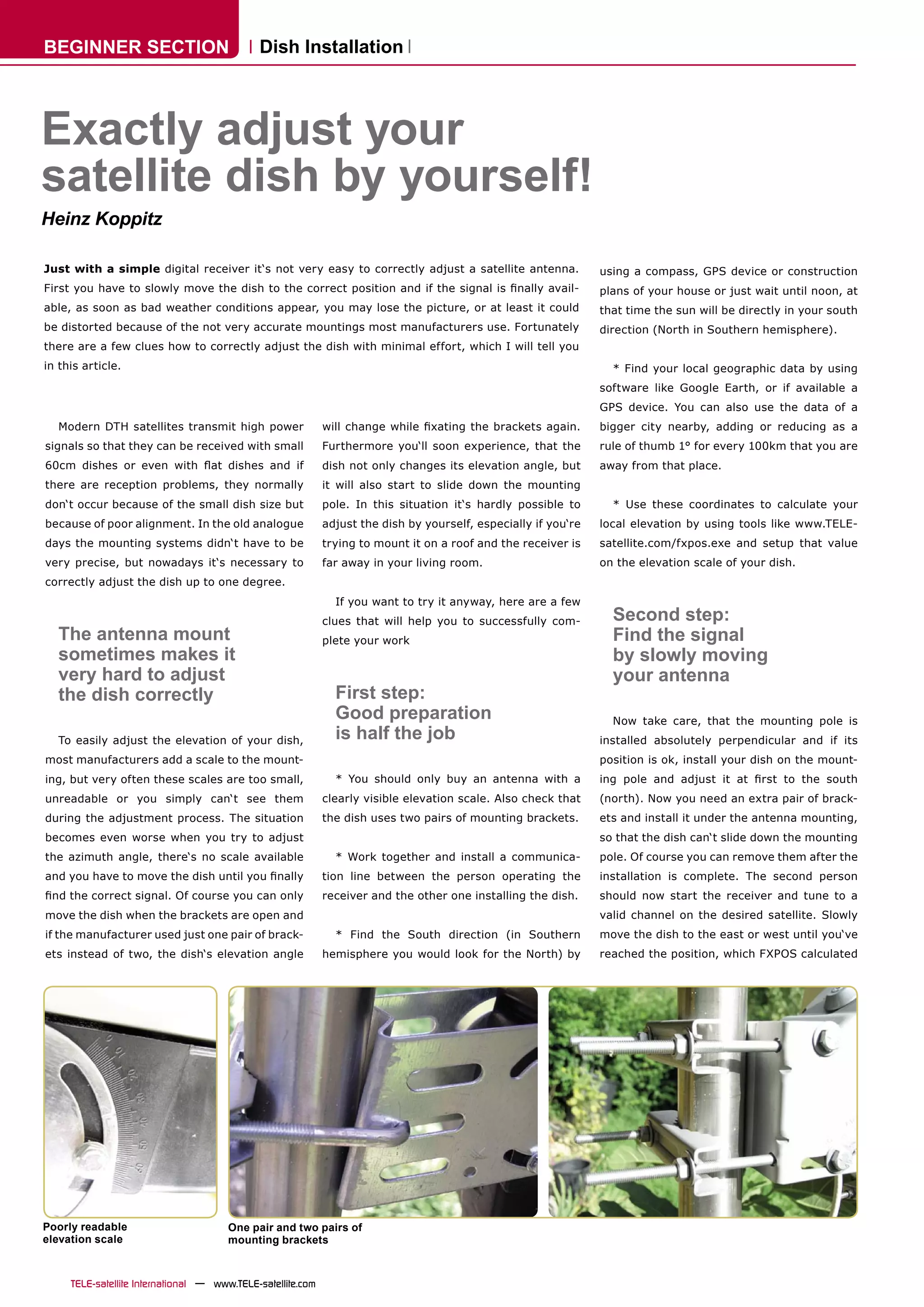
  To easily adjust the elevation of your dish,                 is half the job                                   installed absolutely perpendicular and if its
most manufacturers add a scale to the mount-                                                                     position is ok, install your dish on the mount-
ing, but very often these scales are too small,                * You should only buy an antenna with a           ing pole and adjust it at first to the south
unreadable or you simply can‘t see them                      clearly visible elevation scale. Also check that    (north). Now you need an extra pair of brack-
during the adjustment process. The situation                 the dish uses two pairs of mounting brackets.       ets and install it under the antenna mounting,
becomes even worse when you try to adjust                                                                        so that the dish can‘t slide down the mounting
the azimuth angle, there‘s no scale available                  * Work together and install a communica-          pole. Of course you can remove them after the
and you have to move the dish until you finally               tion line between the person operating the          installation is complete. The second person
find the correct signal. Of course you can only               receiver and the other one installing the dish.     should now start the receiver and tune to a
move the dish when the brackets are open and                                                                     valid channel on the desired satellite. Slowly
if the manufacturer used just one pair of brack-               * Find the South direction (in Southern           move the dish to the east or west until you‘ve
ets instead of two, the dish‘s elevation angle               hemisphere you would look for the North) by         reached the position, which FXPOS calculated


Poorly readable                        One pair and two pairs of
elevation scale                        mounting brackets


     TELE-satellite International — www.TELE-satellite.com
for your azimuth angle. Now the receiver              The last step to perfect signal reception is      you have to install between your antenna and
should already show a signal, if it does not,       the fine tuning of your antenna. It‘s necessary      the receiver by using F plugs, so that it gets
just move the dish a little bit further. If you     to perform it very accurately so that your dish     power from your receiver. Its sensitivity is not
can‘t find a valid signal, your elevation angle is   will also work in bad weather conditions and        as high as the one of a professional gauge, but
probably not correctly adjusted, so move the        show you all available transponders.                it‘s ok to determine the best position for an
dish back to the south, adjust the elevation                                                            already found satellite.
by 1,2 or even 3 degree and repeat the whole          * Nearly every digital receiver shows a
procedure again until you finally get a signal.      quality indicator bar or even a numeric value          * If you want to change your dishes adjust-
                                                    (normally by pressing the info button), so it‘s     ment frequently to different satellites, you
                                                    again up to your aid to tell you these values       should consider buying a DiSEqC motor. These
  Third step:                                       while you fine tune the antenna.                     motors work very accurately in 1/10° steps and
  Fine tuning for your dish                                                                             you can easily receive all available satellites
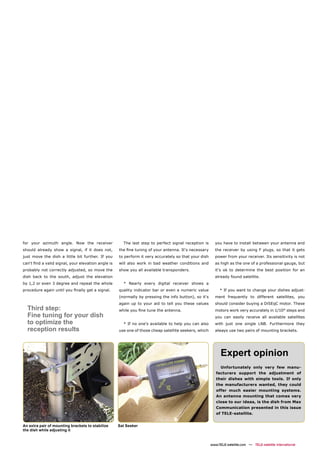
  to optimize the                                     * If no one’s available to help you can also      with just one single LNB. Furthermore they
  reception results                                 use one of those cheap satellite seekers, which     always use two pairs of mounting brackets.


                                                                                                            Expert opinion
                                                                                                            Unfortunately only very few manu-
                                                                                                         facturers support the adjustment of
                                                                                                         their dishes with simple tools. If only
                                                                                                         the manufacturers wanted, they could
                                                                                                         offer much easier mounting systems.
                                                                                                         An antenna mounting that comes very
                                                                                                         close to our ideas, is the dish from Max
                                                                                                         Communication presented in this issue
                                                                                                         of TELE-satellite.


An extra pair of mounting brackets to stabilize     Sat Seeker
the dish while adjusting it


                                                                                                      www.TELE-satellite.com — TELE-satellite International

Beginner

  • 1.
    BEGINNER SECTION Dish Installation Exactly adjust your satellite dish by yourself! Heinz Koppitz Just with a simple digital receiver it‘s not very easy to correctly adjust a satellite antenna. using a compass, GPS device or construction First you have to slowly move the dish to the correct position and if the signal is finally avail- plans of your house or just wait until noon, at able, as soon as bad weather conditions appear, you may lose the picture, or at least it could that time the sun will be directly in your south be distorted because of the not very accurate mountings most manufacturers use. Fortunately direction (North in Southern hemisphere). there are a few clues how to correctly adjust the dish with minimal effort, which I will tell you in this article. * Find your local geographic data by using software like Google Earth, or if available a GPS device. You can also use the data of a Modern DTH satellites transmit high power will change while fixating the brackets again. bigger city nearby, adding or reducing as a signals so that they can be received with small Furthermore you‘ll soon experience, that the rule of thumb 1° for every 100km that you are 60cm dishes or even with flat dishes and if dish not only changes its elevation angle, but away from that place. there are reception problems, they normally it will also start to slide down the mounting don‘t occur because of the small dish size but pole. In this situation it‘s hardly possible to * Use these coordinates to calculate your because of poor alignment. In the old analogue adjust the dish by yourself, especially if you‘re local elevation by using tools like www.TELE- days the mounting systems didn‘t have to be trying to mount it on a roof and the receiver is satellite.com/fxpos.exe and setup that value very precise, but nowadays it‘s necessary to far away in your living room. on the elevation scale of your dish. correctly adjust the dish up to one degree. If you want to try it anyway, here are a few clues that will help you to successfully com- Second step: The antenna mount plete your work Find the signal sometimes makes it by slowly moving very hard to adjust your antenna the dish correctly First step: Good preparation Now take care, that the mounting pole is To easily adjust the elevation of your dish, is half the job installed absolutely perpendicular and if its most manufacturers add a scale to the mount- position is ok, install your dish on the mount- ing, but very often these scales are too small, * You should only buy an antenna with a ing pole and adjust it at first to the south unreadable or you simply can‘t see them clearly visible elevation scale. Also check that (north). Now you need an extra pair of brack- during the adjustment process. The situation the dish uses two pairs of mounting brackets. ets and install it under the antenna mounting, becomes even worse when you try to adjust so that the dish can‘t slide down the mounting the azimuth angle, there‘s no scale available * Work together and install a communica- pole. Of course you can remove them after the and you have to move the dish until you finally tion line between the person operating the installation is complete. The second person find the correct signal. Of course you can only receiver and the other one installing the dish. should now start the receiver and tune to a move the dish when the brackets are open and valid channel on the desired satellite. Slowly if the manufacturer used just one pair of brack- * Find the South direction (in Southern move the dish to the east or west until you‘ve ets instead of two, the dish‘s elevation angle hemisphere you would look for the North) by reached the position, which FXPOS calculated Poorly readable One pair and two pairs of elevation scale mounting brackets TELE-satellite International — www.TELE-satellite.com
  • 2.
    for your azimuthangle. Now the receiver The last step to perfect signal reception is you have to install between your antenna and should already show a signal, if it does not, the fine tuning of your antenna. It‘s necessary the receiver by using F plugs, so that it gets just move the dish a little bit further. If you to perform it very accurately so that your dish power from your receiver. Its sensitivity is not can‘t find a valid signal, your elevation angle is will also work in bad weather conditions and as high as the one of a professional gauge, but probably not correctly adjusted, so move the show you all available transponders. it‘s ok to determine the best position for an dish back to the south, adjust the elevation already found satellite. by 1,2 or even 3 degree and repeat the whole * Nearly every digital receiver shows a procedure again until you finally get a signal. quality indicator bar or even a numeric value * If you want to change your dishes adjust- (normally by pressing the info button), so it‘s ment frequently to different satellites, you again up to your aid to tell you these values should consider buying a DiSEqC motor. These Third step: while you fine tune the antenna. motors work very accurately in 1/10° steps and Fine tuning for your dish you can easily receive all available satellites to optimize the * If no one’s available to help you can also with just one single LNB. Furthermore they reception results use one of those cheap satellite seekers, which always use two pairs of mounting brackets. Expert opinion Unfortunately only very few manu- facturers support the adjustment of their dishes with simple tools. If only the manufacturers wanted, they could offer much easier mounting systems. An antenna mounting that comes very close to our ideas, is the dish from Max Communication presented in this issue of TELE-satellite. An extra pair of mounting brackets to stabilize Sat Seeker the dish while adjusting it www.TELE-satellite.com — TELE-satellite International