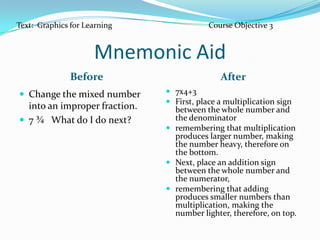
Mnemonic AidBeforeAfterChange themixed number into an improper fraction.7 ¾ What do I do next?7x4+3First, place a multiplication sign between the whole number and the denominator remembering that multiplication produces larger number, making the number heavy, therefore on the bottom. Next, place an addition sign between the whole number and the numerator, remembering that adding produces smaller numbers than multiplication, making the number lighter, therefore, on top. Text: Graphics for Learning Course Objective 3
3.
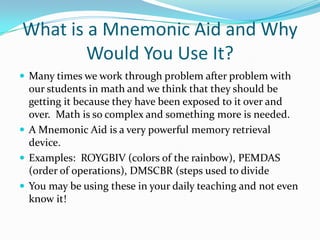
What is aMnemonic Aid and Why Would You Use It?Many times we work through problem after problem with our students in math and we think that they should be getting it because they have been exposed to it over and over. Math is so complex and something more is needed.A Mnemonic Aid is a very powerful memory retrieval device.Examples: ROYGBIV (colors of the rainbow), PEMDAS (order of operations), DMSCBR (steps used to divideYou may be using these in your daily teaching and not even know it!
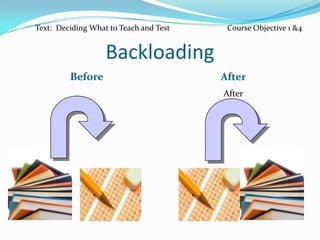
Why Use Backloading?Whynot create the test before you even begin teaching?This will allow for alignment throughout the entire unit. You will only be teaching what you are testing and what you are testing should be what they learned.test=curriculum
6.
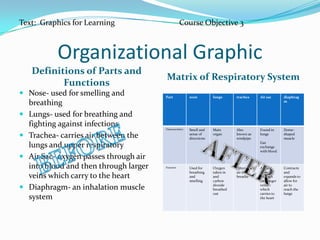
Organizational GraphicDefinitions ofParts and FunctionsMatrix of Respiratory SystemNose- used for smelling and breathingLungs- used for breathing and fighting against infectionsTrachea- carries air between the lungs and upper respiratoryAir Sac- oxygen passes through air into blood and then through larger veins which carry to the heartDiaphragm- an inhalation muscle systemText: Graphics for Learning Course Objective 3BEFOREAFTER
7.
Organizational Graphics Keepyou OrganizedWhat is a Matrix? A matrix is a two-dimensional display of information that allows the viewer to quickly compare feature differences among different things.More relational learning takes placeMatrices use fewer words and physically organize ideas by topic and categories
8.
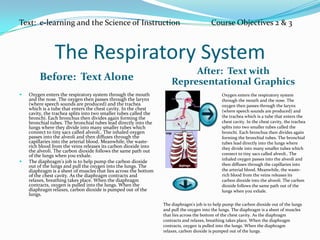
The Respiratory SystemBefore: Text AloneAfter: Text with Representational GraphicsOxygen enters the respiratory system through the mouth and the nose. The oxygen then passes through the larynx (where speech sounds are produced) and the trachea which is a tube that enters the chest cavity. In the chest cavity, the trachea splits into two smaller tubes called the bronchi. Each bronchus then divides again forming the bronchial tubes. The bronchial tubes lead directly into the lungs where they divide into many smaller tubes which connect to tiny sacs called alveoli.. The inhaled oxygen passes into the alveoli and then diffuses through the capillaries into the arterial blood. Meanwhile, the waste-rich blood from the veins releases its carbon dioxide into the alveoli. The carbon dioxide follows the same path out of the lungs when you exhale.The diaphragm's job is to help pump the carbon dioxide out of the lungs and pull the oxygen into the lungs. The diaphragm is a sheet of muscles that lies across the bottom of the chest cavity. As the diaphragm contracts and relaxes, breathing takes place. When the diaphragm contracts, oxygen is pulled into the lungs. When the diaphragm relaxes, carbon dioxide is pumped out of the lungs.Text: e-learning and the Science of Instruction Course Objectives 2 & 3 Oxygen enters the respiratory system through the mouth and the nose. The oxygen then passes through the larynx (where speech sounds are produced) and the trachea which is a tube that enters the chest cavity. In the chest cavity, the trachea splits into two smaller tubes called the bronchi. Each bronchus then divides again forming the bronchial tubes. The bronchial tubes lead directly into the lungs where they divide into many smaller tubes which connect to tiny sacs called alveoli.. The inhaled oxygen passes into the alveoli and then diffuses through the capillaries into the arterial blood. Meanwhile, the waste-rich blood from the veins releases its carbon dioxide into the alveoli. The carbon dioxide follows the same path out of the lungs when you exhale.The diaphragm's job is to help pump the carbon dioxide out of the lungs and pull the oxygen into the lungs. The diaphragm is a sheet of muscles that lies across the bottom of the chest cavity. As the diaphragm contracts and relaxes, breathing takes place. When the diaphragm contracts, oxygen is pulled into the lungs. When the diaphragm relaxes, carbon dioxide is pumped out of the lungs.
9.
Text vs. Textand GraphicsIncluding graphics with text helps the learner visualize the text and build a mental model.“People are more likely to understand material when they can engage in active learning.” Making connectionsMake sure that your graphic supports the textBeware of “decorative graphics”- They do not improve learning. They are more of an eye candy.
10.
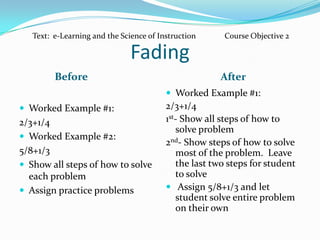
FadingBefore AfterWorked Example #1: 2/3+1/4Worked Example #2: 5/8+1/3 Show all steps of how to solve each problemAssign practice problems Worked Example #1: 2/3+1/41st- Show all steps of how to solve problem2nd- Show steps of how to solve most of the problem. Leave the last two steps for student to solve Assign 5/8+1/3 and let student solve entire problem on their ownText: e-Learning and the Science of Instruction Course Objective 2
11.
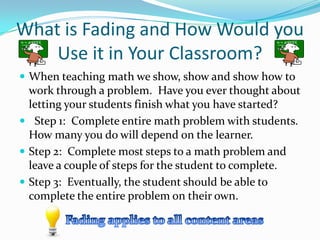
What is Fadingand How Would you Use it in Your Classroom?When teaching math we show, show and show how to work through a problem. Have you ever thought about letting your students finish what you have started? Step 1: Complete entire math problem with students. How many you do will depend on the learner.Step 2: Complete most steps to a math problem and leave a couple of steps for the student to complete.Step 3: Eventually, the student should be able to complete the entire problem on their own. Fading applies to all content areas
12.
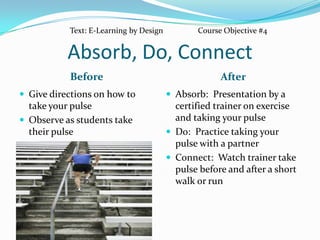
Absorb, Do, ConnectBeforeAfterGivedirections on how to take your pulseObserve as students take their pulseAbsorb: Presentation by a certified trainer on exercise and taking your pulseDo: Practice taking your pulse with a partnerConnect: Watch trainer take pulse before and after a short walk or runText: E-Learning by Design Course Objective #4
13.
Activities for yourClassroomAbsorb Activities: Read, watch, and listenDo Activities: Practice, explore, and discoverConnect Activities: Connect learning to life, work and prior learning
Editor's Notes
#11 Resource: Clark, Ruth Colvin, & Mayer, Richard E.: e-Learning and the Science of InstructionObjective #2


![Decorating On A Budget[2]](https://cdn.slidesharecdn.com/ss_thumbnails/decoratingonabudget2-1300038919055-phpapp02-thumbnail.jpg?width=640&height=640&fit=bounds)


