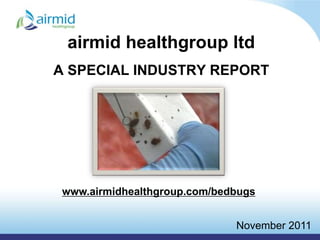





airmid healthgroup ltd
A SPECIAL INDUSTRY REPORT


 www.airmidhealthgroup.com/bedbugs


                              November 2011
Objectives of talk
•     Overview of the issue
•     Fast facts
•     Type of tests that should be considered
•     Testing facilities that should be used
•     Further reading
•     About Airmid and contact info

    This slides accompany a lecture given at Trinity Enterprise Campus by the Bed Bug Research Team

            For further information contact www.airmidhealthgroup.com/bedbugs
Fast Facts
•   Ability to stop the spread of bed bugs is almost non-existent
•   Could almost say it is a pandemic
•   Bed bugs are highly resistant to many of the pesticides that are used to treat
    them
•   Can be found in beds, chairs, sofas, electrical outlets, baseboards, and crevices,
    in homes, apartments, hotels, hospitals, college dorms, offices, high end stores.
•   Getting rid of them is hugely difficult
•   EPA held its first Bed Bug Summit in 2009
•   Federation legislation, known as the “Don’t Let the Bedbugs Bite Act,” has been
    introduced to provide states with more resources to educate health professionals
    and increase inspection, prevention and eradication programs.
•   Bed bugs are difficult to maintain - obligate hematophagous (bloodsucking)
    parasitic insects which feed exclusively on warm blooded mammals.
•   We use specially constructed blood membranes (our dedicated scientists
    volunteer blood!).
•   An adult female will drink about 8mls of blood
A problem of the past, a bigger problem for the future

•    The impact of the rapidly increasing global prevalence of Bedbugs cannot
     be underestimated.
•    Once close to eradication in the late 1940’s, bedbugs have made a
     staggering resurgence particularly in the United States over the past 10
     years but also in western European countries including Ireland and the UK
     where infestation report rates are increasing and distribution areas are
     expanding.
•    Although the basis and point source for this resurgence is unclear, large
     bedbug infestations have been attributed to increased worldwide travel,
     altered insecticide management, and increased resistance to widely used
     broad spectrum insecticides.
•    High resistance has been reported to many of the more limited insecticides
     still available to combat them.
Life cycle

•   Bedbugs undergo incomplete metamorphosis during their lifecycle.
•   Mated adult females will lay up to 5 eggs per day for the duration of their
    life. Eggs are a translucent colour approx 1mm in length and will stick
    strongly to the surface upon which they are laid.
•   Hatching of 1st Instar nymphs occurs 10 days later. After feeding, the 1st
    instar nymph will shed its skin and emerge slightly larger in size as a 2nd
    Instar nymph.
•   This cycle will occur a further 4 times before the adult stage is reached.
    Each nymphal stage requires at least one blood meal to progress to the
    next stage of development.
•   Remarkably, bedbugs have adapted to survive for up to 18 months without
    feeding and up to 2 years in colder environments.
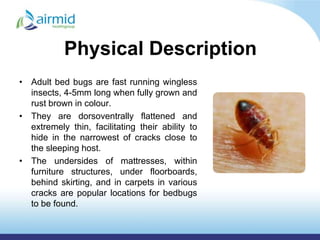
Physical Description
• Adult bed bugs are fast running wingless
  insects, 4-5mm long when fully grown and
  rust brown in colour.
• They are dorsoventrally flattened and
  extremely thin, facilitating their ability to
  hide in the narrowest of cracks close to
  the sleeping host.
• The undersides of mattresses, within
  furniture structures, under floorboards,
  behind skirting, and in carpets in various
  cracks are popular locations for bedbugs
  to be found.
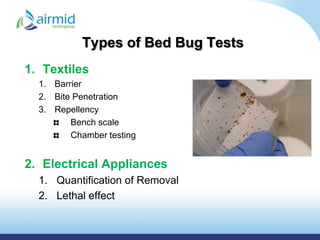
Types of Bed Bug Tests
1. Textiles
  1. Barrier
  2. Bite Penetration
  3. Repellency
         Bench scale
         Chamber testing


2. Electrical Appliances
  1. Quantification of Removal
  2. Lethal effect
Test Facilities
• Climate-Controlled Environmental Chambers
  – Bed Bugs
  – Allergen
  – Environmental


• Class II Microbiological Laboratories
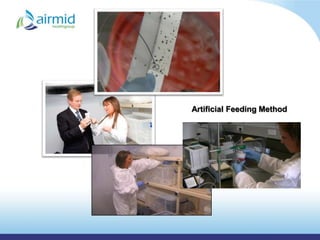
Artificial Feeding Method
Barrier Test
• Artificial Feeding Method (AFM)

• Attractant applied to system to draw bedbugs in a desired direction
    – CO2, heat, chemical cues (pheromones)

• Bedbugs will/will not be able to penetrate test fabric

• Triplicate study with control

• Positive control - AFM where test fabric is replaced with a control
  fabric known to allow bedbugs to penetrate and feed
Bite Penetration Test
• AFM + Non fed bedbugs.

• Hungry bed bugs will be drawn towards warm blood and will
  instinctively want to obtain a blood meal.

• System monitored at defined time intervals

• Fed bedbugs vs. non fed bedbugs visually different due to rapid
  increase in body mass post feeding.

• Evidence of feeding bedbugs indicates that bedbugs can bite
  through the fabric

• Study in Triplicate, with Control
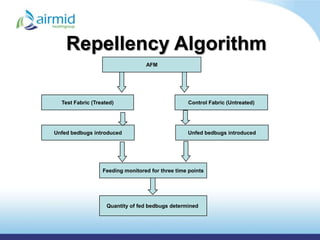
Repellency Algorithm
                                  AFM


  Test Fabric (Treated)                           Control Fabric (Untreated)


Unfed bedbugs introduced                          Unfed bedbugs introduced


                  Feeding monitored for three time points


                    Quantity of fed bedbugs determined
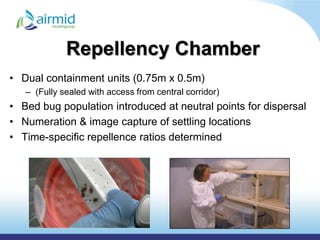
Repellency Chamber
• Dual containment units (0.75m x 0.5m)
   – (Fully sealed with access from central corridor)
• Bed bug population introduced at neutral points for dispersal
• Numeration & image capture of settling locations
• Time-specific repellence ratios determined
www.airmidhealthgroup.com
• Research & Innovation Centre of Excellence
• Biomedical ISO accredited facility
• Specialises in indoor air and health for the built
  environment
• Multidisciplinary staff
• Medical Doctors, Occupational Hygienists PhD's
  researches, specialist technicians
  –   Expertise in
  –   Acarids & Insects,
  –   Mycology, Virology & Bacteriology,
  –   Allergy & Immunology
Accreditation + Validation = Reputation
 • Trusted Test facility to

   • Asthma & Allergy Foundation of America
   • Asthma Society of Canada
   • Asthma UK


 • Exclusive Health Advisor to Major airlines

 • ISO accreditation
For Information Contact
Phone +353-(0)1-633 6820
E-mail: bedbugs@airmidhealthgroup.com
airmid healthgroup ltd.
The Tower,
Trinity Enterprise Campus,
Grand Canal Quay,
Dublin 2, Ireland
www.airmidhealthgroup.com/bedbugs

Bed bug presentation airmid healthgroup

  • 1.
    airmid healthgroup ltd ASPECIAL INDUSTRY REPORT www.airmidhealthgroup.com/bedbugs November 2011
  • 2.
    Objectives of talk • Overview of the issue • Fast facts • Type of tests that should be considered • Testing facilities that should be used • Further reading • About Airmid and contact info This slides accompany a lecture given at Trinity Enterprise Campus by the Bed Bug Research Team For further information contact www.airmidhealthgroup.com/bedbugs
  • 3.
    Fast Facts • Ability to stop the spread of bed bugs is almost non-existent • Could almost say it is a pandemic • Bed bugs are highly resistant to many of the pesticides that are used to treat them • Can be found in beds, chairs, sofas, electrical outlets, baseboards, and crevices, in homes, apartments, hotels, hospitals, college dorms, offices, high end stores. • Getting rid of them is hugely difficult • EPA held its first Bed Bug Summit in 2009 • Federation legislation, known as the “Don’t Let the Bedbugs Bite Act,” has been introduced to provide states with more resources to educate health professionals and increase inspection, prevention and eradication programs. • Bed bugs are difficult to maintain - obligate hematophagous (bloodsucking) parasitic insects which feed exclusively on warm blooded mammals. • We use specially constructed blood membranes (our dedicated scientists volunteer blood!). • An adult female will drink about 8mls of blood
  • 4.
    A problem ofthe past, a bigger problem for the future • The impact of the rapidly increasing global prevalence of Bedbugs cannot be underestimated. • Once close to eradication in the late 1940’s, bedbugs have made a staggering resurgence particularly in the United States over the past 10 years but also in western European countries including Ireland and the UK where infestation report rates are increasing and distribution areas are expanding. • Although the basis and point source for this resurgence is unclear, large bedbug infestations have been attributed to increased worldwide travel, altered insecticide management, and increased resistance to widely used broad spectrum insecticides. • High resistance has been reported to many of the more limited insecticides still available to combat them.
  • 5.
    Life cycle • Bedbugs undergo incomplete metamorphosis during their lifecycle. • Mated adult females will lay up to 5 eggs per day for the duration of their life. Eggs are a translucent colour approx 1mm in length and will stick strongly to the surface upon which they are laid. • Hatching of 1st Instar nymphs occurs 10 days later. After feeding, the 1st instar nymph will shed its skin and emerge slightly larger in size as a 2nd Instar nymph. • This cycle will occur a further 4 times before the adult stage is reached. Each nymphal stage requires at least one blood meal to progress to the next stage of development. • Remarkably, bedbugs have adapted to survive for up to 18 months without feeding and up to 2 years in colder environments.
  • 6.
    Physical Description • Adultbed bugs are fast running wingless insects, 4-5mm long when fully grown and rust brown in colour. • They are dorsoventrally flattened and extremely thin, facilitating their ability to hide in the narrowest of cracks close to the sleeping host. • The undersides of mattresses, within furniture structures, under floorboards, behind skirting, and in carpets in various cracks are popular locations for bedbugs to be found.
  • 7.
    Types of BedBug Tests 1. Textiles 1. Barrier 2. Bite Penetration 3. Repellency Bench scale Chamber testing 2. Electrical Appliances 1. Quantification of Removal 2. Lethal effect
  • 8.
    Test Facilities • Climate-ControlledEnvironmental Chambers – Bed Bugs – Allergen – Environmental • Class II Microbiological Laboratories
  • 9.
  • 10.
    Barrier Test • ArtificialFeeding Method (AFM) • Attractant applied to system to draw bedbugs in a desired direction – CO2, heat, chemical cues (pheromones) • Bedbugs will/will not be able to penetrate test fabric • Triplicate study with control • Positive control - AFM where test fabric is replaced with a control fabric known to allow bedbugs to penetrate and feed
  • 11.
    Bite Penetration Test •AFM + Non fed bedbugs. • Hungry bed bugs will be drawn towards warm blood and will instinctively want to obtain a blood meal. • System monitored at defined time intervals • Fed bedbugs vs. non fed bedbugs visually different due to rapid increase in body mass post feeding. • Evidence of feeding bedbugs indicates that bedbugs can bite through the fabric • Study in Triplicate, with Control
  • 12.
    Repellency Algorithm AFM Test Fabric (Treated) Control Fabric (Untreated) Unfed bedbugs introduced Unfed bedbugs introduced Feeding monitored for three time points Quantity of fed bedbugs determined
  • 13.
    Repellency Chamber • Dualcontainment units (0.75m x 0.5m) – (Fully sealed with access from central corridor) • Bed bug population introduced at neutral points for dispersal • Numeration & image capture of settling locations • Time-specific repellence ratios determined
  • 14.
    www.airmidhealthgroup.com • Research &Innovation Centre of Excellence • Biomedical ISO accredited facility • Specialises in indoor air and health for the built environment • Multidisciplinary staff • Medical Doctors, Occupational Hygienists PhD's researches, specialist technicians – Expertise in – Acarids & Insects, – Mycology, Virology & Bacteriology, – Allergy & Immunology
  • 15.
    Accreditation + Validation= Reputation • Trusted Test facility to • Asthma & Allergy Foundation of America • Asthma Society of Canada • Asthma UK • Exclusive Health Advisor to Major airlines • ISO accreditation
  • 17.
    For Information Contact Phone+353-(0)1-633 6820 E-mail: bedbugs@airmidhealthgroup.com airmid healthgroup ltd. The Tower, Trinity Enterprise Campus, Grand Canal Quay, Dublin 2, Ireland www.airmidhealthgroup.com/bedbugs