Social Media and Employer Branding
Lydia Sewell, Josh Harris and Amanda Matuleviciute
ABOUT US AND WHAT
WE’VE BEEN DOING…
 Therefore as your employees are representatives of the
company, it is important that they act responsibly.
 Currently, social media plays a huge part in our daily
lives
 It has an impact on how we communicate and how
organisations promote and control their reputation.
Which social media site has the biggest active audience?
2 Billion Users 1.5 Billion Users 700 Million Users
368 Million Users 328 Million Users 200 Million Users
106 Million Users
To prevent issues around social media arising in your business we would
strongly recommend using a social media policy.
If your organisation doesn’t have a social media policy in place it can cause
legal and security issues. If ever a problem was to arise without a policy the
solution becomes difficult as there is no policy in place to prove ‘right’ or
‘wrong’
 What is a social media policy and how can I use it effectively in my
business?
Social Media in the workplace
How to create your policy?
Social Media in the workplace
First things first separate social media into two
sections:
 Social media policy for the company’s official
accounts.
 Social media policy for employees.
1. Rules and Regulations
o Brand Guidelines
o Etiquette and Engagement
o Confidentiality
2. Roles and Responsibilities
3. Potential Legal Risks
4. Security Risks
5. Accountability
An example of a social media policy is this one from Greteman Group; While
you are on company time, please refrain from online activities that don’t bring
value to Greteman Group. Think of your personal time online in the same way
you think of personal phone calls or emails.
Your responsibility as an employer!
 Employees should feel safe and know the guidelines for social media use
 Employees should be given a copy of the Policy, signed by them
 If employees are still unsure training sessions should be provided for the benefit of
your business and to also make sure the employee is comfortable
Social Media in the workplace
We know that at Bear Hugs you use social media to advertise your brand and
also jobs. Social media training courses can also include training for creation
of apps, something you may find useful in the future of your organisation.
As your company grows you may find it beneficial to give some of your
employees training in the use of social media. There are different ways you
can go about training your employees:
 You can have an external company to train the employees
 Or you the employer can train them yourself
Social Media Training
Here are some benefits for giving your employees social media
training:
 Improves online collaboration
 Empowers Employees to share organisation message
 Increases employee engagement and motivation
 Keeps employees up to date
 Creates Consistency
Social Media Training
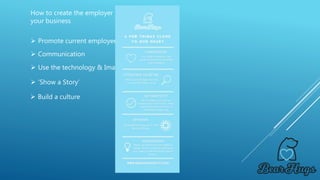
How to create the employer brand you want for
your business
 Promote current employees stories
 Communication
 Use the technology & Imagery
 ‘Show a Story’
 Build a culture

Bear hugs presentation

  • 1.
    Social Media andEmployer Branding Lydia Sewell, Josh Harris and Amanda Matuleviciute
  • 2.
    ABOUT US ANDWHAT WE’VE BEEN DOING…
  • 3.
     Therefore asyour employees are representatives of the company, it is important that they act responsibly.  Currently, social media plays a huge part in our daily lives  It has an impact on how we communicate and how organisations promote and control their reputation.
  • 4.
    Which social mediasite has the biggest active audience? 2 Billion Users 1.5 Billion Users 700 Million Users 368 Million Users 328 Million Users 200 Million Users 106 Million Users
  • 6.
    To prevent issuesaround social media arising in your business we would strongly recommend using a social media policy. If your organisation doesn’t have a social media policy in place it can cause legal and security issues. If ever a problem was to arise without a policy the solution becomes difficult as there is no policy in place to prove ‘right’ or ‘wrong’  What is a social media policy and how can I use it effectively in my business? Social Media in the workplace
  • 7.
    How to createyour policy? Social Media in the workplace First things first separate social media into two sections:  Social media policy for the company’s official accounts.  Social media policy for employees. 1. Rules and Regulations o Brand Guidelines o Etiquette and Engagement o Confidentiality 2. Roles and Responsibilities 3. Potential Legal Risks 4. Security Risks 5. Accountability An example of a social media policy is this one from Greteman Group; While you are on company time, please refrain from online activities that don’t bring value to Greteman Group. Think of your personal time online in the same way you think of personal phone calls or emails.
  • 8.
    Your responsibility asan employer!  Employees should feel safe and know the guidelines for social media use  Employees should be given a copy of the Policy, signed by them  If employees are still unsure training sessions should be provided for the benefit of your business and to also make sure the employee is comfortable Social Media in the workplace
  • 9.
    We know thatat Bear Hugs you use social media to advertise your brand and also jobs. Social media training courses can also include training for creation of apps, something you may find useful in the future of your organisation. As your company grows you may find it beneficial to give some of your employees training in the use of social media. There are different ways you can go about training your employees:  You can have an external company to train the employees  Or you the employer can train them yourself Social Media Training
  • 10.
    Here are somebenefits for giving your employees social media training:  Improves online collaboration  Empowers Employees to share organisation message  Increases employee engagement and motivation  Keeps employees up to date  Creates Consistency Social Media Training
  • 11.
    How to createthe employer brand you want for your business  Promote current employees stories  Communication  Use the technology & Imagery  ‘Show a Story’  Build a culture

Editor's Notes

  • #3 We are here today to present to you our findings on how successful the use of social media can be in creating a customer brand and showcasing your products, we also looked at ways you could use social media training to develop your employees knowledge of this and how to create a fantastic employer brand as your organisation grows and grows. We hope you find the information we have collated to be of use within your organisation both now and in the future.
  • #4 Currently social media plays a large part in our current daily lives, with the average 18-25 year old spending at least 30% of their day on their phones or social media. Online shopping has also had a massive increase especially in the amount of online ‘virtual shops’ with no actual high street stores. This includes both small and global companies.
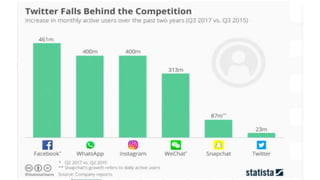
  • #5 An insight into global scale social media. Unsurprisingly Facebook currently has the most active users globally closely followed my YouTube. Quite surprisingly Instagram was in 7th place rankings with 700 Million global users. With Facebook having the most daily active users compared to other social networks it's important to know how your content may potentially perform and what features to use to optimize the reach of content. Facebook is a great social platform for organic and paid opportunities with a huge potential reach - just remember to target content to your business personas. I also found out that currently Twitter is falling behind other social media platforms and is struggling to keep up the increase in number of active users that other platforms are producing such as Facebook at 461 Million new users!
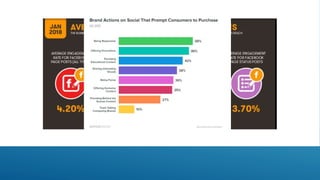
  • #6 With Facebook being the leader of active social media, here are some interesting facts on the average interest rates its users have with different types of posts. This shows that the highest levels of engagement come from a video post on Facebook with the least engaging being the average ‘status update’. This could be really useful for you when trying to target posts at your followers, after now knowing that videos get the most attention on average a great way to showcase your brand and products to your customers/ followers could be through ‘behind the scenes videos’, ‘new product update videos’ and seasonal themed videos to showcase your products throughout the year. On this next graph it also shows that 46% of people who buy products from company's social media say promotions would make them more likely to buy something, also 38% said showing interesting visuals of products or behind the scenes information would also make them for likely to click buy!
  • #7 To prevent issues around social media arising in your business we would strongly recommend using a social media policy. If your organisation doesn’t have a social media policy in place, if ever an employee posts something online about the company which you deem to be unacceptable you are unable to take any disciplinary action as there is no policy in place to prove ‘right’ or ‘wrong’ What is a social media policy and how can I use it effectively in my business? A social media policy outlines how an organization and its employees should conduct themselves online. It also helps you to safeguard your brand’s reputation while also encouraging employees to responsibly share the company’s message. As social media is ever changing, it’s good to have your policy as an open written document which can be changed as and when is required.
  • #8 First things first separate social media into two sections: Social media policy for the company’s official accounts. Social media policy for employees. 1. Rules and Regulations Outline your company’s expectations for appropriate employee behaviour and conduct on company or personal social media. For example restricting the use of controversial opinions when posting about Bear Hugs Brand Guidelines- How to talk about the company and products Etiquette and Engagement- Outline how employees should respond to both negative and positive feedback from customers Confidentiality- Define what should and shouldn’t be shared 2. Roles and Responsibilities Should outline who is responsible for what tasks Some roles to include in this section may be Message approval, Customer service, Social engagement, Security and legal concerns, Staff training 3. Potential Legal Risks -Your social media policy should provide clear guidelines for handling any areas of potential concern. Do your research and be sure to involve legal consultation. Areas this covers are: Crediting sources, privacy and disclosure procedures, employee disclaimers 4. Security Risks -Social media policies can help safeguard against such risks by making employees aware of the threats, how to avoid them, and what to do should an attack occur. Your policy should provide guidelines on how to, Create secure passwords, Avoid phishing attacks, spam, scams, and other malicious threats and how to respond in the event of a security breach or attack 5. Accountability - Every employee is responsible for what they publish online.  An example of a social media policy is this one from Greteman Group; While you are on company time, please refrain from online activities that don’t bring value to Greteman Group. Think of your personal time online in the same way you think of personal phone calls or emails. https://blog.hootsuite.com/social-media-policy-for-employees/
  • #9 Your responsibility as an employer! Employees should feel safe and know the guidelines for social media use Employees should be given a copy of the Policy, signed by them If employees are still unsure training sessions should be provided for the benefit of your business and to also make sure the employee is comfortable
  • #10 We know that at Bear Hugs you use social media to advertise your brand and also jobs. Social media training courses can also include training for creation of apps, something you may find useful in the future of your organisation. As your company grows you may find it beneficial to give some of your employees training in the use of social media. There are different ways you can go about training your employees: You can have an external company to train the employees Or you the employer can train them yourself A well known company that offers social media training for small businesses such as yours is Pink Spaghetti. They offer various different courses targeted at businesses that want to understand more about social media.
  • #11 Here are some benefits for giving your employees social media training: Improves online collaboration Empowers Employees to share organisation message Keeps employees up to date Increases employee engagement and motivation Creates consistency throughout the business
  • #12 Promote current employees stories- this allows new employees to see the opportunities your company offers to employees and if this is the store of career path they want Communication- Ask your employees what they would say to their friends about working for your business. Using the core knowledge of your employees to develop your company’s corporate image is a really effective way of building your employer brand. Use the technology- this allows you to showcase the talent you currently have and what day-to-day life in your business is like, this gives people to make their own opinions as to what your companies philosophy is – imagery- This shows the company off in its best light and not only shows off to future employees but also customers Show a story- is a scheme some businesses use to tell the employee story of current employees rather than just writing it on a website you can show everyone rather than just telling them Build a culture- establish your company as your own, we believe you have already done this aspect along with others. Your website/ social media really harnesses what your company is all about, this is especially showcased in your company values.