Heuristic evaluation of
game-based BCSSs: elements
for discussion
game-based BCSSs: elements
for discussion
v@playfulpandas.org
(v.rao@vu.nl)
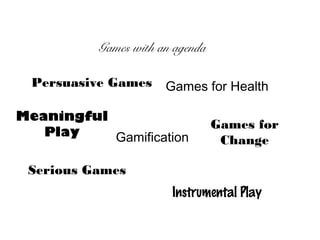
Serious Games
Meaningful
Play
Persuasive Games
Games with an agenda
Instrumental Play
Games for Health
Games for
ChangeGamification
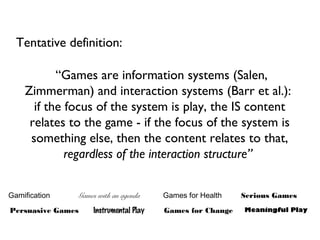
“Games are information systems (Salen,
Zimmerman) and interaction systems (Barr et al.):
if the focus of the system is play, the IS content
relates to the game - if the focus of the system is
something else, then the content relates to that,
regardless of the interaction structure”
Serious Games
Meaningful PlayPersuasive Games
Games with an agenda
Instrumental Play
Games for Health
Games for Change
Gamification
Tentative definition:
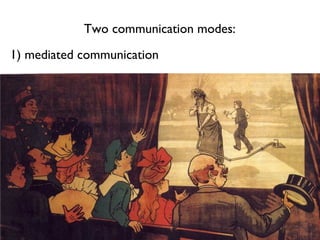
1) mediated communication
Two communication modes:
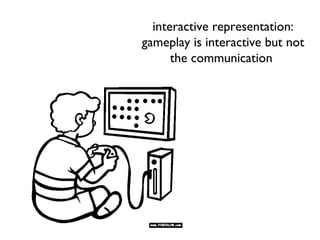
interactive representation:
gameplay is interactive but not
the communication
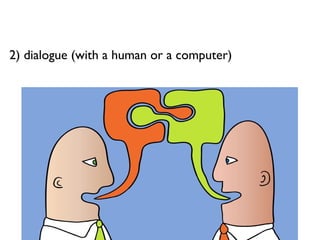
2) dialogue (with a human or a computer)
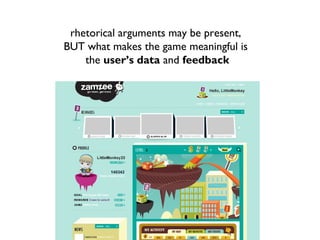
rhetorical arguments may be present,
BUT what makes the game meaningful is
the user’s data and feedback
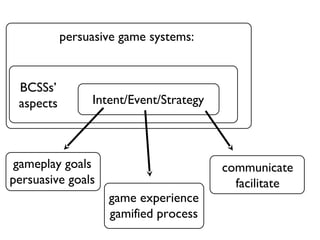
Intent/Event/Strategy
persuasive game systems:
BCSSs’
aspects
gameplay goals
persuasive goals
communicate
facilitate
game experience
gamified process
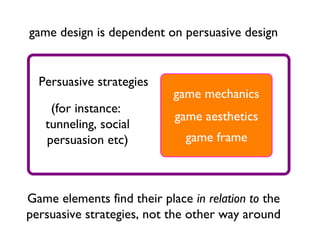
game design is dependent on persuasive design
game mechanics
Persuasive strategies
game aesthetics
game frame
(for instance:
tunneling, social
persuasion etc)
Game elements find their place in relation to the
persuasive strategies, not the other way around
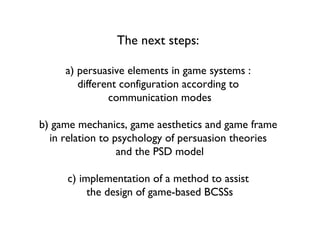
The next steps:
a) persuasive elements in game systems :
different configuration according to
communication modes
b) game mechanics, game aesthetics and game frame
in relation to psychology of persuasion theories
and the PSD model
c) implementation of a method to assist
the design of game-based BCSSs
Thank you for listening!
Some references:
Salen, K. Zimmerman, E.: Rules of Play, Game Design Fundamentals, MIT Press (2004).
Barr, P., Noble, J., and Biddle, R.: Video game values: Human- computer interaction and games. Interacting with
Computers 19, 2 (2007), 180-195.
Oinas-Kukkonen, H. and Harjumaa, M. Towards deeper understanding of persuasion in software and information
systems. Proceedings of The First International Conference on Advances in Human-Computer Interaction (ACHI
2008), 200-205.
Svahn M.: Processing Play: Perceptions of Persuasion. Digra Conference Proceedings (2009)

BCSS seminar Persuasive 2014 Padua

  • 1.
    Heuristic evaluation of game-basedBCSSs: elements for discussion game-based BCSSs: elements for discussion v@playfulpandas.org (v.rao@vu.nl)
  • 2.
    Serious Games Meaningful Play Persuasive Games Gameswith an agenda Instrumental Play Games for Health Games for ChangeGamification
  • 3.
    “Games are informationsystems (Salen, Zimmerman) and interaction systems (Barr et al.): if the focus of the system is play, the IS content relates to the game - if the focus of the system is something else, then the content relates to that, regardless of the interaction structure” Serious Games Meaningful PlayPersuasive Games Games with an agenda Instrumental Play Games for Health Games for Change Gamification Tentative definition:
  • 4.
    1) mediated communication Twocommunication modes:
  • 5.
    interactive representation: gameplay isinteractive but not the communication
  • 6.
    2) dialogue (witha human or a computer)
  • 7.
    rhetorical arguments maybe present, BUT what makes the game meaningful is the user’s data and feedback
  • 8.
    Intent/Event/Strategy persuasive game systems: BCSSs’ aspects gameplaygoals persuasive goals communicate facilitate game experience gamified process
  • 9.
    game design isdependent on persuasive design game mechanics Persuasive strategies game aesthetics game frame (for instance: tunneling, social persuasion etc) Game elements find their place in relation to the persuasive strategies, not the other way around
  • 10.
    The next steps: a)persuasive elements in game systems : different configuration according to communication modes b) game mechanics, game aesthetics and game frame in relation to psychology of persuasion theories and the PSD model c) implementation of a method to assist the design of game-based BCSSs
  • 11.
    Thank you forlistening! Some references: Salen, K. Zimmerman, E.: Rules of Play, Game Design Fundamentals, MIT Press (2004). Barr, P., Noble, J., and Biddle, R.: Video game values: Human- computer interaction and games. Interacting with Computers 19, 2 (2007), 180-195. Oinas-Kukkonen, H. and Harjumaa, M. Towards deeper understanding of persuasion in software and information systems. Proceedings of The First International Conference on Advances in Human-Computer Interaction (ACHI 2008), 200-205. Svahn M.: Processing Play: Perceptions of Persuasion. Digra Conference Proceedings (2009)

Editor's Notes

  • #2 Behavior change support systems, the theoretical model developed by Oinas Kukkonen to describe socio-technical systems that aim to behavior change, is at the moment the most suitable theory to describe a large range of interventions. The systems of heuristics called Persuasive Systems Design model, based on BCSSs theory, has proved useful for analyzing persuasive design in persuasive systems but its categories (primary task, dialogue, credibility, social) leave out many aspects of systems that use the interaction modes of games.
  • #3 Each of these terms evokes a different product, educational games, rhetorical games, games that help children take medicines, games that create a social or civic experience, game elements employed to improve the experience of a boring task such as banking (Mint.com) and make it engaging and enjoyable. It would be useful to find the common strategies among these different ways of understanding persuasive games.
  • #4 let’s try to give a more general definition of persuasive games:
  • #5 So, first of all we can distinguish among two basic structures in systems that use games: one is described in the definition of persuasive games, games with a rethorical content, games that transmit an idea and because of their argument affect attitudes - this kind of games work as other media because they communicate a message
  • #6 the confusion arises from the fact that the medium the story is told with is interactive, but such interaction doesn’t usually take into account the user’s needs and goals in real life because it is focused on telling a story - the communication is then unidirectional, the game (or the author of the game) wants to communicate a concept or information to the player
  • #7 On the other hand, in a dialogic structure the communication is two-ways, and the matters discussed are not just the persuasive content, like in rhetorical games, instead there is a real dialogue between system and user.
  • #8 In the first case of unidirectional communication, we have games that “say” things, create discursive structures and arguments; in this second case, we have games that “do”, games that facilitate or give a more alluring context to real life purposes. Zamzee is a gamification platform to encourage children to improve their fitness habits, it tracks data from wearable sensors and integrates those data into a social game. The feedback provided on such data, and the game structure that makes different users interact with each other, is what makes the game meaningful. Although some rhetorical content is always present (fit is better, social is better, being active is being cool) rhetoric is not the main goal of the system, and the aim is not to change attitudes but first to change behavior.
  • #9 The Behavior Change Support Systems model articulates the design of persuasive systems into three parts or steps: Intent (the persuasive goals) event (the context (technological, social etc) in which the experience takes place), and the strategy (persuasive tools such as different routes to persuasion (Petty, Cacioppo) or persuasive principles such as scarcity, reciprocity, consistency, or social proof (Cialdini), or persuasive technology principles such as suggestions, personalization and tunneling (Fogg). The model outlined by BCSSs can be useful for BCSSs based on game interaction, (game-based BCSSs) with some adjustments: in the intent there are two layers, one is the persuasive goals (for instance, the behavior we want to modify) and the other is the goals of the gameplay. It is important to mention that they are separate because in the last years there has been a silent acknoledgement that to make a game more convincing the gameplay should be conceptually related to the persuasive goals, for example if you want to save trees the game should be a simulation of saving trees). This approach is not useful at all, and by distinguishing between the two we leave more space to understand how we can use gameplay goals (our representation tools or our structural tools) in relation to the desired persuasive goals. At the level of the event, we have to distinguish between the game experience that happens in a separate moment from daily life and is lived in a way similar to television or cinema, as a special moment outside of “reality”, and gamified processes in which the everyday experience of a process is “enhanced” or transformed by the integration of game elements. Such experience is no less real and fruitful than it was before being gamified. It is to see at which level (structural? Psychological?) does the gamification affect the process. Thirdly, the strategy: if we distinguish between games that say and games that do it becomes easier to understand which strategies to adopt case by case, and for the first time we will have something like a range or palette of strategies to choose from.
  • #10 in this framework, the design of the game experience is solidly subordinate to the design of the persuasive strategies.