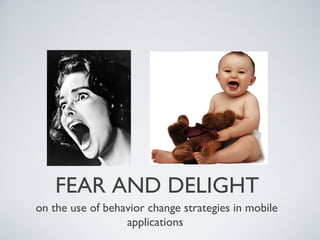
FEAR AND DELIGHT
on the use of behavior change strategies in mobile
applications
write me here:
v@playfulpandas.org

Playful Pandas

Valentina Rao

or here:
@playfulpanda1
Why do you need behavior change?
engage users
with
your app
Target one behavior
(exercise, lose weight, make
people cook more )
Why are the two
(engagement and behavior change)
different?
Emotional connection
with an experience
target behavior
Digression: is Persuasion Evil?

B. J. Fogg
coercion and deception
Unlike old media
persuasive design for interactive media
is more effective when straightforward
Jesse Schell

“Hafta” versus “Wanna”
Create Engagement
Seductive design
Stephen Anderson
“Seduction is the process of deliberately
enticing a person to engage in some sort of behavior
frequently sexual in nature”
fun
unpredictable
stimulating
mysterious
lets people
express themselves
Seductiveness = Usability
/
Delight
ENCHANTMENT
1. a feeling of great pleasure; delight."the enchantment of the
mountains"
2. synonyms:
3. magic, witchcraft, sorcery, wizardry, necromancy; Morecharms,
spells, incantations, mojo;
rarethaumaturgy
"a race of giants skilled in enchantment"
4. allure, delight, charm, beauty, attractiveness, appeal, fascinati
on, irresistibility, magnetism, pull, draw, lure "the enchantment
of the garden by moonlight"
5. bliss, ecstasy, heaven, rapture, joy "being with him was sheer
enchantment"
2.
the state of being under a spell; magic."a world of mystery and
enchantment"

Guy Kawasaki
Stephen Anderson
“Apply Yourself”

“Sugar Coating”
“Mastery”
Sebastian Deterding

Goals + Rules= Interesting Challenges
+ Feedback= EXPERIENCE OF COMPETENCE
give things (experiences) for free
delight and enchantment
ways to mastery
(Target Behavior )
competition via tracking, incentives
Two levels of persuasion:
behavior support
and use support
seamless integration
use = behavior
Where are the triggers?
Computers as actors (and tools, and media)
Cialdini
Persuasion strategies
To conclude....
References
Thank you for listening!
Questions?
v@playfulpandas.org
Twitter:@Playfulpanda1

Rao bc2013

Editor's Notes

  • #4 why do you need to know about behavior change -
  • #5 create emotional connections with your app, encourage the creation new habits (checking in several times a day), develop your applications so that it fits into existing habits - it happens at a level of feelings, in relation to the product or brand
  • #6 otherwise, your app may be targeted to change or create one behavior> a behavior outside of the app: make people go to the cinema more, go exercise, and a behavior inside the app: happens also at the level of feelings, but in relation to a desired behavior
  • #7 it is important to distinguish between the two because there is a great difference at the level of persuasive design, and at the moment the separation between the two fields are quite fuzzy
  • #8 close to brand identity, make people fall in love with your work,
  • #9 targeting behaviors means employing a series of strategies to facilitate the performance of an ACTION if the behavior happens through the app, we are going to see that in more detail in a while
  • #10 evokes masterminds of manipulation, maybe you don’t care, but some people do feel bad about using these techniques, I know I do
  • #11 without using coercion and deception coercion: when you are forced to go through some steps even when you don’t want to deception: when you for instance sign up for something but you are given something else instead
  • #12 Leni Riefenstal/Hitler fear and intimidation
  • #13 difference between a message and interaction
  • #14 how this doesn’t work with new media in general, and mobile apps the user wants to have its say bring ppl to excellence
  • #15 end of digression
  • #17 design for engagement is generous, it gives you stuff
  • #18 it encourages you to be yourself and to encourage your potential
  • #19 it may give you things to do Epic win extra tasks
  • #20 users should fall in love with your design
  • #22 seduction is that little extra beyond usability, that is the minimum we as designer s have to provide
  • #23 Argos eye candy an usual navigation Robbi Leonardi unusual interaction playfulness
  • #25 responsible for first Apple marketing 1984 trustworthiness likeability
  • #26 Ritzer sociologist enchantment of technology from moments of unpredictability and spontaneity experiences of magical consumption
  • #27 things to do: Apply yourself sugar coating mastery
  • #28 BE yourself - mastery your personal path of growth
  • #29 intrinsic extrinsic motivation
  • #30 this concept is very much used in gamification
  • #31 gamification just one way to : give things for free, offer delight and enchantment, offer a way to mastery (page app find)
  • #32 so again, when your aim is not just to engage users with your app but to create new behaviors, you need persuasive design
  • #33 all familiar with BJ Fogg often used in presentations about persuasive design - the point is that this model is not relevant for engagement, this model is useful when you want to create behaviors
  • #34 trigger theory some elements are similar to usability, Fogg is accused of being very general and not immediately applicable
  • #35 apps that support one behavior
  • #36 app support behavior
  • #38 behavior support: seamless integration
  • #39 Mint: support managing your financing when behavior and use overlap
  • #40 use support many applications for bc are very good at making users come back, but experience is all a bit disconnected from the real world and they don’t really support behavior change
  • #41 Fig social support adopt new behaviors for a limited time
  • #42 the same methods are applied if your goal is not to sustain a behavior but to create a new one they produce a new behavior how do they if your app also produces a new behavior you also better focus on this
  • #43 because finally interaction as conversation
  • #44 principles of persuasion derived from face to face interaction