ECHOLOCATION
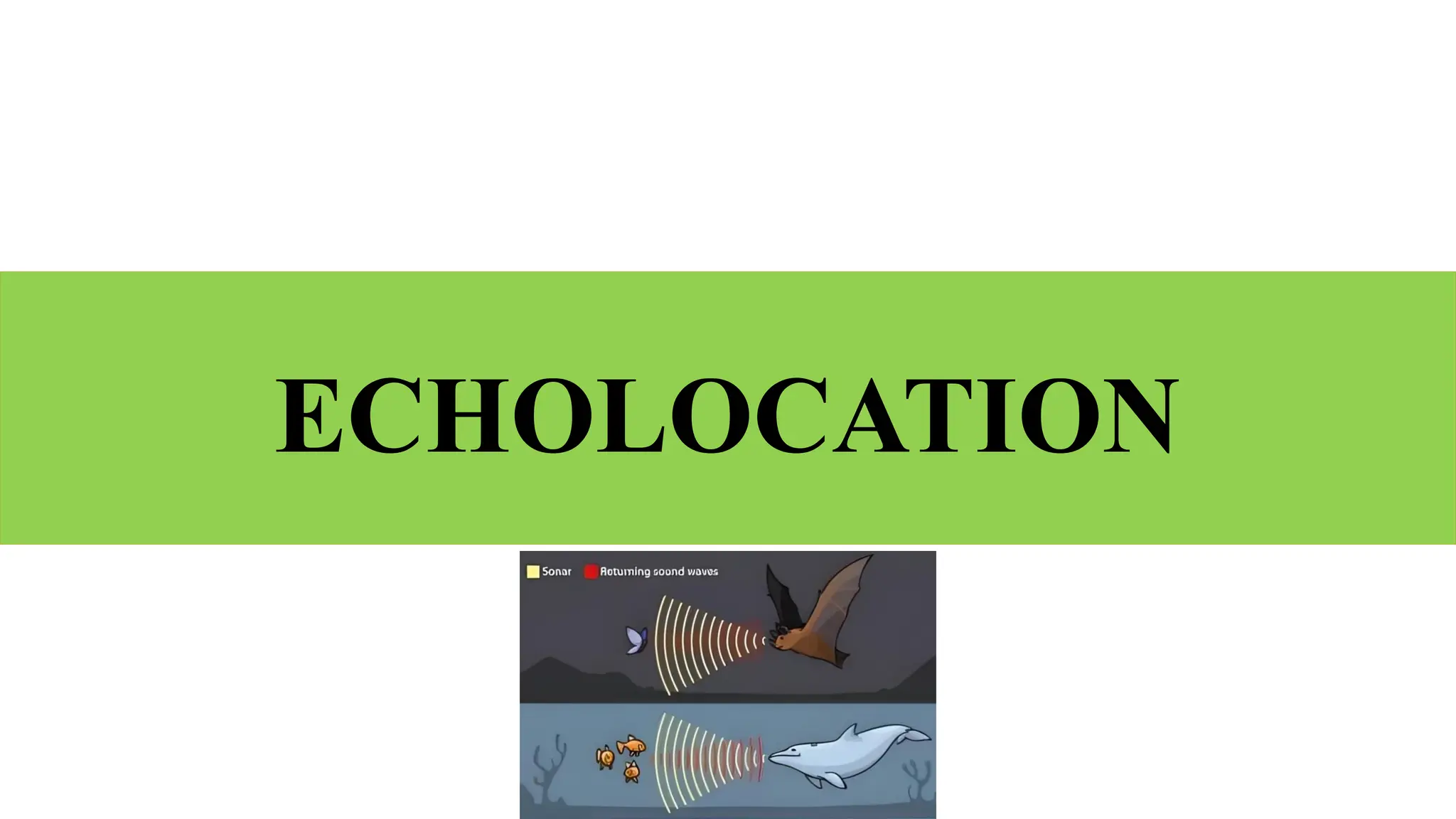
Echolocation IsA Fascinating Biological Phenomenon
Observed In Various Animals, Including Bats, Dolphins &
Some Species Of Birds.
It Involves The Emission Of Sound Waves & Interpretation
Of Echoes Reflected Back From Objects In The
Environment.
This Ability Allows These Animals To Navigate, Perceive
Their Environment, Communicate & Locate Prey Or
Obstacles In Situations Where Vision Alone Would Be
Insufficient, Such As In Darkness Or Murky Water.
6.
ECHOLOCATION – MECHANISM
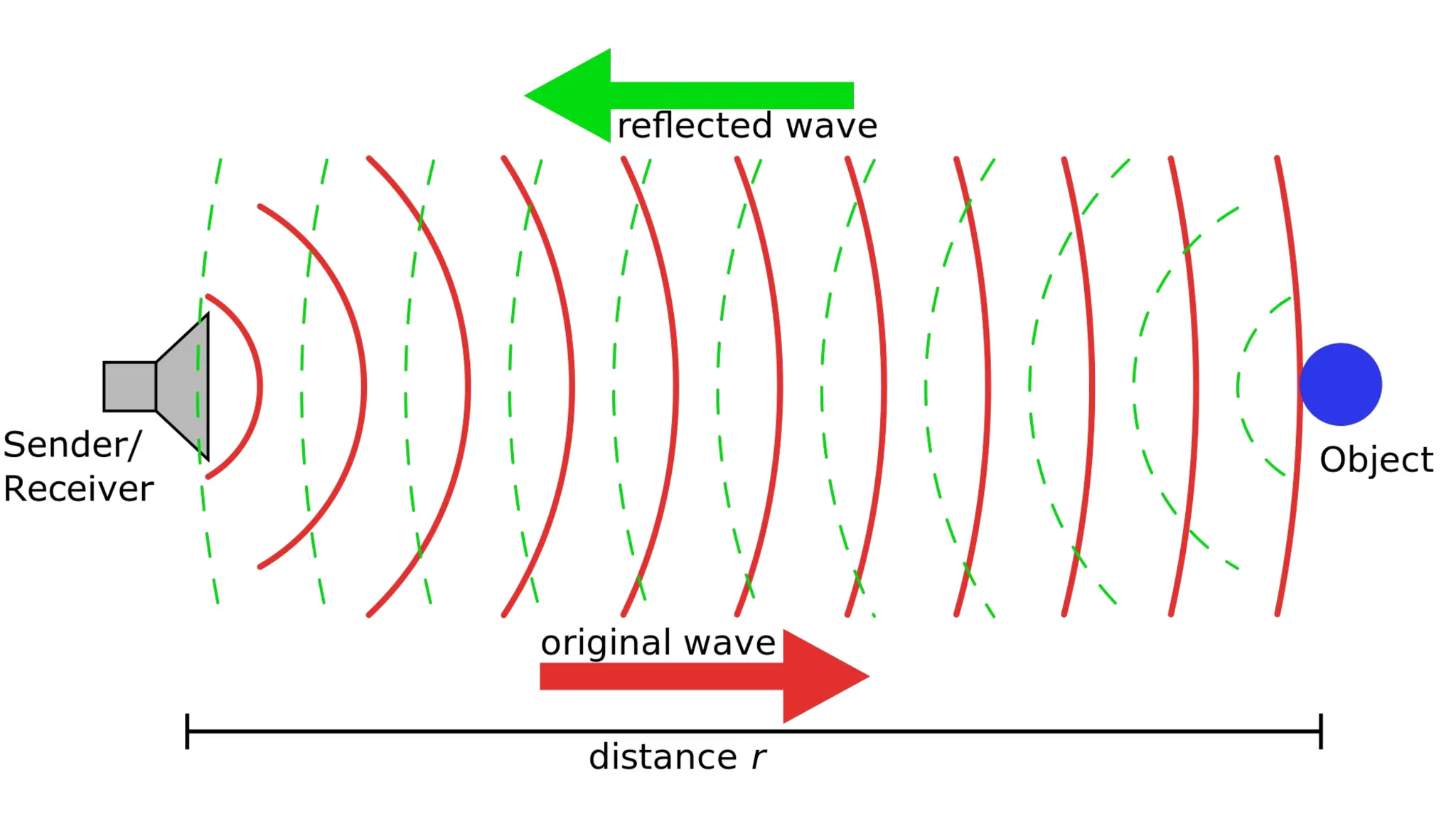
Sound Production: Animals Capable Of Echolocation Emit
High-Frequency Sound Waves, Often Beyond The Range
Of Human Hearing. These Sounds Are Typically Produced
In Specialized Organs Such As The Larynx Or Nasal
Passages.
Sound Propagation: Once Emitted, These Sound Waves
Travel Through The Environment, Where They Encounter
Various Objects.
Echo Reception: Objects In The Environment Reflect A
Portion Of The Emitted Sound Waves Back Towards The
Animal.
7.
ECHOLOCATION – MECHANISM
Sensory Reception: Specialized Sensory Organs, Such As
The Ears Or Other Receptor Structures, Detect These
Returning Echoes.
Neural Processing: The Brain Processes Information
Contained In The Echoes To Create A Spatial Map Of The
Environment, Including The Size, Shape, Distance &
Movement Of Objects.
Frequency Range: Bats Emit Ultrasonic Calls Ranging
From 20 To Over 100 kHz, Whereas Dolphins Produce
Clicks With Frequencies Typically Between 20 & 150 kHz.
9.
ECHOLOCATION – EVOLUTIONARYORIGINS
Bats: They Emit Ultrasonic Calls Through Their Mouths Or
Noses & Listen To Returning Echoes With Their Sensitive
Ears.
Cetaceans: Dolphins, Whales & Porpoises Use
Echolocation Underwater To Navigate, Communicate &
Locate Prey. They Produce High-Frequency Clicks, Which
Are Emitted Through Their Blowholes & Focused By
Structures In Their Heads. The Returning Echoes Are
Detected By Specialized Structures In Their Lower Jaw,
Allowing Them To Perceive Objects In The Water.
10.
ECHOLOCATION – BEHAVIOURALECOLOGY
Foraging: Echolocation Enables Animals To Efficiently
Locate & Capture Prey, Even In Complex Environments.
Navigation: Echolocation Helps Animals Navigate Through
Their Habitats, Avoiding Obstacles & Locating Roosts Or
Breeding Sites.
Communication: Echolocation Is Also Used For
Communication Within Some Species. Dolphins For
Instance, Use Different Click Patterns To Convey
Information To Each Other.
11.
TECHNOLOGICAL APPLICATIONS OFECHOLOCATION
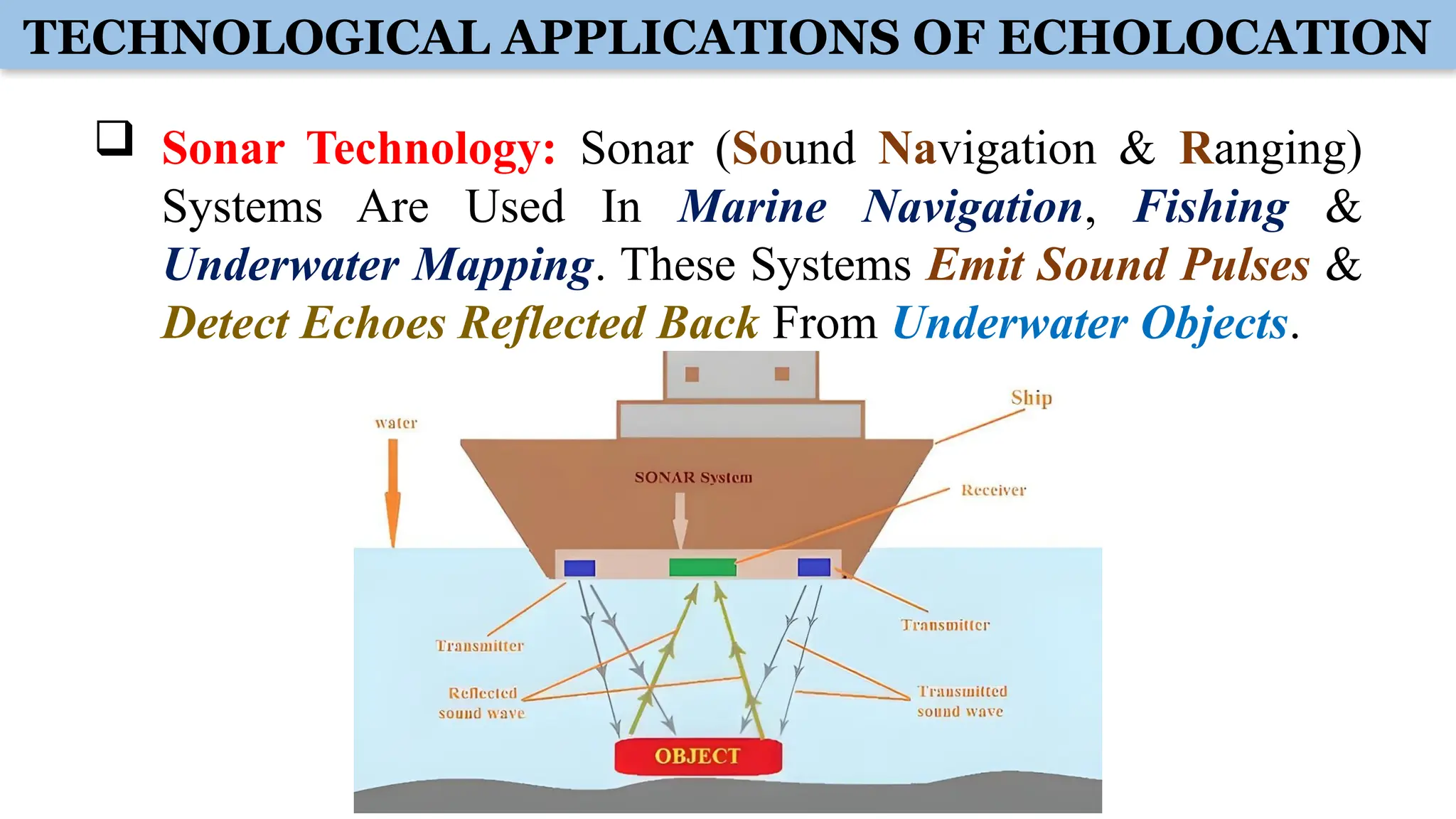
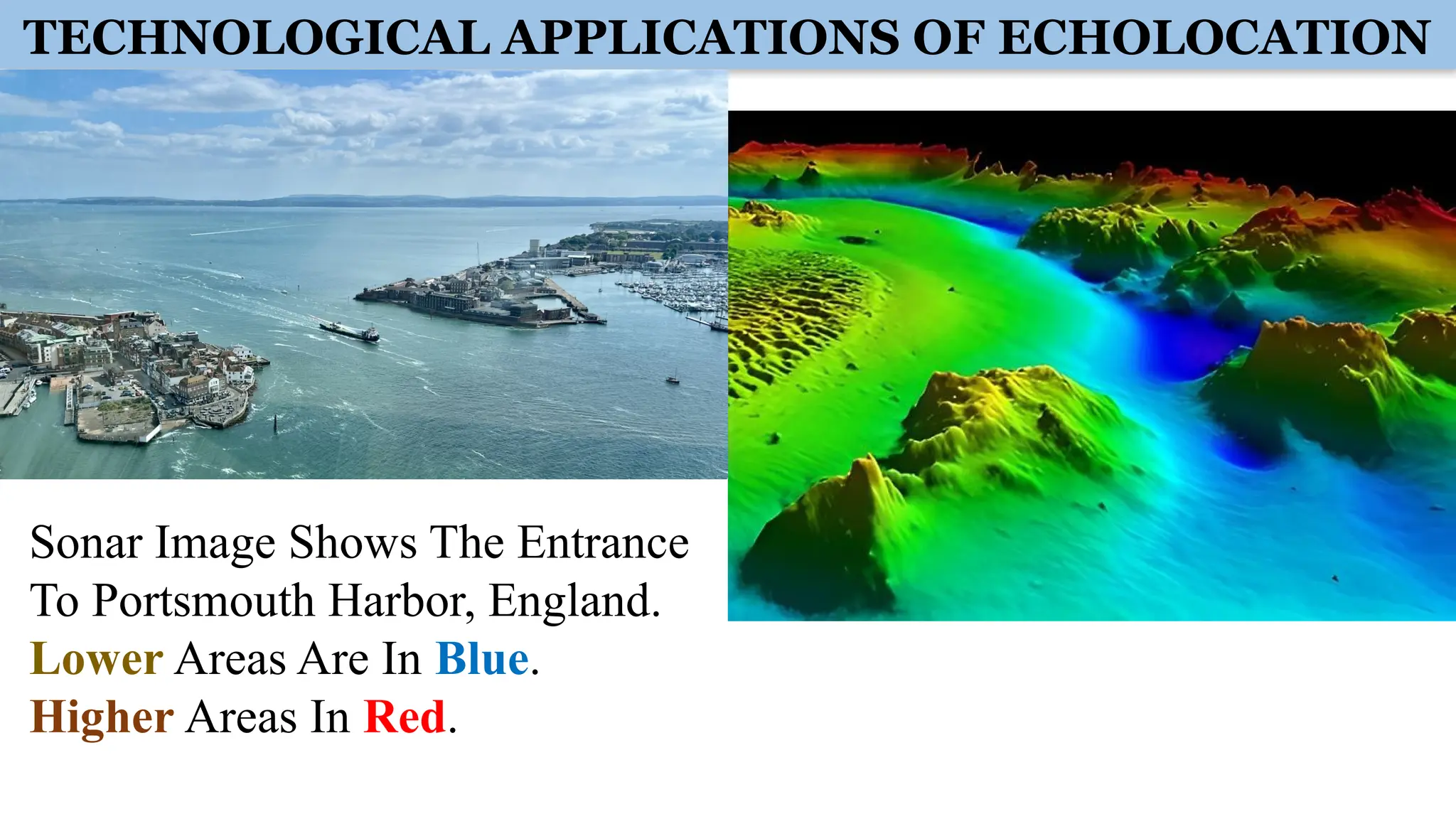
Sonar Technology: Sonar (Sound Navigation & Ranging)
Systems Are Used In Marine Navigation, Fishing &
Underwater Mapping. These Systems Emit Sound Pulses &
Detect Echoes Reflected Back From Underwater Objects.
TECHNOLOGICAL APPLICATIONS OFECHOLOCATION
Sonar Image Shows The Entrance
To Portsmouth Harbor, England.
Lower Areas Are In Blue.
Higher Areas In Red.
14.
TECHNOLOGICAL APPLICATIONS OFECHOLOCATION
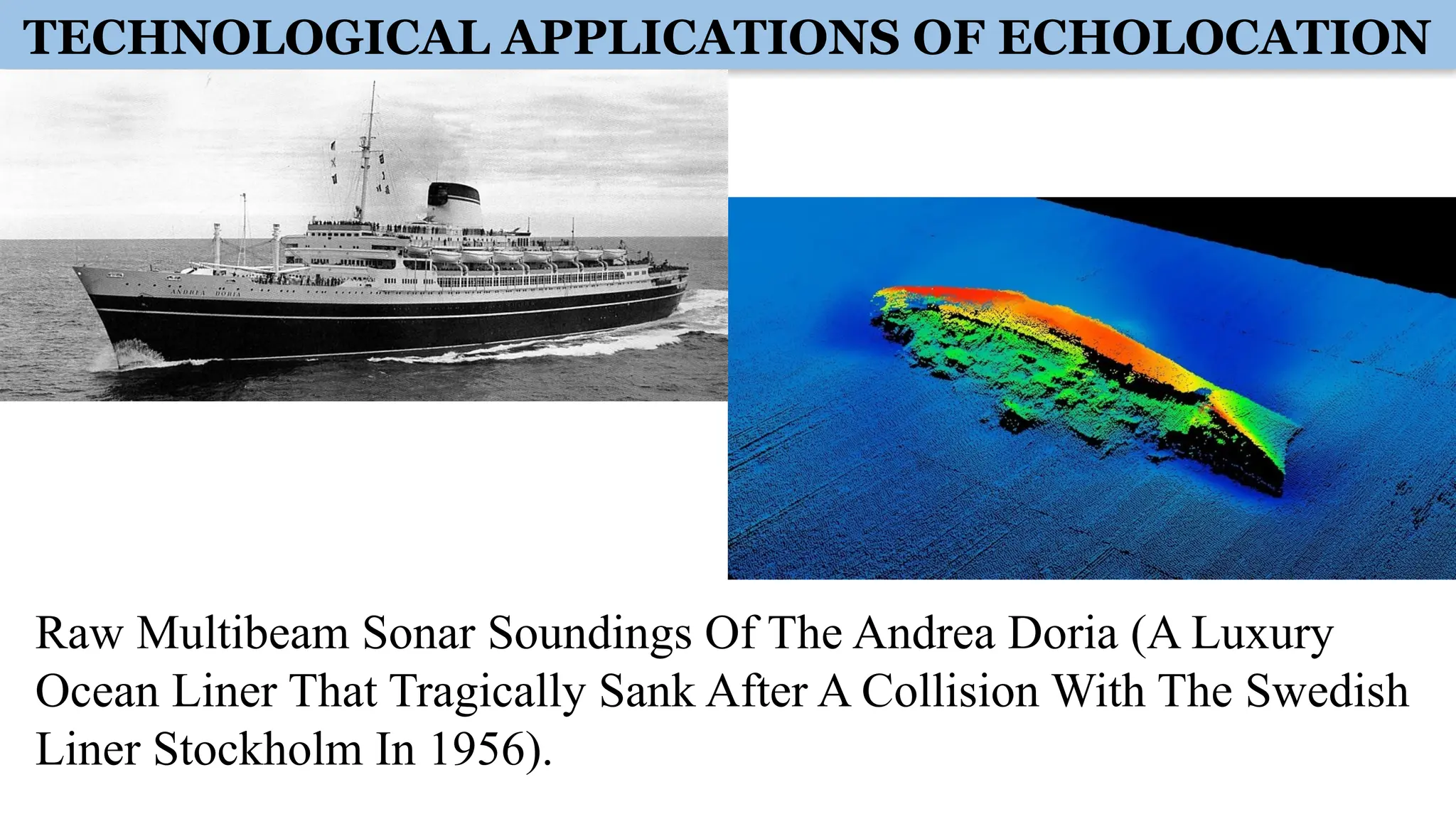
Raw Multibeam Sonar Soundings Of The Andrea Doria (A Luxury
Ocean Liner That Tragically Sank After A Collision With The Swedish
Liner Stockholm In 1956).
15.
TECHNOLOGICAL APPLICATIONS OFECHOLOCATION
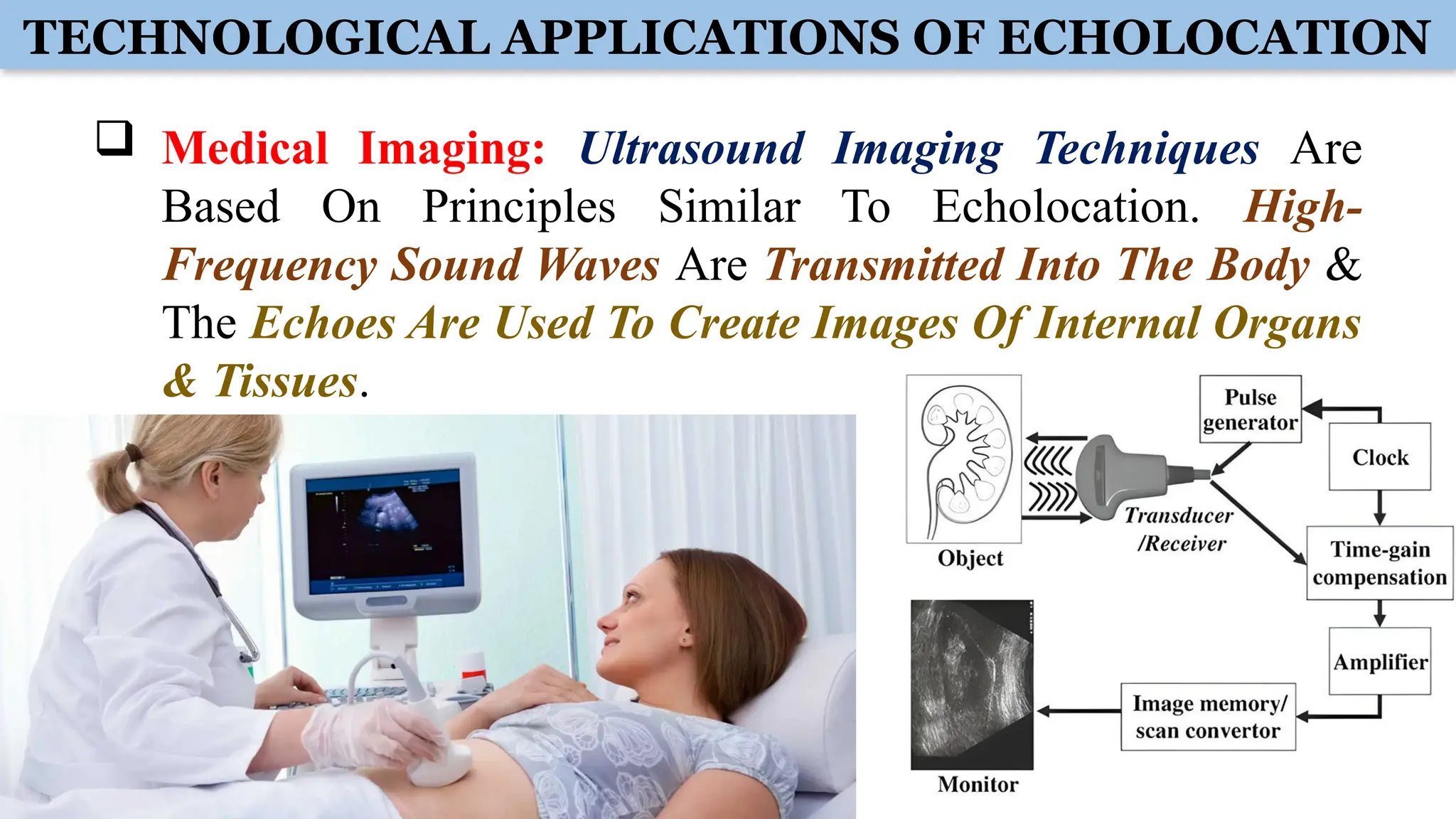
Medical Imaging: Ultrasound Imaging Techniques Are
Based On Principles Similar To Echolocation. High-
Frequency Sound Waves Are Transmitted Into The Body &
The Echoes Are Used To Create Images Of Internal Organs
& Tissues.
16.
TECHNOLOGICAL APPLICATIONS OFECHOLOCATION
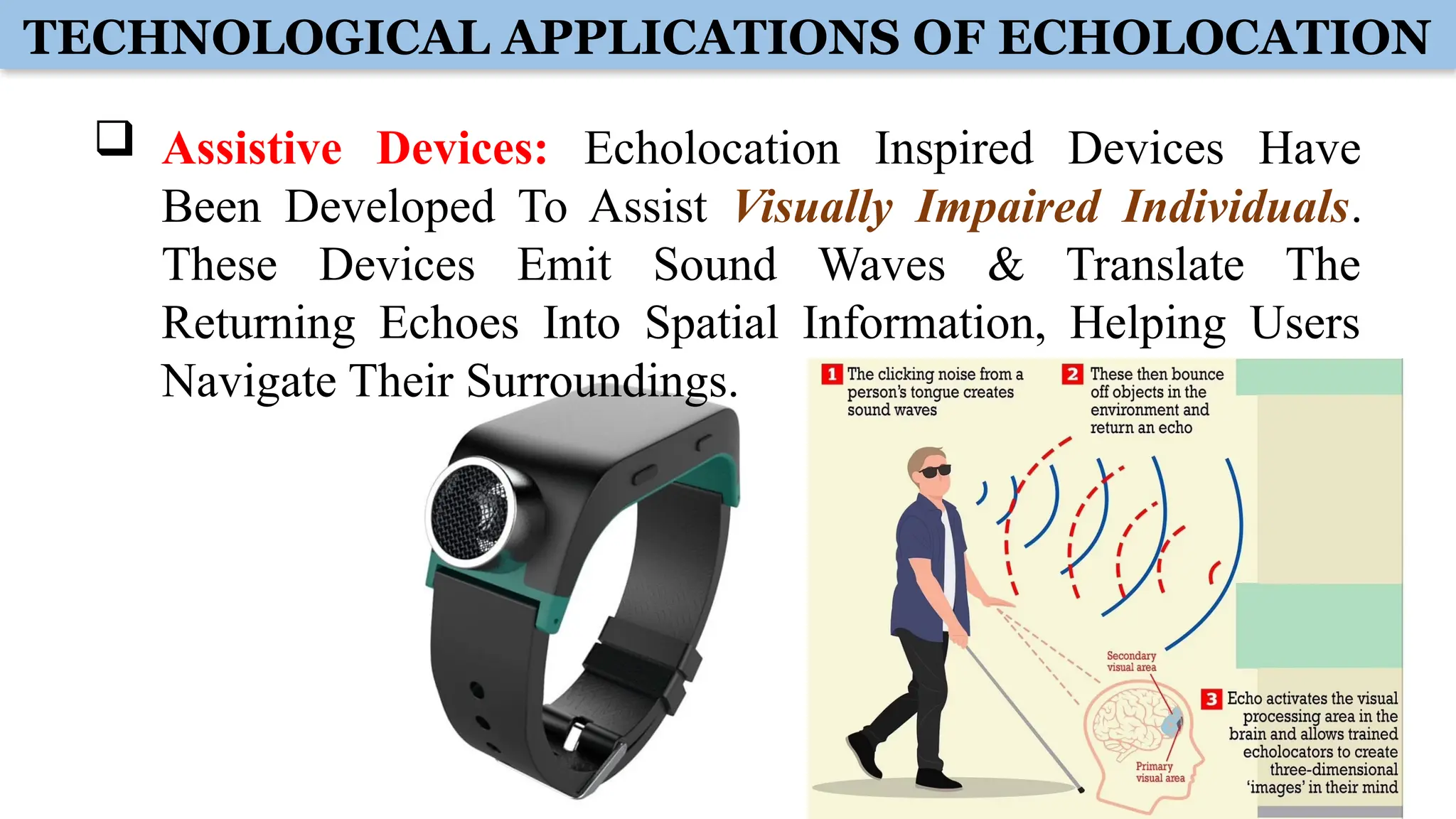
Assistive Devices: Echolocation Inspired Devices Have
Been Developed To Assist Visually Impaired Individuals.
These Devices Emit Sound Waves & Translate The
Returning Echoes Into Spatial Information, Helping Users
Navigate Their Surroundings.
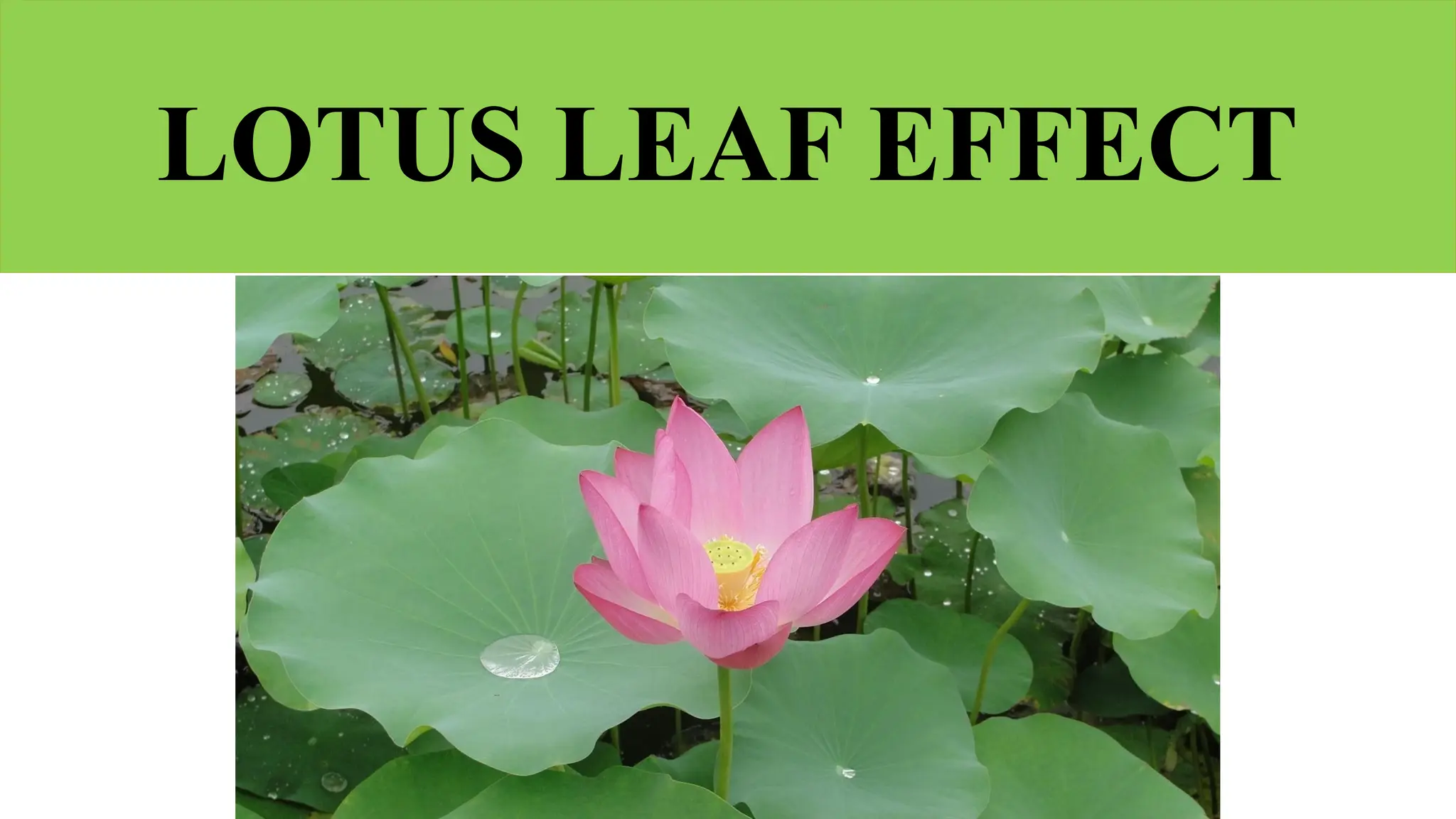
LOTUS LEAF EFFECT
The Lotus Leaf Effect Refers To The Remarkable Self-
Cleaning Ability Of Lotus Leaves To Repel Water & Dirt,
Keeping Their Surfaces Clean & Dry Even In Muddy Or Wet
Environments.
This Natural Phenomenon Has Fascinated Scientists &
Engineers For Its Potential Applications In Developing Self-
Cleaning Surfaces, Water-Repellent Coatings & Anti-
Fouling Materials.
19.
LOTUS LEAF EFFECT– BIOLOGICAL BASIS
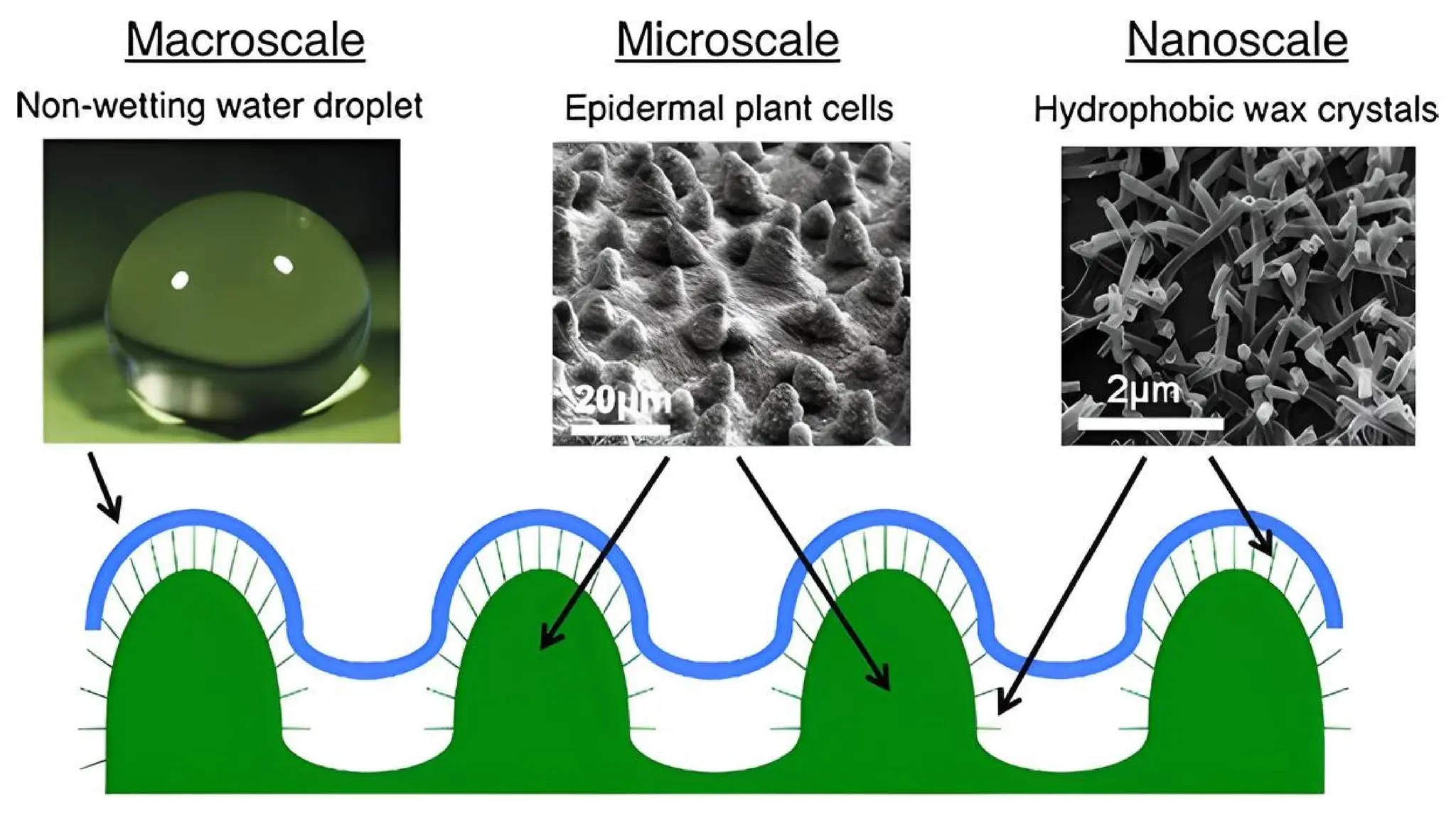
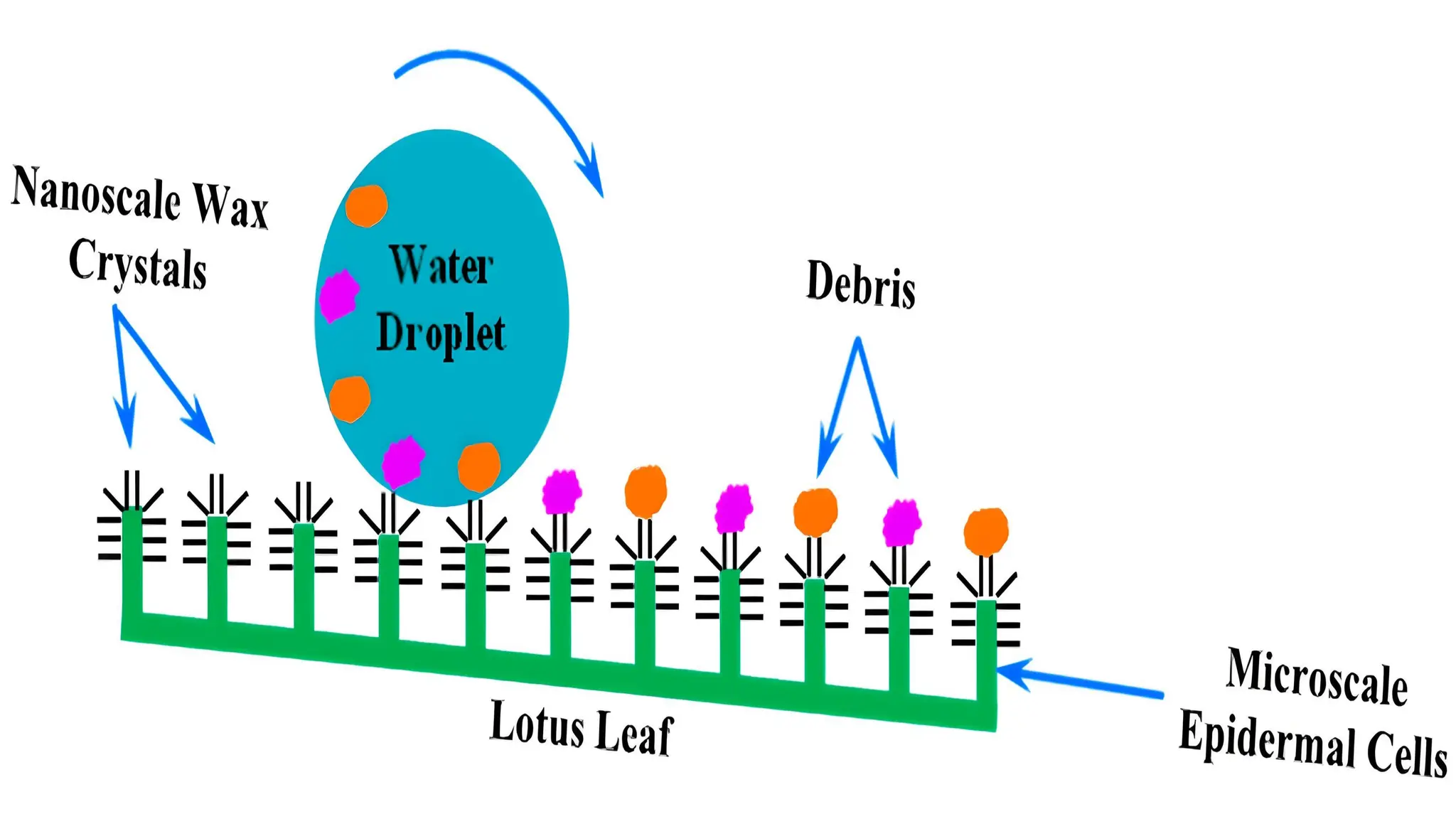
Microscopic Structures: Lotus Leaves Are Covered With Tiny
Bumps Or Papillae, Typically Ranging From 10 To 20 Micrometers
In Height.
Nano-Scale Wax Crystals: These Papillae Are Coated With Nano-
Scale Wax Crystals, Which Are Hydrophobic (Water Repellent) &
Reduce The Contact Area Between Water Droplets & Leaf Surface.
Cassie-Baxter State: Water Droplets On Lotus Leaves Sit In A Non-
Wetting State Known As The Cassie-Baxter State, Where They Rest
On Top Of Air Pockets Created By The Surface Structures. This
Minimizes Contact With The Solid Surface & Facilitates Easy
Rolling Off Of Water Droplets, Carrying Away Dirt Particles In The
Process.
21.
LOTUS LEAF EFFECT– MECHANISM
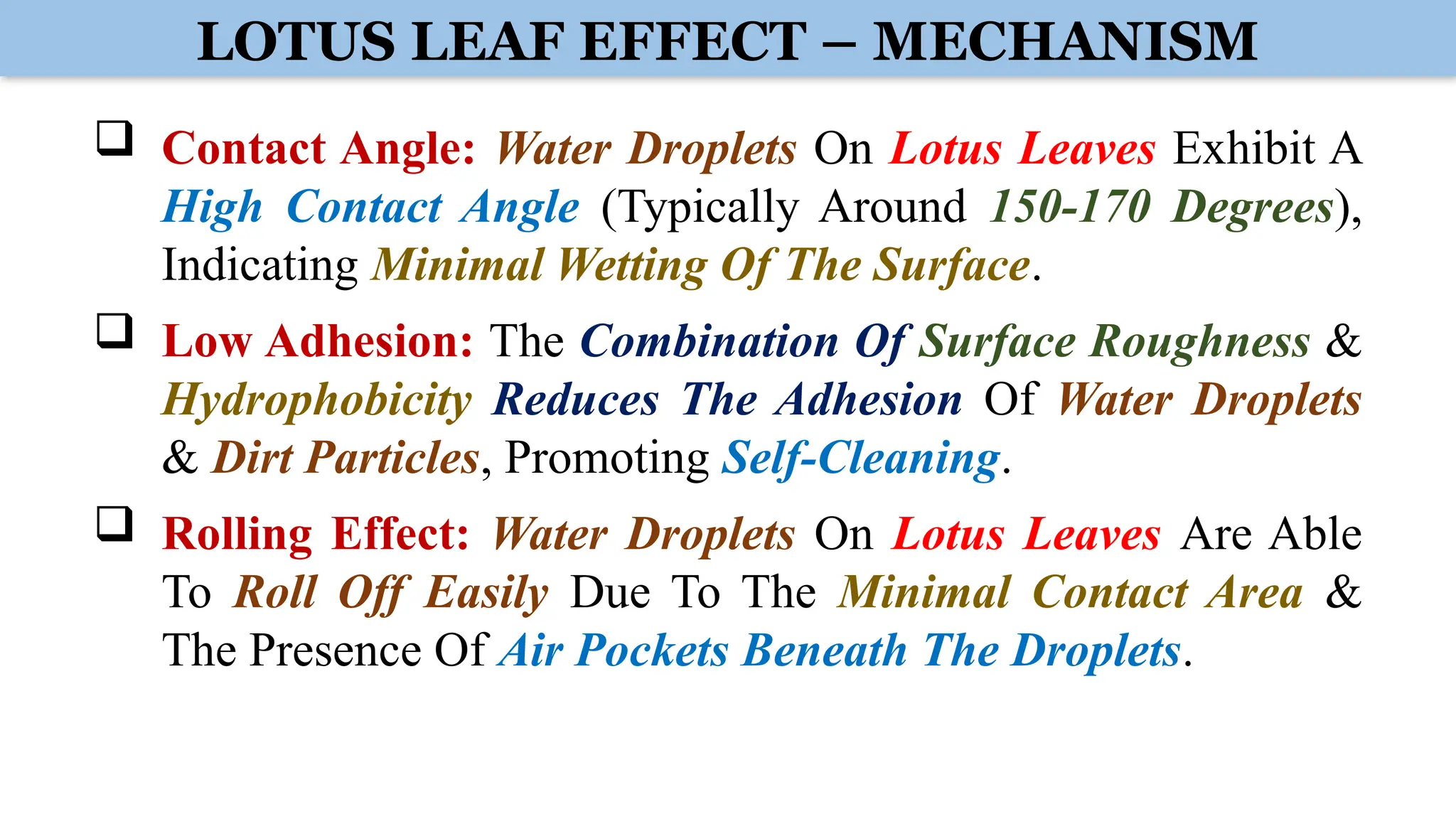
Contact Angle: Water Droplets On Lotus Leaves Exhibit A
High Contact Angle (Typically Around 150-170 Degrees),
Indicating Minimal Wetting Of The Surface.
Low Adhesion: The Combination Of Surface Roughness &
Hydrophobicity Reduces The Adhesion Of Water Droplets
& Dirt Particles, Promoting Self-Cleaning.
Rolling Effect: Water Droplets On Lotus Leaves Are Able
To Roll Off Easily Due To The Minimal Contact Area &
The Presence Of Air Pockets Beneath The Droplets.
23.
LOTUS LEAF EFFECT– PRACTICAL APPLICATIONS
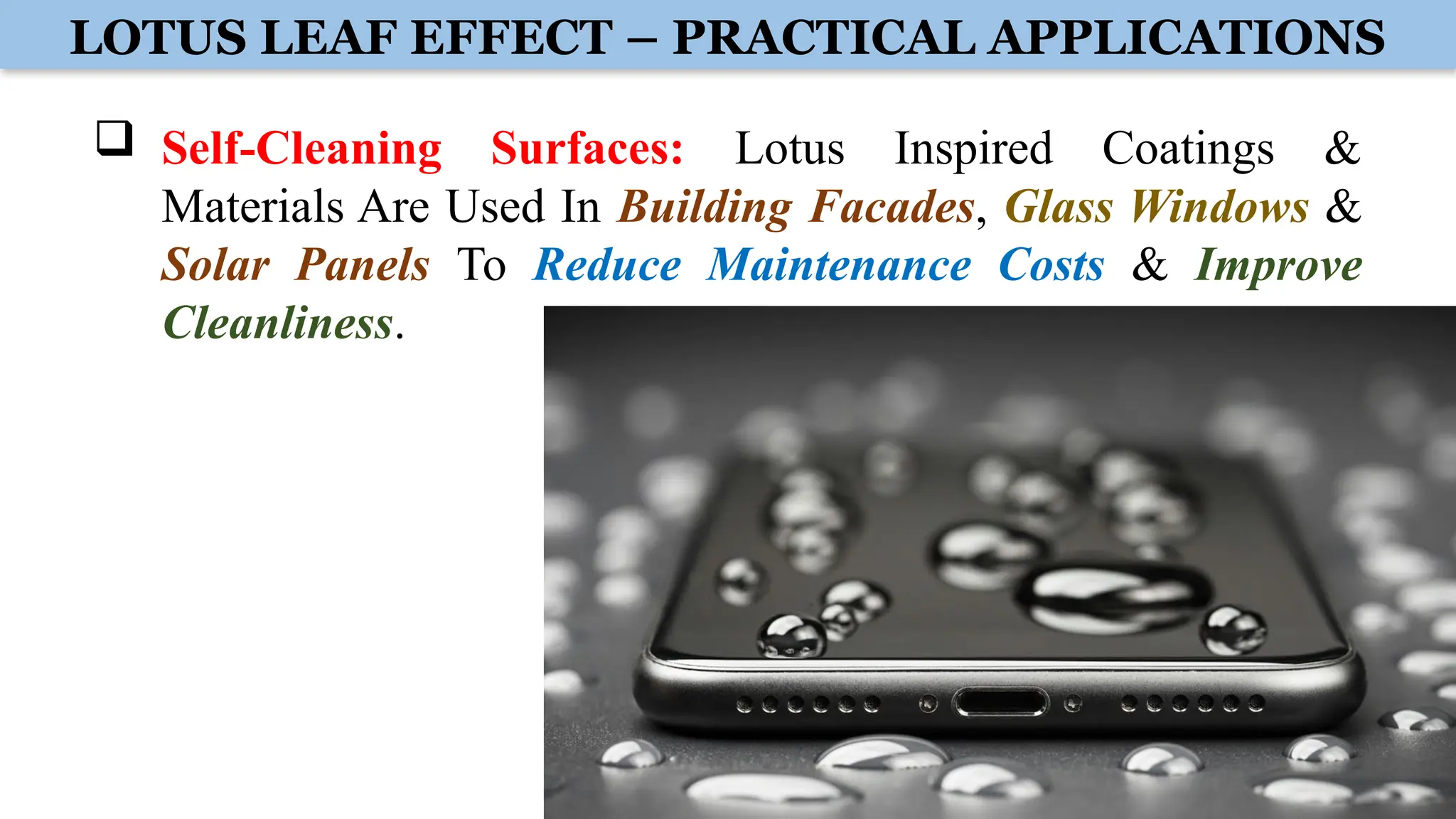
Self-Cleaning Surfaces: Lotus Inspired Coatings &
Materials Are Used In Building Facades, Glass Windows &
Solar Panels To Reduce Maintenance Costs & Improve
Cleanliness.
LOTUS LEAF EFFECT– PRACTICAL APPLICATIONS
Biomedical Devices: Superhydrophobic Surfaces Are
Employed In Medical Devices & Implants To Prevent
Biofouling, Bacterial Adhesion, & Contamination.
26.
LOTUS LEAF EFFECT– PRACTICAL APPLICATIONS
Food Packaging: Hydrophobic Coatings On Food
Packaging Materials Enhance Shelf Life By Repelling
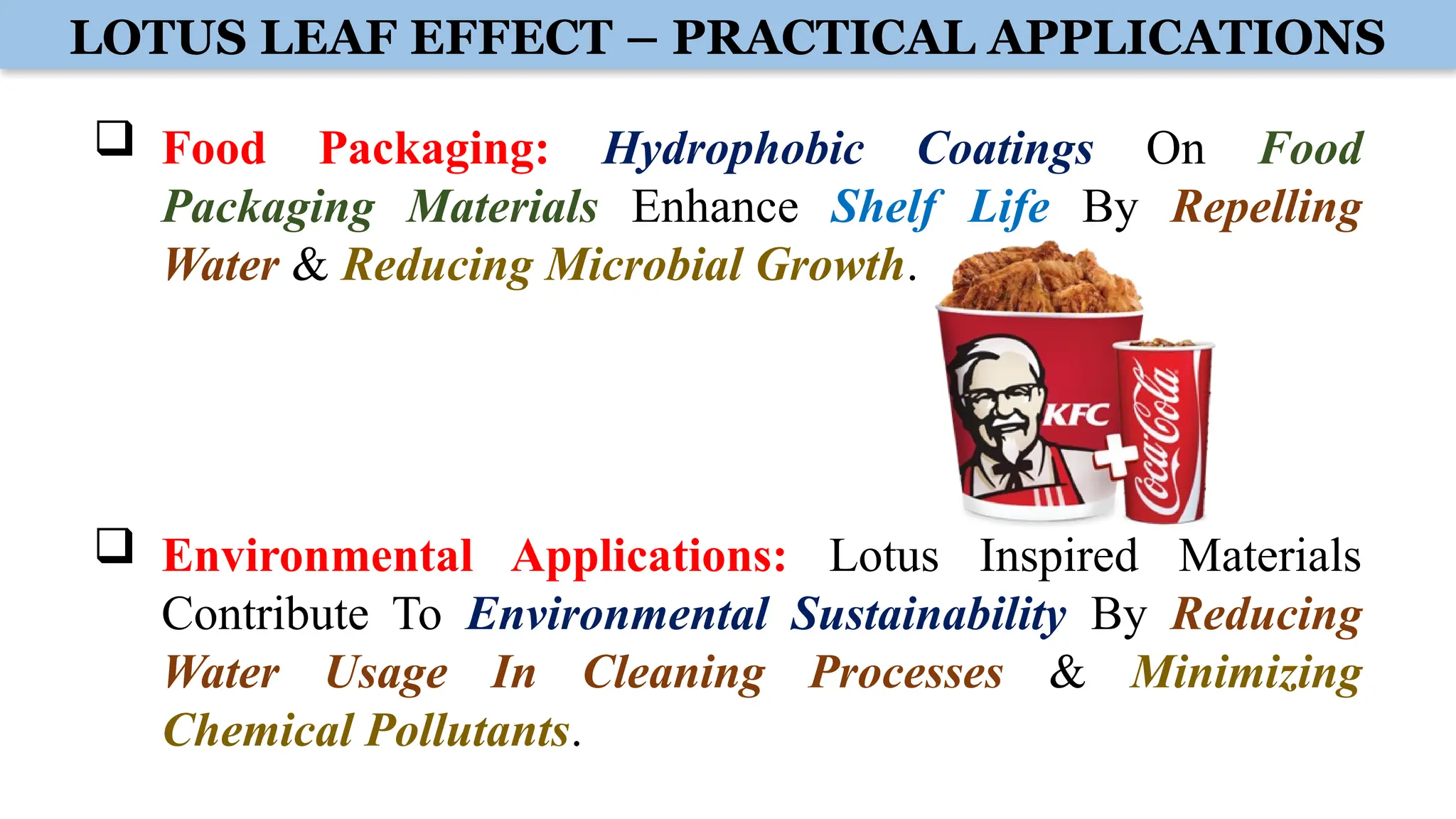
Water & Reducing Microbial Growth.
Environmental Applications: Lotus Inspired Materials
Contribute To Environmental Sustainability By Reducing
Water Usage In Cleaning Processes & Minimizing
Chemical Pollutants.
PLANT BURRS
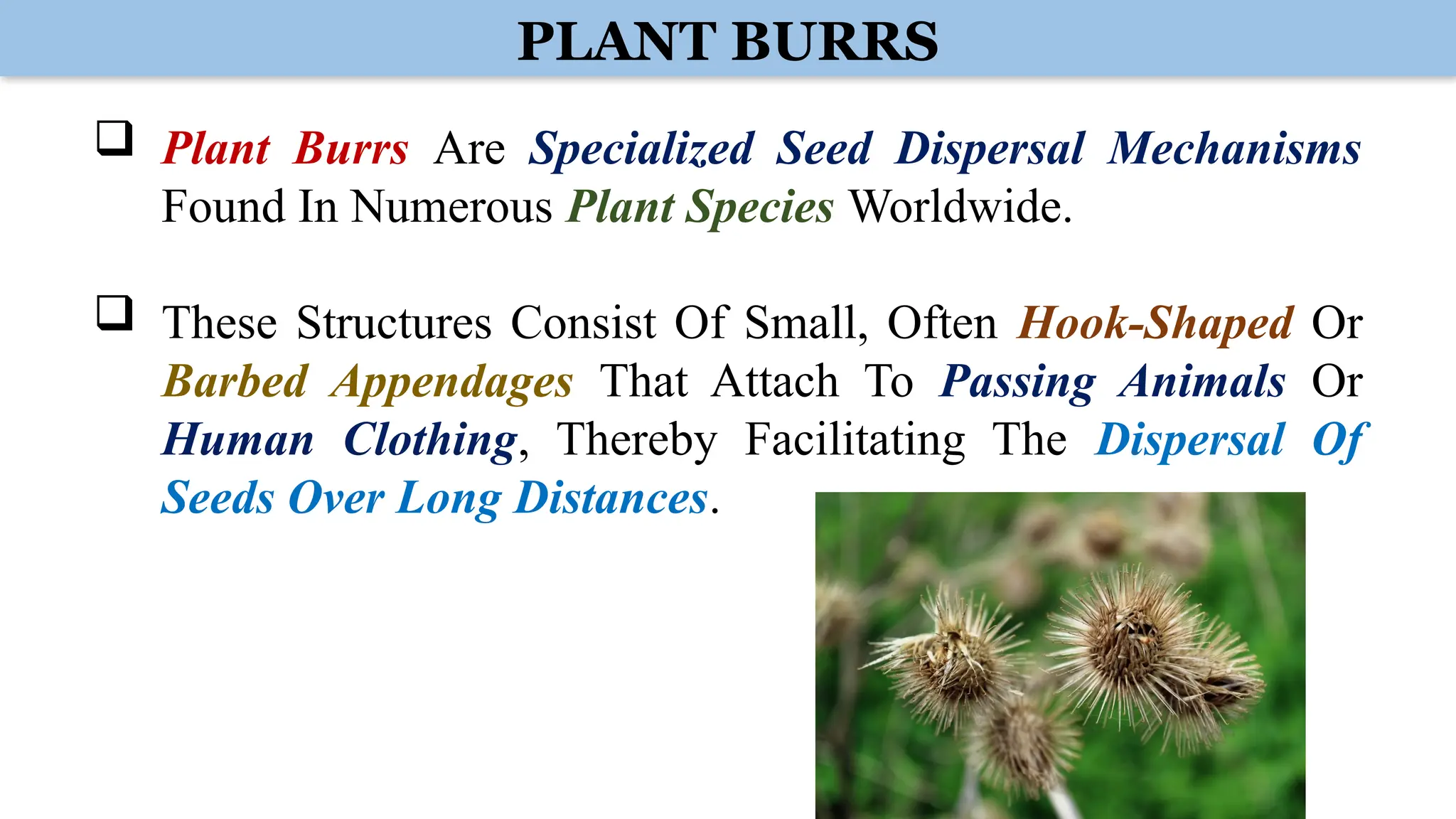
PlantBurrs Are Specialized Seed Dispersal Mechanisms
Found In Numerous Plant Species Worldwide.
These Structures Consist Of Small, Often Hook-Shaped Or
Barbed Appendages That Attach To Passing Animals Or
Human Clothing, Thereby Facilitating The Dispersal Of
Seeds Over Long Distances.
29.
PLANT BURRS –TYPES
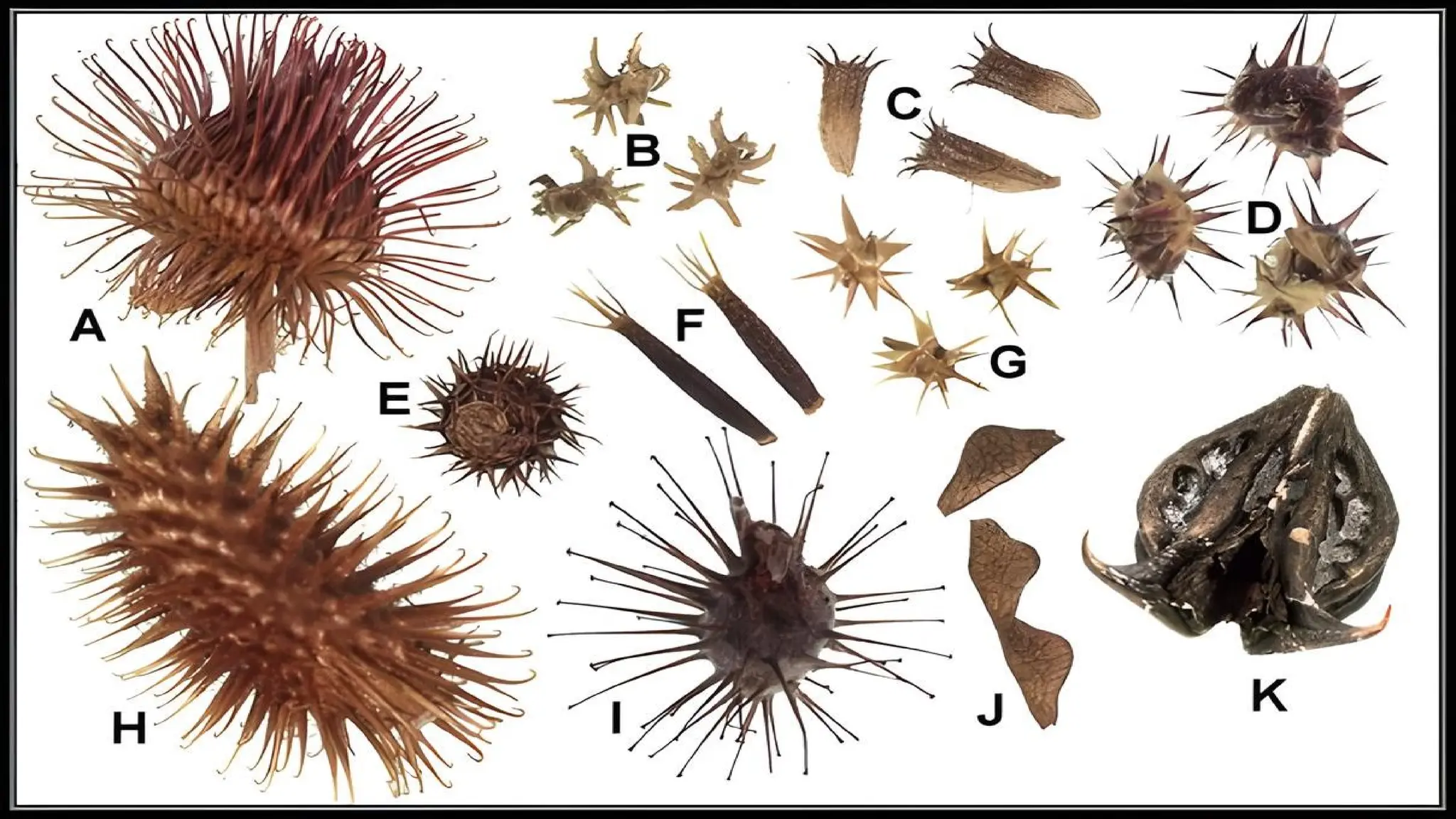
Hooked Structures: Common In Species Like Burdock
(Arctium Spp.) & Cocklebur (Xanthium Spp.), Which Have
Robust Hooks That Latch Onto Fur Or Clothing.
Barbed Appendages: Examples Include Cleavers (Galium
Aparine) & Some Grass Species, Which Feature Tiny,
Backward Pointing Barbs That Cling To Passing Animals.
Velcro Like Mechanisms: Certain Plants, Such As Burr
Marigold (Bidens Spp.), Employ Tiny Bristles Or Hooks
That Interlock With Each Other & With Fabric Fibers.
31.
PLANT BURRS –BIOLOGICAL MECHANISMS
Adhesive Surfaces: Microscopic Structures On Burrs, Such
As Hairs, Hooks Or Barbs, Create A High-Friction Surface
That Adheres To Passing Animals Or Clothing.
Hook & Loop Interactions: Some Plant Burrs Utilize Hook
& Loop Mechanisms, Similar To Velcro, Where Hooks On
Burr Interlock With Loops On Animal Fur Or Textile
Fibers.
Natural Fibers & Resilience: The Materials Composing
Burrs, Often Fibrous & Resilient, Enhance Durability &
Maintain Attachment During Transport.
32.
PLANT BURRS –PRACTICAL APPLICATIONS
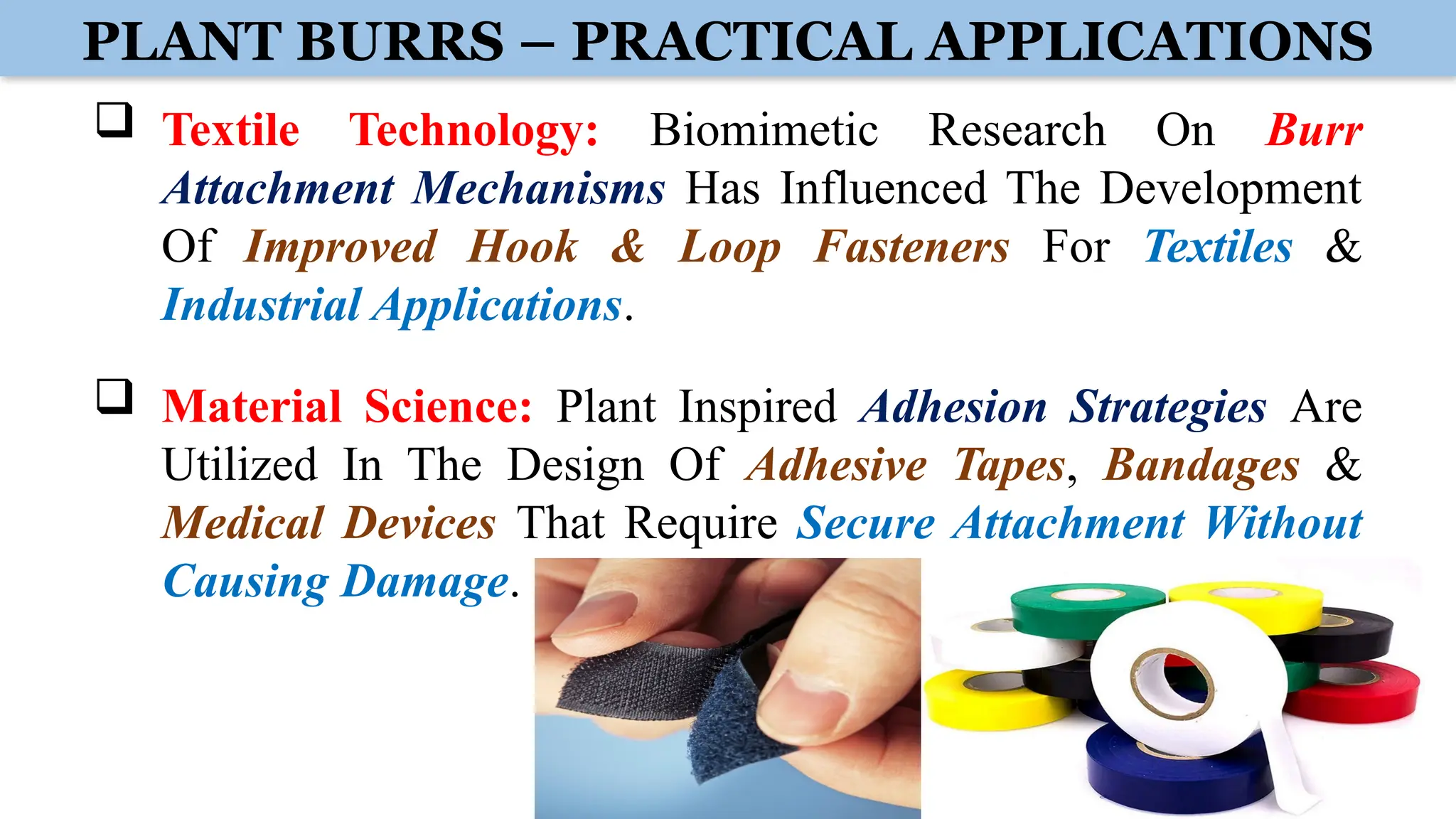
Textile Technology: Biomimetic Research On Burr
Attachment Mechanisms Has Influenced The Development
Of Improved Hook & Loop Fasteners For Textiles &
Industrial Applications.
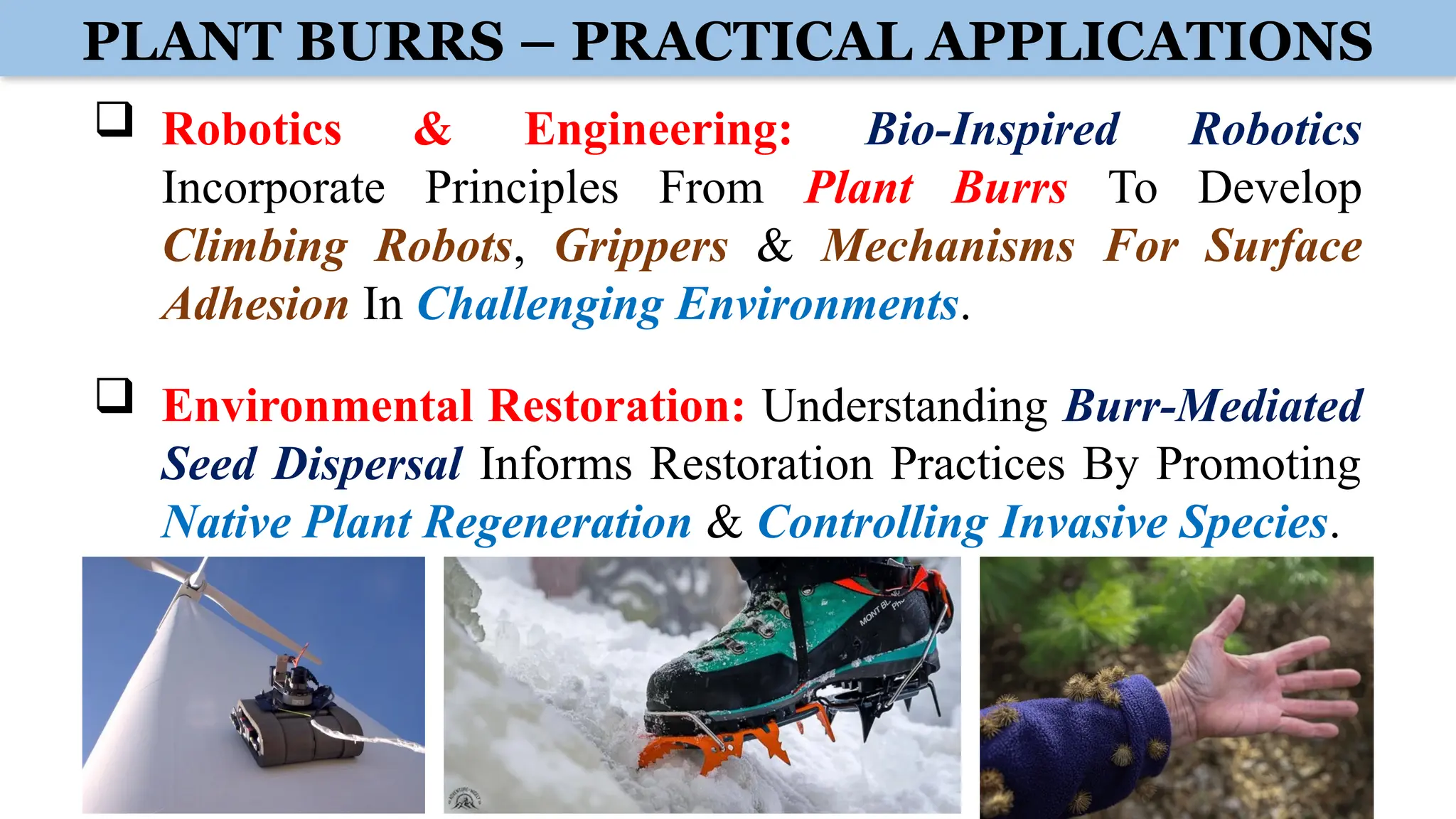
Material Science: Plant Inspired Adhesion Strategies Are
Utilized In The Design Of Adhesive Tapes, Bandages &
Medical Devices That Require Secure Attachment Without
Causing Damage.
33.
PLANT BURRS –PRACTICAL APPLICATIONS
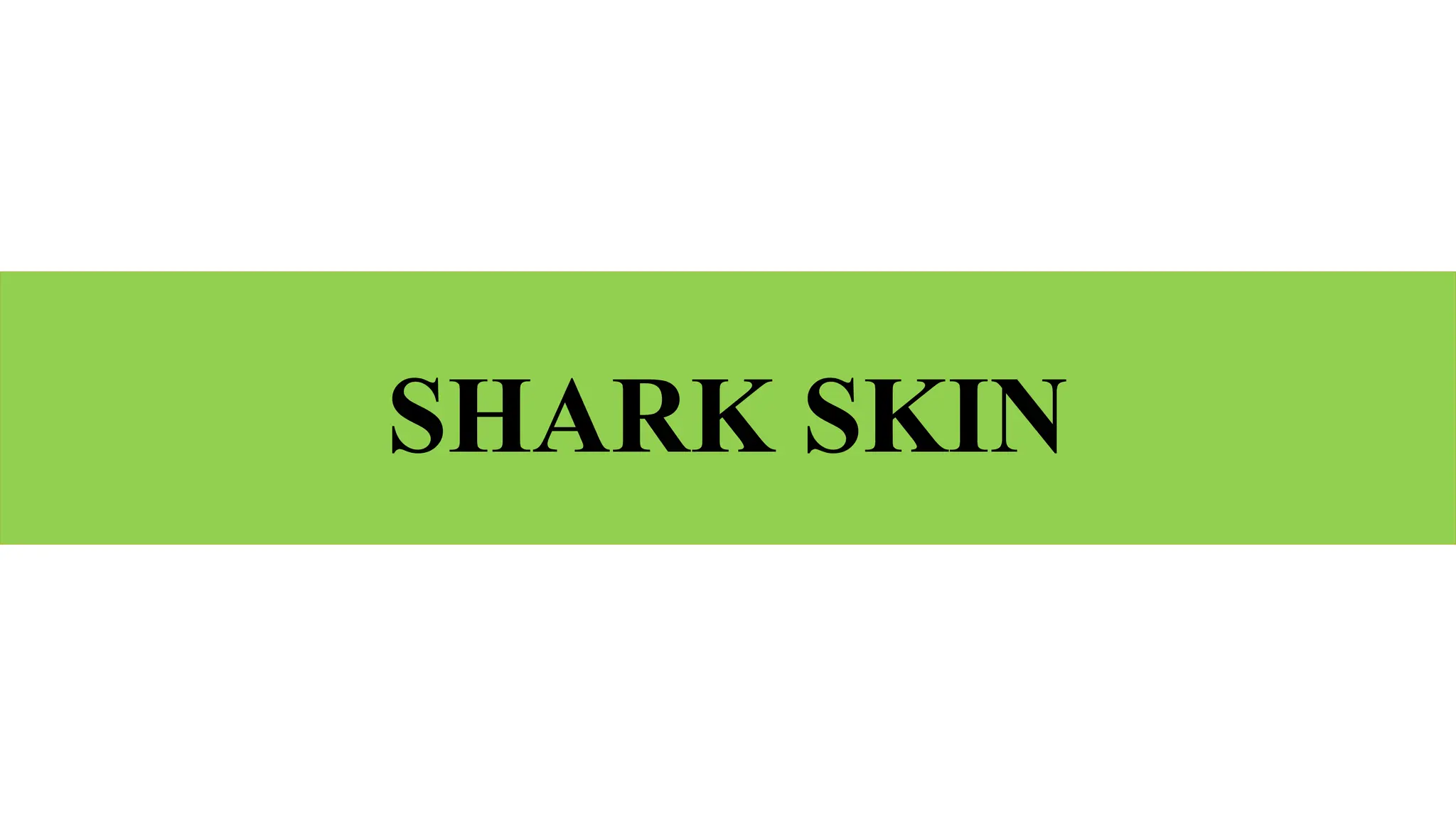
Robotics & Engineering: Bio-Inspired Robotics
Incorporate Principles From Plant Burrs To Develop
Climbing Robots, Grippers & Mechanisms For Surface
Adhesion In Challenging Environments.
Environmental Restoration: Understanding Burr-Mediated
Seed Dispersal Informs Restoration Practices By Promoting
Native Plant Regeneration & Controlling Invasive Species.
SHARK SKIN
SharkSkin Is Renowned For Its Hydrodynamic
Efficiency & Unique Structure, Which Have
Evolved Over Millions Of Years To Optimize
Swimming Performance In Marine
Environments.
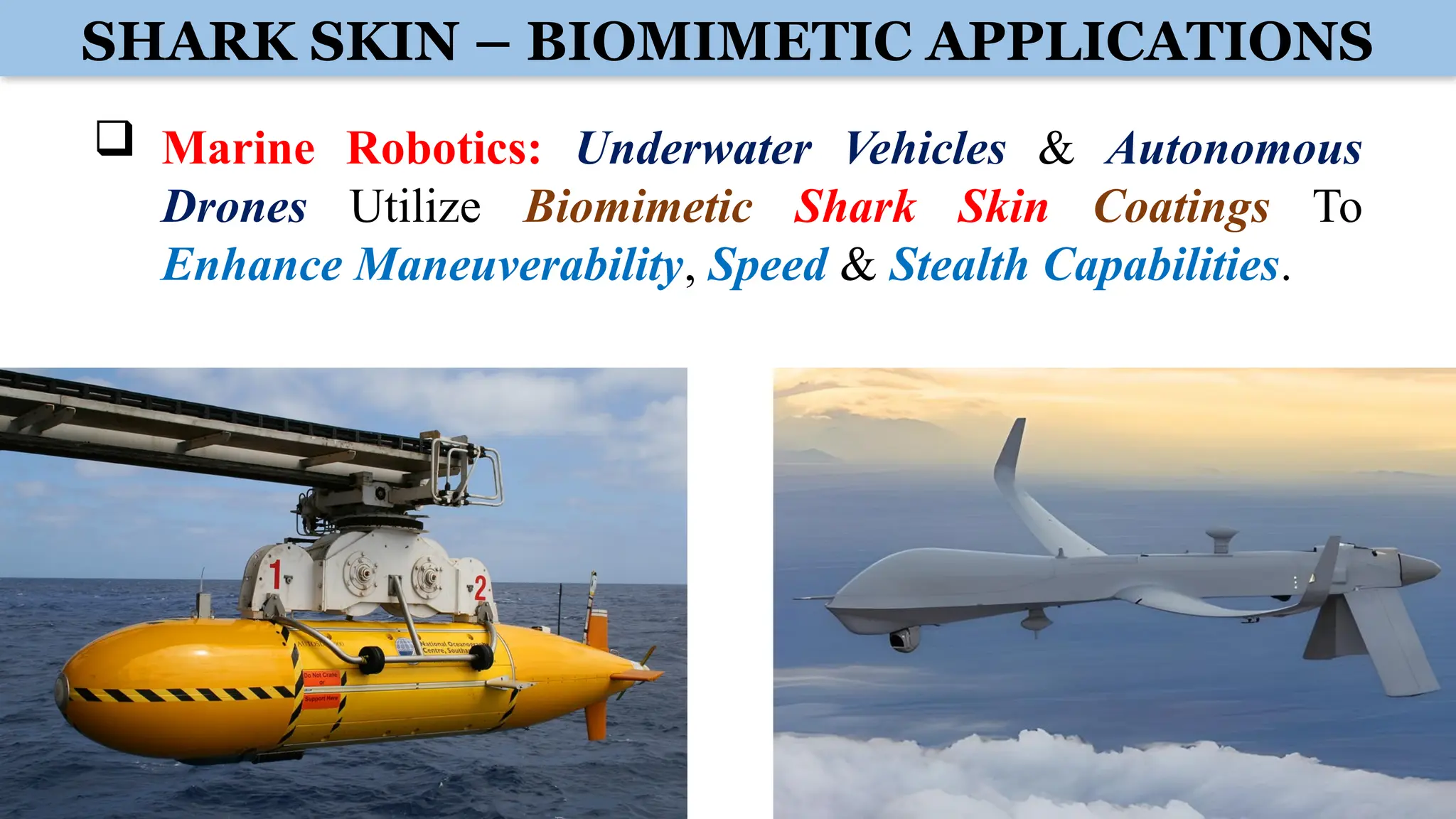
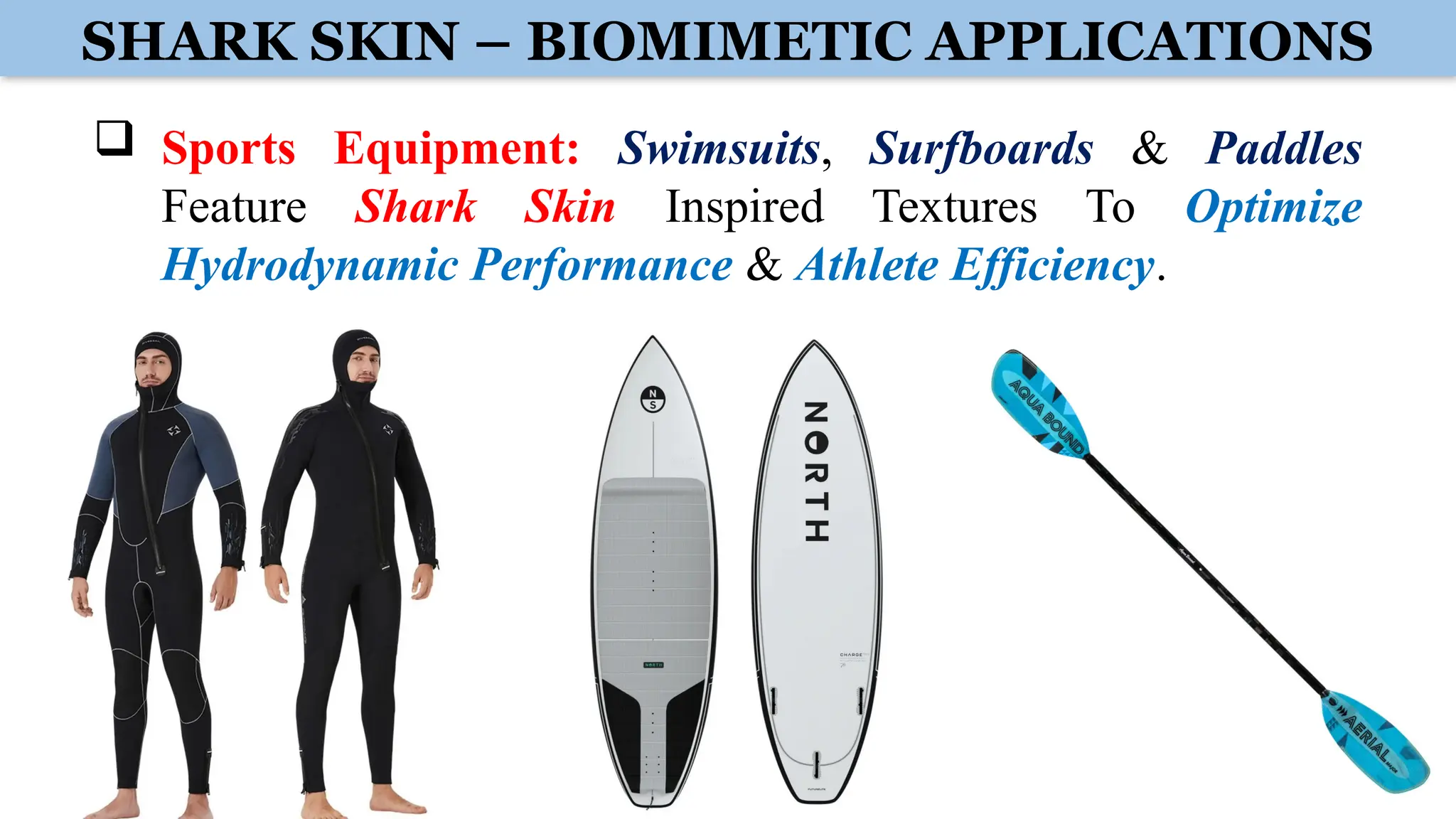
The Study Of Shark Skin Has Inspired
Innovations In Biomimetic Design, Leading To
Applications In Fields Ranging From Aerospace
Engineering To Medical Devices.
36.
SHARK SKIN –STRUCTURE
Surface Texture: Generally, Consists
Of Overlapping Scales With Riblets Or
Grooves That Streamline Water Flow.
Dermal Denticles: Tiny Tooth Like
Structures Called Dermal Denticles
Cover The Surface Of Shark Skin.
These Denticles Are Aligned In
Specific Patterns That Reduce Drag &
Turbulence During Swimming.
37.
Material Properties:Shark Skin Is Composed Of Tough, Flexible
Collagen Fibers Interspersed With Mineralized Deposits, Providing
Strength & Resilience Against Mechanical Stress.
Reduced Drag: Dermal Denticles & Surface Texture Minimize Drag
By Controlling The Flow Of Water Over The Skin, Reducing
Turbulent Eddies & Frictional Resistance, Thus Optimizing
Hydrodynamic Performance, Allowing Sharks To Maintain High
Swimming Speeds With Minimal Energy Expenditure.
Enhanced Maneuverability: Shark Skin Allows For Agile
Movement & Precise Control During Swimming, Enabling Rapid
Acceleration, Efficient Propulsion & Efficient Energy Use.
SHARK SKIN – PROPERTIES & BIOLOGICAL MECHANISMS
38.
SHARK SKIN –PROPERTIES & BIOLOGICAL MECHANISMS
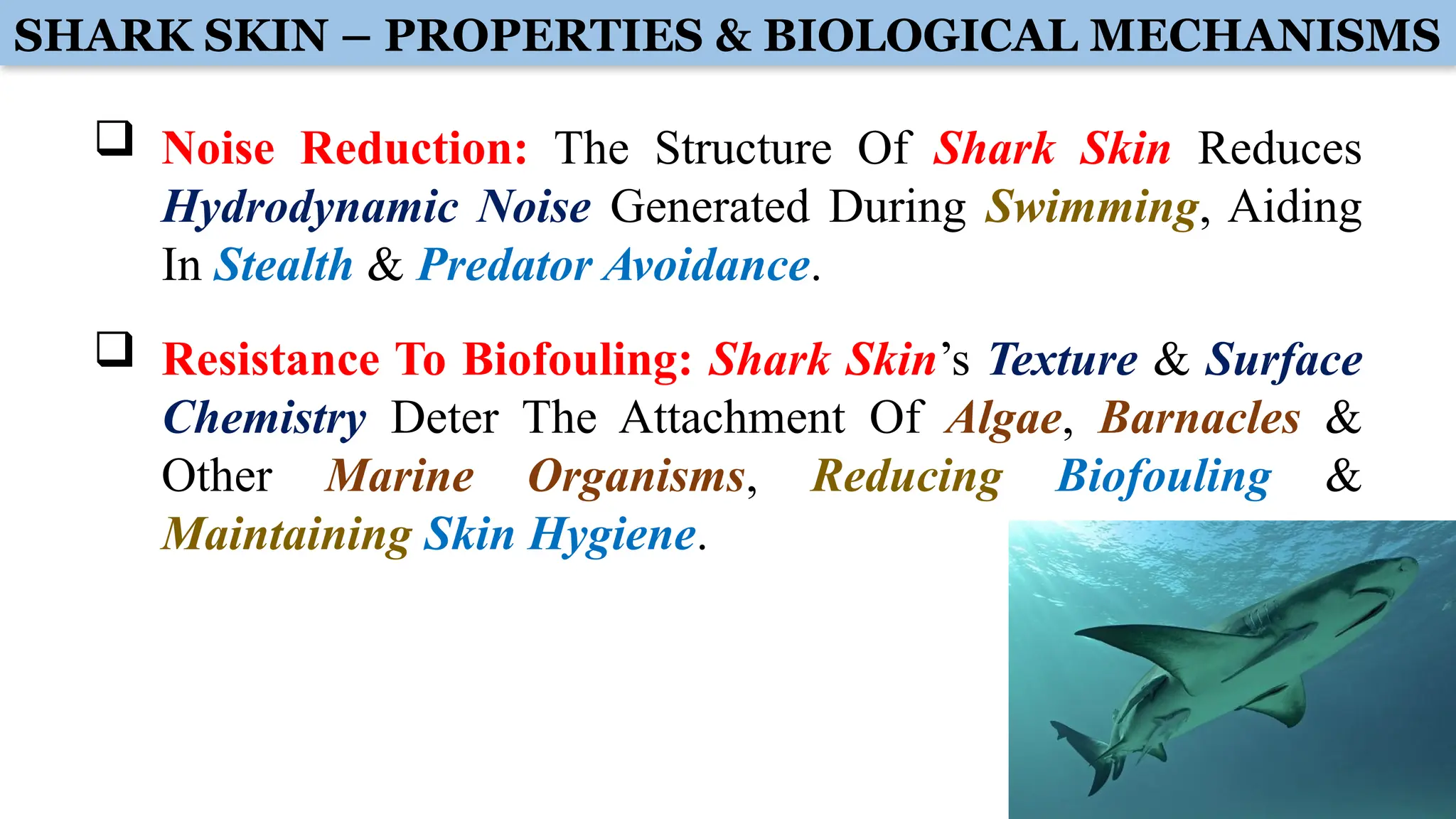
Noise Reduction: The Structure Of Shark Skin Reduces
Hydrodynamic Noise Generated During Swimming, Aiding
In Stealth & Predator Avoidance.
Resistance To Biofouling: Shark Skin’s Texture & Surface
Chemistry Deter The Attachment Of Algae, Barnacles &
Other Marine Organisms, Reducing Biofouling &
Maintaining Skin Hygiene.
SHARK SKIN –BIOMIMETIC APPLICATIONS
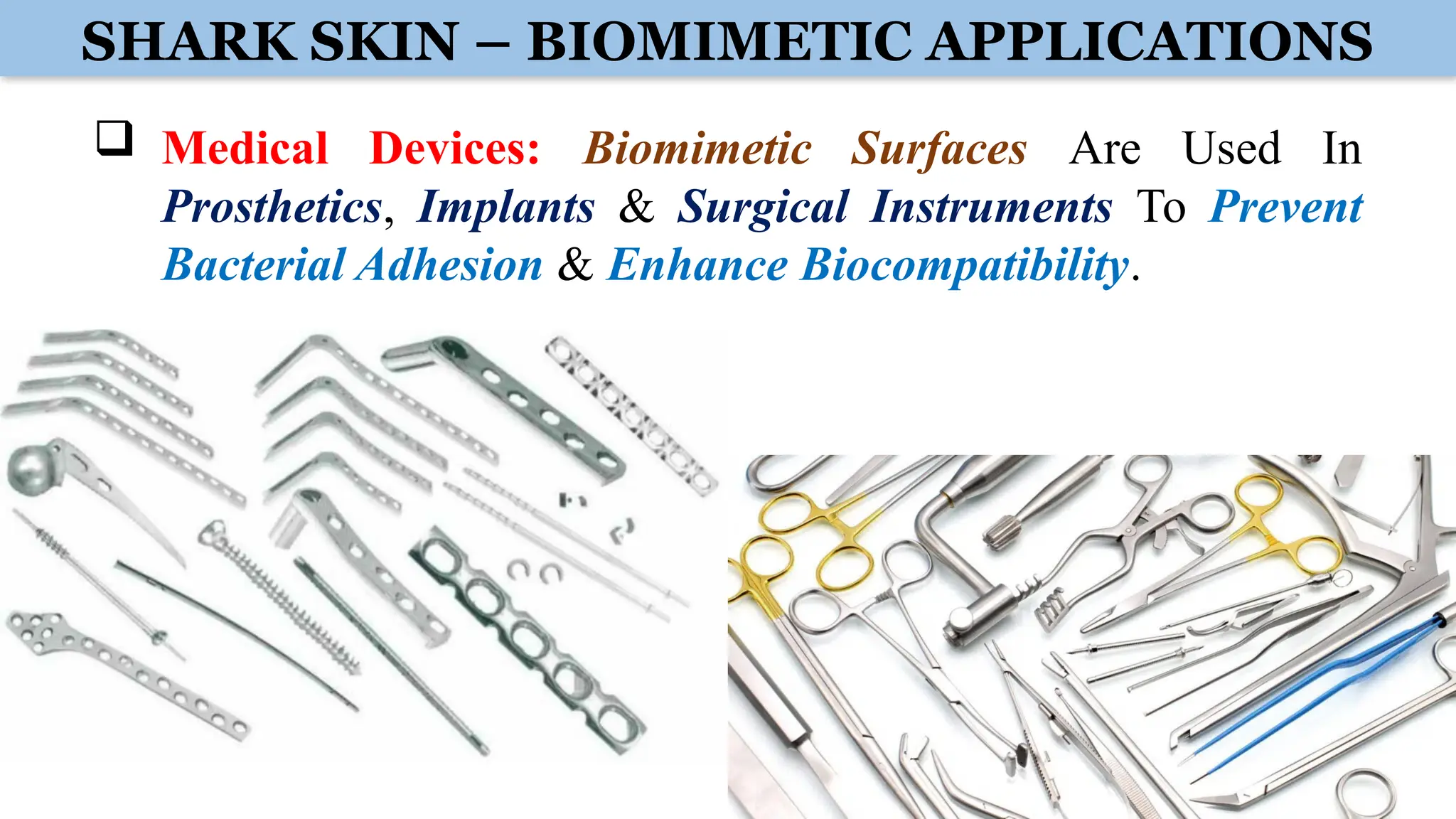
Medical Devices: Biomimetic Surfaces Are Used In
Prosthetics, Implants & Surgical Instruments To Prevent
Bacterial Adhesion & Enhance Biocompatibility.
43.
SHARK SKIN –BIOMIMETIC APPLICATIONS
Wound Healing: Biomimetic Materials Mimic Shark Skin’s
Antimicrobial Properties To Promote Wound Healing &
Prevent Infections.
Implant Surfaces: Prosthetic Implants & Medical Devices
Incorporate Shark Skin Inspired Coatings To Enhance
Biocompatibility & Reduce The Risk Of Rejection.
KINGFISHER BEAK
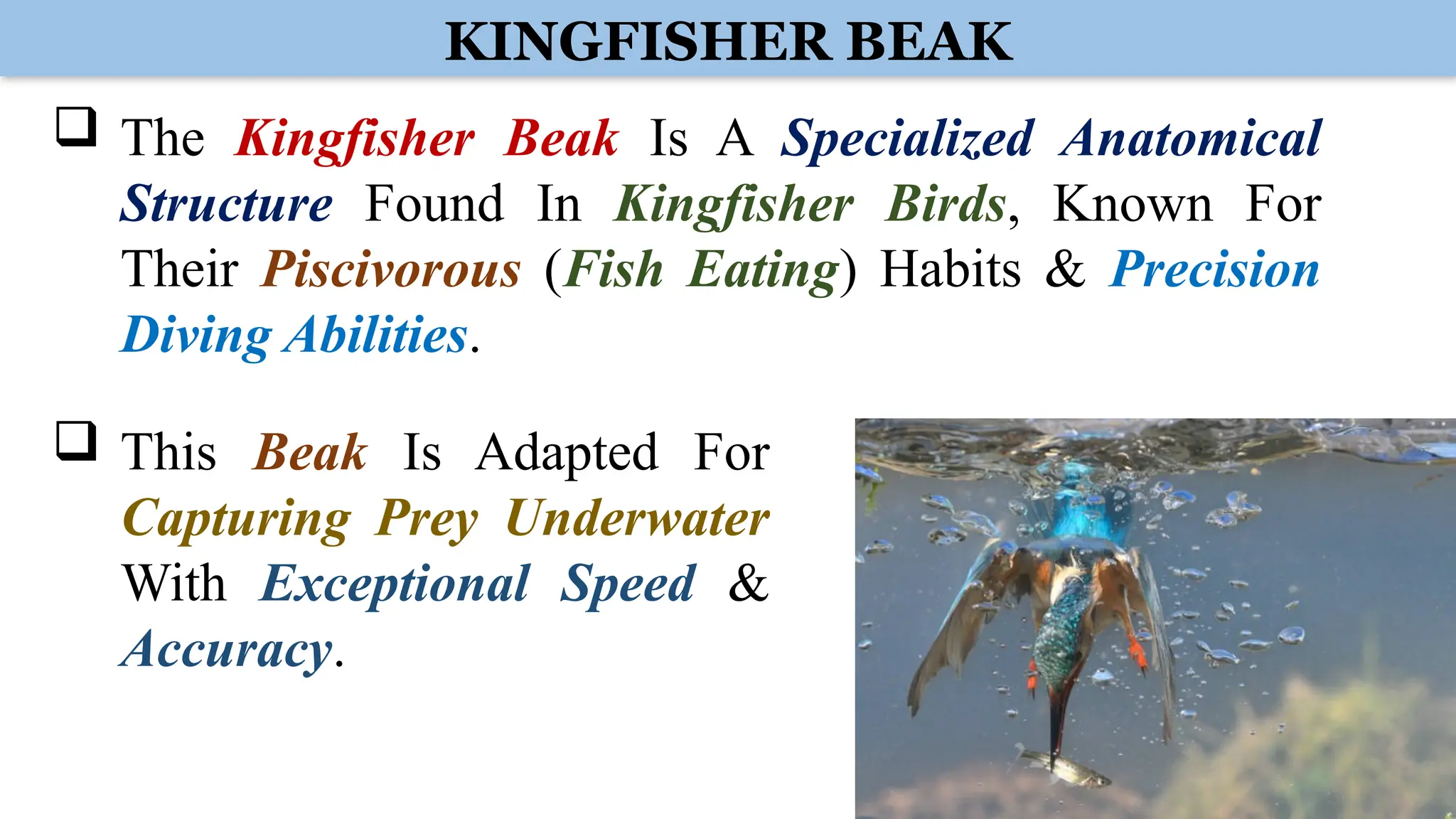
TheKingfisher Beak Is A Specialized Anatomical
Structure Found In Kingfisher Birds, Known For
Their Piscivorous (Fish Eating) Habits & Precision
Diving Abilities.
This Beak Is Adapted For
Capturing Prey Underwater
With Exceptional Speed &
Accuracy.
46.
KINGFISHER BEAK –ANATOMY & STRUCTURE
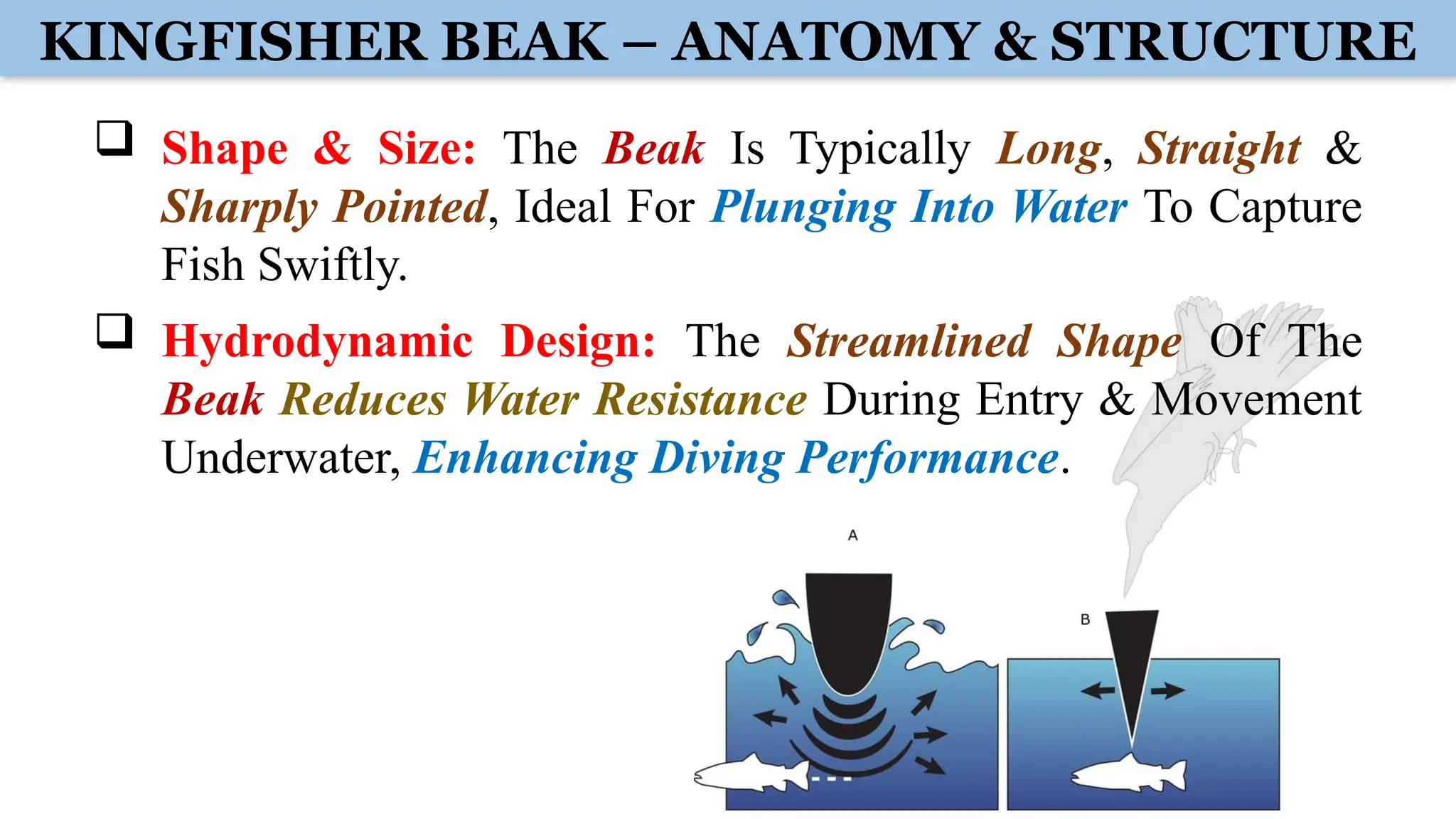
Shape & Size: The Beak Is Typically Long, Straight &
Sharply Pointed, Ideal For Plunging Into Water To Capture
Fish Swiftly.
Hydrodynamic Design: The Streamlined Shape Of The
Beak Reduces Water Resistance During Entry & Movement
Underwater, Enhancing Diving Performance.
47.
KINGFISHER BEAK –BIOMIMETIC INSPIRATION
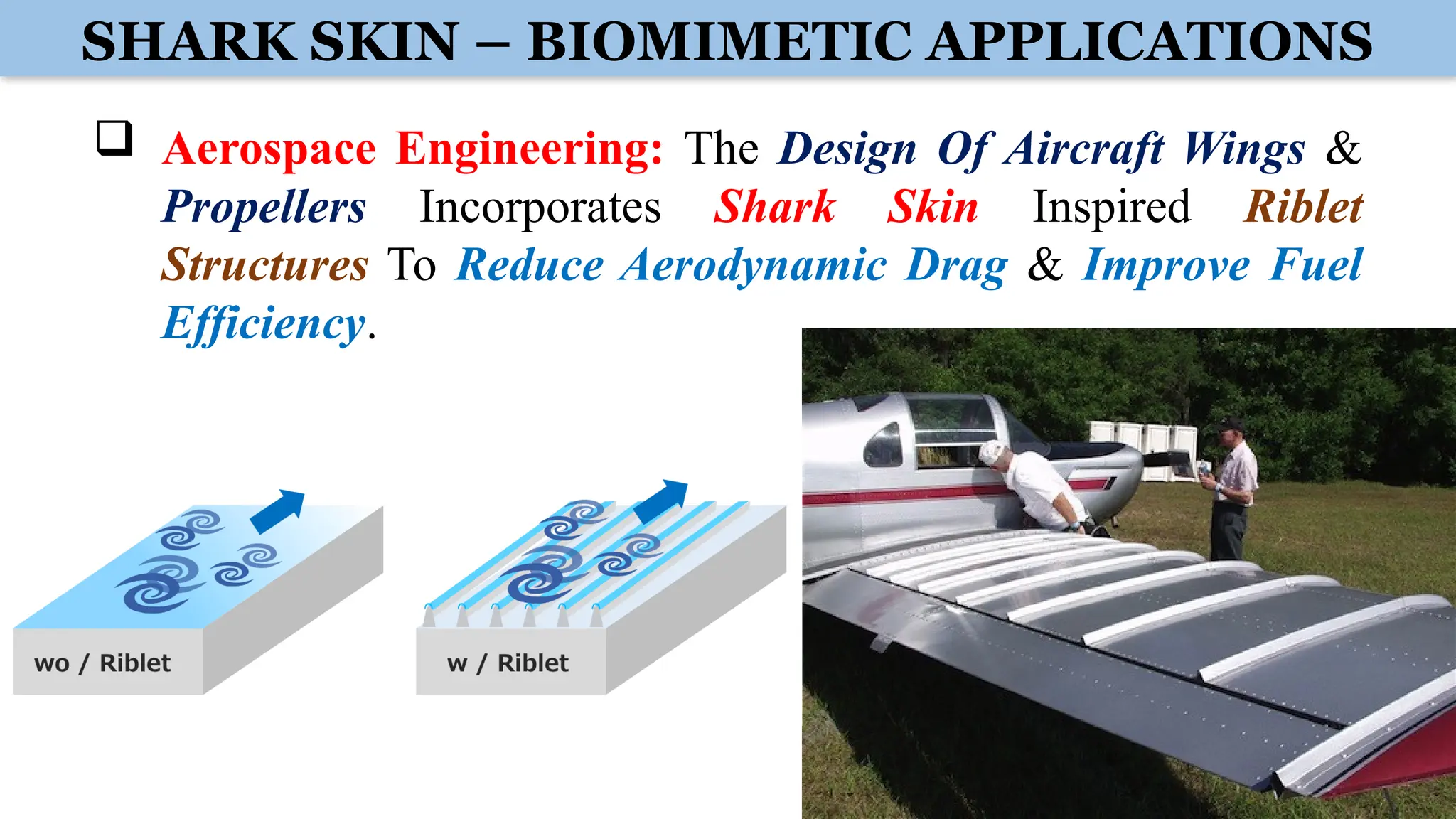
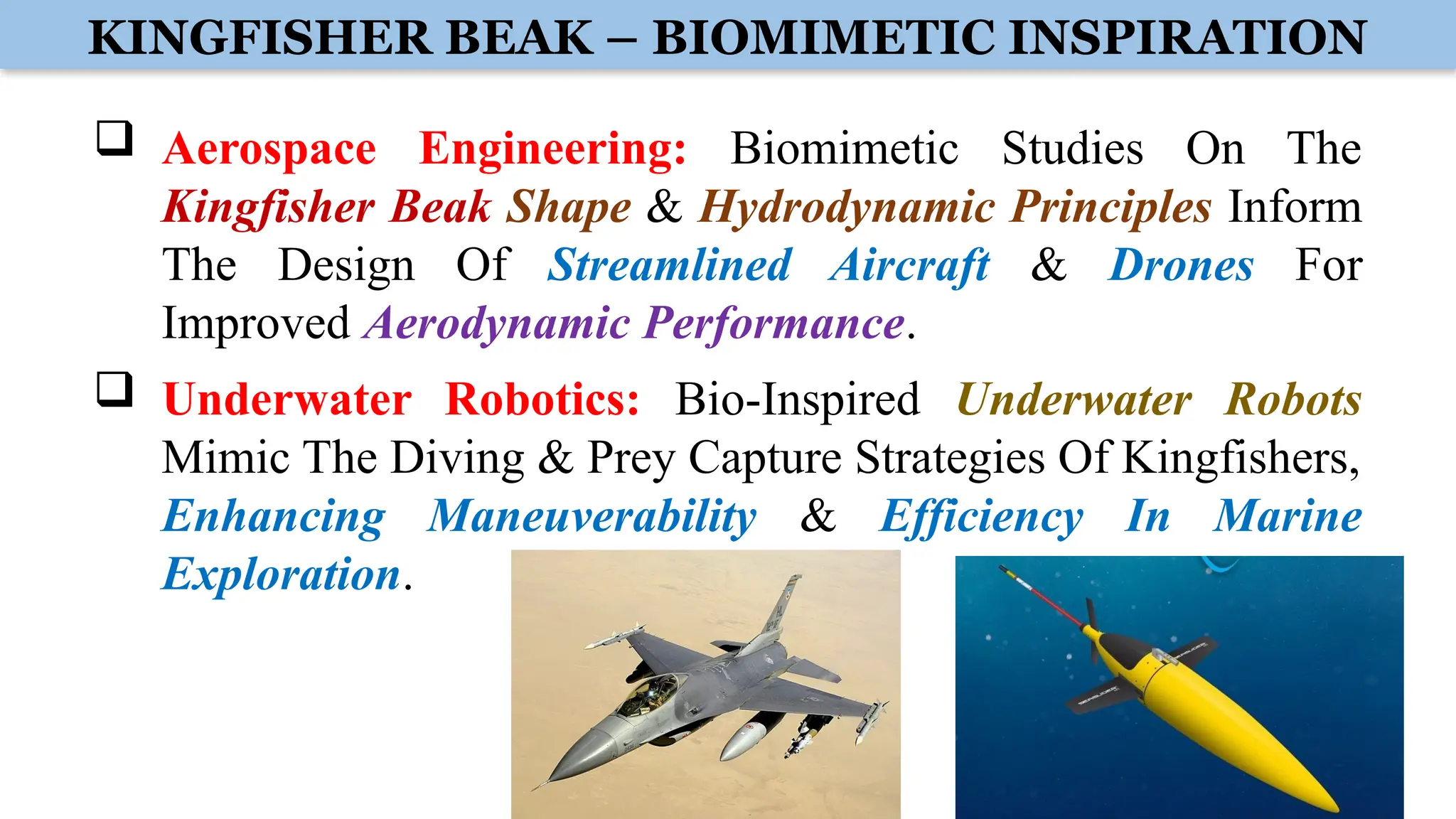
Aerospace Engineering: Biomimetic Studies On The
Kingfisher Beak Shape & Hydrodynamic Principles Inform
The Design Of Streamlined Aircraft & Drones For
Improved Aerodynamic Performance.
Underwater Robotics: Bio-Inspired Underwater Robots
Mimic The Diving & Prey Capture Strategies Of Kingfishers,
Enhancing Maneuverability & Efficiency In Marine
Exploration.
48.
KINGFISHER BEAK –BIOMIMETIC INSPIRATION
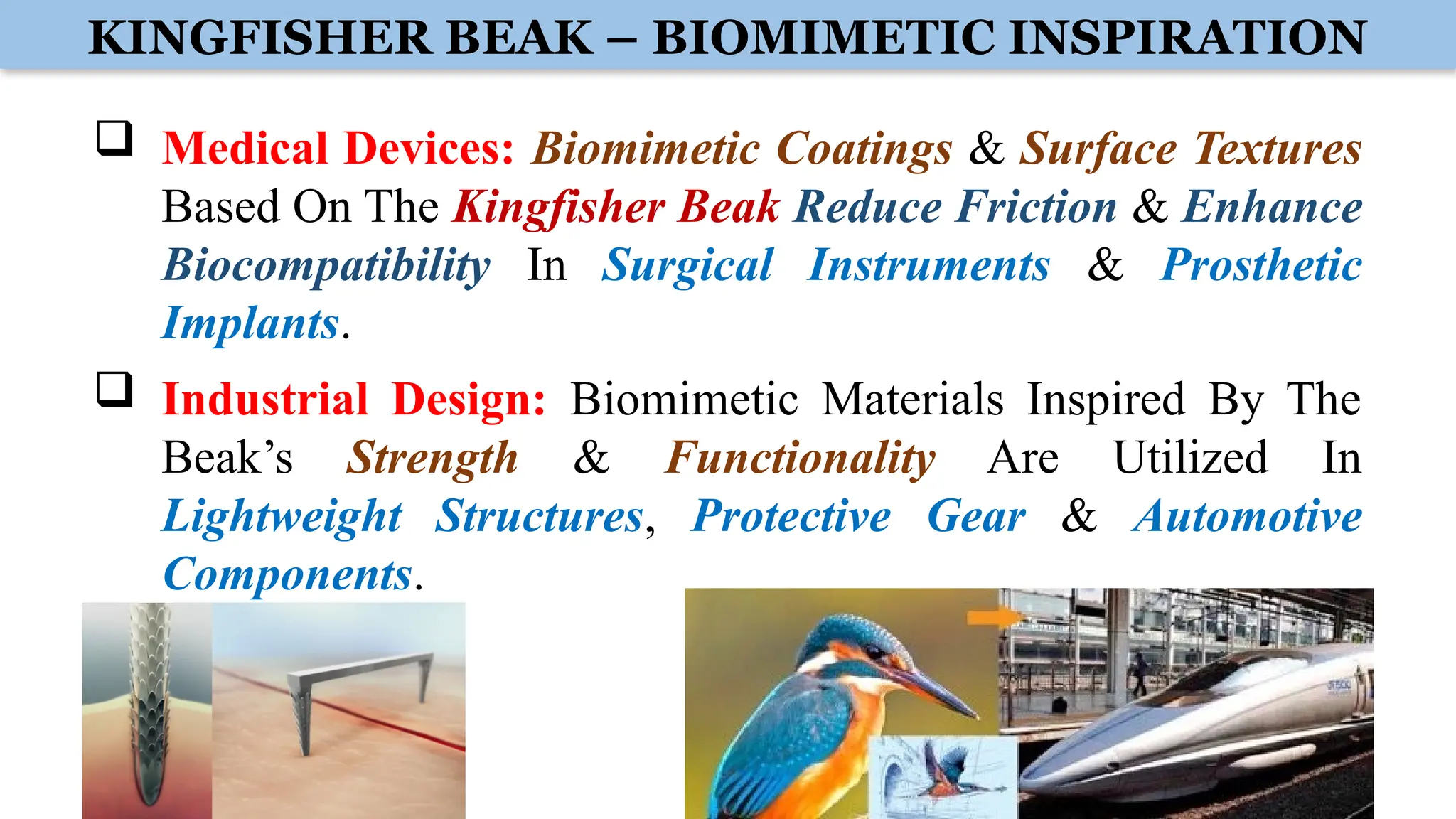
Medical Devices: Biomimetic Coatings & Surface Textures
Based On The Kingfisher Beak Reduce Friction & Enhance
Biocompatibility In Surgical Instruments & Prosthetic
Implants.
Industrial Design: Biomimetic Materials Inspired By The
Beak’s Strength & Functionality Are Utilized In
Lightweight Structures, Protective Gear & Automotive
Components.
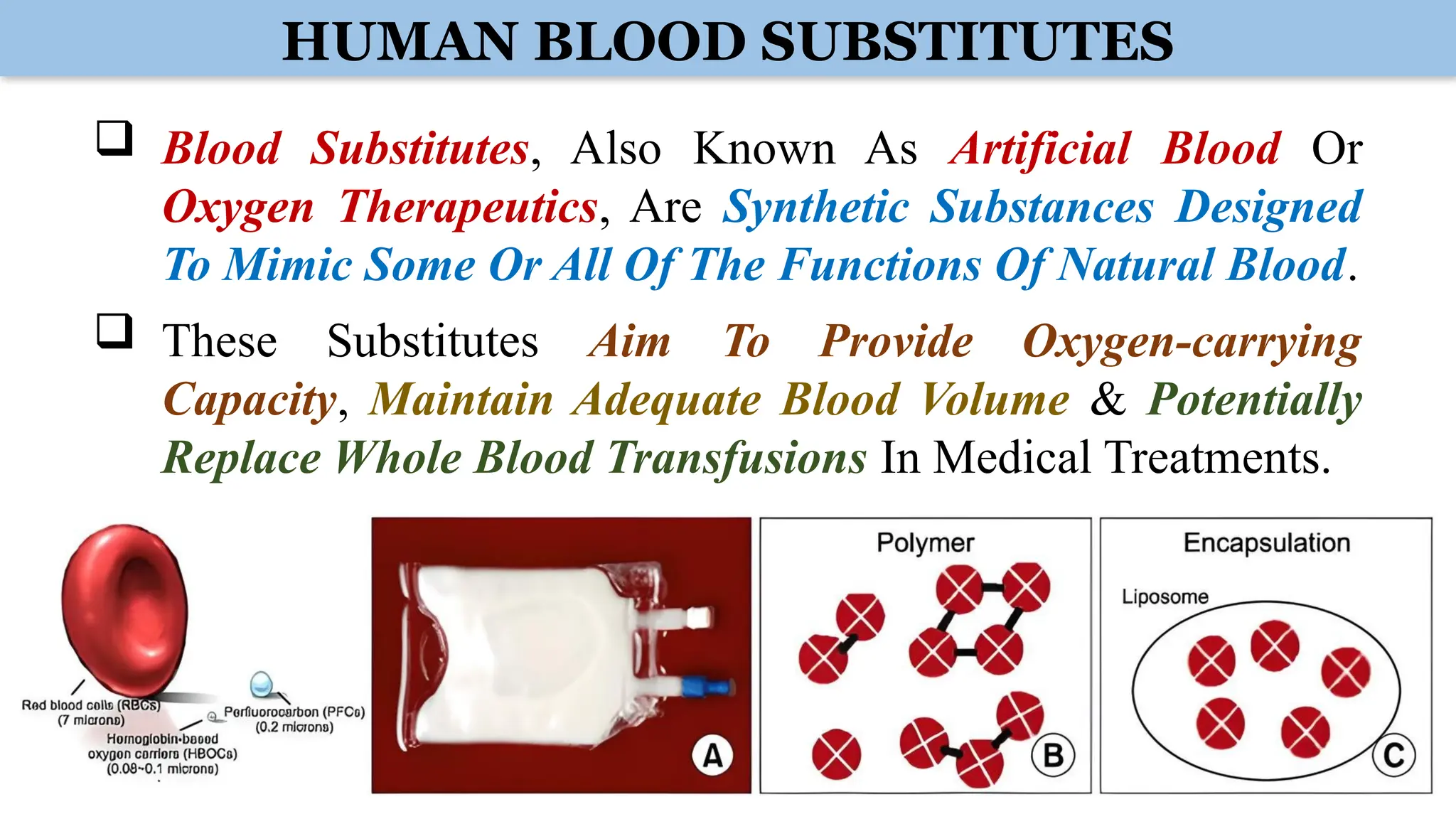
HUMAN BLOOD SUBSTITUTES
Blood Substitutes, Also Known As Artificial Blood Or
Oxygen Therapeutics, Are Synthetic Substances Designed
To Mimic Some Or All Of The Functions Of Natural Blood.
These Substitutes Aim To Provide Oxygen-carrying
Capacity, Maintain Adequate Blood Volume & Potentially
Replace Whole Blood Transfusions In Medical Treatments.
51.
HUMAN BLOOD SUBSTITUTES
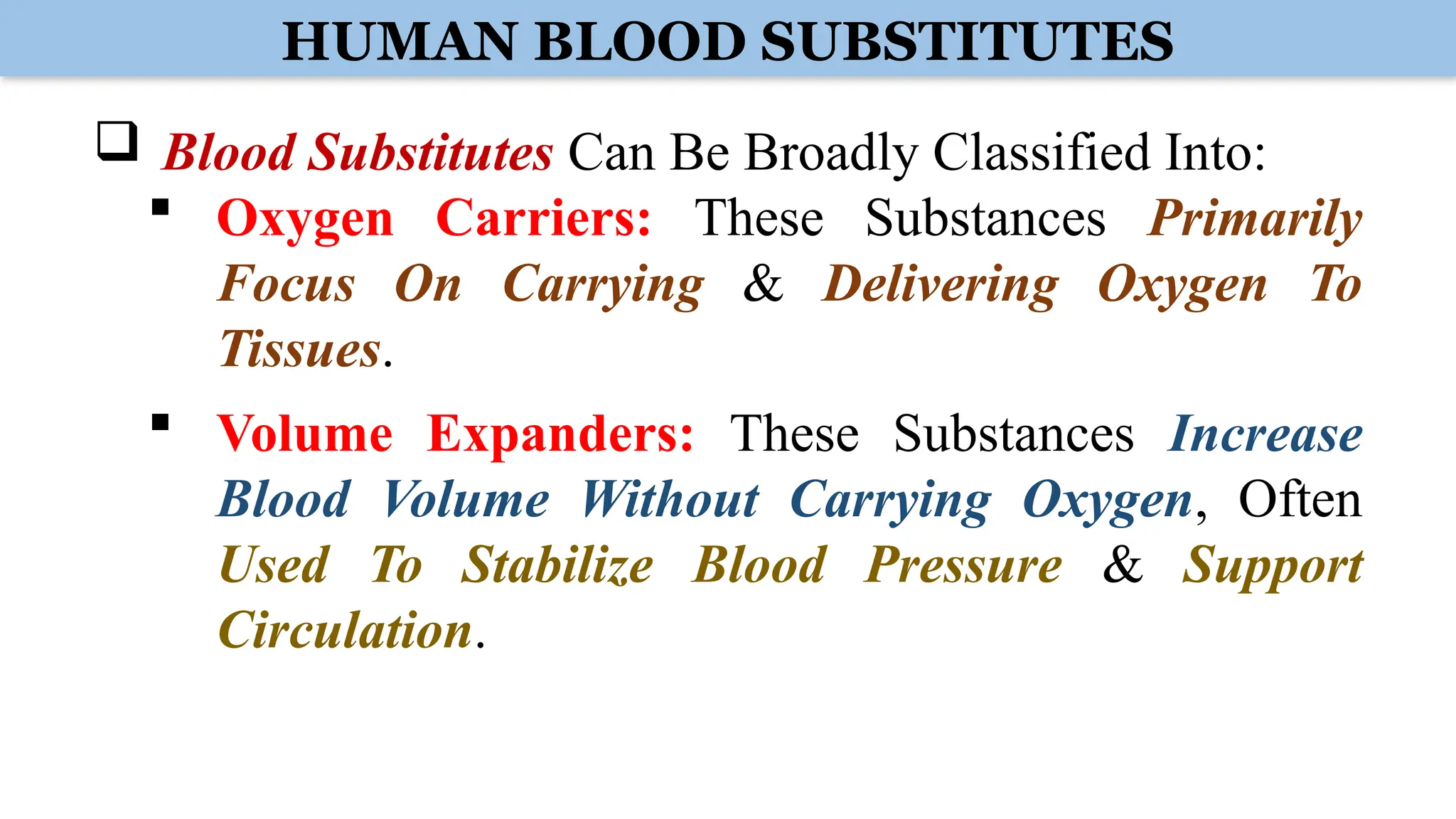
Blood Substitutes Can Be Broadly Classified Into:
Oxygen Carriers: These Substances Primarily
Focus On Carrying & Delivering Oxygen To
Tissues.
Volume Expanders: These Substances Increase
Blood Volume Without Carrying Oxygen, Often
Used To Stabilize Blood Pressure & Support
Circulation.
52.
PRINCIPLES OF BLOODSUBSTITUTES
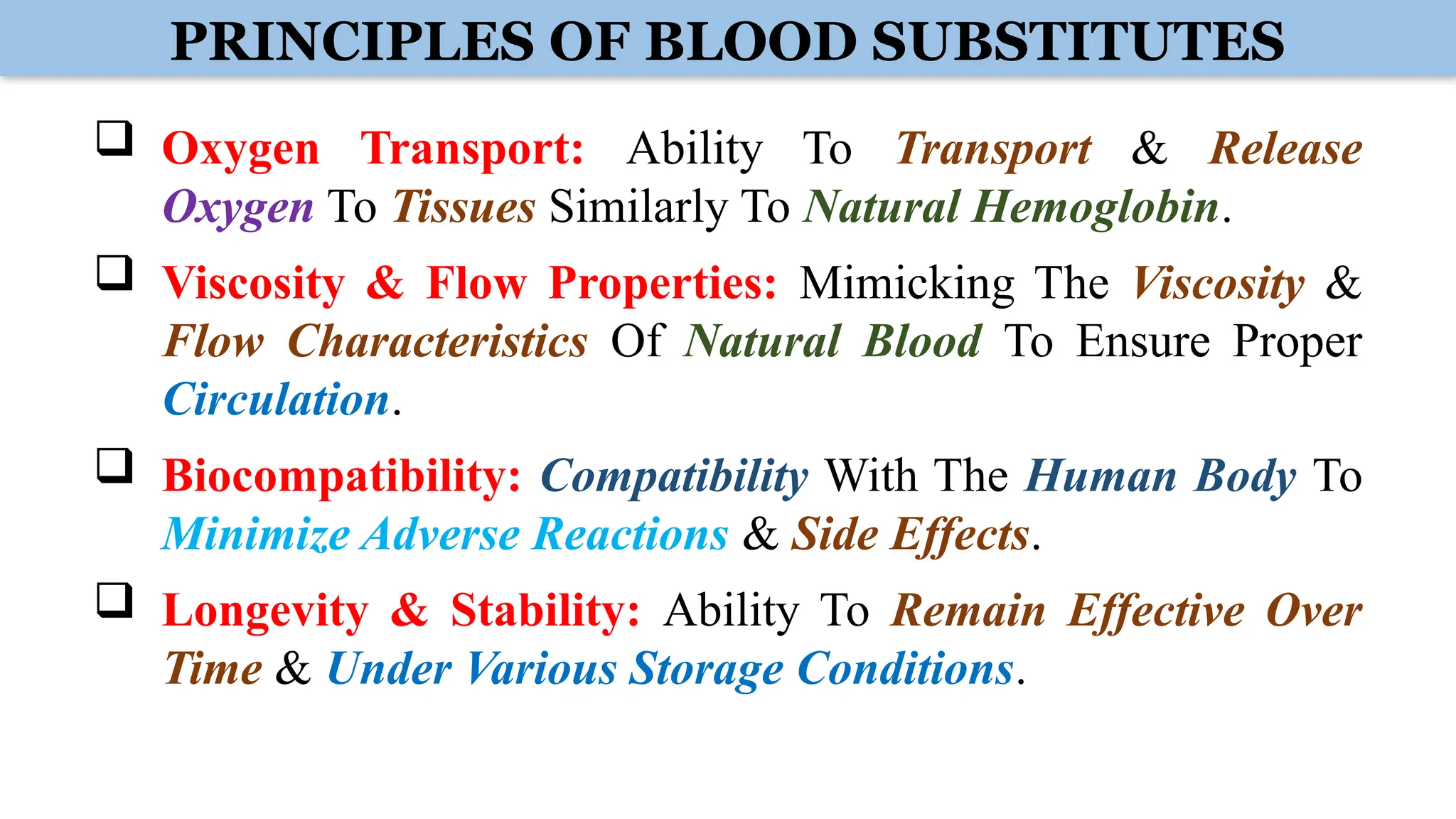
Oxygen Transport: Ability To Transport & Release
Oxygen To Tissues Similarly To Natural Hemoglobin.
Viscosity & Flow Properties: Mimicking The Viscosity &
Flow Characteristics Of Natural Blood To Ensure Proper
Circulation.
Biocompatibility: Compatibility With The Human Body To
Minimize Adverse Reactions & Side Effects.
Longevity & Stability: Ability To Remain Effective Over
Time & Under Various Storage Conditions.
53.
BLOOD SUBSTITUTES –CATEGORIES
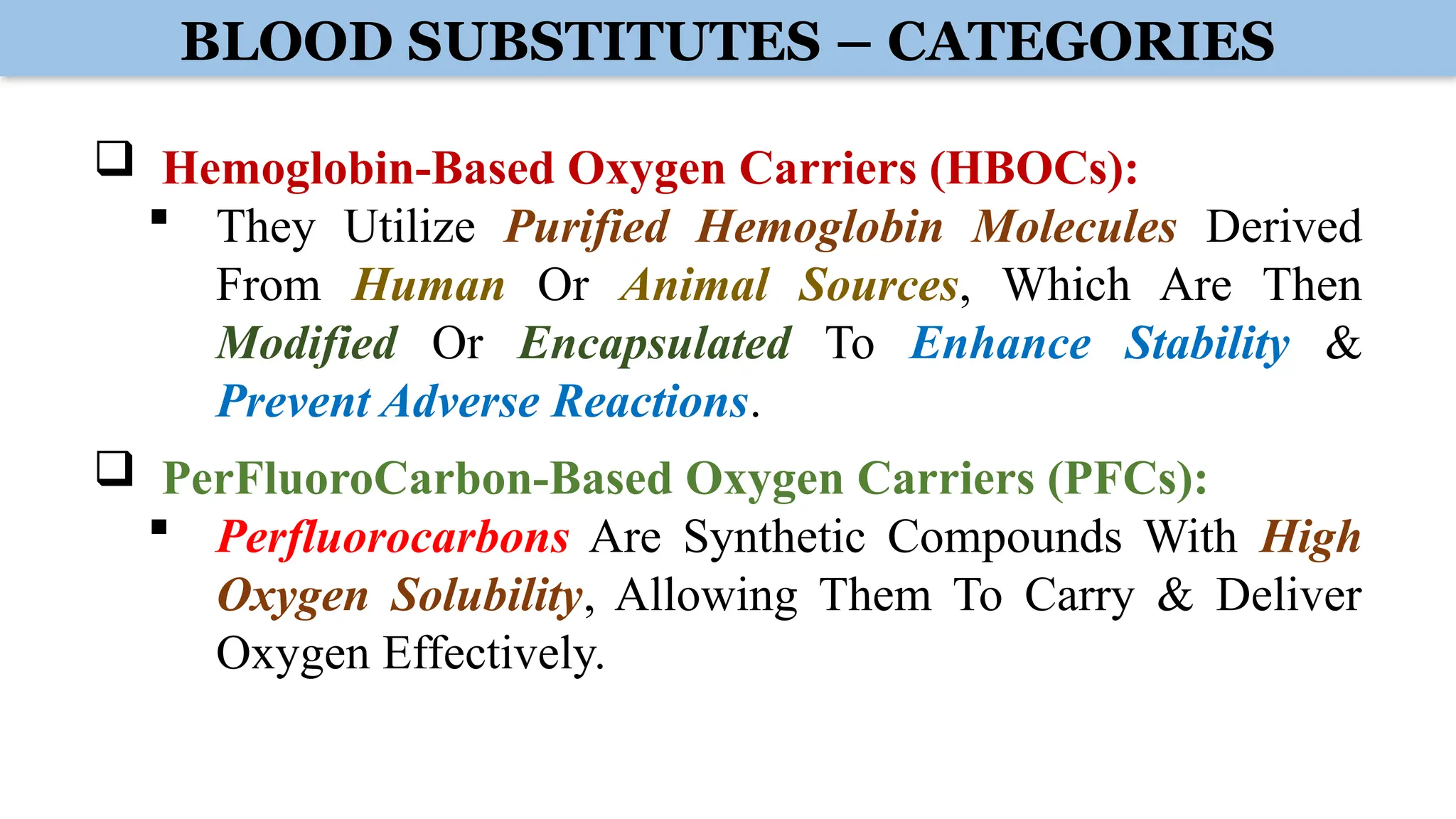
Hemoglobin-Based Oxygen Carriers (HBOCs):
They Utilize Purified Hemoglobin Molecules Derived
From Human Or Animal Sources, Which Are Then
Modified Or Encapsulated To Enhance Stability &
Prevent Adverse Reactions.
PerFluoroCarbon-Based Oxygen Carriers (PFCs):
Perfluorocarbons Are Synthetic Compounds With High
Oxygen Solubility, Allowing Them To Carry & Deliver
Oxygen Effectively.
54.
HEMOGLOBIN-BASED OXYGEN CARRIERS
Hemoglobin-Based Oxygen Carriers Are Synthetic
Molecules Or Products Derived From Hemoglobin
That Are Designed To Transport & Deliver Oxygen
To Tissues In A Manner Similar To Natural Blood.
They Are Developed To Address Limitations
Associated With Traditional Blood Transfusions,
Such As Donor Shortages, Blood Type Compatibility
Issues, & Risks Of Infection Transmission.
55.
HEMOGLOBIN-BASED OXYGEN CARRIERS
Hemoglobin-Based Oxygen Carriers (HBOCs):
Hemoglobin-Based Oxygen Carriers Are One Of The Most
Extensively Researched Types Of Blood Substitutes.
HBOCs Can Be:
Chemically Modified Hemoglobins: Alterations To The
Hemoglobin Molecule To Improve Stability & Oxygen
Affinity.
Encapsulated Hemoglobins: Hemoglobin Enclosed Within
A Lipid Or Polymer Membrane To Prevent Interaction With
Surrounding Tissues & Minimize Toxicity.
56.
HEMOGLOBIN-BASED OXYGEN CARRIERS– PRINCIPLES
Oxygen Binding & Release: Like Natural Hemoglobin,
HBOCs Should Effectively Bind Oxygen In The Lungs &
Release It To Tissues Under Physiological Conditions.
Stability: They Must Maintain Stability During Storage &
Circulation To Ensure Prolonged Effectiveness.
Biocompatibility: HBOCs Should Be Compatible With The
Human Body To Minimize Adverse Immune Responses &
Toxicity.
Oxygen Affinity: Optimal Oxygen Affinity To Balance
Effective Oxygen Delivery With Tissue Oxygenation.
57.
HEMOGLOBIN-BASED OXYGEN CARRIERS– TYPES
Chemically Modified Hemoglobins:
Chemically Modified Hemoglobins Are Derived From Natural
Hemoglobin But Undergo Chemical Alterations To Improve
Stability, Oxygen Affinity & Reduce Adverse Effects. Common
Modifications Include:
Polymerization: Cross-Linking Hemoglobin Molecules To Form
Larger Aggregates, Enhancing Stability & Reducing Renal
Clearance.
PEGylation: Attachment Of Polyethylene Glycol (PEG) Chains To
Hemoglobin To Increase Solubility, Reduce Antigenicity & Prolong
Circulation Time.
Surface Modification: Coating Hemoglobin With Surfactants Or
Polymers To Improve Biocompatibility & Reduce Toxicity.
58.
HEMOGLOBIN-BASED OXYGEN CARRIERS– TYPES
Encapsulated Hemoglobins:
Encapsulated Hemoglobins Involve Enclosing Purified
Hemoglobin Within A Lipid Or Polymer Membrane, Mimicking The
Structure Of Red Blood Cells. This Encapsulation Serves Several
Purposes:
Prevention of Nitric Oxide Scavenging: Nitric Oxide (NO)
Scavenging By Free Hemoglobin Can Lead To Vasoconstriction &
Adverse Effects. Encapsulation Helps Mitigate This Issue.
Enhanced Stability: Protection Of Hemoglobin From Degradation
& Denaturation In The Bloodstream.
Controlled Oxygen Release: Regulation Of Oxygen Release To
Tissues Based On Physiological Demand.
59.
HBOCs – CLINICALAPPLICATIONS
Emergency Medicine & Trauma: Providing Immediate
Oxygen Delivery In Cases Of Severe Blood Loss Or Trauma
Where Rapid Transfusion Is Critical.
Surgery: Supplementing Or Replacing The Need For Donor
Blood During Surgeries, Particularly In Settings Where Blood
Availability Is Limited.
Anemia Management: Offering Alternative Treatment
Options For Patients With Chronic Anemia Who May Not Be
Suitable Candidates For Traditional Blood Transfusions.
60.
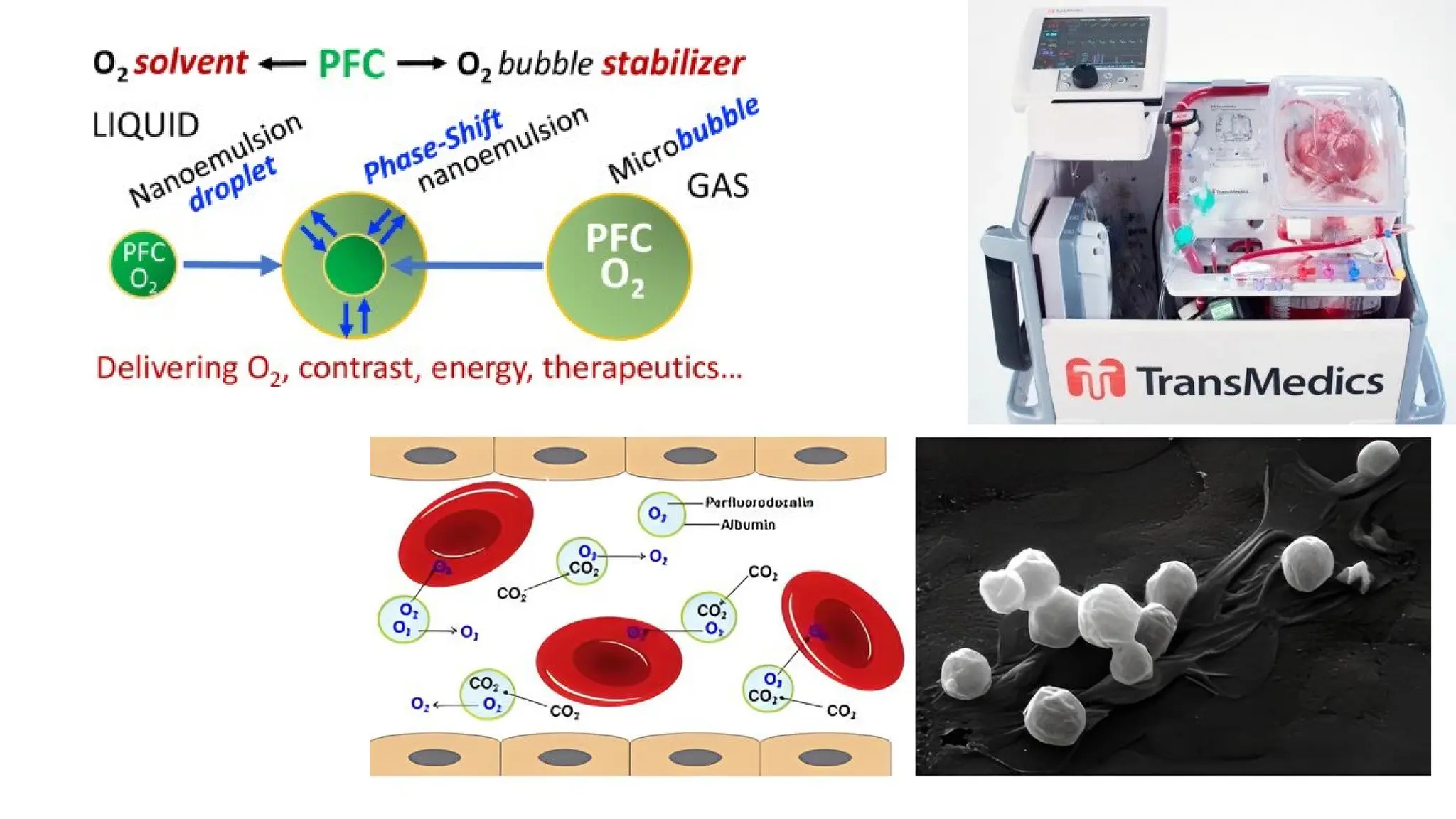
PERFLUOROCARBON-BASED OXYGEN CARRIERS
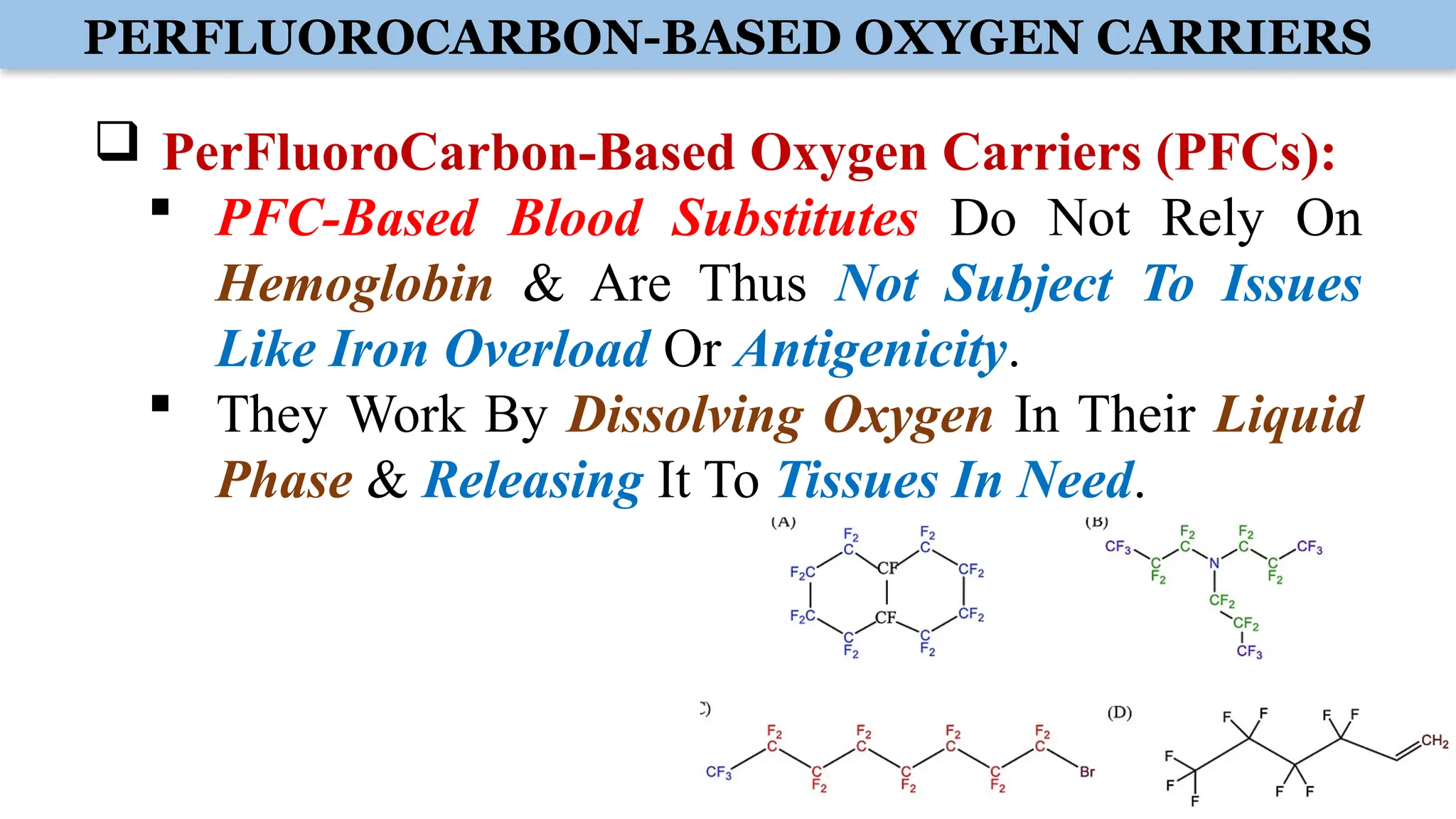
PerFluoroCarbon-Based Oxygen Carriers (PFCs):
PFC-Based Blood Substitutes Do Not Rely On
Hemoglobin & Are Thus Not Subject To Issues
Like Iron Overload Or Antigenicity.
They Work By Dissolving Oxygen In Their Liquid
Phase & Releasing It To Tissues In Need.
61.
PERFLUOROCARBONS
Perfluorocarbons AreFully Fluorinated Hydrocarbons
Where All Hydrogen Atoms Have Been Replaced By
Fluorine Atoms.
This Molecular Structure Results In Several Distinctive
Properties That Make Them Valuable In Medical &
Industrial Applications.
In The Biomedical Field, PFCs Are Primarily Recognized
For Their High Solubility For Gases Like Oxygen & Carbon
Dioxide, Inertness & Ability To Carry & Release Gases
Effectively.
62.
PerFluoroCarbon-Based Oxygen Carriers– PROPERTIES
High Gas Solubility: PFCs Have A High Capacity To Dissolve
Gases Such As Oxygen & Carbon Dioxide, Which Allows Them To
Function As Effective Oxygen Carriers.
Chemical Stability: Due To The Strong Carbon-Fluorine Bonds,
PFCs Are Highly Stable & Chemically Inert, Reducing The Risk Of
Decomposition Or Interaction With Biological Tissues.
Low Surface Tension: PFCs Have Low Surface Tension, Which
Facilitates Their Mixing With Blood & Improves Their Ability To
Navigate Through Small Capillaries.
Biocompatibility: PFCs Are Generally Well Tolerated By The Body
& Do Not Elicit Significant Immune Responses Or Toxicity When
Properly Formulated.
63.
PerFluoroCarbon-Based Oxygen Carriers– PRINCIPLES
Oxygen Transport: PFCs Should Efficiently Dissolve &
Transport Oxygen From The Lungs To Tissues, Similar To
Natural Blood.
Gas Exchange Properties: Ability To Exchange Oxygen &
Carbon Dioxide At The Cellular Level To Support Metabolism.
Biocompatibility: Compatibility With Biological Systems To
Avoid Adverse Reactions & Promote Safe Use.
Longevity: Maintaining Stability & Effectiveness Over Time &
Under Various Storage Conditions.
64.
PERFLUOROCARBON-BASED OXYGEN CARRIERS:TYPES
Emulsions:
Perfluorocarbon Emulsions Are Composed Of Tiny Droplets Of
PFCs Dispersed In An Aqueous Medium, Often Stabilized With
Surfactants Or Lipids.
This Formulation Improves Biocompatibility, Stability & Facilitates
Mixing With Blood.
Nano-Emulsions:
Nanoemulsions Are A Specialized Form Of Emulsion Where The
Perfluorocarbon Droplets Are Significantly Smaller, Typically In
The Nanometer Range (1 mm = 10,00,000 nm).
Nanoemulsions Offer Enhanced Stability, Prolonged Circulation
Times & Improved Tissue Penetration Compared To Larger
Emulsion Droplets.
65.
PERFLUOROCARBONS – CLINICALAPPLICATIONS
Blood Substitutes: Substitute For Or Supplement To
Traditional Blood Transfusions, Particularly In Situations
Where Blood Availability Or Compatibility Is Limited.
Organ Preservation: Use In Organ Preservation
Solutions To Maintain Oxygenation During Transport &
Storage, Improving The Viability Of Organs For
Transplantation.
Oxygen Delivery In Critical Care: Emergency Situations
Requiring Rapid Oxygen Delivery, Such As Trauma Or
Acute Respiratory Distress Syndrome (ARDS).