Bayesian Personalized Rankingfor Non-Uniformly Sampled Items


                              Bayesian Personalized Ranking
                            for Non-Uniformly Sampled Items

                Zeno Gantner, Lucas Drumond, Christoph Freudenthaler,
                                Lars Schmidt-Thieme

                                                University of Hildesheim


                                                 21 August 2011


Zeno Gantner et al., University of Hildesheim                              1 / 15
Bayesian Personalized Rankingfor Non-Uniformly Sampled Items   Questions (and Answers)


                                                What?
               Who?                                                          Which?
                                                How?
                                                                           Where?
                             Why?

Zeno Gantner et al., University of Hildesheim                                            2 / 15
Bayesian Personalized Rankingfor Non-Uniformly Sampled Items   Which problem to solve?


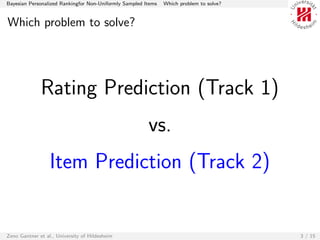
Which problem to solve?


              Rating Prediction (Track 1)
                                                        vs.
                  Item Prediction (Track 2)


Zeno Gantner et al., University of Hildesheim                                            3 / 15
Bayesian Personalized Rankingfor Non-Uniformly Sampled Items   How did we tackle the problem?


How did we tackle the problem?
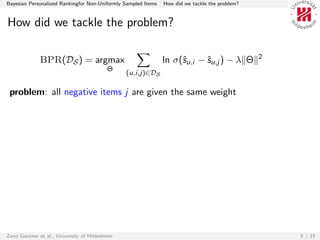
 Bayesian Personalized Ranking:
                                                                                                2
       BPR(DS ) = argmax                                 ln σ(ˆu,i (Θ) − ˆu,j (Θ) )−λ Θ
                                                              s          s
                                    Θ
                                            (u,i,j)∈DS

         DS contains all pairs of positive and negative items for each user,
                     1
         σ(x) = 1+e −x is the logistic function,
         Θ represents the model parameters,
         ˆu,i (Θ) is the predicted score for user u and item i, and
         s
         λ Θ 2 is a regularization term to prevent overfitting.

 interpretation 1: reduce ranking to pairwise classif. [Balcan et al. 2008]
 interpretation 2: optimize for smoothed area under the ROC curve (AUC)
 Model: matrix factorization
 Learning: stochastic gradient ascent

                                                                                 [Rendle et al., UAI 2009]
Zeno Gantner et al., University of Hildesheim                                                          4 / 15
Bayesian Personalized Rankingfor Non-Uniformly Sampled Items   How did we tackle the problem?


How did we tackle the problem?

                                                                                                2
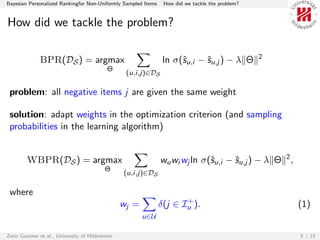
              BPR(DS ) = argmax                                ln σ(ˆu,i − ˆu,j ) − λ Θ
                                                                    s      s
                                          Θ
                                                (u,i,j)∈DS

 problem: all negative items j are given the same weight


Zeno Gantner et al., University of Hildesheim                                                       5 / 15
Bayesian Personalized Rankingfor Non-Uniformly Sampled Items    How did we tackle the problem?


How did we tackle the problem?

                                                                                                 2
              BPR(DS ) = argmax                                 ln σ(ˆu,i − ˆu,j ) − λ Θ
                                                                     s      s
                                          Θ
                                                 (u,i,j)∈DS

 problem: all negative items j are given the same weight

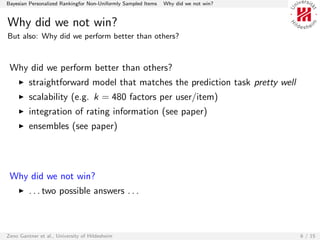
 solution: adapt weights in the optimization criterion (and sampling
 probabilities in the learning algorithm)


        WBPR(DS ) = argmax                                     wu wi wj ln σ(ˆu,i − ˆu,j ) − λ Θ 2 ,
                                                                             s      s
                                         Θ
                                                (u,i,j)∈DS

 where
                                                                      +
                                                wj =           δ(j ∈ Iu ).                             (1)
                                                       u∈U

Zeno Gantner et al., University of Hildesheim                                                          5 / 15
Bayesian Personalized Rankingfor Non-Uniformly Sampled Items   Why did we not win?


Why did we not win?
But also: Why did we perform better than others?


 Why did we perform better than others?
         straightforward model that matches the prediction task pretty well
         scalability (e.g. k = 480 factors per user/item)
         integration of rating information (see paper)
         ensembles (see paper)


 Why did we not win?
         . . . two possible answers . . .


Zeno Gantner et al., University of Hildesheim                                        6 / 15
Bayesian Personalized Rankingfor Non-Uniformly Sampled Items   Why did we not win?


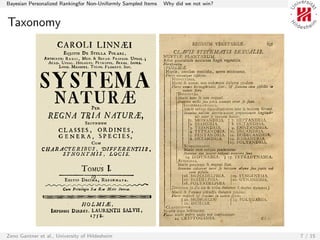
Taxonomy


Zeno Gantner et al., University of Hildesheim                                        7 / 15
Bayesian Personalized Rankingfor Non-Uniformly Sampled Items         Why did we not win?


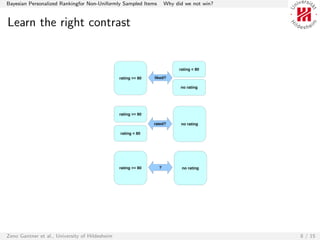
Learn the right contrast


                                                                          rating < 80

                                                rating >= 80   liked?

                                                                           no rating


                                                rating >= 80

                                                               rated?      no rating

                                                rating < 80


                                                rating >= 80     ?          no rating


Zeno Gantner et al., University of Hildesheim                                              8 / 15
Bayesian Personalized Rankingfor Non-Uniformly Sampled Items          Why did we not win?


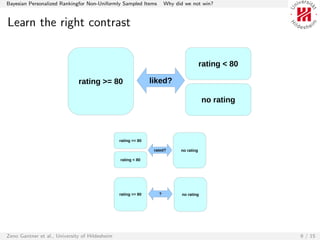
Learn the right contrast


                                                                                        rating < 80

                              rating >= 80                     liked?

                                                                                         no rating


                                                rating >= 80

                                                                rated?      no rating

                                                rating < 80


                                                rating >= 80      ?          no rating


Zeno Gantner et al., University of Hildesheim                                                         9 / 15
Bayesian Personalized Rankingfor Non-Uniformly Sampled Items          Why did we not win?


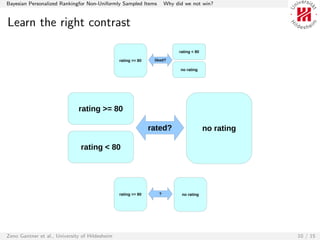
Learn the right contrast

                                                                           rating < 80

                                                rating >= 80    liked?

                                                                            no rating


                              rating >= 80

                                                               rated?                    no rating

                               rating < 80


                                                rating >= 80      ?          no rating


Zeno Gantner et al., University of Hildesheim                                                        10 / 15
Bayesian Personalized Rankingfor Non-Uniformly Sampled Items         Why did we not win?


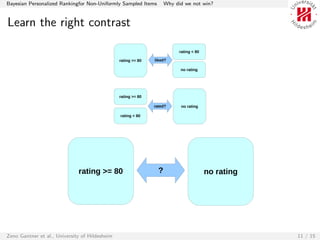
Learn the right contrast

                                                                          rating < 80

                                                rating >= 80   liked?

                                                                           no rating


                                                rating >= 80

                                                               rated?      no rating

                                                rating < 80


                              rating >= 80                       ?                      no rating


Zeno Gantner et al., University of Hildesheim                                                       11 / 15
Bayesian Personalized Rankingfor Non-Uniformly Sampled Items   Where?


Where next?


         classification → ranking → pairwise classification
         pairwise classification: try other losses, e.g. soft margin (hinge) loss
         Bayesian2 Personalized Ranking
         beyond KDD Cup: consider different sampling schemes . . .
Zeno Gantner et al., University of Hildesheim                                 12 / 15
Bayesian Personalized Rankingfor Non-Uniformly Sampled Items   Summary


Summary
        Use matrix factorization optimized for Bayesian
        Personalized Ranking (BPR) to solve the item
        ranking problem.
                BPR reduces ranking (in this case: binary
                variables) to pairwise classification.
        Extend BPR to use different sampling scheme:
        Weighted BPR (WBPR).
        Open question: Learn a different contrast?
        Details can be found in the paper.
        Code: http://ismll.de/mymedialite/
        examples/kddcup2011.html


                               advertisement: Contribute to http://recsyswiki.com!

Zeno Gantner et al., University of Hildesheim                                  13 / 15
Bayesian Personalized Rankingfor Non-Uniformly Sampled Items   Questions


Zeno Gantner et al., University of Hildesheim                              14 / 15
Bayesian Personalized Rankingfor Non-Uniformly Sampled Items


Acknowledgements
 Thank you
         The organizers, for hosting a great competition.
         The participants, for sharing their insights.

 Funding
         German Research Council (Deutsche Forschungsgemeinschaft, DFG) project
         Multirelational Factorization Models.
         Development of the MyMediaLite software was co-funded by the European
         Commission FP7 project MyMedia under the grant agreement no. 215006.

 Picture credits
             by Michael Sauers, under Creative Commons by-nc-sa 2.0
         http://www.flickr.com/photos/travelinlibrarian/223839049/

               by Rob Starling, under Creative Commons by-sa 2.0
         http://en.wikipedia.org/wiki/File:Air_New_Zealand_B747-400_ZK-SUI_at_LHR.jpg

Zeno Gantner et al., University of Hildesheim                                           15 / 15
Bayesian Personalized Rankingfor Non-Uniformly Sampled Items


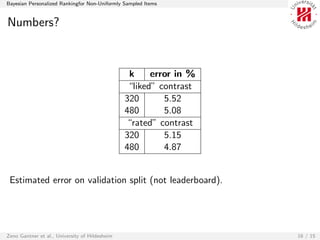
Numbers?


                                                 k     error in %
                                                 “liked” contrast
                                                320       5.52
                                                480       5.08
                                                “rated” contrast
                                                320       5.15
                                                480       4.87


 Estimated error on validation split (not leaderboard).


Zeno Gantner et al., University of Hildesheim                       16 / 15
Bayesian Personalized Rankingfor Non-Uniformly Sampled Items   Advertisement


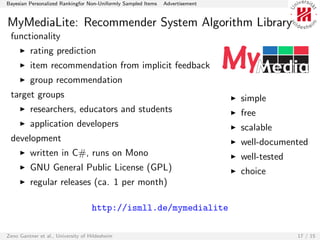
MyMediaLite: Recommender System Algorithm Library
 functionality
         rating prediction
         item recommendation from implicit feedback
         group recommendation
 target groups                                                                 simple
         researchers, educators and students                                   free
         application developers                                                scalable
 development                                                                   well-documented
         written in C#, runs on Mono                                           well-tested
         GNU General Public License (GPL)                                      choice
         regular releases (ca. 1 per month)

                                    http://ismll.de/mymedialite

Zeno Gantner et al., University of Hildesheim                                                17 / 15
Bayesian Personalized Rankingfor Non-Uniformly Sampled Items   Advertisement


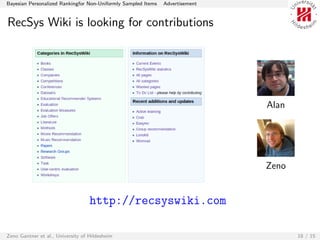
RecSys Wiki is looking for contributions


                                                                               Alan


                                                                               Zeno


                                   http://recsyswiki.com

Zeno Gantner et al., University of Hildesheim                                         18 / 15

Bayesian Personalized Ranking for Non-Uniformly Sampled Items

  • 1.
    Bayesian Personalized RankingforNon-Uniformly Sampled Items Bayesian Personalized Ranking for Non-Uniformly Sampled Items Zeno Gantner, Lucas Drumond, Christoph Freudenthaler, Lars Schmidt-Thieme University of Hildesheim 21 August 2011 Zeno Gantner et al., University of Hildesheim 1 / 15
  • 2.
    Bayesian Personalized RankingforNon-Uniformly Sampled Items Questions (and Answers) What? Who? Which? How? Where? Why? Zeno Gantner et al., University of Hildesheim 2 / 15
  • 3.
    Bayesian Personalized RankingforNon-Uniformly Sampled Items Which problem to solve? Which problem to solve? Rating Prediction (Track 1) vs. Item Prediction (Track 2) Zeno Gantner et al., University of Hildesheim 3 / 15
  • 4.
    Bayesian Personalized RankingforNon-Uniformly Sampled Items How did we tackle the problem? How did we tackle the problem? Bayesian Personalized Ranking: 2 BPR(DS ) = argmax ln σ(ˆu,i (Θ) − ˆu,j (Θ) )−λ Θ s s Θ (u,i,j)∈DS DS contains all pairs of positive and negative items for each user, 1 σ(x) = 1+e −x is the logistic function, Θ represents the model parameters, ˆu,i (Θ) is the predicted score for user u and item i, and s λ Θ 2 is a regularization term to prevent overfitting. interpretation 1: reduce ranking to pairwise classif. [Balcan et al. 2008] interpretation 2: optimize for smoothed area under the ROC curve (AUC) Model: matrix factorization Learning: stochastic gradient ascent [Rendle et al., UAI 2009] Zeno Gantner et al., University of Hildesheim 4 / 15
  • 5.
    Bayesian Personalized RankingforNon-Uniformly Sampled Items How did we tackle the problem? How did we tackle the problem? 2 BPR(DS ) = argmax ln σ(ˆu,i − ˆu,j ) − λ Θ s s Θ (u,i,j)∈DS problem: all negative items j are given the same weight Zeno Gantner et al., University of Hildesheim 5 / 15
  • 6.
    Bayesian Personalized RankingforNon-Uniformly Sampled Items How did we tackle the problem? How did we tackle the problem? 2 BPR(DS ) = argmax ln σ(ˆu,i − ˆu,j ) − λ Θ s s Θ (u,i,j)∈DS problem: all negative items j are given the same weight solution: adapt weights in the optimization criterion (and sampling probabilities in the learning algorithm) WBPR(DS ) = argmax wu wi wj ln σ(ˆu,i − ˆu,j ) − λ Θ 2 , s s Θ (u,i,j)∈DS where + wj = δ(j ∈ Iu ). (1) u∈U Zeno Gantner et al., University of Hildesheim 5 / 15
  • 7.
    Bayesian Personalized RankingforNon-Uniformly Sampled Items Why did we not win? Why did we not win? But also: Why did we perform better than others? Why did we perform better than others? straightforward model that matches the prediction task pretty well scalability (e.g. k = 480 factors per user/item) integration of rating information (see paper) ensembles (see paper) Why did we not win? . . . two possible answers . . . Zeno Gantner et al., University of Hildesheim 6 / 15
  • 8.
    Bayesian Personalized RankingforNon-Uniformly Sampled Items Why did we not win? Taxonomy Zeno Gantner et al., University of Hildesheim 7 / 15
  • 9.
    Bayesian Personalized RankingforNon-Uniformly Sampled Items Why did we not win? Learn the right contrast rating < 80 rating >= 80 liked? no rating rating >= 80 rated? no rating rating < 80 rating >= 80 ? no rating Zeno Gantner et al., University of Hildesheim 8 / 15
  • 10.
    Bayesian Personalized RankingforNon-Uniformly Sampled Items Why did we not win? Learn the right contrast rating < 80 rating >= 80 liked? no rating rating >= 80 rated? no rating rating < 80 rating >= 80 ? no rating Zeno Gantner et al., University of Hildesheim 9 / 15
  • 11.
    Bayesian Personalized RankingforNon-Uniformly Sampled Items Why did we not win? Learn the right contrast rating < 80 rating >= 80 liked? no rating rating >= 80 rated? no rating rating < 80 rating >= 80 ? no rating Zeno Gantner et al., University of Hildesheim 10 / 15
  • 12.
    Bayesian Personalized RankingforNon-Uniformly Sampled Items Why did we not win? Learn the right contrast rating < 80 rating >= 80 liked? no rating rating >= 80 rated? no rating rating < 80 rating >= 80 ? no rating Zeno Gantner et al., University of Hildesheim 11 / 15
  • 13.
    Bayesian Personalized RankingforNon-Uniformly Sampled Items Where? Where next? classification → ranking → pairwise classification pairwise classification: try other losses, e.g. soft margin (hinge) loss Bayesian2 Personalized Ranking beyond KDD Cup: consider different sampling schemes . . . Zeno Gantner et al., University of Hildesheim 12 / 15
  • 14.
    Bayesian Personalized RankingforNon-Uniformly Sampled Items Summary Summary Use matrix factorization optimized for Bayesian Personalized Ranking (BPR) to solve the item ranking problem. BPR reduces ranking (in this case: binary variables) to pairwise classification. Extend BPR to use different sampling scheme: Weighted BPR (WBPR). Open question: Learn a different contrast? Details can be found in the paper. Code: http://ismll.de/mymedialite/ examples/kddcup2011.html advertisement: Contribute to http://recsyswiki.com! Zeno Gantner et al., University of Hildesheim 13 / 15
  • 15.
    Bayesian Personalized RankingforNon-Uniformly Sampled Items Questions Zeno Gantner et al., University of Hildesheim 14 / 15
  • 16.
    Bayesian Personalized RankingforNon-Uniformly Sampled Items Acknowledgements Thank you The organizers, for hosting a great competition. The participants, for sharing their insights. Funding German Research Council (Deutsche Forschungsgemeinschaft, DFG) project Multirelational Factorization Models. Development of the MyMediaLite software was co-funded by the European Commission FP7 project MyMedia under the grant agreement no. 215006. Picture credits by Michael Sauers, under Creative Commons by-nc-sa 2.0 http://www.flickr.com/photos/travelinlibrarian/223839049/ by Rob Starling, under Creative Commons by-sa 2.0 http://en.wikipedia.org/wiki/File:Air_New_Zealand_B747-400_ZK-SUI_at_LHR.jpg Zeno Gantner et al., University of Hildesheim 15 / 15
  • 17.
    Bayesian Personalized RankingforNon-Uniformly Sampled Items Numbers? k error in % “liked” contrast 320 5.52 480 5.08 “rated” contrast 320 5.15 480 4.87 Estimated error on validation split (not leaderboard). Zeno Gantner et al., University of Hildesheim 16 / 15
  • 18.
    Bayesian Personalized RankingforNon-Uniformly Sampled Items Advertisement MyMediaLite: Recommender System Algorithm Library functionality rating prediction item recommendation from implicit feedback group recommendation target groups simple researchers, educators and students free application developers scalable development well-documented written in C#, runs on Mono well-tested GNU General Public License (GPL) choice regular releases (ca. 1 per month) http://ismll.de/mymedialite Zeno Gantner et al., University of Hildesheim 17 / 15
  • 19.
    Bayesian Personalized RankingforNon-Uniformly Sampled Items Advertisement RecSys Wiki is looking for contributions Alan Zeno http://recsyswiki.com Zeno Gantner et al., University of Hildesheim 18 / 15