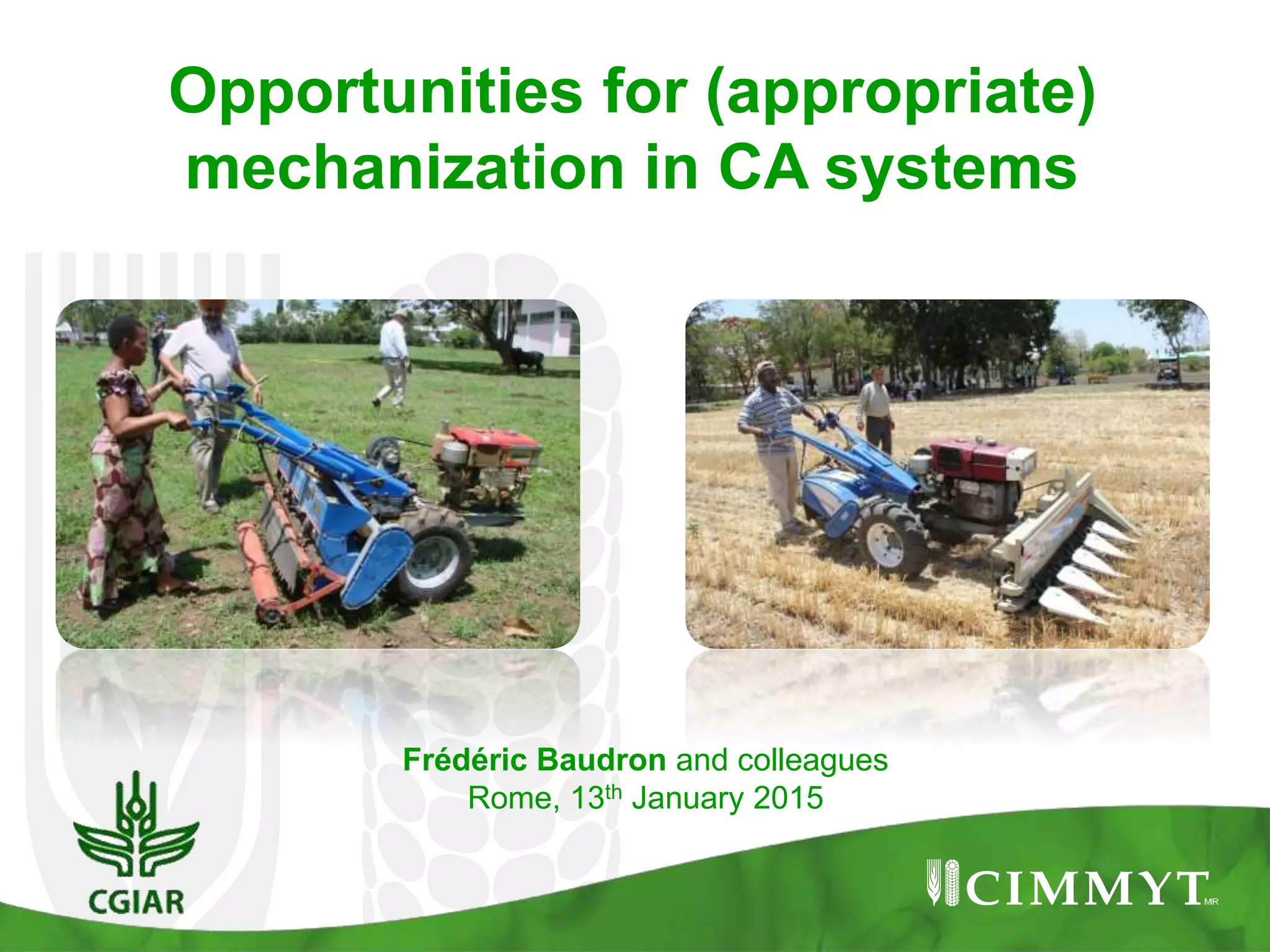
Frédéric Baudron and colleagues
Rome, 13th January 2015
Opportunities for (appropriate)
mechanization in CA systems
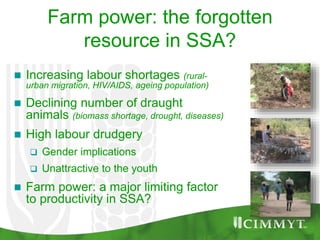
 Increasing labour shortages (rural-
urban migration, HIV/AIDS, ageing population)
 Declining number of draught
animals (biomass shortage, drought, diseases)
 High labour drudgery
 Gender implications
 Unattractive to the youth
 Farm power: a major limiting factor
to productivity in SSA?
Farm power: the forgotten
resource in SSA?
 CA (No-Till) mainly adopted in South
America, North America and Australia + New
Zealand (47%, 38%, and 11% of cropland) (Derpsch
and Friedrich, 2009)
 One of the major incentive: reduction in fuel
and machinery costs (Kassam et al., 2009)
 Major incentive in the less mechanized
systems in developing countries: early
planting (arising from the reduced number of
operations required to prepare the land) (Haggblade
and Tembo, 2003)
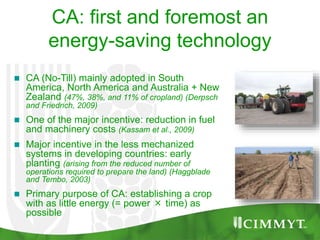
 Primary purpose of CA: establishing a crop
with as little energy (= power × time) as
possible
CA: first and foremost an
energy-saving technology
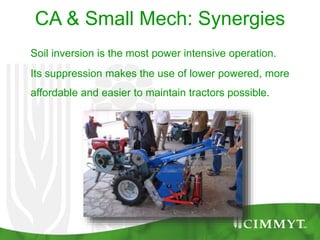
CA & Small Mech: Synergies
Soil inversion is the most power intensive operation.
Its suppression makes the use of lower powered, more
affordable and easier to maintain tractors possible.
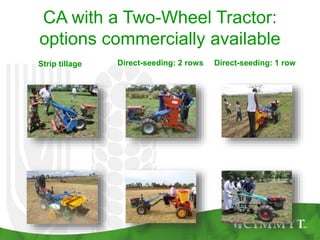
CA with a Two-Wheel Tractor:
options commercially available
Strip tillage Direct-seeding: 2 rows Direct-seeding: 1 row
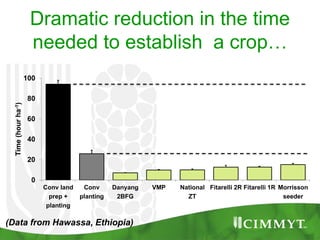
Dramatic reduction in the time
needed to establish a crop…
0
20
40
60
80
100
Conv land
prep +
planting
Conv
planting
Danyang
2BFG
VMP National
ZT
Fitarelli 2R Fitarelli 1R Morrisson
seeder
Time(hourha-1)
(Data from Hawassa, Ethiopia)
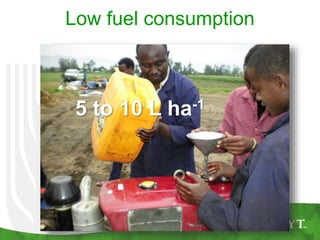
Low fuel consumption
5 to 10 L ha-1
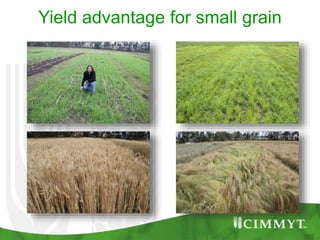
Yield advantage for small grain
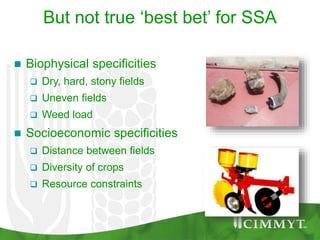
But not true ‘best bet’ for SSA
 Biophysical specificities
 Dry, hard, stony fields
 Uneven fields
 Weed load
 Socioeconomic specificities
 Distance between fields
 Diversity of crops
 Resource constraints
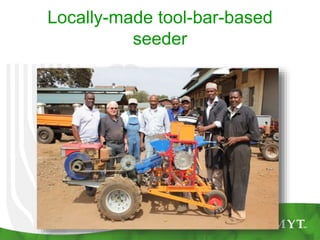
Locally-made tool-bar-based
seeder
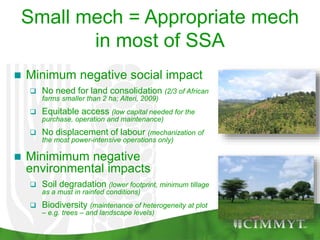
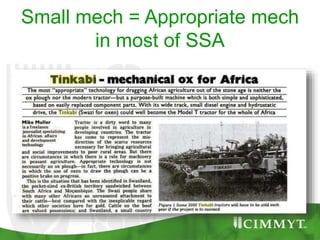
Small mech = Appropriate mech
in most of SSA
 Minimum negative social impact
 No need for land consolidation (2/3 of African
farms smaller than 2 ha; Alteri, 2009)
 Equitable access (low capital needed for the
purchase, operation and maintenance)
 No displacement of labour (mechanization of
the most power-intensive operations only)
 Minimimum negative
environmental impacts
 Soil degradation (lower footprint, minimum tillage
as a must in rainfed conditions)
 Biodiversity (maintenance of heterogeneity at plot
– e.g. trees – and landscape levels)
Small mech = Appropriate mech
in most of SSA
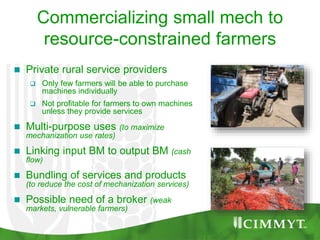
Commercializing small mech to
resource-constrained farmers
 Private rural service providers
 Only few farmers will be able to purchase
machines individually
 Not profitable for farmers to own machines
unless they provide services
 Multi-purpose uses (to maximize
mechanization use rates)
 Linking input BM to output BM (cash
flow)
 Bundling of services and products
(to reduce the cost of mechanization services)
 Possible need of a broker (weak
markets, vulnerable farmers)
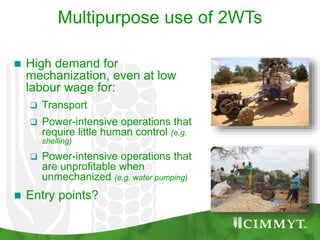
Multipurpose use of 2WTs
 High demand for
mechanization, even at low
labour wage for:
 Transport
 Power-intensive operations that
require little human control (e.g.
shelling)
 Power-intensive operations that
are unprofitable when
unmechanized (e.g. water pumping)
 Entry points?
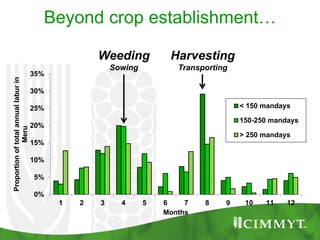
0%
5%
10%
15%
20%
25%
30%
35%
1 2 3 4 5 6 7 8 9 10 11 12
Proportionoftotalannuallaburin
Meru
Months
< 150 mandays
150-250 mandays
> 250 mandays
Weeding
Sowing
Harvesting
Transporting
Beyond crop establishment…
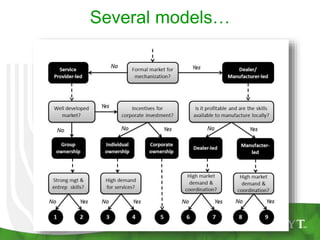
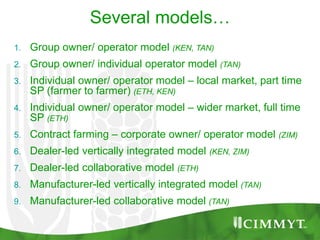
Several models…
Several models…
1. Group owner/ operator model (KEN, TAN)
2. Group owner/ individual operator model (TAN)
3. Individual owner/ operator model – local market, part time
SP (farmer to farmer) (ETH, KEN)
4. Individual owner/ operator model – wider market, full time
SP (ETH)
5. Contract farming – corporate owner/ operator model (ZIM)
6. Dealer-led vertically integrated model (KEN, ZIM)
7. Dealer-led collaborative model (ETH)
8. Manufacturer-led vertically integrated model (TAN)
9. Manufacturer-led collaborative model (TAN)
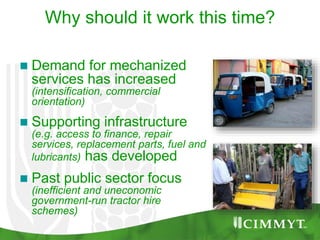
Why should it work this time?
 Demand for mechanized
services has increased
(intensification, commercial
orientation)
 Supporting infrastructure
(e.g. access to finance, repair
services, replacement parts, fuel and
lubricants) has developed
 Past public sector focus
(inefficient and uneconomic
government-run tractor hire
schemes)
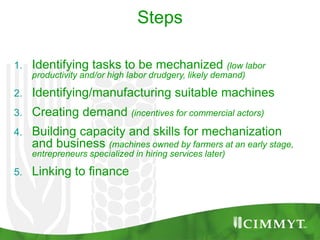
Steps
1. Identifying tasks to be mechanized (low labor
productivity and/or high labor drudgery, likely demand)
2. Identifying/manufacturing suitable machines
3. Creating demand (incentives for commercial actors)
4. Building capacity and skills for mechanization
and business (machines owned by farmers at an early stage,
entrepreneurs specialized in hiring services later)
5. Linking to finance
Thank you!

Opportunities for (appropriate) mechanization in CA systems

  • 1.
    Frédéric Baudron andcolleagues Rome, 13th January 2015 Opportunities for (appropriate) mechanization in CA systems
  • 2.
     Increasing labourshortages (rural- urban migration, HIV/AIDS, ageing population)  Declining number of draught animals (biomass shortage, drought, diseases)  High labour drudgery  Gender implications  Unattractive to the youth  Farm power: a major limiting factor to productivity in SSA? Farm power: the forgotten resource in SSA?
  • 3.
     CA (No-Till)mainly adopted in South America, North America and Australia + New Zealand (47%, 38%, and 11% of cropland) (Derpsch and Friedrich, 2009)  One of the major incentive: reduction in fuel and machinery costs (Kassam et al., 2009)  Major incentive in the less mechanized systems in developing countries: early planting (arising from the reduced number of operations required to prepare the land) (Haggblade and Tembo, 2003)  Primary purpose of CA: establishing a crop with as little energy (= power × time) as possible CA: first and foremost an energy-saving technology
  • 4.
    CA & SmallMech: Synergies Soil inversion is the most power intensive operation. Its suppression makes the use of lower powered, more affordable and easier to maintain tractors possible.
  • 5.
    CA with aTwo-Wheel Tractor: options commercially available Strip tillage Direct-seeding: 2 rows Direct-seeding: 1 row
  • 6.
    Dramatic reduction inthe time needed to establish a crop… 0 20 40 60 80 100 Conv land prep + planting Conv planting Danyang 2BFG VMP National ZT Fitarelli 2R Fitarelli 1R Morrisson seeder Time(hourha-1) (Data from Hawassa, Ethiopia)
  • 7.
  • 8.
  • 9.
    But not true‘best bet’ for SSA  Biophysical specificities  Dry, hard, stony fields  Uneven fields  Weed load  Socioeconomic specificities  Distance between fields  Diversity of crops  Resource constraints
  • 10.
  • 11.
    Small mech =Appropriate mech in most of SSA  Minimum negative social impact  No need for land consolidation (2/3 of African farms smaller than 2 ha; Alteri, 2009)  Equitable access (low capital needed for the purchase, operation and maintenance)  No displacement of labour (mechanization of the most power-intensive operations only)  Minimimum negative environmental impacts  Soil degradation (lower footprint, minimum tillage as a must in rainfed conditions)  Biodiversity (maintenance of heterogeneity at plot – e.g. trees – and landscape levels)
  • 12.
    Small mech =Appropriate mech in most of SSA
  • 13.
    Commercializing small mechto resource-constrained farmers  Private rural service providers  Only few farmers will be able to purchase machines individually  Not profitable for farmers to own machines unless they provide services  Multi-purpose uses (to maximize mechanization use rates)  Linking input BM to output BM (cash flow)  Bundling of services and products (to reduce the cost of mechanization services)  Possible need of a broker (weak markets, vulnerable farmers)
  • 14.
    Multipurpose use of2WTs  High demand for mechanization, even at low labour wage for:  Transport  Power-intensive operations that require little human control (e.g. shelling)  Power-intensive operations that are unprofitable when unmechanized (e.g. water pumping)  Entry points?
  • 15.
    0% 5% 10% 15% 20% 25% 30% 35% 1 2 34 5 6 7 8 9 10 11 12 Proportionoftotalannuallaburin Meru Months < 150 mandays 150-250 mandays > 250 mandays Weeding Sowing Harvesting Transporting Beyond crop establishment…
  • 16.
  • 17.
    Several models… 1. Groupowner/ operator model (KEN, TAN) 2. Group owner/ individual operator model (TAN) 3. Individual owner/ operator model – local market, part time SP (farmer to farmer) (ETH, KEN) 4. Individual owner/ operator model – wider market, full time SP (ETH) 5. Contract farming – corporate owner/ operator model (ZIM) 6. Dealer-led vertically integrated model (KEN, ZIM) 7. Dealer-led collaborative model (ETH) 8. Manufacturer-led vertically integrated model (TAN) 9. Manufacturer-led collaborative model (TAN)
  • 18.
    Why should itwork this time?  Demand for mechanized services has increased (intensification, commercial orientation)  Supporting infrastructure (e.g. access to finance, repair services, replacement parts, fuel and lubricants) has developed  Past public sector focus (inefficient and uneconomic government-run tractor hire schemes)
  • 19.
    Steps 1. Identifying tasksto be mechanized (low labor productivity and/or high labor drudgery, likely demand) 2. Identifying/manufacturing suitable machines 3. Creating demand (incentives for commercial actors) 4. Building capacity and skills for mechanization and business (machines owned by farmers at an early stage, entrepreneurs specialized in hiring services later) 5. Linking to finance
  • 20.

Editor's Notes

  • #4 Resource conservation and productivity increase are just ‘bonuses’ to farmers
  • #13 ‘Appropriate’ mechanization emerged in the 1970s and 1980s as a response to the undesirable consequences of the promotion of large-scale mechanization in sub-Saharan Africa (SSA) in the 1950s and 1960s