SMART CONFERENCE HALL USING IoT TECHNOLOGY
WELLFARE INSTITUTE OF SCIENCE TECHNOLOGY &
MANAGEMENT
(Approved by the AICTE, New Delhi and affiliated to Andhra University)Pinagadi (V),
Pendurthy (M), Visakhapatnam- 531173
PROJECT GUIDE
CH.RAMANA BABU, M.Tech.,(PhD)
Assistant Professor
Department Of ECE, WISTM.
PROJECT ASSOCIATIVES:-
R.LEELA
(318129512024)
P.SAIKUMARI
(318129512019)
G.MANOJKUMAR
(318129512014)
G.GOWTHAMI
(318129512002)
INTRODUCTION
• MOTIVATION : To enhance the standard of living, the appliances need to be
wholly automated without any user intervention in any form whatsoever. This
enables the end user hassle-free interaction with the appliances as the appliances
learn and react as per the user's requirements without him physically pressing a
button.
• PROJECT OBJECTIVE : The main objective of this project is to develop a
conference hall automation system using an Node MCU board with Internet being
remotely controlled by any Android OS smart phone for getting smarter.
• KEY IDEA : In this automation system, we will control conference hall
appliances as bulbs connected to relay using blynk application.
COMPONENTS REQUIRED AND WHY?
NODEMCU : NodeMCU is an open source platform based on ESP8266 which can connect
objects and let data transfer using the WIFI protocol.
RELAY MODULE : A relay is an electrical device which is generally used to
control high voltages using very low voltage as an Input.
PUSH BUTTONS : A Push buttons is a simple switch mechanism to control
some aspect of a machine or a process.
BLOCK DIAGRAM , CODE OPERATION AND
CONNECTIVITY.
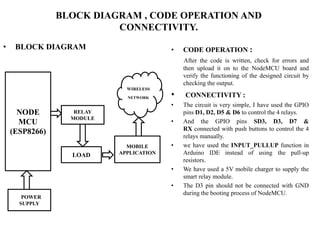
• BLOCK DIAGRAM • CODE OPERATION :
After the code is written, check for errors and
then upload it on to the NodeMCU board and
verify the functioning of the designed circuit by
checking the output.
• CONNECTIVITY :
• The circuit is very simple, I have used the GPIO
pins D1, D2, D5 & D6 to control the 4 relays.
• And the GPIO pins SD3, D3, D7 &
RX connected with push buttons to control the 4
relays manually.
• we have used the INPUT_PULLUP function in
Arduino IDE instead of using the pull-up
resistors.
• We have used a 5V mobile charger to supply the
smart relay module.
• The D3 pin should not be connected with GND
during the booting process of NodeMCU.
NODE
MCU
(ESP8266)
RELAY
MODULE
MOBILE
APPLICATION
BPOWER
SUPPLY
WIRELESS
NETWORK
LOAD
RESULT
• PICTORIAL • PRACTICAL
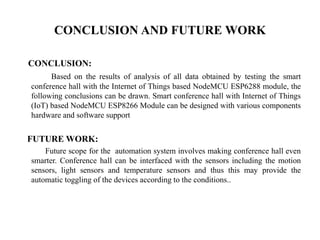
CONCLUSION AND FUTURE WORK
CONCLUSION:
Based on the results of analysis of all data obtained by testing the smart
conference hall with the Internet of Things based NodeMCU ESP6288 module, the
following conclusions can be drawn. Smart conference hall with Internet of Things
(IoT) based NodeMCU ESP8266 Module can be designed with various components
hardware and software support
FUTURE WORK:
Future scope for the automation system involves making conference hall even
smarter. Conference hall can be interfaced with the sensors including the motion
sensors, light sensors and temperature sensors and thus this may provide the
automatic toggling of the devices according to the conditions..

batch 03 ppt.pptx

  • 1.
    SMART CONFERENCE HALLUSING IoT TECHNOLOGY WELLFARE INSTITUTE OF SCIENCE TECHNOLOGY & MANAGEMENT (Approved by the AICTE, New Delhi and affiliated to Andhra University)Pinagadi (V), Pendurthy (M), Visakhapatnam- 531173 PROJECT GUIDE CH.RAMANA BABU, M.Tech.,(PhD) Assistant Professor Department Of ECE, WISTM. PROJECT ASSOCIATIVES:- R.LEELA (318129512024) P.SAIKUMARI (318129512019) G.MANOJKUMAR (318129512014) G.GOWTHAMI (318129512002)
  • 2.
    INTRODUCTION • MOTIVATION :To enhance the standard of living, the appliances need to be wholly automated without any user intervention in any form whatsoever. This enables the end user hassle-free interaction with the appliances as the appliances learn and react as per the user's requirements without him physically pressing a button. • PROJECT OBJECTIVE : The main objective of this project is to develop a conference hall automation system using an Node MCU board with Internet being remotely controlled by any Android OS smart phone for getting smarter. • KEY IDEA : In this automation system, we will control conference hall appliances as bulbs connected to relay using blynk application.
  • 3.
    COMPONENTS REQUIRED ANDWHY? NODEMCU : NodeMCU is an open source platform based on ESP8266 which can connect objects and let data transfer using the WIFI protocol. RELAY MODULE : A relay is an electrical device which is generally used to control high voltages using very low voltage as an Input. PUSH BUTTONS : A Push buttons is a simple switch mechanism to control some aspect of a machine or a process.
  • 4.
    BLOCK DIAGRAM ,CODE OPERATION AND CONNECTIVITY. • BLOCK DIAGRAM • CODE OPERATION : After the code is written, check for errors and then upload it on to the NodeMCU board and verify the functioning of the designed circuit by checking the output. • CONNECTIVITY : • The circuit is very simple, I have used the GPIO pins D1, D2, D5 & D6 to control the 4 relays. • And the GPIO pins SD3, D3, D7 & RX connected with push buttons to control the 4 relays manually. • we have used the INPUT_PULLUP function in Arduino IDE instead of using the pull-up resistors. • We have used a 5V mobile charger to supply the smart relay module. • The D3 pin should not be connected with GND during the booting process of NodeMCU. NODE MCU (ESP8266) RELAY MODULE MOBILE APPLICATION BPOWER SUPPLY WIRELESS NETWORK LOAD
  • 5.
  • 6.
    CONCLUSION AND FUTUREWORK CONCLUSION: Based on the results of analysis of all data obtained by testing the smart conference hall with the Internet of Things based NodeMCU ESP6288 module, the following conclusions can be drawn. Smart conference hall with Internet of Things (IoT) based NodeMCU ESP8266 Module can be designed with various components hardware and software support FUTURE WORK: Future scope for the automation system involves making conference hall even smarter. Conference hall can be interfaced with the sensors including the motion sensors, light sensors and temperature sensors and thus this may provide the automatic toggling of the devices according to the conditions..