Download to read offline

![Basic Data/Variable Types
Numbers Eg : a=1
String Eg: name=”manish”
List Eg: a=[1,2,3,10]
Tuple Eg : a = (1,2,3,10)
Dictionary Eg : tinydict = {'name':
'john','code':6734, 'dept': 'sales'}](https://image.slidesharecdn.com/pythonworkshop-180310125750/85/Basics-of-Python-and-Intro-to-Machine-Learning-4-320.jpg)
![Features of Python
No semi-colon (;)
No curly braces { }
Hashtag is used for commenting #comments
No need to define datatypes
Eg : a = “name” , a=10 ,a = [1,2,3,7]](https://image.slidesharecdn.com/pythonworkshop-180310125750/85/Basics-of-Python-and-Intro-to-Machine-Learning-5-320.jpg)
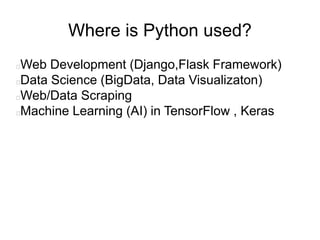

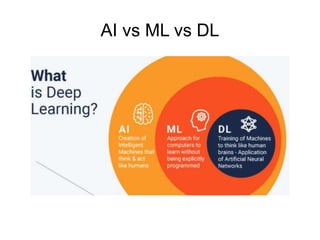
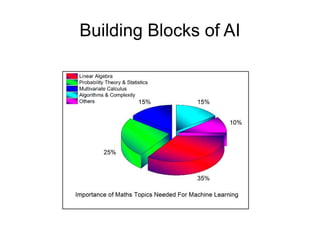


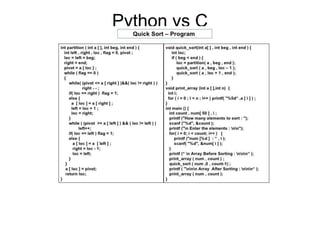
This document provides an introduction to basics of Python and machine learning. It compares Python to C, outlines basic Python data types like numbers, strings, lists and dictionaries. It also describes key Python features like lack of semicolons and type definitions. The document then discusses common uses of Python in areas like web development, data science, scraping and machine learning. It introduces machine learning, artificial intelligence and deep learning concepts before concluding with a note on coding and additional resources.


