Basics of ‘C’
By :Lalit Raghav.
Prof. Anupama Tiwari.
GURUGRAM UNIVERSITY
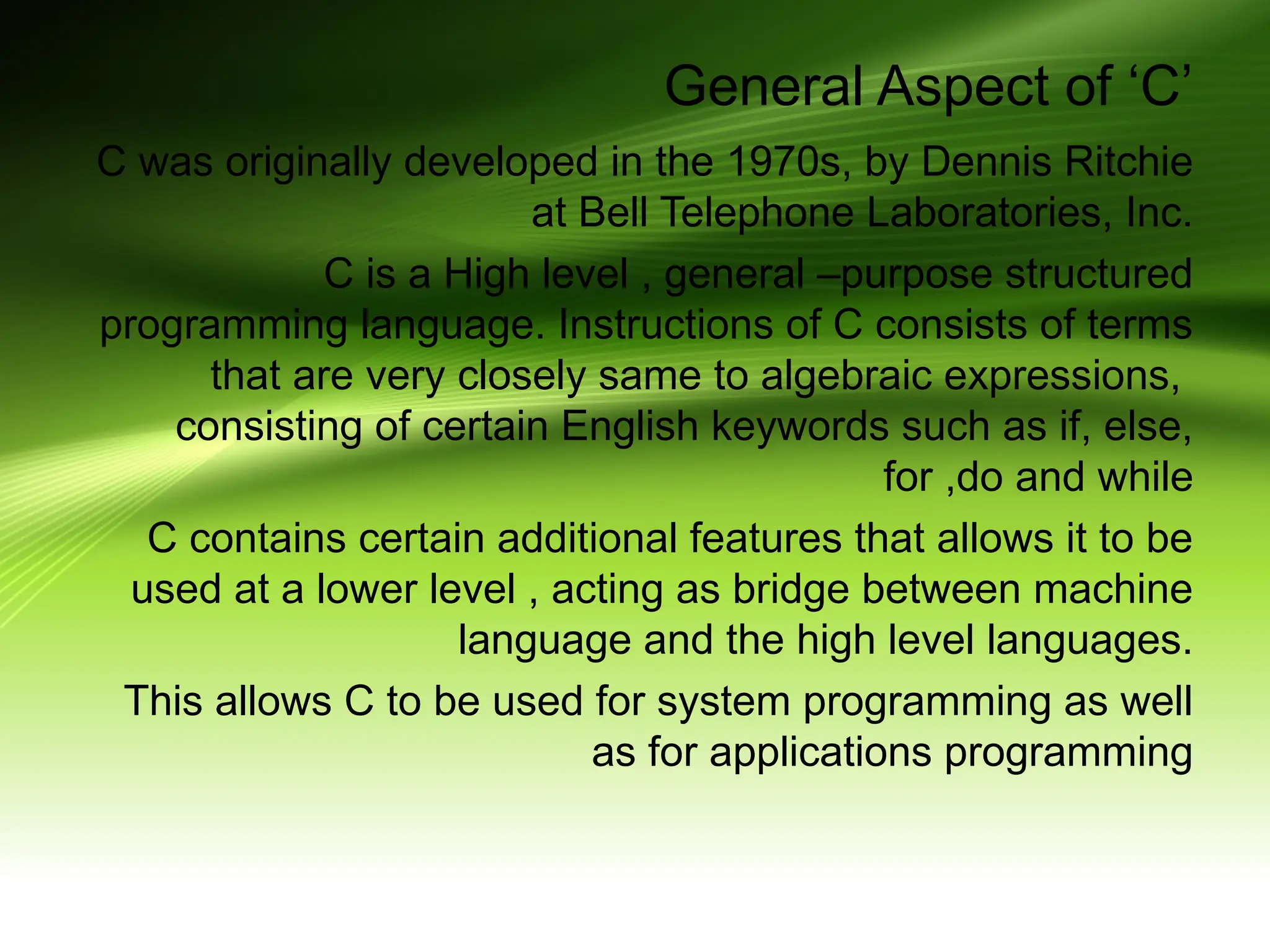
General Aspect of ‘C’
C was originally developed in the 1970s, by Dennis Ritchie
at Bell Telephone Laboratories, Inc.
C is a High level , general –purpose structured
programming language. Instructions of C consists of terms
that are very closely same to algebraic expressions,
consisting of certain English keywords such as if, else,
for ,do and while
C contains certain additional features that allows it to be
used at a lower level , acting as bridge between machine
language and the high level languages.
This allows C to be used for system programming as well
as for applications programming
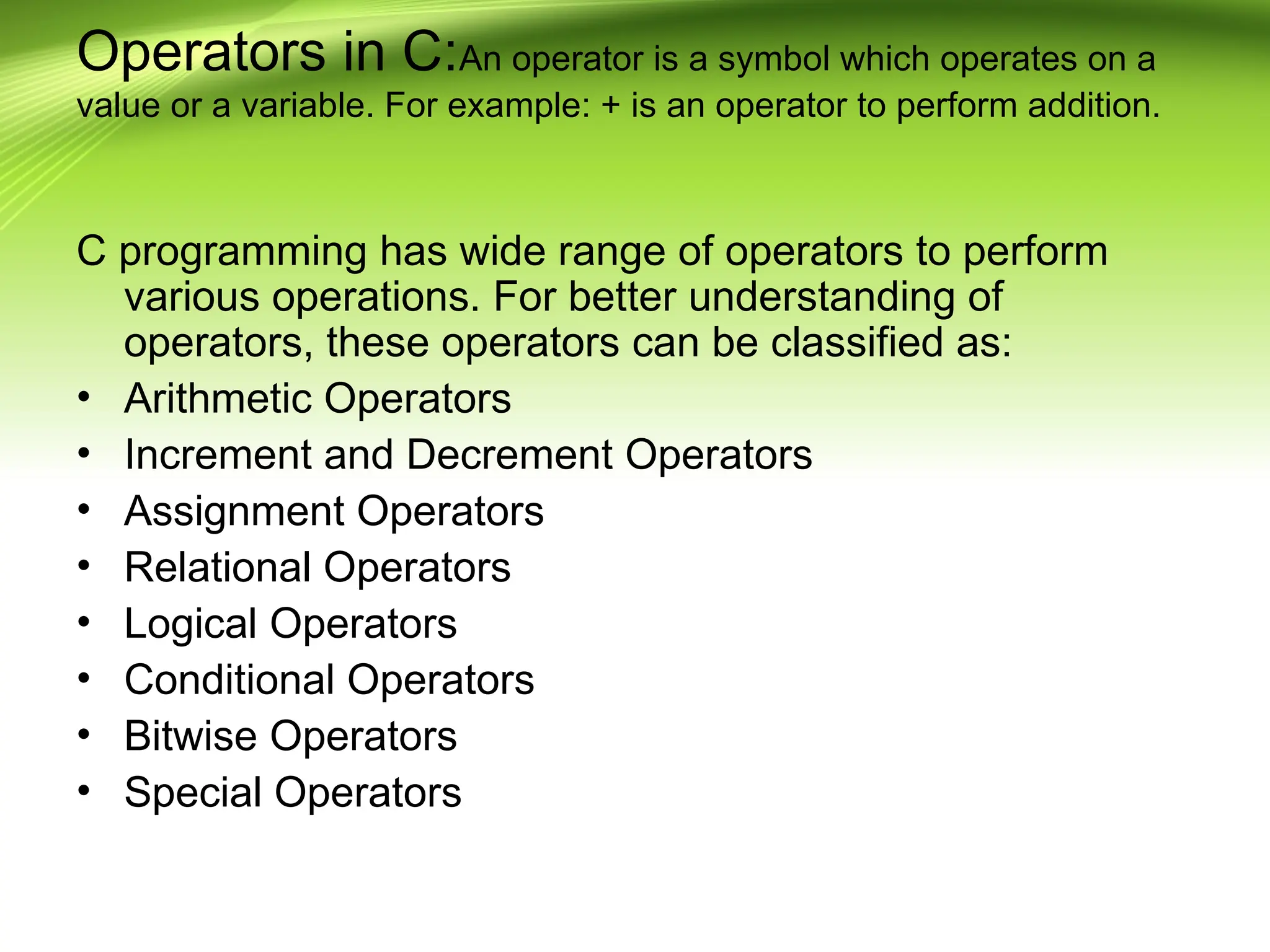
Operators in C:An operator is a symbol which operates on a
value or a variable. For example: + is an operator to perform addition.
C programming has wide range of operators to perform
various operations. For better understanding of
operators, these operators can be classified as:
• Arithmetic Operators
• Increment and Decrement Operators
• Assignment Operators
• Relational Operators
• Logical Operators
• Conditional Operators
• Bitwise Operators
• Special Operators
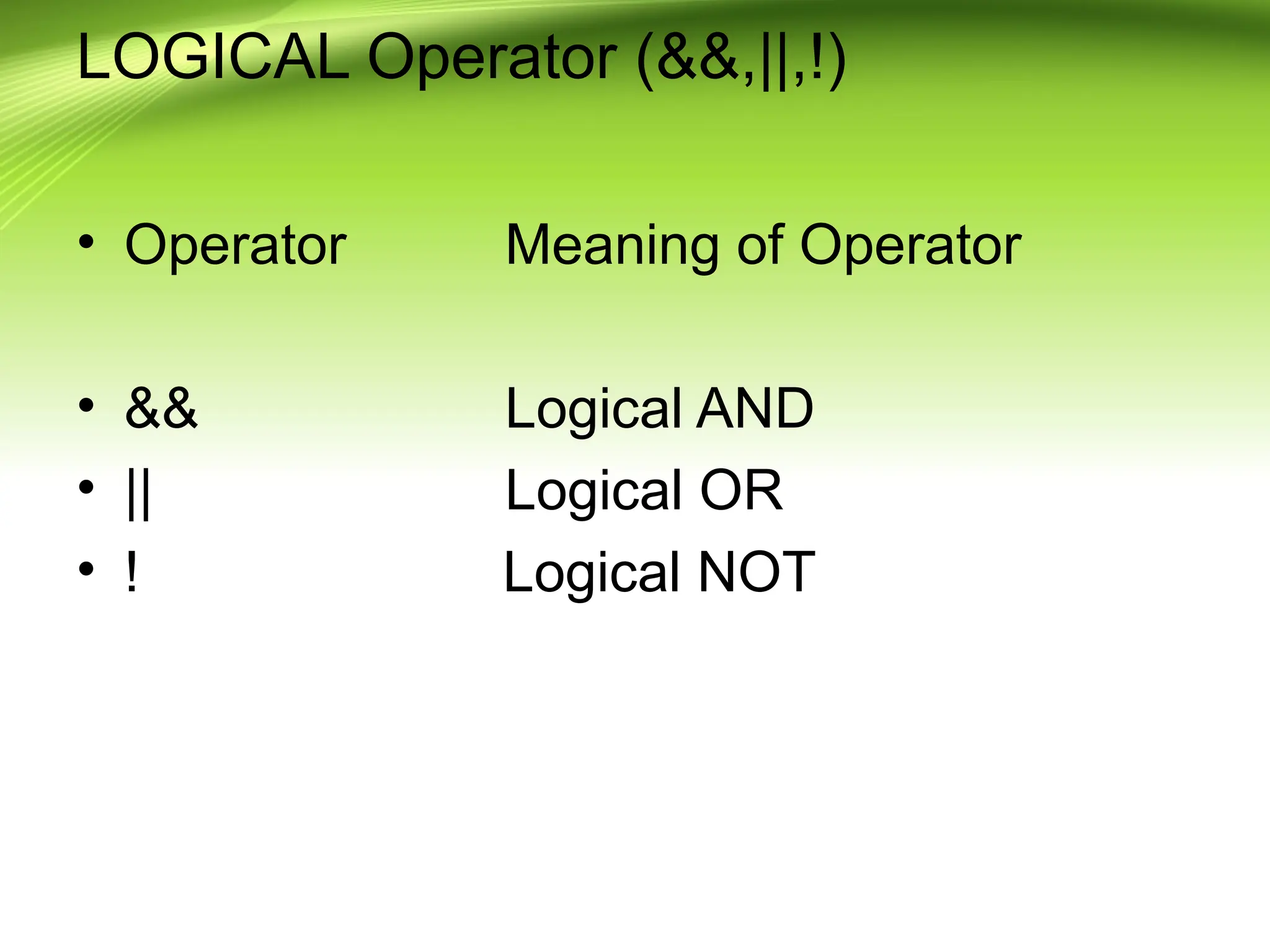
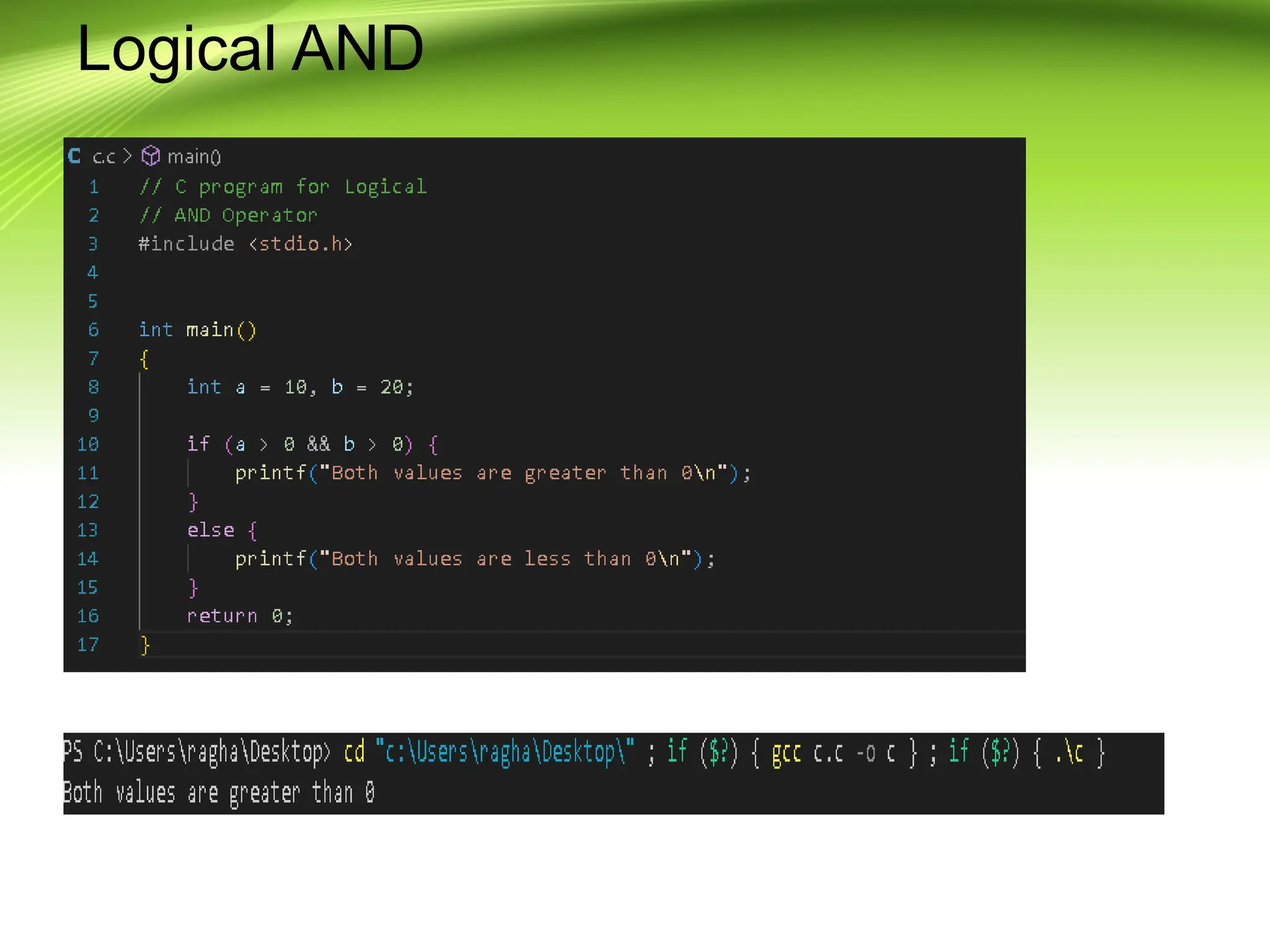
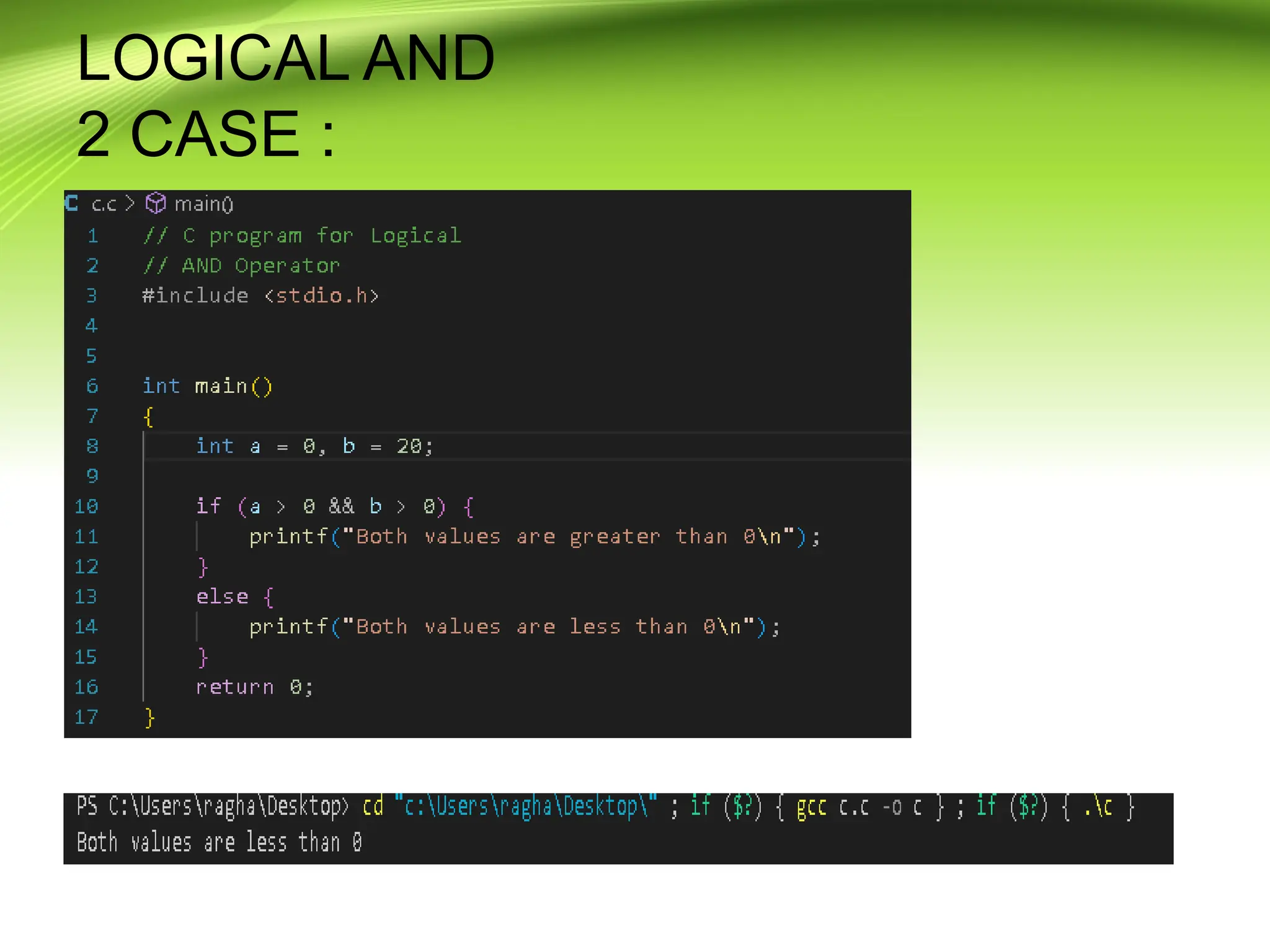
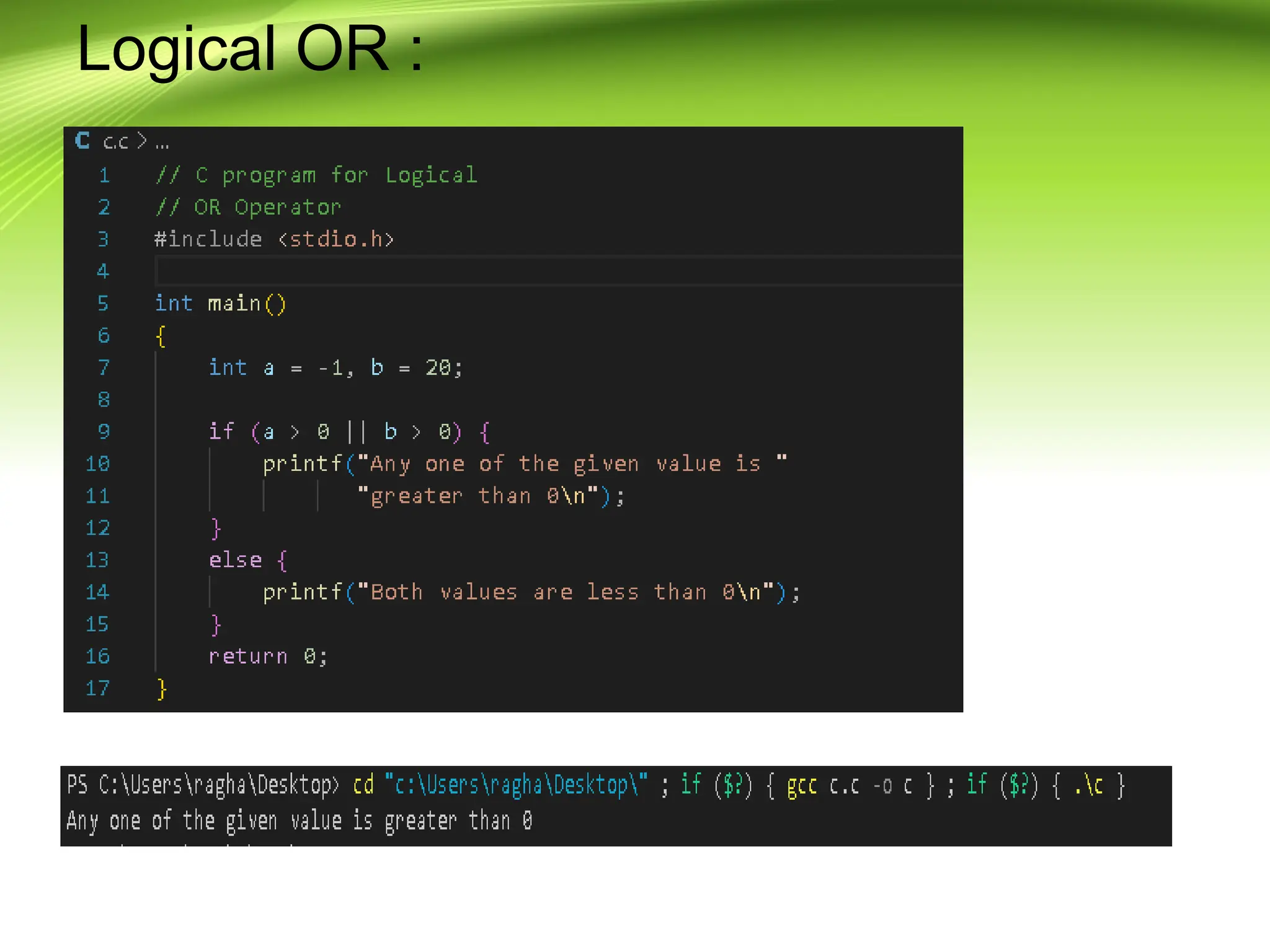
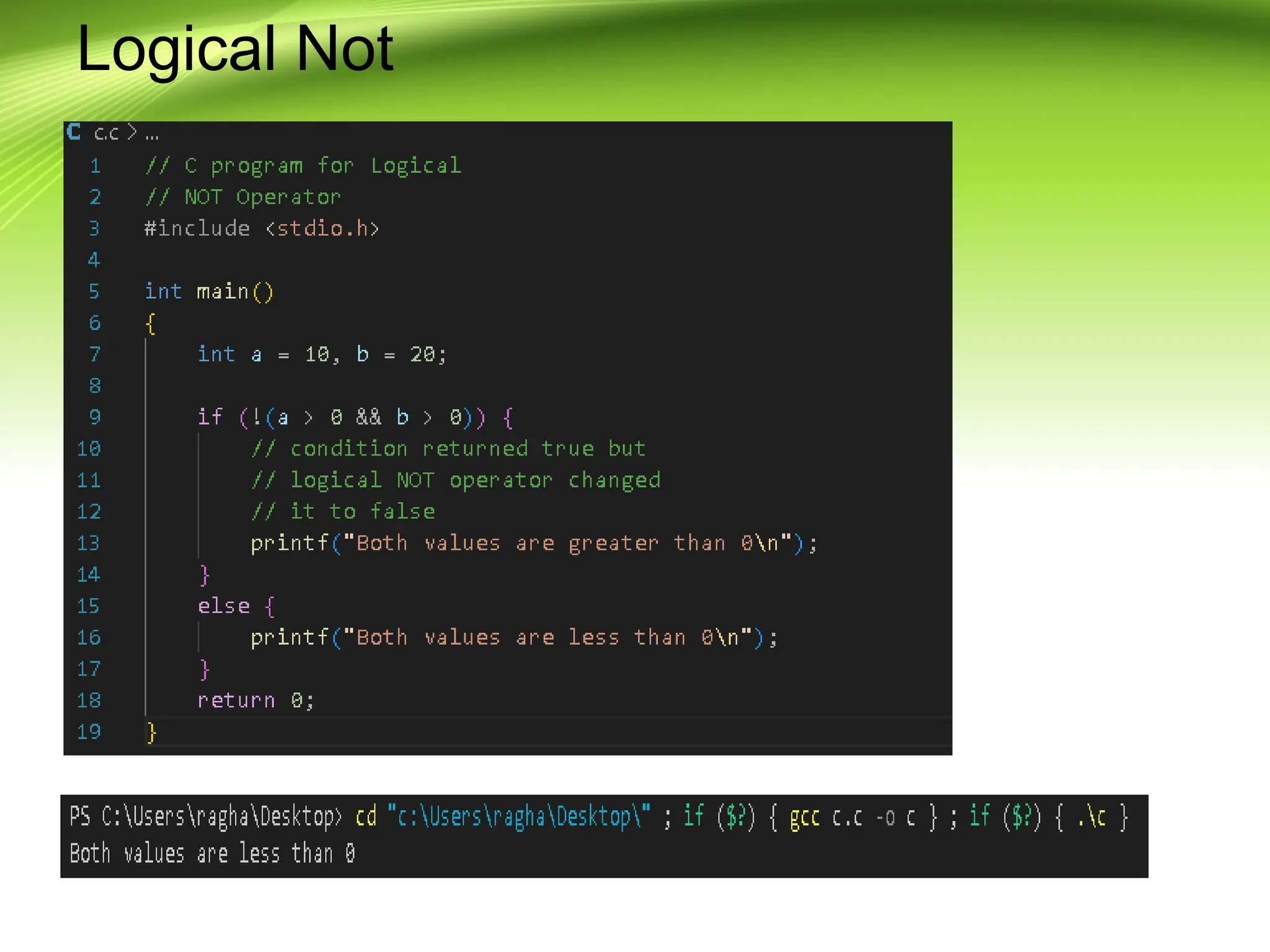
LOGICAL Operator (&&,||,!)
• Operator Meaning of Operator
• && Logical AND
• || Logical OR
• ! Logical NOT
Logical AND
LOGICAL AND
2 CASE :
Logical OR :
Logical Not
Increment and Decrement Operators
1. C programming has two operators increment
++ and decrement -- to change the value of an
operand (constant or variable) by 1.
2. Increment ++ increases the value by 1
whereas decrement -- decreases the value by 1.
3. These two operators are unary operators,
meaning they only operate on a single operand.
eg. int a=10, b=100
++a = 11
--b = 99
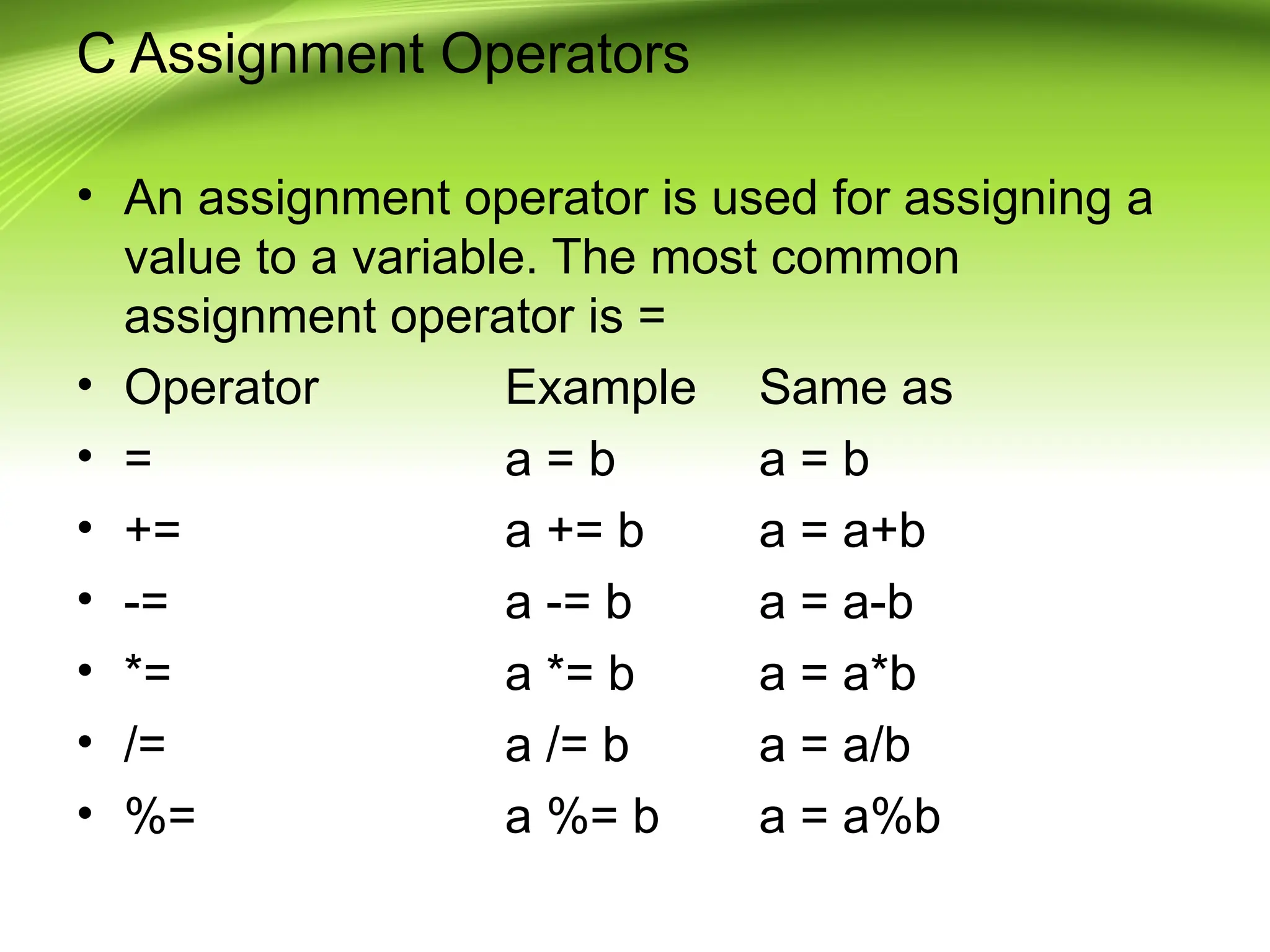
C Assignment Operators
• An assignment operator is used for assigning a
value to a variable. The most common
assignment operator is =
• Operator Example Same as
• = a = b a = b
• += a += b a = a+b
• -= a -= b a = a-b
• *= a *= b a = a*b
• /= a /= b a = a/b
• %= a %= b a = a%b
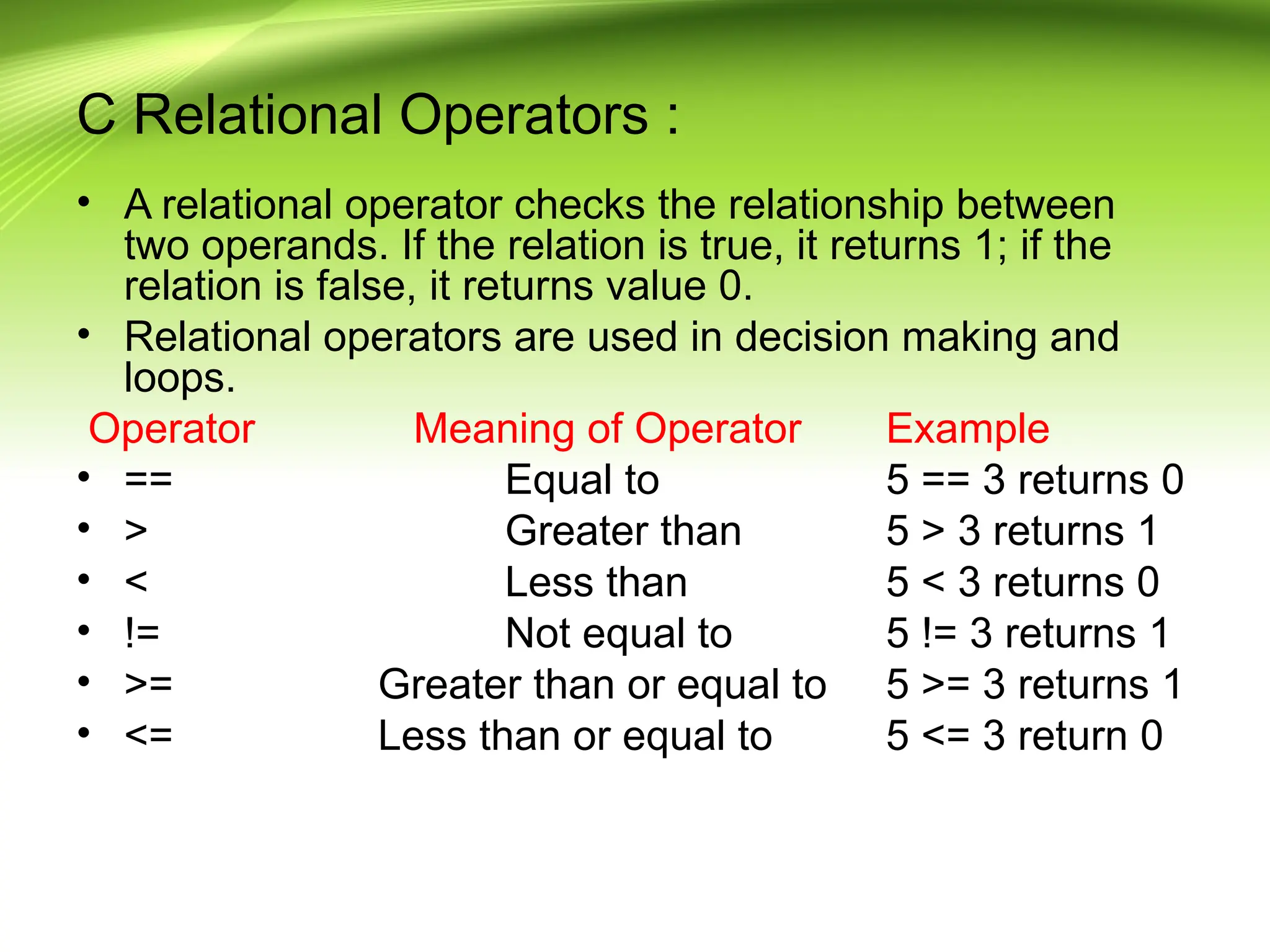
C Relational Operators :
• A relational operator checks the relationship between
two operands. If the relation is true, it returns 1; if the
relation is false, it returns value 0.
• Relational operators are used in decision making and
loops.
Operator Meaning of Operator Example
• == Equal to 5 == 3 returns 0
• > Greater than 5 > 3 returns 1
• < Less than 5 < 3 returns 0
• != Not equal to 5 != 3 returns 1
• >= Greater than or equal to 5 >= 3 returns 1
• <= Less than or equal to 5 <= 3 return 0
Basics of C.ppt this is basic information about the c programming language

Basics of C.ppt this is basic information about the c programming language

  • 1.
    Basics of ‘C’ By:Lalit Raghav. Prof. Anupama Tiwari. GURUGRAM UNIVERSITY
  • 2.
    General Aspect of‘C’ C was originally developed in the 1970s, by Dennis Ritchie at Bell Telephone Laboratories, Inc. C is a High level , general –purpose structured programming language. Instructions of C consists of terms that are very closely same to algebraic expressions, consisting of certain English keywords such as if, else, for ,do and while C contains certain additional features that allows it to be used at a lower level , acting as bridge between machine language and the high level languages. This allows C to be used for system programming as well as for applications programming
  • 3.
    Operators in C:Anoperator is a symbol which operates on a value or a variable. For example: + is an operator to perform addition. C programming has wide range of operators to perform various operations. For better understanding of operators, these operators can be classified as: • Arithmetic Operators • Increment and Decrement Operators • Assignment Operators • Relational Operators • Logical Operators • Conditional Operators • Bitwise Operators • Special Operators
  • 4.
    LOGICAL Operator (&&,||,!) •Operator Meaning of Operator • && Logical AND • || Logical OR • ! Logical NOT
  • 5.
  • 6.
  • 7.
  • 8.
  • 9.
    Increment and DecrementOperators 1. C programming has two operators increment ++ and decrement -- to change the value of an operand (constant or variable) by 1. 2. Increment ++ increases the value by 1 whereas decrement -- decreases the value by 1. 3. These two operators are unary operators, meaning they only operate on a single operand. eg. int a=10, b=100 ++a = 11 --b = 99
  • 10.
    C Assignment Operators •An assignment operator is used for assigning a value to a variable. The most common assignment operator is = • Operator Example Same as • = a = b a = b • += a += b a = a+b • -= a -= b a = a-b • *= a *= b a = a*b • /= a /= b a = a/b • %= a %= b a = a%b
  • 11.
    C Relational Operators: • A relational operator checks the relationship between two operands. If the relation is true, it returns 1; if the relation is false, it returns value 0. • Relational operators are used in decision making and loops. Operator Meaning of Operator Example • == Equal to 5 == 3 returns 0 • > Greater than 5 > 3 returns 1 • < Less than 5 < 3 returns 0 • != Not equal to 5 != 3 returns 1 • >= Greater than or equal to 5 >= 3 returns 1 • <= Less than or equal to 5 <= 3 return 0