BASIC ELECTRICAL AND ELECTRONICONICS
ENGINEERING (23EE01)
DC & AC Circuits
• By
R.ANJANEYULU NAIK ASSOC.PROF
DEPT OF EEE,LBRCE,
•
11-06-2024 R.ANJANEYULU NAIK, ASSOCIATE PROFESSOR,EEE,LBRCE 1
11-06-2024 R.ANJANEYULU NAIK, ASSOCIATE PROFESSOR,EEE,LBRCE 2
11-06-2024 R.ANJANEYULU NAIK, ASSOCIATE PROFESSOR,EEE,LBRCE 3
11-06-2024 R.ANJANEYULU NAIK, ASSOCIATE PROFESSOR,EEE,LBRCE 4
11-06-2024 R.ANJANEYULU NAIK, ASSOCIATE PROFESSOR,EEE,LBRCE 5
11-06-2024 R.ANJANEYULU NAIK, ASSOCIATE PROFESSOR,EEE,LBRCE 6
Why do you study this course?
11-06-2024 R.ANJANEYULU NAIK, ASSOCIATE PROFESSOR,EEE,LBRCE 7
What are the contents of the course?
Course Educational Objectives (CEOs)
What are the abilities/capabilities getting after
completion of the course?
Course Outcomes (COs)
Because our Institute adopted Outcome Based Education (OBE) Approach
EXAMPLE: Do the B.Tech Programme----getting CGPA 9.9
11-06-2024 R.ANJANEYULU NAIK, ASSOCIATE PROFESSOR,EEE,LBRCE 8
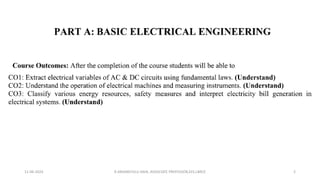
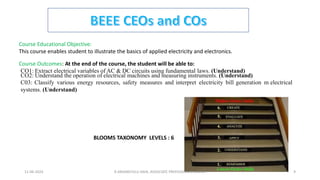
Course Outcomes: At the end of the course, the student will be able to:
CO1: Extract electrical variables of AC & DC circuits using fundamental laws. (Understand)
CO2: Understand the operation of electrical machines and measuring instruments. (Understand)
C03: Classify various energy resources, safety measures and interpret electricity bill generation m electrical
systems. (Understand)
Course Educational Objective:
This course enables student to illustrate the basics of applied electricity and electronics.
BLOOMS TAXONOMY LEVELS : 6
11-06-2024 R.ANJANEYULU NAIK, ASSOCIATE PROFESSOR,EEE,LBRCE 9
Why do you attain these COs?
11-06-2024 10
R.ANJANEYULU NAIK, ASSOCIATE PROFESSOR,EEE,LBRCE
11-06-2024 11
TO ATTAIN YOUR
A: 12 POS
B.PSOs
R.ANJANEYULU NAIK, ASSOCIATE PROFESSOR,EEE,LBRCE
UNIT-I
DC & AC CIRCUITS
PART-A
11-06-2024 R.ANJANEYULU NAIK, ASSOCIATE PROFESSOR,EEE,LBRCE 12
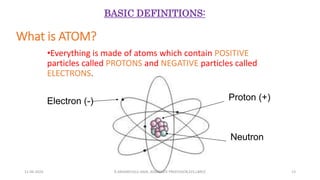
What is ATOM?
•Everything is made of atoms which contain POSITIVE
particles called PROTONS and NEGATIVE particles called
ELECTRONS.
Proton (+)
Neutron
Electron (-)
BASIC DEFINITIONS:
11-06-2024 R.ANJANEYULU NAIK, ASSOCIATE PROFESSOR,EEE,LBRCE 13
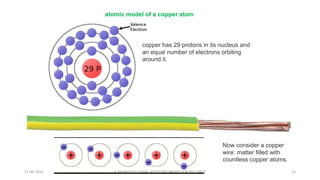
copper has 29 protons in its nucleus and
an equal number of electrons orbiting
around it.
atomic model of a copper atom
Now consider a copper
wire: matter filled with
countless copper atoms.
11-06-2024 R.ANJANEYULU NAIK, ASSOCIATE PROFESSOR,EEE,LBRCE 14
Electrical Charge
• Electric charge is given the symbol
•Q
• Electrons are the charge carriers that flow
in an electrical circuit from the negative to
positive terminals.
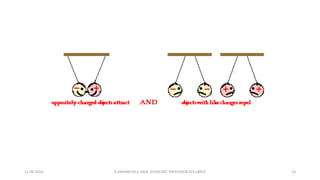
Because Electrons have a negative charge…. Like charges repel, opposites attract) giving rise to an electric
current.
11-06-2024 R.ANJANEYULU NAIK, ASSOCIATE PROFESSOR,EEE,LBRCE 15
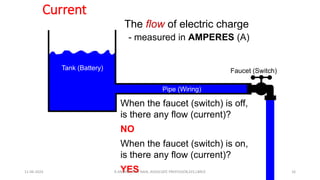
Current
The flow of electric charge
When the faucet (switch) is off,
is there any flow (current)?
NO
When the faucet (switch) is on,
is there any flow (current)?
YES
Tank (Battery) Faucet (Switch)
Pipe (Wiring)
- measured in AMPERES (A)
11-06-2024 R.ANJANEYULU NAIK, ASSOCIATE PROFESSOR,EEE,LBRCE 16
11-06-2024 R.ANJANEYULU NAIK, ASSOCIATE PROFESSOR,EEE,LBRCE 17
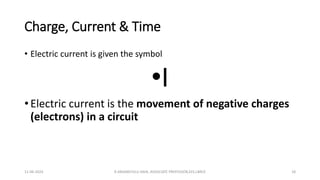
Charge, Current & Time
• Electric current is given the symbol
•I
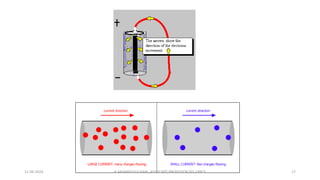
• Electric current is the movement of negative charges
(electrons) in a circuit
11-06-2024 R.ANJANEYULU NAIK, ASSOCIATE PROFESSOR,EEE,LBRCE 18
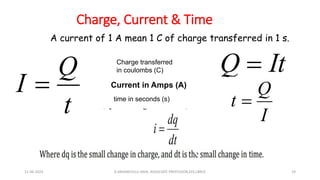
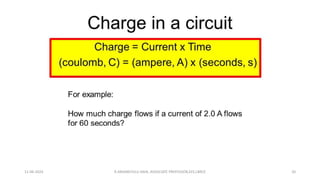
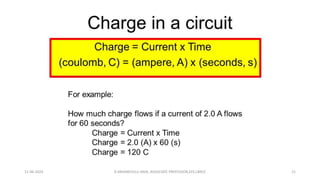
Charge, Current & Time
•If current is charge flowing per second then
t
Q
I  time in seconds (s)
Current in Amps (A)
Charge transferred
in coulombs (C)
A current of 1 A mean 1 C of charge transferred in 1 s.
It
Q 
I
Q
t 
11-06-2024 R.ANJANEYULU NAIK, ASSOCIATE PROFESSOR,EEE,LBRCE 19
11-06-2024 R.ANJANEYULU NAIK, ASSOCIATE PROFESSOR,EEE,LBRCE 20
11-06-2024 R.ANJANEYULU NAIK, ASSOCIATE PROFESSOR,EEE,LBRCE 21
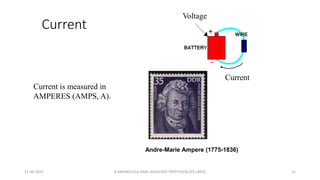
Voltage
Current
Current is measured in
AMPERES (AMPS, A).
Current
Andre-Marie Ampere (1775-1836)
11-06-2024 R.ANJANEYULU NAIK, ASSOCIATE PROFESSOR,EEE,LBRCE 22
11-06-2024 R.ANJANEYULU NAIK, ASSOCIATE PROFESSOR,EEE,LBRCE 23
Electrical Charge Q
• measured in
•Coulombs
• which is given the symbol
•C
11-06-2024 R.ANJANEYULU NAIK, ASSOCIATE PROFESSOR,EEE,LBRCE 24
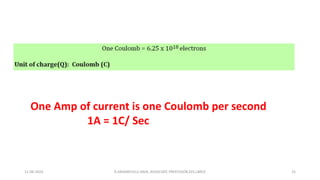
One Amp of current is one Coulomb per second
1A = 1C/ Sec
11-06-2024 R.ANJANEYULU NAIK, ASSOCIATE PROFESSOR,EEE,LBRCE 25
11-06-2024 R.ANJANEYULU NAIK, ASSOCIATE PROFESSOR,EEE,LBRCE 26
11-06-2024 R.ANJANEYULU NAIK, ASSOCIATE PROFESSOR,EEE,LBRCE 27
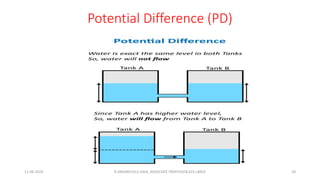
Potential Difference (PD)
11-06-2024 R.ANJANEYULU NAIK, ASSOCIATE PROFESSOR,EEE,LBRCE 28
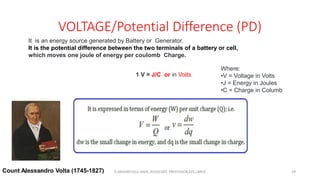
VOLTAGE/Potential Difference (PD)
It is an energy source generated by Battery or Generator.
It is the potential difference between the two terminals of a battery or cell,
which moves one joule of energy per coulomb Charge.
1 V = J/C or in Volts
Where:
•V = Voltage in Volts
•J = Energy in Joules
•C = Charge in Columb
Count Alessandro Volta (1745-1827)
11-06-2024 R.ANJANEYULU NAIK, ASSOCIATE PROFESSOR,EEE,LBRCE 29
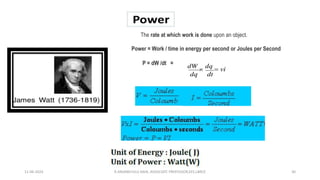
The rate at which work is done upon an object.
Power = Work / time in energy per second or Joules per Second
P = dW /dt =
11-06-2024 R.ANJANEYULU NAIK, ASSOCIATE PROFESSOR,EEE,LBRCE 30
11-06-2024 R.ANJANEYULU NAIK, ASSOCIATE PROFESSOR,EEE,LBRCE 31
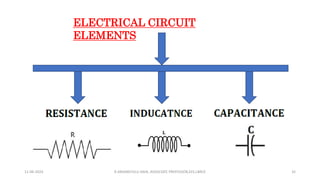
ELECTRICAL CIRCUIT
ELEMENTS
11-06-2024 R.ANJANEYULU NAIK, ASSOCIATE PROFESSOR,EEE,LBRCE 32
RESISTORS
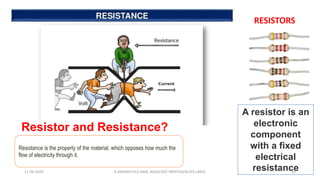
Resistor and Resistance?
A resistor is an
electronic
component
with a fixed
electrical
resistance
Resistance is the property of the material, which opposes how much the
flow of electricity through it.
11-06-2024 R.ANJANEYULU NAIK, ASSOCIATE PROFESSOR,EEE,LBRCE 33
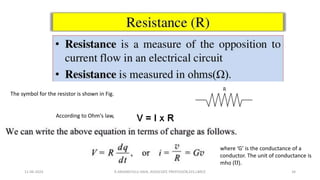
The symbol for the resistor is shown in Fig.
According to Ohm's law,
where ‘G’ is the conductance of a
conductor. The unit of conductance is
mho (℧).
11-06-2024 R.ANJANEYULU NAIK, ASSOCIATE PROFESSOR,EEE,LBRCE 34
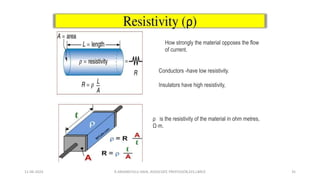
How strongly the material opposes the flow
of current.
Conductors -have low resistivity.
Insulators have high resistivity,
ρ is the resistivity of the material in ohm metres,
Ω⋅m.
11-06-2024 R.ANJANEYULU NAIK, ASSOCIATE PROFESSOR,EEE,LBRCE 35
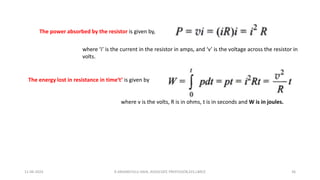
The power absorbed by the resistor is given by,
where ‘i’ is the current in the resistor in amps, and ‘v’ is the voltage across the resistor in
volts.
The energy lost in resistance in time‘t’ is given by
where v is the volts, R is in ohms, t is in seconds and W is in joules.
11-06-2024 R.ANJANEYULU NAIK, ASSOCIATE PROFESSOR,EEE,LBRCE 36
11-06-2024 R.ANJANEYULU NAIK, ASSOCIATE PROFESSOR,EEE,LBRCE 37
11-06-2024 R.ANJANEYULU NAIK, ASSOCIATE PROFESSOR,EEE,LBRCE 38
11-06-2024 R.ANJANEYULU NAIK, ASSOCIATE PROFESSOR,EEE,LBRCE 39
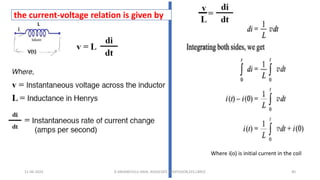
Where i(o) is initial current in the coil
the current-voltage relation is given by
11-06-2024 R.ANJANEYULU NAIK, ASSOCIATE PROFESSOR,EEE,LBRCE 40

BASICS FOR BEEE COURSE . BEEE-PART-A INTRO.pptx

  • 1.
    BASIC ELECTRICAL ANDELECTRONICONICS ENGINEERING (23EE01) DC & AC Circuits • By R.ANJANEYULU NAIK ASSOC.PROF DEPT OF EEE,LBRCE, • 11-06-2024 R.ANJANEYULU NAIK, ASSOCIATE PROFESSOR,EEE,LBRCE 1
  • 2.
    11-06-2024 R.ANJANEYULU NAIK,ASSOCIATE PROFESSOR,EEE,LBRCE 2
  • 3.
    11-06-2024 R.ANJANEYULU NAIK,ASSOCIATE PROFESSOR,EEE,LBRCE 3
  • 4.
    11-06-2024 R.ANJANEYULU NAIK,ASSOCIATE PROFESSOR,EEE,LBRCE 4
  • 5.
    11-06-2024 R.ANJANEYULU NAIK,ASSOCIATE PROFESSOR,EEE,LBRCE 5
  • 6.
    11-06-2024 R.ANJANEYULU NAIK,ASSOCIATE PROFESSOR,EEE,LBRCE 6
  • 7.
    Why do youstudy this course? 11-06-2024 R.ANJANEYULU NAIK, ASSOCIATE PROFESSOR,EEE,LBRCE 7
  • 8.
    What are thecontents of the course? Course Educational Objectives (CEOs) What are the abilities/capabilities getting after completion of the course? Course Outcomes (COs) Because our Institute adopted Outcome Based Education (OBE) Approach EXAMPLE: Do the B.Tech Programme----getting CGPA 9.9 11-06-2024 R.ANJANEYULU NAIK, ASSOCIATE PROFESSOR,EEE,LBRCE 8
  • 9.
    Course Outcomes: Atthe end of the course, the student will be able to: CO1: Extract electrical variables of AC & DC circuits using fundamental laws. (Understand) CO2: Understand the operation of electrical machines and measuring instruments. (Understand) C03: Classify various energy resources, safety measures and interpret electricity bill generation m electrical systems. (Understand) Course Educational Objective: This course enables student to illustrate the basics of applied electricity and electronics. BLOOMS TAXONOMY LEVELS : 6 11-06-2024 R.ANJANEYULU NAIK, ASSOCIATE PROFESSOR,EEE,LBRCE 9
  • 10.
    Why do youattain these COs? 11-06-2024 10 R.ANJANEYULU NAIK, ASSOCIATE PROFESSOR,EEE,LBRCE
  • 11.
    11-06-2024 11 TO ATTAINYOUR A: 12 POS B.PSOs R.ANJANEYULU NAIK, ASSOCIATE PROFESSOR,EEE,LBRCE
  • 12.
    UNIT-I DC & ACCIRCUITS PART-A 11-06-2024 R.ANJANEYULU NAIK, ASSOCIATE PROFESSOR,EEE,LBRCE 12
  • 13.
    What is ATOM? •Everythingis made of atoms which contain POSITIVE particles called PROTONS and NEGATIVE particles called ELECTRONS. Proton (+) Neutron Electron (-) BASIC DEFINITIONS: 11-06-2024 R.ANJANEYULU NAIK, ASSOCIATE PROFESSOR,EEE,LBRCE 13
  • 14.
    copper has 29protons in its nucleus and an equal number of electrons orbiting around it. atomic model of a copper atom Now consider a copper wire: matter filled with countless copper atoms. 11-06-2024 R.ANJANEYULU NAIK, ASSOCIATE PROFESSOR,EEE,LBRCE 14
  • 15.
    Electrical Charge • Electriccharge is given the symbol •Q • Electrons are the charge carriers that flow in an electrical circuit from the negative to positive terminals. Because Electrons have a negative charge…. Like charges repel, opposites attract) giving rise to an electric current. 11-06-2024 R.ANJANEYULU NAIK, ASSOCIATE PROFESSOR,EEE,LBRCE 15
  • 16.
    Current The flow ofelectric charge When the faucet (switch) is off, is there any flow (current)? NO When the faucet (switch) is on, is there any flow (current)? YES Tank (Battery) Faucet (Switch) Pipe (Wiring) - measured in AMPERES (A) 11-06-2024 R.ANJANEYULU NAIK, ASSOCIATE PROFESSOR,EEE,LBRCE 16
  • 17.
    11-06-2024 R.ANJANEYULU NAIK,ASSOCIATE PROFESSOR,EEE,LBRCE 17
  • 18.
    Charge, Current &Time • Electric current is given the symbol •I • Electric current is the movement of negative charges (electrons) in a circuit 11-06-2024 R.ANJANEYULU NAIK, ASSOCIATE PROFESSOR,EEE,LBRCE 18
  • 19.
    Charge, Current &Time •If current is charge flowing per second then t Q I  time in seconds (s) Current in Amps (A) Charge transferred in coulombs (C) A current of 1 A mean 1 C of charge transferred in 1 s. It Q  I Q t  11-06-2024 R.ANJANEYULU NAIK, ASSOCIATE PROFESSOR,EEE,LBRCE 19
  • 20.
    11-06-2024 R.ANJANEYULU NAIK,ASSOCIATE PROFESSOR,EEE,LBRCE 20
  • 21.
    11-06-2024 R.ANJANEYULU NAIK,ASSOCIATE PROFESSOR,EEE,LBRCE 21
  • 22.
    Voltage Current Current is measuredin AMPERES (AMPS, A). Current Andre-Marie Ampere (1775-1836) 11-06-2024 R.ANJANEYULU NAIK, ASSOCIATE PROFESSOR,EEE,LBRCE 22
  • 23.
    11-06-2024 R.ANJANEYULU NAIK,ASSOCIATE PROFESSOR,EEE,LBRCE 23
  • 24.
    Electrical Charge Q •measured in •Coulombs • which is given the symbol •C 11-06-2024 R.ANJANEYULU NAIK, ASSOCIATE PROFESSOR,EEE,LBRCE 24
  • 25.
    One Amp ofcurrent is one Coulomb per second 1A = 1C/ Sec 11-06-2024 R.ANJANEYULU NAIK, ASSOCIATE PROFESSOR,EEE,LBRCE 25
  • 26.
    11-06-2024 R.ANJANEYULU NAIK,ASSOCIATE PROFESSOR,EEE,LBRCE 26
  • 27.
    11-06-2024 R.ANJANEYULU NAIK,ASSOCIATE PROFESSOR,EEE,LBRCE 27
  • 28.
    Potential Difference (PD) 11-06-2024R.ANJANEYULU NAIK, ASSOCIATE PROFESSOR,EEE,LBRCE 28
  • 29.
    VOLTAGE/Potential Difference (PD) Itis an energy source generated by Battery or Generator. It is the potential difference between the two terminals of a battery or cell, which moves one joule of energy per coulomb Charge. 1 V = J/C or in Volts Where: •V = Voltage in Volts •J = Energy in Joules •C = Charge in Columb Count Alessandro Volta (1745-1827) 11-06-2024 R.ANJANEYULU NAIK, ASSOCIATE PROFESSOR,EEE,LBRCE 29
  • 30.
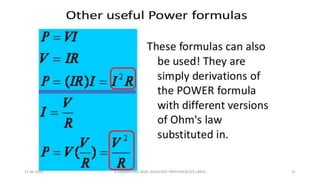
    The rate atwhich work is done upon an object. Power = Work / time in energy per second or Joules per Second P = dW /dt = 11-06-2024 R.ANJANEYULU NAIK, ASSOCIATE PROFESSOR,EEE,LBRCE 30
  • 31.
    11-06-2024 R.ANJANEYULU NAIK,ASSOCIATE PROFESSOR,EEE,LBRCE 31
  • 32.
    ELECTRICAL CIRCUIT ELEMENTS 11-06-2024 R.ANJANEYULUNAIK, ASSOCIATE PROFESSOR,EEE,LBRCE 32
  • 33.
    RESISTORS Resistor and Resistance? Aresistor is an electronic component with a fixed electrical resistance Resistance is the property of the material, which opposes how much the flow of electricity through it. 11-06-2024 R.ANJANEYULU NAIK, ASSOCIATE PROFESSOR,EEE,LBRCE 33
  • 34.
    The symbol forthe resistor is shown in Fig. According to Ohm's law, where ‘G’ is the conductance of a conductor. The unit of conductance is mho (℧). 11-06-2024 R.ANJANEYULU NAIK, ASSOCIATE PROFESSOR,EEE,LBRCE 34
  • 35.
    How strongly thematerial opposes the flow of current. Conductors -have low resistivity. Insulators have high resistivity, ρ is the resistivity of the material in ohm metres, Ω⋅m. 11-06-2024 R.ANJANEYULU NAIK, ASSOCIATE PROFESSOR,EEE,LBRCE 35
  • 36.
    The power absorbedby the resistor is given by, where ‘i’ is the current in the resistor in amps, and ‘v’ is the voltage across the resistor in volts. The energy lost in resistance in time‘t’ is given by where v is the volts, R is in ohms, t is in seconds and W is in joules. 11-06-2024 R.ANJANEYULU NAIK, ASSOCIATE PROFESSOR,EEE,LBRCE 36
  • 37.
    11-06-2024 R.ANJANEYULU NAIK,ASSOCIATE PROFESSOR,EEE,LBRCE 37
  • 38.
    11-06-2024 R.ANJANEYULU NAIK,ASSOCIATE PROFESSOR,EEE,LBRCE 38
  • 39.
    11-06-2024 R.ANJANEYULU NAIK,ASSOCIATE PROFESSOR,EEE,LBRCE 39
  • 40.
    Where i(o) isinitial current in the coil the current-voltage relation is given by 11-06-2024 R.ANJANEYULU NAIK, ASSOCIATE PROFESSOR,EEE,LBRCE 40