What is Bookkeeping
Bookkeeping is the process of systematic recording and classification of
financial transactions of an organisation.
Bookkeeping is said to be the basis of accounting, whereas accounting
forms a part of the broader scope in finance.
The most important focus of bookkeeping is to maintain an accurate record
of all the monetary transactions of a business. Companies use this
information to take major investment decisions.
The bookkeeper maintains bookkeeping records. Accurate bookkeeping is
critical for business as it gives a piece of reliable information on the
performance of a company.
3.
Bookkeeping process
Bookkeeping processconsists of the following
steps:
Identifying a financial transaction
Recording a financial transaction
Preparing a ledger account
Preparing trial balance
4.
What is Accounting?
Accounting is the systematic process of recording, measuring and
communicating information about the financial transaction taking
place in a business. Accounting helps in determining the financial
position of a firm and present the same to stakeholders.
It helps a business in the short and long term decision making and
also conveys the credibility of a company to the market.
It is also known as the language of business.
The purpose of accounting is to provide a clear view of financial
statements to its users, which includes investors, creditors,
employees, and government.
5.
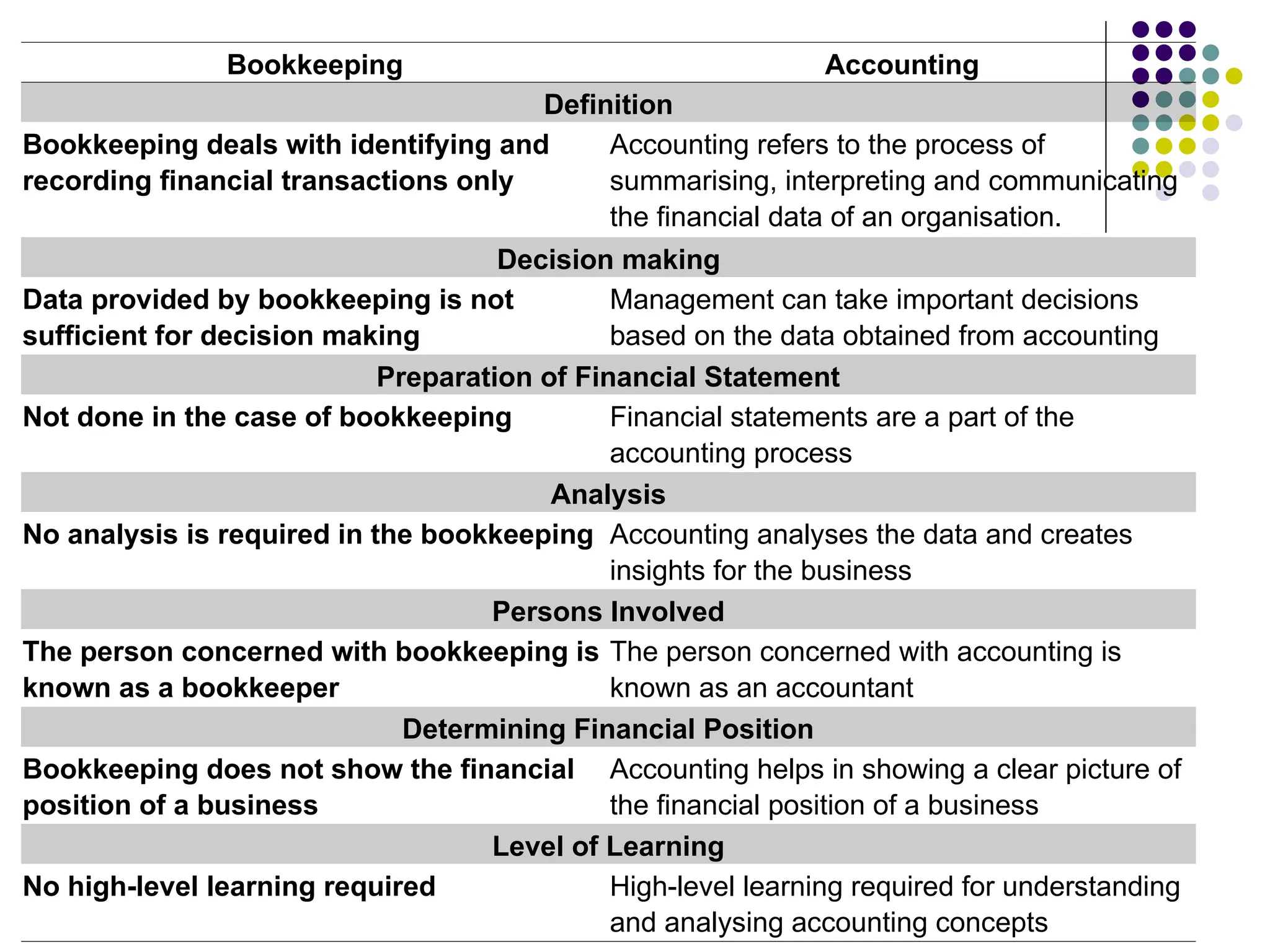
Bookkeeping Accounting
Definition
Bookkeeping dealswith identifying and
recording financial transactions only
Accounting refers to the process of
summarising, interpreting and communicating
the financial data of an organisation.
Decision making
Data provided by bookkeeping is not
sufficient for decision making
Management can take important decisions
based on the data obtained from accounting
Preparation of Financial Statement
Not done in the case of bookkeeping Financial statements are a part of the
accounting process
Analysis
No analysis is required in the bookkeeping Accounting analyses the data and creates
insights for the business
Persons Involved
The person concerned with bookkeeping is
known as a bookkeeper
The person concerned with accounting is
known as an accountant
Determining Financial Position
Bookkeeping does not show the financial
position of a business
Accounting helps in showing a clear picture of
the financial position of a business
Level of Learning
No high-level learning required High-level learning required for understanding
and analysing accounting concepts
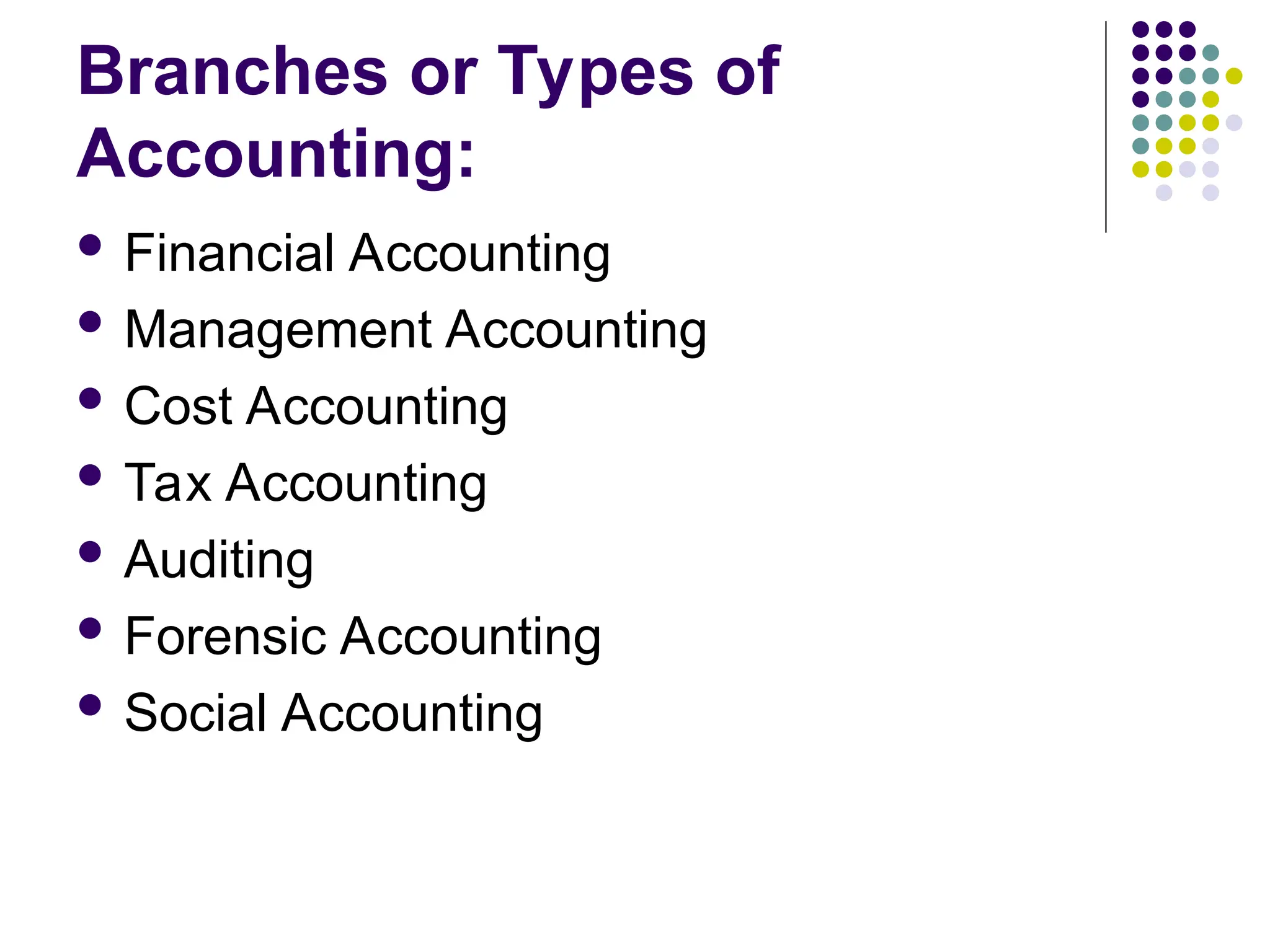
Financial Accounting:
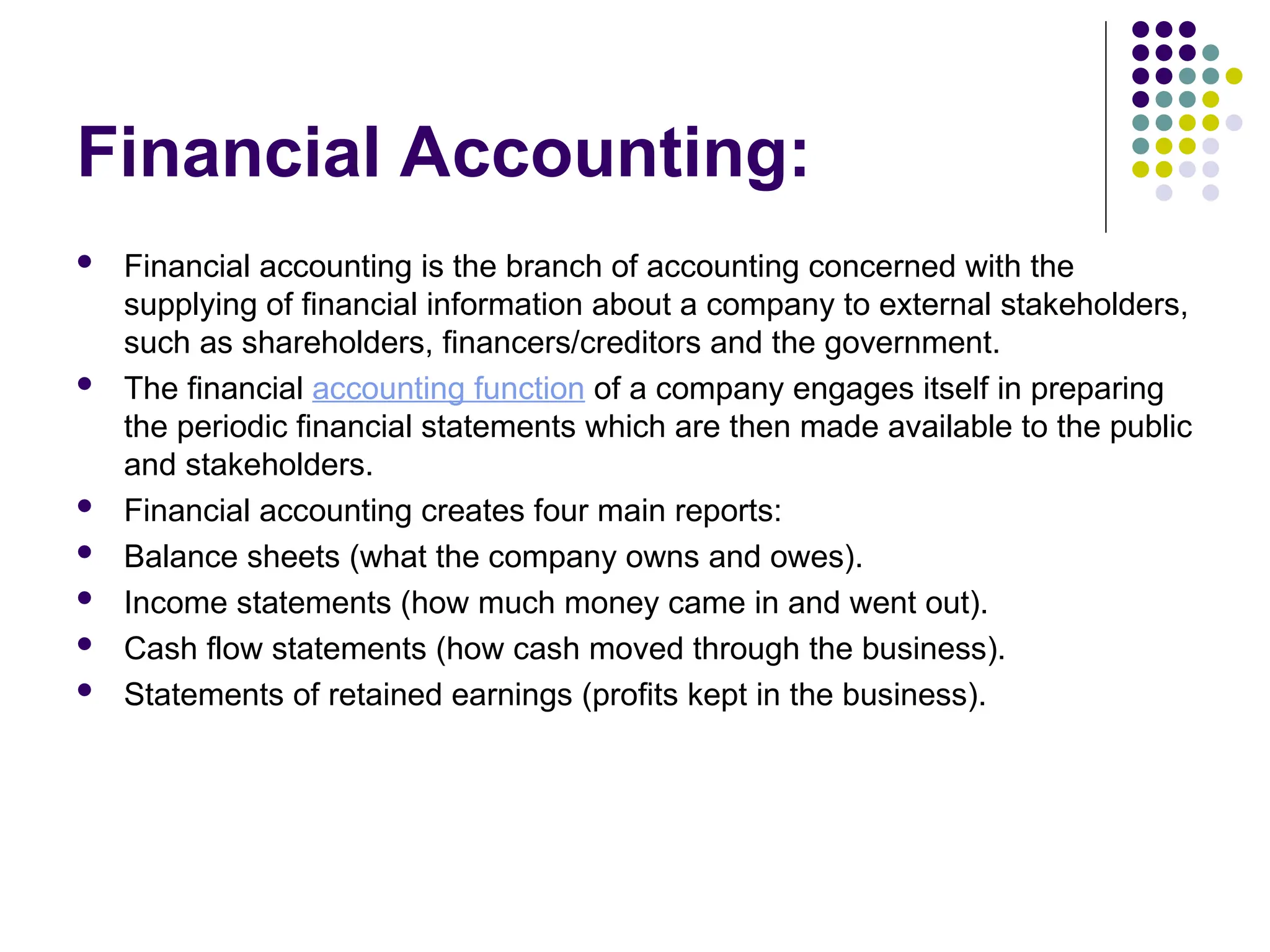
Financialaccounting is the branch of accounting concerned with the
supplying of financial information about a company to external stakeholders,
such as shareholders, financers/creditors and the government.
The financial accounting function of a company engages itself in preparing
the periodic financial statements which are then made available to the public
and stakeholders.
Financial accounting creates four main reports:
Balance sheets (what the company owns and owes).
Income statements (how much money came in and went out).
Cash flow statements (how cash moved through the business).
Statements of retained earnings (profits kept in the business).
8.
Management Accounting:
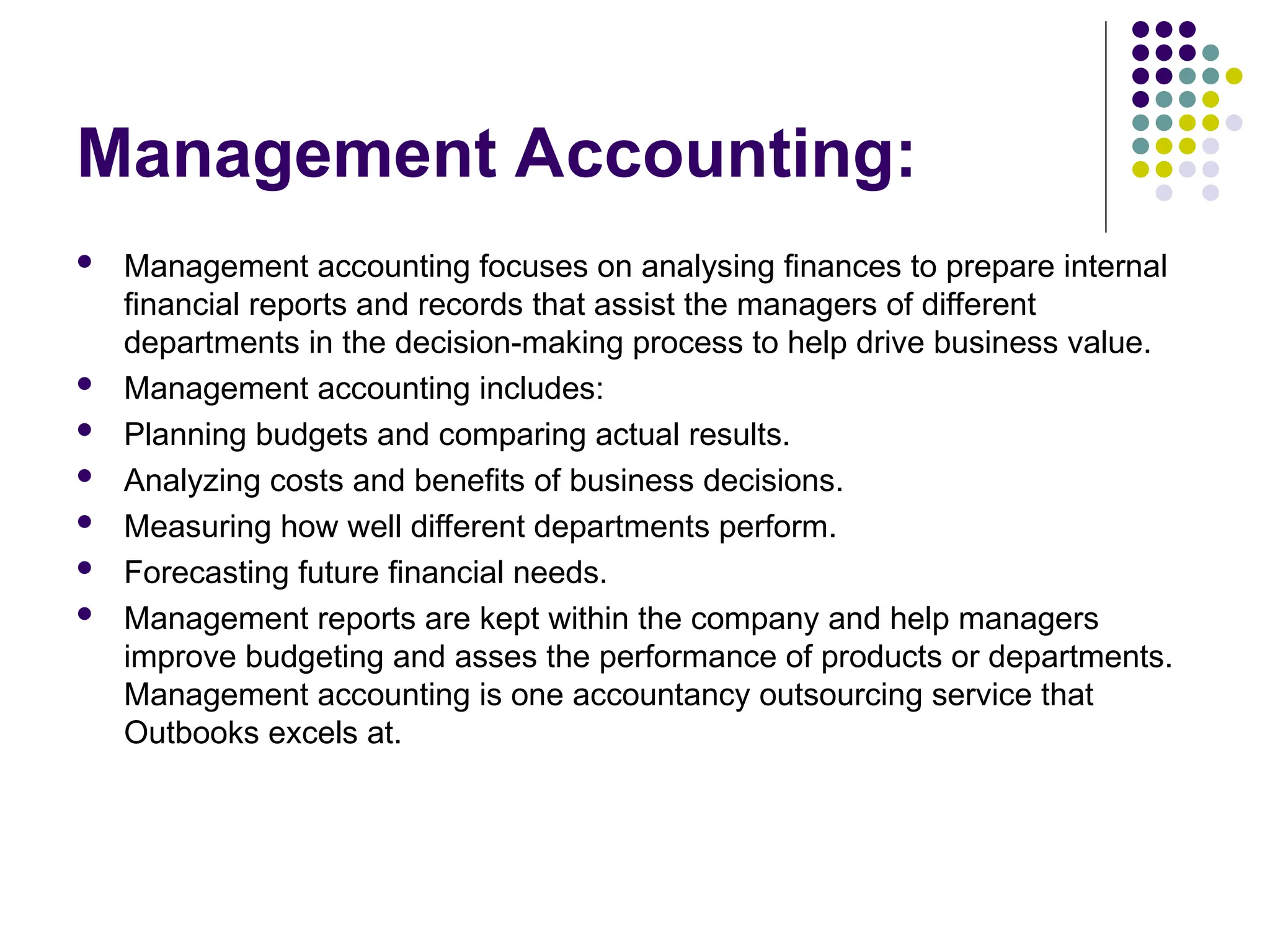
Managementaccounting focuses on analysing finances to prepare internal
financial reports and records that assist the managers of different
departments in the decision-making process to help drive business value.
Management accounting includes:
Planning budgets and comparing actual results.
Analyzing costs and benefits of business decisions.
Measuring how well different departments perform.
Forecasting future financial needs.
Management reports are kept within the company and help managers
improve budgeting and asses the performance of products or departments.
Management accounting is one accountancy outsourcing service that
Outbooks excels at.
9.
Cost Accounting:
Costaccounting, often considered a subset of management
accounting, specifically addresses the costs associated with
producing goods or services. This helps businesses understand
their cost structure and optimise pricing strategies.
It involves the recording, classifying and summarising of the cost
data via a completely quantitative approach. It includes the
management of the overall costs involved in running a business.
Cost data is used by the company management to plan and control
cost operations. Cost accounting aims to track the production cost
and the fixed costs of a company.
10.
Tax Accounting:
Taxaccounting ensures companies follow the tax regulations and stay
compliant with the government. It handles the tax-related matters of the
business and entails the calculation of the taxable income.
Tax accountants play a key role in managing tax filings and planning ahead
to reduce the company’s future tax burden. They are also responsible for
sharing accurate financial information with tax officials when required. Their
work helps businesses stay on the right side of the law.
Since tax rules change often and vary across countries, accountants must
stay constantly updated. They also advise on how taxes impact different
business activities and how to legally minimise them. In some cases, they
help resolve tax-related legal issues as well.
11.
Auditing:
Auditing involvesthe systematic and independent examination of a
company’s financial records, statements and internal control
systems. It ensures accuracy, reliability and compliance with
accounting standards, helping maintain public and stakeholder trust
in financial reporting.
Businesses invest heavily in audits because they offer assurance
that financial data is credible. The audit process includes examining,
verifying and evaluating financial accounts and internal controls to
identify any errors, fraud or misstatements that could mislead users
of financial information.
12.
Forensic Accounting:
Forensicaccounting is often said to be an amalgamation of accounting,
auditing, and investigation. It involves the analysing of information and
records of a company’s accounts for use in a court of law.
It also involves quantifying the damages in matters of embezzlements,
frauds, and falsification of accounts as well as in cases of personal
insurance, injury, business dispute, divorce and marital clashes,
environmental harms, and cybercrimes, among others.
Anything that involves court litigation, investigation and dispute resolution
comes within the ambit of forensic accounting. Forensic accountants may
be called in if anything suspicious surfaces during the external audit of a
company.
13.
Social Accounting:
Socialaccounting aims to incorporate the realisation of social and
environmental impact on the day-to-day accounting activities of
organizations. In the corporate setup, social accounting is closely related to
the Corporate Social Responsibility (CSR) concept.
Social accounting analyses and measures the impact of an organization on
society and the environment. It also measures the social costs and benefits
of organisation’s activities.
Just like any other branch of accounting, social accounting is also a method
of quantifying the performance of a company, but in terms of social
accountability.
14.
Users of Accounting
Information
Investors: They provide capital to the firm. Hence,
they need information to assess the inherent risk
of loss of capital and the return their investment
in the firm is likely to yield. They also need
information to buy, sell or hold these investments.
Lenders: They are interested in ascertaining the
ability of the firm to service their loans over the
entire term of the loan by paying interest and
repaying installments on the due dates.
15.
Suppliers andother creditors: They would
like to assess the ability of the firm to pay
amounts owed to them within the credit
period allowed to the firm. Normally, the
interest of the trade creditors is over shorter
periods as compared to lenders.
Customers and employees: They would like
to know if the firm represents a stable source
of supply/employment.
16.
Government: Thegovernment is interested in
information that will help it to assess the
taxes that can be collected from the firm,
regulate the businesses in general, draft tax
and economic policies, and prepare national
income statistics.
Public: Members of the public are interested
in assessing the economic benefits and costs
arising from factors such as employment of
people from the locality, patronage to local
suppliers and hazards to environment
Basic Terms ofAccounting
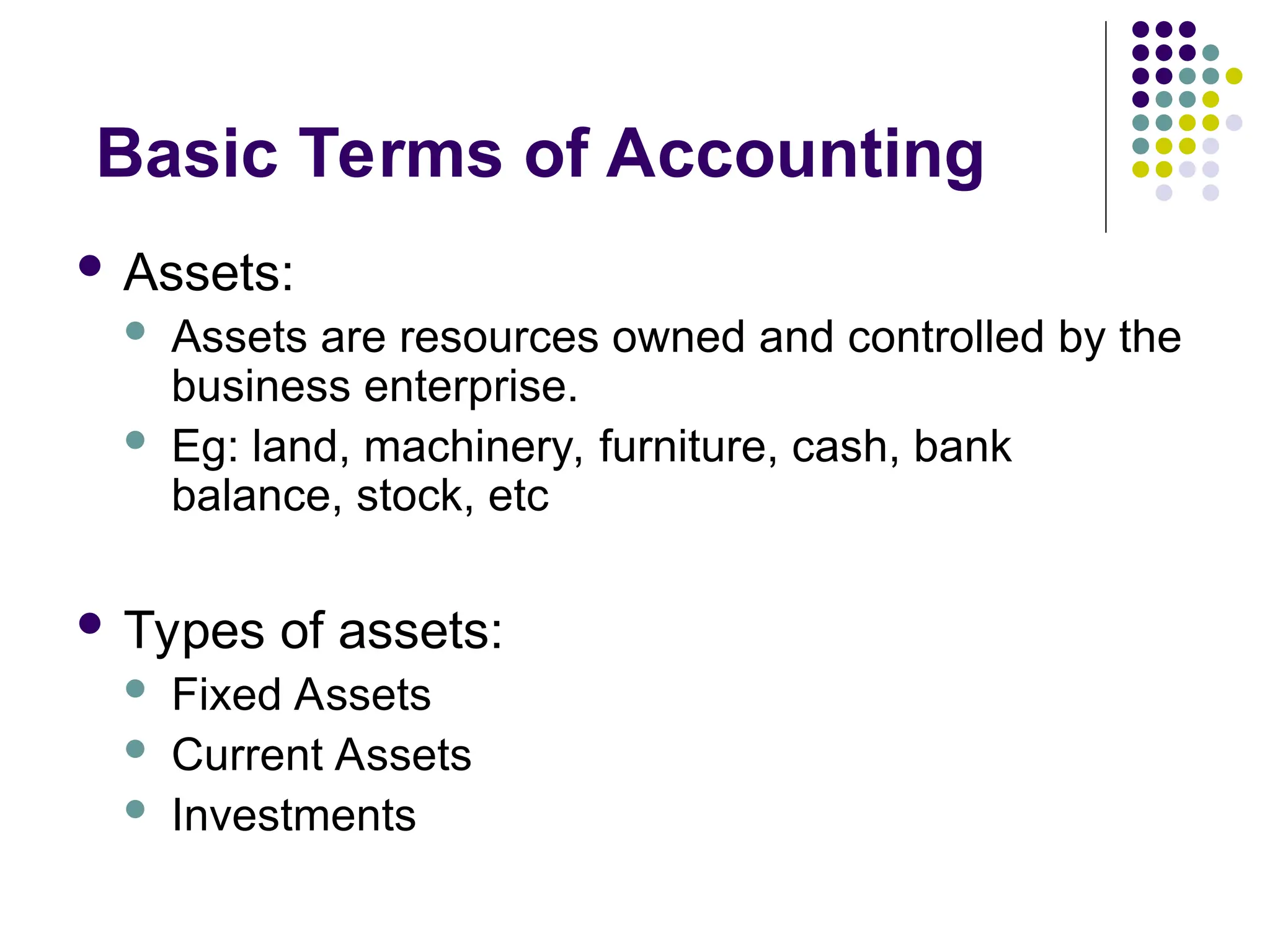
Assets:
Assets are resources owned and controlled by the
business enterprise.
Eg: land, machinery, furniture, cash, bank
balance, stock, etc
Types of assets:
Fixed Assets
Current Assets
Investments
19.
Basic Terms
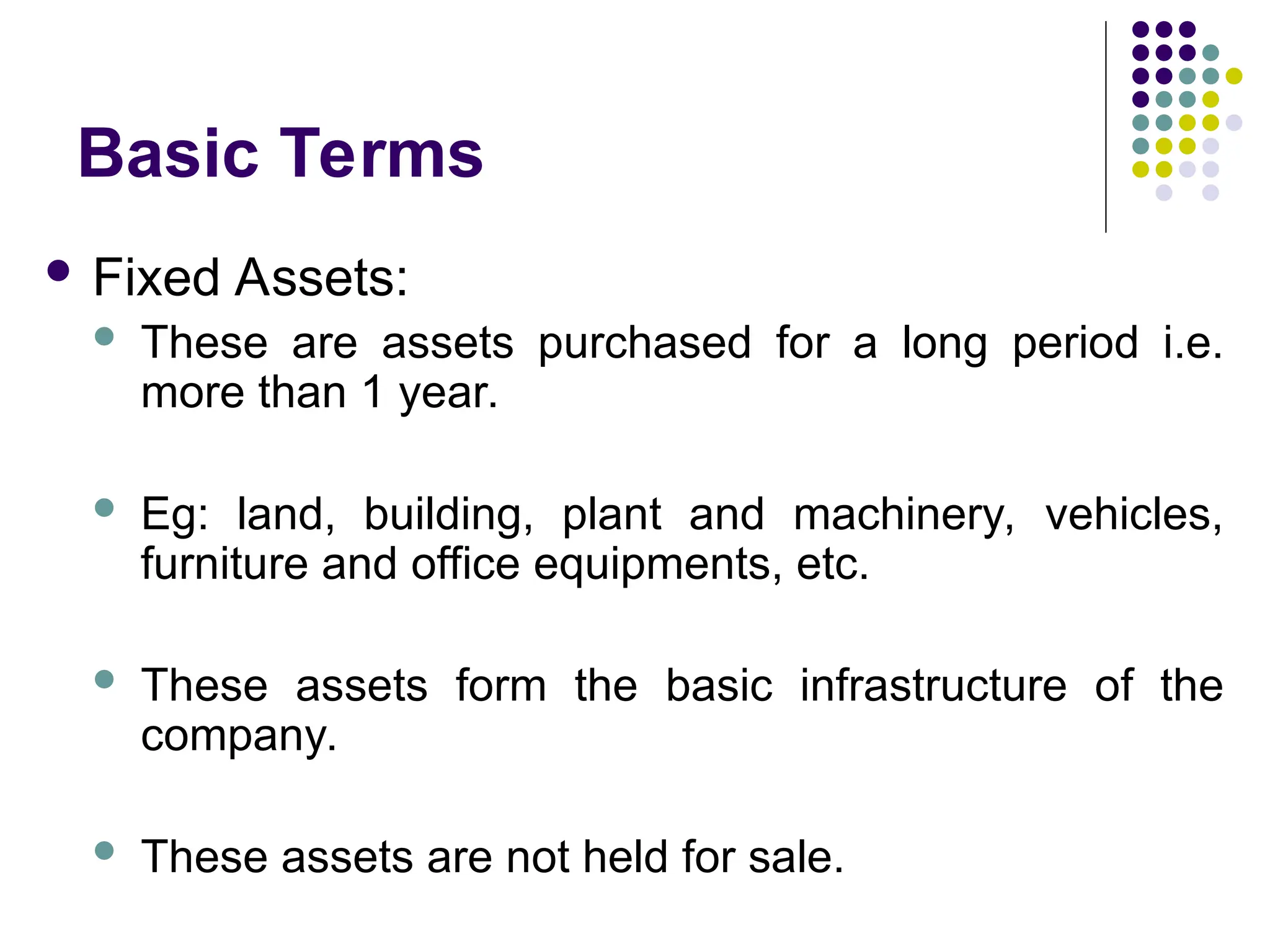
FixedAssets:
These are assets purchased for a long period i.e.
more than 1 year.
Eg: land, building, plant and machinery, vehicles,
furniture and office equipments, etc.
These assets form the basic infrastructure of the
company.
These assets are not held for sale.
20.
Basic Terms
CurrentAssets
These assets are required to carry on the day to
day business activities.
Eg:
Inventories [raw material, work in progress & finished
goods]
Cash balance
Bank balance
Debtors
Receivables
21.
Basic Terms
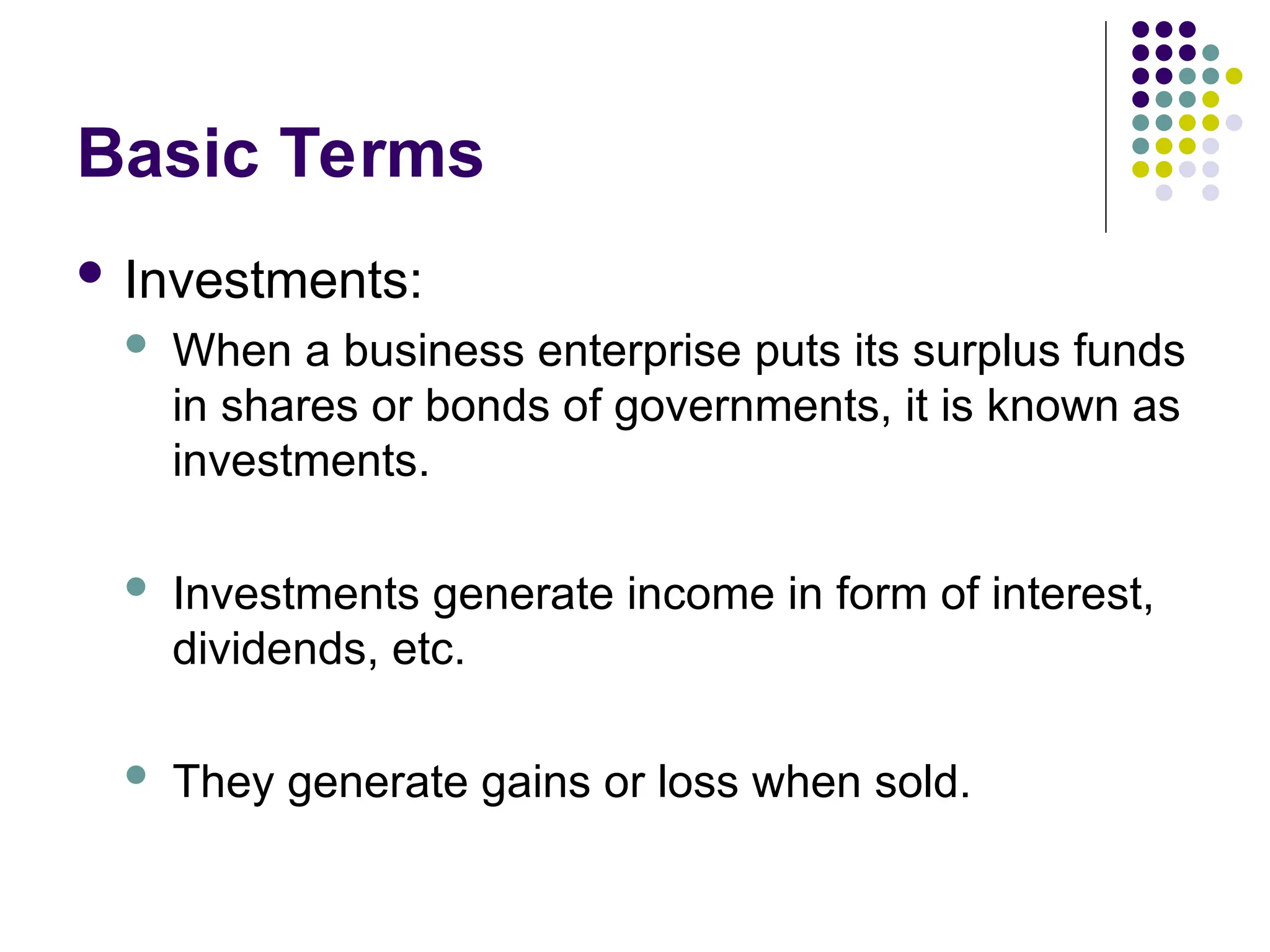
Investments:
When a business enterprise puts its surplus funds
in shares or bonds of governments, it is known as
investments.
Investments generate income in form of interest,
dividends, etc.
They generate gains or loss when sold.
22.
Basic Terms
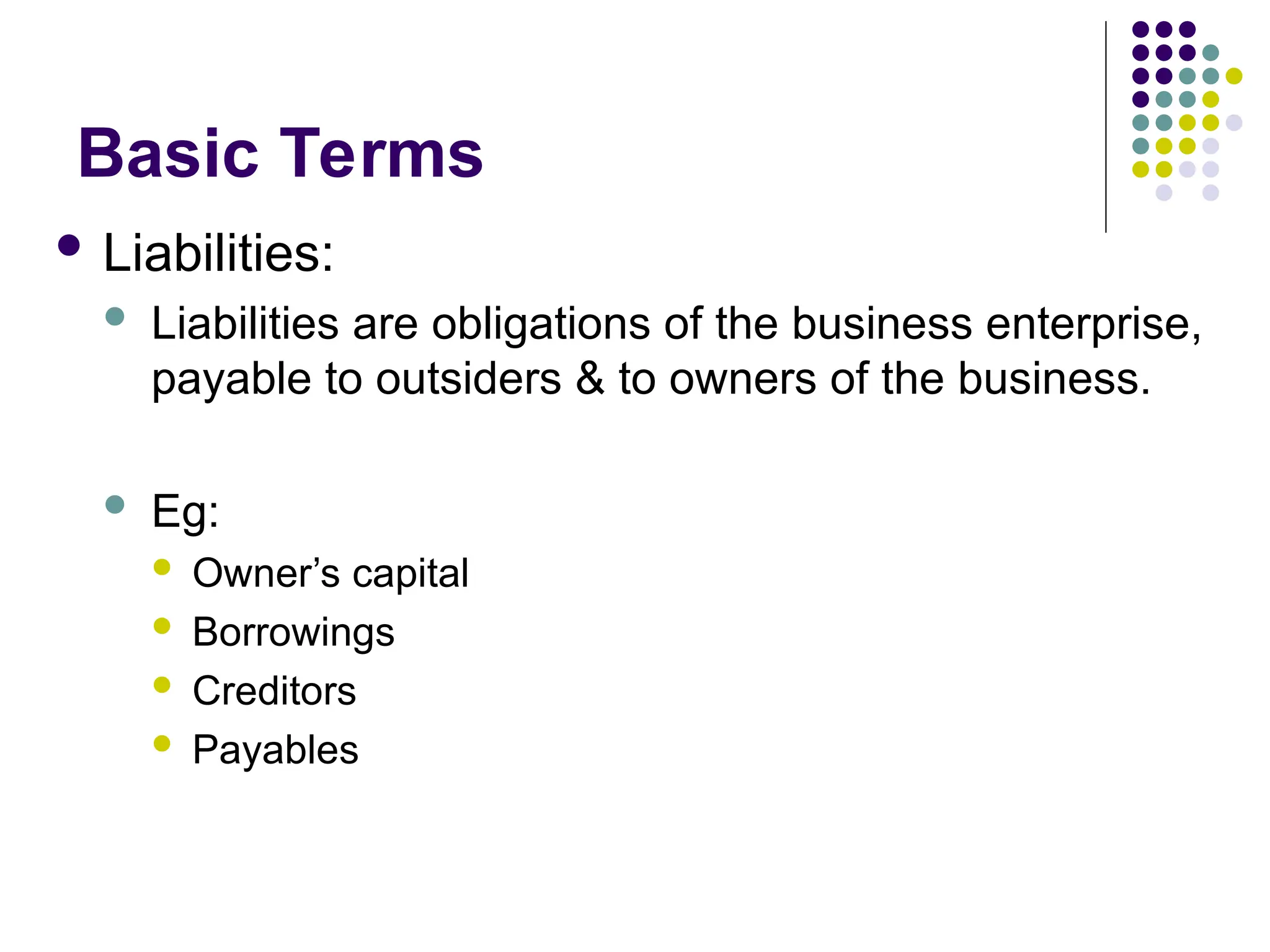
Liabilities:
Liabilities are obligations of the business enterprise,
payable to outsiders & to owners of the business.
Eg:
Owner’s capital
Borrowings
Creditors
Payables
23.
Basic Terms
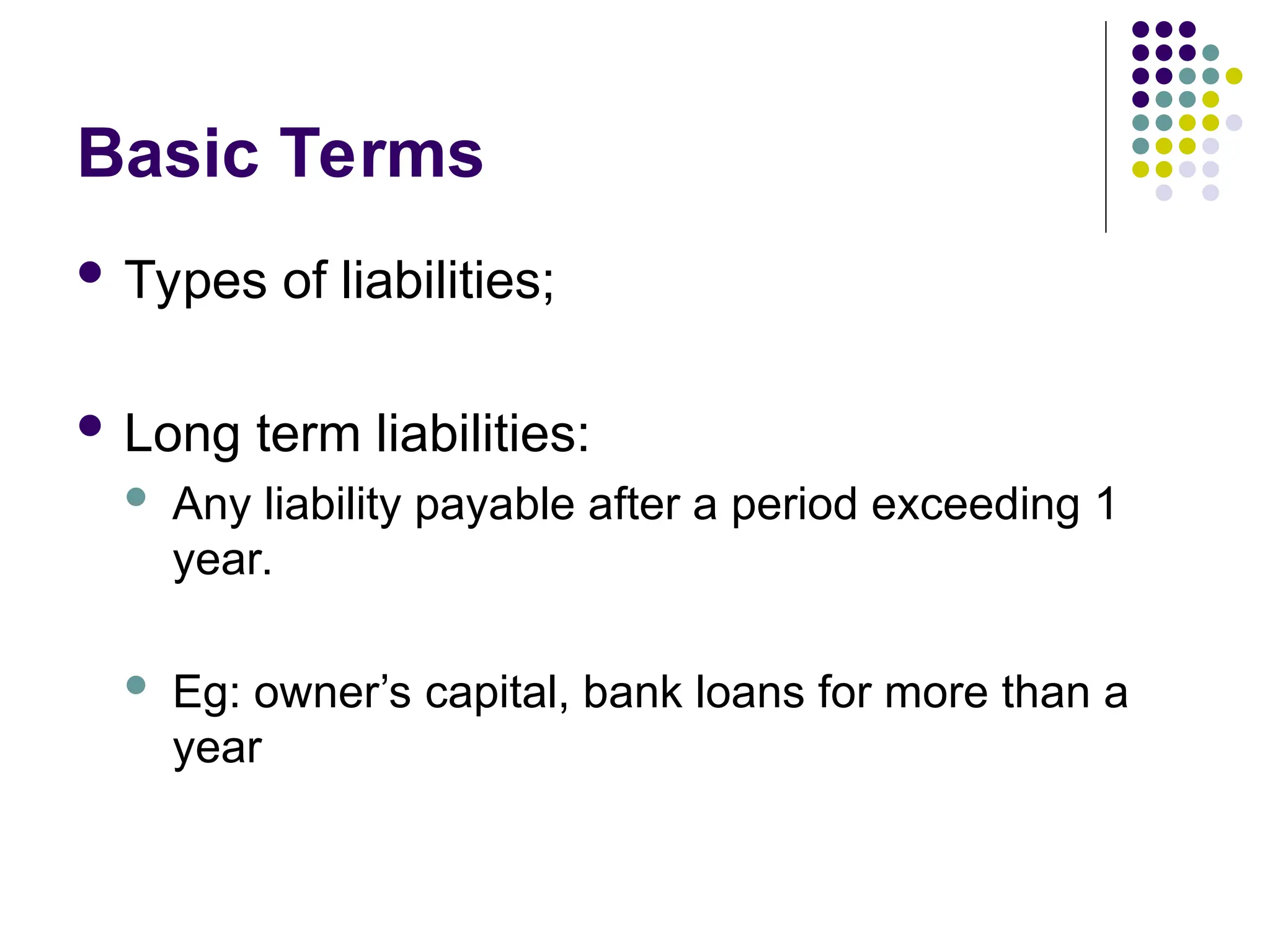
Typesof liabilities;
Long term liabilities:
Any liability payable after a period exceeding 1
year.
Eg: owner’s capital, bank loans for more than a
year
24.
Basic Terms
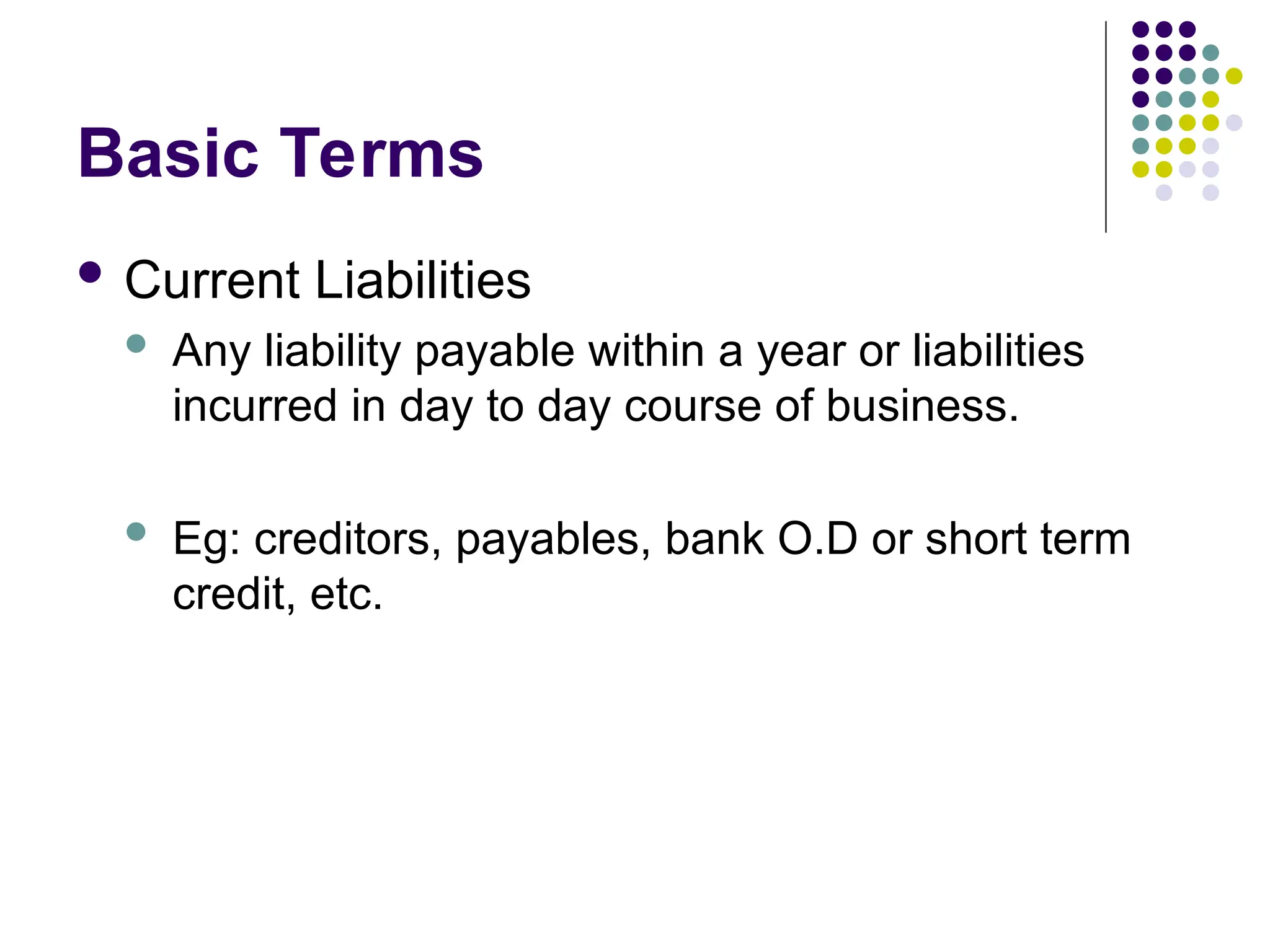
CurrentLiabilities
Any liability payable within a year or liabilities
incurred in day to day course of business.
Eg: creditors, payables, bank O.D or short term
credit, etc.
25.
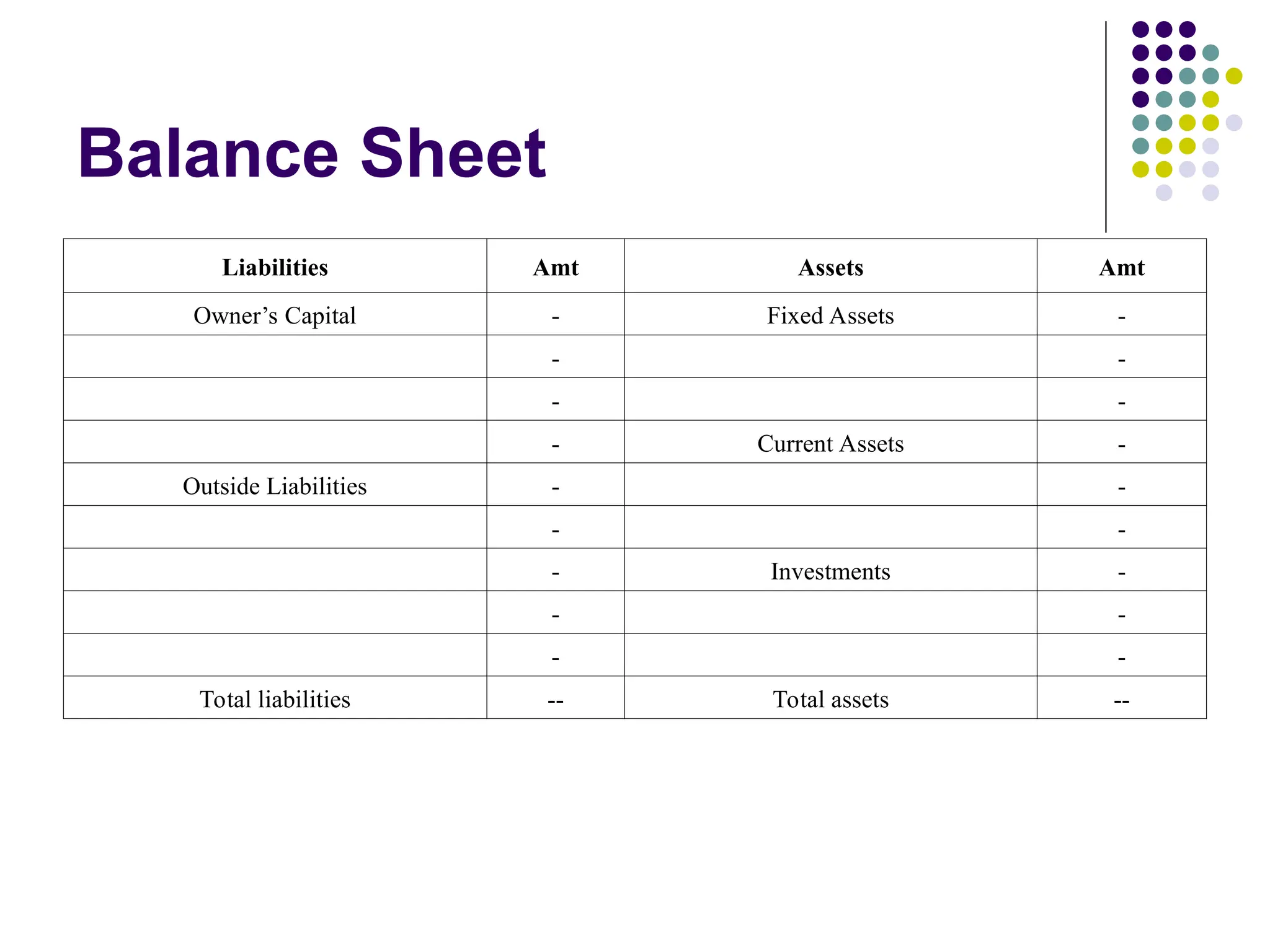
Balance Sheet
Liabilities AmtAssets Amt
Owner’s Capital - Fixed Assets -
- -
- -
- Current Assets -
Outside Liabilities - -
- -
- Investments -
- -
- -
Total liabilities -- Total assets --
26.
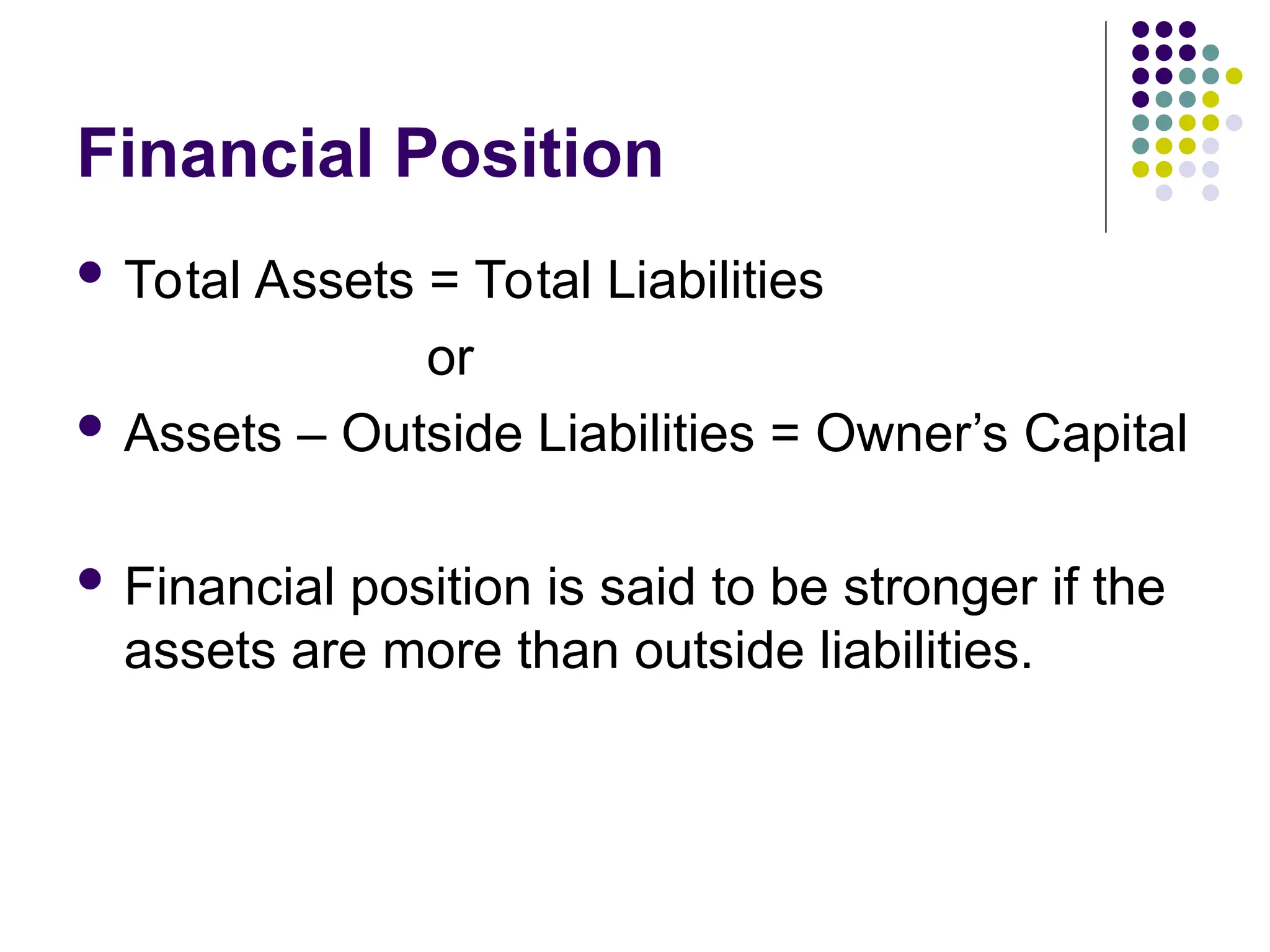
Financial Position
TotalAssets = Total Liabilities
or
Assets – Outside Liabilities = Owner’s Capital
Financial position is said to be stronger if the
assets are more than outside liabilities.
27.
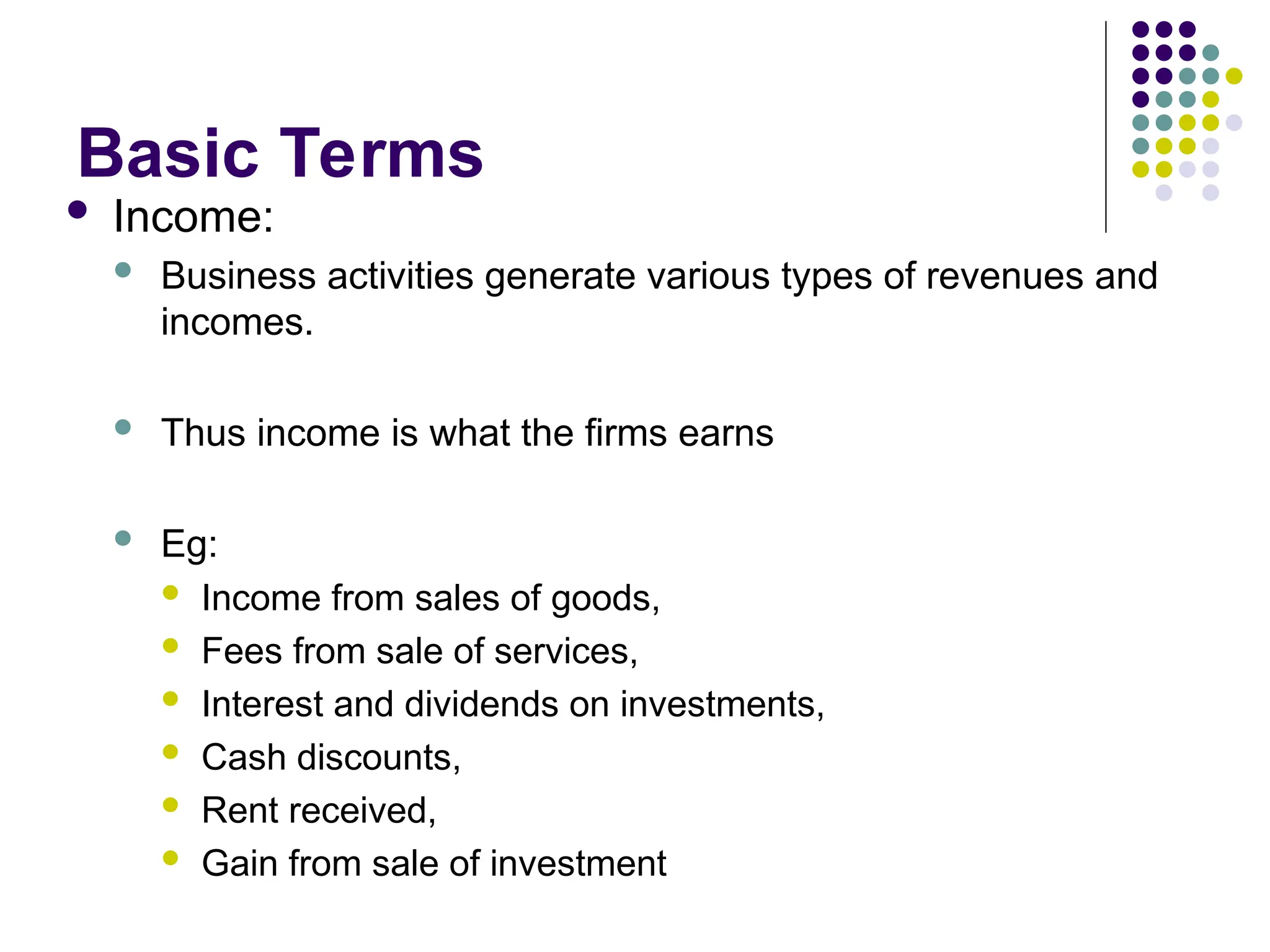
Basic Terms
Income:
Business activities generate various types of revenues and
incomes.
Thus income is what the firms earns
Eg:
Income from sales of goods,
Fees from sale of services,
Interest and dividends on investments,
Cash discounts,
Rent received,
Gain from sale of investment
28.
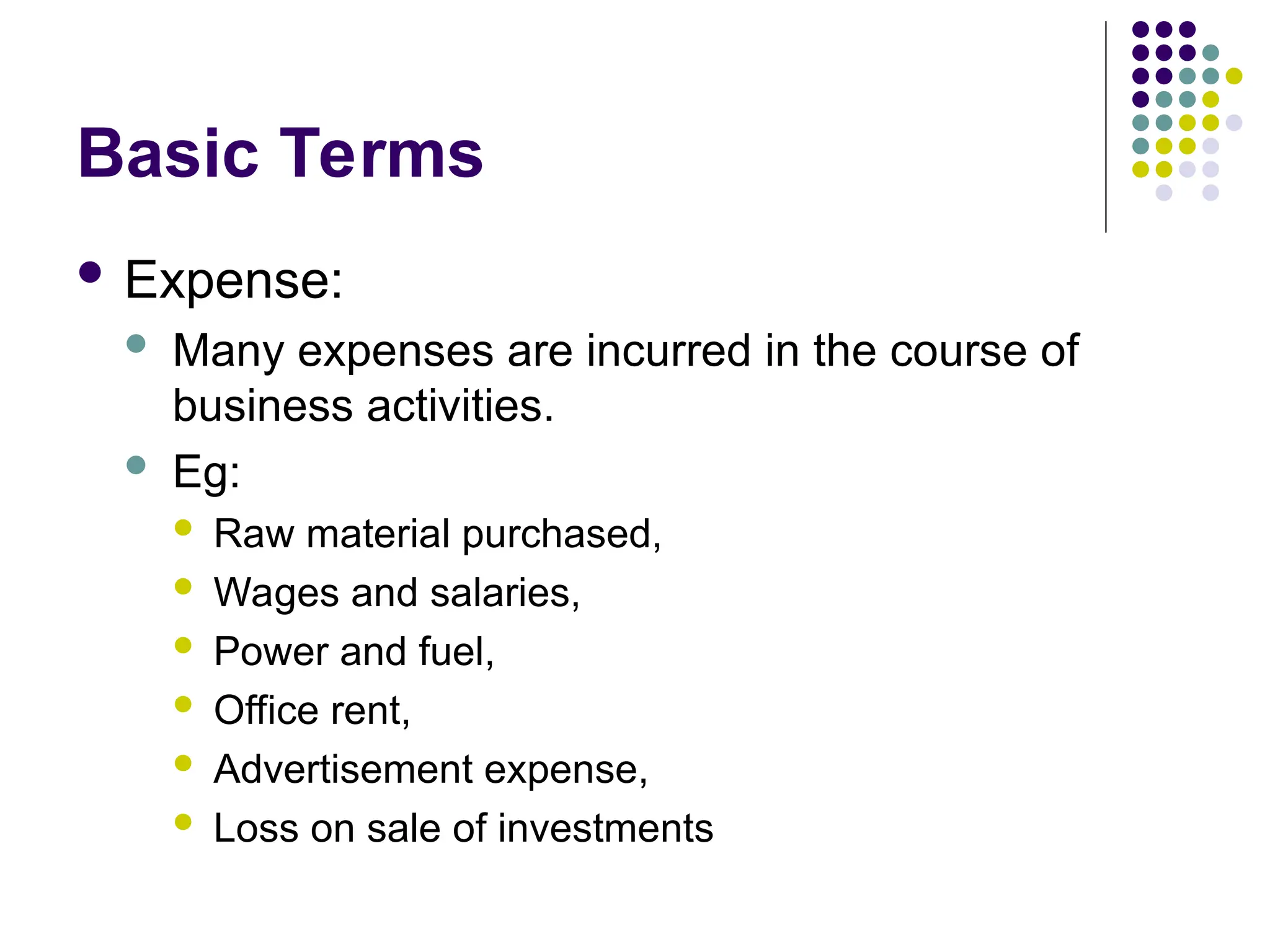
Basic Terms
Expense:
Many expenses are incurred in the course of
business activities.
Eg:
Raw material purchased,
Wages and salaries,
Power and fuel,
Office rent,
Advertisement expense,
Loss on sale of investments
29.
Financial Performance
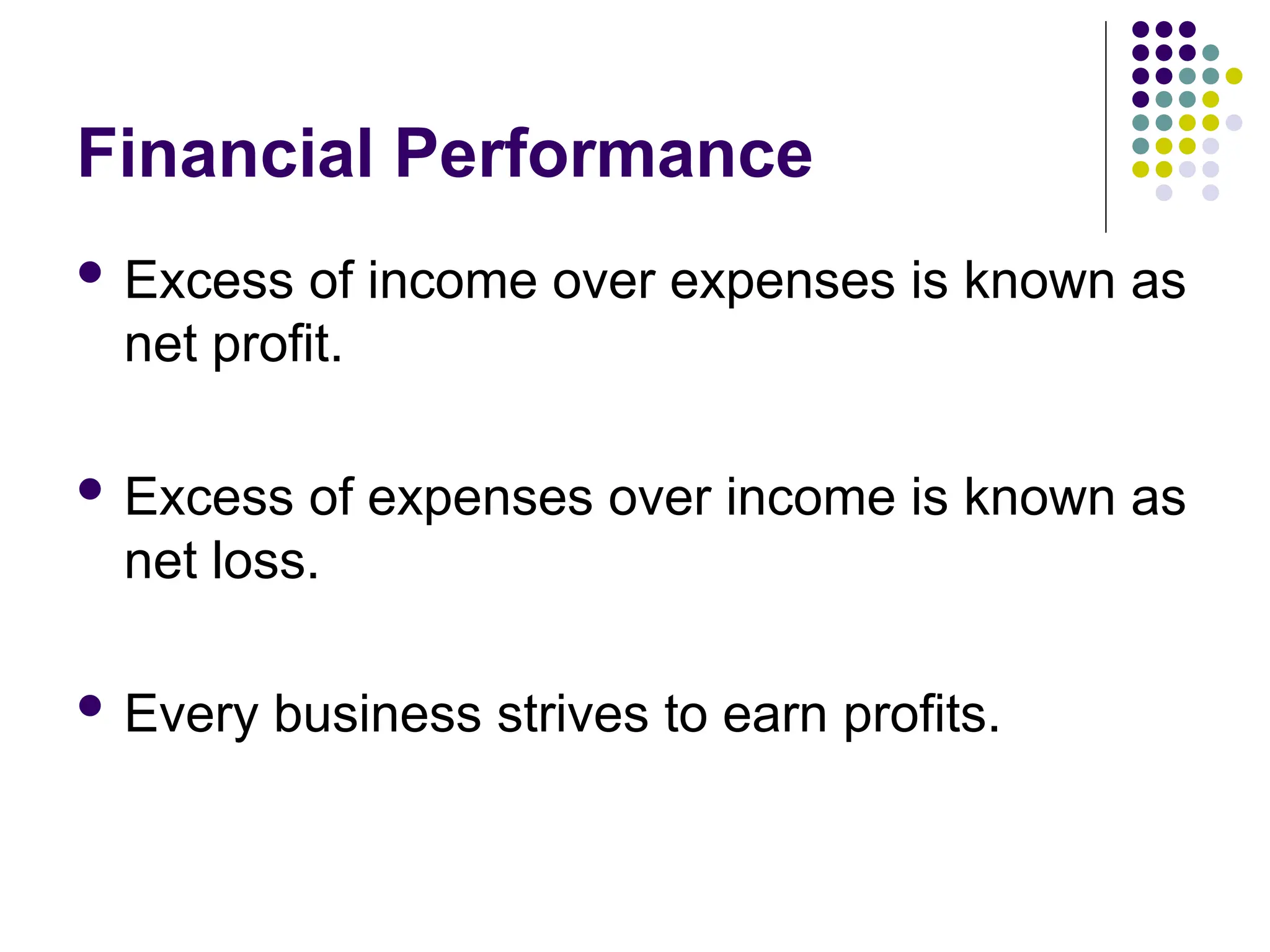
Excessof income over expenses is known as
net profit.
Excess of expenses over income is known as
net loss.
Every business strives to earn profits.
30.
Financial Performance
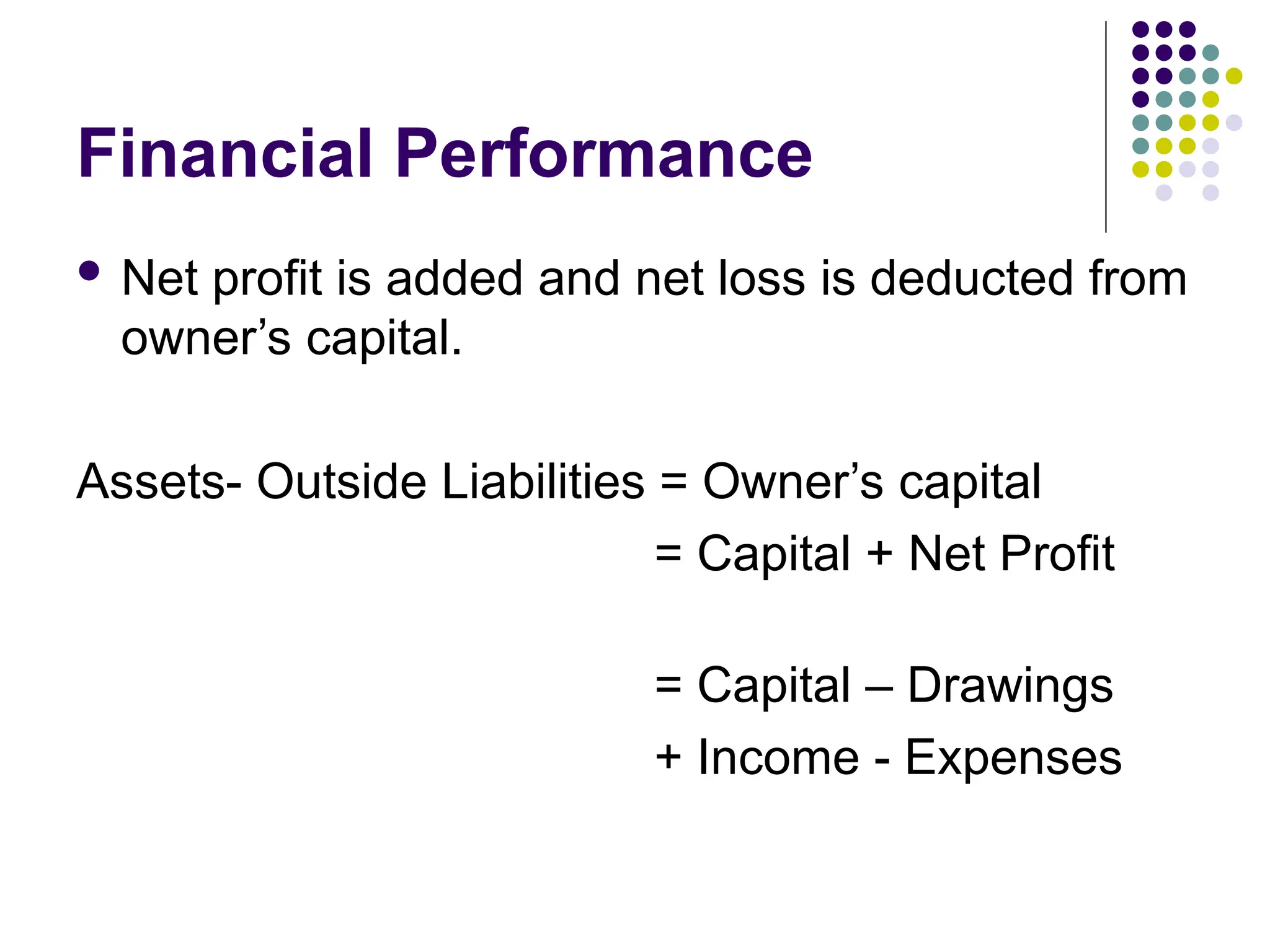
Netprofit is added and net loss is deducted from
owner’s capital.
Assets- Outside Liabilities = Owner’s capital
= Capital + Net Profit
= Capital – Drawings
+ Income - Expenses
31.
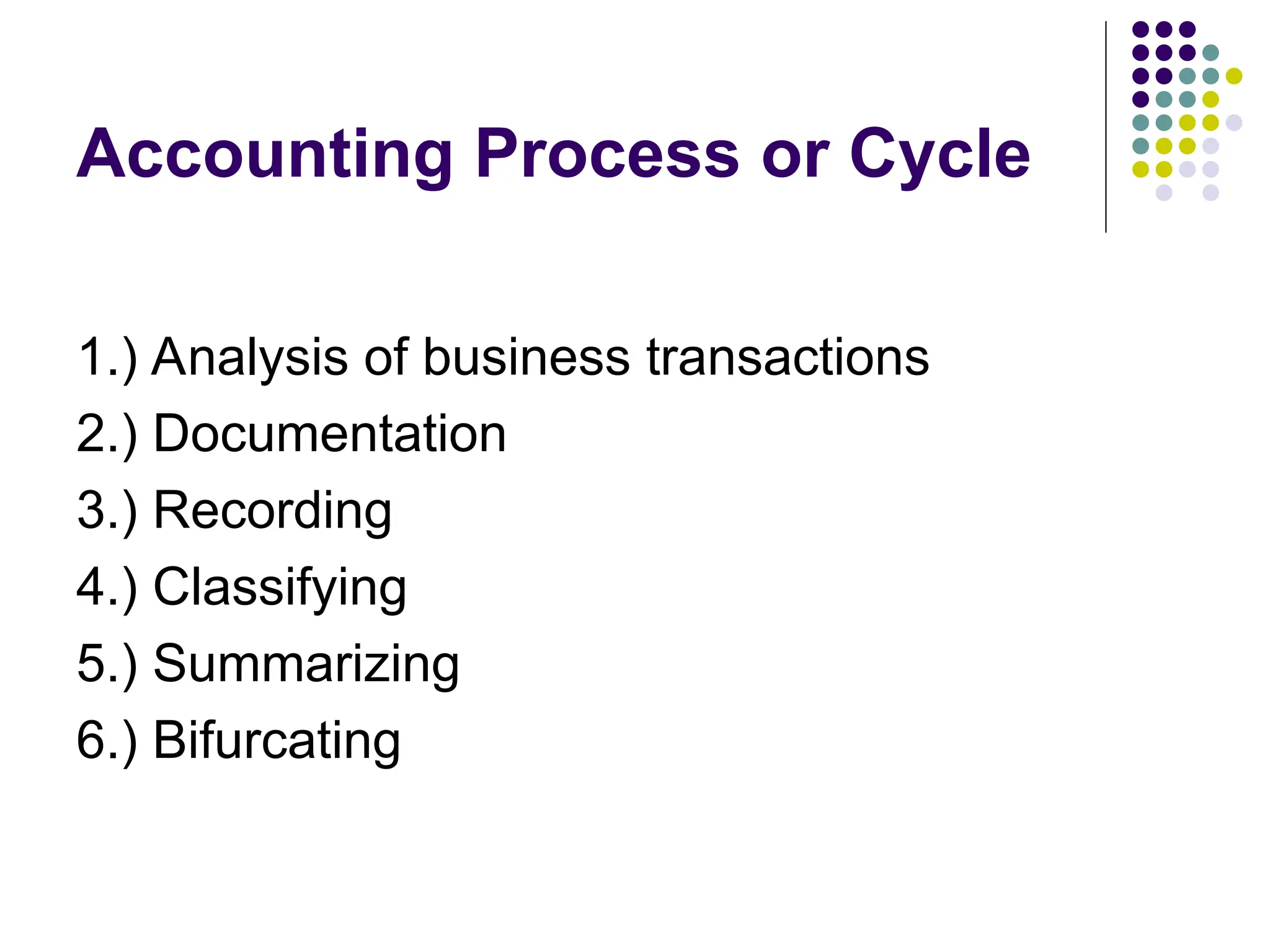
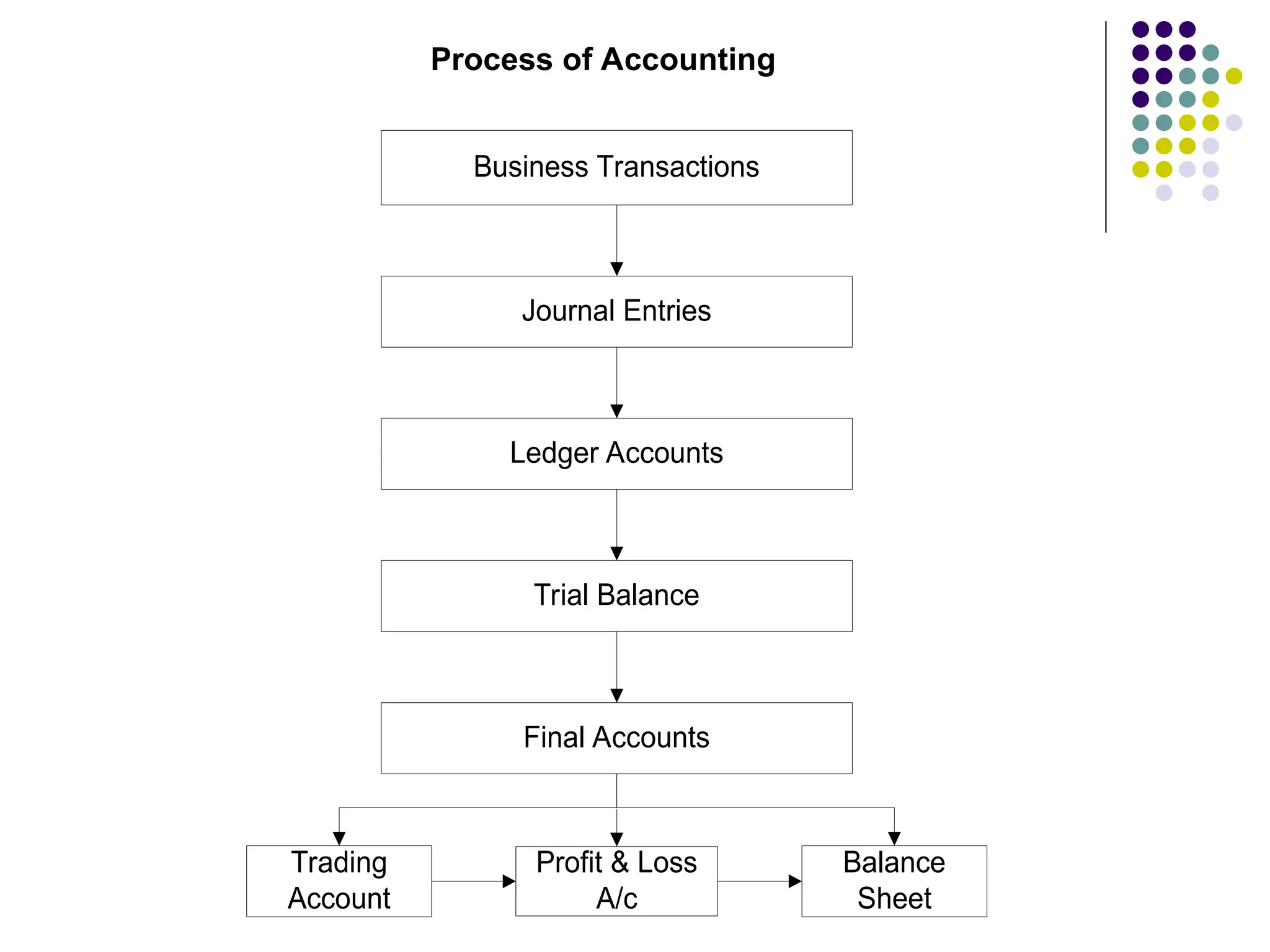
Accounting Process orCycle
1.) Analysis of business transactions
2.) Documentation
3.) Recording
4.) Classifying
5.) Summarizing
6.) Bifurcating
32.
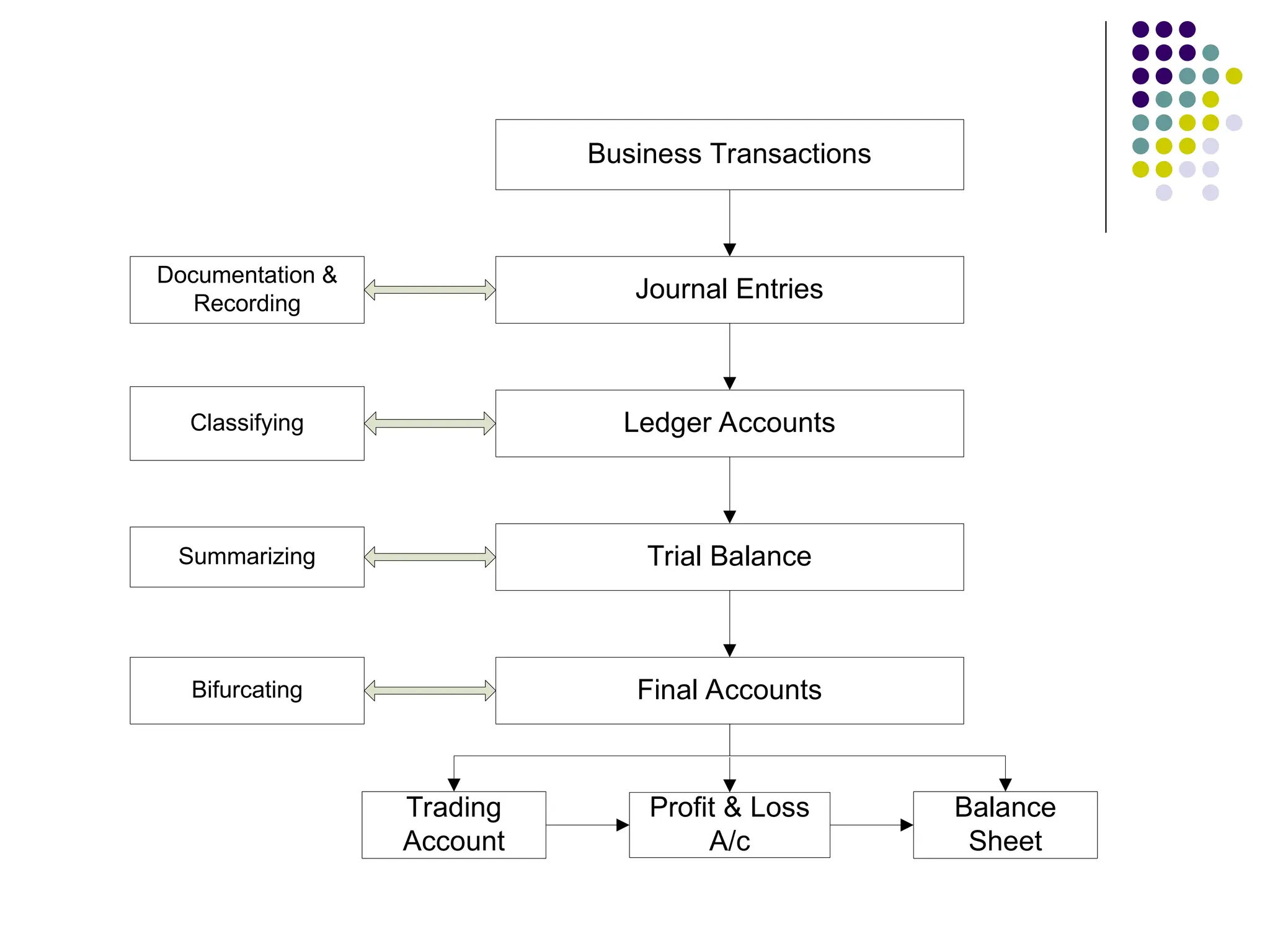
Business Transactions
Journal Entries
LedgerAccounts
Trial Balance
Final Accounts
Trading
Account
Profit & Loss
A/c
Balance
Sheet
Documentation &
Recording
Classifying
Summarizing
Bifurcating
33.
What is anAccount?
An account is a device to record business
transactions.
There are various accounts prepared for
each asset, liability, income and expenses.
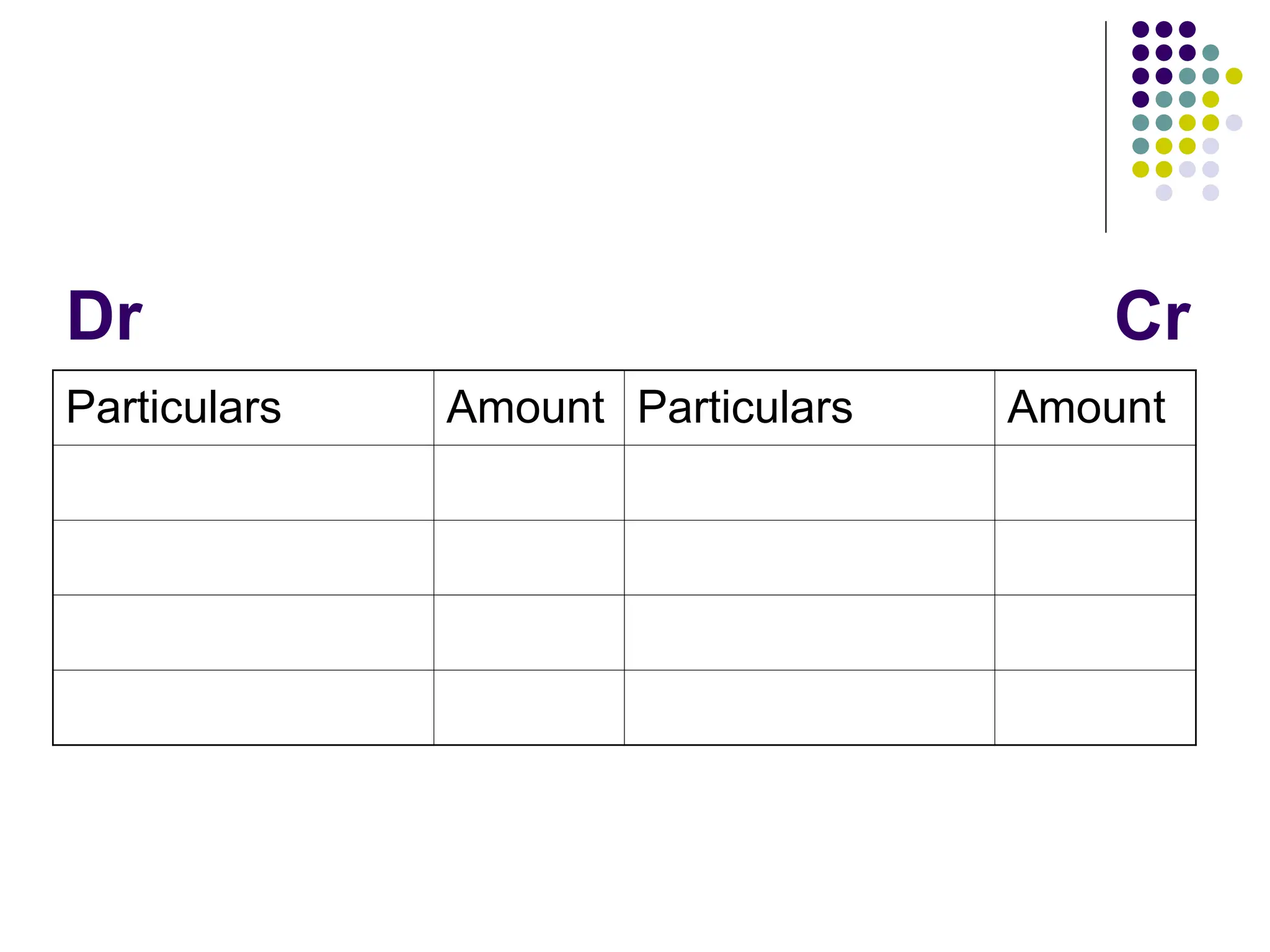
An account has two sides:
What is anAccount?
The left side of an account is known as debit
(Dr).
The right side of an account is known as
credit (Cr).
In any account, on one side increase is
recorded and on other side the decrease in
the item is recorded.
36.
Types of Accounts
Nominal / temporary accounts
The accounts related to all incomes and expenses.
Eg: Interest A/c, Rent A/c, Salary A/c, Etc.
Personal accounts
Accounts of natural persons like Mr. Ramesh, Mr. Suresh, etc.
Accounts of legal persons like companies, banks, government,
etc.
These persons are generally the buyers, sellers, lenders,
investors, etc. associated with the company.
In short they are debtors or creditors.
37.
Types of Accounts
Real / Permanent accounts
These are accounts of various assets and goods.
Eg: Buildings A/c, Machinery A/c, debtors’ A/c,
purchase A/c, Sales A/c.
38.
What is Debitand Credit?
Debit is the left hand side of an A/c.
Thus amounts written on the left side of an
account are called debits.
Credit is the right side of an A/c.
Thus amounts written on the right side of an
account are called credits.
39.
Debit Balance &Credit Balance
Every A/c has a debit balance or a credit balance.
Debit Balance:
An account has a debit balance when the total of debit side
is more than the total of credit side.
All assets and expenses have a debit balance.
For assets and expenses, an increase is written on debit
side and a decrease on credit side.
40.
Debit Balance &Credit Balance
Credit Balance
When the total of credit side is more than the total
of debit side, it is known as a credit balance.
All liabilities and incomes have a credit balance.
For liabilities and incomes, an increase is written
on credit side and decrease is written on debit
side.
41.
Rules of Debitand Credit
The system of accounting is a double entry
system.
Under double entry system of accounting,
every transaction has two effects – one debit
and one credit.
This means for every business transaction
one A/c is debited and one A/c is credited.
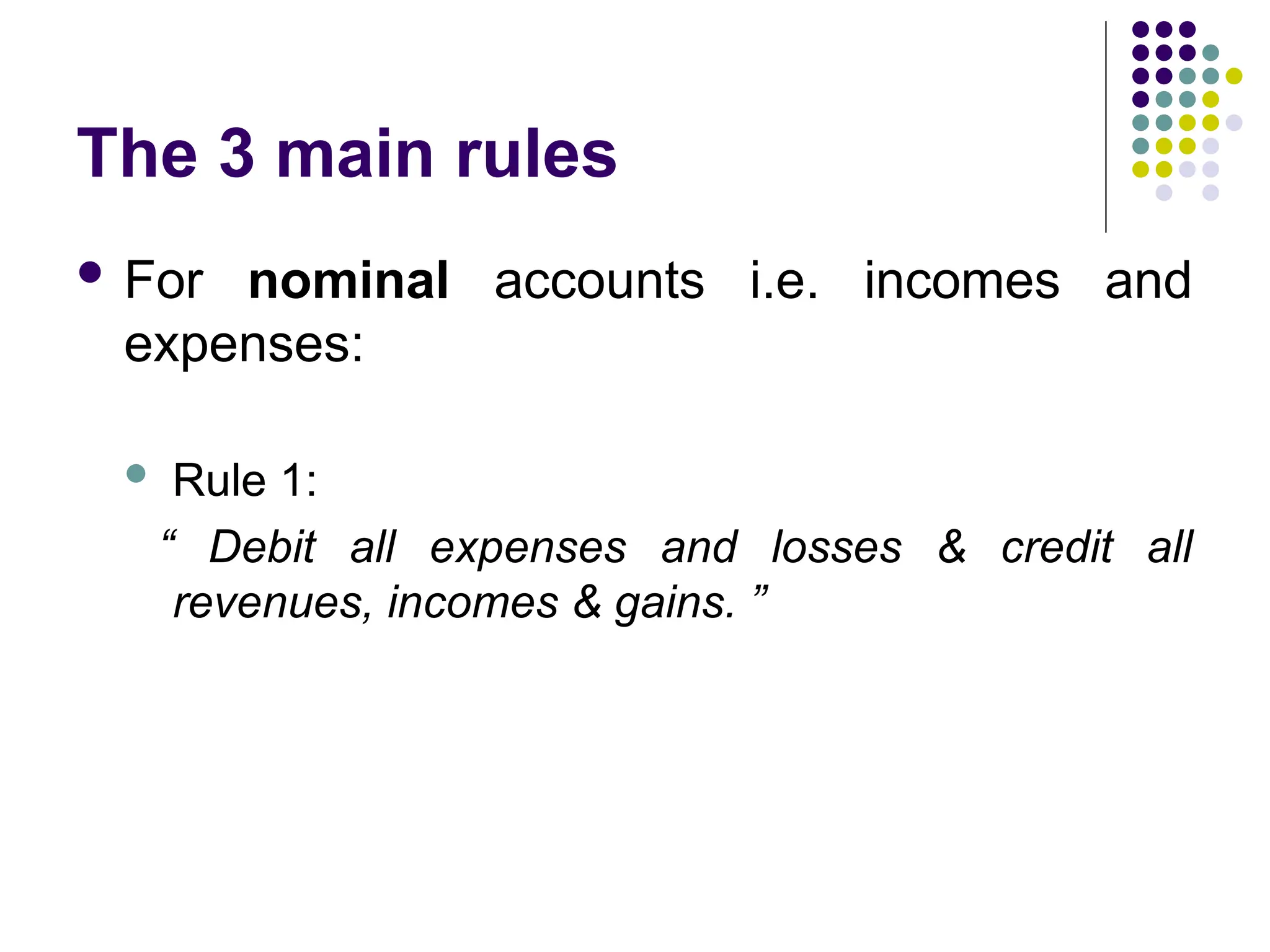
42.
The 3 mainrules
For nominal accounts i.e. incomes and
expenses:
Rule 1:
“ Debit all expenses and losses & credit all
revenues, incomes & gains. ”
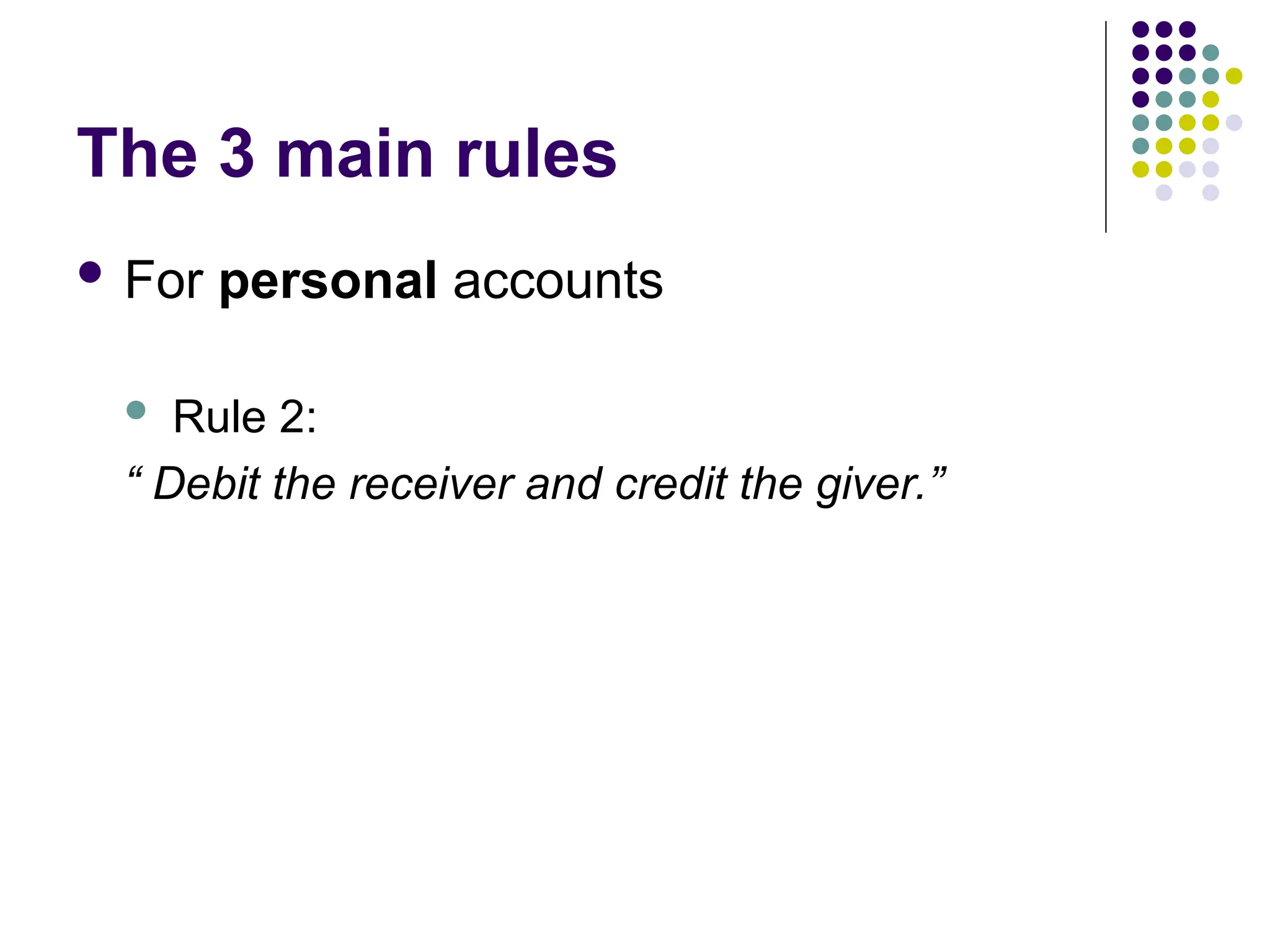
43.
The 3 mainrules
For personal accounts
Rule 2:
“ Debit the receiver and credit the giver.”
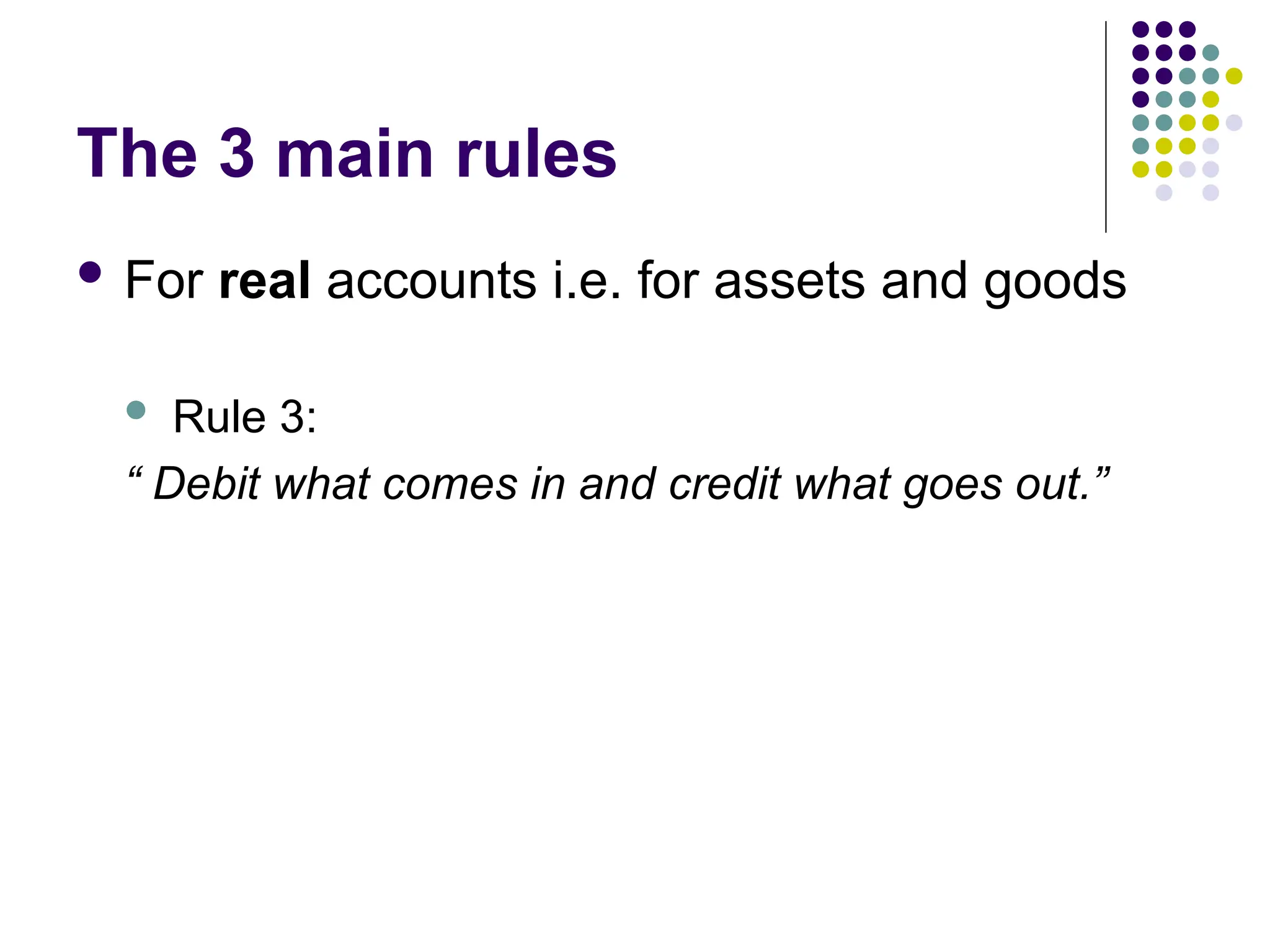
44.
The 3 mainrules
For real accounts i.e. for assets and goods
Rule 3:
“ Debit what comes in and credit what goes out.”
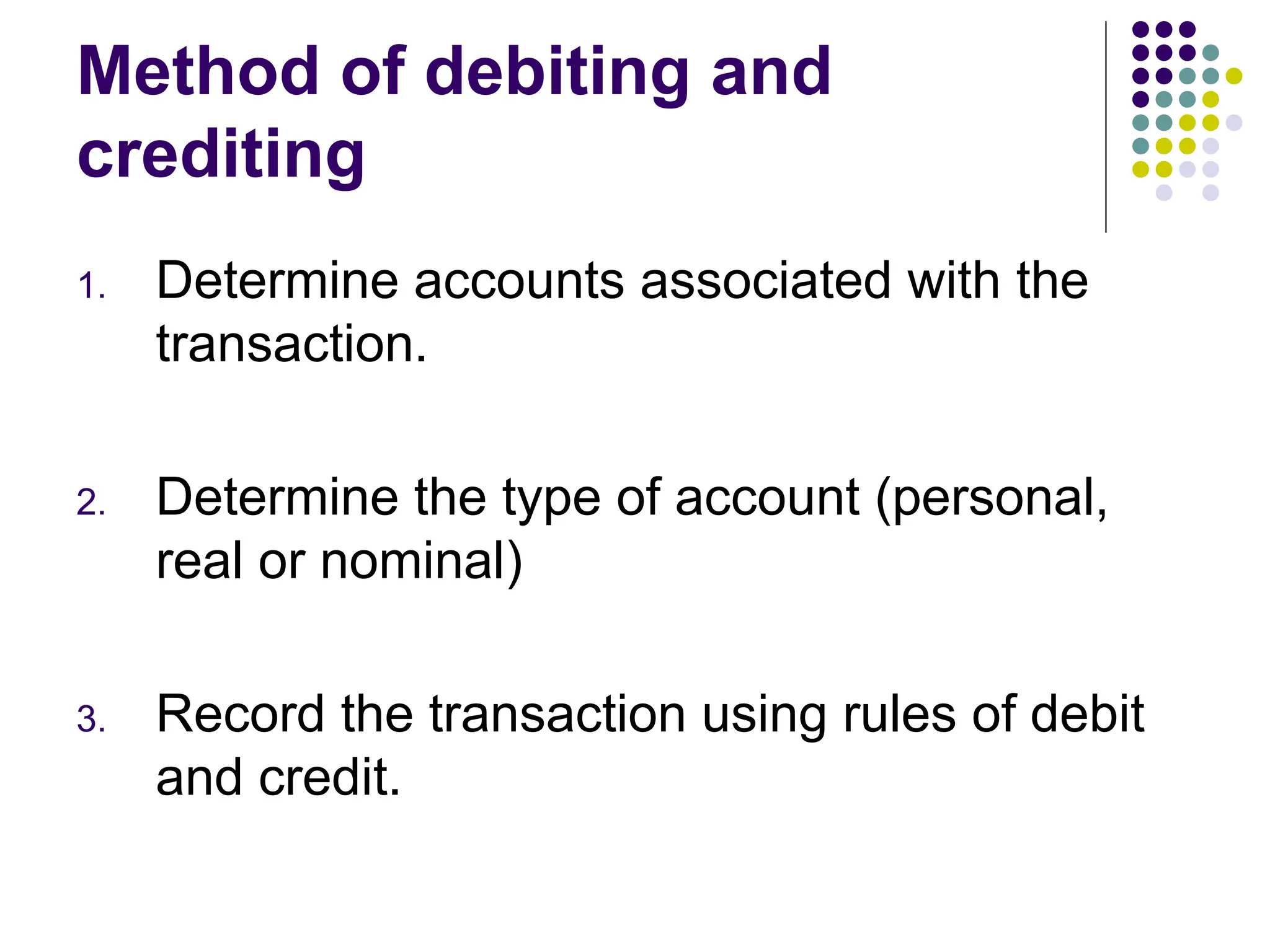
45.
Method of debitingand
crediting
1. Determine accounts associated with the
transaction.
2. Determine the type of account (personal,
real or nominal)
3. Record the transaction using rules of debit
and credit.
![Basic Terms
Current Assets
These assets are required to carry on the day to
day business activities.
Eg:
Inventories [raw material, work in progress & finished
goods]
Cash balance
Bank balance
Debtors
Receivables](https://image.slidesharecdn.com/accountsintro-250918062344-b00b957a/75/Basic-Introduction-to-Accounting-Terminology-20-2048.jpg)