1
Basic Electrical Engineering
(ES-EE101)
Module 1:
DC Circuits
Prepared By:
Manit Mukhopadhyay
Assistant Professor
Electrical Engineering Dept.
Asansol Engineering College
2.
2
Lecture 1
Basic ElectricalEngineering (ES-EE 101) Department of Electrical Engineering
Asansol Engineering College
Kanyapur, West Bengal
3.
3
Basic Electrical Engineering(ES-EE 101) Department of Electrical Engineering
Asansol Engineering College
Kanyapur, West Bengal
Detailed contents:
Module 1:DC Circuits(8 hours)
Electrical circuit elements (R, L and C), voltage and current sources,
Kirchhoff current and voltage laws, analysis of simple circuits with dc excitation.
Superposition, Thevenin and Norton Theorems.
Time-domain analysis of first-order RL and RC circuits
4.
4
Basic Electrical Engineering(ES-EE 101) Department of Electrical Engineering
Asansol Engineering College
Kanyapur, West Bengal
CO Course Outcome of ES EE 101
After successful completion of the course ES 101, students will be able to
ES EE 101.1 Understand the basics of electrical circuits, circuit parameters and components
ES EE 101.2 Analyze AC circuits
ES EE 101.3 Discuss the fundamentals of transformer and its performance
ES EE 101.4 Establish the role of different electrical machines
ES EE 101.5 Develop knowledge in Power Converters
ES EE 101.6 Relate the applications of different switchgear in electrical installations
5.
5 In thissession you will learn about:
1. Concept of Electricity
2. Concept of Circuit element
3. Details & Working of Resistor, Inductor and Capacitor
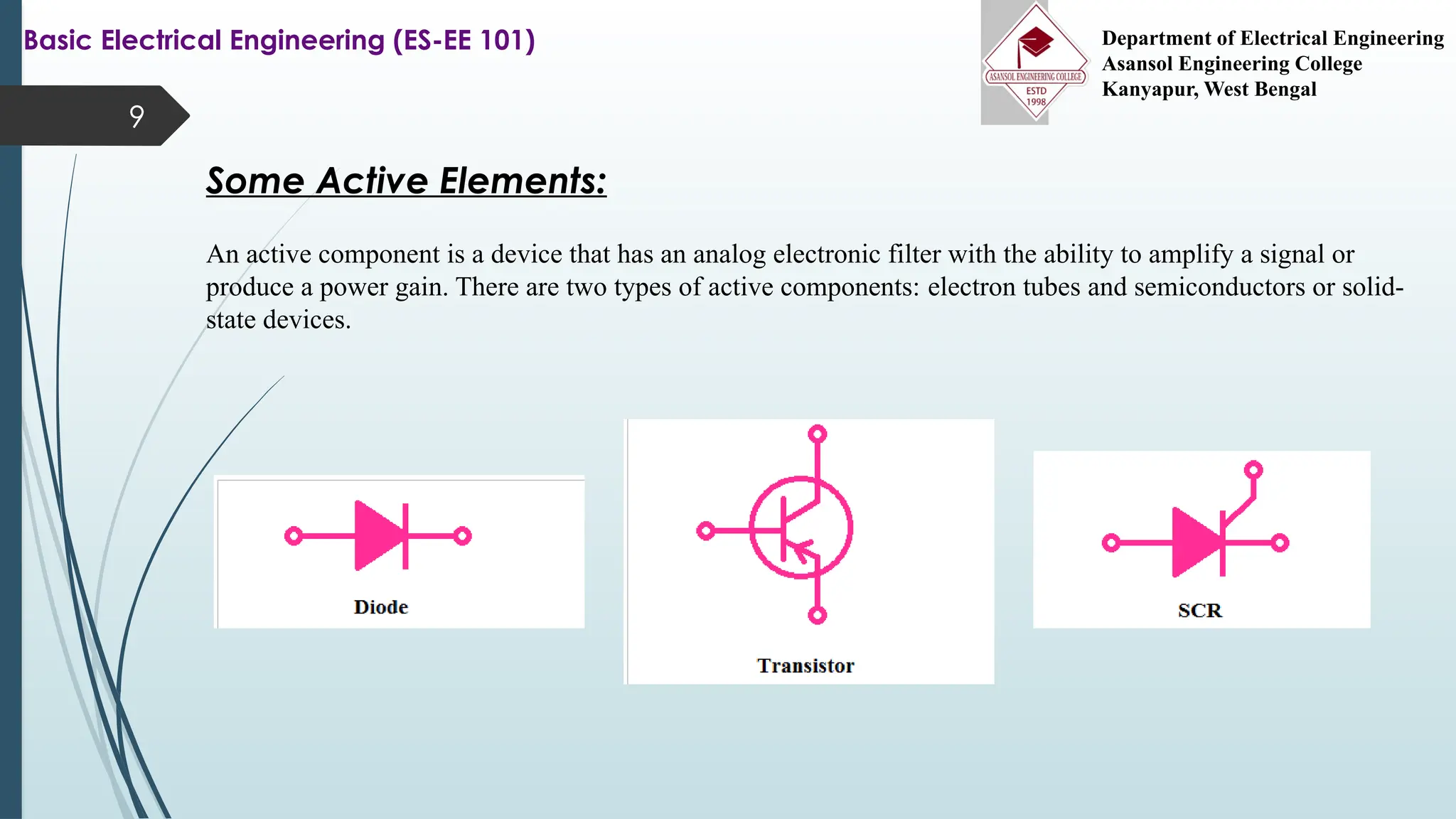
4. Knowledge of some Active elements
5. Numerical
6. Assignments
Basic Electrical Engineering (ES-EE 101) Department of Electrical Engineering
Asansol Engineering College
Kanyapur, West Bengal
6.
6 What isElectricity ?
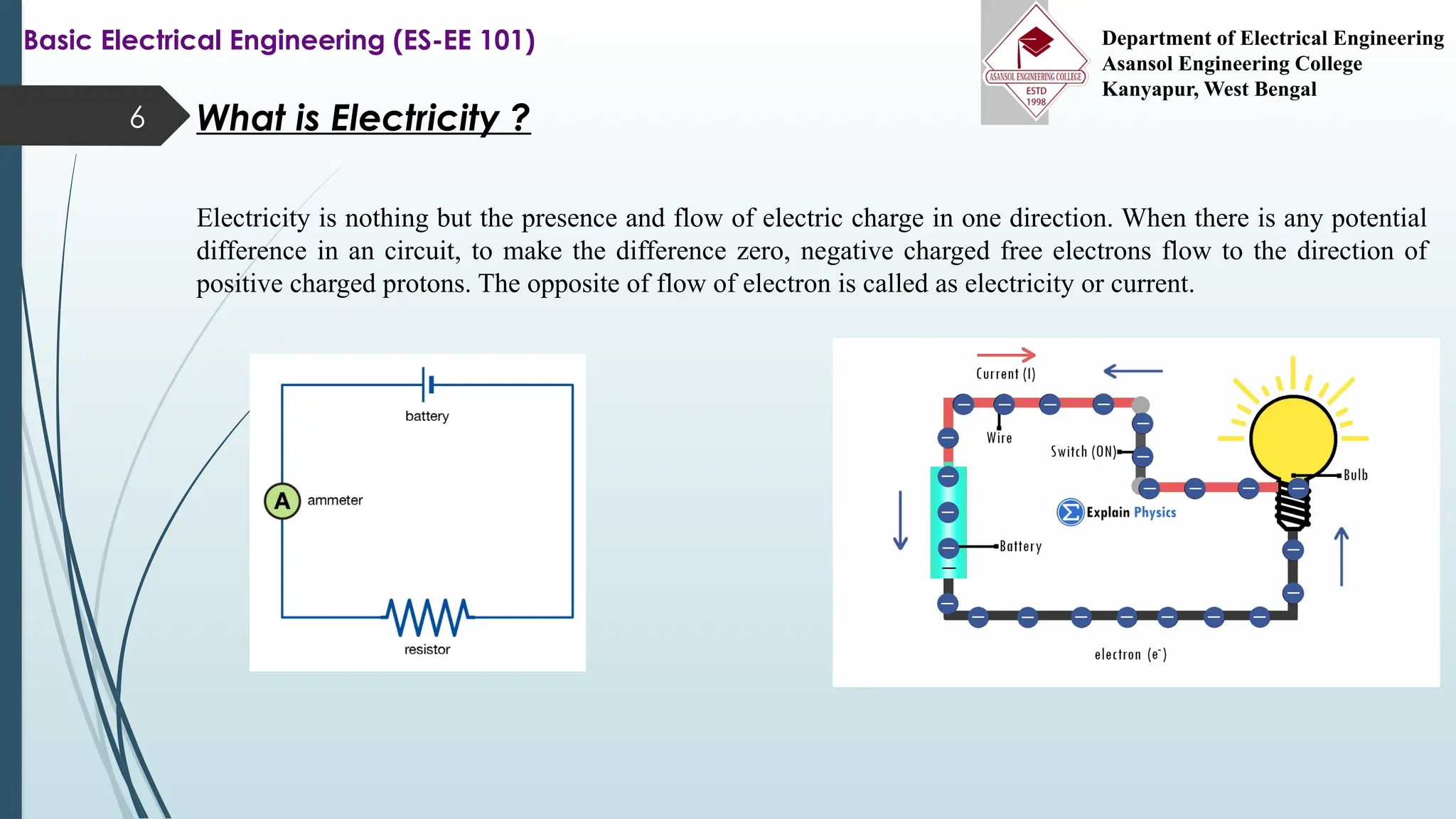
Electricity is nothing but the presence and flow of electric charge in one direction. When there is any potential
difference in an circuit, to make the difference zero, negative charged free electrons flow to the direction of
positive charged protons. The opposite of flow of electron is called as electricity or current.
Basic Electrical Engineering (ES-EE 101) Department of Electrical Engineering
Asansol Engineering College
Kanyapur, West Bengal
7.
7 Circuit Element/NetworkElement:
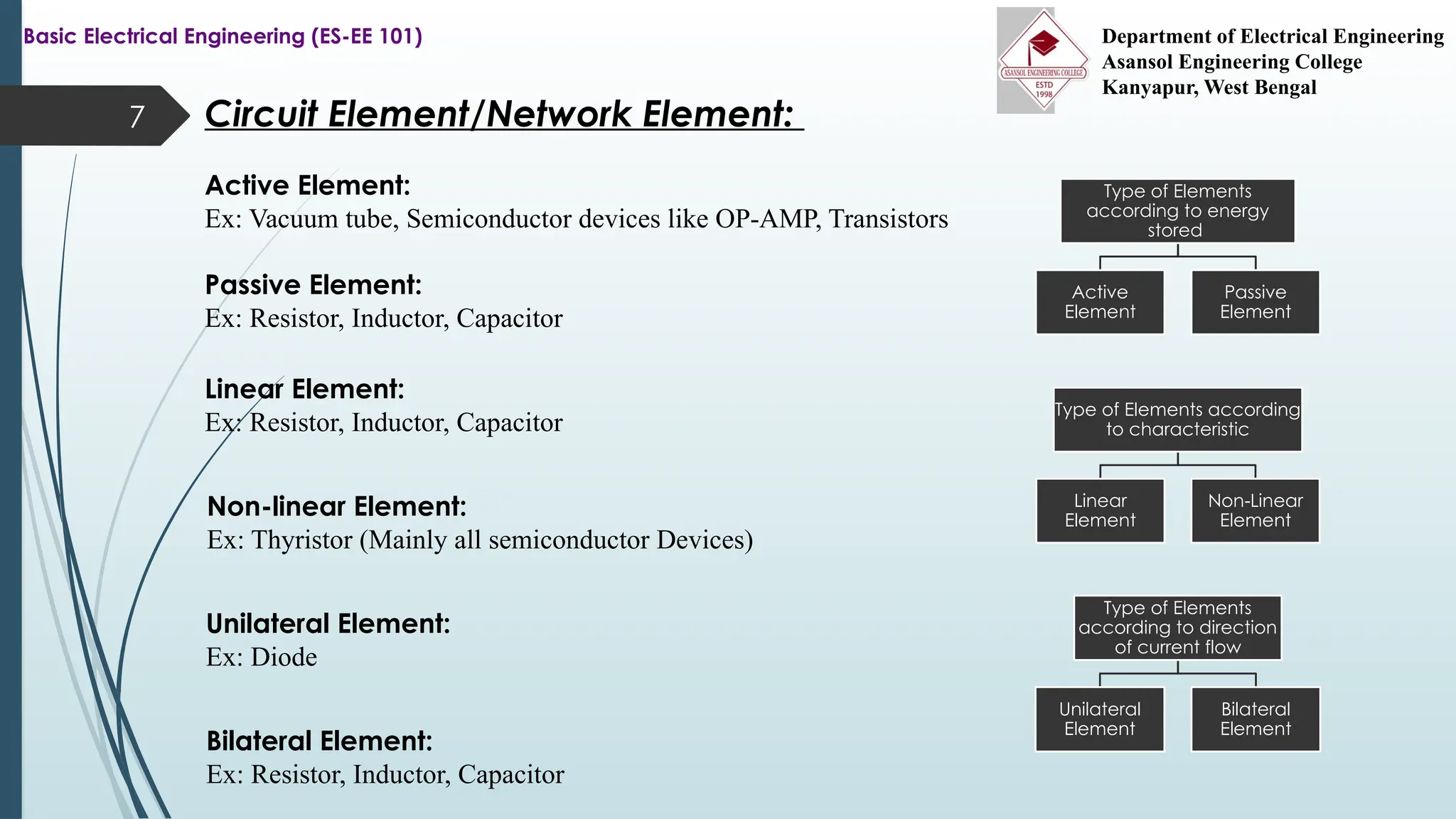
Type of Elements
according to energy
stored
Active
Element
Passive
Element
Active Element:
Ex: Vacuum tube, Semiconductor devices like OP-AMP, Transistors
Passive Element:
Ex: Resistor, Inductor, Capacitor
Type of Elements according
to characteristic
Linear
Element
Non-Linear
Element
Type of Elements
according to direction
of current flow
Unilateral
Element
Bilateral
Element
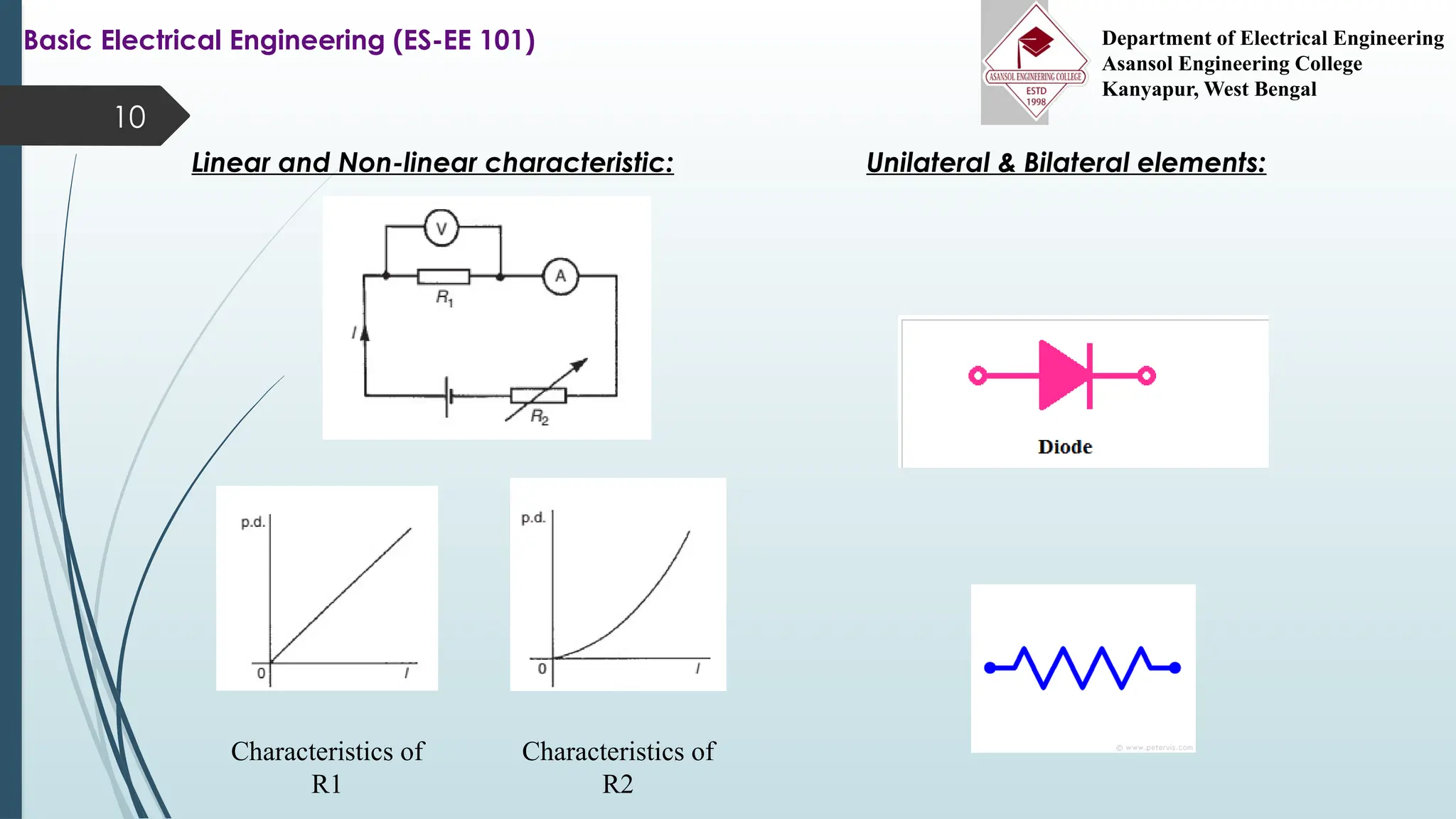
Linear Element:
Ex: Resistor, Inductor, Capacitor
Non-linear Element:
Ex: Thyristor (Mainly all semiconductor Devices)
Unilateral Element:
Ex: Diode
Bilateral Element:
Ex: Resistor, Inductor, Capacitor
Basic Electrical Engineering (ES-EE 101) Department of Electrical Engineering
Asansol Engineering College
Kanyapur, West Bengal
8.
8
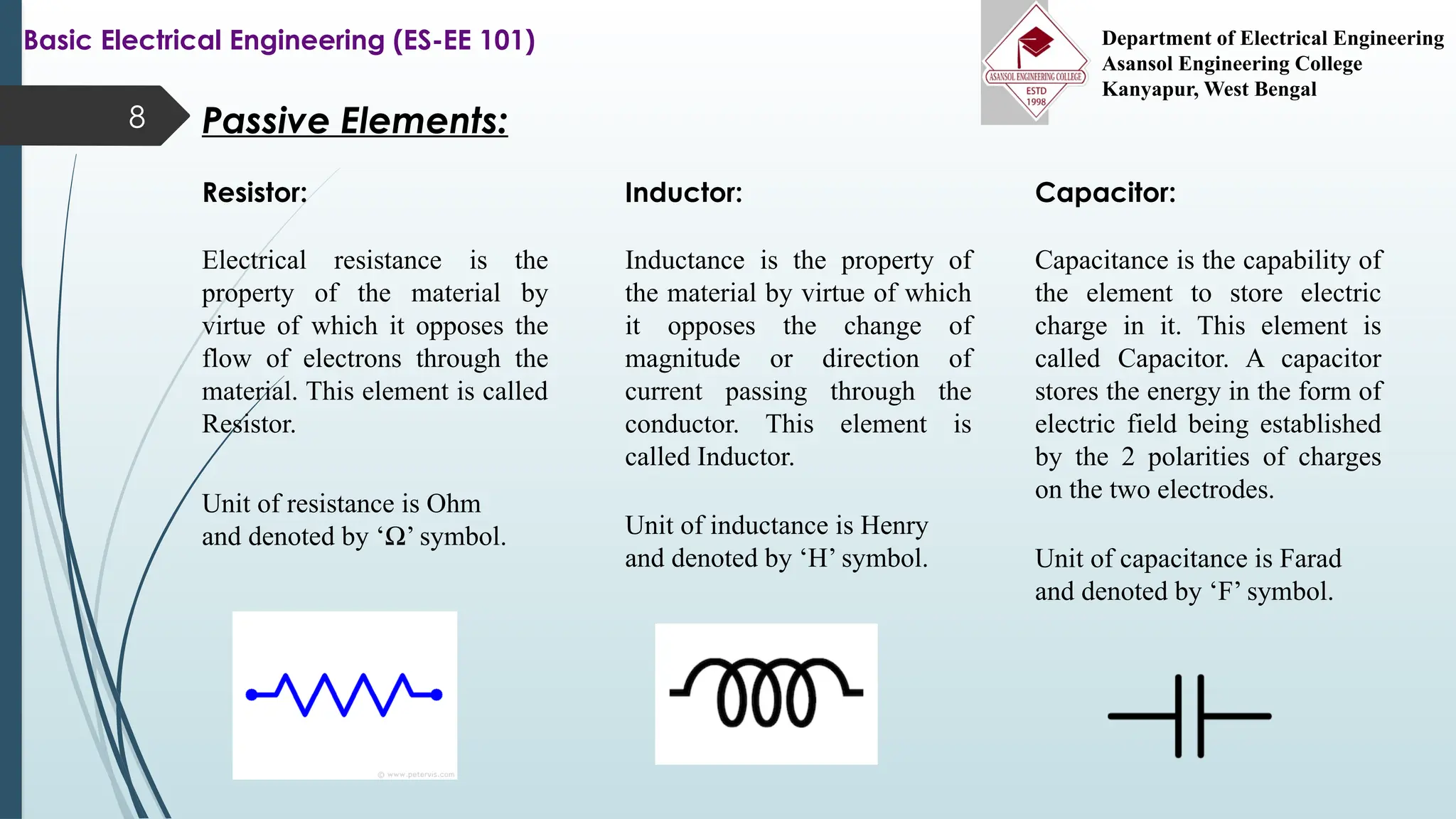
Resistor: Inductor: Capacitor:
PassiveElements:
Electrical resistance is the
property of the material by
virtue of which it opposes the
flow of electrons through the
material. This element is called
Resistor.
Inductance is the property of
the material by virtue of which
it opposes the change of
magnitude or direction of
current passing through the
conductor. This element is
called Inductor.
Capacitance is the capability of
the element to store electric
charge in it. This element is
called Capacitor. A capacitor
stores the energy in the form of
electric field being established
by the 2 polarities of charges
on the two electrodes.
Unit of resistance is Ohm
and denoted by ‘Ω’ symbol. Unit of inductance is Henry
and denoted by ‘H’ symbol. Unit of capacitance is Farad
and denoted by ‘F’ symbol.
Basic Electrical Engineering (ES-EE 101) Department of Electrical Engineering
Asansol Engineering College
Kanyapur, West Bengal
9.
9
Some Active Elements:
Anactive component is a device that has an analog electronic filter with the ability to amplify a signal or
produce a power gain. There are two types of active components: electron tubes and semiconductors or solid-
state devices.
Basic Electrical Engineering (ES-EE 101) Department of Electrical Engineering
Asansol Engineering College
Kanyapur, West Bengal
10.
10
Linear and Non-linearcharacteristic: Unilateral & Bilateral elements:
Characteristics of
R1
Characteristics of
R2
Basic Electrical Engineering (ES-EE 101) Department of Electrical Engineering
Asansol Engineering College
Kanyapur, West Bengal
11.
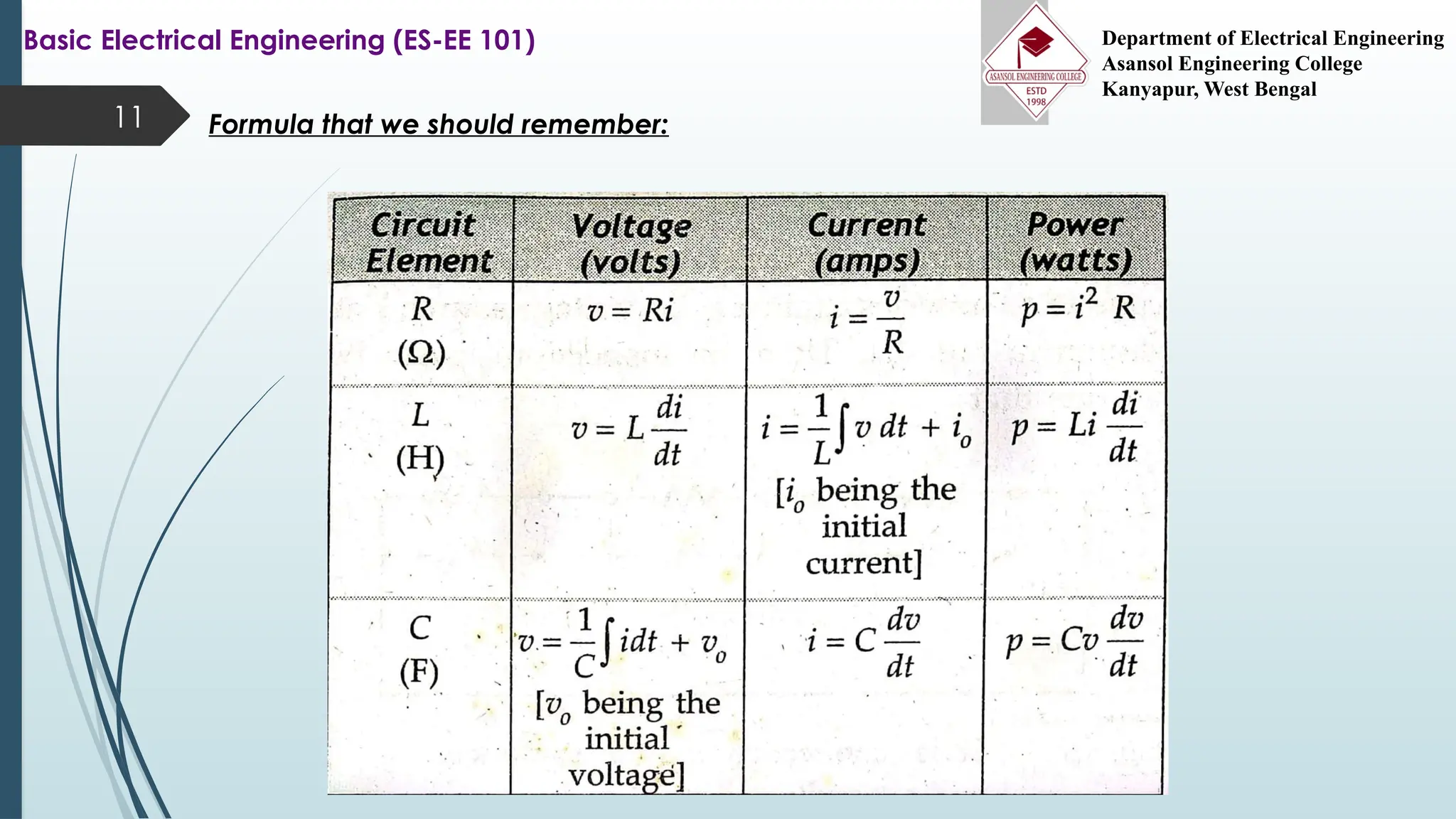
11 Formula thatwe should remember:
Basic Electrical Engineering (ES-EE 101) Department of Electrical Engineering
Asansol Engineering College
Kanyapur, West Bengal
12.
12
Numericals:
Q.1. A 100ohm resistance is directly switched on across a 10 Volt battery. What is the current
through a resistor? How much is the power loss? Also find out the energy consumed in 5 secs?
Basic Electrical Engineering (ES-EE 101) Department of Electrical Engineering
Asansol Engineering College
Kanyapur, West Bengal
Solution: From the given data, V=10 V, R=100 ohm.
Therefore,
𝐼=
𝑉
𝑅
=
10
100
=0.1 𝐴
Power loss,
𝐼2
𝑅=0.12
∗100=1𝑊𝑎𝑡𝑡
Energy Consumed,
𝐼2
𝑅t=1∗5watt sec=5 Joules
Also power loss= V2
/R= 102
/ 100=1 Watt
13.
13
Q.2. The strengthof current in 1 henry inductor changes at a rate of 1 Amp/sec. Find the voltage across it and
determine the magnitude of energy stored in the inductor after 2 secs.
Basic Electrical Engineering (ES-EE 101) Department of Electrical Engineering
Asansol Engineering College
Kanyapur, West Bengal
Solution: From the given data, L=1 ; di/dt = 1 A/sec
Voltage across the inductor,
The energy stored is given as, 𝑊 =
1
2
𝐿𝑖
2
=
1
2
∗1∗2
2
=2 𝐽𝑜𝑢𝑙𝑒
Q.3. The capacitor has the capacitance of 5 µF. Calculate the stored energy in it if a dc voltage of 100 Volt is
applied across it.
Solution: When the capacitor will be fully charged, the voltage across it would be 100 Volt.
Then we get, V = 100 Volt and C = 5*10-6
F
Stored energy is calculated by the formula, 𝑊 =
1
2
𝐶 𝑉
2
=
1
2
∗5∗10
− 6
∗100
2
=2.5∗10
− 2
𝐽𝑜𝑢𝑙𝑒
14.
14 Assignments:
1. Whatwill happen to the inductor if a 10 volt dc is applied to it?
2. What are the types of energy stored in inductor and an capacitor?
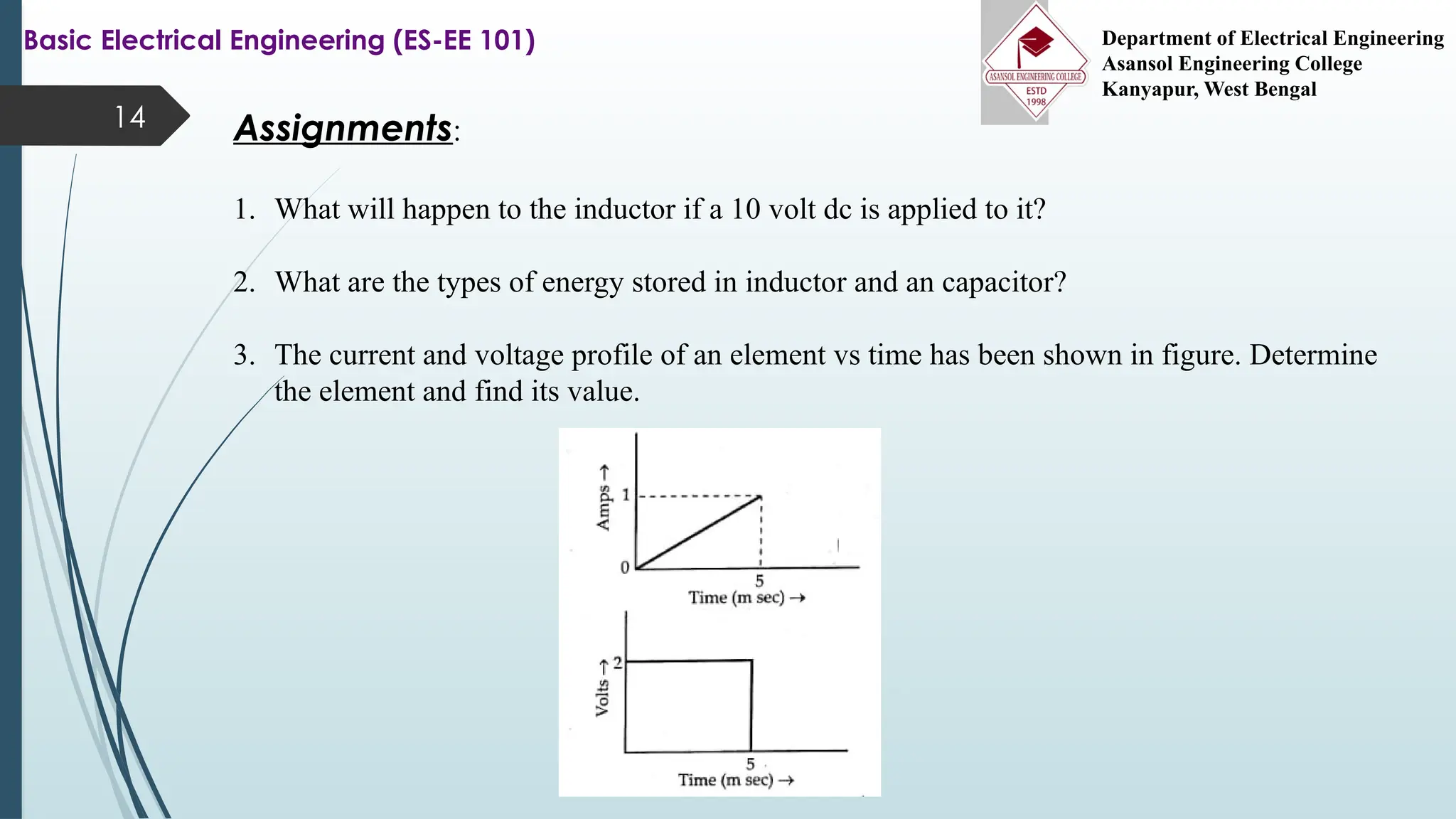
3. The current and voltage profile of an element vs time has been shown in figure. Determine
the element and find its value.
Basic Electrical Engineering (ES-EE 101) Department of Electrical Engineering
Asansol Engineering College
Kanyapur, West Bengal


![UNIT-I Final (1)[1].pptfgcvhvjgbjhbjgbjhhvhvhvh](https://cdn.slidesharecdn.com/ss_thumbnails/unit-ifinal11-251129122433-e786871d-thumbnail.jpg?width=640&height=640&fit=bounds)


