1
2
 Why is it that we cannot get everything we need and want?
 Is it because of money?
 If yes, can Bill Gates, one of the richest men on earth get everything he wants
and do anything he wants to do whenever he wants because he has the means?
Money?
 In a nutshell, The above questions are what we are trying to study, understand
and solve in the study of economics
3
 Economics is a social science study of the day to day
choices that the society makes on how to satisfy their
unlimited needs and wants with limited resources
 By social science we mean that the study of economics is concerned with people
4
5
NEEDS
 Needs are those things that a person has
to have for survival
 For example: food, water, air, shelter
 Our needs are unlimited
WANTS
 Wants are those things that you would
like, but do not need to survive
 For examples: car, concert tickets
 Human wants are unlimited. We want
new things everyday
6
7
 Natural Resources/Land- Also called the ‘free gifts of nature’. These are
resources not created by human effort.
 Capital Resources: Goods produced with the aim of producing other goods
 Labor/Human resources: All the physical and mental effort used in the
production process to produce goods and services
 Entrepreneurship: - A person who combines the other three factors of
production to produce a product and make profit
 These resources are limited and cannot produce goods and services for
everyone in the society.
8
 The scarcity problem exists because we have unlimited needs and wants
coupled with limited resources(resources can be time, money ,people to
produce goods and services)
 It exists when the demand for products increase faster that the supply
 We do not have enough money to buy all the things we need to buy to satisfy
our needs and wants
 If we do have money, there may be a shortage of goods and services that we
need in the market
 We cannot be everywhere we want to be at time we want because of time
constraints
9
Absolute Scarcity
 A condition that exists when we have the
means(money) to buy goods/services but
the goods and services are only available
in limited quantities
Relative Scarcity
 A condition that exists when goods and
services are available in unlimited
quantities but we just do not have the
means(money) to buy them
10
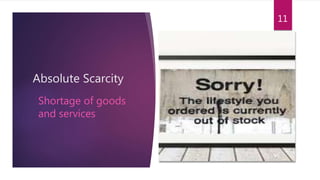
Absolute Scarcity
Shortage of goods
and services
11
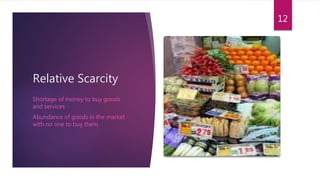
Relative Scarcity
Shortage of money to buy goods
and services
Abundance of goods in the market
with no one to buy them
12
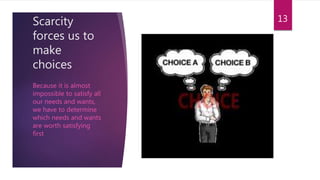
Scarcity
forces us to
make
choices
Because it is almost
impossible to satisfy all
our needs and wants,
we have to determine
which needs and wants
are worth satisfying
first
13
 When a decision is made, something has to be forgone
 Opportunity cost is the value of the next best choice that was given up, or the
next best alternative that could have been chosen but was not. It is what you
have to sacrifice in order to get something that you want
 Example: Imagine you just completed your matric and you are about to start
your tertiary education. When early January hits you get a call from a company
you have been wanting to work for your entire life. You are now faced with a
decision to go to university or join the workforce. Which would you choose?
14
15
 If you choose to go to university to further your studies, Education is your choice
and job is your opportunity cost
 If you choose to go and work for the company instead, the job is your choice
and education is your opportunity cost
16
 Because of the existence of scarcity, every economy has to address the three
fundamental economic questions in their pursuit of solving the scarcity problem.
1) What To Produce- What goods and services should be made available to
satisfy needs and wants?
2) How To Produce- Given the limited resources available, what combinations of
resources should we use to produce goods and services
3) For Whom To Produce- Who is going to consume these goods and services?
17
So…a kid walks into a candy store with
R10
 Can he buy all candies. Why/why not?
 What are his choices?
 What is his opportunity cost?
18
19
 https://www.slideshare.net/CSSohilGajjar?utm_campaign=profiletracking&utm_m
edium=sssite&utm_source=ssslideview
 https://www.slideshare.net/reyzter/scarcity-wants-needs
 https://www.slideshare.net/AHMEDFEQI/economics-unit-1-scarcity-choice
 https://www.slideshare.net/jhossko/economics-scarcity-and-
choices?qid=cfe7300a-f779-4e08-bc18-60c618e4a47b&v=&b=&from_search=1
 https://www.slideshare.net/jnchandrakanth/the-economic-
problems?qid=5965fea6-261d-40d2-aacd-
713d0cf3e707&v=&b=&from_search=10
20

Basic economic problem

  • 1.
  • 2.
  • 3.
     Why isit that we cannot get everything we need and want?  Is it because of money?  If yes, can Bill Gates, one of the richest men on earth get everything he wants and do anything he wants to do whenever he wants because he has the means? Money?  In a nutshell, The above questions are what we are trying to study, understand and solve in the study of economics 3
  • 4.
     Economics isa social science study of the day to day choices that the society makes on how to satisfy their unlimited needs and wants with limited resources  By social science we mean that the study of economics is concerned with people 4
  • 5.
  • 6.
    NEEDS  Needs arethose things that a person has to have for survival  For example: food, water, air, shelter  Our needs are unlimited WANTS  Wants are those things that you would like, but do not need to survive  For examples: car, concert tickets  Human wants are unlimited. We want new things everyday 6
  • 7.
  • 8.
     Natural Resources/Land-Also called the ‘free gifts of nature’. These are resources not created by human effort.  Capital Resources: Goods produced with the aim of producing other goods  Labor/Human resources: All the physical and mental effort used in the production process to produce goods and services  Entrepreneurship: - A person who combines the other three factors of production to produce a product and make profit  These resources are limited and cannot produce goods and services for everyone in the society. 8
  • 9.
     The scarcityproblem exists because we have unlimited needs and wants coupled with limited resources(resources can be time, money ,people to produce goods and services)  It exists when the demand for products increase faster that the supply  We do not have enough money to buy all the things we need to buy to satisfy our needs and wants  If we do have money, there may be a shortage of goods and services that we need in the market  We cannot be everywhere we want to be at time we want because of time constraints 9
  • 10.
    Absolute Scarcity  Acondition that exists when we have the means(money) to buy goods/services but the goods and services are only available in limited quantities Relative Scarcity  A condition that exists when goods and services are available in unlimited quantities but we just do not have the means(money) to buy them 10
  • 11.
    Absolute Scarcity Shortage ofgoods and services 11
  • 12.
    Relative Scarcity Shortage ofmoney to buy goods and services Abundance of goods in the market with no one to buy them 12
  • 13.
    Scarcity forces us to make choices Becauseit is almost impossible to satisfy all our needs and wants, we have to determine which needs and wants are worth satisfying first 13
  • 14.
     When adecision is made, something has to be forgone  Opportunity cost is the value of the next best choice that was given up, or the next best alternative that could have been chosen but was not. It is what you have to sacrifice in order to get something that you want  Example: Imagine you just completed your matric and you are about to start your tertiary education. When early January hits you get a call from a company you have been wanting to work for your entire life. You are now faced with a decision to go to university or join the workforce. Which would you choose? 14
  • 15.
  • 16.
     If youchoose to go to university to further your studies, Education is your choice and job is your opportunity cost  If you choose to go and work for the company instead, the job is your choice and education is your opportunity cost 16
  • 17.
     Because ofthe existence of scarcity, every economy has to address the three fundamental economic questions in their pursuit of solving the scarcity problem. 1) What To Produce- What goods and services should be made available to satisfy needs and wants? 2) How To Produce- Given the limited resources available, what combinations of resources should we use to produce goods and services 3) For Whom To Produce- Who is going to consume these goods and services? 17
  • 18.
    So…a kid walksinto a candy store with R10  Can he buy all candies. Why/why not?  What are his choices?  What is his opportunity cost? 18
  • 19.
  • 20.
     https://www.slideshare.net/CSSohilGajjar?utm_campaign=profiletracking&utm_m edium=sssite&utm_source=ssslideview  https://www.slideshare.net/reyzter/scarcity-wants-needs https://www.slideshare.net/AHMEDFEQI/economics-unit-1-scarcity-choice  https://www.slideshare.net/jhossko/economics-scarcity-and- choices?qid=cfe7300a-f779-4e08-bc18-60c618e4a47b&v=&b=&from_search=1  https://www.slideshare.net/jnchandrakanth/the-economic- problems?qid=5965fea6-261d-40d2-aacd- 713d0cf3e707&v=&b=&from_search=10 20