Fall 2002 CMSC 203 - Discrete Structures 1
One, two, three, we’re…
Counting
Counting
Fall 2002 CMSC 203 - Discrete Structures 2
Basic Counting Principles
Counting problems
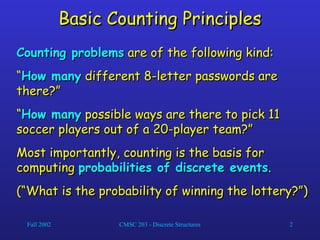
Counting problems are of the following kind:
are of the following kind:
“
“How many
How many different 8-letter passwords are
different 8-letter passwords are
there?”
there?”
“
“How many
How many possible ways are there to pick 11
possible ways are there to pick 11
soccer players out of a 20-player team?”
Most importantly, counting is the basis for
computing
computing probabilities of discrete events
probabilities of discrete events.
.
(“What is the probability of winning the lottery?”)
Fall 2002 CMSC 203 - Discrete Structures 3
Basic Counting Principles
The sum rule:
The sum rule:
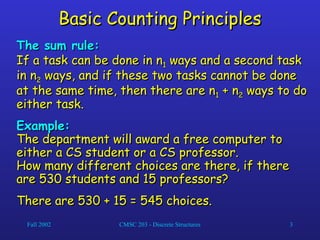
If a task can be done in n
If a task can be done in n1
1 ways and a second task
ways and a second task
in n
in n2
2 ways, and if these two tasks cannot be done
ways, and if these two tasks cannot be done
at the same time, then there are n
at the same time, then there are n1
1 + n
+ n2
2 ways to do
ways to do
either task.
either task.
Example:
Example:
The department will award a free computer to
either a CS student or a CS professor.
How many different choices are there, if there
are 530 students and 15 professors?
There are 530 + 15 = 545 choices.
Fall 2002 CMSC 203 - Discrete Structures 4
Basic Counting Principles
Generalized sum rule:
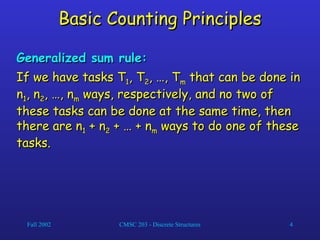
If we have tasks T
If we have tasks T1
1, T
, T2
2, …, T
, …, Tm
m that can be done in
that can be done in
n
n1
1, n
, n2
2, …, n
, …, nm
m ways, respectively, and no two of
ways, respectively, and no two of
these tasks can be done at the same time, then
there are n
there are n1
1 + n
+ n2
2 + … + n
+ … + nm
m ways to do one of these
ways to do one of these
tasks.
tasks.
Fall 2002 CMSC 203 - Discrete Structures 5
Basic Counting Principles
The product rule:
The product rule:
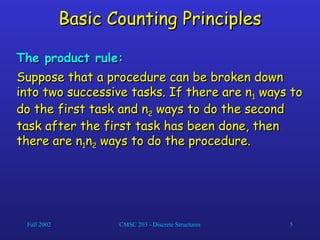
Suppose that a procedure can be broken down
into two successive tasks. If there are n
into two successive tasks. If there are n1
1 ways to
ways to
do the first task and n
do the first task and n2
2 ways to do the second
ways to do the second
task after the first task has been done, then
there are n
there are n1
1n
n2
2 ways to do the procedure.
ways to do the procedure.
Fall 2002 CMSC 203 - Discrete Structures 6
Basic Counting Principles
Example:
Example:
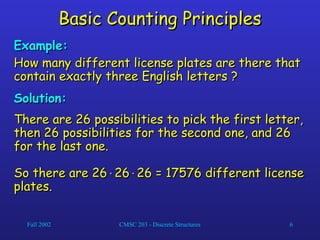
How many different license plates are there that
contain exactly three English letters ?
Solution:
Solution:
There are 26 possibilities to pick the first letter,
then 26 possibilities for the second one, and 26
for the last one.
for the last one.
So there are 26
So there are 26
26
26
26 = 17576 different license
26 = 17576 different license
plates.
plates.
Fall 2002 CMSC 203 - Discrete Structures 7
Basic Counting Principles
Generalized product rule:
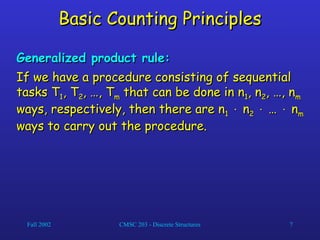
If we have a procedure consisting of sequential
tasks T
tasks T1
1, T
, T2
2, …, T
, …, Tm
m that can be done in n
that can be done in n1
1, n
, n2
2, …, n
, …, nm
m
ways, respectively, then there are n
ways, respectively, then there are n1
1 
 n
n2
2 
 …
… 
 n
nm
m
ways to carry out the procedure.
Fall 2002 CMSC 203 - Discrete Structures 8
Basic Counting Principles
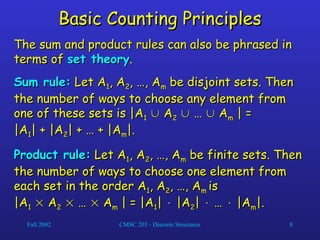
The sum and product rules can also be phrased in
terms of
terms of set theory
set theory.
.
Sum rule:
Sum rule: Let A
Let A1
1, A
, A2
2, …, A
, …, Am
m be disjoint sets. Then
be disjoint sets. Then
the number of ways to choose any element from
one of these sets is |A
one of these sets is |A1
1 
 A
A2
2 
 …
… 
 A
Am
m | =
| =
|A
|A1
1| + |A
| + |A2
2| + … + |A
| + … + |Am
m|.
|.
Product rule:
Product rule: Let A
Let A1
1, A
, A2
2, …, A
, …, Am
m be finite sets. Then
be finite sets. Then
the number of ways to choose one element from
each set in the order A
each set in the order A1
1, A
, A2
2, …, A
, …, Am
m is
is
|A
|A1
1 
 A
A2
2 
 …
… 
 A
Am
m | = |A
| = |A1
1|
| 
 |A
|A2
2|
| 
 …
… 
 |A
|Am
m|.
|.
Fall 2002 CMSC 203 - Discrete Structures 9
Inclusion-Exclusion
Inclusion-Exclusion
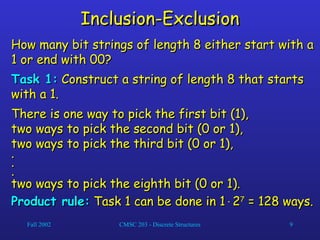
How many bit strings of length 8 either start with a
1 or end with 00?
1 or end with 00?
Task 1:
Task 1: Construct a string of length 8 that starts
Construct a string of length 8 that starts
with a 1.
with a 1.
There is one way to pick the first bit (1),
two ways to pick the second bit (0 or 1),
two ways to pick the third bit (0 or 1),
.
.
.
.
.
.
two ways to pick the eighth bit (0 or 1).
Product rule:
Product rule: Task 1 can be done in 1
Task 1 can be done in 1
2
27
7
= 128 ways.
= 128 ways.
Fall 2002 CMSC 203 - Discrete Structures 10
Inclusion-Exclusion
Inclusion-Exclusion
Task 2:
Task 2: Construct a string of length 8 that ends
Construct a string of length 8 that ends
with 00.
with 00.
There are two ways to pick the first bit (0 or 1),
two ways to pick the second bit (0 or 1),
.
.
.
.
.
.
two ways to pick the sixth bit (0 or 1),
one way to pick the seventh bit (0), and
one way to pick the eighth bit (0).
Product rule:
Product rule: Task 2 can be done in 2
Task 2 can be done in 26
6
= 64 ways.
= 64 ways.
Fall 2002 CMSC 203 - Discrete Structures 11
Inclusion-Exclusion
Inclusion-Exclusion
Since there are 128 ways to do Task 1 and 64 ways
to do Task 2, does this mean that there are 192 bit
strings either starting with 1 or ending with 00 ?
No, because here Task 1 and Task 2 can be done
No, because here Task 1 and Task 2 can be done at
at
the same time
the same time.
.
When we carry out Task 1 and create strings
starting with 1, some of these strings end with 00.
Therefore, we sometimes do Tasks 1 and 2 at the
same time, so
same time, so the sum rule does not apply
the sum rule does not apply.
.
Fall 2002 CMSC 203 - Discrete Structures 12
Inclusion-Exclusion
Inclusion-Exclusion
If we want to use the sum rule in such a case, we
have to subtract the cases when Tasks 1 and 2 are
done at the same time.
How many cases are there, that is, how many
strings start with 1
strings start with 1 and
and end with 00?
end with 00?
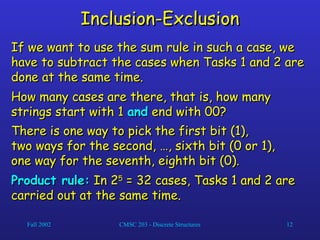
There is one way to pick the first bit (1),
two ways for the second, …, sixth bit (0 or 1),
one way for the seventh, eighth bit (0).
Product rule:
Product rule: In 2
In 25
5
= 32 cases, Tasks 1 and 2 are
carried out at the same time.
Fall 2002 CMSC 203 - Discrete Structures 13
Inclusion-Exclusion
Inclusion-Exclusion
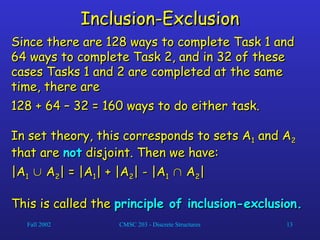
Since there are 128 ways to complete Task 1 and
64 ways to complete Task 2, and in 32 of these
cases Tasks 1 and 2 are completed at the same
time, there are
time, there are
128 + 64 – 32 = 160 ways to do either task.
In set theory, this corresponds to sets A
In set theory, this corresponds to sets A1
1 and A
and A2
2
that are
that are not
not disjoint. Then we have:
disjoint. Then we have:
|A
|A1
1 
 A
A2
2| = |A
| = |A1
1| + |A
| + |A2
2| - |A
| - |A1
1 
 A
A2
2|
|
This is called the
This is called the principle of inclusion-exclusion.
principle of inclusion-exclusion.
Fall 2002 CMSC 203 - Discrete Structures 14
Tree Diagrams
Tree Diagrams
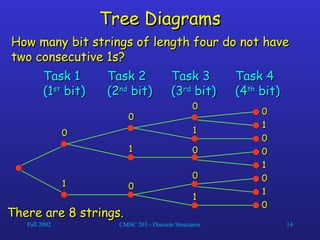
How many bit strings of length four do not have
two consecutive 1s?
two consecutive 1s?
Task 1
Task 1 Task 2
Task 2 Task 3
Task 3 Task 4
Task 4
(1
(1st
st
bit)
bit) (2
(2nd
nd
bit)
bit) (3
(3rd
rd
bit)
bit) (4
(4th
th
bit)
bit)
0
0
0
0
0
0
0
0
1
1
1
1
0
0
1
1 0
0 0
0
1
1
1
1 0
0
0
0 0
0
1
1
1
1
0
0
There are 8 strings.
Fall 2002 CMSC 203 - Discrete Structures 15
The Pigeonhole Principle
The pigeonhole principle:
The pigeonhole principle: If (k + 1) or more
If (k + 1) or more
objects are placed into k boxes, then there is
objects are placed into k boxes, then there is at
at
least
least one box containing two or more of the
one box containing two or more of the
objects.
objects.
Example 1:
Example 1: If there are 11 players in a soccer
If there are 11 players in a soccer
team that wins 12-0, there must be at least one
player in the team who scored at least twice.
Example 2:
Example 2: If you have 6 classes from Monday to
If you have 6 classes from Monday to
Friday, there must be at least one day on which you
have at least two classes.
Fall 2002 CMSC 203 - Discrete Structures 16
The Pigeonhole Principle
The generalized pigeonhole principle:
The generalized pigeonhole principle: If N
If N
objects are placed into k boxes, then there is
objects are placed into k boxes, then there is at
at
least
least one box containing at least
one box containing at least 
N/k
N/k
 of the
of the
objects.
objects.
Example 1:
Example 1: In our 60-student class, at least 12
In our 60-student class, at least 12
students will get the same letter grade (A, B, C, D,
or F).
or F).
Fall 2002 CMSC 203 - Discrete Structures 17
The Pigeonhole Principle
Example 2:
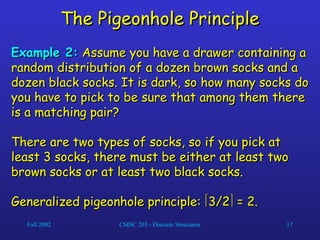
Example 2: Assume you have a drawer containing a
Assume you have a drawer containing a
random distribution of a dozen brown socks and a
dozen black socks. It is dark, so how many socks do
you have to pick to be sure that among them there
is a matching pair?
is a matching pair?
There are two types of socks, so if you pick at
least 3 socks, there must be either at least two
brown socks or at least two black socks.
Generalized pigeonhole principle:
Generalized pigeonhole principle: 
3/2
3/2
 = 2.
= 2.
Fall 2002 CMSC 203 - Discrete Structures 18
Permutations and Combinations
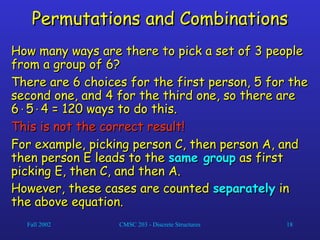
How many ways are there to pick a set of 3 people
from a group of 6?
from a group of 6?
There are 6 choices for the first person, 5 for the
second one, and 4 for the third one, so there are
6
6
5
5
4 = 120 ways to do this.
4 = 120 ways to do this.
This is not the correct result!
For example, picking person C, then person A, and
then person E leads to the
then person E leads to the same group
same group as first
as first
picking E, then C, and then A.
However, these cases are counted
However, these cases are counted separately
separately in
in
the above equation.
the above equation.
Fall 2002 CMSC 203 - Discrete Structures 19
Permutations and Combinations
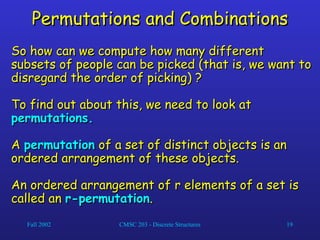
So how can we compute how many different
subsets of people can be picked (that is, we want to
disregard the order of picking) ?
To find out about this, we need to look at
permutations.
permutations.
A
A permutation
permutation of a set of distinct objects is an
of a set of distinct objects is an
ordered arrangement of these objects.
An ordered arrangement of r elements of a set is
called an
called an r-permutation
r-permutation.
.
Fall 2002 CMSC 203 - Discrete Structures 20
Permutations and Combinations
Example:
Example: Let S = {1, 2, 3}.
Let S = {1, 2, 3}.
The arrangement 3, 1, 2 is a permutation of S.
The arrangement 3, 2 is a 2-permutation of S.
The number of r-permutations of a set with n
distinct elements is denoted by
distinct elements is denoted by P(n, r).
P(n, r).
We can calculate P(n, r) with the product rule:
P(n, r) = n
P(n, r) = n
(n – 1)
(n – 1)
(n – 2)
(n – 2) 
…
…
(n – r + 1).
(n – r + 1).
(n choices for the first element, (n – 1) for the
second one, (n – 2) for the third one…)
Fall 2002 CMSC 203 - Discrete Structures 21
Permutations and Combinations
Example:
Example:
P(8, 3) = 8
P(8, 3) = 8
7
7
6 = 336
6 = 336
= (8
= (8
7
7
6
6
5
5
4
4
3
3
2
2
1)/(5
1)/(5
4
4
3
3
2
2
1)
1)
General formula:
General formula:
P(n, r) = n!/(n – r)!
Knowing this, we can return to our initial question:
How many ways are there to pick a set of 3 people
from a group of 6 (disregarding the order of
picking)?
picking)?
Fall 2002 CMSC 203 - Discrete Structures 22
Permutations and Combinations
An
An r-combination
r-combination of elements of a set is an
of elements of a set is an
unordered selection of r elements from the set.
Thus, an r-combination is simply a subset of the set
with r elements.
with r elements.
Example:
Example: Let S = {1, 2, 3, 4}.
Let S = {1, 2, 3, 4}.
Then {1, 3, 4} is a 3-combination from S.
The number of r-combinations of a set with n
distinct elements is denoted by C(n, r).
Example:
Example: C(4, 2) = 6, since, for example, the 2-
C(4, 2) = 6, since, for example, the 2-
combinations of a set {1, 2, 3, 4} are {1, 2}, {1, 3}, {1,
4}, {2, 3}, {2, 4}, {3, 4}.
4}, {2, 3}, {2, 4}, {3, 4}.
Fall 2002 CMSC 203 - Discrete Structures 23
Permutations and Combinations
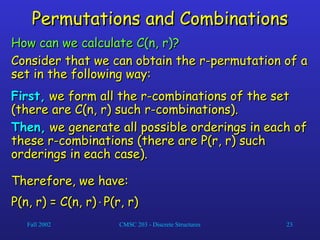
How can we calculate C(n, r)?
Consider that we can obtain the r-permutation of a
set in the following way:
First,
First, we form all the r-combinations of the set
we form all the r-combinations of the set
(there are C(n, r) such r-combinations).
Then,
Then, we generate all possible orderings in each of
we generate all possible orderings in each of
these r-combinations (there are P(r, r) such
orderings in each case).
Therefore, we have:
Therefore, we have:
P(n, r) = C(n, r)
P(n, r) = C(n, r)
P(r, r)
P(r, r)
Fall 2002 CMSC 203 - Discrete Structures 24
Permutations and Combinations
C(n, r) = P(n, r)/P(r, r)
= n!/(n – r)!/(r!/(r – r)!)
= n!/(r!(n – r)!)
= n!/(r!(n – r)!)
Now we can answer our initial question:
How many ways are there to pick a set of 3 people
from a group of 6 (disregarding the order of
picking)?
picking)?
C(6, 3) = 6!/(3!
C(6, 3) = 6!/(3!
3!) = 720/(6
3!) = 720/(6
6) = 720/36 = 20
6) = 720/36 = 20
There are 20 different ways, that is, 20 different
groups to be picked.
Fall 2002 CMSC 203 - Discrete Structures 25
Permutations and Combinations
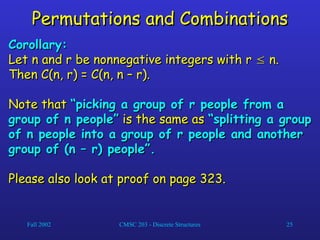
Corollary:
Corollary:
Let n and r be nonnegative integers with r
Let n and r be nonnegative integers with r 
 n.
n.
Then C(n, r) = C(n, n – r).
Note that
Note that “picking a group of r people from a
“picking a group of r people from a
group of n people”
group of n people” is the same as
is the same as “splitting a group
“splitting a group
of n people into a group of r people and another
group of (n – r) people”.
Please also look at proof on page 323.
Fall 2002 CMSC 203 - Discrete Structures 26
Permutations and Combinations
Example:
A soccer club has 8 female and 7 male members.
For today’s match, the coach wants to have 6
female and 5 male players on the grass. How many
possible configurations are there?
C(8, 6) 
 C(7, 5) = 8!/(6!
C(7, 5) = 8!/(6!
2!)
2!) 
 7!/(5!
7!/(5!
2!)
2!)
= 28
= 28
21
21
= 588
= 588
Fall 2002 CMSC 203 - Discrete Structures 27
Combinations
Combinations
We also saw the following:
)
,
(
!
)!
(
!
)]!
(
[
)!
(
!
)
,
( r
n
C
r
r
n
n
r
n
n
r
n
n
r
n
n
C 







This symmetry is intuitively plausible. For example, let us consider
a set containing six elements (n = 6).
Picking two
Picking two elements and
elements and leaving four
leaving four is essentially the same as
is essentially the same as
picking four
picking four elements and
elements and leaving two
leaving two.
.
In either case, our number of choices is the number of possibilities
to
to divide
divide the set into one set containing two elements and another
the set into one set containing two elements and another
set containing four elements.
Fall 2002 CMSC 203 - Discrete Structures 28
Combinations
Combinations
Pascal’s Identity:
Pascal’s Identity:
Let n and k be positive integers with n
Let n and k be positive integers with n 
 k.
k.
Then C(n + 1, k) = C(n, k – 1) + C(n, k).
How can this be explained?
What is it good for?
Fall 2002 CMSC 203 - Discrete Structures 29
Combinations
Combinations
Imagine a set S containing n elements and a set T
containing (n + 1) elements, namely all elements in
S plus a new element
S plus a new element a
a.
.
Calculating C(n + 1, k) is equivalent to answering
the question: How many subsets of T containing k
items are there?
items are there?
Case I:
Case I: The subset contains (k – 1) elements of S
The subset contains (k – 1) elements of S
plus the element
plus the element a
a: C(n, k – 1) choices.
: C(n, k – 1) choices.
Case II:
Case II: The subset contains k elements of S and
The subset contains k elements of S and
does not contain
does not contain a
a: C(n, k) choices.
: C(n, k) choices.
Sum Rule:
Sum Rule: C(n + 1, k) = C(n, k – 1) + C(n, k).
C(n + 1, k) = C(n, k – 1) + C(n, k).
Fall 2002 CMSC 203 - Discrete Structures 30
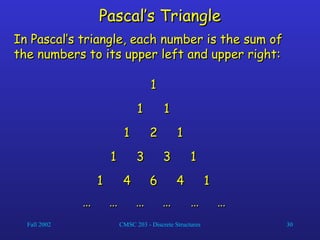
Pascal’s Triangle
Pascal’s Triangle
In Pascal’s triangle, each number is the sum of
the numbers to its upper left and upper right:
1
1
1
1 1
1
1
1 2
2 1
1
1
1 3
3 3
3 1
1
1
1 4
4 6
6 4
4 1
1
…
… …
… …
… …
… …
… …
…
Fall 2002 CMSC 203 - Discrete Structures 31
Pascal’s Triangle
Pascal’s Triangle
Since we have C(n + 1, k) = C(n, k – 1) + C(n, k) and
C(0, 0) = 1, we can use Pascal’s triangle to simplify
the computation of C(n, k):
C(0, 0) =
C(0, 0) = 1
1
C(1, 0) =
C(1, 0) = 1
1 C(1, 1) =
C(1, 1) = 1
1
C(2, 0) =
C(2, 0) = 1
1 C(2, 1) =
C(2, 1) = 2
2 C(2, 2) =
C(2, 2) = 1
1
C(3, 0) =
C(3, 0) = 1
1 C(3, 1) =
C(3, 1) = 3
3 C(3, 2) =
C(3, 2) = 3
3 C(3, 3) =
C(3, 3) = 1
1
C(4, 0) =
C(4, 0) = 1
1 C(4, 1) =
C(4, 1) = 4
4 C(4, 2) =
C(4, 2) = 6
6 C(4, 3) =
C(4, 3) = 4
4 C(4, 4) =
C(4, 4) = 1
1
k
k
n
n
Fall 2002 CMSC 203 - Discrete Structures 32
Binomial Coefficients
Expressions of the form C(n, k) are also called
binomial coefficients
binomial coefficients.
.
How come?
How come?
A
A binomial expression
binomial expression is the sum of two terms,
is the sum of two terms,
such as (a + b).
such as (a + b).
Now consider (a + b)
Now consider (a + b)2
2
= (a + b)(a + b).
= (a + b)(a + b).
When expanding such expressions, we have to
form all possible products of a term in the first
factor and a term in the second factor:
(a + b)
(a + b)2
2
= a·a + a·b + b·a + b·b
Then we can sum identical terms:
(a + b)
(a + b)2
2
= a
= a2
2
+ 2ab + b
+ 2ab + b2
2
Fall 2002 CMSC 203 - Discrete Structures 33
Binomial Coefficients
For (a + b)
For (a + b)3
3
= (a + b)(a + b)(a + b) we have
(a + b)
(a + b)3
3
=
= aaa + aab + aba + abb + baa + bab + bba + bbb
aaa + aab + aba + abb + baa + bab + bba + bbb
(a + b)
(a + b)3
3
= a
= a3
3
+ 3a
+ 3a2
2
b + 3ab
b + 3ab2
2
+ b
+ b3
3
There is only one term a3
, because there is only
one possibility to form it: Choose a from all three
factors: C(3, 3) = 1.
There is three times the term a2
b, because there
are three possibilities to choose a from two out of
the three factors: C(3, 2) = 3.
Similarly, there is three times the term ab2
(C(3, 1) = 3) and once the term b3
(C(3, 0) = 1).
Fall 2002 CMSC 203 - Discrete Structures 34
Binomial Coefficients
This leads us to the following formula:
j
n
j
j
n
n
b
a
j
n
C
b
a 





0
)
,
(
)
(
With the help of Pascal’s triangle, this formula can
considerably simplify the process of expanding powers of
binomial expressions.
For example, the fifth row of Pascal’s triangle
(1 – 4 – 6 – 4 – 1) helps us to compute (a + b)
(1 – 4 – 6 – 4 – 1) helps us to compute (a + b)4
4
:
:
(a + b)
(a + b)4
4
= a
= a4
4
+ 4a
+ 4a3
3
b + 6a
b + 6a2
2
b
b2
2
+ 4ab
+ 4ab3
3
+ b
+ b4
4
(Binomial Theorem)
(Binomial Theorem)

Basic counting in DSA for IT or Computer Science students

  • 1.
    Fall 2002 CMSC203 - Discrete Structures 1 One, two, three, we’re… One, two, three, we’re… Counting Counting
  • 2.
    Fall 2002 CMSC203 - Discrete Structures 2 Basic Counting Principles Basic Counting Principles Counting problems Counting problems are of the following kind: are of the following kind: “ “How many How many different 8-letter passwords are different 8-letter passwords are there?” there?” “ “How many How many possible ways are there to pick 11 possible ways are there to pick 11 soccer players out of a 20-player team?” soccer players out of a 20-player team?” Most importantly, counting is the basis for Most importantly, counting is the basis for computing computing probabilities of discrete events probabilities of discrete events. . (“What is the probability of winning the lottery?”) (“What is the probability of winning the lottery?”)
  • 3.
    Fall 2002 CMSC203 - Discrete Structures 3 Basic Counting Principles Basic Counting Principles The sum rule: The sum rule: If a task can be done in n If a task can be done in n1 1 ways and a second task ways and a second task in n in n2 2 ways, and if these two tasks cannot be done ways, and if these two tasks cannot be done at the same time, then there are n at the same time, then there are n1 1 + n + n2 2 ways to do ways to do either task. either task. Example: Example: The department will award a free computer to The department will award a free computer to either a CS student or a CS professor. either a CS student or a CS professor. How many different choices are there, if there How many different choices are there, if there are 530 students and 15 professors? are 530 students and 15 professors? There are 530 + 15 = 545 choices. There are 530 + 15 = 545 choices.
  • 4.
    Fall 2002 CMSC203 - Discrete Structures 4 Basic Counting Principles Basic Counting Principles Generalized sum rule: Generalized sum rule: If we have tasks T If we have tasks T1 1, T , T2 2, …, T , …, Tm m that can be done in that can be done in n n1 1, n , n2 2, …, n , …, nm m ways, respectively, and no two of ways, respectively, and no two of these tasks can be done at the same time, then these tasks can be done at the same time, then there are n there are n1 1 + n + n2 2 + … + n + … + nm m ways to do one of these ways to do one of these tasks. tasks.
  • 5.
    Fall 2002 CMSC203 - Discrete Structures 5 Basic Counting Principles Basic Counting Principles The product rule: The product rule: Suppose that a procedure can be broken down Suppose that a procedure can be broken down into two successive tasks. If there are n into two successive tasks. If there are n1 1 ways to ways to do the first task and n do the first task and n2 2 ways to do the second ways to do the second task after the first task has been done, then task after the first task has been done, then there are n there are n1 1n n2 2 ways to do the procedure. ways to do the procedure.
  • 6.
    Fall 2002 CMSC203 - Discrete Structures 6 Basic Counting Principles Basic Counting Principles Example: Example: How many different license plates are there that How many different license plates are there that contain exactly three English letters ? contain exactly three English letters ? Solution: Solution: There are 26 possibilities to pick the first letter, There are 26 possibilities to pick the first letter, then 26 possibilities for the second one, and 26 then 26 possibilities for the second one, and 26 for the last one. for the last one. So there are 26 So there are 26 26 26 26 = 17576 different license 26 = 17576 different license plates. plates.
  • 7.
    Fall 2002 CMSC203 - Discrete Structures 7 Basic Counting Principles Basic Counting Principles Generalized product rule: Generalized product rule: If we have a procedure consisting of sequential If we have a procedure consisting of sequential tasks T tasks T1 1, T , T2 2, …, T , …, Tm m that can be done in n that can be done in n1 1, n , n2 2, …, n , …, nm m ways, respectively, then there are n ways, respectively, then there are n1 1   n n2 2   … …   n nm m ways to carry out the procedure. ways to carry out the procedure.
  • 8.
    Fall 2002 CMSC203 - Discrete Structures 8 Basic Counting Principles Basic Counting Principles The sum and product rules can also be phrased in The sum and product rules can also be phrased in terms of terms of set theory set theory. . Sum rule: Sum rule: Let A Let A1 1, A , A2 2, …, A , …, Am m be disjoint sets. Then be disjoint sets. Then the number of ways to choose any element from the number of ways to choose any element from one of these sets is |A one of these sets is |A1 1   A A2 2   … …   A Am m | = | = |A |A1 1| + |A | + |A2 2| + … + |A | + … + |Am m|. |. Product rule: Product rule: Let A Let A1 1, A , A2 2, …, A , …, Am m be finite sets. Then be finite sets. Then the number of ways to choose one element from the number of ways to choose one element from each set in the order A each set in the order A1 1, A , A2 2, …, A , …, Am m is is |A |A1 1   A A2 2   … …   A Am m | = |A | = |A1 1| |   |A |A2 2| |   … …   |A |Am m|. |.
  • 9.
    Fall 2002 CMSC203 - Discrete Structures 9 Inclusion-Exclusion Inclusion-Exclusion How many bit strings of length 8 either start with a How many bit strings of length 8 either start with a 1 or end with 00? 1 or end with 00? Task 1: Task 1: Construct a string of length 8 that starts Construct a string of length 8 that starts with a 1. with a 1. There is one way to pick the first bit (1), There is one way to pick the first bit (1), two ways to pick the second bit (0 or 1), two ways to pick the second bit (0 or 1), two ways to pick the third bit (0 or 1), two ways to pick the third bit (0 or 1), . . . . . . two ways to pick the eighth bit (0 or 1). two ways to pick the eighth bit (0 or 1). Product rule: Product rule: Task 1 can be done in 1 Task 1 can be done in 1 2 27 7 = 128 ways. = 128 ways.
  • 10.
    Fall 2002 CMSC203 - Discrete Structures 10 Inclusion-Exclusion Inclusion-Exclusion Task 2: Task 2: Construct a string of length 8 that ends Construct a string of length 8 that ends with 00. with 00. There are two ways to pick the first bit (0 or 1), There are two ways to pick the first bit (0 or 1), two ways to pick the second bit (0 or 1), two ways to pick the second bit (0 or 1), . . . . . . two ways to pick the sixth bit (0 or 1), two ways to pick the sixth bit (0 or 1), one way to pick the seventh bit (0), and one way to pick the seventh bit (0), and one way to pick the eighth bit (0). one way to pick the eighth bit (0). Product rule: Product rule: Task 2 can be done in 2 Task 2 can be done in 26 6 = 64 ways. = 64 ways.
  • 11.
    Fall 2002 CMSC203 - Discrete Structures 11 Inclusion-Exclusion Inclusion-Exclusion Since there are 128 ways to do Task 1 and 64 ways Since there are 128 ways to do Task 1 and 64 ways to do Task 2, does this mean that there are 192 bit to do Task 2, does this mean that there are 192 bit strings either starting with 1 or ending with 00 ? strings either starting with 1 or ending with 00 ? No, because here Task 1 and Task 2 can be done No, because here Task 1 and Task 2 can be done at at the same time the same time. . When we carry out Task 1 and create strings When we carry out Task 1 and create strings starting with 1, some of these strings end with 00. starting with 1, some of these strings end with 00. Therefore, we sometimes do Tasks 1 and 2 at the Therefore, we sometimes do Tasks 1 and 2 at the same time, so same time, so the sum rule does not apply the sum rule does not apply. .
  • 12.
    Fall 2002 CMSC203 - Discrete Structures 12 Inclusion-Exclusion Inclusion-Exclusion If we want to use the sum rule in such a case, we If we want to use the sum rule in such a case, we have to subtract the cases when Tasks 1 and 2 are have to subtract the cases when Tasks 1 and 2 are done at the same time. done at the same time. How many cases are there, that is, how many How many cases are there, that is, how many strings start with 1 strings start with 1 and and end with 00? end with 00? There is one way to pick the first bit (1), There is one way to pick the first bit (1), two ways for the second, …, sixth bit (0 or 1), two ways for the second, …, sixth bit (0 or 1), one way for the seventh, eighth bit (0). one way for the seventh, eighth bit (0). Product rule: Product rule: In 2 In 25 5 = 32 cases, Tasks 1 and 2 are = 32 cases, Tasks 1 and 2 are carried out at the same time. carried out at the same time.
  • 13.
    Fall 2002 CMSC203 - Discrete Structures 13 Inclusion-Exclusion Inclusion-Exclusion Since there are 128 ways to complete Task 1 and Since there are 128 ways to complete Task 1 and 64 ways to complete Task 2, and in 32 of these 64 ways to complete Task 2, and in 32 of these cases Tasks 1 and 2 are completed at the same cases Tasks 1 and 2 are completed at the same time, there are time, there are 128 + 64 – 32 = 160 ways to do either task. 128 + 64 – 32 = 160 ways to do either task. In set theory, this corresponds to sets A In set theory, this corresponds to sets A1 1 and A and A2 2 that are that are not not disjoint. Then we have: disjoint. Then we have: |A |A1 1   A A2 2| = |A | = |A1 1| + |A | + |A2 2| - |A | - |A1 1   A A2 2| | This is called the This is called the principle of inclusion-exclusion. principle of inclusion-exclusion.
  • 14.
    Fall 2002 CMSC203 - Discrete Structures 14 Tree Diagrams Tree Diagrams How many bit strings of length four do not have How many bit strings of length four do not have two consecutive 1s? two consecutive 1s? Task 1 Task 1 Task 2 Task 2 Task 3 Task 3 Task 4 Task 4 (1 (1st st bit) bit) (2 (2nd nd bit) bit) (3 (3rd rd bit) bit) (4 (4th th bit) bit) 0 0 0 0 0 0 0 0 1 1 1 1 0 0 1 1 0 0 0 0 1 1 1 1 0 0 0 0 0 0 1 1 1 1 0 0 There are 8 strings. There are 8 strings.
  • 15.
    Fall 2002 CMSC203 - Discrete Structures 15 The Pigeonhole Principle The Pigeonhole Principle The pigeonhole principle: The pigeonhole principle: If (k + 1) or more If (k + 1) or more objects are placed into k boxes, then there is objects are placed into k boxes, then there is at at least least one box containing two or more of the one box containing two or more of the objects. objects. Example 1: Example 1: If there are 11 players in a soccer If there are 11 players in a soccer team that wins 12-0, there must be at least one team that wins 12-0, there must be at least one player in the team who scored at least twice. player in the team who scored at least twice. Example 2: Example 2: If you have 6 classes from Monday to If you have 6 classes from Monday to Friday, there must be at least one day on which you Friday, there must be at least one day on which you have at least two classes. have at least two classes.
  • 16.
    Fall 2002 CMSC203 - Discrete Structures 16 The Pigeonhole Principle The Pigeonhole Principle The generalized pigeonhole principle: The generalized pigeonhole principle: If N If N objects are placed into k boxes, then there is objects are placed into k boxes, then there is at at least least one box containing at least one box containing at least  N/k N/k  of the of the objects. objects. Example 1: Example 1: In our 60-student class, at least 12 In our 60-student class, at least 12 students will get the same letter grade (A, B, C, D, students will get the same letter grade (A, B, C, D, or F). or F).
  • 17.
    Fall 2002 CMSC203 - Discrete Structures 17 The Pigeonhole Principle The Pigeonhole Principle Example 2: Example 2: Assume you have a drawer containing a Assume you have a drawer containing a random distribution of a dozen brown socks and a random distribution of a dozen brown socks and a dozen black socks. It is dark, so how many socks do dozen black socks. It is dark, so how many socks do you have to pick to be sure that among them there you have to pick to be sure that among them there is a matching pair? is a matching pair? There are two types of socks, so if you pick at There are two types of socks, so if you pick at least 3 socks, there must be either at least two least 3 socks, there must be either at least two brown socks or at least two black socks. brown socks or at least two black socks. Generalized pigeonhole principle: Generalized pigeonhole principle:  3/2 3/2  = 2. = 2.
  • 18.
    Fall 2002 CMSC203 - Discrete Structures 18 Permutations and Combinations Permutations and Combinations How many ways are there to pick a set of 3 people How many ways are there to pick a set of 3 people from a group of 6? from a group of 6? There are 6 choices for the first person, 5 for the There are 6 choices for the first person, 5 for the second one, and 4 for the third one, so there are second one, and 4 for the third one, so there are 6 6 5 5 4 = 120 ways to do this. 4 = 120 ways to do this. This is not the correct result! This is not the correct result! For example, picking person C, then person A, and For example, picking person C, then person A, and then person E leads to the then person E leads to the same group same group as first as first picking E, then C, and then A. picking E, then C, and then A. However, these cases are counted However, these cases are counted separately separately in in the above equation. the above equation.
  • 19.
    Fall 2002 CMSC203 - Discrete Structures 19 Permutations and Combinations Permutations and Combinations So how can we compute how many different So how can we compute how many different subsets of people can be picked (that is, we want to subsets of people can be picked (that is, we want to disregard the order of picking) ? disregard the order of picking) ? To find out about this, we need to look at To find out about this, we need to look at permutations. permutations. A A permutation permutation of a set of distinct objects is an of a set of distinct objects is an ordered arrangement of these objects. ordered arrangement of these objects. An ordered arrangement of r elements of a set is An ordered arrangement of r elements of a set is called an called an r-permutation r-permutation. .
  • 20.
    Fall 2002 CMSC203 - Discrete Structures 20 Permutations and Combinations Permutations and Combinations Example: Example: Let S = {1, 2, 3}. Let S = {1, 2, 3}. The arrangement 3, 1, 2 is a permutation of S. The arrangement 3, 1, 2 is a permutation of S. The arrangement 3, 2 is a 2-permutation of S. The arrangement 3, 2 is a 2-permutation of S. The number of r-permutations of a set with n The number of r-permutations of a set with n distinct elements is denoted by distinct elements is denoted by P(n, r). P(n, r). We can calculate P(n, r) with the product rule: We can calculate P(n, r) with the product rule: P(n, r) = n P(n, r) = n (n – 1) (n – 1) (n – 2) (n – 2)  … … (n – r + 1). (n – r + 1). (n choices for the first element, (n – 1) for the (n choices for the first element, (n – 1) for the second one, (n – 2) for the third one…) second one, (n – 2) for the third one…)
  • 21.
    Fall 2002 CMSC203 - Discrete Structures 21 Permutations and Combinations Permutations and Combinations Example: Example: P(8, 3) = 8 P(8, 3) = 8 7 7 6 = 336 6 = 336 = (8 = (8 7 7 6 6 5 5 4 4 3 3 2 2 1)/(5 1)/(5 4 4 3 3 2 2 1) 1) General formula: General formula: P(n, r) = n!/(n – r)! P(n, r) = n!/(n – r)! Knowing this, we can return to our initial question: Knowing this, we can return to our initial question: How many ways are there to pick a set of 3 people How many ways are there to pick a set of 3 people from a group of 6 (disregarding the order of from a group of 6 (disregarding the order of picking)? picking)?
  • 22.
    Fall 2002 CMSC203 - Discrete Structures 22 Permutations and Combinations Permutations and Combinations An An r-combination r-combination of elements of a set is an of elements of a set is an unordered selection of r elements from the set. unordered selection of r elements from the set. Thus, an r-combination is simply a subset of the set Thus, an r-combination is simply a subset of the set with r elements. with r elements. Example: Example: Let S = {1, 2, 3, 4}. Let S = {1, 2, 3, 4}. Then {1, 3, 4} is a 3-combination from S. Then {1, 3, 4} is a 3-combination from S. The number of r-combinations of a set with n The number of r-combinations of a set with n distinct elements is denoted by C(n, r). distinct elements is denoted by C(n, r). Example: Example: C(4, 2) = 6, since, for example, the 2- C(4, 2) = 6, since, for example, the 2- combinations of a set {1, 2, 3, 4} are {1, 2}, {1, 3}, {1, combinations of a set {1, 2, 3, 4} are {1, 2}, {1, 3}, {1, 4}, {2, 3}, {2, 4}, {3, 4}. 4}, {2, 3}, {2, 4}, {3, 4}.
  • 23.
    Fall 2002 CMSC203 - Discrete Structures 23 Permutations and Combinations Permutations and Combinations How can we calculate C(n, r)? How can we calculate C(n, r)? Consider that we can obtain the r-permutation of a Consider that we can obtain the r-permutation of a set in the following way: set in the following way: First, First, we form all the r-combinations of the set we form all the r-combinations of the set (there are C(n, r) such r-combinations). (there are C(n, r) such r-combinations). Then, Then, we generate all possible orderings in each of we generate all possible orderings in each of these r-combinations (there are P(r, r) such these r-combinations (there are P(r, r) such orderings in each case). orderings in each case). Therefore, we have: Therefore, we have: P(n, r) = C(n, r) P(n, r) = C(n, r) P(r, r) P(r, r)
  • 24.
    Fall 2002 CMSC203 - Discrete Structures 24 Permutations and Combinations Permutations and Combinations C(n, r) = P(n, r)/P(r, r) C(n, r) = P(n, r)/P(r, r) = n!/(n – r)!/(r!/(r – r)!) = n!/(n – r)!/(r!/(r – r)!) = n!/(r!(n – r)!) = n!/(r!(n – r)!) Now we can answer our initial question: Now we can answer our initial question: How many ways are there to pick a set of 3 people How many ways are there to pick a set of 3 people from a group of 6 (disregarding the order of from a group of 6 (disregarding the order of picking)? picking)? C(6, 3) = 6!/(3! C(6, 3) = 6!/(3! 3!) = 720/(6 3!) = 720/(6 6) = 720/36 = 20 6) = 720/36 = 20 There are 20 different ways, that is, 20 different There are 20 different ways, that is, 20 different groups to be picked. groups to be picked.
  • 25.
    Fall 2002 CMSC203 - Discrete Structures 25 Permutations and Combinations Permutations and Combinations Corollary: Corollary: Let n and r be nonnegative integers with r Let n and r be nonnegative integers with r   n. n. Then C(n, r) = C(n, n – r). Then C(n, r) = C(n, n – r). Note that Note that “picking a group of r people from a “picking a group of r people from a group of n people” group of n people” is the same as is the same as “splitting a group “splitting a group of n people into a group of r people and another of n people into a group of r people and another group of (n – r) people”. group of (n – r) people”. Please also look at proof on page 323. Please also look at proof on page 323.
  • 26.
    Fall 2002 CMSC203 - Discrete Structures 26 Permutations and Combinations Permutations and Combinations Example: A soccer club has 8 female and 7 male members. For today’s match, the coach wants to have 6 female and 5 male players on the grass. How many possible configurations are there? C(8, 6)   C(7, 5) = 8!/(6! C(7, 5) = 8!/(6! 2!) 2!)   7!/(5! 7!/(5! 2!) 2!) = 28 = 28 21 21 = 588 = 588
  • 27.
    Fall 2002 CMSC203 - Discrete Structures 27 Combinations Combinations We also saw the following: We also saw the following: ) , ( ! )! ( ! )]! ( [ )! ( ! ) , ( r n C r r n n r n n r n n r n n C         This symmetry is intuitively plausible. For example, let us consider This symmetry is intuitively plausible. For example, let us consider a set containing six elements (n = 6). a set containing six elements (n = 6). Picking two Picking two elements and elements and leaving four leaving four is essentially the same as is essentially the same as picking four picking four elements and elements and leaving two leaving two. . In either case, our number of choices is the number of possibilities In either case, our number of choices is the number of possibilities to to divide divide the set into one set containing two elements and another the set into one set containing two elements and another set containing four elements. set containing four elements.
  • 28.
    Fall 2002 CMSC203 - Discrete Structures 28 Combinations Combinations Pascal’s Identity: Pascal’s Identity: Let n and k be positive integers with n Let n and k be positive integers with n   k. k. Then C(n + 1, k) = C(n, k – 1) + C(n, k). Then C(n + 1, k) = C(n, k – 1) + C(n, k). How can this be explained? How can this be explained? What is it good for? What is it good for?
  • 29.
    Fall 2002 CMSC203 - Discrete Structures 29 Combinations Combinations Imagine a set S containing n elements and a set T Imagine a set S containing n elements and a set T containing (n + 1) elements, namely all elements in containing (n + 1) elements, namely all elements in S plus a new element S plus a new element a a. . Calculating C(n + 1, k) is equivalent to answering Calculating C(n + 1, k) is equivalent to answering the question: How many subsets of T containing k the question: How many subsets of T containing k items are there? items are there? Case I: Case I: The subset contains (k – 1) elements of S The subset contains (k – 1) elements of S plus the element plus the element a a: C(n, k – 1) choices. : C(n, k – 1) choices. Case II: Case II: The subset contains k elements of S and The subset contains k elements of S and does not contain does not contain a a: C(n, k) choices. : C(n, k) choices. Sum Rule: Sum Rule: C(n + 1, k) = C(n, k – 1) + C(n, k). C(n + 1, k) = C(n, k – 1) + C(n, k).
  • 30.
    Fall 2002 CMSC203 - Discrete Structures 30 Pascal’s Triangle Pascal’s Triangle In Pascal’s triangle, each number is the sum of In Pascal’s triangle, each number is the sum of the numbers to its upper left and upper right: the numbers to its upper left and upper right: 1 1 1 1 1 1 1 1 2 2 1 1 1 1 3 3 3 3 1 1 1 1 4 4 6 6 4 4 1 1 … … … … … … … … … … … …
  • 31.
    Fall 2002 CMSC203 - Discrete Structures 31 Pascal’s Triangle Pascal’s Triangle Since we have C(n + 1, k) = C(n, k – 1) + C(n, k) and Since we have C(n + 1, k) = C(n, k – 1) + C(n, k) and C(0, 0) = 1, we can use Pascal’s triangle to simplify C(0, 0) = 1, we can use Pascal’s triangle to simplify the computation of C(n, k): the computation of C(n, k): C(0, 0) = C(0, 0) = 1 1 C(1, 0) = C(1, 0) = 1 1 C(1, 1) = C(1, 1) = 1 1 C(2, 0) = C(2, 0) = 1 1 C(2, 1) = C(2, 1) = 2 2 C(2, 2) = C(2, 2) = 1 1 C(3, 0) = C(3, 0) = 1 1 C(3, 1) = C(3, 1) = 3 3 C(3, 2) = C(3, 2) = 3 3 C(3, 3) = C(3, 3) = 1 1 C(4, 0) = C(4, 0) = 1 1 C(4, 1) = C(4, 1) = 4 4 C(4, 2) = C(4, 2) = 6 6 C(4, 3) = C(4, 3) = 4 4 C(4, 4) = C(4, 4) = 1 1 k k n n
  • 32.
    Fall 2002 CMSC203 - Discrete Structures 32 Binomial Coefficients Binomial Coefficients Expressions of the form C(n, k) are also called Expressions of the form C(n, k) are also called binomial coefficients binomial coefficients. . How come? How come? A A binomial expression binomial expression is the sum of two terms, is the sum of two terms, such as (a + b). such as (a + b). Now consider (a + b) Now consider (a + b)2 2 = (a + b)(a + b). = (a + b)(a + b). When expanding such expressions, we have to When expanding such expressions, we have to form all possible products of a term in the first form all possible products of a term in the first factor and a term in the second factor: factor and a term in the second factor: (a + b) (a + b)2 2 = a·a + a·b + b·a + b·b = a·a + a·b + b·a + b·b Then we can sum identical terms: Then we can sum identical terms: (a + b) (a + b)2 2 = a = a2 2 + 2ab + b + 2ab + b2 2
  • 33.
    Fall 2002 CMSC203 - Discrete Structures 33 Binomial Coefficients Binomial Coefficients For (a + b) For (a + b)3 3 = (a + b)(a + b)(a + b) we have = (a + b)(a + b)(a + b) we have (a + b) (a + b)3 3 = = aaa + aab + aba + abb + baa + bab + bba + bbb aaa + aab + aba + abb + baa + bab + bba + bbb (a + b) (a + b)3 3 = a = a3 3 + 3a + 3a2 2 b + 3ab b + 3ab2 2 + b + b3 3 There is only one term a3 , because there is only one possibility to form it: Choose a from all three factors: C(3, 3) = 1. There is three times the term a2 b, because there are three possibilities to choose a from two out of the three factors: C(3, 2) = 3. Similarly, there is three times the term ab2 (C(3, 1) = 3) and once the term b3 (C(3, 0) = 1).
  • 34.
    Fall 2002 CMSC203 - Discrete Structures 34 Binomial Coefficients Binomial Coefficients This leads us to the following formula: This leads us to the following formula: j n j j n n b a j n C b a       0 ) , ( ) ( With the help of Pascal’s triangle, this formula can With the help of Pascal’s triangle, this formula can considerably simplify the process of expanding powers of considerably simplify the process of expanding powers of binomial expressions. binomial expressions. For example, the fifth row of Pascal’s triangle For example, the fifth row of Pascal’s triangle (1 – 4 – 6 – 4 – 1) helps us to compute (a + b) (1 – 4 – 6 – 4 – 1) helps us to compute (a + b)4 4 : : (a + b) (a + b)4 4 = a = a4 4 + 4a + 4a3 3 b + 6a b + 6a2 2 b b2 2 + 4ab + 4ab3 3 + b + b4 4 (Binomial Theorem) (Binomial Theorem)