BASIC
CONCEPTS IN
COOKERY
COOKING
•It is the transfer of heat onto a food item to improve its
appearance, taste, and flavor.
•It changes the physical and chemical structure of the food
in order to make it digestible.
•It also kills harmful microorganisms such as bacteria to
make the food safe to eat.
•Heat transfer is vital in cooking food.
•Too much heat can result in overcooking, which can
make the food dry and burnt and make it lose its
flavor, color and even nutritional value.
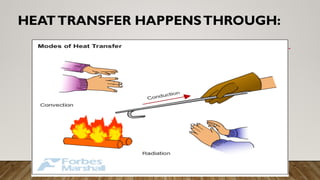
HEATTRANSFER HAPPENSTHROUGH:
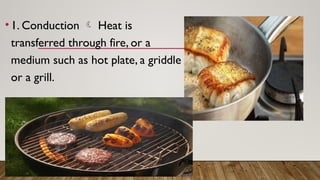
• 1. Conduction  Heat is
transferred through fire, or a
medium such as hot plate, a griddle
or a grill.
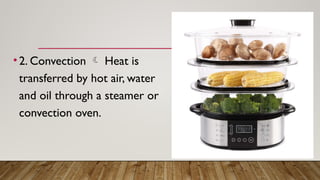
•2. Convection  Heat is
transferred by hot air, water
and oil through a steamer or
convection oven.
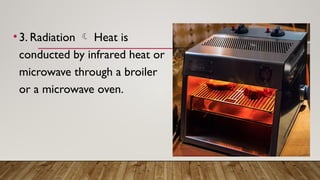
•3. Radiation  Heat is
conducted by infrared heat or
microwave through a broiler
or a microwave oven.
TWOTYPES OF
COOKING
METHODS:
DRY HEAT METHOD
•In this method, cooking is conducted through
moisture such as Hot air, Hot metal or
Radiation.
MOIST HEAT METHOD
•This method pertains to cooking that uses water
or steam. Examples of Cooking the moist heat
method are broiling, steaming, and simmering.
RELEVANCE OFTHE COOKERY COURSE
• Cooking is life skill that everyone needs to learn.
• Learning how to cook can improve oneself as this skill
helps a person acquire good qualities such as
independence, creativity, organization, planning skills,
confidence, and even social skills.
• Cooking and eating at home are also healthier and
cheaper.
•THE CHEF DE PARTIE
* The sauce chef  prepares sauces and stews only.
* The Fish Cook  prepares the fish dishes.
* Vegetable Cook  prepares the vegetables, soups,
starches and eggs.
* Roast Cook  is in charge of preparing roasted and
braised meats.
* Pastry Chef  prepares pastries and desserts.
CAREER OPPORTUNITIES IN COOKERY
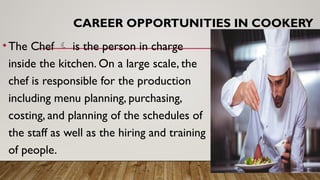
•The Chef  is the person in charge
inside the kitchen. On a large scale, the
chef is responsible for the production
including menu planning, purchasing,
costing, and planning of the schedules of
the staff as well as the hiring and training
of people.
• Restaurant Manager  is tasked to manage, lead, and supervise the restaurant
operations.
• Sales Coordinator  is responsible for representing and advertising the
restaurant.
• Front Office Agent  performs all front desk duties such as check-in and
check out, reservations, phone messages, and special requests from the guest.
• Food Stylist  prepares the food for photography in books, magazines, and
other publications.
• Food writer  writes articles and blogs for food industry journals and other
publications.
basic-concepts-in-cookery powerpoint-.pptx

basic-concepts-in-cookery powerpoint-.pptx

  • 1.
  • 2.
    COOKING •It is thetransfer of heat onto a food item to improve its appearance, taste, and flavor. •It changes the physical and chemical structure of the food in order to make it digestible. •It also kills harmful microorganisms such as bacteria to make the food safe to eat.
  • 3.
    •Heat transfer isvital in cooking food. •Too much heat can result in overcooking, which can make the food dry and burnt and make it lose its flavor, color and even nutritional value.
  • 4.
  • 5.
    • 1. Conduction Heat is transferred through fire, or a medium such as hot plate, a griddle or a grill.
  • 6.
    •2. Convection Heat is transferred by hot air, water and oil through a steamer or convection oven.
  • 7.
    •3. Radiation Heat is conducted by infrared heat or microwave through a broiler or a microwave oven.
  • 8.
  • 9.
    DRY HEAT METHOD •Inthis method, cooking is conducted through moisture such as Hot air, Hot metal or Radiation.
  • 10.
    MOIST HEAT METHOD •Thismethod pertains to cooking that uses water or steam. Examples of Cooking the moist heat method are broiling, steaming, and simmering.
  • 11.
    RELEVANCE OFTHE COOKERYCOURSE • Cooking is life skill that everyone needs to learn. • Learning how to cook can improve oneself as this skill helps a person acquire good qualities such as independence, creativity, organization, planning skills, confidence, and even social skills. • Cooking and eating at home are also healthier and cheaper.
  • 12.
    •THE CHEF DEPARTIE * The sauce chef  prepares sauces and stews only. * The Fish Cook  prepares the fish dishes. * Vegetable Cook  prepares the vegetables, soups, starches and eggs. * Roast Cook  is in charge of preparing roasted and braised meats. * Pastry Chef  prepares pastries and desserts.
  • 13.
    CAREER OPPORTUNITIES INCOOKERY •The Chef  is the person in charge inside the kitchen. On a large scale, the chef is responsible for the production including menu planning, purchasing, costing, and planning of the schedules of the staff as well as the hiring and training of people.
  • 14.
    • Restaurant Manager is tasked to manage, lead, and supervise the restaurant operations. • Sales Coordinator  is responsible for representing and advertising the restaurant. • Front Office Agent  performs all front desk duties such as check-in and check out, reservations, phone messages, and special requests from the guest. • Food Stylist  prepares the food for photography in books, magazines, and other publications. • Food writer  writes articles and blogs for food industry journals and other publications.