Computational Physics
Unit -V
Special Lecture on
Presented By
Dr. Halapagol Pruthviraj
Assistant Professor
Government First Grade College Chitguppa, Dist. BIDAR
2.
Introduction ofComputer
Block diagram of Computer
Parts of Computer
Basic of C Programming Language
Session Outcomes
3.
Introduction of Computer
Nowadays,computers are an integral part of our lives. They are used in number of fields
like.
1) For booking the tickets by airways.
2) For booking the tickets by Buses, railways.
3) Making the payment of telephone and electricity bills.
4) Deposit and withdrawal of money from banks.
5) Processing of business data.
6) Forecasting of weather conditions.
7) Diagnosis of diseases.
8) Searching for information on the Internet, etc.
4.
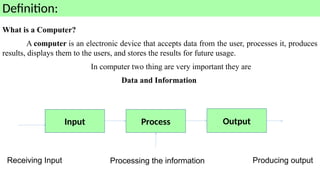
Definition:
Input Output
Process
What isa Computer?
A computer is an electronic device that accepts data from the user, processes it, produces
results, displays them to the users, and stores the results for future usage.
In computer two thing are very important they are
Data and Information
Producing output
Receiving Input Processing the information
5.
A computer performsthe following functions
Receiving Input
Processing the information
Storing the information
Producing output
Functions of Computers
6.
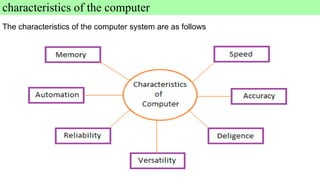
The characteristics ofthe computer system are as follows
characteristics of the computer
7.
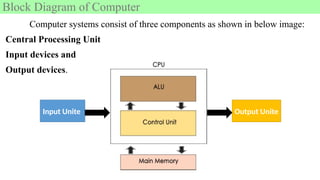
Block Diagram ofComputer
Computer systems consist of three components as shown in below image:
Central Processing Unit
Input devices and
Output devices.
Input Unite Output Unite
8.
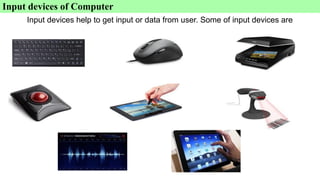
Input devices ofComputer
Input devices help to get input or data from user. Some of input devices are
9.
CPU of Computer
CentralProcessing Unit
The Central Processing Unit (CPU) is called "the brain of computer" as it controls operation of all
parts of computer. It consists of two components: Arithmetic Logic Unit (ALU), and Control
Unit.
10.
Memory Unit
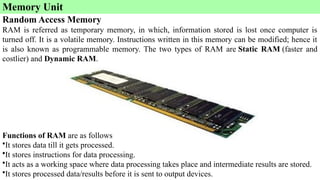
Random AccessMemory
RAM is referred as temporary memory, in which, information stored is lost once computer is
turned off. It is a volatile memory. Instructions written in this memory can be modified; hence it
is also known as programmable memory. The two types of RAM are Static RAM (faster and
costlier) and Dynamic RAM.
Functions of RAM are as follows
•It stores data till it gets processed.
•It stores instructions for data processing.
•It acts as a working space where data processing takes place and intermediate results are stored.
•It stores processed data/results before it is sent to output devices.
11.
Memory Unit
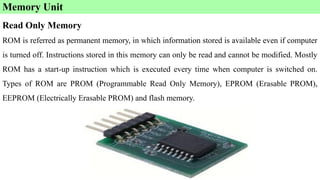
Read OnlyMemory
ROM is referred as permanent memory, in which information stored is available even if computer
is turned off. Instructions stored in this memory can only be read and cannot be modified. Mostly
ROM has a start-up instruction which is executed every time when computer is switched on.
Types of ROM are PROM (Programmable Read Only Memory), EPROM (Erasable PROM),
EEPROM (Electrically Erasable PROM) and flash memory.
12.
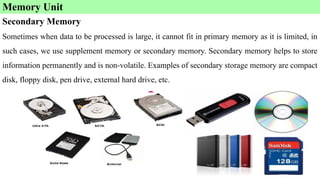
Secondary Memory
Sometimes whendata to be processed is large, it cannot fit in primary memory as it is limited, in
such cases, we use supplement memory or secondary memory. Secondary memory helps to store
information permanently and is non-volatile. Examples of secondary storage memory are compact
disk, floppy disk, pen drive, external hard drive, etc.
Memory Unit
13.
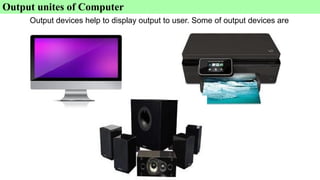
Output unites ofComputer
Output devices help to display output to user. Some of output devices are
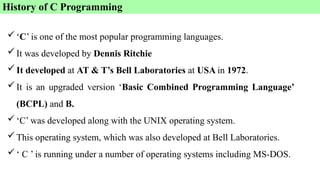
‘C’ is oneof the most popular programming languages.
It was developed by Dennis Ritchie
It developed at AT & T’s Bell Laboratories at USA in 1972.
It is an upgraded version ‘Basic Combined Programming Language’
(BCPL) and B.
‘C’ was developed along with the UNIX operating system.
This operating system, which was also developed at Bell Laboratories.
‘ C ’ is running under a number of operating systems including MS-DOS.
History of C Programming
16.
Importance of CProgramming
o ‘C’ is a general purpose, structured programming language.
o ‘C’ is powerful, efficient, compact and flexible.
o ‘C’ is highly portable (i.e. It can be run in different operating systems
environments).
o ‘C’ is robust language whose rich set of built in functions and operators can be used
to write any complex program.
o ‘C’ has the ability to extend itself. We can continuously add our own functions to the
existing library functions.
o ‘C’ is well suited for writing system software as well as application software.
o ‘C’ program are fast and efficient.
o ‘C’ has rich set of operators.
17.
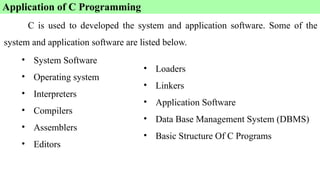
• System Software
•Operating system
• Interpreters
• Compilers
• Assemblers
• Editors
Application of C Programming
• Loaders
• Linkers
• Application Software
• Data Base Management System (DBMS)
• Basic Structure Of C Programs
C is used to developed the system and application software. Some of the
system and application software are listed below.
18.
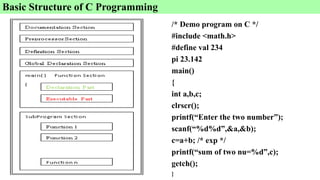
Basic Structure ofC Programming
/* Demo program on C */
#include <math.h>
#define val 234
pi 23.142
main()
{
int a,b,c;
clrscr();
printf(“Enter the two number”);
scanf(“%d%d”,&a,&b);
c=a+b; /* exp */
printf(“sum of two nu=%d”,c);
getch();
}
19.
Constant, Variables andData types
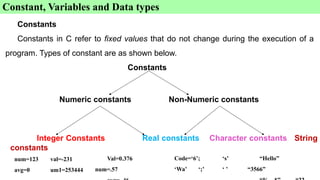
Constants
Constants in C refer to fixed values that do not change during the execution of a
program. Types of constant are as shown below.
Constants
Integer Constants Real constants Character constants String
constants
Numeric constants Non-Numeric constants
num=123 val=-231
avg=0 um1=253444
Val=0.376
num=.57
Code=‘6’; ‘s’
‘Wa’ ‘;’ ‘ ’
“Hello”
“3566”
20.
Data types
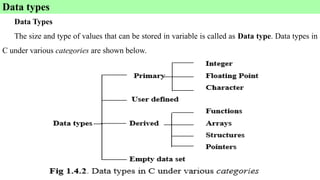
Data Types
Thesize and type of values that can be stored in variable is called as Data type. Data types in
C under various categories are shown below.
21.
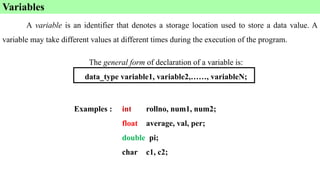
A variable isan identifier that denotes a storage location used to store a data value. A
variable may take different values at different times during the execution of the program.
Variables
The general form of declaration of a variable is:
data_type variable1, variable2,……, variableN;
Examples : int rollno, num1, num2;
float average, val, per;
double pi;
char c1, c2;
22.
Input and OutputStatements
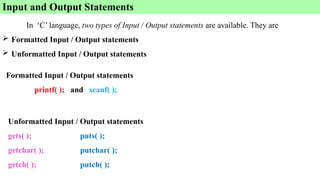
In ‘C’ language, two types of Input / Output statements are available. They are
Formatted Input / Output statements
Unformatted Input / Output statements
Formatted Input / Output statements
printf( ); and scanf( );
Unformatted Input / Output statements
gets( ); puts( );
getchar( ); putchar( );
getch( ); putch( );
23.
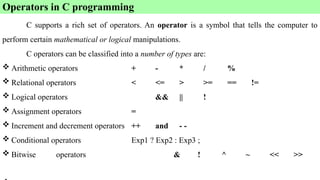
C supports arich set of operators. An operator is a symbol that tells the computer to
perform certain mathematical or logical manipulations.
C operators can be classified into a number of types are:
Arithmetic operators + - * / %
Relational operators < <= > >= == !=
Logical operators && || !
Assignment operators =
Increment and decrement operators ++ and - -
Conditional operators Exp1 ? Exp2 : Exp3 ;
Bitwise operators & ! ^ ~ << >>
Operators in C programming






![Programming in C [Module One]](https://cdn.slidesharecdn.com/ss_thumbnails/programmingincchapterone-150312070001-conversion-gate01-thumbnail.jpg?width=640&height=640&fit=bounds)


