
Catechetical School 
Baptism and Confirmation 
Prayerful Preparation 
and Catechism 2014
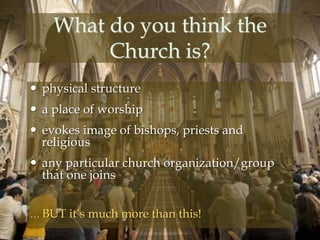
What do you think the 
Church is? 
 physical structure 
 a place of worship 
 evokes image of bishops, priests and 
religious 
 any particular church organization/group 
that one joins 
… BUT it’s much more than this!
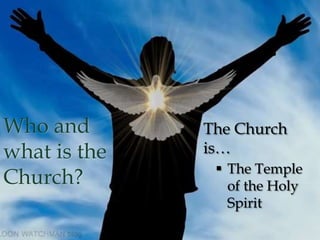
Who and 
what is the 
Church? 
The Church 
is… 
 The Temple 
of the Holy 
Spirit
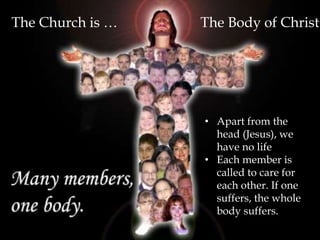
The Church is … The Body of Christ 
• Apart from the 
head (Jesus), we 
have no life 
• Each member is 
called to care for 
each other. If one 
suffers, the whole 
body suffers.
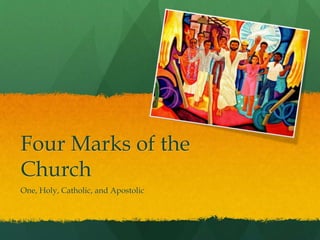
Four Marks of the 
Church 
One, Holy, Catholic, and Apostolic
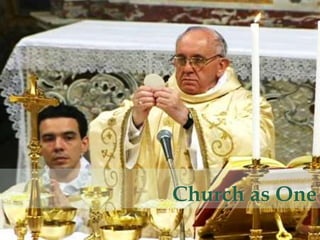
Church as One
Church as One 
 One living God in three persons; One in Her Founder 
(JC); 
 Church is in unity in the Eucharist (Communion) – “one 
loaf of bread broken and shared.” 
 Unified in Jesus in faith and in our Divine Worship as 
one family 
 Unity of liturgy, doctrine and authority. 
 One set of law – Canon Law 
 Peter - visible sign of the Church's unity; first Pope. All 
Popes are called “successors to Peter”
Church is Holy 
 Holy because Jesus Christ loves the Church as His 
Bride and gave Himself up to make her holy. 
 Holy because of the Holy Spirit who helps her 
become holy. 
 Our task then is to always to allow ourselves to be 
purified and renewed. Church is holy but also 
always in need to be purified and renewed. 
 All are called to holiness -- Universal Call to 
Holiness
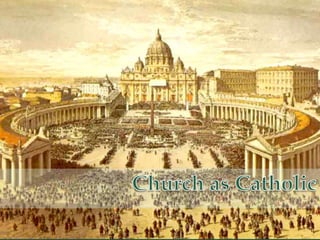
Church is Catholic 
 Catholic – katolikos (term first heard from St. 
Ignatius of Antioch, disciple of St. John the Apostle). 
It means “universal” 
 catholic – “universal” means spread throughout the 
world, possessing all saving truth, sent to all people, 
heals all kinds of sins, and is filled with all kinds of 
virtues 
 Mission - is that our catholic Church must extend to 
all, to love everyone.
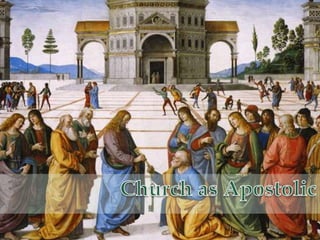
Church is Apostolic 
 Built on the foundation of the apostles 
 The Church guards and transmits the pure teachings 
of the apostles and is seen in their successors 
(Apostolic Succession) 
 The Church has distinct ties, roots, connections to the 
original 12 Apostles Jesus chose to begin His Church. 
They were given the task and grace to guard and 
transmit His teachings. 
 Apostolic Succession 
 Principal way that Apostles still guides us 
 Bishops guided by the Holy Spirit
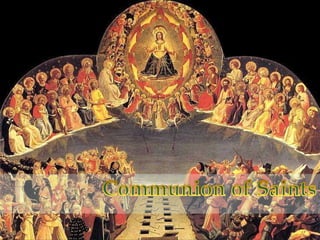
Communion of Saints 
 Refers to the fellowship or community that exist 
between all members of the Church. 
 We believe that death can’t sever the ties that bind 
the members of the Church, because the soul is 
immortal and only the body can die. 
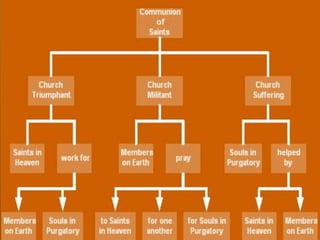
 We believe that the Church is made up of the: 
 Church Militant – we who are still on pilgrimage. 
 Church Suffering – holy souls in purgatory 
 Church Triumphant – saints in heaven
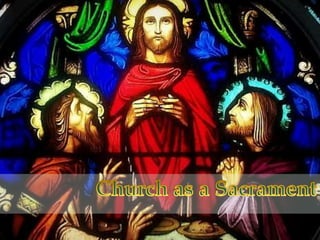
Church as a Sacrament 
 The Church leads us to Christ and the Holy Spirit. 
 The Church is willed by God, so all may share in His 
divine goodness & life in and through the sacraments. 
 CFC 1131: Sacraments are “Efficacious signs of grace, 
instituted by Christ and entrusted to the Church, by 
which divine life is dispensed to us” 
 A Sacrament is a symbol that points to Christ. 
Therefore, the Church is a symbol, a visible sign, that 
points to Christ and gives grace. 
 Grace is simply: a share in the life of God.
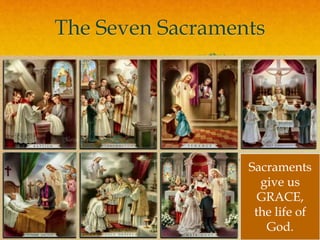
Sacraments 
 Signs – tangible and visible; 
 Symbols – has meaning; real events that 
make present the spiritual reality they 
express 
 Sacred Gift (Grace) – freely given even 
when we are not worthy; not a right 
 Grace – make us holy; inspires us to 
selflessly conform to God’s will.
Sacraments 
 From the Latin “sacramentum”, a word which refers 
to the oath of loyalty sworn by soldiers to the 
emperor; In Christianity it means the mysteries and 
signs by which man expressed loyalty to God. 
 Rites celebrated that use visible signs to symbolize 
invisible grace given by God. 
 Sacraments bear fruit to those who receive with 
required dispositions
Sacraments 
give us 
GRACE, 
the life of 
God. 
The Seven Sacraments
Remember: 
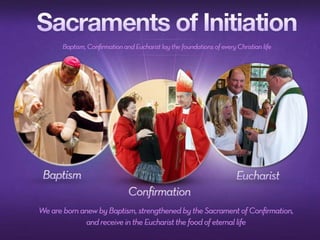
 The Sacrament of Initiation leaves an indelible 
mark on the soul, which can never be repeated nor 
is it removed. No one can ever be un-baptized or 
re-baptized.
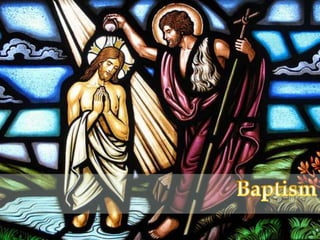
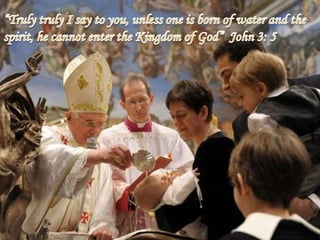
Baptism 
 The first and foremost of the Seven Sacraments 
 Through it we are initiated into the Catholic 
Church 
 We become adopted sons and daughters of 
God 
 Baptism washes away original sin 
 Gives us a share in the Kingly, Priestly and 
Prophetic Mission of Christ
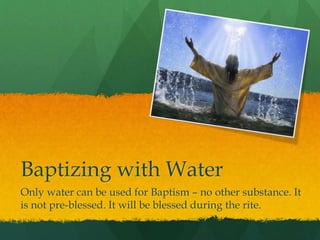
Baptizing with Water 
Only water can be used for Baptism – no other substance. It 
is not pre-blessed. It will be blessed during the rite.
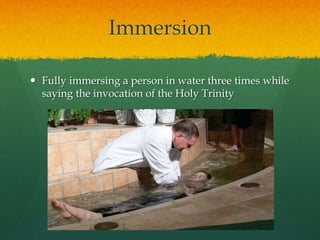
Immersion 
 Fully immersing a person in water three times while 
saying the invocation of the Holy Trinity
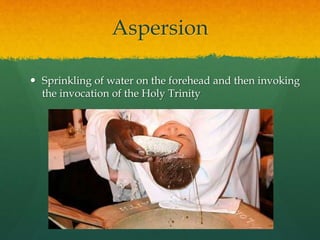
Aspersion 
 Sprinkling of water on the forehead and then invoking 
the invocation of the Holy Trinity
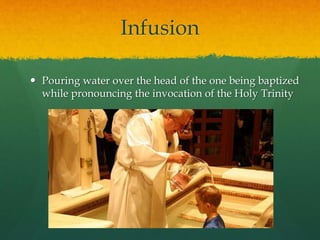
Infusion 
 Pouring water over the head of the one being baptized 
while pronouncing the invocation of the Holy Trinity
Symbols and Meanings 
 Water – forgiveness; cleansing 
 Oil (Chrism) – symbol of “being sent” or 
“anointed”. Share in the three-fold Mission of Christ 
– to sanctify (priestly), to proclaim (prophetic) and 
give Christian leadership and example to the world 
(kingly) 
 White Garment – symbol of dignity; clothed in 
dignity of Christ 
 Candles – symbolic of being light to the world. For 
the Godparents holding it, it means they are to
Rights and Privileges 
of the Baptized 
 To love and serve others in the Church and the world. 
 To love and obey Church Leaders. 
 To receive Sacraments and love them. 
 To be nourished by God’s Word and love it. 
 To go to Church. To seek spiritual guidance. (confession, 
catechism, spiritual counsel/direction, prayers) 
 To participate in the Church’s Missionary Activities. 
 To live a holy life following God’s will as sons and 
daughters through the guidance and power of the Holy 
Spirit.
Confirmation 
 Sacrament of Maturity; “Confirma” means “to strengthen”. 
 In the Bible it is referred to “laying of hands” 
 Accepting responsibility for our faith and actively living our 
vocation. (no longer just by-standers but doers) 
 Be “soldiers of Christ” with spiritual duty to fight battle 
between good and evil, light and darkness – a war between the 
human race and all the powers of hell (sin) 
 Strengthen unity with Church and Christ 
 Exercise Apostolic Zeal (courage sent by Holy Spirit) in 
making Christ known to all the world
Rite of Confirmation
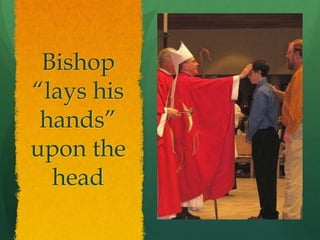
Bishop 
“lays his 
hands” 
upon the 
head
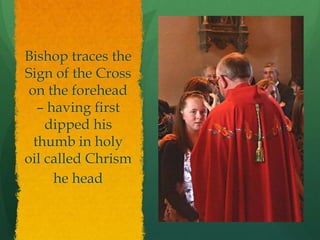
Bishop traces the 
Sign of the Cross 
on the forehead 
– having first 
dipped his 
thumb in holy 
oil called Chrism 
he head
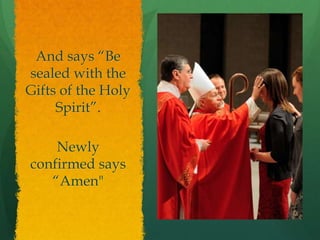
And says “Be 
sealed with the 
Gifts of the Holy 
Spirit”. 
Newly 
confirmed says 
“Amen"
Effects of Confirmation 
 Strengthens the Spirit and Gifts we received in 
Baptism. Increases Sanctifying Grace. 
 We receive a special grace by which our faith is 
deepened and strengthened, so that it will be 
strong enough not only for our own needs but for 
the needs of others with whom we shall try to share 
it.
Effects of Confirmation 
 Root us more deeply in divine filiations (being children 
of God) 
 Unites us more firmly to Christ 
 Increases the gifts of the Holy Spirit in us 
 Strengthens our bond with the Church 
 Associates us more closely to her mission of bearing 
witness to Christ 
 Helps us and more strictly obliges us to spread and 
defend the faith by word and deed
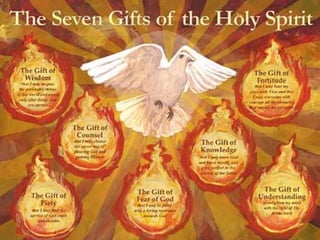
7 Gifts of the Holy Spirit
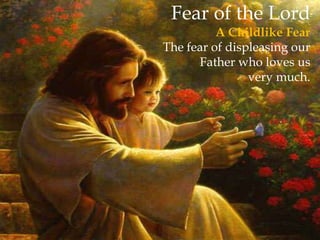
Fear of the Lord 
A Childlike Fear 
The fear of displeasing our 
Father who loves us 
very much.
Fear of the Lord 
 Childlike fear which causes us to be afraid of displeasing 
God. There are two kinds of fear: 
 Fear of a Servant– which is the fear of punishment 
 Fear of a Child- fear of disappointing or hurting his father 
or mother. (a fear that is based on love) 
 Childlike fear of God is the more noble and beautiful of 
the two, as it urges the soul to avoid the least sin in order 
not to displease God, the best and most amiable Father in 
Heaven. 
 The Saints were animated by childlike fear and love for 
the Heavenly Father and were ready to die rather than 
break His holy law by willful sin.
Piety 
Reverence 
for God 
The forgiven woman shows 
much love to Jesus.
Piety 
 Also called “Godliness” – with this gift the 
Holy Spirit infuses into us a reverence for God 
and Divine things. 
 Piety gives us joy and the sweetest pleasure in 
conversing with Him, in listening to spiritual 
reading and in hearing the Divine word. 
 It makes us delight to do the will of the Father 
and makes us have a heart all that wants to 
honor and glorify of God.
Piety 
 Piety leads us to love God as the best of 
Fathers, to love most tenderly His dearly 
beloved Son and the holy Mother of that 
Son. 
 Piety moves us to love not only the Saints 
and the Angels, but also our fellow men, as 
the images and children of God.
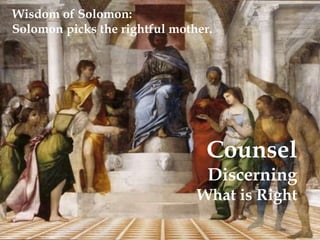
Wisdom of Solomon: 
Solomon picks the rightful mother. 
Counsel 
Discerning 
What is Right
Counsel 
 Counsel moves the soul to choose what gives 
glory to God and what is best for its own 
salvation. 
 Through Counsel we learn how best to please 
God. By following the inspirations of the 
Holy Spirit, we receive true interior peace and 
spiritual consolation.
Counsel 
 We ask ourselves: What Would Jesus Do in 
this Situation? (WWJD) 
 Especially needed by leaders or those tasked 
to lead others and make wise judgments in 
every situation like teachers, principals, 
student leaders, org leaders. (Lawyers are 
often called “Counsel”; Guidance Counselors 
provide sound advice to people who are 
having personal problems.)
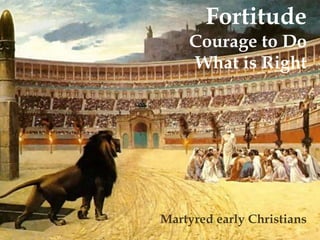
Fortitude 
Courage to Do 
What is Right 
Martyred early Christians
Fortitude 
 With the gift of Counsel, the Holy Spirit helps us discern 
what to do in every situation. With the gift of Fortitude, the 
Holy Spirit gives us the courage to do it or carry it out. 
 Removes timidity/shyness and desire for human praise and 
approval, strengthens souls to hate sin, to practice virtue and 
to prefer contempt, temporal loss, persecution and even death 
rather than to deny Christ by word or deed. 
 HS empowers us to fight and overcome the enemies of our 
salvation (temptations to sin), difficulties and persecutions, 
to fulfill the will of God. It makes us ready and courageous to 
undertake the greatest sacrifices for our salvation.
Fortitude, contd 
 Not seeking danger for danger’s sake; Fortitude is 
always reasoned and reasonable/prudent. 
 Fortitude is not foolhardiness or rashness, "rushing in 
where angels fear to tread." Indeed, part of the virtue of 
fortitude is controlling/stopping reckless behavior 
(hindi pabigla-bigla, gungho o war freak) 
 Fortitude is the virtue of the martyrs, who are willing 
to give their lives rather than to renounce their faith. 
That sacrifice may be passive—Christian martyrs do 
not actively seek martyrdom—but it is still determined 
and resolute/”desidido”
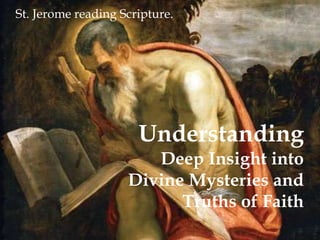
Understanding 
Deep Insight into 
Divine Mysteries and 
Truths of Faith 
St. Jerome reading Scripture.
Understanding 
 Gift enables us to understand the mysteries and 
doctrines of our holy religion. 
 It is discursive – allows us to view these mysteries and 
truths in different angles like studying the properties of 
a diamond. We use enlightened reason to analyze and 
understand something that God wishes to reveal to us. 
 More than just understanding of the mind ---If God 
wants to lead a soul to holiness, He gives it an interior 
light and a deep insight into the Divine mysteries. 
 It reveals the hidden meaning of Sacred Scripture.
Understanding, contd 
 The soul, understanding these mysteries according 
to the will of God, is filled with the desire to serve 
Him more perfectly. 
 Through this gift, simple persons are given by God 
a deep knowledge of great mysteries than learned 
but less devout persons -- for examples, the 
mysteries of the Most Holy Trinity and the 
Incarnation; Because God loves and reveals Himself 
the humble of heart.
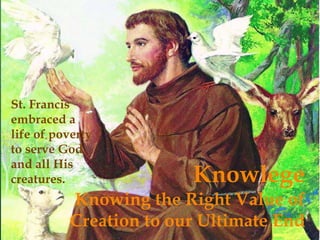
Knowlege 
St. Francis 
embraced a 
life of poverty 
to serve God 
and all His 
creatures. 
Knowing the Right Value of 
Creation to our Ultimate End
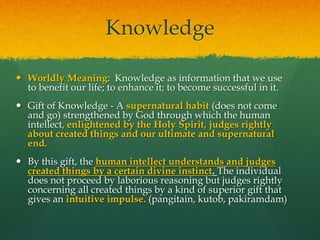
Knowledge 
 Worldly Meaning: Knowledge as information that we use 
to benefit our life; to enhance it; to become successful in it. 
 Gift of Knowledge - A supernatural habit (does not come 
and go) strengthened by God through which the human 
intellect, enlightened by the Holy Spirit, judges rightly 
about created things and our ultimate and supernatural 
end. 
 By this gift, the human intellect understands and judges 
created things by a certain divine instinct. The individual 
does not proceed by laborious reasoning but judges rightly 
concerning all created things by a kind of superior gift that 
gives an intuitive impulse. (pangitain, kutob, pakiramdam)
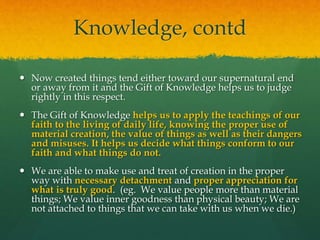
Knowledge, contd 
 Now created things tend either toward our supernatural end 
or away from it and the Gift of Knowledge helps us to judge 
rightly in this respect. 
 The Gift of Knowledge helps us to apply the teachings of our 
faith to the living of daily life, knowing the proper use of 
material creation, the value of things as well as their dangers 
and misuses. It helps us decide what things conform to our 
faith and what things do not. 
 We are able to make use and treat of creation in the proper 
way with necessary detachment and proper appreciation for 
what is truly good. (eg. We value people more than material 
things; We value inner goodness than physical beauty; We are 
not attached to things that we can take with us when we die.)
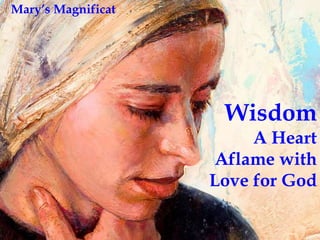
Wisdom 
A Heart 
Aflame with 
Love for God 
Mary’s Magnificat
Wisdom 
 Gift of Wisdom is the highest and most privileged Gift 
of the Holy Spirit. It is like an overflowing of the 
Uncreated Wisdom. 
 St Bernard: “Wisdom enables us to know God and to 
rejoice in perfect love.” 
 Wisdom not only enlightens the mind, but it inflames 
the heart with love for God, gives us a taste for Divine 
things, and an ardent desire for heavenly treasures ------ 
----- especially a longing to possess God and to see Him 
face to face. It detaches our hearts from the goods of this 
world and removes us from everything opposed to our 
last end. In its light, we see more and more clearly the 
nothingness of things created.
Wisdom, contd 
 The truths of God begin to make great sense to us and we begin to 
love what God loves, will what God wills. His teachings become 
clearer to us. We see things increasingly from God’s point of view 
through this supernatural gift. The thinking or “wisdom” of the 
world increasingly seems foolish, even crazy, and appreciation of 
God’s Wisdom becomes greater. 
 Through this gift the person desires to be in union only with God 
and His ways; to be conformed to His will. 
 Our love of neighbor is also perfected by it since the Gift of Wisdom 
helps us to see and thus love others more and more as God sees 
and loves them. Since this is a gift, it cannot be learned or acquired. 
But, as with the Gift of Knowledge, one’s study of Scripture and 
Tradition can help dispose one for the growth of the Gift.
Fruits of the Holy Spirit
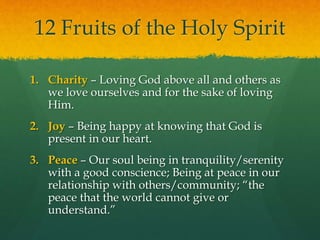
12 Fruits of the Holy Spirit 
1. Charity – Loving God above all and others as 
we love ourselves and for the sake of loving 
Him. 
2. Joy – Being happy at knowing that God is 
present in our heart. 
3. Peace – Our soul being in tranquility/serenity 
with a good conscience; Being at peace in our 
relationship with others/community; “the 
peace that the world cannot give or 
understand.”
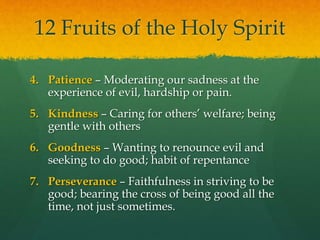
12 Fruits of the Holy Spirit 
4. Patience – Moderating our sadness at the 
experience of evil, hardship or pain. 
5. Kindness – Caring for others’ welfare; being 
gentle with others 
6. Goodness – Wanting to renounce evil and 
seeking to do good; habit of repentance 
7. Perseverance – Faithfulness in striving to be 
good; bearing the cross of being good all the 
time, not just sometimes.
12 Fruits of the Holy Spirit 
8. Temperance – also called prudence; Being 
reasonable; curbing excess; eg. in fraternal 
correction or correcting our brothers and 
sisters who we see are doing something 
sinful; Our ways must be tempered by 
charity. 
9. Faith - The act of spiritual and intellectual 
assent to a revealed truth of God with the 
assistance of Divine grace.
12 Fruits of the Holy Spirit 
10. Modesty - Restraint in dress and attire, and a 
preference of purity of mind and heart in sexual 
matters. 
11.Continency - Virtue of rightful exercise of the 
sexual act, including its desire, as prescribed by 
Almighty God. 
12.Chastity - Virtue that voluntarily excludes all 
indulgence in sexual impulses in the unmarried 
and the habit of refraining from improper use of 
the sexual faculties in married persons.
The Holy Spirit is in each 
of us as disciples of Christ. 
 The HS makes it possible so that risen Christ 
can be present within and among us. 
 How is it expressed in our individual lives? 
 HS adopts us; spirit of adoption - we become 
children of God; Jesus is the only begotten son of 
God but we are adopted by God thru baptism 
 HS empowers us to love 
 HS empowers us to bear witness not only in our 
speech but also in the lives we live
The Holy Spirit is in each 
of us as disciples of Christ. 
 HS empowers us to know the truth - reminds us of 
everything that Jesus said and taught us 
 HS draws us into community, unity and service 
 HS inspires true Christian life -- in 2 ways 
 HS strengthens us in our struggle against evil 
 HS transforms us
Requirements for Confirmation
Requirements 
 At least 12 years old, able to use reason, 
 Properly disposed, be in a state of grace 
 Be cleansed of all sin to prepare for the Holy Spirit. 
 Prayerful and open to receive the strength and 
graces of the Holy Spirit as He wishes to give with 
docility and readiness to act for Him. 
 White dress 
 1 set of Godparents (who are practicing Catholics)
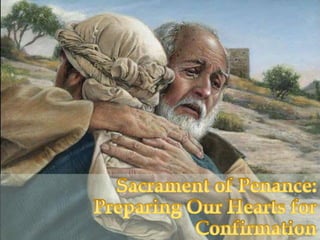
Sacrament 
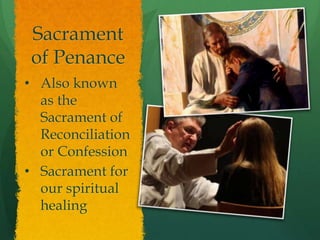
of Penance 
• Also known 
as the 
Sacrament of 
Reconciliation 
or Confession 
• Sacrament for 
our spiritual 
healing
Are you really, truly sorry? 
 Prayerfully Examine your conscience 
 Confess all known and un-confessed 
mortal sins; Any and all venial sins 
committed since the last confession are 
encouraged to be confessed too. 
 Contrition (sorrow) for sin must be 
genuine
Doing Penance 
 Penance – acts of self-abasement, mortification or 
devotion to show sorrow or repentance for sins 
 It may be a set of prayers, acts of mercy etc. as may 
be given by the Priest 
 Whatever the penance, it is merely a token. We 
believe that the sacrifice of Christ on the Cross is 
what made atonement for our sins. Our penance is 
for our benefit – to remind us that God comes first 
and we come last.
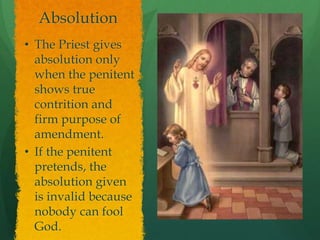
Absolution 
• The Priest gives 
absolution only 
when the penitent 
shows true 
contrition and 
firm purpose of 
amendment. 
• If the penitent 
pretends, the 
absolution given 
is invalid because 
nobody can fool 
God.
Sacramental Absolution 
The Priest prays: 
“God the Father of mercies through the death and 
resurrection of His Son has reconciled the world to 
Himself and sent the Holy Spirit among us for the 
forgiveness of sins. Through the ministry of the 
Church may God give you pardon and peace, and I 
absolve you from all sins, in the Name of the Father, 
and of the Son, and of the Holy Spirit, Amen.”
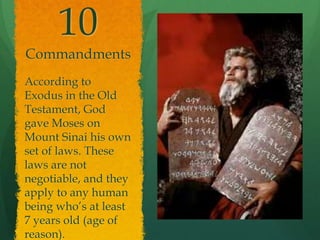
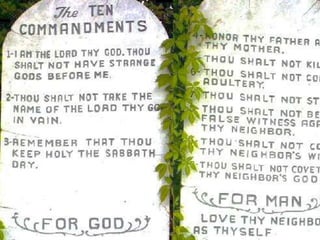
10 
Commandments 
According to 
Exodus in the Old 
Testament, God 
gave Moses on 
Mount Sinai his own 
set of laws. These 
laws are not 
negotiable, and they 
apply to any human 
being who’s at least 
7 years old (age of 
reason).
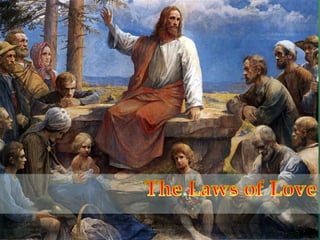
The Laws of Love 
 37 Jesus answered “You shall love the Lord your 
God with all your heart, with all your soul, and 
with all your mind. 38 This is the first and the most 
important of the commandments. 39 But after this, 
there is another one very similar to it: You shall love 
your neighbor as yourself. 40 The whole law and 
the Prophets are founded on these two 
commandments” 
(Matthew 22: 37-40)
Jesus’ Law of Love 
(Mt. 5-7) 
 Do not judge. 
 Do not expect too much or too little from people 
including yourself 
 “Request” not “Demand” 
 Seek reconciliation with people you had a disagreement 
with 
 Be faithful to your marital vows 
 Do not take oaths or swear against people, God loved 
ones etc. It is either YES or NO. Have self-responsibility.
Jesus’ Law of Love 
(Mt. 5-7) 
 Have complete love, trust and dependence on God 
 Love your enemies. Pray for them. 
 “whatsoever you do (or not do) to the least of my 
brothers, you have done unto to me” 
 Do good to the least, the last and the lost. Do it as if 
it is for and to Jesus 
 “Die to yourself that you may have eternal life”
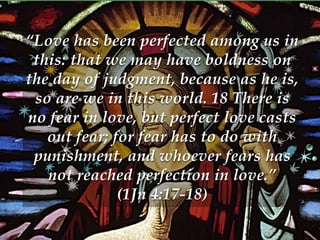
“Love has been perfected among us in 
this: that we may have boldness on 
the day of judgment, because as he is, 
so are we in this world. 18 There is 
no fear in love, but perfect love casts 
out fear; for fear has to do with 
punishment, and whoever fears has 
not reached perfection in love.” 
(1Jn 4:17-18)

Baptism and Confirmation

  • 1.
    Catechetical School Baptismand Confirmation Prayerful Preparation and Catechism 2014
  • 2.
    What do youthink the Church is?  physical structure  a place of worship  evokes image of bishops, priests and religious  any particular church organization/group that one joins … BUT it’s much more than this!
  • 3.
    Who and whatis the Church? The Church is…  The Temple of the Holy Spirit
  • 4.
    The Church is… The Body of Christ • Apart from the head (Jesus), we have no life • Each member is called to care for each other. If one suffers, the whole body suffers.
  • 5.
    Four Marks ofthe Church One, Holy, Catholic, and Apostolic
  • 6.
  • 7.
    Church as One  One living God in three persons; One in Her Founder (JC);  Church is in unity in the Eucharist (Communion) – “one loaf of bread broken and shared.”  Unified in Jesus in faith and in our Divine Worship as one family  Unity of liturgy, doctrine and authority.  One set of law – Canon Law  Peter - visible sign of the Church's unity; first Pope. All Popes are called “successors to Peter”
  • 9.
    Church is Holy  Holy because Jesus Christ loves the Church as His Bride and gave Himself up to make her holy.  Holy because of the Holy Spirit who helps her become holy.  Our task then is to always to allow ourselves to be purified and renewed. Church is holy but also always in need to be purified and renewed.  All are called to holiness -- Universal Call to Holiness
  • 11.
    Church is Catholic  Catholic – katolikos (term first heard from St. Ignatius of Antioch, disciple of St. John the Apostle). It means “universal”  catholic – “universal” means spread throughout the world, possessing all saving truth, sent to all people, heals all kinds of sins, and is filled with all kinds of virtues  Mission - is that our catholic Church must extend to all, to love everyone.
  • 13.
    Church is Apostolic  Built on the foundation of the apostles  The Church guards and transmits the pure teachings of the apostles and is seen in their successors (Apostolic Succession)  The Church has distinct ties, roots, connections to the original 12 Apostles Jesus chose to begin His Church. They were given the task and grace to guard and transmit His teachings.  Apostolic Succession  Principal way that Apostles still guides us  Bishops guided by the Holy Spirit
  • 15.
    Communion of Saints  Refers to the fellowship or community that exist between all members of the Church.  We believe that death can’t sever the ties that bind the members of the Church, because the soul is immortal and only the body can die.  We believe that the Church is made up of the:  Church Militant – we who are still on pilgrimage.  Church Suffering – holy souls in purgatory  Church Triumphant – saints in heaven
  • 18.
    Church as aSacrament  The Church leads us to Christ and the Holy Spirit.  The Church is willed by God, so all may share in His divine goodness & life in and through the sacraments.  CFC 1131: Sacraments are “Efficacious signs of grace, instituted by Christ and entrusted to the Church, by which divine life is dispensed to us”  A Sacrament is a symbol that points to Christ. Therefore, the Church is a symbol, a visible sign, that points to Christ and gives grace.  Grace is simply: a share in the life of God.
  • 19.
    Sacraments  Signs– tangible and visible;  Symbols – has meaning; real events that make present the spiritual reality they express  Sacred Gift (Grace) – freely given even when we are not worthy; not a right  Grace – make us holy; inspires us to selflessly conform to God’s will.
  • 20.
    Sacraments  Fromthe Latin “sacramentum”, a word which refers to the oath of loyalty sworn by soldiers to the emperor; In Christianity it means the mysteries and signs by which man expressed loyalty to God.  Rites celebrated that use visible signs to symbolize invisible grace given by God.  Sacraments bear fruit to those who receive with required dispositions
  • 21.
    Sacraments give us GRACE, the life of God. The Seven Sacraments
  • 23.
    Remember:  TheSacrament of Initiation leaves an indelible mark on the soul, which can never be repeated nor is it removed. No one can ever be un-baptized or re-baptized.
  • 26.
    Baptism  Thefirst and foremost of the Seven Sacraments  Through it we are initiated into the Catholic Church  We become adopted sons and daughters of God  Baptism washes away original sin  Gives us a share in the Kingly, Priestly and Prophetic Mission of Christ
  • 27.
    Baptizing with Water Only water can be used for Baptism – no other substance. It is not pre-blessed. It will be blessed during the rite.
  • 28.
    Immersion  Fullyimmersing a person in water three times while saying the invocation of the Holy Trinity
  • 29.
    Aspersion  Sprinklingof water on the forehead and then invoking the invocation of the Holy Trinity
  • 30.
    Infusion  Pouringwater over the head of the one being baptized while pronouncing the invocation of the Holy Trinity
  • 31.
    Symbols and Meanings  Water – forgiveness; cleansing  Oil (Chrism) – symbol of “being sent” or “anointed”. Share in the three-fold Mission of Christ – to sanctify (priestly), to proclaim (prophetic) and give Christian leadership and example to the world (kingly)  White Garment – symbol of dignity; clothed in dignity of Christ  Candles – symbolic of being light to the world. For the Godparents holding it, it means they are to
  • 32.
    Rights and Privileges of the Baptized  To love and serve others in the Church and the world.  To love and obey Church Leaders.  To receive Sacraments and love them.  To be nourished by God’s Word and love it.  To go to Church. To seek spiritual guidance. (confession, catechism, spiritual counsel/direction, prayers)  To participate in the Church’s Missionary Activities.  To live a holy life following God’s will as sons and daughters through the guidance and power of the Holy Spirit.
  • 34.
    Confirmation  Sacramentof Maturity; “Confirma” means “to strengthen”.  In the Bible it is referred to “laying of hands”  Accepting responsibility for our faith and actively living our vocation. (no longer just by-standers but doers)  Be “soldiers of Christ” with spiritual duty to fight battle between good and evil, light and darkness – a war between the human race and all the powers of hell (sin)  Strengthen unity with Church and Christ  Exercise Apostolic Zeal (courage sent by Holy Spirit) in making Christ known to all the world
  • 35.
  • 36.
    Bishop “lays his hands” upon the head
  • 37.
    Bishop traces the Sign of the Cross on the forehead – having first dipped his thumb in holy oil called Chrism he head
  • 38.
    And says “Be sealed with the Gifts of the Holy Spirit”. Newly confirmed says “Amen"
  • 40.
    Effects of Confirmation  Strengthens the Spirit and Gifts we received in Baptism. Increases Sanctifying Grace.  We receive a special grace by which our faith is deepened and strengthened, so that it will be strong enough not only for our own needs but for the needs of others with whom we shall try to share it.
  • 41.
    Effects of Confirmation  Root us more deeply in divine filiations (being children of God)  Unites us more firmly to Christ  Increases the gifts of the Holy Spirit in us  Strengthens our bond with the Church  Associates us more closely to her mission of bearing witness to Christ  Helps us and more strictly obliges us to spread and defend the faith by word and deed
  • 42.
    7 Gifts ofthe Holy Spirit
  • 43.
    Fear of theLord A Childlike Fear The fear of displeasing our Father who loves us very much.
  • 44.
    Fear of theLord  Childlike fear which causes us to be afraid of displeasing God. There are two kinds of fear:  Fear of a Servant– which is the fear of punishment  Fear of a Child- fear of disappointing or hurting his father or mother. (a fear that is based on love)  Childlike fear of God is the more noble and beautiful of the two, as it urges the soul to avoid the least sin in order not to displease God, the best and most amiable Father in Heaven.  The Saints were animated by childlike fear and love for the Heavenly Father and were ready to die rather than break His holy law by willful sin.
  • 45.
    Piety Reverence forGod The forgiven woman shows much love to Jesus.
  • 46.
    Piety  Alsocalled “Godliness” – with this gift the Holy Spirit infuses into us a reverence for God and Divine things.  Piety gives us joy and the sweetest pleasure in conversing with Him, in listening to spiritual reading and in hearing the Divine word.  It makes us delight to do the will of the Father and makes us have a heart all that wants to honor and glorify of God.
  • 47.
    Piety  Pietyleads us to love God as the best of Fathers, to love most tenderly His dearly beloved Son and the holy Mother of that Son.  Piety moves us to love not only the Saints and the Angels, but also our fellow men, as the images and children of God.
  • 48.
    Wisdom of Solomon: Solomon picks the rightful mother. Counsel Discerning What is Right
  • 49.
    Counsel  Counselmoves the soul to choose what gives glory to God and what is best for its own salvation.  Through Counsel we learn how best to please God. By following the inspirations of the Holy Spirit, we receive true interior peace and spiritual consolation.
  • 50.
    Counsel  Weask ourselves: What Would Jesus Do in this Situation? (WWJD)  Especially needed by leaders or those tasked to lead others and make wise judgments in every situation like teachers, principals, student leaders, org leaders. (Lawyers are often called “Counsel”; Guidance Counselors provide sound advice to people who are having personal problems.)
  • 51.
    Fortitude Courage toDo What is Right Martyred early Christians
  • 52.
    Fortitude  Withthe gift of Counsel, the Holy Spirit helps us discern what to do in every situation. With the gift of Fortitude, the Holy Spirit gives us the courage to do it or carry it out.  Removes timidity/shyness and desire for human praise and approval, strengthens souls to hate sin, to practice virtue and to prefer contempt, temporal loss, persecution and even death rather than to deny Christ by word or deed.  HS empowers us to fight and overcome the enemies of our salvation (temptations to sin), difficulties and persecutions, to fulfill the will of God. It makes us ready and courageous to undertake the greatest sacrifices for our salvation.
  • 53.
    Fortitude, contd Not seeking danger for danger’s sake; Fortitude is always reasoned and reasonable/prudent.  Fortitude is not foolhardiness or rashness, "rushing in where angels fear to tread." Indeed, part of the virtue of fortitude is controlling/stopping reckless behavior (hindi pabigla-bigla, gungho o war freak)  Fortitude is the virtue of the martyrs, who are willing to give their lives rather than to renounce their faith. That sacrifice may be passive—Christian martyrs do not actively seek martyrdom—but it is still determined and resolute/”desidido”
  • 54.
    Understanding Deep Insightinto Divine Mysteries and Truths of Faith St. Jerome reading Scripture.
  • 55.
    Understanding  Giftenables us to understand the mysteries and doctrines of our holy religion.  It is discursive – allows us to view these mysteries and truths in different angles like studying the properties of a diamond. We use enlightened reason to analyze and understand something that God wishes to reveal to us.  More than just understanding of the mind ---If God wants to lead a soul to holiness, He gives it an interior light and a deep insight into the Divine mysteries.  It reveals the hidden meaning of Sacred Scripture.
  • 56.
    Understanding, contd The soul, understanding these mysteries according to the will of God, is filled with the desire to serve Him more perfectly.  Through this gift, simple persons are given by God a deep knowledge of great mysteries than learned but less devout persons -- for examples, the mysteries of the Most Holy Trinity and the Incarnation; Because God loves and reveals Himself the humble of heart.
  • 57.
    Knowlege St. Francis embraced a life of poverty to serve God and all His creatures. Knowing the Right Value of Creation to our Ultimate End
  • 58.
    Knowledge  WorldlyMeaning: Knowledge as information that we use to benefit our life; to enhance it; to become successful in it.  Gift of Knowledge - A supernatural habit (does not come and go) strengthened by God through which the human intellect, enlightened by the Holy Spirit, judges rightly about created things and our ultimate and supernatural end.  By this gift, the human intellect understands and judges created things by a certain divine instinct. The individual does not proceed by laborious reasoning but judges rightly concerning all created things by a kind of superior gift that gives an intuitive impulse. (pangitain, kutob, pakiramdam)
  • 59.
    Knowledge, contd Now created things tend either toward our supernatural end or away from it and the Gift of Knowledge helps us to judge rightly in this respect.  The Gift of Knowledge helps us to apply the teachings of our faith to the living of daily life, knowing the proper use of material creation, the value of things as well as their dangers and misuses. It helps us decide what things conform to our faith and what things do not.  We are able to make use and treat of creation in the proper way with necessary detachment and proper appreciation for what is truly good. (eg. We value people more than material things; We value inner goodness than physical beauty; We are not attached to things that we can take with us when we die.)
  • 60.
    Wisdom A Heart Aflame with Love for God Mary’s Magnificat
  • 61.
    Wisdom  Giftof Wisdom is the highest and most privileged Gift of the Holy Spirit. It is like an overflowing of the Uncreated Wisdom.  St Bernard: “Wisdom enables us to know God and to rejoice in perfect love.”  Wisdom not only enlightens the mind, but it inflames the heart with love for God, gives us a taste for Divine things, and an ardent desire for heavenly treasures ------ ----- especially a longing to possess God and to see Him face to face. It detaches our hearts from the goods of this world and removes us from everything opposed to our last end. In its light, we see more and more clearly the nothingness of things created.
  • 62.
    Wisdom, contd The truths of God begin to make great sense to us and we begin to love what God loves, will what God wills. His teachings become clearer to us. We see things increasingly from God’s point of view through this supernatural gift. The thinking or “wisdom” of the world increasingly seems foolish, even crazy, and appreciation of God’s Wisdom becomes greater.  Through this gift the person desires to be in union only with God and His ways; to be conformed to His will.  Our love of neighbor is also perfected by it since the Gift of Wisdom helps us to see and thus love others more and more as God sees and loves them. Since this is a gift, it cannot be learned or acquired. But, as with the Gift of Knowledge, one’s study of Scripture and Tradition can help dispose one for the growth of the Gift.
  • 63.
    Fruits of theHoly Spirit
  • 64.
    12 Fruits ofthe Holy Spirit 1. Charity – Loving God above all and others as we love ourselves and for the sake of loving Him. 2. Joy – Being happy at knowing that God is present in our heart. 3. Peace – Our soul being in tranquility/serenity with a good conscience; Being at peace in our relationship with others/community; “the peace that the world cannot give or understand.”
  • 65.
    12 Fruits ofthe Holy Spirit 4. Patience – Moderating our sadness at the experience of evil, hardship or pain. 5. Kindness – Caring for others’ welfare; being gentle with others 6. Goodness – Wanting to renounce evil and seeking to do good; habit of repentance 7. Perseverance – Faithfulness in striving to be good; bearing the cross of being good all the time, not just sometimes.
  • 66.
    12 Fruits ofthe Holy Spirit 8. Temperance – also called prudence; Being reasonable; curbing excess; eg. in fraternal correction or correcting our brothers and sisters who we see are doing something sinful; Our ways must be tempered by charity. 9. Faith - The act of spiritual and intellectual assent to a revealed truth of God with the assistance of Divine grace.
  • 67.
    12 Fruits ofthe Holy Spirit 10. Modesty - Restraint in dress and attire, and a preference of purity of mind and heart in sexual matters. 11.Continency - Virtue of rightful exercise of the sexual act, including its desire, as prescribed by Almighty God. 12.Chastity - Virtue that voluntarily excludes all indulgence in sexual impulses in the unmarried and the habit of refraining from improper use of the sexual faculties in married persons.
  • 69.
    The Holy Spiritis in each of us as disciples of Christ.  The HS makes it possible so that risen Christ can be present within and among us.  How is it expressed in our individual lives?  HS adopts us; spirit of adoption - we become children of God; Jesus is the only begotten son of God but we are adopted by God thru baptism  HS empowers us to love  HS empowers us to bear witness not only in our speech but also in the lives we live
  • 70.
    The Holy Spiritis in each of us as disciples of Christ.  HS empowers us to know the truth - reminds us of everything that Jesus said and taught us  HS draws us into community, unity and service  HS inspires true Christian life -- in 2 ways  HS strengthens us in our struggle against evil  HS transforms us
  • 71.
  • 72.
    Requirements  Atleast 12 years old, able to use reason,  Properly disposed, be in a state of grace  Be cleansed of all sin to prepare for the Holy Spirit.  Prayerful and open to receive the strength and graces of the Holy Spirit as He wishes to give with docility and readiness to act for Him.  White dress  1 set of Godparents (who are practicing Catholics)
  • 74.
    Sacrament of Penance • Also known as the Sacrament of Reconciliation or Confession • Sacrament for our spiritual healing
  • 75.
    Are you really,truly sorry?  Prayerfully Examine your conscience  Confess all known and un-confessed mortal sins; Any and all venial sins committed since the last confession are encouraged to be confessed too.  Contrition (sorrow) for sin must be genuine
  • 76.
    Doing Penance Penance – acts of self-abasement, mortification or devotion to show sorrow or repentance for sins  It may be a set of prayers, acts of mercy etc. as may be given by the Priest  Whatever the penance, it is merely a token. We believe that the sacrifice of Christ on the Cross is what made atonement for our sins. Our penance is for our benefit – to remind us that God comes first and we come last.
  • 77.
    Absolution • ThePriest gives absolution only when the penitent shows true contrition and firm purpose of amendment. • If the penitent pretends, the absolution given is invalid because nobody can fool God.
  • 78.
    Sacramental Absolution ThePriest prays: “God the Father of mercies through the death and resurrection of His Son has reconciled the world to Himself and sent the Holy Spirit among us for the forgiveness of sins. Through the ministry of the Church may God give you pardon and peace, and I absolve you from all sins, in the Name of the Father, and of the Son, and of the Holy Spirit, Amen.”
  • 79.
    10 Commandments Accordingto Exodus in the Old Testament, God gave Moses on Mount Sinai his own set of laws. These laws are not negotiable, and they apply to any human being who’s at least 7 years old (age of reason).
  • 82.
    The Laws ofLove  37 Jesus answered “You shall love the Lord your God with all your heart, with all your soul, and with all your mind. 38 This is the first and the most important of the commandments. 39 But after this, there is another one very similar to it: You shall love your neighbor as yourself. 40 The whole law and the Prophets are founded on these two commandments” (Matthew 22: 37-40)
  • 83.
    Jesus’ Law ofLove (Mt. 5-7)  Do not judge.  Do not expect too much or too little from people including yourself  “Request” not “Demand”  Seek reconciliation with people you had a disagreement with  Be faithful to your marital vows  Do not take oaths or swear against people, God loved ones etc. It is either YES or NO. Have self-responsibility.
  • 84.
    Jesus’ Law ofLove (Mt. 5-7)  Have complete love, trust and dependence on God  Love your enemies. Pray for them.  “whatsoever you do (or not do) to the least of my brothers, you have done unto to me”  Do good to the least, the last and the lost. Do it as if it is for and to Jesus  “Die to yourself that you may have eternal life”
  • 85.
    “Love has beenperfected among us in this: that we may have boldness on the day of judgment, because as he is, so are we in this world. 18 There is no fear in love, but perfect love casts out fear; for fear has to do with punishment, and whoever fears has not reached perfection in love.” (1Jn 4:17-18)