Banking Developments and Perspectives


                                              Chapter I


                Banking Developments and Perspectives
One of the major areas of the macro-economy             1999-2000 and a perspective towards
that has been the subject of focused attention          developing a more stable, efficient, resilient
in recent years is the financial sector soundness       and vibrant banking system.
and efficiency. Within the broad ambit of the
financial sector, a well-functioning banking            1. Policy Environment
sector is regarded as the bedrock of a stable
financial system. The renewed focus on the              Monetary and Credit Policies
banking sector has been driven by two major             1.2 The annual Monetary and Credit Policy
considerations.        First,    the     growing        Statements as well as Mid-term Reviews have,
universalisation and internationalisation of            in recent years, elaborated on a number of
banking operations, driven by a combination             medium to long-term structural reform measures
of factors, such as, the continuing deregulation,       for providing stability to the financial system,
heightened competition and technological                besides undertaking short-term monetary policy
advancements, have altered the face of banks            initiatives, when felt necessary, to stimulate the
from one of mere intermediator to one of                economy. The major short-term monetary and
provider of quick, efficient and consumer-              credit policy measures announced during
centric services. In the process, the potential         1999-2000 and 2000-01 (up to October) are
for risks has also increased. Secondly, the             given in Appendix Table I.1. The table shows
widespread banking problems that have                   that interest rates generally softened in 1999-
plagued large areas of the globe have raised            2000 as cash reserve requirements were
a gamut of questions relating to the linkages           reduced and access to liquidity support
between banking reforms and reforms of other            mechanisms was eased. In 2000-2001 (up to
segments of the financial sector, the extent            October), after a brief continuation of the
of exposures to sectors which are                       trends noticed in the previous year, the interest
characterised by asymmetric information                 rates and cash reserve requirements were
problems, and the ‘contagion’ effect. It has,           moved up, and liquidity support was modulated
therefore, become necessary to promote robust           to suit the market conditions. The main
financial practices and policies, especially in         objectives of structural measures have been
respect of banks, in order to sustain financial         five-fold, viz., (a) to increase operational
stability. This is all the more true in                 effectiveness of monetary policy by broadening
developing economies where assets of the                and deepening various segments of the market;
banking system constitute a substantial                 (b) to redefine the regulatory role of the
proportion of financial sector assets. In this          Reserve Bank in order to make it more
context, a number of policy measures have               efficient and purposive; (c) to strengthen the
been taken in recent years to improve the               prudential and supervisory norms; (d) to
health and efficiency of Indian commercial              improve the credit delivery system; and (e) to
banks. This chapter provides an overall view            develop the technological and institutional
of the policy initiatives undertaken since              infrastructure of the financial sector.
1999-2000, the financial performance of
scheduled commercial banks during                       1.3   The    important      policy    measures


                                                    1
Report on Trend and Progress of Banking in India, 1999-2000


pertaining to various segments of the money                     thrust essentially to improve the functioning
market during 1999-2000 and 2000-01 (up                         of the market. The major monetary and credit
to October 2000) are given in Appendix                          Policy measures announced in the Mid-term
Table I.2. The table shows that liberalisation                  Review of October 10, 2000 are indicated
of money market has been given a major                          in Box I.1.

             Box I.1: Major Policy Measures Announced in the Mid-term
            Review of Monetary and Credit Policy for the year 2000-2001
 (i)    In the context of improving the efficacy of the                secondary market, the restriction on
        Liquidity Adjustment Facility (LAF) and to                     transferability period for CDs issued by both
        make the money market more efficient and to                    banks and financial institutions, which was
        enable the development of a short-term rupee                   earlier fixed at 15/30 days from the date of
        yield curve, as recommended by the                             issue, is withdrawn.
        Narasimham Committee II, it is necessary to
        move towards the objective of pure inter-bank           (iv)   In order to improve the functional efficiency of
        call money market. However, considering the                    the market, the rating for the term deposits
        fact that the repo market is yet to be broad-                  accepted by select all-India financial institutions,
        based in terms of instruments and participants                 which are governed by the Reserve Bank
        and yet to acquire enough depth, it was decided                guidelines, has been made mandatory, with
        to extend the permission granted to select                     effect from November 1, 2000.
        corporates, which have been given specific
        permission to route call money transactions             (v)    As a part of tightening the prudential norms,
        through Primary Dealers (PDs) which is                         banks were advised in October 1998 to make a
        available up to December 2000, for a further                   general provision on standard assets of a
        period of six months, i.e., up to June 2001. In                minimum of 25 basis points from the year ended
        addition to select corporates which have been                  March 31, 2000. The guidelines were partially
        permitted to route call money transactions                     modified on April 24, 2000 stipulating that the
        through PDs, there are several non-bank                        provision should be made on a global portfolio
        institutions such as Financial Institutions and                basis and not on domestic advances. The general
        Mutual Funds which are currently permitted to                  provision on standard assets woud be included
        lend directly in the call/notice money market.                 in Tier II Capital, in line with international best
        In order to make necessary transitional                        practices followed in this regard.
        provisions in respect of these institutions also,
        before the call money market is confined only           (vi)   The Reserve Bank issued final guidelines on
        to banks and PDs, it was decided to constitute                 categorisation and valuation of banks’
        a Group to suggest a smooth phasing out by a                   investment portfolio. As per the new guidelines,
        planned reduction in their access to call/notice               banks are required to classify the entire
        money market. The Group would also include                     investment portfolio (including SLR securities
        representatives of non-bank institutions.                      and non-SLR securities) under three categories,
                                                                       viz., ‘Held to Maturity’, ‘Available for Sale’ and
 (ii)   The guidelines for issue of Commercial Paper                   ‘Held for Trading’. Out of these, the investment
        (CP) were finalised, after taking into account                 portfolio ‘Held to Maturity’ will not exceed 25
        the views from the market participants on the                  per cent of the total investments, subject to
        draft guidelines and the Report of an Internal                 certain criteria.
        Group circulated in July 2000. The new
        guidelines are expected to provide considerable         (vii) In order to bring more transparency to the
        flexibility to participants and add depth and                 balance sheets of public sector banks and as a
        vibrancy to the CP market while at the same                   further step towards consolidated supervision
        time ensuring prudential safeguards and                       and to provide additional disclosures, it has been
        transparency.                                                 decided that public sector banks should also
                                                                      annex the balance sheets of their subsidiaries to
 (iii) In order to provide flexibility and depth to the                                                     (Contd....)


                                                            2
Banking Developments and Perspectives


  (....Concld.)
        their balance sheet beginning from the year                Foreign Currency (EEFC) accounts of Export
        ending March 31, 2001.                                     oriented units, units in Export Processing
                                                                   Zone, Software Technology Park or
 (viii) Owing to factors such as the improvements in               Electronic Hardware technology Park, as
        the payment and settlement systems, recovery               prevalent prior to August 14, 2000, i.e., 70
        climate, and upgradation of technology in the              per cent (from 35 per cent). Similarly,
        banking sector, the concept of “past due” (grace           entitlement regarding inward remittances in
        period of 30 days) would be dispensed with,                respect of others was restored to 50 per cent
        effective March 31, 2001.                                  (from 25 per cent). It was also decided that
                                                                   EEFC accounts (including existing accounts)
 (ix) In order to facilitate quick export-related                  would henceforth be held in the form of
      payments and to reduce transaction costs, it                 chequeable, current deposit accounts and no
      was decided to restore fully the earlier                     credit facility would be provided by banks
      entitlements in respect of Exchange Earners                  against EEFC balances.

Liquidity Adjustment Facility                                  June 5, 2000. In the next stage, collateralised
1.4 In line with the recommendations of the                    lending facility (CLF) for banks and level I
                                                               liquidity support to PDs would also be replaced
Committee on Banking Sector Reforms
(Chairman: Shri M. Narasimham), popularly                      by variable rate repo/reverse repo auctions.
                                                               Some minimum liquidity support to PDs would
known as the Narasimham Committee II, the
Reserve Bank decided to introduce a Liquidity                  be continued but at an interest rate that would
                                                               be linked to a variable rate in the daily repo
Adjustment Facility (LAF) to set a corridor
for money market interest rates. LAF has                       auctions as obtained from time to time. With
                                                               full computerisation of Public Debt Office
replaced the Interim Liquidity Adjustment
Facility (ILAF) which was introduced in April                  (PDO) and introduction of real time gross
                                                               settlement (RTGS) system expected to be in
1999, pending upgradation in technology and
legal/procedural changes to facilitate                         place by the end of 2000-01, in the subsequent
                                                               stage, repo operations through electronic
electronic transfer and settlement. The ILAF
operated through a combination of repo,                        transfers would be introduced. In the final
                                                               stage, it would be possible to operate LAF at
export credit refinance, collateralised lending
facilities and open market operations (OMO)                    different timings of the same day. The quantum
                                                               of adjustment as also the rates would be
and provided a mechanism for injection as
well as absorption of liquidity to/from banks                  flexible, responding immediately to the needs
                                                               of the system. The funds would meet primarily
and primary dealers (PDs) in order to
overcome the liquidity mismatches in supply                    the day-to-day liquidity mismatches in the
                                                               system and not the normal financing
and demand.
                                                               requirements of eligible institutions. Both the
1.5 In the light of the experience gained                      time-table and the scope of proposed changes
during 1999-2000, the introduction of LAF by                   would, however, be subject to review in the
the Reserve Bank in June 2000 represented the                  light of actual experience.
first stage of transition to a full-fledged LAF.
In this stage, the additional collateralised                   1.6 Effective June 5, 2000, the first stage of
lending facility (ACLF) for banks and level II                 LAF was operationalised. Initially, repos/
liquidity support to PDs were replaced by                      reverse repo auctions, conducted on a daily
reverse repo auctions, while the fixed rate repo               basis (Monday through Friday) and with one
was replaced by variable rate repos, effective                 day maturity (except on Fridays/days preceding


                                                           3
Report on Trend and Progress of Banking in India, 1999-2000


holidays) were introduced. Subsequently, in           number of PDs increased to 15 as at end-
August 2000, multiple repo/reverse repo               March 2000 from 13 as at end-March 1999.
auctions with 3-7 day maturity periods were           The system of underwriting by PDs in respect
introduced. Interest rates in respect of both         of Treasury Bill auctions was changed
repos and reverse repos are the cut-off yields        effective April 20, 1999. Presently, each PD
emerging from auctions conducted on a                 is required to bid up to a fixed percentage of
uniform price basis.                                  the notified amount and all PDs together have
                                                      to bid for more than 100 per cent of the issue.
Special Fund Facility for Security Settlement         Consequently, PDs are not required to take
                                                      devolvement and the commission payment to
1.7 Pursuant to the announcement in the
                                                      PDs for participation in the Treasury Bill
Monetary and Credit Policy for 2000-01, the
                                                      auctions was withdrawn, effective June 5,
Reserve Bank introduced a special fund
                                                      2000. As regards dated securities, it was
facility, effective October 3, 2000, for
                                                      decided to accept underwriting from PDs, up
settlement of transactions in Central/State
                                                      to 100 per cent of the auction issue (as against
Governments dated securities as well as
                                                      50 per cent earlier), effective April 27, 2000.
Treasury Bills. The scheme would provide
                                                      PDs were earlier permitted in 1999-2000 to
collateralised intra-day (not overnight) funds
                                                      underwrite auction issues of State Government
to banks and PDs to facilitate settlement of
                                                      securities. The liquidity support to PDs was
securities transactions in case of gridlock.
                                                      based on their bidding commitments and
Gridlock occurs in the delivery versus payment
                                                      secondary market operations during 1999-
system on account of shortage of funds on a
                                                      2000. From the year 2000-01, bidding
gross basis in the current account of SGL
                                                      commitments and primary and secondary
account holder(s). Banks and PDs who are
                                                      market performance are taken into account for
eligible for CLF and Liquidity Support Facility
                                                      fixing liquidity support under Level I which
(LSF), respectively, from the Reserve Bank,
                                                      is subject to a cap of three times their net
are entitled to this facility. Credit would be
                                                      owned funds. PDs were advised to evolve
available at the Bank Rate on a collateralised
                                                      reasonable leverage ratios with the consent of
basis and would be extended against undrawn
                                                      their boards of directors. Detailed guidelines
CLF/LSF. In addition, a flat fee of Rs.25 per
                                                      on internal control systems relating to
transaction would be charged from each of the
                                                      securities transactions were issued on
beneficiary participants. All transferable
                                                      December 31, 1999 on a uniform basis. Fresh
Central Government dated securities and
                                                      guidelines for capital adequacy standards for
Treasury Bills (except 14-day Treasury Bills)
                                                      PDs are being evolved to address market
would be eligible collateral for this facility.
                                                      risks.
The drawal would be restricted to 95 per cent
of the face value of outstanding securities in
                                                      1.9 The Reserve Bank has been announcing
reverse repo constituent SGL account of a
participant after providing for successful bids       an advance release calendar on issue of
                                                      Treasury Bills on a half-yearly basis since
in reverse repo auctions.
                                                      April 1999 to remove market uncertainties.
                                                      Further, 182-day Treasury Bills were
Government Securities Market
                                                      reintroduced on fortnightly basis, effective
1.8 The Reserve Bank continued with the               May 26, 1999 providing market players with
process of further deepening and widening of          an additional instrument. The Reserve Bank
the Government securities market. The                 also initiated the process of consolidation of


                                                  4
Banking Developments and Perspectives


outstanding loans since May 1999 to ensure             towards international best practices in banking
sufficient volumes and liquidity in any                supervision. The policy measures during 1999-
particular issue which would also facilitate the       2000 and 2000-01 (up to October) concerning
emergence of benchmarks and development of             banking activities focus on various issues such
Separate Trading of Registered Interest and            as regulation and supervision, enhanced
Principal Securities (STRIPS). Further, as             competition, prudential norms, etc (Appendix
announced in the Monetary and Credit Policy            Table I.3).
for 2000-01, entities allotted securities in
primary auctions have been allowed to sell             Strengthening the Banking System
them on the date of allotment itself, the
                                                       Capital Adequacy
transfer and settlement being effected in the
next working day. Technological upgradation            1.12 As a part of the follow-up of the
of Government securities market by setting up          recommendations of the Narasimham Committee
an Electronic Screen-based Negotiated Dealing          II, it was decided in October 1998 to raise the
System and computerisation of the Public Debt          stipulated minimum capital to risk-weighted
Office will facilitate electronic bidding in           assets ratio (CRAR) of scheduled commercial
auctions and dealing in Government securities          banks by one percentage point to 9 per cent
and money market instruments including their           from the year ended March 2000. Banks were
derivatives. This would also facilitate smooth         advised in October 1999 to assign a risk-weight
settlement through connectivity.                       of 2.5 per cent to cover market risk in respect
                                                       of investments in securities outside the SLR by
1.10 The amendment to Securities Contracts             the year ending March 31, 2001 (over and
(Regulation) Act, 1956, effective March 1,             above the existing 100 per cent credit risk-
2000, has vested the Reserve Bank with                 weight). A market risk-weight of 2.5 per cent
regulatory powers to regulate dealings in              had been prescribed for Government and other
government securities, money market securities,        approved securities from March 31, 2000.
gold related securities as well as securities          Further, banks were advised in April 2000 to
derived from these securities and ready forward        assign a risk-weight of 100 per cent only on
contracts in bonds, debentures, debenture stock,       those State Government guaranteed securities
securitised and other debt securities. The             issued by defaulting entities and not on all the
Reserve Bank permitted all entities having SGL         securities issued or guaranteed by the concerned
and current account with Mumbai office, to             State Government. With regard to provisioning
enter into repos in Treasury Bills and Central         for standard assets, it was clarified that the
and State Government dated securities. So far,         general provision of 0.25 per cent on standard
64 non-bank entities are eligible.                     assets should be made on global portfolio basis
                                                       and not on domestic advances alone. It was
Commercial Banking System                              announced in October 2000 that the general
                                                       provision on standard assets would be included
1.11 In the wake of the recent financial
                                                       in Tier II capital, together with other 'general
crises, there has been a renewed focus world
                                                       provisions/loss reserves', up to a maximum of
wide on containing risks. In this context, there
                                                       1.25 per cent of the total risk weighted assets.
have been proposals for introduction of new
capital adequacy norms and development of
                                                       Public Issue of Shares
international standards and codes with the
objective of achieving/maintaining stability. In       1.13 During 1999-2000, six old private sector
India too, efforts have been made to move              banks – Ganesh Bank of Kurundwad Ltd.

                                                   5
Report on Trend and Progress of Banking in India, 1999-2000


(Rs.0.54 crore), Ratnakar Bank Ltd. (Rs.5.89          2000. During 1999-2000, the Government
crore), Nainital Bank Ltd. (Rs.2.50 crore),           provided a sum of Rs.297.07 crore towards
Bharat Overseas Bank Ltd. (Rs.10.50 crore),           writing down of the investments (capital base)
Bank of Rajasthan Ltd. (Rs.67.24 crore) and           of Vijaya Bank for adjustment of its losses.
Sangli Bank Ltd. (Rs.15.77 crore) were granted        With this, the losses of nationalised banks
permission to issue shares on rights basis for        written off against capital amounted to
augmenting their capital. While five banks            Rs.6,334.44 crore.
have collected the full amounts of the issue,
Sangli Bank Ltd. has collected Rs.3.15 crore.         Recovery Management
                                                      1.16 The relatively high level of non-
Ownership Pattern of Nationalised Banks
                                                      performing assets (NPAs) of public sector
1.14 Recognising that the nationalised banks          banks (PSBs) has been a matter of concern.
need to augment their capital base to cope            Its reduction is closely linked to recoveries.
up with the changing operational                      However, the recovery management has been
environment, the Government has permitted             impeded by the fact that laws have not been
banks to access capital market, both at home          robust enough to provide comfort to banks’
and abroad. However, as the amount of                 efforts in reducing the level of NPAs. Various
capital which can be raised by th e                   measures have been taken recently to address
nationalised banks from the capital market            this issue which include: announcement in the
has been constrained by the minimum                   Union Budget 2000-01 for setting up of seven
shareholding of 51 per cent by the Central            more debt recovery tribunals (DRTs),
Government, the Union Budget for 2000-                strengthening the infrastructure of DRTs and
2001 has envisaged a reduction in the                 amendment to the Recovery of Debts Due to
minimum Government shareholding in                    Banks and Financial Institutions Act. The Act,
nationalised banks to 33 per cent. It was also        inter alia, has sought to empower the DRT to
stated in the Budget that in the process of           straightaway issue certificate for recovery on
reduction of Government shareholding limit,           the basis of decree or order of Civil courts.
the public sector character of these banks
would remain unchanged and that the fresh             1.17 The Reserve Bank had issued guidelines
issue of shares would need to be widely held          to PSBs for the constitution of Settlement
by the public. The Government also proposed           Advisory Committees (SACs) for compromise
to bring about necessary changes in the               settlement of chronic NPAs of small scale
legislative provisions to accord flexibility          sector in May 1999. A review of the
and autonomy to the Boards of the banks.              performance of SACs revealed that progress
                                                      of recovery of NPAs through this mechanism
Recapitalisation and Write-offs of Losses             was not satisfactory. Consequently, the Reserve
against Capital of Nationalised Banks
                                                      Bank issued revised guidelines in July 2000
1.15 The Government had contributed an                covering all sectors, including the small scale
aggregate amount of Rs.20,446.12 crore                sector, to provide a simplified, non-
towards recapitalisation of nationalised banks        discretionary      and    non-discriminatory
by end-March 1999. The Government did not             mechanism for recovery of NPAs with
provide any amount on this account in 1999-           outstanding balance of up to Rs.5 crore as at


                                                  6
Banking Developments and Perspectives


end-March 1997. The scheme would be                     addressed. It may be recalled that draft
operative up to end-March 2001.                         guidelines on asset-liability management
                                                        (ALM) were issued in September 1998 and on
Restructuring of Weak Public Sector Banks               the basis of the feedback received from banks
                                                        on the draft guidelines, the final guidelines
1.18 The Working Group on Restructuring
                                                        were issued in February 1999 for
Weak PSBs (Chairman: Shri M.S. Verma), had
                                                        implementation by banks from April 1, 1999.
concluded that a comprehensive restructuring
strategy     dealing      with    operational,
                                                        1.20 Asset-Liability Management Committees
organisational, financial and systemic aspects,
                                                        (ALCOs) have been set up in all banks and are
would be the most appropriate for the three
                                                        headed by Chairman and Managing Director/
identified weak banks. Subsequently, the Union
                                                        Executive Director to manage various risks from
Budget for 2000-2001 announced that weak
                                                        risk-return perspective. Besides, Management
bank-specific Financial Restructuring Authority
                                                        Committee or a specific Committee of the Board
(FRA) would be constituted, not an authority
                                                        has been formed in each bank to oversee
to deal with all weak banks put together as
                                                        implementation of the ALM system and review
recommended by the Working Group. Under
                                                        its functions periodically.
the proposed framework, the statutes governing
PSBs would be amended to provide for
                                                        1.21 The guidelines introduced two returns,
supersession of the Board of Directors on the
                                                        viz., Statement of Structural Liquidity and
basis of recommendations of the Reserve Bank
                                                        Statement of Interest Rate Sensitivity covering
and constitution of a FRA for such a bank,
                                                        liquidity risk management and interest rate risk
comprising experts and professionals. The
                                                        management in respect of banks’ dealings in
amendments would also enable the FRA to
                                                        rupee. As regards foreign currency risk, banks
exercise special powers, including all powers
                                                        were advised to follow the instructions issued
of the Board of the bank. The Government
                                                        by the Exchange Control Department in
would consider recapitalisation of the weak
                                                        December 1997 that introduced two returns,
banks to achieve the prescribed capital
                                                        viz., Statement of Maturity and Position (MAP)
adequacy norms, provided a viable
                                                        and Statement of Interest Rate Sensitivity
restructuring programme acceptable to the
                                                        (SIR).
Government as the owner and the Reserve
Bank as a regulator is made available by the
                                                        1.22 In July 1999, the Reserve Bank advised
concerned banks. The restructuring plans
                                                        banks to submit four returns with effect from
submitted by the three identified weak banks
                                                        the quarter ended June 1999. The two returns
are being finalised by the Government/Reserve
                                                        on foreign currencies, viz., MAP and SIR have
Bank.
                                                        been aligned in periodicity and time–buckets
                                                        with the Rupee statements on Structural
Asset-Liability Management                              Liquidity and Interest Rate Sensitivity for the
1.19 Given the increasing internationalisation          purpose of supervisory returns. Banks have
of banking operations, commercial banking               been provided with structured formats for
operations are subject to significant mismatch          compiling these returns. Banks have started
between assets and liabilities with implications        submitting the returns since the quarter ended
for several types of risks, such as, the interest       June 1999.
rate risk, liquidity risk and foreign exchange
risk which are likely to arise and need to be           1.23 Keeping      in   view   the   prevailing


                                                    7
Report on Trend and Progress of Banking in India, 1999-2000


Management Information System (MIS) in                 of this, guidelines on Risk Management
banks and in the absence of high level of              Systems were issued in October 1999,
computerisation, banks were advised to ensure          providing essential details to enable the banks
coverage of at least 60 per cent of their assets       to put in place a comprehensive risk
and liabilities from April 1, 1999 and 100 per         management system to take care of credit risk,
cent by April 1, 2000. In view of genuine              market risk and operational risk. The
difficulties expressed by a few banks, it was          guidelines show that risk management is a
decided to grant extension to some of the              necessary condition for maintaining, preserving
banks, subject to their covering at least 80 per       and enhancing financial stability in the context
cent of business by April 1, 2000 and 100 per          of the financial and structural reforms that are
cent by April 1, 2001.                                 being undertaken. An important means for
                                                       positioning appropriate risk management
1.24 The Reserve Bank embarked on a                    techniques is the MIS. Development and
project to upgrade the off-site data base              strengthening of MIS would require in the first
supervisory statistics with enhanced                   place a strong data base, and other information
capabilities of processing of reports on risk          sets, and secondly, application of data mining
exposures based on submission of returns on            techniques and behavioural and technical
ALM, introduced for banks and all-India term           relationships among different variables.
lending and refinancing institutions.
                                                       Exposure Norms
1.25 Considering the existing MIS and
                                                       1.27 Effective April 1, 2000, the exposure
technical expertise, banks have been advised           ceiling in respect of an individual borrower
to adopt the Traditional Gap analysis as a
                                                       was reduced from 25 per cent to 20 per cent
suitable method for measuring interest rate            of the bank’s capital funds. Where the existing
risk. It is, however, the intention of the             level of exposure as on October 31, 1999, was
Reserve Bank to move over to the modern                more than 20 per cent, banks were expected
techniques like Duration Gap analysis,                 to reduce the exposure to 20 per cent of capital
Simulation and Value at Risk over time when            funds over a two-year period (i.e., by end-
banks acquire sufficient expertise and                 October 2001). The Rupee sub-ordinated debt
improvement in acquiring and handling of               raised by banks as Tier-II capital would not
MIS. Banks are, therefore, required to                 be included in the capital funds for the purpose
stipulate a time frame for switching over to           of determining the exposure ceiling to
the new techniques. The switchover is for              individual group borrowers.
prescribing explicit capital charge for interest
rate risk in the trading book.                         1.28 A review of current practices regarding
                                                       credit exposure limits vis-à-vis international
Risk Management                                        best practices shows that there are certain
1.26 The increased complexity in banking               issues which require further consideration. The
operations, and the need to prevent financial          first relates to the concept of ‘capital funds’;
crises of the type witnessed in East Asia, have        second relates to the scope of the measurement
necessitated continuous efforts towards                of credit exposure, in particular, the coverage
strengthening the soundness of financial               of non-fund and other off-balance sheet
entities, and in particular, upgradation of risk       exposures; and the third relates to the level of
management practices and procedures. As part           exposure limit itself. Taking into account the


                                                   8
Banking Developments and Perspectives


complexities involved, it has been decided to          PSBs and as a further step towards
prepare a detailed Discussion Paper on the             consolidated supervision and to provide
subject which would inter alia address issues          additional disclosures.
relating to current practices in India vis-à-vis
international best practices and the possible          Supervisory Initiatives relating to Foreign
alternative approaches with pros and cons and          Branches of Indian Banks
other relevant aspects. The Discussion Paper
                                                       1.30 A Working Group was set up in the
which is expected to be finalised by December
                                                       Reserve Bank to go into the entire gamut of
2000, would be circulated among banks. Based
                                                       the management of overseas operations of
on the comments and suggestions on the issues,
                                                       Indian banks. Officials from major banks
and followed by an interaction with banks, the
                                                       having overseas operations, apart from officials
Reserve Bank would take a final view on the
                                                       from the Reserve Bank were represented in the
approach that should be adopted with a view
                                                       Working Group. Some of the important
to making it effective from end-March 2002.
                                                       recommendations of the Group are:
Consolidated Supervision of Banks and their
Subsidiaries
                                                       •   Introduction of a new supervisory
                                                           reporting system called the DSB-O returns
1.29 The Reserve Bank initiated steps to                   to replace the existing RALOO (Returns
move towards consolidated supervision                      on Assets and Liabilities of Overseas
whereby banks would voluntarily build in the               Offices) statements. The existing system
risk-weighted components of their subsidiaries             is to be rationalised with focus on market
into their own balance sheet on notional basis             risks which were not adequately captured
by applying risk-weights to subsidiaries’ assets           in the present set up.
identical to those applied to banks’ own assets.
Banks would also be required to earmark                •   Introduction of comprehensive policies in
additional capital in their books in a phased              respect of credit and investment
manner beginning from the year ending March                management at the overseas branches
2001 to obviate the possible impairment to                 taking into account the host country
their net worth during the period of switching             regulation/legislation. The objective is to
over to a unified balance sheet for the group              improve the asset quality by taking
as a whole. The principal bank in the group                advantage of the emerging opportunities in
would be responsible for monitoring the group              the overseas markets.
operations from prudential perspective and
provide data/information to the Reserve Bank           •   Formulation of appropriate risk
including filing of returns regarding                      management policies taking into account
subsidiaries. The returns in respect of each of            the scale and complexity of operations,
the subsidiaries would cover capital adequacy,             risk philosophy and risk taking capacity
large credit exposures, asset quality, ownership           of banks. Such policies should aim at
and control, profitability and contingent                  identification of risks, their quantification,
liabilities and credit exposure to each of the             monitoring and control.
subsidiaries. Further, PSBs would also be
required to annex the balance sheets of their          •   Banks to put in place strong management
subsidiaries to their balance sheet beginning              information system which would provide
from the year ending March 2001, to bring                  comprehensive/valuable feed back to the
more transparency to the balance sheets of                 top management on a timely basis to

                                                   9
Report on Trend and Progress of Banking in India, 1999-2000


    enable the top management to initiate                recommendations and furnish to the Reserve
    appropriate action.                                  Bank the progress reports in this regard on a
                                                         quarterly basis, which are being monitored in
•   Periodicity of inspection of foreign                 the Cell.
    branches to be decided by banks taking
    into account the instructions of the host            1.32 The Cell has started analysing the
    country regulator in this regard, if any, and        portfolio appraisal reports of the overseas
    status of the branch. In addition, banks to          operations. The supervisory action being
    introduce a system of quick assessment/              undertaken includes discussion with the top
    review of the larger foreign branches at             management on the identified supervisory
    more frequent intervals.                             concerns and follow-up action on the
                                                         assurances given by the bank. Other activities
•   As regards supervision by the Reserve                of the Cell include analysis of returns from
    Bank, apart from the DSB-O returns, the              overseas offices and undertaking country
    quarterly DO letters from the Head                   analysis on a periodical basis.
    Offices, copies of the head office
    inspection reports of the foreign branches           1.33 The most recent initiative undertaken by
    and inspection reports of the host country           the Cell is the preparation of market
    regulator to be used as supplementary off-           intelligence reports on overseas markets. Such
    site tools. The Reserve Bank is required             reports are being prepared and circulated in the
    to undertake on-site supervision of                  department on a fortnightly basis. These
    foreign branches, the frequency of which             reports are expected to act as an important
    depends on its perception of supervisory             input for initiating supervisory action.
    concerns.
                                                         Technological Developments
•   Banks to initiate action on reviewing their
                                                         Information Technology
    personnel policies consisting of placement
    policy, succession policy, and retention             1.34 During 1999-2000, the Reserve Bank
    policy for smooth functioning of overseas            focussed on two major areas in the field of
    branches.                                            computers and information technology (IT).
                                                         One of the issues of concern related to smooth
1.31 In view of these recommendations, the               year 2000 transition which entailed a thorough
Reserve Bank set up a new cell named                     examination of the hardware, software,
‘Foreign Branches Cell’ in the Department of             operating system and networking systems in
Banking Supervision to oversee the                       vogue in the entire financial sector and in
implementation of these recommendations and              particular, in the banking sector so as to ensure
also to provide sharper focus on the                     that there would be business continuity. The
supervision of overseas operations. The                  efforts made by the Reserve Bank to encourage
Reserve Bank has introduced DSB-O                        and to foster implementation of necessary action
quarterly reporting system consisting of seven           in this regard by commercial banks helped to
returns in place of RALOO statements from                further improve IT infrastructure with latest
the quarter ended June 2000. Further, the                equipments and solutions and integrated
banks were advised to review their policies              networks. The second area of focus was on
relating to credit, investment, risk                     overall technological upgradation in banks,
management, etc. in the light of the Group’s             essentially to facilitate smooth and efficient


                                                    10
Banking Developments and Perspectives


payment and settlement, improved customer                       developing an integrated payment and
service and the resultant increase in profitability.            settlement system. The council has a broad
                                                                representation from commercial banks and
1.35 It was in this direction that the                          other financial sectors (Box I.2).
Committee on Technology Upgradation in the
Banking Sector set up by the Reserve Bank                       1.37 The ultimate goal is to design and
made wide-ranging recommendations based on                      develop a settlement system which will be
which the Reserve Bank drew up an Action                        based on multiplicity of deferred/discrete net
Plan     for    implementation        of    the                 settlement systems and RTGS, and facilitate
recommendations. Besides, three sub-groups                      efficient funds management, house-keeping and
have also been constituted to (i) review                        customer service. Both domestic and cross-
periodically security policies, message formats,                border payment transactions as well as equity
software, etc.; (ii) examine legal issues of                    and other securities settlements would be part
electronic banking; and (iii) monitor progress                  of such a system. The infrastructure that will
of computerisation of branches of banks                         help to make it a reality will be large, and
handling Government transactions.                               will include networking of computerised bank
                                                                branches, with their controlling offices, central
1.36 Furthermore, an institutional mechanism                    treasury cells and head offices with the proviso
in the form of National Payments Council has                    for introducing standardisation of operating
been constituted in May 1999, with Deputy                       systems and networking platforms within the
Governor Shri S.P. Talwar as the Chairman,                      bank and a bank-level standardised gateway to
to focus and recommend broad policy                             Indian Financial Network (INFINET). A
parameters that provide basis for designing and                 consultant has been appointed to assist the


                  Box I.2: National Payments Council - Policy Decisions
  The National Payments Council was constituted in                    e) Systems and Procedures - related issues.
  May 1999 with the objective of providing perspectives
  and recommendations on broad policy issues to help            (iv) Provision of Collateralised credit and/or Repo
  design, develop and maintain an integrated, robust                 based intra-day liquidity by the Reserve Bank
  payment and settlement system for the country.                     with terms and conditions providing due
  Several important policy decisions were taken by the               recognition to risk management.
  National Payments Council in its meetings held
                                                                (v)   Recommendation of standards for smart cards for
  between July 1999 and June 2000. These are detailed
                                                                      financial     transactions     and  thereafter
  as under:
                                                                      operationalisation of these standards in the
                                                                      context of the guidelines given for the
  (i)   Introduction of Real Time Gross Settlement
                                                                      introduction of debit/smart cards.
        (RTGS) System.
                                                                (vi) Adoption of Generic Architecture Model for
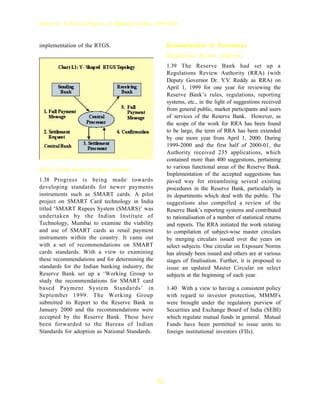
  (ii) Adoption of the ‘Y’ topology for the RTGS                     payment systems which provides for a ‘tree’
       involving a service provider between the                      structure (for older banks) and a ‘star’ topology
       originator and beneficiary of the transaction and             (for newer banks) for inter branch networking
       its settlement in the books of the Reserve Bank               of individual banks with the proviso for a bank-
       (Chart I.1).                                                  level standardised gateway to the Indian
                                                                     Financial Network (INFINET).
  (iii) Constitution of five permanent Task Forces on
        a) Monetary Policy and related issues, b)               (vii) Strategies for computerisation and networking of
        Payment and Settlement Systems Oversight, c)                  bank branches, to ensure that most of the major
        Legal Issues, d) Technology Related Issues, and               centres are covered by the INFINET.


                                                           11
Report on Trend and Progress of Banking in India, 1999-2000


implementation of the RTGS.                            Rationalisation of Procedures
                                                       Regulations Review Authority
                                                       1.39 The Reserve Bank had set up a
                                                       Regulations Review Authority (RRA) (with
                                                       Deputy Governor Dr. Y.V. Reddy as RRA) on
                                                       April 1, 1999 for one year for reviewing the
                                                       Reserve Bank’s rules, regulations, reporting
                                                       systems, etc., in the light of suggestions received
                                                       from general public, market participants and users
                                                       of services of the Reserve Bank. However, as
                                                       the scope of the work for RRA has been found
                                                       to be large, the term of RRA has been extended
                                                       by one more year from April 1, 2000. During
                                                       1999-2000 and the first half of 2000-01, the
                                                       Authority received 235 applications, which
                                                       contained more than 400 suggestions, pertaining
Smart Card based Payment System                        to various functional areas of the Reserve Bank.
                                                       Implementation of the accepted suggestions has
1.38 Progress is being made towards                    paved way for streamlining several existing
developing standards for newer payments                procedures in the Reserve Bank, particularly in
instruments such as SMART cards. A pilot               its departments which deal with the public. The
project on SMART Card technology in India              suggestions also compelled a review of the
titled ‘SMART Rupees System (SMARS)’ was               Reserve Bank’s reporting systems and contributed
undertaken by the Indian Institute of                  to rationalisation of a number of statistical returns
Technology, Mumbai to examine the viability            and reports. The RRA initiated the work relating
and use of SMART cards as retail payment               to compilation of subject-wise master circulars
instruments within the country. It came out            by merging circulars issued over the years on
with a set of recommendations on SMART                 select subjects. One circular on Exposure Norms
cards standards. With a view to examining              has already been issued and others are at various
these recommendations and for determining the          stages of finalisation. Further, it is proposed to
standards for the Indian banking industry, the         issue an updated Master Circular on select
Reserve Bank set up a ‘Working Group to                subjects at the beginning of each year.
study the recommendations for SMART card
based Payment System Standards’ in                     1.40 With a view to having a consistent policy
September 1999. The Working Group                      with regard to investor protection, MMMFs
submitted its Report to the Reserve Bank in            were brought under the regulatory purview of
January 2000 and the recommendations were              Securities and Exchange Board of India (SEBI)
accepted by the Reserve Bank. These have               which regulate mutual funds in general. Mutual
been forwarded to the Bureau of Indian                 Funds have been permitted to issue units to
Standards for adoption as National Standards.          foreign institutional investors (FIIs).


                                                  12
Banking Developments and Perspectives


1.41 The Reserve Bank has permitted banks               Transparency and Disclosure
to fix service charges which would generally
                                                        1.44 In February 1999, the Reserve Bank
be based on the cost of providing services.             issued guidelines for improving transparency
Banks have also been urged to pay interest at
                                                        in the financial statements of banks.
the rate applicable for appropriate tenor of            Accordingly, banks were required to disclose
fixed deposit for the period of delay beyond
                                                        the following information as ‘Notes on
10/14 days in collection of outstation                  Accounts’ to their balance sheets from the year
instruments and pay penal interest at the rate
                                                        ended March 31, 2000: (i) maturity pattern of
of 2 per cent above the fixed deposit rate              loans and advances, investments in securities,
applicable for any abnormal delay that might
                                                        deposits and borrowings, (ii) foreign currency
be caused by bank branches in collection of             assets and liabilities, (iii) movements in NPAs,
outstation instruments.
                                                        and (iv) lending to sensitive sectors as defined
                                                        by the Reserve Bank from time to time. It was
1.42 The Reserve Bank also did away with                decided that the sensitive sectors in respect of
sample test checking of newly printed MICR              which information was to be disclosed for the
instruments at MICR cheque processing centres           year 1999-2000 would include (i) capital
before putting them into use and withdrew the           market, (ii) real estate and (iii) commodities.
requirement of obtaining succession certificate         Considering, however, the difficulties
from the legal heirs, irrespective of the amount        expressed by certain banks in disclosing the
involved in the account of a deceased                   maturity pattern of Indian Rupee assets and
customer.                                               liabilities, in the ‘Notes on Accounts’ as they

                                                        have not covered 100 per cent of their business
1.43 A few important developments during                under ALM system, banks were allowed to
the first half of the current year (April-              disclose, if need be, this information in the
September, 2000) as a result of implementation          Director’s Report. Banks were, however,
of the suggestions were : (a) putting in place          advised in May 2000 to disclose the above
in the Reserve Bank, a comprehensive                    information in the ‘Notes on Accounts’ to their
information transmittal system in electronic            balance sheets from the year ending March 31,
form for the benefit of seekers of information          2001. Such disclosures and transparency
from the Bank, (b) revision in the Bank’s               practices would help improve the process of
instructions relating to nomination facility for        expectation formation by market players and
the benefit of investors in Relief Bonds, (c)           eventually lead to effective decision-making by
increase in the limit of same day credit of             banks.
local/outstation instruments sent for collection
by banks from Rs.5,000 to Rs.7,500 per                  Institutional Reforms for Capacity Building
instrument, (d) streamlining the procedure for
prompt payment of interest to scheduled                 Credit Information Bureau
commercial banks on the eligible CRR                    1.45 There has been a widely felt need to
balances, and (e) relaxation in the prescribed          establish a Credit Information Bureau (CIB)
eligibility criteria for opening and maintaining        designed to obtain and share data on borrowers
Non-Resident External Rupee Accounts by the             in a systematic manner for sound credit
central co-operative banks.                             decisions, thereby helping to facilitate


                                                   13
Report on Trend and Progress of Banking in India, 1999-2000


   Box I.3: Working Group to Explore the Possibilities of Setting up a Credit
            Information Bureau in India – Major Recommendations
 The Working Group constituted by the Reserve Bank             framework and share such information among its
 to explore the possibilities of setting up a Credit           members.
 Information Bureau in India submitted its Report in
 November 1999. The major recommendations of the               The proposed Credit Information Bureau could be
 Working Group are indicated below.                            set up as a separate company jointly owned by
                                                               banks and FIs under the regulatory purview of the
 The existing legal framework does not permit                  Reserve Bank. Co-option of a foreign technology
 disclosure of information except in cases where there         partner/ collaborator would also provide the
 is explicit consent of the constituent or where suits         necessary expertise.
 have been filed. Amendments to existing Acts relating
 to banking sector or enactment of a master legislation        The Bureau should inherit the best international
 would be necessary to form a full-fledged Credit              practices with regard to collection of information,
 Information Bureau.                                           processing of data and sharing of information and it
                                                               should build up effective systems to ensure the
 Pending legislative changes, to begin with, a Credit          security of data maintained by it and restrict access
 Information Bureau can be set up to pool the limited          to its data base to institutions accredited by it and
 information as is possible under the existing legal           evolve an appropriate code of access.


avoidance of adverse selection. This would                     Inc. as foreign partners, to set up a CIB
also facilitate reduction in NPAs. In June 1999,               within the confines of the existing
a Working Group was constituted to explore                     legislation. The work of preparing a master
the possibilities of setting up a CIB in India.                legislation to establish a full-fledged Bureau
The Group, in its Report submitted to the                      is underway.
Reserve Bank, recommended the setting up of
a CIB in India (Box I.3).                                      Deposit Insurance Reform
                                                               1.47 Reforming the deposit insurance system
1.46 Based on the recommendations of the                       is a crucial component of the present phase of
Working Group and realising the importance                     financial sector reforms in India. Accordingly,
of developing better institutional mechanisms                  a Working Group was constituted by the
for sharing of credit-related information, the                 Reserve Bank on Reforms in Deposit Insurance
Union Budget 2000-01 announced the                             in India (Chairman: Shri Jagdish Capoor). The
establishment of a Credit Information                          Group submitted its Report in October 1999.
Bureau. Subsequently, in the Monetary and                      The major recommendations of the Group
Credit Policy of April 2000, the Reserve                       include: (i) fixing the capital of Deposit
Bank advised banks and financial institutions                  Insurance and Credit Guarantee Corporation
to make the necessary in-house arrangement                     (DICGC) at Rs.500 crore, to be contributed
for transmittal of the appropriate information                 fully by the Reserve Bank; (ii) withdrawing
to the Bureau. The State Bank of India (SBI)                   the function of credit guarantee on loans from
has entered into a Memorandum of                               DICGC; and (iii) risk-based pricing of the
Understanding (MOU) with the Housing                           deposit-insurance premium in lieu of the
Development Finance Corporation (HDFC),                        present flat rate system. The task of preparation
with Dun and Bradstreet Information                            of the new draft law has been taken up in
Services Ltd. and Trans Union International                    supersession of the existing law.


                                                          14
Banking Developments and Perspectives


Diversification in Banking Operations                          company will normally be 50 per cent
                                                               of the paid-up capital of the insurance
Insurance
                                                               company. On a selective basis, the
1.48 The Insurance Regulatory and                              Reserve Bank may permit a higher
Development Authority (IRDA) Act, 1999 was                     equity contribution by a promoter bank
passed by the Parliament. The Act is a major                   initially, pending divestment of equity
milestone in liberalisation as it opens the way                within the prescribed period. The
for private sector entry into the insurance                    eligibility criteria for joint venture
business. It also provides statutory backing to                participant as on March 31, 2000 will
the IRDA. Under this Act, foreign equity will                  be as under: (i) the net worth of the
be restricted to 26 per cent of the total paid-                bank should not be less than Rs.500
up capital.                                                    crore; (ii) the CRAR of the bank should
                                                               not be less than 10 per cent; (iii) the
1.49 With a view to assessing the scope,                       level of NPAs should be reasonable;
desirability and eligibility of institutions to                (iv) the bank should have net profit for
take up insurance business, draft guidelines                   the last three continuous years; and (v)
were initially framed for banks entering into                  the track record of the performance of
insurance business with risk participation as                  the subsidiaries, if any, of the
also for permitting banks to undertake fee-                    concerned bank should be satisfactory.
based business as insurance agents. On the
basis of feedback received from banks and                 3.   In cases where a foreign partner
financial insitutions (FIs), the Reserve Bank                  contributes 26 per cent of the equity
issued final guidelines for banks’ entry into                  with the approval of IRDA/Foreign
insurance business along with the                              Investment Promotion Board, more than
announcements in the Monetary and Credit                       one public sector bank or private sector
Policy for the year 2000-2001. The guidelines                  bank may be allowed to participate in
are as under:                                                  the equity of the insurance joint
                                                               venture.
   1.   Any scheduled commercial bank would
        be permitted to undertake insurance               4.   A subsidiary of a bank or of another
        business as an agent of insurance                      bank will not normally be allowed to
        companies on fee basis, without any                    join the insurance company on risk
        risk participation. The subsidiaries of                participation basis. Subsidiaries would
        banks would also be allowed to                         include bank subsidiaries undertaking
        undertake distribution of insurance                    merchant       banking,      securities
        product on agency basis.                               transactions, mutual fund, leasing
                                                               finance, housing finance, etc.
   2.   Banks which satisfy the eligibility
        criteria would be permitted to set up a           5.   Banks which are not eligible as joint
        joint venture company for undertaking                  venture participant, as above, can make
        insurance       business     with     risk             investments up to 10 per cent of the
        participation, subject to safeguards. The              net worth of the bank or Rs.50 crore,
        maximum equity contribution such a                     whichever is lower, in the insurance
        bank can hold in the joint venture                     company for providing infrastructure


                                                     15
Report on Trend and Progress of Banking in India, 1999-2000


       and services support. Such participation         The SBI’s share in equity would be 51 per
       shall be treated as an investment and            cent in the joint venture. The other equity
       should be without any contingent                 participants in the venture are Allahabad Bank
       liability for the bank.                          (8.5 per cent), Corporation Bank (8.5 per cent)
                                                        and Canara Bank (6 per cent). Credit Suisse
1.50 Prior approval of the Reserve Bank is              Financial Products, London (as the foreign
required for banks to enter into insurance              partner) would be holding 26 per cent equity
business. The Reserve Bank would give                   in the joint venture.
permission to banks on a case-by-case basis,
keeping in view all relevant factors including          Banks’ Investments
the position in regard to the level of NPAs of
                                                        Investment in Shares and Debentures
the applicant bank so as to ensure that NPAs
do not pose any future threat to the bank in            1.52 Effective April 24, 1999, the overall
its present or in the proposed line of activity,        ceiling of investment by banks in ordinary
viz., insurance business. With a view to                shares, convertible debentures of corporates
ensuring insulation of banking business from            and units of mutual funds (other than debt
any risks which may arise from insurance                funds), which was at 5 per cent of their
business, there should be ‘arms length’                 incremental deposits of the previous year, was
relationship between the bank and the                   enhanced to the extent of banks’ investments
insurance outfit. With the issuance of                  in venture capital. Such investments in venture
Notification by the Government, specifying              capital were also included under the purview
“Insurance” as a permissible form of business           of priority sector lending.
that could be undertaken by banks under
Section 6(1)(o) of the Banking Regulation               Valuation of Banks’ Investments
Act, 1949, applications were invited from               1.53 The Reserve Bank had advised the banks
banks with supporting documents for their               in April 1992 to bifurcate their investments in
entry into insurance business. While 12 banks           approved securities into ‘permanent’ and
had expressed their intention to enter into             ‘current’ categories, and to keep not less than
insurance business either by way of joint               30 per cent of their investments in the current
venture, strategic investments or agency                category from the accounting year 1992-93.
arrangements, applications to enter into                The ratio of current investments was gradually
insurance business on risk participation basis,         increased to a minimum of 70 per cent of the
supported by required documents have been               approved securities for 1998-99 and further to
received from three banks. Of these, “in                a minimum of 75 per cent for 1999-2000.
principle” approval has been given to two
banks, viz., SBI and Vysya Bank Ltd.
                                                        1.54 Under the Mid-term Review of Monetary
                                                        and Credit Policy of October 10, 2000, the
Subsidiary for Assaying and Hallmarking of              Reserve Bank finalised the guidelines on
Gold                                                    categorisation and valuation of banks’
1.51 The Reserve Bank granted ‘in principle’            investment portfolio. The guidelines would be
approval to the SBI for setting up the                  effective from the half-year ended September
subsidiary SBI Gold and Precious Metals                 2000. First, the banks are required to classify
Private Ltd. (SBIGPMPL) with an authorised              the entire investment portfolio (including SLR
and paid up capital of Rs.15 crore for                  securities and non-SLR securities) under three
undertaking assaying and hall marking of gold.          categories, viz., ‘Held to Maturity’, ‘Available

                                                   16
Banking Developments and Perspectives


for Sale’ and ‘Held for Trading’. The                   the capital market returns without exposing
investments in the ‘Held to Maturity’ category          them to undue risks arising from market
should not exceed 25 per cent of the total              volatility. The Reserve Bank circulated the
investments. The banks have been given the              draft guidelines in September 2000. The final
freedom to decide on the extent of holdings             guidelines were announced in October 2000,
under ‘Available for Sale’ and ‘Held for                after taking into account the views expressed
Trading’ categories. Secondly, investments              by the banks and other market participants.
classified under ‘Held to Maturity’ category            As per the final guidelines, the terms and
need not be ‘marked to market’ and will be              conditions for financing of initial public
carried at acquisition cost, unless it is more          offerings (IPOs) should be the same as those
than the face value, in which case the premium          applicable to advances against shares to
should be amortised over the period of                  individuals. As recommended by the
remaining maturity. The individual scrips in the        Committee, within the overall exposure to
‘Available for Sale’ category will be marked            sensitive sectors, the bank’s total exposure to
to market at the year-end or at more frequent           the capital market by way of investments in
intervals. The individual scrips in the ‘Held           ordinary shares, convertible debentures and
for Trading’ category will be marked to market          units of mutual funds (other than debt funds)
at monthly or at more frequent intervals.               should not exceed ‘5 per cent of total
Thirdly, the Reserve Bank will not announce             outstanding advances as on March 31 of the
the Yield to Maturity (YTM) rates for                   previous year’ as against the earlier ceiling
unquoted Government securities, as hitherto,            of ‘5 per cent of incremental deposits of the
for the purpose of valuation of investments by          previous year’. The Board of Directors of
banks. The banks are required to value the              banks shall formulate their policy on total
unquoted SLR securities on the basis of the             exposure to capital market, keeping in view
YTM rates to be put out by the Primary                  its overall risk profile. In respect of those
Dealers Association of India (PDAI) jointly             banks where the present outstanding
with the Fixed Income Money Market and                  investments in equities are relatively small
Derivatives Association (FIMMDA) at                     and well below the 5 per cent overall ceiling,
periodical intervals. The valuation of the other        as a prudential measure, the Board should also
unquoted non-SLR securities, wherever linked            lay down an annual ceiling for fresh
to the YTM rates, will be with reference to             investments in equities so that any increase
the YTM rates as put out by the PDAI/                   in fresh investments in equities takes place
FIMMDA.                                                 in a phased, gradual and cautious manner,
                                                        within the absolute ceiling fixed by the Board
Banks’ Investments in Capital Market                    for each year. The RBI-SEBI Technical

1.55 In pursuance of the Monetary and Credit            Committee will review the actual working of
Policy for 2000-01, a Standing Technical                the new guidelines in consultation with select
Committee of the Reserve Bank and SEBI on               banks.
Bank Financing of Equities was constituted to
develop operative guidelines for a transparent          Rural Credit, Housing Finance and Credit
and stable system of banks’ financing of                to Small Scale Industries
equities and investments in shares. The
Committee submitted its report to the Reserve           Rural Credit
Bank on August 30, 2000. The guidelines                 1.56 In order to strengthen the capital base
reflected the Committee’s approach to optimise          of the rural institutions, a sum of


                                                   17
Report on Trend and Progress of Banking in India, 1999-2000


Rs.152.65 crore was expended by the Central              for being considered for FDI/OCB/NRI
Government during 1998-99 to strengthen the              investment. This would cover extension of
capital base of Regional Rural Banks (RRBs).             credit facilities at the micro level to small
Besides, a budgeted sum of Rs.168 crore was              producers and small enterprises in the rural and
released for restructuring the capital base of           urban areas.
select RRBs during 1999-2000. The Reserve
Bank has been providing to National Bank for             1.58 The total ground level credit for
Agriculture and Rural Development                        agriculture and allied activities disbursed by
(NABARD), a General Line of Credit (GLC)                 co-operative banks and commercial banks
to enable it to meet the short-term credit               (including RRBs) increased by 13.2 per cent
requirements of co-operative banks and RRBs.             to Rs.41,764 crore during 1999-2000 from
For the year 1999-2000 (July–June), the Reserve          Rs.36,897 crore during 1998-99. The
Bank renewed a credit limit of Rs.5,700 crore,           NABARD has been playing a significant role
sanctioned in the previous year, to NABARD               in providing and facilitating adequate credit
consisting of Rs.4,850 crore under GLC I (for            support to agriculture and other rural activities.
seasonal agricultural operations) and Rs.850             The amount of funds sanctioned and disbursed
crore under GLC II (for various other approved           by NABARD under Rural Infrastructure
short-term purposes). In view of the increase            Development Fund (RIDF) amounted to
in sanction of credit limit by NABARD to co-             Rs.14,923 crore and Rs.6,680 crore,
operatives and RRBs in general, and for meeting          respectively, as at end-August 2000. Kisan
the additional requirements of funds on account          Credit Cards (KCC) numbering 57.41 lakh
of cyclone /floods in Orissa in particular, an           were issued by PSBs, RRBs and co-operative
additional limit of Rs.400 crore under GLC I             banks; the amount sanctioned under this
was sanctioned in December 1999, on request              scheme amounted to Rs.9,632 crore as at end-
by NABARD.                                               March 2000. All PSBs have been advised to
                                                         set monthly targets within the yearly target
1.57 Provision of micro-credit by banks has              fixed for the bank and draw action plan for
emerged as an important instrument for                   achieving the overall target. The role played
alleviating poverty, particularly in rural areas,        by NABARD and co-operative banks in
as this raises the productive capacity of the            augmenting the flow of credit to the rural
beneficiaries. Banks were accordingly advised            sector is detailed in Chapter III, while that of
in February 2000 to make micro-credit an                 commercial banks (including RRBs) is detailed
integral part of their corporate credit plan.            in Chapter II of this Report.
Micro-credit is reckoned as part of banks’
priority sector lending since February 2000.             Housing Finance
Further, with a view to providing an additional          1.59 Commercial banks were advised to
avenue for bank’s lending to agriculture and             compute their minimum share of housing
increasing the outreach of banks in rural areas,         finance allocation for 1999-2000 and 2000-01
lending by banks to non-banking financial                at 3 per cent of their incremental deposits of
companies (NBFCs) for on-lending to                      the previous year or the amount of housing
agriculture is reckoned for the purpose of               finance allocation fixed for the previous year,
priority sector lending as indirect finance to           whichever was higher. Prior to October 1999,
agriculture since April 2000. In a significant           indirect housing loans sanctioned by banks to
move, micro-credit/ rural credit has been                intermediary housing agencies against the
included in the list of eligible NBFC activity           direct loan sanctioned/proposed to be

                                                    18
Banking Developments and Perspectives


sanctioned by the latter were reckoned as part            by accepting bills drawn on corporates by their
of their housing finance allocation, provided the         suppliers, particularly those belonging to the
loan per borrower by such intermediary                    SSI sector. This was aimed at development of
agencies did not exceed Rs.5 lakh and Rs.10               a bills culture. Effective October 29, 1999,
lakh in rural/semi-urban and urban/                       banks were given freedom to charge interest
metropolitan areas, respectively. In order to             rates on discounting of bills without reference
enhance the flow of credit to housing sector,             to PLR, thereby enabling banks to offer
effective October 29, 1999, banks were advised            competitive rates of interest. This measure
that housing finance sanctioned by them to                would motivate corporates to make use of the
housing finance intermediary agencies would               bill route for receiving/paying their credit
henceforth be reckoned for the purpose of                 sales/credit purchases. In view of the above
achievement of their housing finance                      and considering the operational problems faced
allocations, irrespective of the per borrower             by banks in implementing the bills discipline,
size of the loans extended by these agencies.             the mandatory minimum 25 per cent for
                                                          acceptance of bills was withdrawn, effective
Credit to Small Scale Industries                          November 2, 1999.
1.60 Total credit provided by PSBs to small-
scale industries (SSIs) as at end-March 2000              1.62 As a part of follow up of the Union
constituted 15.6 percent of net bank credit and           Budget 2000-01 proposals, the Reserve Bank
35.8 per cent of total priority sector advances           increased the limit for collateral requirement
of these banks. Out of the advances to SSI                on loans from Rs.1 lakh to Rs.5 lakh in respect
sector, the advances to tiny sector (i.e. to units        of the tiny sector. To promote credit flow to
where investment in plant and machinery does              small borrowers, the composite loan limit (for
not exceed Rs.25 lakh) constituted 54.0 per               providing working capital and term loans
cent of advances to SSI sector. Those banks               through a single window) was increased from
which have not achieved the priority sector-              Rs.5 lakh to Rs.10 lakh. PSBs were requested
lending target of 40 per cent even after                  to accelerate their programme of SSI branches
effecting their contribution to the RIDF, have,           to ensure that every district and SSI clusters
however, been included in the consortium for              within districts are well served by at least one
providing finance to the Khadi and Village                specialised SSI bank branch. The Government
Industries Commission (KVIC). Such credit is              decided that SSI branches would need to obtain
reckoned as their indirect lending to SSIs under          ISO certification to improve the quality of their
the priority sector. These loans are provided             banking services. A new central credit
at 1.5 percentage points below the average                guarantee scheme for SSI is proposed to be
prime lending rates (PLRs) of five major banks            implemented through Small Industries
in the consortium. As at the end of June 2000,            Development Bank of India (SIDBI), which
an amount of Rs.518.18 crore was outstanding              would cover loans up to Rs.10 lakh for the
out of an amount of Rs.704.00 crore disbursed             banking sector. The guaranteed loans would be
by the consortium under the scheme.                       securitised and tradable in the secondary debt
                                                          market. Further, PSBs have been advised to
1.61 Banks were advised in January 1998 to                complete the process of opening/
ensure that their corporate borrowers financed            operationalising SSI branches by December
at least 25 per cent of their credit purchases            2000.


                                                     19
Report on Trend and Progress of Banking in India, 1999-2000


2. Financial Performance of                              in operating profits of foreign banks too
   Scheduled Commercial Banks                            turned out to be high at around 51.5 per cent
                                                         as against a decline of 30.3 per cent during
   during 1999-2000                                      1998-99.
1.63 This Section presents highlights of the
financial performance of scheduled commercial            1.66 PSBs exhibited an operating profit
banks during the year 1999-2000 on the basis             growth of 23.7 per cent during 1999-2000 as
of the balance sheets of these banks. The                compared with a marginal increase of 2.8 per
analysis is in terms of both the aggregate and           cent during 1998-99. Even more spectacular
group-wise position of scheduled commercial              was the increase in net profits (57.2 per cent)
banks.                                                   as against a decline of 35.3 per cent in 1998-
                                                         99. The improved financial performance of
Profitability                                            PSBs, despite a sharper increase in interest
                                                         expenditure (15.8 per cent) than that in interest
1.64 The operating profits of scheduled
                                                         income (14.5 per cent), was attributable to the
commercial banks increased by Rs.4,613 crore
                                                         spurt in other income and deceleration in
in 1999-2000 (33.4 per cent) to Rs.18,423
                                                         operating expenses. Booking of capital gains
crore as against a decline of Rs.830 crore (5.7
                                                         by PSBs in their treasury operations in the
per cent) in 1998-99. Net profits increased by
                                                         context of the downward movement of interest
Rs.2,816 crore (62.7 per cent) to Rs.7,306
                                                         rates, inter alia, boosted their other income.
crore during 1999-2000 as against a decline
of Rs.2,012 crore (30.9 per cent) during 1998-           1.67 As a proportion of total assets,
99. As a share of total assets, operating and            provisions and contingencies of scheduled
net profits increased by 21 and 19 basis points          commercial banks increased by 2 basis points
to 1.66 per cent and 0.66 per cent, respectively,        to 1.00 per cent during 1999-2000. The
during 1999-2000 as against a decline of 39              aggregate figure, however, hides the vast
and 35 basis points, respectively, during                differences in bank-group-wise position in
1998-99. The improvement in financial                    respect of provisions. On the one hand,
performance reflected (i) higher rate of growth          provisions by both foreign and new private
in interest income than interest expenditure             sector banks increased sharply by 44 basis
during 1999-2000, ii) a lower rate of growth             points and 40 basis points, respectively, to 2.07
in operating expenses during 1999-2000 as                per cent and 1.15 per cent, respectively, during
compared with that in the preceding year, and            1999-2000 while provision of old private
iii) a higher rate of growth in other income             sector banks increased by 27 basis points to
than that in 1998-99.                                    1.00 per cent. On the other hand, provisions
                                                         by PSBs declined by 6 basis points to 0.89
1.65 Operating and net profits across all                per cent, mainly due to the sharp decline in
bank groups exhibited a substantial increase             the provisions of 17 basis points by the SBI
during 1999-2000 as against a decline across             Group. Provisions by nationalised banks
all bank groups (barring nationalised banks              increased marginally by one basis point.
in operating profits) during 1998-99. In
particular, new and old private sector banks             Spread
registered operating profit growth of 81.8 and
80.4 per cent respectively, during 1999-2000,            1.68 The movements in the interest income
as against a decline of 7.5 and 26.8 per cent,           and interest expenditure were influenced by
respectively, in the preceding year. The rise            liquidity conditions and the varying response

                                                    20
Banking Developments and Perspectives


of major bank groups to the monetary policy             per cent. The share of loans and advances
signals of the Reserve Bank. The spread of              and investments in the total assets increased
PSBs declined by 10 basis points to 2.70 per            to 39.9 per cent and 37.3 per cent,
cent during 1999-2000, due to a 9 basis points          respectively, as at end-March 2000.
fall in interest income. The spread of SBI and
nationalised banks group declined by 9 and 10           Off-Balance Sheet Activities
basis points, respectively. The spread of
                                                        1.71 Reflecting the growing importance of
foreign banks improved sharply by 38 basis
                                                        non-fund based activities of the banking sector,
points owing to a sharper fall in interest
                                                        the off-balance sheet exposures (contingent
expenditure compared with that of interest
                                                        liabilities) of all SCBs recorded an increase
income. While the spread of old private sector
                                                        of 27.6 per cent to Rs. 5,84,441 crore in 1999-
banks improved by 18 basis points, that of new
                                                        2000, led by a sharp increase of 31.4 per cent
private banks declined by 11 basis points. The
                                                        in forward exchange contracts. The off-balance
interest rate spread varied markedly across
                                                        sheet exposures as a proportion to the total
major bank groups – from 1.87 per cent for
                                                        liabilities of all SCBs increased by 4.4
new private sector banks to 3.85 per cent for
                                                        percentage points from 48.2 per cent in 1998-
foreign banks. For the SCBs, the spread
                                                        99 to 52.6 per cent in 1999-2000.
continued to exhibit a declining trend and was
at 2.72 per cent during 1999-2000 as against
                                                        Non-Performing Assets
2.78 per cent during 1998-99.
                                                        1.72 During 1999-2000, there was a marked
Intermediation Cost                                     improvement in the proportion of net NPAs to
                                                        net advances with the number of PSBs with
1.69 An indicator of competitiveness in                 net NPAs up to 10 per cent increasing from
banking is the intermediation cost (i.e.                18 to 22. Similarly, the number of old private
operating expenses as a proportion of total             sector banks and foreign banks with net NPAs
assets). There was a sizeable decline in the            of less than 10 per cent went up from 17 to
intermediation cost of SCBs to 2.49 per cent            18 and from 27 to 31, respectively. New
during 1999-2000 from 2.67 per cent in 1998-            private banks continued to have net NPAs
99, with wage bill declining from 1.75 per cent         below 10 per cent during 1999-2000.
to 1.66 per cent. Among the bank groups, the
highest order of decline in intermediation cost         Capital to Risk-Weighted Assets Ratio
during 1999-2000 was recorded by the foreign
banks (38 basis points). New private sector             1.73 As against the stipulated minimum
banks recorded the lowest intermediation cost           CRAR of 9 per cent of scheduled commercial
(1.42 per cent). PSBs recorded a decline of 14          banks, all but one PSB attained the norm
basis points in intermediation cost to 2.52 per         during 1999-2000. This achievement needs to
cent during 1999-2000.                                  be viewed against the fact that no public sector
                                                        bank was recapitalised during 1999-2000. Of
                                                        the 24 old private sector banks, 21 banks met
Size of Balance Sheet
                                                        the 9 per cent norm. All the 8 new private
1.70 The share of capital in total liabilities          sector banks and 42 foreign banks had CRAR
declined to 1.66 per cent as at end-March 2000          in excess of 9 per cent. It may be recalled that
from 1.92 per cent as at end-March 1999. With           the Narasimham Committee II had emphasised
regard to assets, scheduled commercial banks            the raising of CRAR to 10 per cent by end-
were able to increase their total assets by 16.8        March 2002. 22 PSBs, 19 old private sector

                                                   21
Report on Trend and Progress of Banking in India, 1999-2000


banks, 7 new private sector banks and 37                 new framework on emerging market economies
foreign banks had CRAR in excess of 10 per               like India, the Reserve Bank constituted an
cent as at end-March 2000.                               internal Working Group to examine the impact,
                                                         applicability, scope, problems and the time span
3. Perspectives                                          of its implementation in India. The Reserve
                                                         Bank has finalised its views on the basis of
1.74 As the present phase of reforms
                                                         the recommendations of the Group, and
gathers momentum and competitive pressures
                                                         subsequently forwarded its comments to the
become strong, more focussed attention would
                                                         Basle Committee. The main thrust of the
need to be paid to inter-related sets of issues
                                                         comments is to ensure sufficient flexibility in
regarding (a) strengthening the foundation of
                                                         the framework to fully reflect the macro-
the banking system; (b) streamlining banking
                                                         economic environment, structural rigidities and
procedures including upgrading of
                                                         concerns of emerging markets. The Reserve
technologies and networking; and (c) effecting
                                                         Bank felt that where banks are of simple
structural changes in the system.
                                                         structure and have subsidiaries, the framework
1.75 It needs to be recognised that given the            could be adopted on stand-alone basis with the
size of the financial system, broadly defined,           full deduction of equity contribution made to
the question of banking soundness cannot be              subsidiaries from the total capital. Besides,
analysed in isolation from the broader system.           national supervisors should have discretion to
This is because financial disturbances, wherever         prescribe a material limit up to which cross-
they originate, can have serious consequences            holdings could be permitted. Moreover, the
for the rest of the economy. In view of the              Reserve Bank felt that assigning greater role
universalisation of banking operations, the walls        to external rating agencies in regulatory
between banks and non-bank entities are getting          process would not be desirable. Instead,
gradually blurred. However, banks in their               domestic credit rating agencies, which are
present structural form continue to have                 more adequately informed, would be more
strategic importance, notwithstanding the                effective, subject to adequate safeguards.
importance of other major entities of the                Further, the Reserve Bank viewed that risk
financial system, viz., development financial            weights of banks ought to be de-linked from
institutions (DFIs) and NBFCs.                           that of the sovereign. Instead, preferential risk
                                                         weights in the range of 20-50 per cent, on a
Strengthening the Commercial Banking                     graded scale may have to be assigned on the
System                                                   basis of risk assessments by domestic rating
                                                         agencies. Furthermore, the proposal for
Capital Adequacy Measures
                                                         assigning favourable risk weight to short-term
1.76 Capital constitutes the basic cushion as            claims would jeopardise the stability of the
a rescue for contingencies. The Basle                    international financial architecture. Again, the
Committee on Banking Supervision (BCBS)                  proposal to link the banking supervisor
had released a Consultative Paper on New                 implementing/endorsing the Core Principles
Capital Adequacy Framework in June 1999                  for Effective Banking Supervision was not
to further strengthen the soundness of the               considered desirable. Finally, while the
financial system and better align regulatory             Committee’s views on increased disclosures
capital with the underlying risks faced by               and enhanced transparency are reasonable,
banks. Recognising the implications of the               national supervisors should consider the ability


                                                    22
Banking Developments and Perspectives


of the market to logically interpret the                         with its explicit emphasis on ratings, internal
information.                                                     and external, are likely to have implications
                                                                 for the required levels of capital (Box I.4).
1.77 The new capital adequacy norms
proposed by the BCBS in June 1999, if                            These issues gain in importance in view of
implemented, are likely to be stricter than                      Government ownership of banks and the
those prevailing at present. The new norms                       ability of the PSBs to raise capital either


                                        Box I.4: Ratings of Banks
 The Basle Committee on Banking Supervision (BCBS)               The Reserve Bank, however, favoured greater
 has proposed a revised Capital Adequacy Framework               reliance on internal ratings-based approach for banks,
 in 1999, which uses a three-pillar approach consisting          which could be structured under an acceptable
 of (a) a minimum capital requirements pillar, (b) a             framework so that a standardised approach to internal
 supervisory review pillar to ensure that the bank’s             rating could be adopted. The internal ratings-based
 capital is aligned to its actual risk profile, and (c) a        approach could incorporate supplementary customer
 market discipline pillar to enhance the role of the             information, which is typically not available to credit
 other market participants in ensuring that appropriate          assessment institutions. It could also extend to a
 capital is held by prescribing greater disclosure. The          greater number of counter-parties, such as, unrated
 revised framework is presently being discussed by               borrowers in the small/retail sector. This would
 supervisory authorities all over the world.                     encourage banks to refine their risk assessment and
                                                                 monitoring process, which would facilitate better
 The revised framework places an explicit emphasis               management of their loan books. The regulators
 on ratings. Risk differentiation between counterparties,        should, however, evolve suitable process and criteria
 be they sovereign governments, banks, corporates,               for approving the rating framework so as to ensure
 public sector enterprises or securities firms is sought         the integrity of different banks’ systems and that the
 to be done either on the basis of external or internal          parameters are consistent across various institutions.
 ratings. In broad summary, the weights based on                 While encouraging banks to use their own internal
 external risk assessment proposed for claims on                 rating systems for distinguishing better the credit
 sovereign governments, banks and corporates are                 quality, the issues that need to be addressed relate
 presented in Table 1.                                           to: (i) mapping of bank grades into a series of


               Table 1: Proposed Risk Weights based on External Risk Assessment

 Assessment                                                              Claim on
                                           Sovereign                       Banks                             Corporates
                                         Governments               Option 1            Option 2
 1                                                    2                    3                   4                          5
 AAA to AA-                                           0                   20                 20                       20
 A+ to A-                                            20                   50                 50 *                    100
 BBB+ to BBB-                                        50                  100                 50 *                    100
 BB+ to B-                                         100                   100                100 *                    100
 Below B-                                          150                   150                150                      150
 Unrated                                           100                   100                 50 *                    100
 * Claims on banks of short-term maturity, e.g., less than 6 months would receive a weighting that is one category
   more favourable than the usual risk weight on the bank’s claim.
 Option 1 : Based on risk weight of sovereign where bank is incorporated.
                                                                                                            (Contd....)
 Option 2 : Based on assessment of the individual bank.


                                                            23
Report on Trend and Progress of Banking in India, 1999-2000


   (...Concld.)


  regulatory risk-weight baskets; (ii) development of              upper limit on corporate credit ratings, irrespective
  capital charge on the basis of rating grades; (iii)              of their individual creditworthiness and past debt
  ensuring consistency between the standardised                    service record.
  approach and an internal ratings-based approach; and
  (iv) minimum standards and sound practical                       Yet another type of rating that can be expected to
  guidelines for key elements of rating process and                play a significant role is supervisory rating. The
  supervisory process. Besides, a common standards                 second pillar of the new framework expects
  review mechanism would need to be put in place.                  supervisors to specify bank-specific capital add-ons
                                                                   based on the risk profile of individual banks, thereby
  Secondly, with regard to the new framework, the                  effectively raising the Basle minima for riskier banks.
  Reserve Bank has preferred that assessments be made              Although supervisors would use different methods to
  by the domestic rating agencies for assigning                    diagnose the risk profile of their banks, it can be
  preferential risk weights for banking book assets                expected that some would use the component or
  (excluding claims on sovereign), subject to adequate             composite ratings of supervisory rating models (such
  safeguards. In its view, domestic rating agencies that           as CAMELS) which can provide useful indicators of
  have up-to-date and ongoing access to information on             risk profile. Whatever be the manner of determining
  domestic macro-economic conditions, legal and                    risk profile, what is evident is that several banks in
  regulatory framework, etc. would be better placed to             the Indian context could be expected to have higher
  rate domestic entities vis-à-vis external rating                 than system capital charge required of them, which
  agencies. This would also facilitate the national                would eventually raise the capital requirements for
  supervisory authorities to have greater access to the            the system as a whole.
  quality of assessment sources and methodologies used
  by various rating agencies and also facilitate evolving          References
  country-specific parameters for rating of various
  counter-parties. In general, the skepticism about the            Karacadag, C. and M.W.Taylor (2000), ‘The New
  role of external rating agencies arises because different            Capital Adequacy Framework: Institutional
  external rating agencies resort to different parameters              Constraints and Incentive Structures’, IMF
  for risk evaluation, which are often not transparent.                Working Paper No. 93, IMF: Washington.
  Apart from the lack of uniformity in selection of
  parameters, the mix and weightage of objective and               Monfort, B. and C.Mulder (2000), ‘Using Credit
  subjective factors also vary across agencies, which,                Ratings for Capital Requirements on Lending to
  in the Reserve Bank’s view, may lead to incorrect                   Emerging Market Economies: Possible Impact of
  assessments. Due to enormous subjective element                     a New Basle Accord’, IMF Working Paper No.
  involved in the rating process and the lack of                      69, IMF: Washington.
  transparency in risk assessment, and other reasons,
  the role proposed to be assigned to the external rating          Reserve Bank of India (2000), ‘Comments of the
  agencies is a matter of supervisory concern. This is                 Reserve Bank of India on A New Capital
  particularly so in emerging market economies which                   Adequacy Framework’, Reserve Bank of India:
  are assigned sovereign credit ratings which put an                   Mumbai.


internally or from the market. It appears that                     by contribution from the owners/shareholders
even after allowing for additional infusion of                     or whether legislative ceiling for capital to
capital through internal generation and access to                  be subscribed by the public should be raised.
subordinated debt, the gap between the additional                  Provision of banks’ capital by the Reserve
capital requirement and the leeway available to                    Bank would tantamount to monetisation with
raise capital from the market is likely to remain                  inflationary implications, while contribution
quite sizeable. In this situation, an issue that would             to additional capital by the Government will
require critical attention and would need to be                    adversely impact the fiscal situation.
resolved is whether this gap should be filled                      Therefore, there seems on balance, to be a


                                                              24
Banking Developments and Perspectives


strong case for raising the legislative ceiling             doing so, banks would need to critically
for market participation in equity capital of               evaluate their risk management systems in the
PSBs. In this context, the pronouncement in                 light of the guidelines issued by the Reserve
the Union Budget 2000-01 that the                           Bank and evolve an appropriate system to
Government would reduce its holdings in                     overcome the existing deficiencies and institute
PSBs to 33 per cent while ensuring that                     the requisite improvements.
banks retain their public sector character,
assumes importance.                                         1.80 The need for putting in place ALM and
                                                            risk management systems in banks has
Asset-Liability Management                                  underscored the imperative of building internal
1.78 The increasing internationalisation of                 capacities to make appropriate analysis of the
banking operations engenders the possibility of             evolving domestic and international business
a significant mismatch between assets and                   and economic circumstances. These include
liabilities, which have adverse implications for            both market conditions and the issues arising
liquidity and solvency of the banking sector.               out of financial market integration. In this
In this context, pro-active ALM assumes                     context, the role of bank economists assumes
importance. Broadly, the objectives of ALM                  crucial importance. Bank managements will
are to contain the volatility of net interest               have to reorient and restructure their statistical
income and net economic value of a bank. The                and economics wings in a way that economists
supplementary objectives would be to reduce                 in Indian banks have an important role to play
variability in all target accounts including                as much as in most international banks.
control of liquidity risk, and to ensure balance
between profitability and asset growth. To                  Risk Based Supervision
realise these objectives, asset-liability managers
                                                            1.81 Considering the complexities of banking
must be guided by policies that specifically
                                                            business and emerging product innovations
address the bank’s overall ALM goals and risk
                                                            with complex risk profiles, there is a growing
limits, and also by information that relates
                                                            acceptance that a Risk Based Supervision
directly to its asset-liability positions. Such risk
                                                            (RBS) approach would be more efficient than
management strategies would help to reduce
                                                            the traditional transaction based approach.
the adverse effects of macro-economic shocks
                                                            RBS entails monitoring of banks by allocating
on the soundness of the financial system.
                                                            supervisory resources and focusing
                                                            supervisory attention according to the risk
Risk Management
                                                            profile of each institution. The instruments of
1.79 Given the diversity and varying size of                RBS are off-site monitoring and on-site
balance sheet items among banks as well as                  inspection supplemented by market
across the bank-groups, the design of risk                  intelligence mechanism. However, off-site
management framework would need to be                       surveillance       has     gained      primacy
geared to meet bank-specific requirements,                  internationally in recent times, given the ease
covering the size and complexity of their                   and promptness of monitoring (Box I.5).
business, risk philosophy, market perception                Therefore, the Reserve Bank has decided to
and the existing level of their capital. In other           gradually move towards a risk based approach
words, banks would need to evolve their own                 to inspection. Apart from strengthening the
systems compatible with the type and size of                risk modelling capabilities based on off-site
operations as well as risk perception. While                data and associated research for ‘predictive


                                                       25
Report on Trend and Progress of Banking in India, 1999-2000


   Box I.5: Off-site Monitoring and Surveillance Systems in Select Countries
 The growing complexity of financial institutions                 received from banks include prudential ratios, balance
 coupled with the need for frequent and continuous                sheet and off-balance sheet exposures, and profit and
 monitoring has made off-site monitoring an important             loss accounts. While prudential ratios and balance
 instrument of supervision. Countries all over the world          sheet are received on quarterly basis (some of the
 have embraced off-site surveillance mechanisms in                institutions submit them on monthly basis), profit and
 varying degrees. The Monetary and Credit Policy of               loss account and prudential ratios like capital
 April 2000 has observed that the Reserve Bank would              adequacy and solvency ratios are required to be
 draw on other countries’ experiences in moving                   submitted on half-yearly basis. In addition to the
 towards RBS and it would be instructive, in this                 above off-site returns received from the supervised
 context, to examine the off-site monitoring procedures           institutions, the Commission also receives two reports
 adopted in different countries.                                  relating to internal controls containing details of
                                                                  internal control policies every year. The off-site
 United Kingdom: In the UK, integrated supervision                information is supplemented by on-site inspection
 over the financial system is carried out by the                  reports. Actions under off-site surveillance are
 Financial Services Authority (FSA). The FSA system               preventive measures like advising bank management,
 of bank supervision is predominantly off-site with               resorting to on-site inspection and other measures and
 most of the on-site work being done by accountancy               disciplinary sanctions.
 firms called ‘reporting accountants’ specialising in
 bank audit. The off-site database of FSA includes                Singapore: Bank supervision in Singapore is the
 statistical returns submitted by banks to the Bank of            responsibility of the Monetary Authority of Singapore
 England and information available within FSA files               (MAS). The authority’s off-site monitoring system
 about the banks. Banks are required to submit returns            complements and provides the basis for continuous
 covering aspects of capital adequacy, balance sheet,             supervision of banks. Under the off-site system, the
 profit and loss account, liquidity and large exposures,          MAS has prescribed a set of returns of varying
 large deposits, foreign exchange exposures and                   periodicity (monthly, quarterly and annual). The
 country exposures. Risk assessment of banks is carried           returns cover the capital adequacy, asset quality,
 out on the basis of CAMELB factors (capital, assets,             statutory liquidity, connected lendings, call money
 market risk, earnings, liabilities and business) covering        borrowings, negotiable certificates of deposit, balance
 business risk and COM factors (internal controls,                sheet, large borrowers, profit and loss account, foreign
 organisation and management). The supervisory                    exchange business transacted and loan syndication.
 process is divided into three phases, viz., risk                 The returns are analysed by a team of off-site analysts,
 assessment phase, tools of supervision and risk                  each analyst being responsible for a portfolio of banks.
 evaluation phase. The concerns identified by off-site            The results of the off-site analysis are conveyed to
 analysis are supplemented by one or all of the tools             the on-site examination division. Specific concerns
 of supervision, i.e., accountants reports, traded markets        arising out of the off-site analysis are also investigated
 team visit, risk review team visit, liaison with overseas        through targeted appraisals carried out by on-site
 regulators, prudential and ad-hoc meetings with the              examination teams.
 banks. The risk-based supervisory process is dynamic,
 in that the analyst receives new information                     Hong Kong: The Hong Kong Monetary Authority
 throughout the process. This may cause the analyst               (HKMA) is entrusted with the responsibility of
 to adapt or revise supervisory actions and initiatives           promoting general stability and effective working of
 throughout the supervisory period.                               the banking system under the Banking Ordinance. A
                                                                  member of off-site team is assigned to supervise a
 France: Supervision over the banking system is                   portfolio of banks as a Case Officer and to do all
 carried out by the French Banking Commission known               related off-site supervisory work. The HKMA’s
 as Commission Bancaire. The off-site monitoring                  approach is that of continuous supervision through a
 system involves prudential regulation of banks on five           combination of on-site inspection, off-site reviews and
 parameters, viz., minimum capital and reserves,                  prudential meetings. HKMA collects monthly/quarterly
 liquidity, large exposures ratio, solvency ratio and             prudential off-site returns covering assets and
 capital adequacy ratio. Quarterly monitoring of bank’s           liabilities, profit and loss, capital adequacy, liquidity,
 compliance with the prescribed guidelines is done and            large exposures, loan classification, maturity profile
 any violations are taken up with the bank. The returns                                                         (Contd....)


                                                             26
Banking Developments and Perspectives


  (...Concld.)


 of assets and liabilities, foreign exchange position,           report covers all the important supervisory indicators.
 interest rate risk, country risk, market risks and a            Comparisons with the peer group are also provided.
 certificate of compliance with various requirements             Peer group is arrived at on the basis of asset size of
 under the law. These returns are called either on an            the existing banks and newly established banks are
 individual basis, or combined or in the case of capital         grouped separately.
 adequacy, liquidity and large exposures, on a
 consolidated basis. The accuracy of submitted returns           India: In India, as part of the new supervisory strategy
 and the quality of systems are regularly scrutinised            piloted by the Board for Financial Supervision (BFS),
 by external auditors, besides by the HKMA’s on-site             the Reserve Bank set up an Off-Site Monitoring and
 supervisors. There is a CAMEL rating system in place            Surveillance system (OSMOS) in 1995 in order to
 to trigger discriminatory supervision. Off-site                 supplement the existing system of on-site inspections
 examiners use the data to make regular (at least                and to provide a means of closer and continuous
 annual) off-site reviews, which result in a CAMEL               monitoring of bank performance. Under OSMOS,
 type rating and they also set the triggers for each bank        banks are required to submit quarterly and half-yearly
 or bank group. Where there are causes for concern,              returns on several aspects of financial performance,
 the reviews are more frequent. The off-site examiners           including asset quality, capital adequacy, large
 also run regular reports mirroring bank performance             exposures, connected lending, ownership patterns, etc.
 on the bank data.                                               As a move towards further strengthening the off-site
                                                                 monitoring process, a second tranche of four returns
 United States: In the US, the Board of Governors of             covering liquidity and interest rate risk in local and
 Federal Reserve (FED) is responsible for supervising            foreign currencies has recently been introduced. A
 national banks. The Federal Deposit Insurance                   return covering critical information about the
 Corporation (FDIC) and the Office of the Comptroller            operations of Indian subsidiaries of banks has been
 of Currency (OCC) are responsible for supervision of            introduced, effective quarter ended September 2000
 other types of banks. The supervision is basically              as a move towards consolidated supervision of banking
 conducted by a very strong on-site examination. This            groups. Standard reports and detailed individual and
 is supplemented by the off-site surveillance process            systemic analyses are carried out and shared with the
 called the Financial Institutions Monitoring Systems            Bank Monitoring Divisions of respective banks to
 (FIMS), which is used to track the financial condition          initiate timely supervisory intervention.
 of individual banks and banking organizations between
 on-site examinations. Based on the call reports, which          Off-site surveillance in different economies has
 cover the entire gamut of banking operations including          evolved over a period of time, depending on the
 Capital Adequacy, Asset Quality, Earnings and Large             country’s financial system and their level of
 exposures, received from the bank, the FED prepares             development. As the supervisory framework acquires
 a Uniform Bank Performance Report (UBPR) bank-                  greater sophistication, it is expected that the off-site
 wise or bank-holding company (BHC)-wise. UBPR                   surveillance will acquire greater prominence for
 covers five quarter’ data. This report is generated at          developing policy positions that are both relevant and
 quarterly intervals and forwarded to banks/ BHCs. The           beneficial.


supervision’, the overall compliance burden                      tools, techniques, systems, available IT
under the RBS framework is likely to be                          infrastructure and various internal and external
largely rationalised.                                            linkages. The thrust of the Phase 1
                                                                 recommendations is on enhancements to the
1.82 To develop an overall plan for moving                       regulation and supervision framework leading
towards RBS, international consultants were                      to increased effectiveness of overall
appointed. They completed Phase 1 of the                         supervision through greater focus on risk as
project by conducting a review and evaluation                    well as a realignment of the inspection process
of the current supervisory and regulatory                        to fall in line with a more risk-based approach.
framework, policies, guidelines, instructions,                   Their recommendations cover vital areas, such

                                                            27
Report on Trend and Progress of Banking in India, 1999-2000


as, data management, supervisory process,                 Advisory Group on Transparency in Monetary
inspections, feedback to banks, external audit,           and Financial Policies (Chairman: Shri
etc. During Phase 2 of the project, the                   M.Narasimham) has submitted its report to the
Consultants are expected to work out the                  Chairman of Standing Committee on September
practical and operational aspects of the above            13, 2000. The Group has examined in detail
recommendations and suggest a new RBS                     issues related to the clarity of roles and
framework including the sequencing of                     responsibilities including transparency in
different stages and a time frame for                     monetary        policy      formulation        and
implementation.                                           implementation. Further, the Advisory Groups
                                                          on Banking Supervision (Chairman: Shri
International Financial Standards and Codes               M.S.Verma), Insurance Regulation (Chairman:
                                                          Shri R.Ramakrishnan) and Payment and
1.83 Against the background of financial and
                                                          Settlement System (Chairman: Shri M.G.Bhide)
currency crises in some parts of South-East
                                                          submitted the first part of their Reports in
Asia, Mexico, Brazil and Russia, the systemic
                                                          September 2000. The Report on “Banking
stability issues have come under a sharp focus.
                                                          Supervision” has taken an exhaustive account
Best market practices, transparency and data
                                                          and given recommendations pertaining to four
dissemination have been increasingly viewed as
                                                          major areas in banking regulation, viz., corporate
important areas where standards, codes, and
                                                          governance in banks, transparency practices in
core principles need to be evolved and
                                                          Indian banking, supervision of cross-border
internationally accepted for adoption. India has
                                                          banking and internal rating practices adopted by
recognized that fostering the implementation of
                                                          banks. The Report on “Insurance Regulation”
standards is a means through which financial
                                                          mainly deals with the various provisions relating
stability could be secured and maintained. In
                                                          to licensing of insurance companies in the light
the context of the ongoing financial reforms and
                                                          of standards set by the International Association
in the light of the country’s economic
                                                          of Insurance Supervisors (IAIS) and the Twenty
circumstances and institutional and legal
                                                          Insurance Guidelines issued by OECD. The
infrastructure, a Standing Committee on
                                                          Report on “Payment and Settlement System”
International Financial Standards and Codes
                                                          has dealt with issues pertaining to the inter-bank
(Chairman: Dr.Y.V.Reddy) was set up in
                                                          payment and settlement system covering Core
December 1999 with the objective of laying
                                                          Principle and Central Bank responsibilities. The
down a road-map for aligning India’s standards
                                                          reports have been placed on the Bank’s web-
and practices with international best practices.
                                                          site for wider public information and debate.
The Standing Committee identified ten core
areas and set up Advisory Groups for each of
                                                          Prompt Corrective Action
the areas, viz., international accounting and
auditing, monetary and financial policies,                1.84 Worldwide, there is an increasing
banking supervision, fiscal transparency,                 movement towards building a safe and sound
securities regulation, insurance regulation, data         banking system, backed by a strong
dissemination, payment and settlement system,             supervisory regime. This is in accordance with
corporate governance and bankruptcy laws. The             one of the Core Principles for Effective
Groups are undertaking a review of standards,             Banking Supervision, which mandates that
with reference to the Indian circumstances and            banking supervisors must have at their disposal
the feasibility of implementation of international        adequate supervisory measures, backed by
standards within a time frame, given the legal            legal provisions, to bring about timely
and institutional practices in India. The                 corrective action. Such a phenomenon has

                                                     28
Banking Developments and Perspectives


prompted the supervisory authorities to                  potential for return to profitability, without
consider the possibility of introducing a system         substantial restructuring, is doubtful. The
of Prompt Corrective Action (PCA) in India.              resolution of the NPA problem requires greater
The response has been dictated by two major              accountability on the part of corporates,
considerations. The first is the responsibility          greater disclosures in the case of defaults, and
of bank supervisors to identify problem banks            an efficient credit information system. Action
at an early stage. The other is to monitor the           has been initiated in all these areas, and it is
behaviour of troubled banks in an attempt to             expected that, with the help of stricter
prevent failure or to limit losses or contagion.         accounting and prudential standards and
                                                         appropriate legal support, NPAs will be
1.85 In view of the above considerations, a              effectively contained.
system of PCA with various trigger points and
mandatory and discretionary responses by the             1.87 The problem of NPAs is closely tied to
supervisors is envisaged for the banking system          the issue of legal reforms. Recognizing that
in India. In addition to CRAR, two additional            the legal framework pertaining to the banking
indicators, viz., ‘Net NPA’ and ‘Return on               system might act as an impediment to its
Assets’, reflecting asset quality and                    efficient functioning, initiatives have been
profitability, respectively, have been included          taken to align the legal setup with the
under the broader PCA regime. Trigger points             requirements of the banking system. The legal
have been proposed under each of the three               framework is a key ingredient for limiting
parameters, taking into account the practicality         moral hazard. Given the high transactions
of implementation of certain measures in the             costs of finality of settlement, including legal
Indian context. For CRAR, three trigger points           costs, there is an urgent need for developing
have been proposed - CRAR of greater than                workable laws on contract, collateral and
or equal to 6 per cent, but less than 9 per cent;        bankruptcy proceedings and to implement and
greater than or equal to 3 per cent but less             streamline court procedures for seeking
than 6 per cent; and less than 3 per cent. For           effective and rapid remedies under these laws.
Net NPAs, two trigger points have been                   The issue would assume greater importance as
proposed - greater than 10 per cent but less             economic liberalization gathers momentum.
than 15 per cent; and 15 per cent and above.             Otherwise, the continual state of innovation
For ROA, the trigger point has been set at less          and evolution of new financial products in the
than 0.25 per cent. A discussion paper on PCA            liberalization process would outpace the
has been put on the Reserve Bank's web-site              existing legislation and raise the need for
for wider circulation, inviting suggestions and          implementing fine and sharper points of law.
comments from banks and others.                          It is, therefore, essential that the requisite legal
                                                         framework is quickly put in place.
Non-Performing Assets
1.86 The level of NPAs of the banking system             1.88 In India, the issues pertaining to legal
in India has shown an improvement in recent              framework have been examined by the Expert
years, but it still remains high. A significant          Group under the Chairmanship of Shri
part of the problem arises on account of the             T.R.Andhyarujina, former Solicitor General of
carry-over of old NPAs in certain sun set                India. The Group, in its Report submitted in
industries. The problem is often complicated             February 2000 to the Government
by the fact that there are a few banks which             recommended, among other things, the creation
are fundamentally weak and where the                     of a new law granting statutory power of

                                                    29
Report on Trend and Progress of Banking in India, 1999-2000


possession and sale of security directly to                     achieving the best international
banks and FIs and adoption of the draft                         standards within a reasonable
Securitisation Bill. It has also suggested the                  timeframe.
provision of additional avenues of recovery of
dues to banks and FIs by empowering them to              (ii)   The unions and the management
take possession of securities and sell them for                 should achieve a consensus on
recovery of loans. The Report is under                          converting the present performance-
consideration of the Government.                                unrelated uniform remuneration
                                                                structure fixed for all PSBs and at all
Corporate Governance                                            levels     of    management       into
1.89 Experience of various countries with                       performance-related remuneration
regard to bank failures has clearly identified                  structure.
inadequate/inefficient management as one of
the principal factors. Banking supervisors               (iii) A comprehensive risk management
therefore seek, as one of their key tasks, to                  system should be put in place in all
enhance the quality of corporate governance                    banks within two to three years. Since
in bank management. The corporate                              banks are in different stages of
governance structure of the bank needs to be                   implementation of risk management
transparent and consistent, striking a balance                 systems, small banks, in particular,
between promoting safe and sound banking, on                   would require encouragement and
the one hand, and the flexibility required for                 technical support to undertake risk
effective competition, on the other. The Basle                 management practices.
Committee has also mentioned in one of its
Core Principles that supervisors should                  (iv) The statutory provision (Section 20
encourage and pursue market discipline by                     of the B.R. Act, 1949) prohibiting
encouraging good corporate governance                         connected lending to directors and
(through an appropriate structure and set of                  their connected parties needs to be
responsibilities for a bank’s Board of Directors              extended      to   include     large
and senior management), and enhancing market                  shareholders.
transparency and surveillance.
                                                         (v)    Banks need to develop mechanisms
1.90 The Advisory Group on Banking                              for ensuring percolation of corporate
Supervision (Chairman: Shri M.S.Verma)                          strategic objectives and set values
observed that while ownership of banks is not                   throughout the organisation.
an important issue in establishing corporate
governance practices, the extent of compliance           (vi) Since Boards of very few banks are
of the standards of corporate governance varies               known to enforce clear lines of
from bank to bank. The salient                                responsibility and accountability for
recommendations of the Group are given below.                 themselves, there is an urgent need to
                                                              follow the best practices in the banks
   (i)   All banks should attain an acceptable                in respect of constitution and
         minimum level of corporate                           functioning of the Boards. While
         governance. Subsequently, banks may                  nominating individuals on banks’
         make a sustained progress towards                    Boards, the practice of pre-induction


                                                   30
Banking Developments and Perspectives


        briefing or post-induction orientation                     (viii) The legal processes also need to be
        can be put in place forthwith to                                  strengthened to facilitate corrective
        develop a proper appreciation of their                            action like removal of the incompetent
        role in the banks’ corporate                                      management.
        governance. A ceiling needs to be
        imposed on the number of Boards and                     1.91 The Group, however, noted that the
        the number of Committees a Director                     guidelines and norms for good corporate
        can work at a time, since members of                    governance in banks and overall responsible
        Board of Directors are required to give                 corporate governance are still in formative
        their valuable time to the governance                   stages and healthy conventions do not exist.
        of banks.                                               Laws which can be seen as supporting or
                                                                facilitating corporate governance are also yet
 (vii) With a view to conducting corporate                      to be framed. It will, therefore, take time to
       governance in a transparent manner,                      enact tenets of good governance in a piece of
       public disclosure in respect of details                  legislation.
       of qualifications of the Directors needs
       to be revealed in the balance sheet.                     1.92 Compliance          with       regulatory
       Banks also need to be encouraged to                      prescriptions is a minimal requirement of
       disclose the senior management                           good corporate governance and what is
       structure, basic organisational structure,               required are internal pressures, peer pressures
       information about incentive structure,                   and market pressures to reach standards far
       and nature and extent of transactions                    higher than those prescribed by regulatory
       with affiliated and related parties.                     agencies (Box I.6).


                 Box I.6: Corporate Governance in the Banking Sector
Under corporate governance, banks articulate corporate          hand, shareholdings have until recently been held
values, codes of conduct and standards of appropriate           mainly by individuals. In Japan, the groupings can
behaviour etc, and have systems and controls to ensure          be classified into former zaibatsus, new bank-centred
compliance with them. The Board sets the strategic              groups and manufacture-centred groups. In Germany,
objectives and corporate values of banks and specify            most groupings are industry-based but there are also
transparent lines of responsibility and accountability,         bank and insurance-based groupings. In Sweden,
which are communicated throughout the organisation.             groupings are predominantly family-controlled. With
The Board and the top management meet at specified              regard to structure of corporate Boards, several authors
intervals for timely exchange of information on the             have observed that carefully designed Board structures
bank’s financial condition and management practices.            prevent hostile takeovers from taking place.

It is, therefore, possible to identify different sets of        Since banks are important players in financial system
players in the corporate governance system. There is            in India, special focus on the corporate governance
a dynamic balance among them that determines the                in the banking sector becomes critical. Secondly, the
prevailing corporate governance system depending on             Reserve Bank, as regulator, has responsibility on the
the stage of institutional development and the                  nature of corporate governance in the banking sector.
historical development. Two aspects of financial                Thirdly, to the extent that banks have systemic
systems in other countries emerge as particularly               implications, corporate governance in the banks is of
important in determining the operation of corporate             critical importance. Fourth, given the dominance of
governance, viz., ownership of the corporate sector             public ownership in the banking system in India,
and the structure of corporate Boards. In UK, more              corporate practices in the banking sector would also
than 60 per cent of issued equity is held by financial          set the standards for corporate governance in private
and non-financial corporations. In US, on the other                                                        (Contd....)


                                                           31
Report on Trend and Progress of Banking in India, 1999-2000


  (...Concld.)


 sector. Finally, with a view to reducing the possible           advisory committees.
 fiscal burden of recapitalising the PSBs, attention
 towards corporate governance in the banking sector              Thirdly, there is an issue of institutional structure for
 assumes added importance since PSBs must be in a                regulation. The basis of the institutional approach is
 position to assure the market that their system of              to cover institutions, irrespective of business, which
 corporate governance is such that they can be trusted           is convenient from the prudential angle. This contrasts
 with shareholders’ money.                                       with the functional approach to regulation which seeks
                                                                 to control business activity, irrespective of institutions.
 It is important in this context to examine the                  In reality, there is an overlap and over time, such
 regulatory issues under Government ownership that               overlap between institutions and business are bound
 interact with the corporate governance practices in             to become increasingly complex. In view of the above,
 India. The first issue is that of enhancing corporate           it is deemed essential to review and identify a model
 governance in banks. However, the usefulness of the             that is suitable in the Indian conditions and is
 common supervisory mechanism would require                      consistent with future needs.
 strengthening internal controls and facilitate
 monitoring by focusing on a few identifiable                    References
 parameters.
                                                                 Bank for International Settlements (1999), ‘Enhancing
                                                                    Corporate Governance in Banking Organisations’,
 Secondly, the approach of the Reserve Bank to
                                                                    Basle, Switzerland.
 regulation has some features that would enhance the
 need for and usefulness of good corporate governance            Jenkinson, T and C.Mayer (1992), ‘The Assessment:
 in the banking sector. The transparency aspect has                  Corporate Governance and Corporate Control’,
 been emphasised by expanding the coverage of                        Oxford Review of Economic Policy, 8, pp.1-10.
 information, timeliness of such information and the
 analytical content in various publications. Further,            Reddy, Y. V. (1999), ‘Corporate Governance in
 interaction with market participants has been                      Financial Sector’, RBI Bulletin, August, pp.993-
 intensified both at informal level and formal fora, like           1004.


Streamlining the Banking Procedures                              Transparency and Disclosure
Importance of Audit Procedures                                   1.94 One of the characteristic features of a
                                                                 perfectly competitive market model is the free
1.93 The system of audit plays an important                      flow of information or the transparency of
role in ensuring a proper functioning of the                     business operations. Transparency not only
banking system. The need for external audit                      helps the creditors to make optimal decisions
in maintaining the soundness of the banking                      regarding their investment portfolio, but also
system is being increasingly felt, particularly                  imposes market discipline on banks to
after the recent experience of many East Asian                   perform well in a competitive manner
countries. In India, auditors nominated by the                   (Box I.7).
Reserve Bank have been playing a crucial role
in ensuring the overall soundness of the
banking system. However, the system of audit                     Internal Controls
needs to be made more extensive, accountable                     1.95 Cumbersome loan and documentation
and brought in line with the internationally                     procedures in banks impinge on the efficient
accepted standards.                                              functioning of the banking sector. It is,


                                                            32
Banking Developments and Perspectives


therefore, vital that internal controls, which                   level offices, visits by controlling officials to
consist of a wide spectrum of internal                           the field level offices, simplification of
inspection and audit, observance of manuals                      documentation procedures and efficient inter-
and procedures, submission of control returns                    office communication channels, are
by branches/controlling offices to higher                        substantially strengthened. The Reserve Bank


                 Box I.7: Transparency Practices in Commercial Banks
 Transparency of banking operations plays an important           immunity to contagion. However, while piecemeal
 role in ensuring effective market discipline, a                 implementation does not ward off the threat of the
 potentially crucial mechanism for keeping banks                 ‘contagion effect’, systemic stability would be
 prudent. This particularly helps investors and                  impaired if adverse information about weak banks
 depositors to ascertain the true health of financial            becomes public knowledge all of a sudden. Hence,
 entities and assist policy makers to initiate timely and        complete transparency would need to be gradually put
 adequate remedial action when required. Transparency,           in place. Further, operational risks associated with
 in the context of the banking operations, may be                certain activities cannot be unambiguously quantified,
 defined as public disclosure of reliable and timely             so that disclosures in this respect may not always give
 information that enables the users of that information          a clear picture to the market. Riskiness of a bank’s
 to make an accurate assessment of a bank’s financial            portfolio must also be viewed in the context of its
 condition and performance, business activities, risk            risk appetite and its risk management skills. These
 profile and risk management practices.                          again tend to be somewhat subjective in nature so
                                                                 that an exact quantification is not possible. In such
 In a liberalised economic framework, market discipline          cases disclosure alone would not lead to transparency.
 constitutes a critical pillar of supervision of
 commercial banks, together with minimum capital                 The Transparency Sub-group of the Basle Committee
 requirements and supervisory review of capital                  on Banking Supervision (BCBS) identified six
 adequacy. Under certain circumstances, market                   qualitative characteristics of the information disclosed
 mechanisms complement supervisory efforts by                    by banks that are critical for ensuring that such
 rewarding banks that adopt prudent business strategies          disclosure leads to transparency regarding the
 and penalising those that do not. Public disclosure             operation of banks. These characteristics include
 encourages safe and sound banking practices and acts            comprehensiveness, relevance, timeliness, reliability,
 as a deterrent to imprudent risk taking while providing         comparability and materiality. Comprehensiveness of
 incentive for effective risk management. Market                 information relates to the scope or span of activities
 discipline, however, can be effective only if market            covered by such information. The supervisor should
 participants have access to timely and reliable                 seek information about the different activities
 information which enables them to assess correctly a            undertaken by banks by themselves or through
 bank’s activities and the risks inherent in those               subsidiaries and the risks associated with these
 activities.                                                     activities. Relevance is the characteristic that
                                                                 distinguishes facts, qualitative or quantitative, from
 Systematic transparency in the working of the banking           information and in order to be relevant, information
 sector enhances the stability of a financial system. A          must be timely. Reliability of information depends
 regular flow of information keeps market agents aware           on its factual accuracy and freedom from bias in
 of the situation and prevents sudden unpredictable              presentation. As regards comparability, information
 reactions. Public disclosure also helps limit the               disclosed must be comparable on two fronts. First, it
 contagion of a run on a bank by allowing the market             must be comparable for the reporting entities, to
 to distinguish between banks that are genuinely                 enable the market mechanism to distinguish between
 vulnerable from those that are not. If disclosure norms         ‘good’ and ‘bad’ banks. Second, it must be
 are universally implemented, whereby banks provide              comparable across time for the supervisor to be able
 comprehensive, accurate, and timely information on              to gauge the trends in the performance of banks. The
 their financial conditions, performance, risk exposure,         onus for ensuring comparability, therefore, rests to a
 etc., a sound and well managed bank stands to benefit,          large extent with the supervisor. Finally, information
 e.g. in accessing the capital market and in developing                                                       (Contd....)


                                                            33
Report on Trend and Progress of Banking in India, 1999-2000


  (...Concld.)


 is material if its omission or misstatement could              any falsification should invite criminal procedures.
 change the assessment or decision of a user relying            The Reserve Bank agreed with these recommendations
 on that information.                                           in principle and referred them to the Audit Committee
                                                                of the Board of Financial Supervision. With a view
 The goal of achieving transparency has become more             to discouraging false/inaccurate disclosures by banks,
 challenging in recent years as banks’ activities have          the Reserve Bank can impose a penalty, as
 come to include many new areas of financial                    recommended by the Committee. The banks had
 operations and become more complex and dynamic.                earlier been advised to disclose CRAR, the level of
 The Narasimham Committee II, recognising the                   net NPAs, the ratio of net NPAs to net advances,
 importance of adequate disclosure norms for the                break-up of the provisions made towards NPAs and
 Indian banking sector, noted that there is a need for          depreciation on investments.
 disclosure, in a phased manner, of the maturity pattern
 of assets and liabilities, foreign currency assets and         Consequent to the implementation of the
 liabilities, movements in provision account and NPAs.          recommendations of the Narasimham Committee II,
 The Reserve Bank accordingly, instructed banks to              the standards of disclosure of Indian commercial banks
 provide information regarding these items, except              have moved closer to the international best practices
 movements in provisions, in their ‘Notes on Accounts’          including the standards set by the BCBS. The process
 to their balance sheets with effect from March 31,             of expansion of the ambit of statutory disclosure
 2000. The Committee also suggested that full                   continues.
 disclosure would also be required of connected
 lending, lending to sensitive sectors and loans given
                                                                References
 to related companies in the banks’ balance sheets.
 Banks would be required to publish half-yearly                 Bank for International Settlements (1999), ‘Report of
 disclosure statements. There should be a general                  the Transparency Sub-group of the Basle
 disclosure, providing a summary of performance over               Committee on Banking Supervision’, Basle,
 a period of time, say 3 years, including the overall              Switzerland.
 performance, capital adequacy, information on the
 bank’s risk management systems, the credit rating and          Government of India (1998), ‘Report of the Committee
 any action by the regulator/supervisor. The disclosure            on Banking Sector Reforms’, (Chairman: Shri. M.
 statement should be subject to full external audit and            Narasimham), New Delhi.


issued guidelines in June 1999 to banks to                      Information Technology
strengthen the internal control system by
setting up Electronic Data Processing audit                     1.96 Information technology (IT) has wide
cell in computerised branches/offices.                          ramifications for an entire gamut of issues
Besides, banks have been advised to                             concerning the banking sector. The growing
constitute Audit Committees of the Boards                       internationalisation of banking operations
to enable focussed attention by the Boards                      necessitates flexibility in financial policies to
on internal control systems. It is now time                     raise and sustain economic growth. In this
that such a control system is implemented,                      context, the switchover from manual operations
even though they necessitate revisions in the                   to reliable and time-saving operations has to
‘Operational Manuals’, audit procedures and                     be rendered possible through appropriate
better evaluation of clients. A few banks                       application of IT. Secondly, seamless
seem to have already initiated steps in this                    integration of applications and systems is
direction but these efforts need to be                          crucial to ensure smooth passage of inter-
enhanced throughout the banking system.                         related transactions over the electronic medium


                                                           34
Banking Developments and Perspectives


for facilitating greater integration of various          applications, banks would need to proactively
markets. Thirdly, developments in IT have                address issues that help set up an efficient MIS
contributed to devising complex financial                through adoption of modern IT methods. To
products, such as, derivatives which in turn,            ensure sustained use of IT, institution of
has expanded the options for both savers and             appropriate systems and procedures in
investors, in terms of asset preferences and risk        commercial banks, and effecting requisite shifts
profiles. Coupled with improvements in                   from the written manuals to manuals in
communications infrastructure, this is expected          electronic form would be imperative.
to give rise to efficiency advantage over a
period of time and to act as a driving force             Entry of Banks into Insurance Business
for gradually reducing the digital divide
                                                         1.98 The IRDA Act, 1999, has been enacted
between the rural and urban segments of the
                                                         against the background of the widely
society.
                                                         recognised need for opening up of the
                                                         insurance sector. Banks, with their wide branch
1.97 However, several areas would need to be
                                                         network, particularly in the rural areas, and
addressed before IT can act as a catalyst for            with available manpower, would like to utilize
enhancing financial development. In the highly
                                                         this opportunity in mobilising sizeable funds
industrialised countries, access to financial            of long-term nature, which could finance
entities is increasingly on an on-line basis with
                                                         infrastructure projects having long gestation
virtual banking gaining in prominence. In                periods. However, international experience
India, while the pace of technological
                                                         clearly reveals that insurance business may not
upgradation would need to be accelerated to              break-even during the initial years of
attain international standards, large investment
                                                         operations. It would, therefore, be necessary
requirements of the IT sector, particularly in           for banks to have adequate financial strength
banking, often acts as an impediment towards
                                                         to commence this activity. Insurance business
undertaking full-fledged computerisation of              also requires product designing skills and
branches. It would be useful if banks devise a
                                                         actuarial expertise, and banks may be required
roadmap for networking ‘critical offices’,               to enter into joint ventures with foreign
defined in terms of their volume, diversity and
                                                         insurance partners. The entry of banks into
scope of work, so as to ensure coverage of a             insurance would, however, raise a number of
certain minimum quantum of business, with
                                                         other issues of overlap between banking and
customer service as the main focus in the                insurance business which have been recognized
medium-term. Secondly, under the payment
                                                         in India as very critical. These would need to
system, claims to various parties are interlinked        be addressed as experience is gathered and as
which create potential risk problems, especially
                                                         situations develop in this overlapping business
if the systems are too ‘open’. As a result,              activity (Box I.8).
smooth functioning of the payments system
requires the integration of work processes,
                                                         Financial Innovations
communication linkages and integrated
delivery systems with focus on stability,                1.99 The financial services industry in India
efficiency and security. While adopting the              has witnessed a phenomenal growth,
relevant security standards for India, the               diversification,      transformation        and
specific requirements of the Indian banking              specialisation since the initiation of financial
system would need to be kept in view. Finally,           sector reforms. The industry has gained in
to enhance further appreciation of IT                    depth and sophistication following the entry


                                                    35
Report on Trend and Progress of Banking in India, 1999-2000


of new products, including, among others, take-                  requirements of infrastructure projects, FIs/
out finance and securitisation.                                  banks have been taking recourse to new
                                                                 products and in this context, take-out finance
Take out Finance                                                 is one of the emerging products. The
1.100. In order to meet long term financing                      Reserve Bank has issued guidelines to banks

                   Box I.8: Insurance and Banking – Issues of Overlap
 Insurance may be defined as a ‘social device whereby            Banks are the chief purveyors of financial services to
 a large group of individuals, through a system of               a very large number of individuals and small
 contributions, may reduce or eliminate certain                  borrowers. On account of their geographical reach and
 measurable risks of economic loss common to all                 access to customers, banks could be used as channels
 members of the group’. Insurance involves the transfer          for the distribution of insurance products. Since
 of potential losses to an insurance pool. The pool              banking services, insurance selling and fund
 combines all the potential losses and then transfers            management are all interrelated activities and have
 the cost of the predicted losses back to the exposures.         inherent synergies, selling of insurance by banks
 Thus, insurance involves the transfer of loss exposures         would be mutually beneficial for banks and insurance
 of several entities into a common pool, and the                 companies. In Europe this synergy between banking
 redistribution of the cost of actual losses among the           and insurance has given rise to a novel concept called
 members of the pool. The intermediary in the process,           ‘bankassurance’. Also known as ‘Alfinanz’,
 which collects premia (payment for the purchase of              bankassurance can be defined as a package of
 insurance) from individual entities with risk exposures         financial services that can fulfil both banking and
 and pays compensation to the ones that actually suffer          insurance needs at the same time. For instance,
 the loss insured against, is the insurer. The insurer           financial services companies offer a whole gamut of
 is a risk taker who accepts the risks of others and             financial products that include banking services, motor
 earns a profit given by the difference between the total        insurance, home finance, life insurance and pensions.
 premium collected from the buyers of insurance and
 the total payment made on account of compensation               Many European markets have put bankassurance into
 for losses.                                                     practice. In France more than 50 per cent of life
                                                                 insurance is sold through banks. In the United
 Whenever the contract period of an insurance contract           Kingdom a large number of banks deal with insurers
 covers a long time, as is the case with life insurance,         as providers of products. In the USA, banks lease
 premium payments have two components. The first is              space to insurers and retail products of multiple
 the payment for risk coverage and the second goes               insurers. In India too, banks have been offering
 towards savings. The saving component of life                   personal accident and baggage insurance directly to
 insurance results in enhanced competition between the           their credit card holders as value addition to their
 insurer and other financial intermediaries like banks           products.
 offering different savings instruments. It may be noted
 here that the combination of risk coverage and savings          In developed economies, the collaboration between
 is peculiar to life insurance, especially in developing         banking and insurance is brought about by several
 countries.                                                      means. Banks like the Deutsche Bank and the Credit
                                                                 Agricole have entered the insurance market by starting
 The progressive expansion of the insurance sector in            their own insurance companies. Others like SE Banken
 India has certain implications for the banking industry.        (Sweden) and Lloyds Bank have chosen to buy stakes
 The overlaps between banking and insurance business             in already existing insurance companies. A third group
 implies that, on the one hand, the two can be                   of banks have chosen to swap shares with insurance
 competitors and hence substitutes of each other, and            companies, while some banks have resorted to mergers
 on the other hand, they can complement each other               as means of making inroads into the insurance sector.
 as well.                                                                                                   (Contd....)


                                                            36
Banking Developments and Perspectives


 (...Concld.)


Initiatives in this direction have not been one sided            balance sheet. Second, the guidelines have made a
either. Insurance companies have also sought to                  distinction between the banks which, by setting up
acquire stakes in some banks.                                    joint venture companies, can ‘underwrite’ or perform
                                                                 the principal function and those banks which could
In India the concept of bankassurance has been                   only distribute insurance products, i.e., the agency
recognised with its inclusion in the broader ambit of            function. Third, insurance companies will benefit from
universal banking. The Discussion Paper (RBI, 1999)              the wide net work of rural branches of commercial
states that in a very broad sense, ‘Universal Banking’           banks in India through the agency route while enabling
refers to the combination of commercial banking and              banks to earn fee income.
investment banking. In other words, universal banks
refer to those banks that offer a wide range of                  The issue of regulatory overlap also comes to the fore
financial services, beyond commercial banking and                when banks enter insurance business through setting
investment banking, such as insurance.                           up of joint venture companies. The guidelines,
                                                                 however, seek to eliminate any concern on this
The guidelines issued by the Reserve Bank in April               account. Whereas the holding of equity by a promoter
2000 permitting banks to enter the insurance market              bank in an insurance company or participation in any
emphasise the symbiotic aspect in the relationship               form in the insurance business is subject to
between commercial banks and insurance companies.                compliance with the Government/IRDA regulations,
As per the guidelines, commercial banks, depending               the authority to grant case-by-case permission to banks
on their satisfying specified eligibility criteria, can          to enter insurance business is vested with the Reserve
take any of the three routes: i) undertake distribution          Bank.
of insurance product as an agent of insurance
companies on fee basis, ii) make investments in an               References
insurance company for providing infrastructure and
                                                                 Canals, Jordi (1997), ‘Universal Banking,
services support, or iii) set up a joint venture company
                                                                    International Comparisons and Theoretical
for undertaking insurance business with risk
                                                                    Perspectives’, Oxford University Press, New
participation. The Advisory Group on Insurance
                                                                    York.
Regulation (Chairman: Shri R.Ramakrishnan), in its
Report submitted to the Chairman of the Standing                 Dorfman, Mark S. (1994), ‘Risk Management and
Committee on International Financial Standards and                   Insurance’, Prentice Hall, New Jersey.
Codes in September 2000, noted the possible future
                                                                 Ranade A. and R. Ahuja (1999), 'Insurance' in India
role of co-operative credit institutions in spreading
                                                                     Development Report: 1999-2000, Indira Gandhi
insurance business in rural areas. Similarly, the
                                                                     Institute of Development Research, Mumbai.
distribution of insurance products was one of the areas
that co-operative banks could undertake to diversify             Reddy, Y.V. (1999), ‘Universal Banking and Beyond’,
their portfolios as per the recommendations of the                   in Monetary and Financial Sector Reforms in
Task Force to Study the Co-operative Credit System                   India: A Central Banker’s Perspective, UBSPD,
and Suggest Measures for its Strengthening                           New Delhi.
(Chairman: Shri J.Capoor).                                       Reserve Bank of India (2000), ‘Monetary and Credit
                                                                     Policy for the Year 2000-2001’, Reserve Bank of
As per the Reserve Bank guidelines, banks are not
                                                                     India, Mumbai.
allowed to conduct insurance business departmentally.
Nor can they set up a separately capitalised subsidiary.         Reserve Bank of India (1999), ‘Harmonising the Role
There has to be an ‘arms length’ relationship between                and Operations of Development Financial
the bank and the insurance entity, so that risks inherent            Institutions and Banks’, A Discussion Paper,
in insurance business do not contaminate the bank’s                  Reserve Bank of India, Mumbai.


                                                            37
Report on Trend and Progress of Banking in India, 1999-2000


and FIs on take-out finance. The FI/bank                        and their related cash flows. In effect,
that finances infrastructure projects could                     securitisation is a combination of traditional
have an arrangement with any FI for                             secured financing and securities offering,
transferring to the latter the outstandings in                  involving the issuance of asset-backed
respect of such financing in their books on                     securities. Virtually every asset that has a
a pre-determined basis. Take-out finance                        predictable stream of cash payments could be
would be of help to banks in ALM, since                         securitised (Box I.9).
the financing of infrastructure is long-term
in nature against their predominantly short-                    1.102 The Reserve Bank, considering the
term resource base. Take-out finance could                      evolving situation in this area and the need
be either unconditional of conditional. The                     for reducing risks for the banks, appointed an
take-out-finance products involve three                         in-house Working Group on Asset
parties viz., the project company, taking over                  Securitisation (Chairman: Shri V.S.N. Murty)
institution and the lending banks/FIs. Banks,                   in June 1999 to examine the applicability of
however, would have to assign the risk                          securitisation to the Indian financial system.
weights for calculation of CRAR and                             The Group, in its Report submitted in
application of other prudential norms, as                       December         1999,      categorised      the
advised by the Reserve Bank.                                    recommendations into short-term, medium-term
                                                                and long-term, with a definite time frame for
Securitisation                                                  implementation in each category. It suggested
                                                                that securitisation should be appropriately
1.101. A prominent development in
                                                                defined to lend uniformity of approach and
international finance in recent years has been
                                                                restrict the benefits provided by law/regulation
the growing importance of securitisation.
                                                                for genuine securitisation transactions. The
Securitisation can be best described as
                                                                recommendations also include rationalisation/
structured financing in which assets, having a
                                                                reduction of stamp duties, inclusion of
stable and predictable stream of cash payments,
                                                                securitised instruments in Securities Contracts
can be monetised through a public offering or
                                                                (Regulation) Act, 1956, removal of prohibition
private placement of securities in the capital
                                                                on investment in mortgage-backed securities by
markets and which are secured by, and
                                                                mutual fund schemes, tax neutrality of SPV,
dependent in part upon, the assets securitised
                                                                etc. As medium-term measures, the Working


                                          Box I.9: Securitisation
 Securitisation involves the process of pooling and re-         countries, asset securitisation as a structured financing
 packaging of homogeneous illiquid loans into                   technique had its genesis in the US in the late
 marketable securities and distributing to a broad range        ’seventies. Securitisation evolved rapidly throughout
 of investors through capital markets. In the process,          the ’eighties and ’nineties to become one of the
 the lending institution’s assets are removed from its          dominant means of capital formation. As of 1995,
 balance sheet and are instead funded by investors              securitisation accounted for more than US $ 450
 through a negotiable financial instrument. Increased           billion of financing per year and more than US $ 2
 pressure on operating efficiency, market niches,               trillion in financing outstandings in the US.
 competitive advantages and capital strength provide
 impetus for change. Securitisation has emerged as one          The core concept of securitisation pertains to the
 of the solutions to these challenges.                          segregation of the assets to be securitised from the
                                                                credit risk of entities involved in financing, except,
 Although relatively new in European and other                                                             (Contd....)


                                                           38
Banking Developments and Perspectives


 (...Concld.)


in some instances, for FIs, which provide credit                 towards housing receivables. In India, securitisation
enhancement for the securitised assets. Assets to be             dates back to 1991 when Citibank securitised auto loans
securitised are transferred by the asset owner (the              and placed a paper with GIC Mutual Fund. Since then,
originator or transferor) to a special purpose vehicle           a variety of deals have been undertaken. According to
(SPV) as the asset purchaser. The SPV may be a                   some estimates, 35 per cent of all securitisation deals
corporation, trust or other independent legal entity.            between 1992 and 1998 were related to hire purchase
The SPV issues securities to public or private                   receivables of trucks and the rest towards other auto/
investors in the capital markets, which are backed (i.e.         transport segment receivables. These apart, SBI Caps
secured) by the cash payment streams generated by                structured an innovative deal in 1994-95, where a pool
the assets securitised and by the assets themselves.             of future cash flows of high value customers of
The net proceeds received from the issuance of the               Rajasthan State Industrial and Development Corporation
securities are used to pay the transferor for the assets         was securitised. The recent securitisation deal of Larsen
acquired by the SPV.                                             and Toubro has opened a new vista for financing power
                                                                 projects. National Housing Bank (NHB) has also been
The principal advantage of securitisation is the                 making efforts to structure the pilot issue of mortgage
separation of the transferor’s credit risk from that of          backed securities (MBS) within the existing legal, fiscal
the SPV. By segregating its credit risk in                       and regulatory framework.
securitisation, a transferor can access the capital
market at a lower cost of financing because (a)                  In October 1999, the Parliament was presented with
significant differential exists between the stream of            amendment to the Securities Contracts (Regulation)
cash payments that can be generated by the assets                Act that seeks to redefine ‘securities’. The amended
segregated and the cost of securitisation, and (b) the           definition is broad and covers securitisation
credit of securitisation is based primarily on the credit        instruments also. The results of the amendment, when
of the source of the cash payment streams generated              finally adopted, is expected to bring securitisation
by the assets segregated and on credit enhancement,              public offers under the regulation of the securities
if any. In securitisation, investors focus mainly on the         regulatory body.
credit and liquidity of the assets securitised and on
the structure of the financing - not on the transferor’s         In future, financial entities will be judged more by
credit risk.                                                     the informal strength and capital base rather than by
                                                                 the external support from the central bank or the
Assets that have been securitised in structured                  government. Market penetration of financial
financings in the US include, among others,                      institutions in the area of loan origination in future
mortgages, automobiles, aircraft, equipment and                  will be determined more by the volume of loans
municipal leases, credit card receivables, hospital,             originated during a period than by the amount of loans
retail and trade receivables, real estate, purchase              owned at a particular point of time. As the structure
contract for natural resource assets such as oil, gas            of the financial system evolves over time, it is
and timber, student and home equity loans.                       expected that securitisation will play a much more
                                                                 important role in the future.
The principal disadvantage of securitisation is its
complexity.      Securitisation,      typically    being
                                                                 References
‘transaction-specific’, is more costly to structure and
implement than other more traditional forms of                   Glennie. D.G., E.C.de Bouter and R.D.Luke (1998),
secured financing. Therefore, securitisation is an                   ‘Securitisation’, Kluwer Law International,
appropriate alternative to traditional secured financings            London.
only if the securitisation costs are lower than the cost
of funds accessed in the public or private capital               Kothari, V. (1999), ‘Securitisation: The Financial
markets or if other material benefits are realised from              Instrument of the New Millennium’, Academy of
the securitisation deal.                                             Financial Services, Calcutta.

Most securitisation deals in India have been related to          Reddy, Y.V. (1999), ‘Securitisation in India: Next
transport sector financing, while there have been some              Steps’, RBI Bulletin, pp.693-701.


                                                            39
Report on Trend and Progress of Banking in India, 1999-2000


Group suggested the increased flow of                   mortgage sectors. Adequate disclosure norms
information through credit bureaus,                     have also been suggested to facilitate informed
standardisation of documents, improvement in            decision-making by investors. The Report also
the quality of assets, upgradation of computer          suggested that the Government might consider
skills and exploring the possibilities of               bringing out an umbrella legislation covering
securitising NPAs. As a long-term measure, the          all aspects of securitisation. The Reserve Bank
Group underscored the need to develop                   has set up an Implementation Committee for
insurance/guarantee institutions to give comfort        suggesting the framework for giving effect to
to investors, especially in infrastructure/             the above recommendations.


                                                   40

Banking developments&perspectives (2)

  • 1.
    Banking Developments andPerspectives Chapter I Banking Developments and Perspectives One of the major areas of the macro-economy 1999-2000 and a perspective towards that has been the subject of focused attention developing a more stable, efficient, resilient in recent years is the financial sector soundness and vibrant banking system. and efficiency. Within the broad ambit of the financial sector, a well-functioning banking 1. Policy Environment sector is regarded as the bedrock of a stable financial system. The renewed focus on the Monetary and Credit Policies banking sector has been driven by two major 1.2 The annual Monetary and Credit Policy considerations. First, the growing Statements as well as Mid-term Reviews have, universalisation and internationalisation of in recent years, elaborated on a number of banking operations, driven by a combination medium to long-term structural reform measures of factors, such as, the continuing deregulation, for providing stability to the financial system, heightened competition and technological besides undertaking short-term monetary policy advancements, have altered the face of banks initiatives, when felt necessary, to stimulate the from one of mere intermediator to one of economy. The major short-term monetary and provider of quick, efficient and consumer- credit policy measures announced during centric services. In the process, the potential 1999-2000 and 2000-01 (up to October) are for risks has also increased. Secondly, the given in Appendix Table I.1. The table shows widespread banking problems that have that interest rates generally softened in 1999- plagued large areas of the globe have raised 2000 as cash reserve requirements were a gamut of questions relating to the linkages reduced and access to liquidity support between banking reforms and reforms of other mechanisms was eased. In 2000-2001 (up to segments of the financial sector, the extent October), after a brief continuation of the of exposures to sectors which are trends noticed in the previous year, the interest characterised by asymmetric information rates and cash reserve requirements were problems, and the ‘contagion’ effect. It has, moved up, and liquidity support was modulated therefore, become necessary to promote robust to suit the market conditions. The main financial practices and policies, especially in objectives of structural measures have been respect of banks, in order to sustain financial five-fold, viz., (a) to increase operational stability. This is all the more true in effectiveness of monetary policy by broadening developing economies where assets of the and deepening various segments of the market; banking system constitute a substantial (b) to redefine the regulatory role of the proportion of financial sector assets. In this Reserve Bank in order to make it more context, a number of policy measures have efficient and purposive; (c) to strengthen the been taken in recent years to improve the prudential and supervisory norms; (d) to health and efficiency of Indian commercial improve the credit delivery system; and (e) to banks. This chapter provides an overall view develop the technological and institutional of the policy initiatives undertaken since infrastructure of the financial sector. 1999-2000, the financial performance of scheduled commercial banks during 1.3 The important policy measures 1
  • 2.
    Report on Trendand Progress of Banking in India, 1999-2000 pertaining to various segments of the money thrust essentially to improve the functioning market during 1999-2000 and 2000-01 (up of the market. The major monetary and credit to October 2000) are given in Appendix Policy measures announced in the Mid-term Table I.2. The table shows that liberalisation Review of October 10, 2000 are indicated of money market has been given a major in Box I.1. Box I.1: Major Policy Measures Announced in the Mid-term Review of Monetary and Credit Policy for the year 2000-2001 (i) In the context of improving the efficacy of the secondary market, the restriction on Liquidity Adjustment Facility (LAF) and to transferability period for CDs issued by both make the money market more efficient and to banks and financial institutions, which was enable the development of a short-term rupee earlier fixed at 15/30 days from the date of yield curve, as recommended by the issue, is withdrawn. Narasimham Committee II, it is necessary to move towards the objective of pure inter-bank (iv) In order to improve the functional efficiency of call money market. However, considering the the market, the rating for the term deposits fact that the repo market is yet to be broad- accepted by select all-India financial institutions, based in terms of instruments and participants which are governed by the Reserve Bank and yet to acquire enough depth, it was decided guidelines, has been made mandatory, with to extend the permission granted to select effect from November 1, 2000. corporates, which have been given specific permission to route call money transactions (v) As a part of tightening the prudential norms, through Primary Dealers (PDs) which is banks were advised in October 1998 to make a available up to December 2000, for a further general provision on standard assets of a period of six months, i.e., up to June 2001. In minimum of 25 basis points from the year ended addition to select corporates which have been March 31, 2000. The guidelines were partially permitted to route call money transactions modified on April 24, 2000 stipulating that the through PDs, there are several non-bank provision should be made on a global portfolio institutions such as Financial Institutions and basis and not on domestic advances. The general Mutual Funds which are currently permitted to provision on standard assets woud be included lend directly in the call/notice money market. in Tier II Capital, in line with international best In order to make necessary transitional practices followed in this regard. provisions in respect of these institutions also, before the call money market is confined only (vi) The Reserve Bank issued final guidelines on to banks and PDs, it was decided to constitute categorisation and valuation of banks’ a Group to suggest a smooth phasing out by a investment portfolio. As per the new guidelines, planned reduction in their access to call/notice banks are required to classify the entire money market. The Group would also include investment portfolio (including SLR securities representatives of non-bank institutions. and non-SLR securities) under three categories, viz., ‘Held to Maturity’, ‘Available for Sale’ and (ii) The guidelines for issue of Commercial Paper ‘Held for Trading’. Out of these, the investment (CP) were finalised, after taking into account portfolio ‘Held to Maturity’ will not exceed 25 the views from the market participants on the per cent of the total investments, subject to draft guidelines and the Report of an Internal certain criteria. Group circulated in July 2000. The new guidelines are expected to provide considerable (vii) In order to bring more transparency to the flexibility to participants and add depth and balance sheets of public sector banks and as a vibrancy to the CP market while at the same further step towards consolidated supervision time ensuring prudential safeguards and and to provide additional disclosures, it has been transparency. decided that public sector banks should also annex the balance sheets of their subsidiaries to (iii) In order to provide flexibility and depth to the (Contd....) 2
  • 3.
    Banking Developments andPerspectives (....Concld.) their balance sheet beginning from the year Foreign Currency (EEFC) accounts of Export ending March 31, 2001. oriented units, units in Export Processing Zone, Software Technology Park or (viii) Owing to factors such as the improvements in Electronic Hardware technology Park, as the payment and settlement systems, recovery prevalent prior to August 14, 2000, i.e., 70 climate, and upgradation of technology in the per cent (from 35 per cent). Similarly, banking sector, the concept of “past due” (grace entitlement regarding inward remittances in period of 30 days) would be dispensed with, respect of others was restored to 50 per cent effective March 31, 2001. (from 25 per cent). It was also decided that EEFC accounts (including existing accounts) (ix) In order to facilitate quick export-related would henceforth be held in the form of payments and to reduce transaction costs, it chequeable, current deposit accounts and no was decided to restore fully the earlier credit facility would be provided by banks entitlements in respect of Exchange Earners against EEFC balances. Liquidity Adjustment Facility June 5, 2000. In the next stage, collateralised 1.4 In line with the recommendations of the lending facility (CLF) for banks and level I liquidity support to PDs would also be replaced Committee on Banking Sector Reforms (Chairman: Shri M. Narasimham), popularly by variable rate repo/reverse repo auctions. Some minimum liquidity support to PDs would known as the Narasimham Committee II, the Reserve Bank decided to introduce a Liquidity be continued but at an interest rate that would be linked to a variable rate in the daily repo Adjustment Facility (LAF) to set a corridor for money market interest rates. LAF has auctions as obtained from time to time. With full computerisation of Public Debt Office replaced the Interim Liquidity Adjustment Facility (ILAF) which was introduced in April (PDO) and introduction of real time gross settlement (RTGS) system expected to be in 1999, pending upgradation in technology and legal/procedural changes to facilitate place by the end of 2000-01, in the subsequent stage, repo operations through electronic electronic transfer and settlement. The ILAF operated through a combination of repo, transfers would be introduced. In the final stage, it would be possible to operate LAF at export credit refinance, collateralised lending facilities and open market operations (OMO) different timings of the same day. The quantum of adjustment as also the rates would be and provided a mechanism for injection as well as absorption of liquidity to/from banks flexible, responding immediately to the needs of the system. The funds would meet primarily and primary dealers (PDs) in order to overcome the liquidity mismatches in supply the day-to-day liquidity mismatches in the system and not the normal financing and demand. requirements of eligible institutions. Both the 1.5 In the light of the experience gained time-table and the scope of proposed changes during 1999-2000, the introduction of LAF by would, however, be subject to review in the the Reserve Bank in June 2000 represented the light of actual experience. first stage of transition to a full-fledged LAF. In this stage, the additional collateralised 1.6 Effective June 5, 2000, the first stage of lending facility (ACLF) for banks and level II LAF was operationalised. Initially, repos/ liquidity support to PDs were replaced by reverse repo auctions, conducted on a daily reverse repo auctions, while the fixed rate repo basis (Monday through Friday) and with one was replaced by variable rate repos, effective day maturity (except on Fridays/days preceding 3
  • 4.
    Report on Trendand Progress of Banking in India, 1999-2000 holidays) were introduced. Subsequently, in number of PDs increased to 15 as at end- August 2000, multiple repo/reverse repo March 2000 from 13 as at end-March 1999. auctions with 3-7 day maturity periods were The system of underwriting by PDs in respect introduced. Interest rates in respect of both of Treasury Bill auctions was changed repos and reverse repos are the cut-off yields effective April 20, 1999. Presently, each PD emerging from auctions conducted on a is required to bid up to a fixed percentage of uniform price basis. the notified amount and all PDs together have to bid for more than 100 per cent of the issue. Special Fund Facility for Security Settlement Consequently, PDs are not required to take devolvement and the commission payment to 1.7 Pursuant to the announcement in the PDs for participation in the Treasury Bill Monetary and Credit Policy for 2000-01, the auctions was withdrawn, effective June 5, Reserve Bank introduced a special fund 2000. As regards dated securities, it was facility, effective October 3, 2000, for decided to accept underwriting from PDs, up settlement of transactions in Central/State to 100 per cent of the auction issue (as against Governments dated securities as well as 50 per cent earlier), effective April 27, 2000. Treasury Bills. The scheme would provide PDs were earlier permitted in 1999-2000 to collateralised intra-day (not overnight) funds underwrite auction issues of State Government to banks and PDs to facilitate settlement of securities. The liquidity support to PDs was securities transactions in case of gridlock. based on their bidding commitments and Gridlock occurs in the delivery versus payment secondary market operations during 1999- system on account of shortage of funds on a 2000. From the year 2000-01, bidding gross basis in the current account of SGL commitments and primary and secondary account holder(s). Banks and PDs who are market performance are taken into account for eligible for CLF and Liquidity Support Facility fixing liquidity support under Level I which (LSF), respectively, from the Reserve Bank, is subject to a cap of three times their net are entitled to this facility. Credit would be owned funds. PDs were advised to evolve available at the Bank Rate on a collateralised reasonable leverage ratios with the consent of basis and would be extended against undrawn their boards of directors. Detailed guidelines CLF/LSF. In addition, a flat fee of Rs.25 per on internal control systems relating to transaction would be charged from each of the securities transactions were issued on beneficiary participants. All transferable December 31, 1999 on a uniform basis. Fresh Central Government dated securities and guidelines for capital adequacy standards for Treasury Bills (except 14-day Treasury Bills) PDs are being evolved to address market would be eligible collateral for this facility. risks. The drawal would be restricted to 95 per cent of the face value of outstanding securities in 1.9 The Reserve Bank has been announcing reverse repo constituent SGL account of a participant after providing for successful bids an advance release calendar on issue of Treasury Bills on a half-yearly basis since in reverse repo auctions. April 1999 to remove market uncertainties. Further, 182-day Treasury Bills were Government Securities Market reintroduced on fortnightly basis, effective 1.8 The Reserve Bank continued with the May 26, 1999 providing market players with process of further deepening and widening of an additional instrument. The Reserve Bank the Government securities market. The also initiated the process of consolidation of 4
  • 5.
    Banking Developments andPerspectives outstanding loans since May 1999 to ensure towards international best practices in banking sufficient volumes and liquidity in any supervision. The policy measures during 1999- particular issue which would also facilitate the 2000 and 2000-01 (up to October) concerning emergence of benchmarks and development of banking activities focus on various issues such Separate Trading of Registered Interest and as regulation and supervision, enhanced Principal Securities (STRIPS). Further, as competition, prudential norms, etc (Appendix announced in the Monetary and Credit Policy Table I.3). for 2000-01, entities allotted securities in primary auctions have been allowed to sell Strengthening the Banking System them on the date of allotment itself, the Capital Adequacy transfer and settlement being effected in the next working day. Technological upgradation 1.12 As a part of the follow-up of the of Government securities market by setting up recommendations of the Narasimham Committee an Electronic Screen-based Negotiated Dealing II, it was decided in October 1998 to raise the System and computerisation of the Public Debt stipulated minimum capital to risk-weighted Office will facilitate electronic bidding in assets ratio (CRAR) of scheduled commercial auctions and dealing in Government securities banks by one percentage point to 9 per cent and money market instruments including their from the year ended March 2000. Banks were derivatives. This would also facilitate smooth advised in October 1999 to assign a risk-weight settlement through connectivity. of 2.5 per cent to cover market risk in respect of investments in securities outside the SLR by 1.10 The amendment to Securities Contracts the year ending March 31, 2001 (over and (Regulation) Act, 1956, effective March 1, above the existing 100 per cent credit risk- 2000, has vested the Reserve Bank with weight). A market risk-weight of 2.5 per cent regulatory powers to regulate dealings in had been prescribed for Government and other government securities, money market securities, approved securities from March 31, 2000. gold related securities as well as securities Further, banks were advised in April 2000 to derived from these securities and ready forward assign a risk-weight of 100 per cent only on contracts in bonds, debentures, debenture stock, those State Government guaranteed securities securitised and other debt securities. The issued by defaulting entities and not on all the Reserve Bank permitted all entities having SGL securities issued or guaranteed by the concerned and current account with Mumbai office, to State Government. With regard to provisioning enter into repos in Treasury Bills and Central for standard assets, it was clarified that the and State Government dated securities. So far, general provision of 0.25 per cent on standard 64 non-bank entities are eligible. assets should be made on global portfolio basis and not on domestic advances alone. It was Commercial Banking System announced in October 2000 that the general provision on standard assets would be included 1.11 In the wake of the recent financial in Tier II capital, together with other 'general crises, there has been a renewed focus world provisions/loss reserves', up to a maximum of wide on containing risks. In this context, there 1.25 per cent of the total risk weighted assets. have been proposals for introduction of new capital adequacy norms and development of Public Issue of Shares international standards and codes with the objective of achieving/maintaining stability. In 1.13 During 1999-2000, six old private sector India too, efforts have been made to move banks – Ganesh Bank of Kurundwad Ltd. 5
  • 6.
    Report on Trendand Progress of Banking in India, 1999-2000 (Rs.0.54 crore), Ratnakar Bank Ltd. (Rs.5.89 2000. During 1999-2000, the Government crore), Nainital Bank Ltd. (Rs.2.50 crore), provided a sum of Rs.297.07 crore towards Bharat Overseas Bank Ltd. (Rs.10.50 crore), writing down of the investments (capital base) Bank of Rajasthan Ltd. (Rs.67.24 crore) and of Vijaya Bank for adjustment of its losses. Sangli Bank Ltd. (Rs.15.77 crore) were granted With this, the losses of nationalised banks permission to issue shares on rights basis for written off against capital amounted to augmenting their capital. While five banks Rs.6,334.44 crore. have collected the full amounts of the issue, Sangli Bank Ltd. has collected Rs.3.15 crore. Recovery Management 1.16 The relatively high level of non- Ownership Pattern of Nationalised Banks performing assets (NPAs) of public sector 1.14 Recognising that the nationalised banks banks (PSBs) has been a matter of concern. need to augment their capital base to cope Its reduction is closely linked to recoveries. up with the changing operational However, the recovery management has been environment, the Government has permitted impeded by the fact that laws have not been banks to access capital market, both at home robust enough to provide comfort to banks’ and abroad. However, as the amount of efforts in reducing the level of NPAs. Various capital which can be raised by th e measures have been taken recently to address nationalised banks from the capital market this issue which include: announcement in the has been constrained by the minimum Union Budget 2000-01 for setting up of seven shareholding of 51 per cent by the Central more debt recovery tribunals (DRTs), Government, the Union Budget for 2000- strengthening the infrastructure of DRTs and 2001 has envisaged a reduction in the amendment to the Recovery of Debts Due to minimum Government shareholding in Banks and Financial Institutions Act. The Act, nationalised banks to 33 per cent. It was also inter alia, has sought to empower the DRT to stated in the Budget that in the process of straightaway issue certificate for recovery on reduction of Government shareholding limit, the basis of decree or order of Civil courts. the public sector character of these banks would remain unchanged and that the fresh 1.17 The Reserve Bank had issued guidelines issue of shares would need to be widely held to PSBs for the constitution of Settlement by the public. The Government also proposed Advisory Committees (SACs) for compromise to bring about necessary changes in the settlement of chronic NPAs of small scale legislative provisions to accord flexibility sector in May 1999. A review of the and autonomy to the Boards of the banks. performance of SACs revealed that progress of recovery of NPAs through this mechanism Recapitalisation and Write-offs of Losses was not satisfactory. Consequently, the Reserve against Capital of Nationalised Banks Bank issued revised guidelines in July 2000 1.15 The Government had contributed an covering all sectors, including the small scale aggregate amount of Rs.20,446.12 crore sector, to provide a simplified, non- towards recapitalisation of nationalised banks discretionary and non-discriminatory by end-March 1999. The Government did not mechanism for recovery of NPAs with provide any amount on this account in 1999- outstanding balance of up to Rs.5 crore as at 6
  • 7.
    Banking Developments andPerspectives end-March 1997. The scheme would be addressed. It may be recalled that draft operative up to end-March 2001. guidelines on asset-liability management (ALM) were issued in September 1998 and on Restructuring of Weak Public Sector Banks the basis of the feedback received from banks on the draft guidelines, the final guidelines 1.18 The Working Group on Restructuring were issued in February 1999 for Weak PSBs (Chairman: Shri M.S. Verma), had implementation by banks from April 1, 1999. concluded that a comprehensive restructuring strategy dealing with operational, 1.20 Asset-Liability Management Committees organisational, financial and systemic aspects, (ALCOs) have been set up in all banks and are would be the most appropriate for the three headed by Chairman and Managing Director/ identified weak banks. Subsequently, the Union Executive Director to manage various risks from Budget for 2000-2001 announced that weak risk-return perspective. Besides, Management bank-specific Financial Restructuring Authority Committee or a specific Committee of the Board (FRA) would be constituted, not an authority has been formed in each bank to oversee to deal with all weak banks put together as implementation of the ALM system and review recommended by the Working Group. Under its functions periodically. the proposed framework, the statutes governing PSBs would be amended to provide for 1.21 The guidelines introduced two returns, supersession of the Board of Directors on the viz., Statement of Structural Liquidity and basis of recommendations of the Reserve Bank Statement of Interest Rate Sensitivity covering and constitution of a FRA for such a bank, liquidity risk management and interest rate risk comprising experts and professionals. The management in respect of banks’ dealings in amendments would also enable the FRA to rupee. As regards foreign currency risk, banks exercise special powers, including all powers were advised to follow the instructions issued of the Board of the bank. The Government by the Exchange Control Department in would consider recapitalisation of the weak December 1997 that introduced two returns, banks to achieve the prescribed capital viz., Statement of Maturity and Position (MAP) adequacy norms, provided a viable and Statement of Interest Rate Sensitivity restructuring programme acceptable to the (SIR). Government as the owner and the Reserve Bank as a regulator is made available by the 1.22 In July 1999, the Reserve Bank advised concerned banks. The restructuring plans banks to submit four returns with effect from submitted by the three identified weak banks the quarter ended June 1999. The two returns are being finalised by the Government/Reserve on foreign currencies, viz., MAP and SIR have Bank. been aligned in periodicity and time–buckets with the Rupee statements on Structural Asset-Liability Management Liquidity and Interest Rate Sensitivity for the 1.19 Given the increasing internationalisation purpose of supervisory returns. Banks have of banking operations, commercial banking been provided with structured formats for operations are subject to significant mismatch compiling these returns. Banks have started between assets and liabilities with implications submitting the returns since the quarter ended for several types of risks, such as, the interest June 1999. rate risk, liquidity risk and foreign exchange risk which are likely to arise and need to be 1.23 Keeping in view the prevailing 7
  • 8.
    Report on Trendand Progress of Banking in India, 1999-2000 Management Information System (MIS) in of this, guidelines on Risk Management banks and in the absence of high level of Systems were issued in October 1999, computerisation, banks were advised to ensure providing essential details to enable the banks coverage of at least 60 per cent of their assets to put in place a comprehensive risk and liabilities from April 1, 1999 and 100 per management system to take care of credit risk, cent by April 1, 2000. In view of genuine market risk and operational risk. The difficulties expressed by a few banks, it was guidelines show that risk management is a decided to grant extension to some of the necessary condition for maintaining, preserving banks, subject to their covering at least 80 per and enhancing financial stability in the context cent of business by April 1, 2000 and 100 per of the financial and structural reforms that are cent by April 1, 2001. being undertaken. An important means for positioning appropriate risk management 1.24 The Reserve Bank embarked on a techniques is the MIS. Development and project to upgrade the off-site data base strengthening of MIS would require in the first supervisory statistics with enhanced place a strong data base, and other information capabilities of processing of reports on risk sets, and secondly, application of data mining exposures based on submission of returns on techniques and behavioural and technical ALM, introduced for banks and all-India term relationships among different variables. lending and refinancing institutions. Exposure Norms 1.25 Considering the existing MIS and 1.27 Effective April 1, 2000, the exposure technical expertise, banks have been advised ceiling in respect of an individual borrower to adopt the Traditional Gap analysis as a was reduced from 25 per cent to 20 per cent suitable method for measuring interest rate of the bank’s capital funds. Where the existing risk. It is, however, the intention of the level of exposure as on October 31, 1999, was Reserve Bank to move over to the modern more than 20 per cent, banks were expected techniques like Duration Gap analysis, to reduce the exposure to 20 per cent of capital Simulation and Value at Risk over time when funds over a two-year period (i.e., by end- banks acquire sufficient expertise and October 2001). The Rupee sub-ordinated debt improvement in acquiring and handling of raised by banks as Tier-II capital would not MIS. Banks are, therefore, required to be included in the capital funds for the purpose stipulate a time frame for switching over to of determining the exposure ceiling to the new techniques. The switchover is for individual group borrowers. prescribing explicit capital charge for interest rate risk in the trading book. 1.28 A review of current practices regarding credit exposure limits vis-à-vis international Risk Management best practices shows that there are certain 1.26 The increased complexity in banking issues which require further consideration. The operations, and the need to prevent financial first relates to the concept of ‘capital funds’; crises of the type witnessed in East Asia, have second relates to the scope of the measurement necessitated continuous efforts towards of credit exposure, in particular, the coverage strengthening the soundness of financial of non-fund and other off-balance sheet entities, and in particular, upgradation of risk exposures; and the third relates to the level of management practices and procedures. As part exposure limit itself. Taking into account the 8
  • 9.
    Banking Developments andPerspectives complexities involved, it has been decided to PSBs and as a further step towards prepare a detailed Discussion Paper on the consolidated supervision and to provide subject which would inter alia address issues additional disclosures. relating to current practices in India vis-à-vis international best practices and the possible Supervisory Initiatives relating to Foreign alternative approaches with pros and cons and Branches of Indian Banks other relevant aspects. The Discussion Paper 1.30 A Working Group was set up in the which is expected to be finalised by December Reserve Bank to go into the entire gamut of 2000, would be circulated among banks. Based the management of overseas operations of on the comments and suggestions on the issues, Indian banks. Officials from major banks and followed by an interaction with banks, the having overseas operations, apart from officials Reserve Bank would take a final view on the from the Reserve Bank were represented in the approach that should be adopted with a view Working Group. Some of the important to making it effective from end-March 2002. recommendations of the Group are: Consolidated Supervision of Banks and their Subsidiaries • Introduction of a new supervisory reporting system called the DSB-O returns 1.29 The Reserve Bank initiated steps to to replace the existing RALOO (Returns move towards consolidated supervision on Assets and Liabilities of Overseas whereby banks would voluntarily build in the Offices) statements. The existing system risk-weighted components of their subsidiaries is to be rationalised with focus on market into their own balance sheet on notional basis risks which were not adequately captured by applying risk-weights to subsidiaries’ assets in the present set up. identical to those applied to banks’ own assets. Banks would also be required to earmark • Introduction of comprehensive policies in additional capital in their books in a phased respect of credit and investment manner beginning from the year ending March management at the overseas branches 2001 to obviate the possible impairment to taking into account the host country their net worth during the period of switching regulation/legislation. The objective is to over to a unified balance sheet for the group improve the asset quality by taking as a whole. The principal bank in the group advantage of the emerging opportunities in would be responsible for monitoring the group the overseas markets. operations from prudential perspective and provide data/information to the Reserve Bank • Formulation of appropriate risk including filing of returns regarding management policies taking into account subsidiaries. The returns in respect of each of the scale and complexity of operations, the subsidiaries would cover capital adequacy, risk philosophy and risk taking capacity large credit exposures, asset quality, ownership of banks. Such policies should aim at and control, profitability and contingent identification of risks, their quantification, liabilities and credit exposure to each of the monitoring and control. subsidiaries. Further, PSBs would also be required to annex the balance sheets of their • Banks to put in place strong management subsidiaries to their balance sheet beginning information system which would provide from the year ending March 2001, to bring comprehensive/valuable feed back to the more transparency to the balance sheets of top management on a timely basis to 9
  • 10.
    Report on Trendand Progress of Banking in India, 1999-2000 enable the top management to initiate recommendations and furnish to the Reserve appropriate action. Bank the progress reports in this regard on a quarterly basis, which are being monitored in • Periodicity of inspection of foreign the Cell. branches to be decided by banks taking into account the instructions of the host 1.32 The Cell has started analysing the country regulator in this regard, if any, and portfolio appraisal reports of the overseas status of the branch. In addition, banks to operations. The supervisory action being introduce a system of quick assessment/ undertaken includes discussion with the top review of the larger foreign branches at management on the identified supervisory more frequent intervals. concerns and follow-up action on the assurances given by the bank. Other activities • As regards supervision by the Reserve of the Cell include analysis of returns from Bank, apart from the DSB-O returns, the overseas offices and undertaking country quarterly DO letters from the Head analysis on a periodical basis. Offices, copies of the head office inspection reports of the foreign branches 1.33 The most recent initiative undertaken by and inspection reports of the host country the Cell is the preparation of market regulator to be used as supplementary off- intelligence reports on overseas markets. Such site tools. The Reserve Bank is required reports are being prepared and circulated in the to undertake on-site supervision of department on a fortnightly basis. These foreign branches, the frequency of which reports are expected to act as an important depends on its perception of supervisory input for initiating supervisory action. concerns. Technological Developments • Banks to initiate action on reviewing their Information Technology personnel policies consisting of placement policy, succession policy, and retention 1.34 During 1999-2000, the Reserve Bank policy for smooth functioning of overseas focussed on two major areas in the field of branches. computers and information technology (IT). One of the issues of concern related to smooth 1.31 In view of these recommendations, the year 2000 transition which entailed a thorough Reserve Bank set up a new cell named examination of the hardware, software, ‘Foreign Branches Cell’ in the Department of operating system and networking systems in Banking Supervision to oversee the vogue in the entire financial sector and in implementation of these recommendations and particular, in the banking sector so as to ensure also to provide sharper focus on the that there would be business continuity. The supervision of overseas operations. The efforts made by the Reserve Bank to encourage Reserve Bank has introduced DSB-O and to foster implementation of necessary action quarterly reporting system consisting of seven in this regard by commercial banks helped to returns in place of RALOO statements from further improve IT infrastructure with latest the quarter ended June 2000. Further, the equipments and solutions and integrated banks were advised to review their policies networks. The second area of focus was on relating to credit, investment, risk overall technological upgradation in banks, management, etc. in the light of the Group’s essentially to facilitate smooth and efficient 10
  • 11.
    Banking Developments andPerspectives payment and settlement, improved customer developing an integrated payment and service and the resultant increase in profitability. settlement system. The council has a broad representation from commercial banks and 1.35 It was in this direction that the other financial sectors (Box I.2). Committee on Technology Upgradation in the Banking Sector set up by the Reserve Bank 1.37 The ultimate goal is to design and made wide-ranging recommendations based on develop a settlement system which will be which the Reserve Bank drew up an Action based on multiplicity of deferred/discrete net Plan for implementation of the settlement systems and RTGS, and facilitate recommendations. Besides, three sub-groups efficient funds management, house-keeping and have also been constituted to (i) review customer service. Both domestic and cross- periodically security policies, message formats, border payment transactions as well as equity software, etc.; (ii) examine legal issues of and other securities settlements would be part electronic banking; and (iii) monitor progress of such a system. The infrastructure that will of computerisation of branches of banks help to make it a reality will be large, and handling Government transactions. will include networking of computerised bank branches, with their controlling offices, central 1.36 Furthermore, an institutional mechanism treasury cells and head offices with the proviso in the form of National Payments Council has for introducing standardisation of operating been constituted in May 1999, with Deputy systems and networking platforms within the Governor Shri S.P. Talwar as the Chairman, bank and a bank-level standardised gateway to to focus and recommend broad policy Indian Financial Network (INFINET). A parameters that provide basis for designing and consultant has been appointed to assist the Box I.2: National Payments Council - Policy Decisions The National Payments Council was constituted in e) Systems and Procedures - related issues. May 1999 with the objective of providing perspectives and recommendations on broad policy issues to help (iv) Provision of Collateralised credit and/or Repo design, develop and maintain an integrated, robust based intra-day liquidity by the Reserve Bank payment and settlement system for the country. with terms and conditions providing due Several important policy decisions were taken by the recognition to risk management. National Payments Council in its meetings held (v) Recommendation of standards for smart cards for between July 1999 and June 2000. These are detailed financial transactions and thereafter as under: operationalisation of these standards in the context of the guidelines given for the (i) Introduction of Real Time Gross Settlement introduction of debit/smart cards. (RTGS) System. (vi) Adoption of Generic Architecture Model for (ii) Adoption of the ‘Y’ topology for the RTGS payment systems which provides for a ‘tree’ involving a service provider between the structure (for older banks) and a ‘star’ topology originator and beneficiary of the transaction and (for newer banks) for inter branch networking its settlement in the books of the Reserve Bank of individual banks with the proviso for a bank- (Chart I.1). level standardised gateway to the Indian Financial Network (INFINET). (iii) Constitution of five permanent Task Forces on a) Monetary Policy and related issues, b) (vii) Strategies for computerisation and networking of Payment and Settlement Systems Oversight, c) bank branches, to ensure that most of the major Legal Issues, d) Technology Related Issues, and centres are covered by the INFINET. 11
  • 12.
    Report on Trendand Progress of Banking in India, 1999-2000 implementation of the RTGS. Rationalisation of Procedures Regulations Review Authority 1.39 The Reserve Bank had set up a Regulations Review Authority (RRA) (with Deputy Governor Dr. Y.V. Reddy as RRA) on April 1, 1999 for one year for reviewing the Reserve Bank’s rules, regulations, reporting systems, etc., in the light of suggestions received from general public, market participants and users of services of the Reserve Bank. However, as the scope of the work for RRA has been found to be large, the term of RRA has been extended by one more year from April 1, 2000. During 1999-2000 and the first half of 2000-01, the Authority received 235 applications, which contained more than 400 suggestions, pertaining Smart Card based Payment System to various functional areas of the Reserve Bank. Implementation of the accepted suggestions has 1.38 Progress is being made towards paved way for streamlining several existing developing standards for newer payments procedures in the Reserve Bank, particularly in instruments such as SMART cards. A pilot its departments which deal with the public. The project on SMART Card technology in India suggestions also compelled a review of the titled ‘SMART Rupees System (SMARS)’ was Reserve Bank’s reporting systems and contributed undertaken by the Indian Institute of to rationalisation of a number of statistical returns Technology, Mumbai to examine the viability and reports. The RRA initiated the work relating and use of SMART cards as retail payment to compilation of subject-wise master circulars instruments within the country. It came out by merging circulars issued over the years on with a set of recommendations on SMART select subjects. One circular on Exposure Norms cards standards. With a view to examining has already been issued and others are at various these recommendations and for determining the stages of finalisation. Further, it is proposed to standards for the Indian banking industry, the issue an updated Master Circular on select Reserve Bank set up a ‘Working Group to subjects at the beginning of each year. study the recommendations for SMART card based Payment System Standards’ in 1.40 With a view to having a consistent policy September 1999. The Working Group with regard to investor protection, MMMFs submitted its Report to the Reserve Bank in were brought under the regulatory purview of January 2000 and the recommendations were Securities and Exchange Board of India (SEBI) accepted by the Reserve Bank. These have which regulate mutual funds in general. Mutual been forwarded to the Bureau of Indian Funds have been permitted to issue units to Standards for adoption as National Standards. foreign institutional investors (FIIs). 12
  • 13.
    Banking Developments andPerspectives 1.41 The Reserve Bank has permitted banks Transparency and Disclosure to fix service charges which would generally 1.44 In February 1999, the Reserve Bank be based on the cost of providing services. issued guidelines for improving transparency Banks have also been urged to pay interest at in the financial statements of banks. the rate applicable for appropriate tenor of Accordingly, banks were required to disclose fixed deposit for the period of delay beyond the following information as ‘Notes on 10/14 days in collection of outstation Accounts’ to their balance sheets from the year instruments and pay penal interest at the rate ended March 31, 2000: (i) maturity pattern of of 2 per cent above the fixed deposit rate loans and advances, investments in securities, applicable for any abnormal delay that might deposits and borrowings, (ii) foreign currency be caused by bank branches in collection of assets and liabilities, (iii) movements in NPAs, outstation instruments. and (iv) lending to sensitive sectors as defined by the Reserve Bank from time to time. It was 1.42 The Reserve Bank also did away with decided that the sensitive sectors in respect of sample test checking of newly printed MICR which information was to be disclosed for the instruments at MICR cheque processing centres year 1999-2000 would include (i) capital before putting them into use and withdrew the market, (ii) real estate and (iii) commodities. requirement of obtaining succession certificate Considering, however, the difficulties from the legal heirs, irrespective of the amount expressed by certain banks in disclosing the involved in the account of a deceased maturity pattern of Indian Rupee assets and customer. liabilities, in the ‘Notes on Accounts’ as they have not covered 100 per cent of their business 1.43 A few important developments during under ALM system, banks were allowed to the first half of the current year (April- disclose, if need be, this information in the September, 2000) as a result of implementation Director’s Report. Banks were, however, of the suggestions were : (a) putting in place advised in May 2000 to disclose the above in the Reserve Bank, a comprehensive information in the ‘Notes on Accounts’ to their information transmittal system in electronic balance sheets from the year ending March 31, form for the benefit of seekers of information 2001. Such disclosures and transparency from the Bank, (b) revision in the Bank’s practices would help improve the process of instructions relating to nomination facility for expectation formation by market players and the benefit of investors in Relief Bonds, (c) eventually lead to effective decision-making by increase in the limit of same day credit of banks. local/outstation instruments sent for collection by banks from Rs.5,000 to Rs.7,500 per Institutional Reforms for Capacity Building instrument, (d) streamlining the procedure for prompt payment of interest to scheduled Credit Information Bureau commercial banks on the eligible CRR 1.45 There has been a widely felt need to balances, and (e) relaxation in the prescribed establish a Credit Information Bureau (CIB) eligibility criteria for opening and maintaining designed to obtain and share data on borrowers Non-Resident External Rupee Accounts by the in a systematic manner for sound credit central co-operative banks. decisions, thereby helping to facilitate 13
  • 14.
    Report on Trendand Progress of Banking in India, 1999-2000 Box I.3: Working Group to Explore the Possibilities of Setting up a Credit Information Bureau in India – Major Recommendations The Working Group constituted by the Reserve Bank framework and share such information among its to explore the possibilities of setting up a Credit members. Information Bureau in India submitted its Report in November 1999. The major recommendations of the The proposed Credit Information Bureau could be Working Group are indicated below. set up as a separate company jointly owned by banks and FIs under the regulatory purview of the The existing legal framework does not permit Reserve Bank. Co-option of a foreign technology disclosure of information except in cases where there partner/ collaborator would also provide the is explicit consent of the constituent or where suits necessary expertise. have been filed. Amendments to existing Acts relating to banking sector or enactment of a master legislation The Bureau should inherit the best international would be necessary to form a full-fledged Credit practices with regard to collection of information, Information Bureau. processing of data and sharing of information and it should build up effective systems to ensure the Pending legislative changes, to begin with, a Credit security of data maintained by it and restrict access Information Bureau can be set up to pool the limited to its data base to institutions accredited by it and information as is possible under the existing legal evolve an appropriate code of access. avoidance of adverse selection. This would Inc. as foreign partners, to set up a CIB also facilitate reduction in NPAs. In June 1999, within the confines of the existing a Working Group was constituted to explore legislation. The work of preparing a master the possibilities of setting up a CIB in India. legislation to establish a full-fledged Bureau The Group, in its Report submitted to the is underway. Reserve Bank, recommended the setting up of a CIB in India (Box I.3). Deposit Insurance Reform 1.47 Reforming the deposit insurance system 1.46 Based on the recommendations of the is a crucial component of the present phase of Working Group and realising the importance financial sector reforms in India. Accordingly, of developing better institutional mechanisms a Working Group was constituted by the for sharing of credit-related information, the Reserve Bank on Reforms in Deposit Insurance Union Budget 2000-01 announced the in India (Chairman: Shri Jagdish Capoor). The establishment of a Credit Information Group submitted its Report in October 1999. Bureau. Subsequently, in the Monetary and The major recommendations of the Group Credit Policy of April 2000, the Reserve include: (i) fixing the capital of Deposit Bank advised banks and financial institutions Insurance and Credit Guarantee Corporation to make the necessary in-house arrangement (DICGC) at Rs.500 crore, to be contributed for transmittal of the appropriate information fully by the Reserve Bank; (ii) withdrawing to the Bureau. The State Bank of India (SBI) the function of credit guarantee on loans from has entered into a Memorandum of DICGC; and (iii) risk-based pricing of the Understanding (MOU) with the Housing deposit-insurance premium in lieu of the Development Finance Corporation (HDFC), present flat rate system. The task of preparation with Dun and Bradstreet Information of the new draft law has been taken up in Services Ltd. and Trans Union International supersession of the existing law. 14
  • 15.
    Banking Developments andPerspectives Diversification in Banking Operations company will normally be 50 per cent of the paid-up capital of the insurance Insurance company. On a selective basis, the 1.48 The Insurance Regulatory and Reserve Bank may permit a higher Development Authority (IRDA) Act, 1999 was equity contribution by a promoter bank passed by the Parliament. The Act is a major initially, pending divestment of equity milestone in liberalisation as it opens the way within the prescribed period. The for private sector entry into the insurance eligibility criteria for joint venture business. It also provides statutory backing to participant as on March 31, 2000 will the IRDA. Under this Act, foreign equity will be as under: (i) the net worth of the be restricted to 26 per cent of the total paid- bank should not be less than Rs.500 up capital. crore; (ii) the CRAR of the bank should not be less than 10 per cent; (iii) the 1.49 With a view to assessing the scope, level of NPAs should be reasonable; desirability and eligibility of institutions to (iv) the bank should have net profit for take up insurance business, draft guidelines the last three continuous years; and (v) were initially framed for banks entering into the track record of the performance of insurance business with risk participation as the subsidiaries, if any, of the also for permitting banks to undertake fee- concerned bank should be satisfactory. based business as insurance agents. On the basis of feedback received from banks and 3. In cases where a foreign partner financial insitutions (FIs), the Reserve Bank contributes 26 per cent of the equity issued final guidelines for banks’ entry into with the approval of IRDA/Foreign insurance business along with the Investment Promotion Board, more than announcements in the Monetary and Credit one public sector bank or private sector Policy for the year 2000-2001. The guidelines bank may be allowed to participate in are as under: the equity of the insurance joint venture. 1. Any scheduled commercial bank would be permitted to undertake insurance 4. A subsidiary of a bank or of another business as an agent of insurance bank will not normally be allowed to companies on fee basis, without any join the insurance company on risk risk participation. The subsidiaries of participation basis. Subsidiaries would banks would also be allowed to include bank subsidiaries undertaking undertake distribution of insurance merchant banking, securities product on agency basis. transactions, mutual fund, leasing finance, housing finance, etc. 2. Banks which satisfy the eligibility criteria would be permitted to set up a 5. Banks which are not eligible as joint joint venture company for undertaking venture participant, as above, can make insurance business with risk investments up to 10 per cent of the participation, subject to safeguards. The net worth of the bank or Rs.50 crore, maximum equity contribution such a whichever is lower, in the insurance bank can hold in the joint venture company for providing infrastructure 15
  • 16.
    Report on Trendand Progress of Banking in India, 1999-2000 and services support. Such participation The SBI’s share in equity would be 51 per shall be treated as an investment and cent in the joint venture. The other equity should be without any contingent participants in the venture are Allahabad Bank liability for the bank. (8.5 per cent), Corporation Bank (8.5 per cent) and Canara Bank (6 per cent). Credit Suisse 1.50 Prior approval of the Reserve Bank is Financial Products, London (as the foreign required for banks to enter into insurance partner) would be holding 26 per cent equity business. The Reserve Bank would give in the joint venture. permission to banks on a case-by-case basis, keeping in view all relevant factors including Banks’ Investments the position in regard to the level of NPAs of Investment in Shares and Debentures the applicant bank so as to ensure that NPAs do not pose any future threat to the bank in 1.52 Effective April 24, 1999, the overall its present or in the proposed line of activity, ceiling of investment by banks in ordinary viz., insurance business. With a view to shares, convertible debentures of corporates ensuring insulation of banking business from and units of mutual funds (other than debt any risks which may arise from insurance funds), which was at 5 per cent of their business, there should be ‘arms length’ incremental deposits of the previous year, was relationship between the bank and the enhanced to the extent of banks’ investments insurance outfit. With the issuance of in venture capital. Such investments in venture Notification by the Government, specifying capital were also included under the purview “Insurance” as a permissible form of business of priority sector lending. that could be undertaken by banks under Section 6(1)(o) of the Banking Regulation Valuation of Banks’ Investments Act, 1949, applications were invited from 1.53 The Reserve Bank had advised the banks banks with supporting documents for their in April 1992 to bifurcate their investments in entry into insurance business. While 12 banks approved securities into ‘permanent’ and had expressed their intention to enter into ‘current’ categories, and to keep not less than insurance business either by way of joint 30 per cent of their investments in the current venture, strategic investments or agency category from the accounting year 1992-93. arrangements, applications to enter into The ratio of current investments was gradually insurance business on risk participation basis, increased to a minimum of 70 per cent of the supported by required documents have been approved securities for 1998-99 and further to received from three banks. Of these, “in a minimum of 75 per cent for 1999-2000. principle” approval has been given to two banks, viz., SBI and Vysya Bank Ltd. 1.54 Under the Mid-term Review of Monetary and Credit Policy of October 10, 2000, the Subsidiary for Assaying and Hallmarking of Reserve Bank finalised the guidelines on Gold categorisation and valuation of banks’ 1.51 The Reserve Bank granted ‘in principle’ investment portfolio. The guidelines would be approval to the SBI for setting up the effective from the half-year ended September subsidiary SBI Gold and Precious Metals 2000. First, the banks are required to classify Private Ltd. (SBIGPMPL) with an authorised the entire investment portfolio (including SLR and paid up capital of Rs.15 crore for securities and non-SLR securities) under three undertaking assaying and hall marking of gold. categories, viz., ‘Held to Maturity’, ‘Available 16
  • 17.
    Banking Developments andPerspectives for Sale’ and ‘Held for Trading’. The the capital market returns without exposing investments in the ‘Held to Maturity’ category them to undue risks arising from market should not exceed 25 per cent of the total volatility. The Reserve Bank circulated the investments. The banks have been given the draft guidelines in September 2000. The final freedom to decide on the extent of holdings guidelines were announced in October 2000, under ‘Available for Sale’ and ‘Held for after taking into account the views expressed Trading’ categories. Secondly, investments by the banks and other market participants. classified under ‘Held to Maturity’ category As per the final guidelines, the terms and need not be ‘marked to market’ and will be conditions for financing of initial public carried at acquisition cost, unless it is more offerings (IPOs) should be the same as those than the face value, in which case the premium applicable to advances against shares to should be amortised over the period of individuals. As recommended by the remaining maturity. The individual scrips in the Committee, within the overall exposure to ‘Available for Sale’ category will be marked sensitive sectors, the bank’s total exposure to to market at the year-end or at more frequent the capital market by way of investments in intervals. The individual scrips in the ‘Held ordinary shares, convertible debentures and for Trading’ category will be marked to market units of mutual funds (other than debt funds) at monthly or at more frequent intervals. should not exceed ‘5 per cent of total Thirdly, the Reserve Bank will not announce outstanding advances as on March 31 of the the Yield to Maturity (YTM) rates for previous year’ as against the earlier ceiling unquoted Government securities, as hitherto, of ‘5 per cent of incremental deposits of the for the purpose of valuation of investments by previous year’. The Board of Directors of banks. The banks are required to value the banks shall formulate their policy on total unquoted SLR securities on the basis of the exposure to capital market, keeping in view YTM rates to be put out by the Primary its overall risk profile. In respect of those Dealers Association of India (PDAI) jointly banks where the present outstanding with the Fixed Income Money Market and investments in equities are relatively small Derivatives Association (FIMMDA) at and well below the 5 per cent overall ceiling, periodical intervals. The valuation of the other as a prudential measure, the Board should also unquoted non-SLR securities, wherever linked lay down an annual ceiling for fresh to the YTM rates, will be with reference to investments in equities so that any increase the YTM rates as put out by the PDAI/ in fresh investments in equities takes place FIMMDA. in a phased, gradual and cautious manner, within the absolute ceiling fixed by the Board Banks’ Investments in Capital Market for each year. The RBI-SEBI Technical 1.55 In pursuance of the Monetary and Credit Committee will review the actual working of Policy for 2000-01, a Standing Technical the new guidelines in consultation with select Committee of the Reserve Bank and SEBI on banks. Bank Financing of Equities was constituted to develop operative guidelines for a transparent Rural Credit, Housing Finance and Credit and stable system of banks’ financing of to Small Scale Industries equities and investments in shares. The Committee submitted its report to the Reserve Rural Credit Bank on August 30, 2000. The guidelines 1.56 In order to strengthen the capital base reflected the Committee’s approach to optimise of the rural institutions, a sum of 17
  • 18.
    Report on Trendand Progress of Banking in India, 1999-2000 Rs.152.65 crore was expended by the Central for being considered for FDI/OCB/NRI Government during 1998-99 to strengthen the investment. This would cover extension of capital base of Regional Rural Banks (RRBs). credit facilities at the micro level to small Besides, a budgeted sum of Rs.168 crore was producers and small enterprises in the rural and released for restructuring the capital base of urban areas. select RRBs during 1999-2000. The Reserve Bank has been providing to National Bank for 1.58 The total ground level credit for Agriculture and Rural Development agriculture and allied activities disbursed by (NABARD), a General Line of Credit (GLC) co-operative banks and commercial banks to enable it to meet the short-term credit (including RRBs) increased by 13.2 per cent requirements of co-operative banks and RRBs. to Rs.41,764 crore during 1999-2000 from For the year 1999-2000 (July–June), the Reserve Rs.36,897 crore during 1998-99. The Bank renewed a credit limit of Rs.5,700 crore, NABARD has been playing a significant role sanctioned in the previous year, to NABARD in providing and facilitating adequate credit consisting of Rs.4,850 crore under GLC I (for support to agriculture and other rural activities. seasonal agricultural operations) and Rs.850 The amount of funds sanctioned and disbursed crore under GLC II (for various other approved by NABARD under Rural Infrastructure short-term purposes). In view of the increase Development Fund (RIDF) amounted to in sanction of credit limit by NABARD to co- Rs.14,923 crore and Rs.6,680 crore, operatives and RRBs in general, and for meeting respectively, as at end-August 2000. Kisan the additional requirements of funds on account Credit Cards (KCC) numbering 57.41 lakh of cyclone /floods in Orissa in particular, an were issued by PSBs, RRBs and co-operative additional limit of Rs.400 crore under GLC I banks; the amount sanctioned under this was sanctioned in December 1999, on request scheme amounted to Rs.9,632 crore as at end- by NABARD. March 2000. All PSBs have been advised to set monthly targets within the yearly target 1.57 Provision of micro-credit by banks has fixed for the bank and draw action plan for emerged as an important instrument for achieving the overall target. The role played alleviating poverty, particularly in rural areas, by NABARD and co-operative banks in as this raises the productive capacity of the augmenting the flow of credit to the rural beneficiaries. Banks were accordingly advised sector is detailed in Chapter III, while that of in February 2000 to make micro-credit an commercial banks (including RRBs) is detailed integral part of their corporate credit plan. in Chapter II of this Report. Micro-credit is reckoned as part of banks’ priority sector lending since February 2000. Housing Finance Further, with a view to providing an additional 1.59 Commercial banks were advised to avenue for bank’s lending to agriculture and compute their minimum share of housing increasing the outreach of banks in rural areas, finance allocation for 1999-2000 and 2000-01 lending by banks to non-banking financial at 3 per cent of their incremental deposits of companies (NBFCs) for on-lending to the previous year or the amount of housing agriculture is reckoned for the purpose of finance allocation fixed for the previous year, priority sector lending as indirect finance to whichever was higher. Prior to October 1999, agriculture since April 2000. In a significant indirect housing loans sanctioned by banks to move, micro-credit/ rural credit has been intermediary housing agencies against the included in the list of eligible NBFC activity direct loan sanctioned/proposed to be 18
  • 19.
    Banking Developments andPerspectives sanctioned by the latter were reckoned as part by accepting bills drawn on corporates by their of their housing finance allocation, provided the suppliers, particularly those belonging to the loan per borrower by such intermediary SSI sector. This was aimed at development of agencies did not exceed Rs.5 lakh and Rs.10 a bills culture. Effective October 29, 1999, lakh in rural/semi-urban and urban/ banks were given freedom to charge interest metropolitan areas, respectively. In order to rates on discounting of bills without reference enhance the flow of credit to housing sector, to PLR, thereby enabling banks to offer effective October 29, 1999, banks were advised competitive rates of interest. This measure that housing finance sanctioned by them to would motivate corporates to make use of the housing finance intermediary agencies would bill route for receiving/paying their credit henceforth be reckoned for the purpose of sales/credit purchases. In view of the above achievement of their housing finance and considering the operational problems faced allocations, irrespective of the per borrower by banks in implementing the bills discipline, size of the loans extended by these agencies. the mandatory minimum 25 per cent for acceptance of bills was withdrawn, effective Credit to Small Scale Industries November 2, 1999. 1.60 Total credit provided by PSBs to small- scale industries (SSIs) as at end-March 2000 1.62 As a part of follow up of the Union constituted 15.6 percent of net bank credit and Budget 2000-01 proposals, the Reserve Bank 35.8 per cent of total priority sector advances increased the limit for collateral requirement of these banks. Out of the advances to SSI on loans from Rs.1 lakh to Rs.5 lakh in respect sector, the advances to tiny sector (i.e. to units of the tiny sector. To promote credit flow to where investment in plant and machinery does small borrowers, the composite loan limit (for not exceed Rs.25 lakh) constituted 54.0 per providing working capital and term loans cent of advances to SSI sector. Those banks through a single window) was increased from which have not achieved the priority sector- Rs.5 lakh to Rs.10 lakh. PSBs were requested lending target of 40 per cent even after to accelerate their programme of SSI branches effecting their contribution to the RIDF, have, to ensure that every district and SSI clusters however, been included in the consortium for within districts are well served by at least one providing finance to the Khadi and Village specialised SSI bank branch. The Government Industries Commission (KVIC). Such credit is decided that SSI branches would need to obtain reckoned as their indirect lending to SSIs under ISO certification to improve the quality of their the priority sector. These loans are provided banking services. A new central credit at 1.5 percentage points below the average guarantee scheme for SSI is proposed to be prime lending rates (PLRs) of five major banks implemented through Small Industries in the consortium. As at the end of June 2000, Development Bank of India (SIDBI), which an amount of Rs.518.18 crore was outstanding would cover loans up to Rs.10 lakh for the out of an amount of Rs.704.00 crore disbursed banking sector. The guaranteed loans would be by the consortium under the scheme. securitised and tradable in the secondary debt market. Further, PSBs have been advised to 1.61 Banks were advised in January 1998 to complete the process of opening/ ensure that their corporate borrowers financed operationalising SSI branches by December at least 25 per cent of their credit purchases 2000. 19
  • 20.
    Report on Trendand Progress of Banking in India, 1999-2000 2. Financial Performance of in operating profits of foreign banks too Scheduled Commercial Banks turned out to be high at around 51.5 per cent as against a decline of 30.3 per cent during during 1999-2000 1998-99. 1.63 This Section presents highlights of the financial performance of scheduled commercial 1.66 PSBs exhibited an operating profit banks during the year 1999-2000 on the basis growth of 23.7 per cent during 1999-2000 as of the balance sheets of these banks. The compared with a marginal increase of 2.8 per analysis is in terms of both the aggregate and cent during 1998-99. Even more spectacular group-wise position of scheduled commercial was the increase in net profits (57.2 per cent) banks. as against a decline of 35.3 per cent in 1998- 99. The improved financial performance of Profitability PSBs, despite a sharper increase in interest expenditure (15.8 per cent) than that in interest 1.64 The operating profits of scheduled income (14.5 per cent), was attributable to the commercial banks increased by Rs.4,613 crore spurt in other income and deceleration in in 1999-2000 (33.4 per cent) to Rs.18,423 operating expenses. Booking of capital gains crore as against a decline of Rs.830 crore (5.7 by PSBs in their treasury operations in the per cent) in 1998-99. Net profits increased by context of the downward movement of interest Rs.2,816 crore (62.7 per cent) to Rs.7,306 rates, inter alia, boosted their other income. crore during 1999-2000 as against a decline of Rs.2,012 crore (30.9 per cent) during 1998- 1.67 As a proportion of total assets, 99. As a share of total assets, operating and provisions and contingencies of scheduled net profits increased by 21 and 19 basis points commercial banks increased by 2 basis points to 1.66 per cent and 0.66 per cent, respectively, to 1.00 per cent during 1999-2000. The during 1999-2000 as against a decline of 39 aggregate figure, however, hides the vast and 35 basis points, respectively, during differences in bank-group-wise position in 1998-99. The improvement in financial respect of provisions. On the one hand, performance reflected (i) higher rate of growth provisions by both foreign and new private in interest income than interest expenditure sector banks increased sharply by 44 basis during 1999-2000, ii) a lower rate of growth points and 40 basis points, respectively, to 2.07 in operating expenses during 1999-2000 as per cent and 1.15 per cent, respectively, during compared with that in the preceding year, and 1999-2000 while provision of old private iii) a higher rate of growth in other income sector banks increased by 27 basis points to than that in 1998-99. 1.00 per cent. On the other hand, provisions by PSBs declined by 6 basis points to 0.89 1.65 Operating and net profits across all per cent, mainly due to the sharp decline in bank groups exhibited a substantial increase the provisions of 17 basis points by the SBI during 1999-2000 as against a decline across Group. Provisions by nationalised banks all bank groups (barring nationalised banks increased marginally by one basis point. in operating profits) during 1998-99. In particular, new and old private sector banks Spread registered operating profit growth of 81.8 and 80.4 per cent respectively, during 1999-2000, 1.68 The movements in the interest income as against a decline of 7.5 and 26.8 per cent, and interest expenditure were influenced by respectively, in the preceding year. The rise liquidity conditions and the varying response 20
  • 21.
    Banking Developments andPerspectives of major bank groups to the monetary policy per cent. The share of loans and advances signals of the Reserve Bank. The spread of and investments in the total assets increased PSBs declined by 10 basis points to 2.70 per to 39.9 per cent and 37.3 per cent, cent during 1999-2000, due to a 9 basis points respectively, as at end-March 2000. fall in interest income. The spread of SBI and nationalised banks group declined by 9 and 10 Off-Balance Sheet Activities basis points, respectively. The spread of 1.71 Reflecting the growing importance of foreign banks improved sharply by 38 basis non-fund based activities of the banking sector, points owing to a sharper fall in interest the off-balance sheet exposures (contingent expenditure compared with that of interest liabilities) of all SCBs recorded an increase income. While the spread of old private sector of 27.6 per cent to Rs. 5,84,441 crore in 1999- banks improved by 18 basis points, that of new 2000, led by a sharp increase of 31.4 per cent private banks declined by 11 basis points. The in forward exchange contracts. The off-balance interest rate spread varied markedly across sheet exposures as a proportion to the total major bank groups – from 1.87 per cent for liabilities of all SCBs increased by 4.4 new private sector banks to 3.85 per cent for percentage points from 48.2 per cent in 1998- foreign banks. For the SCBs, the spread 99 to 52.6 per cent in 1999-2000. continued to exhibit a declining trend and was at 2.72 per cent during 1999-2000 as against Non-Performing Assets 2.78 per cent during 1998-99. 1.72 During 1999-2000, there was a marked Intermediation Cost improvement in the proportion of net NPAs to net advances with the number of PSBs with 1.69 An indicator of competitiveness in net NPAs up to 10 per cent increasing from banking is the intermediation cost (i.e. 18 to 22. Similarly, the number of old private operating expenses as a proportion of total sector banks and foreign banks with net NPAs assets). There was a sizeable decline in the of less than 10 per cent went up from 17 to intermediation cost of SCBs to 2.49 per cent 18 and from 27 to 31, respectively. New during 1999-2000 from 2.67 per cent in 1998- private banks continued to have net NPAs 99, with wage bill declining from 1.75 per cent below 10 per cent during 1999-2000. to 1.66 per cent. Among the bank groups, the highest order of decline in intermediation cost Capital to Risk-Weighted Assets Ratio during 1999-2000 was recorded by the foreign banks (38 basis points). New private sector 1.73 As against the stipulated minimum banks recorded the lowest intermediation cost CRAR of 9 per cent of scheduled commercial (1.42 per cent). PSBs recorded a decline of 14 banks, all but one PSB attained the norm basis points in intermediation cost to 2.52 per during 1999-2000. This achievement needs to cent during 1999-2000. be viewed against the fact that no public sector bank was recapitalised during 1999-2000. Of the 24 old private sector banks, 21 banks met Size of Balance Sheet the 9 per cent norm. All the 8 new private 1.70 The share of capital in total liabilities sector banks and 42 foreign banks had CRAR declined to 1.66 per cent as at end-March 2000 in excess of 9 per cent. It may be recalled that from 1.92 per cent as at end-March 1999. With the Narasimham Committee II had emphasised regard to assets, scheduled commercial banks the raising of CRAR to 10 per cent by end- were able to increase their total assets by 16.8 March 2002. 22 PSBs, 19 old private sector 21
  • 22.
    Report on Trendand Progress of Banking in India, 1999-2000 banks, 7 new private sector banks and 37 new framework on emerging market economies foreign banks had CRAR in excess of 10 per like India, the Reserve Bank constituted an cent as at end-March 2000. internal Working Group to examine the impact, applicability, scope, problems and the time span 3. Perspectives of its implementation in India. The Reserve Bank has finalised its views on the basis of 1.74 As the present phase of reforms the recommendations of the Group, and gathers momentum and competitive pressures subsequently forwarded its comments to the become strong, more focussed attention would Basle Committee. The main thrust of the need to be paid to inter-related sets of issues comments is to ensure sufficient flexibility in regarding (a) strengthening the foundation of the framework to fully reflect the macro- the banking system; (b) streamlining banking economic environment, structural rigidities and procedures including upgrading of concerns of emerging markets. The Reserve technologies and networking; and (c) effecting Bank felt that where banks are of simple structural changes in the system. structure and have subsidiaries, the framework 1.75 It needs to be recognised that given the could be adopted on stand-alone basis with the size of the financial system, broadly defined, full deduction of equity contribution made to the question of banking soundness cannot be subsidiaries from the total capital. Besides, analysed in isolation from the broader system. national supervisors should have discretion to This is because financial disturbances, wherever prescribe a material limit up to which cross- they originate, can have serious consequences holdings could be permitted. Moreover, the for the rest of the economy. In view of the Reserve Bank felt that assigning greater role universalisation of banking operations, the walls to external rating agencies in regulatory between banks and non-bank entities are getting process would not be desirable. Instead, gradually blurred. However, banks in their domestic credit rating agencies, which are present structural form continue to have more adequately informed, would be more strategic importance, notwithstanding the effective, subject to adequate safeguards. importance of other major entities of the Further, the Reserve Bank viewed that risk financial system, viz., development financial weights of banks ought to be de-linked from institutions (DFIs) and NBFCs. that of the sovereign. Instead, preferential risk weights in the range of 20-50 per cent, on a Strengthening the Commercial Banking graded scale may have to be assigned on the System basis of risk assessments by domestic rating agencies. Furthermore, the proposal for Capital Adequacy Measures assigning favourable risk weight to short-term 1.76 Capital constitutes the basic cushion as claims would jeopardise the stability of the a rescue for contingencies. The Basle international financial architecture. Again, the Committee on Banking Supervision (BCBS) proposal to link the banking supervisor had released a Consultative Paper on New implementing/endorsing the Core Principles Capital Adequacy Framework in June 1999 for Effective Banking Supervision was not to further strengthen the soundness of the considered desirable. Finally, while the financial system and better align regulatory Committee’s views on increased disclosures capital with the underlying risks faced by and enhanced transparency are reasonable, banks. Recognising the implications of the national supervisors should consider the ability 22
  • 23.
    Banking Developments andPerspectives of the market to logically interpret the with its explicit emphasis on ratings, internal information. and external, are likely to have implications for the required levels of capital (Box I.4). 1.77 The new capital adequacy norms proposed by the BCBS in June 1999, if These issues gain in importance in view of implemented, are likely to be stricter than Government ownership of banks and the those prevailing at present. The new norms ability of the PSBs to raise capital either Box I.4: Ratings of Banks The Basle Committee on Banking Supervision (BCBS) The Reserve Bank, however, favoured greater has proposed a revised Capital Adequacy Framework reliance on internal ratings-based approach for banks, in 1999, which uses a three-pillar approach consisting which could be structured under an acceptable of (a) a minimum capital requirements pillar, (b) a framework so that a standardised approach to internal supervisory review pillar to ensure that the bank’s rating could be adopted. The internal ratings-based capital is aligned to its actual risk profile, and (c) a approach could incorporate supplementary customer market discipline pillar to enhance the role of the information, which is typically not available to credit other market participants in ensuring that appropriate assessment institutions. It could also extend to a capital is held by prescribing greater disclosure. The greater number of counter-parties, such as, unrated revised framework is presently being discussed by borrowers in the small/retail sector. This would supervisory authorities all over the world. encourage banks to refine their risk assessment and monitoring process, which would facilitate better The revised framework places an explicit emphasis management of their loan books. The regulators on ratings. Risk differentiation between counterparties, should, however, evolve suitable process and criteria be they sovereign governments, banks, corporates, for approving the rating framework so as to ensure public sector enterprises or securities firms is sought the integrity of different banks’ systems and that the to be done either on the basis of external or internal parameters are consistent across various institutions. ratings. In broad summary, the weights based on While encouraging banks to use their own internal external risk assessment proposed for claims on rating systems for distinguishing better the credit sovereign governments, banks and corporates are quality, the issues that need to be addressed relate presented in Table 1. to: (i) mapping of bank grades into a series of Table 1: Proposed Risk Weights based on External Risk Assessment Assessment Claim on Sovereign Banks Corporates Governments Option 1 Option 2 1 2 3 4 5 AAA to AA- 0 20 20 20 A+ to A- 20 50 50 * 100 BBB+ to BBB- 50 100 50 * 100 BB+ to B- 100 100 100 * 100 Below B- 150 150 150 150 Unrated 100 100 50 * 100 * Claims on banks of short-term maturity, e.g., less than 6 months would receive a weighting that is one category more favourable than the usual risk weight on the bank’s claim. Option 1 : Based on risk weight of sovereign where bank is incorporated. (Contd....) Option 2 : Based on assessment of the individual bank. 23
  • 24.
    Report on Trendand Progress of Banking in India, 1999-2000 (...Concld.) regulatory risk-weight baskets; (ii) development of upper limit on corporate credit ratings, irrespective capital charge on the basis of rating grades; (iii) of their individual creditworthiness and past debt ensuring consistency between the standardised service record. approach and an internal ratings-based approach; and (iv) minimum standards and sound practical Yet another type of rating that can be expected to guidelines for key elements of rating process and play a significant role is supervisory rating. The supervisory process. Besides, a common standards second pillar of the new framework expects review mechanism would need to be put in place. supervisors to specify bank-specific capital add-ons based on the risk profile of individual banks, thereby Secondly, with regard to the new framework, the effectively raising the Basle minima for riskier banks. Reserve Bank has preferred that assessments be made Although supervisors would use different methods to by the domestic rating agencies for assigning diagnose the risk profile of their banks, it can be preferential risk weights for banking book assets expected that some would use the component or (excluding claims on sovereign), subject to adequate composite ratings of supervisory rating models (such safeguards. In its view, domestic rating agencies that as CAMELS) which can provide useful indicators of have up-to-date and ongoing access to information on risk profile. Whatever be the manner of determining domestic macro-economic conditions, legal and risk profile, what is evident is that several banks in regulatory framework, etc. would be better placed to the Indian context could be expected to have higher rate domestic entities vis-à-vis external rating than system capital charge required of them, which agencies. This would also facilitate the national would eventually raise the capital requirements for supervisory authorities to have greater access to the the system as a whole. quality of assessment sources and methodologies used by various rating agencies and also facilitate evolving References country-specific parameters for rating of various counter-parties. In general, the skepticism about the Karacadag, C. and M.W.Taylor (2000), ‘The New role of external rating agencies arises because different Capital Adequacy Framework: Institutional external rating agencies resort to different parameters Constraints and Incentive Structures’, IMF for risk evaluation, which are often not transparent. Working Paper No. 93, IMF: Washington. Apart from the lack of uniformity in selection of parameters, the mix and weightage of objective and Monfort, B. and C.Mulder (2000), ‘Using Credit subjective factors also vary across agencies, which, Ratings for Capital Requirements on Lending to in the Reserve Bank’s view, may lead to incorrect Emerging Market Economies: Possible Impact of assessments. Due to enormous subjective element a New Basle Accord’, IMF Working Paper No. involved in the rating process and the lack of 69, IMF: Washington. transparency in risk assessment, and other reasons, the role proposed to be assigned to the external rating Reserve Bank of India (2000), ‘Comments of the agencies is a matter of supervisory concern. This is Reserve Bank of India on A New Capital particularly so in emerging market economies which Adequacy Framework’, Reserve Bank of India: are assigned sovereign credit ratings which put an Mumbai. internally or from the market. It appears that by contribution from the owners/shareholders even after allowing for additional infusion of or whether legislative ceiling for capital to capital through internal generation and access to be subscribed by the public should be raised. subordinated debt, the gap between the additional Provision of banks’ capital by the Reserve capital requirement and the leeway available to Bank would tantamount to monetisation with raise capital from the market is likely to remain inflationary implications, while contribution quite sizeable. In this situation, an issue that would to additional capital by the Government will require critical attention and would need to be adversely impact the fiscal situation. resolved is whether this gap should be filled Therefore, there seems on balance, to be a 24
  • 25.
    Banking Developments andPerspectives strong case for raising the legislative ceiling doing so, banks would need to critically for market participation in equity capital of evaluate their risk management systems in the PSBs. In this context, the pronouncement in light of the guidelines issued by the Reserve the Union Budget 2000-01 that the Bank and evolve an appropriate system to Government would reduce its holdings in overcome the existing deficiencies and institute PSBs to 33 per cent while ensuring that the requisite improvements. banks retain their public sector character, assumes importance. 1.80 The need for putting in place ALM and risk management systems in banks has Asset-Liability Management underscored the imperative of building internal 1.78 The increasing internationalisation of capacities to make appropriate analysis of the banking operations engenders the possibility of evolving domestic and international business a significant mismatch between assets and and economic circumstances. These include liabilities, which have adverse implications for both market conditions and the issues arising liquidity and solvency of the banking sector. out of financial market integration. In this In this context, pro-active ALM assumes context, the role of bank economists assumes importance. Broadly, the objectives of ALM crucial importance. Bank managements will are to contain the volatility of net interest have to reorient and restructure their statistical income and net economic value of a bank. The and economics wings in a way that economists supplementary objectives would be to reduce in Indian banks have an important role to play variability in all target accounts including as much as in most international banks. control of liquidity risk, and to ensure balance between profitability and asset growth. To Risk Based Supervision realise these objectives, asset-liability managers 1.81 Considering the complexities of banking must be guided by policies that specifically business and emerging product innovations address the bank’s overall ALM goals and risk with complex risk profiles, there is a growing limits, and also by information that relates acceptance that a Risk Based Supervision directly to its asset-liability positions. Such risk (RBS) approach would be more efficient than management strategies would help to reduce the traditional transaction based approach. the adverse effects of macro-economic shocks RBS entails monitoring of banks by allocating on the soundness of the financial system. supervisory resources and focusing supervisory attention according to the risk Risk Management profile of each institution. The instruments of 1.79 Given the diversity and varying size of RBS are off-site monitoring and on-site balance sheet items among banks as well as inspection supplemented by market across the bank-groups, the design of risk intelligence mechanism. However, off-site management framework would need to be surveillance has gained primacy geared to meet bank-specific requirements, internationally in recent times, given the ease covering the size and complexity of their and promptness of monitoring (Box I.5). business, risk philosophy, market perception Therefore, the Reserve Bank has decided to and the existing level of their capital. In other gradually move towards a risk based approach words, banks would need to evolve their own to inspection. Apart from strengthening the systems compatible with the type and size of risk modelling capabilities based on off-site operations as well as risk perception. While data and associated research for ‘predictive 25
  • 26.
    Report on Trendand Progress of Banking in India, 1999-2000 Box I.5: Off-site Monitoring and Surveillance Systems in Select Countries The growing complexity of financial institutions received from banks include prudential ratios, balance coupled with the need for frequent and continuous sheet and off-balance sheet exposures, and profit and monitoring has made off-site monitoring an important loss accounts. While prudential ratios and balance instrument of supervision. Countries all over the world sheet are received on quarterly basis (some of the have embraced off-site surveillance mechanisms in institutions submit them on monthly basis), profit and varying degrees. The Monetary and Credit Policy of loss account and prudential ratios like capital April 2000 has observed that the Reserve Bank would adequacy and solvency ratios are required to be draw on other countries’ experiences in moving submitted on half-yearly basis. In addition to the towards RBS and it would be instructive, in this above off-site returns received from the supervised context, to examine the off-site monitoring procedures institutions, the Commission also receives two reports adopted in different countries. relating to internal controls containing details of internal control policies every year. The off-site United Kingdom: In the UK, integrated supervision information is supplemented by on-site inspection over the financial system is carried out by the reports. Actions under off-site surveillance are Financial Services Authority (FSA). The FSA system preventive measures like advising bank management, of bank supervision is predominantly off-site with resorting to on-site inspection and other measures and most of the on-site work being done by accountancy disciplinary sanctions. firms called ‘reporting accountants’ specialising in bank audit. The off-site database of FSA includes Singapore: Bank supervision in Singapore is the statistical returns submitted by banks to the Bank of responsibility of the Monetary Authority of Singapore England and information available within FSA files (MAS). The authority’s off-site monitoring system about the banks. Banks are required to submit returns complements and provides the basis for continuous covering aspects of capital adequacy, balance sheet, supervision of banks. Under the off-site system, the profit and loss account, liquidity and large exposures, MAS has prescribed a set of returns of varying large deposits, foreign exchange exposures and periodicity (monthly, quarterly and annual). The country exposures. Risk assessment of banks is carried returns cover the capital adequacy, asset quality, out on the basis of CAMELB factors (capital, assets, statutory liquidity, connected lendings, call money market risk, earnings, liabilities and business) covering borrowings, negotiable certificates of deposit, balance business risk and COM factors (internal controls, sheet, large borrowers, profit and loss account, foreign organisation and management). The supervisory exchange business transacted and loan syndication. process is divided into three phases, viz., risk The returns are analysed by a team of off-site analysts, assessment phase, tools of supervision and risk each analyst being responsible for a portfolio of banks. evaluation phase. The concerns identified by off-site The results of the off-site analysis are conveyed to analysis are supplemented by one or all of the tools the on-site examination division. Specific concerns of supervision, i.e., accountants reports, traded markets arising out of the off-site analysis are also investigated team visit, risk review team visit, liaison with overseas through targeted appraisals carried out by on-site regulators, prudential and ad-hoc meetings with the examination teams. banks. The risk-based supervisory process is dynamic, in that the analyst receives new information Hong Kong: The Hong Kong Monetary Authority throughout the process. This may cause the analyst (HKMA) is entrusted with the responsibility of to adapt or revise supervisory actions and initiatives promoting general stability and effective working of throughout the supervisory period. the banking system under the Banking Ordinance. A member of off-site team is assigned to supervise a France: Supervision over the banking system is portfolio of banks as a Case Officer and to do all carried out by the French Banking Commission known related off-site supervisory work. The HKMA’s as Commission Bancaire. The off-site monitoring approach is that of continuous supervision through a system involves prudential regulation of banks on five combination of on-site inspection, off-site reviews and parameters, viz., minimum capital and reserves, prudential meetings. HKMA collects monthly/quarterly liquidity, large exposures ratio, solvency ratio and prudential off-site returns covering assets and capital adequacy ratio. Quarterly monitoring of bank’s liabilities, profit and loss, capital adequacy, liquidity, compliance with the prescribed guidelines is done and large exposures, loan classification, maturity profile any violations are taken up with the bank. The returns (Contd....) 26
  • 27.
    Banking Developments andPerspectives (...Concld.) of assets and liabilities, foreign exchange position, report covers all the important supervisory indicators. interest rate risk, country risk, market risks and a Comparisons with the peer group are also provided. certificate of compliance with various requirements Peer group is arrived at on the basis of asset size of under the law. These returns are called either on an the existing banks and newly established banks are individual basis, or combined or in the case of capital grouped separately. adequacy, liquidity and large exposures, on a consolidated basis. The accuracy of submitted returns India: In India, as part of the new supervisory strategy and the quality of systems are regularly scrutinised piloted by the Board for Financial Supervision (BFS), by external auditors, besides by the HKMA’s on-site the Reserve Bank set up an Off-Site Monitoring and supervisors. There is a CAMEL rating system in place Surveillance system (OSMOS) in 1995 in order to to trigger discriminatory supervision. Off-site supplement the existing system of on-site inspections examiners use the data to make regular (at least and to provide a means of closer and continuous annual) off-site reviews, which result in a CAMEL monitoring of bank performance. Under OSMOS, type rating and they also set the triggers for each bank banks are required to submit quarterly and half-yearly or bank group. Where there are causes for concern, returns on several aspects of financial performance, the reviews are more frequent. The off-site examiners including asset quality, capital adequacy, large also run regular reports mirroring bank performance exposures, connected lending, ownership patterns, etc. on the bank data. As a move towards further strengthening the off-site monitoring process, a second tranche of four returns United States: In the US, the Board of Governors of covering liquidity and interest rate risk in local and Federal Reserve (FED) is responsible for supervising foreign currencies has recently been introduced. A national banks. The Federal Deposit Insurance return covering critical information about the Corporation (FDIC) and the Office of the Comptroller operations of Indian subsidiaries of banks has been of Currency (OCC) are responsible for supervision of introduced, effective quarter ended September 2000 other types of banks. The supervision is basically as a move towards consolidated supervision of banking conducted by a very strong on-site examination. This groups. Standard reports and detailed individual and is supplemented by the off-site surveillance process systemic analyses are carried out and shared with the called the Financial Institutions Monitoring Systems Bank Monitoring Divisions of respective banks to (FIMS), which is used to track the financial condition initiate timely supervisory intervention. of individual banks and banking organizations between on-site examinations. Based on the call reports, which Off-site surveillance in different economies has cover the entire gamut of banking operations including evolved over a period of time, depending on the Capital Adequacy, Asset Quality, Earnings and Large country’s financial system and their level of exposures, received from the bank, the FED prepares development. As the supervisory framework acquires a Uniform Bank Performance Report (UBPR) bank- greater sophistication, it is expected that the off-site wise or bank-holding company (BHC)-wise. UBPR surveillance will acquire greater prominence for covers five quarter’ data. This report is generated at developing policy positions that are both relevant and quarterly intervals and forwarded to banks/ BHCs. The beneficial. supervision’, the overall compliance burden tools, techniques, systems, available IT under the RBS framework is likely to be infrastructure and various internal and external largely rationalised. linkages. The thrust of the Phase 1 recommendations is on enhancements to the 1.82 To develop an overall plan for moving regulation and supervision framework leading towards RBS, international consultants were to increased effectiveness of overall appointed. They completed Phase 1 of the supervision through greater focus on risk as project by conducting a review and evaluation well as a realignment of the inspection process of the current supervisory and regulatory to fall in line with a more risk-based approach. framework, policies, guidelines, instructions, Their recommendations cover vital areas, such 27
  • 28.
    Report on Trendand Progress of Banking in India, 1999-2000 as, data management, supervisory process, Advisory Group on Transparency in Monetary inspections, feedback to banks, external audit, and Financial Policies (Chairman: Shri etc. During Phase 2 of the project, the M.Narasimham) has submitted its report to the Consultants are expected to work out the Chairman of Standing Committee on September practical and operational aspects of the above 13, 2000. The Group has examined in detail recommendations and suggest a new RBS issues related to the clarity of roles and framework including the sequencing of responsibilities including transparency in different stages and a time frame for monetary policy formulation and implementation. implementation. Further, the Advisory Groups on Banking Supervision (Chairman: Shri International Financial Standards and Codes M.S.Verma), Insurance Regulation (Chairman: Shri R.Ramakrishnan) and Payment and 1.83 Against the background of financial and Settlement System (Chairman: Shri M.G.Bhide) currency crises in some parts of South-East submitted the first part of their Reports in Asia, Mexico, Brazil and Russia, the systemic September 2000. The Report on “Banking stability issues have come under a sharp focus. Supervision” has taken an exhaustive account Best market practices, transparency and data and given recommendations pertaining to four dissemination have been increasingly viewed as major areas in banking regulation, viz., corporate important areas where standards, codes, and governance in banks, transparency practices in core principles need to be evolved and Indian banking, supervision of cross-border internationally accepted for adoption. India has banking and internal rating practices adopted by recognized that fostering the implementation of banks. The Report on “Insurance Regulation” standards is a means through which financial mainly deals with the various provisions relating stability could be secured and maintained. In to licensing of insurance companies in the light the context of the ongoing financial reforms and of standards set by the International Association in the light of the country’s economic of Insurance Supervisors (IAIS) and the Twenty circumstances and institutional and legal Insurance Guidelines issued by OECD. The infrastructure, a Standing Committee on Report on “Payment and Settlement System” International Financial Standards and Codes has dealt with issues pertaining to the inter-bank (Chairman: Dr.Y.V.Reddy) was set up in payment and settlement system covering Core December 1999 with the objective of laying Principle and Central Bank responsibilities. The down a road-map for aligning India’s standards reports have been placed on the Bank’s web- and practices with international best practices. site for wider public information and debate. The Standing Committee identified ten core areas and set up Advisory Groups for each of Prompt Corrective Action the areas, viz., international accounting and auditing, monetary and financial policies, 1.84 Worldwide, there is an increasing banking supervision, fiscal transparency, movement towards building a safe and sound securities regulation, insurance regulation, data banking system, backed by a strong dissemination, payment and settlement system, supervisory regime. This is in accordance with corporate governance and bankruptcy laws. The one of the Core Principles for Effective Groups are undertaking a review of standards, Banking Supervision, which mandates that with reference to the Indian circumstances and banking supervisors must have at their disposal the feasibility of implementation of international adequate supervisory measures, backed by standards within a time frame, given the legal legal provisions, to bring about timely and institutional practices in India. The corrective action. Such a phenomenon has 28
  • 29.
    Banking Developments andPerspectives prompted the supervisory authorities to potential for return to profitability, without consider the possibility of introducing a system substantial restructuring, is doubtful. The of Prompt Corrective Action (PCA) in India. resolution of the NPA problem requires greater The response has been dictated by two major accountability on the part of corporates, considerations. The first is the responsibility greater disclosures in the case of defaults, and of bank supervisors to identify problem banks an efficient credit information system. Action at an early stage. The other is to monitor the has been initiated in all these areas, and it is behaviour of troubled banks in an attempt to expected that, with the help of stricter prevent failure or to limit losses or contagion. accounting and prudential standards and appropriate legal support, NPAs will be 1.85 In view of the above considerations, a effectively contained. system of PCA with various trigger points and mandatory and discretionary responses by the 1.87 The problem of NPAs is closely tied to supervisors is envisaged for the banking system the issue of legal reforms. Recognizing that in India. In addition to CRAR, two additional the legal framework pertaining to the banking indicators, viz., ‘Net NPA’ and ‘Return on system might act as an impediment to its Assets’, reflecting asset quality and efficient functioning, initiatives have been profitability, respectively, have been included taken to align the legal setup with the under the broader PCA regime. Trigger points requirements of the banking system. The legal have been proposed under each of the three framework is a key ingredient for limiting parameters, taking into account the practicality moral hazard. Given the high transactions of implementation of certain measures in the costs of finality of settlement, including legal Indian context. For CRAR, three trigger points costs, there is an urgent need for developing have been proposed - CRAR of greater than workable laws on contract, collateral and or equal to 6 per cent, but less than 9 per cent; bankruptcy proceedings and to implement and greater than or equal to 3 per cent but less streamline court procedures for seeking than 6 per cent; and less than 3 per cent. For effective and rapid remedies under these laws. Net NPAs, two trigger points have been The issue would assume greater importance as proposed - greater than 10 per cent but less economic liberalization gathers momentum. than 15 per cent; and 15 per cent and above. Otherwise, the continual state of innovation For ROA, the trigger point has been set at less and evolution of new financial products in the than 0.25 per cent. A discussion paper on PCA liberalization process would outpace the has been put on the Reserve Bank's web-site existing legislation and raise the need for for wider circulation, inviting suggestions and implementing fine and sharper points of law. comments from banks and others. It is, therefore, essential that the requisite legal framework is quickly put in place. Non-Performing Assets 1.86 The level of NPAs of the banking system 1.88 In India, the issues pertaining to legal in India has shown an improvement in recent framework have been examined by the Expert years, but it still remains high. A significant Group under the Chairmanship of Shri part of the problem arises on account of the T.R.Andhyarujina, former Solicitor General of carry-over of old NPAs in certain sun set India. The Group, in its Report submitted in industries. The problem is often complicated February 2000 to the Government by the fact that there are a few banks which recommended, among other things, the creation are fundamentally weak and where the of a new law granting statutory power of 29
  • 30.
    Report on Trendand Progress of Banking in India, 1999-2000 possession and sale of security directly to achieving the best international banks and FIs and adoption of the draft standards within a reasonable Securitisation Bill. It has also suggested the timeframe. provision of additional avenues of recovery of dues to banks and FIs by empowering them to (ii) The unions and the management take possession of securities and sell them for should achieve a consensus on recovery of loans. The Report is under converting the present performance- consideration of the Government. unrelated uniform remuneration structure fixed for all PSBs and at all Corporate Governance levels of management into 1.89 Experience of various countries with performance-related remuneration regard to bank failures has clearly identified structure. inadequate/inefficient management as one of the principal factors. Banking supervisors (iii) A comprehensive risk management therefore seek, as one of their key tasks, to system should be put in place in all enhance the quality of corporate governance banks within two to three years. Since in bank management. The corporate banks are in different stages of governance structure of the bank needs to be implementation of risk management transparent and consistent, striking a balance systems, small banks, in particular, between promoting safe and sound banking, on would require encouragement and the one hand, and the flexibility required for technical support to undertake risk effective competition, on the other. The Basle management practices. Committee has also mentioned in one of its Core Principles that supervisors should (iv) The statutory provision (Section 20 encourage and pursue market discipline by of the B.R. Act, 1949) prohibiting encouraging good corporate governance connected lending to directors and (through an appropriate structure and set of their connected parties needs to be responsibilities for a bank’s Board of Directors extended to include large and senior management), and enhancing market shareholders. transparency and surveillance. (v) Banks need to develop mechanisms 1.90 The Advisory Group on Banking for ensuring percolation of corporate Supervision (Chairman: Shri M.S.Verma) strategic objectives and set values observed that while ownership of banks is not throughout the organisation. an important issue in establishing corporate governance practices, the extent of compliance (vi) Since Boards of very few banks are of the standards of corporate governance varies known to enforce clear lines of from bank to bank. The salient responsibility and accountability for recommendations of the Group are given below. themselves, there is an urgent need to follow the best practices in the banks (i) All banks should attain an acceptable in respect of constitution and minimum level of corporate functioning of the Boards. While governance. Subsequently, banks may nominating individuals on banks’ make a sustained progress towards Boards, the practice of pre-induction 30
  • 31.
    Banking Developments andPerspectives briefing or post-induction orientation (viii) The legal processes also need to be can be put in place forthwith to strengthened to facilitate corrective develop a proper appreciation of their action like removal of the incompetent role in the banks’ corporate management. governance. A ceiling needs to be imposed on the number of Boards and 1.91 The Group, however, noted that the the number of Committees a Director guidelines and norms for good corporate can work at a time, since members of governance in banks and overall responsible Board of Directors are required to give corporate governance are still in formative their valuable time to the governance stages and healthy conventions do not exist. of banks. Laws which can be seen as supporting or facilitating corporate governance are also yet (vii) With a view to conducting corporate to be framed. It will, therefore, take time to governance in a transparent manner, enact tenets of good governance in a piece of public disclosure in respect of details legislation. of qualifications of the Directors needs to be revealed in the balance sheet. 1.92 Compliance with regulatory Banks also need to be encouraged to prescriptions is a minimal requirement of disclose the senior management good corporate governance and what is structure, basic organisational structure, required are internal pressures, peer pressures information about incentive structure, and market pressures to reach standards far and nature and extent of transactions higher than those prescribed by regulatory with affiliated and related parties. agencies (Box I.6). Box I.6: Corporate Governance in the Banking Sector Under corporate governance, banks articulate corporate hand, shareholdings have until recently been held values, codes of conduct and standards of appropriate mainly by individuals. In Japan, the groupings can behaviour etc, and have systems and controls to ensure be classified into former zaibatsus, new bank-centred compliance with them. The Board sets the strategic groups and manufacture-centred groups. In Germany, objectives and corporate values of banks and specify most groupings are industry-based but there are also transparent lines of responsibility and accountability, bank and insurance-based groupings. In Sweden, which are communicated throughout the organisation. groupings are predominantly family-controlled. With The Board and the top management meet at specified regard to structure of corporate Boards, several authors intervals for timely exchange of information on the have observed that carefully designed Board structures bank’s financial condition and management practices. prevent hostile takeovers from taking place. It is, therefore, possible to identify different sets of Since banks are important players in financial system players in the corporate governance system. There is in India, special focus on the corporate governance a dynamic balance among them that determines the in the banking sector becomes critical. Secondly, the prevailing corporate governance system depending on Reserve Bank, as regulator, has responsibility on the the stage of institutional development and the nature of corporate governance in the banking sector. historical development. Two aspects of financial Thirdly, to the extent that banks have systemic systems in other countries emerge as particularly implications, corporate governance in the banks is of important in determining the operation of corporate critical importance. Fourth, given the dominance of governance, viz., ownership of the corporate sector public ownership in the banking system in India, and the structure of corporate Boards. In UK, more corporate practices in the banking sector would also than 60 per cent of issued equity is held by financial set the standards for corporate governance in private and non-financial corporations. In US, on the other (Contd....) 31
  • 32.
    Report on Trendand Progress of Banking in India, 1999-2000 (...Concld.) sector. Finally, with a view to reducing the possible advisory committees. fiscal burden of recapitalising the PSBs, attention towards corporate governance in the banking sector Thirdly, there is an issue of institutional structure for assumes added importance since PSBs must be in a regulation. The basis of the institutional approach is position to assure the market that their system of to cover institutions, irrespective of business, which corporate governance is such that they can be trusted is convenient from the prudential angle. This contrasts with shareholders’ money. with the functional approach to regulation which seeks to control business activity, irrespective of institutions. It is important in this context to examine the In reality, there is an overlap and over time, such regulatory issues under Government ownership that overlap between institutions and business are bound interact with the corporate governance practices in to become increasingly complex. In view of the above, India. The first issue is that of enhancing corporate it is deemed essential to review and identify a model governance in banks. However, the usefulness of the that is suitable in the Indian conditions and is common supervisory mechanism would require consistent with future needs. strengthening internal controls and facilitate monitoring by focusing on a few identifiable References parameters. Bank for International Settlements (1999), ‘Enhancing Corporate Governance in Banking Organisations’, Secondly, the approach of the Reserve Bank to Basle, Switzerland. regulation has some features that would enhance the need for and usefulness of good corporate governance Jenkinson, T and C.Mayer (1992), ‘The Assessment: in the banking sector. The transparency aspect has Corporate Governance and Corporate Control’, been emphasised by expanding the coverage of Oxford Review of Economic Policy, 8, pp.1-10. information, timeliness of such information and the analytical content in various publications. Further, Reddy, Y. V. (1999), ‘Corporate Governance in interaction with market participants has been Financial Sector’, RBI Bulletin, August, pp.993- intensified both at informal level and formal fora, like 1004. Streamlining the Banking Procedures Transparency and Disclosure Importance of Audit Procedures 1.94 One of the characteristic features of a perfectly competitive market model is the free 1.93 The system of audit plays an important flow of information or the transparency of role in ensuring a proper functioning of the business operations. Transparency not only banking system. The need for external audit helps the creditors to make optimal decisions in maintaining the soundness of the banking regarding their investment portfolio, but also system is being increasingly felt, particularly imposes market discipline on banks to after the recent experience of many East Asian perform well in a competitive manner countries. In India, auditors nominated by the (Box I.7). Reserve Bank have been playing a crucial role in ensuring the overall soundness of the banking system. However, the system of audit Internal Controls needs to be made more extensive, accountable 1.95 Cumbersome loan and documentation and brought in line with the internationally procedures in banks impinge on the efficient accepted standards. functioning of the banking sector. It is, 32
  • 33.
    Banking Developments andPerspectives therefore, vital that internal controls, which level offices, visits by controlling officials to consist of a wide spectrum of internal the field level offices, simplification of inspection and audit, observance of manuals documentation procedures and efficient inter- and procedures, submission of control returns office communication channels, are by branches/controlling offices to higher substantially strengthened. The Reserve Bank Box I.7: Transparency Practices in Commercial Banks Transparency of banking operations plays an important immunity to contagion. However, while piecemeal role in ensuring effective market discipline, a implementation does not ward off the threat of the potentially crucial mechanism for keeping banks ‘contagion effect’, systemic stability would be prudent. This particularly helps investors and impaired if adverse information about weak banks depositors to ascertain the true health of financial becomes public knowledge all of a sudden. Hence, entities and assist policy makers to initiate timely and complete transparency would need to be gradually put adequate remedial action when required. Transparency, in place. Further, operational risks associated with in the context of the banking operations, may be certain activities cannot be unambiguously quantified, defined as public disclosure of reliable and timely so that disclosures in this respect may not always give information that enables the users of that information a clear picture to the market. Riskiness of a bank’s to make an accurate assessment of a bank’s financial portfolio must also be viewed in the context of its condition and performance, business activities, risk risk appetite and its risk management skills. These profile and risk management practices. again tend to be somewhat subjective in nature so that an exact quantification is not possible. In such In a liberalised economic framework, market discipline cases disclosure alone would not lead to transparency. constitutes a critical pillar of supervision of commercial banks, together with minimum capital The Transparency Sub-group of the Basle Committee requirements and supervisory review of capital on Banking Supervision (BCBS) identified six adequacy. Under certain circumstances, market qualitative characteristics of the information disclosed mechanisms complement supervisory efforts by by banks that are critical for ensuring that such rewarding banks that adopt prudent business strategies disclosure leads to transparency regarding the and penalising those that do not. Public disclosure operation of banks. These characteristics include encourages safe and sound banking practices and acts comprehensiveness, relevance, timeliness, reliability, as a deterrent to imprudent risk taking while providing comparability and materiality. Comprehensiveness of incentive for effective risk management. Market information relates to the scope or span of activities discipline, however, can be effective only if market covered by such information. The supervisor should participants have access to timely and reliable seek information about the different activities information which enables them to assess correctly a undertaken by banks by themselves or through bank’s activities and the risks inherent in those subsidiaries and the risks associated with these activities. activities. Relevance is the characteristic that distinguishes facts, qualitative or quantitative, from Systematic transparency in the working of the banking information and in order to be relevant, information sector enhances the stability of a financial system. A must be timely. Reliability of information depends regular flow of information keeps market agents aware on its factual accuracy and freedom from bias in of the situation and prevents sudden unpredictable presentation. As regards comparability, information reactions. Public disclosure also helps limit the disclosed must be comparable on two fronts. First, it contagion of a run on a bank by allowing the market must be comparable for the reporting entities, to to distinguish between banks that are genuinely enable the market mechanism to distinguish between vulnerable from those that are not. If disclosure norms ‘good’ and ‘bad’ banks. Second, it must be are universally implemented, whereby banks provide comparable across time for the supervisor to be able comprehensive, accurate, and timely information on to gauge the trends in the performance of banks. The their financial conditions, performance, risk exposure, onus for ensuring comparability, therefore, rests to a etc., a sound and well managed bank stands to benefit, large extent with the supervisor. Finally, information e.g. in accessing the capital market and in developing (Contd....) 33
  • 34.
    Report on Trendand Progress of Banking in India, 1999-2000 (...Concld.) is material if its omission or misstatement could any falsification should invite criminal procedures. change the assessment or decision of a user relying The Reserve Bank agreed with these recommendations on that information. in principle and referred them to the Audit Committee of the Board of Financial Supervision. With a view The goal of achieving transparency has become more to discouraging false/inaccurate disclosures by banks, challenging in recent years as banks’ activities have the Reserve Bank can impose a penalty, as come to include many new areas of financial recommended by the Committee. The banks had operations and become more complex and dynamic. earlier been advised to disclose CRAR, the level of The Narasimham Committee II, recognising the net NPAs, the ratio of net NPAs to net advances, importance of adequate disclosure norms for the break-up of the provisions made towards NPAs and Indian banking sector, noted that there is a need for depreciation on investments. disclosure, in a phased manner, of the maturity pattern of assets and liabilities, foreign currency assets and Consequent to the implementation of the liabilities, movements in provision account and NPAs. recommendations of the Narasimham Committee II, The Reserve Bank accordingly, instructed banks to the standards of disclosure of Indian commercial banks provide information regarding these items, except have moved closer to the international best practices movements in provisions, in their ‘Notes on Accounts’ including the standards set by the BCBS. The process to their balance sheets with effect from March 31, of expansion of the ambit of statutory disclosure 2000. The Committee also suggested that full continues. disclosure would also be required of connected lending, lending to sensitive sectors and loans given References to related companies in the banks’ balance sheets. Banks would be required to publish half-yearly Bank for International Settlements (1999), ‘Report of disclosure statements. There should be a general the Transparency Sub-group of the Basle disclosure, providing a summary of performance over Committee on Banking Supervision’, Basle, a period of time, say 3 years, including the overall Switzerland. performance, capital adequacy, information on the bank’s risk management systems, the credit rating and Government of India (1998), ‘Report of the Committee any action by the regulator/supervisor. The disclosure on Banking Sector Reforms’, (Chairman: Shri. M. statement should be subject to full external audit and Narasimham), New Delhi. issued guidelines in June 1999 to banks to Information Technology strengthen the internal control system by setting up Electronic Data Processing audit 1.96 Information technology (IT) has wide cell in computerised branches/offices. ramifications for an entire gamut of issues Besides, banks have been advised to concerning the banking sector. The growing constitute Audit Committees of the Boards internationalisation of banking operations to enable focussed attention by the Boards necessitates flexibility in financial policies to on internal control systems. It is now time raise and sustain economic growth. In this that such a control system is implemented, context, the switchover from manual operations even though they necessitate revisions in the to reliable and time-saving operations has to ‘Operational Manuals’, audit procedures and be rendered possible through appropriate better evaluation of clients. A few banks application of IT. Secondly, seamless seem to have already initiated steps in this integration of applications and systems is direction but these efforts need to be crucial to ensure smooth passage of inter- enhanced throughout the banking system. related transactions over the electronic medium 34
  • 35.
    Banking Developments andPerspectives for facilitating greater integration of various applications, banks would need to proactively markets. Thirdly, developments in IT have address issues that help set up an efficient MIS contributed to devising complex financial through adoption of modern IT methods. To products, such as, derivatives which in turn, ensure sustained use of IT, institution of has expanded the options for both savers and appropriate systems and procedures in investors, in terms of asset preferences and risk commercial banks, and effecting requisite shifts profiles. Coupled with improvements in from the written manuals to manuals in communications infrastructure, this is expected electronic form would be imperative. to give rise to efficiency advantage over a period of time and to act as a driving force Entry of Banks into Insurance Business for gradually reducing the digital divide 1.98 The IRDA Act, 1999, has been enacted between the rural and urban segments of the against the background of the widely society. recognised need for opening up of the insurance sector. Banks, with their wide branch 1.97 However, several areas would need to be network, particularly in the rural areas, and addressed before IT can act as a catalyst for with available manpower, would like to utilize enhancing financial development. In the highly this opportunity in mobilising sizeable funds industrialised countries, access to financial of long-term nature, which could finance entities is increasingly on an on-line basis with infrastructure projects having long gestation virtual banking gaining in prominence. In periods. However, international experience India, while the pace of technological clearly reveals that insurance business may not upgradation would need to be accelerated to break-even during the initial years of attain international standards, large investment operations. It would, therefore, be necessary requirements of the IT sector, particularly in for banks to have adequate financial strength banking, often acts as an impediment towards to commence this activity. Insurance business undertaking full-fledged computerisation of also requires product designing skills and branches. It would be useful if banks devise a actuarial expertise, and banks may be required roadmap for networking ‘critical offices’, to enter into joint ventures with foreign defined in terms of their volume, diversity and insurance partners. The entry of banks into scope of work, so as to ensure coverage of a insurance would, however, raise a number of certain minimum quantum of business, with other issues of overlap between banking and customer service as the main focus in the insurance business which have been recognized medium-term. Secondly, under the payment in India as very critical. These would need to system, claims to various parties are interlinked be addressed as experience is gathered and as which create potential risk problems, especially situations develop in this overlapping business if the systems are too ‘open’. As a result, activity (Box I.8). smooth functioning of the payments system requires the integration of work processes, Financial Innovations communication linkages and integrated delivery systems with focus on stability, 1.99 The financial services industry in India efficiency and security. While adopting the has witnessed a phenomenal growth, relevant security standards for India, the diversification, transformation and specific requirements of the Indian banking specialisation since the initiation of financial system would need to be kept in view. Finally, sector reforms. The industry has gained in to enhance further appreciation of IT depth and sophistication following the entry 35
  • 36.
    Report on Trendand Progress of Banking in India, 1999-2000 of new products, including, among others, take- requirements of infrastructure projects, FIs/ out finance and securitisation. banks have been taking recourse to new products and in this context, take-out finance Take out Finance is one of the emerging products. The 1.100. In order to meet long term financing Reserve Bank has issued guidelines to banks Box I.8: Insurance and Banking – Issues of Overlap Insurance may be defined as a ‘social device whereby Banks are the chief purveyors of financial services to a large group of individuals, through a system of a very large number of individuals and small contributions, may reduce or eliminate certain borrowers. On account of their geographical reach and measurable risks of economic loss common to all access to customers, banks could be used as channels members of the group’. Insurance involves the transfer for the distribution of insurance products. Since of potential losses to an insurance pool. The pool banking services, insurance selling and fund combines all the potential losses and then transfers management are all interrelated activities and have the cost of the predicted losses back to the exposures. inherent synergies, selling of insurance by banks Thus, insurance involves the transfer of loss exposures would be mutually beneficial for banks and insurance of several entities into a common pool, and the companies. In Europe this synergy between banking redistribution of the cost of actual losses among the and insurance has given rise to a novel concept called members of the pool. The intermediary in the process, ‘bankassurance’. Also known as ‘Alfinanz’, which collects premia (payment for the purchase of bankassurance can be defined as a package of insurance) from individual entities with risk exposures financial services that can fulfil both banking and and pays compensation to the ones that actually suffer insurance needs at the same time. For instance, the loss insured against, is the insurer. The insurer financial services companies offer a whole gamut of is a risk taker who accepts the risks of others and financial products that include banking services, motor earns a profit given by the difference between the total insurance, home finance, life insurance and pensions. premium collected from the buyers of insurance and the total payment made on account of compensation Many European markets have put bankassurance into for losses. practice. In France more than 50 per cent of life insurance is sold through banks. In the United Whenever the contract period of an insurance contract Kingdom a large number of banks deal with insurers covers a long time, as is the case with life insurance, as providers of products. In the USA, banks lease premium payments have two components. The first is space to insurers and retail products of multiple the payment for risk coverage and the second goes insurers. In India too, banks have been offering towards savings. The saving component of life personal accident and baggage insurance directly to insurance results in enhanced competition between the their credit card holders as value addition to their insurer and other financial intermediaries like banks products. offering different savings instruments. It may be noted here that the combination of risk coverage and savings In developed economies, the collaboration between is peculiar to life insurance, especially in developing banking and insurance is brought about by several countries. means. Banks like the Deutsche Bank and the Credit Agricole have entered the insurance market by starting The progressive expansion of the insurance sector in their own insurance companies. Others like SE Banken India has certain implications for the banking industry. (Sweden) and Lloyds Bank have chosen to buy stakes The overlaps between banking and insurance business in already existing insurance companies. A third group implies that, on the one hand, the two can be of banks have chosen to swap shares with insurance competitors and hence substitutes of each other, and companies, while some banks have resorted to mergers on the other hand, they can complement each other as means of making inroads into the insurance sector. as well. (Contd....) 36
  • 37.
    Banking Developments andPerspectives (...Concld.) Initiatives in this direction have not been one sided balance sheet. Second, the guidelines have made a either. Insurance companies have also sought to distinction between the banks which, by setting up acquire stakes in some banks. joint venture companies, can ‘underwrite’ or perform the principal function and those banks which could In India the concept of bankassurance has been only distribute insurance products, i.e., the agency recognised with its inclusion in the broader ambit of function. Third, insurance companies will benefit from universal banking. The Discussion Paper (RBI, 1999) the wide net work of rural branches of commercial states that in a very broad sense, ‘Universal Banking’ banks in India through the agency route while enabling refers to the combination of commercial banking and banks to earn fee income. investment banking. In other words, universal banks refer to those banks that offer a wide range of The issue of regulatory overlap also comes to the fore financial services, beyond commercial banking and when banks enter insurance business through setting investment banking, such as insurance. up of joint venture companies. The guidelines, however, seek to eliminate any concern on this The guidelines issued by the Reserve Bank in April account. Whereas the holding of equity by a promoter 2000 permitting banks to enter the insurance market bank in an insurance company or participation in any emphasise the symbiotic aspect in the relationship form in the insurance business is subject to between commercial banks and insurance companies. compliance with the Government/IRDA regulations, As per the guidelines, commercial banks, depending the authority to grant case-by-case permission to banks on their satisfying specified eligibility criteria, can to enter insurance business is vested with the Reserve take any of the three routes: i) undertake distribution Bank. of insurance product as an agent of insurance companies on fee basis, ii) make investments in an References insurance company for providing infrastructure and Canals, Jordi (1997), ‘Universal Banking, services support, or iii) set up a joint venture company International Comparisons and Theoretical for undertaking insurance business with risk Perspectives’, Oxford University Press, New participation. The Advisory Group on Insurance York. Regulation (Chairman: Shri R.Ramakrishnan), in its Report submitted to the Chairman of the Standing Dorfman, Mark S. (1994), ‘Risk Management and Committee on International Financial Standards and Insurance’, Prentice Hall, New Jersey. Codes in September 2000, noted the possible future Ranade A. and R. Ahuja (1999), 'Insurance' in India role of co-operative credit institutions in spreading Development Report: 1999-2000, Indira Gandhi insurance business in rural areas. Similarly, the Institute of Development Research, Mumbai. distribution of insurance products was one of the areas that co-operative banks could undertake to diversify Reddy, Y.V. (1999), ‘Universal Banking and Beyond’, their portfolios as per the recommendations of the in Monetary and Financial Sector Reforms in Task Force to Study the Co-operative Credit System India: A Central Banker’s Perspective, UBSPD, and Suggest Measures for its Strengthening New Delhi. (Chairman: Shri J.Capoor). Reserve Bank of India (2000), ‘Monetary and Credit Policy for the Year 2000-2001’, Reserve Bank of As per the Reserve Bank guidelines, banks are not India, Mumbai. allowed to conduct insurance business departmentally. Nor can they set up a separately capitalised subsidiary. Reserve Bank of India (1999), ‘Harmonising the Role There has to be an ‘arms length’ relationship between and Operations of Development Financial the bank and the insurance entity, so that risks inherent Institutions and Banks’, A Discussion Paper, in insurance business do not contaminate the bank’s Reserve Bank of India, Mumbai. 37
  • 38.
    Report on Trendand Progress of Banking in India, 1999-2000 and FIs on take-out finance. The FI/bank and their related cash flows. In effect, that finances infrastructure projects could securitisation is a combination of traditional have an arrangement with any FI for secured financing and securities offering, transferring to the latter the outstandings in involving the issuance of asset-backed respect of such financing in their books on securities. Virtually every asset that has a a pre-determined basis. Take-out finance predictable stream of cash payments could be would be of help to banks in ALM, since securitised (Box I.9). the financing of infrastructure is long-term in nature against their predominantly short- 1.102 The Reserve Bank, considering the term resource base. Take-out finance could evolving situation in this area and the need be either unconditional of conditional. The for reducing risks for the banks, appointed an take-out-finance products involve three in-house Working Group on Asset parties viz., the project company, taking over Securitisation (Chairman: Shri V.S.N. Murty) institution and the lending banks/FIs. Banks, in June 1999 to examine the applicability of however, would have to assign the risk securitisation to the Indian financial system. weights for calculation of CRAR and The Group, in its Report submitted in application of other prudential norms, as December 1999, categorised the advised by the Reserve Bank. recommendations into short-term, medium-term and long-term, with a definite time frame for Securitisation implementation in each category. It suggested that securitisation should be appropriately 1.101. A prominent development in defined to lend uniformity of approach and international finance in recent years has been restrict the benefits provided by law/regulation the growing importance of securitisation. for genuine securitisation transactions. The Securitisation can be best described as recommendations also include rationalisation/ structured financing in which assets, having a reduction of stamp duties, inclusion of stable and predictable stream of cash payments, securitised instruments in Securities Contracts can be monetised through a public offering or (Regulation) Act, 1956, removal of prohibition private placement of securities in the capital on investment in mortgage-backed securities by markets and which are secured by, and mutual fund schemes, tax neutrality of SPV, dependent in part upon, the assets securitised etc. As medium-term measures, the Working Box I.9: Securitisation Securitisation involves the process of pooling and re- countries, asset securitisation as a structured financing packaging of homogeneous illiquid loans into technique had its genesis in the US in the late marketable securities and distributing to a broad range ’seventies. Securitisation evolved rapidly throughout of investors through capital markets. In the process, the ’eighties and ’nineties to become one of the the lending institution’s assets are removed from its dominant means of capital formation. As of 1995, balance sheet and are instead funded by investors securitisation accounted for more than US $ 450 through a negotiable financial instrument. Increased billion of financing per year and more than US $ 2 pressure on operating efficiency, market niches, trillion in financing outstandings in the US. competitive advantages and capital strength provide impetus for change. Securitisation has emerged as one The core concept of securitisation pertains to the of the solutions to these challenges. segregation of the assets to be securitised from the credit risk of entities involved in financing, except, Although relatively new in European and other (Contd....) 38
  • 39.
    Banking Developments andPerspectives (...Concld.) in some instances, for FIs, which provide credit towards housing receivables. In India, securitisation enhancement for the securitised assets. Assets to be dates back to 1991 when Citibank securitised auto loans securitised are transferred by the asset owner (the and placed a paper with GIC Mutual Fund. Since then, originator or transferor) to a special purpose vehicle a variety of deals have been undertaken. According to (SPV) as the asset purchaser. The SPV may be a some estimates, 35 per cent of all securitisation deals corporation, trust or other independent legal entity. between 1992 and 1998 were related to hire purchase The SPV issues securities to public or private receivables of trucks and the rest towards other auto/ investors in the capital markets, which are backed (i.e. transport segment receivables. These apart, SBI Caps secured) by the cash payment streams generated by structured an innovative deal in 1994-95, where a pool the assets securitised and by the assets themselves. of future cash flows of high value customers of The net proceeds received from the issuance of the Rajasthan State Industrial and Development Corporation securities are used to pay the transferor for the assets was securitised. The recent securitisation deal of Larsen acquired by the SPV. and Toubro has opened a new vista for financing power projects. National Housing Bank (NHB) has also been The principal advantage of securitisation is the making efforts to structure the pilot issue of mortgage separation of the transferor’s credit risk from that of backed securities (MBS) within the existing legal, fiscal the SPV. By segregating its credit risk in and regulatory framework. securitisation, a transferor can access the capital market at a lower cost of financing because (a) In October 1999, the Parliament was presented with significant differential exists between the stream of amendment to the Securities Contracts (Regulation) cash payments that can be generated by the assets Act that seeks to redefine ‘securities’. The amended segregated and the cost of securitisation, and (b) the definition is broad and covers securitisation credit of securitisation is based primarily on the credit instruments also. The results of the amendment, when of the source of the cash payment streams generated finally adopted, is expected to bring securitisation by the assets segregated and on credit enhancement, public offers under the regulation of the securities if any. In securitisation, investors focus mainly on the regulatory body. credit and liquidity of the assets securitised and on the structure of the financing - not on the transferor’s In future, financial entities will be judged more by credit risk. the informal strength and capital base rather than by the external support from the central bank or the Assets that have been securitised in structured government. Market penetration of financial financings in the US include, among others, institutions in the area of loan origination in future mortgages, automobiles, aircraft, equipment and will be determined more by the volume of loans municipal leases, credit card receivables, hospital, originated during a period than by the amount of loans retail and trade receivables, real estate, purchase owned at a particular point of time. As the structure contract for natural resource assets such as oil, gas of the financial system evolves over time, it is and timber, student and home equity loans. expected that securitisation will play a much more important role in the future. The principal disadvantage of securitisation is its complexity. Securitisation, typically being References ‘transaction-specific’, is more costly to structure and implement than other more traditional forms of Glennie. D.G., E.C.de Bouter and R.D.Luke (1998), secured financing. Therefore, securitisation is an ‘Securitisation’, Kluwer Law International, appropriate alternative to traditional secured financings London. only if the securitisation costs are lower than the cost of funds accessed in the public or private capital Kothari, V. (1999), ‘Securitisation: The Financial markets or if other material benefits are realised from Instrument of the New Millennium’, Academy of the securitisation deal. Financial Services, Calcutta. Most securitisation deals in India have been related to Reddy, Y.V. (1999), ‘Securitisation in India: Next transport sector financing, while there have been some Steps’, RBI Bulletin, pp.693-701. 39
  • 40.
    Report on Trendand Progress of Banking in India, 1999-2000 Group suggested the increased flow of mortgage sectors. Adequate disclosure norms information through credit bureaus, have also been suggested to facilitate informed standardisation of documents, improvement in decision-making by investors. The Report also the quality of assets, upgradation of computer suggested that the Government might consider skills and exploring the possibilities of bringing out an umbrella legislation covering securitising NPAs. As a long-term measure, the all aspects of securitisation. The Reserve Bank Group underscored the need to develop has set up an Implementation Committee for insurance/guarantee institutions to give comfort suggesting the framework for giving effect to to investors, especially in infrastructure/ the above recommendations. 40