Name :sweta anjali tiwari
Section:D
Roll no:1376
Bathch no : 2021-24
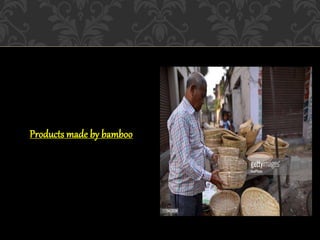
Products made by bamboo
Creativity
Tools
History
Business pattern
Business strategy
Uniqueness
Making process
Lifestyle of dom community
Relation of doms with other castes
occupation
CONTENTS
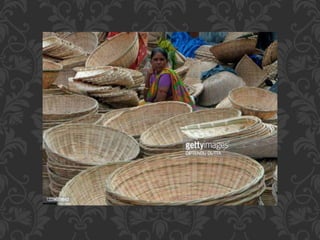
The dom community in Nepal uses bamboo for making various baskets which
are used for various rituals celebrated in Nepal and india specially in chath
puja we hindu believe that baskets made from bamboo are the purest that’s
why the dom community prepares the various types of bamboo baskets called
as supa,daura,dagra and many more which are used in our festivals named
chath .the pictures of the baskets are also given as bellows
CREATIVITY
TOOLS
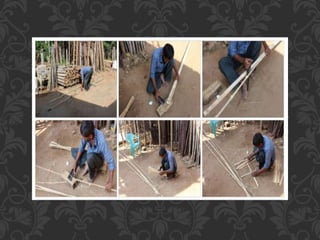
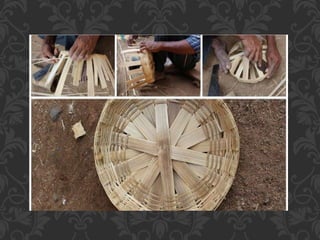
Weaving of basket is completed manually by experienced artisans. Bamboo is
split into strips of various sizes those vary in breadth , this process done
employing a sharp knife. The strips are made thinner by peeling top layer and
therefore the bamboos are split into flat thin strips. Bans baskets are weaved
in several shape and size.
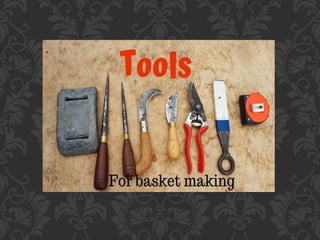
The tools used to make bamboo crafts are:
Big Knifes:
Used to peel the skin before immersing the bamboo in water.
Small Knife:
Used to cut extra bamboo sticks during making process.
Measurement Tape:
Used to measure the length of the bamboo while cutting it to desired pieces.
Hacksaw Blade:
Used to cut the bamboo into pieces according to required size.
Chisel:
Used to peel the skin of the bamboo to make the outer surface smooth.
TOOLS:
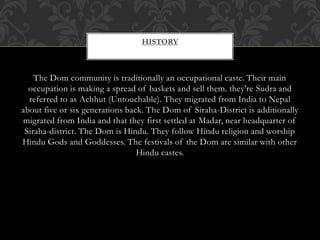
HISTORY
The Dom community is traditionally an occupational caste. Their main
occupation is making a spread of baskets and sell them. they're Sudra and
referred to as Achhut (Untouchable). They migrated from India to Nepal
about five or six generations back. The Dom of Siraha-District is additionally
migrated from India and that they first settled at Madar, near headquarter of
Siraha-district. The Dom is Hindu. They follow Hindu religion and worship
Hindu Gods and Goddesses. The festivals of the Dom are similar with other
Hindu castes.
They mainly celebrate Dashain, Tihar, Maghe Sakranti,
Chhatha Parva, Naga Panchami, Chaurchan, Jur sital, Faguwa
(Holi or Hori). The Dom is poor and exploited by higher
castes. Most of them are landless and uneducated. Therefore,
they're backward in every field. within the study-sites, it's
difficult to ascertain their traditional sort of dresses and
ornaments. They speak Maithili language. However, caste
based discrimination isn't so rigid because it was within the
past, but some discriminations are often seen clearly. The
Dom isn't allowed to enter the house of upper castes. they
need separate tube-wells for his or her own use because they're
not allowed to fetch water either from the private or public
tube-wells.
The Doms aren't found actively participating in local and
national politics . Most of them are only voters. they need
not access in local resources management. they're not aware
of to urge their citizenship and to register the vital events.
there's satisfactory trend of getting health services from
governmental health offices within the Dom community.
differing types of NGOs/INGOs are found working to
enhance and enhance the life sort of Dalits, but there's not
seen any positive sign of improvement within the socio-
economic condition of the Dom's life style.
Gradually, social awareness is improving and enhancing among
the Dom community of the study area thanks to the effect of
modernization.
BUSINESS PATTERN
With the top of Dashain and therefore the beginning of Kattik
Krishnapaksha, the activism of the Dom community within the East Central
Terai has increased. With the onset of Diwali and therefore the subsequent
Chhath festival, the Dom community is now working tirelessly to create their
skills. The tradition of demanding bamboo choya and kaptera weaving on
Diwali and Chhath has added slightly of festivity to the Dom community.
In the Dom settlement, all the relations are now engaged in
bamboo searching, chopping, making kaptera and choya.
consistent with Ratna Marik of Dom Basti in Bhangaha
Municipality-5, Siddhapur, all the relations need to share the
work to form baskets, sticks, hooks, fans, cones and other
toys made from bamboo choya and kaptera, which are in
demand during Diwali and Chhath festivals.At the mouth of
the Siddhapur settlement may be a small thatched hut. With
the top of Dashain and therefore the beginning of Kattik
Krishnapaksha, Ratna has been busy day and night making
choli, kaptera, dali, chiti, nanglo-chalno, fan, koniya and other
toys He wont to sleep while using choya and kaptera till late
in the dark
The lunar census reflects happiness on the faces of the foremost
impoverished Dom community within the Middle Eastern Terai,
including Kattik Krishnapaksha Tekna and Ratna Mahottari.
These festivals became a source of joy and excitement for Dom
as their skills have found a market within the last Diwali of this
party and therefore the Chhath festival which starts in Kattik
Shukla Paksha.
Making a spread of things from bamboo choya and
kaptera (similar to rakhandharan made up of choya and
kaptera) is that the main occupation of the Dom
community. The Maithil tradition of creating freshly
woven bamboo items essential for worship on Diwali
and Chhath per annum has increased the demand for
skills of the Dom community within the Middle Eastern
Terai at this point .
As Diwali and Chhath are approaching, the Dalit
community living within the very poor Dom caste is
happy to possess an honest income. Dom Basti, which
has been embracing the business of creating bamboo
choya and kaptero on Diwali and Chhath, is related to
an equivalent rituals including dali, chiti, nanglo-chalno,
koniya and pankha.
In Dom Basti, all the members of the family seem to be
busy checking out bamboo, cracking it, extracting kaptera
and choya and weaving as per the demand. Even children
between the ages of 5 and 7 from housewives seem to be
busy at work. At other times, within the Dom community,
where there's scarcity, the housewives also keep Diwali and
Chhath together by eating sweets, dressing well and
fulfilling the desires of the small ones.
As Diwali approaches, parents are busy at work and
therefore the demand for an equivalent is increasing.
Parents say that the order added from the youngsters is
functioning as a ‘tonic’ to extend the vigor.
Doms, who are completely unaware of their basic needs like
education and health, are living in small huts for generations. For
the Dom community, which is mired in extreme poverty and
illiteracy, the sole source of income is that the income from the
sale of firewood for cremation, the income from the sale of
choya made by collecting bamboo shoots thrown within the
crematorium, and therefore the income from pig farming. As
Tihar and Chhath also are celebrated by the devotees, the
materials used for these festivals are made by buying new
bamboo and making it with a holy heart.
As Diwali and Chhath are approaching, the villages of are
filled with bamboo choya and kaptero. Elderly leaders of
the Dom community say that there's no problem in selling
such items for the festival because the customers don't pay
much and that they also say that the costs are reasonable.
BUSINESS STRATEGY
There is no such strategic business planning is used in selling and promoting
of bamboo baskets in Nepal .the bamboo baskets are sold by the dom
community itself in the local market on the days and before the festivals as
the bamboo baskets have just demand on those days only so no much
strategies are needed ,they just have to supply the bamboo baskets in the
markets where there is demand at a certain time.
UNIQUENESS
Each of the products is handmade amorously by skilled local artisans using
techniques honed over generations and from natural materials. Products can
therefore vary slightly in size, shape and color.
Younger bamboo plants are a lighter color than more mature ones, so a rattan
or bamboo basket woven from a young plant are going to be lighter and
sometimes with subtle hues of green. Those from older plants will contains
darker reminder sandy brown. After rattan and bamboo is cut, it's dried
outside for variety of days before being woven. The weather over lately also
can affect the eventual colour of the fabric .
Some of our products, like the palm leaf hand fan and
therefore the ivy coaster, are handwoven from one leaf or one
long strip of rattan. even as no two leaves are exactly identical
colour or shape, no two of those products are going to be
identical either. for instance , thicker rattan strips are going to
be woven into bigger coasters.
They love how each may be a unique piece of art, charming
in its title . once they put together a group of baskets or
coasters we confirm to pick pieces that are an honest match
with the others within the set, which they're going to look
beautiful in our customers' home.
Thousands of artisans earn their daily bread and butter by
producing a good sort of bamboo products. Bamboo baskets,
boxes, chairs, handbags, mats, winnow, etc., are samples of
bamboo products. In southern India, Bamboo craft is trendily
emerging for its durable quality, lightweight, and for its leisurely
handling. There are differing types of baskets with varying sorts
of weaving patterns is practiced in Mysore. The bamboo baskets
are made by using the weaving process. Bamboo strips are soaked
in water to form the Bamboo softer for the bending and weaving
process. Weaving isn't the sole method of joining, but a singular
process of bamboo handcraft that represents the actual material
properties and therefore the highly developed techniques of
artisans.
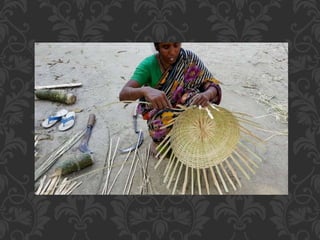
MAKING PROCESS
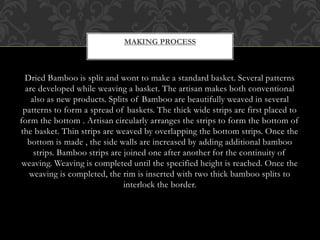
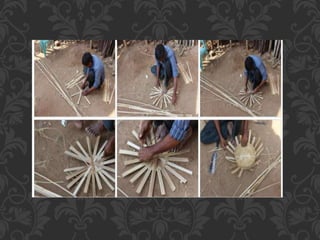
Dried Bamboo is split and wont to make a standard basket. Several patterns
are developed while weaving a basket. The artisan makes both conventional
also as new products. Splits of Bamboo are beautifully weaved in several
patterns to form a spread of baskets. The thick wide strips are first placed to
form the bottom . Artisan circularly arranges the strips to form the bottom of
the basket. Thin strips are weaved by overlapping the bottom strips. Once the
bottom is made , the side walls are increased by adding additional bamboo
strips. Bamboo strips are joined one after another for the continuity of
weaving. Weaving is completed until the specified height is reached. Once the
weaving is completed, the rim is inserted with two thick bamboo splits to
interlock the border.
LIFE STYLES OF DOM COMMUNITY
It is needed to spot the community or the class structure to which Dalit groups belong.
Castes
refer to an occupationally segregated, hierarchically and ritually discriminatory social
organization
based on heredity of a private or group of people . Dalits are known categorically as
economically exploited, politically voiceless, socially humiliated, educationally
backward and
treated as untouchables by the Hindu class structure . the main Dalit groups within the
Tarai (southern
part of Nepal adjoining to Indian border) are Chamars, Mushahar, Dusadhs, Doms,
Sarki, etc.
while those within the hills are Damai, Kami, and Sarki. within the Kathmandu valley,
the main Dalit
castes include Pode and Chyame.
The present paper deals with Dom or Dalit group. The doms are
short in stature, dark skinned,
having long and loosely kept hair mostly unplaited and therefore the
most peculiar feature is their strange
glass like eyes. Their educational status is extremely poor as they're
socially, culturally and economically deprived. The doms are
considered rock bottom untouchable
caste groups of the Terai; they're not allowed to fetch water either
from the private or public
tube wells. they need separate tube wells for his or her own use or
attend the nearby stream and
pond to fetch water.
The Doms are concentrated more in districts like Morang, Jhapa,
Sunsari, Siraha, Saptari,
Dhanusa, Mahottari, Sarlahi Bara, Parsa, Rauthat Rupandehi,
Kapilvastu, Nawalparasi
RELATION OF DOMS WITH OTHER
CASTES
Doms are untouchable as per Hindu class structure . So, they can't get all social
opportunities in
Hindu society. None of the clean or high castes get food or water from them and
avoid physical
contact where possible. But the constitution of Nepal, 2047 and Interim constitution
of Nepal
2063 B.S theoretically forbade caste based discrimination in Nepal. However, there's
found
a satisfactory relationship between the Doms and other castes. the opposite caste

people have
necessity to return within the close contact with the Doms for various reasons, i.e. to

shop for basketry
products
Traditionally speaking, Doms are related to grave digging, cremation of dead
bodies and
making a spread of baskets from the bamboo and as hereditary occupation,
but within the course of
time, situation has changed tons . The Doms are related with making a spread
of basket from a
bamboo leaving grave digging and cremating dead bodies now.
OCCUPATION
1.Where did you learnt this skill from
The answer given by them was that this work is being done sine a long time
ago and it has been passed from one generation to another so they learned
this skill of making bamboo basket from their elders and are now teaching it
to their younger generation
2.Is this your permanent business or job
They said earlier this was the only source of income for their livelihood but
nowadays earning only from selling bamboo baskets made their life tough so
they are also involved in animal husbandry and agricultural business
QUESTIONS
3.In which seasons the sale is highest
For their business of selling bamboo baskets the most favourable season is the
month in which chath puja falls as this is one of the most important festivals
of hindu community and people use bamboo baskets and other bamboo
products in this festival.
4.What difficulties is faced by them in this business
The main problem faced by the in this business of bamboo baskets is no
market demand in normal days as no people use bamboo baskets and bamboo
products in daily life which makes the demand of bamboo products lowest in
normal days
QUESTIONS
5.Is their potential that they can increase this business oppurtunities
They said yes there is chance of increasing this business in nearby future only
if people will be aware of using bamboo products instead of plastic they said
the can also make bamboo products for packaging different things which can
definitely help us to decrease uses of plastic and increase bamboo products
which would help to protect environment from pollution too.
QUESTIONS
Bamboo baskets made in nepal.pptx

Bamboo baskets made in nepal.pptx

  • 1.
    Name :sweta anjalitiwari Section:D Roll no:1376 Bathch no : 2021-24
  • 2.
  • 3.
    Creativity Tools History Business pattern Business strategy Uniqueness Makingprocess Lifestyle of dom community Relation of doms with other castes occupation CONTENTS
  • 4.
    The dom communityin Nepal uses bamboo for making various baskets which are used for various rituals celebrated in Nepal and india specially in chath puja we hindu believe that baskets made from bamboo are the purest that’s why the dom community prepares the various types of bamboo baskets called as supa,daura,dagra and many more which are used in our festivals named chath .the pictures of the baskets are also given as bellows CREATIVITY
  • 6.
    TOOLS Weaving of basketis completed manually by experienced artisans. Bamboo is split into strips of various sizes those vary in breadth , this process done employing a sharp knife. The strips are made thinner by peeling top layer and therefore the bamboos are split into flat thin strips. Bans baskets are weaved in several shape and size.
  • 7.
    The tools usedto make bamboo crafts are: Big Knifes: Used to peel the skin before immersing the bamboo in water. Small Knife: Used to cut extra bamboo sticks during making process. Measurement Tape: Used to measure the length of the bamboo while cutting it to desired pieces. Hacksaw Blade: Used to cut the bamboo into pieces according to required size. Chisel: Used to peel the skin of the bamboo to make the outer surface smooth. TOOLS:
  • 9.
    HISTORY The Dom communityis traditionally an occupational caste. Their main occupation is making a spread of baskets and sell them. they're Sudra and referred to as Achhut (Untouchable). They migrated from India to Nepal about five or six generations back. The Dom of Siraha-District is additionally migrated from India and that they first settled at Madar, near headquarter of Siraha-district. The Dom is Hindu. They follow Hindu religion and worship Hindu Gods and Goddesses. The festivals of the Dom are similar with other Hindu castes.
  • 10.
    They mainly celebrateDashain, Tihar, Maghe Sakranti, Chhatha Parva, Naga Panchami, Chaurchan, Jur sital, Faguwa (Holi or Hori). The Dom is poor and exploited by higher castes. Most of them are landless and uneducated. Therefore, they're backward in every field. within the study-sites, it's difficult to ascertain their traditional sort of dresses and ornaments. They speak Maithili language. However, caste based discrimination isn't so rigid because it was within the past, but some discriminations are often seen clearly. The Dom isn't allowed to enter the house of upper castes. they need separate tube-wells for his or her own use because they're not allowed to fetch water either from the private or public tube-wells.
  • 11.
    The Doms aren'tfound actively participating in local and national politics . Most of them are only voters. they need not access in local resources management. they're not aware of to urge their citizenship and to register the vital events. there's satisfactory trend of getting health services from governmental health offices within the Dom community. differing types of NGOs/INGOs are found working to enhance and enhance the life sort of Dalits, but there's not seen any positive sign of improvement within the socio- economic condition of the Dom's life style.
  • 12.
    Gradually, social awarenessis improving and enhancing among the Dom community of the study area thanks to the effect of modernization.
  • 13.
    BUSINESS PATTERN With thetop of Dashain and therefore the beginning of Kattik Krishnapaksha, the activism of the Dom community within the East Central Terai has increased. With the onset of Diwali and therefore the subsequent Chhath festival, the Dom community is now working tirelessly to create their skills. The tradition of demanding bamboo choya and kaptera weaving on Diwali and Chhath has added slightly of festivity to the Dom community.
  • 14.
    In the Domsettlement, all the relations are now engaged in bamboo searching, chopping, making kaptera and choya. consistent with Ratna Marik of Dom Basti in Bhangaha Municipality-5, Siddhapur, all the relations need to share the work to form baskets, sticks, hooks, fans, cones and other toys made from bamboo choya and kaptera, which are in demand during Diwali and Chhath festivals.At the mouth of the Siddhapur settlement may be a small thatched hut. With the top of Dashain and therefore the beginning of Kattik Krishnapaksha, Ratna has been busy day and night making choli, kaptera, dali, chiti, nanglo-chalno, fan, koniya and other toys He wont to sleep while using choya and kaptera till late in the dark
  • 15.
    The lunar censusreflects happiness on the faces of the foremost impoverished Dom community within the Middle Eastern Terai, including Kattik Krishnapaksha Tekna and Ratna Mahottari. These festivals became a source of joy and excitement for Dom as their skills have found a market within the last Diwali of this party and therefore the Chhath festival which starts in Kattik Shukla Paksha.
  • 16.
    Making a spreadof things from bamboo choya and kaptera (similar to rakhandharan made up of choya and kaptera) is that the main occupation of the Dom community. The Maithil tradition of creating freshly woven bamboo items essential for worship on Diwali and Chhath per annum has increased the demand for skills of the Dom community within the Middle Eastern Terai at this point .
  • 17.
    As Diwali andChhath are approaching, the Dalit community living within the very poor Dom caste is happy to possess an honest income. Dom Basti, which has been embracing the business of creating bamboo choya and kaptero on Diwali and Chhath, is related to an equivalent rituals including dali, chiti, nanglo-chalno, koniya and pankha.
  • 18.
    In Dom Basti,all the members of the family seem to be busy checking out bamboo, cracking it, extracting kaptera and choya and weaving as per the demand. Even children between the ages of 5 and 7 from housewives seem to be busy at work. At other times, within the Dom community, where there's scarcity, the housewives also keep Diwali and Chhath together by eating sweets, dressing well and fulfilling the desires of the small ones.
  • 19.
    As Diwali approaches,parents are busy at work and therefore the demand for an equivalent is increasing. Parents say that the order added from the youngsters is functioning as a ‘tonic’ to extend the vigor.
  • 20.
    Doms, who arecompletely unaware of their basic needs like education and health, are living in small huts for generations. For the Dom community, which is mired in extreme poverty and illiteracy, the sole source of income is that the income from the sale of firewood for cremation, the income from the sale of choya made by collecting bamboo shoots thrown within the crematorium, and therefore the income from pig farming. As Tihar and Chhath also are celebrated by the devotees, the materials used for these festivals are made by buying new bamboo and making it with a holy heart.
  • 21.
    As Diwali andChhath are approaching, the villages of are filled with bamboo choya and kaptero. Elderly leaders of the Dom community say that there's no problem in selling such items for the festival because the customers don't pay much and that they also say that the costs are reasonable.
  • 22.
    BUSINESS STRATEGY There isno such strategic business planning is used in selling and promoting of bamboo baskets in Nepal .the bamboo baskets are sold by the dom community itself in the local market on the days and before the festivals as the bamboo baskets have just demand on those days only so no much strategies are needed ,they just have to supply the bamboo baskets in the markets where there is demand at a certain time.
  • 24.
    UNIQUENESS Each of theproducts is handmade amorously by skilled local artisans using techniques honed over generations and from natural materials. Products can therefore vary slightly in size, shape and color. Younger bamboo plants are a lighter color than more mature ones, so a rattan or bamboo basket woven from a young plant are going to be lighter and sometimes with subtle hues of green. Those from older plants will contains darker reminder sandy brown. After rattan and bamboo is cut, it's dried outside for variety of days before being woven. The weather over lately also can affect the eventual colour of the fabric .
  • 25.
    Some of ourproducts, like the palm leaf hand fan and therefore the ivy coaster, are handwoven from one leaf or one long strip of rattan. even as no two leaves are exactly identical colour or shape, no two of those products are going to be identical either. for instance , thicker rattan strips are going to be woven into bigger coasters. They love how each may be a unique piece of art, charming in its title . once they put together a group of baskets or coasters we confirm to pick pieces that are an honest match with the others within the set, which they're going to look beautiful in our customers' home.
  • 26.
    Thousands of artisansearn their daily bread and butter by producing a good sort of bamboo products. Bamboo baskets, boxes, chairs, handbags, mats, winnow, etc., are samples of bamboo products. In southern India, Bamboo craft is trendily emerging for its durable quality, lightweight, and for its leisurely handling. There are differing types of baskets with varying sorts of weaving patterns is practiced in Mysore. The bamboo baskets are made by using the weaving process. Bamboo strips are soaked in water to form the Bamboo softer for the bending and weaving process. Weaving isn't the sole method of joining, but a singular process of bamboo handcraft that represents the actual material properties and therefore the highly developed techniques of artisans.
  • 27.
    MAKING PROCESS Dried Bamboois split and wont to make a standard basket. Several patterns are developed while weaving a basket. The artisan makes both conventional also as new products. Splits of Bamboo are beautifully weaved in several patterns to form a spread of baskets. The thick wide strips are first placed to form the bottom . Artisan circularly arranges the strips to form the bottom of the basket. Thin strips are weaved by overlapping the bottom strips. Once the bottom is made , the side walls are increased by adding additional bamboo strips. Bamboo strips are joined one after another for the continuity of weaving. Weaving is completed until the specified height is reached. Once the weaving is completed, the rim is inserted with two thick bamboo splits to interlock the border.
  • 31.
    LIFE STYLES OFDOM COMMUNITY It is needed to spot the community or the class structure to which Dalit groups belong. Castes refer to an occupationally segregated, hierarchically and ritually discriminatory social organization based on heredity of a private or group of people . Dalits are known categorically as economically exploited, politically voiceless, socially humiliated, educationally backward and treated as untouchables by the Hindu class structure . the main Dalit groups within the Tarai (southern part of Nepal adjoining to Indian border) are Chamars, Mushahar, Dusadhs, Doms, Sarki, etc. while those within the hills are Damai, Kami, and Sarki. within the Kathmandu valley, the main Dalit castes include Pode and Chyame.
  • 32.
    The present paperdeals with Dom or Dalit group. The doms are short in stature, dark skinned, having long and loosely kept hair mostly unplaited and therefore the most peculiar feature is their strange glass like eyes. Their educational status is extremely poor as they're socially, culturally and economically deprived. The doms are considered rock bottom untouchable caste groups of the Terai; they're not allowed to fetch water either from the private or public tube wells. they need separate tube wells for his or her own use or attend the nearby stream and pond to fetch water. The Doms are concentrated more in districts like Morang, Jhapa, Sunsari, Siraha, Saptari, Dhanusa, Mahottari, Sarlahi Bara, Parsa, Rauthat Rupandehi, Kapilvastu, Nawalparasi
  • 33.
    RELATION OF DOMSWITH OTHER CASTES Doms are untouchable as per Hindu class structure . So, they can't get all social opportunities in Hindu society. None of the clean or high castes get food or water from them and avoid physical contact where possible. But the constitution of Nepal, 2047 and Interim constitution of Nepal 2063 B.S theoretically forbade caste based discrimination in Nepal. However, there's found a satisfactory relationship between the Doms and other castes. the opposite caste people have necessity to return within the close contact with the Doms for various reasons, i.e. to shop for basketry products
  • 34.
    Traditionally speaking, Domsare related to grave digging, cremation of dead bodies and making a spread of baskets from the bamboo and as hereditary occupation, but within the course of time, situation has changed tons . The Doms are related with making a spread of basket from a bamboo leaving grave digging and cremating dead bodies now. OCCUPATION
  • 35.
    1.Where did youlearnt this skill from The answer given by them was that this work is being done sine a long time ago and it has been passed from one generation to another so they learned this skill of making bamboo basket from their elders and are now teaching it to their younger generation 2.Is this your permanent business or job They said earlier this was the only source of income for their livelihood but nowadays earning only from selling bamboo baskets made their life tough so they are also involved in animal husbandry and agricultural business QUESTIONS
  • 36.
    3.In which seasonsthe sale is highest For their business of selling bamboo baskets the most favourable season is the month in which chath puja falls as this is one of the most important festivals of hindu community and people use bamboo baskets and other bamboo products in this festival. 4.What difficulties is faced by them in this business The main problem faced by the in this business of bamboo baskets is no market demand in normal days as no people use bamboo baskets and bamboo products in daily life which makes the demand of bamboo products lowest in normal days QUESTIONS
  • 37.
    5.Is their potentialthat they can increase this business oppurtunities They said yes there is chance of increasing this business in nearby future only if people will be aware of using bamboo products instead of plastic they said the can also make bamboo products for packaging different things which can definitely help us to decrease uses of plastic and increase bamboo products which would help to protect environment from pollution too. QUESTIONS