What is a balance diet?
A balanced diet consists an adequate amount
of all the nutrients required by the body to
grow, remain healthy, and be disease-free. In
addition, a healthy, balanced diet provides the
necessary energy requirement, protects
against vitamin, mineral, and other nutritional
deficiencies, and builds up immunity.
The components of a balanced diet
can be broadly categorized into
macro and micronutrients.
Macro
nutrients
.
Micro
nutrient
s.
-Vitamins,
-Minerals
-Antioxidants.
(Compounds that help
protect the body’s cells
from damage caused by
free radicals. They are
often found in fruits,
vegetables, and certain
-Carbohydrates,
-Proteins,
-Fats,
-Water,
-Fiber.
Carbohydrate
s.
What are
carbohydrates?
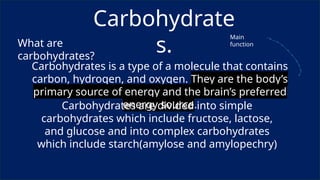
Carbohydrates is a type of a molecule that contains
carbon, hydrogen, and oxygen. They are the body’s
primary source of energy and the brain’s preferred
energy source.
Carbohydrates are divided into simple
carbohydrates which include fructose, lactose,
and glucose and into complex carbohydrates
which include starch(amylose and amylopechry)
Main
function
Carbohydrate
s.
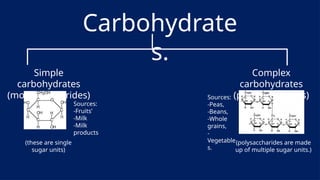
Simple
carbohydrates
(monosaccharides)
Complex
carbohydrates
(polysaccharides)
(polysaccharides are made
up of multiple sugar units.)
Sources:
-Fruits’
-Milk
-Milk
products
Sources:
-Peas,
-Beans,
-Whole
grains,
-
Vegetable
s.
(these are single
sugar units)
Effects of carbohydrate
deficiency
-Brain fog,(Brain fog is characterized by confusion,
forgetfulness, and a lack of focus and mental clarity.)
-Fatigue,(A feeling of constant exhaustion, burnout or
lack of energy.)
-Nausea,(Feeling an urge to vomit.)
-Constipation(A condition in which a person has
uncomfortable bowel movements.)
-Dizziness,(A term used to describe a range of
sensations, such as feeling faint, woozy, weak, or
unsteady.)
-Weakness,(The state of being weak.)
Protei
n.
What are proteins?
Proteins are naturally occurring extremely
complex molecules that consist of amino acid
residues joined by peptide bonds. Proteins are
critical for the functioning of the body, the
make up most of the body structure. Proteins
make up about 42% of the dry weight of our
bodies. All solid non-fat parts of your body are
made up of proteins, including your bones.
The language of
life.
It all begins with amino acids, tiny organic molecules, they are the alphabet of the language
of life. There are 21 different ones, like different letters. If you put around 50 of them
together, they form a protein, which in the language of life is a word, and if you put many of
these protein words, you get a sentence called a biological pathway. For example, if your cell
needs to break down sugar with the language of life, it may take the amino acids for the
letters b, r, e, a, and k, to form break. Then combine this protein word with other protein
words to form a biological pathway “sentence” that means “break down sugar”. In the human
language, 8,000 words are needed to speak well, but in the language of life, there are
estimated 2,0000. An average English word has 5 letters, human proteins have an average of
375 amino acids. The longest protein have more than 30,000. DNA is needed to arrange the
proteins, a long sequence of instructions. Around 1% of the DNA is made up of genes-which
are basically dictionaries that are protein dictionaries that contain all the words of the
language of life your cells speak. Amino acids make chains of proteins but due to slightly
different charges, they fold on themselves. This folding process makes these string into 3D
structures. Shape is everything in the world of proteins. They are like Lego pieces that can
snap together, dismantle, and build complex micro-machines that use energy to do work And
Sources of
proteins:
1-Eggs,
2-Meat,
3-Lentils,
4-Chia seeds
5-Beans,
6-Peanut butter,
7-Almonds,
8-Seafood
Effects of protein
deficiency:
1-Stunted growth(It indicates that a child has failed to
reach his/her growth potential)
2-Muscle weakness(It is when full effort doesn’t produce
a normal muscle contraction or movement)
3-Edema(Swelling of skin caused by too much fluid
trapped in the body’s tissue)
4-Fatty liver(The build up of excess fat in the liver cells)
5-Weak immunity(The compliment system weakens as it
is made up of proteins).
Etc.
Fats
What are fats?
Fats are a type of nutrient found in food that provide the
body with energy, support cell structure, help absorb
certain vitamins, and play a role in hormone production.
Fats are energy stores that contain even more energy
than carbohydrates. Fats are composed of molecules
called fatty acids and are classified into different types,
including saturated, unsaturated, and trans fats.
function
1-Canola,
2-Palm,
3-Nuts,
4-Cheese,
5-Lard,
6-butter.
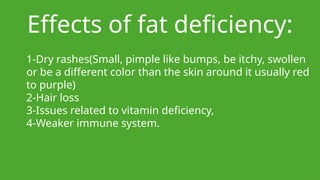
Effects of fat deficiency:
1-Dry rashes(Small, pimple like bumps, be itchy, swollen
or be a different color than the skin around it usually red
to purple)
2-Hair loss
3-Issues related to vitamin deficiency,
4-Weaker immune system.
Fiber
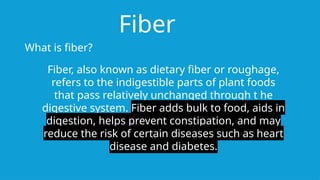
What is fiber?
Fiber, also known as dietary fiber or roughage,
refers to the indigestible parts of plant foods
that pass relatively unchanged through t he
digestive system. Fiber adds bulk to food, aids in
digestion, helps prevent constipation, and may
reduce the risk of certain diseases such as heart
disease and diabetes.
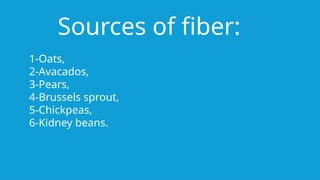
Sources of fiber:
1-Oats,
2-Avacados,
3-Pears,
4-Brussels sprout,
5-Chickpeas,
6-Kidney beans.
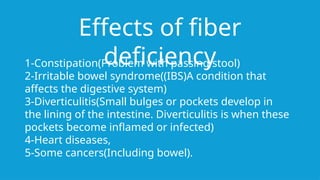
Effects of fiber
deficiency
1-Constipation(Problem with passing stool)
2-Irritable bowel syndrome((IBS)A condition that
affects the digestive system)
3-Diverticulitis(Small bulges or pockets develop in
the lining of the intestine. Diverticulitis is when these
pockets become inflamed or infected)
4-Heart diseases,
5-Some cancers(Including bowel).
Minerals
What are minerals?
Minerals are naturally occurring inorganic
substances found in the earth’s crust that are
essential for the human body’s proper function.
They play critical roles in various bodily
functions, such as bone health, muscle function,
and nerve transmission. For example calcium
and iron.
Calcium:
Calcium strengthens bones and teeth, aids muscle
contraction, including the heart, and supports nerve
signaling, ensuring proper communication
throughout the body
Iron:
Iron helps carry oxygen in all parts of your body. It’s
essential for making red blood cells, which transport
oxygen from your lungs to tissues throughout your body.
Iron also plays a role in supporting energy production and
maintaining a healthy immune system.
Sources of:
Calcium
:
1-milk, cheese, other
dairy products,
2-Leafy green
vegetables,
3-Fish,
4-Nuts and seeds.
Iron:
1-Red meat,
2-Poultry,
3-Fish and
seafood,
4-Nuts and seeds.
Effects of deficiency
of:
Calcium:
1-Osteoporosis,
2-Increased fracture
risk,
3-Reduced bone
density,
4-Rickets,
5-Impaired mobility.
Ion:
1-Fatigue,
2-Anemia,
3-Weakness and
decreased exercise
tolerance,
4-Impaired immune
function,
5-Impaired cognitive
Vitamins
What are
vitamins?
Vitamins are organic compounds that are essential for
normal growth and functioning of the body. They are
required by the body in small amounts and can not be
synthesized in sufficient quantities by the body, so they must
be obtained from the diet. Vitamins play crucial roles in
various bodily functions, including metabolism, immunity,
and cell growth. There are 13 essential, classified into two
groups: fat-soluble vitamins (A,D,E and K) and water-soluble
vitamins (B vitamins and vitamin C).
Vitamin:
A: C: D:
It is essential for
maintaining a healthy
vision, particularly in
low-light. It also plays a
critical role in
supporting the immune
system, helping to keep
the integrity of the skin
Vitamin C, also known
as ascorbic acid, is
essential for the
body’s immune
system, wound
healing, and collagen
production. It acts as
an anti oxidant,
protects cells from
damage, and helps
Vitamin D
helps absorb
calcium for
strong bones
and supports
the immune
system. It’s
crucial for
bone health
Sources of
vitamin:
A: C: D:
1-Liver,
2-Fish liver oils,
3-Dairy products,
4-Eggs,
5-Leafy green
vegetables,
6-Carrots.
1-Citrus
fruits(lemons
limes grapefruits,
tangerines)
2-Kiwifruit
3-Broccoli,
4-Brussels
sprouts.
1-Sunlight
exposure,
2-Fatty fish,
3-Beef liver,
4-Egg yolks.
Effects of deficiency
of:
A: C: D:
Vitamin A
deficiency can
cause vision
problems, weak
immunity, dry
skin, and stunted
growth in children.
It may also affect
Vitamin C deficiency
weakens the immune
system, leading to
frequent infections and
slow wound healing. It
can cause fatigue, skin
issues, and, in severe
cases, scurvy,
Vitamin D
deficiency
weakens bones,
leading to
conditions like
osteoporosis and
rickets. It also
weakensthe
immune system,
increasing the
risk of infections,
Water
What is
water?
Water is a fundamental chemical
compound composed of hydrogen and
hydrogen and oxygen. It’s essential for
life, serving roles like regulating body
temperature, aiding digestion, and
transporting nutrients.
Effects of deficiency of
water
Water deficiency, or dehydration leads
to fatigue, weakness, headaches, and
confusion. It causes dry mouths, lips,
and skin, and reduces urine output.
Sever dehydration can result in heat-
related illness like heat exhaustion or
heatstroke.
Balanced Diet and all essential nutrients

  • 1.
    What is abalance diet? A balanced diet consists an adequate amount of all the nutrients required by the body to grow, remain healthy, and be disease-free. In addition, a healthy, balanced diet provides the necessary energy requirement, protects against vitamin, mineral, and other nutritional deficiencies, and builds up immunity.
  • 2.
    The components ofa balanced diet can be broadly categorized into macro and micronutrients. Macro nutrients . Micro nutrient s. -Vitamins, -Minerals -Antioxidants. (Compounds that help protect the body’s cells from damage caused by free radicals. They are often found in fruits, vegetables, and certain -Carbohydrates, -Proteins, -Fats, -Water, -Fiber.
  • 3.
    Carbohydrate s. What are carbohydrates? Carbohydrates isa type of a molecule that contains carbon, hydrogen, and oxygen. They are the body’s primary source of energy and the brain’s preferred energy source. Carbohydrates are divided into simple carbohydrates which include fructose, lactose, and glucose and into complex carbohydrates which include starch(amylose and amylopechry) Main function
  • 4.
    Carbohydrate s. Simple carbohydrates (monosaccharides) Complex carbohydrates (polysaccharides) (polysaccharides are made upof multiple sugar units.) Sources: -Fruits’ -Milk -Milk products Sources: -Peas, -Beans, -Whole grains, - Vegetable s. (these are single sugar units)
  • 5.
    Effects of carbohydrate deficiency -Brainfog,(Brain fog is characterized by confusion, forgetfulness, and a lack of focus and mental clarity.) -Fatigue,(A feeling of constant exhaustion, burnout or lack of energy.) -Nausea,(Feeling an urge to vomit.) -Constipation(A condition in which a person has uncomfortable bowel movements.) -Dizziness,(A term used to describe a range of sensations, such as feeling faint, woozy, weak, or unsteady.) -Weakness,(The state of being weak.)
  • 6.
    Protei n. What are proteins? Proteinsare naturally occurring extremely complex molecules that consist of amino acid residues joined by peptide bonds. Proteins are critical for the functioning of the body, the make up most of the body structure. Proteins make up about 42% of the dry weight of our bodies. All solid non-fat parts of your body are made up of proteins, including your bones.
  • 7.
    The language of life. Itall begins with amino acids, tiny organic molecules, they are the alphabet of the language of life. There are 21 different ones, like different letters. If you put around 50 of them together, they form a protein, which in the language of life is a word, and if you put many of these protein words, you get a sentence called a biological pathway. For example, if your cell needs to break down sugar with the language of life, it may take the amino acids for the letters b, r, e, a, and k, to form break. Then combine this protein word with other protein words to form a biological pathway “sentence” that means “break down sugar”. In the human language, 8,000 words are needed to speak well, but in the language of life, there are estimated 2,0000. An average English word has 5 letters, human proteins have an average of 375 amino acids. The longest protein have more than 30,000. DNA is needed to arrange the proteins, a long sequence of instructions. Around 1% of the DNA is made up of genes-which are basically dictionaries that are protein dictionaries that contain all the words of the language of life your cells speak. Amino acids make chains of proteins but due to slightly different charges, they fold on themselves. This folding process makes these string into 3D structures. Shape is everything in the world of proteins. They are like Lego pieces that can snap together, dismantle, and build complex micro-machines that use energy to do work And
  • 8.
  • 9.
    Effects of protein deficiency: 1-Stuntedgrowth(It indicates that a child has failed to reach his/her growth potential) 2-Muscle weakness(It is when full effort doesn’t produce a normal muscle contraction or movement) 3-Edema(Swelling of skin caused by too much fluid trapped in the body’s tissue) 4-Fatty liver(The build up of excess fat in the liver cells) 5-Weak immunity(The compliment system weakens as it is made up of proteins). Etc.
  • 10.
    Fats What are fats? Fatsare a type of nutrient found in food that provide the body with energy, support cell structure, help absorb certain vitamins, and play a role in hormone production. Fats are energy stores that contain even more energy than carbohydrates. Fats are composed of molecules called fatty acids and are classified into different types, including saturated, unsaturated, and trans fats. function
  • 11.
  • 12.
    Effects of fatdeficiency: 1-Dry rashes(Small, pimple like bumps, be itchy, swollen or be a different color than the skin around it usually red to purple) 2-Hair loss 3-Issues related to vitamin deficiency, 4-Weaker immune system.
  • 13.
    Fiber What is fiber? Fiber,also known as dietary fiber or roughage, refers to the indigestible parts of plant foods that pass relatively unchanged through t he digestive system. Fiber adds bulk to food, aids in digestion, helps prevent constipation, and may reduce the risk of certain diseases such as heart disease and diabetes.
  • 14.
  • 15.
    Effects of fiber deficiency 1-Constipation(Problemwith passing stool) 2-Irritable bowel syndrome((IBS)A condition that affects the digestive system) 3-Diverticulitis(Small bulges or pockets develop in the lining of the intestine. Diverticulitis is when these pockets become inflamed or infected) 4-Heart diseases, 5-Some cancers(Including bowel).
  • 16.
    Minerals What are minerals? Mineralsare naturally occurring inorganic substances found in the earth’s crust that are essential for the human body’s proper function. They play critical roles in various bodily functions, such as bone health, muscle function, and nerve transmission. For example calcium and iron.
  • 17.
    Calcium: Calcium strengthens bonesand teeth, aids muscle contraction, including the heart, and supports nerve signaling, ensuring proper communication throughout the body Iron: Iron helps carry oxygen in all parts of your body. It’s essential for making red blood cells, which transport oxygen from your lungs to tissues throughout your body. Iron also plays a role in supporting energy production and maintaining a healthy immune system.
  • 18.
    Sources of: Calcium : 1-milk, cheese,other dairy products, 2-Leafy green vegetables, 3-Fish, 4-Nuts and seeds. Iron: 1-Red meat, 2-Poultry, 3-Fish and seafood, 4-Nuts and seeds.
  • 19.
    Effects of deficiency of: Calcium: 1-Osteoporosis, 2-Increasedfracture risk, 3-Reduced bone density, 4-Rickets, 5-Impaired mobility. Ion: 1-Fatigue, 2-Anemia, 3-Weakness and decreased exercise tolerance, 4-Impaired immune function, 5-Impaired cognitive
  • 20.
    Vitamins What are vitamins? Vitamins areorganic compounds that are essential for normal growth and functioning of the body. They are required by the body in small amounts and can not be synthesized in sufficient quantities by the body, so they must be obtained from the diet. Vitamins play crucial roles in various bodily functions, including metabolism, immunity, and cell growth. There are 13 essential, classified into two groups: fat-soluble vitamins (A,D,E and K) and water-soluble vitamins (B vitamins and vitamin C).
  • 21.
    Vitamin: A: C: D: Itis essential for maintaining a healthy vision, particularly in low-light. It also plays a critical role in supporting the immune system, helping to keep the integrity of the skin Vitamin C, also known as ascorbic acid, is essential for the body’s immune system, wound healing, and collagen production. It acts as an anti oxidant, protects cells from damage, and helps Vitamin D helps absorb calcium for strong bones and supports the immune system. It’s crucial for bone health
  • 22.
    Sources of vitamin: A: C:D: 1-Liver, 2-Fish liver oils, 3-Dairy products, 4-Eggs, 5-Leafy green vegetables, 6-Carrots. 1-Citrus fruits(lemons limes grapefruits, tangerines) 2-Kiwifruit 3-Broccoli, 4-Brussels sprouts. 1-Sunlight exposure, 2-Fatty fish, 3-Beef liver, 4-Egg yolks.
  • 23.
    Effects of deficiency of: A:C: D: Vitamin A deficiency can cause vision problems, weak immunity, dry skin, and stunted growth in children. It may also affect Vitamin C deficiency weakens the immune system, leading to frequent infections and slow wound healing. It can cause fatigue, skin issues, and, in severe cases, scurvy, Vitamin D deficiency weakens bones, leading to conditions like osteoporosis and rickets. It also weakensthe immune system, increasing the risk of infections,
  • 24.
    Water What is water? Water isa fundamental chemical compound composed of hydrogen and hydrogen and oxygen. It’s essential for life, serving roles like regulating body temperature, aiding digestion, and transporting nutrients.
  • 25.
    Effects of deficiencyof water Water deficiency, or dehydration leads to fatigue, weakness, headaches, and confusion. It causes dry mouths, lips, and skin, and reduces urine output. Sever dehydration can result in heat- related illness like heat exhaustion or heatstroke.