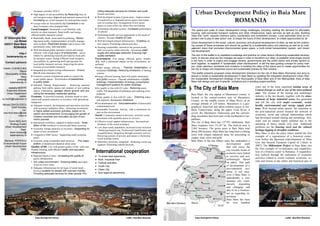
Leaflet - Baia Mare (Romania)Urban Development Policies
European corridors TEN-T
High degree of rail accessibility by Reducing time on
rail transport routes, Regional and national connectivity &
Increasing use of rail transport for metropolitan transit
Europe-wide air Accessibility by Connection to the
main European cities (transport hub)
Local transport. Sustainable Local Mobility with
priority on clean transport, fluent traffic and energy
efficient public transport system:
Road traffic, fluent, secure and less polluting - Reduc-
ing transit traffic; Implementation of traffic manage-
ment systems; Restricted access road in areas with
patrimonial value; Safe road traffic
Well-developed public transport system and energy
efficient, with a high degree of employment - Acces-
sibility by optimizing network provided by local pub-
lic transport routes; Energy Efficient local transport;
Accessibility by optimizing tariff and payment for
local public transport services; Improving the attrac-
tiveness of local public transport
Integrated developed cycling infrastructure - Promo-
tion of clean alternative bike
Extensive system of pedestrian paths to connect the
iconic public spaces - Prioritization of pedestrians
in public areas
Satisfied Parking Requirements - Removing parasitic
parking from public spaces and creation of new parking
spaces; Eliminating garages above ground and pro-
viding the necessary residential parking
Economy. A powerful economy, dynamic based on inno-
vation and research attractive to investors, with specialized
manpower:
Adequate research, development and innovation activities
with economic multiplier effect - Attracting investments
in highly skilled economic activities, based on re-
search and development; Encouraging the growth of
creative industries and innovation as part of eco-
nomic process
Specialized workforce, adapted to market needs - Adap-
tation of the workforce to current and future economy
Economic climate attractive to investors - Supporting the
attract of new investment
Competitive SME Sector - Supporting small economic
actors
Economy using sustainable land resources - The regen-
eration of abandoned industrial urban areas
Quality of life. City with greater quality of life, with com-
fortable housing, with efficient health and education
infrastructure:
Regional Sports Centre - Increasing the quality of
sports infrastructure
Safe urban environment - Ensuring safety and super-
vision to lower crime
Adequate infrastructure for all types of social needs -
Services suitable for people with reduced mobility;
Providing adequate services for older people; Pro-
viding adequate services for children and youth
(leisure activities)
Well developed system of green areas - Improvement
of unattractive or degraded green spaces and expan-
sion of existing ones; Arrangement of new green
spaces in areas of the city where they are lacking
Performing education system - Increased performance
of schools
Performing health services appropriate to the needs of
citizens - Increase Quality of Care
Well-developed cultural infrastructure - Enabling cul-
ture centers; Promoting cultural activities
Housing comfortable, tailored to the present needs,
fully serviced by urban networks - Increasing water
supply and sewerage networks; Ensuring high
quality sanitation
Environment. City energy efficient, green, sustain-
able, with a minimized impact on the environment, un-
polluted:
Estate energy efficient - Thermal rehabilitation of
residential buildings; Reducing emissions of heating
systems
Energy efficient housing fund with public destination
and public services - Thermal rehabilitation of public
buildings; Implementation of energy consumption
management systems for public buildings
Air quality in line with EU rules - Reducing motor
traffic; The absorption of pollutants and reducing noise
pollution
Water quality in line with EU rules - Greening indus-
trial deposits; Wastewater treatment
Uncontaminated soil - Decontamination of historically
contaminated soils
Sustainable Economic Activity, with a minimized im-
pact on the environment
Social. Community united in diversity, inclusive social
environment with equitable access to services:
Effective social support infrastructure - Increased per-
formance of the social assistance
Low share needy population, increased social inclusion
- Reducing dropout rate; Professional Qualification and
re-qualification; Integration through economic activity;
Removing pockets of poverty and ensure a wholesome
social housing system
Minorities protected, integrated - Reducing social seg-
regation; Promoting cultural diversity
To share best experience
Multi Industrial Park
Cultural activities
Youth City
Clean City
Sub-regional partnership
37 Gheorghe Sin-
cai Street
430311 Baia Mare
ROMANIA
http://
baiamarecity.ro
Contact persons
Catalin CHERECHES
Mayor
Municipality of Baia
Mare
primar@
baiamarecity.ro
Izabella MORTH
Executive Director
Urban Department
izabel-
la.morth@baiamare.ro
Mircea DINCULESCU
Cheif Architec
mir-
cea.dinculescu@baia
mare.ro
Dorin MICLAUS
Strategy Expert
Urban Development
Dept.
dorin.miclaus@
baiamarecity.ro
Mariana POPESCU
Environmental Expert
Urban Development
Dept.
International cooperation
Leaflet - Baia Mare (Romania)Urban Development Policies
Baia Mare, the city capital of Maramures county, is
located in the central-western area of Maramures
County, on the middle course of Sãsar River, at an
average altitude of 228 meters. Maramures is a geo-
graphical, historical and ethno-cultural region in nor-
thern Transylvania, along the upper Tisza River; it
covers the Maramures Depression and the surroun-
ding mountains that form part of the northeastern Car-
pathians.
The city of Baia Mare has 137.921 inhabitants. Baia
Mare expanses over 23,247 ha. The built-in area is
2,063 hectares. The green areas in Baia Mare total
about 280 hectares. Baia Mare has long been a mining
town with related industrial areas for processing of
copper, lead, silver and gold.
Baia Mare in the last fifteen years has undertaken a
development path
that will move the
city towards forms of
economy more linked
to services and new
technologies (based
on R&D). This path
of development of a
post-industrial eco-
nomy is not easy,
even if Baia Mare is
undoubtedly a very
dynamic city, conti-
nuously expanding
and changing and
able to be a frontrun-
ner as regarding in-
novation.
Baia Mare has been
for over hundred
The speed and scale of urban development brings challenges, including meeting the demand for affordable
housing, well-connected transport systems and other infrastructure, basic services as well as jobs. Building
cities that “work” requires intensive policy coordination and investment choices. Local authorities have an im-
portant role to play to take action now, to shape the future of their development, to create opportunities for all.
Urban development is the social, cultural, economic and physical development of cities, as well as the underly-
ing causes of these processes and should be guided by a sustainable policy and planning as well as by man-
agement vision that promotes interconnected green space, a multi-modal transportation system, and mixed-
use development.
The aim of this leaflet is to capitalise knowledge and practice on urban factors influencing sustainable develop-
ment, to discuss what are the changes we need in order to transform our cities, to establish what shape should
a city have in order to inspire and engage citizens, governments and the public sector and private sectors to
work together, to establish if "sustainable urban development" is still the best guiding concept for policy mak-
ers, urban planners, architects and investors in building the cities of the future and to create opportunities for
the city to shape and implement sound and sustainable policies for their citizens.
This leaflet presents proposed urban development directions for the city of Baia Mare (Romania) and aims to
assure a model of sustainable development in Baia Mare by updating the Integrated development Urban Plan,
the Sustainable Development Strategy of the Municipality of Baia Mare and of the Metropolitan Area of Baia
Mare with design and use of specific indicators and a resulting project portfolio.
The City of Baia Mare
Urban Development Policy in Baia Mare
ROMANIA
years one of the most important mining areas of
Central Europe as well as one of the most polluted
ones. The closure of the mining and metallurgic
industry in the last decade, together with the aban-
donment of large industrial areas, has generated
and left the city with major economic, social,
health, environmental and energy supply prob-
lems. Well beyond urban sprawl, the transition to
the post-industrial period breaked the network of
economic, social and cultural relationships which
had developed around mining and metallurgy. Soil,
water and air remain highly polluted due to the
amassing of heavy metals over time. Additional
problems are the housing stock and the cultural
heritage lagging in dreadful conditions.
Baia Mare is also the place where started the first
example of a regeneration of a historical center,
even before the blazoned redevelopment of Sibiu
(city that became European Capital of Culture in
2007). The Millennium Project of Baia Mare was
the first example of revitalization and requalifica-
tion of a Historic center in Romania. A requalifica-
tion realized through the realization of economic
activities related to events (cultural, economic, so-
cial) and leisure in the oldest and historical part of
Baia Mare (Romania)
The Millennium Project, requalification of the
old historic
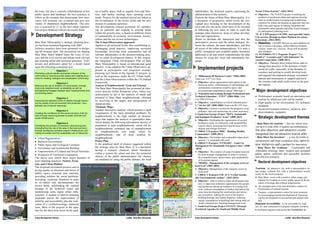
Leaflet - Baia Mare (Romania)Urban Development Policies
the town, but also a concrete refurbishment of key
public spaces and buildings: the best practices to
follow as the example that demonstrate how inno-
vative soft economy can re-launch and give new
vitality to abandoned neighbourhoods. This pro-
ject is assessed by EC as the best urban regenera-
tion project financed with pre-accession funds.
Baia Mare Municipality’s strategic planning proc-
ess has been sustained beginning with 2003 .
Inclusive practices have been promoted in design-
ing the strategic plan. The discussions for shaping
Baia Mare future helped listen the voice of citi-
zens and the civil society and debate most relevant
and pressing urban and territorial questions. Tech-
nicians and politicians opted for a model based
upon the following conceptual axis:
Urban Regeneration
Business Environment
Public Space and Ecological Corridors
Governance and Institutional Building
Empowerment of Cultural and Social Networks
Promotion of Territorial Cooperation
The above axes sketch three major domains of
town planning practices: Society, Econ-
omy and Urban Habitat.
The proposed investment projects aim at
giving quality to functions and forms of
public space (external and internal),
providing solution for social problems,
activating economic dynamics in order
to re-vitalize and decontaminate the
brown fields, refurbishing the cultural
heritage of the historical centre and
modernising some major urban infra-
structure. A number of specific planning
proposals pursue the improvement of
mobility and accessibility plus the reali-
zation of a certified-ecologic industrial
zone. Most of the projects in the pipe-
line for the short term focus on the qual-
ity of public space, both as regards form and func-
tion, and further meeting more pressing social
needs. Projects for the medium period are linked to
the revitalisation of the brown fields and the pro-
motion of economic activities.
The development concept promoted, for capitalis-
ing on potential and respond to existing needs
within the priority area, is based on different forms
of sustainability in economy, environment, society,
culture and the use of new technologies.
The Urban Observatory approach.
Applies to all territorial levels, thus contributing to:
exchanging good practice; improving territorial
knowledge; involving local communities and all
relevant stakeholders in the decision-making proc-
ess on urban development matters. In this respect,
the Integrated Urban Development Plan of Baia
Mare Municipality is based on international good
practice: it has adopted the Urban Observatory ap-
proach as participative and integrated strategic
planning tool, based on the Agenda 21 process, as
well as the experience under the EU Urban Audit,
and the Urban Observatories within the UN Habitat
Framework.
Analysis of Neighbourhoods' Needs and Potential
The Baia Mare Municipality has promoted an inno-
vative process within Romanian cities, whose key
achievement so far is the analysis of needs and
potential of Baia Mare neighbourhoods, obtained
by involving in the supply and interpretation of
statistical data
Thematic Maps
Another innovative element, which permits a rapid
visualisation of the main identified problems, by
neighbourhood, is the high number of thematic
maps that support the analysis of quantitative data,
which display the following information: density of
population in each neighbourhoods; social risk by
neighbourhoods; estimated rate of unemployment
by neighbourhoods; real estate values by
neighbourhoods; rate of local taxation by
neighbourhoods
Poster Plan
Is the graphical draft of choices suggested within
the strategic plan for Baia Mare. It is a document
having a synoptic character which introduces
within a system the urban and also the territorial
choices of the public administration; the choices
are mediated by using the public debates, the local
Objective 1.
Promoting cultural identity and social cohesion of the
community by improving public space and creating struc-
tures for meeting, dialogue and socialization Community.
Objective 2.
Reducing the risk of isolation of communities, through
improving neighborhoods’ accessibility as well as
strengthening linkages between each neighborhoods and
surrounding areas.
Objective 3.
Improving the standard of life of citizens through improv-
ing the quality of the environment and protection / sus-
tainable use of natural resources.
Objective 4.
Creating the conditions for the social inclusion of all citi-
zens through improving access to public services and
social infrastructure.
Objective 5.
Facilitating the process of economic restructuring and
strengthening the role of the area in the local economy,
through developing business support infrastructure, pro-
moting innovation and the sustainable use of resources.
Development Strategy
Leaflet - Baia Mare (Romania)Urban Development Policies
Towns Urban Systems” (2012-2014)
Objective: The STATUS project is tackling the
problem of incoherent urban and regional develop-
ment in South Eastern European and neighboring
countries by jointly developing an approach that can
help cities and regions in making integrated and
sustainable urban agendas and place based strategies
by participatory planning tools.
10. ICT PSP project I-SCOPE- interoperable Smart
City services through an Open Platform for urban
Ecosystems (2012-2015)
Objective: i-SCOPE delivers an open platform on
top of which it develops, within different domains,
various ‘smart city’ services. These will be piloted
and validated.
11. INTERREG IV C Program: Project:” Ce-
RamICa”- Ceramics and Crafts Industries’ In-
creased Cooperation (2008-2011)
Objective: Partners have joined forces and ex-
change best practices in the domains of tradi-
tional art crafts, especially in the domains of
ceramics and potting to jointly develop local
and regional development strategy recommen-
dations and instruments to support and boost
the ceramics and small crafts sector in the part-
ner regions.
Performance economy based on innovation and
tourism by which new jobs will be created
High quality of the environment, EU pollution
standards
Social environment cohesive, inclusive, non-
discriminatory, integrator
” Baia Mare for tourists” – the city where tour-
ists have a wide offer of quality accommodation
but also objective and attractive events
integrated into an attractive tourist offer
” Baia Mare for investors” - a city favorable to
entrepreneurs and large companies alike, open to
new initiatives and a partner for innovation
” Baia Mare for residents” - Comfortable and
Affordable Housing, safer, modern and animated
public spaces, sufficient and accessible facilities
and efficient transport.
Tourism. An attractive city with a representative ur-
ban image, Cultural Pol, with a representative tourist
sector for the local economy:
Baia Mare - town with a positive urban image and
identity by Creating an iconic public spaces & Resto-
ration of heritage and cultural infrastructure
An emergent pole of art and alternative culture by
Polarization of cultural tourism
Tourism - a representative sector for local economy
by Encouraging tourism development & Encourag-
ing the development of ecotourism and natural tour-
ism
Regional Accessibility. A city accessible by road,
rail, air, and connected to European transport corridors:
Increased regional road access by Connection to
stakeholders, the technical experts concerning the
administration of the territory.
Projects the future of Baia Mare Municipality. It is
a document of perspective which revels the con-
ceptual axes focusing on the development of the
town and also the areas which have to be invested
in following the next years in order to reach the
strategic plan objectives: areas of urban develop-
ment and regeneration.
Wants to facilitate the interaction and also the
participative process and the urban dialogue, be-
tween the citizens, the main stakeholders, and also
all actors of the urban metamorphosis. It is truly a
public, transparent and available public document
addressed to all and which communicates the plan
choices by using the visual and immediately lan-
guage.
1. “Millennium III Business Center” (2003-2005) -
Total cost: 4,377,231 Euro
Objective: urban regeneration intervention in the
historical centre, refurbishment of old buildings and
architectonic restoration of public space, and
environmental rehabilitation (about 7000 Sqm )
2. “Education and training through Professional and
Technical Education – TVET” (2004-2006) Total
cost: 808,119 Euro
Objective: rehabilitation of school infrastructures
3. “Air for All” (2003-2004) Total cost 461,555 Euro
Objective: creation a system for the prognosis of air
pollution, alert and monitoring on a short term basis
4. South East Europe Project “SEPA- Sustainable
and Equipped Productive Areas” (2009-2012)
Objective: Facilitating the regeneration of several
productive areas, in conformity with sustainability
criteria, thusly increasing their atractiveness to Ro-
manian and foreign investors
5. URBACT II project “BHC - Building Healthy
Communities” (2009-2011)
Objective: The healthy and sustainable urban devel-
opment / A sustainable life-style
6. URBACT II project “LUMASEC - Land Use
Management for Sustainable European Cities” (2008
-2010)
Objective: The creation of a pan-European network
for land strategic management in order to increase
the competitiveness, atractiveness and sustainability
of European regions
7. ”MODEL- Management of the energetic sector at
local level” (2007-2010)
Objective: Management of the energetic sector at
local level
8. URBACT II project USE ACT “Urban Sustain-
able Environmental Actions” (2012-2015)
Objective: aims to achieve urban development and
new or improved settlement opportunities for people
and businesses taking up residence in existing loca-
tions, without consumption of further land and at the
same time developing the construction and real es-
tate economies, making the most of the historic
building heritage and related character, reducing
energy consumption in buildings and cutting back on
further infrastructure building/management costs.
9. South East Europe Project STATUS “Strategic
Territorial Agendas for Small and Middle-Sized
Implemented projects
Major development objectives
Strategic development themes
Sectoral development objectives

Baia Mare Urban Development Policy Guide

  • 1.
    Leaflet - BaiaMare (Romania)Urban Development Policies European corridors TEN-T High degree of rail accessibility by Reducing time on rail transport routes, Regional and national connectivity & Increasing use of rail transport for metropolitan transit Europe-wide air Accessibility by Connection to the main European cities (transport hub) Local transport. Sustainable Local Mobility with priority on clean transport, fluent traffic and energy efficient public transport system: Road traffic, fluent, secure and less polluting - Reduc- ing transit traffic; Implementation of traffic manage- ment systems; Restricted access road in areas with patrimonial value; Safe road traffic Well-developed public transport system and energy efficient, with a high degree of employment - Acces- sibility by optimizing network provided by local pub- lic transport routes; Energy Efficient local transport; Accessibility by optimizing tariff and payment for local public transport services; Improving the attrac- tiveness of local public transport Integrated developed cycling infrastructure - Promo- tion of clean alternative bike Extensive system of pedestrian paths to connect the iconic public spaces - Prioritization of pedestrians in public areas Satisfied Parking Requirements - Removing parasitic parking from public spaces and creation of new parking spaces; Eliminating garages above ground and pro- viding the necessary residential parking Economy. A powerful economy, dynamic based on inno- vation and research attractive to investors, with specialized manpower: Adequate research, development and innovation activities with economic multiplier effect - Attracting investments in highly skilled economic activities, based on re- search and development; Encouraging the growth of creative industries and innovation as part of eco- nomic process Specialized workforce, adapted to market needs - Adap- tation of the workforce to current and future economy Economic climate attractive to investors - Supporting the attract of new investment Competitive SME Sector - Supporting small economic actors Economy using sustainable land resources - The regen- eration of abandoned industrial urban areas Quality of life. City with greater quality of life, with com- fortable housing, with efficient health and education infrastructure: Regional Sports Centre - Increasing the quality of sports infrastructure Safe urban environment - Ensuring safety and super- vision to lower crime Adequate infrastructure for all types of social needs - Services suitable for people with reduced mobility; Providing adequate services for older people; Pro- viding adequate services for children and youth (leisure activities) Well developed system of green areas - Improvement of unattractive or degraded green spaces and expan- sion of existing ones; Arrangement of new green spaces in areas of the city where they are lacking Performing education system - Increased performance of schools Performing health services appropriate to the needs of citizens - Increase Quality of Care Well-developed cultural infrastructure - Enabling cul- ture centers; Promoting cultural activities Housing comfortable, tailored to the present needs, fully serviced by urban networks - Increasing water supply and sewerage networks; Ensuring high quality sanitation Environment. City energy efficient, green, sustain- able, with a minimized impact on the environment, un- polluted: Estate energy efficient - Thermal rehabilitation of residential buildings; Reducing emissions of heating systems Energy efficient housing fund with public destination and public services - Thermal rehabilitation of public buildings; Implementation of energy consumption management systems for public buildings Air quality in line with EU rules - Reducing motor traffic; The absorption of pollutants and reducing noise pollution Water quality in line with EU rules - Greening indus- trial deposits; Wastewater treatment Uncontaminated soil - Decontamination of historically contaminated soils Sustainable Economic Activity, with a minimized im- pact on the environment Social. Community united in diversity, inclusive social environment with equitable access to services: Effective social support infrastructure - Increased per- formance of the social assistance Low share needy population, increased social inclusion - Reducing dropout rate; Professional Qualification and re-qualification; Integration through economic activity; Removing pockets of poverty and ensure a wholesome social housing system Minorities protected, integrated - Reducing social seg- regation; Promoting cultural diversity To share best experience Multi Industrial Park Cultural activities Youth City Clean City Sub-regional partnership 37 Gheorghe Sin- cai Street 430311 Baia Mare ROMANIA http:// baiamarecity.ro Contact persons Catalin CHERECHES Mayor Municipality of Baia Mare primar@ baiamarecity.ro Izabella MORTH Executive Director Urban Department izabel- la.morth@baiamare.ro Mircea DINCULESCU Cheif Architec mir- cea.dinculescu@baia mare.ro Dorin MICLAUS Strategy Expert Urban Development Dept. dorin.miclaus@ baiamarecity.ro Mariana POPESCU Environmental Expert Urban Development Dept. International cooperation Leaflet - Baia Mare (Romania)Urban Development Policies Baia Mare, the city capital of Maramures county, is located in the central-western area of Maramures County, on the middle course of Sãsar River, at an average altitude of 228 meters. Maramures is a geo- graphical, historical and ethno-cultural region in nor- thern Transylvania, along the upper Tisza River; it covers the Maramures Depression and the surroun- ding mountains that form part of the northeastern Car- pathians. The city of Baia Mare has 137.921 inhabitants. Baia Mare expanses over 23,247 ha. The built-in area is 2,063 hectares. The green areas in Baia Mare total about 280 hectares. Baia Mare has long been a mining town with related industrial areas for processing of copper, lead, silver and gold. Baia Mare in the last fifteen years has undertaken a development path that will move the city towards forms of economy more linked to services and new technologies (based on R&D). This path of development of a post-industrial eco- nomy is not easy, even if Baia Mare is undoubtedly a very dynamic city, conti- nuously expanding and changing and able to be a frontrun- ner as regarding in- novation. Baia Mare has been for over hundred The speed and scale of urban development brings challenges, including meeting the demand for affordable housing, well-connected transport systems and other infrastructure, basic services as well as jobs. Building cities that “work” requires intensive policy coordination and investment choices. Local authorities have an im- portant role to play to take action now, to shape the future of their development, to create opportunities for all. Urban development is the social, cultural, economic and physical development of cities, as well as the underly- ing causes of these processes and should be guided by a sustainable policy and planning as well as by man- agement vision that promotes interconnected green space, a multi-modal transportation system, and mixed- use development. The aim of this leaflet is to capitalise knowledge and practice on urban factors influencing sustainable develop- ment, to discuss what are the changes we need in order to transform our cities, to establish what shape should a city have in order to inspire and engage citizens, governments and the public sector and private sectors to work together, to establish if "sustainable urban development" is still the best guiding concept for policy mak- ers, urban planners, architects and investors in building the cities of the future and to create opportunities for the city to shape and implement sound and sustainable policies for their citizens. This leaflet presents proposed urban development directions for the city of Baia Mare (Romania) and aims to assure a model of sustainable development in Baia Mare by updating the Integrated development Urban Plan, the Sustainable Development Strategy of the Municipality of Baia Mare and of the Metropolitan Area of Baia Mare with design and use of specific indicators and a resulting project portfolio. The City of Baia Mare Urban Development Policy in Baia Mare ROMANIA years one of the most important mining areas of Central Europe as well as one of the most polluted ones. The closure of the mining and metallurgic industry in the last decade, together with the aban- donment of large industrial areas, has generated and left the city with major economic, social, health, environmental and energy supply prob- lems. Well beyond urban sprawl, the transition to the post-industrial period breaked the network of economic, social and cultural relationships which had developed around mining and metallurgy. Soil, water and air remain highly polluted due to the amassing of heavy metals over time. Additional problems are the housing stock and the cultural heritage lagging in dreadful conditions. Baia Mare is also the place where started the first example of a regeneration of a historical center, even before the blazoned redevelopment of Sibiu (city that became European Capital of Culture in 2007). The Millennium Project of Baia Mare was the first example of revitalization and requalifica- tion of a Historic center in Romania. A requalifica- tion realized through the realization of economic activities related to events (cultural, economic, so- cial) and leisure in the oldest and historical part of Baia Mare (Romania) The Millennium Project, requalification of the old historic
  • 2.
    Leaflet - BaiaMare (Romania)Urban Development Policies the town, but also a concrete refurbishment of key public spaces and buildings: the best practices to follow as the example that demonstrate how inno- vative soft economy can re-launch and give new vitality to abandoned neighbourhoods. This pro- ject is assessed by EC as the best urban regenera- tion project financed with pre-accession funds. Baia Mare Municipality’s strategic planning proc- ess has been sustained beginning with 2003 . Inclusive practices have been promoted in design- ing the strategic plan. The discussions for shaping Baia Mare future helped listen the voice of citi- zens and the civil society and debate most relevant and pressing urban and territorial questions. Tech- nicians and politicians opted for a model based upon the following conceptual axis: Urban Regeneration Business Environment Public Space and Ecological Corridors Governance and Institutional Building Empowerment of Cultural and Social Networks Promotion of Territorial Cooperation The above axes sketch three major domains of town planning practices: Society, Econ- omy and Urban Habitat. The proposed investment projects aim at giving quality to functions and forms of public space (external and internal), providing solution for social problems, activating economic dynamics in order to re-vitalize and decontaminate the brown fields, refurbishing the cultural heritage of the historical centre and modernising some major urban infra- structure. A number of specific planning proposals pursue the improvement of mobility and accessibility plus the reali- zation of a certified-ecologic industrial zone. Most of the projects in the pipe- line for the short term focus on the qual- ity of public space, both as regards form and func- tion, and further meeting more pressing social needs. Projects for the medium period are linked to the revitalisation of the brown fields and the pro- motion of economic activities. The development concept promoted, for capitalis- ing on potential and respond to existing needs within the priority area, is based on different forms of sustainability in economy, environment, society, culture and the use of new technologies. The Urban Observatory approach. Applies to all territorial levels, thus contributing to: exchanging good practice; improving territorial knowledge; involving local communities and all relevant stakeholders in the decision-making proc- ess on urban development matters. In this respect, the Integrated Urban Development Plan of Baia Mare Municipality is based on international good practice: it has adopted the Urban Observatory ap- proach as participative and integrated strategic planning tool, based on the Agenda 21 process, as well as the experience under the EU Urban Audit, and the Urban Observatories within the UN Habitat Framework. Analysis of Neighbourhoods' Needs and Potential The Baia Mare Municipality has promoted an inno- vative process within Romanian cities, whose key achievement so far is the analysis of needs and potential of Baia Mare neighbourhoods, obtained by involving in the supply and interpretation of statistical data Thematic Maps Another innovative element, which permits a rapid visualisation of the main identified problems, by neighbourhood, is the high number of thematic maps that support the analysis of quantitative data, which display the following information: density of population in each neighbourhoods; social risk by neighbourhoods; estimated rate of unemployment by neighbourhoods; real estate values by neighbourhoods; rate of local taxation by neighbourhoods Poster Plan Is the graphical draft of choices suggested within the strategic plan for Baia Mare. It is a document having a synoptic character which introduces within a system the urban and also the territorial choices of the public administration; the choices are mediated by using the public debates, the local Objective 1. Promoting cultural identity and social cohesion of the community by improving public space and creating struc- tures for meeting, dialogue and socialization Community. Objective 2. Reducing the risk of isolation of communities, through improving neighborhoods’ accessibility as well as strengthening linkages between each neighborhoods and surrounding areas. Objective 3. Improving the standard of life of citizens through improv- ing the quality of the environment and protection / sus- tainable use of natural resources. Objective 4. Creating the conditions for the social inclusion of all citi- zens through improving access to public services and social infrastructure. Objective 5. Facilitating the process of economic restructuring and strengthening the role of the area in the local economy, through developing business support infrastructure, pro- moting innovation and the sustainable use of resources. Development Strategy Leaflet - Baia Mare (Romania)Urban Development Policies Towns Urban Systems” (2012-2014) Objective: The STATUS project is tackling the problem of incoherent urban and regional develop- ment in South Eastern European and neighboring countries by jointly developing an approach that can help cities and regions in making integrated and sustainable urban agendas and place based strategies by participatory planning tools. 10. ICT PSP project I-SCOPE- interoperable Smart City services through an Open Platform for urban Ecosystems (2012-2015) Objective: i-SCOPE delivers an open platform on top of which it develops, within different domains, various ‘smart city’ services. These will be piloted and validated. 11. INTERREG IV C Program: Project:” Ce- RamICa”- Ceramics and Crafts Industries’ In- creased Cooperation (2008-2011) Objective: Partners have joined forces and ex- change best practices in the domains of tradi- tional art crafts, especially in the domains of ceramics and potting to jointly develop local and regional development strategy recommen- dations and instruments to support and boost the ceramics and small crafts sector in the part- ner regions. Performance economy based on innovation and tourism by which new jobs will be created High quality of the environment, EU pollution standards Social environment cohesive, inclusive, non- discriminatory, integrator ” Baia Mare for tourists” – the city where tour- ists have a wide offer of quality accommodation but also objective and attractive events integrated into an attractive tourist offer ” Baia Mare for investors” - a city favorable to entrepreneurs and large companies alike, open to new initiatives and a partner for innovation ” Baia Mare for residents” - Comfortable and Affordable Housing, safer, modern and animated public spaces, sufficient and accessible facilities and efficient transport. Tourism. An attractive city with a representative ur- ban image, Cultural Pol, with a representative tourist sector for the local economy: Baia Mare - town with a positive urban image and identity by Creating an iconic public spaces & Resto- ration of heritage and cultural infrastructure An emergent pole of art and alternative culture by Polarization of cultural tourism Tourism - a representative sector for local economy by Encouraging tourism development & Encourag- ing the development of ecotourism and natural tour- ism Regional Accessibility. A city accessible by road, rail, air, and connected to European transport corridors: Increased regional road access by Connection to stakeholders, the technical experts concerning the administration of the territory. Projects the future of Baia Mare Municipality. It is a document of perspective which revels the con- ceptual axes focusing on the development of the town and also the areas which have to be invested in following the next years in order to reach the strategic plan objectives: areas of urban develop- ment and regeneration. Wants to facilitate the interaction and also the participative process and the urban dialogue, be- tween the citizens, the main stakeholders, and also all actors of the urban metamorphosis. It is truly a public, transparent and available public document addressed to all and which communicates the plan choices by using the visual and immediately lan- guage. 1. “Millennium III Business Center” (2003-2005) - Total cost: 4,377,231 Euro Objective: urban regeneration intervention in the historical centre, refurbishment of old buildings and architectonic restoration of public space, and environmental rehabilitation (about 7000 Sqm ) 2. “Education and training through Professional and Technical Education – TVET” (2004-2006) Total cost: 808,119 Euro Objective: rehabilitation of school infrastructures 3. “Air for All” (2003-2004) Total cost 461,555 Euro Objective: creation a system for the prognosis of air pollution, alert and monitoring on a short term basis 4. South East Europe Project “SEPA- Sustainable and Equipped Productive Areas” (2009-2012) Objective: Facilitating the regeneration of several productive areas, in conformity with sustainability criteria, thusly increasing their atractiveness to Ro- manian and foreign investors 5. URBACT II project “BHC - Building Healthy Communities” (2009-2011) Objective: The healthy and sustainable urban devel- opment / A sustainable life-style 6. URBACT II project “LUMASEC - Land Use Management for Sustainable European Cities” (2008 -2010) Objective: The creation of a pan-European network for land strategic management in order to increase the competitiveness, atractiveness and sustainability of European regions 7. ”MODEL- Management of the energetic sector at local level” (2007-2010) Objective: Management of the energetic sector at local level 8. URBACT II project USE ACT “Urban Sustain- able Environmental Actions” (2012-2015) Objective: aims to achieve urban development and new or improved settlement opportunities for people and businesses taking up residence in existing loca- tions, without consumption of further land and at the same time developing the construction and real es- tate economies, making the most of the historic building heritage and related character, reducing energy consumption in buildings and cutting back on further infrastructure building/management costs. 9. South East Europe Project STATUS “Strategic Territorial Agendas for Small and Middle-Sized Implemented projects Major development objectives Strategic development themes Sectoral development objectives