BADGING
HOW SHOULD IT BE USED

Group Members:
Razzaq Clark (Documenter)
Maja Anderson
Sally Speed
BADGING

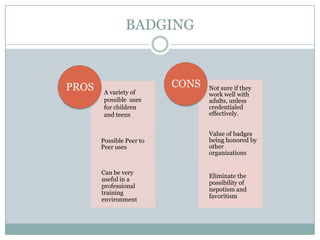
PROS

A variety of
possible uses
for children
and teens

CONS

Not sure if they
work well with
adults, unless
credentialed
effectively.

Possible Peer to
Peer uses

Value of badges
being honored by
other
organizations

Can be very
useful in a
professional
training
environment

Eliminate the
possibility of
nepotism and
favoritism
Badging and
our
Audience:
Is it Suitable?

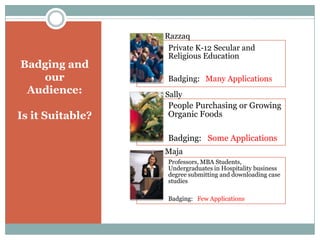
Razzaq
Private K-12 Secular and
Religious Education
Badging: Many Applications
Sally

People Purchasing or Growing
Organic Foods
Badging: Some Applications
Maja
Professors, MBA Students,
Undergraduates in Hospitality business
degree submitting and downloading case
studies
Badging: Few Applications
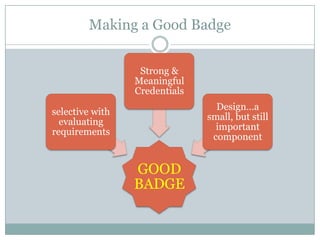
Making a Good Badge
Strong &
Meaningful
Credentials
Design…a
small, but still
important
component

selective with
evaluating
requirements

GOOD
BADGE
Summary
 Overall, we focused on how badging will relate to the audiences we

identified for our learning environments.
 Maja believes badging may not work well with her audience, but may find a
place if used by the system if it is awarded for the person with the most case
studies downloaded.
 Sally also wasn’t sure how badges will merge with her audience. During
that discussion, a few possibilities she suggested were for awarding badges
for certain organic foods they produced. Also, a badge can be awarded to
an individual who successfully created their own organic garden after being
trained. It can be a collaborative badge from larger organic organizations.
 Even though I realize badging can be valuable in a k-12 learning
environment, I was concerned with how to make sure the process was fair.
If we are using the children to award other students, then we have to create
a structure to try to eliminate the friend aspect that is so significant in that
environment. Sally suggested to group kids randomly, outside of their
primary friends. At the grade school level, it can begin to teach them how
to be “fair” and nice”.
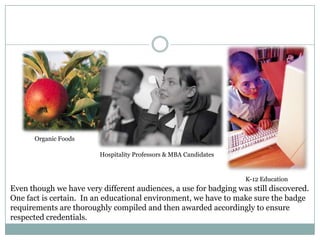
Organic Foods
Hospitality Professors & MBA Candidates

K-12 Education

Even though we have very different audiences, a use for badging was still discovered.
One fact is certain. In an educational environment, we have to make sure the badge
requirements are thoroughly compiled and then awarded accordingly to ensure
respected credentials.

Badging presentation

  • 1.
    BADGING HOW SHOULD ITBE USED Group Members: Razzaq Clark (Documenter) Maja Anderson Sally Speed
  • 2.
    BADGING PROS A variety of possibleuses for children and teens CONS Not sure if they work well with adults, unless credentialed effectively. Possible Peer to Peer uses Value of badges being honored by other organizations Can be very useful in a professional training environment Eliminate the possibility of nepotism and favoritism
  • 3.
    Badging and our Audience: Is itSuitable? Razzaq Private K-12 Secular and Religious Education Badging: Many Applications Sally People Purchasing or Growing Organic Foods Badging: Some Applications Maja Professors, MBA Students, Undergraduates in Hospitality business degree submitting and downloading case studies Badging: Few Applications
  • 4.
    Making a GoodBadge Strong & Meaningful Credentials Design…a small, but still important component selective with evaluating requirements GOOD BADGE
  • 5.
    Summary  Overall, wefocused on how badging will relate to the audiences we identified for our learning environments.  Maja believes badging may not work well with her audience, but may find a place if used by the system if it is awarded for the person with the most case studies downloaded.  Sally also wasn’t sure how badges will merge with her audience. During that discussion, a few possibilities she suggested were for awarding badges for certain organic foods they produced. Also, a badge can be awarded to an individual who successfully created their own organic garden after being trained. It can be a collaborative badge from larger organic organizations.  Even though I realize badging can be valuable in a k-12 learning environment, I was concerned with how to make sure the process was fair. If we are using the children to award other students, then we have to create a structure to try to eliminate the friend aspect that is so significant in that environment. Sally suggested to group kids randomly, outside of their primary friends. At the grade school level, it can begin to teach them how to be “fair” and nice”.
  • 6.
    Organic Foods Hospitality Professors& MBA Candidates K-12 Education Even though we have very different audiences, a use for badging was still discovered. One fact is certain. In an educational environment, we have to make sure the badge requirements are thoroughly compiled and then awarded accordingly to ensure respected credentials.

Editor's Notes

  • #2 I forgot to take a group snapshot. I went back into second life to at least get this image. I was a little distracted because it took us a little while to find our way to the garden.