By
Aditi Pundir
Lack of citations, inadequate citations,
or the misrepresentation of another
person's ideas as the student's own are
all examples of bad academic
practice.
Examples of bad academic practice
are as follows:
 Low-level plagiarism without
citations, such as mistakes brought
on by negligence or
misunderstanding.
 Passing off concepts, information, or
other material as being something
the student individually discovered.
Source: dmu.ac.uk
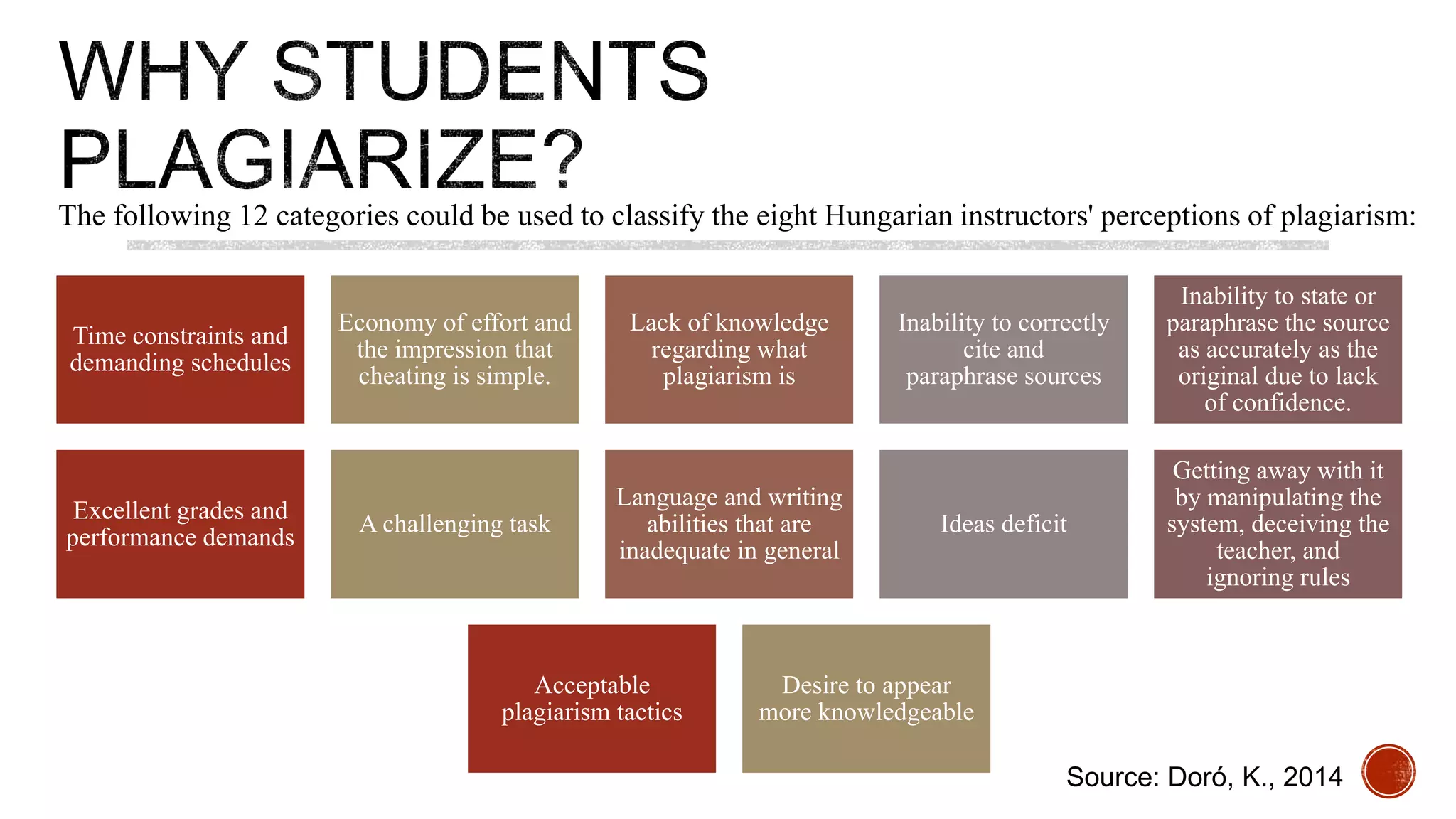
Time constraints and
demanding schedules
Economy of effort and
the impression that
cheating is simple.
Lack of knowledge
regarding what
plagiarism is
Inability to correctly
cite and
paraphrase sources
Inability to state or
paraphrase the source
as accurately as the
original due to lack
of confidence.
Excellent grades and
performance demands
A challenging task
Language and writing
abilities that are
inadequate in general
Ideas deficit
Getting away with it
by manipulating the
system, deceiving the
teacher, and
ignoring rules
Acceptable
plagiarism tactics
Desire to appear
more knowledgeable
The following 12 categories could be used to classify the eight Hungarian instructors' perceptions of plagiarism:
Source: Doró, K., 2014
The ten types of plagiarism are as followed:
 Secondary source
 Invalid source,
 Duplication
 Paraphrasing
 Repetitive research
 Replication
 Misleading attribution
 Unethical collaboration
 Verbatim plagiarism
 Complete plagiarism.
 Depending on the degree of plagiarism, a
reduction in the grade(s) for the relevant
paperwork.
 Resubmitting work that the student originally
plagiarized
 Zero points will be awarded if the work is
completely plagiarized
 If the plagiarism is even more severe, the entire
course will receive zero points.
Source: Berlinck, R.G., 2011
 Cite all your sources.
 Direct quotations from the source must be cited
including paraphrased ideas.
 Use reference list, bibliography, or both at the end of
your written work.
 Your tutor might anticipate that you include background
reading in your bibliography.
 Remember to cite your background reading
because unacknowledged reuse of your own work is
against academic policy.
 It shows that you have done the necessary reading and research.
 It enables you to demonstrate precisely which thoughts originate
from your reading and research.
 It makes it possible for your reader to track down the sources you
used.
 It's likely that the way you use referencing, and its conventions
will be evaluated and affect how you'll be graded overall.
 A plagiarism claim could result from careless referencing.
 It shows a dedication to doing academic work in a thorough
manner.
 Recognizing the work of others is good academic practice and
failing to do so would be unethical.
 Awasthi, S., 2019. Plagiarism and academic misconduct: A systematic
review. DESIDOC Journal of Library & Information Technology, 39(2)
 Berlinck, R.G., 2011. The academic plagiarism and its punishments-a
review. Revista Brasileira de Farmacognosia, 21, pp.365-372.
 Doró, K., 2014. Why do students plagiarize? EFL undergraduates’ views on
the reasons behind plagiarism. Romanian Journal of English Studies, 11(1), pp.255-
263.
 De Montfort University (no date) Bad academic practice. Available
at: https://www.dmu.ac.uk/current-students/student-support/exams-deferrals-
regulations-policies/student-regulations-and-policies/bad-academic-
practice.aspx (Accessed: 21-112022).
Thank you!

Bad Academic Practice.pptx

  • 1.
  • 3.
    Lack of citations,inadequate citations, or the misrepresentation of another person's ideas as the student's own are all examples of bad academic practice. Examples of bad academic practice are as follows:  Low-level plagiarism without citations, such as mistakes brought on by negligence or misunderstanding.  Passing off concepts, information, or other material as being something the student individually discovered. Source: dmu.ac.uk
  • 4.
    Time constraints and demandingschedules Economy of effort and the impression that cheating is simple. Lack of knowledge regarding what plagiarism is Inability to correctly cite and paraphrase sources Inability to state or paraphrase the source as accurately as the original due to lack of confidence. Excellent grades and performance demands A challenging task Language and writing abilities that are inadequate in general Ideas deficit Getting away with it by manipulating the system, deceiving the teacher, and ignoring rules Acceptable plagiarism tactics Desire to appear more knowledgeable The following 12 categories could be used to classify the eight Hungarian instructors' perceptions of plagiarism: Source: Doró, K., 2014
  • 5.
    The ten typesof plagiarism are as followed:  Secondary source  Invalid source,  Duplication  Paraphrasing  Repetitive research  Replication  Misleading attribution  Unethical collaboration  Verbatim plagiarism  Complete plagiarism.
  • 6.
     Depending onthe degree of plagiarism, a reduction in the grade(s) for the relevant paperwork.  Resubmitting work that the student originally plagiarized  Zero points will be awarded if the work is completely plagiarized  If the plagiarism is even more severe, the entire course will receive zero points. Source: Berlinck, R.G., 2011
  • 7.
     Cite allyour sources.  Direct quotations from the source must be cited including paraphrased ideas.  Use reference list, bibliography, or both at the end of your written work.  Your tutor might anticipate that you include background reading in your bibliography.  Remember to cite your background reading because unacknowledged reuse of your own work is against academic policy.
  • 8.
     It showsthat you have done the necessary reading and research.  It enables you to demonstrate precisely which thoughts originate from your reading and research.  It makes it possible for your reader to track down the sources you used.  It's likely that the way you use referencing, and its conventions will be evaluated and affect how you'll be graded overall.  A plagiarism claim could result from careless referencing.  It shows a dedication to doing academic work in a thorough manner.  Recognizing the work of others is good academic practice and failing to do so would be unethical.
  • 9.
     Awasthi, S.,2019. Plagiarism and academic misconduct: A systematic review. DESIDOC Journal of Library & Information Technology, 39(2)  Berlinck, R.G., 2011. The academic plagiarism and its punishments-a review. Revista Brasileira de Farmacognosia, 21, pp.365-372.  Doró, K., 2014. Why do students plagiarize? EFL undergraduates’ views on the reasons behind plagiarism. Romanian Journal of English Studies, 11(1), pp.255- 263.  De Montfort University (no date) Bad academic practice. Available at: https://www.dmu.ac.uk/current-students/student-support/exams-deferrals- regulations-policies/student-regulations-and-policies/bad-academic- practice.aspx (Accessed: 21-112022).
  • 10.