Introduction to backtracking , a slide for learning all the use cases of the most important topic when comes to learning algorithms , the first step after learning recursion
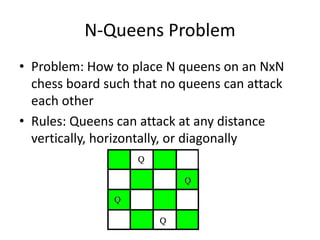
N-Queens Problem
• Problem:How to place N queens on an NxN
chess board such that no queens can attack
each other
• Rules: Queens can attack at any distance
vertically, horizontally, or diagonally
3.
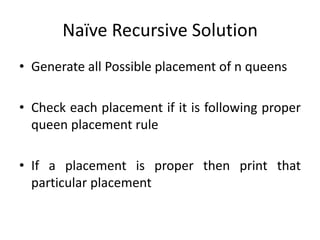
Naïve Recursive Solution
•Generate all Possible placement of n queens
• Check each placement if it is following proper
queen placement rule
• If a placement is proper then print that
particular placement
4.
Generate All PossiblePlacement
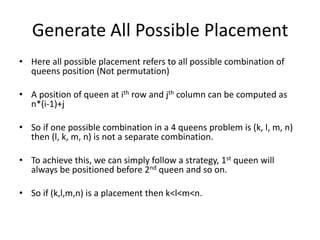
• Here all possible placement refers to all possible combination of
queens position (Not permutation)
• A position of queen at ith row and jth column can be computed as
n*(i-1)+j
• So if one possible combination in a 4 queens problem is (k, l, m, n)
then (l, k, m, n) is not a separate combination.
• To achieve this, we can simply follow a strategy, 1st queen will
always be positioned before 2nd queen and so on.
• So if (k,l,m,n) is a placement then k<l<m<n.
5.
Generate All PossiblePlacement
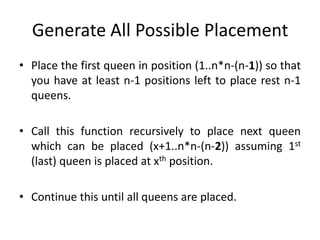
• Place the first queen in position (1..n*n-(n-1)) so that
you have at least n-1 positions left to place rest n-1
queens.
• Call this function recursively to place next queen
which can be placed (x+1..n*n-(n-2)) assuming 1st
(last) queen is placed at xth position.
• Continue this until all queens are placed.
6.
Generate All PossiblePlacement
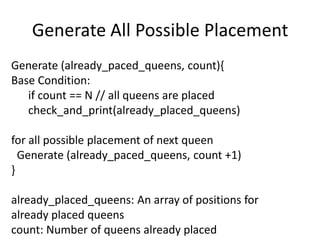
Generate (already_paced_queens, count){
Base Condition:
if count == N // all queens are placed
check_and_print(already_placed_queens)
for all possible placement of next queen
Generate (already_paced_queens, count +1)
}
already_placed_queens: An array of positions for
already placed queens
count: Number of queens already placed
7.
Generate All PossiblePlacement
void generate(int x[N], int count){
int i,start;
if (count == N)
check_and_print(x);
else {
if(count ==0)
start =1;
else
start = x[count-1] +1;
for(i=start;i<=N*N-(N-count-1);i++){
x[count]=i;
generate(x,count+1);
}
}
}
}
8.
Check And Print
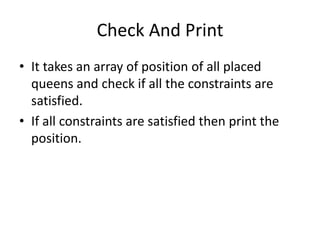
•It takes an array of position of all placed
queens and check if all the constraints are
satisfied.
• If all constraints are satisfied then print the
position.
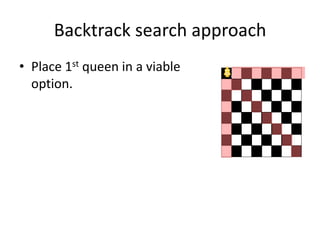
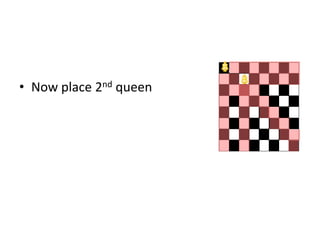
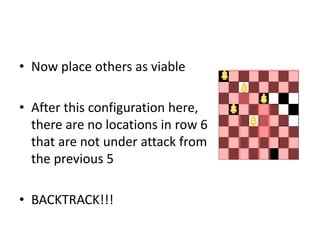
• Now placeothers as viable
• After this configuration here,
there are no locations in row 6
that are not under attack from
the previous 5
• BACKTRACK!!!
16.
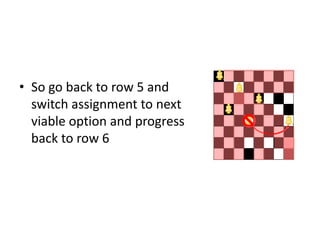
• So goback to row 5 and
switch assignment to next
viable option and progress
back to row 6
17.
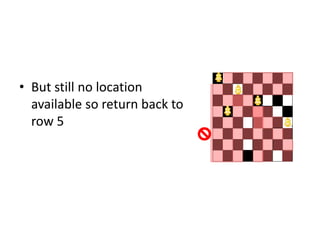
• But stillno location
available so return back to
row 5
18.
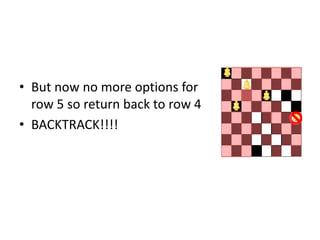
• But nowno more options for
row 5 so return back to row 4
• BACKTRACK!!!!
19.
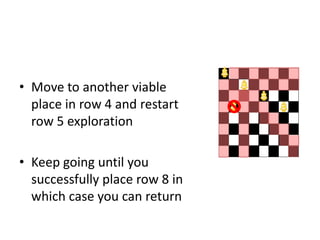
• Move toanother viable
place in row 4 and restart
row 5 exploration
• Keep going until you
successfully place row 8 in
which case you can return
20.
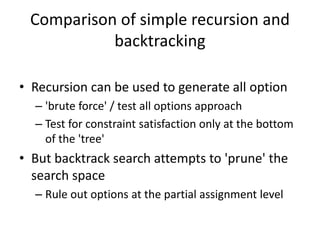
Comparison of simplerecursion and
backtracking
• Recursion can be used to generate all option
– 'brute force' / test all options approach
– Test for constraint satisfaction only at the bottom
of the 'tree'
• But backtrack search attempts to 'prune' the
search space
– Rule out options at the partial assignment level
21.
1. Start inthe topmost row
2. If all queens are placed return true
3. Try all columns in the current row. Do following for every
tried row.
a) If the queen can be placed safely in this column then mark this
[row, column] as part of the solution and recursively check if
placing queen here leads to a solution.
b) If placing the queen in [row, column] leads to a solution then
return true.
c) If placing queen doesn't lead to a solution then unmark this
[row, column] (Backtrack) and go to step (a) to try other
column.
4. If all columns have been tried and nothing worked, return
false to trigger backtracking
22.
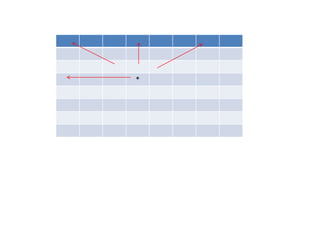
int solveNQ(int placed[N][N],int row){
int col;
if (row >= N)
return 1;
for (col = 0; col < N; col++) {
if (isSafe(row, col,placed)) {
placed[row][col]=1;
if (solveNQ(placed,row+1))
return 1;
placed[row][col]=0; //backtrack
}
}
return 0;
}
23.
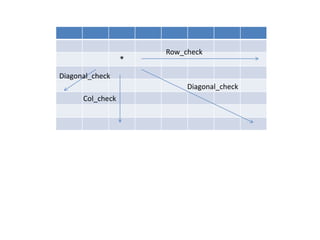
int isSafe(int i,int j, int placed[N][N]){
if (check_row(i,j,placed) && check_col(i,j,placed)
&& check_diagonal(i,j,placed))
return 1;
}
Sudoku
• Given apartially filled
9×9 2D array grid[9][9],
the goal is to assign
digits (from 1 to 9) to
the empty cells so that
every row, column, and
subgrid of size 3×3
contains exactly one
instance of the digits
from 1 to 9.
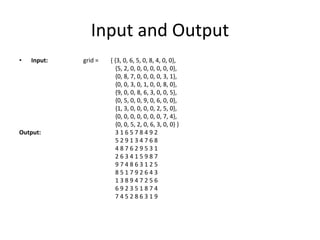
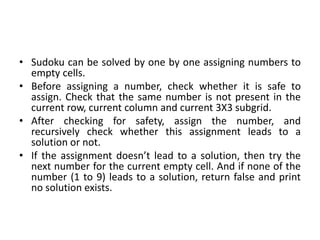
• Sudoku canbe solved by one by one assigning numbers to
empty cells.
• Before assigning a number, check whether it is safe to
assign. Check that the same number is not present in the
current row, current column and current 3X3 subgrid.
• After checking for safety, assign the number, and
recursively check whether this assignment leads to a
solution or not.
• If the assignment doesn’t lead to a solution, then try the
next number for the current empty cell. And if none of the
number (1 to 9) leads to a solution, return false and print
no solution exists.
28.
int SolveSudoku(int grid[N][N])
{
introw, col;
if (there is no unassigned location) //base case
return 1;
else
get row and column of any unassigned location
for (int num = 1; num <= 9; num++) {
if (isSafe(grid, row, col, num)) {
grid[row][col] = num;
if (SolveSudoku(grid))
return 1;
grid[row][col] = UNASSIGNED;
}
}
return false;
}
29.
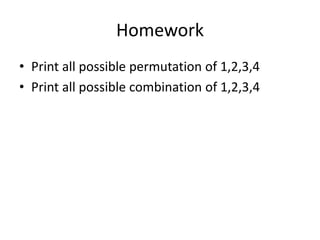
Homework
• Print allpossible permutation of 1,2,3,4
• Print all possible combination of 1,2,3,4
![Generate All Possible Placement
void generate(int x[N], int count){
int i,start;
if (count == N)
check_and_print(x);
else {
if(count ==0)
start =1;
else
start = x[count-1] +1;
for(i=start;i<=N*N-(N-count-1);i++){
x[count]=i;
generate(x,count+1);
}
}
}
}](https://image.slidesharecdn.com/3-250911195120-9c323373/85/Backtracking_Introductory_Slides_notes_important_for-learning-basics-7-320.jpg)
![void check_and_print(int x[N]){
int placed[N][N]={0},i,m,row,col;
for(i=0;i<N;i++){
m=x[i];
row=(m-1)/N;
col=(m-1)%N;
placed[row][col]=1;
}
if (check(placed))
print(placed);
}](https://image.slidesharecdn.com/3-250911195120-9c323373/85/Backtracking_Introductory_Slides_notes_important_for-learning-basics-9-320.jpg)
![Check
int check(int placed[N][N]){
int i,j,k;
for(i=0;i<N;i++){
for(j=0;j<N;j++){
if (placed[i][j]){
if (check_row(i,j,placed) && check_col(i,j,placed) &&
check_diagonal(i,j,placed))
continue;
else
return 0;
}
}
}
return 1;
}](https://image.slidesharecdn.com/3-250911195120-9c323373/85/Backtracking_Introductory_Slides_notes_important_for-learning-basics-11-320.jpg)
![1. Start in the topmost row
2. If all queens are placed return true
3. Try all columns in the current row. Do following for every
tried row.
a) If the queen can be placed safely in this column then mark this
[row, column] as part of the solution and recursively check if
placing queen here leads to a solution.
b) If placing the queen in [row, column] leads to a solution then
return true.
c) If placing queen doesn't lead to a solution then unmark this
[row, column] (Backtrack) and go to step (a) to try other
column.
4. If all columns have been tried and nothing worked, return
false to trigger backtracking](https://image.slidesharecdn.com/3-250911195120-9c323373/85/Backtracking_Introductory_Slides_notes_important_for-learning-basics-21-320.jpg)
![int solveNQ(int placed[N][N], int row){
int col;
if (row >= N)
return 1;
for (col = 0; col < N; col++) {
if (isSafe(row, col,placed)) {
placed[row][col]=1;
if (solveNQ(placed,row+1))
return 1;
placed[row][col]=0; //backtrack
}
}
return 0;
}](https://image.slidesharecdn.com/3-250911195120-9c323373/85/Backtracking_Introductory_Slides_notes_important_for-learning-basics-22-320.jpg)
![int isSafe(int i, int j, int placed[N][N]){
if (check_row(i,j,placed) && check_col(i,j,placed)
&& check_diagonal(i,j,placed))
return 1;
}](https://image.slidesharecdn.com/3-250911195120-9c323373/85/Backtracking_Introductory_Slides_notes_important_for-learning-basics-23-320.jpg)
![Sudoku
• Given a partially filled
9×9 2D array grid[9][9],
the goal is to assign
digits (from 1 to 9) to
the empty cells so that
every row, column, and
subgrid of size 3×3
contains exactly one
instance of the digits
from 1 to 9.](https://image.slidesharecdn.com/3-250911195120-9c323373/85/Backtracking_Introductory_Slides_notes_important_for-learning-basics-25-320.jpg)
![int SolveSudoku(int grid[N][N])
{
int row, col;
if (there is no unassigned location) //base case
return 1;
else
get row and column of any unassigned location
for (int num = 1; num <= 9; num++) {
if (isSafe(grid, row, col, num)) {
grid[row][col] = num;
if (SolveSudoku(grid))
return 1;
grid[row][col] = UNASSIGNED;
}
}
return false;
}](https://image.slidesharecdn.com/3-250911195120-9c323373/85/Backtracking_Introductory_Slides_notes_important_for-learning-basics-28-320.jpg)