Babelfish Articles July 2015-Dec 2015 10-12-15
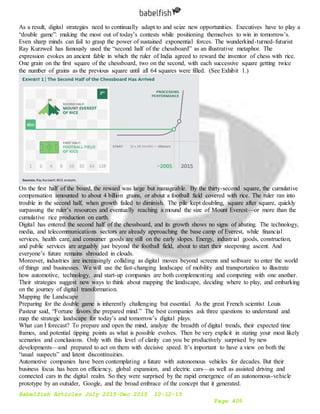
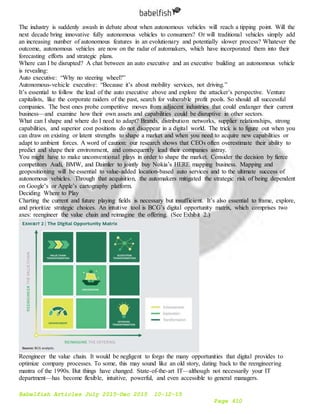
Page 1
Articles #13
July-Dec 2015
Brian Crotty
Babelfish.Brazil@gmail.com
Babelfish Articles July 2015-Dec 2015 10-12-15
Page 2
Summary
Ten Career Lessons. ...................................................... 11
Inside Amazon: Wrestling Big Ideas in a Bruising Workplace................ 13
Why Brands and Agencies Want to Interpret Pizza Slice Smiley Face ......... 14
Don’t Be Dated When It Comes To Data: 8 Types You Should Understand ....... 15
U.K. Marketers Will Use Fewer Agencies by 2020,........................... 16
App attack............................................................... 17
The World in 2025: 8 Predictions for the Next 10 Years.................... 20
Replacing Personas With Characters ....................................... 21
Why gamification is broken (and how to fix it)............................ 26
How Ads Work In Multiscreen Viewing, ..................................... 30
The Missing Media Metric: Reach Velocity — Part 1......................... 33
The Missing Media Metric: Reach Velocity — Part 2......................... 34
Data, Data Everywhere in the Upfront: An Overview -- Part 3............... 35
Data, Data Everywhere in the Upfront: An Overview -- Part 4............... 37
Data, Data Everywhere in the Upfront: An Overview -- Part 5............... 38
Data: A Negotiator's Point of View ....................................... 39
In ten years time your agency will be an algorithm........................ 40
Amid DMP Merger Mania, Brands Face A Changed Marketplace.................. 42
Can Programmatic Solutions Help Solve Agencies' Bandwidth Problem? ........ 43
Facebook video ads for new markets ....................................... 44
Brazil’s economy Broken lever ............................................ 45
Is TV Currency Dead? Predictions from AOL Open Series..................... 47
Why Beats 1 Could Be a Visionary Media Move .............................. 48
Our Smartphones, Ourselves ............................................... 49
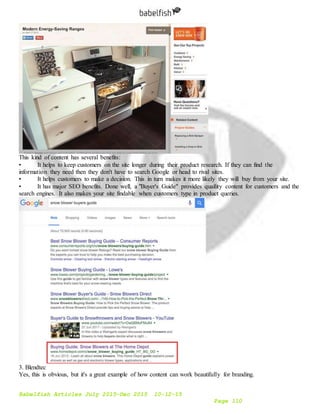
Beauty Products are Best Showcased Through Library Format................. 50
Why Netflix Is Spending $5 Billion To Win The Fight For Your Screens—And How It
Plans To Do It........................................................... 53
TV Isn’t Dead - It's Evolving and Evolving Quickly........................ 54
Using Search Data To Personalize Prices, Discounts Online................. 54
TBWACHIATDAY’s Vaino Leskinen on Storytelling in Mobile Advertising ..... 55
One year in: 7 ways Time Inc. has gone digital post-spinoff............... 56
10 C-Suite Jobs Of The Future ............................................ 57
How a Warm-Up Routine Can Save Your Knees ................................ 59
Coca-Cola's Hybrid....................................................... 60
TV companies waste data potential ........................................ 61
The Uber of Agencies: Why Marketers Want to Ride With a New Kind of Shop .. 62
The CEO of WPP's massive advertising trading desk Xaxis explains the 3 biggest
myths about his company .................................................. 64
9 Year-Over-Year Data Points Every SEO Should Monitor..................... 65
Five Key Milestones In The Digital Analytics Journey...................... 67
Babelfish Articles July 2015-Dec 2015 10-12-15
Page 3
Guia rápido de sobrevivência para líderes Não-Y........................... 69
New employees arrive at the campus of Amazon in Seattle. The company holds
orientation sessions on Mondays. ......................................... 72
BT is attempting to buy EE for a reported £12.5bn......................... 79
Google Makes Search Analytics Data Available Through API.................. 80
9 Year-Over-Year Data Points Every SEO Should Monitor..................... 80
There's Data in Those Emojis -- and Marketers............................. 86
Should every advertiser be a programmatic advertiser?..................... 86
Automated Guaranteed. Part 1: What does it mean for buyers?............... 87
Red-State Algorithm Vs. Blue-State Algorithm.............................. 88
Programmatic TV: Lines Of Demarcation .................................... 89
US cord-cutting at record high ........................................... 91
Saving The TV Business Model ............................................. 92
Programmatic Pain Points And The Measurement Cure-All..................... 93
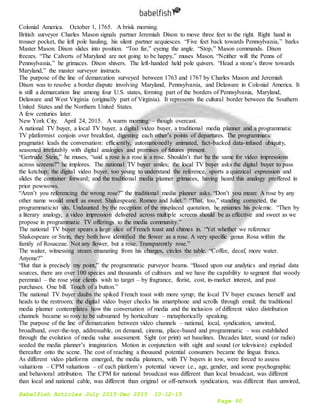
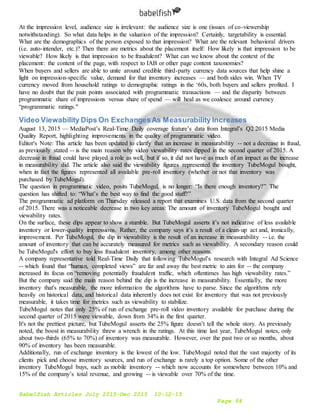
Video Viewability Dips On Exchanges As Measurability Increases ............ 94
Time Inc.'s digital chief: 'Transitioning takes time'..................... 95
New Data on Large Marketers - Tepid Growth, Stable TV Share (But More Digital
Spending To Come?)....................................................... 96
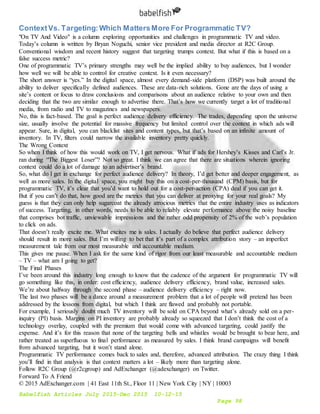
Context Vs. Targeting: Which Matters More For Programmatic TV? ............ 98
Execs From Facebook, Microsoft and More Will Help Guide IAB's Digital Video
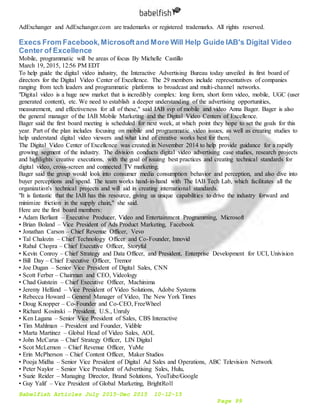
Center of Excellence ..................................................... 99
Retail: Divining shiny objects from true trends.......................... 100
GOOG, AAPL Video Measurement Initiatives Won't Hurt NLSN................. 101
LatAm digital TV to double .............................................. 102
Yahoo fails to impress with digital magazines............................ 103
A publicidade vai chegar ao Netflix (e você nem vai se importar) ......... 105
All of Facebook's revenue growth since it went public comes from one source:
mobile ads.............................................................. 106
Programmatic TV: In Their Own Words ..................................... 106
In OTT market, subscriptions beat ads ................................... 108
9 great examples of content from online retailers........................ 109
Content Tips for an E-Commerce Website .................................. 115
A First Look at Nielsen's Total Audience Measurement and How It Will Change the
Industry................................................................ 116
Why you should give your partner a ‘performance review’.................. 119
Retailers lag consumers by two years .................................... 120
Theater owners are furious about netflix’s new movie..................... 120
Facebook has revealed its new multi-pronged plan for online video domination121
Telstra TV launch date and price revealed ............................... 121
Facebook to Test New E-Commerce Marketplace, Shoppable Ads............... 122
What Facebook's new emojis mean for marketers............................ 123
Dissecting Virality—The Mathematical Formula............................. 123
Babelfish Articles July 2015-Dec 2015 10-12-15
Page 4
Coke sponsors new eSports show .......................................... 126
Why Tesla’s Autopilot and Google’s Car Are Entirely Different Animals .... 126
Aos poucos, mercado publicitário descobre potencial dos gamers ........... 127
Virtual Reality is Coming Directly to Your Living Room................... 128
Programmatic faces threats .............................................. 129
One in five are 'cord-nevers' ........................................... 129
Digitally disrupting the habitual shopping routine....................... 130
Mars prioritises data ownership ......................................... 131
Number of OTT users growing slowly ...................................... 132
Will Apple TV End Endless Search For Content?............................ 132
Rede Globo, Ibope e manipulação de audiência............................. 133
Twitter Plans to Adjust Its Trademark 140-Character Limit................ 134
APAC cautious on Facebook's TRP plan .................................... 134
Yahoo’s Top Tips for Writing Copy That Converts.......................... 135
How we cleaned up our platform and fixed more than “fraud"............... 136
5 reasons why ESPN pulled the plug on Grantland.......................... 137
What running a marathon taught me about business development ............. 138
Copyranter on the 'shit copywriters really think'........................ 139
YouTube Fake Viewer Study, Bloomberg Expose Highlight Key Digital Ad Flaws,
Importance of 3rd Party Measurement ..................................... 140
Google to match Facebook by giving advertisers better data targeting ..... 141
Native Mobile Video Lifts Upper- and Lower-Funnel Metrics................ 142
Ambitions Hinge on AOL's Ad Tech, Verizon's Data and Their Combined Scale 143
Mobile App Report Provides Insights, Highlights Subjectivity In Assessing
Digital Media Trends .................................................... 146
Netflix takes gamble with Epix film cull in US........................... 147
Face analysis can tell what you’ll buy after watching ads................ 148
Tourism video ads boost hotel bookings .................................. 149
3 Tips for Mapping the Customer Journey ................................. 149
DMexco Commentary - Marketing Tech, Ad Blocking, Nielsen, Agencies and More150
The Future Of Luxury Wearable Tech? ..................................... 152
The Skinny on Programmatic TV ........................................... 153
O fim da linha de montagem .............................................. 153
Digital Ad Viewability Good, Blocking Bad ............................... 155
DMexco Day 1 - Walled Gardens for FB, GOOGL, Strong Presence For AMZN, With
Agency Concerns and Opportunities ....................................... 156
Video effectiveness on the rise ......................................... 157
MasterCard pursues purposeful innovation ................................ 158
Tesco and Scottish Widows consider a newsroom approach to ‘always-on’ marketing
........................................................................ 158
Why the Marriage of Data and Creativity Is Critical for Improving Brands' Bottom
Lines................................................................... 159
Babelfish Articles July 2015-Dec 2015 10-12-15
Page 5
Carat sets out bold, five-year programmatic goals........................ 160
Netflix will never have everything you want, and neither will anyone else 161
CX vital to brand advocacy .............................................. 162
Social media drives Nissan .............................................. 163
Deutsch’s Chief Digital Officer on How to “Kill It” in Mobile ............ 164
'Relentless relevance' drives J&J ....................................... 165
Train stations can become sales rooms ................................... 165
The Evolution of Advertising in the Food and Beverage Industry ........... 166
Why There’s No Turning Back from Data-Driven Advertising................. 167
Data Drives Programmatic Advertising In-House and Draws Publishers Together168
Mobile is a 'new ecosystem' ............................................. 169
Third of all viewing is on demand ....................................... 169
App future beckons...................................................... 170
Q&A: IPG SE Asia on Automation, Programmatic and TV...................... 170
B&T Salary Survey: What’s Holding Adland Back From Asking For More Money? 172
5 tendências de varejo baseada em dados ................................. 173
RTB Insider: Is Programmatic Being Used By Big Agencies To Bash The
Independents?........................................................... 174
Winning in 2020......................................................... 175
Brand loyalty shortcuts the paths to purchase............................ 176
Mobile TV Streaming More Likely at Night ................................ 177
GE finds benefits in 'shiny objects' .................................... 177
The Mobile Web Is Alive and Well ........................................ 178
OOH audiences grow across Australia ..................................... 179
Sheep are transformed into billboards to help cut traffic deaths ......... 179
Five predictions for the future of publishing............................ 179
After #60YearsTVAds, will programmatic dominate the future of the small screen?
........................................................................ 181
Online shopping metrics misleading ...................................... 183
Cinema makes people happier ............................................. 183
Five Future Looking Trends in Media and Marketing........................ 184
Conteúdo patrocinado chega às séries de televisão........................ 186
Telefônica caminha para ser uma 'OTT' ................................... 187
Media mix needs to be 're-weighted' ..................................... 188
SVOD steals Aussie broadcast audience ................................... 189
Verdade ou mentira? ..................................................... 189
Q&A: Videology's Managing Director Is Making Programmatic Ad Buying More Exact
........................................................................ 190
Instagram’s New Boomerang App Helps Capture and Share 1-Second Loops of Life191
Ignore all the sensationalist hand-wringing about YouTube Red............ 192
Globo anuncia entrada no mercado de streaming............................ 193
Babelfish Articles July 2015-Dec 2015 10-12-15
Page 6
My life in advertising .................................................. 194
“Most Agencies Are Sh*tting Themselves About Digital:” Bold Media’s Toby Hemming
........................................................................ 195
Dish Launches Programmatic Strategy to Lure Digital Advertisers to TV .... 196
P&G Hikes Media Spending Despite Currency-Driven Sales Plunge............ 197
Dunkin', McDonald’s And ADT Debate: Can We Trust Tech Platforms With Our Data?
........................................................................ 198
John Wren on Viewability: Publishers Should Not Grade Their Own Homework . 200
Inside PwC’s $750 million ad agency ..................................... 201
New TV Data: Cord-Cutter and Cord-Shaver Viewing Trends.................. 202
Your Job Title Is … What? ............................................... 203
Gamification and the Process of Game Thinking............................ 204
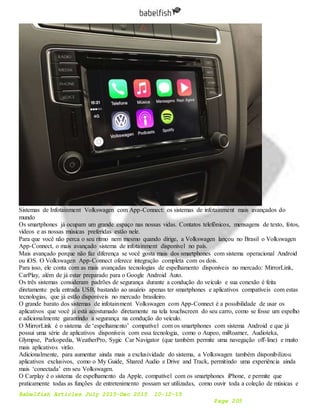
Volkswagen App-Connect, o mais avançado sistema de infotainment disponível no
país.................................................................... 204
Ann Handley’s Fight For Good Content vs. Good Enough Content ............. 206
New TV Data: Traditional Viewing Stable On L7 So Far in 2015-16.......... 208
Internet Advertising: IAB Data Accelerates, Facebook and Google Dominate . 208
Microsoft é a nova líder do Quadrante Mágico de Bancos de Dados do Gartner 209
Itaú quer mais escala na ConectCar ...................................... 209
Why is it so hard to find the perfect agency in a pitch?................. 210
Please Agency, do not thank me when you win a new business pitch ......... 212
Rede social quer mais gente assistindo mais vídeos nativos............... 213
The 3 best books about the future of television and what the authors would add
if they could........................................................... 214
After VivaKi Disperses, Publicis Releases A Tool To Consolidate Programmatic
Functions............................................................... 216
Emotional Connections As A Science ...................................... 217
The New Science of Customer Emotions .................................... 217
Algorithms Don’t Feel, People Do ........................................ 220
50 free apps to make you an incredibly productive person................. 223
Brazilian Programmatic Creative Campaign Takes Customization To New Level 230
Millward Brown Study Shows Pitfalls Of Targeting......................... 230
Netflix launches prepaid in Brazil ...................................... 232
Five smart questions you should ask during every job interview ........... 232
How Facebook Can Shine In Digital Video ................................. 233
Let The Blame Games Begin! .............................................. 233
Apple has four years to change our minds about electric cars ............. 234
When Should You Say No To Your Boss? .................................... 235
Why Your Best Employees Should Be Paid a Lot More........................ 236
In Latin America, App Downloaders Look to Games.......................... 236
Data Drives Programmatic Advertising In-House and Draws Publishers Together237
What Are Millennials Up to with Digital Video?........................... 238
Babelfish Articles July 2015-Dec 2015 10-12-15
Page 7
Saving The TV Business Model ............................................ 239
Broadcasters, Cable Companies and MVPDs Unite to Form the New Video Advertising
Bureau.................................................................. 242
Why Amazon Says It Doesn't Care 'What Netflix Is Doing'.................. 243
When TV Is Obsolete, TV Shows Will Enter Their Real Golden Era ........... 244
SVOD threat 'exaggerated' ............................................... 246
Streaming disrupts linear TV ............................................ 247
The Rise Of The SSP For Programmatic TV ................................. 247
CMCSA Set Top Data - Good for NBCU, Unclear Implications for NLSN, RENT .. 248
Programmers' Paradoxical Positive ....................................... 250
Video Measurement: Keeping SCOR of the Leader............................ 251
Linear TV viewing will peak in 2015 ..................................... 252
Media Planning Toolkit: Planning TV ..................................... 253
Advertising in context: Make real-time the right time.................... 256
Advertising in context: Use algorithms, not segmentation................. 258
Advertising in context: Create context and relevancy..................... 260
Connected TVs Alter Face and Path of Addressable Advertising ............. 263
Google's core business explained in two charts........................... 264
How to dramatically improve your memory ................................. 266
Mobile internet top dog by 2017 ......................................... 268
ESOMAR: Digital Dimensions, June 2014 ................................... 269
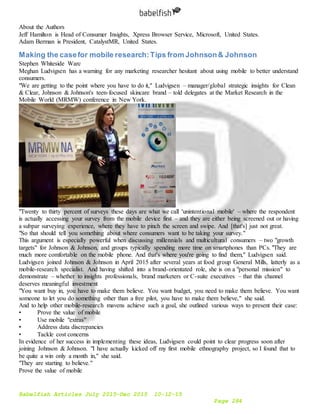
Making the case for mobile research: Tips from Johnson & Johnson ......... 284
The Great Market Research Debate: Are mobile insights better than online? 286
New approach key to tapping new tech .................................... 289
The Future of Branded Education and the Opportunity for Brands ........... 289
Consumer Segments of Consequence in 2020: Are you prepared?.............. 291
What Are 'Micro Mobile Moments,' and What Do They Mean for Your Brand? ... 293
Wearables, drones and beacons: Where is technology taking marketing? ..... 294
Four "mobile truths" from Heineken ...................................... 296
TV companies waste data potential ....................................... 298
Media Planning Toolkit: Planning TV ..................................... 298
Friboi alcança resultado recorde em campanha que sincroniza anúncios na TV e
digital, com tecnologia TVSync da DynAdmic .............................. 302
Future Trends Volume 13: The Future of Money............................. 302
Talking Mobile with Intel’s David Veneski ............................... 303
For Advertisers, It's Mobile Game Time .................................. 305
Mobile Phones Strengthen Lead for Mobile Video Viewing................... 306
Mobile Coupons: Don't Push Without Permission............................ 306
How Mobile Service Providers Are Driving Mobile Web Use in Brazil ........ 307
Digital Brazil 2015: Mobile Paving the Way for a More Connected Country .. 307
Babelfish Articles July 2015-Dec 2015 10-12-15
Page 8
NLSN Total Audience Data: TV Trends Persist, Better Tablet Data Provides Better
Digital Context......................................................... 314
How Mobile Changes Everything ........................................... 316
The Research Fallacy that Refuses to Die ................................ 317
Reckitt Benckiser looks to mcommerce .................................... 318
Generation that lived full employment drops the approval Dilma ........... 319
Mark Zuckerberg: the future of facebook is sharing thoughts.............. 320
5 daily habits to improve brain growth .................................. 320
YouTube: a nova grade televisiva ........................................ 321
TVData ganha o ProXXima Startup ......................................... 322
Novas tecnologias desafiam a indústria da publicidade.................... 322
4 trends in programmatic are really heating up this summer............... 323
A Big Step for Set Top Box Data ......................................... 324
When a promotion is a bad thing ......................................... 325
Big Data Management Requires a Big Makeover ............................. 326
How a Warm-Up Routine Can Save Your Knees ............................... 327
Why I Skipped Cannes: Dave Morgan ....................................... 328
Agency Commoditization – Lost in Translation?............................ 329
Publicidade: tendências do mercado em debate............................. 330
Behold, the Hierarchy of Marketing Content .............................. 331
Mobile affects family relationships ..................................... 331
Mídia Programática: O que é e como negociar?............................. 332
Global Ad Forecasts - Magna and Zenith Updates and Comparisons ........... 333
Por que saí do Brasil – e por que não vou voltar......................... 334
Twitter (TWTR, Buy) announced yesterday that it would be selling auto-play video
ads..................................................................... 337
SMG Acquires Digital Shop AKOM360, Boosts Content Channels............... 337
ShopStyle brings e-commerce to Snapchat, with an assist from influencers . 338
The state of mobile ad spending in 5 charts ............................. 339
How to Staff an Analytics Team .......................................... 340
What the New BMW 7-Series Reveals About the Future of Luxury Cars ........ 341
Data drives Washington Post ............................................. 342
Brazil’s middle class starts to lose ground ............................. 343
Australia’s three free-to-air stations face significant challenges if they don’t
change their business models. ........................................... 345
Do More Faster: 10 Best Apps & Tools .................................... 345
Salesforce Steps Into Ad Tech Via 5 Partnerships......................... 347
Cross Channel And Multichannel: Fraternal, Not Identical, Twins .......... 347
Brain Research: What's The Best Length For A Super Bowl Spot? ............ 348
A guarantee for targeted TV ads ......................................... 349
Shopper marketing: Motivations on the path to purchase................... 350
Babelfish Articles July 2015-Dec 2015 10-12-15
Page 9
Mobile Video: Key Trends for a Fast-Growing Medium....................... 353
Pinterest Debuts Buyable Pins for Mobile Shopping........................ 354
Pinterest............................................................... 354
Madison & Wall: Facebook and Google: Digital Media’s Brick Walls ......... 355
WTF is agency transparency? ............................................. 356
Is It Smart Digital Marketing - Or Is It Creepy?......................... 358
YouTube Unveils New Research and Insights Before NewFronts 2015 .......... 359
Advertisers Focus on Original Digital Video Programming.................. 360
The Sharing Economy: Users Desire 'Access Over Ownership'................ 361
Connected TVs Alter Face and Path of Addressable Advertising ............. 361
Vindico Unveils Video Ad Trends: Shorter, Smarter........................ 362
Além e à frente dos desafios de programático na América Latina ........... 363
Anthology: Helping Brands Tell Stories through Video Ad Content.......... 364
Cadreon Chief: 'Trade Desk Decentralization Is The Wrong Thing To Do' .... 365
Ad Tech Salespeople Need A Common Parlance For Brands.................... 366
CEO Bill Demas Is Out At Turn ........................................... 367
Carat’s Anthony Rhind On His Jump From The Agency World To Ad Tech ....... 368
The Programmatic Waterfall Mystery ...................................... 369
Programmatic TV: Further Ahead, Further Behind Than You Think ............ 371
PubMatic CEO: "Media Arbitrage Models Aren't Profitable"................. 372
Facebook: Quietly Killing The Remarketing Industry....................... 373
Google is bringing DoubleClick to billboard ads for the first time - which could
be huge for outdoor advertising ......................................... 375
Why Change Agents Are Destined To Fail .................................. 376
How to use mobile as a bridge between digital and physical............... 377
Hulu Offers No Commercial Interruptions for Viewers Who Interact With One Ad
Upfront................................................................. 381
Welcome to the Red Cell: The CIA unit that asks the awkward questions .... 382
How Grocery Stores Are Evolving To Meet Mom's Needs...................... 386
Comcast Is Merchandising Its Data: Does This Change the Game for Targeted TV?387
5 Best Free Team Management Tools ....................................... 388
How To Make Long-Lasting Changes To Your Unconscious Habits.............. 390
Viacom Viewing in DISH Proxy Homes Shows Co-Dependent Relationship ....... 392
Quer um conselho da Renata Serafim? ..................................... 394
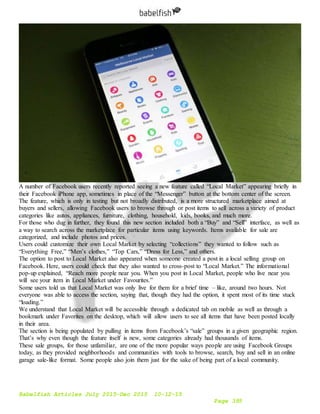
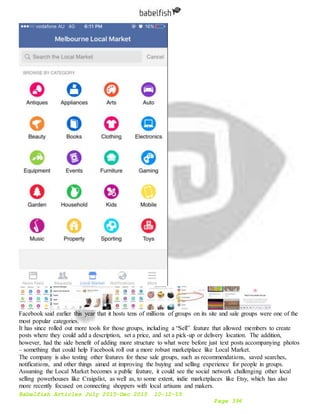
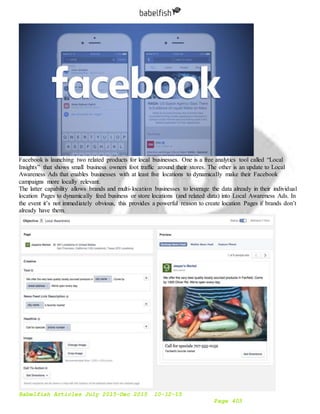
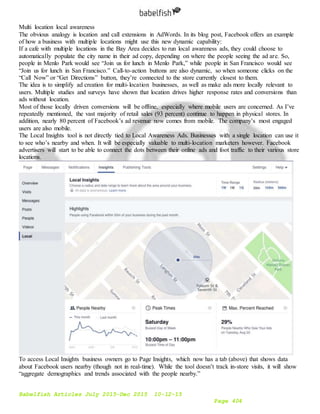
Facebook Tests “Local Market,” .......................................... 394
Finding a way out of analysis paralysis to achieve digital transformation 397
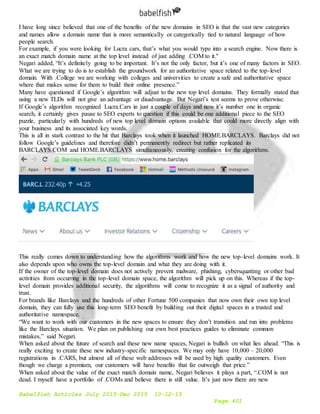
Case study: will new domain extensions provide an SEO boost? ............. 399
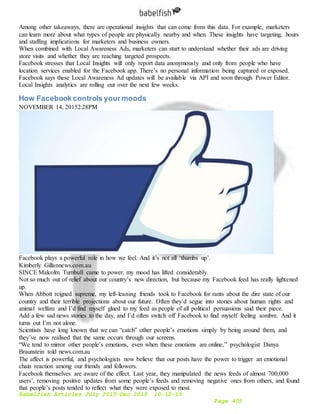
New tools leverage location, provide insight into online-to-offline consumer
behavior................................................................ 402
How Facebook controls your moods ........................................ 405
Google Couldn’t Survive with One Strategy ............................... 407
Babelfish Articles July 2015-Dec 2015 10-12-15
Page 10
The Double Game of Digital Strategy ..................................... 408
Forrester's 2016 Predictions: Audience And Viewership Aren't The Same Thing412
Retailers rein in brands' digital spend ................................. 413
Adobe Debuts Its Data Exchange .......................................... 414
Connected TVs Marry New and Old Viewing Habits........................... 414
DMP News Highlight ADBE Strength, GOOGL Fears............................ 416
The Problem Isn't Redefining the Ad Agency, It's Redefining the Word 'Ad' 416
Frito-Lay backs marketing technologists ................................. 417
While procrastination gets a bad rap it could actually be positive ....... 418
Global Data Bank Announces Launch in Brazil ............................. 420
Mindshare: Broadway Debuts in Your Living Room........................... 420
Confused by the idea of programmatic TV? Here is a handy guide ........... 421
McDonald’s is on a mission to implement ‘mass personalisation’ ........... 422
eCommerce in 2015....................................................... 423
Apple Forays Into Payments: Could The US Finally Have Easy Peer-To-Peer
Payments?............................................................... 429
TV perde espaço para conteúdo via streaming ............................. 431
How to Present Data to People Who Are Scared of Numbers.................. 431
YouTube Music para Android e iOS ........................................ 432
Give social to PR....................................................... 433
Brands move programmatic in house ....................................... 434
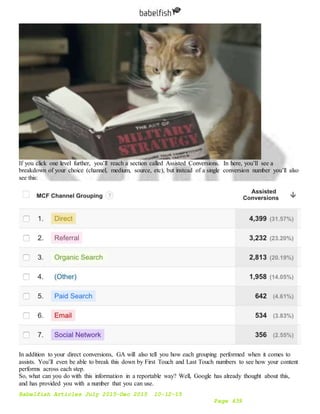
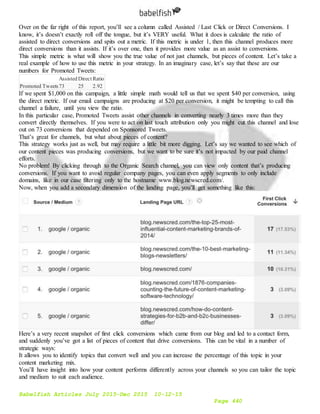
Understanding The True Attribution Value Of Your Content Marketing ....... 434
Automating and Optimizing Local TV Planning ............................. 441
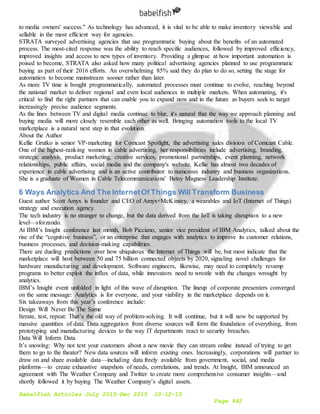
6 Ways Analytics And The Internet Of Things Will Transform Business ...... 442
An Epitaph For Broadcast TV ............................................. 443
Mad Women or Math Women? ................................................ 444
Six marketing trends for 2016 ........................................... 445
Babelfish Articles July 2015-Dec 2015 10-12-15
Page 11
Ten Career Lessons.
Sep 20, 2015 Rishaad Tobacowala
Originally published on my blog...https://rishadt.wordpress.com/
Often when asked for career advice from students coming out of school or individuals early in their own careers
here is what I share.
A. The First Decade
1. Find the least sucky job you can: Early on in your career your initial assignments being those of the starter
variety will be filled with a certain rote drudgery as you being the lowest of the low will be delegated work that
no one wants to do themselves.
Do not delude yourself that in your early years that you are going to find “your purpose”, “your passion” or
“your identity”. Nope. You have found yourself a job in a competitive landscape and you will be learning
valuable lessons on showing up even if you do not feel like coming to work to do stuff “beneath you” , how to
deal with a spectrum of characters and personalities, how to present and write, and what it feels like to being
bossed around.
These elementary skills will turn out to be essential in that communication skills, empathy and discipline will
carry you far and be your friends forever even if you constantly change industries or the world changes around
you.
Unreal expectations must be controlled in the early years or you will be seen as a sniffling blow hard in need of
attitude adjustment.
2. The Trend is your Friend: If you are fortunate to be able to pick between jobs or find demand for your skills
that allow you to choose between opportunities in a company do not select the higher paying one but the one
that is aligned with the future. Shakespeare wrote “we must take the current when it serves. Or lose our
ventures” which in modern vernacular is “go with the flow my friend”. A majority of career success is to be
aligned with trends and industries that are rising and even mediocre players can succeed in an unstoppable tide.
Aligning with a trend and particularly aligning early is critical because not only will the force be with you but
your skills will be in demand as the area grows and if you have joined early you will be experienced and
become well known in the field.
3.Plan and make decisions over a long horizon: Most people coming out of school and early in their careers will
work for nearly 50 years. With life expectancies nearing the mid eighties, social security being pushed back and
health holding out till the seventies it is unlikely that you will be parked on a beach in your mid fifties. Maybe
in your mid sixties or later. Thus do not make job or career decisions with three to five month horizons but
three to five year horizons. Try to give each company or assignment or adventure at least three years and if it is
an industry or company at least five. Your decision making will be better, your skills will mature and you will
take daily and weekly gyrations in perspective.
4. Even the best jobs are only good seventy percent of the time: If you have a great job you will find yourself
wondering three days out ten you what you are doing, why you are doing it and if you are any good. The
reasons for this are three fold. First. do recognize that you are being paid for what you do and the more you are
paid often the harder the job is and the problems and troubles you must deal with. Often the challenges or the
situations or the people you have to deal with require you to steel yourself with a drink or more. Second, if you
have a great job it is one that is growing you and sometimes throws you challenges that require you to build
new muscles and do new things. Learning is never easy and if you are growing there will be days that the pain
will feel more like a signal that you dislike your job rather than you are building new expertise. The best jobs
have flow which is a combination of competence and challenge and sometimes the challenge can be quite
daunting. Finally, we are all living in a time of great change, chaos and velocity which is filled with uncertainty
. The most relevant and most transformative industries are in the eye of the storm and this can make a day at
work feel like a day in the high speed spin cycle of a laundry machine.
5. Compete against yourself rather than with others: The trick is not to try to better than every one else which is
neither possible nor attainable for long or with everybody who is doing the grading. Rather it is to be better
every day than you were yesterday. Perpetual improvement by learning from those you admire and respect or
expertise you appreciate is not only fulfilling but one that you can control free of petty politics or pissing of
Babelfish Articles July 2015-Dec 2015 10-12-15
Page 12
people that you will need to work with. Oddly it is more competitive than external competition because you can
win externally often by bamboozling and sleigh of hand but you cannot really fool yourself. Get better because
in it there is reward.
The Middle Years
6. Who you work for is critical so choose your boss well: Once you get past the first decade of your career and
you have learnt essential skills including how to keep learning, built an early reputation and if lucky aligned
with a growing trend, the key to success is to find and hold on to the right boss. Over the next decade or two
who you work for will be the determining factor in your success more than anything else you do. The middle
years are really about being given new opportunities to learn and grow and linking with someone who is both
growing themselves and is mentoring your own growth. A successful boss increases their remit and thus makes
new opportunities for you, but also ensures that they have your back while being very upfront and
straightforward with you face to face. They challenge you but cover for you when necessary. Find one or more
of these and hold on tight. It makes all the difference and every successful leader has been fortunate to have
someone who mentored, challenged and looked after them.
7. Find Fit: In your middle career you should begin to specialize. You now know what you enjoy and are
passionate about. You also know where you have comparative advantage. And you can see where there are
growing and declining opportunities. Continuously adapt your job and find ways to start doing more and more
things at the intersection of passion, comparative advantage and market demand. Today, more than ever before
it is experts who love their jobs that are happiest and successful. Stop thinking that everyone can or should be a
CEO. And for a lot of people the CEO job makes zero sense. Stop doing and pursuing things just because other
people think they are cool jobs. Stop living in other peoples mind and start living in your own life. It is only
then that autonomy, purpose and mastery come together and you fit your role and your role fits you.
8. Build a Personal Brand: As you get to the last third of your career it is very crucial to enter it with a stellar
reputation. As Jeff Bezos said a brand is what they say about you when you are not in the room. In addition to
being generous and working with integrity which are key to being a successful brand it is important to be well
positioned niche (what are you world class at or what is your special expertise?), have a distinct and clear voice
(who are you and what do you stand for) and have a story (why should people believe you). Here is anexercise
on how to build a personal brand
The Later Years
9. Unlearn. Transform. Re-Invent: A quarter of century or three decades into work still leave a decade or more
of career ahead and this is where things can get really dangerous or interesting.
If you have been successful you are being set up for a fall because without you knowing it the Industry you
grew up in is being transformed and there are new technologies and approaches that make what you learned
obsolete and just when you think you have arrived you have to unlearn what made you successful. Now you
have to start learning and changing and making mistakes that you long thought you no longer have to do since
you are a leader and not a rookie. You are too cool and too senior to actually make a fool of yourself but if you
do not want to become as irrelevant as you fear privately you will have to change.. Now all this talk about
“change is good”that you have been stating to your teams has to be applied to yourself and you begin to realize
that change actually sucks since you have to learn and trip and re-grow.
The really successful folks in the last third of the career are students and learners again and if they have built a
brand and have worked with integrity and helped others along the way, a swarm of people come to help them
adjust. They reverse mentor, form a trampoline and ensure that you do not fail since they recall the days you
helped them.
10. Build a portfolio career and start giving back aggressively : Anyone successful in addition to working hard
and playing the long game has been helped immensely by other people and of course been blessed with luck.
They have been given chances and now is the time to give those chances back.
In addition it is time to build a portfolio career that expands from a job to one that includes a job, consulting,
advising and giving back. Sooner or later the job will end but meaningful and purposeful work will continue.
Successful older people end up being consultants part of the time and serve in advisory roles on boards or as
mentors and they start teaching and helping non- profits. The folks who have ended their jobs most gracefully
Babelfish Articles July 2015-Dec 2015 10-12-15
Page 13
began these alternate streams during their last decade at work by volunteering, by teaching classes by mentoring
and advising younger folks. This way they have a new road ahead when their full time job ends and because
they do they move on gracefully into a new phase.
Inside Amazon: Wrestling Big Ideas in a Bruising Workplace
Amazon employees entering the company’s offices in Seattle. It recently became the most valuable retailer in
the country.
RUTH FREMSON / THE NEW YORK TIMES By JODI KANTOR and DAVID STREITFELD
August 15, 2015
SEATTLE — On Monday mornings, fresh recruits line up for an orientation intended to catapult them into
Amazon’s singular way of working.
They are told to forget the “poor habits” they learned at previous jobs, one employee recalled. When they “hit
the wall” from the unrelenting pace, there is only one solution: “Climb the wall,” others reported. To be the best
Amazonians they can be, they should be guided by the leadership principles, 14 rules inscribed on handy
laminated cards. When quizzed days later, those with perfect scores earn a virtual award proclaiming, “I’m
Peculiar” — the company’s proud phrase for overturning workplace conventions.
At Amazon, workers are encouraged to tear apart one another’s ideas in meetings, toil long and late (emails
arrive past midnight, followed by text messages asking why they were not answered), and held to standards that
the company boasts are “unreasonably high.” The internal phone directory instructs colleagues on how to send
secret feedback to one another’s bosses. Employees say it is frequently used to sabotage others. (The tool offers
sample texts, including this: “I felt concerned about his inflexibility and openly complaining about minor
tasks.”)
Amazon is building new offices in Seattle and, in about three years, will have enough space for about 50,000
employees.
Many of the newcomers filing in on Mondays may not be there in a few years. The company’s winners dream
up innovations that they roll out to a quarter-billion customers and accrue small fortunes in soaring stock.
Losers leave or are fired in annual cullings of the staff — “purposeful Darwinism,” one former Amazon human
resources director said. Some workers who suffered from cancer, miscarriages and other personal crises said
they had been evaluated unfairly or edged out rather than given time to recover.
Even as the company tests delivery by drone and ways to restock toilet paper at the push of a bathroom button,
it is conducting a little-known experiment in how far it can push white-collar workers, redrawing the boundaries
of what is acceptable. The company, founded and still run by Jeff Bezos, rejects many of the popular
management bromides that other corporations at least pay lip service to and has instead designed what many
workers call an intricate machine propelling them to achieve Mr. Bezos’ ever-expanding ambitions.
Interactive Feature | Inside Amazon A look at the experiment in how far to push white-collar workers.
“This is a company that strives to do really big, innovative, groundbreaking things, and those things aren’t
easy,” said Susan Harker, Amazon’s top recruiter. “When you’re shooting for the moon, the nature of the work
is really challenging. For some people it doesn’t work.”
Bo Olson was one of them. He lasted less than two years in a book marketing role and said that his enduring
image was watching people weep in the office, a sight other workers described as well. “You walk out of a
conference room and you’ll see a grown man covering his face,” he said. “Nearly every person I worked with, I
saw cry at their desk.”
Thanks in part to its ability to extract the most from employees, Amazon is stronger than ever. Its swelling
campus is transforming a swath of this city, a 10-million-square-foot bet that tens of thousands of new workers
will be able to sell everything to everyone everywhere. Last month, it eclipsed Walmart as the most valuable
retailer in the country, with a market valuation of $250 billion, and Forbes deemed Mr. Bezos the fifth-
wealthiest person on earth.
Tens of millions of Americans know Amazon as customers, but life inside its corporate offices is largely a
mystery. Secrecy is required; even low-level employees sign a lengthy confidentiality agreement. The company
Babelfish Articles July 2015-Dec 2015 10-12-15
Page 14
authorized only a handful of senior managers to talk to reporters for this article, declining requests for
interviews with Mr. Bezos and his top leaders.
Interactive Feature | Bo Olson “Nearly every person I worked with, I saw cry at their desk.”
However, more than 100 current and former Amazonians — members of the leadership team, human resources
executives, marketers, retail specialists and engineers who worked on projects from the Kindle to grocery
delivery to the recent mobile phone launch — described how they tried to reconcile the sometimes-punishing
aspects of their workplace with what many called its thrilling power to create.
In interviews, some said they thrived at Amazon precisely because it pushed them past what they thought were
their limits. Many employees are motivated by “thinking big and knowing that we haven’t scratched the surface
on what’s out there to invent,” said Elisabeth Rommel, a retail executive who was one of those permitted to
speak.
Others who cycled in and out of the company said that what they learned in their brief stints helped their careers
take off. And more than a few who fled said they later realized they had become addicted to Amazon’s way of
working.
“A lot of people who work there feel this tension: It’s the greatest place I hate to work,” said John Rossman, a
former executive there who published a book, “The Amazon Way.”
Interactive Feature | Tony Galbato “It would certainly be much easier and socially cohesive to just compromise
and not debate, but that may lead to the wrong decision.”
Amazon may be singular but perhaps not quite as peculiar as it claims. It has just been quicker in responding to
changes that the rest of the work world is now experiencing: data that allows individual performance to be
measured continuously, come-and-go relationships between employers and employees, and global competition
in which empires rise and fall overnight. Amazon is in the vanguard of where technology wants to take the
modern office: more nimble and more productive, but harsher and less forgiving.
“Organizations are turning up the dial, pushing their teams to do more for less money, either to keep up with the
competition or just stay ahead of the executioner’s blade,” said Clay Parker Jones, a consultant who helps old-
line businesses become more responsive to change.
On a recent morning, as Amazon’s new hires waited to begin orientation, few of them seemed to appreciate the
experiment in which they had enrolled. Only one, Keith Ketzle, a freckled Texan triathlete with an M.B.A., lit
up with recognition, explaining how he left his old, lumbering company for a faster, grittier one.
“Conflict brings about innovation,” he said.
Why Brandsand Agencies Want to InterpretPizza Slice Smiley Face
By Kate Kaye. Published on July 06, 2015.
Consumers are communicating in broken hearts and bananas -- and brands are listening. As use of emojis
proliferates, brands and their social media agencies are devising ways to interpret the cute icons that form
emotive statements in text messages and more recently on Instagram and Twitter. Digital stickers and brand
logos are also up for interpretation.
"The use of emojis is kind of like were observing a new language right in front of us," said Tony Clement, VP
analytics at independent shop Big Spaceship. The agency is working with technology firms to develop
definitions for brand tracking through emojis. The goal, essentially, is to apply some of the same techniques for
quantifying value and measuring brand sentiment based on words in social media to metrics for imagery.
A heart, after all, doesn't always represent love. Social-media agencies want to learn the nuances in meaning
and sentiment between a blue heart and a crimson one, for instance.
"Basically I'm adopting a new language…how does that inform an advertising strategy?" said Mr. Clement.
Social agency Crimson Hexagon has been evaluating social posts containing digital stickers and logos in photos
for clients including O2 Telefonica UK, Campbell's and Allstate.
"We're missing where people are sharing photos that have our brand in it or our competitor's brand in it," said
Errol Apostolopoulos senior VP-product for Crimson Hexagon. The company uses image detection to identify
coffee or apparel-brand logos that show up in photos people post on Instagram or their Tumblr pages. It
Babelfish Articles July 2015-Dec 2015 10-12-15
Page 15
evaluates the volume of brand imagery in addition to context. For instance, if someone is smiling alongside a
branded coffee drink, it would be perceived as a positive sentiment.
The image detecting, said Mr. Apostolopoulos, is not challenging. "It's the application of it within social
analysis and trying to correlate that with what people have said in text."
Measuring the brand value of speaking in cartoons may seem like a mere novelty, but as adoption of this picture
parlance grows, agencies recognize the need to figure out how to analyze imagery as though it were text.
Instagram has tracked significant increase in use of emojis on its platform since Apple introduced its emoji
keyboard for iOS in 2011 and Android launched its own in 2013. The photo sharing firm said 10% of text on
Instagram contained emojis after the iOS keyboard was made available; that portion has increased to "nearly
half" as of March, according to the company, which published the first of a multi-part blog post series on its
internal emoji research.
"The vocabulary of Instagram is shifting similarly across many different cohorts with a decline in internet slang
corresponding to rise in the usage of emoji," wrote Thomas Dimson, a software engineer on the company's data
team, employing the also-acceptable irregular plural form of the term. Instagram places emojis into a variety of
categories such as food, facial expressions, marine animals and wedding emojis.
Some marketers even are attempting to master the emoji lexicon. On June 23, Chevrolet hinted at its launch
later that week of the 2016 Chevy Cruz with a video and Twitter campaign featuring comedian Norm
McDonald.
"I am excited to translate an emoji announcement on behalf of Chevrolet," declared the former Saturday Night
Live Weekend Update anchor and all-around curmudgeon. He went on to translate tiny icons that popped up on
a TV screen behind him. A mobile phone icon represented the word "technology." The phrase "striking design"
was visualized with a bowling ball and pins followed by one of those triangle rulers kids use in geometry class.
The joke, perhaps, was that a somewhat stodgy guy who live-tweets golf tournaments was translating these
new-age hieroglyphics.
"I can see brands doing that, sort of having emoji battles," said Mr. Clement. Still, he suggested the use of emoji
in marketing campaigns likely will be short-lived since consumer fatigue could set in as it did with gifs and
memes. "They need to be careful about how to deploy it and to what extent," he said. "If we see that at the
Super Bowl then it's definitely peaked"
It's finally 🎓🕐 at #EmojiAcademy. Oh, did I mention I'm really famous? #ChevyGoesEmoji @Chevrolet #ad
🍞🚙😻 https://t.co/Yw4eHUIAAm
— Norm Macdonald (@normmacdonald) June 23, 2015
Andrew Perry
Don’t Be Dated When It Comes To Data: 8 Types You Should Understand
Jul 28, 2015 Diaz Nesamoney
Today, we have more data sources than ever before, so it’s critical for marketers to familiarize themselves with
the ones that are most valuable and most relevant for their brand. Whether these terms are new to you, or you
just need a quick refresher course, the list below is a comprehensive guide.
1. Profile Data
Thanks to profile data, multi-brand marketers may use a single campaign and media buy to ensure focused
messaging to specific audiences. For example, Mercedes could use profile data to show the Mercedes GL, a
high-end SUV, to moms who live in higher-net-worth geographies while showing the entry-level CLA cars to
younger males who are more likely buyers of the CLA.
Profile data could also be used to message different aspects of a car to different audience segments. For
example, men might respond better to messaging about the ruggedness of a car in mountain terrain and specs of
the engine, while women may respond better to messaging about cargo space, safety, etc.
2. CRM Data
A broader set of profile data is available to brands that have a direct relationship with their customers. This is
especially true for brands that offer products directly from their websites and/or their branded retail outlets. The
Babelfish Articles July 2015-Dec 2015 10-12-15
Page 16
data in these cases is much richer and detailed, including things like purchase history, loyalty, average purchase
amounts, and even demographics and wealth brackets.
But integrating CRM data with advertising can be challenging. For example, such profile data often belongs to
the operations team and is managed by corporate IT. It can often be a long and difficult process for the
marketing team to gain access to the data. Companies should consider the privacy implications of using such
data so that they don’t damage the trust relationship they have with customers.
3. Environmental Data
Geographic data can be used to deliver very effective engagement by customizing an ad for local audiences. For
example, auto companies used to have to go through the very cumbersome process of allocating marketing
funds and managing creative integrity for large dealerships across the country. Today, they can simply enable
ads to display creative messaging customized for each local market.
4. Real-Time Events
Social media allows companies to relate marketing messages to events happening in real time. Now, Facebook,
Twitter, Vine, Snapchat, Instagram, and others have taken the idea further by allowing brands to message
directly to consumers.
There are two kinds of event-based dynamic ads. The first type are pre-programmed ads, for events that are
scheduled ahead of time, such as football games or the Grammys. These campaigns are easy to manage because
creative assets can be approved ahead of time.
The second type of event-based dynamic ads is real-time ads. Real-time event-based advertising has primarily
been in the realm of social media because the real-time messaging nature of Twitter fits well with the idea of
real-time “sponsored tweets” or other kinds of messaging that leverages data about the user to tailor messaging.
5. Social Media Data
Social media reveals a lot about a person’s interests and is a rich source of data for personalized advertising.
Most social media platforms offer various targeting segments that an advertiser can use to create precise
messaging. Social media platforms often allow advertisers to pick interests (sports fans), demographics (single
men), as well as friends of fans (with similar interests), and so on.
6. Site/Cookie Data
As users browse websites, they indicate preferences and likes in an indirect way. For example, users visiting the
Car and Driver site would select the kinds of cars they are likely to be in the market for. In some cases,
consumption of content on a site does not directly correlate to purchase intent. Nevertheless, site data can
provide very important insights into consumer interest.
Several startup companies have also recently introduced personalization software for websites. Rather than a
website being static and one-size-fits-all, it’s dynamically configured for the user, based on a continuous
process of learning about the consumer’s interests.
7. Search Data
Search data is the hardest type of data to come by. Since Google switched to secure search, which hides the
referrer URL’s search term, it has become impossible to use a search term to personalize ads on a site.
However, some data providers (e.g., DMPs) do provide aggregated search data that can be used to customize
advertisements. Search data is very personal and should be used with a lot of caution as it can directly reveal
things about the users that they may not want others to know about.
8. Contextual Data
Most media publisher sites have various sections that may have different kinds of context. Many news sites
(e.g., CNN, USA Today) have sections for sports, finance, lifestyle, etc. Often a media purchase is done for the
whole site and runs on all pages. But it’s also possible to have dynamic personalization of an ad, based on the
section or context in which it is running. Such contextually driven personalized ads can be very effective at
creating customized messaging for the audience profile of visitors to a specific section of the publisher’s site
and can be done without creating a lot of complexity in terms of individual ads and ad tags.
U.K. Marketers Will Use Fewer Agenciesby 2020,
'Too Risky' to Outsource Customer Relationships and Data
Babelfish Articles July 2015-Dec 2015 10-12-15
Page 17
By Emma Hall. Published on September 10, 2015.
More than half of U.K. marketers expect to use fewer agencies in the future, according to a new report from
MediaSense and the Incorporated Society of British Advertisers, the U.K.'s advertiser group.
The Media 2020 report, put together by advisory firm MediaSense with ISBA and Ipsos, is a survey of 200
senior marketers. It includes 30 in-depth interviews with participants from ISBA's executive committee – which
counts Procter & Gamble, Nestlé, Kellogg, and Vodafone among its members.
Graham Brown
Graham Brown, founding director of MediaSense, a media advisory firm that specializes in media performance
and agency relationship management, said, "The areas that marketers are looking to bring in-house are around
management of current and potential customers. Outsourcing customer relationships – and the accompanying
data – is not something that marketers feel confident with."
The in-depth interviews revealed that, although some marketers said they find that outsourcing is the only way
to deal with the complex set of different skills required, others – particularly the larger companies -- said they
are prepared to invest in technology and data management, because it is too risky to allow third parties to
manage customers and prospects.
"This is not the death knell for creative agencies," Mr. Brown said. "Media agencies don't have a creative
culture and neither do management consultants. Creativity is still a valued mindset and the creative agency is
still king. But increasingly, marketers require an agility which is not done well by creative agencies."
Nearly 60% of marketers surveyed said that they anticipate that content development will move in-house or go
to alternative agencies within five years. "Lots of marketers say they value their creative agencies but they can't
afford to get them to do SEO and social content," Mr. Brown said. "By 2020, creative agencies will have to be
very different entities if they want to hang on to their status as trusted advisers. They have the opportunity to
win, but they need to reduce costs."
The report also found that 73% of marketers said they expect to be contracting directly with media owners and
technology companies by 2020. "If that isn't disintermediation, I don't know what is," Mr. Brown commented.
"For clients it's about taking greater control."
According to the report, greater self-reliance, new agency models and performance-based remuneration are the
top three priorities for CMOs as they prepare for the next decade; while data analytics, content development,
and omni-channel planning are the top three disciplines they consider critical to success.
The report was compiled between March and July 2015, with respondents from a broad range of industry
sectors including food, media, technology, insurance, retail banking, travel, pharmaceuticals, toys, transport,
drinks and confectionery. Together they represent more than $1.5 billion in advertising investment.
App attack
By Nilay Patel
"The future of TV is here."
It is not the world’s most understated tagline for a new product, especially one from Apple. If you want to set
sky-high expectations around a new TV product after years of rumors and sly winks and shelved plans, well,
that’s exactly how to do it. You say that you’ve invented the future of TV, and that it is here.
You say it while knowing full well that Steve Jobs set the stage for a radical new TV from Apple in 2011 by
directly telling his biographer that he’d "finally cracked it," and that he wanted to create "an integrated
television set that is completely easy to use," with "the simplest user interface you could imagine."
You say that the future of TV is here even though every attempt to place a computer at the center of the living
room experience has bombed catastrophically for nearly two decades, and that rivals like Microsoft and Google
have each been floored by the challenges of television.
You take the weight of those expectations, you bring the power of the Apple brand to bear, and you lift the
entire entertainment industry out of the chaotic technological mess it’s built for itself and right into the shiny
new future of voice control and touchpad remotes, just like we were always promised.
The future of TV is here.
Or is it?
Babelfish Articles July 2015-Dec 2015 10-12-15
Page 18
Here’s the basic blueprint for a modern media streaming device: a smallish black box that runs a zillion apps
from various TV networks and service providers like Netflix, all indexed into some sort of universal search and
controlled by voice.
CONVERGENCE
If you squint, the revolutionary new Apple TV actually looks like one of the oldest ideas in tech: convergence in
the living room. People have been trying to stick computers under TVs for 20 years now — there’s a straight
line from the 1996 webTV to Windows Media Center to Google TV to Android TV to the Xbox One. They’re
all just little PCs; the Google products have Intel processors and the Xbox One is getting a Windows 10 upgrade
in a few weeks. The tech industry (well, mostly Microsoft) has been trying and failing to bring the PC and TV
together for so long that it’s no wonder Apple called the Apple TV a hobby until last year: you can’t fail at a
hobby.
But the new Apple TV is an interesting new riff on the idea of convergence: instead of a little PC under the TV,
it’s a little iPhone. And just like the iPhone and apps ushered in a mobile revolution, it’s entirely possible that
the Apple TV and apps can finally usher in the convergence revolution.
That’s the $129 Roku 4, the $99 Amazon Fire TV 2, and the $99 Google Nexus Player, each to varying degrees
of success. And it’s also the new Apple TV, which is more expensive than all of those with a base price of
$149, although of course Apple’s added some of its typical flourish to the mix.
Take setup, which usually requires some painful entering of Wi-Fi passwords and iCloud credentials and so on
— with the new Apple TV, you just get your iPhone with iOS 9.1 and Bluetooth on near the unit, and it grabs
everything it needs to get online and get started. That’s pretty cool.
Or take the remote, which is a sleek black rectangle with a glass touchpad at the top; home, menu, play, and
volume buttons; an accelerometer and gyroscope; and dual microphones for voice commands that are triggered
by holding down the Siri button. It’s basically all the hardware interface elements of an iPhone reworked for a
10-foot television experience; it even charges over Lightning.
Or take the visual flair of the interface, popping with subtle 3D effects and interesting ideas about how the
multilayered glass aesthetic of iOS should translate to a TV. It’s not radically different than the previous Apple
TV interface or any of its competitors, but it’s far sleeker. The combination of the remote and interface feels
tight and polished and futuristic in a way that makes Roku and Fire TV feel plastic and utilitarian. I will say that
the touchpad can be more flashy than useful — there isn’t a single part of the main interface that actually
requires it, and you can get around just fine using a universal remote with a D-Pad.
But it’s really what’s underneath that’s the news here: tvOS, a new Apple OS that is basically iOS reworked for
television. Previous Apple TVs ran their own weirdo riffs on iOS, but tvOS is a proper part of the Apple
platform family alongside OS X, iOS, and watchOS. Most importantly, tvOS brings support for Siri and the
App Store to the Apple TV, which means any app developer can create apps for the system. The potential here
is massive: this thing is basically a computer under your TV.
But while iOS on the iPhone and iPad is a mature, capable operating system with tons of flexibility and a huge
variety of apps, tvOS is very much a first-generation product. In day-to-day use, it’s basically the same as the
previous Apple TV with the addition of a drastically stripped-down Siri and ported iPhone games.
the execution here is among the best in the game
Seriously: you won’t notice many changes from the previous Apple TV, save those fun 3D effects and the
switch from a black background to a whitish-gray version, until you hold down the Siri button. Then you can
ask any number of interesting questions about shows and movies in pretty granular detail — I asked for "‘80s
movies with Tom Cruise on Netflix" and Siri found me Top Gun and Risky Business, for example. Delightful.
Once you select a movie or show, Siri will open a universal landing page that deep links you right into the
various services that offer the content. So if you search for Game of Thrones, you’ll see that you can buy it on
iTunes and stream it on HBO Go or HBO Now, and you’re off to the races. In terms of iterative improvements
to the Apple TV, this is the most important thing Apple could have done, and the execution here is among the
best in the game.
But limitations are everywhere. Only a small handful of apps work with Siri search right now — iTunes,
Netflix, Hulu, HBO, and Showtime — so finding something in, say, the ESPN or CBS apps isn’t possible. Siri
Babelfish Articles July 2015-Dec 2015 10-12-15
Page 19
can’t find you a funny YouTube video, which seems like a shame. Tim Cook says a Siri search API is coming,
but I get the feeling Apple wants Siri search to be a differentiator for the more premium services, so we’ll see
how wide open that API is when it gets here. And once Siri drops you into a streaming app from that universal
search, it’s a free-for-all — they all have different interfaces and recommendation engines, and none of them
talk to each other. Shouldn’t Siri pay attention to what you’re watching and suggest content across services? Or
at least give you a Most Recently Watched list across all your services, like the Fire TV and Roku? One of the
best things about traditional TV is the serendipity of flipping it on and seeing something you like, or finding
something new. There’s a big discovery piece that really ties all these services together that’s missing here. TV
isn’t all about demanding things from a robot.
Siri can also launch apps and get you sports scores, stocks, and weather, but that’s about it. There’s no voice
feedback. There’s none of Siri’s trademark attitude — asking it to divide 0 by 0 gets nothing — and it can’t set
timers, convert units, or look up random facts on Wolfram Alpha or the web. When you ask Siri to play "my
favorite movie," it brings up a 2015 indie movie called… My Favorite Movie. This would be hilarious if this
version of Siri had a sense of humor.
4K
So the new Apple TV doesn’t support 4K, which is particularly funny when you consider the fact that the
beautiful new aerial-loop screensavers are exactly the sort of demo reels used to show off 4K displays. I would
bet a lot of money that they were originally shot in 4K, in fact.
But even though most mid- to high-end TVs are now 4K, there still isn’t isn’t a ton of 4K content out there. So
unless you’re intent on watching Breaking Bad and YouTube in 4K (and some of you surely are) you’re not
missing out on much because the Apple TV is 1080p.
That said, Apple is one of the few companies that runs a TV and movie service at scale, and if it wanted to push
a 4K upgrade cycle by adding tons of 4K content to iTunes and making it a feature of this new Apple TV, it
could do that. But it didn’t. I would assume that’s coming in the next version, but we’ll see.
Siri is also totally disconnected from Siri on the iPhone — you can’t tell Siri on your phone to play a song or
video on your TV, which seems like another huge missed opportunity. And bafflingly, Siri can’t control Apple
Music, so asking to play a Taylor Swift song results in nothing. "Sorry, I can’t help you with music," says the
screen. Siri says sorry about a lot of things.
And in the biggest oversight, Siri can’t search for apps in the App Store, or even take dictation into the text field
of the App Store search screen. If you thought App Store discovery was kind of messy and bad on iOS, tvOS
won't do anything to change your mind: there will be a few featured categories, a top list, and search. Unless
they get featured, app developers will have to convince people to search for new apps by swiping back and forth
along the terrible on-screen keyboard, which means their apps are going to have to basically cure disease and
print free money to get noticed.
And… that is not what the currently available apps in the App Store do. Most of them are just gigantic iPhone
apps. The Periscope app seems like it would be brilliant, but lacks the ability to log into your Periscope account,
so you can’t see your friends’ streams or leave comments. The Zillow app appears to be an aggressive attempt
to highlight the crime-scene aesthetic of most interior real estate photography. Descriptions for featured games
like Shadowmatic and Mr. Crab talk about plugging in headphones and tapping on your screen. Laziness
abounds.
Now, these games and apps can be fun, and some of them make the jump from the small to big screen so
incredibly well that it seems like they’ve always belonged there. Watching people around the world pour their
hearts into the Sing karaoke app is amazing on the Apple TV. Does not Commute turns into a totally different
game on a much grander scale. The Zova fitness app and Yummly cooking apps are both terrific examples of
how large web video libraries can be turned into focused and useful television.
Most apps are just gigantic iPhone apps
But I am going to be 100 percent crazy honest with you: the single most interesting app in the Apple TV App
Store right now is the QVC app.
The QVC app is the only app that really and truly blends television with interactivity: it shows you a live feed
of QVC, and it overlays the familiar information box on the left side of the screen with a buy button. So you’re
Babelfish Articles July 2015-Dec 2015 10-12-15
Page 20
watching the regular QVC TV channel, and you can just click to buy, or swipe down to see more photos of the
item and related items while the video keeps playing.
That kind of interactivity is the real future of television, and nothing about the Apple TV outside of the QVC
app really leans into it. Now that tvOS is an actual platform, I’m really hoping TV networks lean into the crazy
science fiction possibilities of interactive TV within their apps — think live voting on The Voice, or instant
reaction polls during debates. Or hell, just let fans decide what an NFL catch is, since no one else seems to
know. There’s so much promise here, but it’s all just potential. At this moment, there’s not a single app on the
Apple TV that enhances the experience of watching TV nearly as much as simply opening Twitter on your
phone during an awards show.
If it sounds like I’m holding the Apple TV to a higher standard than every other product, it’s because I am.
Once you really start thinking about the Apple TV and what it is today, it becomes very clear that while Apple
was able to significantly improve the parts of the streaming media experience that it can directly control, it
wasn’t able to use its leverage to really fix the little annoyances and disconnects littered throughout the TV
landscape that it can’t control.
Take setup again: yes, the tap-to-get-settings-from-an-iPhone feature is cool, but you can’t restore anything
from a previous Apple TV, so when you first get started you have to head into the App Store and search for and
download every streaming app you use. Then, once you’ve got them all, you have to authenticate all of them
individually — even apps like HBO Go and Watch ESPN that require the same cable provider TV Everywhere
username and password. And the iPhone Remote app doesn’t work with the new Apple TV yet, so you’re stuck
either swiping around the onscreen keyboard or digging up a laptop to enter an activation code. It’s frustrating
— I found myself reluctant to download new apps because I didn’t really want to log in yet again. If the future
of TV is really apps, adding new apps has to be virtually frictionless.
the very best version of television's present
Not having a single sign-on for apps that require a cable subscription is exactly the sort of piddly nonsense that
needs to get solved before the future of TV actually gets here. And solving exactly this sort of piddly nonsense
for people again and again is what turned Apple into the richest company in the world. I will go so far as to say
that the television market is so complex and so insane that only a company with Apple’s power and influence
can force meaningful change. So the pressure is on.
The streaming boxes on the market right now all compete to do very few simple things: get everything you want
to watch in a single place, make it all easy to search and discover, and get out of the way. And the Apple TV
does that as well or better than anything else on the market. It has virtually every streaming app save Amazon
Prime video, Siri works reasonably well and can answer a wider range of questions across services than the Fire
TV 2 or Roku, and playback is super fast. If you just want a new streaming box, you can happily buy a new
Apple TV. (I would buy the $149 base model.) You’ll like it.
But all of that is very much the best version of television’s present. Apple has a lot more work to do before the
future actually arrives.
The World in 2025: 8 Predictions for the Next 10 Years
By Peter Diamandis May 11, 2015
In 2025, in accordance with Moore's Law, we'll see an acceleration in the rate of change as we move closer to a
world of true abundance. Here are eight areas where we'll see extraordinary transformation in the next decade:
1. A $1,000 Human Brain
In 2025, $1,000 should buy you a computer able to calculate at 10^16 cycles per second (10,000 trillion cycles
per second), the equivalent processing speed of the human brain.
2. A Trillion-Sensor Economy
The Internet of Everything describes the networked connections between devices, people, processes and data.
By 2025, the IoE will exceed 100 billion connected devices, each with a dozen or more sensors collecting data.
This will lead to a trillion-sensor economy driving a data revolution beyond our imagination. Cisco's recent
report estimates the IoE will generate $19 trillion of newly created value.
3. Perfect Knowledge
Babelfish Articles July 2015-Dec 2015 10-12-15
Page 21
We're heading towards a world of perfect knowledge. With a trillion sensors gathering data everywhere
(autonomous cars, satellite systems, drones, wearables, cameras), you'll be able to know anything you want,
anytime, anywhere, and query that data for answers and insights.
4. 8 Billion Hyper-Connected People
Facebook (Internet.org), SpaceX, Google (Project Loon), Qualcomm and Virgin (OneWeb) are planning to
provide global connectivity to every human on Earth at speeds exceeding one megabit per second.
We will grow from three to eight billion connected humans, adding five billion new consumers into the global
economy. They represent tens of trillions of new dollars flowing into the global economy. And they are not
coming online like we did 20 years ago with a 9600 modem on AOL. They're coming online with a 1 Mbps
connection and access to the world's information on Google, cloud 3D printing, Amazon Web Services,
artificial intelligence with Watson, crowdfunding, crowdsourcing, and more.
5. Disruption of Healthcare
Existing healthcare institutions will be crushed as new business models with better and more efficient care
emerge. Thousands of startups, as well as today's data giants (Google, Apple, Microsoft, SAP, IBM, etc.) will
all enter this lucrative $3.8 trillion healthcare industry with new business models that dematerialize, demonetize
and democratize today's bureaucratic and inefficient system.
Biometric sensing (wearables) and AI will make each of us the CEOs of our own health. Large-scale genomic
sequencing and machine learning will allow us to understand the root cause of cancer, heart disease and
neurodegenerative disease and what to do about it. Robotic surgeons can carry out an autonomous surgical
procedure perfectly (every time) for pennies on the dollar. Each of us will be able to regrow a heart, liver, lung
or kidney when we need it, instead of waiting for the donor to die.
6. Augmented and Virtual Reality
Billions of dollars invested by Facebook (Oculus), Google (Magic Leap), Microsoft (Hololens), Sony,
Qualcomm, HTC and others will lead to a new generation of displays and user interfaces.
The screen as we know it — on your phone, your computer and your TV — will disappear and be replaced by
eyewear. Not the geeky Google Glass, but stylish equivalents to what the well-dressed fashionistas are wearing
today. The result will be a massive disruption in a number of industries ranging from consumer retail, to real
estate, education, travel, entertainment, and the fundamental ways we operate as humans.
7. Early Days of JARVIS
Artificial intelligence research will make strides in the next decade. If you think Siri is useful now, the next
decade's generation of Siri will be much more like JARVIS from Iron Man, with expanded capabilities to
understand and answer. Companies like IBM Watson, DeepMind and Vicarious continue to hunker down and
develop next-generation AI systems. In a decade, it will be normal for you to give your AI access to listen to all
of your conversations, read your emails and scan your biometric data because the upside and convenience will
be so immense.
8. Blockchain
If you haven't heard of the blockchain, I highly recommend you read up on it. You might have heard of bitcoin,
which is the decentralized (global), democratized, highly secure cryptocurrency based on the blockchain. But
the real innovation is the blockchain itself, a protocol that allows for secure, direct (without a middleman),
digital transfers of value and assets (think money, contracts, stocks, IP). Investors like Marc Andreesen have
poured tens of millions into the development and believe this is as important of an opportunity as the creation of
the Internet itself.
Bottom Line: We Live in the Most Exciting Time Ever
We are living toward incredible times where the only constant is change, and the rate of change is increasing.
Replacing Personas With Characters
Resolving the destructive effects of Personas.
Actors rehearsing their characters. Photo by David Bukach
Read the Persona* (please see note below) below and then learn what your brain does.
Babelfish Articles July 2015-Dec 2015 10-12-15
Page 22
Alan is a 30 year old white male living in New York. 6 months ago, he got married in Miami Florida. It was a
big event where lots of friends and family attended.
He graduated from University with an MFA degree, but was also always into engineering and has begun writing
software programs when he was very young.
He’s really into fashion, his mother was a fashion stylist, and doesn’t mind spending money on designer clothes.
He doesn’t buy clothes too often because he chooses to only buy pieces he really likes and thinks is a good
color & fit for him.
Some of his hobbies include tennis, playing flamenco guitar and reading.
Alan is someone who needed a tux for wedding and just bought one at a Sandro store.
The tux Alan bought..sort of
The above story of someone buying a product (a new tux) is in the format of a persona. Now… for everyone
who read this persona, 1 of 3 things happened. Their brain either:
1. Instantly assembled the bits into a story explaining why Alan bought this particular tux -adding in
whatever parts it felt were missing.
2. Made an attempt to create a story, but just gave up: probably because it’s tired or just don’t care enough
to figure it out.
3. Consciously decided to make an effort to understand the story, slowed down, and downshifted into a
more critical mode of thinking; however, since the information is too sparse to make sense — it goes back to #1
or #2.
Your brain did one of the above scenarios because it took in these somewhat disconnected facts and then was
left with a result: Alan bought the tux. However… it was unsatisfied- it was left thinking:
‘How did these attributes lead to this particular purchase?’
Because personas focus on creating a story made up of a customer’s attributes, instead of a story that explains a
purchase, personas leave the brain in a unsatisfied state. To fix this, in just a split second, the brain decides to
make up it’s own story about why Alan bought a particular Tux.
The reason why the brain work like this, has to do with cognitive biases; specifically, a phenomenon Daniel
Kahneman calls What You See Is All There Is (WYSIATI).
The above story is an abbreviated Persona… and the gap filling WYSIATI effect it has is not what the inventors
of Personas intended. Because of this, Personas have destructive effects on an organization. As each team
member reads a persona, they will subconsciously fill it with their own assumptions which differ from everyone
else.
The way to mitigate these unintended effects is to replace Personas with models that enable cohesive stories.
These models are called Characters.
Personas, Missing Gaps & The Team
Watch out! You’re about to read a persona! Don’t try to figure anything out…everything you need to know is in
there…trust me…
Over the years, many people have recognized that Personas can cause more problems than they solve. To fix
this, designers began making Personas bigger and more rich. Some Personas can be 1-2 typed pages which
meticulously describe attributes of these imaginary customers.
Yet, no amount of colorful attributes can fill the gaps our brains will automatically fill when reading Personas.
These missing gaps are the causalities which drove the customer to consume a particular product.
When reading a Persona, the brain craves a story that ties everything together. If the story lacks causality, it will
struggle to create that story, and will eventually just make up it’s own causalities — the WYSIATI effect.
The brain works to tie what it takes in so it can create a story — but usually just makes things up ‘cause it’s
lazy…
The brain acts this way because it’s hungry for causal stories which neatly explain why things happen. If it feels
there are any missing gaps, it will subconsciously fill those gaps with it’s own assumptions. Our brains have
evolved this way to keep us safe; if something that looks like a predator suddenly jumps out at us, our brain
would rather quickly assume we are in danger rather then slowly evaluate the situation.
Babelfish Articles July 2015-Dec 2015 10-12-15
Page 23
The problem with this behavior for organizations and teams is: as each member of a team starts subconsciously
creating their own reason why customers are ( or not ) consuming a product, the team will fragment. Even
worse, they will be fragmented and not even know it.
There is hope. There is one important thing that Personas do which make them helpful: They enable a way for a
team to quickly reference what has been learned about customers. However, everything else about Personas
needs to go.
The answer is to take the good, a way for a team to quickly reference insights about a customer, and to add
what’s needed: causality**.
To get the brain to accept a story which explains why a consumer bought a product, it needs information
presented in a particular way. The best way to deliver this information is to explain a customer’s anxieties,
motivations, purchase-progress events, and purchase-progress situations.
When combined, they form what I call Characters.
The Customer Becomes A Character
Let’s consider the above scenario when Alan ( I ) bought a new tuxedo. Everything in that story was true (I did
just buy a tux); however, your brain knew something was off. It recognized that it didn’t make sense for these
attributes to suddenly compel me to buy that tux… and it also picked up some information in there that just
seemed like noise — such as the part about Flamenco guitar playing.
What would make sense for the brain is a believable story which explains that purchase. This is what we can
use Characters for.
A Character is someone who:
1. Has anxieties & motivations.
2. Experiences purchase-progress events.
3. Encounters purchase-progress situations.
Let’s use my story of a tuxedo purchase to create a Character, beginning with anxieties & motivations.
Anxieties & Motivations
Here are some of my anxieties and motivations regarding a tuxedo purchase:
I had been considering buying a tuxedo for years. Some reasons I hadn’t bought one in the past are:
I don’t wear black and most tuxedos for sale are black.
I had only been to a few formal events over the years.
I didn’t want to waste money.
Even though I hated the look and fit of rented tuxedos, I just would feel guilty about buying something I didn’t
need.
If you’re familiar with the Jobs To Be Done concept, you’ll recognize those as some forces which pull and push
consumers.
Customers’ anxieties & motivations are discovered through interviewing them. How to uncover them is beyond
the scope of this article. A good place to start would be to learn about the progress making forces diagram, this
udemy course as well as some techniques explained by David Wu.
With some anxieties and motivations defined, let’s move to Purchase-Progress Events.
Purchase-Progress Events
While your Characters are going about their life with their motivations and anxieties, they are going to
experience particular events which will pull them toward a purchase. These are Purchase-Progress Events.
Here are the Purchase-Progress Events I experienced:
Lately, male celebrities and actors in movies have been wearing more alternative tuxedos — most notably
created by Tom Ford. This has had a ripple effect within the fashion industry and mainstream culture. Now,
alternative styles and colors for tuxedos are more socially acceptable.
Leading up to the purchase, I saw advertisements for the latest James Bond movie. In this movie James Bond,
famous for being dapper and wearing tuxes, wears a non traditional midnight blue tux. He also looks more like
me (blond hair & blue eyes) than previous James Bonds (who all had dark hair and dark eyes).
I recently read an article in GQ magazine on how to buy a tux. The article also showed contemporary models
and actors wearing tuxedos in more casual ways — usually a tux jacket with jeans and a button up shirt.
Babelfish Articles July 2015-Dec 2015 10-12-15
Page 24
So far, I’ve been experiencing Purchase-Progress Events through the lens of my anxieties and motivations. On
their own, these aren’t enough to lead to a purchase. What will tip the scales will be the Purchase-Progress
Situation(s) I encounter.
Purchase-Progress Situations
Purchase-Progress Events are passive. They are things which the customer sees, hears, or has happen to them.
At some point, all customers who end up making a purchase did so because they experienced one or more
Purchase-Progress Situations.
Here are the ones I encountered:
I had just got married and I met a lot of people. I learned that some of these people had their own weddings
coming up and they were inviting me. This meant I would need to wear a tux at least 2 times over the coming
year.
While walking down the street, I walked by a Sandro store and saw a midnight blue tuxedo on sale for a limited
time. After a quick calculation, I realized that buying the discounted tux would cost about the same as renting a
tux twice.
In both cases, I had to make a decision:
1. I have to use a tux in the future, will I buy or rent it?
2. The sale is for a limited time, will I buy now or choose to ignore the discount?
Characters For Your Product
As you begin interviewing more and more customers, you’ll begin to hear them:
1. Describing the same anxieties & motivations.
2. Describing similar purchase progress events.
3. Encountering similar purchase progress situations.
As an example, lets assume that Sandro interviewed customers and found that many of them expressed the same
motivations, anxiety and situations I did. We’ll use this as a basis for a Character.
A Character
Download a Character template here.
Because Characters evolve from a series of interviews, as more interviews occur, you’ll begin to notice
customers expressing similar anxieties, motivations, events and situations; you’ll also start noticing clumps of
them happening together.
Characters For Sales, Promotion & Product Design
Everyone involved with a product will benefit from Characters. Sales can use them to ease a customer’s
anxieties. Promotion & Marketing can use them to create copy and when to deploy advertising.
Product designers can use Characters to improve their product by reducing anxieties, building upon motivations
and navigating them through situations.
Anything Missing From Characters?
Now, even Characters are not immune to the effects of WYSIATI…but that’s ok. The parts which the brain are
going to fill are the non-critical parts about the story. Interestingly, these non-critical parts are those which
Personas traditionally focus on; e.g. what the customer looks like, what they do in their spare time, likes and
dislikes…..
There is another part which is missing from the Character: the product they purchased. This is done by design
because solutions are opinions whereas Characters are facts. Writing ‘The Reluctant Tux Customer needs a tux
that looks like A, B, C…’, will turn the Character into a one time product requirement.
Characters persist throughout your product’s lifecycle. They are places which solutions fit into. Sometimes the
fit works, sometimes it doesn’t.
Lastly, the Character model described in this article is one that is considering a purchase, a buyer Character.
This is different than a Character who is using product. The most notable different is that instead of Purchase-
Progress Events & Situations they are defined by situations & expected outcomes.
The Stars Of Your Product
The term Character was explicitly chosen to describe this model:
Your customers are actors who play different Characters.
Babelfish Articles July 2015-Dec 2015 10-12-15
Page 25
Your product is the story which these Characters take part in.
Sometimes your customer will only play one Character, sometimes they can be multiple Characters. Maybe the
tux customer is considering buying a tux:
1. For themselves.
2. For a son, brother, father or friend.
3. For a group of people.
4. All of the above.
Another way customers assume different Character roles is when they move from someone considering a
purchase (a buyer Character) to someone who is using a product ( e.g. a SaaS ) in an ongoing way (a user
Character).
Use Characters Today
Change is hard for everyone. People who are used to Personas may resist if they feel a new process is being
thrust upon them. To avoid this, begin talking about your customers using the language of Characters. You
don’t need to say the word ‘Character’, but you can start asking everyone to think about:
What anxieties & motivations do you think our customers have / had when purchasing our, or a similar,
product?
Do you suppose there were any events that happened which reminded our customer about the problem our
product solves?
What situations might our customer encounter which would put them in a position where they had to decide to
buy our product or not?
If you’re using Personas, you can sneak Characters in by amending the information to your Persona documents.
Maybe start at the back of the Persona doc….then work the info to the beginning…then maybe drop all the
Persona attribute parts… then one day ask:
Ya know, I think these Personas we’re using are not the typical Personas…let’s call them something else…how
about….Characters….?
A Better Way To Work
Speak directly to customers.
Our goal in product design, marketing and promotion is to be able to relate to our customers in a way which
speaks directly to them: as if they are in a dark room and our product shines a spotlight on them.
We should always reconsider how we think about products and customers. Currently, not enough of the product
process is devoted to understanding situations and causalities which drive product consumption.
Right now is such an exciting time to create products; so much has changed over the last 15 years. It’s time we
look at what hasn’t changed and see if it can be improved as well.
Replacing Personas with Characters is one of those improvements we can make.
[update May 30, 2014]
*Proponents of Cooper style Personas have correctly pointed out that the abbreviated Persona in this example is
far from what a ‘correct’ Persona should be like; thus making the entire article invalid. The goal of the article is
to explain the destructive effects of adding non-pertinent, subjective qualities when creating models of customer
consumption. Because of side effects like WYSIATI, adding subjective and fictional details ( as Cooper
Personas suggest ) to a customer model will unwittingly distract and fragment a team as each team member
subconsciously brings in their own prejudices & confirmation biases into the design process.
**The problem highlighted here isn’t that Personas do or don’t include causality; rather, the problem is that
Personas & Goal Directed Design lack a process to correctly model causalities. Instead, as suggested in ‘About
Face 3', designers should “[imagine] and [develop] scenarios from the perspective of personas” — an
encouragement to add fictional, interpretive attributes & causality to customer models. When reading this
fictional input, the brain will subconsciously begin creating causal relationships between those attributes and
why consumption occurred. E.g. If a Persona created around an iPhone describes the customer as 35 years old
and having a cat name Claude, our brain will subconsciously begin making up reasons why & how being 35
years old and having a cat contribute to the iPhone purchase…WYSIATI strikes again. Our goal is to
Babelfish Articles July 2015-Dec 2015 10-12-15
Page 26
understand how real customers make real decisions and real tradeoffs; adding fictional information to this
process is disinformation.
Thanks to Ervin Fowlkes and David Wu.
Alan Klement
Product designer and engineer who loves to create and grow products.
Why gamification is broken (and how to fix it)
by SERGIO NOUVEL Tweet — 16d ago in DESIGN & DEV
2 Comments
Gamification was not long ago the darling of business talk.
Successful initiatives like Volkswagen’s campaign The Fun Theory proved that incorporating elements of
games can help achieve tangible goals while increasing customer enjoyment. At some point, when Foursquare
had its glory days, it seemed that almost anything could be turned into a game by adding points, badges and
rankings.
But it turned out that gamification wasn’t a piece of cake. Most gamified systems produced mild results, and
some caused the opposite effects to those desired.
Early poster children of gamification even started to detach themselves from it.
Foursquare, for instance, ended up delegating all gamification features to a separate app named Swarm that
never really managed to stay as relevant as its parent. Stack Overflow explains its success as having nothing to
do with the points and badges. And according to Gartner, the penetration of gamification in enterprise last year
was no more than 10 percent.
Even gamification companies acknowledge that it isn’t the panacea everyone thought it was in 2011.The mere
mention of gamification sounds a bit outdated and tired these days.
Where gamification went wrong
But how did it turn into this?
As I explained in UX Design Trends 2015 & 2016, there are four factors to blame:
Babelfish Articles July 2015-Dec 2015 10-12-15
Page 27
The very notion of a “game”. I really dislike the name “gamification”. It conveys the erroneous notion that
everything should look and behave like games. Many companies, product leaders and consultants, eager to jump
on the buzzword wagon, have taken “gamification” literally, creating a pile of goofy products, apps and
systems.
(Ab)use of points, badges and leaderboards. This is the most visible and annoying aspect of gamification.
Product designers started to attach virtual currencies to anything, under the silly premise that if you offer people
something to collect, they will try to collect it no matter what. But virtual economies add cognitive noise,
introducing unwanted distortions both when they are worth too much and when they are worth nothing.
Displacement of rewards. It’s been demonstrated that offering any kind of reward on behaviors that should
happen spontaneously puts people into “transaction mode”, altering the original motivations system and leaving
them less motivated than before. This includes, of course, virtual currencies and rewards.
Condescending tone. Many gamified systems, for the sake of keeping users motivated, adopt a patronizing
treatment, congratulating people in an overly cheerful voice for everything they do. Here, “user-friendly” was
somehow interpreted as “toddler-friendly”, something that I suspect most adults won’t appreciate. A system that
assumes that you need to be constantly led by the hand makes you feel sort of disabled (Clippy, anyone?). No
one likes being treated as a puppy.
Having said all of this, gamification as a design approach has introduced very valuable insights and
methodologies to product and system design, which if leveraged, can make a difference on the user experience.
I’m not interested in determining whether these insights should be called gamification or not; but identifying
these good parts will certainly allow designers and strategists make good use of them.
Examples of Gamification Done Right
Let’s forget for a while all the points, badges and rewards stuff, so we can observe some unlikely examples of
game mechanics producing quite good results.
Duolingo: Adding fun to something that people already wanted to do
This is the only example of a properly gamified system I included. Learning languages in Duolingo is really
fun, light and motivating. Its effectiveness in helping people learning a language from scratch has been
scientifically proven.
The key is that it provides a fun way of learning something that people already wanted to learn. People really
want to learn languages for fun, for travel, for business, for relationships, etc. It’s so important to us that we’re
willing to learn it the boring way – through courses, reading books, and taking tests.
Duolingo is superior because it tackles a tough subject (learning a new language) with a light approach, and
provides the student with a sense of progress. By making you advance through levels, it gives you an objective
measure of your advancement. Passing these levels is just the right amount of difficulty, so you will probably
Babelfish Articles July 2015-Dec 2015 10-12-15
Page 28
make a few mistakes, which in turn actually enhances the sense of unpredictability that is key to keeping you
engaged.
But none of this would work, of course, if people wouldn’t want to learn languages in first place.
2. Sublime Text: making power users even more empowered
This example may leave you perplexed, as it’s a seemingly simple text editor used mainly for writing code.
Probably not even the Sublime developers thought of gamification when creating it. But that’s why Sublime
Text is such a brilliant example: it understands that the core delight of gamification lies in natural
discoverability, not a forced sense of progress.
Sublime Text gives power users nice tools for enhancing their productivity, while keeping the interface
incredibly simple to novice users (who can still use the app right away without much thinking). Users must
discover these controls (literally), as most of them are buried in menus and are not self-explanatory at all.
Maybe you hear from one fellow developer that Package Control lets you install amazing extensions and
customizations. Maybe you see another developer use a cool selection shortcut to edit several lines at once. Or
maybe you just stumble across an article listing some hidden gimmicks. As you get better with the tool, you
find better tricks. Over time, the feedback loop improves your productivity while making the experience quite
addictive.
This sense of discovery and mastery, balanced with a barebone but slick interface, makes Sublime Text really
fun to use. None of these enhancements gets in your way or tries to be clever with badges or artificial “level up”
notifications. Sublime Text represents the spirit of gamification: the discoverables entice users to continue using
the app, which rewards their time with better mastery of the system.
User empowerment is core to every step of the experience, and no gamified system could ask for more.
3. GitHub: a true leaderboard and a valuable currency
GitHub is a weird hybrid of a repository hosting service and a social network. As a repository service it works
quite well, but the social features are what makes it shine as the largest repository of code in the world.
Babelfish Articles July 2015-Dec 2015 10-12-15
Page 29
Like no other platform, GitHub allows developers to showcase and visualize their work. This is true in many of
their features: from the most followed or forked repositories, to the network graph visualizer, the profile
contributions graph, and so on. These tools allow one to assess the quality of a developer in a rational way, so
the prestige earned in the platform is completely deserved.
That’s why many companies actually are relying much more on GitHub profiles than CV’s or LinkedIn profiles
to hire developers, and developers in turn show proudly their GitHub profiles as proof of their talent.
The currency of GitHub is true work, which is infinitely more valuable than any point system. Any currency
system prone to abuse devalues rapidly (looking at you, LinkedIn’s skills recommendation system).
4. Trello: visualizing progress and accomplishment
Most to-do list systems leave you feeling overwhelmed. They remind you constantly of the things you haven’t
done. The more tasks you pile up, the less likely you are to achieve them.
Trello is a notable exception, starting with that it is not a typical to-do list system: like the Kanban methodology
from which it draws inspiration, it acknowledges that tasks may have different states, and that the binary “done”
and “not done” approach is not useful for most purposes. Intermediate states allow you to differentiate the tasks
you started from the things you have not. This is crucial, because starting a task is the most difficult part. A
binary to-do list won’t let you see that.
Babelfish Articles July 2015-Dec 2015 10-12-15
Page 30
Dragging and dropping cards across stacks is natural and helps you feel that you are actually making a task
move forward. And, most importantly, you have a stack of “done” cards, so you can see things you already
achieved, which in turn motivates you to achieve more. You don’t need to be awarded with badges – the
intrinsic reward of seeing a task done is enough. Trello succeeds by recognizing that the things you’ve done
matter as much as the ones you haven’t done yet.
8 Tips for Better Gamification
These examples allows us to derive some useful insights for user experience design:
• Make the users feel smarter. Enhance the tasks that the user already has to do by removing obstacles and
barriers. Guide by hand the first time, then allow users to do it by themselves. Avoid a patronizing tone and
keep congratulations to a minimum.
• Enable discovery of advanced features. When you hide advanced features, you simultaneously make
things simpler for novice users while giving power users a sense of accomplishment and exclusivity. As
described in Interaction Design Best Practices (written by the prototyping app UXPin), the discovery of new
features gives users tiny, random rewards that makes them more productive and engaged.
• Create slick, elegant UI. Well-thought interfaces, with good performance, smooth transitions, consistent
tone and polished design, make users themselves feel more polished and their tasks better executed. Check out
Web UI Design for the Human Eye for more interface design tips.
• Let users define their standards for progress. People have wildly different notions of “better”. Don’t
enforce your rules on them. Rather, give users ways to set their own milestones and act as a measurement tool
rather than a coach.
• Show users how far they’ve progressed. Make them see their achievements in an objective, rational way.
Remind them subtly of how they were when they first began.
• Design for “flow”. Cut out interruptions. Allow users to immerse completely in a task. Offer discrete
feedback to what’s happening. And if it’s possible, allow users to lose their sense of time. When you are
motivated, time flies.
• Avoid the trap of virtual currencies. Virtual currencies, like real currencies, can rapidly become
unmanageable and inflate or deflate. If the currency devalues, it will be no more than noise and added
complexity. And if it becomes too valuable (for example, because it’s tied to money incentives), people will
start to trade it and will find ways to cheat or corrupt the system.
And lastly, don’t force things to be a game. This should be pretty obvious by now. Imposing a game over
existing social or behavioral dynamics will make everyone feel awkward. Real games are fun precisely because
they are opt-in, not forced. I think we are finally understanding this critical distinction.
If you found this post helpful, take a look at the free e-book UX Design Trends 2015 & 2016 that I helped write.
Tips & techniques are provided for gamification (and many other trends). There’s also deconstructed examples
from 71 companies, which helps teach through real practice.
Read Next: Gamification and the Process of Game Thinking
Image credit: Shutterstock
How Ads Work In Multiscreen Viewing,
Dr Ali Goode, Admap, January 2014
360-Degree Sponsorship, Amanda Burningham, Admap, January 2014
Align TV With VoD, Jean-Paul Edwards, Admap, January 2014
Further reading
Ofcom Communications Market Report August 2014 – (Section 2: Television and Audio-Visual)
Decipher Mediabug Report
Thinkbox, http://www.thinkbox.tv
IAB UK, http://www.iabuk.net/disciplines/video-marketing
Kevin Spacey – MacTaggart Memorial Lecture 2013
Project Dovetail. Why is BARB planning a hybrid future?
Media Planning Toolkit: Communications planning
Babelfish Articles July 2015-Dec 2015 10-12-15
Page 31
Tony Regan Brand Performance
Collaboration across multiple agency disciplines and between agency and client is crucial in communications
planning as it helps planners interrogate client briefs and set goals that have genuine business impact. By Tony
Regan, Brand Performance.
Comms planning isn't being talked about much any more. Instead, it's now in the practice, not just the
preaching, of agencies across a variety of disciplines.
For clients, it has moved from nice-to-have to must have, 'more necessary than ever before', and is taken more
seriously because it helps brands navigate a transformed landscape of technology and media.
With this enhanced status comes an energised enthusiasm – doing comms planning is 'super-interesting',
'glorious', 'exciting' and 'at its best, with some clients, on a good day, it's exactly what I hoped ten years ago it
would become'.
Essentially, the discipline is now central to the media agency offer – no longer an optional bolt-on or separate
revenue stream. But different agencies have different approaches and structures for delivering it. (A future piece
will look at comms planning in other kinds of agencies.)
The fashion has passed for comms planners as an elite, taking a broader view (insight-driven, business-level
creative solutions across all channels) while lesser mortals ploughed on with traditional media. Typically these
days, the whole agency across multiple disciplines collaborates in the task of comms planning.
Often the client-facing 'planning' team get the 'comms planning' moniker, or just drop the word 'media' to
become simply 'planning'. Many agencies fiercely resist the stratification that creates upstairs-downstairs castes
of planners, knowing it to be divisive, disempowering and inadequate for a reality in which solutions for every
client will require a multimedia, multichannel, digitally, and socially, enabled plan.
A common approach is to establish a team of strategists who are then usually assigned to client groups and
whose role is to facilitate and drive more ambitious solutions. But they are partners, rather than superiors, to the
central planning teams. Investment teams (buyers) or implementational planners do the detailed planning within
individual media; and best practice is to involve them early so that budgets aren't allocated in a sterile,
mathematical top-down way, but are informed by media marketplace realities and partnership opportunities.
So what is comms planning best practice in 2014?
1 Solve business problems, not comms briefs
The first task is to interrogate and challenge a client brief, to actively move the goalposts so that the task is
defined according to its potential business impact, rather than being a request for a particular kind of
communications execution. Comms planners need to be able to have business-level conversations with clients
and not accept the easy comforts of objectives framed in marketing-speak.
2 Pause to consider which model of communication to pursue
In recent years, the whole industry has benefited from incorporating new influences from neuroscience,
behavioural economics and social psychology (summarised memorably at an APG event as 'Head, Heart and
Herd') and challenges – like Byron Sharp's – to old wisdoms. Communications planners have to pause to
consider and challenge colleagues and clients: 'what assumptions are we making about how communications
might work for this brand? Which elements of this new thinking should we incorporate into our plans?' The
point is, there is a step before leaping into identifying and prioritising media or channel choices.
3 Get to grips with the new consumer journey
Because of all we now know about the irrationality of decision-making, the importance of peer-influence, the
24/7 access to information enjoyed by the device-laden consumer, no-one is any longer defending old-order
notions of a 'purchase funnel' or models like AIDA.
There is plentiful data from search, web analytics and social media sources that now characterises the haphazard
accumulation of signals and information that a consumer gets hold of (either highly purposefully, or largely
passively) en route to a purchase. So plans can't dictate how people will or should see communications; instead
they have to make stuff available, relevant and useful for people to access when they want to.
4 From plans to maps, frameworks, architectures, blueprints
The nomenclature of planning is changing: instead of 'brand platforms', it's about 'connections maps', or 'a
framework to connect assets up', or 'setting up a journey architecture and then pressing play'. Planners are
Babelfish Articles July 2015-Dec 2015 10-12-15
Page 32
figuring out 'how to orchestrate brand encounters for people across channels and devices'; and aspiring to tell
brand stories or create game-like experiences – recognising people's desire to participate and interact with
communications.
And these maps or frameworks are incredibly valued by clients who see how they can use them to integrate
their communications, link with ecommerce and clarify roles and strategies for content. This kind of thinking
helps agencies constructively avoid some of the turf warfare of the past, rather than conceiving grand
communications platforms (that sound to ad agency ears like advertising strategies).
5 No more gurus any more
There was a time, when comms planners were a rare breed, that they enjoyed (and perhaps suffered from) an
elite status, called upon to utter gems of wisdom, to see insights where others couldn't, to be more creative,
more strategic than ordinary agency mortals. It was never really true or sustainable and, thankfully, things have
moved on. Now there is recognition that 'the ground we're being asked to cover and the problems we're being
asked to solve can't easily be done by an individual'.
The requirement for multidisciplinary teamwork means that 'the best strategist is the one with the most friends
in the agency'. An expanding landscape has multiplied specialist disciplines within agencies, requiring comms
planners to be multilingual to orchestrate a response from a wide variety of colleagues with different skills and
perspectives. Collaboration is necessary, enjoyable and effective at all levels – within the agency, with clients
and in multi-agency teams.
6 Loose structures and fluid, cyclical processes
As orchestrators-in-chief of agency-wide collaboration, comms planners have to know how to include people in
the right places, in the right way. Agency processes are flexing to move away from the linear working
approaches that supported the training and upskilling necessary to transform them from the media planning and
buying shops of old.
Now every stage of the process must benefit from a wider variety of perspectives: insight enhanced by web
analytics, strategy informed by media partnership potential, dashboard data-visualisations developed upfront.
One agency has introduced a game-based platform to facilitate open, collaborative working across agency
disciplines worldwide; and other agencies too are looking into gamifying their working processes to open client
problems up to fresh, wide, iterative thinking.
7 Always-on, real-time planning
Building owned and earned media into communications plans has taken them beyond bursts and campaigns into
always-on mode. The flows of influence between paid, owned and earned environments can be stimulated and
facilitated, while paid-social is a fast-growing example of investing to achieve more brand saliency in the
earned channel. The need to respond quickly in owned or paid channels to people responding negatively (or
enthusiastically) in earned means that because comms are alwayson, so is planning.
Russell Davies has described this as like gardening (and Dare's John Owen says, 'you don't launch and leave,
you tend') but while comms planning is expanding to embrace the culture of optimisation driven by
performance marketing and direct response culture, there is an ongoing tension between the insight-driven
strategic approach and a data-driven reactive, tactical one. Drivers who only look at the dashboard and never
out of the windscreen are probably heading for trouble.
8 From creative to content
The maps and frameworks that comms planners are taking to clients are identifying places and roles for new,
non-advertising content; allowing them to conceive, originate or commission content for those places – whether
in partnership with media owners or with social platforms, by outsourcing production or, increasingly, with in-
house creative resources and teams.
'Content', notoriously the flabbiest of terms, has blurred the lines between what were previously clearly
demarcated territories between agencies ('we're creative, you're media') and is beginning to put comms planners
in media agencies into the powerful position of commissioning what used to be called creative work that will
populate social media channels or clients' ecommerce platforms, as well as (of course, still doing) new-form

multichannel advertorials and competitions in partnership with traditional media owners. And clients are
walking into media agencies with substantial budgets for 'content', expecting comms planners to advise.
Babelfish Articles July 2015-Dec 2015 10-12-15
Page 33
9 Data data, everywhere
The apocalyptic view of Big Data as Niagara Falls-like and unmanageable is being quietly, and earnestly,
tackled in media agencies to equip comms planners with the real-time information they need to support fast
decision-making. Dashboards are less likely these days to be merely cosmetic packaging of everyday data and
are becoming powerful platforms for data integration: sales, ad-spends, response data, web traffic, search data,
social media sentiment, PR activity, brand tracking metrics.
Comms planners are having the conversations with clients about sharing client-side data to be integrated with
communications data. And while not all clients see the relevance of sharing such data (or are reluctant to put it
into external hands), many clients do see their media agencies as the most logical place for combining these
streams of data, and interpreting it for communications decision-making. The fact that comms planners are just
a few desks away from in-house analysts, econometricians and insight teams makes it more likely that the data
will be actionable and effective in comms.
What are the common pitfalls? It goes wrong when it's too conceptual and not actionable; when it turns into a
focus for competition rather than collaboration in multiagency teams; or if it's swamped by the expediency or
politics of agency deals, programmatic buying or an uncompromising adherence to performance data.
Looking around the corner to the next two to three years, comms planning still has some unfinished business to
tackle.
Despite all we now know from data about the 'what' of human behaviour, we'll always need to build strategies
from the 'why': insight into the impulses, drivers and motivations of that behaviour. Data can raise as many
questions as it answers. We are still learning about the psychology of choice and the realities of decision-
making. Comms planning must continue to embrace the opportunities of real-time planning, while also
challenging the quick conclusions being hastily reached in the torrential downpours of data.
Comms planning will continue to facilitate the transition from communications that were desperately 'intrusive'
with 'cut-through' to a stronger emphasis on user experience – giving people stuff that is useful to them and has
social currency.
It will continue to lead the way in advocating and developing better, more appropriate measurement approaches
– getting beyond the easy metrics of performance marketing, and looking beyond the boundaries of
econometrics too – to really tackle the flows of influence across paid, owned and earned channels, focusing on
metrics that matter.
Comms planning will be ever more valued as a driver of collaboration inside agencies, between agencies and
with clients. It will be at the forefront of understanding and articulating what makes great content in new
environments.
Comms planning grew its roots in simpler times, evolving rapidly since then to incorporate the impact of digital
and social media. Facebook's recent 10th birthday reminds us of the pace of change, while the ascendancy of
smartphones and tablets makes it easy to forget the launch dates of iPhone (2007) and iPad (2010). But while
comms planning dates back to a pre-digital age, its fundamentals were future-proof. In an evermore complex
environment, it leads the way in enabling agencies to offer their clients innovative, creative, insight-driven
strategies for solving business problems.
The MissingMedia Metric: Reach Velocity — Part1
By bill harvey in terms of roi june 15, 2015
There is growing evidence that the velocity at which reach builds is another variable positively correlated with
ROI increase. True, it is an aspect of Recency, so it is not like it was totally missing. But it does deserve its own
call-out.
Why would velocity matter? If one has chosen media wisely and the brand is reaching most of its true purchaser
prospects every week (not many brands are doing that these days), what difference does it make how rapidly
that reach builds up?
As I said, this is really a corollary to Recency. Let’s dig into it.
Working with Erwin Ephron we compiled a list of media variables it’s important to optimize. These variables
were listed in my acceptance speech when I received the Erwin Ephron Demystification Award and are listed in
Babelfish Articles July 2015-Dec 2015 10-12-15
Page 34
the next paragraph. Working with RMT our current team has created a protocol involving nine levers one can
pull to get more ROI from marketing/advertising, considering not just media but also creative. The whole
Ephron-Harvey media optimization list of key variables is included in this protocol, which Steve Fajen calls
APP, for Advertising Planning Protocol.
However, it also appears this APP is still incomplete. Budget Size, CPM, Reach, Recency, True Purchaser
Targeting, Optimal Frequency Distribution, Optimal Media Environment, Experience Sequencing (aka Path to
Purchase), Hyperlocal Opportunities, Creative Metatagging -- move over. There’s at least one more media lever
to pull.
Erwin emphasized that people can go out to buy something at any time -- and he loved the word “propinquity,”
which is the rubric for temporal readiness to buy. If reach is high, but itbuilt up slowly – say, if you put all of
your money into monthly magazines (not to knock their value in other dimensions) -- then in any two-day
period the percent who received messages will be low.
Why did I bother to mention a “two-day” period?
The Ebbinghaus forgetting curve describes the temporal footprint of advertising’s effectiveness -- it drops off
sharply for the first two days, and then gradually after that. This undoubtedly reflects biological mechanisms in
the brain that are hard-wired into human beings and will be fully documented someday.
Leslie Wood deserves the credit for showing how this affects the sales produced by advertising in CPG
(Consumer Packaged Goods). In my November 1989 newsletter I showed the following table created by Leslie
via her brilliant analysis of Arbitron ScanAmerica data, the precursor of Apollo and one of the noble
experiments in the development of true singlesource. ScanAmerica was invented by Bill McKenna and I was
privileged to consult on its development.
The global paramilitary community uses the term “double-tap” to refer to the firing of two bullets in quick
succession. Apparently there is also a double-tap effect in CPG advertising: If two exposures are delivered in
the two days before a shopping trip, this doubles to triples the sales effect.
This can be seen in Leslie’s table above. For example, Brand C captured 6.2% of all shopping trips overall -- in
other words 6.2% of the time a shopper on a supermarket-type shopping trip bought Brand C. But among just
those people who had been exposed two or more times to Brand C’s advertising in the 48 hours before the
shopping trip, that 6.2% became 20.0%.
This is what makes Reach Velocity important: It is the best media metric to use in order to maximize the
double-tap effect. The faster reach grows, the higher the reach will be in any two-day period under the reach
curve (whether the reach curve is over a week, four weeks, or the whole campaign length). And the higher the
reach in a two-day period, the higher the reach-at-2-frequency will be in a two-day period.
In the next post, we’ll analyze which are the fast-reach media.
My thanks to Tony Jarvis for his contributions to this article.
I will be speaking from the main stage on Tuesday, June 16 at the ARF annual Audience Measurement
conference and also co-presenting a different paper with Turner and TiVo at noon. Hope to see you there!
The opinions and points of view expressed in this commentary are exclusively the views of the author and do
not necessarily represent the views of MediaVillage management or associated bloggers.
Bill Harvey has spent over 35 years leading the way in media research with pioneer thinking in New Media, set
top box data, optimizers, measurement standards, privacy standards, the ARF Model; and inventions such as
ADI/DMA, addressable commercials, passiv... read more
The MissingMedia Metric: Reach Velocity — Part2
By bill harvey in terms of roi june 23, 2015
In our last post, we discussed what makes Reach Velocity important: It is the best media metric to use in order
to maximize the double-tap effect. The faster reach grows, the higher reach will be in any two-day period under
the reach curve. And the higher the reach in a two-day period, the higher the reach-at-2-frequency will be in a
two-day period.
This means there is reason to employ fast-reach media vehicles as a core to one’s schedule if one is a CPG
brand. In all likelihood, this applies to all product categories to some degree as well, but probably applies most
Babelfish Articles July 2015-Dec 2015 10-12-15
Page 35
to high-velocity categories (and of course CPG is also known as FMCG -- Fast Moving Consumer Goods). For
the fastest of FMCG such as candy, beer and soft drinks, the degree of sales impact of the double-tap in the last
48 hours before a shopping trip is probably even greater than shown in Leslie Wood’s table, described in the
last post.
Which media are fast-reach media? Generally they are the highest-rated media, where each individual ad
immediately attains relatively high reach in and of itself.
When we think of which media options offer this quality of fast reach, the first thought is of course broadcast
prime. For example, Nielsen indicates that if you buy the two highest-rated CBS shows each night of the week,
your immediate one-day reach is between 22 and 29 million adults 6 out of 7 nights. Over the week, the reach is
72 million adults just from these shows. If the rest of the budget is spent on the lowest CPM against the target,
the total reach will be far higher than if the whole budget is spent on lowest-CPM without regard for a high-
rating level core. The combination of a high-rated core plus an efficiency remainder will produce higher reach
of your market and more ROI than a pure 100% efficiency buy. See the data from Nielsen.
This is also supported by TiVo Research (TRA) data, which shows that the top two highest-rated CBS show
buy reaches half the new car buying homes in the US all by itself, allowing the efficiency part of the buy to fill
in the other half. This is far better for sales than today’s pure-efficiency buys, which tend to achieve a reach of
only half your market each week. TheTiVo Research (TRA) table also shows this for other broadcast prime
networks.
Less obvious are the high-rated programs in syndication. These shows not only deliver high ratings, they also
generally do so on a Monday-Friday everyday basis, reliably providing two-day double-tap high reach. Warner
Bros. is an interesting example. The syndicator can put together an advertiser schedule that reaches over 18
million adults live on an average weekday. And, they let their advertisers schedule their own air dates.
And now there are also high-rated programs in cable and even in OTT/Streaming Originals. Net net: You need
some high-rated programs in your schedule, even though they raise the average CPM. ROI trumps CPM. Take a
look at the ROI results associated with high-rated programs at the links in the next paragraph.
This explains why TiVo Research/TRA and Effective Marketing Management (EMM) have been consistently
reporting higher ROI for broadcast prime and other high-rated programming.
This metric is really a reflection of the need to cover shopping trips any day of the week by having primed as
many of one’s True Purchaser prospects within 48 hours of the trip. I’m sure Erwin agrees.
The opinions and points of view expressed in this commentary are exclusively the views of the author and do
not necessarily represent the views of MediaVillage management or associated bloggers.
Data, Data Everywhere in the Upfront: An Overview -- Part 3
By charlene weisler media insights q&a june 12, 2015
This is the third in a series of articles examining and comparing all of the data initiative announcements taking
place during this Upfront.
The question this time is whether these initiatives are scalable and if so, how? (Read Part 1 here and Part 2
here.)
There is a bit of skepticism in the industry regarding true scalability of these initiatives which, for many, means
that they are adoptable across the industry. As Liz Janneman, Executive Vice President, Ad Sales at Ovation
TV, said, “From a marketer’s perspective, how can they aggregate all of this data from (different networks) and
all other partners if the data is proprietary and therefore can’t be aggregated across their entire media buy?”
How indeed? For others, scalability means the ability to grow the data service more deeply within a company
and across one’s owned media properties.
My take: At this point I am not sure that many of these data initiatives are truly scalable outside the walls of the
company. For a variety of reasons, I do not expect any of these initiatives to expand and integrate into general
industry use anytime soon. They are generally proprietary services, some with a “secret sauce” of datasets and
algorithms. Just like the agency optimizer models of yesteryear, today’s data initiatives seem to serve as a
marketable point of difference for networks. I believe that it is the combination of quality content and
deliverability of targeted audiences within the currency and sales service backing up all transactions that will be
Babelfish Articles July 2015-Dec 2015 10-12-15
Page 36
the ultimate arbiter of business success. But offering a way to accentuate ROI through the data chain is a nice
added bonus that may tip a sales decision in a network’s favor.
Question 3: Is your data initiative scalable? If so how?
Katie Larkin (Executive Vice President, Advertising Sales Research and Strategy, NBCU):Yes.
NBCUniversal’s broadcast, cable, Hispanic, news and sports programming are all included in our Audience
Targeting Platform (ATP). We are offering this to select clients but broadly across all categories.
Mike Rosen (Executive Vice President, Advertising Sales, NBCU): Our offering, by its nature, is the most
scalable of anything in the marketplace because NBCUniversal’s portfolio of assets has the most scale of
anyone out there. We reach 93% of all US adults every single month. The essence of optimization is to build
effective reach of specific audience segments.
Stephano Kim (Senior Vice President, Ad Operations and Chief Data Strategist, Turner):Turner Data Cloud will
now become Turner’s central repository of data, spanning digital and linear ecosystems. Advertisers and their
agencies can now transact in any format they prefer, with any data source they choose, including their own first
party data.
Beth Rockwood (Senior Vice President, Market Resources, Discovery Communications):We are working with
several systems that will make our initiatives scalable. Discovery is working with Lake5 for data analytics and
with clypd for audience optimization and a higher level of automation. Systems are essential; however, good
targeting work is customized and requires a higher touch approach and direct collaboration with clients.
Paul Haddad (Senior Vice President and General Manager, Advanced Data Analytics, Cablevision Media
Sales): Our data-related initiatives continue to grow, and we are now introducing automation. Just a couple of
weeks ago we introduced Total Audience Application -- an advanced, data-driven platform that leverages the
power of first party data sources to automate the audience and media planning of addressable and optimized
linear television campaigns. The platform reduces the media planning process from weeks to just minutes and
evolves the traditional, spot-based ad-buying model to one that is audience and impression-based.
David Poltrack (Chief Research Officer, CBS Corporation and President of CBS VISION):Yes, it is definitely
scalable. From a pure research perspective we are the best equipped network to add analytics for optimal
targeting. To underscore this, we recently released data showing that consumers across all major buying
categories watch more CBS programming than any other network. By delivering our clients a base audience
rich in consumers we are able to layer on analytics to target more efficiently and effectively than our
competitors.
Geri Wang (President, Ad Sales, ABC): Our TWDC digital portfolio offering provides marketers with the
largest premium video audience marketplace opportunity. No other media company producing premium
original content reaches more people, for more time, with more ad supported video. Our linear TV offering is
rooted in ABC Primetime -- this season’s No. 1 A18-49 entertainment primetime lineup. There’s no better
place to find scale.
Elizabeth Herbst-Brady (Executive Vice President, Ad Sales Strategy, Viacom): Viacom Vantage is scalable
not only because we can offer it across our robust portfolio of networks, but also because we can efficiently
handle the A-to-Z process, from analytics to creative integrations to operational and inventory management.
Tom Ziangas (Senior Vice President, Research and Insights, AMC Networks): Too early to tell at this juncture,
but I believe it will be. Developing our own DMP and Business Analytics Research Tool (BART) that
encompasses Nielsen AMRLD, TVE data, VOD data, online Website data, EST, OTT will make it scalable.
In Part 4, to be published next week, I ask these questions: Do we need a standard metric with all of these data
innovations? If so, then what should it be?
The opinions and points of view expressed in this commentary are exclusively the views of the author and do
not necessarily represent the views of MediaVillage management or associated bloggers. Image at top courtesy
of freedigitalphotos.net.
Charlene Weisler is a media research executive with experience that spans broadcast, cable, off-platform, non-
linear and broadband. Her expertise is in set top box data, SEO, metrics creation and behavioral psychography.
In addition, she writes about the m... read more
Babelfish Articles July 2015-Dec 2015 10-12-15
Page 37
Data, Data Everywhere in the Upfront: An Overview -- Part 4
By charlene weisler media insights q&a june 19, 2015
This is the fourth part of a five-part series examining the new data initiatives of major data companies. Parts 1
through 3 outlined the many data initiatives, their scalability and whether their services were gaining traction in
the industry.
Here, I ask whether there should be a standard metric that helps to link all of these initiatives and if so, what
should that metric be? (You can read Parts 1, 2 and 3 of the series here.)
Bill Feininger, President of MassiveData, a division of FourthWall Media, is immersed in the reportage aspect
of set top box data. “In my opinion, impressions and reach are the most meaningful in measuring ad target
performance and delivery to specific audience segments,” he says. As you will see in the following quotes from
media company executives, while there is some consensus for delivery, there is also a growing interest in ROI,
engagement, segmentation and a measurement metric that may vary from company to company.
My take: If there is to be serious consideration for cross company data services scalability (as well as an
industry accepted cross platform measurement) we need to agree on a standard metric. It could be delivery. It
could be reach. It could even be a form of ROI, although that might be harder to standardize across advertising
categories. But if we cannot agree to a common measurement metric, our ability to create an industry-wide
measurement for the 21stcentury that is not based on “proxies” of age and gender is severely compromised. And
if we continue to rely on age/gender, we will not realize the true value of Big Data in our media currency.
Question 4: Do we need a standard metric with all of these data innovations? If so, then what should it be?
David Poltrack (Chief Research Officer, CBS Corporation and President of CBS VISION): We need to be able
to employ the new metrics across the full range of platform and programming options. However, the metrics
used by each marketer are likely to vary considerably. This limits the benefits of standardization.
Tom Ziangas (Senior Vice President, Research and Insights, AMC Networks): I would prefer a “common”
metric and they should be time spent, reach (duplicated and unduplicated) and gross average impressions.
Paul Haddad (Senior Vice President and General Manager, Advanced Data Analytics, Cablevision Media
Sales): Today, the advertiser demand for a standard metric has been increasing and we view the evolution to an
audience impression measurement as a viable solution to accommodate the multi-screen aspect of media
planning. Census-level data provides more stability with audience segmentation -- unlike sample-based
methods that break down with audience fragmentation. There is a growing amount of data available; however, it
remains in silos and the industry would benefit from a more formalized structure to normalize the data. Once a
connection is made for the disparate datasets we will have a complete, holistic view of consumption and the
ability to reach audiences based on how consumers consume.
Beth Rockwood (Senior Vice President, Market Resources, Discovery Communications): In order to have a
marketplace, at least for the near term, it is important to have a standard metric. This will continue to be
age/sex demographics, as measured by Nielsen. As advertisers and networks become more comfortable with
new data sets, we will begin to place a greater priority on behavioral targets, and tip more towards these metrics,
since they are closer to clients’ KPIs.
Katie Larkin (Executive Vice President, Advertising Sales Research and Strategy, NBCU): We are at a time in
our industry where we need to move beyond age and gender. We can be more precise with consumer and
behavioral targeting. Technology has changed the world by giving consumers more access and more choice.
Reach and concentration of target audiences are key metrics for marketers to target today's audiences. Beyond
that, we have the potential to provide ROI analytics which varies by client based on their KPIs.
Mike Rosen (Executive Vice President, Advertising Sales, NBCU): When any marketer is looking for a
competitive advantage in their category, standardization doesn’t give you a competitive advantage. You need a
unique way to measure against a unique strategy.
Geri Wang (President, Ad Sales, ABC): We need to agree that the unit of trade will continue to be the
impression and, as digital and linear TV evolve to similar addressable models, that we are counting impressions
the same way. Today, TV ratings are based on average minute commercial ratings and digital inventory is based
on ad-served impression counts with varying degrees of viewability and fraud factored in. We need a common
cross-platform impression definition so that addressable ads can be counted and managed equitably.
Babelfish Articles July 2015-Dec 2015 10-12-15
Page 38
Additionally, we need to recognize that as data offerings “fragment” and become proprietary, it will be much
more difficult for buyers and sellers to evaluate the marketplace on an apples-to-apples basis. Some level of
industry standardization around audience segmentation will be required for the marketplace to evolve in a
scalable fashion.
Kern Schireson (Executive Vice President, Data Strategy and Consumer Intelligence, Viacom): With the many
ways content is being consumed, we are focused on continuously evolving and innovating our data capture and
proprietary predictive methods in order to bring advertisers precisely to the consumers they want to engage with
meaningfully. The impact of engagement is more relevant than ever, and that’s a key area of focus for us.
Hanna Gryncwajg (Senior Vice President, Sales, RLTV): I'm not sure we can get to a fully standard metric
considering all of the different data available today. That said, I do think the industry would move quicker to
scalable metrics if there were some broad category standards and, within those categories, specific attributes
that could be bundled together with an algorithmic application. This would also enable small/independent
networks and big media companies to be able to compete in the same format.
Part 5, to be published next week, gives the nod to research and asks the questions: What is the status of the
research department in your company? Has the data imperative changed the perceptions of your departments? If
so, then how?
The opinions and points of view expressed in this commentary are exclusively the views of the author and do
not necessarily represent the views of MediaVillage management or associated bloggers.
Charlene Weisler is a media research executive with experience that spans broadcast, cable, off-platform, non-
linear and broadband. Her expertise is in set top box data, SEO, metrics creation and behavioral psychography.
In addition, she writes about the m... read more
Data, Data Everywhere in the Upfront: An Overview -- Part 5
By charlene weisler media insights q&a june 29, 2015
This is the fifth and final part of a series examining the new data initiatives of major data companies. Parts 1
through 4 outlined the many data initiatives, their scalability, whether their services were gaining traction in the
industry and the issue of a standard metric to link systems and platforms. Here, I ask about the role of research
in the Era of Data. Is its role changing? Is there a future for research as we know it?
The question addressed here was precipitated by some major changes over the past year including the
transitioning of one research department into a data specialist department, layoffs at some other research
departments and the building of new business intelligence departments working in tandem with traditional
research departments but reporting to different managements. (You can read Parts 1-4 of this series here.)
According to ARF CEO Gayle Fuguitt, “There's never been a better or harder time to be in research, insights
and analytics, and there's never been a more important time. Data is just facts without inherent insight. The role
of the new analytics leader is to develop growth ideas and quantity opportunities that bring consumers' needs
and values to life and make an emotional connection.”
My take: My concern about the future of research is not some random paranoia. There is scuttle talk that even
sales, that sacrosanct area of perpetual expansion, might retrench with the advent of programmatic TV. With
change there is transition and even upheaval. So why should research, even in this age of data worship, not be
negatively impacted as well? One would think that the focus on data would catapult research’s role in C-Suite
decision-making but I am of the opinion that the results so far are mixed. In fact, executive titles in research are
now tending to leave off the word “Research” while adding “Analytics,” “Insights” and “Strategy.” When did
“Research” become a title to be avoided?
Question 5: What is the status of the research department in your company? Has the data imperative changed
the perceptions of your departments? If so, how?
Beth Rockwood (Senior Vice President, Market Resources, Discovery Communications):The research group’s
responsibilities are growing; we are in the fortunate position of being able to demonstrate the value of our
inventory in new ways. Collaboration with sales teams, agencies and clients has always been important, but it
is now much more central to our role as researchers.
Babelfish Articles July 2015-Dec 2015 10-12-15
Page 39
David Poltrack (Chief Research Officer, CBS Corporation and President of CBS VISION): It hasn’t changed
the perception of our department because we have been looking beyond the demos for many years. We have
been working with our sales team on usage based data and metrics that are more definitive than age and sex to
evaluate our media offerings vs the competition. The fact is that we have formalized the program and
significantly increased our investment because more advertisers are beginning to embrace and talk about these
new data sources and the quality and quantity of the data is much greater and more comprehensive today. More
and better data and growing advertiser interest have moved research into a more operational part of the
business.
Tom Ziangas (Senior Vice President, Research and Insights, AMC Networks): The AMCN Research team
under my leadership has managed a very simple mission statement which is, “We Make Everyone Smarter.”
Our data initiatives are a function of the lack of movement by industry research partners. We need a holistic
view into the world of media and how it is being consumed across platform and device. Our data initiatives are
exposing key stakeholders in senior management, ad sales, programming, marketing and affiliates on how we
can better target, segment, use third party data and understand the behaviors of our consumers.
Geri Wang (President, Ad Sales, ABC): Research continues to be a critical component of our ABC and larger
TWDC organization and, as the emergence of new types of data and use cases evolve, we are continuing to
invest in new capabilities and people across our organization. We’ve hired a number of data scientists to work
specifically on data modeling and targeting initiatives and have in the past year created a new group within the
New York sales organization responsible for all data-driven and programmatic sales strategy and
implementation. We expect those investments in people and capabilities to continue.
Katie Larkin (Executive Vice President, Advertising Sales Research and Strategy, NBCU):All of advertising
sales research came together under one roof last year. We are focused on our clients’ needs and bringing
comprehensive data-driven capabilities to the marketplace. We added a dedicated analytics team and we are
pushing forward to find new metrics in order to give clients better insights. Our move to Cogent Reports for
CNBC’s “Business Day” is an example of needing to go beyond Nielsen because their measurement of out of
home viewers and highly affluent audience is inadequate. Our research and insights continue to evolve as we
drive and lead in this space of data and analytics.
Paul Haddad (Senior Vice President and General Manager Advanced Data Analytics, Cablevision Media Sales):
With the availability of census level set-top box data the concept of research and reporting evolves to accurate
and accountable measurement that leads to advanced insights and analytics. We see data as glue across all
platforms. Without it, there would be no realizing the full value in new advanced advertising techniques. Data is
plugged into every platform and every step of our work flow, and comprehensive census-level data is crucial for
more accurate measurement in general.
Kern Schireson (Executive Vice President, Data Strategy and Consumer Intelligence, Viacom): Research has
long been an essential aspect of our business, but we no longer separate data from research. Data and research
work in unison at Viacom, and both continue to broaden and evolve at our company ever-rapidly to stay ahead
of the pace at which our consumers’ consumption behaviors change as they engage with our brands and stories
across an expanding array of platforms and experiences.
The opinions and points of view expressed in this commentary are exclusively the views of the author and do
not necessarily represent the views of MediaVillage management or associated bloggers.
Data: A Negotiator's Pointof View
By marc goldstein thought leaders june 04, 2015
Data, data, data -- that's all one seems to hear about these days.
There is no denying the importance of data to inform the buy: make it smarter, more effective, more efficient
and meet the agreed upon goals and objectives set by the client and media agency. Recently, most of the talk
about data has come exclusively from the sales community. In each case they talk about their data, access to
data and willingness to make it work for the buyer.
We haven't heard very much, if anything, from those people who are making the long term commitments on
behalf of their clients. So let a former national broadcast negotiator take a look from his perspective.
Babelfish Articles July 2015-Dec 2015 10-12-15
Page 40
First off, no argument: Data is important!
But part of the negotiator’s job is to look across all broadcast venues and purchase those that best meet the
client’s needs. To do that and to compare one versus another you need data that measures and analyzes
everything the same way.
As much as we clamor about Nielsen, we have relied on these ratings for many years. We know they are
imperfect, but the methodology is there, a 2.0 AA rating has the same meaning everywhere, the nationally
projectable sample is there and the consistency is there. It's a source that measures all broadcast options the
same way.
How can a sound buying decision be made using different data from multiple sources? Can the buyer assume
that all the data being put forth is nationally representative? Is using similar methodology? Is an unbiased third
party source?
What about those broadcasters that do not appear to have data to inform the buys on their networks? Clearly I
must use the data I have access to. It doesn't seem to make sense to make multi-million dollar decisions by
looking at differing sets of data from multiple sources. I need my own, my ability to look at comparable data
that measures everyone the same way, using the same methodology, allowing for a fair comparison of all my
options.
It's really hard, if not impossible, to make purchase decisions when the options are being evaluated on different
basis. Having said that, I applaud the networks’ initiative in introducing new metrics to measure effectiveness.
But I need a common standard to make my dollar commitments, and until then I'll try to make use of your data
in some other way. It's a positive incremental step in a long process that is just at the beginning.
So, thank you networks, but I will still make my buying decisions using the data I have that allows me to look at
all of you on common ground.
The opinions and points of view expressed in this commentary are exclusively the views of the author and do
not necessarily represent the views of Media Village management or associated bloggers. Image at top courtesy
of freedigitalphotos.net.
Marc Goldstein is the Founder of Media Solutions LLC which he established following his career as CEO of
Groupm North America. Previously he was CEO of Mindshare NA, Executive Vice President and The first to
lead the newly cr
In ten years time your agency will be an algorithm
by Nicola Kemp,
Marketers were warned that in ten years time algorithms that will take complete control of the creative process
could usurp their advertising agencies.
Speaking at the Cannes Lion Advertising festival, Will Sansom, director of strategy and content at Contagious
Communications, argued: "We work in an industry, yes it’s a creative industry but it is an industry nonetheless
and we would be kidding ourselves if we don’t recognize that industries are all about efficiencies making things
better faster, cheaper."
Chaos often breeds life when order breeds habit
The debate over the role of algorithms in marketing has been raging for some time; with many marketers
arguing that creativity and science are not mutually exclusive.
New Creative Possibilities
Commenting on this shift to algorithmic-powered marketing Maria Mujica, LATAM regional marketing
director at Mondelez International explains: "I think that there will be new roles played by algorithms and
robots; but there will be new other roles for people. So I think that this is all about fear of change.
"I see this change as a big possibility". In line with this she believes that up to 70% of the jobs of the future
have not yet been created.
She adds: "The big challenge for us today as marketing leaders is how can we prepare teams for something we
don't yet know. But the ability to connect with others, to have empathy, to connect the dots, to integrate multiple
pieces to make sense, to make meaning, I think are going to be more important than ever."
The shift to intent
Babelfish Articles July 2015-Dec 2015 10-12-15
Page 41
Dr David E Martin, founder of M Cam and an expert in algorithmic creativity, argues that over the next five to
ten years marketers will see a shift to intent-based rather than sentiment-based approach to technology and data
analysis.
He explains: "Really what this does is it asks the question and then it helps answer the question whether or not
creativity as we currently understand it has in fact been creative. Because what we have done is we've tried to
seduce people into paying attention. What this pivot represents is a move away from deduction into fulfillment."
In essence this means marketers need to shift their business model away from seducing consumers into
believing they need a certain product or service into fulfilling their exact needs.
Toolkit for Transformation: Key Takeouts
1. Embrace the rise of considered consumption
Consumers are increasingly investing in brands that do good a shift that is driving a whole generation of goods
with social purpose at their core.
2. Connect with the unconnected
According to research from McKinsey, 4.2 billion people will remain offline by 2017; presenting a phenomenal
opportunity for brands. The speakers pointed to the role of brands in connecting and educating.
3. Look beyond the screen
Marketers were urged to return to the idea of experiences without the prism of the screen. "Great brand
experiences will liberate us from screens," explains Raymond Velez, chief technology officer at Razorfish
Global.
Citing Henry Adams the audience was reminded "Chaos often breeds life when order breeds habit".
Marketing Automation Software: Little Used But Oft Requested
Along with managing vast databases of customer data, marketing automation software is used to develop,
execute and track marketing campaigns. Lead generation and management functionality helps ensure that a
business’s sales department receives qualified leads, while campaign management helps marketers foster
relationships with leads and contacts. Reporting and analytics tools measure the performance of campaign
initiatives.
Together, these functions that help align marketing and sales teams and streamline their interactions can be
particularly advantageous for small businesses, for whom driving revenue and profitability is often one of the
biggest challenges
To learn more about what functionality is most important to prospective marketing automation software buyers,
Software Advice analyzed a random sample of small businesses searching for the right marketing automation
software for their needs.
98% of all buyers contacting SoftwareAdvice are looking for dedicated marketing automation software for the
first time, and 47% are still using manual methods.
Considering which functionality prospective buyers cite as most important in a new system, contact
management is the clear winner, at 74%. Interestingly, while nearly three-quarters of buyers request email
marketing and/or drip campaign functionality in a new system (73%, combined), only 4% request social media
marketing functionality.
Most Requested Marketing Automation Features
Automation Feature % of Respondents
Contact management 74%’
Email marketing 55
Lead tracking 43
Drip marketing campaigns 39
Follow-up management 38
Reporting/analytics 24
Lead nurturing 15
Sales pipeline management 11
Campaign management 10
Source: SoftwareAdvice/Gartner, June 2015
Babelfish Articles July 2015-Dec 2015 10-12-15
Page 42
Only 2% of buyers in the study already had a marketing automation system in place, says the report. However,
61% of buyers used some type of software to manage marketing operations.
Though almost all of the prospective buyers in the sample (a combined 98%) are seeking a dedicated marketing
automation system for the first time, a good chunk of these buyers currently use some type of software; either
industry-specific (17%) or customer relationship management (CRM) (15%).
Nearly half of buyers (47%) still rely on manual marketing methods, such as pen and paper, spreadsheets and
one-off emails. Meanwhile, a small percentage (9%) use nothing at all.
Prospective Buyers’ Current Methods of Managing Marketing
Method % of Respondents
Manual methods 47%
Industry specific software 17
CRM online 15
None 9
Email marketing software 8
Proprietary software 8
Marketing automation 2
Source: SoftwareAdvice/Gartner, June 2015
Marketing automation software has historically seen slow adoption. In fact, many marketers seem to have a
poor understanding of these systems: A 2015 survey by Autopilot, a marketing automation startup, found that
44% of marketing professionals in the U.S. who don’t use marketing automation software have no idea what it
is.
Many buyers in the sample say they are overwhelmed with managing clients, contacts and leads, and are
primarily seeking software to improve lead management (27%). Another 15% say dissatisfaction with their
current system is the top reason for seeking new software.
For other buyers, a need for software with greater functional breadth and depth (13%) or pressing company
growth (10%) is the main impetus driving the decision to invest.
Top Reasons for Evaluating New Software
Reason % of Respondents
Improve lead management 27%
Unhappy with current system 15
Need better/more features 13
Company growth 10
Need better integration 9
Need to automate process 8
Other/not specified 13
Source: SoftwareAdvice/Gartner, June 2015
Paul Roetzer, founder and CEO of inbound marketing agency PR 20/20, explains that marketing automation is
starting to get more attention from businesses, particularly as more vendors offer such solutions.
According to Roetzer, “… Marketers will become curators of information… the [software] will advise on the
things that will give the greatest probability of a successful campaign, and then the marketer will provide that
human layer of logic…”
Amid DMP MergerMania,Brands Face AChanged Marketplace
by AdExchanger // Tuesday, April 21st, 2015 – 12:55 pm
"Data-Driven Thinking" is written by members of the media community and contains fresh ideas on the digital
revolution in media.
Today’s column is written by Kristin Marlow, managing director atAccordant Media.
The recent Nielsen acquisition of eXelate, an independent data management platform (DMP), marks the latest
in a string of major mergers that have significantly altered the DMP landscape. The eXelate deal was preceded
by Oracle’s acquisitions of BlueKai andDatalogix, as well as Acxiom’s purchase of LiveRamp.
Babelfish Articles July 2015-Dec 2015 10-12-15
Page 43
As the dust settles, we await how these newly consolidated companies will approach the marketplace and what
it will mean for brand marketers. Will all of the past year’s consolidation allow marketers to more nimbly and
cohesively use data-driven marketing to move the needle for their brands?
I believe Nielsen will use eXelate’s technology to connect traditional television measurement with digital
advertising metrics to generate a digital version of the gross rating point. That would put Nielsen in a prime
position to be the go-to measurement source as we move closer to addressable TV.
Oracle, a traditionally dominant player in enterprise marketing, went after Blue Kai and Datalogix to become
more relevant in digital ad tech. The growing importance of cross-device tracking and targeting inspired both
acquisitions, particularly Datalogix.
These deals place the industry at a clear pivot point. As we get closer to creating industry standards for cross-
device targeting and measurement, I understand that for some, it will be tempting to gain short-term advantage
by holding back desirable third-party segments and data sources for their clients, at the exclusion of other
marketers. However, I think closing ranks around proprietary strategies would create a rigid arena where
marketers wind up more constricted, which would hurt long-term growth for everyone.
For marketers, this new wave of DMP consolidation adds an additional layer of evaluation to their due
diligence. I see several key criteria that brands should weigh as they determine the best route forward,
regardless of particular KPIs and objectives.
Data Architecture
DMPs typically take a pure SaaS approach by handing over the software without offering much guidance in the
creation of audience segments. Programmatic technology works best when it is supported by analytics
professionals. No matter how great the user interfaces for these platforms may be, the importance of having
analytics experts sculpt or “architect” the optimal segments for your brand cannot be understated.
Audience Activation
For marketers with multiple activation points through partnerships with several buying platforms, it is critical to
partner with a DMP that has the dexterity to syndicate audience segments to all of the relevant activation
partners, including but not limited to first-party data and/or third-party data cookies. Acxiom’s purchase of
LiveRamp was ostensibly driven in no small part by its CRM strengths.
Alongside the technical capability for multiple audience syndication, the ideal DMP partner would also be
integrated with a strong demand-side platform (DSP) counterpart that could combine to offer the most
streamlined data-agnostic approach possible.
Cross-Device Capability
As consumers continue to consume media across multiple devices, especially mobile, marketers should ensure
their DMP partners have a clear plan to connect data across devices. Whatever data models are conceived by the
DMP need to be applicable across channels, and the data gleaned across channels need to be ported back into
the DMP and attributed to specific users consistently. I think it’s safe to presume that Nielsen acquired eXelate
to beef up its cross-device matching capabilities for its Nielsen Online Campaign Ratings efforts.
Portability
Due to the mercurial nature of programmatic advertising and the necessity of shifting plans and resources on the
fly, nearly all brands will change DMP partners multiple times over the long term. Thus, it is critical that any
new DMP partner offers a painless mechanism to facilitate transfer of all brand data from one DMP to another.
There have been on occasion horror stories of marketers losing years of data because their DMP partners were
ill-equipped to make seamless transfers.
I’m excited to see what these newly consolidated data-driven entities will contribute to the programmatic media
arena. My advice to marketers: Pay attention to how the newly acquired companies evolve under their new
ownership, and if possible, encourage them to remain data-agnostic and flexible.
Follow Accordant Media (@Accordant) and AdExchanger (@adexchanger) on Twitter.
Can Programmatic Solutions Help Solve Agencies' BandwidthProblem?
by Emmy Spahr, Friday, Nov. 20, 2015
Babelfish Articles July 2015-Dec 2015 10-12-15
Page 44
For years the balance of workload versus scope of work has plagued digital agency teams. The strain is
compounded as agencies invest in new skills to support client business in a marketplace where publishers’
inventory and technology are restructuring for self-service.
Programmatic services can help alleviate the day-to-day requirements for digital media planners, as well as
support a different model for full-time employees and efficient workflows.
Programmatic Helps Lighten The Workload
For the first time ever, programmatic spending in display will outpace traditional direct sales this year.
According to eMarketer’s U.S. Programmatic Ad Spending forecast published in October, programmatic will be
59% of total display ad spending, or $15.43 billion, in 2015.
Today’s digital media planners must have a handle on the programmatic marketplace to successfully design
their clients’ campaigns. The advantage of buying through demand-side platforms and an open marketplace go
beyond efficiency and accumulated performance metrics. Ideally, the growth of automated guaranteed and
private marketplace deals can reduce not only the number of phone calls to sales representatives, but can lighten
the workload of securing and optimizing inventory.
Media agencies now either have a dedicated trading desk or are hiring and transforming existing account teams
with programmatic experts. These resources are going to increase in importance as more publishers and
channels are participating in the open marketplace. Rather than a mass RFP and a two-to-four week turnaround
to negotiate and plan a campaign, platforms offer ready-to-order access to publisher inventory. Sales teams can
approve or revise a submitted request and close a deal without leaving their desks.
Teams Become Empowered
Imagine a direct-response-focused planning team. Typically, acquisition-focused clients require weekly
reporting calls and demand insights to improve performance week-over-week. Rather than seeking input from
multiple partners, a team running the campaign self-serve has all the tools and access to evaluate the weekly
ebbs and flows on their own.
This not only empowers media buyers, but also facilitates additional trust from advertisers and allows them to
quickly increase investments based on the insights.
Previously, planners had to check their reporting with each vendor on the plan. If they wanted to add spend,
they had to ask and wait for answers for each line item. Editing an insertion order could take hours of tedious
revisions and counter-signing.
A Streamlined Process Fuels Huge Productivity Gains
Agencies that onboard platforms for buying to all their planning teams can expect employees to save a huge
amount of time. Rather than waiting for an RFP to be submitted, a planner can quickly repeat a successful
partnership and know the inventory is there as soon as the request is approved. The same time savings occur in
the open market, where users can revise their planned spend with the click of a button — whether it be an
increase or cut due to optimization.
A Renewed Focus on Value
In conjunction with the technology and talent fees associated with an agency-driven programmatic buy,
automated buying systems have the potential to help improve the slim margins related to staffing a client’s
team. If junior team members have less insertion orders to maintain and more time for evaluating results, it’s a
win-win for the clients and the company. It’s possible for digital teams’ head count to be funded from a
combination of the scope of work structure and the inflow of programmatic budgets. And the biggest benefit
will be talent having a direct connection to every dollar spent and constantly improving their value to the client.
While technology and data are driving more media value, people and smart strategic thinking will not be
replaced by machines. Agencies must reassess existing talent and skills while building a programmatic arm in
order to best solve their clients’ business challenges.
Facebookvideo ads for new markets
2 November 2015
MENLO PARK, CA: As part of its strategy to expand into emerging markets, Facebook has rolled out a new
"Slideshow" video ad feature to overcome slow connectivity speeds in many parts of the world.
Babelfish Articles July 2015-Dec 2015 10-12-15
Page 45
The social network's aim is to make it easier for brands to reach millions of potential consumers, who currently
rely on old phones or 2G and 3G networks, while also helping small businesses with little video knowledge to
create engaging ads.
Facebook announced the launch in a blog post and at an event at its head office in California where delegates
were told that most Facebook users watch at least one video a day, but their experience differs because of
varying connection speeds.
Slideshow is a "lightweight" video ad format, the company explained, that can be created from just three to
seven still photos and lasts between five and 15 seconds.
As Slideshow takes five times less to load than traditional video ads, Facebook said this would make ads on the
format more accessible for viewers on slower networks.
Facebook added that Slideshow costs less per view than video ads and it will be rolled out over the coming
weeks to the Power Editor and Ads Manager tools.
"Slideshow reduces the need for video production time and resources, and because of its smaller file size, it
extends eye-catching ads to people on basic devices or with poor connectivity," the company said.
According to the blog post, Coca-Cola has used the format already in Kenya and Nigeria to raise awareness of
the new season of its show, Coke Studio Africa.
Ahmed Rady, marketing director of Coca-Cola Central, East and West Africa, said the campaign had reached
two million people, or double its target audience, and raised ad awareness by 10 points in Kenya.
"We recognise that our consumers may have constraints when accessing video content, hence the slideshow
option by Facebook is spot on in enabling us to still deliver impactful and quality content," he said.
Data sourced from Facebook; additional content by Warc staff
Brazil’s economy Brokenlever
Are dire public finances hindering the central bank from tackling inflation?
Oct 31st 2015 | From the print edition
BRAZIL does not look like an economy on the verge of overheating. The IMF expects it to shrink by 3% this
year, and 1% next. (The country has not suffered two straight years of contraction since 1930-31.) Fully 1.2m
jobs vanished in the year to September; unemployment has reached 7.6%, up from 4.9% a year ago. Those still
in work are finding it harder to make ends meet: real (ie, adjusted for inflation) wages are down 4.3% year-on-
year. Despite the weak economy, inflation is nudging double digits. The central bank recently conceded that it
will miss its 4.5% inflation target next year. Markets don’t expect it to be met before 2019.
Babelfish Articles July 2015-Dec 2015 10-12-15
Page 46
If fast-rising prices are simply a passing effect of the real’s recent fall, which has pushed up the cost of imported
goods, then they are not too troubling. But some economists have a more alarming explanation: that Brazil’s
budgetary woes are so extreme that they have undermined the central bank’s power to fight inflation—a
phenomenon known as fiscal dominance.
The immediate causes of Brazil’s troubles are external: the weak world economy, and China’s faltering appetite
for oil and iron ore in particular, have enfeebled both exports and investment. But much of the country’s pain is
self-inflicted. The president, Dilma Rousseff, could have used the commodity windfall from her first term in
2011-14 to trim the bloated state, which swallows 36% of GDP in taxes despite offering few decent public
services in return. Instead, she splurged on handouts, subsidised loans and costly tax breaks for favoured
industries. These fuelled a consumption boom, and with it inflation, while hiding the economy’s underlying
weaknesses: thick red tape, impenetrable taxes, an unskilled workforce and shoddy infrastructure.
The government’s profligacy also left the public finances in tatters. The primary balance (before interest
payments) went from a surplus of 3.1% of GDP in 2011 to a forecast deficit of 0.9% this year. In the same
period public debt has swollen to 65% of GDP, an increase of 13 percentage points. That is lower than in many
rich countries, but Brazil pays much higher interest on its debt, the vast majority of which is denominated in
reais and of relatively short maturity. It will spend 8.5% of GDP this year servicing it, more than any other big
country. In September it lost its investment-grade credit rating.
Stagflation of the sort Brazil is experiencing presents central bankers with a dilemma. Raising interest rates to
quell inflation might push the economy deeper into recession; lowering them to foster growth might send
inflation spiralling out of control. Between October last year and July this year, the country’s rate-setters
seemed to prioritise price stability, raising the benchmark Selic rate by three percentage points, to 14.25%,
where it remains.
The alluring real rates of almost 5% ought to have made reais attractive to investors. Instead, the currency has
lost two-fifths of its value against the dollar over the past 12 months. It is this pattern of a weakening currency
and rising inflation despite higher interest rates, combined with a doubling of debt-servicing costs in the past
three years (see chart), that has led to the diagnosis of fiscal dominance. The cost of servicing Brazil’s debts has
become so high, pessimists fear, that rates have to be set to keep it manageable rather than to rein in prices.
That, in turn, leads to a vicious circle of a falling currency and rising inflation.
Babelfish Articles July 2015-Dec 2015 10-12-15
Page 47
Monica de Bolle of the Peterson Institute for International Economics reckons that the Selic should be 2-3
percentage points higher than it is in order to anchor inflation expectations. If the selic rose by that much,
however, it might actually stoke inflation, by adding to the government’s already hefty interest bill and thus
raising the risk of default—a prospect that would cause the real to slump and inflation to jump. Alternatively,
the central bank could print money to buy government bonds. But such monetisation would itself fuel inflation.
Either way, spooked investors would surely dump government bonds for foreign assets, speeding the currency’s
fall and inflation’s rise.
Brazil has been caught in such a trap before, most recently just over a decade ago. In a paper published in 2004
Olivier Blanchard, the former chief economist of the IMF who is now at the Peterson Institute, found evidence
that rate rises in Brazil in 2002-03 spurred inflation rather than reining it in. Prices were brought under control
only owing to the fiscal restraint of Ms Rousseff’s predecessor and patron, Luiz Inácio Lula da Silva, who took
office in 2003.
The situation today is different, Mr Blanchard stresses. Real rates are less than half what they were in the early
2000s and only about 5% of government debt is denominated in dollars, compared with nearly half back then.
The central bank’s reluctance to raise the Selic further may have more to do with the impact on output than with
fiscal concerns. Currency depreciation, too, could be down to general gloom about the economy rather than fear
of default or money-printing. It has also made Brazil’s $370 billion in foreign reserves more valuable in
domestic-currency terms—a handy cushion.
There is no question, however, that Brazilian monetary policy is at best hobbled. State-owned banks have
extended nearly half the country’s credit at low, subsidised rates that bear little relation to the Selic—at a cost of
more than 40 billion reais ($10 billion) a year to the taxpayer. As private banks have cut lending in real terms in
the past year, public ones have continued to expand their loan books. All this hampers monetary policy, says
Marco Bonomo of Insper, a university in São Paulo. If left unchecked, this spurt of lending may itself threaten
price stability.
Joaquim Levy, the finance minister, has ordered a spending review. But unlike Lula in 2003, Ms Rousseff has
hardly any political capital left to push through painful reforms. The downturn is now deeper, too; tax receipts
are falling sharply, making it harder to trim the deficit. Mr Levy’s (modest) fiscal measures have faced stiff
opposition from Congress, where much of Ms Rousseff’s coalition is embroiled in a bribery scandal and fearful
of angering voters further with spending cuts or tax rises. Fiscal dominance may be no more than a theory, but
the political burden that is dragging Brazil down is plain for all to see.
From the print edition: Finance and economics
Is TV Currency Dead?Predictionsfrom AOL Open Series
By Charlene Weisler Media Insights Q&A July 30, 2015
There is a lot of talk these days about the changing TV landscape, from the advancement of programmatic to the
demise of dayparts, the Upfront and even our current currency. All of this made for a lively discussion at the
recent AOL Open Series on Programmatic TV. The event featured a panel of media executives from across the
spectrum including Dermot McCormack, President AOL Video and Studios; Jaime Power, Senior Partner at
MODI Media; Dana Hayes Jr, Group Vice President of Global Partner Development for Acxiom, and Dan
Aversano, Senior Vice President, Client & Consumer Insights at Turner Broadcasting. The panel was
moderated by Dan Ackerman, Senior Vice President, Programmatic TV at Adap.tv.
Programmatic TV is not what you think, Ackerman asserted. "Programmatic TV is here to stay," he said. "Sixty
percent of brands will apply programmatic techniques to broadcast TV by 2016. But Programmatic TV is not
RTB. It is not the way it operates in digital space. It is data aggregation and accountability."
I love panels that spark a bit of controversy and this one provided quite a few dissention points. Ackerman
spoke about three areas of linear television disruption taking place today -- content, distribution and
monetization. The one area that can bring a discussion to a boiling point is monetization. No one likes to have
their planned and predictable bread and butter disrupted.
While Aversano believes that the time has come to transition from the current Nielsen currency, Power is not
convinced. "TV is traded on broad demographics," she said. "Now we are trading on consumer behaviors which
Babelfish Articles July 2015-Dec 2015 10-12-15
Page 48
is something that we could never do before in TV. But this is just a complement on traditional TV and not a
replacement."
The heated discussion took off from there:
"Nielsen is the currency," Power said. "Until someone comes up with another way to measure television we
stick with the current currency. The foreseeable future is Nielsen currency."
"I don't know if you need a standardized currency," Aversano countered. "Some say that is crazy talk but who
are we to say to P&G that they use a certain measurement? We have to be okay with that."
"How do you scale without standards?" Power asked.
"We have deals today that are leveraging their CRM data, Rentrak, etc." Hayes noted. "It is a nightmare but …"
"Are you set up to trade in a non-currency environment?" Ackerman asked.
"There is no way to trade at scale without a unified currency," Power insisted.
"People do it in digital today," Aversano interjected. "We need a world class revenue management system to
bring supply and demand together."
"Good luck to you guys," Powers dismissed.
"I have a Switzerland response," a diplomatic Hayes offered. "You can think about digital people based
targeting for TV, but there is too much money and too much risk today in TV. Smarter agencies and marketers
are leveraging now for the future."
While it is not easy today for television to shift to a digital model, this shift may occur in the future as larger and
larger percentages of televisions in homes are connected. So, in my opinion, it is only a matter of time before
the entire TV buy/sell model transitions to something more akin to what we see in digital … and even digital
may evolve. Ackerman pointed out that even today, "every network group is developing their own audience and
targeting products. They are having real business impacts and we are seeing shifts of guarantees."
These shifts in guarantees underscore the real macro trends of supply and demand. "The reported TV ad
impression growth is misleading," Ackerman insisted. "Forty percent of U.S. households have VOD
subscriptions and there are many more programming choices. The impact is fragmentation. The core demo of
TV is adults 18-49. It is the backbone of trade today but it is declining. It is not doom and gloom. It is transition.
Adults 18-49 impressions are declining but ad inventory is increasing resulting in slight growth. There are more
15 second spots. So there is less content, more ads, more ad messages. There is an assault on value."
No one has a lock on how the future will pan out. But if we look objectively at the state of TV we might see that
further fragmentation and higher ad loads could spell the eventual end of business as usual. At the last,
Ackerman asked the panel for one prediction: What will be the biggest headline in the 2017-18 Upfront?
"Upfronts are dead," McCormack predicted.
"I disagree (that Upfronts will be dead)," Power said. "Data will be more actionable. More driven."
"Programmers that do better TV measurement will win," Hayes stated.
"Day parts are dead," Aversano asserted. "There will be new ways to structure inventory, driven by data and
analytics."
It will be interesting to see who is right next year at this time.
The opinions and points of view expressed in this commentary are exclusively the views of the author and do
not necessarily represent the views of MediaVillage.com management or associated bloggers.
Why Beats 1 Could Be a VisionaryMediaMove
In a World of Hyper-Niched Personalization, There Is Room for Monoculture
By Colin Nagy. Published on July 06, 2015.
Trent Reznor is known for many things: frontman of Nine Inch Nails, an act that still fills stadiums; a masterful
producer; outspoken commentator on the internet and artists rights; and one of a handful of musicians to have
won both an Oscar and a Grammy.
Beats 1 DJ Zane Lowe
But as news comes out about the ambitions behind Apple's new music offering Beats 1, we might need to add
media visionary to the list.
Babelfish Articles July 2015-Dec 2015 10-12-15
Page 49
While everyone has been fixated on what critics called a "cluttered and complex" offering that is Apple Music,
the real story is the scope, scale and potential reach of Beats 1, its global radio channel with live DJs, which
launched last week.
In a recent New York Times article, Reznor was named as the brains behind the launch of a global radio station
that will far exceed the likes of BBC Radio One -- or potentially the melba toast-y Sirius XM -- in scale and
scope.
His rationale was curiosity: In a world full of limitless choices, people disappear down into niche tastes.
In the Times piece, Reznor pondered the live, communal experience of an audience tuned in to the same songs.
"I wondered if in today's world there is still a place for monoculture," he said. "Can that still exist?"
A very interesting question, indeed.
We've disappeared so much into our hyper-personalized and curated experiences that the collective experience -
- and surrendering to the taste of a DJ -- has been somewhat lost. It wasn't long ago that disc-jockey legends like
John Peel would break new artists in England and the world by virtue of their finely-tuned tastes and ravenous
appetites for finding unpolished gems from stacks of promos.
The Beats 1 launch names are predictably boldfaced: Elton John is hosting a show, along with Pharrell and St.
Vincent. It will be interesting to see how far they push the envelope in terms of programming and getting
outside of mainstream music.
If Beats 1 features "today's pop hits and yesterday's favorites," it will fail. But if it is a champion for interesting
music for a global creative class (or at least those who buy Apple products and aspire to be), then it could very
well be interesting.
To find true appeal, Apple also needs to champion new talent, just as the BBC championed the now Beats 1
host Zane Lowe from an early stage. And find this talent from around the world, and not just London, New
York and LA. What about Dubai, what about Tokyo and Johannesburg? Who are the up-and-coming hosts who
have a reliable following that could benefit from a bigger stage?
Instead of hiring big EDM (electronic dance music) names that make for a good press headline, why not hire
someone like Tim Sweeney, who has built a rabid global following for his "Beats in Space" podcast that blurs
the line between disco, interesting house, techno and psych leanings? It's been running for 16 years and is
exceptional week-in and week-out. Also, the name works.
The true success of this initiative will come down to many things: user experience, execution, programming and
content.
But the concept is refreshingly new in a world of hyper-filtered algorithms and personal preferences piped
directly into our ears. When wielded correctly, there is power in a big, global radio station with millions of
active listeners -- provided the content is interesting and not boring, automated and predictable like Sirius. Also,
the human touch with DJs and curators makes it more compelling than Pandora.
And what brand advertiser wouldn't want to have access to that type of global scale? Literally, everyone with an
iPhone and an internet connection could be tuned into the same shows. Apple's monetization strategy remains to
be seen, and they've traditionally not been interested in the advertising world. But this could be a major
platform that could attract major attention if executed perfectly.
Our Smartphones,Ourselves
By Joe Laszlo Jul 29, 2015
Our smartphones have so much data on everything about us, from our sleeping patterns to our shopping habits,
they've become extensions of ourselves. Just how much of that data do marketers have access to?
I've started sleeping with my iPhone. Not, I hasten to add, in an inappropriately-crushing-on-Siri kind of way.
And not in a Millennial can't-function-if-it's-more-than-a-meter-away way, either. Rather, I've started using my
phone to track my sleeping patterns, via an app called Sleep Cycle. Ostensibly an alarm clock that gently wakes
you when you're closest to being awake anyway, Sleep Cycle uses the phone's accelerometer to detect your
tossing and turning to determine how deeply asleep you are.
In week two of this new app endeavor, I've validated my longstanding notion that my sleep quality could
definitely be better. And I can demonstrate that with cool charts and graphs. While it's still early nights, I am
Babelfish Articles July 2015-Dec 2015 10-12-15
Page 50
beginning to think there is something to the research suggesting that looking at screens just before bed affects
how you sleep. Ironically, then, data from my phone suggests I should not look at my phone so much.
This got me thinking, and not for the first time, about just how insanely much my phone knows about me, and
everyone's phone knows about everyone. Data related to smartphone use can accurately diagnose depression.
According to a study from Rocketfuel earlier this year, almost one in three U.S. consumers uses some kind of
tool to track their health and fitness, food, diet, sleep, and/or mood. And mobile plays a massive role in that,
thanks in large part to the increasingly powerful sensor array built into smartphones, and app developers'
increasing cleverness in finding new ways to deploy them.
Things for which you might have needed a dedicated device, you can now do with a phone alone. The
"quantified self" phenomenon covers things people measure directly. But combine that with the pictures we take
and the places we go, the music we listen to and the games we play, and everything else and really, it starts to
feel like our phones actually are ourselves.
What does this have to do with mobile marketing? Well, if it's data, it's got value to someone. I could see
Starbucks fine-tuning a campaign message to those who got a sleep score of 60 percent or less, who are likely to
need a triple, not double, latte to make it through the day. As people start capturing more and more data about
themselves, brands will find clever ways to use it to hone their messages and make sure they are reaching the
most relevant audience segments.
That's assuming they can get access to that data. Invaluable though it may be, it's a tough question: how much
should marketers - or anyone - be able to do that?
Some of these data types are clearly health-related and as a result, are legally protected. But equally clearly,
people today can and do overshare everything. Sleep Cycle charts have a "share" button, facilitating posting
your previous night's graph straight to Facebook. I have a friend whose bathroom scale tweets his weight every
week: a rather strong incentive to stick to a diet. So, for at least some people, their data will become part of the
public domain.
As our phones become more and more an extension of ourselves, I wonder if there are ways in which they can
keep our secrets while still enabling better, more relevant ad experiences. Maybe we need to empower the
phone itself to determine the ads and the specific creative executions its humans see, without sharing the data
that drove those selections. Think of VivaKi's Ad Selector, but with a phone doing the selecting, instantly and
from a potentially wide pool of ads. I realize this raises a bunch of questions, like:
• How do you build an ad ecosystem where the client device plays an active role in selecting ads?
• Could this work in a world of diverse ad servers, publishers, apps, and mobile websites?
• What increase in complexity results from adding another party, call it a Phone Side Platform, to the
already complex programmatic ecosystem?
• How do you prevent information about what ads someone saw or responded to from revealing their
preferences?
• What's in it for the human (beyond the incentive of seeing ads you are guaranteed to find useful)?
In the early days of digital there was a brief dream of one-to-one marketing, now largely abandoned in favor of
a trade-off between scale and relevancy. Leveraging the phone's intimate connection could someday offer a
cost-effective way to do that while still preserving anonymity. Until then, if I see a sudden increase in ads for
Zzzquil or chamomile tea on the mobile internet, I'm going to be very suspicious of a certain app ratting me out.
Beauty Products are BestShowcasedThroughLibrary Format
Japanese company Nendo designs library-inspired concept for beauty product consumers
JASON BRICK 10 JULY 2015
Babelfish Articles July 2015-Dec 2015 10-12-15
Page 51
A Japanese design studio, Nendo, has designed a beauty products store where the products are displayed on a
shelves which mirror the layout of a library. The result is aesthetically pleasing, with the bonus feature of being
intuitive to navigate by anybody familiar with looking for books.
Rows of shelves run through the beauty library building, each populated with categorized beauty products for
the shopper to choose from. Unlike a reading library, they are not packed together tightly, but rather spaced
evenly under bright light to offer the best perspective to viewers choosing between options.
Babelfish Articles July 2015-Dec 2015 10-12-15
Page 52
Some shelves run floor to ceiling, while others have a table with stools forming the bottom section so shoppers
can test and examine products. To adhere with the library theme, these tables were designed to resemble the
study tables any college student has spent many hours behind. Along the walls are other stations for testing and
examining different products.
Near each product on display is a QR code, which browsers can use to find detailed product information with
any smartphone, tablet, or other connected device. They can then choose to purchase the product on-site, or
order online after leaving the beauty library.
This library of beauty was developed along an alley behind the Aoyama Street. This is Tokyo’s premier
shopping and home to a variety of flagship stores for fashion brands designed by big-name architects. Inside,
customers will also discover a café featuring food and beverages which promote health and wellness. Since
health and beauty were Nendo’s guiding values in designing the library, all products showcased are natural,
organic and cruelty-free.
Nendo is an architecture and design studio based in Toronto, and has been in business since 1977. Their website
provides more information about the beauty library and other design projects.
Nendo
Babelfish Articles July 2015-Dec 2015 10-12-15
Page 53
Why Netflix Is Spending $5 Billion To Win The FightFor Your Screens—And How
It Plans To Do It
At the Television Critics Association's event this week, Netflix pimped A-list actors and a slew of new projects.
Oh, and: Keith Richards.
By Nicole LaPorte
A few years ago, journalists attending the Television Critics Association press tour might have slept in had a
streaming service kicked off the event.
That's the place, after all, where the titans of cable and network television have traditionally rolled out their
upcoming slates and competed for headlines.
But this year, not only did Netflix launch TCA with an entire day crammed with panels and A-list speakers,
they set the bar for the event, announcing a slew of high-profile projects that amount to a mind-blowing
statistic: In 2016, Netflix will have more series (over two dozen) than powerhouses like HBO and FX/FXX.
Over at Vulture, Joe Adalian contextualizes this figure and lays it out in a helpful chart.
Ted Sarandos
Just last week, Netflix announced another staggering statistic: It expects to spend $5 billion on content next
year, with roughly 10% going to original programming. That will cover shows like Marco Polo, whose first
season cost a reported $90 million; and more Marvel series, such as the upcoming Jessica Jones. Once again,
that figure breezes past the war chests of its rivals. According to reports, HBO, Showtime, Amazon, and Starz
combined spent $4.5 billion on programming last year.
What helps one understand how Netflix can be this aggressive is the company's far less sexy DVD business,
which is still chugging along and churning out profits for the company despite its diminished size. Netflix now
has only 5.3 million DVD-by-mail subscribers, compared to its 65 million global streaming customers. But the
DVD business generates hundreds of millions of dollars each year, according to The New York Times,
compared to its streaming business, which is expected to just break even in 2016.
Numbers aside, Netflix's TCA day is symbolic of how the game has changed for the company here in
Hollywood and how it is no longer playing defense with its TV peers and chroniclers in the press. Although
there was the inevitable "When will you release data about your shows?" question lobbed early on at Ted
Sarandos, Netflix's chief content officer, it was treated as nothing more than a fly-sized annoyance to be
brushed aside with a humorous retort from Sarandos: "Did you think if we did this early enough, I might be
tired and fall into [answering that]?"
Instead, Netflix was very much on the offense, ticking off high-profile announcements, such as the new Keith
Richards documentary and a possible new season of Arrested Development, and rolling out the kind of A-list
stars who are more commonly booked by HBO or Showtime. Tina Fey joked about Donald Trump while
touting the new season of The Unbreakable Kimmy Schmidt. Chelsea Handler took jabs at her former employer
while talking about her upcoming documentaries and talk show. "It's such a different relationship than with E!
It's nice to be involved in a show where I do respect their opinions," she said. "It's like going out with a guy that
you're proud to be seen with."
Tina Fey talks Kimmy Schmidt; Photo: Eric Charbonneau, Courtesy of Netflix
Netflix's targeting of top talent is very much a page stolen from HBO and, by now, everyone else in the original
programming game, but TCA was also a reminder of how Netflix's rule book is ultimately very much its own—
one that is defined by a combination of Sarandos's taste and the company's sophisticated algorithms and endless
data and testing. Whereas HBO would presumably never touch someone like Adam Sandler—whose latest box
office bomb was just released—with a 10-foot pole, Netflix, of course, made a multimovie deal with Sandler on
the basis of his international appeal. And it's hard to imagine anyone else in traditional television (or streaming)

picking up a canceled A&E show like Longmire, a modern-day Western whose third season premieres on
Netflix in September.
At TCA, Sarandos simply said the show was good by way of explanation. "There's no real policy," he said.
"There's no 'a show has to check off these boxes to make it.'"
Perhaps, but behind the scenes, it seems likely that Netflix found data-driven reasons to back up its decision.
Babelfish Articles July 2015-Dec 2015 10-12-15
Page 54
None of that was revealed to the folks at TCA. For all of its splashy announcements, there are certain things
Netflix is still very good at not talking about.
TV Isn’t Dead - It's Evolving and Evolving Quickly
By Larry Allen Aug 31, 2015
The abandonment of linear TV formats for digital on-demand media consumption signifies the rebirth of TV.
How does this metamorphosis affect brand strategy for consumer engagement?
Wall Street research firm Pacific Crest released a report last week that highlights the slow erosion of cable
subscribers and the death toll for TV. I'm not sure I agree with the hysteria that TV is dying, but I do believe
that TV is in the midst of a massive transformation from the analog linear programming engagement model to a
digital, on-demand engagement model.
This transformation is scary for video content owners that have underinvested in digital content distribution, and
likely even more unnerving for multichannel video programming distributors (MVPDs). Cable companies like
Comcast watch hundreds of thousands of subscribers abandon them month after month. However, the modest
erosion of today isn't a massive threat, as TV is still the easiest way to reach consumers consistently with an
engaging message at scale.
We've discussed the need for standardization before. One of the biggest things holding digital video back -
primarily desktop video - from capturing larger brand budgets is the lack of the 100 percent share-of-voice
experience that a brand gets with TV. It's no wonder that when a brand is embedded within a small video player
on a page and is competing for attention with display ads, content, and images, the brand has concerns over the
experience and the associated results.
Enter CTV and mobile video. Generally, brands buying media in these experiences get the same benefit of TV
with 100 percent share-of-voice, a full screen experience, plus the added benefit of a more engaged user. The
consumer is actively involved in accessing the content and therefore, is more likely to watch to completion.
With 100 percent share-of-voice, there is the added benefit of guaranteed viewability. This is a requirement that
all brands are placing on their media.
There isn't an immediate threat to linear TV's scale, but we have heard from Disney, Viacom, and others a
concern over the reduction in cable subscriptions, along with a need to go directly to consumers. While
evaluating the current trends, the linear abandonment is counterbalanced with the rise of OTT services like
Netflix, Crackle, and Roku over the next three to five years. This represents the consumer shift or direct
adoption of digital on-demand programming among younger, Millennial audiences. This shift will be amplified
by new mobile offerings from the likes of Verizon, ATT and Dish.
The best and most-recognized content owners and programs such as The Walking Dead or True Detective
should take comfort in the deep desire of consumers to consume high quality content representing an exciting
opportunity. TV isn't dying; it's just moving to a new box: to any screen a consumer can hold or hang on a wall,
anywhere.
This opportunity is a clear challenge for media owners, as they have always relied on the cable company to
manage the consumer relationship outside of Tune-In marketing. Now, they must evolve their organization to
be more consumer focused to consider location - not just households - to build or license systems, apps or
partners, and to distribute and think holistically about advertising and engagement with brands.
Are the media owners ready to make this transformation? Or are they going to wait too long like many of their
peers in magazine and newspapers, allowing the digital distributors to take over? Or, maybe it's already
happened? What do you think?
Using Search Data To PersonalizePrices,Discounts Online
by Laurie Sullivan @lauriesullivan,
Data from a study scheduled for release Thursday shows that 51% of retailers want to offer personalized
discounts online, although 97% automatically use discounts as a pricing rather than personalization strategy.
Babelfish Articles July 2015-Dec 2015 10-12-15
Page 55
The data, pulled together in an infographic from Sailthru, aims build a story for retail marketers that highlights
some of the challenges and strategies brands are working on and too offer guidance and suggestions to leverage
for their own discount marketing efforts.
It turns out that 75% of shoppers want a personalized experience. It demonstrates how popular discounting
tactics can impact and improve through customization, and that brands should tailor discounts based on specific
channels or search terms. Location also matters. It's more important to personalize discounts to jump-start a
lagging geography or increase market share in a successful area.
Search plays an essential role in personalizing prices because the data tells the marketer a lot about individuals
through browsing behavior and intent, what they search for, and the price they are willing to pay. By leveraging
insights from search, brands can run A/B testing to further understand triggers, and by taking that long-term
approach, brands become more strategic in the discounts they offer and the frequency in which they offer them.
This is not really not the first time that retailers have tried to make personalization work. It wasn't one-to-one,
but done more in the physical store by sensors like radio frequency identification (RFID) or near field

communication (NFC) technology in a specific ZIP code. Discounts can work. In fact, 68% of retailers find
discounts extremely effective. Still, the fact that most retailers use this strategy is one of the reasons that
personalization is a high priority for many marketers, according to Sailthru.
The company's retailers participating in the survey say they see a 34% improvement in performance from
unique click-through rates, 48% in revenue from email, and 27% with transaction rate. While discounts provide
higher revenue and conversion, compared to non-discount emails, that does not mean brands always want to
rely on them.
It's important to keep existing customers immersed in experiences because 80% of future revenue will come
from just 20% of customers, according to the findings.
Discounting is a balancing act, but if the brand knows its customers, how often to communicate, and how much
to discount, the relationship will be long-lasting.
TBWACHIATDAY’s Vaino Leskinen on Storytelling in Mobile Advertising
July 15, 2015 Vaino-Leskinen-web
Vaino Leskinen’s career in mobile spans 16 years, four continents and numerous industry firsts. He created his
first mobile campaign in 1998, first mobile marketing platform in 2000, first mobile app in 2002 and a fully
functioning mobile banking system in 2005. Last year, Vaino’s teams took home a ton of advertising awards for
Adidas Windowshopping and McDonald’s Angry Birds campaigns. Currently based in Los Angeles, Vaino
serves as the Global Director of Mobile at TBWACHIATDAY. Mobile Media Summit CEO/Founder Paran
Johar was able to chat with Vaino before his anticipated July 28 panel at Mobile Media Summit Chicago.
Paran: Welcome back to our favorite Finn, Vaino Leskinen. Vaino, Finland is obviously a global center of
excellence in mobile. As you are now working in LA, what can you tell us about the differences in approach to
mobile marketing in hyper-connected Finland from North America? What have you seen there that we will see
here soon?
Vaino:Thank you for inviting me back. It is always a pleasure.
Storytelling has always been and continues to be a challenge for brands in mobile. Stories are the way we make
sense of our world. For any brand, stories are also the strongest way to form an emotional connection with its
audience. However, scalable mobile ad formats like banners and interstitials have been fairly simple and
sometimes downright boring. Pioneers, such as Rovio and Supercell, followed by tens of game studios, have
trail-blazed mobile as a narrative technology. Whether it’s been the actual mobile games, fresh in-game
advertising formats, or video ads for user acquisition, Finnish studios have been at the forefront of storytelling
in mobile for over a decade.
Paran: In Chicago you will join a panel on doing social and mobile correctly. Can you give us a preview of your
discussion? Where do we start to make social work on mobile?
Vaino:I think all the usual suspects are important, such as capturing the data and listening. But when the right
moment for engagement occurs, the brand needs to have something to say. It needs to be culturally relevant and
it needs to have a clear point of view.
Babelfish Articles July 2015-Dec 2015 10-12-15
Page 56
Paran: We hear so many organizations say they are mobile first, but how many are actually living up to that
statement? How do you know when you are truly mobile first?
Vaino: At the risk of sounding like a broken record, I do not believe a brand or its agency should be mobile
first. I don’t believe TV or Virtual Reality should come first either.
You guessed it – brands should be story-led.
There are a few simple questions you can use to see if the way you tell your stories is mobile proof. (1) have
you built an insight of a mobile moment where your brand’s story has natural attention? (2) Have you figured
out a way your audience can turn into users of your story? (3) How can they immerse and engage themselves
and how can they play your story? (4) Does your brand’s presence in mobile feel authentic and magical to the
user? (5) Are you capturing the analytics that help you improve and improve again?
Paran: Finally, what changes and new developments in mobile will we be talking about next year at Mobile
Media Summit Chicago in 2016?
Vaino: We’ll be focusing on the topic “How to advertise in a zero-interface environment”.
One year in: 7 ways Time Inc. has gone digital post-spinoff
Ricardo Bilton July 13, 2015
When Time Inc. spun off from parent company Time Warner a year ago, the outlook was grim. The magazine
company’s earnings had shrunk to $370 million down from $1 billion in 2006, and it was saddled with $1.3
billion in debt. Not exactly an auspicious start for the newly public company.
A year in, things are still dicey. The company’s revenue fell 8.7 percent last quarter to $680 million, due in
large part to sinking print advertising revenue, which still represents upwards of 80 percent its ad revenue.
“While there are some marketers who remain devoted to physical print publications — especially large ones
with substantial absolute scale — most are using digital media to satisfy marketing goals that in prior decades
would have relied upon national magazines,” said Brian Wieser, senior analyst at Pivotal, painting a bleak
picture for Time Inc. and other print-centric companies.
As the outlook for print continues to dim, Time Inc. has necessarily invested in digital. Here’s what it’s done in
its first year as a public company.
Its digital footprint is growing.
Print circulation may be shrinking, but Time’s digital audience continues to climb. Time’s sites, which include
People, Fortune and InStyle, got 104 million U.S. uniques in May, nearly double their traffic from a year before,
according to comScore.
It’s gone deep on video.
If print is Time Inc.’s past, the Web and digital video are its future. Time said at its Newfronts presentation this
year that it plans to produce 10,000 videos in 2015 alone. That output has included new franchises, such as its
upcoming series about astronaut Scott Kelly, as well as video extensions of its existing properties. The company
also is increasing its distribution partners and announced new ways of buying video by topic and audience
segments and new video ad formats.
It has relentlessly cut costs.
Being profitable also means cutting costs — and jobs. In January alone, Time Inc. laid off the editor and
publisher at All You and a roughly 12 staffers at Sports Illustrated and InStyle. Staffers fear the layoffs aren’t
over.
It has launched new digital-only properties.
Time Inc., a legacy brand, needs to win over the hearts and minds of today’s young people. To turn that around,
in January, it launched The Snug, a DIY and home-decorating site that pulls content from other Time properties.
It followed that up in March with beauty site Mimi and, last week, with The Drive, a vertical for car lovers.
“Moves to redefine themselves as a multiplatform, content-driven media company in sports, fashion, news, etc.,
are tangible signs of this progress,” said Kreisky Media Consultancy founder Peter Kreisky.
It has pushed paywalls.
An over-reliance on the whims of advertisers hasn’t served Time Inc. particularly well — so Time Inc. is trying
to get more cash from readers themselves. In May, it rolled out a metered paywall for Entertainment Weekly,
Babelfish Articles July 2015-Dec 2015 10-12-15
Page 57
which asks readers to cough up $1.99 a month for digital access after they read 15 articles a month. The
company plans to introduce paywalls to other properties this summer.
It has made acquisitions.
Time Inc’s mission to rebrand itself as a digitally integrated company has put it in buying mode. In June 2014, it
acquired tech company Cozi, which creates tools to help families stay organized. In May, it spent roughly $12
million on sports site Fansided. More recently, it scooped up sports information companies SportsSignup and
League Athletics; iScore, which operates scoring apps for youth sports leagues; and events company inVNT.
The sports sites will be rolled up into new unit called Sports Illustrated Play.
It has invested in tech.
In this age of full-stack media companies, tech is destiny. Under CTO Colin Bodell, an eight-year Amazon vet,
Time Inc. is centralizing its disparate technologies to better enable it to build new products for advertisers and
readers. That means building a common CMS for all of its properties, accelerating its product development and
even building a company-wide e-commerce platform.
10 C-Suite Jobs Of The Future
Step aside, chief innovation officers, and make way for chief automation officers and chief freelance
relationship officers.
By Jared Lindzon
With questions about the future of middle management, many believe that corporations will soon beef up their
core leadership teams, allowing them to keep foundational business knowledge close to the top while delegating
the increasingly complex attributes of the modern organization to in-house, executive-level experts.
These changes are expected to bring a slew of new positions into the C-suite, currently occupied by members
with positions like CIO (chief information officer), CFO (chief financial officer), CMO (chief marketing
officer), COO (chief operating officer) and of course CEO (chief executive officer).
With many companies already experimenting with holacracy and flattened organizational structures, some
believe that the anti-middle-management floodgates are about to burst.
"You can't be competitive if somebody else has just eliminated this whole layer of management, and suddenly
their overhead costs shrink by 10%," said Thomas Frey, executive director and senior futurist of The DaVinci
Institute, a futurist think-tank.
"As we get rid of middle management, and we're hiring a lot of freelancers at the bottom, then you have a
relatively small organization, and the people at the top are the harbingers of the high institutional knowledge."
Frey believes that companies will require larger management teams in the future in order to maintain their
history, direction, and methodology.
Another potential driver of an expanding C-suite is the current war for top industry talent. Some believe that
adding new positions at the high end of the management structure will allow companies to retain key personnel.
Photo: Flickr user Mikel Ortega
"I think companies can actually be slowed down when people, based on their title, aren't feeling as valued as
others," said Meagen Eisenberg, the chief marketing officer of MongoDB, a cross-platform, document-oriented
database. "People are being wooed away to other companies, so how do you make them feel valued and part of
the senior team and keep them engaged? They want these chief level titles, so I think we've created more titles
just to appease people and keep them."
I think we've created more titles just to appease people and keep them.
With many considering a significant expansion of the C-suite imminent, here are a few new titles that we may
see added in the near future:
Chief Ecosystem Officer
Of course the three-letter acronym is already taken, but putting one person in charge of industry dynamics and
partnerships will soon be a mainstay of the corporate structure, suggests Bill Briggs, chief technology officer of
Deloitte Consulting.
Babelfish Articles July 2015-Dec 2015 10-12-15
Page 58
"As I've seen in banking and financial services and health care, there's a lot of overlap between how the markets
themselves are shaping," he says. "It’s going to take different partnerships, understanding the dynamic, getting
through risks across those bounds."
Chief User Experience Officer
User experience used to be an afterthought for hardware and software designers. Now that bulky instruction
manuals are largely (and thankfully) a thing of the past, technology companies need to ensure that their products
are intuitive from the moment they’re activated.
"I still think that's the major failure point that companies have today," says Frey, suggesting that this C-level
position will be created to ensure user experience is considered in all areas of operation. "Creating our
relationship with the technology and getting that right, I see that being a big issue."
Chief Automation Officer
As jobs continue to get automated out of existence, Frey believes a member of the core leadership team of the
future will be put in charge of identifying opportunities for companies to become more competitive through
automation.
"We're going to need C-level people that are constantly looking through their system to automate more things
and stay competitive," he said. "They can figure out if they can replace a person with a robot or software, and
see if there's some way to automate each process."
Chief Freelance Relationship Officer
Fifty-three million Americans, or 34% of the U.S. workforce, are considered contingent, temporary, diversified,
or freelance employees today, with that number expected to reach 40% by the year 2020.
As companies continue to increase their dependence on freelance and contingent workers, many believe that the
time will soon arise when an executive employee is tasked with maintaining and growing their partnerships and
reputation within the freelance community.
Chief Intellectual Property Officer
The world of intellectual property law is only getting more vast and complicated as new innovations hit the
market. Not only will companies in the near future need a core leadership team member who can wade through
the dizzying sea of intellectual property laws and patents to ensure their own compliance, but also remain
vigilant to protect their own company against infringement.
"The patent offices do not send people out, we don't have patent cops going around saying, 'Hey, you violated
something," says Frey. "It really ends up coming down to you as a company or you as an individual to manage
and defend your own property."
Chief Data Officer
Chief data officers will help CEOs and COOs run more profitable and streamlined companies by wading
through the sea of information now available to them in order to draw valuable insights.
"We're creating so much data now, and with all the sensor technologies that are coming out, we're going to have
tons and tons of data to draw from," says Frey. "We need to decide what's useful and what’s not, and how to
leverage it."
According to McKinsey and Company, the U.S. will face a deficit of about 140,000 to 190,000 people with
deep analytical skills as well as 1.5 million managers and analysts with the know-how to harness big data
effectively. With this talent shortage looming, one can suspect C-level positions will be awarded to retain key
data analysts. The chief data officer will also be tasked with providing key insights to support the management
team.
Chief Privacy Officer
As companies hang on to more data, the onus to keep that data safe is growing, with the PR nightmare that
ensues following a breach becoming more than most can handle.
"Virtually every company is getting bad PR on one level or another, because they're too controlling in how
much information they're getting about you, and their ability to sell that," says Frey. "There's a potential
massive backlash against corporations for not doing the right thing."
But the position won’t just be about damage control and public image. Chief privacy officers will also be in
charge of managing the company’s internal data.
Babelfish Articles July 2015-Dec 2015 10-12-15
Page 59
"We're seeing clearly significant challenges around maintaining privacy, both of customers and of employees,"
said Art Mazor, a principal of human capital at Deloitte Consulting. "We're finding companies are looking to
emphasize the importance of those roles."
Chief Compliance Officer
One of the few barriers that remain for businesses of all sizes that want to operate beyond their national borders
is the issue of compliance. Organizations have gone so far as to designate a chief compliance officer to ensure
that all rules of international trade are being met, and many feel that the importance of this role will expand
moving forward.
"We're seeing in organizations that have been operating in many different countries the growing need for
attention to compliance and the complexity of compliance related matters," said Mazor.
Chief Human Resources Officer
Already an established position within many major organizations today, Mazor believes the role of chief human
resources officer is evolving from one of compliance to core leadership as competition for talent intensifies.
"That means being at the table, and being more of a strategist and catalyst, and less of two other important faces
of leadership, which are operator and steward," he said. "There is a demand for high-performing talent in a
world where knowledge and innovation are the real keys for most enterprises today. Therefore, as a CHRO,
there’s a demand for helping the organization figure out how to identify, attract, develop, and grow that talent."
Chief Administrative Officer
As CEOs delegate tasks to their expanding teams of C-suite executives, they will be required to handle more
complex, high-level decisions. As such, chief administrative officers will help relieve CEOs and COOs of some
of their day-to-day tasks, allowing them to put their time and effort towards critical, big-picture decisions.
"Placing that in the hands of an expert specializing in administrative back-office accountability is something
that I think is also contributing to expanding the C-suite," said Mazor.
How a Warm-Up Routine Can Save Your Knees
By GRETCHEN REYNOLDS March 19, 2014
Rupturing an anterior cruciate ligament in the knee is a nightmare. As the parent of a teenage son who is seven
months out from A.C.L. reconstruction surgery, I can attest to the physical and psychological toll it can take,
not to mention the medical bills. But a practical new study suggests that changing how sports teams warm up
before practices and games could substantially lower the risk that athletes will hurt a knee, at a cost of barely a
dollar per player.
Injuries to the A.C.L., which connects the tibia and femur and stabilizes the knee joint, are soaring, with an
estimated 150,000 cases a year. The ligament is prone to tearing if the knee shears sideways during hard,
awkward landings or abrupt shifts in direction – the kind of movements that are especially common in sports
like basketball, football, soccer, volleyball and skiing.
Motivated by the growing occurrence of these knee injuries, many researchers have been working in recent
years to develop training programs to reduce their number. These programs, formally known as neuromuscular
training, use a series of exercises to teach athletes how to land, cut, shift directions, plant their legs, and
otherwise move during play so that they are less likely to injure themselves. Studies have found that the
programs can reduce the number of A.C.L. tears per season by 50 percent or more, particularly among girls,
who tear their A.C.L.s at a higher rate than boys do (although, numerically, far more boys are affected).
But to date, few leagues, high schools or teams across the country have instituted neuromuscular training. That
puzzled Dr. Eric Swart, a resident in orthopedic surgery at Presbyterian/Columbia University Medical Center.
Wondering what might motivate coaches and other interested parties to take up A.C.L. injury-prevention
programs, Dr. Swart and his colleagues settled on naked self-interest. They set out to see what the financial
savings involved in undertaking — or resisting — an A.C.L.-injury prevention program might be.
So, for a study presented last Friday at the American Academy of Orthopedic Surgeons annual meeting in New
Orleans, he and his colleagues gathered recent clinical trials related to neuromuscular training and used them to
create a model of what would happen in a hypothetical sports league composed of male and female athletes,
Babelfish Articles July 2015-Dec 2015 10-12-15
Page 60
ages 14 to 22, if they did or did not practice neuromuscular training. The researchers then began running the
monetary numbers.
They first determined that, not surprisingly, the medical costs associated with a single A.C.L. tear are
staggering, with the estimated price for reconstructive surgery and rehabilitation averaging $15,000. If the
incidence of A.C.L. tears is about 3 percent among athletes not practicing neuromuscular training, as the clinical
trials showed, then, the researchers concluded, the cost of these injuries per player was quite high.
“In our model, it worked out to something like $500 per player,” Dr. Swart said. “Imagine if people collected
that as a fee when kids signed up” for club soccer or basketball.
However, neuromuscular training changed that calculus, he continued, dropping the likely incidence of the
injuries to about 1.5 percent of the athletes. More important for this study, the cost of the training was
negligible, since several of the programs included in the analysis are available free on the Internet and require
almost no equipment.
According to the researchers’ calculations, the cost of starting a neuromuscular training program averaged $1.25
per player per year, “which is so much cheaper than visiting an orthopedic surgeon,” said Dr. Swart, an
orthopedic surgeon. The cost was the same whether the training was directed at both genders or only at girls.
Those parents and coaches who find that number enticing can begin neuromuscular training with their charges
quite easily, Dr. Swart said. “Neuromuscular training is just a better way to warm up,” he said.
Most of the scientifically studied programs consist of about 15 to 20 minutes of exercises including marching,
jumping, squatting and side-to-side shuffling that, Dr. Swart said, “help to wake up the brain and nervous
system” and get the entire body moving with sharper coordination. The programs also emphasize landing with
knees bent and in the proper alignment.
Among the most thoroughly studied neuromuscular training options are the PEP (Prevent Injury, Enhance
Performance) program, which was developed by the Santa Monica Sports Medicine Foundation, and the FIFA
11 program, created by the international governing body of soccer. Both programs are free, and coaches need no
training to teach them to athletes.
It is important, though, that athletes perform the exercises correctly and in the order prescribed by the programs,
Dr. Swart said, to avoid injuries during the training itself. You can find step-by-step, easy-to-follow videos of
the workout routines for both the PEP program and the FIFA 11 program on each group’s website. (A sample
video from each program can also be viewed below).
Dr. Swart and his colleagues also evaluated the cost-effectiveness of screening young athletes to find those
whose biomechanics place them at especially high risk of tearing an A.C.L. and train only them. But the costs
of screening were too high to make it practical for youth leagues or high schools.
Instead, Dr. Swart said, universal neuromuscular training for athletes involved in high-risk sports seemed to be
cost-effective and to significantly reduce the chance that you will be visiting his office this season.
Coca-Cola'sHybrid
By brian jacobs august 06, 2015
Congratulations are due to Universal McCann; the agency has triumphed in the first of the mega reviews to
declare a result. UM has won Coca-Cola's business in North America, beating Starcom (the incumbent) and
Mediacom amongst others. To continue reading scroll down or view this article on MediaVillage.com
The wheel indeed turns. For full disclosure I used to run UM across EMEA. I also worked on the Coke business
in three separate agencies, including UM who I joined at a time when the agency had been busy losing Coke
business in many territories for some years.
It must be close to 10 years ago that Michael Roth, the then newly appointed CEO of IPG, McCann's parent
stated very publicly that his media agencies were to act in an entirely transparent fashion at whatever cost. His
company has held to that line ever since, most recently in an interview Roth gave at Cannes this year.
I have no way of knowing if that stance had anything to do with UM besting Starcom and Mediacom, or if you
prefer it IPG beating Publicis and WPP but it can't have done any harm.
For Starcom CEO, Laura Desmond who has been personally involved in the Coke business for many years
stretching back to her time at Leo Burnett, it's a harsh blow. It's partly mitigated by the news that the UK office
Babelfish Articles July 2015-Dec 2015 10-12-15
Page 61
has just won the large Lidl business – a juxtaposition in fortunes that is interesting given that Starcom is by far
the most US-centric of the large media agency networks in both outlook and management.
Another winner in the review is Ogilvy, the well-known not-media-agency who have been hired on certain
unspecified media strategy assignments. Coke is introducing what they refer to as a hybrid approach, picking
talent from around their roster agencies best suited to the various media tasks they've identified, whether that
talent is in the media agency or not.
They're not the first to do this of course but it is unusual for a media pitch to conclude with a solution involving
both a media and a creative agency, certainly not when the two agencies in question are from different holding
companies.
The Cog Blog explained Ogilvy's presence in the review in June, where we also pointed out that clearly Coke
values strategic planning sufficiently to pay for it – something many of the large media agency networks
maintain never happens, and which failure by clients is used as a justification for some of their more dubious
trading practices.
I think the Coke result will have four consequences:
1. The biggest doesn't always win. IPG is by a distance smaller than WPP and Publicis. So the 'bigger the
holding company the better the value' theory is as untrue as most of us always knew. Analysts (and indeed
smaller agencies) – take note.
2. Having the head of the organisation commit unequivocally to deal transparency is desirable. Muddying
the waters semantically doesn't fool anyone.
3. Clients will increasingly look to create their own integrations, using what they consider to be the most
appropriate talent; whether that talent resides in the same holding company or not.
4. Publicis, WPP and Aegis all of whom work with Coke in various parts of the world should take note. In
Coke's case what Atlanta does today the rest of the world tends to do pretty early tomorrow morning.
Finally, as we said back in June, Coca-Cola is a beacon client. What they do today, others tend to do tomorrow.
This hybrid notion will I suspect resurface elsewhere.
The opinions and points of view expressed in this commentary are exclusively the views of the author and do
not necessarily represent the views of MediaVillage.com management or associated bloggers.
[Image courtesy of cooldesign/FreeDigitalPhotos.net]
TV companies waste data potential
1 april 2015 london:
TV companies are collecting vast amounts of data about audiences and users thanks to subscription and
registration services, but are largely failing to put this information to practical use, a white paper has claimed.
In Big Questions, Big Answers: Will harnessing smart data for audience analytics save the broadcast industry?,
market research firm GfK explored the benefits of big data for broadcast and outlined the future it has for the
TV industry, based on interviews with key decision makers and executives from 14 media groups from around
the world.
The study highlighted three broad findings, the first of which was the changing nature of the data now required.
TV operators are moving away from asset-based data – such as the number of subscribers or the number of
plays in a given time period – and towards behavioural data collected from panels or in real-time from viewers.
Behavioural data was also identified as being key to unlocking new insights by placing viewer habits in context.
The third thing stressed by GfK was that all the data collected could only become valuable "through intelligent
transformation and interpretation" in order to enable a better understanding of the audience and emerging
trends.
"The potential offered by big data is immense," said Niko Waesche, global lead of the media and entertainment
industry at GfK. "Currently, everybody is engaged in data experimentation and there is a lot to fight for."
UK broadcaster Channel 4, for example, has been using big data to enhance its ad sales, and anticipates that
within two years half of its VoD advertising inventory will be sold on the basis of demographically targeted
information, up from the current figure of 15%.
Babelfish Articles July 2015-Dec 2015 10-12-15
Page 62
At Viacom data is being used to inform commissioning decisions and which talent to put resources behind. "If
it's a website view, a TV rating, or SVoD stream, we can clearly see which pieces of content are resonating,"
explained Philip O'Ferrall, svp at Viacom International Media Networks.
The power of big data is immense, GfK concluded, "and it's clear that broadcasters and platform operators are
only beginning to scratch the surface of what is possible".
Data sourced from GfK; additional content by Warc staff
The Uber of Agencies:Why MarketersWant to Ride With a New Kind of Shop
Marketers Say Fast-Changing Industry Calls for New Agency Approach -- Owning Clients' Strategy, Data
Without Owning the Execution
By Jack Neff. Published on August 04, 2015.
The agency model of the future might just Uber.
Over the last decade, agencies have kept up with emerging technologies by snapping up companies with
expertise in digitial, social and mobile. But Kimberly-Clark Chief Marketing Officer Clive Sirkin has said the
industry is changing too fast to keep pace by buying things. Instead, he suggested an Uber-like approach:
managing the traffic without owning the ride, or in the case of agencies, owning the relationship with a client,
the strategy and data without owning the execution. Though Mr. Sirkin, himself a former Leo Burnett executive,
said he doesn't want to tell the agency holding companies how to run their business, if he were running one, he
would ask: "What's the Uber look for us?"
Keith Weed, Unilever's chief marketing and communications officer, and Mondelez CMO Dana Anderson at
Cannes almost simultaneously sang the praises of Uber and similarly asset-light Airbnb (renting but not owning
housing), Alibaba (the huge Chinese e-commerce player that mostly aggregates smaller retailers) and Facebook,
a huge media company that doesn't own much of the content it publishes.
But what exactly does that mean? After all, plenty of major marketers seem to be moving in the exact opposite
direction of a decentralized service model or something as disruptive as Uber and Lyft are supposed to be.
Procter & Gamble and Kimberly-Clark Try Different Strokes to Fix Agency Model
Mr. Sirkin may not want to tell agencies their business, but it's clear the clamor from marketers like K-C,
Unilever and Mondelez for simplicity is getting louder. "What we're doing from an agency standpoint is
consolidating the long tail," Procter & Gamble Global Brand Officer Marc Pritchard said in a panel discussion
in Cannes. "And it's not just agencies, but related vendors."
Less than 20 minutes later from a different Cannes stage, Mr. Weed said fragmentation is "pulling our brands
apart." He said "the time when we went to one agency to really manage the whole brand needs to come back in
some shape or form."
It's more than just talk. RSW/US, a Cincinnati-based consulting firm, found in a survey of marketers earlier this
year that 59% have moved in the past year to consolidate agencies and 63% expect that trend to continue.
For Mr. Weed, the Uber analogy was more a segue into his company's effort to find marketing-tech startups
through its Foundry unit and vet them through pilot projects with its brands. Picture hundreds of marketing-tech
startups circling the city as the Foundry dispatches them where they're most needed. So far, it's reviewed 3,000
such startups in its first year, bringing the 50 or so it found most promising to Cannes for other marketers to
check out as well.
More broadly, Uber-esque approaches to content kept cropping up elsewhere at Cannes in the form of content
partnerships that let marketers or agencies tap a broader pool of creators. Unilever announced a partnership with
Vice to create content through its Broadly women's channel; WPP joined the Daily Mail and Snapchat to launch
the Truffle Pig content agency; and Pinterest announced it has paired with Vice to create content for Bank of
America, among others.
"The broader trend is that marketers are looking to cut their spending, and whatever means make sense for an
individual marketer is how they'll approach it," said Pivotal Research analyst Brian Wieser.
And for some marketers, cutting through the complexity means cutting shops.
Babelfish Articles July 2015-Dec 2015 10-12-15
Page 63
Few marketers have gone so far as to rebundle media and creative, but even on that front Coca-Cola Co. will
use creative shop Ogilvy & Mather for some media duties following a review that gave most work to UM.
Consolidation within media assignments is on the agenda in P&G's current North American media review,
which could roll three current geographic assignments into one and bundle communications planning and search
optimization with media buying.
Even with P&G still in the early stages of its "Agency Rationalization" project for creative shops, the recent
consolidation of Venus, Braun and other grooming work with WPP's Grey was the latest in a series of moves
that have left few P&G brands with separate digital AOR assignments alongside the general agency of record.
Publicis Groupe's DigitasLBi, once sprinkled liberally throughout the P&G brand roster, no longer does any
work for the company, CEO Tony Weisman said.
But the push for marketer simplicity has also benefited DigitasLBi, which in 2013 won the general AOR
assignment for Whirlpool Corp. including all creative plus retail and event for brands that include Whirpool and
Maytag. Having fewer agencies allows Whirlpool to "maintain focus, drill deep into our business and drive
better integration across disciplines," said VP-Marketing Bill Beck. "It enables us to most effectively optimize
our media spend, staffing resources and travel costs. It just makes sense for us."
In a sign of how much standalone digital assignments have dried up, this year's Cannes Cyber shortlists saw
almost four in five entries from full-service shops rather than digital specialists. Even in the mobile category,
slightly more than half of the shortlisted entries were from full-service shops. Of course, that imbalance likely
also reflects bigger budgets for award entries at the bigger shops.
To the extent it remains, the distinction between "creative" and "digital" shops leaves the industry tongue-tied
and sends bad messages that digital shops aren't creative and creative shops aren't digital, said Mr. Sirkin.
The terminology is part of how clients cause the problems they want to fix. "Digital agencies can become really
good executors of random acts of digital but struggle to think of a big cohesive idea," he said. "The mainline
agency, we keep beating them up because they don't have digital centricity, then we look to them for the TV ad
and wonder why they think only of TV."
But just cutting agencies is "a superficial look at the solution," Mr. Sirkin said. Fewer agencies "will maybe get
me less out of pocket for the same outcome, or the same outcome with less confusion. But I don't want the same
outcome. I want a different and better outcome."
For now, K-C's solution isn't to eliminate "digital," full-service or other agency types, but manage them better.
It uses in-house account planners to craft the best possible brief, then assigns one of the shops on its roster to
develop the idea and lets that shop direct the group in developing creative executions in various disciplines.
Who gets to lead stems in part from performance reviews three times a year in which marketers rate agencies
and vice versa, and the agencies rate one another.
Really cutting through the complexity will require "zero-based" thinking and new ideas, like Uber. Other
marketers are also intrigued with the concept.
That can be good news for small shops. Just ask VSA Partners Chicago, which is leading the recent Kleenex
campaign, though JWT remains on the team, or "digital" shop Organic, which is leading on Depend while full-
service Ogilvy & Mather remains on the team.
Platforms like Facebook create content, too. Ironically that's where Uber comes into the conversation for Mr.
Sirkin. For the VSA-led Kleenex effort, Facebook's Creative Shop created the "Unlikely Best Friends" video
featuring a man in a wheelchair and his dog with prosthetic wheels for back legs. With more than 1.2 million
shares, it was the eighth-most-shared online ad from the first half of 2015, according to Unruly, despite only
being released June 24.
The daily need for new content is what makes K-C turn to Facebook and other nontraditional sources, Mr.
Sirkin said. "We're going to be sourcing content from everyone, anyone -- individuals, companies, Facebook
and Google and everyone in between." But he added, "That shouldn't be seen as a failure" for any agencies.
The ability of marketers -- or agencies -- to get content from so many places does, however, raise the question
of where agencies should invest, Mr. Sirkin said.
"Are you going to invest in building massive content machines or in high-level strategic thought leadership?
Are you going to invest in content execution or are you going to invest in high-level operational general
Babelfish Articles July 2015-Dec 2015 10-12-15
Page 64
contracting that wires the pieces together? Are you going to invest in loose creativity or hard-driving behavioral
science, predictive modeling and analytics?"
Maybe it's small agencies that aggregate work from others -- a model some agency executives have tried as they
left bigger agencies, but has yet to widely catch on, Mr. Sirkin acknowledged.
Another top marketer at a major food company said tapping small shops -- which don't own many or any of the
content-creating assets and so have no legacies to sell or defend -- may ultimately be the best way for marketers
to simplify rosters.
One advantage of casting a broad net for content: It can be cheaper than agencies. Pivotal's Mr. Wieser
notedVaynerMedia opened a new office in Chattanooga, Tenn., and even before that reported $50 million in
revenue with 800 employees -- $62,500-per-head, well below norms for conventional agencies.
(UPDATE:VaynerMedia says its 2014 revenue was $41 million, with 431 employees, or just under $95,000 a
head, although that is still under half that of Omnicom Group.)
"Agencies are cockroaches, not dinosaurs," said Mr. Wieser. "They will evolve with these trends. The question
is whether the new business is as lucrative as the old."
The CEO of WPP's massive advertisingtrading deskXaxis explainsthe 3 biggest
myths abouthis company
(First up — it's 'not a trading desk')
Lara O'Reilly Jul. 22, 2015, 8:59 AM
Xaxis is the programmatic media platform, within the world's largest advertising agency holding group WPP,
that is projected to manage $950 million in ad spend this year across 40 markets.
The division was formed in 2011, but CEO Brian Lesser told Business Insider there are still a number of huge
misconceptions about what the company is, what it does, and what it wants to be in the future.
Over the course of our phone discussion, he attempted to dispel a few of those myths.
MYTH 1: "Xaxis is an agency trading desk"
Ask most people within the ad industry what Xaxis is, and they'll probably respond: "An agency trading desk."
That is, a centralized operation within WPP that manages its clients' and separate agencies' programmatic (or
automated) advertising buying. Other examples within the industry include Omnicom's Accuen and Publicis'
VivaKi Audience on Demand platform.
But Lesser says Xaxis is more of a media company.
"We are not a trading desk. A trading desk is a service an agency provides that is disclosed and acts as a filter
for all programmatic media. If I'm an advertiser, and I spend $10 million in programmatic, I would rely on a
trading desk to advise me on that $10 million, like what DSP (demand-side platform) to use, inventory, and data
services."
While Xaxis still does that to some extent for some clients, Lesser said it tries to build the actual line items that
go on the media plan. For example, it recently created a product called Xaxis Sync that allows advertisers to
sync advertising served to a mobile device with what is happening at the same time on TV.
LUMA PartnersThe infamous online advertising LUMAscape.
MYTH 2: "Xaxis is not transparent about what clients are paying for"
Xaxis often takes a lot of heat from the industry about the way it prices its products to advertisers. Xaxis doesn't
break out what proportion of marketers' fees went to buying ad space, and the percentage that went towards
human resources, data, and technology. Publicis' VivaKi AoD, on the other hand, claims that it does break out
these figures if marketers ask for them.
Lesser thinks Xaxis is at the end of undue amounts of criticism on this issue because Xaxis is "very good at
what we do."
"We invest more in technology than any other agency, so when we are compared to Publicis' AoD, that's like
apples to oranges. That's a trade desk, they have no [internal] tech, they rely solely on third-party tech. They are
happy to surface the cost of their inventory because they don't trade the way we do. I think as a result, they don't
provide nearly as much as we do," Lesser said.
Babelfish Articles July 2015-Dec 2015 10-12-15
Page 65
Xaxis invested $25 million in building its data management platform (DMP) Turbine last year, for example,
which Lesser says makes it difficult to break down that investment client-by-client.
In addition, Xaxis negotiates big trade deals with publishers, which Lesser says disables his company from
exposing that pricing to clients — Xaxis is leveraging a better deal because of its scale (the number of
advertisers it works with) than the types of pricing its competitors might be able to get.
And Lesser said that all the advertisers it works with understand the model, sign up to its model, and they can
opt out at any time.
MYTH 3: "Xaxis is just an online display advertising company"
US programmatic ad spending on digital display ads is set to grow 47.9% to reach almost $15 billion this year,
according to eMarketer. That figure includes banners, rich media, sponsorship, video, and other ads seen on
desktop computers, mobile phones, and tablets.
For Xaxis, more than 50% of its revenue already comes from video advertising, one of the fastest-growing
segments in online advertising. But the next five years are going to be transformative, according to Lesser, who
said he is planning for Xaxis to "primarily be a mobile company, and a TV advertising company."
By 2019, IPG Mediabrands' insights unit Magna Global predicts $10 billion will be spent on programmatic TV
advertising in the US by 2019, representing 17% of the total.
Lesser admits there are a few hurdles to overcome before the industry gets there: TVs will need to be connected
in order to allow for the automated ad buying processes to work, broadcasters will need to co-operate, a
mechanism to serve the advertising will need to be created, new measurement tools will need to be developed,
and the economics will need to be right and beneficial for all parties.
"We are going to get there slowly. It will take longer to meet the challenge of TV than it did with display.
There's no doubt that consumers and young consumers are watching less of linear TV (TV as it is scheduled.)
However, it's still a very effective channel ... it's still a massive reach vehicle and TV content is getting better,
and it remains a very effective medium for advertisers," Lesser told us.
9 Year-Over-Year Data Points Every SEO Should Monitor
By Josh McCoy Aug 10, 2015
As a digital marketer with a past and a passion for SEO, I have become data lover over the years. It gleans
insight on our opportunities, sheds light on our digital issues and weaknesses, and most excitingly, reveals our
successes. However, it is important that the SEO tactician with their “head under the hood” is reviewing the
right data, under the appropriate comparative periods, and most importantly, as quickly as possible.
I am a big proponent of Year-Over-Year (YoY) analysis versus Month-over Month (MoM) because there is a
lot of seasonality in search. It must be understood that for you to complete “apples-to-apples” organic
comparisons, data periods need to be relevant with consideration to industry and environmental, as well as
seasonal factors, such as national holidays.
Each month, I make it a point of focus - even before completing SEO reporting - to access nearly a dozen YoY
data points. I have provided many of these below, each giving you the ability to travel back a year, taking into
consideration that you may be new to the in-house team or part of a new agency in charge of an SEO effort
where certain previous year data may not be available.
1. Organic by Landing Page/User Behavior/Goal Conversions
This may be seem like a “duh” entry into the top data points to review, but it is, and it is likely the most
important so we don’t want to forget it. While we obviously want to compare YoY organic traffic by search
engine, we also want to narrow it down to performance by page. This will help us understand if the homepage
or specific folders, such as the blog, are carrying the success or decreases in comparison to last year.
Keep in mind that if you have undergone a URL rewrite within the last year, you will have incomparable data,
as there will be internal pages that look like standout performers when in fact, they simply did not exist last
year. Remember to consider this, as well as other instances, such as individual blog performance based on
media related factors. A blog topic that was widely-searched last year may have been widely-forgotten by now.
Babelfish Articles July 2015-Dec 2015 10-12-15
Page 66
Don’t just think about sessions when reviewing these pages. Be cognizant of user behavior metrics, as well as
goal conversions, both on the whole and at the page level. This can be an indication of comparative visit quality
in the last year and remind you to be mindful of the user experience.
2. Organic Mobile Traffic
The times are changing and the devices used to arrive organically at your site are, as well. You should be
concerned about organic traffic, user behavior and goal conversions, but don’t forget about how those users are
getting to your site and how much this is changing each year. You will likely see that mobile is gobbling up
organic traffic share and I hope that your mobile conversions are keeping up. This may lend insights into the
need for mobile SEO best practice adherence.
3. Organic Traffic by Demographic and Location
Just as we took our overall traffic and conversion blinders off for a moment above, let us not forget to review
other user-specific elements, such as their location and demographic data. In comparison to the focus month
from last year to now, are age groups of organic traffic changing? Does the dominant age of organic visitors
correlate to your targeted user personas? Additionally, it may be great that organic has grown in YoY review,
but looking at traffic by country of origin may help you to understand your growth. Is it happening in market-
relative countries or is it arriving from irrelevant countries that you do not serve? If it is relevant and converts,
you may have native content topics to address, as well as paid advertising target potential.
4. Organic 404s / Overall Internal-Inbound Link Health
While SEO tools are great for auditing a site for things like broken links and non-indexed content, analytics can
give us a YoY view of how well a site is managing 404 pages. By creating an advanced segment of organic and
then drilling down through site pages and page title, we can then use a filter to only view views from pages that
have title elements matching our custom 404 page. Using a secondary dimension of landing pages will also give
you a good YoY view of whether we have internal and inbound links leading to 404s error pages, and if this
number is higher or lower in the last year for our organic visitors.
5. Referring Site Traffic with Consideration to Organic
I know, I know. Referring site traffic is not organic traffic. However, there can be a need to address a few issues
that may assist in accurate organic traffic. From a month-to-month perspective, you may not see a noticeable
trend in referring site traffic, but from a YoY comparison, changes may be glaring. What I am looking for here
is subdomain/separate property referrals that may actually be a part of the conversion funnel and what organic
users were truly interacting with. I am also going to look at the lift and drop in self-referrals. This may show
that we need to address everything from analytics tracking for domain version issues to addressing SEO needs,
such as a recent duplication of www. and non-www.
6. Multi-Channel Attribution
We just reviewed the consideration of other properties entering the site as a referral, when it was likely an
organic entry initially. Let’s keep traveling down this road and consider the YoY difference in how organic as a
first touchpoint has led to multiple visits and conversions through other channel entry. I typically like to set a
filter to look at what multi-channel relationships began with an organic entry. Of course, I want to see an
increase in multi-channel conversions, but it helps to understand if my organic users remember me and return
through direct traffic to conversion, or whether hitting them with social, PPC or email is bringing them back to
the site.
7. Ranking Content by Keyword and Landing Page
Our first point of analysis was reviewing YoY Organic performance by landing page; this data point is a similar
approach, but we are reviewing landing page performance associated to keyword visibility in Google.
For this, I step away from Google Analytics and rely on SEMRush. The two exports I will look at are the
previous month, as well as that month from last year. My preference is to export into Excel and sort by landing
page, and also by search volume. This helps me understand which sections of the site are performing well by
amount of ranking keywords, as well as the amount of high search volume terms that they are ranking for.
Addressing births or loss gaps here is essential for understanding content needs on your site.
8. Google Search Console Index Status
Babelfish Articles July 2015-Dec 2015 10-12-15
Page 67
Google Search Console is a very insightful platform to help understand how Google perceives your site.
However, there are several helpful areas only showing data from a rolling 90-day view. With this in mind, my
YoY point of reference is the Index Status screen. This helps my forgetful mind compare this year with how
many pages we had indexed this time last year, as well as how many pages were being restricted by robots.txt.
Indexed pages themselves are not a determinant of SEO success, but it does help to understand if there is a
correlation: having a lot of content created in the last year alongside seeing large organic traffic gains, for
instance.
9. Links: Referring Domains
Links, which I often refer to as the right leg of SEO, are an essential component of a well-oiled SEO effort.
While deep analysis needs to be done often as it relates to accrual of links from high authority domains, I want
to take a look at total referring domains from a YoY perspective. For this, I rely on backlinks data from
Majestic. By looking at the referring domain history section from a year-long and cumulative view, one can get
a sense of link accrual moving in the right direction.
Conclusion
Hopefully the aforementioned data points have given you a little more insight on SEO success vs. a month-
over-month or quarter-over-quarter review. A 12-month spread in data paired with similar seasonal effects will
always paint the clearest picture on where you need to focus your SEO efforts - and where you need to start
bragging!
Brent Dykes ,
Five Key Milestones In The Digital Analytics Journey
AUG 27, 2015 Forbes
While questions have recently arisen about certain cultural aspects of Amazon, you can’t question the
company’s innovation or ambition. Amazon CEO Jeff Bezos is quoted as saying, “What’s dangerous is to not
evolve.” His company has followed this mantra to the point where you can’t tell any more if Amazon is a retail,
media, or technology firm. All organizations, and startups especially, must follow Bezos’ advice when it comes
to evolving their digital analytics efforts or risk being left behind in an increasingly competitive, data-driven
world.
Today most companies are capturing data on their web properties and mobile apps. However, not all of these
organizations are at the same level in their digital analytics maturity. Having worked and interacted with many
companies over the years, I’ve created a simplified framework or “analytics maturity model” that a company of
any size can use. It highlights five essential milestones or inflection points in the digital analytics journey.
Understanding these milestones will help you tackle digital analytics within your organization, uncover the
business value it offers and continue evolving your capabilities.
Stage 1: Basic Measurement
When you’re first starting with web analytics, you may be content to know how many visits and visitors you
have to your site, where the visitors are coming from, and which pages are most popular. With very little
implementation effort—just inserting the analytics tag on your web pages and a few simple report settings—
you’re able to receive a baseline of useful and interesting information on your web property. Many individuals
and small businesses start at this stage because it is easy to get up and running with a free or low-cost tool. If
your digital initiatives aren’t that strategic to your organization then you might never progress beyond these
basic reports.
While these standard, generic reports may satisfy your periodic curiosity, most people discover they can’t
answer deeper or even fundamental questions about their specific websites because the measurement isn’t tied
to their unique business goals or objectives. Although you’ll have a better appreciation of traffic sources,
general content consumption and basic visitor attributes, you won’t have a clear picture of how successful your
web property really is, which makes improving your online performance more akin to guesswork than science.
Stage 2: Custom Measurement
After some initial forays with web analytics, most organizations recognize the need to have their analytics
reports aligned with their business strategies. For example, a retailer needs ecommerce metrics such as orders,
Babelfish Articles July 2015-Dec 2015 10-12-15
Page 68
revenue and average order value—not just traffic metrics. The successful organization goes beyond the standard
reports and default metrics that are available out-of-the-box and measure aspects that are unique to its particular
digital strategy, online business model and industry vertical.
Custom reports and metrics provide deeper, more targeted insights into key user activities with engagement and
conversion metrics. Tailoring reports to your specific business needs will require more planning,
implementation work and maintenance, but the payoff is significantly greater. The richer information will
provide a clearer, more granular lens for understanding user behaviors and improving your overall digital
performance.
When your digital measurement efforts are closely tied to your unique business goals, you’ll find custom
reporting becomes an iterative process where you repeatedly refine what’s measured over time. Your business
strategy typically isn’t static so what’s measured will need to be updated to match your company’s shifting
business priorities, objectives and targets. In addition, similar to a gold mine, once your custom reports have
been sufficiently mined and stop yielding as many new insights, a new mine shaft or set of custom reports may
need to be tapped to discover the next gold deposit. You may find that your existing reports can only answer
business questions up to a certain point before additional implementation work is required to provide more
granular reporting to answer deeper questions.
Stage 3: Integrated Measurement
After customizing your reports, you may discover the need to integrate data from other sources to obtain even
richer insights. For many businesses, digital analytics captures only part of the customer journey or story. What
precedes or follows an online session may be just as important as or even more crucial than the observed online
activity. All kinds of valuable data often resides in other marketing and backend systems that if connected with
your web data could enrich your understanding of your visitors and what drives overall success—not just digital
success.
In some cases, pre-built integrations make it fairly straightforward to merge data from other sources with your
digital data. For proprietary backend systems, the integration path may not be as easy or seamless; however, the
rewards could be even greater in terms of what competitive advantages it affords your company. For example,
knowing that an expensive, hotly contested marketing channel generates a lot of online leads but very few
closed sales (data from your CRM system) will enable you to target more effective but less competitive
channels that your rivals may have overlooked or ignored. When your web data is integrated with relevant
offline data, it will be more potent and valuable to your organization.
Stage 4: Analytics-Powered Solutions
At this stage the focus shifts from enriching the data or reports within your web analytics tool to how your
digital data can be used throughout your organization in more innovative and automated ways. Rather than
bringing external data into your digital analytics tool, you now focus on how your digital data can be fed into
other applications and systems to make these solutions even more intelligent, targeted and effective. While
some companies are distracted by massive, all-encompassing Big Data initiatives, a subset of clever, more
nimble organizations recognize they already have a wealth of relevant, actionable data within their immediate
grasp that can be used to optimize and power their marketing and business operations.
In this phase, most of the emphasis transitions from descriptive analytics where you’re analyzing historical
performance to predictive and prescriptive analytics in which you anticipate future outcomes and recommend or
take an optimal course of action. Analytics-powered solutions are typically reliant on business rules, algorithms
and models to identify and take advantage of the insights hidden within the digital data. This approach opens up
opportunities for marketers to target more relevant offers, personalize online experiences, drive re-marketing
efforts, inform dynamic pricing and so on. In some cases, you might be able to leverage existing integrations
and in other situations you may need to build hybrid solutions using various technologies.
Stage 5: Customer Intelligence
Many organizations reach a point where they need to expand their focus from digital analytics into the broader
area of customer intelligence. When companies want to understand how individuals interact with their
businesses across multiple channels or touch points, digital analytics is limited to just measuring their behaviors
and activities within the digital channel as online visitors or app users. With integrated measurement (Stage 3),
Babelfish Articles July 2015-Dec 2015 10-12-15
Page 69
companies can enrich and complement their digital data with a targeted set of strategic external data to obtain
deeper insights. However, the perspective remains firmly centered on the digital channel and how it potentially
impacts other offline channels.
Customer-focused analytics places the individual at the center of analysis irrespective of the channel. It
combines the clickstream data with data from point-of-sale (POS), call center and CRM systems to create a
more complete, holistic view of customers and their cross-channel interactions. User identification within each
channel is central to customer intelligence so that it can bridge user interactions across channels. Through
loyalty programs and other authentication processes, some organizations already have all or most of the
necessary pieces to construct a comprehensive view of their users or customers.
As the digital channel continues to expand and grow, digital analytics will increasingly converge with customer
intelligence, which may be an area managed by a separate business intelligence team. Digital analytics should
remain a unique and specialized field of expertise that complements and supports customer-focused analytics
rather than competing with it.
Where Do You Stand?
By sharing these maturity levels, my goal is to clarify the key transition points or milestones that your
organization will experience or may have already experienced in its digital analytics journey. It’s helpful to
know where you currently fall along these stages as well as where you might focus next. As you experience
some wins with digital analytics, it will build momentum within your organization. A hunger for more and
deeper insights will emerge and propel your company down the maturity path.
If you’re worried about where your organization currently sits in this maturity continuum, don’t forget you need
to crawl and walk before you can run. Although you can certainly skip forward to the latter stages, each
organization needs to gain experience, expertise and trust in the data through the initial measurement stages. In
addition, integrating other data sources or pushing data into other systems will make little business sense if your
underlying digital data is flawed or misaligned with your business needs.
While evolution has been critical to Amazon’s ongoing success, it is equally essential to your digital analytics
success. I’d recommend determining what you’re currently doing with your digital data, how proficient you are
at your current level and what benefits could be achieved by pushing to the next stage. As you move down the
maturity path, you’ll be in a position to reap more and more business value from your digital analytics
investments.
Brent Dykes is an Analytics Evangelist at Adobe and author of Web Analytics Kick Start Guide: A Primer on
the Fundamentals of Digital Analytics.
Guia rápido de sobrevivência paralíderes Não-Y.
12 de ago de 2015
Um jovem designer entra na minha sala e pede demissão. E aí, tá indo pra onde, perguntei. Ele manda: pro
mundo.
Esse carinha largou seu emprego para viajar de carro pelo país com a namorada. Justo.
Sim, ele faz parte da geração Y ou Millenials, indivíduos nascidos mais ou menos entre os anos 1990 e os anos
2000 e que, agora, estão entrando no mercado de trabalho.
Quando percebi que andava reclamando muito dos Y, percebi também que estava ficando velho. Nada mais
clichê do que uma geração falar mal da outra.
Li também dezenas de ótimos textos, em publicações como Fast Company, que faziam críticas a essa geração.
Textos com um tom de esperança de que algum Y lesse o artigo e mudasse de comportamento. O problema é
que os leitores desses artigos sãona maioria não Y. E os artigos sempre apontavam os problemas mas não
davam caminhos.
Esse artigo é a minha tentativa de entender os caras. É um texto mais para mim do que para qualquer pessoa.
Reuni nesse breve guia um mix de percepções e experiências pessoais como gestor de Y’s por vários anos,
somadas às referências de um livro muito bacana que trata dessa questão e se chama: The XYZ Factor – The
DoSomenthing.org Guide to Creating a Culture of Impact.
Babelfish Articles July 2015-Dec 2015 10-12-15
Page 70
A primeira constatação foi: essa galera nasceu num mundo diferente do meu.
Então, se eles são diferentes (meus amigos diriam mimados, descompromissados, egocêntricos e prepotentes)
não é exatamente culpa deles.
Nasci em 1978. Esse meu mundo tinha 5 canais de TV. No supermercado, tínhamos a árdua tarefa de escolher
entre duas ou três marcas. Comprar roupa, carro, até jogar videogame: Riveraid ou PacMan?
A geração Y nasceu num outro mundo. Nasceram na era da ultra diversificação.
Ironicamente, num universo de centenas de canais de TV, surge o YouTube e a moçadinha simplesmente não
assiste mais televisão.
E mais, hoje, se o que eles querem não existe, eles mesmo criam. Cada um é uma emissora de si mesmo.
Portanto, nem sempre se trata de desapego ou falta de compromisso. Mas pode ter a ver com buscar o que
melhor se encaixa diante de um universo de opções. Foi assim que eles foram criados.
Para um Y o mundo é instantâneo como um Miojo.
Não muito tempo atrás a vida era analógica. O que significa que tudo andava com as limitações do mundo
físico. Imprimir, aprovar, assinar, carimbar, dias, meses.
Essa galera já nasceu num mundo de cultura digital. É um jogo diferente.
Não culpe os caras pela pressa. Um Y foi moldado pela instantaneidade. Se querem ouvir música, ouvem
streaming. Se querem comprar, dão One-Click-to-buy. Não cozinham, usam micro ondas. Sentem-se ignorados
se uma resposta leva mais de 1 minuto no whatsapp. Não tem jeito, está no DNA.
É importante mostrar para um Y que nem tudo acontece na velocidade do clique. Que ele não vai virar
presidente da empresa em 6 meses. Que as coisas levam tempo.
Mas, é importante criar um dinamismo corporativo diferente para essa nova geração. Crie novas funções, dê
novos desafios, mude de grupo de trabalho, troque de clientes.
Um Y precisa sentir que a sua carreira está em movimento constante.
A procura de sentido.
A geração dos meus pais e avós tem aquela visão bem tradicional sobre trabalho onde carreira é sinônimo de
sustento, estabilidade e status. A minha geração ainda tem um resquício desse pensamento.
Um Y pensa completamente diferente. Trabalho se funde com diversão. Hobby e profissão podem ser a mesma
coisa.
Acima de tudo, um Y vai passar a vida buscando um lugar onde as horas de trabalho sejam recheadas de
sentido e significado.
Veja o caso da DoSomething.org, uma espécie de agência de publicidade Nova Iorquina sem fins lucrativos
que tem a missão de engajar jovens em causas sociais. Possivelmente os salários na DoSomenthing.org são
inversamente proporcionais ao quanto ela é desejada por Ys sedentos por empregos com significado.
Simon Sinek em seu livro “The Golden Circle” fala sobre a cultura das empresas mais bem sucedidas desse
século como Nike e Apple. É impressionante como para elas o que importa não é o que elas fazem, mas por que
elas fazem. Vale pena assistir a sua palestra no TED.
Uma vez um colega veio reclamar de uma tarefa mal executada por um Y da minha equipe. Perguntado por que
ele tinha entregue daquela jeito, ele respondeu que havia entendido o que tinha que ser feito, mas não tinha
entendido o por quê aquilo tinha que ser feito.
Um Y se sente motivado quando ele entende o por quê das coisas.
Eu acredito que toda tarefa, por mais braçal ou trivial que ela pareça, sempre tenha um sentido. O problema é
que em geral os gestores têm certa preguiça para esse tipo de reflexão.
Encontre o significado das coisas, comunique com clareza e tenha um Y engajado.
Feedback preciso e constante são os combustíveis de um Y.
A internet nos deu algo sem precedentes: o feedback em tempo real. E um Y espera isso não apenas dos
computadores, mas da vida.
Feedbacks anuais simplesmente não funcionam. Um Y precisa de um feedback, positivo ou negativo, na hora
em que as coisas acontecem. Se o feedback estiver distante do fato ele perde o link emocional com o mesmo.
Você já teve que educar filhote de cachorro quando faz xixi no lugar errado? Então.
Babelfish Articles July 2015-Dec 2015 10-12-15
Page 71
Outra coisa, na hora de dar um feedback negativo, seja gentil, até porque feedback não é bronca, mas uma
ferramenta essencial para o crescimento profissional de qualquer pessoa.
E, o mais importante, seja específico. A era da informação é precisa. Por exemplo, por causa do Waze,
sabemos quantos minutos se levam para dirigir de Sapopemba até a Vila Madalena. Sabemos exatamente
quantos seguidores temos no Instagram e quantos por cento está a evolução de um download segundo a
segundo.
Por isso, quando for dar um feedback a um Y, não seja genérico do tipo “sinto que está desmotivado” ou
“pessoas dizem que você é um cara difícil”. Um Y precisa saber quem, quando, como e onde. É preciso dar
exemplos concretos. Sem isso o feedback vira um jogo de subjetividades e não cria oportunidades concretas
para mudança, aprendizado e evolução.
Um jeito próprio de lidar com fracassos.
No mundo dos games, quando você morre, começar de novo é tão simples quanto apertar um botão no controle.
Lembre-se que um Y nasceu nesse contexto. É uma geração criada onde as coisas são sempre uma versão beta.
É a cultura da tentativa e erro.
Portanto, um erro não deve produzir necessariamente uma punição como acontecia com a minha geração, mas
deve servir como uma informação para gerar um ajuste e um aprendizado.
Vale lembra que no mundo corporativo contemporâneo, as empresas de maior sucesso são aquelas que criam
um ambiente para riscos calculados. Até porque para inovar é preciso arriscar e só arrisca quem não tem medo
de quebrar a cara.
Entretanto, porém, todavia, não estou dizendo que um Y não deva se responsabilizar por seus erros. A questão
é como lidar com as falhas de um Y. Tenho a convicção de que um erro de um Y bem gerenciado pode se
transformar em coisas positivas e surpreendentes. Eles têm facilidade de cair e levantar.
Ultra conexão e dispersão.
Estudos recentes da DoSomenthing.org dizem que um adulto americano de classe média consegue lidar 3
aparelhos ao mesmo tempo. É a tv ligada no jornal, portal de notícias num laptop e celular respondendo alguns
e-mails.
Esse mesmo estudo diz que um Y consegue lidar com até 9 coisas ao mesmo tempo.
São múltiplas janelas de chats: Gtalk, Facebook Messanger, whatsapp, além de Snapchat, Twitter, Instagram,
ao som do set personalizado do Spotify. Tudo isso com a tv ligada que para eles serve como um abajur
multicolorido J
Esses caras tem um conceito diferente de foco e dispersão. Ao invés de achar que o Y não está trabalhando,
mas se divertindo “na internet”, cobre responsabilidade e produtividade. Deixe ele estabelecer um estilo de
trabalho e cobre compromisso com prazo, com assertividade e inovação.
A pior coisa que uma empresa pode fazer é bloquear as redes sociais. Até porque um Y sempre vai encontra
uma maneira de se manter conectado.
Não proíba um Y de ficar na internet, porém faça ele perceber que as vezes é necessário se desconectar e focar
para conseguir melhores resultados.
Vida privada e hierarquia. Esses estranhos.
As redes sociais esmagaram a noção de hierarquia e poder. Um tweet do Obama e da minha tia avó ocupam o
mesmo espaço na timeline. Muitas vezes a postagem de um estranho consegue uma repercussão muito maior
que a de um famoso. Essa noção de que todo mundo é igual e tem a mesma importância está instalada no
sistema operacional de um Y.
Graças também às redes sociais, a noção de vida privada não existe para um Y. Dividir assuntos pessoais no
trabalho e de trabalho no círculo pessoal é algo extremamente natural.
Não é raro no meio de uma reunião importante, repleta de peixes grandes, um Y fazer uma colocação descabida
ou dar uma opinião sobre um assunto por puro enxerimento.
O problema é que a sociedade não é flat como o Facebook e hierarquia como existe hoje é algo que vai
continuar existindo por um tempo. Quando um Y entra no mercado de trabalho ele entra também em rota de
colisão com esse status quo.
Considerações finais.
Babelfish Articles July 2015-Dec 2015 10-12-15
Page 72
Se você é líder de um Y, olhe para o negócio, para a sua empresa, para o seu time, e reflita se o modelo de
trabalho é onde um Y pode melhorar performar, afinal, eles são a maioria da força de trabalho nos dias de hoje.
Faça essa auto reflexão: será que nossos modelos e processos não estão aprisionando talentos que tem uma
relação totalmente diferente com os negócios e com a vida?
A Zappos, um dos maiores comércio eletrônico dos EUA adotou a Holocracy como modelo de gestão, onde
cada funcionário vira chefe de si mesmo acabando com os cargos gerenciais. Tenho certeza que a maior parte
dos funcionários da Zappos são Y.
Assim como não dá pra ser contra a lei da gravidade, é preciso aceitar o que não dá pra mudar. Ficar
reclamando que essa geração é mimada e não tem responsabilidade não resolve o problema.
Reveja a sua estrutura, os seus processos e a forma como você faz gestão de pessoas. Passe mais tempo com um
Y, ao invés de falar, escute-os. Se você não moldar a sua empresa para essa nova geração de profissionais é bem
provável que você enfrente grandes dificuldades para atrair e reter talentos.
A teoria da evolução se aplica também no mercado de trabalho, onde não são os mais fortes, mas os mais
adaptados que sobrevivem.
Adapte-se enquanto é tempo. Ou você vai ser lembrado, numa mesa de bar cheia de Y, como aquele tio
saudosista que contava sempre as mesmas histórias do passado e meia dúzia de piadas sem graça.
New employeesarriveat the campus of Amazon in Seattle. The company holds
orientation sessions on Mondays.
RUTH FREMSON / THE NEW YORK TIMES
A Philosophy of Work
Jeff Bezos turned to data-driven management very early.
He wanted his grandmother to stop smoking, he recalled in a 2010 graduation speech at Princeton. He didn’t
beg or appeal to sentiment. He just did the math, calculating that every puff cost her a few minutes. “You’ve
taken nine years off your life!” he told her. She burst into tears.
He was 10 at the time. Decades later, he created a technological and retail giant by relying on some of the same
impulses: eagerness to tell others how to behave; an instinct for bluntness bordering on confrontation; and an
overarching confidence in the power of metrics, buoyed by his experience in the early 1990s at D. E. Shaw, a
financial firm that overturned Wall Street convention by using algorithms to get the most out of every trade.
According to early executives and employees, Mr. Bezos was determined almost from the moment he founded
Amazon in 1994 to resist the forces he thought sapped businesses over time — bureaucracy, profligate
spending, lack of rigor. As the company grew, he wanted to codify his ideas about the workplace, some of them
proudly counterintuitive, into instructions simple enough for a new worker to understand, general enough to
apply to the nearly limitless number of businesses he wanted to enter and stringent enough to stave off the
mediocrity he feared.
The result was the leadership principles, the articles of faith that describe the way Amazonians should act. In
contrast to companies where declarations about their philosophy amount to vague platitudes, Amazon has rules
that are part of its daily language and rituals, used in hiring, cited at meetings and quoted in food-truck lines at
lunchtime. Some Amazonians say they teach them to their children.
The guidelines conjure an empire of elite workers (principle No. 5: “Hire and develop the best”) who hold one
another to towering expectations and are liberated from the forces — red tape, office politics — that keep them
from delivering their utmost. Employees are to exhibit “ownership” (No. 2), or mastery of every element of
their businesses, and “dive deep,” (No. 12) or find the underlying ideas that can fix problems or identify new
services before shoppers even ask for them.
The workplace should be infused with transparency and precision about who is really achieving and who is not.
Within Amazon, ideal employees are often described as “athletes” with endurance, speed (No. 8: “bias for
action”), performance that can be measured and an ability to defy limits (No. 7: “think big”).
“You can work long, hard or smart, but at Amazon.com you can’t choose two out of three,” Mr. Bezos wrote in
his 1997 letter to shareholders, when the company sold only books, and which still serves as a manifesto. He
added that when he interviewed potential hires, he warned them, “It’s not easy to work here.”
Babelfish Articles July 2015-Dec 2015 10-12-15
Page 73
Amazon employees and family members attending a company picnic. Some fathers at Amazon said they
considered quitting because of pressure from bosses to spend less time with their families.
Mr. Rossman, the former executive, said that Mr. Bezos was addressing a meeting in 2003 when he turned in
the direction of Microsoft, across the water from Seattle, and said he didn’t want Amazon to become “a country
club.” If Amazon becomes like Microsoft, “we would die,” Mr. Bezos added.
While the Amazon campus appears similar to those of some tech giants — with its dog-friendly offices, work
force that skews young and male, on-site farmers’ market and upbeat posters — the company is considered a
place apart. Google and Facebook motivate employees with gyms, meals and benefits, like cash handouts for
new parents, “designed to take care of the whole you,” as Google puts it.
Amazon, though, offers no pretense that catering to employees is a priority. Compensation is considered
competitive — successful midlevel managers can collect the equivalent of an extra salary from grants of a stock
that has increased more than tenfold since 2008. But workers are expected to embrace “frugality” (No. 9), from
the bare-bones desks to the cellphones and travel expenses that they often pay themselves. (No daily free food
buffets or regular snack supplies, either.) The focus is on relentless striving to please customers, or “customer
obsession” (No. 1), with words like “mission” used to describe lightning-quick delivery of Cocoa Krispies or
selfie sticks.
As the company has grown, Mr. Bezos has become more committed to his original ideas, viewing them in
almost moral terms, those who have worked closely with him say. “My main job today: I work hard at helping
to maintain the culture,” Mr. Bezos said last year at a conference run by Business Insider, a web publication in
which he is an investor.
Of all of his management notions, perhaps the most distinctive is his belief that harmony is often overvalued in
the workplace — that it can stifle honest critique and encourage polite praise for flawed ideas. Instead,
Amazonians are instructed to “disagree and commit” (No. 13) — to rip into colleagues’ ideas, with feedback
that can be blunt to the point of painful, before lining up behind a decision.
“We always want to arrive at the right answer,” said Tony Galbato, vice president for human resources, in an
email statement. “It would certainly be much easier and socially cohesive to just compromise and not debate,
but that may lead to the wrong decision.”
At its best, some employees said, Amazon can feel like the Bezos vision come to life, a place willing to
embrace risk and strengthen ideas by stress test. Employees often say their co-workers are the sharpest, most
committed colleagues they have ever met, taking to heart instructions in the leadership principles like “never
settle” and “no task is beneath them.” Even relatively junior employees can make major contributions. The new
delivery-by-drone project announced in 2013, for example, was coinvented by a low-level engineer named
Daniel Buchmueller.
Interactive Feature | Dina Vaccari “I was so addicted to wanting to be successful there. For those of us who
went to work there, it was like a drug that we could get self-worth from.”
Last August, Stephenie Landry, an operations executive, joined in discussions about how to shorten delivery
times and developed an idea for rushing goods to urban customers in an hour or less. One hundred eleven days
later, she was in Brooklyn directing the start of the new service, Prime Now.
“A customer was able to get an Elsa doll that they could not find in all of New York City, and they had it
delivered to their house in 23 minutes,” said Ms. Landry, who was authorized by the company to speak, still
sounding exhilarated months later about providing “Frozen” dolls in record time.
That becomes possible, she and others said, when everyone follows the dictates of the leadership principles.
“We’re trying to create those moments for customers where we’re solving a really practical need,” Ms. Landry
said, “in this way that feels really futuristic and magical.”
Motivating the ‘Amabots’
Company veterans often say the genius of Amazon is the way it drives them to drive themselves. “If you’re a
good Amazonian, you become an Amabot,” said one employee, using a term that means you have become at
one with the system.
In Amazon warehouses, employees are monitored by sophisticated electronic systems to ensure they are
packing enough boxes every hour. (Amazon came under fire in 2011 when workers in an eastern Pennsylvania
Babelfish Articles July 2015-Dec 2015 10-12-15
Page 74
warehouse toiled in more than 100-degree heat with ambulances waiting outside, taking away laborers as they
fell. After an investigation by the local newspaper, the company installed air-conditioning.)
But in its offices, Amazon uses a self-reinforcing set of management, data and psychological tools to spur its
tens of thousands of white-collar employees to do more and more. “The company is running a continual
performance improvement algorithm on its staff,” said Amy Michaels, a former Kindle marketer.
The process begins when Amazon’s legions of recruiters identify thousands of job prospects each year, who
face extra screening by “bar raisers,” star employees and part-time interviewers charged with ensuring that only
the best are hired. As the newcomers acclimate, they often feel dazzled, flattered and intimidated by how much
responsibility the company puts on their shoulders and how directly Amazon links their performance to the
success of their assigned projects, whether selling wine or testing the delivery of packages straight to shoppers’
car trunks.
Interactive Feature | Amy Michaels “When you have so much turnover, the risk is that people are seen as
fungible. You know that tomorrow you’re going to look around and some people are going to have left the
company or been managed out.”
Every aspect of the Amazon system amplifies the others to motivate and discipline the company’s marketers,
engineers and finance specialists: the leadership principles; rigorous, continuing feedback on performance; and
the competition among peers who fear missing a potential problem or improvement and race to answer an email
before anyone else.
Some veterans interviewed said they were protected from pressures by nurturing bosses or worked in relatively
slow divisions. But many others said the culture stoked their willingness to erode work-life boundaries,
castigate themselves for shortcomings (being “vocally self-critical” is included in the description of the
leadership principles) and try to impress a company that can often feel like an insatiable taskmaster. Even many
Amazonians who have worked on Wall Street and at start-ups say the workloads at the new South Lake Union
campus can be extreme: marathon conference calls on Easter Sunday and Thanksgiving, criticism from bosses
for spotty Internet access on vacation, and hours spent working at home most nights or weekends.
“One time I didn’t sleep for four days straight,” said Dina Vaccari, who joined in 2008 to sell Amazon gift cards
to other companies and once used her own money, without asking for approval, to pay a freelancer in India to
enter data so she could get more done. “These businesses were my babies, and I did whatever I could to make
them successful.”
She and other workers had no shortage of career options but said they had internalized Amazon’s priorities. One
ex-employee’s fiancé became so concerned about her nonstop working night after night that he would drive to
the Amazon campus at 10 p.m. and dial her cellphone until she agreed to come home. When they took a
vacation to Florida, she spent every day at Starbucks using the wireless connection to get work done.
Interactive Feature | Liz Pearce “I would see people practically combust.”
“That’s when the ulcer started,” she said. (Like several other former workers, the woman requested that her
name not be used because her current company does business with Amazon. Some current employees were
reluctant to be identified because they were barred from speaking with reporters.)
To prod employees, Amazon has a powerful lever: more data than any retail operation in history. Its perpetual
flow of real-time, ultradetailed metrics allows the company to measure nearly everything its customers do: what
they put in their shopping carts, but do not buy; when readers reach the “abandon point” in a Kindle book; and
what they will stream based on previous purchases. It can also tell when engineers are not building pages that
load quickly enough, or when a vendor manager does not have enough gardening gloves in stock.
“Data creates a lot of clarity around decision-making,” said Sean Boyle, who runs the finance division of
Amazon Web Services and was permitted by the company to speak. “Data is incredibly liberating.”
Amazon employees are held accountable for a staggering array of metrics, a process that unfolds in what can be
anxiety-provoking sessions called business reviews, held weekly or monthly among various teams. A day or
two before the meetings, employees receive printouts, sometimes up to 50 or 60 pages long, several workers
said. At the reviews, employees are cold-called and pop-quizzed on any one of those thousands of numbers.
Explanations like “we’re not totally sure” or “I’ll get back to you” are not acceptable, many employees said.
Some managers sometimes dismissed such responses as “stupid” or told workers to “just stop it.” The toughest
Babelfish Articles July 2015-Dec 2015 10-12-15
Page 75
questions are often about getting to the bottom of “cold pricklies,” or email notifications that inform shoppers
that their goods won’t arrive when promised — the opposite of the “warm fuzzy” sensation of consumer
satisfaction.
The sessions crowd out other work, many workers complain. But they also say that is part of the point: The
meetings force them to absorb the metrics of their business, their minds swimming with details.
Interactive Feature | Stephanie Landry “There’s no reward for not speaking up. ‘Good backbone’ is a
compliment. It’s a very seductive quality about the organization because people want to contribute.”
“Once you know something isn’t as good as it could be, why wouldn’t you want to fix it?” said Julie Todaro,
who led some of Amazon’s largest retail categories.
Employees talk of feeling how their work is never done or good enough. One Amazon building complex is
named Day 1, a reminder from Mr. Bezos that it is only the beginning of a new era of commerce, with much
more to accomplish.
In 2012, Chris Brucia, who was working on a new fashion sale site, received a punishing performance review
from his boss, a half-hour lecture on every goal he had not fulfilled and every skill he had not yet mastered. Mr.
Brucia silently absorbed the criticism, fearing he was about to be managed out, wondering how he would tell his
wife.
“Congratulations, you’re being promoted,” his boss finished, leaning in for a hug that Mr. Brucia said he was
too shocked to return.
Noelle Barnes, who worked in marketing for Amazon for nine years, repeated a saying around campus:
“Amazon is where overachievers go to feel bad about themselves.”
A Running Competition
In 2013, Elizabeth Willet, a former Army captain who served in Iraq, joined Amazon to manage housewares
vendors and was thrilled to find that a large company could feel so energetic and entrepreneurial. After she had
a child, she arranged with her boss to be in the office from 7 a.m. to 4:30 p.m. each day, pick up her baby and
often return to her laptop later. Her boss assured her things were going well, but her colleagues, who did not see
how early she arrived, sent him negative feedback accusing her of leaving too soon.
“I can’t stand here and defend you if your peers are saying you’re not doing your work,” she says he told her.
She left the company after a little more than a year.
Ms. Willet’s co-workers strafed her through the Anytime Feedback Tool, the widget in the company directory
that allows employees to send praise or criticism about colleagues to management. (While bosses know who
sends the comments, their identities are not typically shared with the subjects of the remarks.) Because team
members are ranked, and those at the bottom eliminated every year, it is in everyone’s interest to outperform
everyone else.
Craig Berman, an Amazon spokesman, said the tool was just another way to provide feedback, like sending an
email or walking into a manager’s office. Most comments, he said, are positive.
However, many workers called it a river of intrigue and scheming. They described making quiet pacts with
colleagues to bury the same person at once, or to praise one another lavishly. Many others, along with Ms.
Willet, described feeling sabotaged by negative comments from unidentified colleagues with whom they could
not argue. In some cases, the criticism was copied directly into their performance reviews — a move that Amy
Michaels, the former Kindle manager, said that colleagues called “the full paste.”
Soon the tool, or something close, may be found in many more offices. Workday, a human resources software
company, makes a similar product called Collaborative Anytime Feedback that promises to turn the annual
performance review into a daily event. One of the early backers of Workday was Jeff Bezos, in one of his many
investments. (He also owns The Washington Post.)
The rivalries at Amazon extend beyond behind-the-back comments. Employees say that the Bezos ideal, a
meritocracy in which people and ideas compete and the best win, where co-workers challenge one another
“even when doing so is uncomfortable or exhausting,” as the leadership principles note, has turned into a world
of frequent combat.
Interactive Feature | David Loftesness “You can feel comfortable that if there’s a flaw in your plan someone
will tell you to your face.”
Babelfish Articles July 2015-Dec 2015 10-12-15
Page 76
Resources are sometimes hoarded. That includes promising job candidates, who are especially precious at a
company with a high number of open positions. To get new team members, one veteran said, sometimes “you
drown someone in the deep end of the pool,” then take his or her subordinates. Ideas are critiqued so harshly in
meetings at times that some workers fear speaking up.
David Loftesness, a senior developer, said he admired the customer focus but could not tolerate the hostile
language used in many meetings, a comment echoed by many others.
For years, he and his team devoted themselves to improving the search capabilities of Amazon’s website —
only to discover that Mr. Bezos had greenlighted a secret competing effort to build an alternate technology.
“I’m not going to be the kind of person who can work in this environment,” he said he concluded. He went on
to become a director of engineering at Twitter.
Each year, the internal competition culminates at an extended semi-open tournament called an Organization
Level Review, where managers debate subordinates’ rankings, assigning and reassigning names to boxes in a
matrix projected on the wall. In recent years, other large companies, including Microsoft, General Electric and
Accenture Consulting, have dropped the practice — often called stack ranking, or “rank and yank” — in part
because it can force managers to get rid of valuable talent just to meet quotas.
The review meeting starts with a discussion of the lower-level employees, whose performance is debated in
front of higher-level managers. As the hours pass, successive rounds of managers leave the room, knowing that
those who remain will determine their fates.
Preparing is like getting ready for a court case, many supervisors say: To avoid losing good members of their
teams — which could spell doom — they must come armed with paper trails to defend the wrongfully accused
and incriminate members of competing groups. Or they adopt a strategy of choosing sacrificial lambs to protect
more essential players. “You learn how to diplomatically throw people under the bus,” said a marketer who
spent six years in the retail division. “It’s a horrible feeling.”
Amazon employees on a lunch break. Many employees say they spend hours working at home most nights or
on weekends.
Mr. Galbato, the human resources executive, explained the company’s reasoning for the annual staff paring.
“We hire a lot of great people,” he said in an email, “but we don’t always get it right.”
Dick Finnegan, a consultant who advises companies on how to retain employees, warns of the costs of
mandatory cuts. “If you can build an organization with zero deadwood, why wouldn’t you do it?” he asked.
“But I don’t know how sustainable it is. You’d have to have a never-ending two-mile line around the block of
very qualified people who want to work for you.”
Many women at Amazon attribute its gender gap — unlike Facebook, Google or Walmart, it does not currently
have a single woman on its top leadership team — to its competition-and-elimination system. Several former
high-level female executives, and other women participating in a recent internal Amazon online discussion that
was shared with The New York Times, said they believed that some of the leadership principles worked to their
disadvantage. They said they could lose out in promotions because of intangible criteria like “earn trust”
(principle No. 10) or the emphasis on disagreeing with colleagues. Being too forceful, they said, can be
particularly hazardous for women in the workplace.
Motherhood can also be a liability. Michelle Williamson, a 41-year-old parent of three who helped build
Amazon’s restaurant supply business, said her boss, Shahrul Ladue, had told her that raising children would
most likely prevent her from success at a higher level because of the long hours required. Mr. Ladue, who
confirmed her account, said that Ms. Williamson had been directly competing with younger colleagues with
fewer commitments, so he suggested she find a less demanding job at Amazon. (Both he and Ms. Williamson
left the company.)
He added that he usually worked 85 or more hours a week and rarely took a vacation.
When ‘All’ Isn’t Good Enough
Molly Jay, an early member of the Kindle team, said she received high ratings for years. But when she began
traveling to care for her father, who was suffering from cancer, and cut back working on nights and weekends,
her status changed. She was blocked from transferring to a less pressure-filled job, she said, and her boss told
Babelfish Articles July 2015-Dec 2015 10-12-15
Page 77
her she was “a problem.” As her father was dying, she took unpaid leave to care for him and never returned to
Amazon.
“When you’re not able to give your absolute all, 80 hours a week, they see it as a major weakness,” she said.
A woman who had thyroid cancer was given a low performance rating after she returned from treatment. She
says her manager explained that while she was out, her peers were accomplishing a great deal. Another
employee who miscarried twins left for a business trip the day after she had surgery. “I’m sorry, the work is still
going to need to get done,” she said her boss told her. “From where you are in life, trying to start a family, I
don’t know if this is the right place for you.”
A woman who had breast cancer was told that she was put on a “performance improvement plan” — Amazon
code for “you’re in danger of being fired” — because “difficulties” in her “personal life” had interfered with
fulfilling her work goals. Their accounts echoed others from workers who had suffered health crises and felt
they had also been judged harshly instead of being given time to recover.
A former human resources executive said she was required to put a woman who had recently returned after
undergoing serious surgery, and another who had just had a stillborn child, on performance improvement plans,
accounts that were corroborated by a co-worker still at Amazon. “What kind of company do we want to be?”
the executive recalled asking her bosses.
The mother of the stillborn child soon left Amazon. “I had just experienced the most devastating event in my
life,” the woman recalled via email, only to be told her performance would be monitored “to make sure my
focus stayed on my job.”
Interactive Feature | Jason Merkoski “The joke in the office was that when it came to work/life balance, work
came first, life came second, and trying to find the balance came last.”
Mr. Berman, the spokesman, said such responses to employees’ crises were “not our policy or practice.” He
added, “If we were to become aware of anything like that, we would take swift action to correct it.” Amazon
also made Ms. Harker, the top recruiter, available to describe the leadership team’s strong support over the last
two years as her husband battled a rare cancer. “It took my breath away,” she said.
Several employment lawyers in the Seattle area said they got regular calls from Amazon workers complaining
of unfair treatment, including those who said they had been pushed out for “not being sufficiently devoted to the
company,” said Michael Subit. But that is not a basis for a suit by itself, he said. “Unfairness is not illegal,”
echoed Sara Amies, another lawyer. Without clear evidence of discrimination, it is difficult to win a suit based
on a negative evaluation, she said.
For all of the employees who are edged out, many others flee, exhausted or unwilling to further endure the
hardships for the cause of delivering swim goggles and rolls of Scotch tape to customers just a little quicker.
Jason Merkoski, 42, an engineer, worked on the team developing the first Kindle e-reader and served as a
technology evangelist for Amazon, traveling the world to learn how people used the technology so it could be
improved. He left Amazon in 2010 and then returned briefly in 2014.
“The sheer number of innovations means things go wrong, you need to rectify, and then explain, and heaven
help if you got an email from Jeff,” he said. “It’s as if you’ve got the C.E.O. of the company in bed with you at
3 a.m. breathing down your neck.”
A Stream of Departures
Amazon retains new workers in part by requiring them to repay a part of their signing bonus if they leave within
a year, and a portion of their hefty relocation fees if they leave within two years. Several fathers said they left or
were considering quitting because of pressure from bosses or peers to spend less time with their families. (Many
tech companies are racing to top one another’s family leave policies — Netflix just began offering up to a year
of paid parental leave. Amazon, though, offers no paid paternity leave.)
In interviews, 40-year-old men were convinced Amazon would replace them with 30-year-olds who could put
in more hours, and 30-year-olds were sure that the company preferred to hire 20-somethings who would
outwork them. After Max Shipley, a father of two young children, left this spring, he wondered if Amazon
would “bring in college kids who have fewer commitments, who are single, who have more time to focus on
work.” Mr. Shipley is 25.
Babelfish Articles July 2015-Dec 2015 10-12-15
Page 78
Amazon insists its reputation for high attrition is misleading. A 2013 survey by PayScale, a salary analysis firm,
put the median employee tenure at one year, among the briefest in the Fortune 500. Amazon officials insisted
tenure was low because hiring was so robust, adding that only 15 percent of employees had been at the
company more than five years. Turnover is consistent with others in the technology industry, they said, but
declined to disclose any data.
Interactive Feature | Chris Brucia “Working at Amazon can be a bit of an acquired taste, because everyone has a
different need for positive reinforcement. It was hard to feel like the work we were doing was satisfactory.
There are not a lot of people that last even as long as I stayed.”
Employees, human resources executives and recruiters describe a steady exodus. “The pattern of burn and churn
at Amazon, resulting in a disproportionate number of candidates from Amazon showing at our doorstep, is clear
and consistent,” Nimrod Hoofien, a director of engineering at Facebook and an Amazon veteran, said in a recent
Facebook post.
Those departures are not a failure of the system, many current and former employees say, but rather the logical
conclusion: mass intake of new workers, who help the Amazon machine spin and then wear out, leaving the
most committed Amazonians to survive.
“Purposeful Darwinism,” Robin Andrulevich, a former top Amazon human resources executive who helped
draft the Leadership Principles, posted in reply to Mr. Hoofien’s comment. “They never could have done what
they’ve accomplished without that,” she said in an interview, referring to Amazon’s cycle of constantly hiring
employees, driving them and cutting them.
“Amazon is O.K. with moving through a lot of people to identify and retain superstars,” said Vijay Ravindran,
who worked at the retailer for seven years, the last two as the manager overseeing the checkout technology.
“They keep the stars by offering a combination of incredible opportunities and incredible compensation. It’s
like panning for gold.”
The employees who stream from the Amazon exits are highly desirable because of their work ethic, local
recruiters say. In recent years, companies like Facebook have opened large Seattle offices, and they benefit
from the Amazon outflow.
Recruiters, though, also say that other businesses are sometimes cautious about bringing in Amazon workers,
because they have been trained to be so combative. The derisive local nickname for Amazon employees is
“Amholes” — pugnacious and work-obsessed.
Call them what you will, their ranks are rapidly increasing. Amazon is finishing a 37-floor office tower near its
South Lake Union campus and building another tower next to it. It plans a third next to that and has space for
two more high-rises. By the time the dust settles in three years, Amazon will have enough space for 50,000
employees or so, more than triple what it had as recently as 2013.
Those new workers will strive to make Amazon the first trillion-dollar retailer, in the hope that just about
everyone will be watching Amazon movies and playing Amazon games on Amazon tablets while they tell their
Amazon Echo communications device that they need an Amazon-approved plumber and new lawn chairs, and
throw in some Amazon potato chips as well.
Maybe it will happen. Liz Pearce spent two years at Amazon, managing projects like its wedding registry. “The
pressure to deliver far surpasses any other metric,” she said. “I would see people practically combust.”
But just as Jeff Bezos was able to see the future of e-commerce before anyone else, she added, he was able to
envision a new kind of workplace: fluid but tough, with employees staying only a short time and employers
demanding the maximum.
“Amazon is driven by data,” said Ms. Pearce, who now runs her own Seattle software company, which is well
stocked with ex-Amazonians. “It will only change if the data says it must — when the entire way of hiring and
working and firing stops making economic sense.”
The retailer is already showing some strain from its rapid growth. Even for entry-level jobs, it is hiring on the
East Coast, and many employees are required to hand over all their contacts to company recruiters at
“LinkedIn” parties. In Seattle alone, more than 4,500 jobs are open, including one for an analyst specializing in
“high-volume hiring.”
Babelfish Articles July 2015-Dec 2015 10-12-15
Page 79
Some companies, faced with such an overwhelming need for new bodies, might scale back their ambitions or
soften their message.
Not Amazon. In a recent recruiting video, one young woman warns: “You either fit here or you don’t. You love
it or you don’t. There is no middle ground.”
Correction: August 18, 2015
An article on Sunday about the workplace culture at Amazon.com erroneously included a company among
those that have opened offices in Seattle and that benefit from the outflow of workers from Amazon. Facebook
has done so, but LinkedIn has not.
Are 'skinny' services the next media trend?
This post is by Sam Farrand, account/planning director at the7stars.
BT is attempting to buy EE for a reported£12.5bn.
The deal, should it go through, represents the latest move within the utilities industry to shore up a company's
position across multiple products, bundle them up and sell customers a suite of services.
Big money acquisitions only represent the crest of the wave: Sky offers its customers TV, a phone line,
broadband and mobile; Vodafone provides Spotify Premium as part of its higher price contract bundles; and
even energy companies such as Southern Electric are now offering products as diverse as broadband on top of
power supply. In short, bundling is big business.
However, in the media world there are hints of a very different future, one where content is being actively
'unbundled', with veteran market-disruptor Apple leading the charge. CBS CEO Les Moonves views Apple as
'trying to change the universe' – the universe in question being the traditional satellite or cable subscription TV
model.
Apple is widely expected to announce a new version of Apple TV that involves content deals to show catch-up
and live TV across the Web. This would allow consumers to sign up to much smaller 'skinny' bundles of TV
networks, delivered online and allowing a much more tailored package for customers. Sony too has looked to
pre-empt Apple's move with its announcement last month that its PlayStation Vue streaming TV service will
allow subscribers to pick the channels they want to subscribe to. Although the offering launched with a very
limited selection of channels, like Apple the potential is huge. Nearly 45,000 PlayStation 4s are sold worldwide
every day and sales are expected to pass 38m by the end of March 2016. That's a lot of set top boxes ready to
go.
Consumers will undoubtedly benefit from the new approach – one look at Netflix's usage stats (accounting for
35% of US internet traffic alone) shows that an appetite for on-demand content is there, as is the threat to
traditional pay TV suppliers such as Sky. Also, with the likes of BT winning vital content bids such as the
Champions League, the single-source content bundle is becoming a tougher sell. There is a clear trend of
content platforms offering premium users ad-free content. Spotify, Amazon and Netflix are all ad-free for their
paid subscribers (despite reports to the contrary, Netflix recently reaffirmed its promise to users that third-party
adverts will never be shown on the site).
Even the bastion of free content, YouTube, got in on the act in April, announcing that a paid-for ad-free version
of its service will arrive by the end of the year. In this environment, the old pay TV model of customers paying
for access and still seeing ads begins to look unappealing to viewers.
The likelihood is that many of these 'skinny' platforms will be free of advertising. Any increase in walled
gardens, where the best quality content lives ad-free, is clearly not great news for advertisers. More ad-free
viewing means supply of ad-exposed consumers will decrease and the price of ads will rise. Brands will have to
think more creatively to get in front of audiences.
An emphasis on branded and additional content will form a bigger part of media schedules in an unbundled
future. When the content itself becomes ad-free, the opportunities shift elsewhere. Media schedules of the future
are likely to include an increased role for product placement and celebrity endorsement. While advertisers will
be increasingly unable to place a 30-second advert in the middle of high rating series, that won't stop them
signing up the programmes' stars to tweet endorsements to their audience of millions of followers and include
numerous product shots within the content (yes, House of Cards, you're not fooling anyone).
Babelfish Articles July 2015-Dec 2015 10-12-15
Page 80
Brands are also sidestepping this issue by getting involved earlier in the funding of the content itself. At the
extreme end, toy brands Transformers and LEGO have funded entire movies, but brands such as Omega and
Aston Martin have been involved in the Bond franchise for years in exchange for endorsement.
Another option is a more transparent approach to how advertising funds content. Spotify video ads, for
example, let users watch a brand-sponsored video spot in exchange for 30 minutes of uninterrupted music.
Savvy companies will start to explore what other platform partnerships are out there for their brands.
The arrival of unbundling in the UK is more a question of when than if. What's for certain is that Sky won't give
up its hard-fought brand dominance without a fight and fledgling media models will have to up their game if
they are to stand a chance of taking over the telecoms giant. The race is on.
Google Makes SearchAnalytics Data Available ThroughAPI
by Laurie Sullivan @lauriesullivan, August 5, 2015, 1:12 PM
After taking away some data from search marketers, Google is giving back. The Mountain View, Calif.
company has made Search Analytics data accessible to developers looking for more information about their
Web sites through an application program interface (API).
Google Search Console, formally Webmaster Tools, provides a free service to help Web site administrators
track site indexing and presence in Google Search. Among the most-used elements of the service are Search
Analytics reports, which serve data on how a Web site delivers content in search results. The tool allows
marketers to filter and group data by categories such as search query, date, or device.
The Search Analytics API aims to help marketers improve the site's performance. It also enables marketers to
integrate search performance data into apps and tools. It lets marketers run queries from Google Search data to
see how often Web site property appear in Google Search results, with what queries, whether from desktop or
smartphones, and more.
Google Webmaster Trends Analyst Guru John Mueller said in March that Google would phase out support for
the Google Webmasters API to encourage developers to use a new version launched September 2014.
"If you've been hungry for even more information about your website's performance in search, if you're happy
to whip up some code, and yearning to play with another API, we hope you'll savor the new Search Analytics
API for Search Console," Mueller writes in a Google+ blog post published Wednesday.
Mueller said marketers can use the API to do things like verify the present of data, as well as access information
on the top 10 queries by click count, top 10 pages, top 10 queries in India, top 10 mobile queries in India, and
more.
9 Year-Over-Year Data Points Every SEO Should Monitor
By Josh McCoy Aug 10,
As a digital marketer with a past and a passion for SEO, I have become data lover over the years. It gleans
insight on our opportunities, sheds light on our digital issues and weaknesses, and most excitingly, reveals our
successes. However, it is important that the SEO tactician with their “head under the hood” is reviewing the
right data, under the appropriate comparative periods, and most importantly, as quickly as possible.
I am a big proponent of Year-Over-Year (YoY) analysis versus Month-over Month (MoM) because there is a
lot of seasonality in search. It must be understood that for you to complete “apples-to-apples” organic
comparisons, data periods need to be relevant with consideration to industry and environmental, as well as
seasonal factors, such as national holidays.
Each month, I make it a point of focus - even before completing SEO reporting - to access nearly a dozen YoY
data points. I have provided many of these below, each giving you the ability to travel back a year, taking into
consideration that you may be new to the in-house team or part of a new agency in charge of an SEO effort
where certain previous year data may not be available.
1. Organic by Landing Page/User Behavior/Goal Conversions
Babelfish Articles July 2015-Dec 2015 10-12-15
Page 81
This may be seem like a “duh” entry into the top data points to review, but it is, and it is likely the most
important so we don’t want to forget it. While we obviously want to compare YoY organic traffic by search
engine, we also want to narrow it down to performance by page. This will help us understand if the homepage
or specific folders, such as the blog, are carrying the success or decreases in comparison to last year.
Keep in mind that if you have undergone a URL rewrite within the last year, you will have incomparable data,
as there will be internal pages that look like standout performers when in fact, they simply did not exist last
year. Remember to consider this, as well as other instances, such as individual blog performance based on
media related factors. A blog topic that was widely-searched last year may have been widely-forgotten by now.
Don’t just think about sessions when reviewing these pages. Be cognizant of user behavior metrics, as well as
goal conversions, both on the whole and at the page level. This can be an indication of comparative visit quality
in the last year and remind you to be mindful of the user experience.
2. Organic Mobile Traffic
The times are changing and the devices used to arrive organically at your site are, as well. You should be
concerned about organic traffic, user behavior and goal conversions, but don’t forget about how those users are
getting to your site and how much this is changing each year. You will likely see that mobile is gobbling up
organic traffic share and I hope that your mobile conversions are keeping up. This may lend insights into the
need for mobile SEO best practice adherence.
3. Organic Traffic by Demographic and Location
Babelfish Articles July 2015-Dec 2015 10-12-15
Page 82
http://searchenginewatch.com/IMG/921/323921/seodatapoints3.png?1438957220
Just as we took our overall traffic and conversion blinders off for a moment above, let us not forget to review
other user-specific elements, such as their location and demographic data. In comparison to the focus month
from last year to now, are age groups of organic traffic changing? Does the dominant age of organic visitors
correlate to your targeted user personas? Additionally, it may be great that organic has grown in YoY review,
but looking at traffic by country of origin may help you to understand your growth. Is it happening in market-
relative countries or is it arriving from irrelevant countries that you do not serve? If it is relevant and converts,
you may have native content topics to address, as well as paid advertising target potential.
4. Organic 404s / Overall Internal-Inbound Link Health
Babelfish Articles July 2015-Dec 2015 10-12-15
Page 83
While SEO tools are great for auditing a site for things like broken links and non-indexed content, analytics can
give us a YoY view of how well a site is managing 404 pages. By creating an advanced segment of organic and
then drilling down through site pages and page title, we can then use a filter to only view views from pages that
have title elements matching our custom 404 page. Using a secondary dimension of landing pages will also give
you a good YoY view of whether we have internal and inbound links leading to 404s error pages, and if this
number is higher or lower in the last year for our organic visitors.
5. Referring Site Traffic with Consideration to Organic
I know, I know. Referring site traffic is not organic traffic. However, there can be a need to address a few issues
that may assist in accurate organic traffic. From a month-to-month perspective, you may not see a noticeable
trend in referring site traffic, but from a YoY comparison, changes may be glaring. What I am looking for here
Babelfish Articles July 2015-Dec 2015 10-12-15
Page 84
is subdomain/separate property referrals that may actually be a part of the conversion funnel and what organic
users were truly interacting with. I am also going to look at the lift and drop in self-referrals. This may show
that we need to address everything from analytics tracking for domain version issues to addressing SEO needs,
such as a recent duplication of www. and non-www.
6. Multi-Channel Attribution
We just reviewed the consideration of other properties entering the site as a referral, when it was likely an
organic entry initially. Let’s keep traveling down this road and consider the YoY difference in how organic as a
first touchpoint has led to multiple visits and conversions through other channel entry. I typically like to set a
filter to look at what multi-channel relationships began with an organic entry. Of course, I want to see an
increase in multi-channel conversions, but it helps to understand if my organic users remember me and return
through direct traffic to conversion, or whether hitting them with social, PPC or email is bringing them back to
the site.
7. Ranking Content by Keyword and Landing Page
Our first point of analysis was reviewing YoY Organic performance by landing page; this data point is a similar
approach, but we are reviewing landing page performance associated to keyword visibility in Google.
For this, I step away from Google Analytics and rely on SEMRush. The two exports I will look at are the
previous month, as well as that month from last year. My preference is to export into Excel and sort by landing
page, and also by search volume. This helps me understand which sections of the site are performing well by
amount of ranking keywords, as well as the amount of high search volume terms that they are ranking for.
Addressing births or loss gaps here is essential for understanding content needs on your site.
8. Google Search Console Index Status
Babelfish Articles July 2015-Dec 2015 10-12-15
Page 85
Google Search Console is a very insightful platform to help understand how Google perceives your site.
However, there are several helpful areas only showing data from a rolling 90-day view. With this in mind, my
YoY point of reference is the Index Status screen. This helps my forgetful mind compare this year with how
many pages we had indexed this time last year, as well as how many pages were being restricted by robots.txt.
Indexed pages themselves are not a determinant of SEO success, but it does help to understand if there is a
correlation: having a lot of content created in the last year alongside seeing large organic traffic gains, for
instance.
9. Links: Referring Domains
Links, which I often refer to as the right leg of SEO, are an essential component of a well-oiled SEO effort.
While deep analysis needs to be done often as it relates to accrual of links from high authority domains, I want
to take a look at total referring domains from a YoY perspective. For this, I rely on backlinks data from
Majestic. By looking at the referring domain history section from a year-long and cumulative view, one can get
a sense of link accrual moving in the right direction.
Conclusion
Hopefully the aforementioned data points have given you a little more insight on SEO success vs. a month-
over-month or quarter-over-quarter review. A 12-month spread in data paired with similar seasonal effects will
Babelfish Articles July 2015-Dec 2015 10-12-15
Page 86
always paint the clearest picture on where you need to focus your SEO efforts - and where you need to start
bragging!
There's Data in Those Emojis -- and Marketers
It Wasn't an April Fools' Joke: Amazon Dash Buttons Are Available Now for $5
But will anybody buy them? By Christopher Heine
July 29, 2015, 5:41 PM EDT
Tide is one of the marketers offering the buttons.
Amazon's Dash buttons are here, going on sale on the e-commerce giant's website today for $5 each.
Eighteen brands are offering the buttons, which let consumers place them around the house, press the button
and instantly re-order products like toilet paper and coffee. The small, plastic buttons are wired to the Amazon
Prime smartphone app, allowing users to control purchasing restrictions, such as quantity, while stocking up on
Gatorade, Gerber, Tide, Huggies, Kraft, Glad and other products.
The buttons were first announced March 31, prompting many to wonder if they were an early April Fools' Day
joke. They were not, though whether people actually buy them, put them up in their homes and use them is
another matter altogether.
Adam Padilla, creative director at BrandFire, said he believed they would when the buttons were announced
three months ago.
"Maybe I am drinking the Kool-Aid," he told Adweek at the time. "But I think it's obviously very smart and
also has practical use cases."
Stay tuned.
Should everyadvertiser be a programmatic advertiser?
Posted on August 25, 2015 in PA.O Exclusives with No Comments on Should every advertiser be a
programmatic advertiser?
By Danielle Manley
One of the major questions surrounding programmatic advertising is how to incorporate it into your agency. Do
you create a separate team? Do you incorporate programmatic into your existing team? How do you train
employees for the future that is programmatic?
John Merris, vice president of programmatic advertising at MultiView, offers his advice for incorporating
programmatic, including his belief that programmatic should be used “as a tool, not a stand-alone method.”
Don’t create a new team – incorporate your existing team
Many agencies believe that creating a team devoted entirely to programmatic is the best way to leap into the
future of advertising. However, Merris disagrees.
“Programmatic is the direction the industry is going. I would suggest that every organization invest in their
existing digital teams to make sure they are trained and proficient in programmatic advertising strategies,” said
Merris.
Unlike traditional advertising where there are teams devoted to different platforms, programmatic advertising
encompasses many different platforms all at once. Therefore, programmatic should be incorporated into all
parts of your advertising teams.
Starcom, a media agency, is a great example of this strategy. Instead of creating a whole new team, they spent
almost two years retraining their entire staff of 1,200. This training not only allowed Starcom to advance into
the future of advertising, it empowered the company’s employees – a win-win.
Changes to the traditional ad team
Differences between traditional and programmatic advertising are abundant. However, in regards to your
advertising team, there are a few strong differences that you should be aware of before incorporating
programmatic.
Previously, there were teams devoted to specific platforms, like “head of national broadcast” or “head of print,”
according to an article on Digiday. However, with programmatic, it makes more sense to have teams devoted to
specific clients since programmatic will incorporate many platforms.
Babelfish Articles July 2015-Dec 2015 10-12-15
Page 87
Your agency’s sales people will also change; they will no longer be “just the salesman.” Instead, they are going
to be advisers to clients, helping them create the highest value campaign. The change to programmatic will also
force agencies to change their compensation models to “ensure sales people are compensated on growing
relationships rather than selling through one channel or another,” according to IAB, a global nonprofit group
open to companies actively engaged in the sale of interactive advertising and marketing.
Creating a team devoted to programmatic is not the way to bring programmatic to your agency. It’s time to start
retraining your team to incorporate programmatic into all areas of your agency. Do this, and you will create a
high-quality team that ensures future success in programmatic advertising.
Danielle Manley is an assistant executive editor at MultiView. Danielle graduated from the University of North
Texas with a bachelor’s degree in English with a focus in technical writing. At Multiview, Danielle became a
part of the company’s original content team, contributing content based on a variety of industries. Besides her
career, Danielle has a family with three children and enjoys the quiet life of living on a farm.
Want to Mine Them
Automated Guaranteed. Part1: What does it mean for buyers?
10 de ago de 2015
A whole host of recent events, M&A activity, and industry articles confirm that “Automated Guaranteed” has
now cemented itself in the industry as a new sector. Automated Guaranteed refers specifically to the automated
‘direct sale’ of forward guaranteed ad inventory. Instead of manually planning and fulfilling the buy (often via
spread-sheets, emails and phone calls) the process for both buyer and seller is automated through a single
trading platform.
The reasons why the industry has embraced Automated Guaranteed are pretty obvious when you take a look at
the numbers. The global digital display media market is worth $51.8 billion annually[1]. As things stand,
approximately 20%[2] of those dollars flow through existing “Programmatic channels” (i.e. the exchange-
driven technology stack often known as RTB). This means that the remaining 80% (or $41.4 billion dollars) still
flows through some kind of RFP mechanism.
This is a staggering amount of money being traded through what is effectively a manual process. Automated
Guaranteed is fundamentally designed to address this problem. It is for this reason, that industry analysts have
forecasted the Automated Guaranteed sector to grow to $4.4b by 2018[3]. It’s no surprise that Google (and
others) are now trying to jump head first into this space and bolt it on as part of their overall offering.
So what does Automated Guaranteed mean for buyers?
Automated Guaranteed respects the buying status of the agency in the marketplace.
In other words, the greater the volume of media bought, the better the price. Media agencies invest hugely in
consolidating their assets in order to leverage their aggregated buying power and price preference. With
Automated Guaranteed, the trading relationship between the buyer and seller is reflected in the price paid, just
as it should be.
Automated Guaranteed is essentially a more streamlined and automated version of the RFP process, the main
benefits of this being:
• Providing the agency with complete transparency. The buyer knows exactly which properties and ad
placements they are negotiating, and the seller knows exactly who the buyer is and what advertiser they
represent
• Allowing pricing agreements to take effect in a seamless and automated fashion. Any inventory can be
exposed uniquely to a buyer, preserving the individual buyer/seller relationships.
Automated Guaranteed enables you to buy on a forward basis.
A very important reason for the longevity of the RFP process is that media agencies prefer to trade on a forward
guarantee basis. This is critical when you have clients whose campaigns require specific launch dates, delivery
schedules and expected outcomes. Through Automated Guaranteed, you can procure inventory by ad units, site,
timeframes and desired audience, including reach and frequency thresholds.
However, in contrast to the traditional RFP process, Automated Guaranteed enables buyers to check availability
in real time, and transact with publishers in the knowledge that the inventory being traded is available at the
Babelfish Articles July 2015-Dec 2015 10-12-15
Page 88
time of trade (i.e. no more time intensive, manual availability queries for the publisher). The RFP process
breaks down as soon as the inventory data is taken out of the ad server and inserted into a spreadsheet, meaning
you lose your point of truth regarding availability and what you can guarantee.
With Automated Guaranteed, buyers get access to the high quality inventory.
Given the level of transparency and control available to publishers, they have confidence in exposing exclusive
high impact formats, across high quality placements that are extremely unlikely to be exposed through other
performance driven channels. Importantly, these placements are available with all of the various targeting
options in the publisher’s ad server – all exposed directly into the buying interface for the agency. This
empowers buyers to easily incorporate a range of targeting capabilities – ad units, specific audiences, and
custom criteria.
Automated Guaranteed drives better results.
It does so by respecting the very human dynamic that is the bedrock of our industry. In-platform messaging
means that buyer and seller can collaborate much more closely to achieve the desired outcome. In tandem,
direct access to the ad server by the seller means that optimization is a far more dynamic proposition and a far
more responsive process. The media schedule becomes a dynamic document as a result. So the days of change
requests and optimizing via email are close to being over, for good.
Automated Guaranteed means you get more value for money.
For other ‘traditional’ forms of programmatic, the ad tech stack is bloated and convoluted, with scores of
different players and middlemen. In contrast to this, the technology stack for Automated Guaranteed is much
cleaner. There is a buyer, there is a seller, and there is one sole intermediary sitting between them facilitating
the process. This means that a greater percentage of the advertiser’s budget is spent on media, and this produces
better outcomes by default in return. Given this level of transparency, challenges around fraud and quality are
entirely mitigated.
Automated Guaranteed is more efficient.
It enables you to cover more ground faster. Let’s be honest, the relentless back and forth to secure inventory can
be excruciating. Finally, you secure your client’s approval and suddenly, the inventory is no longer available
and the cycle starts over again. All the while, you’re losing money. This is particularly frustrating when you
know what you want to buy; but can’t access it quickly. At Adslot, we refer to these types of RFPs as
“transactional RFPs” – where the sale is purely a standard buy rather than a custom deal. Our research suggests
that over 50% of RFPs fall into this category, which means that you are wasting your time more often than not.
Through Automated Guaranteed, the trades are executed in minutes, not days or weeks. Welcome to the new era
of digital media trading.
Watch out for ‘Part 2’ of this series, where we’ll be taking a look at what Automated Guaranteed means for
sellers.
[1] http://techcrunch.com/2014/04/07/internet-ad-spend-to-reach-121b-in-2014-23-of-537b-total-ad-spend-ad-
tech-gives-display-a-boost-over-search/
[2] IAB: Programmatic and RTB - http://www.iab.net/programmatic#sthash.XTc16EO3.dpuf
Red-State Algorithm Vs. Blue-State Algorithm
by Steve Smith, Monday, Aug. 10, 2015
Claims of media bias have been with us for decades and are pretty much baked into political discourse now. The
rise of Fox, MSNBC and hyper-partisan punditry in recent decades may seem to many like a contemporary
devolution of political discourse from an imagined golden age where media sources were presumed impartial or
“objective,” and disagreements more civil.
A longer media history view suggests otherwise. The notion of “objective” news delivery was more a
construction of the modern, corporatized mass media of the last century, especially television. For much of the
nation’s history, the principal source of political information, newspapers, often transparently represented the
leanings of their publishers. In many cities multiple newspapers waged partisan battles in their headlines,
coverage choices and overall tone. “Bias” in journalism and uncivil public discourse are not exactly inventions
Babelfish Articles July 2015-Dec 2015 10-12-15
Page 89
of our age of supposed decline. If anything, this notion of “objectivity” in media is more of a short-lived conceit
of mid-20th century TV culture.
The next battleground in the media bias argument may well be search engines and social networks. A newly
published article from researchers at the American Institute for Behavioral Research and Technology reports on
experiments in how search results can alter voter preferences. The researcher ran an extensive series of
controlled tests in the U.S. and India in which a mock search engine exposed different test groups to results that
were neutral or positive toward one candidate or another. Results were manipulated so that positive reports on a
given candidate appeared higher in the search rank, where people tend to focus attention and infer greater
relevance and authority.
It turns out that a biased algorithm can have a substantial impact on political views. “Following Web research,
significant differences emerged among the three groups for this measure, and the number of subjects who said
they would vote for the favored candidate in the two bias groups combined increased by 48.4%,” the
researchers reported. They call this lift the “Vote Manipulation Power.” In a series of subsequent tests, they
found VMPs of roughly 40% and 33%.
Perhaps even more interesting in all of this was the low awareness of manipulation. In most cases 70% of
subjects showed no awareness that the search results they were seeing were skewed to the positive. In fact, the
researchers found that user awareness that the results appeared to be pushing favorable stories about a candidate
only increased their impact on voting intent: “perhaps because people trust search order so much that awareness
of the bias serves to confirm the superiority of the favored candidate,” the researchers speculate.
Of course, the real-world test of this thesis has to recognize that searches don’t happen in a vacuum, but in the
context of other information from multiple media. We know for instance from last week’s Republican debates
that on-air content drove people to do searches of candidates. The U.S. tests involved either foreign or domestic
past elections of which there was no current coverage.
So the researchers moved the test to India, where it used a real election going on at the time. Where searches
were just one element in a current election with many information inputs, skewed results still produced a VME
of about 10%.
These researchers take an alarmist view of these results. “Because the majority of people in most democracies
use a search engine provided by just one company, if that company chose to manipulate rankings to favor
particular candidates or parties, opponents would have no way to counteract those manipulations,” they write.
“We conjecture, therefore, that unregulated election-related search rankings could pose a significant threat to
the democratic system of government.”
The prospect of regulating algorithms to achieve unbiased search results in political elections is fraught with
problems, political and technical. But long before we even get to that phase, don’t be surprised if this coming
cycle sees candidates whining over how they are being mistreated in Google search results.
Programmatic TV:Lines Of Demarcation
by Mitch Oscar, September 18, 2015, 3:13 PM
Spain. July 2, 1494. A stone-cold morning.
Spanish King Ferdinand II complains to his queen, Isabella: “The Portuguese. Always the Portuguese.” Isabella
munches on a quail egg and light toast. “Boundaries,” he murmurs. Then taps the right-handed quill twice: once
to his Aquitaine nose – an itch perhaps; the second, to the table summoning a minion. The king affixes the royal
signature to the hieroglyphic’d, besotted treaty. A servant appears. A specter. Rolls up the parchment, gingerly.
Places it in a black box, closes the lid, bows, and obsequiously retires. “Boundaries,” the Spanish king mutters.
The purpose of the line of demarcation mediated by Pope Alexander was to divide trading and colonizing rights
for all newly discovered lands of the world between Portugal and Spain to the exclusion of other European
nations. The Treaty of Tordesillas specified the line of demarcation in leagues from the Cape Verde Islands. It
did not specify the line in degrees, nor did it identify the specific island or the specific length of its league.
Though intermittently repudiated, violated and anathematized by both signatories, the imaginary demarcated
line stood for nearly 100 years.
A few centuries later.
Babelfish Articles July 2015-Dec 2015 10-12-15
Page 90
Colonial America. October 1, 1765. A brisk morning.
British surveyor Charles Mason signals partner Jeremiah Dixon to move three feet to the right. Right hand in
trouser pocket, the left pole hauling, his silent partner acquiesces. “Five feet back towards Pennsylvania,” barks
Master Mason. Dixon slides into position. “Too far,” eyeing the angle. “Stop,” Mason commands. Dixon
freezes. “The Calverts of Maryland are not going to be happy,” muses Mason. “Neither will the Penns of
Pennsylvania,” he grimaces. Dixon shivers. The left-handed held pole quivers. “Head a stone’s throw towards
Maryland,” the master surveyor instructs.
The purpose of the line of demarcation surveyed between 1763 and 1767 by Charles Mason and Jeremiah
Dixon was to resolve a border dispute involving Maryland, Pennsylvania, and Delaware in Colonial America. It
is still a demarcation line among four U.S. states, forming part of the borders of Pennsylvania, Maryland,
Delaware and West Virginia (originally part of Virginia). It represents the cultural border between the Southern
United States and the Northern United States.
A few centuries later.
New York City. April 24, 2015. A warm morning – though overcast.
A national TV buyer, a local TV buyer, a digital video buyer, a traditional media planner and a programmatic
TV platformist conjoin over breakfast, digesting each other’s points of departures. The programmatic
pragmatist leads the conversation: efficiently, automationedly animated, fact-backed data-infused ubiquity,
seasoned irrefutably with digital analogies and promises of futures present.
“Gertrude Stein,” he muses, “said a rose is a rose is a rose. Shouldn’t that be the same for video impressions
across screens?” he implores. The national TV buyer smiles; the local TV buyer asks the digital buyer to pass
the ketchup; the digital video buyer, too young to understand the reference, sports a quizzical expression and
slides the container forward; and the traditional media planner grimaces, having heard this analogy proffered in
prior powwows.
“Aren’t you referencing the wrong rose?” the traditional media planner asks. “Don’t you mean: A rose by any
other name would smell as sweet. Shakespeare. Romeo and Juliet.” “That, too,” standing corrected, the
programmaticist sits. Undaunted by the reception of the misplaced quotation, he resumes his polemic. “Then by
a literary analogy, a video impression delivered across multiple screens should be as effective and sweet as we
propose in programmatic TV offerings to the media community.”
The national TV buyer spears a large slice of French toast and chimes in. “Yet whether we reference
Shakespeare or Stein, they both have identified the flower as a rose. A very specific genus Rosa within the
family of Rosaceae. Not any flower, but a rose. Transparently rose.”
The waiter, witnessing steam emanating from his charges, circles the table. “Coffee, decaf, more water.
Anyone?”
“But that is precisely my point,” the programmatic purveyor beams. “Based upon our analytics and myriad data
sources, there are over 100 species and thousands of cultivars and we have the capability to segment that woody
perennial – the rose your clients wish to target – by fragrance, florist, cost, in-market interest, and past
purchases. One bill. Touch of a button.”
The national TV buyer daubs the spiked French toast with more syrup; the local TV buyer excuses herself and
heads to the restroom; the digital video buyer checks his smartphone and scrolls through email; the traditional
media planner contemplates how this conversation of media and the inclusion of different video distribution
channels became so rosy to be subsumed by horticulture – metaphorically speaking.
The purpose of the line of demarcation between video channels – national, local, syndication, unwired,
broadband, over-the-top, addressable, on demand, cinema, place-based and programmatic – was established
through the evolution of media value assessment. Sight (or print) set baselines. Decades later, sound (or radio)
seeded the media planner’s imagination. Motion in conjunction with sight and sound (or television) exploded
thereafter onto the scene. The cost of reaching a thousand potential consumers became the lingua franca.
As different video platforms emerged, the media planners, with TV buyers in tow, were forced to assess
valuations – CPM valuations – of each platform’s potential viewer i.e., age, gender, and some psychographic
and behavioral attribution. The CPM for national broadcast was different than local broadcast, was different
than local and national cable, was different than original or off-network syndication, was different than unwired,
Babelfish Articles July 2015-Dec 2015 10-12-15
Page 91
was different than addressable, was different than ad supported video on demand, was different than broadband
video (premium or otherwise), was different than place based and cinema advertising and is different than
programmatic TV propositions.
The traditional media buying community has always demonstrated reluctance to experiment with new forms of
TV content distribution and audience based targeting. Programmatic TV endeavors are making headway – at
least by trade coverage representation standards. At this juncture, combining inventory across multiple
distribution channels in programmatic TV proposals can only obfuscate value propositions by crossing
established lines of demarcation, which will ultimately delay acceptance and inclusion in media campaigns by
the traditional media buying community.
2 comments about "Programmatic TV: Lines Of Demarcation".
Check this box to receive email notification when other comments are posted.
1. dorothy higgins from Mediabrands WW, September 20, 2015 at 1:19 p.m.
As someone with a "traditional" background I am bruised from constant bashing. And annoyed you flippant
misunderstanding. The "value prop" of CPMs is not going to go away. Moreover, amidst exploding platform,
partners and channels/devices it is the most adaptable comparison tool which can be nuanced for any variety of
effectiveness measures. The distinctions drawn among channels allow us to gauge premiums. The
measurements among channels allow us to reflect that local TV, to use your example, will generate a very
different reach than unwired, syndication, long-tail cable. Etc. We seek coherent and holistic plan measurement
as that is an essential KPI for media agencies to deliver to their clients. The differences are not fabricated by
resistance to change but by recognition of penetration variations. Until we can accurately measure every
potential exposure to all 300,000,000 people individually, we must retain the lingua franca of yesterday so we
can bridge today to the holy grail of tomorrow. i ain't no Luddite.
Reply
2. Ed Papazian from Media Dynamics Inc, September 20, 2015 at 4:38 p.m.
Good for you, Dorothy.
The idea that "old media"----ooops, I meant "legacy media" ----folks shoud drop all of their long established
metrics and embrace "change" sounds fine until you realize that the "change" that everyone is talking about---
nemely digital----is taking us into largely uncharted waters. Worse, these waters are rife with bogus audiences,
slap dash ad placement, lots of angry "users", many of whom are resorting to ad blockers to vent their
frustration, and, in general, an absence of readable metrics.
Take the question of CPMs. Yes, it's true that each form of TV---daytime, fringe, prime, sports,cable,
syndication broadcast network, spot, etc, had its own CPM level, but these were established by the buyers, in
concert with their clients, on a comparative basis, taking into account intangibles like the amount of effort---or
"quality" ---the sellers put into their programming, the amount of ad clutter, the merchandisability factor, reach
considerations, etc. One may not agree with these assessments, but they went far beyond the simplistic
assumption that seems to underlie so-called "programmatic" buying. Here, all that seems to count is "targeted"
audience tonnage at the lowest cost, without regard for reach, viewer engagement, or any of the other factors
that determined TV's CPM distinctions. Sorry, digital guys and gals, that's not going to fly for "premium" forms
of TV and, by "premium" I'm not just talking about broadcast network prime.
US cord-cuttingat recordhigh
17 August 2015 MONTEREY, CA:
Pay TV operators in the US lost 625,000 video subscribers in Q2 2015, the largest quarterly drop on record,
according to new industry data.
Although there are still 100.4m US residential and commercial customers of pay-TV services, research firm
SNL Kagan warned that the trend is likely to continue throughout the year.
"The slide, which follows an uncharacteristically weak first quarter, points towards the likelihood of a much
larger decline for full-year 2015 than the industry produced between 2010 and 2014, during what could
essentially be seen as a period of general malaise," the report said.
Babelfish Articles July 2015-Dec 2015 10-12-15
Page 92
It found there had been "a dramatic softening" in the telco video sector and that cable TV's losses of 350,000,
while slowing, remain the greatest source of downward pressure on multichannel subscriptions.
Meanwhile, the direct-broadcast satellite (DBS) segment lost an estimated 304,000 subscribers after DirecTV
and Dish Network both reported record declines.
The findings chime with recent analysis by MoffettNathanson Research, which estimated that cable, satellite
and telco pay-TV providers lost about 566,000 subscribers in the second quarter, USA Today reported.
It found that the number of US consumers cord-cutting or never subscribing to pay-TV had risen to nearly 2m
over the past year. "New households are being formed precisely by the millennials that are least likely to
subscribe to pay TV," MoffatNathanson said.
Ian Olgeirson, an analyst at SNL Kagan, attributed the large quarterly falls experienced by the traditional TV
providers to the ever-growing number of options available to consumers, especially concerning streaming
services. He also confirmed that the firm expects bigger losses over the year.
"You certainly have an emerging slate of options for consumers outside of the multichannel space … and there's
the continued gravitational pull of Netflix and Hulu," he said.
"In past years, [the two quarters] tended to balance each other. We didn't see that this year," he added.
"Certainly that portends to a bigger loss for the full year."
Saving The TV BusinessModel
by Charlene Weisler, August 13, 2015, 5:00 PM
As the upfront finishes, we see not only flat and declining sales, but also how this impacts media stock values.
While I am no longer a TV network executive, I am an informed advocate of the industry as well as an investor
in many media companies. So I have a vested interest in the health of the business and in the success of those
working hard to make their companies profitable.
So with the greatest respect, I say to my friends in the industry: I can’t help but feel frustrated by your slow
pace implementing solutions to the changing media environment.
There are many reasons why this stagnation occurs. Internal office environments can sometimes foster fear of
change, luddite-ism, risk-aversion and myopia. Competitive external business forces can sometimes discourage
collaboration across corporations. And so we tread water until we either swim or drown.
The current marketplace demands that we take more concrete action. Here are some suggestions on ways to
invigorate the business model:
Agree to universal program and ad IDs. Measuring audiences across all possible platforms in a fail-safe,
accurate manner is pivotal to maximizing revenue. But it is taking far too long to reach a consensus on standard
universal content recognition IDs for programs and ads. Once we can all agree and apply these codes, we can
truly maximize the value of all content across all possible and potential platforms.
“We need to make an honest and compelling case for what we need and stop accepting subpar workarounds as
the best we can do,” says Janice Finkel-Greene, executive vice president, buying analytics, Initiative MAGNA,
and a strong advocate of universal codes. “Systems that were once facilitators have become impediments, but
it’s a situation that goes largely unrecognized because it has evolved so slowly. Now it’s something we live
with like a morning traffic jam.” But she warns, “The universal codes are only the first big step in the process.
Once they exist, we will have to capture and report them by media outlet for verification and audience
analysis.”
Stop negotiating and selling on age and gender proxies. There is nothing more frustrating to me than the
continued use of the current proxies of age and gender to transact on television. Not only are they arbitrary
breaks, (who came up with Adults 18-49 anyway?) they hardly reflect actual spending habits (which are based
on lifestyle more than age). They also terribly undervalue inventory by discrediting and ignoring some of the
biggest spenders of certain consumer goods, which are often Adults 50+.
On the front lines of this issue is Hanna Gryncwajg, senior vice president, sales, for RLTV, whose network
targets Adults 50+ (which now includes the first wave of Gen Xers). She says, “I believe audience-based
buying, driven through purchase and behavior data, would be a win-win for marketers and consumers.”
Babelfish Articles July 2015-Dec 2015 10-12-15
Page 93
Compensating for declines by increasing the ad load only makes it worse. How many times do we “solve” for
under-delivery by increasing the ad load? While it might be a short-term fix, it can soon become a vicious cycle
that only denigrates content quality, encourages more ad skipping, and further erodes overall delivery.
There are probably many solutions to this problem. A few years ago, I advocated for pod curation: higher-
performing ads could be rewarded with better pod position. Pod lengths could be calculated more scientifically
– perhaps by program genre. Neuroscience precepts could be used to improve promo performance in the “A”
position and rank ads more effectively. Taking these steps might even help slow ad-skipping.
Steve Sternberg, former senior vice president, research, at ION Media, and author of The Sternberg Report, has
conducted extensive pod research. He says, "Part of the problem is that Nielsen's C3 measurement does not
measure commercials, commercial pods, or DVR fast-forwarding. It is really a pretense at measuring
commercials. C3 was designed as a one-year band-aid until exact commercials or commercial pods could be
measured by industry post-buy systems. That was eight years ago.
“We know that the first minute in a pod over-delivers C3 by 20-30% while every other commercial minute
within the pod under-delivers C3. So adding additional commercials to a pod should result in further rating
declines."
It used to be easy to kick the can down the road and leave the solutions to the next generation of television
executives. However, at this business tipping point, we need to act courageously now to ensure that there is a
successful next generation.
Programmatic Pain Points And The MeasurementCure-All
by Josh Chasin, August 13, 2015, 12:07 PM
Last week AdExchanger put out a research report on “The State of Programmatic Selling, 2015,” which
MediaPost covered here. What interested me in particular were the pain points that have emerged in the
programmatic space, and the extent to which measurement can remedy this pain (or, conversely, the extent to
which absence of measurement may be a source of pain).
I wrote in this space last month about the nature of currency audience measurement data in the 21st century. But
in the programmatic space, the question of currency grows even more complex. Certainly we understand that
whether you’re talking about a major agency holding company making its annual upfront commitment to a
broadcast network, or an advertiser buying a few million impressions in a programmatic environment, there
needs to be some way for buyer and seller to value the impressions transacted.
The complexity in digital arises from the fact that essentially these impressions are being bought and sold one at
a time. So a digital version of a program rating (or even a commercial rating) is largely useless, especially in a
programmatic context. Program and commercial ratings are born of a broadcast construct, where commercials
are placed in programs and beamed out into the ether. In digital, the impressions are served one at a time, and
you may not even be able to tie these impressions back to specific content environments.
According to AdExchanger, inventory quality was a pain point for 27% of agencies and 25% of marketers, but
only 10% of publishers. For publishers, the biggest problem was vendor complexity. (The second publisher pain
point, a lack of understanding about programmatic technologies, might reasonably be seen as another flavor of
complexity).
The disparity between buyer and seller perceptions of inventory quality, coupled with publisher frustrations
over vendor complexity, suggest that we have yet to solve the “currency” challenge in the programmatic space
— and that we need to. To me, conversations about inventory quality lead directly to questions about valuation:
What is an impression worth, and how it may be valued. From valuation, it’s a short hop to currency, which in a
media-buying context refers to the (typically third-party) data that buyers and sellers agree to use in inventory
valuation. Historically, we’ve called such currency data “the ratings.”
So, then, what should “programmatic ratings” look like?
Ideally, in a programmatic environment, buyers and sellers should have equal access to impression-specific or
placement-specific third-party data that shines a light on the potential value of that impression or placement.
The data must be available in real time. And it should be provided in as granular and transparent a fashion as
possible.
Babelfish Articles July 2015-Dec 2015 10-12-15
Page 94
At the impression level, audience size is irrelevant: the audience size is one (issues of co-viewership
notwithstanding). So what data helps in the valuation of the impression? Certainly, targetability is essential.
What are the demographics of the person exposed to that impression? What are the relevant behavioral drivers
(i.e. auto-intender, etc.)? Then there are metrics about the placement itself: How likely is that impression to be
viewable? How likely is that impression to be fraudulent? What can we know about the context of the
placement: the content of the page, with respect to IAB or other page content taxonomies?
When buyers and sellers are able to unite around credible third-party currency data sources that help shine a
light on impression-specific value, demand for that inventory increases — and both sides win. When TV
currency moved from household ratings to demographic ratings in the ‘60s, both buyers and sellers profited. I
have no doubt that the pain points associated with programmatic transactions — and the disparity between
programmatic share of impressions versus share of spend — will heal as we coalesce around currency
“programmatic ratings."
Video Viewability Dips On ExchangesAs Measurability Increases
August 13, 2015 — MediaPost’s Real-Time Daily coverage feature’s data from Integral’s Q2 2015 Media
Quality Report, highlighting improvements in the quality of programmatic video.
Editor's Note: This article has been updated to clarify that an increase in measurability -- not a decrease in fraud,
as previously stated -- is the main reason why video viewability rates dipped in the second quarter of 2015. A
decrease in fraud could have played a role as well, but if so, it did not have as much of an impact as the increase
in measurability did. The article also said the viewability figures represented the inventory TubeMogul bought,
when in fact the figures represented all available pre-roll inventory (whether or not that inventory was
purchased by TubeMogul).
The question in programmatic video, posits TubeMogul, is no longer: “Is there enough inventory?” The
question has shifted to: “What’s the best way to find the good stuff?”
The programmatic ad platform on Thursday released a report that examines U.S. data from the second quarter
of 2015. There was a noticeable decrease in two key areas: The amount of inventory TubeMogul bought and
viewability rates.
On the surface, these dips appear to show a stumble. But TubeMogul asserts it’s not indicative of less available
inventory or lower-quality impressions. Rather, the company says it’s a result of a clean-up act and, ironically,
improvement. Per TubeMogul, the dip in viewability is the result of an increase in measurability -- i.e. the
amount of inventory that can be accurately measured for metrics such as viewability. A secondary reason could
be TubeMogul's effort to buy less fraudulent inventory, among other reasons.
A company representative told Real-Time Daily that following TubeMogul’s research with Integral Ad Science
-- which found that “human, completed views” are far and away the best metric to aim for -- the company
increased its focus on “removing potentially fraudulent traffic, which oftentimes has high viewability rates.”
But the company said the main reason behind the dip is the increase in measurability. Essentially, the more
inventory that's measurable, the more information the algorithms have to parse. Since the algorithms rely
heavily on historical data, and historical data inherently does not exist for inventory that was not previously
measurable, it takes time for metrics such as viewability to stabilize.
TubeMogul notes that only 25% of run of exchange pre-roll video inventory available for purchase during the
second quarter of 2015 were viewable, down from 34% in the first quarter.
It's not the prettiest picture, but TubeMogul asserts the 25% figure doesn’t tell the whole story. As previously
noted, the boost in measurability threw a wrench in the ratings. At this time last year, TubeMogul notes, only
about two-thirds (65% to 70%) of inventory was measurable. However, over the past two or so months, about
90% of inventory has been measurable.
Additionally, run of exchange inventory is the lowest of the low. TubeMogul noted that the vast majority of its
clients pick and choose inventory sources, and run of exchange is rarely a top option. Some of the other
inventory TubeMogul buys, such as mobile inventory -- which now accounts for somewhere between 10% and
15% of the company’s total revenue, and growing -- is viewable over 70% of the time.
Babelfish Articles July 2015-Dec 2015 10-12-15
Page 95
This shows that if viewability is what you're looking for, other formats are emerging that will quench your
thirst. Exchanges, on the other hand, just don't fit the bill. With three quarters of video ads bought via run of
exchange never even having a chance to be seen, it's hard for a video marketer to justify pumping spend into the
open exchanges.
"We believe this quarter's viewability rate is a temporary phenomenon. As measurability improves and
suspicious traffic is sniffed out and purged, viewability rates will naturally dip in the short term,” said David
Burch, VP of global communications at TubeMogul. “As we noted last quarter, we believe that overall
viewability rates are trending up and to the right as marketers refine optimization strategies and prioritize media
quality."
Only time will tell if TubeMogul's is right in saying that viewability will rise again once measurability rates
steady, but the fact the company posted strong second quarter earnings just last weeklends credence to the
reasoning. TubeMogul did not stumble its way through the quarter the way the viewability numbers might
suggest. In other words, viewability rates decreased but TubeMogul's business increased, which indicates the
"we're going backward because we're going forward" explanation -- confusing though it may be -- is logical.
Additionally, new data from Integral Ad Science, also releasedThursday, indicates that the quality of
programmatic video is improving. Integral's data notes that 37.2% of all video ads traded on networks and
exchanges were viewable during the second quarter of 2015. (Keep in mind Integral's data deals with both
networks and exchanges, while TubeMogul's regards run of exchange.)
Integral's data also shows that video fraud decreased from 14% to 11.6% quarter-over-quarter, and "brand risk"
decreased from 22.7% to 15.4%.
Time Inc.'s digital chief: 'Transitioning takes time'
Brian Braiker @slarkpope 8 hours ago
It’s hard enough to build a sustainable, scalable digital brand from scratch in the current media landscape.
Imagine being a legacy print publisher trying to reinvent yourself as more than just a magazine company.
This is precisely the challenge facing Time Inc., which was spun off from Time Warner a year ago with $1.3
billion in debt. The publisher of Time, Fortune and People, among others, doesn’t want people to think of it as a
“magazine” company anymore — and it’s easy to understand why. The company’s revenue fell 8.7 percent last
quarter to $680 million, due in large part to sinking print advertising revenue, which still represents upwards of
80 percent its ad revenue.
Advertisement
But Scott Havens, svp of digital at Time Inc., is undeterred. In the 18 months since joining the company from
the Atlantic, Havens has helped Time Inc. double down on video and explore e-commerce, launch new digital-
only properties, push paywalls, invest in tech — and learn to play the Facebook traffic game.
“We’re transitioning, and transitions take a while,” said Havens, who joins the Digiday podcast this week to
discuss Time Inc.’s journey. “I am encouraged by what I’ve seen in the last year-and-a-half I’ve been there.
We’ve dramatically increased the scale of our digital operation. We’ve dramatically increased the monetization
of that digital platform, acquired a bunch of new businesses.”
Excerpts and highlights from our broad-ranging discussion, lightly edited, below:
If you’re calling yourself a magazine company, you’re ‘probably doomed.’
Magazines will remain central to the Time Inc. business model for “a very long time.” But they’ll soon have
robust complementary business lines.
“You have to diversify into live events and digital and apps, e-commerce and video and television,” he said.
“What I consider Time Inc. today — and frankly anybody else in the media space — is a media company.”
The newsroom and the business side need to work more closely together.
The gradual erosion of church-and-state lines is not a cause for concern, according to Havens, but more a simple
acknowledgment of reality. Being a modern media company means not just connecting ad sales with editorial
but also product and tech teams. Collaboration is the new watchword.
Babelfish Articles July 2015-Dec 2015 10-12-15
Page 96
“The church-and-state issue for me has never been about editorial or journalistic integrity. It’s been about
working together,” he said. “I don’t know any other industry where the people largely in charge of the product
are not communicating with the team that’s marketing and selling it.”
Time Inc and other publishers will continue to open their platforms to outside contributors.
In the past year, Time, Fortune, My Recipes, EW and other Time Inc. titles have allowed non-staff and non-
freelance writers to publish on their sites. The trick, said Havens, is mitigating risk by moderating posts before
they go live and adding an editorial layer. The risk is not, he claims, in diluting the brand.
“It’s part of this modern media content strategy, especially when you play in the premium space,” he said. “You
can have professionally produced content; you can have user-generated content; you can have contributors who
know a lot about a lot of subjects; you can have structured data and polls. All of that is the product, at the end of
the day, versus the magazine which was written by a bunch of freelancers and staff. It’s a very different
approach, but I think it’s the only way to approach it. People want to be part of the conversation.”
Sites like Upworthy are pivoting because they’re not viable businesses.
Publishers have to be careful they’re not chasing scale for scale’s sake and going too far downmarket — a risk
at the front of Havens’ mind as Time Inc. looks to scale its own brand. But he watches warily the companies
that have had amazing success by riding the Facebook wave and producing content you can’t not click on.
“You might be able to exit — as ViralNova just did,” Havens conceded. “But it’s not a business to create this
house of cards to produce clickbait and hope you can arbitrage it with exchange advertising. BuzzFeed of
course has been pivoting hard toward more serious journalism. That’s not the old BuzzFeed we knew five or six
years ago at all. What all these guys are going to have to do — and I think it’s difficult — is that they’re going
to ride the quality curve up in order to build a sustainable business. That doesn’t mean someone won’t buy them
for their audience.”
And yet, he has tremendous admiration for BuzzFeed and its co-founder, Jonah Peretti.
“I take inspiration from the things they do,” said Havens. “They actually built a distributed Web team to think
about how does BuzzFeed live off of their owned and operated platforms? Jonah was out ahead of this saying
this is the future. Pandora’s Box is open. We’ve to to be there. It’s different than publishing on a CMS to our
website. You gotta be where the fish are and you risk brand obsolescence if you’re not where the eyeballs are.”
New Data on Large Marketers - Tepid Growth,Stable TV Share (But More Digital
SpendingTo Come?)
9 de julho de 2015 02:35:07 PM
BOTTOM LINE: New data from Ad Age on spending from the largest advertisers highlights tepid industry-
level growth at the level of the marketer, but also highlights relative stability in budget allocations towards
television among the largest marketers on average reinforcing our view that shifts of spending from TV to
digital advertising have generally been overstated to date. However, this says nothing about the potential of
greater shifts to occur in the future if comparably premium content is consumed in digital environments via the
likes of Google (GOOGL, Buy) and Facebook (FB, Buy) in substantially greater volumes than has occurred
historically.
This week, Ad Age released its latest “Leading National Advertisers” report with estimates for total spending
by advertiser within the United States for the country’s 200 largest marketers. Media-specific data was
incorporated from Kantar. Total growth in ad spending among this group was +2.0%, which compares with our
estimates for total advertising growth (including political and Olympic advertising) last year of +3.1%.
The data reinforces many of the key points we have been making about the state of the advertising economy in
general and TV in particular, especially among larger marketers.
• First, annual spending growth of +2.2% among the 100 largest compared with growth of +4.4% among
the 100 largest in 2013, mirroring the slowdown in spending growth among large marketers we have been
pointing out through our analyses of reported marketing expense growth from large marketers, albeit on a
global level and among a smaller group of marketers.
• Second, among the 100 largest advertisers, television accounted for 36% of their total spending in 2014
up slightly vs. levels observed in 2011, 2012 and 2013 at 35%, but matching 2010’s level. Olympic spending
Babelfish Articles July 2015-Dec 2015 10-12-15
Page 97
was the likely cause of the relatively higher rates in 2014 vs. 2013, but levels were still slightly higher vs. 2012
(as well as 2011). The bigger point is that the largest advertisers have not – on average – reduced their spending
weights on television according to this data. Interestingly, if we make some estimates around “like for like”
spending patterns (where we include in a data set only those advertisers who have been among the largest
spenders for a decade or more and include or exclude advertisers from the sample based on M&A activity) we
can see similar shares allocated to TV and similar stability.
• Third, when we attempt to break down the data to analyze “like-for-like” spending patterns over
extended periods of time we can see that the 60 companies for whom we can establish relatively consistent data
maintained nearly flat (+0.4%) spending levels over the past ten years and flat spending during 2014 rather than
the +2.2% growth rate for the whole top 200. Incidentally, growth in spending on television among this group
was +0.2% in 2014 and +0.8% over the prior ten year period.
On this latter point, we have indicated previously that growth in advertising – and especially growth in
television – is ultimately dependent upon the emergence of new categories who differentiate themselves from
competitors by virtue of awareness of brand attributes. From looking at data over the past decade, we can point
to consumer banking (JP Morgan, Bank of America and Wells Fargo), consumer electronics (Samsung and
Apple), internet companies (Google, Amazon and Expedia) and auto insurance companies (State Farm,
Progressive and Nationwide) among the largest advertisers in 2014 that were either not on the list or nowhere
near as large 10 years prior, and even the lay observer can consider how the dynamics in those categories have
created a need for marketers within those categories to build ever-stronger brands.
See attached for our analysis of spending for like-for-like advertisers over the past ten years here: Like For Like
Advertisers.xls
The big question in anticipating growth is identifying whether or not the economy will continue to produce
companies who compete on this basis. On the other hand, if “macro” brands have permanently ceded ground to
“micro” brands (which might more efficiently use paid search, PR or social media) or if some categories have
become so concentrated that they are no longer competitive (and tacit collusion around advertising budgeting
might follow) then the reverse is more likely to occur.
In context of the current US national TV Upfront marketplace, these points are important to note, as the absence
of meaningful new growth categories is probably a bigger factor weighing on the market than most observers
might consider. Buyers we have been in contact with generally expect spending volumes to fall by mid to high
single digits for national television during the Upfront, although the market is a long way from completed still.
The total US market won’t fall by that much on a broadcast year basis of course, as legacy advertisers are in no
hurry to buy all the inventory they need at this point in time, and they are exhibiting a preference for spending
closer to air dates, not least as the aforementioned absence of new meaningful categories chasing scarce
inventory limits the need to rush. Over the course of the full year low single digit growth in revenues still
seems likely for the 2015-16 broadcast year, not far from total advertising growth.
Still, many observers will point to the Upfront figures and regular anecdotes from marketers emphasizing their
digital focus as evidence that there are accelerating shifts of spending from TV to digital, with permanent
revenue declines ahead in the near future. We continue to believe this is a mistaken view. Many marketers will
cut their spending on TV, and many of them will directly shift spending to digital. This will be made all the
more likely in the future as Facebook, Google and others license comparably professional content for their
platforms. However, we think it will be gradual unless substantially more consumption of comparable-quality
content occurs in these environments. In fact, a bullish argument can be made for Facebook and Google by
suggesting that the growth that most investors believe has been happening over the past couple of years has
barely even begun. At the same time, growth in digital spending can help today’s legacy TV networks so long
as they maintain ownership in their properties and participate in the economics of distribution of those
properties through digital channels, which we expect to be the case for the foreseeable future. Ultimately the
dynamics around the creation, expansion or decline of spending among marketers who disproportionately care
about the use of TV-like advertising vehicles will determine the broad thrust of growth or decline for the sector.
Babelfish Articles July 2015-Dec 2015 10-12-15
Page 98
ContextVs. Targeting:Which MattersMore For Programmatic TV?
"On TV And Video" is a column exploring opportunities and challenges in programmatic TV and video.
Today’s column is written by Bryan Noguchi, senior vice president and media director at R2C Group.
Conventional wisdom and recent history suggest that targeting trumps context. But what if this is based on a
false success metric?
One of programmatic TV’s primary strengths may well be the implied ability to buy audiences, but I wonder
how well we will be able to control for creative context. Is it even necessary?
The short answer is “yes.” In the digital space, almost every demand-side platform (DSP) was built around the
ability to deliver specifically defined audiences. These are data-rich solutions. Gone are the days of using a
site’s content or focus to draw conclusions and comparisons about an audience relative to your own and then
deciding that the two are similar enough to advertise there. That’s how we currently target a lot of traditional
media, from radio and TV to magazines and newspapers.
No, this is fact-based. The goal is perfect audience delivery efficiency. The trades, depending upon the universe
size, usually involve the potential for massive frequency but limited control over the context in which ads will
appear. Sure, in digital, you can blacklist sites and content types, but that’s based on an infinite amount of
inventory. In TV, filters could narrow the available inventory pretty quickly.
The Wrong Context
So when I think of how this would work on TV, I get nervous. What if ads for Hershey’s Kisses and Carl’s Jr.
ran during “The Biggest Loser”? Not so great. I think we can agree that there are situations wherein ignoring
context could do a lot of damage to an advertiser’s brand.
So, what do I get in exchange for perfect audience delivery? In theory, I’d get better and deeper engagement, as
well as more sales. In the digital space, you might buy this on a cost-per-thousand (CPM) basis, but for
programmatic TV, it’s clear that you’d want to hold out for a cost-per-action (CPA) deal if you can get it.
But if you can’t do that, how good are the metrics that you can deliver at proxying for your real goals? My
guess is that they can only help sugarcoat the already atrocious metrics that the entire industry uses as indicators
of success. Targeting, in other words, needs to be able to reliably elevate performance above the noisy baseline
that comprises bot traffic, unviewable impressions and the rather odd propensity of 2% of the web’s population
to click on ads.
That doesn’t really excite me. What excites me is sales. I actually do believe that perfect audience delivery
should result in more sales. But I’m willing to bet that it’s part of a complex attribution story – an imperfect
measurement tale from our most measurable and accountable medium.
This gives me pause. When I ask for the same kind of rigor from our least measurable and accountable medium
– TV – what am I going to get?
The Final Phases
I’ve been around this industry long enough to know that the cadence of the argument for programmatic TV will
go something like this, in order: cost efficiency, audience delivery efficiency, brand value, increased sales.
We’re about halfway through the second phase – audience delivery efficiency – right now.
The last two phases will be a dance around a measurement problem that a lot of people will pretend has been
addressed by the lessons from digital, but which I think are flawed and probably not portable.
For example, I seriously doubt much TV inventory will be sold on CPA beyond what’s already sold on a per-
inquiry (PI) basis. Margins on PI inventory are probably already so squeezed that I don’t think the cost of a
technology overlay, coupled with the premium that would come with advanced targeting, could justify the
expense. And it’s for this reason that none of the targeting bells and whistles would be brought to bear here, and
rather treated as superfluous to final performance as measured by sales. I think brand campaigns will benefit
from advanced targeting, but it won’t stand alone.
Programmatic TV performance comes back to sales and, therefore, advanced attribution. The crazy thing I think
you’ll find in that analysis is that context matters a lot – likely more than targeting alone.
Follow R2C Group (@r2cgroup) and AdExchanger (@adexchanger) on Twitter.
Forward To A Friend
© 2015 AdExchanger.com | 41 East 11th St., Floor 11 | New York City | NY | 10003
Babelfish Articles July 2015-Dec 2015 10-12-15
Page 99
AdExchanger and AdExchanger.com are trademarks or registered trademarks. All rights reserved.
Execs From Facebook,Microsoftand More Will Help Guide IAB's Digital Video
Center of Excellence
Mobile, programmatic will be areas of focus By Michelle Castillo
March 19, 2015, 12:56 PM EDT
To help guide the digital video industry, the Interactive Advertising Bureau today unveiled its first board of
directors for the Digital Video Center of Excellence. The 29 members include representatives of companies
ranging from tech leaders and programmatic platforms to broadcast and multi-channel networks.
"Digital video is a huge new market that is incredibly complex: long form, short form video, mobile, UGC (user
generated content), etc. We need to establish a deeper understanding of the advertising opportunities,
measurement, and effectiveness for all of these," said IAB svp of mobile and video Anna Bager. Bager is also
the general manager of the IAB Mobile Marketing and the Digital Video Centers of Excellence.
Bager said the first board meeting is scheduled for next week, at which point they hope to set the goals for this
year. Part of the plan includes focusing on mobile and programmatic video issues, as well as creating studies to
help understand digital video viewers and what kind of creative works best for them.
The Digital Video Center of Excellence was created in November 2014 to help provide guidance for a rapidly
growing segment of the industry. The division conducts digital video advertising case studies, research projects
and highlights creative executions, with the goal of issuing best practices and creating technical standards for
digital video, cross-screen and connected TV marketing.
Bager said the group would look into consumer media consumption behavior and perception, and also dive into
buyer perceptions and spend. The team works hand-in-hand with The IAB Tech Lab, which facilitates all the
organization's technical projects and will aid in creating international standards.
"It is fantastic that the IAB has this resource, giving us unique capabilities to drive the industry forward and
minimize friction in the supply chain," she said.
Here are the first board members:
• Adam Berliant – Executive Producer, Video and Entertainment Programming, Microsoft
• Brian Boland – Vice President of Ads Product Marketing, Facebook
• Jonathan Carson – Chief Revenue Officer, Vevo
• Tal Chalozin – Chief Technology Officer and Co-Founder, Innovid
• Rahul Chopra – Chief Executive Officer, Storyful
• Kevin Conroy – Chief Strategy and Data Officer, and President, Enterprise Development for UCI, Univision
• Bill Day – Chief Executive Officer, Tremor
• Joe Dugan – Senior Vice President of Digital Sales, CNN
• Scott Ferber – Chairman and CEO, Videology
• Chad Gutstein – Chief Executive Officer, Machinima
• Jeremy Helfand – Vice President of Video Solutions, Adobe Systems
• Rebecca Howard – General Manager of Video, The New York Times
• Doug Knopper – Co-Founder and Co-CEO, FreeWheel
• Richard Kosinski – President, U.S., Unruly
• Ken Lagana – Senior Vice President of Sales, CBS Interactive
• Tim Mahlman – President and Founder, Vidible
• Marta Martinez – Global Head of Video Sales, AOL
• John McCarus – Chief Strategy Officer, LIN Digital
• Scot McLernon – Chief Revenue Officer, YuMe
• Erin McPherson – Chief Content Officer, Maker Studios
• Pooja Midha – Senior Vice President of Digital Ad Sales and Operations, ABC Television Network
• Peter Naylor – Senior Vice President of Advertising Sales, Hulu,
• Suzie Reider – Managing Director, Brand Solutions, YouTube/Google
• Guy Yalif – Vice President of Global Marketing, BrightRoll
Babelfish Articles July 2015-Dec 2015 10-12-15
Page 100
• James Smith – Senior Vice President at Sony Pictures Entertainment Head of Digital Media Sales, Playstation
and Crackle
• Jeremy Steinberg – Head of Sales, The Weather Company
• Dan Suratt – Executive Vice President, Digital Media and Business Development, A+E Networks
• Lisa Valentino – Senior Vice President of Digital Sales, Condé Nast
• Shereta Williams – President, Videa
Retail: Divining shiny objects from true trends
March 04, 2015 by Jack Daniel
STORY's retail concept “takes the point of view of a magazine, changes like a gallery and sells things like a
store”
Forget yesterday's novelties. MediaCom's global business development director considers five technologies
likely to gain a foothold
There’s little doubt that the retail business is changing, and that technology is one of the main drivers of that
change. Some are surprised, however, at the relatively slow pace of this evolution, given that – while gadgets
and gewgaws have created countless possibilities (magic fitting room, anyone?) – none have been adopted
across the board.
Let’s look at a few of the technologies gaining or most likely to gain a true foothold.
1. Simplifiers: Where technology can help .
As in most sectors, we nerds often get caught up in what is possible vs. what people actually want, and nowhere
is this truer than in the retail space. NFC, apps and BLE beacons are hot, but what will actually make shopping
easier? Any technology interested in meeting this need will either have to streamline or significantly improve
the experience. Three areas of opportunity include:
Transaction: Target’s In a Snap mobile app enables a shopper to purchase directly from a print ad or editorial
feature, thereby killing the second thoughts that can seep in between the moment an item is spotted and when
it’s actually bought. A second innovation, click and collect, does the same and is highly prized by last-minute
shoppers and those with hectic schedules. As odd as it may seem, many would prefer to buy online and then
travel to the store or pick-up point at a pre-determined time, rather than waiting at home, unsure when a parcel
will arrive. Gap and Banana Republic both offer this service, calling it Reserve In Store.
Click-and-collect systems are also helping a number of retailers expand their footprints: John Lewis has only 40
stores, but customers can pick up any item bought online at the country’s more than 300 Waitrose outlets. The
same company owns both retail networks.
Enhancing: Let us count the ways that the shopping process could be more fun, educational and interesting.
Beacon technology is a good example of information enhancement; those embedded in the mannequins at
House of Fraser offer additional product information and enable buying on the spot. Mapping store or mall
routes for mission shoppers is another example. Virtual store and mall maps are becoming increasingly popular,
delivered either in-store or on the shopper’s WiFi-enabled smartphone. Galeries Lafayette in Paris has its own
downloadable mobile app that makes browsing and finding easy. And smart supermarkets are beginning to
guide you through the aisles to pick up everything you need for a recipe.
Visualizing: Lowe’s in-home visualizer and Samsung CenterStage are two great examples of digital tools that
help you "do before you do" – designing rooms and appliance choices, respectively, that you know for sure will
fit your preferences, habits and practical needs. Washing clothes has never been more interesting.
2. Re-personalization.
When did personalization become special? Indeed, Normal founder Nikki Kaufman likes to point out that
customization used to be the norm. Your tailor made clothes for you, the cobbler fit shoes to your feet, and
furniture was purpose-built for your home. Today, it’s only the wealthy who may purchase goods this way.
Normal returns these advantages to the average person by leveraging cheap 3D printing and laser cutting
techniques to deliver custom-fit 3D earphones for only one user. Another retailer, Indochino, provides "the
modern gentleman" with menswear that is hand-tailored based on a 10- minute in-home measurement process.
With suits priced from $450-$850, its clothing is within the reach of many.
Babelfish Articles July 2015-Dec 2015 10-12-15
Page 101
Note that "re-personalization" may be applicable not only to products but to processes, as well; consider Trunk
Club, a company that matches you with a personal stylist who handpicks clothes based on your size, style and
preferences; sends you a preview online; and then ships your "trunk" straight to your door.
3. The retail destination
Creating a shopping environment you actually want to experience is a trend that’s been around for a long time,
but it’s genuinely starting to pick up steam. Making shops a destination and not a chore, increasing footfall and
dwell time and growing softer revenue streams are all dividends.
IKEA Australia took it to the extreme by partnering with Airbnb to offer overnight stays (complete with puppy
wake-up calls), but the simple notion underneath is one of community and the store’s role in it. STORY is a
retail concept in New York that "takes the point of view of a magazine, changes like a gallery and sells things
like a store." This means that the shop completely reinvents itself from top to bottom every 1-2 months to
highlight a trend or theme. STORY began in 2013 as a "startup store" meant to showcase emerging digital
retail concepts, but it has blossomed into a cultural destination whose frequent reboots make it into the city’s
arts calendars.
4. Digital increasing humanization
Is retail an arena in which technology will ultimately increase relevant human interactio, rather than reduce it?
Thomas Pink will not only wrap e-commerce gifts free of charge but will turn your gift message into a hand-
written note and tuck it into the box. Others are producing "human" touches like this based on loyalty and
tracked purchases.
5. Building community by combining the physical and digital. (I refuse to say "phygital.")
Interestingly, the strength of physical places is becoming evident in the activities of brands that were born
online. Jeff Raider, founder of Warby Parker, opened Harry’s Corner Shop in New York’s West Village as a
physical presence for his Harrys.com shaving products e-commerce brand. As you might expect, Harry’s isn’t
just a barbershop. It’s stocked with locally sourced products, from pajamas and briefcases to motorcycle
helmets and notebooks. And while all the products can be purchased from the Harry’s website, the existence of
a real store is an almost mythical element of the brand for the thousands of web customers who will probably
never see it in person.
Warby Parker itself has seven stores in the US as of this writing, and Birchbox opened a storefront last year in
New York. Both see these adventures in "old retail" as a way to build existing relationships (and word of
mouth from current customers), in addition to picking up new devotees who, for one reason or another, have not
been swayed by an online-only pitch.
Then of course there’s Amazon’s own foray into melding both worlds with its purposeful rollout of Amazon
Lockers, from which urban dwellers can not only pick up their packages but return them as well: a clever hedge
against increasing shipping fees.
Or should I have put Amazon Lockers in the "click-and-collect" category? In the end, who knows? This article
would be different if I were to write it next month… or last month. What we do know is that, for consumers,
the walls between the physical and digital are falling and that shopping can still be a hassle. Technologies,
experiments and investments that make life easier, more enjoyable and better informed — no matter where in
the purchase cycle a shopper may be literally or figuratively standing — have the best chance of making a
difference.
Jack Daniel is MediaCom global business development director.
GOOG,AAPL Video MeasurementInitiatives Won't Hurt NLSN
23 de março de 2015 12:37:52 AM BRT
BOTTOM LINE: Google (GOOG, Buy) Fiber TV’s capacity to provide audience measurement services made
its way into the press late on Friday following on news earlier in the week that Apple (AAPL, N/R) would also
offer measurement around viewing on its soon-to-be-launched platform. Both stories may be representative of
further ones yet to come. Our view is that neither measurement initiatives from upstart MVPD and OTT
services nor potential blocking of Nielsen’s (NLSN, Buy) efforts to measure in these fields will realistically
threaten Nielsen’s position in the market for TV ratings.
Babelfish Articles July 2015-Dec 2015 10-12-15
Page 102
Late on Friday, Ad Week reported that it has “learned that Google will be rolling out a TV ad-tracking system
similar to the technology used to measure ad views online, giving the company a more accurate idea of how
many people are watching the ad inventory it sells in Kansas City than traditional panel measurement ever
could.” The article goes on to note that “this is a big deal.” We strongly disagree.
Limitations on Nielsen’s methodologies for measuring TV viewing – especially in local markets – are well
known. Issues around the use of set-top data for measurement are perhaps less-well understood (absence of
demographic data or clarity of who specifically is watching and assumptions around how long an unchanged
channel is merely an unattended TV are two of the most glaring). Among the other factors limiting the potential
of such an offering include the following:
• The inventory Google will be able to sell – even if Google Fiber had more scale in the future – will
likely remain limited to two minutes per hour on cable networks across its footprint, and there will be few
footprints where it covers a majority of the DMAs in which it operates. This limits the ad sales potential to
smaller locally-oriented advertisers for some inventory and direct response advertisers for the rest. Few of
these advertisers will realistically care about the specific source of audience measurement data they receive
• Larger buyers of TV inventory who might consider buying inventory across Google’s national footprint
will generally be un-keen on letting a media owner serve as the provider of measurement unless absolutely
necessary.
• There are already growing numbers of buyers and sellers of local TV inventory using Rentrak (RENT,
N/R) (which, interestingly, was not mentioned in the article), such that a provider of more granular data already
exists for any demand in the market at a much more meaningful scale.
Nonetheless, there may be a read-through in the presence of the story itself (i.e. if someone from Google served
as the underlying source of the article). For example, it may be that Google is looking to indirectly threaten
Nielsen in some manner. Recall that Google played hardball with Nielsen in the past by prohibiting the use of
Nielsen’s OCR tags on YouTube until late 2013/early 2014 (large brand marketers were overwhelmingly
choosing to use OCR rather than comScore’s (SCOR, N/R) vCE and we believe as much as hundreds of
millions of dollars was held back from Google as a result). Google has appeared to prioritize support for
comScore in other instances as well.
It’s also worth considering this issue in context of the launch of other new video services, which Nielsen is
intending to measure in many instances in partnership with Adobe (ADBE, Buy). Adobe’s site analytics
product is the gold standard for cross-platform site measurement for publishers and is widely deployed among
owners of national TV properties; their partnership with Nielsen enables Nielsen to append demographic-based
data to site data, creating value for publishers and advertisers alike. Among Adobe’s interests in working with
Nielsen is tying its media and entertainment clients to Adobe site measurement products given the rising quality
of comparable offerings from its leading competitor in site measurement, Google.
One potentially significant wrinkle to their offering relates to Apple’s refusal to allow Adobe’s analytics
software on Apple TV products (although it does allow the SDK to run on Apple’s tablets and phones).
Already Nielsen will have to establish a work-around to measure and report on viewing associated with Netflix
(NFLX, Buy, covered by Pivotal’s Jeffrey Wlodarczak) given Netflix’ blocking of Nielsen watermarks over its
service. Perhaps to provide an alternative, Apple is “offering to share data and other insights with potential
programming partners” according to a report in the New York Post last week. While this might prove to be the
only census-level data that an owner of video content might be able to receive from viewing over Apple TV
devices, it probably won’t impact anyone other than to serve as a frustration on advertisers or media owners
looking for an holistic and consistent approach to measuring media consumption. This will likely remain as an
ongoing theme in press reporting on media measurement for the foreseeable future. So long as large
advertisers ultimately prefer the approach that Nielsen takes to all others on offer, their position will continue to
remain well-assured.
LatAm digital TV to double
18 March 2015
Babelfish Articles July 2015-Dec 2015 10-12-15
Page 103
LATIN AMERICA: The number of digital TV households in Latin America will double to 152m by 2020,
according to a new report.
Digital TV Latin America Forecasts, from London-based Digital TV Research said that slowing economic
growth across the region would not hinder the growing penetration of digital TV, which currently stands at just
over 50% and is expected to hit 93.6% by 2020.
This is despite few of the 19 countries covered in the report completing conversion to digital. Puerto Rico was
the first to do so, in 2014, but by 2020 Panama and Uruguay will be the only other countries to have achieved
this.
The greatest absolute increase will come in Brazil, where 28.3m digital TV households will be added between
2014 and 2020, bringing the total there to 63.5m. During the same period Mexico will contribute an extra 10.9m
for a total of 27.7m.
Fastest growth is expected to come in Central America and the Caribbean which together will increase the
number of digital households by some 145% to 11.9m.
The Andean countries of Bolivia, Colombia, Ecuador, Peru and Venezuela will also more than double, rising
113% to 29.4m. The southern cone – Argentina, Chile, Paraguay and Uruguay – will grow more slowly, at 71%,
to a total of 19.4m digital households.
Pay satellite TV is projected to add another 10m or so households between 2014 and 2020, but the report
suggested that this technology has already passed through its period of fast growth and would be overtaken by
free-to-air digital terrestrial television in the next couple of years.
In fact, the report predicted that primary free-to-air digital terrestrial television would overtake pay satellite TV
as the leading digital platform in 2016, with the number of primary DTT homes hitting 68m in 2020,
representing 41.9% penetration, compared to the 25% achieved by pay satellite.
Digital cable penetration is forecast to hit 20% by 2020, and while IPTV numbers will grow fivefold the total
will remain small at just 6.8m.
Finally, total Pay TV revenues in Latin America are expected to increase by $2.6bn by 2020, with satellite TV
continuing to be the largest pay TV platform, with revenues of $16.7bn.
Yahoo fails to impresswith digital magazines
Lucia Moses May 7, 2015
A year ago, Yahoo, struggling to turn its ad business around, kicked off a string of digital “magazines” run by
big-name print journalists like David Pogue and Joe Zee.
It was an understandable attempt to pitch digital ads at high rates by making advertisers believe they could get
the same quality and reach online of glossy print magazines. But a year into the experiment, advertisers are still
cool on the concept, complaining that Yahoo has yet to deliver the kind of audience scale the portal used to
hang its hat on.
“It’s not something that’s been on the radar,” said Alan Smith, chief digital officer at media agency Assembly,
citing a lack of audience.
Advertisement
Yahoo started its magazine endeavor in January 2014 with Food and Tech and has continued the roll-out right
up until last month, when it put out its thirteenth vertical, Autos.
Of Yahoo’s verticals launched in 2014, some have in less than a year accumulated audiences that are far bigger
than traditional publishers that have been around for decades. Health and Parenting topped 17 million unique
visitors in March, according to comScore. Style captured around 15 million and Movies, nearly 14 million.
But for a portal like Yahoo (Yahoo, in partnership with ABC News, reaches 130 million uniques), those are
very small numbers in Internet terms. Travel was fourth in comScore’s travel-information category. Rolled up,
Beauty & Style ranked No. 5 in its category, as did Parenting. The rest ranked seventh or eighth in their
categories.
Yahoo didn’t make any executives available for comment, but a spokesperson countered that when non-
publisher sites are excluded, several of its verticals rank No. 1 in their respective categories.
Babelfish Articles July 2015-Dec 2015 10-12-15
Page 104
In one of the more charitable comments to come from buyers, Brian Ko, managing partner of digital for MEC,
said that at least Yahoo has started to get attention. “A lot of advertisers had dissed Yahoo, but these magazines
have at least brought up Yahoo in the conversational mix,” he said.
But the “magazine” approach is a questionable way to reach consumers, particularly younger ones, who are not
as interested in print, said Ben Winkler, chief digital officer at OMD. He said the native ad units are attractive
(OMD client Wells Fargo is running now on Yahoo Tech), but Yahoo’s ad offering will be stronger once it
enables advertisers to target by intent, not just behavior.
Where Yahoo’s verticals do get points are for their design. Whether it’s parenting, style or autos, the magazines
all share the same highly visual look: built on its blogging platform Tumblr, they all feature big photos, stacked
tile-like on top of one another. The articles are often from other sources, though. On the homepage of Yahoo
Food on Wednesday, for example, eight of the first 16 editorial posts came from other publishers (Bon Appétit,
Refinery29, America’s Test Kitchen). On Parenting, eight of the first 20 came from other sources (Associated
Press, New York magazine, Cosmopolitan).
Native advertising was supposed to be a central part of the pitch. Many publishers have built well-staffed
content studios to create ads that don’t just look like, but read like, the actual editorial content surrounding it, to
charge advertisers more than bargain-basement banner ad rates. According to a Yahoo spokesperson, its
verticals have attracted the likes of Gucci, Toyota, Visa and Old Navy.
But many of the native ads on Yahoo’s verticals just turn out to be cheesy direct-response ads in disguise — an
issue Digiday and others pointed out two years ago. Case in point is this one from CompareCards.com that ran
on Yahoo Travel.
Another issue is that often the ads don’t seem to be in keeping with the content of the host vertical (in some
cases because of audience targeting), as in the case of this scary viewpoint from Money Morning on the risk of
World War III, which appeared on Yahoo Parenting surrounded by light family and kid fare.
Babelfish Articles July 2015-Dec 2015 10-12-15
Page 105
But maybe there’s another way of looking at the native ads. Yahoo may — inadvertently, perhaps — be doing
too good a job with their homepage presentation. Multiple buyers said they’re hard to tell apart from the
editorial content. “Some of the ads I see, you don’t know they’re ads,” Smith said.
Image courtesy of Yahoo.
A publicidade vaichegarao Netflix (e você nem vai se importar)
24 de julho de 2015 · Atualizado às 15h56
Só de pensar na possibilidade da Netflix veicular publicidade, muita gente já fica de cabelo em pé: "Se isso
acontecer eu cancelo a minha assinatura na mesma hora". Cancela nada. Esse tipo de coisa já aconteceu diversas
vezes em outras mídias. Alguém se lembra da TV a cabo? Hoje ela é lotada de comerciais. E quem cancelou a
assinatura por isso? Quem deixou de assistir vídeos no YouTube quando os anúncios começaram a ser
veiculados? Sem falar que há muita gente que utiliza a conta free do Spotify, que exibe anúncios entre as
músicas e banners dentro do site/app. Então calma lá com essa rebeldia aí, meu chapa.
O que eu quero dizer é que a publicidade sempre encontra um caminho. Tudo vira formato. Produto. Não tem
escapatória. Quanto mais dinheiro a Netflix ganha adquirindo novos assinantes mundo afora, mais os detentores
de direitos de conteúdo irão exigir uma contrapartida para manter seus filmes/séries/documentários lá dentro.
Ok. É certo também que, se o serviço seguir nessa crescente — e tudo aponta que sim — não ter o conteúdo
sendo veiculado no Netflix talvez não seja interessante, já que é previsto que a audiência dentro do serviço deve
ultrapassar a audiência na TV americana já no próximo ano.
Francamente, eu não me importo em começar a ver publicidade por ali. Se de alguma forma isso servir para que
o serviço tenha mais bala na agulha pra criar conteúdo original e seguir bancando uma gama cada vez maior de
conteúdo de terceiros e, principalmente, manter o preço que, digamos, é bem baixo. O CEO da empresa, Reed
Hastings, segue firme negando a chegada da publicidade. Mas eu digo que as coisas mudam.
Estamos vivendo um momento pra lá de interessante no que diz respeito a relevância na veiculação de anúncios.
Os old times da publicidade intrusiva estão ficando pra trás. A mídia baseada no comportamento e hábito das
pessoas começa a ser adotada em grande escala em todo o mundo. Nunca imaginamos ter tantas opções de
segmentação.
Muito do que víamos em Minority Report, naquela cena onde eram exibidos painéis luminosos rodando
publicidade direcionada para quem olhava pra eles, é possível hoje. Isso já se vê em feiras de tecnologia. Só não
Babelfish Articles July 2015-Dec 2015 10-12-15
Page 106
é ainda aplicado em larga escala. Ainda é caro. E ainda não é 100% perfeito. Mas estamos chegando lá. Aquele
mundo onde o termo publicidade remetia a interrupção está ficando pra trás.
Voltando ao Netflix, já imaginou como poderia funcionar a publicidade lá dentro? Poderia ser segmentada por
gênero de filme. No halloween, por exemplo, anúncios de marcas que possuem relevância com o tema em todos
os filmes de terror. Simples, um pré-roll de 15 ou 30 segundos antes da exibição do filme, com opção de skip,
claro. Indolor. Você não seria mais interrompido dali em diante e seguiria assistindo seu programa predileto, na
hora que você escolheu.
Marcas poderiam montar playlists de filmes, assim como já acontece no Spotify. Já imaginou como seriam os
filmes recomendados pela Red Bull? E os recomendados pelo Google, Apple? Afinal, qual o problema em
marcas também oferecerem curadoria dentro da plataforma? Claro, tudo dentro dos limites, sem interromper ou
prejudicar a experiência do usuário. A curadoria oferecida através de playlists de filmes, tipo um sponsored by,
ficaria dentro de uma seção especial, separada da curadoria baseada nos algoritmos do Netflix. Cada coisa em
seu lugar.
Imagine conteúdo original de marca dentro da plataforma. Não falo de conteúdo ruim, com simples objetivo de
vender um produto. Poderia haver uma espécie de comitê de aprovação para analisar o que a marca em questão
estaria disposta a fazer dentro da ferramenta. Um documentário? Qual o objetivo? Qual a relevância dele para
os usuários? Com tudo alinhado e com garantia de boa experiência para o usuário, não há problema.
O Netflix já está testando prograganda de conteúdo próprio dentro do serviço. Por enquanto são apenas trailers
de conteúdo original. Mas quem acredita que ficará apenas por aí? Com a tecnologia pronta, fica cada dia mais
difícil resistir a publicidade. Ela vai chegar. O mundo não vai acabar, as pessoas seguirão assinando o serviço e
o conteúdo lá dentro vai melhorar. Pode apostar.
Artigo de Rodrigo Cunha, diretor de mídia e novos negócios da fri.to
All of Facebook's revenue growth since it went public comes from one source:
mobile ads
Matt Rosoff Jul. 30, 2015, 12:46 PM
Facebook reported solid earnings yesterday, beating expectations on both revenue and earnings. It also revealed
that more than 75% of its ad revenue comes from mobile advertising.
That's remarkable because when Facebook went public in May 2012, just three years ago, it had no mobile
advertising business at all.
In fact, if you look at this chart from Statista based on Facebook earnings reports, it's clear that mobile
advertising is Facebook's business. All of the company's revenue growth since it went public came from mobile
ads — desktop ads and payments revenue have remained about flat.
Statista and Facebook
Programmatic TV:In Their OwnWords
by Mitch Oscar, Charlene Weisler, Friday, July 24, 2015
Investigative journalist Charlene Weisler and I thought it would be an interesting proposition for this week’s
Audience Buying Insider to allow some of the prominent programmatic TV players to speak for themselves
rather than through our vivisection of their value propositions. To accomplish this feat, we invited four
companies to participate: data-ists Rentrak and Oracle Marketing Cloud DMP, and platforms TubeMogul and
Videa. This week we’ll focus on the data-ists; next week, the platforms.
For continuity, we’ve asked that the participants succinctly answer a series of queries:
1. Company description
2. Utilization of data for promoting the value of TV inventory
3. Early experiences and subsequent evolution of value proposition
4. Biggest hurdles and applicable lessons
5. Recommendations for adoption
A Data-ist’s Perspective
Rentrak: Evan Goldfarb, Senior Vice President, Agency, Advertiser & Media Analytics
Babelfish Articles July 2015-Dec 2015 10-12-15
Page 107
Oracle Marketing Cloud: Alexander Hooshmand, Vice President, Product
Please provide a brief description of your company.
Evan Goldfarb: Rentrak measures TV and Movies Everywhere. In the television marketplace, Rentrak provides
ratings, measurement and analytical services to linear television and on-demand customers. Rentrak’s television
measurement information comes from set-top-box data from approximately 15 million US HHs providing the
most stable and granular information used to target, plan, buy and measure television campaigns.
Alexander Hooshmand: The Oracle Marketing Cloud DMP was created through the acquisition of BlueKai in
April 2014 and recent purchase of Datalogix – both residing on top of other data partnerships and integrations.
The DMP’s primary mission is to help our clients with a data-driven, customer-centric marketing strategy
across channels.
When did your company start to investigate utilizing data – beyond age and gender – for promoting the value of
TV inventory, and for what reason?
Evan Goldfarb: Creating “Advanced Demographics” was one of our first strategic initiatives as we first released
our national television ratings data in 2010. We believed then, and we believe now, that being able to target
television viewers by the products and services they buy, rather than by age/sex demographics, is a far more
advanced way to guide investment dollars. Today, Rentrak has “Advanced Demographic” solutions in the
automotive, CPG, retail, political and financial services verticals.
Alexander Hooshmand: Our clients, both marketers and agencies, use our DMP to create and centrally manage
audience data and to activate that data for targeting in display, mobile, search and social channels, as well as
using it to optimize what’s happening on their sites and apps. Today’s savvy consumers expect brands to talk to
them intelligently as they are going through their individual customer journeys – including when they are
consuming TV content on various devices such as phones, smartphones, and over-the-top devices (OTT). As a
result the great digital divide between TV media planners and digital media planners is becoming a thing of the
past. We are investing heavily to ensure that our clients stay at the forefront of this transition.
What were some of your first data explorations in the programmatic TV space? What did you learn from that
experience that perhaps changed the way you approached advertising agencies - TV and digital buyers and
planners - and helped evolve your approach to data infused audience reporting?
Evan Goldfarb: In the early programmatic days, many of the networks that had inventory to sell
programmatically were only measured by Rentrak. As more and more networks began to show interest and sell
programmatically, it was the stability of Rentrak’s data that made our information the best source to use. With
data coming from 15 million HHs, we have the information to look at impressions in a very granular way.
Rentrak is a data source to add “behavioral” targets to our viewing information, so buyers and sellers can target
and buy the exact consumers they’re looking for.
Alexander Hooshmand: We were first able to bring TV viewing data into the digital sphere for analytics and
targeting; and right on the heels of that, we launched Oracle Marketing Cloud DMP integrations to pass data
from the DMP into TV-related platforms for targeting and measurement:
1. Data From TV Informing Digital Marketing
The most important challenge has been connecting a specific user or household to TV viewership data – both in
terms of obtaining the data and also doing so at scale.
2. Digital Data Driving TV Targeting
Directly targeting users or households in the TV landscape has become of increasing interest to enterprise brand
marketers who invest heavily in traditional TV buying today. Our clients want to experiment with technology
that enables all of our and their partners to achieve their desired goals.
3. TV Advertising Performance Measurement
Marketers want a cross-channel performance measurement tool for their advertising. Our goal is to go beyond
traditional measures of ad performance such as TV ratings, and tie TV ad views to real consumer events, such
as web site engagement, online and offline commerce.
What have been your biggest hurdles as you endeavor to utilize data to unlock more of the value of program
viewership?
Babelfish Articles July 2015-Dec 2015 10-12-15
Page 108
Evan Goldfarb: All of the stakeholders have their own ways in which they want to buy and sell. It takes a
massive and passive dataset like Rentrak’s to be able to ensure that each buyer and each seller has the specific
information they want and need in order to execute their business the way they wish to.
Alexander Hooshmand: Scale and execution speed. Oracle is collaborating with the larger TV companies in the
TV ecosystem to create deep integrations that benefit all participants, as well as nurturing relationships with
smaller start-ups evolving technology that offers greater targetability and measurement. Consumers get a more
personalized and relevant experience, marketers get better results for their ad dollars, and TV companies make
more money.
Any recommendations for programmatic TV platforms and owners of TV content to help facilitate the
utilization of the programmatic concept by traditional agency TV buyers and planners?
Evan Goldfarb: Having a common currency in programmatic like Rentrak can be an important foundation for
the market. We work with each client to provide proprietary solutions that they may want within their specific
buying or selling process.
Alexander Hooshmand: Push to use all of the data at your fingertips. Continue investing in empowering
marketers to take a data-driven, customer-centric, targeted approach to their advertising. And wherever
possible, include ad performance measurement to show the value of that targeting.
In OTT market,subscriptions beatads
Rachel Raudenbush
The battle for over-the-top supremacy is being fought with a single weapon: subscriptions.
The periodic-payment model that was once favored by newspapers and magazines, and then found a home on
television, is now dominating online video. Subscription-based services like Netflix and Amazon Prime face
little competition from ad-supported content.
The reason is simple: “Subscription services offer consumers what they’ve been wanting for years, which is
broad-based access to large catalogs of content without ad interruptions,”said Erick Opeka, evp of digital
networks at Cinedigm. It’s a model that also works for businesses that benefit from recurring revenue that
grows month over month.
“Advertising will never be able to support great content,” said Fahad Khan, CEO of Tube Centrex. He noted
that the high cost of content creation (HBO’s “Game of Thrones” reportedly runs $6 million an episode)
prevents video from surviving on ad rates alone.
Online, the one major exception is Hulu, which uses a hybrid model of subscriptions and advertisements.
According to a page in Hulu’s Help Center, “many shows on the Hulu subscription include commercials in
order to reduce the monthly subscription price of the service.”
All the other major players in OTT are subscription-based. It’s an industry that’s expected to grow between $4
billion and $8 billion in revenue over the next four years, according to a new report by Ooyala and Vindicia.
“The prospects for growth are in subscriptions,” said Paula Minardi, digital TV marketing manager at Ooyala,
though she believes more hybrids could develop. It comes down to introducing ads in a way that doesn’t annoy
the customer. For Opeka, that goes against the value proposition of most of these sites. Providing ad-supported
content is better used as a customer-acquisition tool to drive subscriptions.
Netflix has used a similar strategy, although without ads, in its one-month free-trial program, allowing users to
sample the service with the aim of converting them into paying subscribers. And it’s been working —
Wednesday the service reported that it added 3.3 million subscribers during the second quarter of the year for a
total of 65.5 million customers across the globe.
But it’s also possible to have too much of a good thing. On average, U.S. consumers are willing to pay $38 per
month for a la carte TV content, according to Digitalsmiths Q1 2015 Video Trends Report. With more mass-
market (like Netflix) and niche services (like Cinedigm’s Con TV) entering the field, that monthly bill could
creep upward.
That’s where the risk of what Opeka called “subscription fatigue” begins. The only way to combat it is through
a unique selling proposition: “The content and the benefit to the subscriber will be the deciding factor,” he said.
The saturation of services may also lead to rebundling of channels.
Babelfish Articles July 2015-Dec 2015 10-12-15
Page 109
“Pricing is going to be the king,” said Khan, and whoever can offer the most valuable services for the lowest
price will come out on top.
9 greatexamples of contentfrom online retailers
Graham Charlton | October 20, 2015
This examines content marketing strategies of nine e-commerce retailers that effectively promote their brands
and assist customers via videos, quizzes, social communities, and buyers' guides.
Content is vitally important in e-commerce and more and more retailers are building a serious content strategy
around their sites.
In this article, I'll look at examples from sites using content effectively for a number of reasons.
The use of content by online retailers has a number of potential benefits:
• Branding. Good content can build awareness of a brand.
• SEO. Quality content can give retailers the edge over competitors.
• Sales. Well written and persuasive product page copy can convert visitors into customers.
• To help customers choose. Content such as Buyer's Guides leads shoppers through the product selection
process and also helps with SEO.
• User content. This can be used as a form of social proof.
The following examples showcase these benefits:
1. Bonobos
Bonobos' "Chino Fit Quiz" is a fun way to help customers find the right fit:
2. Home Depot
"Buyer's Guides" and "How-To Guides" are great content for shoppers.
This one from Home Depot helps visitors to make more informed decisions about ranges, talking customers
through the pros and cons of the different types on offer.
Babelfish Articles July 2015-Dec 2015 10-12-15
Page 110
This kind of content has several benefits:
• It helps to keep customers on the site longer during their product research. If they can find the
information they need then they don't have to search Google or head to rival sites.
• It helps customers to make a decision. This in turn makes it more likely they will buy from your site.
• It has major SEO benefits. Done well, a "Buyer's Guide" provides quaility content for customers and the
search engines. It also makes your site findable when customers type in product queries.
3. Blendtec
Yes, this is obvious, but it's a great example of how content can work beautifully for branding.
Babelfish Articles July 2015-Dec 2015 10-12-15
Page 111
The videos have made the brand known around the world and have been viewed more than 265 million times on
YouTube.
These videos are fun, but also have the added benefit of showing how robust the blenders are.
4. Modcloth
Modcloth's user communities contribute lots of useful content to the site.
There are reviews on product pages, and a style gallery where customers send photos of themselves wearing the
products.
It's a great use of the community, as these images are shared and help to promote the products more widely.
In addition, this is valuable social proof that tells potential buyers that this site has lots of satisfied customers.
Babelfish Articles July 2015-Dec 2015 10-12-15
Page 112
5. Patagonia
This site has lots of very detailed and beautifully produced content, which matches the brand's values perfectly.
Though this isn't content which seeks to sell too hard, it does reference and link to products where it's relevant.
6. J. Peterman Company
J. Peterman Company's content really helps to define the brand, and it is pretty entertaining too.
Unique product page copy is also great from an SEO perspective.
So many retailers lazily reproduce the standard manufacturer product descriptions that sites can stand out by
being different.
Babelfish Articles July 2015-Dec 2015 10-12-15
Page 113
7. Chubbies
Chubbies' site, which sells shorts as a kind of lifestyle choice, uses customer content to help promote its
products.
It's a great way for a smaller retailer to promote itself cost-effectively. For the price of a free pair of shorts, the
company gets free content and lots of social promotion.
8. Casper
Casper.com creates content that tells customers about the process behind its products.
Babelfish Articles July 2015-Dec 2015 10-12-15
Page 114
This reinforces the perception of quality, and provides customers with lots of information to help the decide on
the right product.
9. Repair Clinic
Repair Clinic's site sells spare parts for household appliances, and it produces video guides for the majority of
its products.
These video guides work in a number of ways:
Babelfish Articles July 2015-Dec 2015 10-12-15
Page 115
• They tell the customer what to do with the product they're buying, thus ensuring that it works as it
should and reduced returns rates.
• They promote the brand on social media.
• The videos can help with customer acquisition. Users will search for guides on repairing appliances, and
these not only help with the how-to, but also where to buy the spare parts they need.
In summary
These examples of content are produced and used in a variety of ways, but the common factor is that each one
not only promotes the brands but also provides help to the customers.
The brands here have found ways to use content to complement their products and services by explaining the
products and features, by allowing their customers to do this work, or simply by providing entertaining and
interesting content.
In each case, the content fits well with the brand values. Practical, in the case of Repair Clinic or Home Depot,
or more connected to the consumers' lifestyle, as on Patagonia and Chubbies.
As with all effective content marketing, strategy is very important.
Useful ecommerce content needs to take account of customer needs as well ad brand values, and should help
improve the customer experience.
Tags:
• SEO
• Content Marketing
• Google
• Home Depot
• social analytics
• social commerce
• social media
• YouTube
• E-commerce
• search marketing
• Branding
• community management
• Consumer insights
• paid social
• Social Media
• video
• Print
• Email a friend
• Contact Graham
• Contact Editors
• Subscribe
ABOUT THE AUTHOR Graham Charlton is Editor in Chief at ClickZ Global. Previously he worked as Editor
in Chief at Econsultancy. He has written several best practice guides on topics including content marketing
ecommerce and mobile marketing,
ContentTips for an E-Commerce Website
Christian Arno | June 15, 2015
The demise of content marketing has been predicted by some but for e-commerce sites the maxim ‘content is
king’ still holds true.
In a recent poll online marketers were asked which single digital marketing technique they thought would make
the biggest commercial impact for them in 2015. Content marketing was the clear winner with 29.6 percent of
the vote, more than twice the amount of big data (14.6 percent) and around three times more than mobile
marketing (11 percent) and social media marketing (8.9 percent).
Babelfish Articles July 2015-Dec 2015 10-12-15
Page 116
An Econsultancy report also found that, 60 percent of companies see content engagement increasing and 30
percent of companies plan to invest more in creating original and unique content.
"They are making this investment to stay ahead of competition, as well as a way to improve SEO,” the report
says.
Content is key but it must be created and used effectively to have a real impact. Here are some tips on making
content pay.
There is More Than One Type of Content
Relationship-building content is the stuff that most people think of when content marketing is mentioned. This
could take the form of a blog, a YouTube channel or various other platforms and should be designed to attract
an audience, gain their trust and set you up as an expert in your own field.
This sort of content does not have to present the hard sell. It may refer directly to your products but more
general articles, advice, guides and think-pieces can be just as effective.
Transitional content is designed to help customers progress from awareness of your brand to viewing relevant
products and actually making a purchase. AO.com has some great examples, providing a 90-second video guide
to choosing a fridge-freezer and a Q+A format guide to buying the right hob.
Transactional copy is aimed at helping (and encouraging) the customer to make that transaction. This usually
takes the form of ‘microcopy’ – small but important touches that engender trust or help you stand out.
Take a look at The Guardian’s free membership page and note the little guiding touches on the form itself.
Use Videos and Images
Written blogs and FAQs can be useful but they’re certainly not the only types of content you should be using.
According to comScore, 188.2 million people in the US watched 52.4 billion online content videos in December
2013, with the average American spending more than 19 hours watching online video.
Videos can be used to provide instruction, to present a product or simply to engage a potential customer at the
relationship-building stage. Photographs and images are also important.
They can help catch the eye or break up walls of text when used in conjunction with written content and are
essential for product descriptions. Take a look at Grazia’s Hot Drops section for a dynamic, fashion mag-style
feature.
Use Instructional Content
In his book ‘Youtility’ marketing guru Jay Baer writes: “Today’s consumers are staring at an invitation
avalanche, with every company asking for likes, follows, clicks, and attention. This is on top of all the legacy
advertising that envelops us like a straitjacket. There are only two ways for companies to break through in an
environment that is unprecedented in its competitiveness and cacophony. They can be ‘amazing’ or they can be
useful.”
You can aim for amazing but anyone can be useful. From how-to video guides to infographics, detailed FAQs,
content that informs and instructs the customer can be incredibly valuable and engaging.
Encourage Customer Reviews
Customer reviews are now an essential part of the decision-making process for the majority of online shoppers.
A 2014 survey found that 72 percent of consumers said positive reviews made them trust a business more, with
85 percent of those reading up to 10 reviews before feeling they could trust a business. Some products will
attract multiple pages of reviews, all of which provide fresh, original content for free.
There’s always the chance of negative reviews of course but these can serve as an incentive to improve products
and levels of service. And if you have no reviews at all, potential customers might consider a rival who does, to
be a safer bet.
For the foreseeable future content remains king, but knowing how to create, source and use it effectively does
require a little forethought and knowledge.
*Image via Shutterstock
A FirstLook at Nielsen's TotalAudienceMeasurementand How It Will Change
the Industry
Rollout begins in December ByJason Lynch
Babelfish Articles July 2015-Dec 2015 10-12-15
Page 117
It´s been two years since Nielsen first began developing a tool to measure viewers across all platforms—not
just TV watchers as it has for the last 65 years. Since then, however, the project has attained mythical status
among many advertisers, buyers and network executives. "I'll believe it when I see it," more than one has told
me dismissively in recent months.
But the wait is almost over. Nielsen is putting the finishing touches on total audience measurement and gave
Adweek an exclusive look at its new multiplatform measurement tool, which it says will forever change the
industry. The company will begin sharing data with its clients this December and roll out the tool's full
capabilities early next year.
To paraphrase Seinfeld, total audience measurement is real and, given the industry's growing cries this fall (in
the face of more live TV viewership declines) for a tool that will finally allow them to fully measure and
monetize viewers, it's spectacular.
Nielsen has spent two years working on the framework, as it worked to align the disparate metrics for video
content. The company has long had the capability to measure ratings up to 35 days after live airing, for both
linear and digital TV. But evp Megan Clarken, who is leading the project, said this is over and above anything
Nielsen has ever compiled. "What we have to do to perform a cross-platform total audience measurement is line
all of those numbers up, so they have to be apples-to-apples comparisons," Clarken said. "They have to follow
the same underlying rules. They have to be on a single-sourced platform, because otherwise you're cobbling
numbers together and creating Frankenmetrics."
The result is total audience measurement, Nielsen's single-sourced platform to account for all viewing across
linear TV, DVR, VOD, connected TV devices (Roku, Apple TV and Xbox), mobile, PC and tablets. The only
thing left out: streaming content on wearables like the Apple Watch. "There's always going to be things that are
so small for us right now," said Clarken.
"What we're acutely aware of is our measurement underpins $70 billion worth of advertising," she added.
While TV ratings would indicate that television viewership is in continued decline, especially this fall, "video
viewing is actually relatively flat, but it's moved," said Clarken, as audiences continue to shift from live TV to
watching VOD and connected devices or streaming them via mobile or tablet devices, which are not measured
in the industry's standard C3 and C7 ratings metrics. Digital first providers like YouTube and AOL have also
been shut out. They will now be included.
An early test of Nielsen's total audience measurement reveals just how much of a program's audience is
overlooked by the current C3 and C7 metrics. For one client's broadcast drama that aired in early September,
Nielsen found the following:
• 45 percent of the episode's audience watched during its live airing
• An additional 32 percent watched it via DVR during the first seven days after it aired
• 2 percent watched on DVR between 8 days and 35 days after it aired
• 7 percent of the audience watched it on VOD from within 35 days
• 6 percent watched via a connected TV device
• 8 percent watched digitally, streaming it on a PC, mobile device or tablet
Notably, among the adults 25-34 demographic, only 15 percent watched the episode live (compared with 64
percent of adults 50 and older). Of that same 25-34 demo, 22 percent used a connected TV to watch the show,
and 18 percent watched it digitally, the highest of any demo.
"No longer are [networks] just stuck with [live viewers]," said Clarken. "Through total audience, we're now
picking up all of their viewing across DVR, VOD and connected TV, and able to add that together so they can
get a real sense of their audiences, and not just be restricted to reporting out or talking about their live
audiences. Live and DVR is very dominant in the older demographics, very less predominant in the younger
demographics, so being able to measure that is extremely valuable."
Meanwhile, other shows will discover that they are not as popular across all platforms. Another Nielsen client
asked the company to measure its audience across digital devices only to learn that its lift is minuscule. "What
this does for them is it tells them that and it allows them to reset their strategies" to reduce dynamic ad load,
said Clarken.
The first look at Nielsen's total audience measurement tool, coming early next year.
Babelfish Articles July 2015-Dec 2015 10-12-15
Page 118
The total audience measurement tool, which will roll out late in the first quarter of 2016 (Nielsen will begin to
share data with clients in December, allowing them full access to the tool), will allow users to break down
programs by categories like unique audience, reach, gross average minute audience (both in viewers and GRP—
gross ratings point, where one GRP is equal to 1 percent of TV households), minutes viewed and frequency (the
average number of exposures to a show or network). Users can search across a variety of demos, date ranges
and platforms.
The tool will include AOL and YouTube alongside the networks. "For total content ratings, we want to have
like-for-like, level playing field. Everybody can get measured, and the objective is to have that complete view,
regardless of how they're monetized," said David Wong, svp, product leadership.
With the tool, users will be able to track the overall performance in a selected date range and all the views that
are coming to that network. "We're still tied to this old-fashioned, telecast-oriented view—the broadcast time,"
said Wong. "The approach we're taking here is, 'Tell me what happened last week. I don't care what program it
was or what telecast it was. I want to know what happened last week.' The idea is that we're shifting to start to
provide that view of all the consumption, across a particular asset, network or episode that consumers are
viewing."
Nielsen can also "de-duplicate" the total numbers, removing duplicate views by the same person on different
platforms, revealing the total unduplicated audience (which will, of course, be lower than the duplicated
audience, given that some viewers were counted multiple times). "This is very powerful, particularly for
advertisers, when you're trying to make sure that you're managing frequency, you're capping the amount of
times they've seen an advertising campaign," said Clarken.
For specific episodes, users can see how it performed over a specific date range and take into account repeat
airings of an episode, VOD playback and its performance on other platforms like a network's websites and apps
and SVOD platforms like Hulu.
"It is going to help our clients not only be able to value their media assets, but be able to demonstrate what the
value is to marketers and to the marketplace, how much interest there is in their media, but it will also help them
to make better choices about how to evolve the currency. Because it gives them the flexibility to start to say,
'What really happens when I put an episode out there? What does the life of an episode look like after it first
hits, and then it becomes available on multiple platforms and the windows start to open up.' This will give all
the texture to a consumer behavior around a particular show," said Wong.
While the tool has created comparability metrics among the various platforms, "that doesn't mean we're going to
ignore the metrics which are relevant to a particular platform" like viewability, said Wong.
While Nielsen is often criticized for its inability to fully measure audiences, the company says its hands have
been tied as it was forced to adhere to the C3 and C7 metrics agreed to in 2006. Those metrics discount any
viewing beyond seven days, most mobile viewing and any content with different ad loads than the original
broadcast.
In addition to its panel of 20,000 households (which will be doubled this January to 40,000 households or
100,000 people in total), Nielsen has been working with media owners and MVPDs (cable and satellite
providers) to install its software development kit (SDK) on their various apps and players. "Panels are never
going to be big enough, so we use census measurement so that we can accurately collect every single thing that
happens as it happens," said Clarken
When Nielsen's SDK is installed on apps and software, the company is alerted when any machine accesses
video content. Nielsen then aggregates the device IDs and passes them along to Facebook, which has 180
million device IDs and uses a "blind match," per Clarken, to attach age and gender and sends that data back to
Nielsen. (Users can opt out on their respective devices.)
"Then, at the end of the day, it's always the single-sourced TV panel that connects that data, calibrates it and
makes sure it looks right," said Clarken. The panel then helps Nielsen determine, for example, which video
views should be applied to kids who aren't allowed to have Facebook accounts.
When total audience measurement rolls out in December in what svp Kelly Abcarian calls "a private industry
preview," clients will only be able to view their own data but won't have full use of the tool and can't see how
Babelfish Articles July 2015-Dec 2015 10-12-15
Page 119
their content stacks up against others. Then, late in the first quarter of 2016, all clients will have access to the
tool, which will allow them to see each other's performance.
Total audience measurement comes as Nielsen is under more pressure than ever to deliver a multiplatform tool.
Several companies, including Symphony Advanced Media, have crated tools of their own they hope will allow
then to overtake Nielsen as the new ratings standard. On Sept. 29, ComScore announced it will acquire Rentrak
in an effort to take on Nielsen.
Clarken said Nielsen's rollout has nothing to do with the recent moves by its competitors. "We're focused on
getting the service out into the marketplace as fast as possible," she said. "A disaster would be if you get that
wrong or you went out too soon. We have the burden of responsibility to make sure that as fast as people want
this, it's more important that it's introduced in the market in a way that's not disruptive to $70 billion worth of
advertising."
Why you should give your partnera ‘performancereview’
October 20, 201511:33am
Jason Bateman and Kristen Bell in the film Couples Retreat. Annual ‘performance reviews’ could have helped
their relationships?
IN THE first year of my marriage, a friend encouraged me to interview my wife about the effect I had on her
each day.
Truth be told, I thought it would be an easy interview. After all, we were generally happy — but then shortly
into the interview, her tears started flowing.
I had no idea how much of a negative effect I had on her. I just assumed that because I had gotten used to my
personality during my first 29 years, she would easily get used to it as well. But she was getting hurt — a lot of
times by careless communication — and I was missing it, even when she would try to let me know. As I
processed the interview with friends and mentors, the experience served as a valuable lesson.
As couples grow more and more familiar with each other, we start giving unfiltered and uninvited feedback. If
we’re on the receiving end of it, we resist, dismiss, defend, and explain — which is our way of effectively
ignoring the concerns of our spouse. But the problem with ignoring our partner’s feedback is that eventually, he
or she will start to feel disrespected and invalidated, which can harden into toxic contempt.
We could grow so much in our marriages if we didn’t have a panic attack every time our husband or wife takes
us to task. I know that’s much easier said than done — especially when our spouse is only 86 per cent correct in
their criticism and we focus on the 14 per cent that’s wrong. But as Sarah Groves says in her song, “Loving a
Person,” “Love and pride can’t occupy the same spaces, baby, and only one makes us free.”
Why not consider doing a little interview with your spouse? Remember, all you’ve got to do is take notes and
ask questions. You’re relieved of your duties as your personal defence lawyer. Ask these questions and let the
self-discovery begin.
1. What’s it like to be on the other end of my personality?
2. What are some ways I’m doing a good job as a partner?
3. What are some ways I could be a better partner?
4. Do you feel like I understand your frustrations?
5. What do you see in my life that’s off-putting?
6. What do you see in my life that you admire?
7. Where do you see my life headed in five to ten years?
8. What do other people think of me but don’t have the courage to say?
9. Go ahead and share the 10 per cent you may be holding back.
When I suggest this exercise to others, they invariably say, “Oh, I already know what the answers to these
questions are. I don’t have to ask.”
Not so fast.
You may have an idea what your partner might say, but there’s nothing like allowing your spouse to speak for
him or herself. So go ahead — try it, and when you do, let the experience to be humbling instead of humiliating.
Babelfish Articles July 2015-Dec 2015 10-12-15
Page 120
In that place of humility, you can learn about your imperfections from the person who knows them best. And
you might just have the courage to change for love’s sake.
Joshua Rogers is an lawyer and writer who lives in Washington, USA. You can follow Joshua on Twitter
@MrJoshuaRogers and Facebook, and read more of his writing at JoshuaRogers.com.
Retailers lag consumersby two years
19 October 2015
PETALUMA, CA: Retailers cannot keep pace with the speed at which digital consumers are adopting new
technologies, and are probably two years behind them, according to an industry expert.
Ken Burke, founder and CEO of MarketLive, made the observation to MediaPost as he discussed the e-
commerce technology platform's 7th Annual Holiday Research Study – based on the shopping experiences of
1,000 US consumers who have shopped online at least four times within the past year, own a smartphone, and
typically spend $250 or more online annually.
"Consumers are adopting new technologies that seemed futuristic just a year ago," he said. "There's no question
now that consumers are asking for much more than retailers can give, like coupons with local discounts through
mobile devices," he added.
The survey found that many were taking advantage of what retailers were able to offer them. Thus 78% of
shoppers were likely to visit a store as a result of a text promotion or alert via mobile device.
But when they get there, 69% now want in-store text messages to receive coupons or be alerted of promotions,
while 62% indicated they would make a purchase as a result of a notification or offer sent to their mobile device
while in the store.
Burke also noted that retailers were struggling to promote their deals in search ads or search marketing. "They
can do it through hyperlocal advertising," he said, "but many do not have the knowledge or skills."
Instead, retailers are turning to social media which they found easier to understand. "Buying a search ad to
promote a discount in local stores, rather than running a national ad, is a stretch for most retailers," Burke said.
"It's easier to just tweet it on Twitter."
And while relatively few are buying via social media, a majority are using it to look for gift ideas and to share
information.
In particular, Burke stressed the importance of social media for millennials: "A staggering 47% with Pinterest
accounts said they had purchased something online after pinning it," he said. "Millennials should become an
advocate of your brand – that is paramount."
Data sourced from MarketLive, MediaPost; additional co9ntent by Warc staff
Theater ownersare furious aboutnetflix’s new movie
NETFLIX HAS MORE than a few enemies. When it launched its DVD service, it threatened brick-and-mortar
video rental stores. Now Blockbuster is no more. When it pushed full-force into producing its own original TV
shows like House of Cards, it encroached on HBO.
Now Netflix is going into the movie business. Today it’s releasing its first major feature film, Beasts of No
Nation. Naturally, this means you’ll now be able to watch the movie on Netflix. But in an interesting twist,
Netflix is also releasing Beasts in theaters. Well, at least theaters whose owners aren’t too pissed off at Netflix
to show it.
Earlier this year, major movie theater chains AMC, Regal, Cinemark, and Carmike told Variety they would
refuse to screen Beasts, which stars Idris Elba. The outcry comes as the movie theater business faces similar
pressures to those that torpedoed physical video stores—more and more viewers are shifting their entertainment
habits online.
Typically, theaters enjoy at least a 90-day period between the day a film is released on the big screen and the
day it reaches audiences at home (though that window is beginning to shrink). But Netflix is not a typical
company.
“Netflix is not serious about a theatrical release,” says Patrick Corcoran, vice president of the National
Association of Theatre Owners. “There isn’t a real commitment.”
Babelfish Articles July 2015-Dec 2015 10-12-15
Page 121
Corcoran says that theater owners commit marketing, time, and theater space to screening movies, which leaves
little incentive to show a film that people can already watch for less money at home. In fact, any marketing
theaters did to help promote the movie could even lead to more people watching at home.
“It’s not equal space,” says Phil Contrino, chief analyst at BoxOffice.com. “A lot of people subscribe to Netflix
and they can watch Beasts of No Nation at home. How many of those subscribers are going to go see it in
theaters?”
Theater owners first heard about the company’s plans to release Beasts simultaneously in theaters and on-
demand from a press release, Corcoran says. This didn’t go over well. Normally, Corcoran says, distributors
will negotiate a release with theater owners ahead of a public announcement. In the case of Beasts, theater
owners first heard about it when everyone else did. (Netflix did not respond to WIRED’s repeated requests for
comment.)
“The purpose here is PR,” Corcoran says. “They want to qualify for an Academy Award.”
Netflix Wants to Be A Contender
Beasts, a film about a child soldier caught up in fighting in an unnamed African country’s civil war, has already
received critical acclaim and attention as a potential Oscar contender. Starring Idris Elba and directed by Cary
Fukunaga of True Detective fame, the film may be Netflix’s latest chance to win the most prized award in
Hollywood
Facebookhas revealed its new multi-pronged plan for online video domination
October 16, 20158:17pm
FACEBOOK has revealed its new multi-pronged plan for online video domination.
While YouTube remains the current and undisputed king of online video, the ubiquitous social network is
making a number of important moves that should have folks at Google just a tad bit worried.
But first, it might be helpful to quickly recap what Facebook has been up to video-wise over the last few
months.
In addition to rolling out support for interactive 360 degree videos last month, Facebook recently began testing
a new feature called “Suggested Videos.”
As the name implies, the feature is designed to make it easier for users to discover and watch all sorts of video
clips, with the ultimate goal, of course, being to keep users glued to the site for as long as possible.
“While we’re still in the early days of testing,” Facebook said in a press release, “we’re pleased with initial
results, which show that people who have suggested videos are discovering and watching more new videos.”
Not a bad start, but that’s just the beginning of Facebook’s plan to give YouTube a run for its money.
Facebook also unveiled how they’re working on a feature that will enable users to watch video in a floating
window, thereby allowing users to watch clips while simultaneously perusing through Facebook.
As it stands now, watching an embedded Facebook video requires that users keep their newsfeed static so that
the video remains in view. YouTube, for what it’s worth, already employs a similar feature on its mobile app.
TelstraTV launch date and price revealed
October 16, 20157:09am
TELSTRA’S latest announcement could prove to be a TV gamechanger.
The telco announced in August this year that it would be partnering with US company Roku to launch a home
streaming device called the Telstra TV. Well, we finally have the details.
The device goes on sale for $109 on October 27, or if you sign up to one of Telstra’s L or XL internet bundles
you’ll get it thrown in for free.
Netflix and Presto will both be available on the service from day one, as will catch-up services SBS on
Demand, Plus 7 and 9JumpIn. YouTube is also on there, as are other apps such as Red Bull TV, Vimeo and the
Roku Media Player to stream your own files. Stan has been confirmed to be launching next month.
While ABC iView isn’t there on launch, Telstra media managing director Joe Pollard assured news.com.au that
the popular catch-up service will be available very soon, with both companies working together closely to
develop it.
Babelfish Articles July 2015-Dec 2015 10-12-15
Page 122
Foxtel group director of corporate affairs Bruce Meagher told news.com.au that the company believes Telstra
TV will be a convenient way for consumers to access a range of services, including Presto. He also said Foxtel
is keen to explore the opportunity for the platform to deliver a service such as Foxtel Play or an app or version
of Foxtel tailored specifically for Telstra TV.
As big as a hockey puck.
Telstra TV finally enables all major streaming services to be on the same TV platform, eliminating the need to
keep track of different streaming subscriptions and apps.
While nothing was announced today, Ms Pollard told news.com.au that the company was hoping to bundle a
subscription to all three major streaming services for a price cheaper than if you bought them individually.
“While we haven’t got it right now, we’re definitely looking at the opportunity to bundle a subscription between
the main three streaming services in Australia,” Ms Pollard said.
Until then though, the telco is hoping the idea of a free three-month subscription to both Presto and Stan will
entice you.
The Roku player’s search feature, unlike Apple TV or Google’s Chromecast, allows you to search between all
your streaming apps for a particular title in one step, saving users from having to navigate through each
individual service to look for what they want. This feature hasn’t quite been padded out at launch, but will be
coming soon here.
“We’re working to get universal search happening here, but it’s just a matter of working with Roku and the
content providers to get the APIs open for them to do so,” Ms Pollard told news.com.au at the Telstra TV
launch event.
The benefit of the Telstra TV is that non-tech savvy people can simply plug it in and use each streaming app
like they would TV channels. There’s no need to try and cast something off your phone or computer, you
simply turn it on and away you go.
Facebookto TestNew E-Commerce Marketplace,Shoppable Ads
Retailers Can Sell Products Directly Within Facebook, Which Won't Take a Cut
By Tim Peterson. Published on October 12, 2015.
Facebook is looking to sell retailers on selling more products through Facebook.
After rolling out its "buy" button and adding e-commerce shops to companies' Facebook pages, the social
network plans to start testing two new ways for merchants to market their wares on the social network,
including a new Amazon-lite shopping marketplace for mobile and more shoppable mobile ads.
Facebook's rationale for building more e-commerce features into its social network is much the same as its
rationale for hosting publishers' articles on its social network: Those experiences on smartphones currently
aren't very good, and Facebook -- which famously pivoted to mobile in 2012 -- thinks it can do it better.
"The experience of shopping on mobile isn't great," said Matt Idema, Facebook's VP of monetization product
marketing. "It's hard for businesses to reach customers. Occasionally those shopping experiences have long load
times, and there's lots of stuff to check out. And we know that people are increasingly going to Facebook to
look for and discover products on the platform."
The marketplace that Facebook is testing will let users browse and buy clothes and accessories, at times without
even leaving Facebook. Participants in the test include small businesses that have already set up e-commerce
shops on their Facebook pages. Those businesses now have the option to upload their product catalogs directly
to Facebook instead of using a third-party company like Shopify, which was originally required.
Even if businesses sell their products directly within the section instead of sending shoppers back to their own
sites, Facebook will not take a cut, Mr. Idema said.
To access the new shopping section, people will need to click on the "More" tab at the bottom of Facebook's
app, yielding a list of sections including "Shopping." People will be able to check out products organized by
merchant as well as by categories as determined by a Facebook algorithm. When deciding which products to
show an individual, the algorithm will take into account the pages that person has liked as well as the organic
content and ads they've interacted with on Facebook, Mr. Idema said. There won't be any ads within the
shopping section, so merchants won't be able to pay to promote their products there, he added.
Babelfish Articles July 2015-Dec 2015 10-12-15
Page 123
For retailers looking to advertise their products, Facebook is adding to its immersive, iAd-like Canvas mobile
ad format so that people will be able to click on an ad and be shown a full-screen product catalog that loads 10
times faster than the average mobile site, according to Mr. Idema. The product catalog will show a list of items
related to the one featured in the initial ad, complete with images, names and prices. People will be able to click
on the products to view more information like available colors and sizes as well as navigate to the retailer's site
or bookmark the product to their saved folder on Facebook, which is also home to other saved content like
videos.
What Facebook's new emojis mean for marketers
October 12, 2015 by Jack Rands
Facebook: users in Spain and Ireland can try the new features
Overall engagement is likely to increase on the social networking platform, while advertisers will be able to
better understand their audience, says the social media account director at Manning Gottlieb OMD.
Facebook’s chief product officer, Chris Cox, last week posted an update to his public Facebook page which
announced the launch of a pilot test of ‘Reactions’ in Spain and Ireland, described as a "more expressive Like
button".
The new feature will allow users to reply to Facebook posts with a pre-determined set of six emojis including
Love, Haha, Yay, Wow, Sad and Angry. A far cry from the fabled "Dislike" button that many had speculating
about.
This represents a positive development for users as it will allow them to better portray a breadth of emotions
when responding to friends, content, such as news articles and, of course, ads.
Facebook is always working on improving and updating the "user experience" as the reason for product updates
and this will ranks as a major update to the platform.
The new emoticons represent a real opportunity for brands to encourage users to respond to posts beyond a
Like, comment or share offering greater understanding of the impact of branded communication within
Facebook.
Over the last few months there has been a lot of speculation about the introduction of a "Dislike" button on
Facebook and while it’s always been our impression that this was a move about giving some depth of the
expression rather than increasing a negative interaction, the introduction of six new ‘light touch’ ways to
communicate represents a big shift.
The main drivers would be removing the strange feeling generated by "Likeing" posts about negative news
stories or tragic events, which has always felt counterintuitive.
Also to bring a current user behaviour (commenting with a single emoji) into the architecture of the platform,
ultimately making it more quantifiable. The effect will be likely be to increase overall engagement on in the
platform, upping the amount of "lightweight interactions" available to those who want to interact, but not go as
far as a comment.
Although some brands may get slightly nervous at the introduction of the angry face emoji, it shouldn’t affect
those who are taking the platform seriously and generating content and sentiment that is appropriate for the
channel.
Brands shouldn’t be hesitant about producing content and running Facebook ads; instead it should be a reminder
that we need to create engaging and relevant platform-specific content that appeals to the target audience.
Although it may lead to an increased focus on sentiment, in reality the main change brands are likely to witness
will be the need to update their reporting metrics.
Overall, it's an exciting and expansive development from Facebook, that will see increased engagement and
offer brands an opportunity to take advantage of the new emojis.
Jack Rands is the social media account director at Manning Gottlieb OMD
Dissecting Virality—The MathematicalFormula
Guest author Gal Nachum is an entrepreuner, 5X founder and startup advisor.
Babelfish Articles July 2015-Dec 2015 10-12-15
Page 124
If the holy grail of mobile and consumer online service could be summarized in one word, it would be
“virality.”
The great thing about virality, as the measure of how fast or far a product or service gets shared, is that it’s
essentially a by-product—the result of a user’s normal interaction with a product or service. The user simply
uses the product as he or she normally would and virality happens as a consequence.
See also: Please Educate Your Startup Team About Equity
Virality can be the object of obsession for some startups. Many invest in initiatives designed to encourage viral
growth, believing that once they reach positive virality, they have made it. At the least, some feel it’s an early-
stage quantitative predictor of a service’s potential growth.
There’s something to this mindset. A weekly viral growth of 1.2 is equivalent to annual growth factor of over
65,000. Moreover, virality is usually fast, effective and, last but not least, cheap. With user acquisition costs on
the rise, it is no wonder that app developers and other consumer services covet positive virality.
Really understanding virality involves some math, which could be one reason it’s usually not fully understood
or harnessed. To demystify this facet of modern business, let’s take a real-life view of virality and go beyond
the classical viral growth formula.
Viral vs. Non-Viral Growth
The simplest method to assess growth is to set a metric and use it as a comparison, such as the number of users,
over subsequent periods of time. If we have an average growth of 10% week-over-week, we may be tempted to
conclude that this is sustainable viral growth.
Unfortunately, it’s not so simple.
When trying to measure and quantify virality, it’s important to first differentiate between viral and non-viral
growth. Various events—such as an incidental blogger review—can create a spike of growth. But that’s not
viral, and the attention won’t grow along with the service. This is particularly important in the beginning, when
overall numbers are low, since one-off events that temporarily cast attention can overshadow the entire viral
activity.
It’s crucial to make sure you don’t confuse viral and non-viral growth, otherwise, your assessments will be off.
This, unfortunately, is much easier said than done.
A common strategy is to focus on “traceable virality”—which is when a new user acquisition can be traced back
to a specific person or activity that led to it. For instance, when Alice sends Bob a link to a cute YouTube video,
and Bob clicks on that link, YouTube knows that Bob was acquired because of viral activity, not from a generic
review about YouTube. With a few more steps, YouTube can link Bob back to Alice and credit Alice’s viral
score with the acquisition.
Looking at traceable virality allows us to filter out incidental activity and measure only the genuinely viral (and
sustainable) component of the service’s growth. But there are limitations.
It’s hard to distinguish between a user acquired via a product review and a user that heard about the service
verbally from a friend. In such cases, instead of calculating virality from the bottom up using traceable virality,
the best approach would be to filter out non-viral activity. There are plenty of web-based services that can help
you closely monitor referral data. You can also establish quiet periods for marketing activity, so they don’t
compromise your results.
There’s a down side, though: Both approaches aren’t so applicable to mobile services. Unfortunately, neither
the Apple Appstore nor Google Play provide referral data or acquisition analytics.
The Classical Viral Model And Mathematical Formula
We can get more precise if we drill down into the details. Virality is a mathematical model, after all. The
following digs further into the formula for assessment.
The model assumes something like the following: In each time period we have a certain number of new users
that, shortly after joining the service and due to the viral nature of the service, generate additional users for the
service, which then become the new users of the following period. This classical viral loop is depicted in Chart
1. The average number of new users who joined the service in the next period (as a result of the activity of a
single user in the current period) is the definition of the famous viral coefficient or K factor. A bit of math based
on the above model will yield the following viral growth formula:
Babelfish Articles July 2015-Dec 2015 10-12-15
Page 125
Where c is the number of cycles, time periods or generations; U© is the number of users at generation c and K
is our viral coefficient. The chart below shows how this function behaves for different values of K.
As shown above, values of K below 1 lead to stagnation. When K=1 we have linear growth and when K>1 we
have exponential growth. Services with a K factor greater than one are said to have positive virality. A closer
look at the chart reveals that the formula is very sensitive to small changes of K and each slight increase has a
huge impact. This is the reason that K=1 is linear growth whereas going just to K=1.1 gives a yearly compound
growth rate of 1,410. Going to K=1.2 gives a yearly growth rate factor of over 65,000 which means that if you
started out with 1,000 users you’ll have over 65 million users in just a year.
A weekly viral growth with K=2 would translate into an unfathomable yearly growth by a factor of
4,503,599,627,370,490 (over 4.5 quadrillion). This is the reason startups make a huge effort to optimize the
viral coefficient of their service. Every small increase counts big time.
This formula alone, however, is not very useful as, since we’re usually not interested in the number of users
we’ll have N cycles from now. What we want to know is the number of users we’ll have N days or weeks from
now. To fix this, we simply replace the number of cycles by the time – t, divided by the cycle time – Ct. This
gives us the viral growth formula in its most commonly known form:
This classical viral growth formula is driven by two parameters, the viral coefficient – K and the cycle time –
Ct. We have just discussed the importance of the value of the viral coefficient. The importance of the cycle
time, however, is many times overlooked. The chart below describes growth based on the above formula for
various combinations of K and Ct. We are starting with K=2 and Ct=12 and then increase each parameter by
50% and 100%. This gets us to K=3 and K=4 when increasing the viral coefficient and to Ct=8 and Ct=6 when
making the cycle time shorter.
As you can see, the impact of the cycle time is even stronger than that of the viral coefficient. That means that,
theoretically, if your team can either increase the viral coefficient by a factor of 2 or reduce the cycle time by a
factor of 2—with the exact same effort—then reducing the cycle time is the way to go.
Beyond the Classical Model
Cycle time is the most important parameter of the viral growth formula, but it’s also the least understood. How
do we measure the cycle time of a given service, and what exactly does it mean? To understand it, we need to
go back to our model.
If grouping users into “generations” may have seemed artificial to you, you’re absolutely correct. It is an
artificial construct we needed to make our model work. The framework assumes that the entire viral activity
takes place in a short span of time following the moment the user joins the service. The length of that virality
period is our cycle time. Real-life virality, however, does not behave this way.
Different services have different virality patterns. One of the most common patterns is that of a decay function.
This means that there’s a strong viral activity shortly after users joins the service, and there’s less viral activity
as time passes. Other patterns may be influenced by periodic and seasonal fluctuations—such as weekends,
holidays, vacation time—external events like major sports games or world events, and many other factors that
are hard to foresee.
To predict growth accurately, we would like to understand how the viral coefficient evolves over time. Using
traceable virality we can count how many users in average each user generates at the first, second … and Nth
day after joining the service. Such a chart might look as follows:
The Step line is the viral pattern on which our original model is built. This is usually not the case. The Decay
line is the pattern of a decaying viral activity. A decaying viral pattern can be approximated using the classical
model pretty effectively and the cycle time is derived by the time period in which most of the viral effect has
been attained. The Warm Up line shows another common scenario where users need a “warming up” period
before they start being viral.
Following the warming up period, users behave in a manner very similar to the decay pattern, which results in a
pattern resembling a bell curve. If the bell is steep, then it too can be approximated by a step function, and the
classical model can be used. The cycle time in this case will roughly be the time it took to reach the peak of the
curve. When the viral pattern cannot be approximated by a step function, a dedicated growth model and formula
need to be developed.
Babelfish Articles July 2015-Dec 2015 10-12-15
Page 126
Understanding the viral pattern will help us understand whether we can or cannot use the classical viral formula
and if so which cycle time to use.
The Bottom Line
Virality is a great early stage indicator to the potential growth of a service. It can be measured at the very early
stages of a service, and when used correctly, it can predict how fast the service will scale.
When measuring virality early on, it’s important to focus on traceable virality. Analyzing the viral pattern is
critical in order to understand whether the classical viral growth formula is applicable, and to determine its
parameters. For many services, the classical viral growth formula is not applicable and a dedicated formula
needs to be developed in order to predict growth rates.
Lead photo courtesy of Shutterstock; all others courtesy of Gal Nachum
This article was written by Gal Nachum from ReadWrite and was legally licensed through the NewsCred
publisher network.
Coke sponsorsnew eSportsshow
12 October 2015
SAN FRANCISCO: Soft drinks giant Coca-Cola has teamed up with IGN, a gaming-focused media company,
to launch a new online eSports show that was due to debut last Friday evening.
Called "Esports Weekly With Coca-Cola" and hosted by IGN's Kevin Knocke, the weekly 30-minute
programme will recap the week's headlines from eSports around the world.
The show features roundtable discussions about different leagues and tournaments and includes celebrities and
special guests, with Coca-Cola looking to tap into IGN's 66m monthly viewers, Digiday reported.
Broadcast across IGN's channels on the internet, mobile devices, video game consoles and OTT streaming
platforms, the initiative also will help Coca-Cola to reach a growing audience of eSports' fans that is expected to
increase to 226m this year, according to gaming industry research firm Newzoo.
"We want to create a new watering hole for the eSports community. Something they can dig into, something
that can have real reporting behind it, not fluffy pieces but interesting news stories," said Matt Wolf, head of
gaming at Coca-Cola.
"We really want the users to help create the show," he continued. "When it airs, fans are invited to show up and
chat with us, and we will be having a conversation to understand what's resonating. We are treating it as a
living, breathing show and the feedback will help craft and influence what the show becomes."
According to estimates from SuperData Research earlier this year, corporate sponsorship of eSports in the US is
on course to top $100m this year, rising to $143m once merchandising and ticket sales are included.
Separately, Coca-Cola's involvement in the sponsorship of eSports featured in a Warc Trends report, which
suggested the video-gaming phenomenon had reached a tipping point and identified Coke as a brand "ahead of
the curve".
Data sourced from Coca-Cola, Digiday; additional content by Warc staff
Why Tesla’s Autopilotand Google’s Car Are Entirely DifferentAnimals
By Brad Templeton Oct 28, 2015
In the buzz over the Tesla autopilot update, a lot of commentary has appeared comparing this autopilot with
Google’s car effort and other efforts and what I would call a “real” robocar — one that can operate unmanned
or with a passenger paying no attention to the road. We’ve seen claims that “Tesla has beaten Google to the
punch” and other similar errors. While the Tesla release is a worthwhile step forward, the two should not be
confused as all that similar.
Tesla’s autopilot isn’t even particularly new. Several carmakers have had similar products in their labs for
several years, and some have released them to the public, at first in a “traffic jam assist” mode, but reportedly in
full highway cruise mode outside the USA. The first companies to announce these were Cadillac with the
“Super Cruise” and VW’s “Temporary Autopilot” but they delayed that until much later.
Remarkably, Honda showed off a car ten years ago doing this sort of basic autopilot (without lane change) and
sold only in the UK. They decided to stop doing that, however.
Babelfish Articles July 2015-Dec 2015 10-12-15
Page 127
That this was actually promoted as an active product ten years ago will give you some clue it’s very different
from the bigger efforts.
These cruise products require constant human supervision. That goes back to cruise control itself. With regular
cruise control, you could take your feet off the pedals, but might have to intervene fairly often either by using
the speed adjust buttons or full control. Interventions could be several times a minute. Later, “Adaptive Cruise
Control” arose which still required you to steer and fully supervise, but would only require intervention on the
pedals rarely on the highway. A few times an hour might be acceptable.
The new autopilot systems allow you to take your hands off the wheel but demand full attention. Users report
needing to intervene rarely on some highways, but frequently on other roads. Once again, the product is useful
if you only intervene once an hour, it might make your drive more relaxing.
Now look at what a car that drives without supervision has to do. Human drivers have an accident around every
2,500 to 6,000 hours, depending on what figures we believe. That’s a minor accident, and it’s after around 10 to
20 years of driving. A fatality accident takes place every 2,000,000 hours of driving — around 10,000 years for
the typical driver. (It’s very good that it’s much more than a lifetime.)
If a full robocar needs an intervention, that means it’s going to have an accident, because there is nobody there
to intervene. Just like humans, most of the errors that would cause an accident are minor. Running off the road.
Fender benders. Not every mistake that could cause a crash or a fatality causes one. Indeed, humans make
mistakes that might cause a fatality far more often than every 2,000,000 hours, because we “get away” with
many of them.
Even so, the difference is staggering. A cruise autopilot like Tesla and the others have made is a workable
product if you have to correct it a few times an hour. A full robocar product is only workable if you would need
to correct it in decades or even lifetimes of driving. This is not a difference of degree, it is a difference of kind.
It is why there is probably not an evolutionary path from the cruise/autopilot systems based on existing ADAS
technologies to a real robocar. Doing many thousands times better will not be done by incremental
improvement. It almost surely requires a radically different approach, and probably very different sensors.
To top it all off, a full robocar doesn’t just need to be this good, it needs a lot of other features and capabilities
once you imagine it runs unmanned, with no human inside to help it at all.
The mistaken belief in an evolutionary path also explains why some people imagine robocars are many decades
away. If you wanted evolutionary approaches to take you to 100,000x better, you would expect to wait a long
time. When an entirely different approach is required, what you learn from the old approach doesn’t help you
predict how the other approaches — including unknown ones — will do.
It does teach you something. By being on the road, Tesla will encounter all sorts of interesting situations they
didn’t expect. They will use this data to train new generations of software that do better. They will learn things
that help them make the revolutionary unmanned product they hope to build in the 2020s. This is a good thing.
Google and others have also been out learning that, and soon more teams will.
Brad Templeton is Singularity University's Networks and Computing Chair. This article was originally
published on Brad's blog.
Aos poucos,mercadopublicitário descobrepotencialdos gamers
Brasil Game Show 2015, maior feira do setor na América Latina, abre para o público nesta sexta-feira (9)
por Rafael Vazquez publicado em 09 de outubro, 2015 - 00:01
A partir das 13h desta sexta-feira (9) estará aberta ao público a Brasil Game Show 2015, maior feira de games
da América Latina. O evento, que acontece até a próxima segunda (12) no Expo Center Norte, em São Paulo,
reúne as maiores companhias desenvolvedoras de jogos do mundo. Se em uma primeira impressão parece ser
somente mais uma das inúmeras feiras que acontecem durante todo o ano na capital paulista, uma observação
mais profunda sobre o tema desmente o equívoco.
Segundo números do setor, o mercado de games tem obtido um faturamento maior que o cinema nos últimos
anos. Em 2013, por exemplo, foram US$ 52 bilhões contra US$ 50 bilhões no mundo. Além disso, no mesmo
ano, o jogo Grand Theft Auto V quebrou o recorde de lucro de todos os segmentos ao ganhar mais de US$ 1
bilhão em apenas três dias após o lançamento.
Babelfish Articles July 2015-Dec 2015 10-12-15
Page 128
A tendência de crescimento é a mesma no Brasil. Dados do instituto de pesquisa NewZoo aponta que o país já é
o quarto maior em número de gamers – como são chamados os jogadores de videogames – e o 11º maior em
termos de faturamento. Em 2014, o segmento movimentou mais de US$ 1,28 bilhão.
Apesar dos números atraentes, principalmente em relação a quantidade de potenciais consumidores que habitam
esse universo, poucas marcas e agências de publicidade se aventuram no negócio. Em geral, as propagandas
vistas sobretudo em jogos online, seja de PC ou de aplicativos mobile, ainda são feitas pelas próprias empresas
de games. “É um mercado que se retroalimenta, mas grandes marcas como Nissan e Nike, por exemplo, já estão
começando a entender o potencial desse mercado”, conta Marcelo Tavares, idealizador e diretor da Brasil Game
Show.
Para Tavares, é questão de tempo até que os anunciantes comecem a contemplar plataformas de games em suas
estratégias de comunicação. Ao contrário do que muitos pensam, o público do segmento ultrapassa os limites da
infância e da adolescência e abrange pessoas de ambos os sexos desde os 7 até os 35 anos, com uma
concentração ainda maior na faixa entre 18 e 35. “Notamos que o público envelheceu no sentido de que quem
começou a jogar Atari nos anos 80 não parou mais e continua sendo um gamer. Esse mercado oferece um
consumidor com grande potencial tanto de renda como de capacidade de engajamento, mas ainda tem sido
pouco explorado por empresas de produtos que não são games”, diz.
Gamers seguem os passos dos avatares do jogo Just Dance
A observação é reforçada por Eduardo Trench, fundador e sócio da agência de publicidade FTA Brasil, uma das
poucas especializadas em games no país. “O público de games é diferente e não existe igual no mundo. São
pessoas enteradas, superconectadas e engajadas que geram um tsunami de informações. O boca a boca é
incrível”, diz. “Quando um jogo é lançamento, espontaneamente as pessoas que conhecem o produto começam
a compartilhar informações pela internet que se espalham por todo o mundo”, acrescenta Trench, ressaltando
que esse perfil dos gamers funciona para o bem e para o mal. “Se o jogo tem algum defeito ou algo que não
gostam, também comentam”.
Os games na mídia e a mídia nos games
Segundo Trench, há razões que explicam a ausência das marcas de games nos espaços publicitários da mídia
tradicional como TV, jornais e rádio. “O público está lá, mas os clientes são bastante severos em relação a
personagens e tudo o que envolve os jogos. Isso muitas vezes impossibilita adaptações para a comunicação
local. Além disso, no caso de filmes de TV, principalmente no Brasil, o preço para produzir um comercial com
características para o mercado brasileiro é proibitivo. No final, acabam optando por campanhas digitais e rodam
os vídeos produzidos nos países de origem”.
De acordo com o publicitário, a internet e os pontos de venda são os principais canais usados pelas companhias
do setor para divulgar os produtos.
DivulgaçãoEduardo Trench (dir.) e João Valim, sócios da agência FTA Brasil
Trench ainda observa uma forte tendência na transformação das plataformas de games em mídia. Um dos
exemplos é o Youtube Gaming, lançado recentemente pelo Google para abrigar somente vídeos referentes a
jogos eletrônicos. “Pode ter certeza de que nos próximos anos as empresas que não são de games passarão a
investir nisso. Vai ser um boom muito maior do que já é hoje”, conclui.
VirtualReality is Coming Directly to Your Living Room
By Mindshare Culture Vulture --- Mindshare October 08, 2015
This week on Mindshare’s Culture Vulture Live, Tiffany Winter discusses some big moves for content players
in the world of virtual reality.
Hulu, Netflix, Vimeo, Twitch, and more are all launching virtual reality apps through Oculus. In fact, the
Netflix app went live just recently.
For Hulu and Netflix, when you put on a VR headset, you experience the content from a virtual living room – or
a virtual movie theater. In fact, for Seinfeld fans, if you’re watching the show on Hulu, you can watch it from
the blue couch in Jerry’s apartment.
The actual shows themselves will still be in 2D – but who knows what could happen further down the line. In
fact, Hulu is already working on its first original VR short film, with YouTube gaming star Freddy Wong.
Babelfish Articles July 2015-Dec 2015 10-12-15
Page 129
The Oculus news follows a couple of different trends that Mindshare has been tracking. One is the rise of new
narratives. Digital media and a changing consumer mindset have led to new ways to tell stories with content.
The second is the growth of multi-sensory experiences – and not just VR. Research has shown that the more
senses you use to engage with content, the more likely you are to remember that experience later on.
Marketers and brands should pay attention to both of these trends. As your consumers continue to be flooded
with content, it’s important to find new ways to stand out and engage audiences.
The opinions and points of view expressed in this commentary are exclusively the views of the author and do
not necessarily represent the views of MediaVillage.com / MyersBizNet, Inc. management or associated
bloggers.
Programmatic faces threats
8 October 2015
LONDON: Opaque trading desk practices, an addiction to jargon and the ad blocking revolution threaten the
growth of programmatic advertising, a panel of experts has suggested.
Speaking at an event organised by Mediatel, the online media information source, members of the panel said
that automated buying faces many serious challenges, despite its recent rapid advances. (For more, including
discussion of publishers' walled gardens, waste and future predictions for the sector, read Warc's exclusive
report: Seven big issues shaping the programmatic sector.)
Media agency trading desks came under fire, with only Sacha Bunatyan, COO of Amnet UK, a programmatic
network owned by Dentsu Aegis, broadly positive on their impact. "We now have the pipes in place to get
better value for our clients," she said.
But Brian Jacobs, Founder Director at Enreach, pointed out that many clients "don't trust" trading desks. "They
think something's up," he added. "I think that trading desks will evolve... they can do a great deal to add value
for clients. But that's very different to driving value for agency holding companies. They are profitable as silos.
But the game is up."
Fellow panellist Bob Wootton, Director of Media and Advertising at ISBA, a client trade body, suggested that
ad blocking would prove a particular headache for the sector.
According to research issued by PageFair and Adobe earlier in 2015, almost 200m people worldwide have
installed an ad blocker to their desktop web browser, a 41% annual increase.
More concerning still for advertisers is the influx of mobile ad blocking solutions, including those permitted by
iOS9, the latest iteration of Apple's mobile operating system.
"People are blocking ads on mobile because they can't get around them on such a small screen," said Wootton.
Meanwhile, Bunatyan talked of a "broken trust" with consumers that needs to be rebuilt, while her fellow
panellist Phil Macauley, EU Managing Director of Quantcast, an audience measurement company, suggested
that "we need to push things through at a legal level" if ad blocker usage is to decline.
The sometimes confusing acronyms and jargon beloved by many in the programmatic sector were also
criticised by Wootton.
Few outside the ad tech space know their DSPs from their PMPs – including those who actually spend ad
dollars. Clients understand attribution, not tech, Wootton said. "They're not interested [in talking about tech].
Just like you're not interested in how they make their chocolate bars."
Rupert Staines, managing director of RadiumOne, a digital insights provider, also raised this as an issue. "We
are drowning in techno-babble," he said. "Clients don't get it – they don't care."
One in five are 'cord-nevers'
8 October 2015
CAMBRIDGE, MA: One in five US adults are "cord-nevers" – people who have never had a cable subscription
– and that proportion will rise to one in three among Millennials by 2025, a new study has predicted.
A survey of 32,000 US adults by Forrester Research found that 76% currently subscribed to cable; and among
the 24% who didn't, just 6% were classed as "cord cutters" who had ended their subscription, while 18% had
never had one, Ad Week reported.
Babelfish Articles July 2015-Dec 2015 10-12-15
Page 130
This year is something of a turning point, noted Forrester analyst James McQuivey, as the proportion of cord-
nevers passes that of cord-cutters, a development he described as "the next stage of evolution in TV viewing".
CMOs must experiment on these groups now, he advised, in order to learn how to serve them later.
Older viewers remain committed to cable, however, with 80% of those over the age of 32 subscribing in 2015,
with 15% being cord-nevers and 5% cord-cutters. The equivalent figures for 18-31 year olds show 65%
subscribing, 25% being cord-nevers and 10% cord-cutters.
Forrester expected that in ten years' time just 50% of the younger age group would still have a cable
subscription while 35% would never have had one and 15% would have cut the cord.
"Rather than inherit TV viewing expectations from a prior era and then consciously reject them, as cord cutters
have done, these cord-never viewers have simply bypassed prior assumptions, exhibiting nearly the exact set of
behaviors that cord cutters have pieced together for themselves over the past decade of viewing," McQuivey
said.
In terms of viewing time, cord-nevers watch almost twice as much streaming video as those with cable, at
around eight hours a week compared to the latter group's 4.6 hours. Cord-cutters, however, are the most
enthusiastic viewers, on 10.2 hours.
Earlier this year research firm SNL Kagan reported that pay-TV operators in the US had lost 625,000 video
subscribers in the second quarter, which was the largest quarterly drop on record.
It's a trend that will not be reversed, given the growing number of options open to viewers. In response,
networks like HBO and CBS have already launched standalone, online streaming services.
Data sourced from Ad Week; additional content by Warc staff
Digitally disruptingthe habitualshopping routine
09-29-2015
Today’s shoppers are time-starved and overwhelmed with information. And as a result, many tend to run on
autopilot as they cruise the aisles during their routine shopping trips. This can leave brands feeling unable to
have a meaningful influence on purchase decisions at the shelf. Thankfully, however, technology allows brands
to create engaging and personalized experiences that can disrupt habitual shopping routines. So how should
brands and retailers use digital media to grab shoppers’ attention and influence purchasing?
According to Nielsen research, about half of brand purchases are not driven by a need to replenish. This
provides marketers with a key opportunity to influence purchase decision before consumers get in the store.
Digital mediums can play a significant role in influencing brand purchase decisions, particularly when
consumers are planning their shopping trips. Among non-replenish-driven purchases, Nielsen research has
found that shoppers recall using pre-store online resources about 7% of the time, which is more frequent than
levels for recommendations and advertising. While coupons are the top pre-store brand purchase influencer,
digital drives how shoppers obtain coupons. In fact, consumers get more than 40% of the coupons they use for
brand purchases from websites (30%) and email/mobile apps (11%).
While digital engagement pre-store plays a notable role in the path to purchase, it’s still forging a path at the in-
store level. Today, in-store mobile use is still relatively low and is a growth opportunity for brands.
What Influences Brand Decisions Before Shopping
(excluding replenish-driven purchases)
Influencer Percent
Coupon 15%
Promotion 14%
Request* 8%
Digital¶ 7%
Recommendation§ 5%
Advertising (print, broadcast and digital) 3%
*Requested by individual in the household
¶I heard about on social media + researched on social media + looked on retailer website + looked at brand
manufacturer website + looked at coupon website + used mobile
Babelfish Articles July 2015-Dec 2015 10-12-15
Page 131
§I heard through word of mouth + someone recommended it + a vet recommended it + a doctor recommended /
prescribed it.
Source: Nielsen
Before they hit the stores, shoppers leverage an array of online resources to give themselves a leg up when they
get to the shelves. The most common resources are coupon sites and retailer websites. What are they looking
for? Deals and trip planning tools.
But not all categories are equal when it comes to digital influence. Brands in personal care, infant care and
nutritional categories have the highest pre-store digital engagement levels. Social media plays a big role among
these digitally influenced brand purchases, but it’s not the only digital forum that matters.
Pre-store Digital Engagement
Product/Category Index to Average Sites Most Often Leveraged
Nutritional Drinks / Shakes 323 Social Media
Sports Nutrition / Protein Supplements 302 Social Media, Brand/Manufacturer Site
Sun care 287 Social Media, Coupon Site
Women's Shaving Products (razors & creams) 281 All
Baby Wipes & Diapers 281 Coupon Site
Cosmetics 272 Social Media
Baby Food Health 249 All
Baby Formula 247 Social Media
Frozen Desserts & Bakery 234 All
Men's Shaving Products (razors & creams) 232 Coupon Site, Retailer Site
Source: Nielsen
Brands and marketers looking to capitalize by engaging with shoppers that are digitally engaged, delivering
relevant and personalized content is paramount. It’s also critical to know what works for your category.
Methodology
Category Shopping Fundamentals is a robust study that examines what influences purchase decision along the
shopper path, both pre-store and in-store, for 100+ CPG Food and Non-Food categories.
• Provides insight on shopper behavior on Category Planning, Trip Impact, Store Choice, Decision
Making Autonomy, Shopper Engagement & In-Store Purchase Influencers
• Unique integration of attitudinal drivers with actual CPG purchase behavior from the Homescan
purchase panel
• Quantitative study, capturing 45,000+ purchases among 18,000+ respondents
Mars prioritisesdata ownership
7 October 2015
GLASGOW: Mars, the confectionery business, is placing greater emphasis on owning data and is considering
setting up its own data management platform (DMP) to facilitate this, a leading executive has said.
"We need to understand why managing and keeping your own data is important," Dan Burdett, global brand
director for Snickers, told The Drum.
"In the past, we, along with other companies, have fallen into the trap of allowing the data and information to be
held by third parties," he said, a practice that had not been conducive to getting full value from the information.
Third parties, he suggested, "give you the bits of information that they're keen for you to see … while keeping
the bits that they think are better for themselves".
It's a problem faced by many FMCG brands which don't own their own purchase channels and, in the case of
snacks, are often bought on impulse.
As Derek Luddem, Mondelez area media manager for the UK, Ireland and Nordics, explained to Warc last year:
"Where you own the point of [digital] consumer purchase then you can profile all those people who are actually
buying."
Babelfish Articles July 2015-Dec 2015 10-12-15
Page 132
Mars' own data, however, will not supply answers to all the questions to which it seeks answers, so it will
continue to work with third-party data from businesses such as Facebook and Google to develop nuanced
audience segmentations.
It may even take the process a step further and share its own audience insights with selected third parties. "We
don't have a DMP but it's something we're looking at," said Burdett.
Mars has no shortage of data but problems arise in trying to make sense of it, interrogating it in different ways
to generate insights.
"I think you can only interrogate that data in all those different ways if you have a proper data management
platform in place," he said "And I think we need to set that up."
Data sourced from The Drum; additional content by Warc staff
Number of OTT usersgrowing slowly
6 October 2015
NEW YORK: The number of users of over-the-top (OTT) video in the US is growing only slowly with seven in
ten internet users already using such services.
During 2015, according to new figures from researcher eMarketer, a total of 181m people in the US will watch
video content streamed over the internet, a 4.6% increase on the previous year.
And growth will be even slower in each of the next four years as the total climbs to almost 200m in 2019.
Currently 69.7% of internet users are watching OTT material, a proportion that will edge upwards to 70.4% in
2016 and reach 72.1% three years later.
Nor will that time span see a surge in the percentage of digital video viewers turning to OTT services, as nine in
ten already watch video content this way, mostly via YouTube.
This platform will reach 170.7m monthly video viewers in 2015, according to eMarketer estimates – that's
94.3% of all OTT video service users.
Other leading OTT services, such as Amazon, Hulu and Neflix, have lower penetration and, consequently,
much faster growth.
A recent survey by Zogby Analytics found that not only were more and more Americans opting to use these
alternative OTT platforms but a majority no longer expected cable or satellite TV to be widely used in five
years' time.
The number of users of Netflix, for example, is projected by eMarketer to jump 20.4% this year to 114.3m.
Growth at Amazon and Hulu is more modest but at 16.2% and 13.5% respectively they still boast significant
numbers of users (65.2m and 59.9m).
Netflix penetration of OTT video service users is also well ahead of its rivals. It currently stands at 63.2%
compared to Amazon's 36.0% and Hulu's 33.1%.
That lead will be maintained in coming years: by 2019, Netflix penetration will be 71.7%, while that of Amazon
will be 44.4% and that of Hulu 41.2%.
Data sourced from eMarketer; additional content by Warc staff
Will Apple TV End Endless SearchFor Content?
by P.J. Bednarski @pjbtweet, October 5, 2015, 2:27 PM
I wish I could rediscover this news clip but I swear it’s true.
In the early days of television, the Waldorf-Astoria contemplated putting sets in rooms, but in anticipation,
asked guests if they’d prefer calling downstairs to ask the front desk to switch the stations, or try to do it
themselves. As I recall from reading a vintage story about it in Broadcasting magazine, the guests voted to have
the hotel to do it for them.
That seems hard to believe, because operating a TV, even back then, was pretty easy. But if you didn’t know
how and someone was offering, well, why not? Nobody wants to work hard to be entertained.
Online video viewing is, by comparison, a lot harder.
The user interfaces from various operators, are still awfully clunky and pretty uninformative. The hunt-and-peck
search for content can be time consuming and, often, a wasted effort. Amazon’s voice-recognition service is
Babelfish Articles July 2015-Dec 2015 10-12-15
Page 133
pretty dandy--it does understand most queries--but it only selects movies or television shows that are in
Amazon’s library, not in any of the other services, like Netflix or Hulu.
And that makes that Amazon service only half useful, if that.
That might be why the migration from cable to OTT devices is not a real stampede — yet.
It’s not easy. I don’t know if it’s more time-consuming if you access content via apps more frequently than you
watch on a laptop or a connected TV, but in all those instances, that which should be fast, vast and liberating
instead takes minutes of possibly fruitless searching.
And that’s why the new Apple Tv set-top box, out this month, will at least takes a giant step forward. According
to BuzzFeed, Apple CEO Tim Cook says the new box will offer a universal search function. If you’re searching
for something, Apple will tell you in one inquiry who’s got it, even if it's not them.
“I think that many, many people will want to be in that search,” he said. “And that’s great for users. Think about
your experience today. Even if you’re fortunate enough to have the content you want to watch in an app, you
sometimes don’t remember exactly where that show is, so you’re going to Netflix or Hulu or Showtime. You
shouldn’t have to do that. It should be very simple.”
What’s more, since BuzzFeed asked, Cook said Apple will be able to distinguish between which service has
Year 3 of series and which one has the other seasons, and be able to tell you that, again, in one inquiry. If that
story is true, that’s great.
Apple TV will include Netflix, HBO Go, Hulu and Showtime on its service, but Cook told BuzzFeed that’s just
for starters. That’s a pretty good start.
Rede Globo,Ibope e manipulação de audiência
05 OUTUBRO 2015
Entrada de outro instituto de medição de audiência de TVs mostra que números da Globo podem ter sido
artificialmente turbinados, com consequências sobre as contas públicas.
Por Helena Sthephanowitz
Rede Brasil Atual
Os primeiros números da medição por amostragem de audiência televisiva pelo Instituto alemão Gfk mostram
diferenças em relação ao Ibope, que detinha o monopólio deste mercado. E as diferenças mostram que os
resultados do Ibope eram favoráveis a Rede Globo.
Pelo Gfk, a Rede Record tem uma audiência maior às tardes e à noite do que a registrada pelo instituto
concorrente. O SBT também é mais assistido nas manhãs e tardes.
SBT e Record sempre questionaram os dados do Ibope. A Globo nunca reclamou. Pior, boicotou a entrada de
qualquer concorrente do Ibope no mercado brasileiro. Todas as emissoras pagam ao Ibope pelos serviços de
medição da audiência, mas só Record, SBT e Rede TV contratam o instituto alemão.
O mercado de TV aberta, mesmo em crise devido à linha de programação excessivamente oposicionista
espantar consumidores, faturou cerca de R$ 33 bilhões apenas no primeiro semestre. A Globo fica com a fatia
do leão deste valor. Mas estranhamente se recusa a dividir com as demais emissoras um investimento
relativamente pequeno, de cerca de US$ 130 milhões, para trazer outro instituto que dê mais confiança, controle
e transparência para os anunciantes neste mercado bilionário.
As emissoras menores sempre criticaram o que chamavam de promiscuidade nas relações entre a Globo e
Ibope, que pareciam viver uma longa lua de mel. Quando outras emissoras apareciam na frente no chamado
tempo real, que é a medida on-line minuto a minuto, no cálculo consolidado divulgado no dia seguinte, a Globo
reassumia a liderança. Já ocorreram episódios mal explicados de "apagão" na medição justamente em horários
desfavoráveis à emissora líder. Em março deste ano, o SBT conseguiu em disputa judicial obrigar o Ibope a
abrir a "caixa-preta" de como são feitos estes cálculos.
A audiência define o preço dos anúncios nos intervalos comerciais e a própria decisão do mercado publicitário
sobre onde anunciar. É critério inclusive para anúncios governamentais fazerem a chamada "mídia técnica". No
caso dos governos, se de fato a audiência do Ibope estava inflada, é como se houvesse superfaturamento.
Imagine se um governo comprasse lata de leite em pó para a merenda de um 1kg, e o fornecedor que vencesse a
licitação só enchesse com 800g. Pois se a comunicação governamental pagou por uma audiência de dez milhões
Babelfish Articles July 2015-Dec 2015 10-12-15
Page 134
de lares e só oito milhões eram entregues, o caso é semelhante. Os consumidores, anunciantes privados, também
teriam sido lesados. E as emissoras concorrentes teriam sofrido perdas. É motivo suficiente para uma operação
"Plim-plim" da Policia Federal apurar os fatos.
O caso é tão grave que até o horário eleitoral "gratuito" é pago pelo governo na forma de abatimentos nos
impostos, calculado pelo preço médio do que a emissora ganharia em anúncios comerciais no horário.
Se a operação Lava Jato investigou cartéis de empreiteiras para combinar e manipular preços, uma operação
"Plim-Plim" apuraria se houve combinação entre Rede Globo e Ibope na mediçãoo de audiência para manipular
preços de anúncios nas últimas décadas – e portanto lucrar abusivamente pelo recebimento de recursos públicos,
além de obstruir o acesso à informação pública a parcela significativa da população. Justifica também uma CPI.
Apesar do boicote da Globo, a entrada do instituto alemão no mercado brasileiro mexeu com o concorrente.
Primeiro o antigo dono, Carlos Augusto Montenegro, caiu fora do negócio e vendeu a empresa para o grupo
inglês WPP Kantar. Sob nova direção, o Ibope divulgou mudanças nos métodos, o que a aproximou da mesma
metodologia do Gfk.
Porém, o instituto alemão captou mudanças no perfil de consumidores brasileiros nos últimos anos, sobretudo
pela ascensão social de camadas da população. Esse movimento, acabou sento talvez ignorado, talvez
despercebido pelo concorrente. Sob pressão e com credibilidade abalada, em decisão inédita o Ibope anunciou
que vai liberar informações sobre audiência da tv aberta e paga em seu site.
A entrada, tardia, de outro instituto traz mais confiança, controle e transparência para o bilionário mercado
publicitário de televisão daqui para frente. Mas só uma operação investigativa da Polícia Federal, assim como
no caso da Lava Jato, pode ressarcir os cofres públicos de eventuais pagamentos indevidos para a emissora dos
Marinho, quem sabe se sistematicamente e por décadas, além de abrir a caixa-preta da corrupção na mídia
tradicional, pródiga em dar apoio midiático a políticos dóceis aos interesses empresarias dos "barões da mídia".
Twitter Plans to Adjust Its Trademark140-CharacterLimit
Although Twitter cofounder Jack Dorsey is expected to retain his title as permanent CEO, It seems Twitter isn’t
holding on to everything it’s held close since it launched. In fact, as Recode first reported, Twitter is building a
product that will allow users to share tweets longer than the trademark 140 character limit.
Yet while opening up a world of opportunity for marketers and users alike, this step away from the platform’s
trademark brevity is still under heated. As Twitter attempts to remedy a stagnant user base, a change or
modification of the character limit could be a vital favor in saving the platform from an untimely death. Yet as
Quartz contends, the 140-character limit is irreplaceable, having “forced innovation in language and art, and
created a platform perfectly tailored to facilitate instant interaction”. Read more here.
ComScore, Rentrak Team Up to Battle Nielsen
This week, ComScore revealed a move that’s sure to get Nielsen sweating. The digital analytics giant will join
forces with Rentrak, a rival that specializes in data measuring television viewing. The announcement of this
merger, which sees a powerful combination of two crucial data banks for marketers, comes just at the heels of
criticism of Nielsen from outlets like ABC, who condemned the data measurement firm for providing a weak
method of measuring their audiences across all platforms, thereby leaving them in the dark about their overall
impact. Well, one thing is clear; it’s a data-hungry world out there. Read more here.
APAC cautious on Facebook'sTRP plan
5 October 2015
SYDNEY: Agencies and advertisers in Asia are choosing to remain cautious as Facebook makes a play for
more ad dollars and positions itself as a complementary mobile channel to TV.
The social media giant has partnered with Nielsen to launch a new advertising product, Target Rating Points
Buying, which will allow buyers to integrate and measure campaigns across both television and Facebook.
Facebook confirmed to Campaign Asia-Pacific that the new product will initially be available in Australia only,
with no current plans to roll it out across wider Asia.
Brands can plan a campaign with Target Rating Points in mind as they usually would, then allocate and buy
those TRPs directly with Facebook.
Babelfish Articles July 2015-Dec 2015 10-12-15
Page 135
Options for video GRP buying have been available in in parts of Asia since early 2013 when TubeMogul,
ComScore and Nielsen launched measurement platforms bringing TV planning tools into the online space.
In markets that consume a lot of video, such as Singapore, a roll out could definitely affect traditional TV
budgets, said Giles Henderson, Director – Media and Channels at VML Qais. Digital video and social media
has greater penetration in Singapore than TV advertising, numbers which could prompt brands to rethink their
strategy in the South East Asian market if the product was launched there.
Derek Laney, head of product marketing for Salesforce in Asia-Pacific, was skeptical. "Reality is, brands aren't
going to just transfer their above-the-line budgets straight to digital and try to do the exact same thing and try to
blanket Facebook with 'try my product' messages," he told Campaign Asia-Pacific.
Asia is the fastest growing region for Facebook, with the number of users in the area grew 21% over the year to
June 2015.
Data sourced from Campaign Asia-Pacific, Digiday; additional content by Warc staff
Yahoo’s TopTips for Writing Copy ThatConverts
Oct 1, 2015
Many marketers are too wrapped up in the product to consider the user experience. That disconnect often results
in bland ad copy. Here are some tips for creating more compelling copy.
Digital marketers are swamped with options when it comes to buying and targeting online ads, but all that
money and time is wasted if no one actually reads the ad copy.
Writing successful ad copy means focusing on people rather than product, which means that marketers need to
make sure ads make the audience feel a connection to the product with carefully chosen language that evokes an
emotional, rather than intellectual response. However, many marketers get too wrapped up in the product to
fully consider the user experience. Here are a few strategies from Frank Palmieri, manager of creative strategy
at Yahoo, for getting out of the marketer mindset to get the most out of your ad copy.
Check Out Your Competitors
According to Palmieri, the most effective copy comes from companies who notice what their competition is
doing and strive to stand out.
“Sometimes, people write what they think is a competitive advantage without going to the search engine and
looking at what competitors are serving for the ad,” Palmieri says. “See what the other ads say. If one of your
selling points is that you’re open 24 hours but you see five ads that offer the same thing, it’s not an advantage
for your ad. Therefore, it’s kind of a waste.”
Describe Benefits, Not Features
Successful ad copy doesn’t tick off the best parts of a product; it explains how the product can improve the lives
of the audience. Too often, marketers write to an audience of their peers rather than putting themselves in the
users’ place.
“Showing what a product can do for the end user makes a world of difference,” Palmieri says. “Put yourself in
the end user’s seat. For example, if you’re featuring a car with a Wi-Fi system, instead of saying ‘Our new
sports car has onboard Wi-Fi’, say ‘Listen to your favorite tunes with our new Wi-Fi.’”
Get Out of Email Mode
Word choice is everything in the restricted space of an online ad, so if you’re writing copy the same way you
would email a colleague, you’re missing out. “For the past 20 years, anyone who has a professional job is in
email mode most of the time, where we’re constantly using professional jargon,” Palmieri says. “We know
usually what we’re talking about when we’re writing in a snappy acronym, but the end user isn’t going to know
that stuff and really isn’t going to be responsive. If you don’t clean up that jargon, the ad won’t sound natural to
the audience.”
Don’t Stop Testing
Once an ad is deemed successful, most marketers stop testing. This is a huge mistake, according to Palmieri.
“Even if it’s a really good ad, test little variations. Let the ad run for a few weeks then run A/B tests against it
that isolate a single word. Be aware of seasonality. It’s important we don’t rest on our laurels. Don’t set and
forget.”
Babelfish Articles July 2015-Dec 2015 10-12-15
Page 136
Read Like a Customer
But the most important part of successful copy writing is making sure writers can read like users. Learning to
write in a way that’s appealing and natural takes time says Palmieri. And little changes can make big
differences.
“Once you’ve written the ad, step back and look at it with fresh eyes,” Palmieri says. “If you see anything that
looks too professional or not colloquial enough, change a word here and there. Once you start doing that, you’ll
see that it becomes more relatable. With ad copy writing we’re trying to reach as many people as possible, so
we have to make sure we’re speaking their language.”
You can read more tips for improving your ad copy from Palmieri here.
How we cleanedup our platform and fixed more than “fraud"
September 30, 2015 By Catherine Williams, Chief Data Scientist, AppNexus
Last week, you read about AppNexus’ initiative to rid its platform of as much invalid traffic as possible. The
undertaking was complex, but through a combination of aggressive policy enforcement and sophisticated data
science measures, we did it.
As a mathematician and data scientist, what interests me even more is what we learned along the way. We set
out to develop some algorithms to clean our platform of invalid traffic and in the process came to a deeper
understanding of the system and improved the whole thing.
Advertisement
By stripping out extraneous layers of intermediation that sometimes facilitate invalid traffic, we streamlined our
marketplace in ways that will benefit both advertisers and publishers. In an industry that is always under close
scrutiny, these developments should excite everyone.
Here’s the inside story.
Inventory quality
From the start, we understood that inventory quality was more complicated than is often reported. To the lay
observer, what the ad industry calls “fraud” – which I’ll define as the misallocation of advertiser dollars to bad
traffic – seems directly correlated to the volume of invalid inventory on a platform. In other words, if X% of
inventory is invalid, then X% of advertising dollars are lost. It’s a logical assumption, but it’s actually not the
case.
Even before we launched our company-wide initiative, buyers on our platform made roughly 65 percent of their
purchases in a white-list environment, meaning via seller-whitelisting or domain-whitelisting.
As such, only about 3 percent of advertiser dollars found their way to the invalid impressions we ultimately
pulled off the platform.
Nevertheless, we regarded invalid traffic as a serious challenge and were determined to combat it. First we
ended the longstanding practice of relying on seller-provided domains for our on-platform supply and now rely
instead on domains we detect. Second, we dedicated a team of data scientists to the task of identifying non-
human traffic patterns. Third, as a consequence of our data science findings, we encouraged sellers to resell
only inventory that they acquired directly from publishers (including owned and operated inventory), thus
minimizing the arbitrage practice of buying and reselling inventory from SSPs and ad networks. Fourth, we
leveraged the data science team’s findings to screen out invalid inventory from our platform on a pre-bid basis.
And we’re making an ongoing investment in data science and partnerships with industry groups and other
ecosystem players.
Simplify the ecosystem
Strictly speaking, the most important result of our inventory quality initiative is the establishment of a premium
platform with rigorous detection and policy enforcement mechanisms. Prior to our policy change, 97 percent of
RTB spend on our platform was directed at high-quality inventory. Now that ratio is 100 percent.
For marketplace participants, eliminating these low-quality transactions had profound and tangible results.
Publishers have experienced an average rise in CPMs of 175 percent, while advertisers have seen average view-
through rates increase 75 percent and post-click conversions, 130 percent.
Babelfish Articles July 2015-Dec 2015 10-12-15
Page 137
A key element of inventory quality involves simplifying the ecosystem. By encouraging sellers to re-sell only
inventory bought directly from publishers, we reduced the daisy-chain practice of bouncing the same
impression between multiple SSPs and networks – a practice that opens the door to invalid traffic, and which
can also degrade each advertising dollar. Going forward, a streamlined platform will return a greater portion of
spend to publishers.
For advertisers, a streamlined platform that delivers heightened average performance rates is also good news; it
eliminates the need to assemble a prophylaxis of complicated measures and third-party vendors to ensure the
validity of impressions and measure viewability or conversion rates.
(Numbers are an estimate and meant to be indicative only)
What it all means
It doesn’t take more than a momentary glimpse at the LUMAscape to appreciate the complexity of the ad tech
ecosystem. On the other hand, industry analysts expect we are entering a period of consolidation. As a handful
of end-to-end, full-stack platforms absorb and supplant point solutions, buyers and sellers should experience –
and certainly, they will be in their right to demand – a more streamlined marketplace.
Removing excess layers of intermediation helps publishers capture greater value and empowers buyers to spend
less time and money on “fraud prophylaxis” measures.
Our experience with inventory quality was in many ways a welcomed anomaly. Usually when you fix one
problem, another pops up in its place — an endless game of whack-a-mole. This time, we fixed one problem
(invalid traffic) by intention, and another problem (complexity, opacity) got fixed as a result. That’s good news,
and news worth telling.
5 reasonswhy ESPN pulled the plug on Grantland
Brian Morrissey October 30, 2015
ESPN chose a Friday afternoon to pull the plug on Grantland, an esoteric offshoot site created for former ESPN
personality Bill Simmons that mixed high-minded sports commentary with pop culture.
The demise of Grantland, at just 4 years old, was not difficult to forecast, yet it landed as a shock to its many
fans and, perhaps more tellingly, among legions of journalists. For many, it was unfair that a huge media
conglomerate like ESPN would axe a lively site that jazzed up sports journalism, which tends too often to be
either breathlessly hyperbolic or get-off-my-lawn stodgy.
Grantland’s demise says a lot about the current state of media.
Grantland was tiny.
For all the lamentations of Grantland’s demise, the site never had a very big audience. Despite prominent
placement on the ESPN homepage and plugs from the megawatt celebrity of Simmons, Grantland never reached
more than 7 million unique visitors, according to comScore. That’s about 7.5 percent of ESPN’s overall digital
traffic. For a site with over 25 staffers, that’s very small in a time when big can be very big.
Internal politics suck.
The divorce of Simmons and ESPN was anything but harmonious. Despite claiming in May to being
“committed to Grantland,” ESPN president John Skipper decided otherwise. Grantland, despite the team
Simmons left in place, was destined to be seen as a Simmons vehicle within ESPN, where clearly no love was
lost for Simmons, who subsequently decamped for an HBO show and promptly began poaching a half dozen
Grantland staffers.
Personal brand vehicles are risky.
Grantland would not have existed if not for Bill Simmons. It was created as part of his last contract negotiation
with ESPN. The site never felt fully integrated within ESPN, operating as a semi-autonomous region within the
ESPN empire. Its identity was inevitably wrapped up around the gigantic personality of Simmons, which
combined with ESPN’s patrimony gave it a big leg up.
But sites tied to journalistic starpower, particularly individuals with strong personalities, have mixed records.
First Look Media found that out the hard way with The Racket, a muckraking site created for former Rolling
Stone writer Matt Taibbi. The site never launched, scrapped last year after an acrimonious divorce between
Taibbi and First Look.
Babelfish Articles July 2015-Dec 2015 10-12-15
Page 138
“Obviously Simmons was a major tentpole to that brand,” said Jason Kint, CEO of Digital Content Next and a
former CBS Sports exec. “There is no reason that ESPN can’t and won’t continue to do the same deeper
storytelling on its flagship brand rather than sending users elsewhere.”
Pet project sites are hard to justify these days.
Grantland, by all accounts, was not a huge moneymaker. It may or may not have eked out a profit, an
impressive feat for a young site that kept ad placements to a minimum. According to Vanity Fair, Grantland
brought in $6 million last year, which is miniscule for an operation like ESPN which throws off over $1 billion
in operating income last year. As Deep Focus CEO Ian Schafer told Digiday in May, Grantland was a “distant
priority” for ESPN. Those are the kinds of things that get chopped during tough times.
In days past, this would be considered a rounding error for a well-heeled media entity like ESPN. But thanks to
a combination of skyrocketing costs for live sporting events contracts and the trials and tribulations of cable
networks, ESPN is in belt-tightening mode. Just this week, ESPN cut 300 staffers, in a move that Sports
Business Daily said left many “incredulous that a company rife with cash would have to lay off so many good
people.” In such times, it’s hard to justify a side project whose sole reason for existence is no longer at the
company.
Grantland was neither mass nor focused.
Grantland was conceived as an idiosyncratic endeavor, where movie critiques could live alongside an analysis
of that weekend’s NFL matchups. The world of media, however, is bifurcating. On one end are mass sites like
BuzzFeed, Huffington Post and Vox. On the other side are narrowly focused destinations producing unique
content for a specific audience. The former can survive on commodity at rates because of their scale. The latter
can command a premium because of their specialization. Grantland was somewhere in between.
What running a marathontaughtme aboutbusiness development
Maggie O. Connors director of business development, J. Walter Thompson New York October 31, 2015
This time each year, I become a bit nostalgic. Not just because the autumn leaves remind me of school in
Vermont or the fact that Thanksgiving is around the corner, but because on the first Sunday of the month more
than 50,000 people do something tremendous – they run the New York City Marathon.
I had the privilege of running this amazing course a few years back. Time and again, I am reminded how much
the experience taught me. The tools, discipline and perspective it gave me have influenced my personal and
professional life. And it is also why I keep running … even if it’s just two miles in the cold, at 5 a.m. with a
headlamp.
There’s something about preparing for a marathon and the simple act of running that is incredibly analogous to
business development – something I know a little bit about. In running, there are so many things to learn; new
people to meet; goals, big and small, to reach for; days when you feel on top of the world and days where you
want to throw in the towel; and, of course, the ultimate … crossing the finish line. That’s what each day is like
working to grow a business – pushing mile after mile until you win.
So with that, I thought I would share five lessons that running a marathon taught me about business
development. Maybe these will inspire you to pick up your sneakers and approach business development in a
new way.
Perfect the basics
When you decide to run a marathon, there’s nothing more important, and nothing more basic, than the shoes
and clothes in which you run. They need to fit, help you perform at your best and function properly. It’s
amazing how one faulty shoelace, shoes that blister or a shirt that’s too hot can become the difference between
finishing and not.
The same holds true for business development. When you are out in the world selling the promise of your
company or organization to prospective clients or partners, you are only as good as the tools in your toolbox.
You need the stories and the content to deliver. Perfecting the simple narrative of who you are, what you
believe, how you think, plus the proof points through the resulting work, is the foundation of successful
business development.
Get out there
Babelfish Articles July 2015-Dec 2015 10-12-15
Page 139
Training for a marathon is all about getting out the door in the morning and just doing it. No excuses.
In business development, there’s nothing more important than getting your name out there. Picking up the
phone to call that old client to tell them about your company’s new division; going to that charity event and
networking; sitting on a committee or a panel that covers an important industry topic. Every call, discussion and
new person met is an opportunity for a lead.
It’s a team sport
At first glance, running appears to be a solo activity … but preparing to run a marathon cannot be done alone.
You need peers and friends who have the same vision and end goal you do. When I ran the marathon, I ran with
the charity Team for Kids, and had 100+ fellow team members that got me through every week of training and
mile of the marathon. We would encourage each other every step of the way – when our legs were stiff or it was
raining cats and dogs – and we’d cheer each other when we’d run a little faster or longer, taking note of what
we did right so we could do it again the next day.
Business development is all about the team. There’s nothing more important that the camaraderie, support and
goodwill between you and the people around you. And it’s not simply about collaborating – it’s about helping,
respecting and championing each other. Working together to always push to the best possible solution and idea,
and never letting each other settle or veer off course.
Just. Keep. Moving.
I remember when I hit mile 18. It was getting colder, the crowds and cheers were a bit sparser and my legs felt
like bricks. At that moment, instead of focusing on the fact I had eight more miles to run, I focused on keeping
my feet moving. One step at a time, one foot in front of the other. Just. Keep. Moving. I knew, at some point, I
would finish.
Keeping your feet moving in business development is that little secret no one tells you. When times are slower,
the urge is to stop, reboot and revaluate. My experience has shown the exact opposite works best. Take that
meeting that seems like a long shot. Say yes to a proposal request that’s due in only two days. Try. Pitch. Call.
Present. Keep the wheels moving, because every opportunity is a chance to practice, perfect and try new things.
Doing so allows you to perfect the machine and build momentum – so when the big one comes in, you’re ready.
Believe
During the last two weeks of marathon training, our coach made us do something that, at the time, I thought was
a bit corny. He made us run the last mile of the marathon, past Tavern on the Green, through where the finish
line would be – over and over again.
I quickly realized his point – to imagine yourself finishing, to feel yourself already crossing the finish line
helped you believe. It made you believe that this seemingly unattainable feat was just a few strides up a small
hill in Central Park. It made you believe that not only would you finish but that you’d finish strong.
There are many important aspects to succeeding in business development, but at the top of the list is simply
believing that you can.
Copyranter on the 'shit copywriters really think'
Mark Duffy October 30, 2015
Mark Duffy has written the Copyranter blog for 10 years and is a freelancing copywriter with 20-plus years of
experience. His hockey wrist shot is better than yours.
Copywriters are still both the most insecure and the most important agency employees. That’s because, despite
this new “ideas can come from anywhere” hooey parroted by various vice presidents of strategy and “content”
and especially Digital Whatnots, all the good ideas still come from copywriters.
Because of this, copywriters say all kinds of abrasive, condescending and even hateful things to art directors,
creative directors, account idiots, digital know-nothings, clients, their friends, their own CEO, etc.
Three years ago, some agency creatives did a “Shit Copywriters Say” video, but it is a terrible example of the
“Shit _______ Say” meme, and they should have been fired for making it.
No matter. Because what copywriters think is far, far worse than what they say, trust me.
SCENARIO: Client briefing with marketing manager
Babelfish Articles July 2015-Dec 2015 10-12-15
Page 140
Why am I here? This is the account exec’s job to listen to this useless pointless garbage. Oh look, the marketing
manager’s got two BlackBerrys going at once. Aren’t you such a pretend-busy little psycho. I think I’ll try to
sneak a short brunette double BlackBerry Jersey girl in 5” heels into the next TV campaign, see if you notice…
You want me to “refresh” your website copy — dreadful meaningless run-on paragraphs written by your
nimrod marketing VP? Texting the smiling pencil-neck AE sitting next to me: “U wanna write copy, son? Here
ya go. You’re fluent in this marcom non-speak, u no-talent 2-faced suit.” I don’t hit send.
SCENARIO: Monday morning 10 a.m. agency status meeting
If this thing goes longer than 90 minutes (again), I’m going across the street (again) and pounding three shots of
speed rack vodka (only $3 a pop) for lunch. There are zero reasons for copywriters to be at status meetings.
What’s the point of them? They’re for account execs and vice presidents of strategy and social media managers
to, yet again, try to justify their existence.
Free bagels to soak up the hooch, though.
SCENARIO: Pre-judging the ADDY Awards, print room
Dogshit. Dogshit. Dogshit. Kill yourselves. Dogshit…
SCENARIO: Meeting with the client’s digital agency’s “creative” team to “brainstorm”
Search all the parks in all your cities; you’ll find no statues of “committees” … or digital “content” managers in
skinny jeans with Peaky Blinders haircuts. Christ, I’m so far out of touch, I feel like a time traveler.
Why are they all smiling? Quit looking at me like I’m dead, you noodled-armed Warby Parker-wearing
algorithm-loving wuss-face … I could clean & jerk you and throw you out the window…
Hey, I got an idea: How about an actual idea? Apps aren’t ideas. Plug-ins aren’t ideas. Snapchat isn’t an idea.
They’re TOOLS, you tools.
Free lunch at least…
SCENARIO: Interview with a big media site’s 30-year-old “content” studio creative director
What do I have to prove to this child? Yet here I am, lying to his face about how good his sponsored posts are,
when in fact they are the absolute worst advertising I’ve ever seen. EVER. A post titled simply: “CLICK HERE
ASSHOLE (sponsored)” would be better and score better than everything he has ever done.
And yet here I am begging him for a job. To do what? Write garbage “content?” Eating a bullet crosses my
mind. Luckily, I’m not hired.
SCENARIO: Scanning Digiday Headlines
Goddammit, I don’t know what half of these words mean.
YouTube Fake ViewerStudy,BloombergExpose HighlightKey Digital Ad Flaws,
Importance of 3rd Party Measurement
28 Sep 2015 12:31 am
BOTTOM LINE: A study from European academics referenced by several publications last week showed
significant gaps between video view figures presented by Google’s (GOOGL, Hold) YouTube to content
uploaders vs. advertisers, indicating that advertisers may have been unwittingly paying Google for fraudulent
views on YouTube. Separately, Bloomberg BusinessWeek published an extensive report on ad fraud based in
part on an interview with an actual supplier of fraudulent inventory. While we don’t doubt that the specific
problems at hand can be remedied, the research and reporting serves to highlight key flaws that can arise in
digital media which is particularly problematic for large brands or those unable to use direct-sales-based media
buying metrics. It also highlights the durable importance of third party measurement services such as Nielsen
(NLSN, Hold) and comScore (SCOR, N/R) for those brands.
Last week, several publications (although evidently few in the United States) wrote about the publication of
research from a group of European academics who claim that Google’s YouTube and other hosts of ad-
supported user generated video content are likely charging advertisers for video views that the web hosting
entities themselves identify as fake, driven by non-human-based activity. The full study can be viewed here:
http://arxiv.org/pdf/1507.08874v1.pdf
In the study, the researchers review data provided through UGC-based online video services including YouTube
and other similar services including DailyMotion and IAC’s (IACI, N/R) Vimeo. The researchers describe how
Babelfish Articles July 2015-Dec 2015 10-12-15
Page 141
YouTube’s analytics service provides content uploaders with validated view counts which are intended to adjust
for non-human views, which YouTube’s own site describes in more detail here
https://support.google.com/youtube/answer/2991785?vid=1-635789743081694087-86744390. What follows in
the study is a description of a series of experiments involving actual human viewers and bot-based views in
order to evaluate the performance of each service’s fake view detection capabilities. Specific to YouTube, the
researchers identified that “monetized view counters report at least 75% more fake views than public view
counters.” It is important to call out that the study did find that YouTube’s fake view-detection efforts were
superior to those of the other sites they studied and that “YouTube is shown to strive to protect its users and
clients, for example by reacting quickly when suspicious behavior is identified.” However, they also note “that
its setup seems to place an unnecessary burden of risk on (advertisers).”
A follow-up article in the Financial Times featured comments from WPP (WPP.L, Sell) CEO Sir Martin Sorrell
who, according to the FT, “warned Google that unless it improves its efforts to weed out ‘fake views’ of online
adverts, marketers will shift their focus back to traditional media such as press and television.” In the FT
article, “Google said it would contact (the researchers) to discuss the findings” and that it takes “invalid traffic
very seriously.”
Separately, we encourage anyone unfamiliar with some of the mechanics of how frauds are conducted to review
an article Bloomberg BusinessWeek published last week, entitled “How Much of Your Audience Is Fake?”,
which can be found here: http://www.bloomberg.com/features/2015-click-fraud/ . The article provides
extensive reporting on the topic, including interviews with marketers and providers of suspicious ad inventory.
As we have written previously, for all the praise that comes from so many marketers, agency executives and
industry practitioners regarding digital media (it’s more effective! It’s more engaging! Other media is dying
and doesn’t work as well as digital!), some is warranted, but there is also a parade of horribles within the eco-
system that still goes widely unappreciated. Although practitioners are becoming more educated about these
topics, we think that few senior company executives at large brand-focused marketers have a sufficiently
complete appreciation of the issues around ad quality (fraud, bots, viewability, brand-safe environments) let
alone issues around attribution and the nuances of building and assessing ROI models nor comparisons of all of
the above to other media types. Within this context, we can see how ad quality is a here-and-now problem,
while something like ad blocking is merely a potential problem that may or may not hurt the industry.
While we don’t doubt that many of the problems around digital advertising can be fixed, we think that investors
need to be mindful of the industry’s flaws, especially in relation to arguments conveying that traditional ad
models are themselves highly flawed. At least those latter flaws are generally well known, much more widely
tested and more likely to be controlled for in ROI or attribution model building. A separate but equally critical
take-away from a report such as this one is that it should serve to highlight the durable nature of third party
measurement services. We have heard (and disagreed strongly with) commentary from those who will argue
that the likes of Nielsen and comScore are made less relevant if Google and other sellers of advertising can
provide advertisers with their own counts of views and then provide attribution tools connecting those views to
sales or other metrics that brands care about. As evidenced by the research referenced in the FT article,
advertisers and agencies have good reason not to proverbially let an opposing player serve as referee. This
reinforces our view that third party providers of measurement of audiences and other metrics such as
viewability retain their importance as digital media continues to grow. When publishers fail to allow those third
parties into their systems, growth will be constrained. We also note that reports such as those referenced above
should serve as reminders to be cautious regarding publishers’ self-measured claims regarding how many views
or how much time consumers spend with their platforms, especially when there are significant gaps vs. figures
provided by third parties.
Google to match Facebook by giving advertisers better data targeting
Garett Sloane September 25, 2015
Google is about to give brands a new way to target their own customers with ads across its platform, opening a
marketing opportunity already offered by top rival Facebook. The search giant is set to announce the upgrade
during Advertising Week, according to industry sources, kicking off on Monday.
Babelfish Articles July 2015-Dec 2015 10-12-15
Page 142
The new program lets advertisers import their customer lists to Google and market to those audiences in Gmail,
search and YouTube, according to the sources, who have been briefed on the product.
“Basically, advertisers will be able to take their customer files and match them against Google’s Gmail master
file,” said one search marketing executive, speaking on condition of anonymity. “From that list of matches, they
can create an audience list from which to target ads across Google’s empire.”
Advertisement
Brands will also be able to target Internet lookalikes — users who share the same characteristics as people on
the brands’ customer lists, the sources said.
“This is the next logical step for Google — a product like Facebook’s custom audiences,” said one executive at
an ad tech company, who works closely with Google.
Facebook and Twitter have similar audience-building ad programs that allow brands to retarget users, so they
can serve messages to their customers on those platforms. Facebook describes its offering as “people-based
marketing,” because it allows advertisers to deliver ads to known consumers rather than just guessing who is on
the other end of the computer.
Of course, Facebook has almost 1.5 billion registered users. While Google still dominates the overall online
advertising market, Facebook has become a formidable competitor. With its highly targeted marketing product,
the social network leads Google in display ad revenue in the U.S., $6.8 billion to Google’s $3.5 billion in 2015,
according to eMarketer.
However, Google has yet to fully exploit many aspects of its business, as evidenced by this new audience
matching tool for advertisers. Gmail has 900 million registered users, and Google owns heavily used properties
like the Chrome Web browser, Android phones, Google Play and YouTube.
Google has been slow to adopt more targeted ad systems in part because regulators and industry watchdogs are
constantly scrutinizing its practices. Facebook’s push into this area helped pave the way for Google, though,
sources said.
“All of a sudden, we can retarget people in search, Gmail and YouTube,” said the search marketing source.
Google declined to comment for this article.
Brands and agencies have been waiting for Google to allow for this type of targeting. For almost any other big
social platform, such a move would be expected, but ever-private Google is “starting to join 2015,” said the
search marketing executive.
Google already allows some retargeting into search with its Remarketing Lists for Search Ads, but that’s always
a tricky proposition, marketers said. It’s tough for brands to really know whether their ad showed up
appropriately in an individual search result.
All top brands have gotten serious about managing data on consumers, amassing email lists and creating
segments of their audiences — breaking them up by age, gender, income, household attributes — for marketing
purposes.
“All you have to do is import your customer list, match targets across Google and that will drive revenue,” the
search marketing source said.
Native Mobile Video Lifts Upper- and Lower-FunnelMetrics
In-feed mobile video ads lift recall, purchase intent
September 24, 2015 | Advertising & Marketing | Marketing Technology | Mobile
Mobile video is a fast-growing ad format, and many brands are rushing specifically to create video ads for
native mobile environments like Facebook or Instagram feeds. Research suggests that viewing such ads
improves a variety of metrics, from recall to purchase internet.
In a study conducted by Opera Mediaworks and comScore, a group of US mobile users was shown a mobile
native video ad—the kind of ad created specifically for a mobile feed environment.
Advertisers hope to develop creative that’s a “thumb-stopper,” convincing people to stop scrolling long enough
to let the sound and motion begin. After viewing such an ad, the mobile users took a survey about the relevant
brand or product.
Babelfish Articles July 2015-Dec 2015 10-12-15
Page 143
When compared to a control group that hadn’t seen the ad, the mobile users who watched a mobile native video
ad were 5 percentage points more likely to want to buy the product. The ads produced a 4-point boost in
favorability, a 7-point increase in likelihood to recommend, and a 6-point increase in mobile ad recall.
Video ads on Facebook have proved popular with marketers, and not only on mobile.
eMarketer estimates that US advertisers will spend $2.78 billion this year on mobile video ads on all platforms.
US spending on mobile video ads will more than double by 2019.
- See more at:
http://www.emarketer.com/Article.aspx?R=1013021&_sm_au_=iFVbHKKFHFsqtNbP#sthash.Q41IpZO2.dpuf
Loaded With Data, Verizon's AOL Looks up at Giants -- and Takes Aim
Ambitions Hinge on AOL's Ad Tech,Verizon's Data and TheirCombined Scale
By Tim Peterson. Published on September 28, 2015.
As one of AOL's largest advertisers, Verizon knew the company's advertising business well, strengths and
weaknesses, even before it agreed to buy the portal for $4.4 billion earlier this year.
"The performance of the ad product was significantly greater than what we got anywhere else. The challenge
that we had is that there was never enough scale or inventory for us to buy," said Marni Walden, exec VP-
president of product innovation and new businesses, Verizon.
So Verizon decided to buy AOL -- all of it.
Verizon wasn't only looking to buy ads but also sell them. The telecom, internet and pay-TV giant's core
business of selling access to its internet, cellular and TV networks "will always be important to us, but one of
things we think a lot about is how do you monetize above the access network," Ms. Walden said.
Verizon had begun to assemble a media business through its content-delivery systems Edgecast and Uplynk and
its data marketing arm called Precision Market Insights and would be adding a streaming video service that it
had acquired from Intel, which it unveiled earlier this month as Go90. But it needed ad tech to turn those
businesses into real moneymakers. "We tended to think about having all of this oil in the ground, but we didn't
have the rig to bring it up. So AOL and its ad-tech capabilities were that rig," Ms. Walden said.
Sometime between 12 and 18 months ago -- roughly the same timeframe that AOL was contemplating a deeper
pivot to mobile -- Ms. Walden and AOL's CEO Tim Armstrong began discuss different ways the two
companies could work more closely together, such as a joint venture. "It didn't probably get as heated until
probably the end of last year. Then the full decision for acquisition happened shortly before we did the deal,"
Ms. Walden said. The rationale for that decision was fairly simple, to hear Ms. Walden tell it.
"If you think about how the model works, bringing scale to their platform is what they desperately needed to
make that business compete in the top three," said Ms. Walden, positioning AOL alongside digital media
juggernauts Google and Facebook. "And we believe that Verizon brings that."
There's a punishingly long way to go before AOL truly reaches that plane, but Verizon's plan is clear. It starts
with bringing AOL into the mobile landscape, where it's largely been absent while Facebook and Google have
plunged big stakes in the ground.
Google and Facebook "are sort of native mobile companies," said Jordan Bitterman, chief strategy officer at the
media agency network Mindshare. "And AOL was never going to get there by evolving the company. They had
to buy it and be bought by it."
In the months immediately before and after the Verizon deal closed in June, AOL signed a slew of deals to
increase the amount of inventory it could sell to advertisers and gain a foothold in mobile. It struck a video
programming deal with NBC Universal, signed a 10-year display ad and search deal with Microsoft and agreed
to buy mobile ad network Millennial Media.
AOL had vast content and online reach, Verizon brought 109.5 million wireless subscribers in the U.S., and
Millennial Media had access to 65,000 apps and tons of mobile login data, said Wenda Harris Millard, president
and COO of advisory firm MediaLink and former Yahoo sales boss. "If you look at that combination of vast
inventory and matching the data to target and serve advertising to the same people via desktop, mobile and
addressable TV, that's a big story," she said.
Babelfish Articles July 2015-Dec 2015 10-12-15
Page 144
But there wouldn't be any story if not for the work AOL had also done over the past few years in assembling its
ad-tech stack, which attracted Verizon's attention and will undergird everything that Verizon and AOL look to
accomplish.
When Razorfish's then-global CEO Bob Lord joined AOL as head of its ad-tech arm in July 2013, the portal's
ad-tech business was in its "1.0" stage, said Mr. Lord, now president of AOL. "It was all focused on the [real-
time bidding] market," referring to the eBay-style auctions hosted by computers that would let other computers
bid to buy ads across multiple sites in the blink of an eye.
Over the succeeding two years, AOL has upgraded its ad-tech arm through a flurry of acquisitions, including
video ad network Adap.tv and analytics firm Convertro, to add to the products it already had in place, such as
its automated ad-buying and ad-selling tools and its ad server. Earlier this year, AOL formally combined all of
its ad-tech assets into a one-stop ad-tech shop called One by AOL.
At the same time that AOL was piecing together its ad-tech stack, it was connecting the data dots across the
stack's various assets as well as across the larger AOL in order to better target and measure ads and personalize
content.
After unifying its ad-tech data for better targeting and more accurate measurement, it began incorporate other
data. It added data from ContentLearn, its product that determined what to show on the AOL home page, and
eventually data from Gravity, the content personalization firm AOL acquired in January 2014. Then it added a
Convertro-powered data management platform that would crunch data to assess where marketers should spend
their money as well as TV set-top box data through its PrecisionDemand acquisition.
"What you have is a flywheel that you're seeing that gets faster and faster and more useful as more data gets
added to it," said Seth Demsey, chief technology officer for AOL Platforms. And now AOL gets to add
Verizon's customer data, which includes authenticated demographic information and real-time locations.
Gaining access to Verizon's anonymized customer data "was really essential. That will be our key sustainable
competitive advantage for a long time to come because it's a persistent data record that not only provides me
with information around content consumption but also the context that somebody's in and the behaviors they
have," Mr. Lord said.
Mr. Demsey declined to discuss details of how AOL plans to use Verizon's data, but one possibility seems
obvious. When it comes to mobile ad targeting and measurement, location is as valuable a signal as someone's
age or gender. Problem is, location data has historically been pretty bad. "There's a little distrust around the
accuracy of location data," said Andrew Casale, CEO of publisher-centric ad-tech firm Index Exchange.
An ad-tech company may be able to identify where someone is one minute, but it will keep targeting that person
with ads based on that location days later when the person has moved on to somewhere else. That's because
those companies are "a few steps away from the source [of the location data, and Verizon is the beginning of the
source," said Forrester analyst Richard Joyce, referring to Verizon's network-level data. "It has the potential to
be very powerful."
But that data is only as valuable as AOL's ability to use it to find places to put those ads. Until the acquisition of
Millennial Media closes, AOL's mobile footprint is relatively small compared to giants like Facebook and
Google. All of AOL's desktop and mobile properties combined to reach 170.7 million people in the U.S. in
August 2015, a 6% drop year-over-year, according to comScore. While AOL CMO Allie Kline said two-thirds
of AOL's traffic is mobile, the company doesn't generate enough mobile revenue to appear on eMarketer's list of
U.S. mobile ad revenue share, according to the research firm. When the acquisition of Millennial Media closes,
that will change somewhat. Millennial Media is estimated to rake in 0.3% of the $30.5 billion U.S. advertisers
are expected to spend on mobile ads this year, per eMarketer. By comparison Google will take in 32.9% of that
money, Facebook will take 19.4% and Yahoo will take 2.9%.
That's why AOL has been assembling what Mr. Lord described as its "content stack." In addition to the NBC
Universal deal, the company is looking for its deal with Microsoft -- to handle ad sales for Microsoft's
properties like MSN, Skype and Xbox and which brought 940 of Microsoft's full-time ad sales employees and
contractors to AOL -- to add more content and inventory it can sell and shore up the scale issue that Ms. Walden
had mentioned.
Babelfish Articles July 2015-Dec 2015 10-12-15
Page 145
In particular, AOL is focusing on video as a way to grow its mobile audience and revenue, Mr. Lord said. "We
know that we need a lot more video on our properties," said Jimmy Maymann, Executive VP and President of
AOL Content and Consumer Brands.
At its Digital Content NewFronts presentation in April, AOL execs said the company plans to create more than
3,600 video episodes, 45 times as many episodes as it produced last year. And it's continuing to increase both
the amount of video it produces and the places through which it can distribute those videos. The company will
distribute some of its video programming through Verizon's mobile-first video service Go90 and is expected to
support the ads that will run on the service, though execs from neither AOL nor Verizon wouldn't go into details
on those plans. The NBC Universal deal will bring some of the Comcast-owned conglomerate's TV shows to
AOL and offer AOL opportunities to bring some of its own programs and talent to TV.
Similar to how Facebook decentralized mobile and threaded it throughout the company, AOL is doing the same
with video. Last week the company ousted its head of video Dermot McCormack, who had been at the company
less than a year but joined before Verizon bought the company and spurred AOL's broader overhaul. AOL's VP
of Originals and Branded Entertainment Nate Hayden is taking over as the company's de facto video boss and
will report directly to Mr. Maymann, according to an AOL spokeswoman. But Mr. Hayden won't be the only
face of AOL's video business as its various businesses take on more video responsibilities.
For example AOL will lean on the Huffington Post to fill up its video library. Despite reports that AOL would
look to shed the news site, "that was never the plan," said Mr. Maymann, who had been CEO of Huffington
Post before being promoted to oversee all of the company's consumer brands in August.
On Oct. 19 the Huffington Post will premiere "HuffPost Rise," a 10-minute morning news show that will stream
live on the Huffington Post's home page five days a week and also have an emailed version with a 90-second
video news digest. "HuffPost Rise" will bookend its news round-up with an opening inspirational message and
a closing call to action to get involved or donate to a charity or nonprofit organization, in keeping with co-
founder and editor-in-chief Arianna Huffington's emphasis on balancing negative news coverage with more
positive messages.
"HuffPost Rise" will join the Huffington Post's growing programming slate. The site already produces shows
like HuffPost Live -- which outputs eight hours of live programming a day that can be edited into 500 clips to
populate AOL's properties and averages 100 million to 130 million streams a month, per Mr. Maymann -- and
struck a deal over the summer with digital video network BroadbandTV to erect a video network of citizen
journalists, as it gets ready to launch its 24-hour video network HuffPost 24.
"As we are moving towards what we are calling HuffPost 24, which is 24 hours of programming, we want to
capture the whole spectrum," Ms. Huffington said. And AOL's hope is that more content -- from the Huffington
Post, NBC Universal and Microsoft -- will capture more ad dollars.
"Now I have simplified two things for a brand advertiser; No. 1, I'm providing you potentially one automated
programmatic stack, and now I'm the company that's going to help you pool audience access to simplify your
buying," Mr. Lord said.
It will take time, however, to see if simplicity can help AOL's sales. Considering that eMarketer projects AOL
will receive 0.7% of the $170.2 billion advertisers will spend on digital ads worldwide this year—compared
with Google's 30.4% share and Facebook's 9.6%—the company has leagues to travel before it can legitimately
be considered on par with the two digital ad goliaths.
Through the Verizon, Microsoft and Millennial Media deals, AOL's share of global digital ad revenue will
likely go from "less than a percent of revenue to something that is probably two-and-a-half times that," Mr.
Bitterman said. "So it's not going to get them close to Facebook. It's certainly not going to get them close to
Google."
AOL and Verizon may have to settle in the foreseeable future for just getting closer.
Amid major media agency reviews being conducted this year, agencies have incorporated AOL's ad-tech
products and content offerings into their pitches to big brands looking for partners to help them spend their
budgets, according to Mr. Lord. "The NBCU-AOL relationship was central to one of the proposals," he said,
declining to name the agency or brand involved. "I haven't heard the outcome of that yet, but we were in the
pitch at least."
Babelfish Articles July 2015-Dec 2015 10-12-15
Page 146
Mobile App ReportProvidesInsights,Highlights Subjectivity In Assessing
Digital Media Trends
22 de setembro de 2015 13:31:16 BRT
BOTTOM LINE: comScore (SCOR, N/R) has released the 2015 edition of its Mobile App Report, an annual
release featuring recent data from comScore’s Media Metrix and Mobile Metrix and MobileLens products.
While the data provides useful fodder for assessing the state of digital content consumption and advertising,
contrasts with similar data from Nielsen (NLSN, Hold) also highlights that it should be interpreted with a
degree of subjectivity.
comScore has released the 2015 edition of its Mobile App Report, an annual release featuring recent data from
comScore’s Media Metrix and Mobile Metrix and MobileLens products. Conversations with industry
practitioners has indicated to us that the growth in importance of apps seems all-but-certain to continue. This is
especially likely given publishers’ preferences to control their environments and consumer experiences while
increasing the changes that they can overcome ad-blocking, which is easier for consumers to pursue through
browsers. However, the growth of apps is not all-good for all publishers given the tendencies of consumers to
concentrate usage with a handful of them, meaning that the big (like Facebook (FB, Buy) and Google (GOOGL,
Hold)) probably get proportionately bigger over the long-run, which comScore’s data reinforces for us.
In our view, independent publishers who are important to their niche audiences can still build a solid presence
on consumers’ mobile devices, at least among the most interested users (peripheral / casual consumers of a
given publisher’s site may be more likely to want to access a publisher’s content through one of the apps they
already have, as with sharing content via Facebook). Our guess is that broadly-focused publishers whose most
interested audiences are only casually interested in publishers’ content will generally suffer as app usage grows.
A second big take-away from the comScore data is the significant contrasts with comparable data from Nielsen
where we have it available to us. There are meaningful challenges in accurately measuring digital content
consumption, and so it is difficult to say with a high degree of confidence who is most “right.” From our
experience, Nielsen has historically proven to be more accurate on absolute figures (which means we’d tend to
defer to a Nielsen data point on something like time spent with a medium) and consistency across data sets
while comScore has been viewed as excelling at relative figures (which means we’d tend to defer to a comScore
data point on a rank order of publishers), although different industry research practitioners will certainly have
different views. Nielsen’s soon-to-be-launched Digital Content Ratings product may yet prove to be superior on
all dimensions. For now, the only certainty for us is our view that data in this sphere should be interpreted with
a degree of subjectivity.
Key observations on the new release follow:
• Per comScore, time on mobile apps equated to 13bn person-hours during June 2015, up by 25% year-
over-year. Time on mobile browsers rose to 2bn person-hours, up 21% year-over-year. On this data, apps
accounted for 87% of mobile time spent in June 2015 vs. 86% in June 2014.
• Time with the digital media via desktop browsers in June was up by +14% year-over-year, a notable
acceleration from the +1% growth reported by comScore between June 2013 and June 2014. This contrasts
with data for the second quarter included in Nielsen’s Total Audience Report which indicates a -8% year-over-
year decline in time spent with desktop-based media during 2Q15 and a +6% gain reported during 2Q14.
comScore notes approximately 9 billion person-hours were spent on desktop internet access during June –
which, if extrapolated for the whole quarter would equate to around 27 billion person-hours. By contrast,
Nielsen’s 2Q15 equivalent figure was 16 billion person-hours, a significantly lower figure.
• comScore notes 27 apps had more than 20 million unique monthly users in the United States, up from 21
in the year-ago period. By contrast, 71 web properties had more than 20mm unique visitors in June 2015.
Further highlighting the highly concentrated nature of app consumption, the average user’s top-ranked app
accounts for 50% of smartphone time and 59% of tablet time. The top three apps account for more than 80% of
the typical user’s app time. As well, 8 of the top 9 apps are owned by Facebook (Facebook, Facebook
Messenger and Instagram) or Google (YouTube, Google Search, Google Play, Google Maps, Gmail).
Babelfish Articles July 2015-Dec 2015 10-12-15
Page 147
• Facebook’s flagship product is the #1 app for 48% of users. Demonstrating the improving breadth of the
company’s portfolio, Facebook Messenger is by far the fastest growing app among the top 25, up by +144% in
unique users year-over-year.
• Other companies beyond Google and Facebook with apps in the top 25 include Pandora (P,N/R), Apple
(AAPL, N/R) (for Music/iTunes and Maps), Yahoo (YHOO, Hold) (for Stocks and Mail), Amazon (AMZN,
N/R), Twitter (TWTR, Buy), Pinterest, The Weather Company, Snapchat, Netflix (NFLX, covered by Pivotal’s
Jeffrey Wlodarczak and Buy-rated), eBay (eBay, N/R), Spotify and Walmart (WMT, N/R).
• However, demonstrating how measured use of apps isn’t necessarily illustrative of meaningful consumer
traction, Google+ qualified as the 18th most widely used app, with 33mm unique monthly users (+15% year-
over-year).
Netflix takes gamble with Epix film cull in US
Dave Lee North America technology reporter
9 September 2015
Netflix will soon not have many popular movies - including the Hunger Games starring Jennifer Lawrence
Thousands of movies will be removed from Netflix in the US after the streaming service decided not to renew a
deal with distributor Epix.
Removed titles will include the Hunger Games and Transformers movies.
Netflix, which has more than 60 million subscribers worldwide, said it wanted to focus on exclusive content.
Rival US service Hulu will take on the Epix catalogue. "Our subscribers have been asking us for more, and
more recent, big movies," Hulu said.
"We listened. Through this new deal with Epix, we are proud to now be able to offer a huge selection of the
biggest blockbusters and premium films."
Netflix's deal with Epix - which was worth a reported $1bn (£650m) - runs up until the end of September 2015,
at which point the films will disappear from the service.
Explaining the move to subscribers, Netflix's chief content officer Ted Sarandos wrote: "While many of these
movies are popular, they are also widely available on cable and other subscription platforms at the same time as
they are on Netflix and subject to the same drawn out licensing periods."
He then went on to list a variety of exclusive shows coming up on the service, including new work from Ricky
Gervais, Idris Elba and Adam Sandler.
He also praised an upcoming Netflix-made documentary about Rolling Stones guitarist Keith Richards.
'Data decision'
As competition between video on demand (VOD) services intensifies, Netflix's decision may appear to be an
unlikely move.
However, Forrester analyst Jim Nail said he believed the company was making a calculated gamble.
Netflix is banking on original content, from the likes of Ricky Gervais, will set it apart
"Netflix is a very smart data company," he told the BBC.
"They didn't make this decision without looking at how many people are viewing these titles."
He said Netflix was positioning itself to be considered a luxury service with high-quality offers rather than an
enormous library.
"They're not trying to please everyone. They're pleasing people who want premium content. That's not all of
America."
Globally, Netflix faces similar battles.
In the UK, its film library - which is distinct from its US catalogue - is hindered thanks to existing deals
between movie distributors and Sky, which has its own on-demand offering, Now TV.
Exclusive battle
As well as signing content deals, VOD services are investing heavily in creating original content. The platform
is seen by some in the industry as a welcome alternative to the commissioning processes and priorities of
established cable networks and film studios.
Babelfish Articles July 2015-Dec 2015 10-12-15
Page 148
The approach is reaping dividends. At this year's Emmy awards, Netflix enjoyed 34 nominations, while
Amazon - it too a major VOD player - earned 12.
Yahoo, a minor player at this stage, earned one nomination for Community - a comedy that had been cancelled
by US network NBC.
The breadth and success of VOD programming means Netflix's decision is a reflection that no single firm will
be able to dominate the market, said Mr Nail.
"Netflix is thinking about what they want their role in the viewers' video consumption to be, as opposed to
thinking they can monopolise all video consumption.
"I think they're taking a bet here - but they've made those calculated bets in the past."
Face analysis can tell what you’ll buy after watching ads
Now the ads watch you (Image: Daniel Allan/Cultura/Alamy)
DON’T pretend you don’t want that chocolate bar. Software can now sense how much you’ve been swayed by
marketing just by analysing your face as you watch advertisements.
Ad companies are often interested in gauging consumers’ reactions to their latest TV spot. Traditionally, this is
done by bringing a few customers into an office and asking questions.
But the system made by Affectiva, a start-up in Waltham, Massachusetts, can pick up on hidden emotions just
by monitoring face movements. The approach, says Affectiva’s principal scientist Daniel McDuff, lets you find
out what people actually think from moment to moment while the ad runs, not just what they say once it is over.
“It provides a way of getting at those more genuine, spontaneous interactions,” he says. “This is their visceral
response. It’s not sent through a cognitive filter where they have to evaluate how they feel.”
Affectiva’s software first pinpoints important facial markers, such as the mouth, eyebrows and the tip of the
nose. Then, machine-learning algorithms watch how those regions move or how the skin texture and colour
changes over the course of the video. These changes are broken down into discrete expressions indicating
shifting emotions.
In a study published this month, McDuff and his colleagues asked 1223 people to give his team access to their
home webcams while they watched a series of ads for sweets, pet supplies and groceries. Before and after the
ads ran, the subjects filled out online surveys about how likely they were to purchase the products shown. While
they watched, the software stayed on the lookout for emotions, such as happiness, surprise or confusion.
Afterwards, the researchers found that they could use the facial data to accurately predict someone’s survey
results – suggesting that they could rely on the computer’s analysis alone to know whether an ad was successful
(IEEE Transactions on Affective Computing, doi.org/7mm).
In the future, McDuff thinks the system could plug into TV services such as Netflix. “You could imagine
suggesting TV programmes or movies that people could watch, or ads that they find more enjoyable,” he says.
“You could imagine suggesting movies that people could watch, or ads that they find enjoyable”
The Affectiva team has amassed a database of over three million videos of people across different ages, genders
and ethnicities. McDuff says that there seem to be subtle variations in emotional responses: women tend to have
more positive facial expressions than men, for example. By understanding how different groups respond,
companies could put together ads that are fine-tuned for particular audiences.
The data could also help advertisers to tweak their adverts to tie in more closely to viewers’ emotions – for
example, by putting in the name of the brand at the moment that elicits the strongest positive reaction.
Automated emotion analysis systems are promising, says Michel Wedel, who studies consumer science at the
University of Maryland in College Park. They let advertisers break an ad down moment by moment, to figure
out exactly what works and what doesn’t.
“What’s particularly powerful is that they’re unobtrusive,” he says. “They don’t rely on introspection or
recollection.”
Being able to do research through viewers’ home webcams is another advantage, says Wedel, although it won’t
be foolproof. “People could be at the computer eating a sandwich or turning their head, so it could be the case
that you can’t classify their emotions reliably.”
This article appeared in print under the headline “What will you buy next? The computer knows”
Babelfish Articles July 2015-Dec 2015 10-12-15
Page 149
Tourism video ads boosthotelbookings
25 September 2015
REDWOOD CITY, CA: Travellers who watch a tourism video ad to completion are 23 times more likely to
book a hotel in the destination city advertised, new research claims.
Rocket Fuel, a programmatic marketing platform provider, reached this conclusion after analysing data from a
recent US regional tourism ad campaign and from a hotel advertiser that had partnered with Rocket Fuel at the
same time.
The likelihood to book increased with the video completion rate and was highest for consumers who were both
exposed to display ads and watched to completion one or more video ads.
While the above figures are impressive, even being exposed to tourism display or video ads – without viewing
to completion – meant that travellers were six times more likely to book a hotel in the destination city those who
hadn't seen them.
And consumers who saw only display ads for the tourism campaign were still more than three times more likely
to book a hotel in the destination city.
"Billions are spent digitally in the highly competitive travel market, yet video is underutilised, mainly due to
perceived costs," said Chris Lorenzoni, Rocket Fuel's director of category strategy for travel.
But, he added, "an investment in programmatic video ads, in tandem with display, can drive real results".
Hotels generally face a major challenge in identifying whether ads shape choice, since consumers are also likely
to be using search engines, user reviews and price-comparison sites as well.
Choice Hotels addressed this by building a holistic marketing-mix model that incorporated these factors and
also pulled together ROI figures in a directly comparable fashion.
One unexpected finding was that the business was over-serving ads to certain users, so a frequency cap was
implemented in order to boost efficiency.
At the same time it set standards for display formats and began to make accurate comparisons about the ROI
delivered by different publishers and so was able to allocate spending accordingly.
Data sourced from Rocket Fuel; additional content by Warc staff
3 Tips for Mappingthe Customer Journey
Ellen Valentine | September 22, 2015
Use these three insights for visualizing, designing and mapping out the customer journey in order to effectively
increase engagement across multiple channels and platforms.
The way customers engage with brands has changed. Customers no longer move from point A to point B in a
linear fashion. There are many twists, turns, and hiccups along the journey. As marketers, we must adapt to this.
How do you move from pushing out campaigns in your own time frame to a more "customer first" approach? Is
it possible to consistently create perfect moments by meeting customers at each stage in their journey to present
the best content, at the right time, on the most appropriate channel?
A customer journey, or a buyer journey, is all of the steps a prospective customer goes through to engage with a
company as they consider a product or service. Every step and all interactions a potential customer experiences
are part of their customer journey. The ideal result is that as a brand or company, you offer a unique, helpful,
frictionless experience for your buyers. Mapping the journey, as well as all of its possible pit stops, is essential
to marketing success. Here are a few tips to help you get started.
1. Remember: Everyone Is Different
For most of us, our businesses, customers, and potential customers are not identical. Different people take
radically different paths when contemplating solutions, making selections, and following through with
purchases. The same people may also consider other product sets that are made by the same company in
different ways. Even though individuals are unique, the exercise of discussing and formulating a map reflective
of your customers' journeys will help your team see the common stages and processes that they go through
while interacting with your brand.
2. Enter: Customer Journey Mapping
Babelfish Articles July 2015-Dec 2015 10-12-15
Page 150
Once you begin to do a detailed analysis of your company's customer journey, you will probably find it easiest
to summarize all of the possible interactions into a customer journey map: a handy visual representation of all of
the steps and stages that customers and prospects experience.
This is where buyer personas come in. Using your personas and buyer interview details, begin to outline both an
"as is" state of the customers' journeys. Also, include a desired view of what you and your buyers would like
this journey to be for users. If different personas experience your brand in unique ways, you may want to
construct different customer journey maps for each one.
3. The True Customer Journey: A Multichannel Experience
Think of yourself as a consumer. All of the technology we interact with and use daily could potentially be used
in each one of our own purchase decisions. Consider facilitating a customer journey that is able to accommodate
multichannel interactions.
Don't leave legacy methods like phone calls and direct mail behind; these avenues can be stalwarts in delivering
a great customer journey. Other channels involved could include your website, smartphone apps, social media,
engaging content in the form of an eBook or blog, an in-store visit, and a stadium visit. When designing your
customer journey, it is important to keep in mind that the more channels you are able to effectively integrate,
the more you will be able to oblige the varying preferences and diverse needs of customers.
Fortunately, there are tools available, like IBM's Journey Designer, that help simplify the customer journey
mapping process. Remember to loop in organizations outside the marketing department, such as customer
support or e-commerce, to ensure you're accounting for every single interaction a customer has with your brand.
Visualizing and designing the customer journey will prime your business for success.
DMexco Commentary- Marketing Tech,Ad Blocking,Nielsen,Agencies and
More
Mon, Sep 21, 2015 at 10:52 AM
BOTTOM LINE: Additional comments and observations from our visit to DMexco – the world’s leading digital
advertising conference, held last week in Cologne German – follow below. Companies referenced include
Adobe (ADBE, Buy), Oracle (ORCL, N/R), Salesforce.com (CRM, Buy), Nielsen (NLSN, Hold), comScore
(SCOR, N/R) and agency holdcos including Omnicom (OMC, Sell).
During the second day of DMexco, press items relevant to Adobe, Oracle, and Salesforce.com caught our
attention, as did the significant physical presence of each of these companies on the convention floor:
• First, Adobe announced, with some hyperbole, the launch of the “industry’s most advanced
programmatic advertising platform.” We confirmed on the floor that the primary news was the availability of
more self-service functionality for the company’s DSP, Media Optimizer. Self-service buying has been
commonly available for many years from all of the industry’s leading DSPs, which is to say the news reflected a
product feature catch-up more than anything else. Adobe also announced a new product offering which is
essentially a customized version of the DSP for TV programmers’ marketing tech teams, supporting tighter
integration of Media Optimizer with Adobe Primetime.
• Oracle announced news related to a product integration with Mediamath, one of the top three or four
DSPs. Mediamath’s DSP will be integrated with Oracle’s Responsys (a leading B2C email marketing /
marketing automation platform) and Eloqua (a leading B2B email marketing / marketing automation platform).
Such integrations make it easier and cheaper for marketers (or agencies) to use best-in-class tools, although at
the potential risk of marketers continuing to buy point solutions rather than holistic solutions from single
technology providers.
• Salesforce.com was clearly focused on its flagship Dreamforce event, held in San Francisco at the same
time, although it maintained a large booth for its Marketing Cloud products in Cologne as well. However, what
stood out to us was that the global head of digital and social marketing for Philips – which has featured
prominently at Dreamforce in the past – spoke at DMexco at an Oracle-sponsored event on one of the main
public stages. We thought this was also illustrative of the degree to which marketers are looking to work with
multiple partners in ad tech and marketing tech.
Babelfish Articles July 2015-Dec 2015 10-12-15
Page 151
Ad blocking was a hot topic at all times given recent press on the issue, the widely awaited release of iOS9 and
the fact that the conference was held in Germany – a country in which around 40% of people use ad-blockers,
according to the CEO of leading SSP Pubmatic. Additional considerations related to the topic which came up
in presentations and conversations included the following:
• For now we do not sense that most industry practitioners are not “freaking out” about the topic given the
capacity to reach audiences in desktop-focused environments or in apps, although it is clearly a concern.
• While it may be true that a) eventually publishers will figure out solutions to the potential problems
associated with rising (and easing) use of ad-blockers and that b) there are other problems with digital
advertising that we have noted as warranting more concern than ad blocking – such as viewability – we had not
considered that premium video-focused publishers will probably rank ad blocking as a greater concern than
viewability given that consumers tend to keep premium content and related ads in view at all times.
• The usefulness of products such as Nielsen’s Digital Ad Ratings and comScore’s vCE also came up in
context of ad-blocking discussions. While total ads to be measured may fall if there are more ads blocked, we
confirmed separately with Nielsen that both DAR and the related DCR (Digital Content Ratings) work in-app,
which is where we expect most mobile device-focused advertising to shift over time.
• As conveyed on a panel hosted by Medialink and featuring executives from AOL, Outbrain, Tumblr,
Nestle and Omnicom, content marketing is undoubtedly an area that will see more investment in the future
regardless of whether or not ad blocking becomes an issue. As ad-supported content worthy of consumers’
time and attention which works well when shared virally, content marketing can be viewed as something that is
relatively immune to the issue. Both agencies and media owners can be beneficiaries, as both have been
investing in creative studios to satisfy this demand from marketers.
Other items of note which we thought calling out from our conversations and presentations we attended include
the following:
• A trend that came across in many of our conversations (and which DMexco is uniquely well positioned
to serve) is the notion that marketers are increasingly choosing the technology firms such as DSPs, DMPs and
ad servicers their agencies will work with. Doing so can mean that there will be separate contracts for services
vs. technology. This allows agencies to continue performing the service-based work marketers commonly
expect of them and provides marketers with a heightened sense of pricing transparency. Such arrangements can
help ensure that key contractual elements – such as possession of data – may be more favorable to marketers
than would otherwise be the case.
• During a public presentation / conversation, Heineken’s Executive Director of Global Marketing
articulated a view that we have also believed to be true regarding Twitter. Even at its current size, for marketers
Twitter is “a brilliant platform…a unique way of communicating. When you talk about a real-time platform,
Twitter is unparalleled.” A presentation / discussion on the main stage featuring Twitter’s Adam Bain was well
attended, and focused mostly on the upcoming launch of Project Lightning (a curated Twitter experience set to
launch in the fall).
• Attacks on Nielsen were pretty widespread onstage at various presentations. However, we think the
bigger issue is that measurement in digital media in particular (and fragmented media in general) is always
going to be highly flawed given the challenges of coordinating the interests of competing parties, the absence of
realistically one-size-fits-all solutions and the generally heightened costs required to measure fragmented media
in a manner that would satisfy everyone in the eco-system.
• SNAPCHAT ADDS ‘PAY-TO-REPLAY’ OPTION, ANIMATED EFFECTS CAPABILITIES
• This week, Snapchat implemented its first in-app purchase option, giving users the ability to replay as
many as 20 snaps and marking the company’s biggest jump away from ephemerality to date. $.99 cents will
now get you three replays, with prices increasing to $2.99 for 10.
• What could make a simple 10-second clip worth your money? Well, aside from anything overtly
scandalous, Snapchat coupled their ‘pay-to-replay’ options with an intriguing new feature. Using facial-
detection, you can now add animated effects to their selfies. What effects, you ask? Well, the ability to vomit
rainbows or turn into a post-apocalyptic monster, for one. I know, what took them so long? Read more here.
• FACEBOOK WORKING ON ‘DISLIKE’ BUTTON TO CONVEY EMPATHY
Babelfish Articles July 2015-Dec 2015 10-12-15
Page 152
• This week, Facebook announced plans to integrate a ‘dislike’ button into its interface. But, it’s not the
‘dislike’ button you might expect; this new feedback option is intended as a way for users to convey sympathy
or empathy towards content that deals with heavy emotions – loss, tragedy, disaster. More significantly, the
‘dislike’ button is a new engagement metric that could adds another dimension to advertisers’ measurements of
their post performance, sitting alongside likes, comments, and shares. Read more here.
The Future OfLuxury WearableTech?
by Agathe Laurent, September 17, 2015, 8:00 AM
Six months ago, Apple introduced its newest product line with the Apple Watch, including a high-end “luxury”
version in gold priced between $10,000 and $17,000. Apple’s Tim Cook went to great pains, including bringing
in fashion supermodel Christy Turlington, to explain that they were now a true luxury brand on par with the
great Swiss watchmakers. Although the company has yet to publish sales data, success of the gold Watch has
been questionable. Luxury, fortunately, is more than just design plus marketing power.
Trying a different approach
Just last week, however, “luxury smartwatch” took on a whole different meaning with the presentation of the
Apple Watch Hermes, which is a case study in creating a whole new market luxury segment: luxury wearable
technology.
Of course, Apple is not the only major tech player to investigate this area. Tag Heuer (LVMH group)
announced in March that it would work with Intel (for hardware) and Google (for software) to develop its own
smartwatch design. Mont Blanc has introduced a “smart” E-Strap wristband as a creative way to add technology
to its renowned classic watch pieces. Frederique Constant of Geneva has also produced its own “Swiss-made”
smartwatch, the Horological Smartwatch.
Other tech companies such as Samsung are improving their mass market smartwatches to give them more
design and a touch of luxury. But these, like the gold Apple Watch, are incomplete efforts aimed at urgently
occupying the marketing space for luxury wearable tech.
The Apple-Hermes collaboration is different, because it demonstrates both a profound understanding of the
luxury market and strong expertise in business partnerships on the part of the two partners.
A profound understanding of the luxury market
Luxury, like trust, is built not bought. And Apple, despite all its resources and its focus on premium markets,
cannot pass for a luxury company when it is fundamentally a technology company. (In 2005, Steve Jobs even
called it a “mobile devices company.”)
Hermes, on the other hand, is one of the world’s most iconic luxury companies, with 178 years of history to
show. By associating with such a prestigious brand, Apple is acknowledging that it cannot compete on every
aspect of a true luxury product. This humility and respect for the historical luxury industry demonstrates
Apple’s emotional intelligence and sensitivity, and is a good omen for its future in luxury.
Meanwhile, by working with Apple, Hermes is moving toward the future with confidence in its skills and
image. Hermes is by no means the most sophisticated watchmaker, but their iconic status and the very image
they project has tremendous value, and is not belittled by associating with a mass-market tech product. Their
venture with Apple is a prime example of how leading luxury brands can innovate while building on their
heritage.
Expertise in business partnerships
Beyond the luxury world, the association of Apple and Hermes is a perfect business case for successful
partnerships. First, the two companies share a common DNA focused on quality, user experience in the broader
sense, design and excellence. They are both iconic in their respective fields and, therefore, working together not
only makes sense but also has a positive effect on both companies. Secondly, they operate with the same level
of strategic flexibility — notably strong finances, stable management and a long-term view that enables them to
align their objectives with regards to their joint product. Thirdly, their areas of expertise are clearly defined:
Apple will produce the watch itself, while Hermes produces the leather wristbands and, just as importantly, the
branding and exclusive watch faces. Finally, for both companies, this is presented as a “peripheral,” i.e., just
Babelfish Articles July 2015-Dec 2015 10-12-15
Page 153
another showcase for their creativity and craftsmanship, thereby reducing the stakes and letting the product
speak for itself.
A blue print for the future ?
By carefully aligning on culture, strategy and execution, Apple and Hermes have set a perfect blue print for
success in the brave new world of luxury wearable technologies. It will be interesting to see how the
competition adjusts to this innovative partnership.
The Skinny on Programmatic TV
September 16, 2015 Gavin Dunaway
For a while the term programmatic TV has been getting a lot of lip service in industry trades and conferences,
but it’s also caused a great deal of head scratching. Turns out, programmatic TV is one of those vague catch-alls
the industry loves (remember programmatic premium?) that covers several sorta-related channels.
Programmatic TV is still not completely defined and the channels laid out below are changing at a clip. Many of
these are still in early stages when it comes to advertising, but opportunities for both the open marketplace and
private marketplaces are quickly appearing.
Addressable linear television. Many multi-service operators now offer set-top boxes that can dynamically insert
advertising into live linear television because the content is being delivered digitally. From what MSO and
broadcaster ops people tell us, home-built or provider solutions are rickety at best, and often limited in their
offerings. Tapping into the video exchanges for programmatic buys is mainly in the experimental stages, but
offers a great deal of promise, particularly when it comes to targeting demographics. But there also strict rules
for TV advertising (e.g., competing advertisers cannot be featured in the same pod) that make this a trickier path
to go down.
Dynamically inserted advertising in MSO-based video on demand. Similar story to addressable linear
television.
Live digital television streams. Companies like Bloomberg have digitally streamed their TV offering for years,
with advertising dynamically inserted thanks to home-built technology. Recently Dish introduced SlingTV,
which digitally streams content from a selection of broadcasters. The dynamically served advertising is done in
partnership by SlingTV and the broadcasters, as detailed during the opening keynote at AdMonsters’ OPS
conference in June 2015. This space is very nascent and definitely still developing.
On-demand digital television. This is actually a prime space for video exchanges and PMPs – broadcasters like
CBS and streaming video-on-demand providers like Hulu have launched subscription-based services offering
consumers access to vast libraries of content. The targeting is further enhanced by publisher first-party data (i.e.,
much beloved registration data). These services are available on desktop, mobile and connected TV.
Video spots within over-the-top or connected TV apps. Another big opportunity for transacting
programmatically. The biggest advertiser complaint about OTT is a lack of metrics, specifically GRPs,
advertisers’ preference. The major measurement companies are currently tackling these channels, but the lack of
GRPs make them prime to be sold programmatically, which can take advantage of other data points for
targeting.
This is an excerpt from the AdMonsters Playbook: Private Marketplaces and Advanced Studies in
Programmatic Video. Download your copy today!
O fim da linha de montagem
Ezra Geld, CEO da J. Walter Thompson, afirma que as agências precisam encerrar o copy paste e atuar de
forma mais colaborativa
FELIPE-TURLAO| 17 de Setembro de 2015• 12:41
Geld, sobre a nova economia: "Você não tem que ter posse de tudo. As coisas estão aí e você pode aproveitar,
ou não" Crédito: Arthur Nobre
Historiador, Ezra Geld tornou-se CEO da J. Walter Thompson, uma das maiores agências do Brasil, em julho de
2013. Movido pela curiosidade sobre o comportamento humano, ele decidiu trabalhar com publicidade na PHD
de Londres, durante os dez anos que viveu no exterior.
Babelfish Articles July 2015-Dec 2015 10-12-15
Page 154
Em 2004, de volta ao Brasil, ingressou na J.Walter Thompson como diretor de pesquisa de mídia. Em 2011, foi
promovido a diretor-geral e, em 2013, a presidente
Especialista em revolução francesa, cujos impactos na sociedade foi tema de seu mestrado, Ezra acredita que o
mercado de Comunicação vive um momento de grande disrupção.
Algumas regras antigas, não valem mais. Uma delas é o que ele chama de “linha de montagem”, estruturas nas
agências voltadas à criação de campanhas no método copy-paste. Hoje, cada projeto precise ser pensado de
maneira exclusiva. Outra disrupção é na forma mais colaborativa de se trabalhar, oposta à ideia de propriedade
intelectual de um único criativo, por exemplo.
Não é fácil comandar essa transição que afeta profundamente a cultura de uma agência de publicidade. “O
mercado sofre uma ruptura porque as nossas máquinas ainda funcionam para alimentar uma linha de montagem
que deixou de funcionar”, afirma Ezra Geld, em entrevista cuja íntegra foi publicada na edição impressa 1677
de Meio&Mensagem. Confira os principais trechos do bate-papo:
Meio & Mensagem — Quais os desafios para estabelecer uma gestão mais colaborativa em um negócio como a
publicidade?
Ezra Geld — Há uma longa tradição de autoria e propriedade intelectual no mercado que é compreensível.
Quem cria algo se sente dono. O que está acontecendo é que, no contexto das mudanças na área, e mesmo no
mundo, a criatividade tem mais a ver com a cooperação, o que deixa todos muito desconfortáveis. A pessoa
pode ter tido a ideia, mas a partir do momento em que alguém a melhorou, passa a ser algo compartilhado. Essa
é uma questão mal resolvida no mercado de comunicação, especialmente porque as ideias são difíceis de
delinear. E existe a questão geracional. Para a turma que está chegando, até os 30 e poucos anos, a coisa de ser
dono e ter posse de alguma coisa é diferente da minha perspectiva e daquela das gerações mais velhas. Há um
desapego maior. Isso tem a ver com movimentos sociais que têm ocorrido e com a tecnologia. Você não tem
que ter posse de tudo. As coisas estão aí e você pode aproveitar, ou não. Essa visão altera a maneira como
encaramos o trabalho em comunicação.
M&M — Altera de que maneira? A ponto de afetar o modelo sob o qual as agências tradicionalmente
constituíram suas operações?
Geld — Se fosse fazer uma crítica ao mercado, diria que passamos muito tempo em cima do modelo que nasceu
na revolução industrial de copy paste e linha de montagem, que funcionou bem por muito tempo. O mercado
sofre uma ruptura porque as nossas máquinas ainda funcionam para alimentar uma linha de montagem que
deixou de funcionar. Estamos nos acostumando com um cenário em que não há uma fórmula mágica. O que é
feito aqui é ajustado ali, logo depois. Para dar vida a uma constante mudança, é preciso cooperação nas
agências. Essa é a mágica de empresas mais jovens, que nascem com a máquina pronta para rodar de um novo
jeito. O desafio das agências é resertar sua máquina, embora ela ainda tenha relevância e resolva parte dos
problemas. Há estabilidade por conta dessas estruturas, mas é preciso correr mais riscos calculados. Se houver
tempo para planejar, a agência pode mudar gradativamente. Se há mudança brusca, aí tem que resetar e começar
do zero.
M&M — Pensar a gestão de forma mais colaborativa envolve pensar no aspecto humano. Como gerenciar egos
nesse cenário?
Geld — Ego é um problema quando se sobrepõe ao objetivo do nosso negócio. O ego pode ser o freio do atraso,
de tirar a humildade necessária para te ajudar a entender novas coisas. Mas é fácil acusar o ego de ser o
principal problema. É preciso ter curiosidade de saber o que vem por aí e coragem de experimentar e errar. A
garantia da linha de montagem, de ter um produto vendável no final do processo, não existe mais. Os criativos
são inteligentes e querem evoluir. O maior desafio é ter mais desapego em relação às ideias. O que estão
aprendendo na marra é que a ideia não é exatamente aquilo que vão colocar na rua. Será ajustada. Plantam a
semente, mas não regam sozinhos.
M&M — O quão profundas são as mudanças que o mercado de comunicação atravessa? É uma evolução ou
revolução?
Geld — Existe uma evolução na sociedade, porque sempre tivemos acessos a tecnologias novas, da roda à faca
de cortar pão, às tecnologias digitais, que nos modificam. No caso do mercado de comunicação, é mais
profundo: trata-se de uma disrupção muito agressiva. Mas até isso é por tabela, porque a disrupção verdadeira
Babelfish Articles July 2015-Dec 2015 10-12-15
Page 155
ocorre no mercado de mídia, nos veículos de comunicação, e na forma como pessoas consomem conteúdo.
Existia uma questão de posse, transacional e financeira, em que eu pago pelo conteúdo para ter o direito de usá-
lo. Mas, hoje, a distribuição e geração de conteúdos são fáceis. Os antigos latifúndios editoriais não estão
sozinhos. Isso não quer dizer que detentores de conteúdo não sigam sendo relevantes. Mas a curadoria toma a
dianteira no modo como as pessoas vão filtrar essa riqueza de conteúdo. À medida em que existe um dilúvio de
conteúdos, a comunicação e a propaganda podem se perder. O mercado está sendo obrigado a voltar a gerar
conteúdo com a meta de que ele seja relevante. Hoje, as pessoas têm opções. Por isso, todo mundo tem que
subir o sarrafo. A publicidade está competindo com o gerador de conteúdo editorial. E sendo forçada a editar o
que gera de uma forma mais relevante.
Leia Mais: http://www.meioemensagem.com.br/home/comunicacao/noticias/2015/09/17/O-fim-da-linha-de-
montagem#ixzz3qHsWCPnA
Digital Ad Viewability Good,Blocking Bad
Sep 8, 2015 at 10:49 AM
BOTTOM LINE: Good news and bad news for digital advertising over the past week. Reports that Google
(GOOGL, Hold) will relent and allow third party providers of viewability measurement on YouTube are
positive as it reflects an important concession to advertisers (ultimately helping Google) from the largest
provider of online video inventory. On the other hand, a growing parade of noise around Apple’s (AAPL, N/R)
anticipated launch of iOS 9 – and support for ad-blocking – leads to incremental concerns about risks to the
medium, which we think are mostly overstated.
Reports from the Financial Times on Sunday evening indicated that Google will at last allow advertisers to use
third-party providers of viewability measurement services on YouTube. Some of the leading providers include
comScore (SCOR, N/R), DoubleVerify, Integral Ad Science, Moat. Viewability has become a critical area of
focus for large brands over the past couple of years given growing awareness among marketers that a
substantial volume – sometimes a majority – of ads quantified as “served” in digital environments either never
ran in a part of a page that could be seen or ran for so little time that there was no opportunity for an ad to be
practically seen. Google had previously held that viewability measures it was providing advertisers itself would
be sufficient, and blocked the use of third parties. The reversal of position should provide some incremental
revenue for Google given that some large advertisers such as Kellogg’s had publicly indicated earlier this year
they were not buying ads on YouTube because of Google’s stance. Our guess is that Kellogg’s was not alone in
its position, and that others either have stayed on the sidelines or would have done so in the future had Google
not reversed course. At an industry level, moves which enhance the perceived integrity of the medium – such
as this efforts to improve viewability standards – can be seen positively as they will help advertisers who want
to shift spending into digital media justify their decisions. The news can also be read as significant for many
third party measurement services, as it highlights the critical role that independent providers, including digital
audience measurement services from the likes of Nielsen (NLSN, Hold) and comScore, play now and in the
future.
In a separate matter, sentiment towards digital advertising conveyed more widely in the press last week was
relatively pessimistic given anticipation of news related to ad-blocking at Apple’s scheduled press event
tomorrow. At that event, Apple is expected to demonstrate support for mobile browser-based ad-blocking on
iOS 9. It is unclear at this point to what degree ad blocking on Apple devices might become more significant
than ad blocking on Google’s Android-powered devices presently. Whatever the specifics that will come, it
seems safe to suggest that growth in ad-blocking in general is worse for ad-supported publishers than if there
were no ad-blocking, as improved consumer experiences may be offset by diminished investment in content.
On that basis, there is some justification for negativity.
However, worst-case scenarios – or even noticeably negative scenarios – are unlikely to emerge for the industry
for several reasons:
• Providers of mobile operating systems are unlikely to make ad-blocking a default setting, which means
some incremental effort will be required for consumers to avoid exposure to ads in their mobile browsers
Babelfish Articles July 2015-Dec 2015 10-12-15
Page 156
• Mobile web browsing represents a minority of mobile device content access, with apps providing the
dominant form of content consumption for most publishers. On data published last year by comScore, social
media content (i.e. Facebook (FB, Buy) and Twitter (TWTR, Buy) captures more than 90% of consumption in-
app, although for other categories such as news, sports and lifestyle-based content it is more like 60-70% in-app
• In-app ads are unlikely to be successfully blocked, as publishers are better positioned to limit access to
content in app-based environments if ad-blockers are on. Alternately, publishers will be better positioned to
shift to subscription models via apps in some instances
• Desktop environments continue as the dominant place for advertising inventory, both because absolute
consumption levels and reach remains high (and relatively stable), but also because the overall ad experience
(for both consumers and advertisers) is typically superior vs. mobile device-based environments.
There may be some publishers who would be hurt by wider-spread mobile ad-blocking, such as sites which only
capture enough consumer interest to warrant occasional browser views rather than an app download. Our guess
is that this will be relatively minor in context of the total effects on the industry. More importantly, as with other
media, absolute ad budgets for digital media will generally be determined independent of the availability of
inventory against which those budgets may be deployed, and the elimination of several percentage points of
potential impressions across the industry will likely have little, if any, effect on total spending. To be clear,
digital advertising is not without real risks to growth (such as those we wrote about in a note from March,
Madison and Wall 3-13-15.pdf) and ad blocking could yet become more pervasive within apps and on desktops,
but on a relative basis, the topic is low on a list of our concerns for the industry.
DMexco Day 1 - Walled Gardens for FB,GOOGL,Strong PresenceFor AMZN,
With Agency Concerns and Opportunities
Wed, Sep 16, 2015 at 10:01 PM
BOTTOM LINE: We are attending DMexco in Cologne Germany this week. DMexco is the world’s largest
digital advertising conference. We review our Day 1 Summary notes from meetings with individuals from
some of the leading professionals within the industry.
Recurring comments clearly reinforced past observations around Facebook (FB, Buy) and Google’s (GOOGL,
Hold) dominant positions in the industry, with much talk of walled gardens and growth of these two at the
expense of the bulk of the rest of the industry. Amazon (AMZN, N/R) came up in one form or another (usually
unprompted) in almost every conversation given their role as the most important e-commerce player, but also
given their role as a marketer and as a seller of advertising and ad technologies. Ad quality issues (around
viewability and bots) are also concerning to the extent that many marketers do not appreciate the scale of the
issues across the universe. For agency holding companies such as Interpublic (IPG, Hold), Omnicom (OMC,
Sell), Publicis (PUB.PA, Sell) and WPP (WPP.L, Sell), the major issues that recurred in our conversations
related to differing perspectives on the degree to which marketers bring pieces of work (i.e. those related to data
management and programmatic trading) in-house or increasingly rely on best practices from agencies to help
manage complexity (clearly evident given the presence of hundreds of booths of ad tech vendors on the
convention floor).
More information on issues addressed and questions discussed during our meetings include the following:
• Data and negotiating leverage go hand-in-hand. Marketers had significantly more leverage in
negotiations with media owners in early days of programmatic advertising because they paid more attention to
this (and bought using data when sellers didn’t). This imbalance is changing, in part because of the Walled
Garden concept and because some publishers/sellers (i.e. Amazon) are increasingly conscious of minimizing
data “leakage.”
• Ad quality (related to ‘bots, viewability and fraud) is a serious problem, with only some related issues
appreciated by some advertisers, some of which are not – and all of which are probably more important than ad
blocking
• Mobile device growth – especially in apps – is important area of focus, but desktop-based inventory and
mobile web continue to satisfy the vast majority of demand (and continue to reach most of the digital
population)
Babelfish Articles July 2015-Dec 2015 10-12-15
Page 157
• Efforts to bring more science and marketing to the industry are growing of course, but do agencies want
mathematicians vs. engineers? Which would want to work for an agency vs. a technology company?
Relatedly, do companies need to choose between either being technology companies or media companies?
Talent attraction and retention is difficult when these blur inside the same company
• Do agencies get disintermediated in the long run or do they add more value through expertise in
managing technology? Or is scope expansion incorporated into contracts likely to follow, as agencies play on
capacity to manage complexity. Complexity is clearly evident given the presence of hundreds of booths of ad
tech vendors on the convention floor
• Agencies can compete through pairing their offerings with those of marketing technology-focused
consulting firms or through partnerships with them (or other kinds of companies for that matter)
• Facebook’s intentions to establish a dominant position in ad tech have been made clear, but reality is that
they are still small (i.e. via LiveRamp, Atlas and Facebook Audience Network) certainly when compared with
Google’s efforts
• Google is doing all that it can to create a walled garden for digital advertising and Facebook appears to
be doing the same. Does this entrench itself or does the history of disruption in the industry suggest that any
walled garden eventually gets broken down?
• Amazon came up in one form or another (usually unprompted) in almost every conversation given their
role as the most important e-commerce player, but also given their role as a marketer and as a seller of
advertising and ad technologies.
• Ad tech companies looking to deepen direct-to-client relationships can do so in part with new value
added services (such as analytics and data visualizations related to marketing / media activity)
• Different ad tech companies can compete and coexist with different bundles of services and value
propositions. Independence or lack of conflicts of interest may appeal to some advertisers while integration
between buy side and sell side tools which produces lower pricing may more appropriate to others. Integration
of services matters, but the integrations that one marketer wants may be different than those which another
wants leading to low adoption off complete stacks from one vendor. Most companies seem to build tools as a
“confederation of modules”
• Software sales orientations among ad tech companies may require more sales and support services to be
in a market where customers are located vs. other go-to-market approaches.
Video effectiveness on the rise
17 September 2015
BOSTON: Video's usefulness as a marketing channel has been reinforced by a recent global survey, which
found 87% of marketing, sales and business professionals believe its effectiveness is increasing.
Out of the 280 industry practitioners who took part in the survey conducted by Ascend2, 43% said the
marketing effectiveness of video was increasing significantly while 44% said it was increasing marginally.
Only 1% of respondents reported video marketing effectiveness to be decreasing marginally while none of them
thought it was decreasing significantly.
"This change in effectiveness is considerable compared to other marketing methods and reflects a fast growing
rate of video marketing adoption," said Todd Lebo, CMO and partner at Ascend2, in comments to Marketing
Dive.
More than half (51%) said videos with customer testimonial content were the most effective, closely followed
by explainer and tutorial videos (50%) and demonstration videos (49%).
Just 13% cited event videos for effectiveness and the respondents also had a relatively low opinion about vlogs
(15%) and webinar videos (23%).
While customer testimonial videos were cited as the most effective type of video, the respondents ranked it as
the most difficult type of video content to create, Marketing Charts reported.
Meanwhile, tutorial and demonstration videos, which were viewed as being only marginally less effective than
customer testimonials, were perceived to be easier to produce, suggesting that this type of content might be
better for marketers to target.
Babelfish Articles July 2015-Dec 2015 10-12-15
Page 158
Elsewhere, Ascend2 revealed that brand awareness (47%) was the top motivation for marketers to invest in
video, followed by increased online engagement (45%) and improving customer education (43%).
To help them with the content, just over a fifth (22%) commission outside specialists, but the great majority
(70%) said a combination of outsourced and in-house resources produced the best quality work.
Data sourced from Ascend2, Marketing Dive, Marketing Charts; additional content by Warc staff
MasterCard pursues purposefulinnovation
15 September 2015
RANCHO PALOS VERDES, CA: MasterCard, the payments company, believes innovation should be defined
as "creativity with a job to do" if it is to yield the maximum benefit for brands.
Adam Broitman, vp/senior business leader in MasterCard's Global Digital Marketing group, discussed this
subject at the Association of National Advertisers' (ANA) 2015 Digital & Social Media Conference.
"When I hear people talk about 'innovation', somehow the conversation turns to conversations about things that
are new," he said. (For more, including details of how the brand is leveraging beacons, read Warc's exclusive
report: How MasterCard masters technology for marketing.)
"But that's not how I define 'innovation'. 'New' is not 'innovation'. You can do very 'un-innovative' – if that's a
word – things with the 'new' things."
Rather, Broitman proposed, an alternative point of emphasis – based around ideas like context and practical
application – is typically more powerful.
"I define 'innovation' as 'creativity with a job to do' – the very purposeful use of technology," he told the event
delegates.
"Using this definition kind of saves you from the trappings of just going toward shiny objects and doing aimless
things with them … 'Creativity with a job to do' is our North Star for innovation."
Such a "North Star" is especially important at a time when marketers have an increasingly vast array of data at
their disposal – and almost as many tools promising to collect, analyse and activate this information.
By fully understanding the context in which consumers are exposed to its brand and marketing messages,
MasterCard can help ensure its innovation efforts are both relevant and useful.
"The amount of time that we have; the device we use at a given time; what we want to accomplish; and our
location. They all add context and add to consumer behavior," said Broitman.
"Historically, if someone was watching television, we would assume they're at home. But look at all the
different behaviors and situations in which people are consuming media.
"We're able to understand a whole lot more now, given context."
Tescoand Scottish Widows considera newsroomapproach to ‘always-on’
marketing
Tesco and Lloyds Banking Group’s Scottish Widows are two national marketers reassessing how they keep
their brand promises, a process that’s pushing them to consider whether they need to think like a newsroom to
reach the audiences that matter
Eyes often roll when the phrase content marketing is mentioned in reference to what has become a catch-all
definition for creating more customer-centric marketing. And while the majority of these discussions are still
geared around the somewhat simplistic ads versus content debate, there are some brands searching for a more
sophisticated dynamic to shaping a customer experiences amid all the clutter and filters.
For Tesco (at least at the moment), it’s about ensuring there’s a blend between internal and external expertise.
The supermarket, which is on a marketing-led drive to stem haemorrhaging sales, has a ‘content and
conversation’ group working within the wider team that’s lead by brand director Michelle McEttrick.
McEttrick, who joined in May, gave attendees at an Oystercatchers event on Tuesday (8 September) a glimpse
into how the fledgling team works.
“It’s not a full publishing model,” she explained. “We have been working as the result of co-creating and a
communications model together with our strategic agencies. We’ve both reorganised ourselves to deliver that
model as opposed to having something on the wall and then going in with a serial campaign.”
Babelfish Articles July 2015-Dec 2015 10-12-15
Page 159
It’s a reference to the traditional communications model, whereby activity and subsequently investments were
planned around a big advertising campaign at the expense of continuing those messages across other channels
and for an extended period of time. Moving away from this and adopting the publishing mindset needed to be
always-on also means adjusting to a rhythm that’s likely to change abruptly, centred on the long idea rather than
the big idea.
“We’re iterating a bit too [with newsroom marketing],” said Toby Strauss , chief executive and group director
of Scottish Widows at Lloyds Banking Group at the same Oystercatchers event. “The expertise sits within our
internal teams and we’ve had some good experience of those people being able to express themselves in a way
that works in a digital world, and we’ve had some pretty bad experiences as well. We’re still trying to get it
right.”
The 200 year-old life, pensions and investment firm’s brand is recalibrating itself to stand out in a financial
services market where customer apathy is high but digital is making money management more interactive. In
two years it rebranded, hired new agencies including 101 and GroupM, and changed how it talks to people
online and fact-to-face.
In order to ensure these facets are all aligned around the customer, Strauss said the business needed the “right
blend” of trained people to produce content. “Some of [our team] have got [those skills] already but as we’ve
tried to scale that up we’ve run in to some issues like having a boring content calendar,” he added.
“Getting that right is the challenge, I think. On top of that you’ve also got the challenge, particularly in our
world, of whether that engagement will work. Not only are we trying to get our own people to cope with the
new means of communicating but we also haven’t figured out the way to engage with customers.”
It’s an issue other marketers are still scratching their heads trying to resolve. The clearest indication of this
confusion is the $25bn worth of media that has been put up for review this year by heavy spenders such as Coke
and Procter & Gamble.
“There needs to be a new way that brands can engage with audiences and the consumers and content,” said
Chris Gorell Barnes, founder and chief executive of content agency Adjust Your Set. The agency, which has
developed a year-round content model that flits between campaign content, editorial content and conversion
content, is advising some clients on how they can adopt a newsroom approach to content marketing.
“The reason content is a buzzword is because of the fundamental shift in digital,” added Gorell Barnes. “I think
the biggest shift we’re going to see is money coming out of traditional TV and moving into digital and that’s
going to manifest as brands creating their own channels and actually creating interesting content.
The blurring of these content lines, between what’s products, what’s communications and what’s trust is also
impacting how agencies talk to their clients.
“All agencies have got to be clear on what they’re adding and recalibrate themselves,” said Vizeum’s managing
director Richard Morris. “Everyone wants to say they deliver this model; the technology is there, the insight is
there, but for many clients that I speak to, they’re realising how they structure their creative content around the
opportunity.”
Why the Marriage of Data and Creativity Is Criticalfor Improving Brands' Bottom
Lines
Bridging the gap between science and art By Anush Prabhu September 7, 2015, 8:00 PM EDT
It's time for data and creativity to meet.
In the constantly shifting and often convoluted world of media, two major industry movements are currently
under way that will shape how content is produced and business gets done: the rise of programmatic ad
buying—you might have heard something about that over the last 18 months or so—and a growing openness on
the part of sellers to work more closely and collaboratively with creative.
Firstly, and in a nutshell, the vaunted rise of the programmatic age has resulted in data being used to reach niche
audience/consumer targets across multiple channels and driving efficiency and results. Though one can get
data-driven insight without programmatic buying, it has certainly made it easier to activate the data to target an
audience. From digital to more recently television, the sale of media inventory is becoming increasingly
standardized and automated through exchanges. This booming sector that is reliant on advanced technology also
Babelfish Articles July 2015-Dec 2015 10-12-15
Page 160
comes with its own set of issues and headaches. Viewability, fraud and a lack of transparency are some of the
biggest criticisms leveled at programmatic media buying practices.
More importantly to me, however, is the way it's activated. Currently, programmatic leaves little room for
creativity in media planning and this at a time when brands must do more with less and expect greater
measurable impact. Falling short of that equals a fail.
The second shift signals an increased appetite for bringing creative ideation to media discussions much sooner
and, more broadly, media's openness to work with brands in ways they have never done before. Increasingly
buyers and sellers are both involved in content creation and equally responsible for delivering innovative ways
of driving and lifting impact, engagement and conversion.
And this is a good thing as the link between creative and media strengthens. Marketers and agencies alike are
rushing to become experts in areas where traditionally they were not—oftentimes far from it. Whether in a
desire to capture a greater footprint of a client's business or provide more creative solutions across a portfolio of
disciplines, the confluence of creative and media throughout the industry is torrential. But, interestingly, most of
these discussions are devoid of data-driven insights which makes it difficult for brands to create activations that
truly work and are measurable.
These two movements are growing with equal vigor but are also seemingly at odds with one another—one
eliminates creativity in planning while the other calls for more content solutions, but eliminates data. One
focuses on science and the other on art. A continuation of this bifurcated approach will result in two versions of
a media plan—one for programmatic and the other for creative content that are separate and likely incongruent.
Both will hold goals so disparate that they may not be able to join forces.
This is especially concerning because everything we know from years of reading results tells us that advertising
works best when it is has the right balance of being rational and emotional. When you can get to the right
audience at the right place, but in a way that surprises and delights them, you can drive an exponentially larger
and deeper impact.
The solution for bringing these two approaches together? Data-driven insights activated at the right time and
around the right points. Bringing data-driven audience insights into view far earlier in the process, so it equally
directs both media and creative briefs and bridges the gap between science and art, copy and code, and insight
intelligence and emotion intelligence.
If marketers are able to effectively use the same data insight as a guide to reaching the right audiences, but also
to inspire and spur and shape the creation of the right creative elements, we will be more effective at bridging
the gap between programmatic and creativity. For example, understanding that seven out of 10 new entrants to
the cruising category are driven by current cruisers can drive both the targeting and creative strategy for cruise
lines.
Of course this is obviously not the only answer to fixing this unproductive bifurcation, but it will be a
tremendous help in leading to better solutions that utilize the best of both indispensable marketing mindsets.
It is critical in today's world that these two elements come together, now more than ever. Doing so will change
the way that brands go to market and, ultimately, result in improved bottom lines. Programmatic, meet creative.
Creative, this is programmatic. I'll let you two take it from here.
Anush Prabhu is partner and chief channel planning and investment officer at Deutsch (@deutschinc), and was
a member of the class of 2015 Adweek Media All-Stars.
Caratsets out bold, five-year programmatic goals
By Pippa Chambers | 11 September 2015
Carat CEO Simon Ryan has outlined clear plans for the media agency to be 100% digital and 40%
programmatic by 2020.
The Dentsu Aegis agency has been gearing up and readying for the increasingly programmatic-looking future
and he reckons few agencies will be able to match Carat on its offering due to the advancements and work it has
put in so far.
The media agency boss also believes 60% of its media strategy and buy will be underpinned by analytics by that
date.
Babelfish Articles July 2015-Dec 2015 10-12-15
Page 161
“These predictions are based on the force of change that is currently occurring and the necessity of being more
ROI focused,” Ryan said.
“Data from clients, media and associated media, and client partners such as Quantium, will also see an increase
in media that is automated and data to lead future-proof investment and drive ROI for clients.”
The industry is seeing an increasing amount of programmatic activity based on client demand and objectives,
but this is often limited by the ability of the media to offer automation as part of their inventory access, he
added.
“The programmatic growth is matched by the client objectives and the access to inventory in both lower cost
environments, and increasingly access to premium inventory at varying levels of cost access,” Ryan said.
“It’s a big area of growth for our clients, particularly around video, and from the results we have to date we
have seen improved ROI in the models we have developed.”
The local media is working to varying levels of access and with a number of international media opening
themselves up to be active in the space locally, the inventory will increasingly become available to remain
competitive for clients and the media.
“It will also open up global programmatic trading platforms for clients and media alike, which is a great place to
be with ability for clients to scope global opportunities,” Ryan added. “Whether it’s a cost-driven environment
or linked to storytelling as part of a wider screen-driven media campaign ecosystem, our offering is always
bespoke to the interests of campaign delivery.”
He said pivotal points in the programmatic space are around key areas such as speed of transaction, cost of
client access, improved inventory access and efficiency around reach and frequency for clients. “The media
ecosystem changes ensure that media agencies must not only innovate with clients, but also have access to
media inventory that delivers on and beyond expectations,”Ryan said.
Netflix will never haveeverything you want,and neither will anyone else
Stop waiting for the Spotify of movies
By Bryan Bishop on September 3, 2015 10:13 am
This past weekend Netflix announced that it was not renewing its streaming deal with cable channel Epix, and
as a result, movies like The Hunger Games: Catching Fire, The Wolf of Wall Street, and Transformers: Age of
Extinction will be disappearing from the service by the end of September. Hulu signed up with Epix instead
(Amazon Video already has a deal), and Netflix’s attempt to soften the blow — "Hey guys, we’ve got new
Adam Sandler and Pee-wee Herman movies coming!" — was met with swift and merciless ridicule.
Behind all the sturm and drang is a basic truth: consumers want a single subscription service that can offer all
the movies and TV shows they could possibly want, all in one place. Conditioned by years of streaming music
services, audiences simply expect a Spotify-style service to become a reality, and anything that veers away from
that goal is seen as a momentous failure.
There’s just one problem: a Spotify for movies and TV is never going to happen. And that’s just the way the
studios and services want it.
Collecting all the content was never the point
When Netflix first got into the streaming game, it wasn’t even a matter of collecting all the content; it was a
question of collecting enough content to justify the service’s own existence. A lot of those movies came from
side deals with cable channels: rather than getting movies from studios directly, Netflix could sub-license from
channels like Starz (or Epix), and let those catalogs flow into its own online library. There tended to be some
quality issues back in the day — Starz was particularly notorious for serving up pan-and-scan versions of
movies — but it was a quick way to build a catalog when Netflix was best known for mailing out plastic discs.
It also came with some pretty major downsides, like when Starz realized just how much value it gave to Netflix,
and ended up pulling out of negotiations in 2011. At the time, Netflix CEO Reed Hastings estimated that Starz
content accounted for 8 percent of Netflix’s domestic viewing, and his company’s stock plunged appropriately.
Epix pulled a similar move in 2012, when it decided to not move forward with Netflix on an exclusive basis,
and instead began working with Amazon as well.
Netflix CEO Reed Hastings
Babelfish Articles July 2015-Dec 2015 10-12-15
Page 162
For consumers, the Epix / Amazon deal was a great step — more places to find your favorite movies. But for a
company like Netflix, non-exclusive content is far less valuable. When a movie is available everywhere, it
becomes a commodity instead of a differentiator, moving the competition to less quantifiable terrain such as
value and quality of service. Get in the ring with someone like Amazon, which uses its streaming service as a
value-add rather than a revenue generator, and you’re talking about asymmetrical warfare.
Given that television also offers a higher chance of sustained viewership than movies — we’ve all binged a
season of a favorite show, but nobody really sits down to binge all of Will Ferrell’s movies — Netflix’s
decision to not renew with Epix starts looking like a sound strategic decision.
Not renewing the Epix deal starts looking like a sound strategic decision
The exclusivity war is at its fiercest in the world of TV, where, it’s become the focal point. Amazon in
particular has been on a tear since 2013, locking down shows like Justified, Under the Dome, and Orphan
Black. In fact, Amazon feels so strongly about exclusivity that it gave up Doctor Who earlier this year rather
than agree to a deal that would have let other services have the show at the same time. The newly reinvigorated
Hulu has been making headlines almost entirely around its exclusive deals, keeping everything from Seinfeld to
Fear the Walking Dead out of the hands of its competitors.
And none of this is touching on the original shows and movies that all of the services are producing themselves
— essentially the most exclusive content imaginable.
The objective is to make sure you never search at all
On one hand, it’s tempting to look at this scenario as a temporary moment; a transitional period between
different eras of media that will eventually give way to the kind of service consumers really want. But if that’s
the case, there’s no sign any of the parties involved are actually trying to make that happen. On the product side,
Netflix has been laser-focused on creating a singular user experience across all devices, with one goal in mind:
keep audiences watching. From its recommendation algorithms to its auto-play features, the objective isn’t to
make sure you find what you want when you search — it’s to make sure you never search at all. Once the
exclusive content lures you in (and when Netflix’s Disney deal kicks off in 2016, Pixar, Marvel, and Star Wars
will do a lot of luring), you can just sit back and enjoy a custom-curated stream; the lean-back passivity of
television reasserting its claim over the theoretical choice of digital.
The streaming companies are content to jockey for exclusive contracts, but the media companies want it that
way too: for them, there’s real benefit in keeping their wares spread out across multiple services. Hollywood
learned the lessons of the music industry well, and while record labels rushed into digital arms, seeking
salvation, the rest of the entertainment industry has been patient and cautious in both preventing piracy (the
tyranny of HDCP) and keeping any one single player from gaining too much power (sorry, Apple). Netflix’s
rapid success essentially encouraged studios to breathe life into its competitors, and as long as those fears exist,
it’s unlikely the dynamic will shift.
Hollywood learned from the music industry's mistakes
So instead of the versatile, open future that once seemed so possible, we’re instead looking at a fragmented
landscape that looks a lot more like cable television: you can get some of the shows you want from one service,
but you need all of the services to get all of the shows. Given the complexities involved, the only foreseeable
way consumers could get what they actually want is for some sort of massive, dystopian merger to take place,
or for a single service to achieve such incredible popularity and success out of left field that it assumes de facto
monopoly status. Although I suppose the entertainment companies could all get together, hash everything out,
and build one master service to rule them all.
Yeah. Good luck with that UltraViolet account.
CX vital to brand advocacy
11 September 2015
BOSTON: In an omnichannel world, brand advocacy is a reliable indicator of business performance, according
to BCG, making the customer experience a crucial element of a marketer's toolkit.
The consulting firm used its Brand Advocacy Index to measure the experiences of more than 227,000 customers
with 650 brands in eight countries and seven industries and reported that direct word-of-mouth
Babelfish Articles July 2015-Dec 2015 10-12-15
Page 163
recommendations from friends and family were four to five times more influential than indirect
recommendations associated with newspapers, magazines, television and social media.
And the impact of such endorsements could be significant, as brands with high levels of advocacy significantly
outperformed those that were heavily criticised.
In the sample of brands studied by BCG, the average difference between the topline growth of the highest- and
lowest-scoring brands was 27 percentage points.
"Strong advocates for a brand spend more, as measured by higher rates of cross-selling, larger shares of wallet,
and other industry-specific metrics," it said. "A better experience leads to greater revenues, loyalty, and
growth."
The reverse was also true. Strong critics were more likely to switch brands and many would continue to talk
negatively about the one they had left, a behaviour that was often noticeable in industries with contractual
relationships, such as mobile, broadband and retail banking.
Four particular aspects of the customer experience were highlighted as having an impact on brand advocacy –
value for money, customer service, product satisfaction, and emotional connection – with the mix depending on
industry and segment.
Thus, product satisfaction (35%) and emotional connection (28%) were most important for smartphone
consumers, while value for money (30%) and customer service (27%) topped the priorities for those in the
market for car insurance.
While a brand can control the rational factors, emotional factors, such as brand identification, social
responsibility, innovation and trustworthiness, are often what separates the good from the great, said BCG.
That may require marketers to play a long game; offering gifts that matter to target customers without expecting
anything in return, for example, will increase affinity with the brand.
Data sourced from BCG; additional content by Warc staff
Socialmedia drives Nissan
11 September 2015
RANCHO PALOS VERDES, CA: Nissan, the carmaker, believes that social media represents "table stakes" if
it is to successfully differentiate its brand from other auto marques in the US.
Scot Cottick, senior manager/social media marketing at Nissan North America, discussed this topic at the
Association of National Advertisers' (ANA) 2015 Digital & Social Media Conference.
More specifically, he reported that social sites like Facebook and Twitter increasingly represent "table stakes" in
a crowded and competitive category.
"We have to look at it from a 360-degree perspective," he said. (For more, including practical examples of this
idea, read Warc's exclusive report: Nissan's focus on social media is "table stakes".)
"And then, to be the best, we have to differentiate ourselves from Honda. We have to differentiate ourselves
from Toyota. We have to do things that only Nissan can do. That's a serious filter that we talk about.
"How else are you going to differentiate who you are in such a competitive market?"
A few guidelines help point Nissan in the right direction on this channel, particularly when it comes to
attracting and retaining the attention of its target clientele.
"When we think about social, we think about a couple of things. We think about engagement," Cottick said.
"And, in today's fast-paced world, if you're not creating engaging content, you're going to lose your audience.
"We're trying to bring the customer on a journey with us … so we can present Nissan in a different way."
And while social can ultimately exert an influence on car sales, Cottick further suggested that its impact may be
greatest closer to the top of the funnel.
"For a durable good like a car, social [media] is very much an awareness play," he told the conference
delegates.
"I don't want to discount how many [cars] it sells, but I tend to think of how many mindsets were changed [and]
how many shopping lists did we get on [because of social media]."
Data sourced from Warc
Babelfish Articles July 2015-Dec 2015 10-12-15
Page 164
Deutsch’sChiefDigital Officer on How to “Kill It” in Mobile
September 9, 2015
As Chief Digital Officer of Deutsch North America, Winston Binch has transformed the company from an ad
agency to a digital innovator. He’s won at Cannes 30 times, including two Titanium Lions, three Grand Prix
awards, and Interactive Agency of the Year three times.
Some of the most innovative digital in advertising can be credited to Winston. He helped bring customization to
Nike by way of Nike iD, Whopper Sacrifice to Burger King, and the Pizza Tracker to Domino’s. Most recently,
he reinvented Volkswagen’s approach to online car shopping and is currently helping Taco Bell reimagine
mobile ordering. In 2015, Deutsch was #2 on Ad Age’s Agency A-List. Check out his full bio in the speakers
section of our website.
Winston will be talking mobile video at Mobile Media Summit New York During Ad Week on September 28
and recently chatted with Mobile Media Summit CEO & Founder Paran Johar.
Paran: You are very deeply engaged with the concept of advertising agencies as inventors, building ideas into
prototypes and actual products. Can you give a deeper explanation of what you mean by that, and how mobile
fits into this concept?
Winston: The best ads aren’t always ads. Sometimes the right answer is a new product or service. Great
marketing starts with the product experience itself. In terms of how mobile fits in, since the launch of the
iPhone and rise of the app economy, we’ve increasingly taken a mobile-centered approach. With U.S.
smartphone penetration at 77%, if mobile’s not at the center of your thinking you’re nowhere.
Paran: Digital marketing is now a mature industry. Is the “mobile “part of digital marketing mature? Is there
any meaningful difference between digital and mobile marketing?
Winston: Mobile marketing has made strides, but it’s still figuring out what it wants to be when it grows up.
Display has had challenges since the beginning based on the small size of the units. People also don’t like
banners. It’s not a model we should be replicating. Search works because at their core, smartphones are
amazingly powerful discovery and way-finding devices. Native apps were attractive for a few years, but unless
you’ve got a truly remarkable idea that’s core to your business, it can be challenging to get downloads and
sustained engagement.
The one thing we do know is that social and video are and will be a very big part of the future equation. As of
last winter, 65% of Facebook video views happened on mobile. That number will continue to increase. In
addition to smarter mobile content, a big opportunity for brands is more contextual, personal, and location-
aware advertising. Platforms like Facebook enable you to do some amazing hyper-targeting, yet most ads aren’t
as intelligent or personal as they could be.
My advice to brands looking to kill it in mobile is to shift more of your spend to platforms like Facebook and
experiment/make a lot of content with a focus on personalization and entertainment. Also, find creative ways to
partner with emerging platforms that your target customers are using with high frequency. Investing in this type
of creative experimentation is critical to mobile marketing innovation.
We’re seeing a lot of blurring between brand, digital/social, and mobile marketing. That’s to be expected as
things mature. The blurring will continue. But right now, I see social and mobile as vital components of digital
marketing. And if you want to make ads that matter in a mobile world, you need people who specialize in these
areas leading your business.
Paran: If you could change one thing about how brands and agencies approach mobile, what would that be?
Winston: Brands and agencies need to get better at creating advertising designed for the medium. Too many are
simply re-appropriating TV spots. That doesn’t work. Mobile isn’t just another screen. It’s an entirely different
context.
Paran: The iPhone has been with us since 2007 which means those graduating from college in 2015 have had
access to smart phones since they were freshmen in high school. How have these “mobile natives” changed
marketing? What’s the best way to reach them?
Winston: Internet kids are the future and now. Hire as many as you can if you want to create marketing that
resonates with them. That’s not to say that digital can’t be learned — there are no experts. Things move too
quickly. I know people in their fifties who are smarter digitally than some kids coming right out of school. But
Babelfish Articles July 2015-Dec 2015 10-12-15
Page 165
having more of them in your company ups your odds of success. They not only approach marketing problems
from more of a digital first and user-centric perspective, but also aren’t burdened by the rules of old advertising.
They’re more likely to bring you ideas that a fan (not a corporation) would make. Ideas that are Internet-smart
and don’t look like traditional ads. Ads that may scare you but will get attention.
The best way to reach them is on a platform that a lot of people over 34 years of age don’t know what to do
with. SnapChat. It’s valued at between $10 and 20 billion and is the definitive social network for young people.
The ad products are new and not yet totally proven, but it’s a really important platform to get good at. It
represents a significant paradigm shift in how people connect with each other and share things. Unlike the
previous generation of social networks, it’s impermanent, highly intimate, surprising, a low judgment and
anxiety zone, and was born and remains mobile-only. Brands, if you’re not here, change that.
Paran: What can we expect to see from Deutsch in the coming year? How will your mobile marketing efforts
evolve?
Winston: We’re doing a lot of interesting things in mobile and beyond in both NY and LA. A couple of things
I’m particularly excited about are helping Taco Bell re-imagine mobile food ordering as well as the work we’re
doing with Anthem to make shopping for insurance a more calming experience. In terms of how our mobile
efforts evolve, product development and commerce will remain priorities, as will smarter content creation and
production. We already live in a “skip ad” culture but with iOS 9 coming, we all have even more pressure on us
to make original and shareable advertising.
It’s an exciting time to be in the business. The rules keep changing, the expectations keep getting bigger, and
the advertisers aren’t in charge anymore. It’s time to level up our game, put customers first, and make work that
leads (not chases) culture. “Innovate or die” has never been truer.
'Relentless relevance' drivesJ&J
10 September 2015
RANCHO PALOS VERDES, CA: Johnson & Johnson, the healthcare giant, is placing a heightened emphasis
on achieving "relentless relevance" in order to connect with consumers and drive conversations about its brands.
Vineet Mehra, president/global marketing services, Johnson & Johnson Consumer Group of Cos., discussed this
subject at the Association of National Advertisers' (ANA) 2015 Digital & Social Media Conference.
"Relevance today is social currency," he said. (For more, including examples of this strategy in practice, read
Warc's exclusive report: J&J reinvents branding with "relentless relevance".)
"Without relevance, your brand is not going to be discussed in social channels. Without relevance, there is
absolutely no desire for a consumer to want to be part of your brand's conversation."
For an organisation like J&J, where its products are not typically part of a customer's daily routine, attaining
such a status largely relies on identifying a clear purpose and activating it in-market.
"It's especially important for the brands we have at J&J – brands like Zyrtec, Motrin, Neutrogena [and] Aveeno
– that are not lifestyle brands … that inspire deep cultural relevance," said Mehra.
"We have to drive relevance by putting a deep sense of purpose into our brands, and connecting that purpose via
content in moments that matter."
And tapping into these "moments", he continued, very much depends on reaching the consumer with the right
content, on the right device, at the right time, using the right channel.
While meeting that requirement often "sounds easy", in reality it is "very difficult" to do so consistently and at
scale.
But a failure to obtain this objective, in turn, means that a brand's purpose – however profound – cannot be fully
conveyed to the target audience.
"We have to work very hard at [creating relevance] in a world where push marketing is not going to work; in a
world where integrating with social conversations is the key," said Mehra.
Data sourced from Warc
Train stations can become sales rooms
9 September 2015
Babelfish Articles July 2015-Dec 2015 10-12-15
Page 166
LONDON: Train stations in the UK are outperforming the high street in terms of sales growth and are set to be
an important part of the marketing mix in the future, an industry figure has claimed.
Network Rail, the body that manages some of the country's major stations, reported like-for-like sales up 3.67%
in the second quarter, a period when high street sales were down 0.1%.
Andrew Ledger, national business development at the company, said this showed how train stations could
appeal to brands. "There are a billion people using our 18 stations and we are outperforming the high street on
both retail and advertising," he told Marketing Week.
"We are focused on creating environments where our passengers can connect with engaging brands, who can in
turn provide memorable experiences," he added.
Examples include auto brand Jaguar displaying one of its upmarket vehicles at London St Pancras and a
Jurassic World film exhibit at London Waterloo.
The latter, claimed Ledger, was instrumental in the station achieving a 13% uplift in like-for-like sales in the
second quarter while also generating a record number of tweets.
"One of the key observations I've made is that commuters are willing to spend more time and money at our
stations if we get the marketing mix right," he said.
A cynic might argue that the time-money equation was less to do with the marketing mix and more to do with
delays and cancellations and that commuters might be more appreciative of a better train service.
But Ledger insisted that "the experiences we've added … are making commuters a lot happier and more settled
on their journeys, we have proof of that. We can add extra value to the experience."
And, from the retail point of view, he observed that stations were able to provide accurate footfall data to brands
and would in future be able to offer wifi and heat mapping software to enable better understanding of how
people shop at these locations.
"Train stations are becoming the sales rooms of the future and we are committed to working with brands who
share our vision for unique interactive experiences," Ledger said.
Data sourced from Marketing Week; additional content by Warc staff
The Evolution ofAdvertisingin the Food and Beverage Industry
Summer is here, meaning millions of people are cracking open ice-cold beverages and tossing some hot dogs on
the grill. As they prepare for fun in the sun, they make thousands of subconscious decisions on which food and
beverage products to take with them. Not coincidentally, brands often step up their advertising during this time
in order to capture this seasonally high consumption.
The Three Main Phases
In her book The Food Industry: Lifeline of America, Lillian E. Edds summarizes the evolution of food and
beverage advertising into three tidy categories: fragmentation, unification and segmentation.
Fragmentation refers to a period before 1880 where food supplies were almost exclusively local. Packaged food
and beverage goods often could not survive long-term transport or storage, so most brands, no matter how large,
were limited to a small regional market. Advertising was done through one-off painted murals in visible public
spaces or through locally-circulating publications like gazettes.
Like most other industries, the packaged food and beverage business reached new heights of sophistication
following industrial advances. Products like canned foods and bottled beverages could be mass manufactured
then distributed safely and efficiently across new transport lines. This ability to share the same products without
regard for region defines the beginning of the unification period.
Major brands like Heinz, Pillsbury, and Campbell Soup rose to prominence during this period, backing national
distribution efforts with well-funded national advertising campaigns that increased the visibility of their
products over that of local competitors. Brand iconography like the calligraphic Morton Salt’s umbrella girl
were born around this time.
The segmentation period marked the realization that competing products had to differentiate themselves by
appealing to different market segments with different values. This period began around 1950 with the rise of the
large Madison Avenue agencies as depicted in Mad Men, fueled by advertising’s ensuing “creative revolution.”
Food and Beverage Advertising Today
Babelfish Articles July 2015-Dec 2015 10-12-15
Page 167
Segmentation still continues to define how brands reach out to their respective customers. With so many more
options and so much more access to information than at any other point in history, consumers now have more
means than ever to make informed decisions about the products they buy and even the ways they buy.
Modern companies’ branding efforts focus on convincing these demographics that their products can provide
the most value. Some are highlighting the responsible sourcing of raw materials to emphasize the sustainability
of their products. Others are trying to appeal to the modern consumer’s desire to branch out and try new things.
Nearly all of them will be trying to reach their customers in new ways targeting these desires through content
posted on social media and sites like Buzzfeed. After all, the need to create emotional connections and explain
the far-reaching value products offer takes longer than a conventional 12-30 second ad space will allow.
While attempting all of these techniques, brands will be keeping a close eye on the data customers generate.
Digital advertising produces far more data points than other forms of communication, and responses to
traditional ads are being closely measured and compiled. All of this data informs branding decisions, making
new campaigns leaner, more effective than ever before. Information has even ushered in a new era of micro-
segmentation where every user gets a unique collection of ads tailored to their relevant interests. Smart
marketers are harnessing this information to create one-of-a-kind campaigns.
As high-volume, low-cost goods with nearly universal appeal, packaged foods and beverages have helped
encourage the evolution of advertisement perhaps more than any other consumer product. The need for
consumers to buy the same good, new goods and buy those more often in order to sustain revenue meant that
advertising was a necessary and integral part of the food and beverage industry’s overall business plan. As the
marketplace evolves, data-based decisioning is driving the future of advertising for not just foods and
beverages, but the modern industry at large.
Why There’s No Turning Back from Data-Driven Advertising
As advertising’s brightest minds gather for Advertising Week, expect plenty of comments on how data will be
the key contributor to brand success moving forward.
In an era when the capability to precision-target customer segments is the most effective way to get your
message across, data became a way for brands to set themselves apart from the competition.
Now, data and research is doing so much more than predicting outcomes and evaluating results. Moving
towards this upcoming Advertising Week event in New York, major brands and marketing thought leaders are
using research and data to discover tools for building bold strategies that will drive the future of the industry.
A Push for Programmatic
Programmatic ad buys have moved from an experimental exercise in making real-time buying less tedious into
a full-blown digital strategy. Now, programmatic is moving away from the frontier and finding its place among
traditional venues like TV advertising. In fact, publications like Advertising Age are predicting that
programmatic ad buys will account for $2.5 billion of total TV marketing spend in 2015. They anticipate that
number to swell to $10 billion by 2019.
These developments symbolize the adoption of programmatic from the “fringe” of digital advertising into the
core of the industry. People like AOL Platforms CEO Bob Lord credit this growth to the precision-targeting
abilities of “programmatic data to define the when and where of strategic ad placement.” Using heaps of
historical behavioral data to anticipate consumer reactions regarding ad placement helps brands achieve the best
ROI possible from their ad spend.
The next step, according to Lord, is for developers to enable marketers to “effectively leverage data to overlay
the most compelling creative on top.”
Where Everybody Knows Your Name
Another “superpower” data has bestowed upon brands is the ability to attribute consumer actions across
multiple platforms. The catchy refrain from Cheers may be an unwelcome prospect for some die-hard privacy
advocates, but if brands were able to develop true convergence, then they would only try to reach a customer
through the most relevant means possible.
This deep level of segmentation will set brands apart in a world where “a fragmented and anonymized view of
their audiences across disparate media channels just isn’t cutting it,” in the words of AdBrain’s Paul Turner. By
Babelfish Articles July 2015-Dec 2015 10-12-15
Page 168
tracking users across the devices they use, more authentic and organic-feeling marketing campaigns can become
the norm. Since many brands are discovering that relevance is the only realistic way to create worthwhile
conversion rates and generate strong ROI, brands that are able to piece together 360° perspectives of their
prospective customers will likely have a huge competitive advantage in the marketing climate ahead.
Disruptions like these will change the face of digital marketing as we know it and place immense pressure on
brands to continuously innovate in the way they capture and leverage data. As some of advertising’s brightest
and most prescient minds gather for the upcoming NYC Advertising Week event, expect plenty of similar
comments on how data will be the key contributor to brand success moving forward.
Data Drives Programmatic Advertising In-House and DrawsPublishers Together
John Nardone CEO
Many companies are restructuring their data and programmatic strategies to keep up with the ever-changing
programmatic space. John Nardone, CEO of ad serving and online technology platform Flashtalking, recently
spoke with eMarketer’s Lauren Fisher about the increasingly critical role data is playing in the programmatic
ecosystem and how it is driving multiple trends such as brands taking programmatic in-house and publishers
looking to co-op first-party data.
eMarketer: What are some of the broader programmatic trends that you’re seeing unfold this year?
John Nardone: There’s an inevitability of programmatic overtaking more of the spend on the ad tech side and
more of the interactions on the martech side. The idea that data in real time should be driving interactions is
something that almost every marketer has bought into and accepted. Though there’s a desire to do it, the biggest
challenge marketers face today is getting there.
As a result, we’ve seen a lot of internal restructuring among companies looking to try and operationalize their
data and programmatic strategies and organize themselves around it. That has led to a lot of things that we’re
seeing as the beginning of trends. For example, big advertisers are taking more chunks of their programmatic
buying in-house and taking agencies out of the process.
The goal isn’t necessarily to take advertising in-house, it’s to control their data better. It’s not to say they don’t
want to work with agencies, but it’s more about the fact that they’re now making strategic decisions about what
competencies and processes have to be in-house vs. what can be out-of-house when they’re using their
proprietary data. That starts to become an issue inside the walls of a lot of companies, because it needs to be a
core competency and they believe they need to take responsibility for the management of their data and not
outsource it. Once they do that, the programmatic media piece tends to follow.
eMarketer: One of the big data-driven trends that we’re seeing is this idea of data co-ops or partnerships among
companies and publishers looking to leverage proprietary data to improve targeting or expand their cross-device
footprint. Are you also seeing this happen?
Nardone: Absolutely. There’s another factor that is really important that people are reluctant to talk about but is
one of the driving forces behind those conversations, which is fear of Google and Facebook. Advertisers do not
want to be held hostage to Google’s and Facebook’s data. The only way for them to not be held hostage in their
view is to create their own data assets. Since no individual company tends to have everything, they’re looking
for natural partners they can band together with to create enough value and scale so as not to be so dependent on
Google and Facebook.
“Advertisers do not want to be held hostage to Google’s and Facebook’s data.”
eMarketer: The point you made about the ad tech and martech spaces merging was an interesting one. Can you
expand on it?
Nardone: At my former company, we were seeing clients wrestle with the challenge of managing
communications to their individual customers across channels and formats. We had one banking client that took
the perspective that it didn’t matter whether a customer got a communication in email, the call center, the
website or a display ad because the customer doesn’t perceive much difference in where they communicated.
All they knew was that they were being messaged by the bank.
That changed their need to manage frequency and the number of touches across all the touchpoints to be able to
improve the quality of their communications with customers.
Babelfish Articles July 2015-Dec 2015 10-12-15
Page 169
That’s the next big hill that marketers are going to have to climb: Thinking about marketing and advertising
from the perspective of the consumer. From the consumers’ point of view, the artificial separation of channels
makes no sense. This centralization of data that we’re seeing, that’s the first step. The next step is managing
their communications across all channels, which is still a very challenging thing to do today.
Mobile is a 'new ecosystem'
4 September 2015
LONDON: Marketers need to stop thinking about mobile as simply another screen and rather as a new
ecosystem requiring a radically different approach, a leading industry figure has said.
Writing in the current issue of Admap, the focus of which is mobile creativity, Michael Bertaut, managing
director, EMEA strategic accounts at AdRoll, argues that mobile is "a fundamentally new way of working for
marketers".
If they are to succeed they need to rethink data, tactics, creativity, metrics, he says, and appreciate how different
media and channels work together.
So, for example, most online purchases are completed on desktop or tablets, but smartphones are a crucial part
of the research process. At the same time, however, mobile commerce boosts overall ecommerce.
Brands need to be ready with mobile-optimised sites and bespoke apps, according to Bertaut. "If you don't,
you'll be out of the running in the evaluation stage – alienating potential customers long before they reach the
point of purchase."
It's a given that such sites and apps should be user-friendly but Bertaut emphasised the necessity of going a step
further and ensuring that content works for the new context.
He reported that AdRoll had found that consumers browsing retailer sites on their mobiles valued having
information on store location and opening hours up front and centre, something that was very much a secondary
issue for those using a desktop.
Similarly, creative on mobile has to be rethought – just shrinking ads is "one of the worst approaches mobile
advertisers can take".
Bertaut suggests embracing the size constraints imposed by mobile and simplifying creative with punchy
taglines, bright colours and a clear call to action. "Or even better, a personalised ad that takes into account the
consumer's browsing habits – offering them free shipping, for example."
While mobile presents certain difficulties it has to be thought of not as a separate channel but as a core part of
an overall marketing strategy. Thinking this way, Bertaut argues, will help tackle mobile while also boosting
marketing methods overall and preparing marketers for whatever comes after mobile.
Data sourced from Admap
Third of all viewing is on demand
4 September 2015
GLOBAL: Just over one third of all TV and video viewing time now takes place on demand, according to a new
study which also highlights consumer dissatisfaction with recommendation features.
The Ericsson ConsumerLab TV & Media Report was based on interviews with more than 22,500 people across
20 markets, all of whom had a broadband internet connection at home and watched TV/video at least once a
week.
This found that consumers now spend six hours per week watching streamed on-demand TV series, programs,
and movies, a figure that has more than doubled from the 2.9 hours of such viewing in 2011.
When recorded and downloaded content is added to the equation, 35% of all TV and video viewing is now
spent watching VOD, the report said.
Watching multiple TV episodes in a row has rapidly become a key part of the TV and video experience, with
this habit especially noticeable among users of subscription video-on-demand (SVOD) services such as Netflix,
Amazon Prime, and HBO: 87% reported binge-viewing at least once a week.
The rise of VOD and binge-viewing appears to be linked to difficulties finding content, so that when people do
find something they like they can go back to it whenever they want or watch several episodes at once.
Babelfish Articles July 2015-Dec 2015 10-12-15
Page 170
Half of consumers watching linear TV said they couldn't find anything to watch on a daily basis and there was a
feeling that current recommendation features were not smart or personal enough.
Another noteworthy finding was the rise in viewing of user-generated content (UGC), with one in three now
considering it very important to be able to watch such content on TV at home.
The existence of UGC-rich platforms like YouTube has also resulted in a popularity boost for educational and
instructional videos, with consumers watching an average 73 minutes of these videos per week.
Anders Erlandsson, senior advisor at Ericsson ConsumerLab, pointed to three factors in the rise of VOD and
UGC services: great content, flexibility and a high-quality overall experience.
"Innovative business models that support these three areas are now crucial to creating TV and video offerings
that are both relevant and attractive," he said.
Data sourced from Ericsson; additional content by Warc staff
App future beckons
3 September 2015
LONDON/NEW YORK: Marketers grappling with the fragmentation of audiences across a multitude of
channels could be saved by the emergence within the next five years of an app ecosystem featuring perhaps 50
dominant apps that permit media planning and buying at scale.
Rob Norman, chief digital officer at GroupM, the media investment business, outlines this thesis in the current
issue of Admap, arguing that apps will succeed channels and websites as the principal gateway to screen time.
Apps are everywhere, are simple to use, are optimised at the device level and are bandwidth-efficient, he notes:
"the presence of apps on limited screen real estate may be the battleground to dominate in the second half of
this decade and beyond".
And just as people only use maybe 20 of the 500 TV channels available to them, so they will end up with
perhaps 50 apps that will account for around 80% of aggregate screen on connected devices.
Already some apps are near universal – writing from a US perspective, Norman cites Facebook, Instagram,
YouTube, Google Maps, LinkedIn, Messenger, Twitter and Amazon – while others are in "massive
distribution", including Walmart and Target in retail, Netflix and Hulu in streaming video.
A range of media apps and service apps from banks, retailers, hotels and transport will round out the list of apps
that everyone will know and use, he suggests.
"If media space is truly to become shelf space, then these are the shelves to occupy," Norman says.
"Further, as media space becomes shelf space, the very notion of the purchase funnel is disrupted as almost any
contact can result in an instant transaction."
That implies a reversal of 30 years of multichannel fragmentation and 15 years of web-driven atomisation.
The development of such an app ecosystem also has major implications for search. "As desktop usage declines,
so do brand websites; as trust and familiarity increase, the desire to compare falls … The key now is asset
creation".
Data sourced from Admap
Q&A: IPG SE Asia on Automation,Programmatic and TV
By Jay Sears Programmatic + Ad Automation September 01, 2015
The Summer of Sears continues! Jay Sears, Senior Vice President Marketplace Development of Rubicon
Project discusses “Automation, Programmatic and TV” with Yean Cheong of IPG Mediabrands’ Cadreon in SE
Asia. The two executives appeared at Rubicon Project’s 2nd Annual Real Time Trading Update from SE Asia's
Buy Side in Bintan, Indonesia in July 2015.
This is the second of a four-part series. Watch for Sears' upcoming interviews with Stephen Tompkins of
Publicis' VivaKi and Michel de Rijk of WPP's Xaxis. Be sure to read his interview with Anna Chan of Dentsu
Aegis' Amnet Asia.
Your Name: Yean Cheong
Your Company: Cadreon of IPG Mediabrands
Your Title: Vice President, Market Solutions Asia Pacific
Babelfish Articles July 2015-Dec 2015 10-12-15
Page 171
SEARS: What do you read to keep up with politics, art and culture?
CHEONG: TED, Flipboard, Buzzfeed, The Onion, Facebook feed, newspaper apps, BBC, New York Times,
CNN, CNA
SEARS: What do you read to keep up with friends?
CHEONG: I read anything that stirs my interest at any point of time. I have a huge diversity of friends with
varied interests, we keep one another entertained and updated.
SEARS: What do you read to keep up with our industry?
CHEONG: Industry newsletters from APAC, EMEA and US. Whitepapers, autobiography/biography of
prominent industry players or political leaders.
SEARS: What’s your favorite commercial of all time?
CHEONG: I love all the Coke commercials through the years. This is one brand that has lived the test of time
and remained relevant to its core values to this day. I was a little girl when I first saw this ad, at a time when
sharing a Coke (with my siblings) was an absolute treat. I can never forget the hill-top song.
SEARS: With regards to advertising automation and programmatic, what are Cadreon’s three biggest initiatives
in South East Asia in 2015?
CHEONG:
1. Focus on data. It is not new news that we generally lack measurement and brand safety standards and
third-party data providers in SEA. This is amidst a climate where marketers are still unraveling the complexities
to fully grasp the benefits of programmatic. Notwithstanding, via strong data strategy and implementation, we
have successfully developed attribution modelling for some of our clients.
2. Building private marketplaces of premium and relevant inventory for each of our local markets across
the region.
3. Developing bespoke DMP solutions for clients, support them in better organization, segmentation and
deployment of data.
SEARS: Tell us the about the global advertising operations of Cadreon.
CHEONG: Cadreon has evolved from being a trading desk to the technology engine for Mediabrands whose
objective is to create custom solutions for clients at scale. Product engineering and customized data stacks have
become key investment priorities as we shifted from scaling programmatic to automation. Strong product
development and innovation at the core in combination with embedded client focused trading teams is the best
approach to the ecosystem.
SEARS: Please tell us:
• Percentage increase, managed budget (media spend) 2014 vs. expected 2015:
o CHEONG: More than 100% growth from 2014.
• How many employees are there in your organization?
o CHEONG: Total: 600+ across Southeast Asia.
SEARS: Draw an analogy between the automation of television and a cricket game. Are we in the pre-game?
Still driving to the stadium?
CHEONG: We are already in the stadium with our team warming up to play. For the last 18 months in the US,
we’ve been at the forefront of the advanced TV market in collaboration with data partners and with private
inventory deals with different publishers. This is a strategy which is creating phenomenal efficiencies gains for
our clients. We are co-creating an exclusive Cadreon Advanced TV platform with Tube Mogul to apply our data
stack and client data into a TV buying solution. We’ll launch this platform in June.
SEARS: How can advertising automation help the strategy and planning functions (directly or indirectly) at an
advertising agency?
CHEONG: Liberates time spent on manual trading functions and reporting to strategic thinking and innovate
creative solutions to meet the objectives of client briefs.
SEARS: Can linear TV be automated, yes or no?
CHEONG: Yes! Over the last two years, as programmatic has evolved and scaled, it spawned innovation across
all media. Our partnerships with key media houses and tech partners have allowed us to bring automation
efficiencies to radio and OOH, which up until now were considered non-digital media channels. Cadreon
Babelfish Articles July 2015-Dec 2015 10-12-15
Page 172
Advanced TV platform is a great example of leveraging programmatic practices to drive innovation and buying
efficiencies in non-digital channels.
SEARS: What two or three events or happenings will accelerate the automation of television?
CHEONG:
1. The changing consumer: Increased consumption of IP enabled content.
2. Technology shifts: New tech such as a rapid uptake of new set top boxes, cable/fiber delivery, tech like
SAT > IP making broadcast signals addressable.
3. Top advertisers demand it: Industry becomes less accepting of broadcast advertising and starts to expect
the reduced wastage, improved targeting and relevancy that automation brings.
SEARS: Transparency -- on media costs, on data, on inventory -- has become a lightning rod issue. Should
transparency be a negotiated benefit for the advertiser client, yes or no?
CHEONG: We prefer to define transparency as being open about how we invest our client’s dollars. In
programmatic, the client’s investment is split to pay for media, data, platform fees, technology fees, people,
service fees, etc. At times, media or inventory will get more, other times, data or platform fees. This percentage
splits and changes depending on the audience we buy and how we go about identifying such audiences.
Technologies are still evolving; products are still developing; partners from new entrants, to mergers to those
who dropped off the radar. The landscape is still morphing. We should not lose sight of the fact that the chief
benefit of programmatic is about effectiveness, not savings. This preoccupation of transparency in the context
of costs, to me, is misaligned. It distracts advertisers or clients from the real focus, what is most important, i.e.
leveraging programmatic to locate and buy the right audience, at the right time and at the right price.
SEARS: Which of the following will accelerate the automation of site direct (direct orders) budget? Pick all that
apply:
a. Dynamic access to all publisher inventory [vs. just “remnant” or “auction”]
b. Ability to leverage publisher first party data
c. Ability to leverage advertiser first party data [against all publisher inventory, especially premium]
d. Availability of rich media, expandable units and larger IAB Rising Star formats
e. Ability to more easily curate audiences for specific advertisers across the premium content of multiple
publishers
f. All of the above
CHEONG: All of the above. The more players the better. The less restrictions, the better for market demand and
supply dynamics to come into play.
SEARS: If you could go to the airport right now with friends or family and fly anywhere in the world for
vacation, who would you take and where would you go?
CHEONG: My partner of 20 years and my entourage of about 30-plus friends would go Eat Play Love
throughout Italy.
SEARS: If you could create an endowment to fund any existing non-profit you designated, what lucky non-
profit organization would that be?
CHEONG: It’s hard to limit to one, I’ll have to say any non-profit organization that does work to prevent
cruelty to animals, provide shelter and re-homing of pets will be top on my list. Just as important if not the most
important would be a non-profit that promotes and nurtures compassion and mindful living.
SEARS: What is your favorite restaurant in the world?
CHEONG: Favorite in world would be over-stating it, but whenever my partner and I crave a good steak in
Singapore, we head out to Lawry’s The Prime Rib. They never disappoint.
SEARS: Thanks, Yean!
The opinions and points of view expressed in this commentary are exclusively the views of the author and do
not necessarily represent the views of MediaVillage/MyersBizNet management or associated bloggers.
B&T Salary Survey: What’s Holding Adland Back From Asking For MoreMoney?
1 September, 2015 Posted byB&T Magazine
Babelfish Articles July 2015-Dec 2015 10-12-15
Page 173
A lack of confidence and the ‘right’ genitals seem to be the big issues holding media people back from asking
for more coin, according to B&T’s salary survey.
Here are the best responses to the question: “What’s The One Thing Holding You Back From Getting More
Money?”:
Confidence and the culture around it – our head of HR changes the process around asking for pay rises,
he decreed that we will no longer be able to ask for a pay review on any day of the year and our pay reviews
will no long be tied to our performance review. He was also sure to mention that discussing our pay with any
one else as sack-able offence.
Lack of balls to ask.
Having to spend too much time doing administrative things that are not in my skill set.
Working at a start-up and their lame excuse that they don’t have the money. So nothing’s holding me
back from looking for a new job.
My age and gender is to old for agency world and I was always underpaid and undermined being a
female.
Perception that because I don’t have a degree, I’m not talented enough to have a higher pay. It’s bullshit
– I’ve worked in the industry for eight years as a marketing professional, and I know my stuff.
I genuinely think that it is easier for men to approach conversations around money and pay rises. If a
woman approaches these conversations, she is often dismissed as being “full of herself”, bossy or selfish. A
man would be seen as driven and assertive.
Age, experience, shitty finance director more interested in underpaying staff then keeping them happy.
Experience and lack of awards. Having been in the industry under two years, I’ve done a good job
networking and moving around to gain some wonderful experiences, but at the end of the day still feel at times
inexperienced.
Confidence. I fell like I lost all my skills in the last 3 years. My current employer does nothing to
educate or train staff
Asking for it (confidence). We need to train people how to pitch for salary increases when they feel they
deserve it. Many people, particularly women, wait to be “recognised” and offered an increase rather than asking
for it and reminding the business of their worth.
5 tendênciasde varejo baseadaem dados
sse passo nos colocou num caminho sem volta em que a tecnologia saltou do controle do termostato da gôndola
de congelados para a gestão digital dos negócios de forma ampla e abrangente
• Oct 29, 2015 10:53:21 AM
POR INNOVATION INSIGHTS
O varejo contemporâneo, seja ele o das lojas físicas, seja ele o e-commerce, evoluiu na última década para se
tornar um intricado e integrado conjunto que envolve hoje não mais apenas as tradicionais (e ainda altamente
eficazes) promoções na mídia e ações no ponto de venda, mas também e cada vez mais incorporar a
contribuição de informações e dados estruturados em bancos digitalmente acessáveis.
Esse passo nos colocou num caminho sem volta em que a tecnologia saltou do controle do termostato da
gôndola de congelados para a gestão digital dos negócios de forma ampla e abrangente. Do controle de estoques
a comunicação com o consumidor.
Há algumas tendências que podemos identificar como características deste momento que vivemos. Como as
transformações são rápidas, pode ser que algumas delas sejam ultrapassadas por outras ou incorporadas entre si,
tornando-se uma coisa só.
Mas entres as mais destacadas, há 5 que parecem estar na lista comum dos analistas do varejo baseado em
dados.
1. Funel – o conceito de funil não é novo. Há muito tempo o varejo conhece o fato de que, antes do consumidor
chegar a uma loja (antes mesmo da internet), ele de alguma forma passava por um processo precedente, que
afunila suas escolhas. Seja o comentário de um familiar ou vizinho, seja a comunicação de massa ou de mala-
Babelfish Articles July 2015-Dec 2015 10-12-15
Page 174
direta. Hoje esse funil, embora ainda mantenha algumas das mesmas etapas do passado, incorporou um amplo
conjunto de novos canais e caminhos de captação e estímulo do potencial consumidor ao longo de seu percurso
até a loja física ou a loja virtual, com seus respectivos sistemas de e-commerce. O funil hoje é também
fortemente digital e pode começar (prioritariamente, de fato, começa) nos mecanismos de busca como o Google
ou os comparadores de preço e vai se estreitando até a conversão final. Estar presente nessa boca do funil é
vital. Se sua marca, sua empresa, seus serviços não estiverem lá, fica reduzida sua probabilidade de figurar com
destaque nas preferências dos consumidores. A captação desse momento da boca do funil pode incorporar a
presença em redes sociais ou até em portais de conteúdos e serviços. O importante é capturar os primeiros dados
e perfis do seu potencial consumidor já nesse primeiro estágio de relacionamento com ele. São esses dados que
serão trabalhados da boca do funil até as fases subsequentes.
2. Atribution – os modelos de atribuição são bancos de dados cruzados, que se sobrepõem e conversam entre si,
acompanhando toda a jornada do consumidor da boca do funil até o click final de compra. Cada banco de dados
contribui com sua parcela de informações adicionais e complementares a anterior. É uma cadeia. Essa cadeia
recebe a contribuição de algoritmos de integração de dados e de oferta de promoções e produtos. Cruzados com
o perfil do consumidor em cada estágio do seu percurso de compra. Um atribui ao outro a informação
precedente e induz ao momento subsequente.
3. Omnichannel – todo esse percurso não se dá numa linha lógica, nem numa sequência linear. Muito ao
contrário, ele é multifacetado e extremamente pulverizado. O consumidor é errático. Cada qual tem sua própria
jornada. Através do acompanhamento permanente da base de dados de cada consumidor é possível atingir a
excelência da previsibilidade, em que é possível “adivinhar” com alguma precisão o comportamento do
internauta até a conversão final. Mas esse é um estágio avançado e ele só será atingido com um
acompanhamento apurado de cada canal de contato. Estamos falando desde um blog a um banner; de um
comercial na TV a uma conversa de comunidade numa rede social; de um vídeo no You Tube a um aplicativo;
de um anúncio classificado de jornal a um post patrocinado. Acrescentando aí, obviamente, o comportamento
dentro do próprio ambiente de compras. São canais, canais e canais, que cada vez mais estão integrados no
conceito de omnichannel, o que nos remete a ideia de onipresença. Aliás, é exatamente essa a meta: estar
onipresente em todos os possíveis pontos de contato, integrando-os. Captando dados e utilizando-os de forma
precisa e cada vez mais personalizada.
4. On/Off – como vimos até aqui, a jornada do consumidor é hoje possível de ser acompanhada, mensurada e
muitos dados podem ser extraídos desse processo, gerando valiosos insights para a conversão. Só que os dois
mundos em que todo esse percurso ocorre, o físico e o digital, estão colidindo. No bom sentido. Estão se
transformando quase que praticamente numa coisa só, de tão crescentemente integrada. Os dados captados
online alimentam a base de dados offline e vice-versa. Essa tendência se sofisticou e se sofisticará cada vez
mais através da revolução da mobilidade. São os aparelhos móveis o principal driver dessa transformação e
dessa integração. Porque o consumidor cada vez mais consulta preços e características de produtos em seus
aparelhos celulares e tablets, fazendo sua compra imediatamente online ou dirigindo-se a uma loja física.
5. Shop Digitalization – por fim, já no ponto de venda físico, uma camada cada vez mais digital está sendo
colocada agora a serviço dos varejistas. Estamos falando dos recursos de geolocalização, que permitem que o
consumidor seja abordado por tecnologias como Near Field Communication (NFC), QR Codes e iBeacons,
todas integrando o mundo on com o mundo off. A digitalização da loja se dá ainda através de digital signage,
cada vez mais integrados ao mundo digital.
As tendências do varejo otimizado por dados são hoje o grande marco da nova fase de sua evolução. Estar
atento e adotar as tecnologias a disposição dessa digitalização é a palavra de ordem para qualquer operação do
comércio contemporâneo.
RTB Insider:Is Programmatic Being Used By Big Agencies To Bash The
Independents?
by Sean Hargrave, Friday, Oct. 30, 2015
There has always been a question mark around programmatic, and it ties in with another industrywide question.
If the cost of media is going down, as is the cost of labour now that machines are doing the bidding and placing,
Babelfish Articles July 2015-Dec 2015 10-12-15
Page 175
how come it still ends up costing a lot? Which give rise to the question: if media has come down in cost, and the
big agencies make their fess as a percentage of those mega deals, why are their profits going up?
It's a conundrum, isn't it -- and it ties into what pals at smaller independent agencies have quietly moaned about
for the past couple of years. Big agencies pitching their big clients is nothing out of the ordinary because all is
fair in love and digital marketing. But programmatic has, in their opinion, taken this to a whole new level. Not
only does it allow a large agency with its own trading desk and demand-side platform (DSP) to work at an
unprecedented scale, it also provides a new channel through which fees will notch up. So the media may be
more cost-effective, but there are fees involved in data management, campaign management, brand safety tools,
viewability checking and so on. I'm not suggesting for a moment that these are not legitimate charges, but the
fact remains these previous third parties are being increasingly brought in-house so a large agency can do more
under one roof. That means, of course, that a good proportion of the fees paid remain under the same roof.
Again, there's nothing wrong with running a simple, streamlined service in-house -- it makes perfect sense.
More to the point, it speaks to brands' desires to simplify their agency and tech partner relationships.
So where's the rub? I have to careful how I put this -- it's a complaint, or at least a suspicion that I have heard
from different independent agencies -- particularly those who have a specialty and work with some big
household names which they are, not surprisingly, reluctant to see go to a massive chain of agencies.
The suspicion is this. A brand spending a decent amount, for an independent on SEO or paid search and maybe
display too, gets an offer it can't resist. Display with a big agency's DSP can be supplemented with a far "better"
deal on other aspects of their digital marketing. Say a thousand dollars a month is shaved off their SEO or PPC
costs, and maybe both -- that revenue can then be pocketed by the client or even put into additional display that
will earn far more impressions with a big agency than a small one because of more favourable media rates.
The big question, then, is does the client actually save any money -- or does it go in fees surrounding
programmatic display? Is programmatic being used to attract more business from independents allowing big
agencies to make up any reduced prices on other aspects of digital marketing to be made up for through
intermediary fees and rebates chalked up through programmatic display campaigns?
I honestly don't know the answer, but it's a question that has been posed enough times for me to pose it to you
now.
Winning in 2020
By Cary Tilds, Chief Innovation Officer, GroupM Date 31 Mar 2014
Marketers will have to incorporate the habits and advantages of both big and small organizations if they want to
reap the benefits of true innovation leading up to the Year 2020.
Leading up to 2020, companies will have to decide how to handle the tidal wave of innovation in the technology
space. Which ideas do they embrace and which do they ignore? Having a solid framework for testing various
tools and platforms will be critical to identifying and rapidly deploying those that can drive real revenue. One
thing is certain: the era of companies lumbering along, relying on the benefits of scale, is over. The influx of
new technological possibilities will no longer allow for multi-year development cycles (remember five-year
plans?); brands are going to have to adapt a "start-up approach" to analyzing and then embracing or discarding
ideas that come their way.
Technology investments
According to the most recent edition of the National Venture Capital Yearbook, approximately 35 percent of the
total venture capital dollars in the United States in 2012 was directed to the technology (including software,
semiconductors and networking) sector. This connotes the largest venture capital investment in any industry,
by far. Another interesting finding is that - while 53 percent of these investment dollars went to California-
based portfolio companies - start-ups and other early-stage firms in 48 states received financing, a record high.
With money pouring in, and open source code and cloud-based network and stage options, founding a
technology-based business that develops "killer apps" or on-the-fly software is easier than ever. This means that
the next business-changing innovation can come from anywhere or anyone: including a high school whiz kid in
India or a factory worker on the graveyard shift. How on earth can major corporations adapt?
Innovation must be purposeful
Babelfish Articles July 2015-Dec 2015 10-12-15
Page 176
With the decentralization of global technology development, brands must establish new policies and procedures
that ensure new ideas are found, tested and, when appropriate, implemented. Developing the right method of
developing and judging new ideas is a critical process in itself, and is often the most complicated. At GroupM,
we have tried and tested a number of different models, some of which may be appropriate for brands. Each has
its own characteristics as to relative time commitment required, the type of project to be considered and,
sometimes, which individuals would need to lead. These approaches include:
• Incubators: longer term, more significant investment, leadership team
• Accelerators: shorter, can be brief-focused, small investment, mentorship team
• Speed Dating: short burst meet-and greet sessions to generate ideas
• Idea-Sharing Sessions: often against a specific brief, but not always
• Webinar Sharing: when dealing with multiple locations, leverage webinars to share widely
Innovation is about "Scale and Scrappy"
Once a new idea is formulated, we must learn what works and what does not. This is where the concept of
"Scale and Scrappy" comes in. Scale is about rolling out business changing ideas across an enterprise, while
scrappy creates an environment where failure is acceptable. Tolerating failure is difficult to accept in today's
world, but acknowledging the possibility of failure helps teams innovate faster. Scrappy represents what is new.
Scale represents what's productive. Scrappy uses some of the processes above (as well as some more outlined
below) to generate ideas, while scale is more structured and mindful of the realities of how a company operates.
Brands must be scrappy, developing novel ideas that can fill inevitable opportunity gaps. It's important to get
beyond the incorrect point of view that a "new" idea has to be "brand new." That's invention. Innovation
embraces adapted ideas that provide more productive solutions to current and future problems. Being scrappy
isn't a one-stop process. Brands need to continue to create and participate in speed dating sessions, industry
events and even focused accelerators. Keeping up with what's new is what it will take to survive. This includes
initiatives such as structured reviews with technology leaders, speaking and planning at focused industry events
and monitoring media content and technology players. Once an opportunity has passed the scrappy phase,
brands can then roll it out and take advantage of its benefits across the business. That's how the scale phase
delivers. Focusing on both scale and scrappy is critical to the successful media strategies for 2014, let alone
2020. Fully understanding the technology capabilities of scalable solutions is absolutely essential to
understanding the innovation (vs. invention) opportunities related to those technologies. To win in 2020, brands
and their agency partners will have to be more rigorous than ever at testing existing boundaries, and
implementing ways to find, test and roll-out ideas that can produce positive change. Start-up behavior isn't just
for start-ups anymore.
Brand loyalty shortcuts the paths to purchase
by Nigel Hollis | August 10, 2015 1 comment
Millward Brown Digital in the USA have produced a report titled, "Demystifying the Consumer Journey”,
which addresses the fundamental challenge of delivering a seamless customer experience across multiple
touchpoints. One of the key findings from the report confirms the importance of creating attitudinal
predisposition before consumers even enter the purchase process.
As noted in the report Millward Brown Digital’s “Getting Digital Right” study conducted earlier this year found
that only 25 percent of marketers are confident that their resources are properly aligned to orchestrate a
seamless consumer experience across touchpoints. The report demonstrates how analysis of the Compete
desktop and mobile clickstream panels can be used to break down the decision process into three stages:
category, brand and the role of the touchpoint.
Importantly, the report notes that there are multiple paths to purchase and that marketers need to identify and
focus on the ones that offer the highest potential impact and value. The fact that the length of the consumer
journey is affected by the category of the product being bought should come as little surprise, but the finding
that really stood out for me was that people who are predisposed to buy a brand spend less time on the purchase
process. That’s less time for them to be influenced by another brand’s marketing activity.
Babelfish Articles July 2015-Dec 2015 10-12-15
Page 177
When I think about the value of attitudinal loyalty, I typically think of its influence on the probability of buying
a brand or the willingness to pay a price premium. In categories like financial services, the influence of positive
predisposition is seen in measures like lower cost of acquisition and reduced churn. The fact that predisposition
also influences the search process is obvious once identified. As the Millward Brown Digital report notes,
“The decision-making process for a brand loyalist is significantly simpler than that of a consumer who is
considering several brands at once.”
In the example cited for a consumer electronics manufacturer, where survey and clickstream data were collected
for the same respondents, people who were brand loyal spent less time on the research process in total, devoted
less cumulative time to active research, and took far fewer steps on their journey to purchase. In addition to
continuing to build longer-term brand predisposition, the company also focused on capturing a greater share of
semi-loyalists along their specific purchase paths.
So what do you think of this finding? What are the implications? Please share your thoughts.
1 comment
Leave a comment
1. Victor, August 31, 2015
I concur,typically it takes less time in purchase process for a loyal customer on a loyal brand.this is because
history speaks for itself and any doubt is cleared since since the inception of the brand,it has always provided
quality product...Unlike new brands,where consumer doubts the product more than likely
- See more at: http://www.millwardbrown.com/global-navigation/blogs/post/mb-blog/2015/08/10/brand-loyalty-
shortcuts-the-paths-to-purchase#sthash.9mVDYtkf.dpuf
Mobile TV Streaming More Likely at Night
Smaller—and larger—screens prevail for evening and late-night viewing
October 6, 2015 |
Digital video viewers stream their favorite TV shows to PCs and mobile devices all day—and all night.
According to 2015 data on when accompanying pre-roll video ads were served, daypart plays a role in
determining which devices they use. Mobile devices, including tablets, appear to be more congenial to late-
night viewing.
According to TubeMogul data about activity on its platform from April through June 2015, among pre-roll ads
supporting streaming TV being viewed on computers, just 12% were served overnight, from midnight until
6am. On mobile phones, the overnight share of pre-roll ads was more than twice as high, at 25%. Tablets saw a
similarly strong 22% of streaming TV ads served between midnight and 6am.
Evening viewing was stronger on all mobile devices, but heaviest on tablets. More than two in five (41%)
streaming TV pre-roll ads served to tablets were served between 6pm and midnight. That compared to 29% of
ads served to mobile phones and 33% of ads served to computers.
A majority of TV streaming to computers occurred during the day, with 56% of ads served between 6am and
6pm. For mobile phones, the daytime share was 46%, and for tablets just 37%.
Q2 2015 data from FreeWheel Also found a stronger daytime share of digital video ad views for desktop and
laptop computers, along with higher nighttime usage of smartphones and tablets. The FreeWheel data also
included over-the-top (OTT) devices, which had the highest concentration of primetime and late-night viewing
of any device—and among the lowest daytime viewership.
Results such as these are common, and mesh with what media consumers report about their device usage habits.
- See more at: http://www.emarketer.com/Article/Mobile-TV-Streaming-More-Likely-
Night/1013066?ecid=NL1001&mkt_tok=3RkMMJWWfF9wsRokuqTOZKXonjHpfsX56%2BkpX6a0lMI%2F
0ER3fOvrPUfGjI4ARcBkI%2BSLDwEYGJlv6SgFTrXGMapmyrgFXhM%3D#sthash.WL1uRQTC.dpuf
GE finds benefits in 'shiny objects'
20 October 2015
ORLANDO, FL: Experimenting with carefully selected "shiny objects" can bring tangible benefits for brands,
according to a leading executive from General Electric.
Babelfish Articles July 2015-Dec 2015 10-12-15
Page 178
Linda Boff, who was named as the organisation's chief marketing officer in September, discussed this topic at
the Association of National Advertisers' (ANA) 2015 Masters of Marketing Conference.
More specifically, she reported that GE had benefitted from being among the first brands to tap into platforms
like Instagram, Vine and MikMak.
"We look for these opportunities. And sometimes people say, 'Are you chasing the shiny object?' Maybe a little
bit," she admitted. (For more, including why GE emphasises creativity, read Warc's exclusive report: GE
reinvents its marketing: Fast, creative, unexpected.)
"But we do this for a reason … We think you only get one chance to be out in front. The moment passes and it
passes quickly. Platforms get saturated, people move on, and the spoils sort of go to the first early adopters."
And while a firm selling jet engines, wind turbines and medical equipment may not always seem like an
obvious contender for youth-focused digital sites, Boff suggested being an early mover was a core component
of its DNA.
"When it comes to being first, we take an investigative pride, if you will, in uncovering new platforms – in fact,
being the first brand on these platforms. Not the first B2B brand – the first brand," she said.
"Every day, I wake up, my team wakes up, our agencies wake up and we think about: how can we be relevant
today? How can we be contemporary? How can we make sure that what we're doing is fresh? We're constantly
reinventing."
Alongside helping GE remain "fresh" and "relevant", a willingness to try new things means it can learn first-
hand about such services.
"You have to be on the playing field. You can't read about these technologies," said Boff. "To experiment, it
costs almost nothing, and you learn so much. And that's a big part of what we're trying to do.
"If we had stopped and said, 'OK, let's debate whether we should go up on Snapchat,' we would still be debating
it now. I think a lot of it is: as a brand, who are you? What's your North Star?
Data sourced from Warc
The Mobile Web Is Alive and Well
A new study shows that the mobile Web is being used just as much as apps
By Steven Perlberg The Wall Street Journal Oct. 5, 2015 5:00 a.m. ET
The conventional wisdom in media is that people using mobile devices are spending more and more time in
apps as opposed to browsers. But a new report from Millward Brown Digital suggests that, contrary to popular
belief, the mobile Web isn’t dying—it’s being used just as much as apps.
Of the 30 most-visited properties on mobile, 59.2% of unique visitors viewed through a browser while 60.3%
visited through an app, according to the report, which tracked a panel of 20,000 smartphone users over the first
six months of the year.
The study comes as publishers struggle to generate revenue from their growing mobile audience. Viewership
has climbed on mobile devices, but revenue isn’t keeping pace, creating an issue known as the “mobile gap.”
Publishers have experimented with a range of strategies on mobile, like developing their own apps and signing
deals with tech giants like Facebook FB -2.77 % and Snapchat to distribute their content and share ad revenues.
Meanwhile, the rise of software that can block ads on mobile browsers have been cause for concern, too.
The report found that users “don’t have a strong preference between apps and browsers” when it comes to
news—except for sports and business news, which favor apps.
Rachel Eisenberg, senior vice president of marketing and client services at Millward Brown Digital, said that
many consumers are drawn to the mobile Web because it replicates the desktop experience, while apps often
feel different and require a “ramp up.”
“The consumer really wants a consistent experience across platforms,” Ms. Eisenberg said.
Ms. Eisenberg said the perception that the mobile Web was in decline spurred Millward Brown Digital to look
into the matter.
A full 61% of smartphone users accessed their mobile browsers at least once a day for an average of 31
minutes, according to the report. More than half of smartphone users have 40-70 apps on their phones, but 43%
use only 4-6 a day and 28% use only 1-3 a day.
Babelfish Articles July 2015-Dec 2015 10-12-15
Page 179
Write to Steven Perlberg at steven.perlberg@wsj.com
OOH audiencesgrow acrossAustralia
23 October 2015
PERTH: Out-of-home (OOH) opportunities for advertisers are growing across major urban areas in Australia,
new data show.
Audiences in 2015 have grown by an average 3.4% across all mainland capital cities and have also grown
across the suite of OOH formats, B&T reported.
Figures from MOVE (Measurement of Outdoor Visibility and Exposure) estimate that OOH initiatives can now
reach 12.2m Australians daily as they make 51m trips in the country's top five metropolitan areas.
All five mainland cities saw outdoor audiences increase. Perth led with an increase of 6.4% year-on-year,
followed by Melbourne (+5.1%), Adelaide (+5.0%), Brisbane (+2.8%) and Sydney (+1.6%).
"We find ourselves in an enviable position, as fragmentation of other traditional media channels solidifies our
position, because the undeniable fact is that our audiences keep growing," said Charmaine Moldrich, CEO of
the Outdoor Media Association and MOVE.
With growth, comes innovation. Australia's largest outdoor advertising company, Ooh! Media, claimed a world-
first in out-of-home (OOH) engagement with its consumer-targeted interactive retail screens, according to
Digital Signage Today.
The screens, set to be prominent in Australian malls and airports, include multi-touch displays, gesture
response, voice recognition technology, HD Web cams, wi-fi, audio and networking capabilities. The
interactive screens allow integration of outdoor content directly with a campaign's online, mobile and social
channels.
Outdoor is a major growth area in Australian advertising, despite accounting for just 5.3% of all Australian
advertising spend. Industry revenues in the OOH sector are up 16.8% so far this year on top of record breaking
annual growth of 10% in 2014.
A number of factors are influencing advertisers' media decisions including: employment levels across 17,800
separate travel zones; changes to transport infrastructure; changes to public transport routes; new signs and
updates to trip attractors in each travel zone, including shopping centres and school enrolments.
Data sourced from B&T, Digital Signage Today; additional content by Warc
Sheep are transformed into billboardsto help cut traffic deaths
29 October 15, by Sara Spary
image: http://cached.imagescaler.hbpl.co.uk/resize/scaleWidth/820/offlinehbpl.hbpl.co.uk/news/OKM/sheep-
20151029104949319.jpg
Think! turned sheep into road safety messages in campaign
Road safety body Think! spray-painted some unsuspecting farmyard animals with safety messages in a bid to
make drivers more aware of potential dangers.
60% of all fatalities occur on country roads, according to Think! which has partnered with a farmer in
Bedfordshire to spray paint sheep with road safety messages.
The concept is to make drivers consider the sharp bends and blind bends that hide unexpected hazards
Brand: Think!
Agency: AMV BBDO
Read more at http://www.marketingmagazine.co.uk/article/1370587/sheep-transformed-billboards-help-cut-
traffic-deaths#JCOwTeKZbtOrHxpu.99
https://www.youtube.com/watch?v=nSEa6Onkfys&feature=player_embedded
Five predictionsfor the future of publishing
Apple’s battle with Facebook and deals with tech companies will shape the face of the publishing industry in
the coming years
Old news: what does the future hold for the publishing industry? Photograph: Alamy
Babelfish Articles July 2015-Dec 2015 10-12-15
Page 180
David Benigson CEO at Signal Monday 12 October 2015 10.40 BST
More than a month after the public release of Apple’s iOS 9, each day is bringing new surprises, dramas and
lessons for the digital media world. We’ve accelerated towards an ad blocking apocalypse thanks to iOS 9,
failed to see the rollout of the Apple News app in the UK (though you can access it if you really want to), and
seen the launch of its rival Facebook Signal.
We’ve also witnessed the sudden rise and equally sudden disappearance of ad blocking app Peace, with Apple
now also removing some ad-blockers that it deems to pose a security risk to users.
The latest analysis shows that iOS 9 adoption is happening at record speed, so publishers need to move quickly
to take advantage of Apple’s software shakeup and adapt accordingly. Outside the Cupertino universe, there are
some wider trends in the media that they should also be planning for. Below are a few key changes which are
set to hit the publishing world in the near future.
1. There will be more deals between publishers and tech companies
The desire for hits, impressions and revenue is rapidly pushing news companies into the arms of the social
giants. We’re at a stage where venerable global brands such as the New York Times and the Guardian are
partnering with Facebook and Apple. They’re upstarts when it comes to news, yes, but their massive user bases
are enticing publishers with promises of millions of newer and (crucially) younger readers.
With Apple’s News app – which aims to combine the immersive design of a print magazine with interactivity of
digital media – Apple has seen this opportunity, and by the time of its announcement, it could already boast 50
different publisher partners in the US. This wouldn’t have happened five years ago, but forward-thinking media
companies are now much more open to this, as they see social as a way of monetising content – it’s effectively a
new distribution channel. We’ll have to wait for the appearance of Apple News in the UK to see the lasting
effects on publishers here.
2. Apple faces a tough fight with Facebook
Companies like Apple and Facebook have huge, incredibly rich data sets, allowing them to craft content portals
that will keep millions of users within their walled gardens. While the barrier to entry for a consumer is very
low for Facebook, the bar is slightly higher for iOS devices. And while there are plenty of iOS users out there
who can be reached through Apple’s News app, the problem is that Apple hasn’t really solved the thorny
problem of app engagement yet. Most people use very few of the apps that they have on their handset, so while
the News app is all very well, are people going to use it regularly?
Meanwhile, networks like Facebook and Snapchat have engagement nailed down - users are coming back
repeatedly and dwelling for a long time while they’re there. And in the past few months, Facebook has
overtaken Google as a traffic source for news content. One of the predominant reasons for this is the highly
personalised nature of social networks, and publishers looking to create compelling experiences through these
platforms will need to bear this in mind.
3. All content will be personalised
Networks like Facebook enable publishers to better know their audience, and then deliver the right content for
that person at the right time. There has been a lot of experimentation with personalisation from media
companies, but consumers looking for personalised news feeds often turn to tools like Feedly and Flipboard.
This reflects the fact that in the news space, no one has really nailed personalisation yet.
Apple’s News app, with its emphasis on a personalised experience, may well change this. Looking at the
entertainment space, Netflix and Spotify are just some of the players that have mastered this on-demand,
personalised model and proved that it works. (It’s worth noting that Google experimented with personalised
news feeds with Google Reader, but it closed down in 2013 – a possible hint that achieving this will not be
straightforward.)
4. Quality journalism will continue to thrive; paywalls may prosper
The frantic hunt for clicks is consuming traditional media outlets, forcing them to think about omnichannel
strategy and online engagement rather than their unique selling point – quality reporting. Too many have tried
to create content for content’s sake, despite competing against native platforms like BuzzFeed that have far
more direct expertise in that world.
media & tech network
Babelfish Articles July 2015-Dec 2015 10-12-15
Page 181
The publishers targeting the professional market are faring better, though. You only have to look at the success
of the Financial Times, which has seen its recent profits grow after increasing subscriptions by over 21% in
2014. Business news outlets are also, by and large, less reliant on clickbait: more often than not, the news they
publish will be read because it conveys critical information, rather than because its readers are idly browsing the
web for any old content to consume. This engenders loyalty among a readership, a valuable commodity in
today’s cut-throat media landscape.
Content creators have to think creatively, yes, but those predicting the death of quality journalism are wrong.
There’s certainly a place for high-quality, longform journalism in this brave new web, though publishers need to
think about how they utilise social media to share this content quickly and efficiently.
5. New media companies will continue to attract investment
Concerns have been raised as to how attractive new media companies will be as investments should there be
another economic slump. However, the fundraising activities of some of these organisations in recent years
(Thrillist raised $54m recently, for example) mean that they are able to be very agile when it comes to finances
and operations – an alien concept to many traditional media organisations, who have relied on staid proprietor
models for decades. The acquisition of Business Insider by media giant Axel Springer for $343m is indicative
of a need for different business models for monetising – BI Insights is the money-making jewel in their crown.
New media is showing old media how it’s done, not just with innovative business models, but by constantly
experimenting with the types of content they offer. Consumers will always want content, but what more
established publishers need to think about – and learn from new media companies – is how it is consumed and
where it is consumed. Apple has addressed some of these issues with its iOS9 update, but there is a lot further to
go. Those who are true innovators will be able to monetise their content, and should be attractive investment
opportunities.
David Benigson is cofounder of Signal Media
To get weekly news analysis, job alerts and event notifications direct to your inbox, sign up free for Media and
Tech Network membership.
All Guardian Media and Tech Network content is editorially independent except for pieces labelled “Brought to
you by” – find out more here.
After #60YearsTVAds,will programmatic dominate the future of the small
screen?
by Charlotte McEleny, 07.10.2015
After #60YearsTVAds, will programmatic dominate the future of the small screen?
We've spent the past month celebrating the creative, emotional and effective brilliance of TV over the past 60
years but what does the future hold? We asked Nestle, TUI, Google and TubeMogul what they thought was in
store for TV advertising in the near future.
It’s been 60 years since ITV launched and, therefore, brought TV advertising to our small screens in the UK. At
Marketing, we spent the whole of September looking back at the medium and celebrating its merits with the
great and good of the industry.
It’s quite clear that programmatic TV is going to become the next most disruptive force to hit the digital and TV
space
But as Google UK director of performance Matt Bush recently put it at a Marketing conference, "the pace of
change today is slower than it’s ever going to be". The face of TV advertising is rapidly changing and is only
ever going to change faster, so what do advertisers need to do to prepare for the next 60 years of TV ads?
The digitisation of delivery
Central to the change is the technology used to serve TV ads. The digitisation of delivery means TV ads will be
bought in the same way advertisers are used to online. Programmatic TV advertising is largely confined to
video on demand services and via Sky’s AdSmart product in the UK, but in other markets, such as the US, it’s
rapidly moving towards a large proprtion of the way TV ads are delivered.
At the vortex of the change are the tech players such as TubeMogul. Alongside a handful of other tech firms,
TubeMogul provides a platform that allows brands and agencies to deliver video ads across all channels, using
Babelfish Articles July 2015-Dec 2015 10-12-15
Page 182
data and real-time technology to be much more efficient. Founder Brett Wilson says the uptake has even
surprised them, smashing the predictions they had fed Wall Street when they launched the ability to buy TV
programmatically.
"I think we told Wall Street that we thought programmatic TV spend would be 6m, so relatively small, in all of
2015. We did more than that in Q2 of this year and it is still early and in experimentation phase," he says.
The next most disruptive force
It isn’t just the likes of Tubemogul that has an interest, unsurprisingly Google is is looking at how this fits into
its ad business DoubleClick.
Phil Miles, director of media buying solutions at Google UK, tells Marketing, "It’s quite clear that
programmatic TV is going to become the next most disruptive force to hit the digital and TV space. According
to Magna Global, we’re looking at an industry that will be worth an estimated $10bn in the US by 2019.
Programmatic will certainly change the way we buy TV, and the goal for us at DoubleClick is to be able to
house all of a brand’s video, display, mobile and TV-buying in one platform and help our clients achieve
significantly better engagement and performance."
People are consuming TV on multiple devices and in a non-linear fashion, yet we still buy and sell TV as if
nothing has changed
The tech providers are (obviously) convinced, but are the brands? With many brands still having around 60% of
spend in TV, it is still the primary branding tool.
For Nestle, programmatic is part of a solution to driving the cost of advertising on TV down.
Steven Pollack, head of media communications at Nestle UK, says, "The current TV trading model is very
much rooted in the 1970’s/1980’s way of trading but audiences have moved on. People are consuming TV on
multiple devices and in a non-linear fashion, yet we still buy and sell TV as if nothing has changed. As an
industry we are infatuated with average station price and we have to buy broad demographic audiences. But as
TV viewership continues to age and TV inflation returns to 1980’s levels, advertisers will look for more
efficient ways of spending their budgets. Programmatic could be part of this solution."
Issues of scale
For TUI head of media Sammy Austin, the future is less clear as a myriad of issues are still in the way of any
scale for programmatic TV.
"I think that the initial appetite is definitely there and clear benefits have been identified for both buyers and
sellers and that’s great, but as with everything new and exciting in this space, the industry has a very long way
to go to deliver universality and scale across all markets. We are definitely not there yet but we are heading in
the right direction," says Austin.
The industry has a very long way to go to deliver universality and scale across all markets
In the UK the future being programmatic may be on the horizon but it’s less likely to happen as fast as the US,
where there is a more fragmented commercial TV market.
"On the sales side, I can see why there’s a reluctance to adopt a completely new technology trading model.
Business is great for broadcasters at the moment, so why change?," said Nestle's Pollack, "None of this means
that we would necessarily spend less on TV advertising, which I think might be one of the concerns of the
broadcasters. I actually think the opposite would be true".
Push the market forward
TUI's Austin says while a lot of the control is taken away from advertisers, they can help push the market
forward.
"How soon in the UK for Programmatic TV is uncertain and largely beyond the control of the Advertiser. There
is an element of demand that advertisers can facilitate and this will undoubtedly help push the market forward
but there are other parties in the ecosystem, i.e, software partners that have the power to innovate and push this
forward," she says, "We can’t ignore how many challenges there are to overcome, some markets are better
positioned than the UK to deliver Programmatic TV and I think we need to encourage shared learnings, work
together and learn not to run before we can walk."
You have a set of companies where monetising information sharing is not natural to them
Babelfish Articles July 2015-Dec 2015 10-12-15
Page 183
A lot of effort is put into TV creative, it costs a lot more to deliver and the industry has lasted 60 years without a
great deal of disruption. Understandably, many parts of the ecosystem is reluctant to change the way it does
things without a bit of a fight. Many advertisers are sold on the idea of efficienies in TV ad buying but to truly
benefit from this data-led approach, much like online, having dynamic creative will be where the real wins are
made. However, this might mean a creative agency (and its production partners) creating hundreds of TV
creative variables. It’s not something many agencies are ready for. For many advertisers, the gap between the
polar ends of the software business and the production company needs to close.
TubeMogul’s Wilson said this gap is fed by existing politics and lack of commercial remuneration for
collaboration.
"It’s corporate politics right now. What I see is creative being a trusted advisor to the brand. The media agency,
not always, are the commodity and execution arm - and some execute far better than others. You have a set of
companies where monetising information sharing is not natural to them," he says.
It is no doubt that advertisers will want to see more media bought via data-led and automated platforms but
there is still a long way to go before spend shifts in the UK. At the very least, there needs to be more
commercial incentive for collaboration or the pace of change may even slow down.
Online shopping metricsmisleading
20 October 2015
NEW YORK/DUBLIN: Digital marketers do not properly understand consumers' online shopping behaviour
and are using the wrong metrics as a result, according to research from AOL.
Quantitative research into online shopping in the UK, US and Canada was presented in a paper – Hooked on
shopping: Understanding what fuels the new daily online shopping habit – at the recent ESOMAR Congress in
Dublin.
The authors – Andrew Consky , director of research at AOL Canada, Vicki Draper, director/consumer analytics
& research at AOL US, and Steve Payne, head/planning, insight & research at AOL UK – outlined seven core
online shopping motivations and two broad states – utilitarian and emotional – in which browsing takes place.
While shopping generally meets many core human emotional needs, the authors reported that online retail often
fails to make an emotional connection with shoppers in the way that offline channels do, with products
presented on a blank backdrop, devoid of context.
"Browsing and shopping are much more nuanced than most digital marketers thought," they said, adding that
"current metrics and KPIs don't account for these nuances".
The authors pointed to shopping cart abandonment as an example of a widely used metric, and one on which
potential revenue is modelled.
When people put an item in their cart and then don't transact during the session, it is considered a failure, they
noted, with marketers assuming the act of adding an item to the cart constitutes an intent to purchase.
But their research had shown that between half and three quarters of shoppers (74% in the US, 63% in Canada,
53% in the UK), routinely placed things in their carts even if they had "no immediate intention" of making a
purchase.
In other words, marketers may be needlessly fretting about issues such as shipping costs, availability and price,
when consumers are simply using the cart as a wish list, putting items in the cart so they can compare them, and
placing items there that inspire them.
The authors suggest introducing better contextualisation measures, such as including navigational cues that
enable the shopping experience to shift based on the prevailing browsing motivation.
Data sourced from ESOMAR; additional content by Warc staff
Cinema makes peoplehappier
22 October 2015
LONDON: Consumer happiness levels are higher in the cinema than with other media channels, leading to a
positive impact on levels of engagement and creating a uniquely valuable environment for advertisers, a study
has said.
Babelfish Articles July 2015-Dec 2015 10-12-15
Page 184
In Reel happiness: Understanding the emotions of cinema goers, a paper presented at the recent ESOMAR
Congress in Dublin, the authors outlined qualitative research that showed people vividly recalled many small
details and emotions from their cinema experience while often failing to remember what they had even
consumed on other media channels.
Anna Cremin (Head of Research and Consumer Insight at cinema advertiser Pearl & Dean) Graeme Lawrence
(Director of Sales and Marketing at consumer insight agency Join the Dots) and Kelly McKnight (Consumer
Trends Director, Join the Dots) explained how their research had captured "happiness levels" for five different
channels and established that these were highest before and highest after attending the cinema.
Further, they reported that while each of the media channels tested was successfully tapping into a primary
happiness driver to deliver clear benefits to individuals, cinema was, uniquely, tapping into two happiness
drivers – Focus and Relationships – and doing so in a very powerful way.
Cinema offers consumers a rare opportunity to focus on one thing without distractions and it is usually attended
with someone else, making it talkable and enhancing memory.
The authors found that participants' recall of cinema adverts was better than advertising they had been exposed
to in other media.
Cinema advertising accounts for only around 1% of total media spending in the UK but is experiencing a good
year in 2015.
Spending was up 2.7% to £84m over the first six months of the year, according to the latest results from the
AA/Warc UK Expenditure Report, released this week, while growth for the full year is forecast to be 5.1% with
a strong fourth quarter expected following the release of new Star Wars and James Bond films.
Cremin, Lawrence and McKnight argued that "there are opportunities for brands to tap into emerging trends
around 'slow time' and 'togetherness' and in doing so make themselves an even bigger part in the cinema
experience".
More generally, they said that "Happiness matters to people and it should matter to brands looking to connect
emotionally with consumers. So why aren't we thinking about happiness and measuring it?"
Data sourced from ESOMAR; additional content by Warc staff
Five Future Looking Trendsin Media and Marketing
By Jack Myers Jack Myers TomorrowToday October 26, 2015
I've written frequently that "change" is an over-used word. In a business plan I wrote in 1980 when I was an
executive at CBS-TV, I emphasized the need for change, as emerging technologies such as cable impacted our
businesses and revenue models. Before and since, there has been non-stop change in the media and advertising
business. Do you remember any time in your career when change has not been an industry mantra?
"Transformation," "Transition," "Reinvention." All over-used and redundant. But today, unlike just a few years
ago, patterns are emerging that inform us how to change, that empower us to form a reasonably reliable vision
for the future, and to adapt our businesses and revenue models accordingly. Here are five future looking trends
in media and advertising that we can confidently incorporate into our strategic planning, organizational
restructuring and investments.
AGENCY AND MEDIA REALIGNMENT AND REINVENTION
a. Programmatic and procurement based media buying and selling will gain increased priority across the
full media landscape with a focus on algorithm-based decision-making and a growing reliance on real and near-
real time bidding.
b. Reimagining John Wanamaker: has he been misquoted all these years? Many modern marketers are
saying, behind closed doors, "Only half or less of my advertising works, and there may be bot fraud and lack of
viewability, but it works and as long as it's more cost efficient than last year for the same metrics and
awareness, I don't care if I know which half works. As a matter of fact, I don't care if only 30% works if I'm
paying 75% less for the 30% that works."
c. Strategic ideas and creativity gain increased prominence, with marketers focusing on partnering with
media brands and addressable targeting to implement below-the-line marketing objectives: shopper marketing;
Babelfish Articles July 2015-Dec 2015 10-12-15
Page 185
consumer sales promotion; trade promotion, co-op and vendor support; social media innovation; audience
engagement.
d. Below-the-line marketing budgets will drive investments in premium branded media content, which will
often be defined based on socially active brand purchase influencers.
e. It will become increasingly difficult to differentiate among sincere brand advocates, paid brand
advocates and corporate-funded brand advocacy. This won't necessarily be as bad as it may seem.
f. Creative, account and media planning will re-bundle, adding sales promotion, social media and direct
marketing resources to the mix.
g. Media buying organizations will eventually figure out how to co-exist in a less competitive environment
and make a meaningful profit margin when they do.
h. Issues of transparency, rebates and kick-backs will bubble-up like steroids in baseball, fomented by
righteous indignation from industry leaders although everyone has known it's been going on forever. Some
players will get caught in the firestorm. Some have already changed their behavior and contracts. It remains to
be learned whether the practices will ultimately be embraced by the U.S. industry as they are in most of the
world, or if the rest of the world will adopt the U.S. attitude.
i. Media sellers will become wary of side-deals with agencies and marketers as global media companies
inevitably shoulder some of the blame for agency rebates.
REINVENTING CONTENT
a. Multiple news media will integrate their news collection and publishing around a collaborative content
aggregation service. The focus of independent full-service news providers will shift to long-tail content
development, social media, native content and branded journalism.
b. Branded journalism and native content will gain value, but only when the media brand has equity value
to the marketer.
c. Marketers will focus on their messaging on story-telling and narratives that can be delivered in
creatively relevant content. Advertising based on a "Story Well Told" will re-emerge as a marketing priority.
d. Back to the Future: a growing focus on sponsorships, billboards, content ownership, and advertisers'
association with media brands across multiple distribution platforms.
e. Marketers will develop content-focused business partnerships with studios and media companies. We
return to yesteryear, when almost all content was branded by an advertiser.
f. Traditional bundled media distribution packages will disintegrate and re-integrate.
g. Supply of high-engagement media inventory will decline.
h. Supply of low engagement media inventory will exponentially increase.
i. Marketers will place increased focus on and investments in local community media that have meaningful
local vendor support resources and services.
NEW OWNERS, NEW PLAYERS, START-UP BOOT HILL
a. Many of the leading legacy media companies are in-play, positioned for mergers, acquisitions and
privatizing.
b. Tech-focused Silicon Valley media companies will acquire and partner with legacy media companies
that own large content libraries. The value of long-form content libraries will grow exponentially in value, as
the economics around new production of original long-form programming decline. Marketers, studios and
distributors will partner to re-introduce golden oldie content from the past.
c. Media alliances will expand and strange bedfellows will engage. Most legacy media companies are in-
play – buying and selling. Can Verizon/AOL and Time Warner possibly reconnect? Very unlikely but a fun
theory. .. Will Apple and Disney connect? … Yahoo without Alibaba will be valued at only and estimated $3 to
$4 billion - pocket change for many companies… Amazon will emerge as the most prized, innovative and
valued media company when it connects One-Click Purchasing to advertising and content… What will AT&T
do next? DISH? … Pay attention, above all else, to what John Malone does… What will Oracle, Adobe,
Salesforce, IBM and corporate outliers acquire in the media space?... What unknown suitor is lurking?
d. Thousands of VC-funded companies in the ad tech space will be acquired, merged or relegated to start-
up boot hill as the industry contracts and consolidates around market leaders, as it always has.
Babelfish Articles July 2015-Dec 2015 10-12-15
Page 186
DATA, BIG DATA AND EMOTIONAL DATA
a. The industry will continue to buzz and tweet and fume about viewability, click fraud, and adblocking.
Little will actually change.
b. Oracle, Adobe, Salesforce, IBM, Accenture and others will expand their presence in the media business
as the marketing cloud becomes the central hub for big data analytics.
c. The focus on performance-based metrics will increasingly dominate but not replace traditional media
currencies.
d. Nielsen will remain the key source for media industry currency, with Kantar, comScore/Rentrak
inspiring currency innovation and advances.
e. Comcast/NBCU and Google will engage in a war of acquisition and investment to consolidate and
dominate back-end administration, addressability, and data implementation.
f. Amazon will deliver the most advanced measurement of the relationships between content, advertising
and commerce with One-Click to Purchase integrated in content and advertising.
g. Emotion-Technology will emerge through the integration of marketing exposure, purchase behavior and
metrics, neuro-science, location analytics, galvanic response data and the Internet of Things, delivering the first
new viable currencies in decades for both media selection and creative application.
h. Emotional technologies will drive the next wave of innovation, invention and investment in both media
content and ad tech.
i. The most valuable short-term media assets will be qualified customer/prospective customer databases.
SMART STAFFING
a. The next wave of corporate power will be under 28, female and multi-cultural, at least for those
companies and industries visionary enough to hire, support and advance them quickly into decision-making
responsibility.
b. The Future of Men is an emerging issue for media, marketing, content (especially television),
advertising, and society. As a multi-gender/multi-cultural workforce expands, there will be growing recognition
of the fascinating and rapidly changing realities of being a man today.
c. Brand equity valuations will be increasingly impacted by brands' exposure in social media, with
employees and customers having a direct and unfiltered voice in public communications.
d. Companies will invest more in training, education and re-education at all employee levels.
e. Companies will invest significantly in employee loyalty and retention initiative
Conteúdopatrocinadochega às séries de televisão
FOLHA DE S. PAULO - 29/10/2015
Em busca de novas formas de engajar os consumidores na era dos serviços de streaming (exibição via web, sem
precisar baixar o conteúdo), grandes companhias vêm apostando em um novo modelo de publicidade, o
"branded content", ou publicidade nativa.
Por meio de parcerias, pontuais ou de longo prazo, com empresas de mídia, elas financiam a produção de
conteúdo relevante como forma de tornar suas marcas mais conhecidas e engajar os consumidores.
Nesse contexto, a GE lança no dia 7 de novembro a série de TV "Breakthrough - Bem-vindo ao Futuro",
produzida com a National Geographic e executada por nomes conhecidos da indústria cinematográfica norte-
americana. Dividida em seis episódios, cujos temas incluem energia, crise da água e saúde, ela será exibida em
171 países e 45 idiomas.
"No relacionamento empresa-empresa é muito difícil de explicar o que estamos fazendo em um comercial de 30
segundos, um minuto", diz Pedro Alves, gerente de Publicidade e Comunicação Digital da GE para a América
Latina. "Discutir os temas dos setores em que estamos inseridos é muito importante para desmistificar,
materializar e dar cara para a companhia."
A GE e a Fox, uma das controladoras da NatGeo, não revelam os valores pagos pela produção. Os temas
tratados pela série foram decididos pela GE. A partir daí, o conteúdo foi definido e produzido pelo canal.
Babelfish Articles July 2015-Dec 2015 10-12-15
Page 187
De acordo com Alves, não há exigência de que as soluções da GE apareçam em todos os episódios. "A
companhia faz parte da narrativa quando é pertinente ao que está fazendo e não estar por estar em nenhum dos
episódios", diz.
Concorrentes também não foram deixados de fora, segundo o presidente da multinacional no Brasil, Gilberto
Peralta. "É evidente que, se nós produzimos a série, queremos mostrar os nossos produtos em primeiro plano.
Mas o segundo plano pode ficar para quem for coadjuvante nesse processo", afirma.
Para chamar a atenção do público em geral para a "Breakthrough", que, segundo Peralta é o principal alvo da
série, a NatGeo convocou grandes de Hollywood para dirigir cada um dos episódios. Entre eles, estão Brett
Ratner ("X-Men: O Confronto Final"), Ron Howard (vencedor do Oscar de melhor direção, por "Uma Mente
Brilhante) e o ator Paul Giamatti ("O Resgate do Soldado Ryan").
"Assim você cria a porque aí você gera atenção para que as pessoas tenham o interesse de assistir. E quando ela
são retidas, começam a discutir temas que antes não estavam em suas agendas", diz Alves.
investimento
Os investimentos da GE na publicidade nativa devem crescer, de acordo com os executivos. "O futuro da
publicidade passa cada vez mais por uma integração entre editorial e empresas", afirma o gerente de
Publicidade da companhia.
Para Sérgio Lage Carvalho, professor da pós-gradução da ESPM (Escola Superior de Propaganda e Marketing),
a publicidade tradicional não tende a desaparecer, mas torna-se cada vez menos atraente.
"Hoje em dia, as pessoas mudam de canal, não querem mais prestar atenção ao formato tradicional. Na web e na
rede social vão atrás dos conteúdos que atendem aos seus interesses de acordo com suas necessidades", diz.
"As marcas perceberam que para atrair o consumidor e gerar resposta é preciso oferecer mais que um produto
ou uma marca, mas conteúdo relevante."
ESTÚDIO FOLHA
A publicidade nativa é o foco de um novo núcleo de negócios da Folha da Manhã, empresa que edita a Folha.
Independente da Redação da Folha e norteado pelos princípios de qualidade editorial do jornal, o Estúdio Folha
oferece conteúdo patrocinado feito sob medida para marcas, em diferentes plataformas e formatos.
Telefônica caminha paraser uma 'OTT'
VALOR ECONÔMICO - 29/10/2015
A Telefônica caminha para atuar como uma OTT, sigla para "over¬the¬top content", que define empresas que
oferecem conteúdo pela internet. A tele vem lançando aplicativos e caminha cada vez mais para o mundo
digital. Está prestes a lançar um novo produto, o TuGo, que possibilitará que o cliente acesse seu conteúdo,
inclusive de TV paga e voz, por meio de qualquer dispositivo, como celular, TV e tablet. O presidente da
Telefônica, Amos Genish, não forneceu detalhes, mas sabese que a batalha da empresa contra as OTTs
intensifica¬se. O principal alvo é o serviço de mensagem instantânea WhatsApp, do Facebook, principalmente
depois que começou a oferecer a possibilidade de o usuário usar voz em vez de mandar mensagem escrita no
aplicativo. Para Genish, isso é inaceitável porque o WhatsApp usa os números de celular dos clientes das
operadoras móveis para prestar o serviço. "Não podem usar nossos números, nós pagamos por eles", diz Genish.
Para ele, a Agência Nacional de Telecomunicações (Anatel) está errada ao permitir que as OTTs ofereçam
serviços como uma empresa de telecomunicações. Se as OTTs forem regulamentadas, a rixa termina. "É bom
para as OTTs e bom para nós", disse. Genish rebate posição do presidente da Anatel, João Rezende. Para este, a
questão deve ser resolvida entre as empresas. Sobre a eventual fusão entre TIM e Oi, envolvendo o fundo russo
LetterOne, Genish diz que não se opõe à transação, mesmo que isso resulte em um competidor mais forte. "Três
operadoras são bem¬vindas", disse ele, acrescentando ser saudável que empresas que não têm todos os negócios
de telecomunicações (a TIM não tem rede fixa para telefonia e dados, nem TV paga) possam juntar sinergias
para completar o portfólio. O presidente da TIM, Rodrigo Abreu, que também participou do evento, disse que é
preciso resolver o modelo de concessão de telefonia fixa, que se tornou "anacrônico", para melhorar a
visibilidade dos planos de investimento das teles e abrir caminho para uma potencial consolidação do setor. A
TIM deve se posicionar sobre uma potencial fusão com a Oi apenas quando for comunicada oficialmente, disse
Abreu. "Não existe nenhum processo de negociação em andamento", enfatizou. O marco regulatório deve
Babelfish Articles July 2015-Dec 2015 10-12-15
Page 188
passar por profundas mudanças nos próximos 6 a 9 meses, diz. "Com isso o cenário se torna diferente." Abreu
afirma que são necessários elementos não apenas regulatórios mas industriais para viabilizar uma consolidação.
Do ponto de vista industrial, ele destacou que a TIM está bem posicionada em termos de escala, capacidade
competitiva e flexibilidade financeira. "Hoje nós temos um ótimo nível de escala do ponto de vista móvel, mas
temos uma participação muito pequena no fixo. Olhando para o futuro, esse poderia ser um 'driver' potencial de
consolidação, para aumentar ainda mais a escala no móvel e introduzir mais escala no fixo." A TIM passou por
uma virada em infraestrutura no ano passado que permitiu, por exemplo, ampliar a cobertura de 4G de 45
municípios em dezembro de 2014 para 265 cidades neste mês, com meta de cobrir 400 municípios até o final do
ano. "Em dois anos, o nosso 4G cobrirá 90% da população", prometeu Abreu.
'Quanto menos competidores, mais forte é a mão do regulador'
Uma eventual fusão entre Oi e TIM ainda não resultou em consulta ou comunicado formal à Agência Nacional
de Telecomunicações (Anatel), disse ontem ao Valor, João Rezende, presidente da Anatel. "Quanto mais
competição, melhor. Quanto menos competidores, mais forte é a mão do órgão regulador", afirmou, destacando
que o mesmo acontece em todo o mundo. Em uma fusão entre as duas teles os problemas serão de capacidade
de espectro e de concentração de mercado, o que conflita com as regras atuais, disse Rezende. Cada tele tem um
limite de espectro. Ao somar TIM e Oi, o total de espectro supera o limite permitido. E onde as duas atingirem
dominância de mercado, será exigido que reduzam a concentração. O presidente da Anatel lembra que há muita
especulação e é preciso ter cautela. Quando se falava no fatiamento da TIM, todo o mercado acreditou, mas não
aconteceu nada, afirmou. Como concessionária, a Oi tem obrigações de cumprimento de metas e investimentos,
de universalização dos serviços e de qualidade. A TIM, por sua vez, como autorizatária, pode investir nas
regiões e nos serviços de seu interesse.
Media mix needs to be 're-weighted'
29 October 2015
LONDON: Marketers have moved too far in the direction of digital platforms and at some point they will start
to come back to more traditional media, according to the new managing director of News UK Commercial, part
of Rupert Murdoch's News Corp business.
"I think there's probably been a bigger shift of money to some of those [online] platforms than there needed to
have been," Dominic Carter told Business Insider. "But there will be a correction at some point. I'm not saying
it will all tip back to newspapers, but it'll definitely change."
In saying that, he was echoing others, notably Sir Martin Sorrell, CEO of WPP.
Facebook has emerged as a potent rival for advertising revenue while at the same time developing a role as a
partner through its Instant Articles product which enables newspaper stories to appear in the News Feeds of
Facebook users.
Carter accepted that the social media giant worked for advertisers – "it's got cut-through, it's a fantastic,
interesting business" – but added that it was only one business with a role to play like any other.
"What [marketers have] probably done is re-weighted [their] media probably too far [Facebook's] way than I
think they should have," he said.
He contrasted the attention levels that a digital platform like Facebook commanded with those achieved by print
media. North American users of Facebook, for example, spend an average of 45 minutes day on the site, but
that's spread over maybe 40 visits. A reader of the Times, however, might spend 45 minutes in one session with
a newspaper, whether read in print or on a tablet.
"That's a large amount of time doing a singular thing, and there has to be a value to that, rather than someone
that's dipping in for two minutes at a time, and each time they come in they could be confronted with hundreds
of new messages," said Carter.
The main problem is how to prove to advertisers the value of newspapers in the marketing mix.
Earlier this year, News UK's Project Footprint claimed to show how advertising to subscribers who access
content behind a paywall drives higher levels of online and offline behaviour and action.
The Financial Times has also been exploring the sale of advertising based on "engaged time" – cost-per-hour
currently represents 7% of impressions served by the FT.
Babelfish Articles July 2015-Dec 2015 10-12-15
Page 189
But Carter suggested the industry needed to work together to develop a new common currency.
Data sourced from Business Insider; additional content by Warc staff
SVOD steals Aussie broadcastaudience
29 October 2015
SYDNEY: Streaming video-on-demand (SVOD) services are eating into traditional television audiences in
Australia, with 15% of streaming users now claiming to watch no broadcast TV at all, a new survey has said.
A study by media agency ZenithOptimedia surveyed more than 1,000 Australians aged 14-59 and found that
those subscribing to SVOD services were watching around one third less broadcast TV than those who didn't
subscribe.
"Time spent watching broadcast is being cannibalised by streaming," Luisa Howard, insights director at
ZenithOptimedia, told Ad News.
"Viewers are moving their quality time to SVOD and, for advertisers, this means eyeballs are moving to a space
where we can't reach them," she added.
Howard explained that while a brand could get some reach points using broadcast TV, "the really strong impact
is in SVOD".
"Broadcast is now often background noise," she said. "When viewers finish everything for the day is when they
switch on SVOD and spend time focusing on a particular program."
The study found that 40% of viewers reported "very high" attention levels while watching SVOD; only 20%
claimed a similar focus while watching broadcast.
SVOD viewing also dominated peak times, between 7.30pm and midnight, although broadcast TV continues to
rule the rest of the day, peaking between 5.30pm and 7.30pm.
"We are being forced to be smarter about how we buy linear TV, in particular focusing on the earlier part of
peak from 6pm to 7.30pm," said Howard. "We need to make sure we are in the genres that work for broadcast
TV – reality, news and sport."
Some advertisers will have to look beyond television, the report advised; men under 40 with above average
income and who are early tech adopters, for example, is no longer an audience one can expect to easily find
watching broadcast TV.
SVOD penetration currently stands at around 15% but is expected to grow rapidly over the next five years and
could hit 50% by 2020.
Data sourced from Ad News; additional content by Warc staff
Verdade ou mentira?
Quatro exemplos que mostram como o marketing esportivo era feito no País há bem pouco tempo Crédito:
Fotolia
1. Uma corrida de taxi e dois negócios milionários
Há quinze anos um folclórico representante de uma agência de marketing esportivo do Rio veio à Praia de
Botafogo no Rio de Janeiro tentar vender as duas últimas placas de campo de um amistoso da Seleção Brasileira
na França.
Reza a lenda que ele fechou os dois negócios milionários com uma só corrida de taxi. Uma placa foi para a
patrocinadora de bebidas e a outra para a empresa de telefonia, as duas empresas que ocupavam um mesmo
edifício de escritórios.
O jovem gerente de marketing da multinacional ligou para seus contatos no escritório de Paris e ficou sabendo
que a empresa já tinha direito às mesma placas pelo patrocínio com a Seleção Francesa de futebol.
Haviam comprado duas vezes a mesma placa. O negócio no Brasil foi desfeito.
2. Onde está o dinheiro?
No dia da produção do comercial com um dos maiores jogadores de todos os tempos, o atleta se recusou a
filmar porque não tinha sido pago pelo cliente.
Babelfish Articles July 2015-Dec 2015 10-12-15
Page 190
O que ele não sabia é que o patrocinador havia pago mas o seu empresário de confiança embolsara a comissão e
desaparecera do Brasil. O jogador, depois de ver o contrato e os recibos, filmou e foi resolver a questão na
justiça. Até hoje não viu a cor do dinheiro.
3. Amanhã o time não entra em campo
O famoso dirigente da Federação que tinha dívida de milhões com o patrocinador se recusava a pagar. Depois
de oito anos, a justiça decretou a apreensão dos seus bens.
O cartola liga tarde da noite para o executivo da empresa para dizer que na semana seguinte o time não entraria
em campo por falta de recursos.
Ameaçou fazer uma coletiva de imprensa para dizer para os torcedores que a patrocinadora havia tirado todo o
dinheiro deles e não tinham como viajar. Chantagem da mais barata. Era apenas um blefe que não deu em nada.
Viajaram, jogaram e perderam como sempre.
4. Amigo
A reunião para todos os patrocinadores globais do evento aconteceu em um hotel dos mais fuleiros do nordeste.
Os executivos estrangeiros que estavam acostumados a hospedarem-se em hotéis cinco estrelas reclamaram,
mais acabaram ficando lá mesmo. Afinal, não havia nada melhor na região.
A localização era ruim, a infraestrutura precária e o custo do evento foi 10 vezes o que poderia ter custado em
São Paulo. Ninguém entendeu nada.
Meses depois descobriram que a decisão foi um favor do dirigente da federação ao amigo dono do hotel. Uma
troca de favores que beneficiou duas pessoas e atrapalhou a vida de 200.
Infelizmente, todas as histórias são verídicas. Assim que grande parte do marketing esportivo era feito no Brasil
há 10 anos.
Ricardo Fort (@SportByFort) é executivo de marketing internacional baseado em São Francisco, Califórnia
Leia Mais: http://www.meioemensagem.com.br/home/marketing/ponto_de_vista/2015/10/27/Verdade-ou-
mentira.html#ixzz3qFx15gwJ
Follow us: @meioemensagem on Twitter | Meioemensagem on Facebook
Q&A: Videology'sManaging DirectorIs Making Programmatic Ad Buying More
Exact
Tim Castree has the results to prove it By Janet Stilson
October 26, 2015, 7:24 PM EDT
Current gig Managing director, North America, Videology
Previous gig COO, MediaVest U.S.
Age 44
Twitter @castree
Adweek: Why did you leave the agency world for Videology?
Tim Castree: There were two decisions in that chain for me. About seven years ago, I went from being a
creative agency CEO to working in a media agency. All of the excitement and innovation in the larger
advertising ecosystem was happening in the media agencies. Cut to a year ago, and I made another similar
decision. The power of platforms and technology in shaping the future of our media business has been, and will
continue to be, really profound. In Videology I found a company that was most aligned with my worldview.
Over the next few years there's going to be a lot of shaking out and consolidation in the world of advertising
technology. There are too many players offering narrow solutions in disconnected ways at the moment. So I
was also looking for a company that had the right positioning and the right product.
How does Videology differ from other programmatic services specializing in video?
A lot of programmatic technology was really built for real-time auctions. What Videology does that's ostensibly
unique is it creates the opportunity for our customers to buy in upfront ways, in near-real-time ways and also in
real-time auctions. They're able to take all that inventory and optimize it, forecasting very specific outcomes.
We think a lot about how we can help our customers manage their inventories across these three time-based
trading modalities. In the online world, where there's unlimited inventory supply, it's perfect for auctions. In the
world of video [TV], where there's a very limited supply, we think the vast majority of inventory will continue
Babelfish Articles July 2015-Dec 2015 10-12-15
Page 191
to be sold on an upfront, guaranteed basis. And to have the ability to manage that alongside real-time
transactions is really important.
Videology's clients include Dentsu, Havas, Omnicom and WPP—are you also working with TV networks?
We are. We have a lot of existing relationships and we have a lot of developmental work with partners in that
ecosystem as well. I'm bound by nondisclosure agreements, and can't name names on our supply-side
customers. They're national broadcasters, well-known cable networks, MVPDs and also SSPs (supply side
platforms) and [inventory] aggregators.
What results has Videology garnered for clients?
There was a study released recently by Nielsen that showed campaigns managed through the Videology
platform achieved a 70.8 percent improvement in purchase intent for advertisers. For the total U.S. panel for
Nielsen, the improvement in purchase intent was about 13 percent. So in aggregate, campaigns managed
through the Videology platform were six times more impactful.
You're Australian. Do you have any interest in going back there to work again?
I'm proudly Australian by birth. It's intertwined with my identity. But I have an American wife and two
American kids with strange accents, and we're here to stay. I might jump into the naturalization realm in the
next year or so. I'm there emotionally. Now it's just about finding the time to go through the process.
This story first appeared in the Oct. 26 issue of Adweek magazine. Click here to subscribe
Instagram’s New Boomerang App Helps Capture and Share1-Second Loops of
Life
Published on October 23, 2015 by Michael Zhang
Instagram’s New Boomerang App Helps Capture and Share 1-Second Loops of Life
Instagram has launched a new app called Boomerang that lets you share your life with extremely short looping
animations. The app shoots 5 still photos in just 1 second, and then turns those frames into a moving picture that
plays forward, and then backward, looping forever.
The app could be seen as a new competitor to Apple’s Live Photos feature in iOS, which helps create short
moving picture snippets of your life’s moments. Here’s a short video introduction to Boomerang:
There’s no login required for the app, and using it is extremely simple and straightforward. Tap a shutter button
to shoot a Boomerang sequence with either the front or back camera. The app then shows you the resulting
animation in 1 second, meaning things are played back at 2x speed. From there, you can share the creation
through Instagram, Facebook, or other services.
You’ll also have the sequence saved as a 4 second video that loops the shots back and forth a number of times
so you can watch and share it outside of Boomerang.
Boomerang joins Hyperlapse and Layout as standalone apps launched by Instagram over the past year or so.
You can download the app for free right now for iOS and Android.
(via Instagram via TechCrunch)
Google Photos Draws 100M Users In Just 5 Months, Plus Other Things To Know About The Service
By Aaron Mamiit, Tech Times | October 21, 6:28 AM
Like Follow Share(3) Tweet(19) Reddit 3 Comments Subscribe
Google Photos has drawn 100 million monthly active users, a feat that took Instagram two and a half years to
accomplish. It was also revealed that food is the most photographed subject for Google Photos users.
(Photo : Google Photos)
Through a post on its official blog, Google revealed that Google Photos has reached the major milestone of
drawing 100 million monthly active users, among other interesting details regarding the unlimited picture
service.
Google Photos, which was spun off from the Google+ social network back in May, comes with apps that are
available on the web and on iOS and Android devices. The service was praised for both the simplicity it offers
and its combination of the best features offered by rivals such as the Carousel of Dropbox, the iCloud of Apple
and Flickr of Yahoo.
Babelfish Articles July 2015-Dec 2015 10-12-15
Page 192
Hitting the 100 million monthly active user mark is an amazing achievement for Google Photos. In comparison,
Twitter and Pinterest both took around five years before growing their user base to that size. Even the popular
Instagram took about two and a half years to hit that figure.
The growth of users for Google Photos could have been aided by the fact that Google allows anyone with a
Gmail account to sign up for the service.In addition, the migration of users from the old photos service of
Google+ to Google Photos could have given it a head start. However, these do not take away from what Google
Photos was able to accomplish over a relatively short period of time.
In Google's blog post, the company also revealed other interesting facts about Google Photos, such as that the
service has been able to free up the equivalent of 3,720 TB in storage. According to Google, that is like filling
up the memory capacity of a 16 GB device with pictures daily for 637 years.
Other interesting facts include food being what Google Photos users take a picture of the most followed by cars,
weddings being the most photographed event, users taking pictures of dogs more than any other animal, and
Paris being the top pictured place.
Additionally, Google revealed that the top subject searched for in Google Photos is "babies" and users have
created over 15 million collages and animations. The sky, mountains and beaches also fall among the top 10
things Google Photos users take pictures of, and searches for "me" fall under the more popular search terms.
Ignore all the sensationalisthand-wringing aboutYouTube Red
The new subscription service won't force creators to sacrifice
By Ben Popper on October 23, 2015 11:47 am
Every time a massive internet service makes a significant change, people get upset. From Facebook to
Instagram, Twitter to Tumblr, people are suspicious when something they love is tampered with. This week's
announcement of YouTube's subscription service, YouTube Red is no different. Right off the bat, articles
suggested YouTube was bullying its creators like a mafia boss, and now we're being told that content creators
across the site are in open revolt. It's a tempting narrative, but it doesn't match the facts.
Let's start with the basics. YouTube Red works just like Spotify, Pandora, or Hulu — all big services most
people are familiar with. If you want to pay, you can remove ads and get some power features like offline
videos and background play. If you don't want to pay, YouTube is the same old service it always was, with ads
paying the bills for creators. Next year, a few dozen videos will be released that are for subscribers only,
meaning a measly 99.99999 percent of YouTube videos will still be available for free.
No content creator has to put anything behind a paywall, which is why over 98 percent of videos on YouTube
are now covered by agreements that make them part of both free and subscription YouTube. So wait, that's 2
percent. Are those small creators who are being abused by the system? Principled artists who refuse to put their
work into a system where the rich can skip ads but the poor have to suffer through them? Well, no, actually, that
2 percent is folks like Disney, a massive corporation which believes that it should get a bigger cut of YouTube
Red subscription money than the average YouTuber. This blackout will certainly have a negative effect on the
YouTube experience for users, but it's hardly an example of the service abusing its size to bully small content
creators into unfair terms.
Update: A source familiar with the situation says Disney has in the last day or so signed on for YouTube Red,
moving the amount of content not yet licensed to below one percent. ESPN, however, has a number of contracts
in place across subscription and paid viewing — many relating to cable deals, video on demand, and regional
sports networks — which means we may not see its content on YouTube for a while. ESPN later emailed The
Verge to confirm. "ESPN is not currently part of the Red service. Content previously available on the free
YouTube service will be available across ESPN digital properties."
It's not "elitist" for content creators to have both free and paid videos
And that's the thing. The system being offered right now for YouTube Red is wonderfully democratic. It means
a channel with a billion views and a small time creator with just a few thousand are entitled to the same deal.
Each gets a percentage of total subscription revenue based on the total amount of time people spend watching
their videos, and no one gets a bigger cut or a bonus just because they're famous or powerful. The cut that goes
to creators, just like on the ad side, is more than 50 percent.
Babelfish Articles July 2015-Dec 2015 10-12-15
Page 193
Fusion, citing TechCrunch, writes that "[YouTube] creators currently receive 55 percent of advertising revenue
on their videos, which, TechCrunch notes, is way lower than similar streaming competitors like Spotify (70
percent) and Apple Music (71.5 percent)." This is wrong on multiple levels. First, Spotify and Apple Music
don’t stream videos, and the split received by creators from Google Play Music is roughly identical to every
other streaming music service. Second, the 70 percent paid to "creators" on streaming music services almost
always gets divided up between labels, publishers, and artists, which is why the final check to creators is often
so puny. On YouTube by contrast, anyone with a webcam can start uploading videos and if they succeed, take
home the full 55 percent of ad revenue.
Yes, if YouTube Red succeeds, the rich get richer. But so do the poor and middle class creators, in equal
measure. Perhaps YouTube could have done a better job explaining exactly how creators will be rewarded. The
company was straightforward and detailed when explaining it to journalists, but the FAQ they put on the web
doesn't do nearly as good a job. The idea that "no one knows what it means" for the majority of creators,
however, is patently false. YouTube will pay the majority of subscription revenue back to creators, and
everyone gets an equal chance to win their piece of the pie, and that was made clear several times at the launch,
both onstage and in the press.
Is it possible that in the future a lot of content from top creators will end up behind a paywall? Sure, anything
can happen. But YouTube isn't angling for that. In fact, its chief business officer, Robert Kyncl, told me that he
expects the vast majority of content on YouTube will remain free and ad supported, and that YouTube likes it
that way. The only change is that creators will have more options for monetizing their videos, users will have
more control over how they experience YouTube.
Verge Video: YouTube Red hands-on
Related Items espn disney anger confusion youtube subscription youtube red subscription youtube
Globo anuncia entrada no mercado de streaming
27 de outubro de 2015 · Atualizado às 10h45
A Globo entra, finalmente, para o mercado de streaming. A emissora acaba de lançar o Globo Play, sua
plataforma de vídeo on demand.
A partir do dia 3 de novembro, será possível acompanhar a programação ao vivo, assistir a trechos de
programas e ter acesso ao acervo aos clássicos do canal em múltiplos devices, como smartphones, tablets,
desktops e, em breve, em TVs conectadas.
"Estamos ampliando o alcance de nossa grade linear para novos devices e momentos de consumo,
enriquecendo a experiência do público com os nossos conteúdos. Com as mudanças na rotina e novos hábitos de
consumo, é natural o fortalecimento de nossa presença em todas as plataformas. Vamos continuar trabalhando
para oferecer o melhor conteúdo, da forma que for mais conveniente para a nossa audiência", afirma Carlos
Henrique Schroder, diretor geral da Globo.
A novidade também marca o início da distribuição do conteúdo da Globo em 4K. As minisséries ‘Dupla
Identidade’ e ‘Ligações Perigosas’, com estreia prevista para janeiro, poderão ser assistidas com a tecnologia de
ultra alta definição, com qualidade de imagem 4x superior ao HD.
A plataforma oferecerá ainda o catch up dos principais trechos de novelas, séries e minisséries, além da íntegra
dos programas jornalísticos e dos telejornais esportivos. Para os assinantes estarão reservados íntegra dos
produtos de dramaturgia, humor e câmeras exclusivas do BBB, além do acervo de programas jornalísticos,
novelas, séries e minisséries que foram sucesso na Globo. Entre os mais de 80 títulos do acervo disponíveis, o
público poderá rever sucessos como ‘Avenida Brasil’ e ‘Felizes Para Sempre’.
Com foco em vídeos, a chegada do Globo Play ao mercado também representa uma evolução na publicidade
para anunciantes e agências. Inicialmente, o Globo Play irá contar com mídias pre-roll e espaços para projetos
especiais focados em ações de branded content. "O mercado de vídeos ainda tem grande potencial de
crescimento no Brasil. E as opções comerciais estão apenas começando", diz Eduardo Becker, diretor de
Comercialização de Mídias Digitais da Globo.
Babelfish Articles July 2015-Dec 2015 10-12-15
Page 194
My life in advertising
26 de out de 2015 Dr. Michael Karg CEO Razorfish International
M&M Global: What are clients looking for in their advertising and media solutions in 2015?
Many clients are getting inspired by the likes of Uber or Airbnb, and are beginning to question what they have
been doing, wondering whether their industries are under threat, how consumer behaviour has changed and
what advancements in technology means for their value chain.
In essence, they are beginning to consider investing more in services and utilities and less in advertising and
media spend. The other big topics are omni-channel retail and in particular optimising the online-to-offline
experience as well as change management.
What have been the most notable changes in the advertising industry since your career began?
The pace of change was slower and the threat for our clients getting dis-intermediated much smaller. In parallel,
everything was focused on the desktop experience and now mobile is at the centre and digital increasingly
everywhere. It used to be that marketers were ahead of the consumer — today the consumer is way ahead of the
marketer.
What has been the biggest challenge of your career?
Managing and timing change. Our clients are looking for Razorfish to lead the digital change with [them] and
for them. We constantly need to find the right balance between what is possible and what our clients are willing
to pay for without becoming too slow and losing our leadership in innovation.
How would you describe your leadership style?
Open – I am very transparent and inclusive with my team.
Collaborative – I like to get involved, particularly in strategic topics and work with the team on solutions. At
times I wish I had more time for doing that.
Listening – Before making a decision, I am trying to understand different perspectives before jumping to a
conclusion.
Direct – Maybe that is due to my Germanic routes. I just don’t want to waste time with
misunderstandings…albeit I am trying to be polite in how my message comes across.
Supportive – We are a talent business. We need to invest and dedicate time to our teams to develop and nurture
their skills. This is absolutely key in developing a high performance organisation.
What’s the best piece of advice you’ve been given in your career?Almost exactly 15 years ago when I
interviewed at Digitas in Boston. On my way out of the building I run into this guy called George Chu. George
was a legend with clients and internally and I am convinced [he] had a photographic memory. We stood on the
escalator and he said: ‘If you are uncomfortable with change, don’t join a digital business.’ Well, I decided
jump on board!
If you could pick one media platform that currently offers the greatest potential, which would it be and why?
That would clearly be WeChat.
For one, it is very rapidly evolving its capabilities and services in line with consumer needs. It has made
tremendous progress in pushing the original messaging platform towards becoming the centre of an ecosystem
of services and utilities — ranging from banking, entertainment, travel to transportation.
Secondly, because the Chinese consumers are hyper-mobile and very digital savvy, much more so than their
Western counterparts. So, WeChat is poised for success
If you could pick a single industry buzzword you could ban, what would it be and why?
I would temporarily ban ‘big data’ until marketers and agencies take ‘small data’ more seriously.
We don’t lack data or ideas on what additional data we could add to what we have. What is massively lacking is
a commitment to actually using data and insights to drive better results.
In general, we first need a culture and dedicated budgets around the importance of analytics in driving relevance
and performance. Without that most markets won’t even get ‘small data’ right.
What are your passions outside of work?
This may sound crazy given that I am traveling four to five days a week for work. However, I would say
exploring the world with my family and good food in the company of close family and friends.
What’s the most exciting thing about being in the advertising and media industry today?
Babelfish Articles July 2015-Dec 2015 10-12-15
Page 195
The most exciting thing about it is that I don’t actually think I am in the advertising and media industry. At the
core, Razorfish is an innovation business – and that I find very exciting. At our best we design services and
utilities that help overcome friction points along the consumer journey. We are definitely not in the interruption
advertising business.
This interview was published in M&M Global on September 8th, 2015 (http://mandmglobal.com/my-life-in-
advertising-michael-karg-razorfish/)
“MostAgenciesAre Sh*tting Themselves AboutDigital:” Bold Media’s Toby
Hemming
26 October, 2015 Posted byNiki Waldegrave
This cat-loving, Guardian-reading, TV-dodging PR is the son of a wizard. When he’s not chewing the fat with
James Brown he may be found dad dancing to soft 80s rock. Just don’t ask him about phone hacking. Yes, it’s
Bold Media’s director, Toby Hemming.
What’s different in marketing and communications today compared to five years ago?
Ask anyone in 2010 if they think they had digital nailed they would all lie and say yes. Ask them now and they
will openly admit they are shitting themselves. That’s how far we have come in a relatively short time. I think
we are living though the most exciting times possible within our industry. I still get so frustrated that many
people seem to be complacently sailing into a sunset of oblivion, whilst the sharp minds just get on with
creating solutions that really work.
What do you think are the most exciting things in the marketing world at the moment?
Blurring of lines between online, offline paid and earned – sounds obvious but the opportunities are immense.
Where we sit as a business there is a clear fork in the road between old school PR, and clients with the
imagination and ambition to connect with audiences in ways that are new and engaging. There is always going
to be a need for strong media networks, and I’m 100 per cent committed to their survival. But we have made
video series in Singapore, podcasts in Sydney and direct mail pieces in London that have had more impact than
media releases – and have, crucially, been far more fun.
What made you jump from journalism to the dark side?
The truth is, I studied communications as a first degree with all intentions of winning a Pulitzer Prize. However,
fate sucked into the horrific vortex that is recruitment and headhunting for ten years. I always knew I wanted
out; so started writing music reviews for magazines that spiralled into news, and then features. It was only when
I had the confidence that I enrolled on a Masters degree and talked my way into a corporate communications
position at BSkyB in London. And the rest, as they say, is a cliché’.
What’s the meatiest story you ever worked on, either as a journo or PR?
I worked at News Limited in Sydney on The Daily Telegraph during the phone hacking scandal in the UK.
Funnily enough, I still have “no comment!”
How do those other roles compare to what you’re doing now?
In-house corporate affairs is a great role, which I was lucky enough to do for many years. Being involved in
corporate strategy and reputation at that level is incredibly exhilarating. Leaving to start my own business was a
great jump and, in hindsight, something I was hugely underprepared for. I miss the simple things like a regular
pay packet and IT, finance and HR support massively. Saying that, I can’t say I shed any tears for not having to
sit through hours of board meetings and health and safety committees. Over three years Bold Media has evolved
from my initial vision for an independent agency serving the industry, into something far more exciting. Whilst
we work with the media, advertising and adtech industry to create compelling stories to take to market, the
opportunity has become far greater.
What are marketing’s biggest threats and opportunities?
Pretty simple really, we are all doomed….
What inspired you to get into the industry?
I had a pretty good idea I could write. I soon found out I wasn’t half as good as I thought I was, but thankfully I
still enjoy it. But, literary aspirations aside, I think I was labouring under the false impression that working
incredibly long hours to impossible deadlines for unforgiving clients was somehow glamorous.
Babelfish Articles July 2015-Dec 2015 10-12-15
Page 196
What gets your goat?
Bad writing, irritating jargon and so called ‘celebrity culture’. We can spend hours crafting concise responses
for clients to present to the media, and then read seemingly quality publications writing headlines about
“Obama throwing shade at opponents”, or editorialising about the younger sister of a family I’ve never even
heard of in the US. I know this crap gets clicks, but there must be a point of no return before the whole vacuous
business disappears up its own arse forever?
What’s your best way of dealing with difficult clients?
Patience and craft beer.
What has been your favourite job in media and why?
What I’m doing now, I love the industry; love my colleagues and love (most) of my clients. Saying that I really
enjoyed both my jobs at BSkyB where I was the oldest trainee in town, working under a formidable but
incredibly talented individual by the name of Robert Fraser, and the privilege of working with Michael Miller at
News here in Sydney.
What would be your ultimate role?
Director general of the BBC, which was my ambition as a youngster. I’d say it’s a bit of a poisoned chalice now
though, although I did see that Mark Scott from the ABC was stepping down at the ABC, so never say never.
What’s your proudest professional moment?
Apart from answering these questions for B&T? My first professional piece of media coverage in a local
Somerset newspaper was pretty cool. And of course realising I had the ability to work for myself and generate a
real wage not just for me but for others as well. That was quite a defining moment.
And your most cringeworthy?
Where do you start?
Have you ever met one of your idols?
I have been lucky enough to interview both ‘The Hardest Working Man in Showbusiness’ James Brown, and
Nile Rogers from Chic. James Brown was clearly on another planet, whilst Nile Rogers was the ultimate
professional; there are certainly some people in our industry that could learn from him.
Hipster coffee snob or tea drinker?
Tea, strong but milky. I have never understood the appeal of a cup of lukewarm milk with a half-arsed few
stimulants thrown in.
News or Fairfax?
I’m more of a Guardian man, myself.
Cats or dogs?
Cats definitely, have you ever seen a police cat?
Guilty pleasure?
Late 70s early 80s disco music, but to be true I’m far from guilty about it.
What’s your favourite TV programme?
TV is one of the only contemporary media channels I don’t really engage with. Subsequently I have missed
‘The Golden Age of TV, and have never seen Game of Thrones, Mad Men, Breaking Bad, The Wire or
anything similar. I did used to have a soft spot for Only Fools and Horses though.
What’s your quirkiest attribute?
True fact, my birth certificate lists father’s profession as ‘Wizard.’ I’d be hard pressed out out-quirk that.
One thing no one knows about you?
If I could sing (or dance) I’d be odd-on favourite to win X Factor.
Advertise with us
Your house is on fire and the arsonists have nicked your car. What would you save?
Apart from my wife and children? Definitely my record collection, I had vinyl way before it was cool – these
youngsters need schooling.
Dish Launches Programmatic Strategy to Lure DigitalAdvertisersto TV
It's all about making things easier By Jason Lynch
Babelfish Articles July 2015-Dec 2015 10-12-15
Page 197
October 26, 2015, 8:59 AM EDT
Dish has begun beta testing programmatic advertising. Dish Network
Dish is making a play for digital advertisers to come to television, by launching a programmatic strategy, which
its ad sales division, Dish Media Sales, is beta testing beginning today.
The satellite TV provider partnered with digital ad technology provider Iponweb to build the marketplace, and
is beta testing with three demand-side platforms: DataXu, Rocket Fuel and TubeMogul.
Dish says it is the first pay TV producer to offer an "impression by impression" programmatic marketplace.
"That's not how TV works, but it's exactly how the digital ecosystem works," said Adam Gaynor, vp, Dish
Media Sales. "And so we're giving the digital marketplace an opportunity to be on television in the way that
they're used to purchasing and transacting media." In addition to attracting digital advertisers, Gaynor is hoping
to lure former Dish advertisers, and other brands who haven't worked with them before.
"The platform is designed to have multiple monetization strategies so the partners will be able to interact with
their clients in a bidding scenario, but me and my direct sales team will be able to use the platform for private
marketplaces if we want," said Gaynor. "It's not just so we can enter the digital marketplace, but also to help our
existing clients have a level of automation that makes things easier."
This is an extension of Dish's addressable advertising technology, where Dish delivers targeted ads to the DVRs
of its more than 8 million households, which are dynamically played during commercial breaks. Dish receives
two minutes of advertising time each hour (for a total of 6 million 30-second spots per year) on the cable
networks it carries.
Dish is embracing programmatic advertising as it attempts to monetize the inventory not covered by its
addressable advertising, and capitalizing on its first-party data that brands are increasingly interested in. While
digital ecosystem buys can be flawed due to to ad blockers and bots, "the beauty of the digital ecosystem is that
buyers have control," said Gaynor. "So we've taken our addressable platform, which already delivers to the
household and we can already use data to find the households that match. Now we open it up transact in the
digital ecosystem."
As Dish's addressable advertising, which was beta tested in 2011 and officially launched a year later, has grown
more detailed and complex, the company says its programmatic platform will be more simplified. "We're going
back to 80 segments that we're putting into the system—[including] age, sex, education, income, presence of
children—and we'll allow that digital world to find that audience," said Gaynor. "But instead of finding it in a
display ad below the screen or below the fold, they're going to see it on a 60-inch screen in someone's living
room. I expect over time, we will do more data in that platform, allow brands to bring their own data and all the
things we're able to do in the addressable world right now."
While Dish Media Sales handles ad sales for both Dish and its OTT Sling TV, the company's programmatic
offering will only be available on Dish during the beta testing. "As the product grows, I absolutely expect that
we'll be able to bring in Sling inventory, that we'll be able to bring in VOD inventory and other inventory on the
set top box that's not necessarily linear commercials. But right now, it's TV," said Gaynor.
Dish is the latest outlet to branch out into programmatic advertising. Just last Tuesday, Hulu announced its own
programmatic strategy.
P&G Hikes Media Spending Despite Currency-DrivenSales Plunge
Marketer Cuts Agency Fees, Exits Unprofitable Developing-Market Businesses
By Jack Neff. Published on October 23, 2015.
Procter & Gamble Co. missed analyst expectations on the top line last quarter but still increased media
spending, thanks in part to lower agency and production fees. P&G's cost cutting and other margin-boosting
efforts still produced better-than-anticipated earnings, which, combined with a rosier outlook for the rest of the
fiscal year, sent the stock up 3% in early-morning trading.
Jon Moeller
P&G's organic sales fell 1% in the quarter, even excluding currency effects and the roughly 100 slower-growing
brands the company has shed or is in the process of divesting. Including effects of a stronger dollar on overseas
revenue, P&G sales plunged 12% to $16.5 billion.
Babelfish Articles July 2015-Dec 2015 10-12-15
Page 198
Despite that, P&G increased "working media" spending both as a share of sales and in absolute terms last
quarter, and plans to continue to do so for the full fiscal year ending June 30, said Chief Financial Officer Jon
Moeller in a call with media and later with analysts. He didn't quantify how much P&G will increase paid
media spending.
"We will not cut smart investments to offset foreign-exchange impacts," Mr. Moeller said on the analyst call.
To get margin room for that approach, P&G is leaning in part on the $300 million in cuts to agency fees and
production costs made last fiscal year and another $200 million of such cuts planned for this year.
Within that media budget, P&G continues to shift to digital media, which is now around 35% of its "working
media" spending, Mr. Moeller said in an interview with CNBC this morning, adding that digital is a higher
proportion of the U.S. budget.
P&G has also made the media-spending hike possible through continuing reductions in its own ranks, including
marketing, other administrative and manufacturing staff. Lower commodity costs have helped too, as has the
decision to exit unprofitable product lines in Mexico and India that were a drag on profits.
Organic sales are already looking better this quarter, up 3% so far in October vs. the same period a year ago,
Mr. Moeller said.
But last quarter was rough, as P&G took price hikes to offset currency impact, and volumes declined as a result.
Mr. Moeller said P&G is monitoring how competitors and consumers respond before deciding whether to roll
any of those overseas price hikes back.
P&G's top line is far worse than results from such rivals as Unilever, RB (Reckitt-Benckiser), Johnson &
Johnson and Kimberly-Clark Corp., which all reported organic sales growth in the 3% to 7% range last quarter
in comparable businesses.
In the analyst call, Mr. Moeller went through a long list of factors, including that competitors reporting results
in euros are facing only about half the developing-market currency impact P&G does, and that P&G has by far
the biggest businesses among its competitive set in such markets as China, Russia and the Middle East, which
have been beset by slowing growth and declining currency. In China, P&G's second biggest market after the
U.S., P&G's organic sales were down 8% last quarter, he said.
"Each of these items are realities, not excuses," he said.
In the U.S., P&G lost about 0.2 percentage points of market share across its whole business, Mr. Moeller said.
And later on the analyst call, he said: "We don't like the top-line situation. We don't accept the top-line
situation. We will fix the top-line situation. But we need to do that in ways that are certain and sustainable."
That won't include a step up in price promotion, he said.
Dunkin',McDonald’s And ADT Debate: Can We TrustTechPlatformsWith Our
Data?
by Zach Rodgers // Friday, October 16th, 2015 – 6:02 pm
It's a question every CMO must answer: How much of my first-party data can safely be shared with tech
platform partners?
For advertisers in categories where Google has a product offering of its own, the question has even more
urgency.
Consider ADT, whose home security business faces an emerging competitor in Google's Nest smart thermostat
and home automation product line.
"For me, Google is in spaces that compete with me, so even though there are always supposed to be walls up
against sharing data, I'm always just a little nervous about that," Jerri DeVard, CMO at ADT Corp., said Friday
during a panel discussion at the Association of National Advertisers' Masters of Marketing conference.
"In the back of my mind, it's always ‘Is this information going to come back and haunt me or hurt me?’"
DeVard said.
The panel discussion also included McDonald's CMO Deborah Wahl, Dunkin' Brands global marketing
president John Costello and Starcom CEO Lisa Donohue. Suzanne Vranica, advertising editor for The Wall
Street Journal, moderated the panel.
Babelfish Articles July 2015-Dec 2015 10-12-15
Page 199
For McDonald's, the concern around freely sharing data with platform companies has less to do with
competitive concerns than self-determination.
"When you have those requests from Facebook and Google to have all the data, that would be giving away our
decision-making capabilities," said CMO Wahl. "That's where companies like ours have to get really creative."
Rather than fork over raw data files with sensitive business and campaign information, the company has
experimented with sharing high-value segments that are of a slightly more generic nature. "We did a test with
Apple and got high performance out of it," she said. "Everyone's trying to find their way."
Dunkin' Brands’ Costello is a data-savvy marketer by any measure. Under his leadership, the company made a
commitment more than six years ago to beef up its first- and third-party data collection.
"Every morning at 5:30, I get sales by item by hour from the previous day,” he said. “We also get third-party
data on guest experience and brand perception."
Lately, the company has bolstered its first-party data asset with insights gleaned from its mobile app. "That's
enabled us to serve up more relevant messaging and offers to the consumers, but also to more precisely measure
the ROI of that."
Costello said the perceived dangers of sharing data with vendors – product data, pricing data, customer lists and
so on – must be weighed on a case-by-case basis, according to the benefits and risks inherent in each
partnership.
"You don't want somebody to have your proprietary product development data," he said. "On the other hand, if
you want to benchmark market share it's impossible to do that without sharing data. It boils down to: What's
your objective and what's the risk of sharing that data?"
These concerns have led to a more rigorous approach to contracts, at Dunkin’ and elsewhere.
"Early in my career, the data paragraph was the one you delegated to a marketing assistant," Costello said.
"Now you're poring over every verb."
Many marketers are not as thoughtful, according to Starcom CEO Donohue. "I've watched people turn over
reams of data, including cost data, to Google because it's Google.”
Donahoe added that one difficult aspect of working with big companies, such as Facebook and Google, is that
the data often doesn't flow both ways.
"When doing multitouch attribution … you have to have the data across your whole system to be able to do the
modeling work," she said. “Increasingly you are seeing walled gardens. If there's vertical optimization within a
media partner, fine, but if you can't look horizontally," it's hard to see what works.
When To Ignore The Data
As a counterpoint to the data protection alarmism, the same group of panelists stipulated there is often an
overreliance on data in marketing circles.
"I say data is overrated," DeVard said. "I sit in meetings all the time where people present data and I sit back
and say, ‘So what?’ It's not the data, it's the insights."
As an example, she said ADT's messaging has recently shifted toward a story around home automation. The
company's performance data from direct marketing television and other channels shows these ads don't resonate
as well as the company's security-themed ads. However, that's beside the point because the company is
positioning itself for a future where it serves the holistic home automation needs of its customers, including
thermostat, connected appliances and other functions.
Dunkin’ Brands' Costello describes the condition of over-measurement as "analysis paralysis."
"Big data is not a strategy, it's a tool," he said. From a product development standpoint, Dunkin’ relies as much
on its culinary experts as it does on third-party data and external market research.
"If they see a trend coming, you may need to trust the experts in the field. If you become too data-driven you
spend all your time looking at the rear-view mirror as opposed to looking through the windshield," he said. "It's
important to be very analytical, but don't downplay your judgment if you see trends emerging or if consumers
are having difficulty explaining what they want."
Costello's comment was echoed by another speaker at the conference, GE chief marketing officer Linda Boff,
who said it's sometimes important to allocate dollars on a wing and a prayer.
Babelfish Articles July 2015-Dec 2015 10-12-15
Page 200
"We're proud of the fact that we sometimes drive mindshare before we drive market share," Boff said. "Are we
chasing the shiny object? Maybe a little bit. You only get one chance to be in front, the moment passes quickly
and platforms get saturated.
"Spoils go to the early mover.”
John Wren on Viewability: PublishersShould Not Grade Their Own Homework
Omnicom CEO Weighs in on Ad Blocking, Transparency and Media Reviews in Earnings Call
By Alexandra Bruell. Published on October 20, 2015.
In a conference call after the holding company's third-quarter earnings announcement, Omnicom Group
President-CEO John Wren addressed three issues that have been top of mind with the advertising community --
viewability, media transparency and ad blocking.
Viewability, which Mr. Wren described as "how much of an ad is seen by the actual consumer and for how
long," is a focus for the company, which advocates for third-party verification independent of a publisher's
verification.
"Publishers should not grade their own homework," said Mr. Wren. "We've been providing third-party
verification on programmatic and digital network buys," he said, later explaining that the company hires
independent verifiers, as opposed to using in-house resources. "It gives us the data and visibility we need to
adjust publisher pricing on viewability rates, and ensure that clients receive the value they expect."
He said that the company is also supporting efforts to combat client concerns surrounding transparency by
backing the ANA-4A's joint task force to create U.S. media transparency principles. Those principles should be
issued shortly, he said.
"In conversations with clients, advertisers are seeking more choices today in terms of service and performance
requirements. It underscores the industry's obligations for strict contractual compliance. Disclosure of all
services, and the return of rebates in the U.S., from an Omnicom standpoint, is fundamental to essential trust
between the client and agency."
Mr. Wren also provided an update on the many media reviews that contributed to the company's net new
billings of $950 million in the third quarter. He said the company has been selective, not going after Citi, Coke,
Coty or L'Oreal. It has gone after, and won, SC Johnson and Wells Fargo, as well as international Bacardi work,
while successfully defending JC Penney and GSK. Ongoing reviews should wrap up by Thanksgiving.
On ad-blocking, Mr. Wren said, "It's an ongoing battle. People don't have to sit there and suffer things that are
not of interest to them. It's on us to improve the product. Some high-quality publishers are already requiring
users to disable ad blockers to gain access to their content. We'll see what happens in that battle. We're
addressing it ourselves by focusing on the work and the content."
Ads on content streaming sites outperform pre-roll average finds TubeMogul study
Source: Programmatic Living Room White Paper
Video ads placed on content streaming websites are far more effective than pre-roll ads on sites such as
YouTube, according to a study by TubeMogul.
In a white paper called The programmatic living room, the demand-side platform found that video ads on
licensed content sites such as Hulu delivered a higher return in terms of viewability, how much of the ad is seen,
and completion rate, how many of the ads are watched until the end.
The study did not cover unlicensed streaming sites, which were the subject of a story on Mumbrella last month
that found brands including Singtel, POSB Bank, P&G and Toyota placed next to illegal content.
Data for Hong Kong showed that the viewability rate of ads on licensed streaming sites was 54 per cent
compared to 29 per cent for pre-roll advertising. In Australia, the viewability rate on streaming sites was 51 per
cent compared to just 19 per cent for pre-roll video ads.
In both territories, completion rates were high for streaming site ads, 84 per cent for a 30-second video ad in
Australia, 75 per cent for the same format in Hong Kong.
But viewability rates are much lower for content aggregators than programme or service providers.
Source: TubeMogul
Babelfish Articles July 2015-Dec 2015 10-12-15
Page 201
Streaming sites enable brands to reach a younger demographic, the report pointed out, as consumers of
streaming sites, who tend to watch less linear TV, tend to skew younger.
Streaming sites offer the targeting options of digital, combined with the “lean-back” viewing experience
associated with television, whether it occurs in an actual living room or not, the study observed.
In a statement about the placement of ads on illicit sites, TubeMogul told Mumbrella: “There is a general
concern in the programmatic advertising market that across Southeast Asia and around the world, there is a
distinct lack of transparency. Some ad networks and other shady characters have perpetuated this misconception
by embracing black-box solutions that can mislead marketers. We believe advertisers deserve site-level
transparency across both economic- as well as performance-based metrics, so they can see exactly where their
ads have run, how much they have cost, and how they have performed.”
TubeMogul’s desktop-based pre-roll inventory is manually screened by a specialist team before it is loaded on
to its platform, the company explained. TubeMogul has publicly named sites known to be infected with
suspicious traffic to “help move the industry forward and provide benefit to all marketers, not just our clients,”
the firm said.
To read the report in full, click here.
Inside PwC’s $750 million ad agency
Shareen Pathak October 22, 2015
An insurance company that will go unnamed here recently tapped an ad agency to streamline the insurance
process for 16,000 customers — a difficult, high-level human-resource job, according to executives who were
leading the project.
Thankfully, the agency just happened to have 750 human-resources specialists on staff whom it could ask for
help.
That’s the competitive advantage of being PricewaterhouseCoopers, which houses an ad agency, called Digital
Services, within the walls of the consulting and accounting firm at large. The agency alone did $750 million in
revenue in 2014, making it the fourth-biggest agency network in the U.S. according to AdAge Datacenter. Its
scale is what makes it able to compete against more traditional Madison Avenue advertising shops.
And the scale is huge: PwC Digital has more than 3,000 creatives and digital experts, who work inside an
“Experience Center” that houses physical labs for prototyping, design and other creative. They work across 31
cities and at any time are working with over 200 clients.
David Clarke, principal and chief experience officer, who joined the agency via the firm’s acquisition of his
shop, BGT, in 2013, says he knows the difference scales makes first hand. “When I had a small agency I used to
say, ‘It’s not a big deal having only a couple hundred people,” he said. “But now, it’s a game changer. I’m
challenged with a problem, I pull in someone from healthcare, or innovation or wherever. I love the
horsepower.”
While the PwC agency does pitch clients in traditional reviews, many clients are often also working with its
parent consulting arm as well. Clients and projects move back and forth often, said Clarke. The shop offers pay-
for-performance billing as well as other options.
The division was officially launched in 2014, and a lot of the growth came, as is traditional with these kinds of
shops, through acquisitions. It’s part of a larger trend within the industry of consulting and accounting firms that
are building up businesses to compete with more traditional agencies. Accenture and McKinsey both have in-
house agencies. Deloitte’s is a $1.5 billion business with 6,000 people on staff. Agencies are feeling the heat:
Holding company CEOs have made it a point to recognize the competition they are providing.
Analysts see the trend as a wise investment. Brian Wieser of Pivotal called Deloitte, PwC and other consulting-
agency behemoths like KPMG and Accenture “sleeping giants” in agency services. And people who dismiss
them saying they can’t do creative work have, said Wieser, “a misplaced sense of their role in the universe.”
PwC, for example, recently launched “Impulse,” an app developed in one of its labs for a retail client (it
declined to disclose which clients PwC works with). The app measures and captures heart rate data to discover
what products excite customers so retailers can target marketing to an individual. For a health client, it
developed Somni: A team of strategists, creatives and designers from the agency met with physiologists,
Babelfish Articles July 2015-Dec 2015 10-12-15
Page 202
biologists and data scientists from the health industry practice to work on a project to help users get a better
understanding of how they are sleeping.
Even search consultants are starting to pay closer attention as these agencies start landing on their desks as part
of client reviews. One search consulting exec — who preferred not to be named as she manages reviews for a
lot of clients using these companies — said they are on her list of agencies to get to know better as clients start
asking for their services.
Those reviews, however, can sometimes get interesting, says Clarke. “We bring in our agency people with
tattoos and long hair and then our other partners from the business, who are buttoned up MBAs from Harvard.
The room is always like ‘what is this?’” he said. “But that’s why we work. We’re right brain and left brain
together.”
Homepage image: the Impulse app courtesy PwC
New TV Data: Cord-Cutterand Cord-ShaverViewing Trends
BOTTOM LINE: In this note, we review L7 viewing data through week 3 of the broadcast season. In total, we
see slight declines across all audiences three weeks into 2015-16 vs. the same period of 2014-15. Beyond the
top-line figures, we have focused on television viewing trends among cord-cutters and many cord-shavers and
find further evidence around the relative strength that broadcast networks have, even in homes who subscribe to
SVOD services. This is more favorable for owners of broadcast networks vs. cable as we assess long-term
trends. We also consider that erosion in viewing on DVDs by kids may be a contributing factor to growth in
viewing by kids on SVOD services, rather than just cannibalization of conventional kids’ focused cable
networks.
In this note, we have assessed trends for ~9% of people living in broadband-only homes (one which has at least
one operable television which receives video through a broadband internet connection and who does not receive
content over the air or through an MVPD) and broadcast-only homes (one which does not have pay TV
services, but does receive content over the air), with segmentation on the basis of those subscribing to SVOD
services such as Netflix, Hulu and Amazon Prime vs. those who do not. Within these groups, we look at
viewing trends via internet-connected devices (such as Roku, Google’s Chromecast and Apple TV) and other
platforms among different age groups within households who are broadband-only or broadcast-only.
Some key take-aways include the following:
• People in broadband-only homes consume much more television through internet-connected devices
than do people in broadcast-only homes and the general population, although people in broadcast-only homes
still spend more than 20% of their time with televisions on internet-connected devices (vs. less than 5% for the
total population).
• Broadband-only homes have very similar television usage trends regardless of whether or not they have
stated they have access to an SVOD service.
• Both DVD Playback and video game console use among broadband-only and broadcast-only homes are
generally declining in absolute and relative levels, suggesting these platforms may be cannibalized in part to
drive growth in consumption of content via internet-connected devices.
• Broadcast-only homes with internet access are generally lighter viewers than the population as a whole,
consuming ~60% of typical levels of television. Broadcast-only homes with SVOD services consume 82%-93%
(depending on the age demo) of the amount of viewing of conventional English-language networks that the
broader population consumes, suggesting that the conventional broadcast networks should be able to hold their
own in competition with SVOD services in years ahead.
• In Broadcast-only homes with internet connections and SVOD subscriptions, People 2-17 years-old use
internet-connected devices more than 2x the amount they use DVDs for playback. By contrast, in Broadcast-
only homes with internet connections but without SVOD subscriptions, DVD playback accounts for more than
2x the time spent with internet-connected devices, suggesting that DVD cannibalization may be a contributing
factor supporting growth of kids’ content consumption on SVOD services.
Babelfish Articles July 2015-Dec 2015 10-12-15
Page 203
Your Job Title Is … What?
RON BARRETT By SAM SLAUGHTER October 23, 2015
Late last summer, I traveled to San Francisco to give a talk at a conference on corporate communications.
There, one speaker identified herself as a “corporate storyteller.” Her job, she explained, is to help companies
develop a “humanizing narrative.”
Next up was a “story strategist,” who advises brands on how technology can help them tell such narratives.
Both used pictures of cave paintings in their presentations to emphasize humankind’s ancient connection to the
craft.
Batting third was Robert Scoble, a “futurist” at a cloud computing company called Rackspace. Mr. Scoble
showed slides of virtual reality headsets, and a device that looked something like a TV remote control that will
provide detailed information about objects around you.
“You can aim it at a box of Cheerios, or even a dog,” he told the audience, then referred to the annual Consumer
Electronics Show in Las Vegas, saying, “It’s going to be huge at C.E.S.”
I don’t mean to judge — my own job is hardly less opaque. I am the vice president for content at Contently, a
company that helps brands expand their content online and publishes commentary on the changing media
landscape (including that of The New York Times). Or, as my mom tells her friends, “Sam works for one of
those start-up companies that nobody knows what it does.”
Me and everybody else, it seems.
I have had meetings with brand ambassadors (a bit like celebrity endorsers, but with more tattoos). I have coffee
with thought leaders (those with “authority” in a given field) and customer happiness managers. (Your guess is
as good as mine, but I assume that it used to be called “customer service.”)
A few months ago, I walked into a company where the sign on the receptionist’s desk identified her as the
“head of office experience.” A friend worked in a company whose human resources manager was called,
simply, “VP, people.”
And don’t get me started on how many “influencers” and “trend strategists” I have met, few of whom can
describe with any degree of coherence what it is they do each day. I bet their moms don’t know either.
“I’m personally branding myself according to what I want to do in the world,” said Maya Zuckerman, a
transmedia producer (that is, a producer who works across digital platforms) whose LinkedIn profile identifies
her as a “Media Entrepreneur, Story Architect, Culture Hacker.” “But to be honest I change the title on my
LinkedIn every few months and try to see what hits.”
My younger brother is a lawyer, with no such issues.
Job titles as we traditionally know them — vice president for marketing, or East Coast sales manager —
emerged in the 1930s as a way to define roles in organizations that were becoming increasingly complex, said
Peter Cappelli, the director of the Center for Human Resources at the Wharton School of the University of
Pennsylvania.
That started to change in the 1990s, when employees began to be concerned with how their job titles might be
interpreted.
“There was a time,” Dr. Cappelli said, “when employees actually had two sets of business cards: one that
identified you within the company, and another for people on the outside.”
These days, two business cards would hardly be enough. Employment is ever more fragmented, freelance,
entrepreneurial and digitally focused, and there are plenty of jobs that never existed before.
In many cases, the roles are changing faster than the titles can even reflect.
“I don’t really know anyone with a traditional title anymore,” said Leslie Merinoff, a former brand manager
whose current title at the Noble Experiment NYC, the Brooklyn-based rum distillery, is “Thing 2” — a
reference to “The Cat in the Hat.”
“My boss was having a hard time figuring out what the titles should be, so she told me to come up with one that
would encompass everything I’m doing,” Ms. Merinoff explained. “And Dr. Seuss had a really big influence on
my life.”
Babelfish Articles July 2015-Dec 2015 10-12-15
Page 204
The company was founded in 2012, which may help explain the laissez-faire attitude. Start-ups often bear the
brunt of the blame for the sheer range of bizarre jobs, and often for good reason. They start small, with little to
no structure and roles that shift week to week as the company evolves.
In such a company, you can go from being the chief marketing officer in a morning meeting to the head of
business development in an afternoon sales call.
In that kind of environment, a title seems like at best an afterthought and at worst a hindrance. (Early-stage
start-ups are often populated by iconoclastic types, as well — which may help explain the preponderance of
“wizards,” “ninjas” and “hackers.”)
But mystifying job titles have spread far beyond the start-up universe.
A search on LinkedIn reveals that over 55,000 people have the word “influencer” in their titles; there are more
than 74,000 brand architects and 35,156 professional evangelists. (LinkedIn doesn’t break down how many of
those evangelists are associated with an actual religious congregation, but I suspect it is relatively few.)
Now, certainly, there is a bit of willful fakery at work. I have known a company where an intern moonlit as the
head of marketing, and another where an employee was the editorial director … of an editorial team of one.
And there is a whole universe of solo practitioners in a variety of business arts who have a vested interest in
making themselves sound as impressive as possible.
“If given the opportunity, why wouldn’t I choose the most senior title possible?” joked Chris Mohney, the
former editor in chief of Tumblr. (He had a team of three.)
Yet it is also true that changing titles reflect real shifts in how businesses operate and, let’s be honest, a very
real need to reimagine traditional roles, especially in jobs that involve managing people or that require
creativity, according to Dr. Cappelli.
Sure, it may cause confusion for those used to more traditional gigs. One journalist I know went as far as to
create an FAQ page on her website to describe a new job at a tech company.
But an inflated title can also be a signal that a company is taking a given function seriously, Dr. Cappelli said.
That woman with the Skrillex haircut and “Crayon Evangelist” on her business card may just have the ear of the
C.E.O.
As for myself, I will admit that I have drawn my fair share of Venn diagrams on whiteboards and had plenty of
meetings about meetings — none of which would have helped my mom understand my job at all.
“I think the vice president of the content is like something from ‘The Phantom Tollbooth’ ”she told me a few
weeks ago. “Like the guy that runs the alphabet and is in charge of the letters that make the words. You’re like
the head of the alphabet.”
She paused.
“Well, I guess the vice president of the alphabet.”
Gamification and the Process of Game Thinking
by TNW — 12 Jun, 02:55pm in INSIDER
Gabe Zichermann, not the guy you want to ask to land a plane, reveals that today’s games produce new kinds of
people and consequently, new kinds of consumers. The new business challenge is to engage them – possibly
through the process of gamification. It can be applied to obvious things like learning, but also on giving
employee feedback, reducing speeding on roads, and resolving world conflicts. There are several lessons to be
learnt from the process of gamification, like the power of positive reinforcement. But the most important lesson
of all is…. revealed in the video.
https://www.youtube.com/watch?feature=player_embedded&v=UdUclLUDxRg
VolkswagenApp-Connect,o mais avançadosistema de infotainmentdisponível
no país
02/09/2015 | Por: Redação
Babelfish Articles July 2015-Dec 2015 10-12-15
Page 205
Sistemas de Infotainment Volkswagen com App-Connect: os sistemas de infotainment mais avançados do
mundo
Os smartphones já ocupam um grande espaço nas nossas vidas. Contatos telefônicos, mensagens de texto, fotos,
vídeos e as nossas músicas preferidas estão nele.
Para que você não perca o seu ritmo nem mesmo quando dirige, a Volkswagen lançou no Brasil o Volkswagen
App-Connect, o mais avançado sistema de infotainment disponível no país.
Mais avançado porque não faz diferença se você gosta mais dos smartphones com sistema operacional Android
ou iOS. O Volkswagen App-Connect oferece integração completa com os dois.
Para isso, ele conta com as mais avançadas tecnologias de espelhamento disponíveis no mercado: MirrorLink,
CarPlay, além de já estar preparado para o Google Android Auto.
Os três sistemas consideram padrões de segurança durante a condução do veículo e sua conexão é feita
diretamente pela entrada USB, bastando ao usuário apenas ter smartphones e aplicativos compatíveis com estas
tecnologias, que já estão disponíveis no mercado brasileiro.
O grande barato dos sistemas de infotainment Volkswagen com App-Connect é a possibilidade de usar os
aplicativos que você já está acostumado diretamente na tela touchscreen do seu carro, como se fosse um espelho
e adicionalmente garantindo a segurança na condução do veículo.
O MirrorLink é o sistema de ‘espelhamento’ compatível com os smartphones com sistema Android e que já
possui uma série de aplicativos disponíveis com essa tecnologia, como o Aupeo, miRoamer, Audioteka,
Glympse, Parkopedia, WeatherPro, Sygic Car Navigator (que também permite uma navegação off-line) e muito
mais aplicativos virão.
Adicionalmente, para aumentar ainda mais a exclusividade do sistema, a Volkswagen também disponibilizou
aplicativos exclusivos, como o My Guide, Shared Audio e Drive and Track, permitindo uma experiência ainda
mais ‘conectada’ em seu Volkswagen.
O Carplay é o sistema de espelhamento da Apple, compatível com os smartphones iPhone, e permite que
praticamente todas as funções de entretenimento possam ser utilizadas, como ouvir toda a coleção de músicas e
Babelfish Articles July 2015-Dec 2015 10-12-15
Page 206
podcasts armazenados, controle de mensagens, do telefone e alguns outros aplicativos, como o Spotify, TuneIn,
Podcasts, Stitcher, Overcast, Umano e DeeJay.
Os sistemas de infotainment Volkswagen com ‘App-Connect’ também estão preparados para o Google Android
Auto, que é a plataforma de espelhamento desenvolvida pelo Google e que permitirá também a exibição dos
aplicativos de smartphones com essa tecnologia, como o Google Maps, Google Play Music, Phone, Voice
Search e TuneIn.
Além disso, também pensando na segurança e na comodidade do motorista, praticamente todos os comandos
dos sistemas de infotainment podem ser executados sem que o condutor tenha que retirar as mãos do volante, já
que o sistema pode ser operado pelas teclas do volante multifuncional ou por comandos de voz. Aliás, por
comando de voz o condutor pode selecionar as mídias (CD, SD-Card, Bluetooth, entradas auxiliar e USB),
operar o telefone e o sistema de navegação.
Ann Handley’s Fight For Good Contentvs. Good EnoughContent
By Amber van Natten • NewsCred Blog
Much like a chain restaurant or an email list, as the quantity of blog posts goes up, the quality often goes down.
It’s just too difficult for most teams to churn out a massive amount of content while maintaining that special
something that brought their audience in in the first place.
The entire industry is suffering from bad content. And I’ll be the first to say, everyone is guilty. Marketers and
editors get tired, overwhelmed, or under-funded, and the result is bad content that no one wants and no one
reads (and a wasted budget to boot).
According to Content Marketer extraordinaire Ann Handley, there are three ways to fix bad, boring content
marketing. We need:
-BIGGER stories
-BRAVER marketers
-BOLDER writing.
As many of you know, only 30% of B2B brands KNOW their content is effective, and many marketers
complain that creating engaging content is their top challenge. But “engagement” is more about brains than
budget, says Handley.
Better Storytelling
A great example of solid storytelling is Handley’s: “Beer Koozy: A Love Story.”
Look at that #flawless copy!
Handley’s brother loves to drink craft beer, but struggled to find a koozy that met his needs and didn’t look like
crap. Then he discovered Freaker. From their copy alone, you can tell why this company inspires fans and is
worthy of a case study:
“Freaker USA quickly grew to be the global leader of preventing moist handshakes and sweaty beverages. They
aren’t just selling you their fit-everything product, they’re giving you an invitation to their party – a starter kit
for a new lifestyle. The Freaker isn’t a strike-at-the-wind attempt to get rich, it’s the background music to a
never-ending journey. Infusing life, style and functionality into a drink insulator.”
Handley notes that anyone can make a product, but your story is what sets you apart. Your content should make
you feel #SquadGoals as her kids say. To tell an amazing story about your brand, you need brains, heart, and
guts – and effective content marketing takes all three. The bigger the story, the more people you can convert to
your #squad like all of the beer nerds obsessed with Freaker.
Blue Bottle Coffee
Blue Bottle Coffee has a rabid fan base, and despite costing far more than the average cup of joe, it still inspires
lines out the door in most locations during caffeine rush hour.
The company recently created a course on Skillshare that explains how to make and enjoy coffee. Seems pretty
simple right? But the course is over 2 HOURS long and really highlights the company’s appreciation for a
perfectly brewed cup of coffee. It also creates an opportunity to educate their customers, which creates value.
This example of content marketing, while it may seem silly, works on a few levels. Blue Bottle is operating in a
larger context: enjoying coffee. Who doesn’t enjoy coffee? (Sociopaths.) It also didn’t create a joke series, but
Babelfish Articles July 2015-Dec 2015 10-12-15
Page 207
offered a real class, with real curriculum and course work in short, tight segments. Handley offered that after
taking the course she felt not only smarter, but part of something bigger. AND she bought a $18 bag of Blue
Bottle coffee.
MailChimp
Any content marketer worth their salt has created a “style guide” at some point for their brand and writers. But
creating a style guide isn’t easy. So MailChimp, who has a very distinct brand voice, decided to offer theirs
online for free. When it comes to the content marketing you create, think about how you can lead, how you can
make your customers DEEPLY smarter, and how are you making the world a better place?
Bolder Marketing
Lifestyle blog Greatist has grown to over 10M subscribers in four years. Anyone growing a mailing list knows
this is quite the feat. What is even more incredible is the lifestyle blog space is incredibly crowded. How did
Greatist stand out?
On most lifestyle blogs, the content follows a specific format: here’s the problem, here’s how we overcame it,
everything is awesome.
A lot of content marketing, especially case studies, follow this format as well. But the problem is, that’s not the
way life works. As Handley says, “there’s no room for messiness or authenticity.” Greatist took a different
approach, attacking real-life health and fitness issues with less-than-perfect writers who took an honest
approach with great writing to boot.
According to Handley, when your writing is good and has integrity, people gravitate to it. Also, writing
honestly gives you access to a narrower audience based on reliable personas. Greatist succeeded in a crowded
market by challenging assumptions about their market, relying on more than one source (surveys, customer
convos, read what they read), and using data to refine (Google Analytics/CRMs).
According to Handley, another great way to tell a story is to do the opposite of what people expect. A great
example of this is Toyota’s “Fueled By Bullshit” campaign. After Elon Musk called Toyota’s hydrogen fuel cell
“bullshit” they found hilarious, unexpected, and irreverent ways to tell the story of why their fuel cells DO
work. This video currently has over 800K views on YouTube.
How Do I Create Less Boring Content?
The first step to less boring content marketing is getting a handle on your brand’s tone. Handley says the key to
creating a brand tone of voice is this equation:
culture x story x empathy = tone of voice
• Culture: who are you?
• Story: why do you do what you do?
• Empathy: what are you like to deal with?
She suggests stumped marketers play a little game of Brand Marketing Mad Libs.
We are…
1.
2.
3.
And try to avoid as much jargon and BS as possible. That means no: cutting edge, revolutionary, proactive
(gross) or friendly, reliable, honest (tablestakes).
Everything Is Content
“Your brand voice should attract the like-minded and repel the timid,” says Handley. Encouraging marketers to
FIWTSBS: “find interesting ways to say boring stuff.”
Handley uses the example of Chubbies shorts to remind us that, like the Freaker site, EVERYTHING is content
– from your “about” page to popups, landing pages, microcopy, social,and your FAQs.
Chubbies gets great content.
Your audience should be able to read an unbranded sentence and know right away that it’s associated with your
company. Or as Handley put it: “if the label fell off, you’d know it’s theirs.”
She says the biggest missed opportunity is playing it safe. Content marketing is not for the meek or light-
hearted. Brands who stay stuck with boring content will be overlooked. Anyone can create a product, it takes
Babelfish Articles July 2015-Dec 2015 10-12-15
Page 208
real effort to go above and beyond to learn how your audience wants to be spoken to. How to create a shared
language that feels inclusive and exclusive at the same time.
Handley summed it up perfectly:
“A ship is safe in harbor, but that’s not what ships are for” – William Shedd
How can your content marketing be bigger, bolder, and braver? And no BS? Tear yourself away from your
editorial calendar and try to think quality above all.
Image courtesy of craftofmarketing.com. Amber van Natten is Managing Editor at NewsCred.
New TV Data: TraditionalViewing Stable On L7 So Far in 2015-16
23 de outubro de 2015 11:31:51 BRST
BOTTOM LINE: Nielsen’s C3 is the standard commercial currency of TV ratings. However, that metric
provides only part of the story regarding underlying viewing trends for the medium. Our analysis of new data
from Nielsen on a more comprehensive measure, which includes live viewing and seven days of DVR playback
plus viewing of content not necessarily specifically encoded or assigned to specific networks is a better –
although still incomplete – basis against which to assess the medium’s health. Despite excluding many fast-
growing and increasingly significant areas of “television” viewership, under the aforementioned definition on a
whole day basis, we find that so far this year aggregated viewing of TV is stable in average viewing levels, with
Kids 2-17 down by -0.2% and gains for Adults 18-49 of +0.3%.
We also review trends among viewers between homes who subscribe to Netflix and those who do not. While
there are unsurprising directional gaps in viewing trends between the two, cause and effect remains difficult to
separate. Further, we can identify large networks posting identical or more favorable viewing trends in homes
with Netflix than in those without, highlighting that Netflix is not always associated with viewing erosion of
traditional TV.
While the data here is far from conclusive and contains many caveats, we think that analyses related to
consumers’ interest in television requires increasingly comprehensive measures of viewing in order to better
assess the evolving importance of the medium. 21 de outubro de 2015 15:56:17 BRST
InternetAdvertising: IAB Data Accelerates,Facebookand Google Dominate
brian@pvtl.com
BOTTOM LINE: Trade group the IAB released its 2Q15 and 1H15 estimates of digital ad spending in the
United States today. While our own estimates on spending trends suggest a slower rate of acceleration than the
IAB’s figures indicate, directionally we think they are correct. Using their figures and our own, we can continue
to highlight the degree to which Google and Facebook dominate the industry presently.
Trade group the IAB (the Internet Advertising Bureau) released its 2Q15 and 1H15 results of digital ad
spending in the United States today. The IAB numbers provide a comprehensive view on the advertising
revenue base of digital media owners from surveys of IAB members. Not all members participate in the surveys
which lead to these numbers, which leads to the inclusion of estimates. As presented, the figures indicate that
total media owner revenue from digital advertising was up by 22.5% in 2Q15, representing a significant
acceleration from the first quarter at which time growth was +15.5%. The former figure was much more in line
with recent historical growth trends.
Acceleration in the second quarter vs. the first is directionally consistent with what our own estimates indicated,
based upon our analysis of reported (or estimated) US-based digital advertising revenues from fifteen different
digital media owners. However, our composite indicates that growth was slower than what the IAB figures
state. Median acceleration in year over year growth for the group of companies we have been tracking was more
like 100bps sequentially, while aggregated acceleration (heavily skewed by the inclusion of Google in the
composite) was up by around 500bps sequentially by the 700bps acceleration that the IAB data shows.
Accelerated spending on digital advertising contrasts with deceleration in median growth in spending on sales
and marketing from those among the 200 largest marketers who provided public data on such figures during the
second quarter. It also contrasts with substantially lower rates of growth in spending on marketing both this year
so far vs. last year and in the second quarter vs. the first quarter of 2015 by 13 large “web endemic” companies
Babelfish Articles July 2015-Dec 2015 10-12-15
Page 209
we track. Digital advertising is only a part of the spending total for the former group, although a much more
significant figure for the latter one. Sales and marketing spending trends will not directly match ad spending
trends, so we recognize some room for interpretation in the figures we have estimated. On balance, we are
inclined to believe that actual industry growth was probably not quite as strong as the IAB figures show,
although we agree with the direction their data pointed to.
Both the IAB data and our own estimates provide a basis for indicating that the bulk of the industry’s growth
and the bulk of its volumes continue to flow through Facebook and Google. Putting search aside, where Google
by itself dominates, we estimate Google’s GDN (Google Display Network) generated around $2.2bn in gross
revenue in the quarter and that half of it originated in the United States. We further estimate that YouTube
generated around $1bn in revenue during the quarter. Paired with Facebook’s $1.8bn the two companies
captured $4bn in gross revenue from display related (non-search-based) advertising or nearly 60% of the
industry’s total. Adding search raises the two companies’ market share of digital spending by even more,
although backing out the TAC that Google pays to its network from GDN still means the two companies likely
have around 60% of the industry’s share. As growth from Google and Facebook continue to outpace both our
estimates of industry growth and those of the IAB, we believe that the two companies continue to expand their
market share and influence within the industry.
RISKS. Three core risks for all web publishers companies relate to: 1) high degree of rivalry given an absence
of barriers preventing new competition from emerging 2) overly high and increasing capital needs to remain
competitive and 3) government regulations and consumer pushback related to management of consumer data
and respect for privacy.
Microsofté a nova líder do QuadranteMágico de Bancos de Dados do Gartner
Publicado em: outubro 21, 2015outubro 21, 2015
O instituto de pesquisas Gartner reconheceu a Microsoft como líder absoluta no segmento de banco de dados,
colocando-a em primeiro lugar em visão e capacidade de execução no Quadrante Mágico 2015 para Tecnologia
de Banco de Dados (Operational Database Management Systems).
“Esta conquista é um marco histórico para a nossa plataforma, pois é a primeira vez que a Microsoft é
reconhecida como líder no grid de análise de fornecedores do Gartner, ultrapassando Oracle, AWS, IBM e
SAP”, afirma Frederico Rezende, gerente de produto da Plataforma de Dados da Microsoft para a América
Latina.
O estudo do Gartner traçou também um perfil da Microsoft, no qual destaca a liderança da empresa no mercado
de NoSQL (com suas tecnologias baseadas em Nuvem, DocumentDB Azure e Azure Tables), computação em
nuvem (incluindo nuvem híbrida), uso de analytics em transações (PAH) e suporte à mobilidade. Reforçou
ainda que a nossa visão estratégica de implantação de nuvem híbrida cloud first está acima de seus concorrentes
e elogiou a o processamento in-memory.
“Esses recursos demonstram que a família de produtos e soluções de banco de dados Microsoft é a mais
completa e robusta do mercado, capaz de manipular grandes volumes de informações com um alto desempenho,
de realizar consultas e análises preditivas online e suportar as operações de missão crítica das empresas com
segurança e eficiência”, complementa Frederico Rezende.
Itaú quer mais escala na ConectCar
VALOR ECONÔMICO - 23/10/2015
O investimento de R$ 170 milhões que o Itaú Unibanco fará por metade da ConectCar, facilitadora de
pagamentos eletrônicos em pedágios, postos de gasolina e estacionamento, está sustentado na aposta do banco
de que será capaz de dar mais escala à operação ¬ que ainda está longe de ter o tamanho de seu rival, o
SemParar. Vice¬líder no segmento, a ConectCar tem em circulação 510 mil "tags" (os dispositivos de
pagamento fixados nos veículos), o que representa apenas 9% do mercado, que conta com 5,6 milhões de
dispositivos ao todo. O Itaú anunciou na noite de quarta¬feira um acordo para comprar os 50% que a Odebrecht
Transport detinha na ConectCar. A outra metade pertence à Ipiranga Produtos de Petróleo, controlada pela
Ultrapar Participações. "Daqui para frente, a ConectCar tem dois grandes desafios: ter mais capilaridade, sendo
Babelfish Articles July 2015-Dec 2015 10-12-15
Page 210
aceita em mais lugares, e ter uma base maior de clientes. São duas coisas que o banco tem muito a
complementar", afirma Milton Maluhy Filho, diretor executivo do Itaú. A ideia é que a ConectCar vá além das
estradas e dos postos de combustível. Na lista de possibilidades de uso da tecnologia, Maluhy lista itens como
pagamento de Zona Azul, de pedágios urbanos e um avanço para estacionamentos que não sejam apenas os de
grandes shoppings centers. Pelo lado da distribuição, o produto passará a ser oferecido também pelos canais do
banco, não só para clientes pessoa física como para empresas, mirando, por exemplo, os gestores de frotas
rodoviárias. O banco pretende usar sua operação de financiamento de veículos ¬ que tem encolhido, mas é uma
das maiores do país ¬ para vender o dispositivo. Em 2014, os pedágios do país somaram 1,6 bilhão de
passagens de veículos, o equivalente a R$ 15 bilhões, com crescimento de 10% ante o ano anterior. Como 25%
dessas travessias são pagas eletronicamente, o segmento movimentou cerca de R$ 3,7 bilhões, estima Leocadio
de Almeida Filho, diretor¬superintendente da Ipiranga. "Mesmo dentro da base de clientes Ipiranga, há um
grande espaço para a ConectCar crescer", afirma Almeida Filho. Ele cita, por exemplo, que o programa de
fidelidade da rede de postos de gasolina, o "KM de Vantagens", tem 19 milhões de associados. "Não há porque
o ConectCar não atingir o mesmo potencial", diz. Segundo Maluhy, não houve concorrência pelo ativo e a
expectativa é que a aprovação ocorra logo. "A Odebrecht teve um papel muito importante em pavimentar a
entrada da ConectCar em um mercado em que havia exclusividade. Mas os desafios da ConectCar foram
mudando e vimos uma oportunidade de entrar em um segmento que já estávamos olhando".
Why is it so hard to find the perfectagency in a pitch?
Posted on October 14, 2015 by Darren Woolley
This post is by Darren Woolley, Founder of TrinityP3. With his background as analytical scientist and creative
problem solver, Darren brings unique insights and learnings to the marketing process. He is considered a global
thought leader on agency remuneration, search and selection and relationship optimisation.
In a recent discussion on a creative pitch, the procurement team informed me that they needed to go to open
tender as this was the mandated approach for the organisation. I pointed out the shortcomings of the open tender
approach for selecting agencies and provided them this link to this article I had written on this topic.
But more convincing than all of the reasons not to run an open tender was demonstrating to them the breadth
and depth of information we have on thousands of agencies of many different types in the TrinityP3 Agency
Register. You can read more about the Agency Register here.
What are the alternatives?
Apart from running an open tender, there are a few alternatives to try out including:
1. Go online and check out industry directories
2. Contact Industry bodies for recommendations
3. Read the Trade press to see who are in the headlines
4. Search and check out a few agency websites
5. Ask colleagues and peers for recommendations
6. Send an RFI and ask the agencies
There is an article from back in 2012 that provides a full review of the options.
What do our competitors do?
Talking with some of our competitors and with agencies who have been through pitches with other consultants
we have a view of our competitors’ capabilities in this area. It appears that:
1. Some consultants rely on their personal knowledge of the market and recommend the agencies that are
top of mind
2. Some consultants do not make the time to meet with agencies face to face and rely on the agency’s
reputation and trade press coverage alone
3. One consultant is known to have the agencies complete a form, which they file. Others have upgraded
this approach to include the details in an Excel spreadsheet
4. Another has a group of graduates undertaking online research on the agencies and they then compile this
into an agency profile which they sell to potential clients
Babelfish Articles July 2015-Dec 2015 10-12-15
Page 211
But it appears that the TrinityP3 Agency Register is the only fully searchable online site that captures agency
information including:
1. Contact details – provides us with the details of the key point of contact
2. Offices – allows for agencies to have one record with all of their offices or one record for each office
3. Ownership – details on the size of the agency and the ownership
4. Associations – lists the associations and industry bodies the agency supports or is a member of
5. Philosophy / Market Positioning – provides an understanding of the culture, philosophy and how the
agency positions itself against its competitors
6. Key Personnel – lists all key personnel including links to their LinkedIn profiles
7. Capabilities – a prioritised list of skills and capabilities across 12 categories
8. Clients – lists all of the agency clients, their category and duration of the relationship
9. Awards – lists all current awards won by the agency
10. Work examples – allows the agencies to either upload work or provide links to examples of agency work
Plus our TrinityP3 consultants meet with the agencies face-to-face on a regular basis to check the details and
provide personal insights into the agency culture and performance.
See it for yourself
Check with your agency to see if they are registered on the TrinityP3 Agency Register. Or if you want to see it
for yourself, let us know. We are happy to do a market search to your brief so that you do not have to go to open
tender, or miss an agency that just may be right for you just because you don’t know about them.
Let us know.
Video Transcript:
Over the past decade we have heavily invested time and money in our online agency register to ensure we have
the most comprehensive and up to date information on the agencies and suppliers in each market.
This agency register contains information and details on agency key personnel, capabilities, clients, work,
awards and financials. It also has observations and notes from the TrinityP3 consultants who visit agencies
every week or work with agencies on reviews and negotiations.
So why do we do this?
Because the agency landscape, across all disciplines, is too large and complex to be left to someone’s memory
or their opinion.
We use this agency register to ensure we provide the widest breadth of the market for consideration and not
simply a handful of agencies that come to mind.
Try this quick exercise. Write down the name of eight experiential agencies in your market.
No?
How about six media agencies that do not have conflicts with your business?
Harder than it seems. (Isn’t it?)
A bank approached us to help them find a specialist agricultural agency.
But they had no money. (Unusual for a bank?) So instead they prepared the list themselves from the advice and
recommendations of staff and colleagues.
The list took almost a month to prepare and in the end they had seven agencies on their list.
But it was a waste of time.
Of the seven agencies recommended to them as agribusiness agencies, four had banking conflicts (go figure)
and three did not even have agricultural experience. Leaving them with their incumbent.
So sure, you can make a list of agencies yourself.
But if you want the most comprehensive search of agencies suitable for your needs, no matter what the
discipline, we can help you.
We don’t do it for free, because it is our business.
But we will make sure it is worth every cent.
(By the way – we found four, but they were the right four)
Find out more about the TrinityP3 Agency Register here
Babelfish Articles July 2015-Dec 2015 10-12-15
Page 212
Please Agency,do not thank me when you win a new businesspitch
Posted on December 20, 2013 by Darren Woolley
This post is by Darren Woolley, Founder of TrinityP3. With his background as analytical scientist and creative
problem solver, Darren brings unique insights and learnings to the marketing process. He is considered a global
thought leader on agency remuneration, search and selection and relationship optimisation.
Many agency people approach me to join TrinityP3 because they want to be a pitch consultant. They want to get
on the other side of the pitch to see how it happens. And to be honest, when the pitch is complete and the
winner is appointed there is much celebration and jubilation. For everyone that is, except the unsuccessful
agencies.
Often the CEO of the winning agency will thank me for the win. And I feel disingenuous accepting this thanks
for a number of reasons that I will explain below. Do not get me wrong though, I understand why they are
thanking me.
But I am not sure I should be thanked for the following reasons:
1. We presented the agency to the client for consideration because they met the client requirements
2. We did not sell the agency, but presented the information known to us from the industry
3. The client chose the agency because they believed they were the best fit for the task at hand
Ultimately all we did was create an opportunity based on fulfilling the advertiser’s needs. It is always up to the
agency to win the business.
Let me explain, as I believe many agencies and marketers have the wrong idea of what we do as pitch
consultants.
1. Defining the advertiser’s requirements
The first step in undertaking an agency review is to understand the reason for the review and to articulate what a
successful outcome would look like in the minds of the marketers and advertisers.
The purpose of the review is important and in some cases we have talked the advertiser out of undertaking a
review because their reason did not justify the investment of time and the disruption the process would inflict on
the marketing team and the industry, when more effective and less disruptive solutions were available and
unconsidered.
Defining the successful outcome determines the parameters of the marketers’ requirements of an agency,
including capabilities, chemistry / culture and creativity as well as the more practical but no less important
attributes such as size, location and place in the roster structure and strategy.
2. Matching the agency attributes to the advertiser needs
The next step is to then use our agency register and the industry knowledge we have, to filter the available
agencies against these requirements and to provide an overview of suitable agencies that can deliver the
marketers’ needs. This forms the long list.
We review the long list with the marketers, providing them with details about the individual agencies and an
independent and informed assessment in regards to how well they best fit the requirements of the brief. We also
answer questions that the marketer may have and if the answer is unknown, will confidentially approach the
agency to obtain the answer. This is especially sensitive in relation to conflicting business.
From this discussion, the marketer selects an invitation list of agencies, usually between 4 – 6, but depending on
the range of capabilities required, sometimes more. This filtering process, even at this early stage, can be
difficult for marketers, as the decision making process is eliminating options.
Marketers are rightly concerned that they ensure they have the best options from those presented, in this list.
The role of the consultant here is not to make the choice, but to provide the information, insights and guidance
through the decision making process.
3. Managing a fair process that lets all agencies be their best
People talk about an even playing field and often procurement will design and manage a very inflexible process
in the belief it creates this outcome. But in the words of Albert Einstein
“If you judge a fish by its ability to climb a tree,
it will live its whole life believing that it is stupid.”
Babelfish Articles July 2015-Dec 2015 10-12-15
Page 213
The process must allow the marketers to identify and assess the agencies for the requirements that are defined in
the brief. The 4C’s of capabilities, chemistry, creativity and commercial considerations must all be presented
and reviewed in a way that allows the most rigorous evaluation and must be fair to all parties.
A successful outcome will see both the marketers and the agencies feeling positive about the process and the
outcome. Again, on a personal level, it is a matter of some pride that we have consistently positive reports from
agencies on the process we run, both from successful and unsuccessful agencies.
4. Letting the advertiser make their own decision
In every pitch there comes a time when a marketer or advertiser will ask us:
Which agency would you choose / select / appoint?
The answer, with tongue firmly in cheek is always:
We do not have to live with the agency – you do.
The consequence of the choice does not impact on the consultant, beyond the marketer making a choice that
delivers the desired outcome. Therefore the process is to focus on the success criteria defined in the briefing
process and then discuss and guide the marketer through the various agencies’ performance and undertakings,
allowing them to focus on making an informed and reasoned choice for themselves.
This decision making process is informed and supported by fact, emotion and instinct. The role of the
consultant is simply to facilitate the process leading to the decision, based on the information and observations
of the pitch, but never to make the decision for the marketer or advertiser.
5. Success outcome for the consultant
As a consultant, it is important to not become attached to the outcome, to not have a desire for any particular
agency to succeed. Instead, the success outcome is to have a client who is completely comfortable with their
decision, by ensuring their decision best fits their needs.
The industry concept of the ‘best agency’ is incorrect when it comes to pitches. Instead, the successful outcome
is the ‘best fit agency’. often the industry lauded agencies are not the best fit for a particular client. This is not
because the client has made the wrong choice. But because their criteria is specific and different to the general
criteria set by industry awards.
My personal measure of success is if the final decision is a difficult one because all of the agencies meet the
client’s requirements. Preparing a list and managing a process that gives the client a plethora of excellent
options is what we are engaged to achieve. Therefore while the decision making struggle can be torture for the
agencies waiting for the outcome, it is potentially a sign of a very tight race.
An important afterthought
Anyone undertaking the management of a pitch or tender of any type should remember that for every winner
there is always a much larger number of losers. You can say to yourself, it is just business, but the fact is that
you are dealing with people and that makes it personal.
The ultimate outcome is that all participating parties feel that they have had a fair and equitable hearing, their
professionalism and goodwill is respected and that they are acknowledged for their time and efforts.
To this last point, for all agencies there should be an open and honest feedback process that provides the agency
with an understanding of their performance and provides them with tangible evidence and advice. It is the least
you can do for the commitment they have made in participating in your process.
Feed de notícias específico para vídeos é nova arma do Facebook contra o YouTube
Rede socialquer mais gente assistindo mais vídeos nativos
por Rafael Silva
Que o Facebook está tentando (e conseguindo) roubar uma fatia do mercado do YouTube, já deu para perceber
há algum tempo. Mas com um novo teste iniciado hoje, a rede social deixa isso ainda mais evidente. O
aplicativo do Facebook passou a exibir, como sempre apenas para um grupo de usuários, a opção de um feed de
notícias exclusivo para vídeos.
A opção é mostrada onde antes ficava o botão do messenger. Esse novo feed de notícias separa os vídeos entre
aqueles publicados por páginas que o usuário segue, os que foram compartilhados por amigos, os vídeos salvos
e vídeos já vistos, dentre outras opções. Por enquanto esta opção só está disponível nos aplicativos, o que faz
Babelfish Articles July 2015-Dec 2015 10-12-15
Page 214
sentido considerando que boa parte do tráfego de vídeo está em smartphones atualmente. E também apenas para
vídeos nativos do Facebook – links para o YouTube vão continuar abrindo a versão móvel do site.
O teste é apenas mais um na lista de novidades que Facebook implementou há alguns meses no campo de
vídeos, como a opção de exibir um player de vídeo destacado e flutuante dentro do próprio app e o suporte a
vídeos em 360 graus, coisas que o YouTube já executa há tempos.
No vídeo publicado abaixo, você pode ver como o feed de notícias de vídeo vai funcionar e outras novidades
que o Faceook já implementou.
Como se trata de um teste, o Facebook não diz quando ou se ele será disponibilizado para todo mundo por
enquanto. Tudo depende do sucesso desta opção no grupo de testes.
The 3 best books aboutthe future of television and whatthe authorswould add
if they could
22 september 2015 - 11:00am | posted by adam flomenbaum and natan edelsburg
Daunting, exciting, and unpredictable are among the many adjectives that can be used to characterize the future
of television.
The industry is in a state of flux. The amount of content options and content producers is growing by the day
and the means through which to distribute this content is expanding. How people engage with TV is playing out
across more devices and more screens than ever before.
Michael Wolff, Mike Proulx and Stacey Shepatin, and Alan Wolk, have authored the three best books about the
future of television by examining these subjects, carefully considering trends and their implications, and making
sound predictions based on the evidence.
As one can imagine, writing about these changes is no easy task. At Found Remote, we have the luxury of being
able to describe what is happening in near real-time. For those writing books on the subject, however, so much
can and does change between the time a manuscript is submitted and publication. This is why we asked the
authors what two things they would add to their books given the chance:
Michael Wolff, author of Television Is the New Television: The Unexpected Triumph of Old Media In the
Digital Age
Ad blocking and addressable television.
As though with a terrible shiver, the digital world in the summer of 2015 woke up to ad blocking. Software can
strip out tiresome search, banner, pop-up and video ads—and, hence, the lion’s share of digital media revenue.
While television is now 50% supported by non-advertising revenue, digital media is yet 100% supported by ads
and hence 100 per cent exposed to the prospect of losing them--hastening the day when it will have to embrace
content that people will pay for (i.e. television).
Television, for all that it remains the most powerful ad medium, still has only ever offered dumb ads.
Everybody sees the same thing. But finally, after years of promise, this changes in the run up to the 2016
Presidential election with addressable television. Using politics as addressabilities first wide test, candidates
will have ever-more economical way to increase the effectiveness of their “spend” by precisely targeting
geographically and demographically ideal, issue focused, never-miss-an-election, voters. Indeed, in the long-
feared big-brother world, television will now know exactly who you are. With addressability, you don’t buy
ratings, you buy actual results, not just of overall numbers, but of people with specific, granular attributes. This
not only makes television advertising all the more valuable, but it foreshadows a world where Nielsen is no
longer necessary.
Mike Proulx, author of Social TV: How Marketers Can Reach and Engage Audiences by Connecting Television
to the Web, Social Media, and Mobile
Since publishing Social TV in 2012, the disruption in the TV/media industry has only accelerated. Stacey and I
expected this and alluded to it in our book’s bonus chapter. In it, we emphasized that there can be no more
baton passes between media and creative groups. And technology can’t be a bolt on. Modern marketing is a
result of a tight collaboration of creative + media + technology talent working together from the start.
Babelfish Articles July 2015-Dec 2015 10-12-15
Page 215
Stacey and I also got a few things wrong—And that’s pretty much all of chapter 3. “TV check-in” apps never
took off. In fact, all of them have since vaporized either by folding, getting acquired, or pivoting into something
else.
Although stats have changed, consolidation in the marketplace has happened, and new platforms have
emerged—the principles we laid out in Social TV still stand strong almost 4 years later—they’ve only just
evolved across the board, especially in the TV everywhere, OTT, and addressable TV spaces.
And if there’s one chapter I’d add today, it would be called Original Programming. A year after Stacey and I
published Social TV, I wrote an article, The One Thing That Will Change The Business Of Television, that
highlighted how Hollywood grade content (from the likes of Netflix, Amazon, Hulu etc.) completely bypasses
the TV networks and MSOs. And since then, it’s gone from a novelty to a full-fledged disruption—in a good
way for consumers. Content from Netflix and Amazon are now winning Emmys and Golden Globe awards. The
amount of quality content people can get today is growing a breakneck speeds. And with rumors that Apple is
getting into the original programming business…well, stay tuned for what’s in store.
Throughout Social TV, Stacey and I made the point to approach TV as “new media.” We still very much share
this point-of-view and would add to think about TV today not as television but as video. The physical TV set is
merely one of many ways to consume TV video content. And what this means for marketers is that they should
no longer approach television and online video separately. At Hill Holliday/Trilia, Stacey’s team has
transformed from a television buying department to an integrated video buying department. On the planning
side, we work with clients to create integrated video strategies that transcend channels and devices but are
purpose built and optimized for each.
Alan Wolk, author of Over The Top: How The Internet Is (Slowly But Surely) Changing The Television
Industry
When I finished writing the book, there was about a two to three month period where every week some new
development would crop up (e.g. HBO Now) and I’d feel the need to go back in and edit the book to reflect
that. Eventually I realized that could go on forever, so in April 2015, I just said, "okay, pens down," and sent it
off to be published.
Since April 2015, I’d say the two biggest developments were (a) CBS’s decision to run the same ads on their
live stream of the Super Bowl as they will on the live broadcast and (b) the continued blossoming of high
quality content, aka TV’s second Golden Age
The CBS decision is important because right now we are still treating all OTT broadcasts (live or otherwise) as
“digital” and networks are selling different ads to different advertisers than they are on the linear stream. And
that makes no sense to the consumer at home who really doesn’t see the difference. What’s more, it makes it
harder on everyone— networks and advertisers— as the audiences are not markedly different.
The main reason OTT TV advertising has been so tricky is that Nielsen still doesn’t measure OTT views, which
means the networks have not universally agreed upon standard upon which to base their ad rates. Now that
should be changing soon—Nielsen is working with Adobe and I’ve been told they’re going to be rolling that
product out later this year or early next year—but until they do OTT remains a challenge. The CBS decision is
noteworthy because it’s a sign of where we’re heading as an industry and how the ability to buy specific
audience segments— Audience Parting— makes OTT such a game-changer.
The quality content phenomenon is very heartening as it allows TV to take its place at the table as a serous
medium. Or at least a decidedly middlebrow one. Series like Mr Robot, from USA, a network not known for
that kind of show, continue to delight and surprise. And that’s all important because it speaks to changing
business models, where shows with small but passionate audiences are far more valuable than shows with large
but indifferent ones. Those audience are more likely to pay money to watch the shows on subscription services,
to support the sponsors and advertisers and to promote the shows via social media. They also help point out the
value of the subscription business model, where if a show gets viewed two years after it’s first aired, that’s still
a win if it helps to retain existing subscribers or draw in new ones.
There’s been much talk as of late about the “glut” of good programming and how there’s “too much” of it, but
I’m confused about what those naysayers see as the alternative: produce more bad programming? Spend money
Babelfish Articles July 2015-Dec 2015 10-12-15
Page 216
on shows that no one will ever want to see? As far as I’m concerned there can never be enough good
programming.
You can access the Found Remote hub here.
After VivaKiDisperses,Publicis Releases A ToolTo Consolidate Programmatic
Functions
by Liz Rowley // Tuesday, September 15th, 2015 – 11:51 am
Publicis Groupe's VivaKi will officially release a tool called Quality Index (QI) at the end of this month,
designed to streamline inventory sources, manage multiple KPIs and cross-check viewability.
QI has been in Beta since late 2014, and will be part of an internal UI called the VivaKi Operating System
(VOS) Platform that VivaKi is building for media buyers and planners.
The new tool is necessary following the decentralization of Publicis' VivaKi trading desk earlier this year. This
dispersion of programmatic knowledge means agency employees must get up to speed about how automation
works, said Arzu Karimova, VP of advanced analytics at VivaKi.
QI helps campaign managers and media planners at Publicis agencies with pre-planning and in-campaign
optimization. It enables them to find inventory that fits their campaign goals and objectives by exchange, DSP
or site.
“The challenge is managing multiple goals,” Karimova said. “Increasingly, brands are looking for multiple
KPIs. This tool is built to bring performance and verification data under one umbrella and allow analysts and
brands to evaluate their campaign performance based on multiple KPIs.”
The tool also helps solve some viewability discrepancy issues, said Brian Zaben, VP of programmatic strategy
and analysis for Publicis agency DigitasLBi (which is using QI), because it brings together reports from various
viewability partners.
“Our analytics teams spend a lot of time manually consolidating reports from the DSPs and our viewability
partners,” Zaben said. “We need third-party validation of viewability within our platform partners and those
insights are needed more and more readily. QI allows us to get those insights quickly and more frequently.”
Publicis is under increasing pressure to combat fraud and boost transparency, said VivaKi’s VP of solutions
consulting, Justin Moreno. QI’s “human CPM,” which helps campaign managers weed out bot fraud by
removing inventory sources with low rates of viewability, is designed to address those concerns.
“That’s really valuable for the planning stage,” Moreno said. “We can get to campaign goals faster by isolating
inventory sources and navigating not only inventory verticals but client verticals. We can start the campaign
with a robust list of inventory sources that set the stage for success early on.”
When DigitasLBi saw low viewability with a financial services client, it used QI to compare inventory sources
and uncover and remove the source of non-viewable impressions. It then reallocated client spend to inventory
sources and publishers with higher rates of viewability.
“We saw an increase of viewability across the board,” Zaben said.
Though Publicis’ agencies have begun adopting QI into their workflows, agencies haven’t yet shared many
details about the tool in client meetings and negotiation as it’s still in beta. In the coming months, Publicis
hopes to consolidate more of its proprietary tools into the VOS Platform.
The hope is to give programmatic team members a single UI to access different solutions. In addition to the QI,
the VOS Platform will also include an analytics toolkit for predictive modeling and campaign measurement, as
well as a DMP for audience management and segmentation.
“Getting to that single UI is about 75% done,” Moreno said. “The single sign-on could be completed as soon as
the end of the month. The next step is rolling it out.”
Moreno said all of Publicis’ agencies are using QI in some capacity, though usage differs from one agency to
the next depending on how developed their in-house programmatic teams are.
Publicis clients will likely hear more about the holding company’s propriety tech in the coming months as
VivaKi’s decentralization continues. In the meantime, from DigitasLBi’s perspective, programmatic
decentralization has been a success.
Babelfish Articles July 2015-Dec 2015 10-12-15
Page 217
“It’s something we needed,” DigitasLBi's Zaben said. “With budgets now over 50% programmatic across
clients it doesn’t make sense to have it siloed in a trading desk. Having hand-in-hand planning, activation,
insights and analytics all sitting together across programmatic traditional buying is where we needed to go. For
us it has been a tremendous step forward.”
“We’re better for it,” Karimova agreed. “Brands want to know how their campaigns are managed, planned and
executed. Decentralization brings agency traders closer to those operations.”
EmotionalConnections As A Science
by Laurie Sullivan @lauriesullivan,
Intent drives search campaigns, and emotional connections drive intent. For the past year I have been writing
about how emotions will become the next targeting signal in search and other media. Now the Harvard Business
Review (HBR) has released 10 signals that significantly affect customer value across all categories studied.
Marketers understand the importance of emotional connections between consumers and brands, and many
acknowledge that identifying and measuring motivators is one of the more challenging endeavors -- yet
customers are often unaware of these connections. Marketers realize that emotional motivators are typically
different from what customers say or type and the reasons they make the brand choices, but struggle with
knowing how to apply the concept.
Motivators typed into search query boxes or verbally articulated in Google voice, Apple Siri or Microsoft
Cortana -- or written in social media posts on Facebook or Twitter, or even photos uploaded and shared on
Pinterest or Instagram -- drive consumer behavior. It's all about the colors in photos, color choice in purchases,
and music downloaded from iTunes or Google Play Music.
Eight years ago the researchers Scott Magids, Alan Zorfa, and Daniel Leemon set out to create a standard
lexicon of emotions, working with experts and surveying anthropological and social science research. The
researchers finally assembled a list of more than 300 emotional motivators and found that customers are
emotionally connected with a brand when it aligns with their motivations to help fulfill deep -- and often
unconscious -- desires.
Important emotional motivators that brands can leverage include desires like "stand out from the crowd."
Brands can do this by understanding how they affect customer value. In this instance the person wants to project
a unique social identity and be seen as special. If the person wants to "have confidence in the future," the signal
identifies the person's desire to perceive the future as better than the past and has a positive mental picture of
what is to come.
Brands may be liked or trusted, but they often fail to align themselves with consumers' emotions. Some brands
like Disney or Apple have an easier time of it. "Across a sample of nine categories, fully connected customers
are 52% more valuable, on average, than those who are just highly satisfied," per the research.
To increase revenue and market share, many companies focus on customer acquisition. The analysis shows that
moving customers from highly satisfied to fully connected can generate three times the financial return of
moving them from unconnected to highly satisfied. The highest returns come from focusing on customers who
are already fully connected to the category.
The research also delves into the emotional motivators that vary by category and brand and across customer
segments; emotional motivators for a given brand or industry and the person's position in the customer journey;
and the growth opportunities that exist across the customer experience, not just in traditional brand positioning
and advertising.
The New Science of Customer Emotions
Scott Magids, Alan Zorfas, Daniel Leemon from the november 2015 issue
When companies connect with customers’ emotions, the payoff can be huge. Consider these examples: After a
major bank introduced a credit card for Millennials that was designed to inspire emotional connection, use
among the segment increased by 70% and new account growth rose by 40%. Within a year of launching
products and messaging to maximize emotional connection, a leading household cleaner turned market share
losses into double-digit growth. And when a nationwide apparel retailer reoriented its merchandising and
Babelfish Articles July 2015-Dec 2015 10-12-15
Page 218
customer experience to its most emotionally connected customer segments, same-store sales growth accelerated
more than threefold.
Given the enormous opportunity to create new value, companies should pursue emotional connections as a
science—and a strategy. But for most, building these connections is more guesswork than science. At the end of
the day they have little idea what really works and whether their efforts have produced the desired results.
Our research across hundreds of brands in dozens of categories shows that it’s possible to rigorously measure
and strategically target the feelings that drive customers’ behavior. We call them “emotional motivators.” They
provide a better gauge of customers’ future value to a firm than any other metric, including brand awareness
and customer satisfaction, and can be an important new source of growth and profitability.
At the most basic level, any company can begin a structured process of learning about its customers’ emotional
motivators and conducting experiments to leverage them, later scaling up from there. At the other end of the
spectrum, firms can invest in deep research and big data analytics or engage consultancies with specific
expertise. Companies in financial services, retail, health care, and technology are now using a detailed
understanding of emotional connection to attract and retain the most valuable customers. The most sophisticated
firms are making emotional connection part of a broad strategy that involves every function in the value chain,
from product development and marketing to sales and service.
High-Impact Motivators
Hundreds of “emotional motivators” drive consumer behavior. Below are 10 that significantly affect customer
value across all categories studied.
In what follows we’ll describe our research and our work with companies—to our knowledge, the first to show
direct, robust links among specific emotional motivators, a firm’s actions to leverage them, consumer behavior,
and business outcomes.
Defining Emotional Motivators
Our research stemmed from our frustration that companies we worked with knew customers’ emotions were
important but couldn’t figure out a consistent way to define them, connect with them, and link them to results.
We soon discovered that there was no standard lexicon of emotions, and so eight years ago we set out to create
one, working with experts and surveying anthropological and social science research. We ultimately assembled
a list of more than 300 emotional motivators. We consider customers to be emotionally connected with a brand
when it aligns with their motivations and helps them fulfill deep, often unconscious, desires. Important
emotional motivators include desires to “stand out from the crowd,” “have confidence in the future,” and “enjoy
a sense of well-being,” to name just a few.
Identifying and measuring emotional motivators is complicated, because customers themselves may not even be
aware of them. These sentiments are typically different from what customers say are the reasons they make
brand choices and from the terms they use to describe their emotional responses to particular brands. What’s
more, as we’ll discuss, emotional connections with products are neither uniform nor constant; they vary by
industry, brand, touchpoint, and the customer’s position in the decision journey.
Why Emotional Connections Matter
Although brands may be liked or trusted, most fail to align themselves with the emotions that drive their
customers’ most profitable behaviors. Some brands by nature have an easier time making such connections, but
a company doesn’t have to be born with the emotional DNA of Disney or Apple to succeed. Even a cleaning
product or a canned food can forge powerful connections.
Getting Started
Identifying and leveraging customers’ emotional motivators can be broken into three phases.
First, inventory your existing market research and customer insight data. You will probably find qualitative
descriptions of your customers’ motivating emotions, such as what aspects of life they value most (family,
community, freedom, security) and what they aspire to day-to-day and in the future. From there, pursue research
to add detail to your understanding of those emotions. Define a set of emotional motivators to probe—the list in
the exhibit “High-Impact Motivators” will provide ideas, as will your qualitative research. Online surveys can
help you quantify the relevance of individual motivators. Are your customers more driven by life in the moment
or by future goals? Do they place greater value on social acceptance or on individuality? Don’t assume you
Babelfish Articles July 2015-Dec 2015 10-12-15
Page 219
know what motivates customers just because you know who they are. Young parents may be motivated by a
desire to provide security for their families—or by an urge to escape and have some fun (you will probably find
both types in your customer base). And don’t undermine your understanding of customers’ emotions by
focusing on how people feel about your brand or how they say it makes them feel. You need to understand their
underlying motivations separate from your brand.
Second, analyze your best customers—those who buy and advocate the most, are the least price-sensitive, and
are the most loyal. To do this, identify those who are highly satisfied with your brand—whatever the degree of
their emotional connection—and divide them into quartiles according to annual purchases, advocacy, and so on.
Examine the top quartile to see how the characteristics and behavior of your best customers differ from those of
people in the other quartiles. Look at demographics, whether people buy in person or online, how much they
buy from your competitors, and where they get their information about your brand (traditional media, social
networks, and so on). Compare the emotional motivators of your best customers with the ones you’ve
researched for your overall customer base and see which are specific or more important to the high-value group.
Find the two or three of these key motivators that have a strong association with your brand. They will serve as
an initial guide to the emotions you need to connect with in order to grow the most valuable customer segment
of your business and to the marketing strategies and customer experience tactics that will provide the greatest
connection opportunities.
Third, make the organization’s commitment to emotional connection a key lever for growth. Use the language
of emotional connection when you talk about your customers—not just in the marketing department but across
the firm. In our experience, successful strategies based on emotional connection require buy-in from the top and
must be embraced across functions. For example, if people in product development are working on a version
that’s easier to use, they shouldn’t just ask whether customers will be satisfied with it; they should learn which
emotional motivators it resonates with and how it will strengthen emotional connections.
READ MORE
The process, in brief, looks like this: Applying big data analytics to detailed customer-data sets, we first identify
the emotional motivators for a category’s most valuable customers. High-value automobile customers, for
example, might want to “feel a sense of belonging” and “feel a sense of freedom.” Next we use statistical
modeling to look at a large number of customers and brands, comparing survey results about people’s emotional
motivators with their purchase behavior and identifying spikes in buying that are associated with specific
motivators. This reveals which motivators generate the most-profitable customer behaviors in the category. We
then quantify the current and potential value of motivators for a given brand and help identify strategies to
leverage them.
The model also allows us to compare the value of making strong emotional connections with that of scoring
well on standard customer metrics such as satisfaction and brand differentiation, thus highlighting the potential
gains from looking beyond traditional measures. We find that customers become more valuable at each step of a
predictable “emotional connection pathway” as they transition from (1) being unconnected to (2) being highly
satisfied to (3) perceiving brand differentiation to (4) being fully connected.
Although customers exhibit increasing connection at each step, their value increases dramatically when they
reach the fourth step: Fully connected customers are 52% more valuable, on average, than those who are just
highly satisfied. In fact, their relative value is striking across a variety of metrics, such as purchases and
frequency of use.
The pathway is an important guide to where companies should invest—and it reveals that they often invest in
the wrong places. To increase revenue and market share, many companies focus on turning dissatisfied
customers into satisfied ones. However, our analysis shows that moving customers from highly satisfied to fully
connected can have three times the return of moving them from unconnected to highly satisfied. And the highest
returns we’ve seen have come from focusing on customers who are already fully connected to the category—
from maximizing their value and attracting more of them to your brand.
Four insights from our research are especially relevant to firms looking to build on emotional connection.
Emotional motivators vary by category and brand.
Babelfish Articles July 2015-Dec 2015 10-12-15
Page 220
Of the 300-plus motivators we’ve identified, 25 significantly affect customer value across all the categories
we’ve analyzed. Anywhere from five to 15 additional motivators are important in any given category. For
example, the sense that a home furnishings store “helps me be creative” inspires consumers to shop there more
often. The wish to “feel revived and refreshed” drives loyalty to fast-food restaurants. Emotional motivators
also vary within categories, depending on the desires of brands’ most valuable customers. Because brands differ
in how well they align with their customers’ motivators, each may have a different starting point in any effort to
strengthen emotional connections—and that point won’t necessarily relate to conventional measures of brand
perception.
Emotional motivators vary across customer segments.
Recall the credit card designed with Millennials in mind. Our model uncovered desires to “protect the
environment” and “be the person I want to be” as key motivators in the banking category for that age group.
(Traditional industry motivators such as desires to “feel secure” and to “succeed in life” are more typical of
older groups.) The bank crafted messaging and features to connect to those sentiments, leading to its fastest-
growing new credit card.
Emotional motivators for a given brand or industry vary with a person’s position in the customer journey.
In banking, the desire to “feel secure” is a critical motivator when attracting and retaining customers early on.
When cross-selling products later, the wish to “succeed in life” becomes more important. To maximize results,
companies must align their emotional-connection strategies with their specific customer-engagement
objectives—acquisition, retention, cross-selling, and so on.
Emotional-connection-driven growth opportunities exist across the customer experience, not just in traditional
brand positioning and advertising.
For example, social media can have a big impact on emotional connection. One condiments brand found that
60% of its social-network-affiliated customers (especially followers on Facebook, Twitter, and Pinterest)—
versus 21% of all customers—were emotionally connected. It accelerated growth in a matter of months by
increasing its focus on its social media network, developing its online customer community, and pointing
customers to the website for recipes and promotions.
Putting Emotional Connections to Work
Let’s look at how an emotional-connection strategy paid off for a national fashion retailer. The company was
struggling with common industry challenges. Although it had a well-known brand and a strong market
presence, same-store sales were stagnating, and promotional pricing was shrinking margins. So it focused on
cost management, logistical efficiency, and streamlining the merchandise and store mix—with limited success.
Over the past two years we worked with the retailer on a four-part strategy to identify, understand, and quantify
the value of the most emotionally connected customers. This exposed large, unexploited opportunities and
allowed the retailer to better direct investments across the firm.
Algorithms Don’t Feel,People Do
Alan Schulman
Advertising is still very much about the brand messaging business, not just the reaching the consumer on any
device business.
1. Target connected customers.
We set out to answer two basic questions: How valuable were the retailer’s fully connected customers, and
could the company attract more of them? We used statistical techniques to measure the strength of customers’
emotional connections with the retailer and with its competitors. The process began with surveys to discern how
consumers related to key motivators in the category and with analysis to see which motivators best predicted
purchase behavior. We then modeled the financial impact of building emotional connections with customers at
each step on the pathway from unconnected to fully connected.
Our analysis showed that although fully connected customers constituted just 22% of customers in the category,
they accounted for 37% of revenue and they spent, on average, twice as much annually ($400) as highly
satisfied customers. Enhancing emotional connection could be a viable growth strategy if the retailer could
Babelfish Articles July 2015-Dec 2015 10-12-15
Page 221
attract fully connected customers from competitors, transform satisfied customers into fully connected ones, or
both.
Further segmentation revealed a group of especially valuable customers. We labeled them Fashion Flourishers,
because apparel connects to their deep desire for excitement, social acceptance, and self-expression. As a group,
Flourishers are the most emotionally connected segment by far; half are already fully connected to the category.
Comparing the ratios of various emotion-based segments’ spending to those segments’ size highlights
extraordinary differences in value: Flourishers have a ratio of 1.9—nearly twice the market average and more
than nine times that of the least-connected group (whom we called Can’t Please Them, and whose ratio is just
0.2). Given the relatively fixed cost structure of retailing, acquiring and retaining Flourishers represented an
opportunity to boost revenue and margins.
A detailed profile of Flourishers underscored their attractiveness and exposed ways for the retailer to target
them. Customers in this segment:
• have a high lifetime value, spending an average of $468 a year in the category, versus $235 for other
customers.
• shop more often and advocate more: Fully 46% of Flourishers shop key fashion categories at least
monthly, versus 21% of all shoppers. Flourishers are 1.4 times as likely as other customers to recommend
retailers to their friends and family members.
• are less price-sensitive: They are 2.3 times as likely as other customers to say they are “willing to pay
more for the best fashion products,” 1.7 times less likely to make fashion purchase decisions solely on the basis
of price, and 1.3 times less likely to shop for the lowest prices.
• are predominantly female and younger, more ethnically diverse, and more likely to live in urban centers
than other customers.
• are more digitally engaged than other segments: They are 2.3 times as likely to research a fashion
retailer online, 2.9 times as likely to shop for fashion products through their mobile devices, and 3.7 times as
likely to follow a retailer on social media.
Drawing on these and other insights, the retailer created a blueprint for pursuing the most valuable customer
opportunities. By applying the category segmentation scheme to the more than 25 million people in its customer
database, it determined the financial value and behaviors of its own Flourishers, confirming that they spent
substantially more than other customers and had the highest lifetime value and the lowest attrition and price
sensitivity of any segment. It estimated that moving satisfied Flourishers up the pathway to full emotional
connection could increase annual sales by 3% to 5%, and that luring Flourishers away from competitors could
increase revenue by 5% to 8%. Because members of this group spend more per capita than other customers and
turn over less often, the analysis also predicted improvements in operating margins and returns on capital.
2. Quantify key motivators.
Next, by analyzing tens of thousands of Flourishers across the category, we quantified the impact of more than
40 motivators on the group’s purchasing, spending, loyalty, and advocacy. We identified the most important
category motivators—the ones that bore the strongest relationship to purchases—and assessed the retailer’s
competitive position in each. The financial analysis and modeling showed that further investments to strengthen
the customer experience around the desires to “feel a sense of belonging,” “feel a sense of thrill,” and “feel a
sense of freedom”—the motivators driving category purchase behavior and for which the retailer already had
the strongest position—were likely to yield the highest ROI. Those motivators therefore became the focus of
specific customer-experience investments.
3. Optimize investments across functions.
To maximize opportunities from emotional connection, companies must look beyond the marketing department.
The retailer examined every function and customer touchpoint to find ways to enhance high-ROI emotional
motivators. This brought four major investment areas into focus: stores, online and omnichannel experiences,
merchandising, and message targeting.
Stores.
To estimate which of the retailer’s more than 700 stores had the most Flourisher customers, we scored each one
according to the presence of this segment in the store’s trading area. We found that high-scoring stores
Babelfish Articles July 2015-Dec 2015 10-12-15
Page 222
generated up to 25% more revenue than others. Their same-store sales were growing twice as quickly, and their
operating profit was 30% greater. Their profit margins were enhanced by 10% higher inventory turns and—
consistent with expectations—by lower coupon usage. (Flourishers don’t just say they’re willing to pay more—
they actually do pay more.)
These analytics changed the retailer’s store location strategy. We mapped the concentrations of Flourishers in
all U.S. markets and submarkets, along with the segment’s propensities to shop at more than 150 other retailers.
The company’s real estate team now uses a predictive model to identify sites near Flourishers and also near
other retailers they frequent.
The change is paying off. New stores in trading areas with high concentrations of Flourishers have first-year
sales that are 20% higher than historical averages, leading to faster break-even times and higher returns on
capital. Further analysis has revealed opportunities to open hundreds of stores catering to underserved
Flourisher populations. To free up capital for new stores, the retailer is closing ones in low-Flourisher areas.
Emotional-connection analytics have also allowed the retailer to understand which aspects of the in-store
shopping experience are most important to Flourishers. Because those qualities often aren’t recognized by
customers themselves, they had not informed store design. Flourishers say it’s important that sales associates
are easy to find, that clearance items are easy to locate, and that stores have free Wi-Fi. However, analysis
showed that those aren’t actually the features that drive their visits and purchases. On the basis of its modeling,
the retailer predicted that the option to purchase online and pick up in-store—something that few customers say
is important and that was available only on a limited basis—would be a key driver of emotional connection (it
speaks to Flourishers’ desire to “feel a sense of freedom”). It tested targeted communication and in-store
promotion of the option and saw a material lift in sales; it has now committed capital to a nationwide rollout of
the capability. Similarly, the retailer predicted that seeing imagery in-store of “people like you” would drive
emotional connection and purchasing among Flourishers (although they say that this factor is unimportant). As
a test, it expanded its presence on photo-sharing social media sites and encouraged customers to submit selfies
showing their favorite outfits and styles. Selfie slide shows are (with subjects’ permission) displayed on large
screens in test stores, thus addressing Flourishers’ desire to “feel a sense of belonging.” Research indicates that
the segment has responded to this motivator and increased purchase intent.
The retailer is now designing and testing store experiences to leverage nearly a dozen other drivers of emotional
connection.
Online and omnichannel experiences.
Like individual store environments, online and omnichannel experiences can be optimized for emotional
connection. To this end the retailer quantified the impact of more than 100 omnichannel touchpoints on
customers’ emotional connection and spending. These included mobile app browsing and purchasing, visits to
the retailer’s social media pages, e-commerce site navigation, and in-store returns of merchandise bought
online. Each touchpoint was scored according to its potential impact on emotional connection and spending.
Statistical models then revealed the most powerful combinations of touchpoints at each stage of the customer
journey, allowing the retailer to hone its omnichannel strategy and prioritize investments.
Merchandising.
Merchandise selection, from the broad category level to specific labels, can be optimized to drive emotional
connection. The retailer now tracks the purchasing habits of Flourishers nationwide through point-of-sale data
collected from hundreds of retailers by independent research companies. By applying the Flourisher
segmentation to these POS databases, it has modeled the segment’s purchase behavior across more than 20
product categories and 100 labels and learned which of the approximately 10 competitive retailers these
consumers buy from. The resulting insights have exposed gaps in merchandise important to Flourishers, and the
retailer is working with its manufacturers to rebalance its mix.
Message targeting.
Having identified its Flourisher customers, the retailer can now send them personalized messages designed to
resonate with the emotional motivators that drive behavior at each stage of the customer journey. For example,
when Flourishers are initially considering the retailer, “having fun” while shopping is paramount. At the point
of purchase, “helps me feel creative” emerges as key. Working from such insights, the retailer has developed a
Babelfish Articles July 2015-Dec 2015 10-12-15
Page 223
series of messages targeting Flourishers and timed according to their position in the journey: A rules engine
sends out e-mails tailored to browsing, transacting, and servicing interactions. Response rates to this direct-
marketing campaign are 40% to 210% higher than historical averages.
Media selection can also be finely tuned to boost emotional connection. We profiled the media consumption of
Flourishers across 500 TV shows, 100 websites and social networks, 50 types of mobile apps, 80 print
publications, and 20 types of radio programming. Working with its ad agency, the retailer is executing
emotional-connection-based media plans. For example, knowing that Flourishers are enthusiastic users of
Instagram, YouTube, and Twitter, it has scaled up its programs on these platforms, which has increased its
marketing ROI.
4. Systematize, measure, and learn.
Leveraging emotional connection does not require turning your business processes upside down; you can embed
relevant strategies into existing work streams. This is most effectively done by making emotional connection a
key performance indicator and including it on the cross-functional senior-management dashboard.
The retailer developed a scorecard that gives the CEO and the executive team a single-page view of customers’
progression on the emotional-connection pathway, along with the increase or decrease in connected customers
of the company and its key competitors. The scorecard shows the correlation of customers’ emotional-
connection scores with lifetime value measures such as annual spending, churn, and tenure. It also shows how
the business impacts of specific emotions are trending and how Flourishers engage with key in-store and
omnichannel touchpoints that drive emotional connection. In addition, the retailer includes emotional-
connection metrics in its ongoing testing of media messages, store designs, and digital and mobile experiences.
The results of these strategic and operational changes are startling. Same-store sales for stores serving
Flourishers realized growth of 3.5% over the past year, whereas annual same-store growth over the past five
years has averaged just 1%. Inventory turns increased more than 25%. Market share and customer advocacy
also grew (the number of customers recommending the retailer is up 20% year-over-year), contributing to
record-high customer lifetime values. Underlying all these gains is a 20% rise in the company’s emotional-
connection score—largely the result of moving satisfied customers to full emotional connection.
The Management Imperative
Embracing an emotional-connection strategy across the organization requires deep customer insights, analytical
capabilities, and, above all, a managerial commitment to align the organization with the new way of thinking.
It’s important that marketing not hoard the strategy as “its” domain (although the function can and should use
emotional connection to demonstrate the direct financial impact of its spending). Instead, marketing must
partner with other functions, teaching and socializing emotional connection. The retailer we profiled now uses
emotional connection to drive alignment across the operations management team, the C-suite, and the
boardroom. At the outset the CEO identified emotional connection as a strategy to restore profitable growth.
The CFO and the chief strategy officer then “sized the financial prize,” leading the heads of marketing, stores,
customer experience, and merchandising to collaborate on an integrated strategy.
The advent of big data analytics brings clarity, discipline, and rigor to companies’ long-held desire to connect
with the customer emotions that truly matter. Emotional connections no longer have to be a mystery—they can
be a new source of real competitive advantage and growth.
A version of this article appeared in the November 2015 issue (pp.66–74, 76) of Harvard Business Review.
50 free apps to make you an incredibly productiveperson
Communicate with ease, tame your schedule, and get things done with these great tools.
BY DOUG AAMOTH
You’re running a million miles an hour, trying to hold down a tight schedule full of tight deadlines on a tight
ship. From messages to meetings to managing meddlesome minutiae, these 50 apps can help you work wonders
with your otherwise limited time.
CloudMagic
UNIFY YOUR INBOXES
Babelfish Articles July 2015-Dec 2015 10-12-15
Page 224
If you’re like most people, you’ve signed up for at least a handful of email services. CloudMagic (Android,
iOS) does an impeccable job of tying popular email offerings together into one powerful, feature-filled app. It’ll
handle your corporate mail with ease, along with Gmail, Yahoo, iCloud, and a host of others, and you can save
messages to big-name note taking, list making, and CRM services.
KEEP IN TOUCH WITH YOUR TEAM
Instead of relying on a mish-mash of email, instant messaging, text messaging, and phone calls, Slack (Android,
iOS, web) does a good job of streamlining things down into a real-time communications tool that can hook into
a heaping helping of popular third-party services. You and your team discuss topics in different virtual channels
full of updates, images, files, tweets, and links that are open for all to see, which can help keep everyone on the
same page. The free offering lets you set up an unlimited number of users, archives 10,000 past messages, and
can integrate with up to 10 services (here's the full services list).
PROCRASTINATE SMARTER, NOT HARDER
Boomerang (web) lets you temporarily clear messages out of your inbox to return at a time and date you
specify. It’s a dead-simple way to turn messages into individual reminders. You can also use it to prewrite
messages and schedule them to be sent later as well. Want that client to think you’re working hard on their big,
important project? Schedule an email to send out at 3:30 a.m., even though you’re writing it at 2 p.m. They’ll
think you’re burning the midnight oil, even though you’re really burning a grilled cheese before a Netflix binge.
The free version lets you play God with 10 messages each month.
NEVER STOP TO ANSWER, "WHERE ARE YOU?" AGAIN
Glympse (Android, iOS, Windows Phone) is a simple but powerful way to share your location with people for
up to four hours at a time—perfect for keeping your team informed about your whereabouts without having to
constantly update them manually. Your invitees get a text message or email with a link they can use to track
you, and they don't need to have the Glympse app installed themselves, which is a big selling point.
Productivity Week
• Secrets Of People Who Get Enough Sleep
• 50 Free Apps To Make You An Incredibly Productive Person
• 6 Productivity Experts Show Us What's On Their Desks (And What Should Be On Yours)
• How To Unlock Your Secret Productivity Powers
• 7 Popular Productivity Beliefs You Should Ignore
• The Most Productive Month Of My Life
• How The Most Productive People Procrastinate
• Is A Messy Desk Really Better For Creativity?
• How Much Does Lack Of Sleep Really Affect Your Work?
• How To Craft A Perfect Productive 40-Hour Work Week
• The Three Biggest Differences Being Busy And Productive
• Who Is More Productive: Multitaskers or Monotaskers?
• The Six Lists You Need To Make Every Day Productive
• Chronically Unproductive? It's Not You, It's Your Tools
• Four Strategies To Carve Out Two Really Productive Hours Every Day
• 6 Sleep Habits Of Productive People
• Getting More Done At Work Won’t Make You As Happy As Just Working Less
• Why Are We So Obsessed With Productivity?
SNAG A TEMPORARY PHONE NUMBER
Use Burner (Android, iOS) to set up a disposable phone number while you're interviewing candidates or
collecting bids on projects—especially those posted on publicly accessible sites. You get a free number to start
with, which forwards to your main number but can have its own separate voicemail greeting. You can return
calls using your virtual number so you don't reveal your personal number, and once your project has wrapped
up, you can torch your burner number to avoid being inundated with phone calls.
TALK LIKE YOU'RE TEXTING
Babelfish Articles July 2015-Dec 2015 10-12-15
Page 225
Cord (Android, iOS) blends the straightforwardness of text messaging with the expressiveness of phone calls.
The app lets you bandy 12-second voice messages back and forth between your colleagues, either individually
or in a group. The home screen shows little round bubbles with each of your fellow Cord users' faces, along
with how many messages you have from each. Tap each person to listen to their messages and then hold down
to reply.
MAKE AND TAKE CALLS AS THOUGH YOU'RE AT YOUR DESK
If you work for a large-ish company, chances are you've got a fancy Avaya phone on your desk. If you do, you
might be able to use the Avaya one-X Mobile (Android, BlackBerry, iOS) app to route calls to and from your
smartphone while your clients are none the wiser. You can look up colleagues via your business's phone
directory and deal with your voicemail while on the go as well.
CREATE QUICK GROUPS
Should you find yourself working on project after project, each time with different people, check out GroupMe
(Android, iOS, web, Windows Phone). Assuming everyone knows how text-message works (right? right??),
you’ll be able to quickly cobble together a private chat room where you can meet with coworkers, contractors,
vendors, and clients. Once you’ve wrapped up one project, eighty-six the room and start over with your next
group.
HARNESS YOUR INNER NEXTEL
Relieve the glory days of push-to-talk service. Voxer (Android, iOS) turns your phone into a walkie-talkie,
letting you and your work buddies instantly bandy intel to and fro. If you’re at an event, for instance, you can
add text, photos, and location information for some additional color, and if nobody's home on the other end, you
can leave old-school voice messages for them to listen to later.
SEND SELF-DESTRUCTING NOTES
Privnote (web) helps you send messages electronically without leaving a paper trail. Simply write a note in the
site’s Post-It-like interface and you’ll be provided with a unique URL. Send the URL to your recipient via
email, text message, or any other method, and once they click the link, they’ll have access to the note, but the
link and its message will get killed off for anyone who tries to access it in the future.
Scheduling And Meetings
Sunrise
GET YOUR DAY TOGETHER BEFORE EVEN GETTING OUT OF BED
Load up Sunrise Calendar (Android, iOS, Mac App Store, web). It makes keeping a calendar . . . fun? Maybe
not fun, but it definitely makes it not awful. Sunrise plays nicely with Google, iCloud, and Exchange calendars,
connecting to your various accounts—Facebook, Twitter, Evernote, LinkedIn, and a host of others—to
automatically pull in pertinent info for you. You'll get birthday reminders, travel updates, weather forecasts, and
maps to route you to your next appointment. Adding entries is a snap, too: just type in plain English ("Bike ride
tomorrow at noon in Boston") and the app will parse your meaning.
SCHEDULE MEETINGS WHEN PEOPLE CAN ACTUALLY MEET
Meekan (Android, iOS) not only hooks into the most popular calendar services, it’ll pinpoint everyone’s open
time slots in order to schedule meetings when it’s most convenient. Setting meetings up entails little more than
entering invitee email addresses, it takes time zones into account, and there’s a natural-language component that
lets you enter things like "breakfast with John on Tuesday morning."
SET UP DEAD-SIMPLE CONFERENCE CALLS
Take a look at UberConference (Android, iOS, web). You can host an unlimited number of conference calls
with up to 10 callers at a time, and there's built-in call recording so you can play the calls back later. Guests can
call in the old-fashioned way or connect to the conference via the web or mobile apps, which sport some
additional features such as higher-quality audio. And the conference organizer has access to a nice web-based
dashboard, with the ability to mute individual guests or text with each one privately. Not too shabby for zero
dollars.
GET THE LOW-DOWN ON ATTENDEES
If you find yourself walking into a meeting with people you’ve never met, give Charlie(iOS, Web) a try. A few
minutes before your meeting is supposed to start, the app will surface relevant info about attendees, pulling data
Babelfish Articles July 2015-Dec 2015 10-12-15
Page 226
in from hundreds of available sources—social apps, news articles, and more. Consider it a system for automated
one-pagers that you can use to your advantage.
MAKE PRESENTATIONS POP
Prezi (Android, iOS, web) helps you create engaging, cloud-synched presentations that you can access from all
sorts of devices. Companion mobile apps let you practice your presentations while you’re on your way to your
meeting and control your presentations on the big screen once you’re there. You can even stream your
presentations to remote attendees who can’t make meetings in person. The free version lets you create publicly
viewable presentations, so you make sure you’re not outing any sensitive company info.
Tools
Quip
TAG-TEAM YOUR DOCS AND SPREADSHEETS
Quip (Android, iOS) injects a human element into an otherwise boring pasttime. It’s a relatively fully featured
document and spreadsheet app that lets you and your cohorts work on things at the same time, tied together by a
real-time chat system used to keep in touch alongside your documents. Files can be pulled in from popular
cloud storage services and exported to Word, PDF, and Excel formats when they’re finished.
QUIT REPEATING THE SAME TASKS
Check to see if they can be automated with If(Android, iOS, web). The app works like a digital Rube Goldberg
machine, connecting popular online services with one another. Let's say your boss wants you to add every tweet
you send out to a spreadsheet. Bo-ring! Formerly known as IFTTT—which stands for If This, Then That—the
app can do that for you automatically so you don't have to copy and paste tweets all day. And let's say the same
boss wants to get an email from you every time you add a new event to the company calendar. Yep: that can be
automated too. It's great for dealing with old-schoolers who always want to be "kept in the loop" without
requiring a whole lot of effort on your part.
DIGITALLY DETOX
The tried-and-true CCleaner (Android, Kindle Fire, Mac, PC) scours your computers and mobile devices for
excess crud—temporary files, cookies, old apps, and more—to clean out the cobwebs and, in turn, speed things
up. Free versions of the app treat you to as-needed cleanups, which are plenty effective; paid versions offer real-
time monitoring, automatic updates, lost file recovery, and premium support features.
DOCUMENT EVERYTHING
Microsoft’s free OneNote app (Android, iOS, Windows Phone) is a note-taker on steroids that lets you type,
handwrite, audio-record, snap photos, and more. Notes are saved and synched across devices, with different
formats available—checklists, research, meetings, lectures—based on what you’re looking to do.
FABRICATE A FORM, FAST
Forget paper. If you need to whip up a form on the go, Canvas (Android, iOS) is worth a look. The app lets you
cobble together custom forms—invoices, expense reports, checklists, work orders, and more—and sports
additional features such as signature capturing and cloud synchronization. There are more than 5,000 prebuilt
forms for you to finesse as you see fit.
INSTALL A TON OF WINDOWS APPS AT ONCE
Visit Ninite (Windows) for a great click-and-pick selection of popular Windows apps. Whether you’re setting
up a new computer or want to update a bunch of your apps to their latest versions, the site will build you a
customized one-time installer that packages up the programs you want and installs them all in one fell swoop:
No need to go from site to site, sit through download after download, or weather installation after installation.
GET TO KNOW YOUR PHONE BETTER
Chances are, you probably haven’t fully tapped into all your phone’s features.Drippler (Android, iOS) provides
Android- and Apple-specific versions that run down notable features, recent updates, and provide how-to
articles that you can use to really get into the nitty-gritty of that handheld computer that’s always in your
pocket.
BEEF UP YOUR BRAND
Like most businesses, it's completely reasonable to think that much of your marketing strategy relies heavily
upon popular social networks. Try Postfity (web) to manage your Facebook, Twitter, LinkedIn, and Google
Babelfish Articles July 2015-Dec 2015 10-12-15
Page 227
Plus accounts. You can blast an update out to multiple accounts at the same time, or use the handy scheduling
tool to dole your musings out at predetermined times. The free version lets you connect up to five accounts and
schedule up to 10 updates.
GRAB SCREENSHOTS IN SECONDS
FireShot (web) is a slick, lightweight screenshot tool that works with just about every browser to quickly grab
whatever's in your browser window. You can save the visible section of the page, the entire page, or a selection
of your choosing, all with a single click. Once you've got what you need, you can download it as an image file,
as a PDF file, or print it out.
KEEP ALL THOSE PASSWORDS STRAIGHT
If you use the same password for everything (don't do it!), check out Dashlane(Android, iOS, web). It's a
password manager for mobile devices and desktops that keeps track of all your logins, automatically entering
your credentials as you surf. The app will automatically generate new, super-strong passwords for you and can
lock itself down if you lose your phone. The free version is limited to one device at a time.
PROTECT YOUR EMAIL ADDRESS
Stop trading your email address for free stuff! MailDrop (web) lets you create a onetime address that disappears
after you’re done with it—perfect for those quick-hit deals, downloads, and promotions. There’s no signup or
passwords involved—by MailDrop’s admission, it should not be used for sensitive email—and you can store up
to 10 messages should you need to engage in a bit of back and forth with your recipient. Leave your temporary
mailbox untouched for 24 hours, and it’ll vanish forever.
CONVERT VIDEOS WITH YOUR EYES CLOSED
With several competing video formats out there, it's hard to please everyone. Thankfully, Any Video Converter
(Mac, Windows) makes it easy to convert a video from one format to another—or several videos from one
format to another. Drag your videos into the app, and select from more than 150 possible output formats, all
thoughtfully categorized for specific devices, web formats, and offline formats. Then hit the Convert Now
button, grab a cup of coffee, and . . . well, that's about it.
LET YOUR PHONE TYPE FOR YOU
You’ve never really had a way with words, and scratching out screeds on a smartphone can be maddening. Try
SwiftKey (Android, iOS) as a keyboard replacement. The more you use it, the more it learns about how you
type, including the ability to pull data from popular cloud-connected services you use in order to return
incredibly personalized predictions. Just type your first word and the app will suggest the next one right above
the keyboard.
SURF FREELY
The popular Betternet (Android, iOS, Mac, Windows) service provides a free, unlimited (albeit ad-supported)
VPN connection that you can use to sidestep blocked sites and surf anonymously. There’s no signup required,
making this one of the easiest—if not the easiest—VPN tools around.
SYNC YOUR STUFF
There’s no shortage of file-shuttling solutions, but Daemon Sync (Android, iOS, Linux,Mac, PC) is worth a
look, thanks to its sheer simplicity. Load the app up on your phone and install the agent on your PC or Mac, and
every time your devices are on the same wireless network, your phone’s photos, videos, and other files you
specify will seamlessly synch with the computer and get passed along to other mobile devices you have.
TROUBLESHOOT YOUR CONNECTION
Slow Internet? Maybe it’s actually slow, or maybe your device is acting up. Rule one of them out with
Speedtest (Android, iOS, web). The service will connect you to a nearby test server so you can double-check
your upload speeds, download speeds, and ping, with data relayed to you via a cool-looking speedometer.
SAVE YOUR DATA
Few things sting more than a nice American data overage. In that spirit, Onavo(Android, iOS) works to preserve
your precious data allotment. Tell the app how much you’ve got to work with each month, and it’ll compress
various image files while you’re connected to your mobile network with smart tricks such as not loading images
in your web browser unless you scroll down to the point that they’re in view.
SCRATCH OUT SOME DESIGNS
Babelfish Articles July 2015-Dec 2015 10-12-15
Page 228
If you’re not ready to tackle complicated prototyping and wireframing software, POP(Android, iOS) might be
right up your alley. Short for Prototyping on Paper, you sketch your idea out on paper, snap a photo of it, and
then trace around the elements on your phone to quickly create a digitized version of your design that you can
manipulate as though it’s a live interface.
EDIT IMAGES WITHOUT BREAKING THE BANK
Photoshop may be powerful, but it's also expensive. Paint.net (Windows) is free and features a lot of the same
functionality, including a clean, straightforward interface and built-in effects along with the ability to use layers.
There's a vibrant user community as well, which offers up helpful tutorials and plugins to extend the program's
functionality.
MINIMIZE DOWNTIME
Like it or not, your website is probably going to crash once in a while. Montastic(web) can keep an eye on your
site around the clock, sending you an email if your site goes down, and sending another one once it's back up.
The free plan lets you monitor up to three URLs at a time, and checks in every 30 minutes, while inexpensive
paid plans shorten the check-in time to five minutes.
Organization
Any.do
GET YOUR DUCKS IN A ROW
When it comes to keeping track of life’s many, many tasks, Any.do (Android, iOS, web) offers plenty of
options without being overly complicated. You can even forward an email message to turn it into a task—the
21st-century equivalent of stuffing Post-It notes all over your desk. And all your notes, tasks, and to-dos
synchronize with the web-based version of Any.do so you can access them from just about anywhere.
PUT PAPER IN ITS PLACE
TinyScan (Android, iOS) helps you digitize the mountain of paperwork, receipts, and takeout menus threatening
to split your desk in half. This very simple but effective scanner app lets you capture images as PDFs that you
can email to yourself or save to Dropbox, Evernote, Google Drive, Box, and other popular cloud storage
services. You can save documents in black and white or color, and you can string several snaps into single
documents if you're working with multiple items that belong together.
TAKE NO-FUSS NOTES
Simplenote (Android, iOS) focuses on letting you take quick notes without worrying too much about
organization. All your notes are searchable and synch to other devices, with a built-in to-do list to help you stay
on track if you need to get certain tasks done. If you're not naturally super organized, this can be a good first
step towards a slightly less messy lifestyle.
GROUP YOUR GOOGLE TOOLS
Handle (Chrome, iOS) pulls your Gmail, Google Calendar, and to-do list together into one handy dashboard. It
turns your email messages into actionable items and serves them up in the middle column of a distraction-free
interface, flanked on either side by your projects and your calendar. The iOS app lets you add new tasks via Siri
as well.
WHITEBOARD TOGETHER
Finally, a way to experience the white-knuckled thrill of a . . . well, it’s still whiteboarding. Even if you're not in
the same room as your colleagues, you can share a real-time virtual whiteboard with SyncSpace (Android, iOS).
Add text and doodles as a group, and when you've finally gotten all your ideas down, your whiteboard can be
emailed around as a set of images or even edited later if you need to make some changes.
Running Your Business
Weebly
GET YOUR SITE UP AND RUNNING
Go with Weebly (Android, iOS, web). The freebie account sports a slick drag-and-drop interface with plenty of
starter templates, free hosting, and the ability to sell up to five e-commerce products (Weebly takes a 3% cut of
each sale). The mobile apps make updating your site with new content and sharing it on social networks a
breeze as well. You can even build your site entirely from your phone if you're feeling adventurous. Weebly is a
Babelfish Articles July 2015-Dec 2015 10-12-15
Page 229
good option for people who know they need some sort of web presence but don't want to put too much time and
effort into dealing with one.
FIND AN OFFICE ON DEMAND
Breather (Android, iOS) helps you forgo the expense of a fixed office, offering up "spaces" that can be rented
out around the city for a half hour at a time. Meet with a client, respond to email while you’ve got some time
between appointments, or just get off your feet for a bit. Spaces can be unlocked with your phone and sport Wi-
Fi, power plugs, and charging docks. The service is currently available in New York, San Francisco, Boston,
Montreal, and Ottawa, with additional cities on the way.
MAKE YOUR MARK
You don’t have to read a stack of books or sit through grad school to make sure your marketing’s on point.
Primer (Android, iOS) is a handy Google-built app that dishes up easily digestible lessons and tips that you can
peruse whenever you have a few minutes to spare. Topics include advertising, content, design, marketing, and
more.
DON'T GET DELAYED BY DELIVERIES
Use Slice (Android, iOS) to track your packages from big-name retailers Amazon, Best Buy, Nordstrom,
Walmart, and several others. The app automatically plucks your purchase info from your email account and
serves up a trackable map of your item as it makes its way to your house. Best of all, after you've bought
something, Slice will alert you to price drops that fall within the retailer's adjustment window, making it easy to
save on stuff after the fact.
SEAL THE DEAL
If you need to make sure your legal bases are covered, use Shake (Android, iOS). This app helps you whip up
contracts that you and another party can sign on the spot. There are preselectable templates available that you
can customize to your liking. Contracts can be signed and then sent electronically for signatures as well.
GET YOUR CLIENTS TO PONY UP
Load up Zoho Invoice and Time Tracker (Android, iOS, web, Windows Phone). Easy-to-create invoices get top
billing here, but Zoho adds some nice extras like time- and expense-tracking, recurring bills, and connections
with online payment processors. The mobile app handles just about everything that the web-based version does,
with a straightforward layout and similarly robust feature set. You can bill up to five clients using the free
version.
ESTIMATE YOUR WINDFALL
When tax season draws near, get an idea of how much moola you’re getting back or—gulp—how much you’re
going to owe. TaxCaster (Android, iOS), from popular tax preparation provider TurboTax, asks you for some
basic info and then estimates the final tally. Just enter your filing status, your income, and any tax breaks you’re
expecting, and watch the dial at the top of the app (hopefully) move from red to green to indicate that a refund
is headed your way.
KEEP YOUR FINANCES IN ORDER
The easy-to-use Mint (Android, iOS) app helps you corral all your financial accounts—banking, credit cards,
loans, and more—to present you with a nice overview of how much money you have. As far as taxes go, the
app does a good job of breaking all your purchases down by category so that you can find various deductions
without combing through statement after statement from each of your financial institutions.
(RE)COVER YOUR TRACKS
Business mileage can be a big write-off, so a good tracker like MileIQ (Android, iOS) is a must. The app can
auto-log miles for you by using your phone’s GPS, or you can manually add entries for past trips. It’ll show you
how much of a deduction you’ll get—rates are currently 57.5 cents per mile—and entries are stored in IRS-
friendly formats. The app lets you log 40 drives for free every month; monthly fees start at $6 thereafter.
MAKE A PLAN TO EXPAND
Try Centro Business Planning Tool (Android, iOS) if you’re looking for some guidance when cobbling together
a new business plan. The app steps you through a series of questions that cover finances, operations, your value
proposition, target markets and more. The app is structured as a string of activities; once you complete them all,
you’ll have yourself a nice little business plan to work with.
Babelfish Articles July 2015-Dec 2015 10-12-15
Page 230
Axe Remakes Story of Romeo -- 100,000 Times
Brazilian Programmatic Creative CampaignTakesCustomizationTo New Level
By Jack Neff. Published on August 10, 2015.
While an intriguing concept, programmatic creative in practice often boils down to tweaking background colors,
swapping out models or changing cents-off offers in banner ads. Now, Unilever's Axe is trying something far
more ambitious in Brazil -- trailers for "Romeo Reboot," a faux cinematic remake of Shakespeare's tragedy in
which almost everyone sees a different story.
These so-called "generative trailers" come from Axe's digital agency in Brazil, Interpublic's CUBOCC, Sao
Paulo, working with the shop's recently opened New York office. The result is something that Matheus Barros,
who runs the New York office and helms strategy for the shop globally, believes both creatives and consumers
will want to engage with more than the less-ambitious programmatic creative offerings to date.
The campaign, launched last month, breaks the Axe target consumer into four segments, offering 25,000
permutations to each segment, or 100,000 in all. Working with research firm Box1824, CUBOCC segmented
the target clusters -- based on such factors as musical tastes, brands they identified with and other consumption
preferences -- into Artsy, Fresh, Naturals and Roots groups.
Of 11 scenes in the trailer, six can vary according to the viewer's profile. The agency validated the segmentation
by serving different versions of the trailer to people in the target groups as part of a test that monitored how well
people completed viewing and otherwise responded. As the campaign runs in Brazilian digital media, the
agency keeps optimizing the results based on how people are responding.
Customization in the trailers ranges from subtle to extensive, with a range of music, sexual and romantic
content. Some versions show a man in an office. Others focus more on nighttime crime-story action or sci-fi
action featuring a cyclops.
Axe wanted something "more aggressive" than the "low customization" that programmatic creative has meant
to date, Mr. Barros said. "We want each person to watch the trailer and think it really was made for them, and
very different from what their friends see as well."
The campaign supports a relaunch of Axe in Brazil as the brand rolls out "White Label" products like those
launched last year in the U.S. (and which get cameo roles in the Romeo trailer).
"Axe in Brazil is in a very important moment," said NathalieHonda, brand manager for Axe in the country. "For
that we wanted to have something totally new and different."
While it's a Brazilian campaign for now and in Portuguese, Ms. Honda said she's already heard interest from
Axe marketers in other countries, including elsewhere in Latin America, about trying the customized trailers
more broadly.
The campaign is expected to run through next month, and it's too soon to judge results, Ms. Honda said. But so
far she's pleased with what she's seeing in terms of high completion rates for the 60-second trailers.
Axe is the No. 3 men's grooming brand in Brazil, Ms. Honda said, but unlike in the U.S. operates only in
deodorants, not body wash, haircare or facial skincare. The brand hopes to expand and take leadership in men's
grooming ultimately, she said.
The four versions below, all in Portuguese, provide a sample of the 100,000 permutations in the campaign.
Millward BrownStudy Shows Pitfalls Of Targeting
by P.J. Bednarski @pjbtweet, 2 hours ago
A new global report out from Millward Brown concludes that TV viewers are more receptive to ads than digital
viewers, but it also points out the pitfalls of targeting and tracking: In short, viewers don’t dig them.
They are less antagonistic toward ads that target their interests than ads that target where they’ve previously
been on the Internet.
While Millward Brown notes that where you have been is very likely to be based on your interests, that didn’t
seem to matter. Users in the study had the most negative reaction to ads served to them that were based on their
Web browsing and search history, their shopping history or their social media profile.
Babelfish Articles July 2015-Dec 2015 10-12-15
Page 231
In big bold type, Millward Brown states: “Attitudes toward targeting are less positive when it feels like
stalking.” No kidding.
One interesting bit of logic fleshed out by research (or maybe the other way around) is that -- while consumers
like to be able to be manage their ad intake -- "TV 'gets away' with less control over ads due to familiarity." The
study of viewers in 42 countries concludes that audiences feel most in control on computers, but TV doesn’t
suffer from its imposition of ads because, Millward Brown presumes, viewers accept that’s how it is.
That got me thinking: Maybe online viewing is a tough nut to crack because users have, over the years and on
various sites, run across lots of different strategies to lure them. Going to a site to watch video shouldn’t trigger
feelings of being on guard to ward off ads taking over from the left, right and middle. If you’re always looking
around for a pickpocket, you may not feel comfortable walking on that street.
Showing interest in a subject or an advertiser shouldn’t mean you want to be pestered forever. To belabor that
street analogy, if I see you walking by and ask how you’re doing, it doesn’t mean I really want to see the results
of your last blood test. And if I’ve had my pleasant exchange with you on the street, it doesn’t mean you should
run ahead to the next corner and pass me by again hoping for another friendly, even more meaningful greeting.
This study says viewers are turned off by mobile pop-up ads most of all, followed by in-banner autoplay, pre-
roll and variations. They appreciate mobile reward-for-viewing gambits, followed (but not as enthusiastically)
by ad strategies that give the viewer some control.
"While video is now available on myriad screens, applying TV thinking to digital content and placement is
simply not acceptable, and consumers expect more from online advertisers," said Duncan Southgate, Millward
Brown's Global Brand Director for Digital, in a press release.
By the numbers/attitudes:
• Consumers believe the laptop gives them the most control (63%) over content and Millward Brown says,
“This explains their irritation by online ad formats which fail to respect this control.”
• Skippable pre-rolls (34%) and skippable mobile pre-rolls (31%) are viewed much more favorably than
mobile app pop-ups (14%) and non-skippable pre-rolls (15%). The most popular ad format is mobile app
reward videos (49%).
The report, AdReaction: Video Creative in a Digital World, doesn’t exactly start the online video advertising
world spinning in a new direction, but it has several interesting observations and suggestions.
One it seems to dwell on is that online ads, more than TV ads, have to grab hold quickly-- or make that
instantly--and even so, most people won’t hang in for long.
But another point is that ads, especially because of mobile, have to be filled with clear, crisp images of the
product.
Online is no place to be subtle, and it is a place to be funny. In all of the 42 countries in this study, Japan is the
only one where “humor” was not one of the two top reasons for not skipping an ad. I’d make more of that, but
there are other studies out there that show bad humor---and that’s most of it---is more harmful than not even
trying.
pj@mediapost.com
1 comment about "Millward Brown Study Shows Pitfalls Of Targeting".
Check this box to receive email notification when other comments are posted.
1. Ed Papazian from Media Dynamics Inc, October 14, 2015 at 11:06 a.m.
As I've been saying for some time, one of the main issues confronting digital ad sellers is not only the number
of ads they impose upon users but how this is done.
TV viewers are more tolerant of TV commercials---not that they watch all of them, by any means---because
they are long conditioned to know that the ads are coming in organized bursts---commercial breaks----that
interrupt content but not while content is on. Indeed, most TV content is designed with this in mind; drama and
comedy breaks come at the end of scenes, not in the midst of them; when a TV news anchor finishes a report he
announces that he'll be back shortly with another item---after a break for ads, etc. Digital hits you all the time
and disrupts your use of content, which is most annoying. Solution: consider moving more towards the TV
model---or, at least test it.
Babelfish Articles July 2015-Dec 2015 10-12-15
Page 232
Netflix launchesprepaid in Brazil
New streaming platform system allows the purchase cards in the amount of R $ 30 R $ 70 and R $ 150
08 October 2015 • 08:58
Netflix launched in Brazil on Wednesday, 7, a prepaid payment system.
Buying cards in the amount of R $ 30 R $ 70 and R $ 150 the customer may pay the subscription of any of the
plans offered by the service.
The cards will be available at Saraiva and Walmart networks and, in November, in the shops of Pão de Açúcar
network. You can also buy them on the site provided by Netflix.
In the US, the prepaid model works since July this year, the same month, the option also began to be offered in
Canada, Mexico and Germany. In some countries of Europe and Japan Netflix already sells the cards.
Read more: http://www.meioemensagem.com.br/home/midia/noticias/2015/10/08/Netflix-lanca-pre-pago-no-
Brasil.html#ixzz3oUwPsTJi
Five smartquestions you should ask duringeveryjob interview
SEPTEMBER 28, 20155:28PM
‘I’m looking for the least possible amount of responsibility.’
CHAD BROOKSnews.com.au
EMPLOYERS shouldn’t be the only ones asking questions during job interviews.
Although interviews are typically a time for hiring managers to learn more about the candidates, it’s also
important for candidates to pose some questions of their own.
Interviews are the perfect opportunity to learn about a company’s priorities, the position and how you can add
value, says Bill Driscoll of staffing firm Accountemps.
“When first meeting with potential employers, it’s better to pose big-picture questions so you can discover how
aligned your skills and personality are with the role and the organisation,” Mr Driscoll said. “You can delve into
the details in future meetings.”
Most professionals do spend at least some time during their interviews asking questions of their potential
employer, according to a new Accountemps study.
Overall, 84 per cent of those surveyed said that, when interviewing for a job, they ask the hiring manager
questions of their own, the study found. The most common topics they inquire about are salary, corporate
culture, benefits and chances for advancement.
Accountemps suggested five questions applicants should ask during job interviews to gain insight on
employers:
• What’s a typical day like for someone in this position? The answer to this question provides you with a better
idea of not only what’s required of the position on a day-to-day basis, but also how well your would-be boss
understands what the job involves.
• Why did the person who previously held the job leave? Taking a job that’s a revolving door might not be the
best move for you. That could mean there are unrealistic expectations or that previous workers holding the
position weren’t set up for success.
• What qualities do you need to be successful in this position? This is a chance for you to highlight how your
relevant traits match with what the hiring manager is looking for, and also helps you make sure you have the
strengths needed to be successful.
• What are the greatest opportunities for the company in the next several years?The answer to this question
gives you an idea of how the business may fare in the coming years, as well as whether those in charge are more
pragmatic or visionary.
• What do you like most about working here? This gives you insight into the employer’s corporate culture and a
better sense of what motivates your potential boss.
The study was based on surveys of more than 400 US workers 18 years or older and employed in office
environments.
This article originally appeared on BusinessNewsDaily.
Babelfish Articles July 2015-Dec 2015 10-12-15
Page 233
How Facebook Can Shine In Digital Video
by Brian Shin, Monday, Sept. 28, 2015
Everyone’s been talking about Facebook challenging YouTube in the digital video space — but Facebook still
has a lot of catching up to do.
With over one billion viewers worldwide, YouTube still reigns as the digital video champion. People watch
hundreds of millions of hours of video on YouTube each day, and the number of hours of video watched is up
by 50% over 2014. Furthermore, YouTube is the world’s second largest search engine behind its parent
Google, cementing its status as the place to find videos.
So how can Facebook outshine YouTube? We’ve found five key areas that Facebook must improve to best the
reigning champion:
Search. One of the biggest problems Facebook has is that users and content owners cannot easily find videos on
Facebook, even ones that they have seen in prior days in their newsfeed.
In contrast, YouTube’s excellent search capabilities and comprehensiveness make it easy for people to discover
new and existing videos quickly and easily. Research revealed that brand channels on YouTube realize an
average of 59% of views coming from their existing videos. Conversely, on Facebook, older videos from the
same brand barely get seen at all. When a new video content ad is launched on Facebook, 94% of overall brand
views are associated only with that new video, indicating that older videos are not benefiting from the type of
“ripple effect” demonstrated on YouTube.
Fortunately for Facebook, as its audience growth has continued to surge, fixing search represents a huge
opportunity — if it can create the ultimate “personalized” search experience driven by micro-search-indexes
dynamically built and updated for each individual user.
User experience for video. Facebook must create a video-centric user experience instead of offering a news feed
that just happens to include video.
Content recommendations. YouTube recommends videos based on what you watched, what you searched for —
and content that is related to content that you have watched or to the uploader of the content. Facebook must
improve the quality of its content recommendations, as well as its their appearance. Once the quality improves,
they could be shown in more places.
Tools for content owners. Facebook must provide enhanced tools to protect content owners, including an
improved Content ID service to give content owners assurance that their content is 100% protected.
Content delivery performance.Facebook must dramatically improve video load times and overall performance.
Every millisecond that a user waits for a video to load or buffer is a chance for her to lose interest and navigate
away from your property.
While Facebook does have plenty of catching up to do, it is gaining momentum against YouTube. Last
December, Facebook accounted for less than 5% of an average video marketers’ campaign video views. Less
than one year later, Facebook now accounts for 35% of the views for a brand’s video content advertising
campaign.
Over time, Facebook and YouTube will converge in many ways, even as they current occupy opposite ends of
the spectrum for things such as user experience (discovery versus search), content (of-the-moment versus
evergreen), and network (your “friends” versus everyone who uploads content). Facebook will improve search
and become a true hub for video. YouTube will become a personalized experience for users, perhaps even with
a “newsfeed” of trending content for people like you.
At the end of the day, users want both breadth and relevance in video — and now we have both Facebook and
YouTube trying to provide those qualities.
About the author: Brian Shin, CEO & Founder, Visible Measures
Let The Blame Games Begin!
By Maarten Albarda Monday, Sept. 28, 2015
If we didn’t already, now we know for sure that consumers don’t love our brands and ads so much. Apparently,
they’re prepared to pay to ban intrusive and non-relevant advertising from their lives. People love the ability to
Babelfish Articles July 2015-Dec 2015 10-12-15
Page 234
block marketing efforts, whether it’s ad blocking for $2.99 or an ad-free subscription with Hulu, Netflix or
Amazon.
Ad tech has been selling the virtues of digital advertising since the first banner ad was published for AT&T in
1994. At the same time, some unscrupulous folks with ad-tech chops figured out how easy it is to make a quick
buck by duping naïve marketers chasing the lowest advertising cost with fraudulent clicks, views and other
tactics that deliver absolutely zero value to marketers. It seems as if no one is safe from this nonsense: last week
we learned that even on YouTube, you pay for bot views.
Agencies, initially dazzled by the lure of being in the driver seat of something marketers wanted but did not
understand, jumped in with both feet, extolling the virtues of programmatic, trading desks and data dashboards
to create an aura of foolproof accountability — while, in the background, engineering not-so-transparent deals
and delivery tactics.
Today marketers are getting a lot smarter. And agencies, bless them, now blame the challenges of digital
advertising on the very same thing they pushed so hard to marketers: programmatic (per this article on
MediaPost last week ).
Side note to Jeff Bezos: How about a premium-priced, ad-free Washington Post offering? Call it WaPo Prime?
You’re welcome.
So who is to blame for this fine mess (to quote Oliver Hardy)?
Is it the marketers? After all, they created (and continue to create) digital advertising demand, and failed to
perform the due diligence needed to establish guidelines on acceptable delivery of commercial messages.
Or is it the agencies, who in their initial greed failed to protect their clients’ best interests in favor of their (the
agencies’) bottom line — and
now have to find solutions for the resulting monster (ad blocking) they helped to create?
Or should the blame be placed with the ad-tech industry, for seducing us all with their wizardry without taking
sufficient steps to reign in the bad and the ugly and only deliver the good?
Of course the answer is: all of the above. The more important question is now: What do we do about it?
I have been vocal before that this is not an issue for the techies to sort out alone, or the agencies building new,
“clean” offerings, or marketers setting up guidelines. As this is an industrywide issue, the industry as a whole
needs to come together to redraw the rules of engagement.
I do know that the answer to the challenge is NOT an arms race to combat fleeing consumers with alternate ad-
tech solutions. “Gotcha” is not a strategy that will convince consumers to allow you in their lives. I say this
because there are already voices saying that ads are dead, and marketers must refocus their efforts on
storytelling content strategies (Nescafe is going all Tumblr — story here).
If we all pursue “gotcha” as the be-all-end-all solve, I predict it will be only a matter of time before someone
develops an algorithm to rinse marketing messages from timelines, photo and video-sharing platforms and other
assorted content strategy delivery tactics. And then where will we go?
Maarten has lived in five countries across three continents and honed his integrated marketing communication
skills at JWT, Leo Burnett, McCann-Erickson, The Coca-Cola Company and AB-InBev. He now runs his own
integrated marketing consultancy in partnership with Flock Associates, and has written the book "Z.E.R.O."
with Joseph Jaffe. He can be reached on Twitter @malbarda.
Online Spin for Monday, Sept. 28, 2015:
http://www.mediapost.com/publications/article/259211/let-the-blame-games-begin.html
Apple has four years to changeour minds aboutelectric cars
Apple is full speed ahead on designing its own electric car, with a ship date of 2019.
That gives the company four years to convince Americans that electric cars are worthwhile. According to a
recent Harris Poll survey, charted here by Statista, more than half of Americans are concerned about electric
cars' price, range, repair costs, reliability, or performance.
This is an unprecedented challenge for Apple — it's one thing to convince people to take a chance on a fancy
cellphone that costs several hundred dollars. It's quite another to get people to spend tens of thousands of dollars
to replace one of their most important possessions.
Babelfish Articles July 2015-Dec 2015 10-12-15
Page 235
When Should You Say No To Your Boss?
Sep 20, 2015
The typical workday is long enough as it is, and technology is making it even longer. When you do finally get
home from a full day at the office, your mobile phone rings off the hook, and emails drop into your inbox from
people who expect immediate responses.
While most people claim to disconnect as soon as they get home, recent research says otherwise. A study
conducted by the American Psychological Association found that more than 50% of us check work email before
and after work hours, throughout the weekend, and even when we’re sick. Even worse, 44% of us check work
email while on vacation.
A Northern Illinois University study that came out this summer shows just how bad this level of connection
really is. The study found that the expectation that people need to respond to emails during off-work hours
produces a prolonged stress response, which the researchers named telepressure. Telepressure ensures that you
are never able to relax and truly disengage from work. This prolonged state of stress is terrible for your health.
Besides increasing your risk of heart disease, depression, and obesity, stress decreases your cognitive
performance.
We need to establish boundaries between our personal and professional lives. When we don’t, our work, our
health, and our personal lives suffer.
Responding to emails during off-work hours isn’t the only area in which you need to set boundaries. You need
to make the critical distinction between what belongs to your employer and what belongs to you and you only.
The items that follow are yours. If you don’t set boundaries around them and learn to say no to your boss,
you’re giving away something with immeasurable value.
Your health. It’s difficult to know when to set boundaries around your health at work because the decline is so
gradual. Allowing stress to build up, losing sleep, and sitting all day without exercising all add up. Before you
know it, you’re rubbing your aching back with one hand and your zombie-like eyes with the other, and you’re
looking down at your newly-acquired belly. The key here is to not let things sneak up on you, and the way you
do that is by keeping a consistent routine. Think about what you need to do to keep yourself healthy (taking
walks during lunch, not working weekends, taking your vacations as scheduled, etc.), make a plan, and stick to
it no matter what. If you don’t, you’re allowing your work to overstep its bounds.
Your family. It’s easy to let your family suffer for your work. Many of us do this because we see our jobs as a
means of maintaining our families. We have thoughts such as “I need to make more money so that my kids can
go to college debt-free.” Though these thoughts are well-intentioned, they can burden your family with the
biggest debt of all—a lack of quality time with you. When you’re on your deathbed, you won’t remember how
much money you made for your spouse and kids. You’ll remember the memories you created with them.
Your sanity. While we all have our own levels of this to begin with, you don’t owe a shred of it to your
employer. A job that takes even a small portion of your sanity is taking more than it’s entitled to. Your sanity is
something that’s difficult for your boss to keep track of. You have to monitor it on your own and set good limits
to keep yourself healthy. Often, it’s your life outside of work that keeps you sane. When you’ve already put in a
good day’s (or week’s) work and your boss wants more, the most productive thing you can do is say no, then go
and enjoy your friends and hobbies. This way, you return to work refreshed and de-stressed. You certainly can
work extra hours if you want to, but it’s important to be able to say no to your boss when you need time away
from work.
Your identity. While your work is an important part of your identity, it’s dangerous to allow your work to
become your whole identity. You know you’ve allowed this to go too far when you reflect on what’s important
to you and work is all that (or most of what) comes to mind. Having an identity outside of work is about more
than just having fun. It also helps you relieve stress, grow as a person, and avoid burnout.
Your contacts. While you do owe your employer your best effort, you certainly don’t owe him or her the
contacts you’ve developed over the course of your career. Your contacts are a product of your hard work and
effort, and while you might share them with your company, they belong to you.
Babelfish Articles July 2015-Dec 2015 10-12-15
Page 236
Your integrity. Sacrificing your integrity causes you to experience massive amounts of stress. Once you realize
that your actions and beliefs are no longer in alignment, it’s time to make it clear to your employer that you’re
not willing to do things his or her way. If that’s a problem for your boss, it might be time to part ways.
Bringing It All Together
Success and fulfillment often depend upon your ability to set good boundaries. Once you can do this, everything
else just falls into place.
What do you do to set boundaries around your work? Please share your thoughts in the comments section
below, as I learn just as much from you as you do from me.
ABOUT THE AUTHOR:
Dr. Travis Bradberry is the award-winning co-author of the #1 bestselling book, Emotional Intelligence 2.0, and
the cofounder of TalentSmart, the world's leading provider of emotional intelligence tests and training, serving
more than 75% of Fortune 500 companies. His bestselling books have been translated into 25 languages and are
available in more than 150 countries. Dr. Bradberry has written for, or been covered by, Newsweek, TIME,
BusinessWeek, Fortune, Forbes, Fast Company, Inc., USA Today, The Wall Street Journal, The Washington
Post, and The Harvard Business Review.
If you'd like to learn how to increase your emotional intelligence (EQ), consider taking the online Emotional
Intelligence Appraisal® test that's included with theEmotional Intelligence 2.0 book. Your test results will
pinpoint which of the book's 66 emotional intelligence strategies will increase your EQ the most.
Why Your BestEmployees Should Be Paid a Lot More
Sep 19, 2015
Pay scales are often used to justify salary levels. And that's fine... but not where a genuine superstar is
concerned. In that case, forget pay scales. Forget industry benchmarks. Forget, "I can't afford to pay any
employee that much."
Forget all that when an employee is truly outstanding (here's how to know if an employee really is a superstar.)
Why? Here's a cool story from David Halberstam's The Breaks of the Game.
In 1974 the Pittsburgh Steelers drafted Lynn Swann. Swann was the twenty-first choice in the draft but his
agent, Howard Slusher, managed to negotiate for his client the second-highest starting salary of that year's
rookies. In simple terms Slusher managed to get Swann paid like a two instead of a twenty-one, a pretty rare
feat.
At the press conference to announce the signing Slusher was pulled aside by Art Rooney, the owner of the
Steelers. "You think you screwed us, don't you?" Rooney said to Slusher.
Slusher took the politic route and didn't respond, although privately he did think he had gotten the best of the
Steelers.
"You're wrong," Rooney said. "We got you. My son says he's not a good football player, he's a great football
player. Probably the best draft pick we've ever had. Maybe better than Terry Bradshaw or Joe Greene." (Since
Swann went on to have a Hall of Fame career, Rooney was dead on about "great.")
Slusher could tell Rooney wasn't done making his point so he didn't respond.
"Let me teach you a lesson, young man," Rooney said. "You can never overpay a good player. You can only
overpay a bad one. I don't mind paying a good player $200,000. What I mind is paying a $20,000 player
$22,000."
And he was right. Great employees are worth significantly more -- to teams, to customers, and to the bottom
line -- than average or even above-average employees. Sometimes twice as much. Sometimes multiples more.
So forget scales and benchmarks. Truly top performers are rare. Pay your superstars not just as if you want to
keep them... but as if you desperately need to keep them.
Because you do.
In Latin America,App Downloaders Lookto Games
SEPTEMBER 2, 2015
Gaming apps dominate downloads in the region
Babelfish Articles July 2015-Dec 2015 10-12-15
Page 237
Games are a popular mobile content category around the world—and in Latin America, they appear to dominate
mobile app downloads. Other apps, including communication tools, are far behind.
According to InMobi, 85% of all app downloads on its network were gaming apps, vs. just 9% that were for
communications and 3% for entertainment.
In Brazil in particular, mobile games are a big business. More than eight in 10 gamers in Brazil play on
smartphones, and mobile gaming revenues in the largest Latin American country are set to reach $202.8 million
for smartphone games alone.
According to Flurry, Mexico was the No. 7 country worldwide in terms of average time spent per day with
mobile games among gamers who play on Android-based phones. It was the only Latin American country to
make the list in January 2014.
Other 2014 research, this time conducted in September by Asociación Chicos.netand Trendsity, found that
among internet users ages 7 to 12, 66% of those in Mexico played mobile games, as did 64% in Brazil and 61%
in Argentina. It was the most common mobile activity studied among kids.
Data Drives Programmatic Advertising In-House and DrawsPublishers Together
John Nardone CEO Flashtalking
Many companies are restructuring their data and programmatic strategies to keep up with the ever-changing
programmatic space. John Nardone, CEO of ad serving and online technology platform Flashtalking, recently
spoke with eMarketer’s Lauren Fisher about the increasingly critical role data is playing in the programmatic
ecosystem and how it is driving multiple trends such as brands taking programmatic in-house and publishers
looking to co-op first-party data.
eMarketer: What are some of the broader programmatic trends that you’re seeing unfold this year?
John Nardone: There’s an inevitability of programmatic overtaking more of the spend on the ad tech side and
more of the interactions on the martech side. The idea that data in real time should be driving interactions is
something that almost every marketer has bought into and accepted. Though there’s a desire to do it, the biggest
challenge marketers face today is getting there.
As a result, we’ve seen a lot of internal restructuring among companies looking to try and operationalize their
data and programmatic strategies and organize themselves around it. That has led to a lot of things that we’re
seeing as the beginning of trends. For example, big advertisers are taking more chunks of their programmatic
buying in-house and taking agencies out of the process.
The goal isn’t necessarily to take advertising in-house, it’s to control their data better. It’s not to say they don’t
want to work with agencies, but it’s more about the fact that they’re now making strategic decisions about what
competencies and processes have to be in-house vs. what can be out-of-house when they’re using their
proprietary data. That starts to become an issue inside the walls of a lot of companies, because it needs to be a
core competency and they believe they need to take responsibility for the management of their data and not
outsource it. Once they do that, the programmatic media piece tends to follow.
eMarketer: One of the big data-driven trends that we’re seeing is this idea of data co-ops or partnerships among
companies and publishers looking to leverage proprietary data to improve targeting or expand their cross-device
footprint. Are you also seeing this happen?
Nardone: Absolutely. There’s another factor that is really important that people are reluctant to talk about but is
one of the driving forces behind those conversations, which is fear of Google and Facebook. Advertisers do not
want to be held hostage to Google’s and Facebook’s data. The only way for them to not be held hostage in their
view is to create their own data assets. Since no individual company tends to have everything, they’re looking
for natural partners they can band together with to create enough value and scale so as not to be so dependent on
Google and Facebook.
“Advertisers do not want to be held hostage to Google’s and Facebook’s data.”
eMarketer: The point you made about the ad tech and martech spaces merging was an interesting one. Can you
expand on it?
Nardone: At my former company, we were seeing clients wrestle with the challenge of managing
communications to their individual customers across channels and formats. We had one banking client that took
Babelfish Articles July 2015-Dec 2015 10-12-15
Page 238
the perspective that it didn’t matter whether a customer got a communication in email, the call center, the
website or a display ad because the customer doesn’t perceive much difference in where they communicated.
All they knew was that they were being messaged by the bank.
That changed their need to manage frequency and the number of touches across all the touchpoints to be able to
improve the quality of their communications with customers.
That’s the next big hill that marketers are going to have to climb: Thinking about marketing and advertising
from the perspective of the consumer. From the consumers’ point of view, the artificial separation of channels
makes no sense. This centralization of data that we’re seeing, that’s the first step. The next step is managing
their communications across all channels, which is still a very challenging thing to do today.
What Are Millennials Up to with Digital Video?
SEPTEMBER 2, 2015
More than nine in 10 watch digital video monthly
Millennials are the most active video viewers of any US age group. But understanding their video viewing
habits can be difficult, thanks to the changing landscape for digital content viewing and shifting time spent with
various screens. A new eMarketer report, “US Millennials and Video: Seven Insights into Their Evolving
Screen Choices and Viewing Habits,” explores what marketers need to know.
eMarketer predicts there will be 77 million millennial digital video viewers in 2015, representing more than
92% of all US millennial internet users. Additional growth in new millennial digital video viewers is expected
to remain mostly flat for the foreseeable future, given that video viewing is already near ubiquitous for this age
group. eMarketer forecasts that the total audience will increase by 1 million or fewer viewers annually through
2019.
The video consumption habits of US millennials are more pronounced when compared with other age groups.
In 2015, eMarketer expects 25- to 34-year-olds to make up the largest segment of digital video viewers of any
age group, accounting for more than 18% of the 204.2 million digital video viewers in the US. Adults in the 18-
to-34 age group, along with 12- to 17-year-olds (some of whom are millennials) have the highest levels of
digital video viewer penetration among all age groups, reaching levels of more than 90%.
Much as marketers and experts try, there is no single unifying theme that explains the video habits of US
millennials. Instead, there is a shifting landscape of video viewing options, fluid boundaries between traditional
TV and digital video, and changes in the millennial mindset toward video content—all of which contribute to
their screen time and content choices.
For example, they still watch lots of TV—at least for now. According to Nielsen, US adults ages 18 to 24
watched more than 18.5 hours of traditional TV per week, while those in the 25-to-34 age group watched nearly
25 hours per week. While this is less time spent than older generations, it still made up the majority of
millennials' media time.
eMarketer corporate subscription clients can view the full report here.
Media Dynamics, Inc. Press Release: 02/11/15 View this email in your browser Tracking TV's Upfront Trends:
2015-16 Could Be A Tipping Point Media Dynamics Inc.'s new upfront trend analysis is featured in the just-
relased report, TV Dimensions 2015 Nutley, NJ, February 11, 2015 - With yet another primetime upfront
looming in the not too distant future, Media Dynamics, Inc. has taken a look at significant trends in these annual
TV time auctions, and their implications for the future. Declining Spending Over the past 25 seasons,
advertisers have invested $307 billion in TV’s upfront, but the pace of spending growth has declined
dramatically in recent years. Looking at a compilation of exclusive season-by-season data from the just-released
TV Dimensions 2015, the 1995-96 to 1999-2000 period saw a robust 82% increase over the 1990-91 to 1994-95
period, with the networks up 56% and cable doubling its take. As shown in Table I, the amount spent on the
upfront over the past five seasons saw increases of only 11% over the previous 5-year interval, with cable up
29% and the broadcast networks up a mere 1% (see Table I). Ed Papazian, President of Media Dynamics, Inc.,
sees several causes for this. “Clearly the slowdown in upfront spending is a function of declined economic
growth,” he stated, “but digital media has also begun to siphon off upfront dollars.” Winners & Losers In the
early-1990s, ABC, CBS and NBC routinely garnered 70% of the primetime upfront sales. That number has
Babelfish Articles July 2015-Dec 2015 10-12-15
Page 239
since dropped to only 37%. On the other hand, cable attracted only 18% of upfront ad dollars in the early-90s,
but its share has risen to 51%. In terms of absolute dollar yield, NBC was tops in the first 15 seasons measured,
but CBS has led since then (see Table II). Media Dynamics, Inc.’s Perspective During the past 25 years, only
four seasons witnessed spending declines—1991-92; 2001-02; 2009-10 and 2014-15. Given that the first three
instances each saw rebounds in the subsequent seasons, Papazian expects to see an uptick in the 2015-16
upfront, perhaps on the order of 5%. However, if this does not materialize and spending again drops, this may
indicate a major realignment in advertiser budgeting, one that is driven by competition from digital media and
economic issues. This should be a powerful sign for the broadcast networks, who need to intensify their
expansion into the digital arena. It will also likely prompt the networks to increase their pressure on Nielsen to
include all of their delayed viewers in its ratings and accelerate its efforts to measure the networks’ out-of-home
and digital audience venues. In short, as Papazian asserts, “the 2015-16 season should be the most significant
upfront in years, and possibly a tipping point for traditional TV’s dominance.” About TV Dimensions 2015 TV
Dimensions, the centerpiece of Media Dynamics, Inc.'s series of media research annuals, was launched in 1982
as a premier reference source for advertisers, agencies and the media. Focusing on the medium's function as an
advertising vehicle, it covers all the key aspects, including audience demographic and consumption patterns, ad
impact and engagement, ROI, reach and frequency and CPMs. About Media Dynamics, Inc. Media Dynamics
Inc. is a publishing & consulting company founded in 1982 by Ed Papazian, the former Media Research
Director and Media Director of BBDO (1960-75) and co-creator/publisher of Ad Forum and The Media Cost
Guide. MDI’s Dimensions series has served as the reference source for data trending and insights on radio,
magazines, TV and intermedia. For 28 years, the newsletter, Media Matters, has delved into territory often
slighted by other publications and presented a voice of reason to a frenetic and often overloaded media industry.
Media Dynamics’ library includes several research annuals and numerous special reports and white papers that
focus on targeted areas of the media, e.g. spot TV, cable, ad receptivity, CPMs and upfront cost estimates.
Media Dynamics, Inc. has also spent more than 20 years consulting on various media issues, including
agency/client interactions on the media function, the hiring of independent media buying services and the
evaluation of agency/media buying performance. Past clients include a cross section of TV networks, cable
services, magazines, TV & radio reps, advertisers, ad agencies, research companies and new media. Share
Tweet Forward to Friend Copyright © 2015 Media Dynamics, Inc., All rights reserved. Our mailing address is:
Media Dynamics, Inc. 363 Centre Street Nutley, NJ 07110 973-542-8188 unsubscribe from this list update
subscription preferences
Saving The TV BusinessModel
by Charlene Weisler, August 13, 2015, 5:00 PM
As the upfront finishes, we see not only flat and declining sales, but also how this impacts media stock values.
While I am no longer a TV network executive, I am an informed advocate of the industry as well as an investor
in many media companies. So I have a vested interest in the health of the business and in the success of those
working hard to make their companies profitable.
So with the greatest respect, I say to my friends in the industry: I can’t help but feel frustrated by your slow
pace implementing solutions to the changing media environment.
There are many reasons why this stagnation occurs. Internal office environments can sometimes foster fear of
change, luddite-ism, risk-aversion and myopia. Competitive external business forces can sometimes discourage
collaboration across corporations. And so we tread water until we either swim or drown.
The current marketplace demands that we take more concrete action. Here are some suggestions on ways to
invigorate the business model:
Agree to universal program and ad IDs. Measuring audiences across all possible platforms in a fail-safe,
accurate manner is pivotal to maximizing revenue. But it is taking far too long to reach a consensus on standard
universal content recognition IDs for programs and ads. Once we can all agree and apply these codes, we can
truly maximize the value of all content across all possible and potential platforms.
“We need to make an honest and compelling case for what we need and stop accepting subpar workarounds as
the best we can do,” says Janice Finkel-Greene, executive vice president, buying analytics, Initiative MAGNA,
Babelfish Articles July 2015-Dec 2015 10-12-15
Page 240
and a strong advocate of universal codes. “Systems that were once facilitators have become impediments, but
it’s a situation that goes largely unrecognized because it has evolved so slowly. Now it’s something we live
with like a morning traffic jam.” But she warns, “The universal codes are only the first big step in the process.
Once they exist, we will have to capture and report them by media outlet for verification and audience
analysis.”
Stop negotiating and selling on age and gender proxies. There is nothing more frustrating to me than the
continued use of the current proxies of age and gender to transact on television. Not only are they arbitrary
breaks, (who came up with Adults 18-49 anyway?) they hardly reflect actual spending habits (which are based
on lifestyle more than age). They also terribly undervalue inventory by discrediting and ignoring some of the
biggest spenders of certain consumer goods, which are often Adults 50+.
On the front lines of this issue is Hanna Gryncwajg, senior vice president, sales, for RLTV, whose network
targets Adults 50+ (which now includes the first wave of Gen Xers). She says, “I believe audience-based
buying, driven through purchase and behavior data, would be a win-win for marketers and consumers.”
Compensating for declines by increasing the ad load only makes it worse. How many times do we “solve” for
under-delivery by increasing the ad load? While it might be a short-term fix, it can soon become a vicious cycle
that only denigrates content quality, encourages more ad skipping, and further erodes overall delivery.
There are probably many solutions to this problem. A few years ago, I advocated for pod curation: higher-
performing ads could be rewarded with better pod position. Pod lengths could be calculated more scientifically
– perhaps by program genre. Neuroscience precepts could be used to improve promo performance in the “A”
position and rank ads more effectively. Taking these steps might even help slow ad-skipping.
Steve Sternberg, former senior vice president, research, at ION Media, and author of The Sternberg Report, has
conducted extensive pod research. He says, "Part of the problem is that Nielsen's C3 measurement does not
measure commercials, commercial pods, or DVR fast-forwarding. It is really a pretense at measuring
commercials. C3 was designed as a one-year band-aid until exact commercials or commercial pods could be
measured by industry post-buy systems. That was eight years ago.
“We know that the first minute in a pod over-delivers C3 by 20-30% while every other commercial minute
within the pod under-delivers C3. So adding additional commercials to a pod should result in further rating
declines."
It used to be easy to kick the can down the road and leave the solutions to the next generation of television
executives. However, at this business tipping point, we need to act courageously now to ensure that there is a
successful next generation.
11 comments about "Saving The TV Business Model".
Check this box to receive email notification when other comments are posted.
1. Ed Papazian from Media Dynamics Inc, August 13, 2015 at 5:32 p.m.
I agree with you, Charlene, however it should be remembered that "targets" like adults 18-49 are not really
targets at all. Rather they provide a demographically tilted umbrella "currency" for buying GRP tonnage which
is later split up among an advertiser's brands using somewhat more scientific methods. Take the upfront, for
example. There is a great deal of talk about using product usage indices applied to Nielsen ratings, as if this is a
new idea---which it isn't. But how do you handle a 15-brand corporate upfront buy using product usage indices-
--even if the sellers agreed to this? Each product has its own product usage signature. Since the corporate buy
lumps all of the brands together do you average all of the divergent indices together? Of course not as you
would have many of the highs cancelled out by the lows. What then? Do you negotiate the upfront on a brand
by brand or product category basis? There are thousands of brands. How would they all get bought within a ten
day period? Also, wouldn't going brand by brand, put the advertisers at the mercy of the sellers?
I realize that some of the things that are standard practice in TV seem ridiculous, however, sometimes they are
not when all of the ramifications are considered. And, just for the record, there are better ways to use demos in
the upfront buying process as we point out in an about-to-be-released report on the upfront.
Reply
2. Jason Burke from clypd, Inc, August 14, 2015 at 10:09 a.m.
Babelfish Articles July 2015-Dec 2015 10-12-15
Page 241
While the mention of a slow pace in the industry might generally be accurate, there have been recent examples
of top-end media companies doing things that, 5yrs ago, woudl ellicit a response of "that will never happen in
television!" That said, transitioning to these new concpets through legacy concepts such as age/gender proxies,
provides a comfortable way to ease an ultra-successful industry into change (gasp).
These examples of innovation by the most premium of media companies will be what shifts the mindset and
breaks the perceived stagnation.
Reply
3. ida tarbell from s-t broadcasting, August 14, 2015 at 10:25 a.m.
They're all done. People are going to begin programming themselves. Its ridiculous to let any other institution
do it for one. The last of old dogs like David Letterman finally give up the ghost. So yesterday (Thurs) Johnny
Carson Productions announces Johnny's reruns will air at roughly the same time they used to five nights a week,
with the 90 minute shows airing on weekends. Reruns are not going to save the existing broadcast systems. The
networks and cable are exhausted. Its time for something new.
Reply
4. Leonard Zachary from EquityStep, August 14, 2015 at 12:14 p.m.
Upfronts provide risk free development capital to create content.
Innovation and technology is changing this dynamic.
Amazon and Netflix are paving the way with audience data to select and produce content.
Linear TV will need to be re-invented.
Unfortunately Major Broadcast TV networks are not innovators.
Therefore Partnerships are the only way forward in an ever Audience Fragmentation landscape and unbundling
of the payTV bundle where viewers choose what they want.
Reply
5. Ed Papazian from Media Dynamics Inc, August 14, 2015 at 1:38 p.m.
Leonard, could you explain what you mean by Netflix and Amazon are using audience data to select and
produce content. Before I comment, I'd like to be sure about your premise here. Thanks.
Reply
6. Mark Eberra from Magicneering Media, August 14, 2015 at 4:04 p.m.
By this time next year user generated content in the form of live mobile streaming will become more popular
than broadcast television programming. Think Apps, like periscope and meerkat. And CPMs and GRPs will be
replaced by GSI, (Guaranteed Sales Increase). It's already begun. The revolution WILL be televised!
Reply
7. Ed Papazian from Media Dynamics Inc, August 14, 2015 at 4:20 p.m.
Dream on, Mark. At least Leonard has a rationale that follows---to him and some others---a logical path. That
allows people like myself, who think that the revolutionary vision being epoused is way too exaggerated, to
have a semi rational dialog with him.
Reply
8. Chris Swan from Datastream Media, August 14, 2015 at 4:39 p.m.
Charlene's first point is the strongest. Once the eco-system agrees on a universal approach to measuring
viewership through technology (such as embedded QR codes on all programs and ads) then the advertising
world can move quickly with cutting edge approaches to efficiently deliver targeted audiences to advertisers.
Increasing the ad load seems like the exact wrong answer.
Reply
9. Charlene Weisler from Writer, Media Consultant: WeislerMedia.blogspot.com, August 14, 2015 at 5:29
p.m.
Great conversations here! Thank you all. My point with proxy measurements is that they are at once too broad
and too specific to mean anything and the ranges omit some of the most influential and monied audiences. We
plan on behaviors regardless of age and gender but steward and post on the age gender proxies which erodes the
value of many networks' inventories. In a time of eroding audience for linear TV it is in their interest to
Babelfish Articles July 2015-Dec 2015 10-12-15
Page 242
advocate for behavior/lifestyle measurement I stated of age gender. Also, linking to sales sounds good but omits
many advertisers like longer range purchases like cars and durables and image campaigns for branding.
Reply
10. Charlene Weisler from Writer, Media Consultant: WeislerMedia.blogspot.com, August 14, 2015 at 5:30
p.m.
Instead of age gender....sorry for the autocorrect.
Reply
11. Ed Papazian from Media Dynamics Inc, August 14, 2015 at 5:36 p.m.
The problem, Chris, is that you can't measure "viewing" electronicly. All you get is that the content was on the
screen, not whether anyone was even present let alone paying attention. That's what makes it so difficult. And
this is compunded by the natural desire of the vested powers to protect their research investments.
I doubt that we will have real progress on this across media platforms for some time, if ever. Imagine what
would happen if TV's combination of metered set usage coupled with self-repoted claims of "viewing" were set
as the standard. How would digital comply----not only regarding the "visibility" mess but also by showing that
users actually "saw" the content in question when it was "visible"? That strikes me as a really tall order.
Broadcasters,Cable Companies and MVPDs Unite to Form the New Video
Advertising Bureau
Replaces Cabletelevision Advertising Bureau to provide new advertising insight By Jason Lynch
May 18, 2015, 1:00 PM EDT
The VAB is comprised of 110 broadcast/cable networks and the 11 largest MVPDs.
The Cabletelevision Advertising Bureau (CAB) is dead—long live the Video Advertising Bureau (VAB).
As of today, the CAB, founded in 1980, has dissolved and been replaced by a bigger, brawnier organization
comprising 110 broadcast and cable networks and the 11 largest MVPDs to form a single voice to promote the
power of video advertising.
The group has a new name, a new logo and new members (all the broadcast networks, for the first time), but the
same goal as the CAB: providing advertisers with the most current insights about premium, multiscreen TV
content. By working together, VAB members hope to provide advertisers a single source for the best research
and insight on video advertising, including primary research on the impact of TV advertising.
"Our industry is changing rapidly; however, one constant is the unquestionable power of television to reach
consumers with advertiser messaging," said VAB co-chairman and Discovery advertising sales president Joe
Abruzzese. "By broadcasters, cable networks and distributors coming together in this unprecedented way, VAB
members will share expertise and insights, put forward original research and push toward a common goal of
elevating television's leadership in driving product sales and brand affinity for clients."
The VAB companies include A+E Networks, AMC Networks, Cablevision, CBS Corporation, Comcast, Cox,
Discovery Networks, Fox Networks, NBCUniversal, Scripps Networks, Time Warner Cable, Turner Networks,
Verizon FiOS, Viacom and Walt Disney Co. The VAB notes that its members produce and sell about 140
hours, or 80 percent, of the 175 hours of video content Americans consume each month.
With all these companies under one organization, "it accelerates our ability to view meaningful research and
develop analytics about being able to do things on an industrywide basis," said Sean Cunningham, president and
CEO of VAB (the same title he held at CAB). "Whether the subject is our thoughts on viewability or
measurement on multiscreen, these are big topics, and to be able to bring as many players around one table to
talk about solutions, developing greater analytics and having the ability to, with one voice, gain commitment
against specific priorities, specific initiatives, specific research, this is truly the bigger swath of the business, the
better."
The supergroup's top priority is "the race to hard-proof data and analytics" that advertisers and agencies
demand, said Cunningham. "We've got the best in class content, and we've got all this time and attention. And
advertisers would like data of a quality collectively that's equal to the class of content we have."
While the CAB had been in existence for 35 years, "it only makes sense to expand this organization's focus to
reflect the rapidly changing premium video environment and strengthen the research it can provide to content
Babelfish Articles July 2015-Dec 2015 10-12-15
Page 243
creators and advertisers, regardless of platform," said Linda Yaccarino, NBCUniversal's chairman of advertising
sales and client partnerships. "It doesn't matter where the content is consumed, it only matters that it's great."
The CAB-to-VAB shift has been in the works since December; broadcasters were approached earlier this year
to come on board. So why make the announcement now? They wanted to take advantage of the industrywide
shift toward talking about ad-supported TV on all screens in the marketplace. "It really was the momentum of
how well this collective story was working," said Cunningham. "And I think we struck a chord, because the
advertisers and buyers were thinking more holistically about premium, ad-supported multiscreen TV."
Yet, the announcement's timing is also interesting because it comes on the heels of an upfront week in which
many of the companies separately pitched advertisers and buyers on the notion that they, and they alone, were
the companies that had the best solutions to many of these same issues. But Cunningham notes that when the
members come together, "they've always been able to focus on the greater good for the common industry."
Why Amazon Says It Doesn'tCare 'What Netflix Is Doing'
Streaming service focuses on quality By Jason Lynch
August 3, 2015, 6:42 PM EDT
The Man in the High Castle is Amazon's most-watched and best-reviewed pilot of all time. Amazon Studios
Amazon's streaming video service—part of Amazon Prime—may lag far behind Netflix when it comes to
popularity, but CEO Jeff Bezos' company says it cares more about the quality of the shows than the number of
people who watch them.
At the Television Critics Association's summer press tour in Los Angeles, Amazon laid out its strategy for the
rest of the year, which includes the return of its signature series, Transparent. Execs also talked about how the
service has carved out a niche in an overcrowded marketplace.
"None of us are up here trying to make anyone's third-favorite show," said Joe Lewis, Amazon's head of
comedy. "Internally, we talk about the quality of the shows a hundred times more than we talk about the
numbers."
Morgan Wandell, Amazon's head of drama, said creating shows that no one else is making—like Transparent or
its upcoming drama The Man in the High Castle— "is more important than what Netflix is doing."
Amazon hopes to build momentum this fall by releasing one new series each month, including the drama Hand
of God on Sept. 4, comedy Red Oaks on Oct. 9, The Man in the High Castle on Nov. 20, Transparent's second
season on Dec. 4, and the second season of Mozart in the Jungle in January.
And despite Woody Allen's continued statements that he regrets signing a deal to create a new Amazon series,
Amazon Studios director Roy Price said all systems are go for Allen's show. "I was with Woody on Friday. The
scripts for Season 1 are just about done," said Price, adding that production will begin in December or January
and the show will debut in the second half of 2016.
Price also downplayed any potential controversy with the series, given the sexual abuse allegations that
resurface every time Allen has a new project. "Woody Allen is one of the greatest filmmakers America has ever
produced," said Price. "You have to take everything into account, but our focus is on the fact that he is a great
filmmaker and storyteller."
Amazon Studios similarly dismissed concerns over getting into business with Jeremy Clarkson, the
controversial former host of BBC's Top Gear, for a new auto-themed show. "I think there's a lot to focus on
other than that," Price said. "We're bullish about the show."
While neither Allen nor Clarkson were in attendance (they'll be subject to grilling when the calendar draws
closer to the debuts of their respective series), the other Amazon show creators and actors on hand raved about
the creative freedom they're enjoying on the streaming service versus more traditional outlets.
"For women, there's always that thing on network television of the 'likability factor,' and that's something
Amazon has never mentioned," said Hand of God star Dana Delaney.
"It is so far and above—superior—the material they give," added Jennifer Grey, who appears in Amazon's Red
Oaks. "They're basically answering to no one except themselves. …They have insane taste."
Babelfish Articles July 2015-Dec 2015 10-12-15
Page 244
The only issue, apparently, is that even the actors' families don't understand how to access the shows. "The
hardest part is explaining to my 80-year-old mother-in-law how she can watch it," said Paul Reiser, who also
stars in Red Oaks.
David Zucker and Frank Spotnitz, the producers of The Man in the High Castle, said they spent nine years
trying to launch an adaptation of Philip K. Dick's 1962 novel, which imagines a world in which the Allies lost
World War II. Both BBC and Syfy developed it and ultimately passed on it, before Amazon swooped in just as
their option on the book was about to expire.
Amazon made the pilot available in January, and the show has been streamed more than any pilot on the
service. It is also the best reviewed. (This is as close as Amazon gets to releasing ratings details; though the
service also revealed that its detective series Bosch is the most-watched Amazon Prime show this year.)
While Amazon's new shows will try to make a splash this fall, the pressure is also on Transparent to follow up
on its critically acclaimed debut season, where it won two Golden Globes, including for Best Comedy, and was
nominated for 11 Emmys.
"I think about how much has changed in the past year, and it's mind-blowing," said the show's creator, Jill
Soloway, referring to a culture that "has caught up to Trans 101," thanks to people like Caitlyn Jenner. Soloway
has added a trans writer (Our Lady J) and a trans director (Silas Howard) to the staff this season.
But the "mind-blowing" description can also apply to Amazon itself, which in essence did not exist as an outlet
for television content just two years ago. Since then, Amazon has commissioned 49 pilots, 17 of which became
series.
11 than digital though. Platforms built for digital can not be retrofit to work directly for TV. Building a platform
with a focus on TV from the ground up will provide the translation to digital.
Perhaps some convergence will happen through M&A as Terry predicts…perhaps some will be a “build” versus
buy, but there will certainly be new innovators that bridge the gap between the currently separate worlds. One
scenario Terry suggests is that seven percent of inefficient TV budgets be shifted to digital, doubling the digital
video market. A similar case can be made in taking 25 percent of a digital budget and spend it on TV (with
matching audience segments to the digital campaign) for positive effects.
Terry claims that linear TV is a growth industry, estimated to $83B by 2020. We absolutely agree that TV is not
going anywhere. The future will include programmatic ad solutions for TV to protect TV asset inventory,
building a platform from the ground up to serve the merged worlds, increased digital spending and opportunities
for monetization. In the near future, I imagine Terry’s team will deliver the output of a far easier single “video”
LUMAscape featuring the players in this new video world.
When TV Is Obsolete,TV Shows Will Enter Their RealGolden Era
BY MARCUS
When I was in college, I went to see a seven-hour black-and-white Hungarian art house film, as one does. The
movie, Satantango, included a 45-minute single-shot scene of a morbidly obese doctor in a rural village
injecting himself with opium and passing out. Some of the movie was beautiful, and some of it was deadly
boring. But I remember the mood in the theater, where people brought pillows, as giddy. We weren’t
necessarily there for the movie itself, but the experience of seeing something that so aggressively broke the
commercial norms of the genre. This wasn’t a movie in any traditional sense. It was something else.
The half-hour sitcom? The hour-long drama? These are conventions that came into existence for reasons that
don’t matter anymore.
The same thing is about to happen with television. Streaming video as offered by Netflix and Amazon Instant
Video are not constrained by any of the commercial or technical boundaries of traditional broadcast television
or cable. There aren’t schedules. There aren’t channels. The only limitations are how much bandwidth their data
centers and the internet itself can support. The half-hour sitcom? The hour-long drama? These are conventions
that came into existence for reasons that don’t matter anymore. Soon, the conventions themselves won’t matter
anymore, either. Welcome to the real new golden age of television — television without limits.
“I don’t know how much longer the idea of a ‘season’ will be something that we feel like we need to adhere to
in television. Even the idea of an episode,” House of Cards creator Beau Willamon told The Atlantic.
Babelfish Articles July 2015-Dec 2015 10-12-15
Page 245
In some ways, Willamon’s political drama on Netflix is the flagship of this new way of thinking about TV, a
show created entirely outside the confines of broadcast and cable that became a must-watch part of the national
conversation. Yet even House of Cards sticks to many of the standard conventions of TV drama: 13 episodes
per season, each 50 minutes long. They even have spots for commercial breaks, Willamon says, for when the
episodes are re-broadcast on regular TV in international markets.
But he’s eager to push against those limits. “I’ve toyed with the idea for a show that doesn’t have episodes at
all,” Willamon says. “That would simply be one eight-hour stream for a season, and the viewer decides when
they want to pause, if at all.”
Infinite Channels
It’s a little ironic that this change is coming now, when, in the wake of The Sopranos, television has become so
good. Just as reality TV began to take over the broadcast networks in the mid-1990s, HBO arrived to say a
different way was possible. Quality could be a growth model. Since then, sleepy cable backwaters such as FX
and AMC have become powerhouses of original programming by following the model HBO pioneered with
The Sopranos. Shows like The Shield, Mad Men, and Breaking Bad may not have generated ratings as high as
the latest incarnation of those generic CBS crime dramas. But they became deeply relevant parts of the
conversation — and, in some ways, you might even call then important.
Bruce Springsteen back in the early 1990s sang, “57 Channels (And Nothin’ On).” Today, it’s more like 600.
The reason for the embarrassment of riches on television today is pretty easy to grasp, and not that different
from what will make the next, even more powerful iteration of TV possible. Cable just keeps adding more
channels. Bruce Springsteen back in the early 1990s sang, “57 Channels (And Nothin’ On).” Today, it’s more
like 600. To distinguish themselves in this void, a few courageous executives said: “Let’s set ourselves apart by
making shows that are, you know, good.” As it turns out, the entertainment industry has plenty of people that,
with the right financial support and creative freedom, can make awesome stuff year after year. Now imagine
when the number of channels becomes infinite.
A useful comparison to consider is radio since the birth of the podcast. Unlike TV, the barrier to entry for a
podcast is pretty much the price of a digital audio recorder and an internet connection. As a result, the podcast
as a genre unto itself has taken off much faster. Without the time constraints imposed by broadcasting over an
individual frequency, podcasters have invented a kind of radio without limits. They broadcast whatever they
want for as long as they want, and listeners can hear it whenever they want. The freeing effects of podcasting
have created genuine stars of the genre, such as Marc Maron, and full-on production companies, like the
Earwolf alt-comedy empire.
The Power of Netflix
But the success of podcasting isn’t just about the ability to post digital audio online. It’s about the centralized
platform for distribution iTunes provides to attract a large audience and surface quality content. In the same
way, the expanded future of television depends on more than the technology to distribute video online.
Netflix has also shown a willingness to put significant money behind programming as original as anything on
traditional television.
It takes a platform like Netflix to consolidate an audience and underwrite the production of new forms and
approaches. Netflix has already displayed a desire to break with convention in releasing all episodes of a
“season” at once. With shows like the latest season of Arrested Development and House of Cards, it has also
shown a willingness to put significant money behind programming as original as anything on traditional
television.
But how much convention-busting creativity can Netflix afford to get behind? When technology makes
previously existing limitations moot, the only limit on what you can do becomes money. And for now, that
appears to be a serious constraint.House of Cards reportedly had a budget of $100 million — or nearly all of
Netflix’s profits for 2013. One more show like that would leave Netflix in the red.
At the same time, a bigger investment by Netflix could mean a bigger reward, and experimenting with
something new could make that reward even bigger. Netflix’s impressive subscriber growth last year followed
on its biggest push to date into original content. If that content deserves most of the credit for that increase in
interest, then Netflix has tapped into a potentially virtuous cycle that broadcast television and even non-
Babelfish Articles July 2015-Dec 2015 10-12-15
Page 246
premium cable can’t quite match. As long as Netflix keeps making shows that attract more subscribers, it has
more cash flow to make more. And if its best shows are any indication, we all might be lucky enough that the
stuff subscribers want to watch is actually what’s good.
Pay As You Go
It’s even possible to imagine a pay-as-you-go model, in keeping with Willamon’s vision of a few hours released
here and there throughout the year. In a variation on crowdsourcing, maybe Netflix could set subscription goals:
Add so many new signups, and new episodes get produced. If something like that comes to pass, it would be
seen as innovation. But it would also be returning to a business model that precedes television altogether. The
serial was once a standby of movies, and of novels before that. After all, what are Dickens’ novels but
collections of episodes that, when they first came out, were released serially?
We can see if episodes or seasons are conventions that viewers still care about.
The serial saw a seeming resurgence not that long ago with the popularity of Lost, a rare creative hit for
broadcast TV. But picture Lost constrained only by the interest of viewers willing to pay more for more shows.
Maybe viewers will resist changes to the formulas that have become so familiar that they’re no longer
questioned. But the brilliant opportunity presented by television not limited by time or channel is that now
technology has served up the chance to ask the question.
If Netflix or someone with similar resources is willing to take the risk, we can see if episodes or seasons are
conventions that viewers still care about. And because we can all so easily vote with our dollars, the makers of
TV will know quickly what’s working and what isn’t. In a way, platforms like Netflix make possible the same
kind of iteration in TV that has driven computing tech forward so quickly in the internet age. If TV changes as
much as the web has in the past decade, the stuff today’s iPad-addled kids watch by the time they’re adults
might look nothing like what we call television at all.
The age of Internet ubiquity has arrived.
The world is moving beyond standalone devices into a new era where everything is connected.
We've created a slideshow highlighting the key trends and forecasts for the entire Internet-connected ecosystem,
including connected TVs, connected cars, wearable computing devices, and all of the consumer and business
tools that will soon be connected to the "Internet Of Things."
SVOD threat'exaggerated'
7 January 2015
LONDON: The impact of subscription video-on-demand (SVOD) services such as Netflix and Amazon Prime
on pay-TV broadcasters has been hugely overstated according to consulting firm Deloitte.
In its annual TMT Predictions report, published next week, Deloitte says that at around £5bn globally, SVOD
accounts for just 3% of the pay-TV market, and a mere 1% once advertising and licence fees are factored into
the equation.
The volume of attention being directed towards Netflix and Amazon Prime was not justified by the figures, said
Paul Lee, director of technology, media and telecommunications (TMT) at Deloitte.
"When we look at the actual numbers, the impact of SVOD is just a few percentage points," he told the
Independent.
"The rise of Netflix doesn't mean the demise of pay-TV," he added. "The impact of Netflix has been greatly
exaggerated."
With around three quarters of UK SVOD subscribers also subscribing to a pay-TV service, Deloitte suggests
that SVOD is not so much a rival to pay-TV as a complementary resource that has replaced DVDs and box sets.
He further noted how Netflix had grown to 37m subscribers while the number of pay-TV homes in the US had
"barely shifted".
Previously Deloitte has remarked that a cable TV customer might want the high broadband speeds available via
digital cable as well as some of the content only available from a satellite provider and choose to access the
latter via an additional SVOD subscription rather than taking out a platform-based subscription.
And content is at the heart of the reason SVOD will not be eclipsing TV any time soon. Netflix may have made
a splash with its original show House of Cards but it owns the exclusive rights to very few shows.
Babelfish Articles July 2015-Dec 2015 10-12-15
Page 247
The high-end content that viewers want is costly to produce and likely to remain the preserve of broadcasters.
"If people like content, they will find content wherever they want," Lee said. "People who stream also watch a
lot of live TV."
Data sourced from The Independent, Deloitte; additional content by Warc staff
Streaming disruptslinear TV
10 December 2014
NEW YORK: Streaming services such as Netflix are taking audiences from traditional TV and also threatening
its business model, according to industry figures.
"The growth of streaming is seen at this point to be the major disruptive force in the media landscape today,"
according to David Poltrack, chief research officer at CBS.
The New York Times reported his remarks to a recent media and communications conference, where Poltrack
outlined new research that showed households with Netflix were watching significantly less traditional
television than those homes without it.
Different interpretations, however, were put on the data. Poltrack's view was that while Netflix was competing
with TV for viewers, it also offered a new revenue source for licensed content, while the syndication of past
shows could also help build an audience for new programming.
"Wouldn't you prefer that your competition relied on old episodes of your programs as opposed to new content
from someone else?" he asked. "You have to look at the big picture. Yes, Netflix is a formidable competitor.
But they're a valued partner as well."
Not everyone was convinced by this argument. Television viewing has dropped 3% this season and television's
share of the total ad market is set to be overtaken by digital in the next couple of years.
"The ratings have just disappeared," said Todd Juenger, a media analyst with Bernstein Research. "You have
audiences leaving ad-supported television for non-ad-supported television, and I don't think that they are
coming back."
For Netflix, chief content officer Ted Sarandos suggested that TV companies change their business models
instead of wringing their hands about a clear trend of people wanting to be able to watch programs on demand
or multiple episodes in one sitting.
"If you want to fix the economics of ad-supported television, you have to fix the product," he said. That could
mean, for example, cable operators investing in technologies that enable advertisers to insert up-to-date
commercials when people are watching TV episodes weeks after they are first broadcast.
Data sourced from New York Times; additional content by Warc staff
The Rise Of The SSP For Programmatic TV
by Tyler Loechner @mp_tyler, Yesterday, 11:00 AM
In Monday's RTBlog, I wrote about the expanding programmatic TV marketplace, but perhaps I should have
waited until Friday, because the industry went through another growth spurt through the course of the week.
The supply side of the budding programmatic TV ad industry received major reinforcements this week. A new
player entered the fray, and two companies saw their pockets get deeper.
Clypd, a leader in the space, announced Thursday that it has closed a $19.4 million Series B round of funding
led by German broadcaster RTL Group. Clypd has now raised a total of $30 million.
Clypd also gained new competition this week, as Videa, a Cox-backed SSP for TV, announced its plans to
launch at the NAB show in Las Vegas next week. Specific financing terms were not released, but Videa’s
President, Shereta Williams, told Adweek in a recent interview that Cox invested “north of $10 million” in
Videa.
Videa claims to have an impressive group of partners already in place, including Gannett, Raycom, Media
General, Graham Media, and Cox on the supply-side as well as Carat/Amplifi and Starcom on the buy-side.
Videa has also partnered with Mediaocean, an ad management platform. The broadcast inventory from Videa's
SSP will be made available through Spectra, Mediaocean’s platform. Videa will focus on selling local broadcast
media via programmatic, per a release.
Babelfish Articles July 2015-Dec 2015 10-12-15
Page 248
It was a big week for the SSPs -- old and new -- of the television world. Competition is healthy for any market,
and it gives both buyers and sellers more options. There’s also a fresh $30 million now in play for hirings,
expansion and tech advancements.
CMCSASet Top Data - Good for NBCU, Unclear Implications for NLSN,RENT
Reply-To: brian@pvtl.com
BOTTOM LINE: Comcast (CMCSA, Buy rated by Pivotal’s Jeffrey Wlodarczak) will allow the use of Comcast
set-top box data in an ad sales context for the first time we are aware of for purposes of allowing NBC
Universal to improve its ATP (“Audience Targeting Platform”) initiative. For immediate purposes this should
add incrementally to the value of the data-driven sales story that NBCU and other national TV networks are
pushing in this year’s Upfront. While we’re doubtful it makes much difference in terms of TV spending, it
probably helps with sentiment towards the medium among marketers. More significant implications would
follow for the measurement industry should Comcast choose to license this data to one or more of Nielsen
(NLSN, Hold), Rentrak (RENT, N/R) or others in the future given Comcast’s scale and concentration of
subscribers in urban centers.
According to news today from NBC’s upfront presentation, Comcast will allow NBC Universal to use Comcast
set-top box data in its ATP (“Audience Targeting Platform”) initiative. This is the first time we are aware of
Comcast allowing the use of its set-top data for purposes of supporting advertising. It has long been evident
that Comcast was refraining from allowing use of set-top data associated with its customers’ click-streams
because of concerns about regulatory reaction despite a widely understood legal right to use the data.
Evidently, the failure of Comcast’s recent merger attempt altered the company’s thinking on the matter. Given
Comcast’s historical choices, major users of set-top data have had to operate without any data from the single
most important source – important both because of Comcast’s size, but also because of its presence in
households in major urban centers.
For the national TV network sales that NBCU networks pursue, this should help provide incremental value in
helping provide some advertisers with inventory that makes them happier (by appearing to be more targeted,
even if cause and effect will be difficult to ascertain). However, there may be so many conditions on the use of
the data for purposes of choosing inventory (limiting which networks can be bought in this way, for example) or
pricing might be incrementally higher that it ultimately proves to make no difference to an advertiser whether
they take advantage of this opportunity or not. Still, in context of the efforts by NBCU and other network
groups to demonstrate the potential to apply data to TV buying as a means of making TV seem more like a
“bright shiny object” to advertisers, this can be viewed positively.
Broader implications on the measurement industry are difficult to ascertain, not least as they will depend on
how Comcast will specifically license its data. For example, most set-top boxes may not have the technical
capacity to supply set-top data. Comcast may then decide that it only wants to license data from a subset of
those boxes which are technically able to supply data.
However, should Comcast choose to license a significant volume of data to third parties this could (and we
emphasize “could”) positively impact the quality of set-top data in the market to a significant degree and bring
closer the day when set-top box data might replace the panels that national advertiser presently rely on.
Comcast could then find itself in the position of helping to entrench Nielsen or empower Rentrak if it chose to
provide data to one and not the other. Or it could choose to try and foster a broader eco-system or even sell the
data itself. Of course, none of this would matter so long as the bulk of advertisers and their agencies prioritize
the notion of age-gender-based demographics in planning and executing on their TV buys. For now we see no
signs of any meaningful change in this regard, which limits any near-term read-throughs.
"On TV And Video" is a column exploring opportunities and challenges in programmatic TV and video.
After this exclusive first look for subscribers, the story by AdExchanger’s Kelly Liyakasa will be published in
its entirety on AdExchanger.com on Thursday.
TV ad delivery will become more addressable as more viewers stream video from set-top boxes and consume
IP-based content.
Babelfish Articles July 2015-Dec 2015 10-12-15
Page 249
Although the addressable TV ad market is still only worth $300 million compared to linear TV’s $70 billion,
cable operators and agencies agree that growing the addressable TV footprint will introduce more flexibility
into the cross-platform sales process.
"Addressable" TV inventory can be defined as advertising that is dynamically served on either an impression or
household-level basis. The benefit of selling on impressions, rather than traditional units, is advertisers can fine-
tune their TV targets.
“If you’re a media owner and you find your over-the-top audience is more receptive to a message within a
certain industry vertical, you might be able to monetize that inventory at a slightly higher rate,” said Randy
Cooke, VP of programmatic TV for SpotXchange. “By incorporating device-level information, you can begin to
institute frequency caps and offer advertisers an episodic ad campaign based on the number of times someone
was exposed to a message.”
As ABC has demonstrated, enabling dynamic ad insertion across video-on-demand, set-top box and digital
inventory drives more incremental value for the network because it unifies inventory and allows the network to
reclaim “lost” linear viewership.
VOD, in particular, represents a big opportunity for networks, cable MSOs and advertisers because it’s
impression-based and scalable – a provider like Canoe, for instance, can target ads across 130 DMAs and more
than 1 billion nonlinear impressions.
“Any type of technology-driven ad insertion technique will make things easier for us,” said Michael Bologna,
president of GroupM’s addressable TV agency Modi Media. “It’s a combination of using data to better
associate content and technology to better reduce the waste by only sending the commercials to the households
that make the most sense.”
Cable operators have the most to gain from dynamically served ads, since there’s a lot of scale – they represent
50-70 ad-insertable networks at the least, Cooke reasoned – and they work with a multitude of network partners.
For advertisers, dynamic ad insertion diversifies the ad pod and enables more granular segmentation.
“If you’re a car advertiser, you can run different adverts or calls to action for dealers in different parts of the
country,” said Hilary Perchard, chief of investments for European broadcaster and pay-TV operator Sky. “It
essentially means we can make more money from the ads and command a higher price.”
Dynamic ad insertion enables sequential messaging, Perchard said, as well as frequency capping.
One of the lingering challenges of unlocking more addressable TV inventory is unifying the legacy systems that
sit between cable operators, multichannel video programming distributors and networks.
Owning the pipes and the platform components enables flexible and nimble infrastructure. Broadcasters can
dynamically deliver ads in a live linear stream through a satellite feed, download ads into the set-top box and
then live-stitch ads targeted to the individual in rapid succession.
“Dynamic ad insertion is a little different than linear broadcast addressability,” SpotXchange’s Cooke said.
“You’re looking at media owners weighing the costs of building out an addressable platform in the legacy
infrastructure vs. waiting it out a little bit and monetizing addressable within an IP-based environment.”
Experts predict more inventory in the US will be dynamically served and addressable in the future.
Pre-merger, AT&T and DirecTV each respectively pursued their own addressable strategies.
DirecTV works with 50 premium cable networks to dynamically insert ads, and ran more than 500 addressable
campaigns last year. And AT&T U-Verse, which supplies more than 15 million set-top boxes, notes 85% of
customers also view video on-demand content; it is working toward dynamic ad insertion for all over-the-top
content.
Similarly, Comcast, which has 550 ad zones within its footprint, is working toward improving dynamic ad
insertion capabilities within its nonlinear platforms like set-top boxes, TV Everywhere apps and VOD. Its
acquisition of addressable TV ad company Visible World was intended to accelerate the pace.
“It will encourage people to move beyond the legacy and dinosaur television and into a data and tech-driven
infrastructure,” Bologna said.
Babelfish Articles July 2015-Dec 2015 10-12-15
Page 250
Programmers' ParadoxicalPositive
News of the proposed Comcast-Time Warner Cable merger is probably the biggest story in the media industry
at the present time. It's also a topic that, on its face, looks alarming to media investors and industry participants
who focus their time and efforts on the programming and broadcasting side of the business given the potentially
threatening size of the combined entity. We think there is no reason to worry: if the deal goes through, we can
paradoxically see it as favorable for CBS, and relatively benign for cable-centric programmers such as Viacom
and Discovery Communications. Here are several considerations:
If Comcast, already the biggest MVPD in the Unites States, becomes substantially bigger, it will be much easier
for other industry participants to portray Comcast (and cable as a whole) to Congress and regulators as "big bad
cable", with broadcasters more likely viewed in a more positive light. Fair or not, a Comcast-Time Warner
Cable transaction makes it more likely rather than less that other industry participants with powerful trade
lobbies (such as broadcasters with the NAB) will be able to secure concessions from Comcast in any regulatory
negotiations they engage in. As well, when new legislation is developed or when old legislation is renewed, it is
more likely that other trade group members become relatively better off, as lawmakers and regulators alike will
be better able to score political points against cable (which means a better chance of making choices that favor
broadcasters)
The very notion of the concession that Comcast would likely have to make and that regulators will increase
their presence in the industry suggests strongly that there will be an entrenchment for the status quo in many
aspects of the industry (at least if one subscribes to a view that more regulation tends to benefit an industry's
dominant participants). This would be helpful for broadcasters to the extent that a stable system increases the
chances that retransmission consent rules remain in place for years, if not decades into the future.
Comcast would also be far less likely to aggressively fight retransmission consent fee growth than would, say, a
combined Charter-Time Warner Cable. Comcast has an incentive to allow for higher benchmark prices across
the industry, especially if they believe that on balance they (as a cable operator) can pass along most of the cost
increases to consumers. This should ultimately facilitate broadcasters' efforts to drive ongoing gains in
retransmission consent fees with every contract renewal.
There will presumably be some concessions offered to the FCC that presumably would benefit programmers,
competitors and alternative providers of content (such as web-based video services). This probably helps
increase the chances that alternative video services will evolve, many of which will license content from
programmers and studios. It is possible that some services emerge to compete with today's MVPDs, but this
would probably have happened anyways, so it is difficult to assess the incremental effects.
A larger Comcast is probably better able to negotiate with pure-play cable programmers such as Viacom and
Discovery, but so long as there is one (if not two) competing services available to the bulk of homes, this
advantage will remain limited. Programmers have demonstrated that their ad revenues will not suffer materially
if their carriage is partially disrupted, but MVPDs are probably less likely to gain new subscribers looking to
choose between services if the MVPD is in a dispute with a major programmer. While Comcast is certainly
better positioned to get better pricing as a larger entity rather than as a smaller one, the underlying dynamics of
the industry are unlikely to change by much, especially as Comcast knows that its overall business is probably
better off if the programming industry remains healthy.
The timing of the news was in some ways coincidental, coming as it did mere hours after CBS exclaimed their
expectations for $2bn in retrans-related revenue by 2020. While we have concerns over the long-term viability
of the rules which enable Comcast to capture those revenues (or alternately in consumers' willingness to absorb
the costs that MVPDs would likely try to pass through to them) retrans could very well equate to more than
$100 in revenues per household per year for a given broadcast network. However, such concerns mostly won't
phase investors. Of course, cable consolidation probably will phase investors, at least initially, but we think on
further reflection most will come to appreciate that more regulation - and more regulation which favors
broadcasters and programmers at cable's expense - will prove to be a paradoxical positive for the programmers.
Babelfish Articles July 2015-Dec 2015 10-12-15
Page 251
Video Measurement: Keeping SCORof the Leader
comScore made high profile announcements over the past couple of weeks, which on their face sound
potentially transformative for advertising, if not outright threatening to the measurement industry's dominant
company, Nielsen. While the opportunities that comScore is addressing are real, they are probably less
significant than most observers appreciate, and unlikely to shake up the measurement industry or the broader
media industry any time soon.
The primary piece of news released this week was that comScore's vCE product (which allows for
demographic-based measurement of online campaigns) would be built "directly into (Google's) DoubleClick ad
serving products, where it can serve as a transparent currency for both marketers and publishers to buy, sell and
measure ad space across sites, formats and screens". It is also intended to provide data in real-time rather than
over the multi-day period that it normally takes for vCE data to be updated. The time frame to establishing the
product is expected to be six months. Several large media agencies and marketers were cited praising
comScore's efforts, to boot.
Indeed, there is undoubtedly real interest in such a product, but the commercial scale and competitive dynamic
to come is still unknown. One problem this product should solve is that it eliminates a step an agency or
marketer desiring demographic-based data might choose to make in integrating the data associated with their
campaigns (otherwise it would be necessary to work with one data set from comScore's vCE product or
Nielsen's OCR product and another from the Google ad server for purposes of analysis). A second is that it
speeds up the process with which demographic data is provided for a campaign, which if using comScore
presently might take multiple days; if using Nielsen there is an overnight turnaround.
Of course, few advertisers who are TV-centric (i.e. large brands) actually need demographic data in real-time
and few would know what to do with it, not least as data provided in association with the rest of their campaign
activities - and arguably the most essential ones, such as television - takes a day for preliminary data and weeks
for complete data to be provided. That noted, there will be some advertisers who undoubtedly want
demographic-based data associated with their marketing campaigns in real-time so they can optimize, iterate or
otherwise reach campaign goals. But then again, the bulk of advertisers who need to trade media in real time
likely have media goals which won't be measured in age-gender-based demographic groups (there is no
shortage of other data that such advertisers can get in real-time to optimize their media buying decisioning on
this basis). Useful product improvement? Sure, it certainly seems so. But Nielsen will likely have their own
real-time product soon, and Google's VP of display advertising Neal Mohan told Ad Age that their agreement
"doesn't mean we're not going to work with other partners".
The media measurement industry can be very complicated, and video measurement in particular is no less
complicated. It can be difficult to understand industry participants' real interests and separate their aspirations
from their perspirations. Getting past those issues requires questioning some of the details in any piece of news,
separating fact from fiction and aspiration from action. For example, Google may own the dominant ad server,
but its dominance is primarily around display advertising, but it is far from the only one offering video ad
serving (and in areas such as video and mobile, many advertisers have exhibited preferences around servers that
are best-in-class for a given media platform / medium. Separately, agencies and advertisers may praise one
vendor, but not actually be paying customers. They might be making statements as part of a negotiation that
each agency (and marketer) has with the company they are talking about as well as its direct competitors. The
vendor might reference an agency or marketer as having an exclusive relationship, although the definition of
exclusive may be fungible.
Putting cynicism aside, simplification of ideas and puffery of others' ideas is often necessary as it helps the
industry evolve over very long periods of time. But observers must be mindful that while some people try to
lead and move their portion of the industry forward, many other parts of the industry will take a while to get
there too. And this is largely why Nielsen not only has time to evolve and improve its own products, but is
probably set to continue as the leading provider of video measurement services for many more years to come.
CMCSA Set Top Data - Good for NBCU, Unclear Implications for NLSN, RENT
BOTTOM LINE: Comcast (CMCSA, Buy rated by Pivotal’s Jeffrey Wlodarczak) will allow the use of Comcast
set-top box data in an ad sales context for the first time we are aware of for purposes of allowing NBC
Babelfish Articles July 2015-Dec 2015 10-12-15
Page 252
Universal to improve its ATP (“Audience Targeting Platform”) initiative. For immediate purposes this should
add incrementally to the value of the data-driven sales story that NBCU and other national TV networks are
pushing in this year’s Upfront. While we’re doubtful it makes much difference in terms of TV spending, it
probably helps with sentiment towards the medium among marketers. More significant implications would
follow for the measurement industry should Comcast choose to license this data to one or more of Nielsen
(NLSN, Hold), Rentrak (RENT, N/R) or others in the future given Comcast’s scale and concentration of
subscribers in urban centers.
According to news today from NBC’s upfront presentation, Comcast will allow NBC Universal to use Comcast
set-top box data in its ATP (“Audience Targeting Platform”) initiative. This is the first time we are aware of
Comcast allowing the use of its set-top data for purposes of supporting advertising. It has long been evident
that Comcast was refraining from allowing use of set-top data associated with its customers’ click-streams
because of concerns about regulatory reaction despite a widely understood legal right to use the data.
Evidently, the failure of Comcast’s recent merger attempt altered the company’s thinking on the matter. Given
Comcast’s historical choices, major users of set-top data have had to operate without any data from the single
most important source – important both because of Comcast’s size, but also because of its presence in
households in major urban centers.
For the national TV network sales that NBCU networks pursue, this should help provide incremental value in
helping provide some advertisers with inventory that makes them happier (by appearing to be more targeted,
even if cause and effect will be difficult to ascertain). However, there may be so many conditions on the use of
the data for purposes of choosing inventory (limiting which networks can be bought in this way, for example) or
pricing might be incrementally higher that it ultimately proves to make no difference to an advertiser whether
they take advantage of this opportunity or not. Still, in context of the efforts by NBCU and other network
groups to demonstrate the potential to apply data to TV buying as a means of making TV seem more like a
“bright shiny object” to advertisers, this can be viewed positively.
Broader implications on the measurement industry are difficult to ascertain, not least as they will depend on
how Comcast will specifically license its data. For example, most set-top boxes may not have the technical
capacity to supply set-top data. Comcast may then decide that it only wants to license data from a subset of
those boxes which are technically able to supply data.
However, should Comcast choose to license a significant volume of data to third parties this could (and we
emphasize “could”) positively impact the quality of set-top data in the market to a significant degree and bring
closer the day when set-top box data might replace the panels that national advertiser presently rely on.
Comcast could then find itself in the position of helping to entrench Nielsen or empower Rentrak if it chose to
provide data to one and not the other. Or it could choose to try and foster a broader eco-system or even sell the
data itself. Of course, none of this would matter so long as the bulk of advertisers and their agencies prioritize
the notion of age-gender-based demographics in planning and executing on their TV buys. For now we see no
signs of any meaningful change in this regard, which limits any near-term read-throughs.
Linear TV viewing will peak in 2015
4 August 2015
LONDON: Traditional TV viewing around the world is expected to peak this year and then begin to decline for
the first time in 2016, according to a new report.
Based on analysis of 40 key markets, media services network ZenithOptimedia forecast that the number of
global linear TV viewers will rise 3.1% in 2015, but then fall by 1.9% in 2016 and 0.9% in 2017.
At the same time, online video viewing is expected to record strong growth of 23.3% this year, rising to 19.8%
in 2016, on the back of rapid adoption of mobile devices across the globe.
Video consumption on mobile devices is forecast to grow by 43.9% in 2015 and 34.8% in 2016, putting mobile
on course to become the main platform for viewing online video next year.
Mobile is expected to account for 52.7% of all online video viewing in 2016, rising to 58.1% in 2017, and
advertising expenditure will follow the development.
Babelfish Articles July 2015-Dec 2015 10-12-15
Page 253
Adspend dedicated to online video is expected to increase to 12.8% by 2017, or an eighth of all internet
adspend, as budgets for the platform grow steadily over the next two years.
Global online video adspend is forecast to grow 28.9% to $16.1bn in 2015 followed by 22.5% growth in 2016.
It is then expected to grow another 19.7% in 2017, taking the total to $23.7bn.
The research was carried out in partnership with Newcast, ZenithOptimedia's global branded content network.
Commenting on the report, Mark Waugh, global managing director at Newcast, observed that consumers
around the world are rapidly embracing online video because it offers them "a near limitless array of engrossing
content".
"Some of the keenest users are the young, affluent viewers who are hardest to reach on television," he said.
"Brands are finding online video a particularly effective way to reach these valuable audiences, not just with
advertising, but also with branded content," he added.
He said branded content on video is able to inform and entertain consumers in "a deeper and richer way than is
possible with short, interruptive ads".
Data sourced from ZenithOptimedia; additional content by Warc staff
Media PlanningToolkit: Planning TV
Tony Regan Brand Performance
This month's Media Planning Toolkit explains how TV is transforming and thriving, but the transitions and
restructures are not yet complete, and the future of TV as an advertising medium looks secure but by no means
risk-free.
It's difficult now to imagine any credibility being given a decade or so ago to the doomsayer predictions being
made about the forthcoming death of TV.
Television is now triumphantly in place at the centre of the paid, owned, earned communications ecosystem;
deemed highly effective by awards juries and econometricians; validated by analysis of the IPA's Databank and
by the latest thinking from neuroscience as the driver of all-important emotional resonance and memory
structures. It is still the medium that can best drive reach – crucial for brand growth from light users. It seems
TV can look forward confidently to having a first-choice place on the team-sheet of most advertisers.
With media agency TV departments acquiring new names such as Vision (Havas) and Screen (Walker Media)
and the TV planning discipline transitioning in most agencies into 'AV Planning', it's clear that agencies are
acknowledging fundamental transformations in TV and organising themselves differently. Meanwhile, sales
teams on the media owner side have been restructuring, with a determined shift from selling and optimising
airtime to a focus on strategic and creative collaboration.
Alan Carr's Chatty Man: the Channel 4 show was taken over by a live stream of Sam Smith's single Stay with
Me
A close look at the numbers might suggest that everyone is overreacting. People still primarily watch TV on
televisions.
Broadcast viewing levels of just under four hours a day have been consistent for many years and live viewing
still accounts for around 90% of the total. One agency estimate suggests that only 1.8% of total TV viewing is
on-demand on other devices, while BARB's report at the end of 2013 described TV viewing via computers,
tablets and smartphones as 'minimal'. Incremental reach from broadcaster VoD is estimated to be only about
1%. Spot advertising revenues in 2013 were up 3% at £4.2bn, still representing over 90% of total industry
revenue, with broadcaster VoD revenues at £126m, not even 3% of the total.
But change is accelerating. The stability of in-home viewing of live, linear TV is perhaps obscuring the
undoubted growth of viewing overall – from additional viewing in times and places that television didn't
previously reach. Far from cannibalising time spent with conventional TV, viewing on smartphones and tablets
is adding incremental viewing time while also growing its share. More viewing than ever is on-demand, online
and on other devices and these trends are set to continue. The most recent Advertising Association/ Warc report
forecasts growth in broadcaster VoD revenues at 27% and 31% for 2014 and 2015 respectively. Agency and
sales-side restructuring perhaps doesn't seem so crazy after all.
Babelfish Articles July 2015-Dec 2015 10-12-15
Page 254
Behind the 'AV planning' moniker is something more than just cosmetic change. During the past couple of
years, TV plans have become less likely to be 'a conventional plan with some VoD on the bottom' and more
likely to reflect a holistic approach.
TV has never been more versatile or flexible. With broadcaster VoD growing, product placement deregulated
and sponsorship scope expanding, its capability is broader than ever. TV can have multiple effects and address a
longer list of advertiser business objectives - all parts of the purchase journey, in fact - requiring more emphasis
on big-picture planning as well as fine-detail expert implementation.
Key considerations at the planning stage must include:
• Defining TV's role alongside other paid media (remembering that multimedia campaigns are proven to
be more effective).
• Deciding how TV will work to drive owned (e.g. web traffic) and earned (e.g. second-screen activity on
Twitter and Facebook).
• Considering how the various AV elements of the plan will work together, what are the respective roles
for linear broadcast airtime, catch-up TV and online video?
• Laying foundations with the fundamentals of spot advertising (because this will still be the lion's share
of the spend): target audience definition, channel delivery, dayparts, programming, timelengths, strike weights,
phasing and seasonality.
• Taking account of viewer mindsets. In its research series 'Screen Life', Thinkbox has identified a variety
of need states that TV viewing provides for. Catch-up TV seems smaller, closer, more intimate, personal and
attentive - a lean-forward setting with potential perhaps for interactivity and higher engagement. Does that
justify a higher CPM? Or should we be sceptical about call-to-action or interactive advertising within on-
demand content, where the viewer is less willing to be drawn off down a purchase path than when they are
viewing live? A debate to be settled by testing with server data, perhaps
• Reconsidering received wisdoms from the old world of TV planning. In particular, the long-standing
convention that 'response' TV was best placed in daytime or down the long tail of low-rating, low- attention,
low-commitment programmes; while 'branding' TV commanded evening peak time with its high ratings and
high attention, appointment-to-view programming. Second-screen behaviour has put paid to that convention,
turning what was deemed distractibility into a form of multi-tasking and achieving the seemingly impossible
task of making peak-time TV into a point-of-sale medium.
• Assessing the potential for incremental reach. Behind the growth of broadcast VoD has been a rationale
(sell-side and buy-side) about accessing light viewers of linear TV and thereby pushing incremental reach. The
reality seems less dramatic than promised, while accurate measurement of deduplicated reach is very difficult to
achieve. For now, clients and agencies agree that cautious investment and testing is worthwhile until
measurement becomes more robust.
Measurement is a huge challenge. Despite advances by Nielsen (Online Campaign Ratings), comScore (Video
Metrix 3.0 tracks audiences across desktop, over-the-top, mobile and tablet devices - but not linear TV), and
proprietary agency tools such as Maxus' Web Karma, the industry awaits further developments from BARB's
Project Dovetail. In development throughout 2015, and fully available in early 2016, this is heralded as the
gold-standard hybrid methodology to combine the rigour of proven panel-based research with a content-tagging
approach for online impressions, providing the Holy Grail of deduplicated, cross-device reach and frequency.
The precise responsibilities of the emerging AV teams vary between agencies. When broadcaster VoD was
newer and smaller it was the job of digital planning teams along with all online display. As it has grown, spends
have been incorporated into annual negotiations at agency holding-group level and steadily moved since then
under the planning jurisdiction of AV teams. All agencies now handle broadcaster VoD this way, and often
radio and cinema also come into the integrated teams. Generally speaking, though, online video is handled by
digital planning teams and increasingly implemented as a programmatic buy through agency trading desks.
All this seems somewhat provisional until the timescales get clearer about TV being traded programmatically.
The consensus is that this is inevitable in the long term but unlikely to change in the short term, held back by
ongoing concerns about viewability, brand safety and ad fraud as well as inventory management systems at
broadcasters. C4's recent Upfronts announced the introduction of programmatic trading from 2015 on its on-
Babelfish Articles July 2015-Dec 2015 10-12-15
Page 255
demand platform, All 4, described as 'blending linear and on-demand into a single brand'. With a database of 11
million viewers, including half of the national population of 16–34s, C4 is in a strong position to lead this shift.
And the programmatic revolution is already having an impact on elements of the TV landscape, with some
broadcaster VoD inventory available through ad network Videology and with online video more generally
traded that way.
As the worlds of broadcast and online video come together, agencies are cross-pollinating the skill sets, with
digital people working with their TV colleagues to share the skills and perspectives of tagging, ad serving,
frequency capping and optimisation on engagement metrics. The digitisation of TV departments reflects their
acquisition of responsibility for VoD, but also a wider recognition that the craft of TV planning and buying is
harder to learn than digital campaign management: it can't be easily picked up.
This point is not just about the complex nitty-gritty of perfecting a TV schedule, haggling with broadcast sales
teams to optimise spots against reach and frequency for particular demographics, ratings strike weights and
quality metrics such as access to targeted programming, position in break (the evidence remains that first or last
are the most effective) or centre breaks. It's also that the culture within broadcast buying teams is much more
focused on content (in the form of programme and channel brands) than in digital planning teams where
audiences are delivered with much less concern about context or the host content, and where the programmatic
agenda divorces still further the digital planner from appreciating those effects.
As our industry frets about imperfect knowledge of viewing across devices and platforms, it's worth
remembering the perspective of audiences and clients, who are all focused on the programmes. In online
parlance, this is 'premium video content' but for everyone else, including Kevin Spacey, they're just great
stories, enjoyed whenever and wherever people want. This is why TV buyers' knowledge of this broadcast
environment is prized highly as agencies bring those disciplines together – digitising the TV buyers, while
giving broader implementational planning roles to AV planners drawn from TV or digital planning. In this new
era, clichés start to weaken about work-hard-play-hard TV buying teams as their knowledge of the softer
aspects of 'content' gains respect.
AV planners and buyers need increasingly to be multi-skilled – analytical and creative; data experts and
relationship builders; as skilled in impressions management and click-metrics as they are in airtime ratings and
audience conversions.
There was a time not so many years ago when planning a TV campaign was a sure-fire way to avoid winning a
media award. TV was so dominant, so established and so obvious that there seemed little scope for flair or
innovation and media planners focused their efforts elsewhere. Not any more.
Collecting a shedload of awards this year has been the Lego Movie ad break, where agency PHD and its content
arm Drum collaborated with ITV and a handful of other advertisers to recreate a set of commercials using Lego
figures – taking over a whole ad break as a showcase. Exploiting an online meme about recreating iconic
televised moments in Lego (like the scene of President Obama's war room at the moment of bin Laden's
capture), and leveraging the power of social media, it was a great creative idea that would have succeeded in a
pre-digital era too.
The entire ad break in Alan Carr's Chatty Man show on Channel 4 was taken over by a live stream of Sam
Smith's single Stay with Me from his performance at London's Roundhouse venue, promoting his forthcoming
album. By integrating and leveraging social media, MediaCom and client Universal Music ensured the event
impacted more than just the audience of the linear break.
The consumer behaviour of second screening is opening up more creative opportunity. Via the companion app
for Channel 4's Million Pound Drop, viewers can play along live with the quiz, while rivalry among viewers
(e.g. boys vs. girls) is incorporated into the live commentary of presenter Davina McCall. ITV's Ad Sync
product allows advertisers to buy into the companion app for shows such as The X-Factor,with over 30
advertisers booked in for 2014's season, where viewers using the app during the show can interact with
advertisers during the ad break. By sponsoring this app, Domino's Pizza took advantage of its great fit with
Saturday night entertainment and saw 64% of those who downloaded the app interacting with a Domino's game
and 18% downloading a promotional code.
Babelfish Articles July 2015-Dec 2015 10-12-15
Page 256
Meanwhile, Sky TV's AdSmart product has introduced addressable, dynamic advertising into the broadcast
sphere, providing a degree of control that combines metrics from broadcast (demographics and regionality),
online (frequency capping, creative sequencing) and direct (Mosaic household targeting).
There are proliferating advertising opportunities beyond airtime: Chambord liqueur sponsored E4's debut show
Revenge and increased sales by 47% without airtime or a previous history as a TV advertiser. VoD-only
campaigns are a way for broadcast advertisers to continue a presence during off-air weeks; or for non-broadcast
advertisers to sit alongside premium broadcast content at less than the entry cost of airtime budgets.
During a time of rapid transition in TV, it's sensible to limit predictions to the short-term future. The main
things to watch out for would be:
• New learning from BARB's Project Dovetail as it wrestles with methodological issues during 2015 and
starts reporting to the market in 2016.
• Proprietary learnings at agency level from testing view-throughs and click-throughs in online video and
VoD.
• The onward march to programmatic as the industry grapples with advertiser concerns that currently
bedevil what's seen as inevitably long term.
• The impact of smart/connected TVs on viewing behaviours (penetration is still very low but buoyed by
5.8m connections to Sky On Demand), which - according to Decipher's Mediabug report - is already eating into
the share of viewing on tablets as viewers prefer to catch up on the big screen rather than a hand-held device.
Overthe- top services such as Apple TV, NOW TV and Chromecast are set to accelerate the share growth of
catchup viewing on televisions and away from mobile devices, desktops and laptops.
• The gains being made by subscription-based ad-free platforms such as Netflix and Amazon Prime,
which - unlike device proliferation - will eat into big-screen, prime-time viewing time to reduce advertising
impacts.
TV is transforming and thriving, but the transitions and restructures are not yet complete, and the future of TV
as an advertising medium looks secure but by no means risk-free.
Advertising in context: Makereal-time the righttime
Phil Shaw Ipsos
The key to successful brand communications is not just in developing creative big ideas that are true to the
brand but also in using data and technologydriven approaches to execute and deliver them in the right context,
at the moments of greatest relevance and receptivity.
Context is King
This article is part of a collection of articles on the importance of context in advertising. Read more.
The man sitting beside me on the train has his laptop open and is playing a show on ITV Player in the corner of
his screen while browsing Amazon, and around every 30 seconds he picks up his phone presumably to check
email or social updates. His phone has become a yo-yo that bounces in and out of his hand, sometimes with a
pause for a scroll or quick reply, but more often put straight back down on the table. I don't normally pay this
much attention to what media my fellow commuters are consuming but it's rather distracting.
I want to tell him I have an article to write and need to concentrate but realise that by trying to focus on one
task, my behaviour is probably more unusual in the context of the morning commute. All around me people are
looking at smartphones, tablets, e-readers and newspapers, and at least half are switching between devices or
have headphones in.
As people spend more time consuming media and do so across more devices, this 'double-fragmentation'
presents brands with opportunities and risks. Reaching large audiences is becoming more challenging, but
technology offers greater ability to deliver more targeted, relevant and engaging communications to people at
the moments when it's most influential and impactful, using approaches such as:
• Programmatic – the traditional paradigm of segment-based ad targeting is shifting to technology-led,
data-driven, individual and context-triggered targeting to reach the right audiences at the right moment.
• Real-time marketing – enabling brands to create and execute tailored content and messages that engage
with trends and events that people are discussing and attending to.
Babelfish Articles July 2015-Dec 2015 10-12-15
Page 257
• Mobile and personalised – mobile allows brands to engage people in new ways, such as using location to
deliver personalised messages and offers at the most relevant moments.
• More interactive – all of the above can be achieved through more interactive, immersive, informative
and entertaining digital formats to drive deeper engagement.
By adopting these techniques, brands can get closer to the consumer at the moment when they are most
receptive and deliver communications in the most effective context. We can think of context in two ways:
• Media context – how brand communications are delivered in the context of the media content that's
being consumed.
• Personal context – what the person is receptive to, depending on their mood and needs at the moment the
communication is delivered.
The traditional audience-based approach to media buying tended to prioritise reach over context but we're
increasingly learning more about how the context in which advertising is received has a strong impact on its
effectiveness.
At Ipsos, our work in researching the effectiveness of online advertising has shown that, in general, ads that are
served alongside relevant content are more effective; for example, serving ads for cheap flights to someone who
is browsing holidays. But it's not always the case. Ads still need to engage people and avoid becoming
wallpaper. For instance, we've seen car ads that were barely noticed on car websites because they blended into
the background and failed to stand out from the myriad images of cars and similar content. Personal context and
mindset matters too. We also have evidence that people who are in a strongly task-orientated mindset can be
less likely to notice advertising. For example, if someone is focused on making a specific online purchase then
they can be much less receptive to ads that appear around them, especially if they're under time pressure.
Of course, people have always screened out ads that aren't relevant to them and with 3,000+ brand messages
received per day, no one can possibly attend to all of them. Emerging formats such as native can help overcome
this by becoming the content that people want to consume, and as media buying moves to programmatic
approaches, context is in the ascendancy, with brand communications being served with more precision to the
channels, platforms and audiences to whom they're most relevant. Data is key to reaching people when they're
most receptive: trending topics and events, search queries, social media, web analytics, behavioural feedback
and user or customer demographics can all be utilised to reach people with relevant content at the right moment,
as the following examples from Kleenex and Lurpak demonstrate. During the flu season, Kleenex used Google
search query data to identify hotspots in the UK where people were searching for flu remedies. It then served
96% of its online ads only to those localities and regions that were experiencing outbreaks. It estimated that the
campaign returned a 46% year-on-year sales increase, which equated to an extra 430,000 boxes sold.
Lurpak used news, weather and social data to run a campaign that was based around the insight that people turn
to comfort food in moments when they need cheering up. It created a national 'Spirit Level' that used data to
gauge the nation's mood and to run digital activity only when feelings were likely to be low. It estimates the
approach returned a 9% increase in sales and saved over £1 million in media efficiency.
The challenge for research is to properly reflect media experiences and evaluate assets as they're experienced in
the real world. At Ipsos, we're using innovative approaches to measure and optimise campaigns in context. Our
client Birds Eye recently ran a campaign in which it served online ads to people between 5pm and 11pm when
they were most likely to be hungry and in the mood for a fish finger sandwich.
To evaluate the campaign, we needed to use a research technique that allowed us to reach people at the right
time of day and when they were in the right need state. Currently, mobile surveys are ideally suited to this and
enabled us to interview people between 5pm and 11pm and ask whether they were hungry or not. We then
created four matched cells: combining people who were hungry or not, with whether or not they'd been exposed
to the campaign.
The hypothesis that reaching people in the right need state is more likely to lead to activation was confirmed by
the finding that 33% of hungry people who were exposed to the ad said they wanted to 'eat fish fingers right
now' compared with just 12% of those who were not hungry. The campaign also drove brand effects: 43% of
hungry people who saw the ad said they'd buy Birds Eye fish fingers the next time they shopped, compared with
33% of hungry people who didn't see it.
Babelfish Articles July 2015-Dec 2015 10-12-15
Page 258
It also showed the potential for long-term impact as well as immediate activation: among people who were not
hungry, 17% of those who saw the ad said that they would eat fish fingers more often compared with 6% who
were not exposed to the ad.
Mobile is ideal for enabling consumers to tell us about brand experiences as they happen, so we can measure the
impact of advertising, word of mouth and point of sale and get closer to the moment of truth. We can also use
mobile diaries to better understand media consumption and people's receptivity to different types of
communication at different moments in their day. Of course, we can go even further and in some studies have
installed cameras in people's homes to observe how they consume media and how they interact with content and
those around them at different times of day.
Today's media environment is always on. Mobile devices keep us constantly connected and give brands more
ability than ever to advertise, engage and entice consumers throughout their day. But more media competition,
combined with lower attention, especially from multitaskers, means brand communications and content must be
compelling. Communications that are delivered in the most relevant context and when people are most receptive
are likely to be the most successful.
But we mustn't let technology make us lose sight of creativity. As Mark Pritchard, global brand-building officer
at Procter & Gamble, said: "We may have fallen a little in love with the technology and have taken our trusted
friend, the idea, a little bit for granted… we need to fall back in love with 'The Idea'."
Without compelling and engaging creative, brand communications will fail to connect. This means big ideas
need to perform cost-effectively across multiple contexts and touchpoints to deliver consistent brand
experiences over the short and long term.
So rather than a choice between prioritising technology and data or creativity, the key to success is in
acknowledging that both are important. This means developing creative big ideas that are true to the brand and
founded on insights that resonate and inspire, and using data and technology-driven approaches to ensure that
these are executed and delivered in the right context, at the moments of greatest relevance and receptivity.
Advertising in context: Use algorithms,not segmentation
Magnus Fitchett SapientNitro
For modern brands to create personal connections with consumers, they must become more responsive to
context, and to do this they will need to embrace machine learning which, in turn, will free them up to think
creatively.
Context is King
This article is part of a collection of articles on the importance of context
Babelfish Articles July-Dec 2015 10-12-15

Babelfish Articles July-Dec 2015 10-12-15

  • 1.
    Babelfish Articles July2015-Dec 2015 10-12-15 Page 1 Articles #13 July-Dec 2015 Brian Crotty Babelfish.Brazil@gmail.com
  • 2.
    Babelfish Articles July2015-Dec 2015 10-12-15 Page 2 Summary Ten Career Lessons. ...................................................... 11 Inside Amazon: Wrestling Big Ideas in a Bruising Workplace................ 13 Why Brands and Agencies Want to Interpret Pizza Slice Smiley Face ......... 14 Don’t Be Dated When It Comes To Data: 8 Types You Should Understand ....... 15 U.K. Marketers Will Use Fewer Agencies by 2020,........................... 16 App attack............................................................... 17 The World in 2025: 8 Predictions for the Next 10 Years.................... 20 Replacing Personas With Characters ....................................... 21 Why gamification is broken (and how to fix it)............................ 26 How Ads Work In Multiscreen Viewing, ..................................... 30 The Missing Media Metric: Reach Velocity — Part 1......................... 33 The Missing Media Metric: Reach Velocity — Part 2......................... 34 Data, Data Everywhere in the Upfront: An Overview -- Part 3............... 35 Data, Data Everywhere in the Upfront: An Overview -- Part 4............... 37 Data, Data Everywhere in the Upfront: An Overview -- Part 5............... 38 Data: A Negotiator's Point of View ....................................... 39 In ten years time your agency will be an algorithm........................ 40 Amid DMP Merger Mania, Brands Face A Changed Marketplace.................. 42 Can Programmatic Solutions Help Solve Agencies' Bandwidth Problem? ........ 43 Facebook video ads for new markets ....................................... 44 Brazil’s economy Broken lever ............................................ 45 Is TV Currency Dead? Predictions from AOL Open Series..................... 47 Why Beats 1 Could Be a Visionary Media Move .............................. 48 Our Smartphones, Ourselves ............................................... 49 Beauty Products are Best Showcased Through Library Format................. 50 Why Netflix Is Spending $5 Billion To Win The Fight For Your Screens—And How It Plans To Do It........................................................... 53 TV Isn’t Dead - It's Evolving and Evolving Quickly........................ 54 Using Search Data To Personalize Prices, Discounts Online................. 54 TBWACHIATDAY’s Vaino Leskinen on Storytelling in Mobile Advertising ..... 55 One year in: 7 ways Time Inc. has gone digital post-spinoff............... 56 10 C-Suite Jobs Of The Future ............................................ 57 How a Warm-Up Routine Can Save Your Knees ................................ 59 Coca-Cola's Hybrid....................................................... 60 TV companies waste data potential ........................................ 61 The Uber of Agencies: Why Marketers Want to Ride With a New Kind of Shop .. 62 The CEO of WPP's massive advertising trading desk Xaxis explains the 3 biggest myths about his company .................................................. 64 9 Year-Over-Year Data Points Every SEO Should Monitor..................... 65 Five Key Milestones In The Digital Analytics Journey...................... 67
  • 3.
    Babelfish Articles July2015-Dec 2015 10-12-15 Page 3 Guia rápido de sobrevivência para líderes Não-Y........................... 69 New employees arrive at the campus of Amazon in Seattle. The company holds orientation sessions on Mondays. ......................................... 72 BT is attempting to buy EE for a reported £12.5bn......................... 79 Google Makes Search Analytics Data Available Through API.................. 80 9 Year-Over-Year Data Points Every SEO Should Monitor..................... 80 There's Data in Those Emojis -- and Marketers............................. 86 Should every advertiser be a programmatic advertiser?..................... 86 Automated Guaranteed. Part 1: What does it mean for buyers?............... 87 Red-State Algorithm Vs. Blue-State Algorithm.............................. 88 Programmatic TV: Lines Of Demarcation .................................... 89 US cord-cutting at record high ........................................... 91 Saving The TV Business Model ............................................. 92 Programmatic Pain Points And The Measurement Cure-All..................... 93 Video Viewability Dips On Exchanges As Measurability Increases ............ 94 Time Inc.'s digital chief: 'Transitioning takes time'..................... 95 New Data on Large Marketers - Tepid Growth, Stable TV Share (But More Digital Spending To Come?)....................................................... 96 Context Vs. Targeting: Which Matters More For Programmatic TV? ............ 98 Execs From Facebook, Microsoft and More Will Help Guide IAB's Digital Video Center of Excellence ..................................................... 99 Retail: Divining shiny objects from true trends.......................... 100 GOOG, AAPL Video Measurement Initiatives Won't Hurt NLSN................. 101 LatAm digital TV to double .............................................. 102 Yahoo fails to impress with digital magazines............................ 103 A publicidade vai chegar ao Netflix (e você nem vai se importar) ......... 105 All of Facebook's revenue growth since it went public comes from one source: mobile ads.............................................................. 106 Programmatic TV: In Their Own Words ..................................... 106 In OTT market, subscriptions beat ads ................................... 108 9 great examples of content from online retailers........................ 109 Content Tips for an E-Commerce Website .................................. 115 A First Look at Nielsen's Total Audience Measurement and How It Will Change the Industry................................................................ 116 Why you should give your partner a ‘performance review’.................. 119 Retailers lag consumers by two years .................................... 120 Theater owners are furious about netflix’s new movie..................... 120 Facebook has revealed its new multi-pronged plan for online video domination121 Telstra TV launch date and price revealed ............................... 121 Facebook to Test New E-Commerce Marketplace, Shoppable Ads............... 122 What Facebook's new emojis mean for marketers............................ 123 Dissecting Virality—The Mathematical Formula............................. 123
  • 4.
    Babelfish Articles July2015-Dec 2015 10-12-15 Page 4 Coke sponsors new eSports show .......................................... 126 Why Tesla’s Autopilot and Google’s Car Are Entirely Different Animals .... 126 Aos poucos, mercado publicitário descobre potencial dos gamers ........... 127 Virtual Reality is Coming Directly to Your Living Room................... 128 Programmatic faces threats .............................................. 129 One in five are 'cord-nevers' ........................................... 129 Digitally disrupting the habitual shopping routine....................... 130 Mars prioritises data ownership ......................................... 131 Number of OTT users growing slowly ...................................... 132 Will Apple TV End Endless Search For Content?............................ 132 Rede Globo, Ibope e manipulação de audiência............................. 133 Twitter Plans to Adjust Its Trademark 140-Character Limit................ 134 APAC cautious on Facebook's TRP plan .................................... 134 Yahoo’s Top Tips for Writing Copy That Converts.......................... 135 How we cleaned up our platform and fixed more than “fraud"............... 136 5 reasons why ESPN pulled the plug on Grantland.......................... 137 What running a marathon taught me about business development ............. 138 Copyranter on the 'shit copywriters really think'........................ 139 YouTube Fake Viewer Study, Bloomberg Expose Highlight Key Digital Ad Flaws, Importance of 3rd Party Measurement ..................................... 140 Google to match Facebook by giving advertisers better data targeting ..... 141 Native Mobile Video Lifts Upper- and Lower-Funnel Metrics................ 142 Ambitions Hinge on AOL's Ad Tech, Verizon's Data and Their Combined Scale 143 Mobile App Report Provides Insights, Highlights Subjectivity In Assessing Digital Media Trends .................................................... 146 Netflix takes gamble with Epix film cull in US........................... 147 Face analysis can tell what you’ll buy after watching ads................ 148 Tourism video ads boost hotel bookings .................................. 149 3 Tips for Mapping the Customer Journey ................................. 149 DMexco Commentary - Marketing Tech, Ad Blocking, Nielsen, Agencies and More150 The Future Of Luxury Wearable Tech? ..................................... 152 The Skinny on Programmatic TV ........................................... 153 O fim da linha de montagem .............................................. 153 Digital Ad Viewability Good, Blocking Bad ............................... 155 DMexco Day 1 - Walled Gardens for FB, GOOGL, Strong Presence For AMZN, With Agency Concerns and Opportunities ....................................... 156 Video effectiveness on the rise ......................................... 157 MasterCard pursues purposeful innovation ................................ 158 Tesco and Scottish Widows consider a newsroom approach to ‘always-on’ marketing ........................................................................ 158 Why the Marriage of Data and Creativity Is Critical for Improving Brands' Bottom Lines................................................................... 159
  • 5.
    Babelfish Articles July2015-Dec 2015 10-12-15 Page 5 Carat sets out bold, five-year programmatic goals........................ 160 Netflix will never have everything you want, and neither will anyone else 161 CX vital to brand advocacy .............................................. 162 Social media drives Nissan .............................................. 163 Deutsch’s Chief Digital Officer on How to “Kill It” in Mobile ............ 164 'Relentless relevance' drives J&J ....................................... 165 Train stations can become sales rooms ................................... 165 The Evolution of Advertising in the Food and Beverage Industry ........... 166 Why There’s No Turning Back from Data-Driven Advertising................. 167 Data Drives Programmatic Advertising In-House and Draws Publishers Together168 Mobile is a 'new ecosystem' ............................................. 169 Third of all viewing is on demand ....................................... 169 App future beckons...................................................... 170 Q&A: IPG SE Asia on Automation, Programmatic and TV...................... 170 B&T Salary Survey: What’s Holding Adland Back From Asking For More Money? 172 5 tendências de varejo baseada em dados ................................. 173 RTB Insider: Is Programmatic Being Used By Big Agencies To Bash The Independents?........................................................... 174 Winning in 2020......................................................... 175 Brand loyalty shortcuts the paths to purchase............................ 176 Mobile TV Streaming More Likely at Night ................................ 177 GE finds benefits in 'shiny objects' .................................... 177 The Mobile Web Is Alive and Well ........................................ 178 OOH audiences grow across Australia ..................................... 179 Sheep are transformed into billboards to help cut traffic deaths ......... 179 Five predictions for the future of publishing............................ 179 After #60YearsTVAds, will programmatic dominate the future of the small screen? ........................................................................ 181 Online shopping metrics misleading ...................................... 183 Cinema makes people happier ............................................. 183 Five Future Looking Trends in Media and Marketing........................ 184 Conteúdo patrocinado chega às séries de televisão........................ 186 Telefônica caminha para ser uma 'OTT' ................................... 187 Media mix needs to be 're-weighted' ..................................... 188 SVOD steals Aussie broadcast audience ................................... 189 Verdade ou mentira? ..................................................... 189 Q&A: Videology's Managing Director Is Making Programmatic Ad Buying More Exact ........................................................................ 190 Instagram’s New Boomerang App Helps Capture and Share 1-Second Loops of Life191 Ignore all the sensationalist hand-wringing about YouTube Red............ 192 Globo anuncia entrada no mercado de streaming............................ 193
  • 6.
    Babelfish Articles July2015-Dec 2015 10-12-15 Page 6 My life in advertising .................................................. 194 “Most Agencies Are Sh*tting Themselves About Digital:” Bold Media’s Toby Hemming ........................................................................ 195 Dish Launches Programmatic Strategy to Lure Digital Advertisers to TV .... 196 P&G Hikes Media Spending Despite Currency-Driven Sales Plunge............ 197 Dunkin', McDonald’s And ADT Debate: Can We Trust Tech Platforms With Our Data? ........................................................................ 198 John Wren on Viewability: Publishers Should Not Grade Their Own Homework . 200 Inside PwC’s $750 million ad agency ..................................... 201 New TV Data: Cord-Cutter and Cord-Shaver Viewing Trends.................. 202 Your Job Title Is … What? ............................................... 203 Gamification and the Process of Game Thinking............................ 204 Volkswagen App-Connect, o mais avançado sistema de infotainment disponível no país.................................................................... 204 Ann Handley’s Fight For Good Content vs. Good Enough Content ............. 206 New TV Data: Traditional Viewing Stable On L7 So Far in 2015-16.......... 208 Internet Advertising: IAB Data Accelerates, Facebook and Google Dominate . 208 Microsoft é a nova líder do Quadrante Mágico de Bancos de Dados do Gartner 209 Itaú quer mais escala na ConectCar ...................................... 209 Why is it so hard to find the perfect agency in a pitch?................. 210 Please Agency, do not thank me when you win a new business pitch ......... 212 Rede social quer mais gente assistindo mais vídeos nativos............... 213 The 3 best books about the future of television and what the authors would add if they could........................................................... 214 After VivaKi Disperses, Publicis Releases A Tool To Consolidate Programmatic Functions............................................................... 216 Emotional Connections As A Science ...................................... 217 The New Science of Customer Emotions .................................... 217 Algorithms Don’t Feel, People Do ........................................ 220 50 free apps to make you an incredibly productive person................. 223 Brazilian Programmatic Creative Campaign Takes Customization To New Level 230 Millward Brown Study Shows Pitfalls Of Targeting......................... 230 Netflix launches prepaid in Brazil ...................................... 232 Five smart questions you should ask during every job interview ........... 232 How Facebook Can Shine In Digital Video ................................. 233 Let The Blame Games Begin! .............................................. 233 Apple has four years to change our minds about electric cars ............. 234 When Should You Say No To Your Boss? .................................... 235 Why Your Best Employees Should Be Paid a Lot More........................ 236 In Latin America, App Downloaders Look to Games.......................... 236 Data Drives Programmatic Advertising In-House and Draws Publishers Together237 What Are Millennials Up to with Digital Video?........................... 238
  • 7.
    Babelfish Articles July2015-Dec 2015 10-12-15 Page 7 Saving The TV Business Model ............................................ 239 Broadcasters, Cable Companies and MVPDs Unite to Form the New Video Advertising Bureau.................................................................. 242 Why Amazon Says It Doesn't Care 'What Netflix Is Doing'.................. 243 When TV Is Obsolete, TV Shows Will Enter Their Real Golden Era ........... 244 SVOD threat 'exaggerated' ............................................... 246 Streaming disrupts linear TV ............................................ 247 The Rise Of The SSP For Programmatic TV ................................. 247 CMCSA Set Top Data - Good for NBCU, Unclear Implications for NLSN, RENT .. 248 Programmers' Paradoxical Positive ....................................... 250 Video Measurement: Keeping SCOR of the Leader............................ 251 Linear TV viewing will peak in 2015 ..................................... 252 Media Planning Toolkit: Planning TV ..................................... 253 Advertising in context: Make real-time the right time.................... 256 Advertising in context: Use algorithms, not segmentation................. 258 Advertising in context: Create context and relevancy..................... 260 Connected TVs Alter Face and Path of Addressable Advertising ............. 263 Google's core business explained in two charts........................... 264 How to dramatically improve your memory ................................. 266 Mobile internet top dog by 2017 ......................................... 268 ESOMAR: Digital Dimensions, June 2014 ................................... 269 Making the case for mobile research: Tips from Johnson & Johnson ......... 284 The Great Market Research Debate: Are mobile insights better than online? 286 New approach key to tapping new tech .................................... 289 The Future of Branded Education and the Opportunity for Brands ........... 289 Consumer Segments of Consequence in 2020: Are you prepared?.............. 291 What Are 'Micro Mobile Moments,' and What Do They Mean for Your Brand? ... 293 Wearables, drones and beacons: Where is technology taking marketing? ..... 294 Four "mobile truths" from Heineken ...................................... 296 TV companies waste data potential ....................................... 298 Media Planning Toolkit: Planning TV ..................................... 298 Friboi alcança resultado recorde em campanha que sincroniza anúncios na TV e digital, com tecnologia TVSync da DynAdmic .............................. 302 Future Trends Volume 13: The Future of Money............................. 302 Talking Mobile with Intel’s David Veneski ............................... 303 For Advertisers, It's Mobile Game Time .................................. 305 Mobile Phones Strengthen Lead for Mobile Video Viewing................... 306 Mobile Coupons: Don't Push Without Permission............................ 306 How Mobile Service Providers Are Driving Mobile Web Use in Brazil ........ 307 Digital Brazil 2015: Mobile Paving the Way for a More Connected Country .. 307
  • 8.
    Babelfish Articles July2015-Dec 2015 10-12-15 Page 8 NLSN Total Audience Data: TV Trends Persist, Better Tablet Data Provides Better Digital Context......................................................... 314 How Mobile Changes Everything ........................................... 316 The Research Fallacy that Refuses to Die ................................ 317 Reckitt Benckiser looks to mcommerce .................................... 318 Generation that lived full employment drops the approval Dilma ........... 319 Mark Zuckerberg: the future of facebook is sharing thoughts.............. 320 5 daily habits to improve brain growth .................................. 320 YouTube: a nova grade televisiva ........................................ 321 TVData ganha o ProXXima Startup ......................................... 322 Novas tecnologias desafiam a indústria da publicidade.................... 322 4 trends in programmatic are really heating up this summer............... 323 A Big Step for Set Top Box Data ......................................... 324 When a promotion is a bad thing ......................................... 325 Big Data Management Requires a Big Makeover ............................. 326 How a Warm-Up Routine Can Save Your Knees ............................... 327 Why I Skipped Cannes: Dave Morgan ....................................... 328 Agency Commoditization – Lost in Translation?............................ 329 Publicidade: tendências do mercado em debate............................. 330 Behold, the Hierarchy of Marketing Content .............................. 331 Mobile affects family relationships ..................................... 331 Mídia Programática: O que é e como negociar?............................. 332 Global Ad Forecasts - Magna and Zenith Updates and Comparisons ........... 333 Por que saí do Brasil – e por que não vou voltar......................... 334 Twitter (TWTR, Buy) announced yesterday that it would be selling auto-play video ads..................................................................... 337 SMG Acquires Digital Shop AKOM360, Boosts Content Channels............... 337 ShopStyle brings e-commerce to Snapchat, with an assist from influencers . 338 The state of mobile ad spending in 5 charts ............................. 339 How to Staff an Analytics Team .......................................... 340 What the New BMW 7-Series Reveals About the Future of Luxury Cars ........ 341 Data drives Washington Post ............................................. 342 Brazil’s middle class starts to lose ground ............................. 343 Australia’s three free-to-air stations face significant challenges if they don’t change their business models. ........................................... 345 Do More Faster: 10 Best Apps & Tools .................................... 345 Salesforce Steps Into Ad Tech Via 5 Partnerships......................... 347 Cross Channel And Multichannel: Fraternal, Not Identical, Twins .......... 347 Brain Research: What's The Best Length For A Super Bowl Spot? ............ 348 A guarantee for targeted TV ads ......................................... 349 Shopper marketing: Motivations on the path to purchase................... 350
  • 9.
    Babelfish Articles July2015-Dec 2015 10-12-15 Page 9 Mobile Video: Key Trends for a Fast-Growing Medium....................... 353 Pinterest Debuts Buyable Pins for Mobile Shopping........................ 354 Pinterest............................................................... 354 Madison & Wall: Facebook and Google: Digital Media’s Brick Walls ......... 355 WTF is agency transparency? ............................................. 356 Is It Smart Digital Marketing - Or Is It Creepy?......................... 358 YouTube Unveils New Research and Insights Before NewFronts 2015 .......... 359 Advertisers Focus on Original Digital Video Programming.................. 360 The Sharing Economy: Users Desire 'Access Over Ownership'................ 361 Connected TVs Alter Face and Path of Addressable Advertising ............. 361 Vindico Unveils Video Ad Trends: Shorter, Smarter........................ 362 Além e à frente dos desafios de programático na América Latina ........... 363 Anthology: Helping Brands Tell Stories through Video Ad Content.......... 364 Cadreon Chief: 'Trade Desk Decentralization Is The Wrong Thing To Do' .... 365 Ad Tech Salespeople Need A Common Parlance For Brands.................... 366 CEO Bill Demas Is Out At Turn ........................................... 367 Carat’s Anthony Rhind On His Jump From The Agency World To Ad Tech ....... 368 The Programmatic Waterfall Mystery ...................................... 369 Programmatic TV: Further Ahead, Further Behind Than You Think ............ 371 PubMatic CEO: "Media Arbitrage Models Aren't Profitable"................. 372 Facebook: Quietly Killing The Remarketing Industry....................... 373 Google is bringing DoubleClick to billboard ads for the first time - which could be huge for outdoor advertising ......................................... 375 Why Change Agents Are Destined To Fail .................................. 376 How to use mobile as a bridge between digital and physical............... 377 Hulu Offers No Commercial Interruptions for Viewers Who Interact With One Ad Upfront................................................................. 381 Welcome to the Red Cell: The CIA unit that asks the awkward questions .... 382 How Grocery Stores Are Evolving To Meet Mom's Needs...................... 386 Comcast Is Merchandising Its Data: Does This Change the Game for Targeted TV?387 5 Best Free Team Management Tools ....................................... 388 How To Make Long-Lasting Changes To Your Unconscious Habits.............. 390 Viacom Viewing in DISH Proxy Homes Shows Co-Dependent Relationship ....... 392 Quer um conselho da Renata Serafim? ..................................... 394 Facebook Tests “Local Market,” .......................................... 394 Finding a way out of analysis paralysis to achieve digital transformation 397 Case study: will new domain extensions provide an SEO boost? ............. 399 New tools leverage location, provide insight into online-to-offline consumer behavior................................................................ 402 How Facebook controls your moods ........................................ 405 Google Couldn’t Survive with One Strategy ............................... 407
  • 10.
    Babelfish Articles July2015-Dec 2015 10-12-15 Page 10 The Double Game of Digital Strategy ..................................... 408 Forrester's 2016 Predictions: Audience And Viewership Aren't The Same Thing412 Retailers rein in brands' digital spend ................................. 413 Adobe Debuts Its Data Exchange .......................................... 414 Connected TVs Marry New and Old Viewing Habits........................... 414 DMP News Highlight ADBE Strength, GOOGL Fears............................ 416 The Problem Isn't Redefining the Ad Agency, It's Redefining the Word 'Ad' 416 Frito-Lay backs marketing technologists ................................. 417 While procrastination gets a bad rap it could actually be positive ....... 418 Global Data Bank Announces Launch in Brazil ............................. 420 Mindshare: Broadway Debuts in Your Living Room........................... 420 Confused by the idea of programmatic TV? Here is a handy guide ........... 421 McDonald’s is on a mission to implement ‘mass personalisation’ ........... 422 eCommerce in 2015....................................................... 423 Apple Forays Into Payments: Could The US Finally Have Easy Peer-To-Peer Payments?............................................................... 429 TV perde espaço para conteúdo via streaming ............................. 431 How to Present Data to People Who Are Scared of Numbers.................. 431 YouTube Music para Android e iOS ........................................ 432 Give social to PR....................................................... 433 Brands move programmatic in house ....................................... 434 Understanding The True Attribution Value Of Your Content Marketing ....... 434 Automating and Optimizing Local TV Planning ............................. 441 6 Ways Analytics And The Internet Of Things Will Transform Business ...... 442 An Epitaph For Broadcast TV ............................................. 443 Mad Women or Math Women? ................................................ 444 Six marketing trends for 2016 ........................................... 445
  • 11.
    Babelfish Articles July2015-Dec 2015 10-12-15 Page 11 Ten Career Lessons. Sep 20, 2015 Rishaad Tobacowala Originally published on my blog...https://rishadt.wordpress.com/ Often when asked for career advice from students coming out of school or individuals early in their own careers here is what I share. A. The First Decade 1. Find the least sucky job you can: Early on in your career your initial assignments being those of the starter variety will be filled with a certain rote drudgery as you being the lowest of the low will be delegated work that no one wants to do themselves. Do not delude yourself that in your early years that you are going to find “your purpose”, “your passion” or “your identity”. Nope. You have found yourself a job in a competitive landscape and you will be learning valuable lessons on showing up even if you do not feel like coming to work to do stuff “beneath you” , how to deal with a spectrum of characters and personalities, how to present and write, and what it feels like to being bossed around. These elementary skills will turn out to be essential in that communication skills, empathy and discipline will carry you far and be your friends forever even if you constantly change industries or the world changes around you. Unreal expectations must be controlled in the early years or you will be seen as a sniffling blow hard in need of attitude adjustment. 2. The Trend is your Friend: If you are fortunate to be able to pick between jobs or find demand for your skills that allow you to choose between opportunities in a company do not select the higher paying one but the one that is aligned with the future. Shakespeare wrote “we must take the current when it serves. Or lose our ventures” which in modern vernacular is “go with the flow my friend”. A majority of career success is to be aligned with trends and industries that are rising and even mediocre players can succeed in an unstoppable tide. Aligning with a trend and particularly aligning early is critical because not only will the force be with you but your skills will be in demand as the area grows and if you have joined early you will be experienced and become well known in the field. 3.Plan and make decisions over a long horizon: Most people coming out of school and early in their careers will work for nearly 50 years. With life expectancies nearing the mid eighties, social security being pushed back and health holding out till the seventies it is unlikely that you will be parked on a beach in your mid fifties. Maybe in your mid sixties or later. Thus do not make job or career decisions with three to five month horizons but three to five year horizons. Try to give each company or assignment or adventure at least three years and if it is an industry or company at least five. Your decision making will be better, your skills will mature and you will take daily and weekly gyrations in perspective. 4. Even the best jobs are only good seventy percent of the time: If you have a great job you will find yourself wondering three days out ten you what you are doing, why you are doing it and if you are any good. The reasons for this are three fold. First. do recognize that you are being paid for what you do and the more you are paid often the harder the job is and the problems and troubles you must deal with. Often the challenges or the situations or the people you have to deal with require you to steel yourself with a drink or more. Second, if you have a great job it is one that is growing you and sometimes throws you challenges that require you to build new muscles and do new things. Learning is never easy and if you are growing there will be days that the pain will feel more like a signal that you dislike your job rather than you are building new expertise. The best jobs have flow which is a combination of competence and challenge and sometimes the challenge can be quite daunting. Finally, we are all living in a time of great change, chaos and velocity which is filled with uncertainty . The most relevant and most transformative industries are in the eye of the storm and this can make a day at work feel like a day in the high speed spin cycle of a laundry machine. 5. Compete against yourself rather than with others: The trick is not to try to better than every one else which is neither possible nor attainable for long or with everybody who is doing the grading. Rather it is to be better every day than you were yesterday. Perpetual improvement by learning from those you admire and respect or expertise you appreciate is not only fulfilling but one that you can control free of petty politics or pissing of
  • 12.
    Babelfish Articles July2015-Dec 2015 10-12-15 Page 12 people that you will need to work with. Oddly it is more competitive than external competition because you can win externally often by bamboozling and sleigh of hand but you cannot really fool yourself. Get better because in it there is reward. The Middle Years 6. Who you work for is critical so choose your boss well: Once you get past the first decade of your career and you have learnt essential skills including how to keep learning, built an early reputation and if lucky aligned with a growing trend, the key to success is to find and hold on to the right boss. Over the next decade or two who you work for will be the determining factor in your success more than anything else you do. The middle years are really about being given new opportunities to learn and grow and linking with someone who is both growing themselves and is mentoring your own growth. A successful boss increases their remit and thus makes new opportunities for you, but also ensures that they have your back while being very upfront and straightforward with you face to face. They challenge you but cover for you when necessary. Find one or more of these and hold on tight. It makes all the difference and every successful leader has been fortunate to have someone who mentored, challenged and looked after them. 7. Find Fit: In your middle career you should begin to specialize. You now know what you enjoy and are passionate about. You also know where you have comparative advantage. And you can see where there are growing and declining opportunities. Continuously adapt your job and find ways to start doing more and more things at the intersection of passion, comparative advantage and market demand. Today, more than ever before it is experts who love their jobs that are happiest and successful. Stop thinking that everyone can or should be a CEO. And for a lot of people the CEO job makes zero sense. Stop doing and pursuing things just because other people think they are cool jobs. Stop living in other peoples mind and start living in your own life. It is only then that autonomy, purpose and mastery come together and you fit your role and your role fits you. 8. Build a Personal Brand: As you get to the last third of your career it is very crucial to enter it with a stellar reputation. As Jeff Bezos said a brand is what they say about you when you are not in the room. In addition to being generous and working with integrity which are key to being a successful brand it is important to be well positioned niche (what are you world class at or what is your special expertise?), have a distinct and clear voice (who are you and what do you stand for) and have a story (why should people believe you). Here is anexercise on how to build a personal brand The Later Years 9. Unlearn. Transform. Re-Invent: A quarter of century or three decades into work still leave a decade or more of career ahead and this is where things can get really dangerous or interesting. If you have been successful you are being set up for a fall because without you knowing it the Industry you grew up in is being transformed and there are new technologies and approaches that make what you learned obsolete and just when you think you have arrived you have to unlearn what made you successful. Now you have to start learning and changing and making mistakes that you long thought you no longer have to do since you are a leader and not a rookie. You are too cool and too senior to actually make a fool of yourself but if you do not want to become as irrelevant as you fear privately you will have to change.. Now all this talk about “change is good”that you have been stating to your teams has to be applied to yourself and you begin to realize that change actually sucks since you have to learn and trip and re-grow. The really successful folks in the last third of the career are students and learners again and if they have built a brand and have worked with integrity and helped others along the way, a swarm of people come to help them adjust. They reverse mentor, form a trampoline and ensure that you do not fail since they recall the days you helped them. 10. Build a portfolio career and start giving back aggressively : Anyone successful in addition to working hard and playing the long game has been helped immensely by other people and of course been blessed with luck. They have been given chances and now is the time to give those chances back. In addition it is time to build a portfolio career that expands from a job to one that includes a job, consulting, advising and giving back. Sooner or later the job will end but meaningful and purposeful work will continue. Successful older people end up being consultants part of the time and serve in advisory roles on boards or as mentors and they start teaching and helping non- profits. The folks who have ended their jobs most gracefully
  • 13.
    Babelfish Articles July2015-Dec 2015 10-12-15 Page 13 began these alternate streams during their last decade at work by volunteering, by teaching classes by mentoring and advising younger folks. This way they have a new road ahead when their full time job ends and because they do they move on gracefully into a new phase. Inside Amazon: Wrestling Big Ideas in a Bruising Workplace Amazon employees entering the company’s offices in Seattle. It recently became the most valuable retailer in the country. RUTH FREMSON / THE NEW YORK TIMES By JODI KANTOR and DAVID STREITFELD August 15, 2015 SEATTLE — On Monday mornings, fresh recruits line up for an orientation intended to catapult them into Amazon’s singular way of working. They are told to forget the “poor habits” they learned at previous jobs, one employee recalled. When they “hit the wall” from the unrelenting pace, there is only one solution: “Climb the wall,” others reported. To be the best Amazonians they can be, they should be guided by the leadership principles, 14 rules inscribed on handy laminated cards. When quizzed days later, those with perfect scores earn a virtual award proclaiming, “I’m Peculiar” — the company’s proud phrase for overturning workplace conventions. At Amazon, workers are encouraged to tear apart one another’s ideas in meetings, toil long and late (emails arrive past midnight, followed by text messages asking why they were not answered), and held to standards that the company boasts are “unreasonably high.” The internal phone directory instructs colleagues on how to send secret feedback to one another’s bosses. Employees say it is frequently used to sabotage others. (The tool offers sample texts, including this: “I felt concerned about his inflexibility and openly complaining about minor tasks.”) Amazon is building new offices in Seattle and, in about three years, will have enough space for about 50,000 employees. Many of the newcomers filing in on Mondays may not be there in a few years. The company’s winners dream up innovations that they roll out to a quarter-billion customers and accrue small fortunes in soaring stock. Losers leave or are fired in annual cullings of the staff — “purposeful Darwinism,” one former Amazon human resources director said. Some workers who suffered from cancer, miscarriages and other personal crises said they had been evaluated unfairly or edged out rather than given time to recover. Even as the company tests delivery by drone and ways to restock toilet paper at the push of a bathroom button, it is conducting a little-known experiment in how far it can push white-collar workers, redrawing the boundaries of what is acceptable. The company, founded and still run by Jeff Bezos, rejects many of the popular management bromides that other corporations at least pay lip service to and has instead designed what many workers call an intricate machine propelling them to achieve Mr. Bezos’ ever-expanding ambitions. Interactive Feature | Inside Amazon A look at the experiment in how far to push white-collar workers. “This is a company that strives to do really big, innovative, groundbreaking things, and those things aren’t easy,” said Susan Harker, Amazon’s top recruiter. “When you’re shooting for the moon, the nature of the work is really challenging. For some people it doesn’t work.” Bo Olson was one of them. He lasted less than two years in a book marketing role and said that his enduring image was watching people weep in the office, a sight other workers described as well. “You walk out of a conference room and you’ll see a grown man covering his face,” he said. “Nearly every person I worked with, I saw cry at their desk.” Thanks in part to its ability to extract the most from employees, Amazon is stronger than ever. Its swelling campus is transforming a swath of this city, a 10-million-square-foot bet that tens of thousands of new workers will be able to sell everything to everyone everywhere. Last month, it eclipsed Walmart as the most valuable retailer in the country, with a market valuation of $250 billion, and Forbes deemed Mr. Bezos the fifth- wealthiest person on earth. Tens of millions of Americans know Amazon as customers, but life inside its corporate offices is largely a mystery. Secrecy is required; even low-level employees sign a lengthy confidentiality agreement. The company
  • 14.
    Babelfish Articles July2015-Dec 2015 10-12-15 Page 14 authorized only a handful of senior managers to talk to reporters for this article, declining requests for interviews with Mr. Bezos and his top leaders. Interactive Feature | Bo Olson “Nearly every person I worked with, I saw cry at their desk.” However, more than 100 current and former Amazonians — members of the leadership team, human resources executives, marketers, retail specialists and engineers who worked on projects from the Kindle to grocery delivery to the recent mobile phone launch — described how they tried to reconcile the sometimes-punishing aspects of their workplace with what many called its thrilling power to create. In interviews, some said they thrived at Amazon precisely because it pushed them past what they thought were their limits. Many employees are motivated by “thinking big and knowing that we haven’t scratched the surface on what’s out there to invent,” said Elisabeth Rommel, a retail executive who was one of those permitted to speak. Others who cycled in and out of the company said that what they learned in their brief stints helped their careers take off. And more than a few who fled said they later realized they had become addicted to Amazon’s way of working. “A lot of people who work there feel this tension: It’s the greatest place I hate to work,” said John Rossman, a former executive there who published a book, “The Amazon Way.” Interactive Feature | Tony Galbato “It would certainly be much easier and socially cohesive to just compromise and not debate, but that may lead to the wrong decision.” Amazon may be singular but perhaps not quite as peculiar as it claims. It has just been quicker in responding to changes that the rest of the work world is now experiencing: data that allows individual performance to be measured continuously, come-and-go relationships between employers and employees, and global competition in which empires rise and fall overnight. Amazon is in the vanguard of where technology wants to take the modern office: more nimble and more productive, but harsher and less forgiving. “Organizations are turning up the dial, pushing their teams to do more for less money, either to keep up with the competition or just stay ahead of the executioner’s blade,” said Clay Parker Jones, a consultant who helps old- line businesses become more responsive to change. On a recent morning, as Amazon’s new hires waited to begin orientation, few of them seemed to appreciate the experiment in which they had enrolled. Only one, Keith Ketzle, a freckled Texan triathlete with an M.B.A., lit up with recognition, explaining how he left his old, lumbering company for a faster, grittier one. “Conflict brings about innovation,” he said. Why Brandsand Agencies Want to InterpretPizza Slice Smiley Face By Kate Kaye. Published on July 06, 2015. Consumers are communicating in broken hearts and bananas -- and brands are listening. As use of emojis proliferates, brands and their social media agencies are devising ways to interpret the cute icons that form emotive statements in text messages and more recently on Instagram and Twitter. Digital stickers and brand logos are also up for interpretation. "The use of emojis is kind of like were observing a new language right in front of us," said Tony Clement, VP analytics at independent shop Big Spaceship. The agency is working with technology firms to develop definitions for brand tracking through emojis. The goal, essentially, is to apply some of the same techniques for quantifying value and measuring brand sentiment based on words in social media to metrics for imagery. A heart, after all, doesn't always represent love. Social-media agencies want to learn the nuances in meaning and sentiment between a blue heart and a crimson one, for instance. "Basically I'm adopting a new language…how does that inform an advertising strategy?" said Mr. Clement. Social agency Crimson Hexagon has been evaluating social posts containing digital stickers and logos in photos for clients including O2 Telefonica UK, Campbell's and Allstate. "We're missing where people are sharing photos that have our brand in it or our competitor's brand in it," said Errol Apostolopoulos senior VP-product for Crimson Hexagon. The company uses image detection to identify coffee or apparel-brand logos that show up in photos people post on Instagram or their Tumblr pages. It
  • 15.
    Babelfish Articles July2015-Dec 2015 10-12-15 Page 15 evaluates the volume of brand imagery in addition to context. For instance, if someone is smiling alongside a branded coffee drink, it would be perceived as a positive sentiment. The image detecting, said Mr. Apostolopoulos, is not challenging. "It's the application of it within social analysis and trying to correlate that with what people have said in text." Measuring the brand value of speaking in cartoons may seem like a mere novelty, but as adoption of this picture parlance grows, agencies recognize the need to figure out how to analyze imagery as though it were text. Instagram has tracked significant increase in use of emojis on its platform since Apple introduced its emoji keyboard for iOS in 2011 and Android launched its own in 2013. The photo sharing firm said 10% of text on Instagram contained emojis after the iOS keyboard was made available; that portion has increased to "nearly half" as of March, according to the company, which published the first of a multi-part blog post series on its internal emoji research. "The vocabulary of Instagram is shifting similarly across many different cohorts with a decline in internet slang corresponding to rise in the usage of emoji," wrote Thomas Dimson, a software engineer on the company's data team, employing the also-acceptable irregular plural form of the term. Instagram places emojis into a variety of categories such as food, facial expressions, marine animals and wedding emojis. Some marketers even are attempting to master the emoji lexicon. On June 23, Chevrolet hinted at its launch later that week of the 2016 Chevy Cruz with a video and Twitter campaign featuring comedian Norm McDonald. "I am excited to translate an emoji announcement on behalf of Chevrolet," declared the former Saturday Night Live Weekend Update anchor and all-around curmudgeon. He went on to translate tiny icons that popped up on a TV screen behind him. A mobile phone icon represented the word "technology." The phrase "striking design" was visualized with a bowling ball and pins followed by one of those triangle rulers kids use in geometry class. The joke, perhaps, was that a somewhat stodgy guy who live-tweets golf tournaments was translating these new-age hieroglyphics. "I can see brands doing that, sort of having emoji battles," said Mr. Clement. Still, he suggested the use of emoji in marketing campaigns likely will be short-lived since consumer fatigue could set in as it did with gifs and memes. "They need to be careful about how to deploy it and to what extent," he said. "If we see that at the Super Bowl then it's definitely peaked" It's finally 🎓🕐 at #EmojiAcademy. Oh, did I mention I'm really famous? #ChevyGoesEmoji @Chevrolet #ad 🍞🚙😻 https://t.co/Yw4eHUIAAm — Norm Macdonald (@normmacdonald) June 23, 2015 Andrew Perry Don’t Be Dated When It Comes To Data: 8 Types You Should Understand Jul 28, 2015 Diaz Nesamoney Today, we have more data sources than ever before, so it’s critical for marketers to familiarize themselves with the ones that are most valuable and most relevant for their brand. Whether these terms are new to you, or you just need a quick refresher course, the list below is a comprehensive guide. 1. Profile Data Thanks to profile data, multi-brand marketers may use a single campaign and media buy to ensure focused messaging to specific audiences. For example, Mercedes could use profile data to show the Mercedes GL, a high-end SUV, to moms who live in higher-net-worth geographies while showing the entry-level CLA cars to younger males who are more likely buyers of the CLA. Profile data could also be used to message different aspects of a car to different audience segments. For example, men might respond better to messaging about the ruggedness of a car in mountain terrain and specs of the engine, while women may respond better to messaging about cargo space, safety, etc. 2. CRM Data A broader set of profile data is available to brands that have a direct relationship with their customers. This is especially true for brands that offer products directly from their websites and/or their branded retail outlets. The
  • 16.
    Babelfish Articles July2015-Dec 2015 10-12-15 Page 16 data in these cases is much richer and detailed, including things like purchase history, loyalty, average purchase amounts, and even demographics and wealth brackets. But integrating CRM data with advertising can be challenging. For example, such profile data often belongs to the operations team and is managed by corporate IT. It can often be a long and difficult process for the marketing team to gain access to the data. Companies should consider the privacy implications of using such data so that they don’t damage the trust relationship they have with customers. 3. Environmental Data Geographic data can be used to deliver very effective engagement by customizing an ad for local audiences. For example, auto companies used to have to go through the very cumbersome process of allocating marketing funds and managing creative integrity for large dealerships across the country. Today, they can simply enable ads to display creative messaging customized for each local market. 4. Real-Time Events Social media allows companies to relate marketing messages to events happening in real time. Now, Facebook, Twitter, Vine, Snapchat, Instagram, and others have taken the idea further by allowing brands to message directly to consumers. There are two kinds of event-based dynamic ads. The first type are pre-programmed ads, for events that are scheduled ahead of time, such as football games or the Grammys. These campaigns are easy to manage because creative assets can be approved ahead of time. The second type of event-based dynamic ads is real-time ads. Real-time event-based advertising has primarily been in the realm of social media because the real-time messaging nature of Twitter fits well with the idea of real-time “sponsored tweets” or other kinds of messaging that leverages data about the user to tailor messaging. 5. Social Media Data Social media reveals a lot about a person’s interests and is a rich source of data for personalized advertising. Most social media platforms offer various targeting segments that an advertiser can use to create precise messaging. Social media platforms often allow advertisers to pick interests (sports fans), demographics (single men), as well as friends of fans (with similar interests), and so on. 6. Site/Cookie Data As users browse websites, they indicate preferences and likes in an indirect way. For example, users visiting the Car and Driver site would select the kinds of cars they are likely to be in the market for. In some cases, consumption of content on a site does not directly correlate to purchase intent. Nevertheless, site data can provide very important insights into consumer interest. Several startup companies have also recently introduced personalization software for websites. Rather than a website being static and one-size-fits-all, it’s dynamically configured for the user, based on a continuous process of learning about the consumer’s interests. 7. Search Data Search data is the hardest type of data to come by. Since Google switched to secure search, which hides the referrer URL’s search term, it has become impossible to use a search term to personalize ads on a site. However, some data providers (e.g., DMPs) do provide aggregated search data that can be used to customize advertisements. Search data is very personal and should be used with a lot of caution as it can directly reveal things about the users that they may not want others to know about. 8. Contextual Data Most media publisher sites have various sections that may have different kinds of context. Many news sites (e.g., CNN, USA Today) have sections for sports, finance, lifestyle, etc. Often a media purchase is done for the whole site and runs on all pages. But it’s also possible to have dynamic personalization of an ad, based on the section or context in which it is running. Such contextually driven personalized ads can be very effective at creating customized messaging for the audience profile of visitors to a specific section of the publisher’s site and can be done without creating a lot of complexity in terms of individual ads and ad tags. U.K. Marketers Will Use Fewer Agenciesby 2020, 'Too Risky' to Outsource Customer Relationships and Data
  • 17.
    Babelfish Articles July2015-Dec 2015 10-12-15 Page 17 By Emma Hall. Published on September 10, 2015. More than half of U.K. marketers expect to use fewer agencies in the future, according to a new report from MediaSense and the Incorporated Society of British Advertisers, the U.K.'s advertiser group. The Media 2020 report, put together by advisory firm MediaSense with ISBA and Ipsos, is a survey of 200 senior marketers. It includes 30 in-depth interviews with participants from ISBA's executive committee – which counts Procter & Gamble, Nestlé, Kellogg, and Vodafone among its members. Graham Brown Graham Brown, founding director of MediaSense, a media advisory firm that specializes in media performance and agency relationship management, said, "The areas that marketers are looking to bring in-house are around management of current and potential customers. Outsourcing customer relationships – and the accompanying data – is not something that marketers feel confident with." The in-depth interviews revealed that, although some marketers said they find that outsourcing is the only way to deal with the complex set of different skills required, others – particularly the larger companies -- said they are prepared to invest in technology and data management, because it is too risky to allow third parties to manage customers and prospects. "This is not the death knell for creative agencies," Mr. Brown said. "Media agencies don't have a creative culture and neither do management consultants. Creativity is still a valued mindset and the creative agency is still king. But increasingly, marketers require an agility which is not done well by creative agencies." Nearly 60% of marketers surveyed said that they anticipate that content development will move in-house or go to alternative agencies within five years. "Lots of marketers say they value their creative agencies but they can't afford to get them to do SEO and social content," Mr. Brown said. "By 2020, creative agencies will have to be very different entities if they want to hang on to their status as trusted advisers. They have the opportunity to win, but they need to reduce costs." The report also found that 73% of marketers said they expect to be contracting directly with media owners and technology companies by 2020. "If that isn't disintermediation, I don't know what is," Mr. Brown commented. "For clients it's about taking greater control." According to the report, greater self-reliance, new agency models and performance-based remuneration are the top three priorities for CMOs as they prepare for the next decade; while data analytics, content development, and omni-channel planning are the top three disciplines they consider critical to success. The report was compiled between March and July 2015, with respondents from a broad range of industry sectors including food, media, technology, insurance, retail banking, travel, pharmaceuticals, toys, transport, drinks and confectionery. Together they represent more than $1.5 billion in advertising investment. App attack By Nilay Patel "The future of TV is here." It is not the world’s most understated tagline for a new product, especially one from Apple. If you want to set sky-high expectations around a new TV product after years of rumors and sly winks and shelved plans, well, that’s exactly how to do it. You say that you’ve invented the future of TV, and that it is here. You say it while knowing full well that Steve Jobs set the stage for a radical new TV from Apple in 2011 by directly telling his biographer that he’d "finally cracked it," and that he wanted to create "an integrated television set that is completely easy to use," with "the simplest user interface you could imagine." You say that the future of TV is here even though every attempt to place a computer at the center of the living room experience has bombed catastrophically for nearly two decades, and that rivals like Microsoft and Google have each been floored by the challenges of television. You take the weight of those expectations, you bring the power of the Apple brand to bear, and you lift the entire entertainment industry out of the chaotic technological mess it’s built for itself and right into the shiny new future of voice control and touchpad remotes, just like we were always promised. The future of TV is here. Or is it?
  • 18.
    Babelfish Articles July2015-Dec 2015 10-12-15 Page 18 Here’s the basic blueprint for a modern media streaming device: a smallish black box that runs a zillion apps from various TV networks and service providers like Netflix, all indexed into some sort of universal search and controlled by voice. CONVERGENCE If you squint, the revolutionary new Apple TV actually looks like one of the oldest ideas in tech: convergence in the living room. People have been trying to stick computers under TVs for 20 years now — there’s a straight line from the 1996 webTV to Windows Media Center to Google TV to Android TV to the Xbox One. They’re all just little PCs; the Google products have Intel processors and the Xbox One is getting a Windows 10 upgrade in a few weeks. The tech industry (well, mostly Microsoft) has been trying and failing to bring the PC and TV together for so long that it’s no wonder Apple called the Apple TV a hobby until last year: you can’t fail at a hobby. But the new Apple TV is an interesting new riff on the idea of convergence: instead of a little PC under the TV, it’s a little iPhone. And just like the iPhone and apps ushered in a mobile revolution, it’s entirely possible that the Apple TV and apps can finally usher in the convergence revolution. That’s the $129 Roku 4, the $99 Amazon Fire TV 2, and the $99 Google Nexus Player, each to varying degrees of success. And it’s also the new Apple TV, which is more expensive than all of those with a base price of $149, although of course Apple’s added some of its typical flourish to the mix. Take setup, which usually requires some painful entering of Wi-Fi passwords and iCloud credentials and so on — with the new Apple TV, you just get your iPhone with iOS 9.1 and Bluetooth on near the unit, and it grabs everything it needs to get online and get started. That’s pretty cool. Or take the remote, which is a sleek black rectangle with a glass touchpad at the top; home, menu, play, and volume buttons; an accelerometer and gyroscope; and dual microphones for voice commands that are triggered by holding down the Siri button. It’s basically all the hardware interface elements of an iPhone reworked for a 10-foot television experience; it even charges over Lightning. Or take the visual flair of the interface, popping with subtle 3D effects and interesting ideas about how the multilayered glass aesthetic of iOS should translate to a TV. It’s not radically different than the previous Apple TV interface or any of its competitors, but it’s far sleeker. The combination of the remote and interface feels tight and polished and futuristic in a way that makes Roku and Fire TV feel plastic and utilitarian. I will say that the touchpad can be more flashy than useful — there isn’t a single part of the main interface that actually requires it, and you can get around just fine using a universal remote with a D-Pad. But it’s really what’s underneath that’s the news here: tvOS, a new Apple OS that is basically iOS reworked for television. Previous Apple TVs ran their own weirdo riffs on iOS, but tvOS is a proper part of the Apple platform family alongside OS X, iOS, and watchOS. Most importantly, tvOS brings support for Siri and the App Store to the Apple TV, which means any app developer can create apps for the system. The potential here is massive: this thing is basically a computer under your TV. But while iOS on the iPhone and iPad is a mature, capable operating system with tons of flexibility and a huge variety of apps, tvOS is very much a first-generation product. In day-to-day use, it’s basically the same as the previous Apple TV with the addition of a drastically stripped-down Siri and ported iPhone games. the execution here is among the best in the game Seriously: you won’t notice many changes from the previous Apple TV, save those fun 3D effects and the switch from a black background to a whitish-gray version, until you hold down the Siri button. Then you can ask any number of interesting questions about shows and movies in pretty granular detail — I asked for "‘80s movies with Tom Cruise on Netflix" and Siri found me Top Gun and Risky Business, for example. Delightful. Once you select a movie or show, Siri will open a universal landing page that deep links you right into the various services that offer the content. So if you search for Game of Thrones, you’ll see that you can buy it on iTunes and stream it on HBO Go or HBO Now, and you’re off to the races. In terms of iterative improvements to the Apple TV, this is the most important thing Apple could have done, and the execution here is among the best in the game. But limitations are everywhere. Only a small handful of apps work with Siri search right now — iTunes, Netflix, Hulu, HBO, and Showtime — so finding something in, say, the ESPN or CBS apps isn’t possible. Siri
  • 19.
    Babelfish Articles July2015-Dec 2015 10-12-15 Page 19 can’t find you a funny YouTube video, which seems like a shame. Tim Cook says a Siri search API is coming, but I get the feeling Apple wants Siri search to be a differentiator for the more premium services, so we’ll see how wide open that API is when it gets here. And once Siri drops you into a streaming app from that universal search, it’s a free-for-all — they all have different interfaces and recommendation engines, and none of them talk to each other. Shouldn’t Siri pay attention to what you’re watching and suggest content across services? Or at least give you a Most Recently Watched list across all your services, like the Fire TV and Roku? One of the best things about traditional TV is the serendipity of flipping it on and seeing something you like, or finding something new. There’s a big discovery piece that really ties all these services together that’s missing here. TV isn’t all about demanding things from a robot. Siri can also launch apps and get you sports scores, stocks, and weather, but that’s about it. There’s no voice feedback. There’s none of Siri’s trademark attitude — asking it to divide 0 by 0 gets nothing — and it can’t set timers, convert units, or look up random facts on Wolfram Alpha or the web. When you ask Siri to play "my favorite movie," it brings up a 2015 indie movie called… My Favorite Movie. This would be hilarious if this version of Siri had a sense of humor. 4K So the new Apple TV doesn’t support 4K, which is particularly funny when you consider the fact that the beautiful new aerial-loop screensavers are exactly the sort of demo reels used to show off 4K displays. I would bet a lot of money that they were originally shot in 4K, in fact. But even though most mid- to high-end TVs are now 4K, there still isn’t isn’t a ton of 4K content out there. So unless you’re intent on watching Breaking Bad and YouTube in 4K (and some of you surely are) you’re not missing out on much because the Apple TV is 1080p. That said, Apple is one of the few companies that runs a TV and movie service at scale, and if it wanted to push a 4K upgrade cycle by adding tons of 4K content to iTunes and making it a feature of this new Apple TV, it could do that. But it didn’t. I would assume that’s coming in the next version, but we’ll see. Siri is also totally disconnected from Siri on the iPhone — you can’t tell Siri on your phone to play a song or video on your TV, which seems like another huge missed opportunity. And bafflingly, Siri can’t control Apple Music, so asking to play a Taylor Swift song results in nothing. "Sorry, I can’t help you with music," says the screen. Siri says sorry about a lot of things. And in the biggest oversight, Siri can’t search for apps in the App Store, or even take dictation into the text field of the App Store search screen. If you thought App Store discovery was kind of messy and bad on iOS, tvOS won't do anything to change your mind: there will be a few featured categories, a top list, and search. Unless they get featured, app developers will have to convince people to search for new apps by swiping back and forth along the terrible on-screen keyboard, which means their apps are going to have to basically cure disease and print free money to get noticed. And… that is not what the currently available apps in the App Store do. Most of them are just gigantic iPhone apps. The Periscope app seems like it would be brilliant, but lacks the ability to log into your Periscope account, so you can’t see your friends’ streams or leave comments. The Zillow app appears to be an aggressive attempt to highlight the crime-scene aesthetic of most interior real estate photography. Descriptions for featured games like Shadowmatic and Mr. Crab talk about plugging in headphones and tapping on your screen. Laziness abounds. Now, these games and apps can be fun, and some of them make the jump from the small to big screen so incredibly well that it seems like they’ve always belonged there. Watching people around the world pour their hearts into the Sing karaoke app is amazing on the Apple TV. Does not Commute turns into a totally different game on a much grander scale. The Zova fitness app and Yummly cooking apps are both terrific examples of how large web video libraries can be turned into focused and useful television. Most apps are just gigantic iPhone apps But I am going to be 100 percent crazy honest with you: the single most interesting app in the Apple TV App Store right now is the QVC app. The QVC app is the only app that really and truly blends television with interactivity: it shows you a live feed of QVC, and it overlays the familiar information box on the left side of the screen with a buy button. So you’re
  • 20.
    Babelfish Articles July2015-Dec 2015 10-12-15 Page 20 watching the regular QVC TV channel, and you can just click to buy, or swipe down to see more photos of the item and related items while the video keeps playing. That kind of interactivity is the real future of television, and nothing about the Apple TV outside of the QVC app really leans into it. Now that tvOS is an actual platform, I’m really hoping TV networks lean into the crazy science fiction possibilities of interactive TV within their apps — think live voting on The Voice, or instant reaction polls during debates. Or hell, just let fans decide what an NFL catch is, since no one else seems to know. There’s so much promise here, but it’s all just potential. At this moment, there’s not a single app on the Apple TV that enhances the experience of watching TV nearly as much as simply opening Twitter on your phone during an awards show. If it sounds like I’m holding the Apple TV to a higher standard than every other product, it’s because I am. Once you really start thinking about the Apple TV and what it is today, it becomes very clear that while Apple was able to significantly improve the parts of the streaming media experience that it can directly control, it wasn’t able to use its leverage to really fix the little annoyances and disconnects littered throughout the TV landscape that it can’t control. Take setup again: yes, the tap-to-get-settings-from-an-iPhone feature is cool, but you can’t restore anything from a previous Apple TV, so when you first get started you have to head into the App Store and search for and download every streaming app you use. Then, once you’ve got them all, you have to authenticate all of them individually — even apps like HBO Go and Watch ESPN that require the same cable provider TV Everywhere username and password. And the iPhone Remote app doesn’t work with the new Apple TV yet, so you’re stuck either swiping around the onscreen keyboard or digging up a laptop to enter an activation code. It’s frustrating — I found myself reluctant to download new apps because I didn’t really want to log in yet again. If the future of TV is really apps, adding new apps has to be virtually frictionless. the very best version of television's present Not having a single sign-on for apps that require a cable subscription is exactly the sort of piddly nonsense that needs to get solved before the future of TV actually gets here. And solving exactly this sort of piddly nonsense for people again and again is what turned Apple into the richest company in the world. I will go so far as to say that the television market is so complex and so insane that only a company with Apple’s power and influence can force meaningful change. So the pressure is on. The streaming boxes on the market right now all compete to do very few simple things: get everything you want to watch in a single place, make it all easy to search and discover, and get out of the way. And the Apple TV does that as well or better than anything else on the market. It has virtually every streaming app save Amazon Prime video, Siri works reasonably well and can answer a wider range of questions across services than the Fire TV 2 or Roku, and playback is super fast. If you just want a new streaming box, you can happily buy a new Apple TV. (I would buy the $149 base model.) You’ll like it. But all of that is very much the best version of television’s present. Apple has a lot more work to do before the future actually arrives. The World in 2025: 8 Predictions for the Next 10 Years By Peter Diamandis May 11, 2015 In 2025, in accordance with Moore's Law, we'll see an acceleration in the rate of change as we move closer to a world of true abundance. Here are eight areas where we'll see extraordinary transformation in the next decade: 1. A $1,000 Human Brain In 2025, $1,000 should buy you a computer able to calculate at 10^16 cycles per second (10,000 trillion cycles per second), the equivalent processing speed of the human brain. 2. A Trillion-Sensor Economy The Internet of Everything describes the networked connections between devices, people, processes and data. By 2025, the IoE will exceed 100 billion connected devices, each with a dozen or more sensors collecting data. This will lead to a trillion-sensor economy driving a data revolution beyond our imagination. Cisco's recent report estimates the IoE will generate $19 trillion of newly created value. 3. Perfect Knowledge
  • 21.
    Babelfish Articles July2015-Dec 2015 10-12-15 Page 21 We're heading towards a world of perfect knowledge. With a trillion sensors gathering data everywhere (autonomous cars, satellite systems, drones, wearables, cameras), you'll be able to know anything you want, anytime, anywhere, and query that data for answers and insights. 4. 8 Billion Hyper-Connected People Facebook (Internet.org), SpaceX, Google (Project Loon), Qualcomm and Virgin (OneWeb) are planning to provide global connectivity to every human on Earth at speeds exceeding one megabit per second. We will grow from three to eight billion connected humans, adding five billion new consumers into the global economy. They represent tens of trillions of new dollars flowing into the global economy. And they are not coming online like we did 20 years ago with a 9600 modem on AOL. They're coming online with a 1 Mbps connection and access to the world's information on Google, cloud 3D printing, Amazon Web Services, artificial intelligence with Watson, crowdfunding, crowdsourcing, and more. 5. Disruption of Healthcare Existing healthcare institutions will be crushed as new business models with better and more efficient care emerge. Thousands of startups, as well as today's data giants (Google, Apple, Microsoft, SAP, IBM, etc.) will all enter this lucrative $3.8 trillion healthcare industry with new business models that dematerialize, demonetize and democratize today's bureaucratic and inefficient system. Biometric sensing (wearables) and AI will make each of us the CEOs of our own health. Large-scale genomic sequencing and machine learning will allow us to understand the root cause of cancer, heart disease and neurodegenerative disease and what to do about it. Robotic surgeons can carry out an autonomous surgical procedure perfectly (every time) for pennies on the dollar. Each of us will be able to regrow a heart, liver, lung or kidney when we need it, instead of waiting for the donor to die. 6. Augmented and Virtual Reality Billions of dollars invested by Facebook (Oculus), Google (Magic Leap), Microsoft (Hololens), Sony, Qualcomm, HTC and others will lead to a new generation of displays and user interfaces. The screen as we know it — on your phone, your computer and your TV — will disappear and be replaced by eyewear. Not the geeky Google Glass, but stylish equivalents to what the well-dressed fashionistas are wearing today. The result will be a massive disruption in a number of industries ranging from consumer retail, to real estate, education, travel, entertainment, and the fundamental ways we operate as humans. 7. Early Days of JARVIS Artificial intelligence research will make strides in the next decade. If you think Siri is useful now, the next decade's generation of Siri will be much more like JARVIS from Iron Man, with expanded capabilities to understand and answer. Companies like IBM Watson, DeepMind and Vicarious continue to hunker down and develop next-generation AI systems. In a decade, it will be normal for you to give your AI access to listen to all of your conversations, read your emails and scan your biometric data because the upside and convenience will be so immense. 8. Blockchain If you haven't heard of the blockchain, I highly recommend you read up on it. You might have heard of bitcoin, which is the decentralized (global), democratized, highly secure cryptocurrency based on the blockchain. But the real innovation is the blockchain itself, a protocol that allows for secure, direct (without a middleman), digital transfers of value and assets (think money, contracts, stocks, IP). Investors like Marc Andreesen have poured tens of millions into the development and believe this is as important of an opportunity as the creation of the Internet itself. Bottom Line: We Live in the Most Exciting Time Ever We are living toward incredible times where the only constant is change, and the rate of change is increasing. Replacing Personas With Characters Resolving the destructive effects of Personas. Actors rehearsing their characters. Photo by David Bukach Read the Persona* (please see note below) below and then learn what your brain does.
  • 22.
    Babelfish Articles July2015-Dec 2015 10-12-15 Page 22 Alan is a 30 year old white male living in New York. 6 months ago, he got married in Miami Florida. It was a big event where lots of friends and family attended. He graduated from University with an MFA degree, but was also always into engineering and has begun writing software programs when he was very young. He’s really into fashion, his mother was a fashion stylist, and doesn’t mind spending money on designer clothes. He doesn’t buy clothes too often because he chooses to only buy pieces he really likes and thinks is a good color & fit for him. Some of his hobbies include tennis, playing flamenco guitar and reading. Alan is someone who needed a tux for wedding and just bought one at a Sandro store. The tux Alan bought..sort of The above story of someone buying a product (a new tux) is in the format of a persona. Now… for everyone who read this persona, 1 of 3 things happened. Their brain either: 1. Instantly assembled the bits into a story explaining why Alan bought this particular tux -adding in whatever parts it felt were missing. 2. Made an attempt to create a story, but just gave up: probably because it’s tired or just don’t care enough to figure it out. 3. Consciously decided to make an effort to understand the story, slowed down, and downshifted into a more critical mode of thinking; however, since the information is too sparse to make sense — it goes back to #1 or #2. Your brain did one of the above scenarios because it took in these somewhat disconnected facts and then was left with a result: Alan bought the tux. However… it was unsatisfied- it was left thinking: ‘How did these attributes lead to this particular purchase?’ Because personas focus on creating a story made up of a customer’s attributes, instead of a story that explains a purchase, personas leave the brain in a unsatisfied state. To fix this, in just a split second, the brain decides to make up it’s own story about why Alan bought a particular Tux. The reason why the brain work like this, has to do with cognitive biases; specifically, a phenomenon Daniel Kahneman calls What You See Is All There Is (WYSIATI). The above story is an abbreviated Persona… and the gap filling WYSIATI effect it has is not what the inventors of Personas intended. Because of this, Personas have destructive effects on an organization. As each team member reads a persona, they will subconsciously fill it with their own assumptions which differ from everyone else. The way to mitigate these unintended effects is to replace Personas with models that enable cohesive stories. These models are called Characters. Personas, Missing Gaps & The Team Watch out! You’re about to read a persona! Don’t try to figure anything out…everything you need to know is in there…trust me… Over the years, many people have recognized that Personas can cause more problems than they solve. To fix this, designers began making Personas bigger and more rich. Some Personas can be 1-2 typed pages which meticulously describe attributes of these imaginary customers. Yet, no amount of colorful attributes can fill the gaps our brains will automatically fill when reading Personas. These missing gaps are the causalities which drove the customer to consume a particular product. When reading a Persona, the brain craves a story that ties everything together. If the story lacks causality, it will struggle to create that story, and will eventually just make up it’s own causalities — the WYSIATI effect. The brain works to tie what it takes in so it can create a story — but usually just makes things up ‘cause it’s lazy… The brain acts this way because it’s hungry for causal stories which neatly explain why things happen. If it feels there are any missing gaps, it will subconsciously fill those gaps with it’s own assumptions. Our brains have evolved this way to keep us safe; if something that looks like a predator suddenly jumps out at us, our brain would rather quickly assume we are in danger rather then slowly evaluate the situation.
  • 23.
    Babelfish Articles July2015-Dec 2015 10-12-15 Page 23 The problem with this behavior for organizations and teams is: as each member of a team starts subconsciously creating their own reason why customers are ( or not ) consuming a product, the team will fragment. Even worse, they will be fragmented and not even know it. There is hope. There is one important thing that Personas do which make them helpful: They enable a way for a team to quickly reference what has been learned about customers. However, everything else about Personas needs to go. The answer is to take the good, a way for a team to quickly reference insights about a customer, and to add what’s needed: causality**. To get the brain to accept a story which explains why a consumer bought a product, it needs information presented in a particular way. The best way to deliver this information is to explain a customer’s anxieties, motivations, purchase-progress events, and purchase-progress situations. When combined, they form what I call Characters. The Customer Becomes A Character Let’s consider the above scenario when Alan ( I ) bought a new tuxedo. Everything in that story was true (I did just buy a tux); however, your brain knew something was off. It recognized that it didn’t make sense for these attributes to suddenly compel me to buy that tux… and it also picked up some information in there that just seemed like noise — such as the part about Flamenco guitar playing. What would make sense for the brain is a believable story which explains that purchase. This is what we can use Characters for. A Character is someone who: 1. Has anxieties & motivations. 2. Experiences purchase-progress events. 3. Encounters purchase-progress situations. Let’s use my story of a tuxedo purchase to create a Character, beginning with anxieties & motivations. Anxieties & Motivations Here are some of my anxieties and motivations regarding a tuxedo purchase: I had been considering buying a tuxedo for years. Some reasons I hadn’t bought one in the past are: I don’t wear black and most tuxedos for sale are black. I had only been to a few formal events over the years. I didn’t want to waste money. Even though I hated the look and fit of rented tuxedos, I just would feel guilty about buying something I didn’t need. If you’re familiar with the Jobs To Be Done concept, you’ll recognize those as some forces which pull and push consumers. Customers’ anxieties & motivations are discovered through interviewing them. How to uncover them is beyond the scope of this article. A good place to start would be to learn about the progress making forces diagram, this udemy course as well as some techniques explained by David Wu. With some anxieties and motivations defined, let’s move to Purchase-Progress Events. Purchase-Progress Events While your Characters are going about their life with their motivations and anxieties, they are going to experience particular events which will pull them toward a purchase. These are Purchase-Progress Events. Here are the Purchase-Progress Events I experienced: Lately, male celebrities and actors in movies have been wearing more alternative tuxedos — most notably created by Tom Ford. This has had a ripple effect within the fashion industry and mainstream culture. Now, alternative styles and colors for tuxedos are more socially acceptable. Leading up to the purchase, I saw advertisements for the latest James Bond movie. In this movie James Bond, famous for being dapper and wearing tuxes, wears a non traditional midnight blue tux. He also looks more like me (blond hair & blue eyes) than previous James Bonds (who all had dark hair and dark eyes). I recently read an article in GQ magazine on how to buy a tux. The article also showed contemporary models and actors wearing tuxedos in more casual ways — usually a tux jacket with jeans and a button up shirt.
  • 24.
    Babelfish Articles July2015-Dec 2015 10-12-15 Page 24 So far, I’ve been experiencing Purchase-Progress Events through the lens of my anxieties and motivations. On their own, these aren’t enough to lead to a purchase. What will tip the scales will be the Purchase-Progress Situation(s) I encounter. Purchase-Progress Situations Purchase-Progress Events are passive. They are things which the customer sees, hears, or has happen to them. At some point, all customers who end up making a purchase did so because they experienced one or more Purchase-Progress Situations. Here are the ones I encountered: I had just got married and I met a lot of people. I learned that some of these people had their own weddings coming up and they were inviting me. This meant I would need to wear a tux at least 2 times over the coming year. While walking down the street, I walked by a Sandro store and saw a midnight blue tuxedo on sale for a limited time. After a quick calculation, I realized that buying the discounted tux would cost about the same as renting a tux twice. In both cases, I had to make a decision: 1. I have to use a tux in the future, will I buy or rent it? 2. The sale is for a limited time, will I buy now or choose to ignore the discount? Characters For Your Product As you begin interviewing more and more customers, you’ll begin to hear them: 1. Describing the same anxieties & motivations. 2. Describing similar purchase progress events. 3. Encountering similar purchase progress situations. As an example, lets assume that Sandro interviewed customers and found that many of them expressed the same motivations, anxiety and situations I did. We’ll use this as a basis for a Character. A Character Download a Character template here. Because Characters evolve from a series of interviews, as more interviews occur, you’ll begin to notice customers expressing similar anxieties, motivations, events and situations; you’ll also start noticing clumps of them happening together. Characters For Sales, Promotion & Product Design Everyone involved with a product will benefit from Characters. Sales can use them to ease a customer’s anxieties. Promotion & Marketing can use them to create copy and when to deploy advertising. Product designers can use Characters to improve their product by reducing anxieties, building upon motivations and navigating them through situations. Anything Missing From Characters? Now, even Characters are not immune to the effects of WYSIATI…but that’s ok. The parts which the brain are going to fill are the non-critical parts about the story. Interestingly, these non-critical parts are those which Personas traditionally focus on; e.g. what the customer looks like, what they do in their spare time, likes and dislikes….. There is another part which is missing from the Character: the product they purchased. This is done by design because solutions are opinions whereas Characters are facts. Writing ‘The Reluctant Tux Customer needs a tux that looks like A, B, C…’, will turn the Character into a one time product requirement. Characters persist throughout your product’s lifecycle. They are places which solutions fit into. Sometimes the fit works, sometimes it doesn’t. Lastly, the Character model described in this article is one that is considering a purchase, a buyer Character. This is different than a Character who is using product. The most notable different is that instead of Purchase- Progress Events & Situations they are defined by situations & expected outcomes. The Stars Of Your Product The term Character was explicitly chosen to describe this model: Your customers are actors who play different Characters.
  • 25.
    Babelfish Articles July2015-Dec 2015 10-12-15 Page 25 Your product is the story which these Characters take part in. Sometimes your customer will only play one Character, sometimes they can be multiple Characters. Maybe the tux customer is considering buying a tux: 1. For themselves. 2. For a son, brother, father or friend. 3. For a group of people. 4. All of the above. Another way customers assume different Character roles is when they move from someone considering a purchase (a buyer Character) to someone who is using a product ( e.g. a SaaS ) in an ongoing way (a user Character). Use Characters Today Change is hard for everyone. People who are used to Personas may resist if they feel a new process is being thrust upon them. To avoid this, begin talking about your customers using the language of Characters. You don’t need to say the word ‘Character’, but you can start asking everyone to think about: What anxieties & motivations do you think our customers have / had when purchasing our, or a similar, product? Do you suppose there were any events that happened which reminded our customer about the problem our product solves? What situations might our customer encounter which would put them in a position where they had to decide to buy our product or not? If you’re using Personas, you can sneak Characters in by amending the information to your Persona documents. Maybe start at the back of the Persona doc….then work the info to the beginning…then maybe drop all the Persona attribute parts… then one day ask: Ya know, I think these Personas we’re using are not the typical Personas…let’s call them something else…how about….Characters….? A Better Way To Work Speak directly to customers. Our goal in product design, marketing and promotion is to be able to relate to our customers in a way which speaks directly to them: as if they are in a dark room and our product shines a spotlight on them. We should always reconsider how we think about products and customers. Currently, not enough of the product process is devoted to understanding situations and causalities which drive product consumption. Right now is such an exciting time to create products; so much has changed over the last 15 years. It’s time we look at what hasn’t changed and see if it can be improved as well. Replacing Personas with Characters is one of those improvements we can make. [update May 30, 2014] *Proponents of Cooper style Personas have correctly pointed out that the abbreviated Persona in this example is far from what a ‘correct’ Persona should be like; thus making the entire article invalid. The goal of the article is to explain the destructive effects of adding non-pertinent, subjective qualities when creating models of customer consumption. Because of side effects like WYSIATI, adding subjective and fictional details ( as Cooper Personas suggest ) to a customer model will unwittingly distract and fragment a team as each team member subconsciously brings in their own prejudices & confirmation biases into the design process. **The problem highlighted here isn’t that Personas do or don’t include causality; rather, the problem is that Personas & Goal Directed Design lack a process to correctly model causalities. Instead, as suggested in ‘About Face 3', designers should “[imagine] and [develop] scenarios from the perspective of personas” — an encouragement to add fictional, interpretive attributes & causality to customer models. When reading this fictional input, the brain will subconsciously begin creating causal relationships between those attributes and why consumption occurred. E.g. If a Persona created around an iPhone describes the customer as 35 years old and having a cat name Claude, our brain will subconsciously begin making up reasons why & how being 35 years old and having a cat contribute to the iPhone purchase…WYSIATI strikes again. Our goal is to
  • 26.
    Babelfish Articles July2015-Dec 2015 10-12-15 Page 26 understand how real customers make real decisions and real tradeoffs; adding fictional information to this process is disinformation. Thanks to Ervin Fowlkes and David Wu. Alan Klement Product designer and engineer who loves to create and grow products. Why gamification is broken (and how to fix it) by SERGIO NOUVEL Tweet — 16d ago in DESIGN & DEV 2 Comments Gamification was not long ago the darling of business talk. Successful initiatives like Volkswagen’s campaign The Fun Theory proved that incorporating elements of games can help achieve tangible goals while increasing customer enjoyment. At some point, when Foursquare had its glory days, it seemed that almost anything could be turned into a game by adding points, badges and rankings. But it turned out that gamification wasn’t a piece of cake. Most gamified systems produced mild results, and some caused the opposite effects to those desired. Early poster children of gamification even started to detach themselves from it. Foursquare, for instance, ended up delegating all gamification features to a separate app named Swarm that never really managed to stay as relevant as its parent. Stack Overflow explains its success as having nothing to do with the points and badges. And according to Gartner, the penetration of gamification in enterprise last year was no more than 10 percent. Even gamification companies acknowledge that it isn’t the panacea everyone thought it was in 2011.The mere mention of gamification sounds a bit outdated and tired these days. Where gamification went wrong But how did it turn into this? As I explained in UX Design Trends 2015 & 2016, there are four factors to blame:
  • 27.
    Babelfish Articles July2015-Dec 2015 10-12-15 Page 27 The very notion of a “game”. I really dislike the name “gamification”. It conveys the erroneous notion that everything should look and behave like games. Many companies, product leaders and consultants, eager to jump on the buzzword wagon, have taken “gamification” literally, creating a pile of goofy products, apps and systems. (Ab)use of points, badges and leaderboards. This is the most visible and annoying aspect of gamification. Product designers started to attach virtual currencies to anything, under the silly premise that if you offer people something to collect, they will try to collect it no matter what. But virtual economies add cognitive noise, introducing unwanted distortions both when they are worth too much and when they are worth nothing. Displacement of rewards. It’s been demonstrated that offering any kind of reward on behaviors that should happen spontaneously puts people into “transaction mode”, altering the original motivations system and leaving them less motivated than before. This includes, of course, virtual currencies and rewards. Condescending tone. Many gamified systems, for the sake of keeping users motivated, adopt a patronizing treatment, congratulating people in an overly cheerful voice for everything they do. Here, “user-friendly” was somehow interpreted as “toddler-friendly”, something that I suspect most adults won’t appreciate. A system that assumes that you need to be constantly led by the hand makes you feel sort of disabled (Clippy, anyone?). No one likes being treated as a puppy. Having said all of this, gamification as a design approach has introduced very valuable insights and methodologies to product and system design, which if leveraged, can make a difference on the user experience. I’m not interested in determining whether these insights should be called gamification or not; but identifying these good parts will certainly allow designers and strategists make good use of them. Examples of Gamification Done Right Let’s forget for a while all the points, badges and rewards stuff, so we can observe some unlikely examples of game mechanics producing quite good results. Duolingo: Adding fun to something that people already wanted to do This is the only example of a properly gamified system I included. Learning languages in Duolingo is really fun, light and motivating. Its effectiveness in helping people learning a language from scratch has been scientifically proven. The key is that it provides a fun way of learning something that people already wanted to learn. People really want to learn languages for fun, for travel, for business, for relationships, etc. It’s so important to us that we’re willing to learn it the boring way – through courses, reading books, and taking tests. Duolingo is superior because it tackles a tough subject (learning a new language) with a light approach, and provides the student with a sense of progress. By making you advance through levels, it gives you an objective measure of your advancement. Passing these levels is just the right amount of difficulty, so you will probably
  • 28.
    Babelfish Articles July2015-Dec 2015 10-12-15 Page 28 make a few mistakes, which in turn actually enhances the sense of unpredictability that is key to keeping you engaged. But none of this would work, of course, if people wouldn’t want to learn languages in first place. 2. Sublime Text: making power users even more empowered This example may leave you perplexed, as it’s a seemingly simple text editor used mainly for writing code. Probably not even the Sublime developers thought of gamification when creating it. But that’s why Sublime Text is such a brilliant example: it understands that the core delight of gamification lies in natural discoverability, not a forced sense of progress. Sublime Text gives power users nice tools for enhancing their productivity, while keeping the interface incredibly simple to novice users (who can still use the app right away without much thinking). Users must discover these controls (literally), as most of them are buried in menus and are not self-explanatory at all. Maybe you hear from one fellow developer that Package Control lets you install amazing extensions and customizations. Maybe you see another developer use a cool selection shortcut to edit several lines at once. Or maybe you just stumble across an article listing some hidden gimmicks. As you get better with the tool, you find better tricks. Over time, the feedback loop improves your productivity while making the experience quite addictive. This sense of discovery and mastery, balanced with a barebone but slick interface, makes Sublime Text really fun to use. None of these enhancements gets in your way or tries to be clever with badges or artificial “level up” notifications. Sublime Text represents the spirit of gamification: the discoverables entice users to continue using the app, which rewards their time with better mastery of the system. User empowerment is core to every step of the experience, and no gamified system could ask for more. 3. GitHub: a true leaderboard and a valuable currency GitHub is a weird hybrid of a repository hosting service and a social network. As a repository service it works quite well, but the social features are what makes it shine as the largest repository of code in the world.
  • 29.
    Babelfish Articles July2015-Dec 2015 10-12-15 Page 29 Like no other platform, GitHub allows developers to showcase and visualize their work. This is true in many of their features: from the most followed or forked repositories, to the network graph visualizer, the profile contributions graph, and so on. These tools allow one to assess the quality of a developer in a rational way, so the prestige earned in the platform is completely deserved. That’s why many companies actually are relying much more on GitHub profiles than CV’s or LinkedIn profiles to hire developers, and developers in turn show proudly their GitHub profiles as proof of their talent. The currency of GitHub is true work, which is infinitely more valuable than any point system. Any currency system prone to abuse devalues rapidly (looking at you, LinkedIn’s skills recommendation system). 4. Trello: visualizing progress and accomplishment Most to-do list systems leave you feeling overwhelmed. They remind you constantly of the things you haven’t done. The more tasks you pile up, the less likely you are to achieve them. Trello is a notable exception, starting with that it is not a typical to-do list system: like the Kanban methodology from which it draws inspiration, it acknowledges that tasks may have different states, and that the binary “done” and “not done” approach is not useful for most purposes. Intermediate states allow you to differentiate the tasks you started from the things you have not. This is crucial, because starting a task is the most difficult part. A binary to-do list won’t let you see that.
  • 30.
    Babelfish Articles July2015-Dec 2015 10-12-15 Page 30 Dragging and dropping cards across stacks is natural and helps you feel that you are actually making a task move forward. And, most importantly, you have a stack of “done” cards, so you can see things you already achieved, which in turn motivates you to achieve more. You don’t need to be awarded with badges – the intrinsic reward of seeing a task done is enough. Trello succeeds by recognizing that the things you’ve done matter as much as the ones you haven’t done yet. 8 Tips for Better Gamification These examples allows us to derive some useful insights for user experience design: • Make the users feel smarter. Enhance the tasks that the user already has to do by removing obstacles and barriers. Guide by hand the first time, then allow users to do it by themselves. Avoid a patronizing tone and keep congratulations to a minimum. • Enable discovery of advanced features. When you hide advanced features, you simultaneously make things simpler for novice users while giving power users a sense of accomplishment and exclusivity. As described in Interaction Design Best Practices (written by the prototyping app UXPin), the discovery of new features gives users tiny, random rewards that makes them more productive and engaged. • Create slick, elegant UI. Well-thought interfaces, with good performance, smooth transitions, consistent tone and polished design, make users themselves feel more polished and their tasks better executed. Check out Web UI Design for the Human Eye for more interface design tips. • Let users define their standards for progress. People have wildly different notions of “better”. Don’t enforce your rules on them. Rather, give users ways to set their own milestones and act as a measurement tool rather than a coach. • Show users how far they’ve progressed. Make them see their achievements in an objective, rational way. Remind them subtly of how they were when they first began. • Design for “flow”. Cut out interruptions. Allow users to immerse completely in a task. Offer discrete feedback to what’s happening. And if it’s possible, allow users to lose their sense of time. When you are motivated, time flies. • Avoid the trap of virtual currencies. Virtual currencies, like real currencies, can rapidly become unmanageable and inflate or deflate. If the currency devalues, it will be no more than noise and added complexity. And if it becomes too valuable (for example, because it’s tied to money incentives), people will start to trade it and will find ways to cheat or corrupt the system. And lastly, don’t force things to be a game. This should be pretty obvious by now. Imposing a game over existing social or behavioral dynamics will make everyone feel awkward. Real games are fun precisely because they are opt-in, not forced. I think we are finally understanding this critical distinction. If you found this post helpful, take a look at the free e-book UX Design Trends 2015 & 2016 that I helped write. Tips & techniques are provided for gamification (and many other trends). There’s also deconstructed examples from 71 companies, which helps teach through real practice. Read Next: Gamification and the Process of Game Thinking Image credit: Shutterstock How Ads Work In Multiscreen Viewing, Dr Ali Goode, Admap, January 2014 360-Degree Sponsorship, Amanda Burningham, Admap, January 2014 Align TV With VoD, Jean-Paul Edwards, Admap, January 2014 Further reading Ofcom Communications Market Report August 2014 – (Section 2: Television and Audio-Visual) Decipher Mediabug Report Thinkbox, http://www.thinkbox.tv IAB UK, http://www.iabuk.net/disciplines/video-marketing Kevin Spacey – MacTaggart Memorial Lecture 2013 Project Dovetail. Why is BARB planning a hybrid future? Media Planning Toolkit: Communications planning
  • 31.
    Babelfish Articles July2015-Dec 2015 10-12-15 Page 31 Tony Regan Brand Performance Collaboration across multiple agency disciplines and between agency and client is crucial in communications planning as it helps planners interrogate client briefs and set goals that have genuine business impact. By Tony Regan, Brand Performance. Comms planning isn't being talked about much any more. Instead, it's now in the practice, not just the preaching, of agencies across a variety of disciplines. For clients, it has moved from nice-to-have to must have, 'more necessary than ever before', and is taken more seriously because it helps brands navigate a transformed landscape of technology and media. With this enhanced status comes an energised enthusiasm – doing comms planning is 'super-interesting', 'glorious', 'exciting' and 'at its best, with some clients, on a good day, it's exactly what I hoped ten years ago it would become'. Essentially, the discipline is now central to the media agency offer – no longer an optional bolt-on or separate revenue stream. But different agencies have different approaches and structures for delivering it. (A future piece will look at comms planning in other kinds of agencies.) The fashion has passed for comms planners as an elite, taking a broader view (insight-driven, business-level creative solutions across all channels) while lesser mortals ploughed on with traditional media. Typically these days, the whole agency across multiple disciplines collaborates in the task of comms planning. Often the client-facing 'planning' team get the 'comms planning' moniker, or just drop the word 'media' to become simply 'planning'. Many agencies fiercely resist the stratification that creates upstairs-downstairs castes of planners, knowing it to be divisive, disempowering and inadequate for a reality in which solutions for every client will require a multimedia, multichannel, digitally, and socially, enabled plan. A common approach is to establish a team of strategists who are then usually assigned to client groups and whose role is to facilitate and drive more ambitious solutions. But they are partners, rather than superiors, to the central planning teams. Investment teams (buyers) or implementational planners do the detailed planning within individual media; and best practice is to involve them early so that budgets aren't allocated in a sterile, mathematical top-down way, but are informed by media marketplace realities and partnership opportunities. So what is comms planning best practice in 2014? 1 Solve business problems, not comms briefs The first task is to interrogate and challenge a client brief, to actively move the goalposts so that the task is defined according to its potential business impact, rather than being a request for a particular kind of communications execution. Comms planners need to be able to have business-level conversations with clients and not accept the easy comforts of objectives framed in marketing-speak. 2 Pause to consider which model of communication to pursue In recent years, the whole industry has benefited from incorporating new influences from neuroscience, behavioural economics and social psychology (summarised memorably at an APG event as 'Head, Heart and Herd') and challenges – like Byron Sharp's – to old wisdoms. Communications planners have to pause to consider and challenge colleagues and clients: 'what assumptions are we making about how communications might work for this brand? Which elements of this new thinking should we incorporate into our plans?' The point is, there is a step before leaping into identifying and prioritising media or channel choices. 3 Get to grips with the new consumer journey Because of all we now know about the irrationality of decision-making, the importance of peer-influence, the 24/7 access to information enjoyed by the device-laden consumer, no-one is any longer defending old-order notions of a 'purchase funnel' or models like AIDA. There is plentiful data from search, web analytics and social media sources that now characterises the haphazard accumulation of signals and information that a consumer gets hold of (either highly purposefully, or largely passively) en route to a purchase. So plans can't dictate how people will or should see communications; instead they have to make stuff available, relevant and useful for people to access when they want to. 4 From plans to maps, frameworks, architectures, blueprints The nomenclature of planning is changing: instead of 'brand platforms', it's about 'connections maps', or 'a framework to connect assets up', or 'setting up a journey architecture and then pressing play'. Planners are
  • 32.
    Babelfish Articles July2015-Dec 2015 10-12-15 Page 32 figuring out 'how to orchestrate brand encounters for people across channels and devices'; and aspiring to tell brand stories or create game-like experiences – recognising people's desire to participate and interact with communications. And these maps or frameworks are incredibly valued by clients who see how they can use them to integrate their communications, link with ecommerce and clarify roles and strategies for content. This kind of thinking helps agencies constructively avoid some of the turf warfare of the past, rather than conceiving grand communications platforms (that sound to ad agency ears like advertising strategies). 5 No more gurus any more There was a time, when comms planners were a rare breed, that they enjoyed (and perhaps suffered from) an elite status, called upon to utter gems of wisdom, to see insights where others couldn't, to be more creative, more strategic than ordinary agency mortals. It was never really true or sustainable and, thankfully, things have moved on. Now there is recognition that 'the ground we're being asked to cover and the problems we're being asked to solve can't easily be done by an individual'. The requirement for multidisciplinary teamwork means that 'the best strategist is the one with the most friends in the agency'. An expanding landscape has multiplied specialist disciplines within agencies, requiring comms planners to be multilingual to orchestrate a response from a wide variety of colleagues with different skills and perspectives. Collaboration is necessary, enjoyable and effective at all levels – within the agency, with clients and in multi-agency teams. 6 Loose structures and fluid, cyclical processes As orchestrators-in-chief of agency-wide collaboration, comms planners have to know how to include people in the right places, in the right way. Agency processes are flexing to move away from the linear working approaches that supported the training and upskilling necessary to transform them from the media planning and buying shops of old. Now every stage of the process must benefit from a wider variety of perspectives: insight enhanced by web analytics, strategy informed by media partnership potential, dashboard data-visualisations developed upfront. One agency has introduced a game-based platform to facilitate open, collaborative working across agency disciplines worldwide; and other agencies too are looking into gamifying their working processes to open client problems up to fresh, wide, iterative thinking. 7 Always-on, real-time planning Building owned and earned media into communications plans has taken them beyond bursts and campaigns into always-on mode. The flows of influence between paid, owned and earned environments can be stimulated and facilitated, while paid-social is a fast-growing example of investing to achieve more brand saliency in the earned channel. The need to respond quickly in owned or paid channels to people responding negatively (or enthusiastically) in earned means that because comms are alwayson, so is planning. Russell Davies has described this as like gardening (and Dare's John Owen says, 'you don't launch and leave, you tend') but while comms planning is expanding to embrace the culture of optimisation driven by performance marketing and direct response culture, there is an ongoing tension between the insight-driven strategic approach and a data-driven reactive, tactical one. Drivers who only look at the dashboard and never out of the windscreen are probably heading for trouble. 8 From creative to content The maps and frameworks that comms planners are taking to clients are identifying places and roles for new, non-advertising content; allowing them to conceive, originate or commission content for those places – whether in partnership with media owners or with social platforms, by outsourcing production or, increasingly, with in- house creative resources and teams. 'Content', notoriously the flabbiest of terms, has blurred the lines between what were previously clearly demarcated territories between agencies ('we're creative, you're media') and is beginning to put comms planners in media agencies into the powerful position of commissioning what used to be called creative work that will populate social media channels or clients' ecommerce platforms, as well as (of course, still doing) new-form multichannel advertorials and competitions in partnership with traditional media owners. And clients are walking into media agencies with substantial budgets for 'content', expecting comms planners to advise.
  • 33.
    Babelfish Articles July2015-Dec 2015 10-12-15 Page 33 9 Data data, everywhere The apocalyptic view of Big Data as Niagara Falls-like and unmanageable is being quietly, and earnestly, tackled in media agencies to equip comms planners with the real-time information they need to support fast decision-making. Dashboards are less likely these days to be merely cosmetic packaging of everyday data and are becoming powerful platforms for data integration: sales, ad-spends, response data, web traffic, search data, social media sentiment, PR activity, brand tracking metrics. Comms planners are having the conversations with clients about sharing client-side data to be integrated with communications data. And while not all clients see the relevance of sharing such data (or are reluctant to put it into external hands), many clients do see their media agencies as the most logical place for combining these streams of data, and interpreting it for communications decision-making. The fact that comms planners are just a few desks away from in-house analysts, econometricians and insight teams makes it more likely that the data will be actionable and effective in comms. What are the common pitfalls? It goes wrong when it's too conceptual and not actionable; when it turns into a focus for competition rather than collaboration in multiagency teams; or if it's swamped by the expediency or politics of agency deals, programmatic buying or an uncompromising adherence to performance data. Looking around the corner to the next two to three years, comms planning still has some unfinished business to tackle. Despite all we now know from data about the 'what' of human behaviour, we'll always need to build strategies from the 'why': insight into the impulses, drivers and motivations of that behaviour. Data can raise as many questions as it answers. We are still learning about the psychology of choice and the realities of decision- making. Comms planning must continue to embrace the opportunities of real-time planning, while also challenging the quick conclusions being hastily reached in the torrential downpours of data. Comms planning will continue to facilitate the transition from communications that were desperately 'intrusive' with 'cut-through' to a stronger emphasis on user experience – giving people stuff that is useful to them and has social currency. It will continue to lead the way in advocating and developing better, more appropriate measurement approaches – getting beyond the easy metrics of performance marketing, and looking beyond the boundaries of econometrics too – to really tackle the flows of influence across paid, owned and earned channels, focusing on metrics that matter. Comms planning will be ever more valued as a driver of collaboration inside agencies, between agencies and with clients. It will be at the forefront of understanding and articulating what makes great content in new environments. Comms planning grew its roots in simpler times, evolving rapidly since then to incorporate the impact of digital and social media. Facebook's recent 10th birthday reminds us of the pace of change, while the ascendancy of smartphones and tablets makes it easy to forget the launch dates of iPhone (2007) and iPad (2010). But while comms planning dates back to a pre-digital age, its fundamentals were future-proof. In an evermore complex environment, it leads the way in enabling agencies to offer their clients innovative, creative, insight-driven strategies for solving business problems. The MissingMedia Metric: Reach Velocity — Part1 By bill harvey in terms of roi june 15, 2015 There is growing evidence that the velocity at which reach builds is another variable positively correlated with ROI increase. True, it is an aspect of Recency, so it is not like it was totally missing. But it does deserve its own call-out. Why would velocity matter? If one has chosen media wisely and the brand is reaching most of its true purchaser prospects every week (not many brands are doing that these days), what difference does it make how rapidly that reach builds up? As I said, this is really a corollary to Recency. Let’s dig into it. Working with Erwin Ephron we compiled a list of media variables it’s important to optimize. These variables were listed in my acceptance speech when I received the Erwin Ephron Demystification Award and are listed in
  • 34.
    Babelfish Articles July2015-Dec 2015 10-12-15 Page 34 the next paragraph. Working with RMT our current team has created a protocol involving nine levers one can pull to get more ROI from marketing/advertising, considering not just media but also creative. The whole Ephron-Harvey media optimization list of key variables is included in this protocol, which Steve Fajen calls APP, for Advertising Planning Protocol. However, it also appears this APP is still incomplete. Budget Size, CPM, Reach, Recency, True Purchaser Targeting, Optimal Frequency Distribution, Optimal Media Environment, Experience Sequencing (aka Path to Purchase), Hyperlocal Opportunities, Creative Metatagging -- move over. There’s at least one more media lever to pull. Erwin emphasized that people can go out to buy something at any time -- and he loved the word “propinquity,” which is the rubric for temporal readiness to buy. If reach is high, but itbuilt up slowly – say, if you put all of your money into monthly magazines (not to knock their value in other dimensions) -- then in any two-day period the percent who received messages will be low. Why did I bother to mention a “two-day” period? The Ebbinghaus forgetting curve describes the temporal footprint of advertising’s effectiveness -- it drops off sharply for the first two days, and then gradually after that. This undoubtedly reflects biological mechanisms in the brain that are hard-wired into human beings and will be fully documented someday. Leslie Wood deserves the credit for showing how this affects the sales produced by advertising in CPG (Consumer Packaged Goods). In my November 1989 newsletter I showed the following table created by Leslie via her brilliant analysis of Arbitron ScanAmerica data, the precursor of Apollo and one of the noble experiments in the development of true singlesource. ScanAmerica was invented by Bill McKenna and I was privileged to consult on its development. The global paramilitary community uses the term “double-tap” to refer to the firing of two bullets in quick succession. Apparently there is also a double-tap effect in CPG advertising: If two exposures are delivered in the two days before a shopping trip, this doubles to triples the sales effect. This can be seen in Leslie’s table above. For example, Brand C captured 6.2% of all shopping trips overall -- in other words 6.2% of the time a shopper on a supermarket-type shopping trip bought Brand C. But among just those people who had been exposed two or more times to Brand C’s advertising in the 48 hours before the shopping trip, that 6.2% became 20.0%. This is what makes Reach Velocity important: It is the best media metric to use in order to maximize the double-tap effect. The faster reach grows, the higher the reach will be in any two-day period under the reach curve (whether the reach curve is over a week, four weeks, or the whole campaign length). And the higher the reach in a two-day period, the higher the reach-at-2-frequency will be in a two-day period. In the next post, we’ll analyze which are the fast-reach media. My thanks to Tony Jarvis for his contributions to this article. I will be speaking from the main stage on Tuesday, June 16 at the ARF annual Audience Measurement conference and also co-presenting a different paper with Turner and TiVo at noon. Hope to see you there! The opinions and points of view expressed in this commentary are exclusively the views of the author and do not necessarily represent the views of MediaVillage management or associated bloggers. Bill Harvey has spent over 35 years leading the way in media research with pioneer thinking in New Media, set top box data, optimizers, measurement standards, privacy standards, the ARF Model; and inventions such as ADI/DMA, addressable commercials, passiv... read more The MissingMedia Metric: Reach Velocity — Part2 By bill harvey in terms of roi june 23, 2015 In our last post, we discussed what makes Reach Velocity important: It is the best media metric to use in order to maximize the double-tap effect. The faster reach grows, the higher reach will be in any two-day period under the reach curve. And the higher the reach in a two-day period, the higher the reach-at-2-frequency will be in a two-day period. This means there is reason to employ fast-reach media vehicles as a core to one’s schedule if one is a CPG brand. In all likelihood, this applies to all product categories to some degree as well, but probably applies most
  • 35.
    Babelfish Articles July2015-Dec 2015 10-12-15 Page 35 to high-velocity categories (and of course CPG is also known as FMCG -- Fast Moving Consumer Goods). For the fastest of FMCG such as candy, beer and soft drinks, the degree of sales impact of the double-tap in the last 48 hours before a shopping trip is probably even greater than shown in Leslie Wood’s table, described in the last post. Which media are fast-reach media? Generally they are the highest-rated media, where each individual ad immediately attains relatively high reach in and of itself. When we think of which media options offer this quality of fast reach, the first thought is of course broadcast prime. For example, Nielsen indicates that if you buy the two highest-rated CBS shows each night of the week, your immediate one-day reach is between 22 and 29 million adults 6 out of 7 nights. Over the week, the reach is 72 million adults just from these shows. If the rest of the budget is spent on the lowest CPM against the target, the total reach will be far higher than if the whole budget is spent on lowest-CPM without regard for a high- rating level core. The combination of a high-rated core plus an efficiency remainder will produce higher reach of your market and more ROI than a pure 100% efficiency buy. See the data from Nielsen. This is also supported by TiVo Research (TRA) data, which shows that the top two highest-rated CBS show buy reaches half the new car buying homes in the US all by itself, allowing the efficiency part of the buy to fill in the other half. This is far better for sales than today’s pure-efficiency buys, which tend to achieve a reach of only half your market each week. TheTiVo Research (TRA) table also shows this for other broadcast prime networks. Less obvious are the high-rated programs in syndication. These shows not only deliver high ratings, they also generally do so on a Monday-Friday everyday basis, reliably providing two-day double-tap high reach. Warner Bros. is an interesting example. The syndicator can put together an advertiser schedule that reaches over 18 million adults live on an average weekday. And, they let their advertisers schedule their own air dates. And now there are also high-rated programs in cable and even in OTT/Streaming Originals. Net net: You need some high-rated programs in your schedule, even though they raise the average CPM. ROI trumps CPM. Take a look at the ROI results associated with high-rated programs at the links in the next paragraph. This explains why TiVo Research/TRA and Effective Marketing Management (EMM) have been consistently reporting higher ROI for broadcast prime and other high-rated programming. This metric is really a reflection of the need to cover shopping trips any day of the week by having primed as many of one’s True Purchaser prospects within 48 hours of the trip. I’m sure Erwin agrees. The opinions and points of view expressed in this commentary are exclusively the views of the author and do not necessarily represent the views of MediaVillage management or associated bloggers. Data, Data Everywhere in the Upfront: An Overview -- Part 3 By charlene weisler media insights q&a june 12, 2015 This is the third in a series of articles examining and comparing all of the data initiative announcements taking place during this Upfront. The question this time is whether these initiatives are scalable and if so, how? (Read Part 1 here and Part 2 here.) There is a bit of skepticism in the industry regarding true scalability of these initiatives which, for many, means that they are adoptable across the industry. As Liz Janneman, Executive Vice President, Ad Sales at Ovation TV, said, “From a marketer’s perspective, how can they aggregate all of this data from (different networks) and all other partners if the data is proprietary and therefore can’t be aggregated across their entire media buy?” How indeed? For others, scalability means the ability to grow the data service more deeply within a company and across one’s owned media properties. My take: At this point I am not sure that many of these data initiatives are truly scalable outside the walls of the company. For a variety of reasons, I do not expect any of these initiatives to expand and integrate into general industry use anytime soon. They are generally proprietary services, some with a “secret sauce” of datasets and algorithms. Just like the agency optimizer models of yesteryear, today’s data initiatives seem to serve as a marketable point of difference for networks. I believe that it is the combination of quality content and deliverability of targeted audiences within the currency and sales service backing up all transactions that will be
  • 36.
    Babelfish Articles July2015-Dec 2015 10-12-15 Page 36 the ultimate arbiter of business success. But offering a way to accentuate ROI through the data chain is a nice added bonus that may tip a sales decision in a network’s favor. Question 3: Is your data initiative scalable? If so how? Katie Larkin (Executive Vice President, Advertising Sales Research and Strategy, NBCU):Yes. NBCUniversal’s broadcast, cable, Hispanic, news and sports programming are all included in our Audience Targeting Platform (ATP). We are offering this to select clients but broadly across all categories. Mike Rosen (Executive Vice President, Advertising Sales, NBCU): Our offering, by its nature, is the most scalable of anything in the marketplace because NBCUniversal’s portfolio of assets has the most scale of anyone out there. We reach 93% of all US adults every single month. The essence of optimization is to build effective reach of specific audience segments. Stephano Kim (Senior Vice President, Ad Operations and Chief Data Strategist, Turner):Turner Data Cloud will now become Turner’s central repository of data, spanning digital and linear ecosystems. Advertisers and their agencies can now transact in any format they prefer, with any data source they choose, including their own first party data. Beth Rockwood (Senior Vice President, Market Resources, Discovery Communications):We are working with several systems that will make our initiatives scalable. Discovery is working with Lake5 for data analytics and with clypd for audience optimization and a higher level of automation. Systems are essential; however, good targeting work is customized and requires a higher touch approach and direct collaboration with clients. Paul Haddad (Senior Vice President and General Manager, Advanced Data Analytics, Cablevision Media Sales): Our data-related initiatives continue to grow, and we are now introducing automation. Just a couple of weeks ago we introduced Total Audience Application -- an advanced, data-driven platform that leverages the power of first party data sources to automate the audience and media planning of addressable and optimized linear television campaigns. The platform reduces the media planning process from weeks to just minutes and evolves the traditional, spot-based ad-buying model to one that is audience and impression-based. David Poltrack (Chief Research Officer, CBS Corporation and President of CBS VISION):Yes, it is definitely scalable. From a pure research perspective we are the best equipped network to add analytics for optimal targeting. To underscore this, we recently released data showing that consumers across all major buying categories watch more CBS programming than any other network. By delivering our clients a base audience rich in consumers we are able to layer on analytics to target more efficiently and effectively than our competitors. Geri Wang (President, Ad Sales, ABC): Our TWDC digital portfolio offering provides marketers with the largest premium video audience marketplace opportunity. No other media company producing premium original content reaches more people, for more time, with more ad supported video. Our linear TV offering is rooted in ABC Primetime -- this season’s No. 1 A18-49 entertainment primetime lineup. There’s no better place to find scale. Elizabeth Herbst-Brady (Executive Vice President, Ad Sales Strategy, Viacom): Viacom Vantage is scalable not only because we can offer it across our robust portfolio of networks, but also because we can efficiently handle the A-to-Z process, from analytics to creative integrations to operational and inventory management. Tom Ziangas (Senior Vice President, Research and Insights, AMC Networks): Too early to tell at this juncture, but I believe it will be. Developing our own DMP and Business Analytics Research Tool (BART) that encompasses Nielsen AMRLD, TVE data, VOD data, online Website data, EST, OTT will make it scalable. In Part 4, to be published next week, I ask these questions: Do we need a standard metric with all of these data innovations? If so, then what should it be? The opinions and points of view expressed in this commentary are exclusively the views of the author and do not necessarily represent the views of MediaVillage management or associated bloggers. Image at top courtesy of freedigitalphotos.net. Charlene Weisler is a media research executive with experience that spans broadcast, cable, off-platform, non- linear and broadband. Her expertise is in set top box data, SEO, metrics creation and behavioral psychography. In addition, she writes about the m... read more
  • 37.
    Babelfish Articles July2015-Dec 2015 10-12-15 Page 37 Data, Data Everywhere in the Upfront: An Overview -- Part 4 By charlene weisler media insights q&a june 19, 2015 This is the fourth part of a five-part series examining the new data initiatives of major data companies. Parts 1 through 3 outlined the many data initiatives, their scalability and whether their services were gaining traction in the industry. Here, I ask whether there should be a standard metric that helps to link all of these initiatives and if so, what should that metric be? (You can read Parts 1, 2 and 3 of the series here.) Bill Feininger, President of MassiveData, a division of FourthWall Media, is immersed in the reportage aspect of set top box data. “In my opinion, impressions and reach are the most meaningful in measuring ad target performance and delivery to specific audience segments,” he says. As you will see in the following quotes from media company executives, while there is some consensus for delivery, there is also a growing interest in ROI, engagement, segmentation and a measurement metric that may vary from company to company. My take: If there is to be serious consideration for cross company data services scalability (as well as an industry accepted cross platform measurement) we need to agree on a standard metric. It could be delivery. It could be reach. It could even be a form of ROI, although that might be harder to standardize across advertising categories. But if we cannot agree to a common measurement metric, our ability to create an industry-wide measurement for the 21stcentury that is not based on “proxies” of age and gender is severely compromised. And if we continue to rely on age/gender, we will not realize the true value of Big Data in our media currency. Question 4: Do we need a standard metric with all of these data innovations? If so, then what should it be? David Poltrack (Chief Research Officer, CBS Corporation and President of CBS VISION): We need to be able to employ the new metrics across the full range of platform and programming options. However, the metrics used by each marketer are likely to vary considerably. This limits the benefits of standardization. Tom Ziangas (Senior Vice President, Research and Insights, AMC Networks): I would prefer a “common” metric and they should be time spent, reach (duplicated and unduplicated) and gross average impressions. Paul Haddad (Senior Vice President and General Manager, Advanced Data Analytics, Cablevision Media Sales): Today, the advertiser demand for a standard metric has been increasing and we view the evolution to an audience impression measurement as a viable solution to accommodate the multi-screen aspect of media planning. Census-level data provides more stability with audience segmentation -- unlike sample-based methods that break down with audience fragmentation. There is a growing amount of data available; however, it remains in silos and the industry would benefit from a more formalized structure to normalize the data. Once a connection is made for the disparate datasets we will have a complete, holistic view of consumption and the ability to reach audiences based on how consumers consume. Beth Rockwood (Senior Vice President, Market Resources, Discovery Communications): In order to have a marketplace, at least for the near term, it is important to have a standard metric. This will continue to be age/sex demographics, as measured by Nielsen. As advertisers and networks become more comfortable with new data sets, we will begin to place a greater priority on behavioral targets, and tip more towards these metrics, since they are closer to clients’ KPIs. Katie Larkin (Executive Vice President, Advertising Sales Research and Strategy, NBCU): We are at a time in our industry where we need to move beyond age and gender. We can be more precise with consumer and behavioral targeting. Technology has changed the world by giving consumers more access and more choice. Reach and concentration of target audiences are key metrics for marketers to target today's audiences. Beyond that, we have the potential to provide ROI analytics which varies by client based on their KPIs. Mike Rosen (Executive Vice President, Advertising Sales, NBCU): When any marketer is looking for a competitive advantage in their category, standardization doesn’t give you a competitive advantage. You need a unique way to measure against a unique strategy. Geri Wang (President, Ad Sales, ABC): We need to agree that the unit of trade will continue to be the impression and, as digital and linear TV evolve to similar addressable models, that we are counting impressions the same way. Today, TV ratings are based on average minute commercial ratings and digital inventory is based on ad-served impression counts with varying degrees of viewability and fraud factored in. We need a common cross-platform impression definition so that addressable ads can be counted and managed equitably.
  • 38.
    Babelfish Articles July2015-Dec 2015 10-12-15 Page 38 Additionally, we need to recognize that as data offerings “fragment” and become proprietary, it will be much more difficult for buyers and sellers to evaluate the marketplace on an apples-to-apples basis. Some level of industry standardization around audience segmentation will be required for the marketplace to evolve in a scalable fashion. Kern Schireson (Executive Vice President, Data Strategy and Consumer Intelligence, Viacom): With the many ways content is being consumed, we are focused on continuously evolving and innovating our data capture and proprietary predictive methods in order to bring advertisers precisely to the consumers they want to engage with meaningfully. The impact of engagement is more relevant than ever, and that’s a key area of focus for us. Hanna Gryncwajg (Senior Vice President, Sales, RLTV): I'm not sure we can get to a fully standard metric considering all of the different data available today. That said, I do think the industry would move quicker to scalable metrics if there were some broad category standards and, within those categories, specific attributes that could be bundled together with an algorithmic application. This would also enable small/independent networks and big media companies to be able to compete in the same format. Part 5, to be published next week, gives the nod to research and asks the questions: What is the status of the research department in your company? Has the data imperative changed the perceptions of your departments? If so, then how? The opinions and points of view expressed in this commentary are exclusively the views of the author and do not necessarily represent the views of MediaVillage management or associated bloggers. Charlene Weisler is a media research executive with experience that spans broadcast, cable, off-platform, non- linear and broadband. Her expertise is in set top box data, SEO, metrics creation and behavioral psychography. In addition, she writes about the m... read more Data, Data Everywhere in the Upfront: An Overview -- Part 5 By charlene weisler media insights q&a june 29, 2015 This is the fifth and final part of a series examining the new data initiatives of major data companies. Parts 1 through 4 outlined the many data initiatives, their scalability, whether their services were gaining traction in the industry and the issue of a standard metric to link systems and platforms. Here, I ask about the role of research in the Era of Data. Is its role changing? Is there a future for research as we know it? The question addressed here was precipitated by some major changes over the past year including the transitioning of one research department into a data specialist department, layoffs at some other research departments and the building of new business intelligence departments working in tandem with traditional research departments but reporting to different managements. (You can read Parts 1-4 of this series here.) According to ARF CEO Gayle Fuguitt, “There's never been a better or harder time to be in research, insights and analytics, and there's never been a more important time. Data is just facts without inherent insight. The role of the new analytics leader is to develop growth ideas and quantity opportunities that bring consumers' needs and values to life and make an emotional connection.” My take: My concern about the future of research is not some random paranoia. There is scuttle talk that even sales, that sacrosanct area of perpetual expansion, might retrench with the advent of programmatic TV. With change there is transition and even upheaval. So why should research, even in this age of data worship, not be negatively impacted as well? One would think that the focus on data would catapult research’s role in C-Suite decision-making but I am of the opinion that the results so far are mixed. In fact, executive titles in research are now tending to leave off the word “Research” while adding “Analytics,” “Insights” and “Strategy.” When did “Research” become a title to be avoided? Question 5: What is the status of the research department in your company? Has the data imperative changed the perceptions of your departments? If so, how? Beth Rockwood (Senior Vice President, Market Resources, Discovery Communications):The research group’s responsibilities are growing; we are in the fortunate position of being able to demonstrate the value of our inventory in new ways. Collaboration with sales teams, agencies and clients has always been important, but it is now much more central to our role as researchers.
  • 39.
    Babelfish Articles July2015-Dec 2015 10-12-15 Page 39 David Poltrack (Chief Research Officer, CBS Corporation and President of CBS VISION): It hasn’t changed the perception of our department because we have been looking beyond the demos for many years. We have been working with our sales team on usage based data and metrics that are more definitive than age and sex to evaluate our media offerings vs the competition. The fact is that we have formalized the program and significantly increased our investment because more advertisers are beginning to embrace and talk about these new data sources and the quality and quantity of the data is much greater and more comprehensive today. More and better data and growing advertiser interest have moved research into a more operational part of the business. Tom Ziangas (Senior Vice President, Research and Insights, AMC Networks): The AMCN Research team under my leadership has managed a very simple mission statement which is, “We Make Everyone Smarter.” Our data initiatives are a function of the lack of movement by industry research partners. We need a holistic view into the world of media and how it is being consumed across platform and device. Our data initiatives are exposing key stakeholders in senior management, ad sales, programming, marketing and affiliates on how we can better target, segment, use third party data and understand the behaviors of our consumers. Geri Wang (President, Ad Sales, ABC): Research continues to be a critical component of our ABC and larger TWDC organization and, as the emergence of new types of data and use cases evolve, we are continuing to invest in new capabilities and people across our organization. We’ve hired a number of data scientists to work specifically on data modeling and targeting initiatives and have in the past year created a new group within the New York sales organization responsible for all data-driven and programmatic sales strategy and implementation. We expect those investments in people and capabilities to continue. Katie Larkin (Executive Vice President, Advertising Sales Research and Strategy, NBCU):All of advertising sales research came together under one roof last year. We are focused on our clients’ needs and bringing comprehensive data-driven capabilities to the marketplace. We added a dedicated analytics team and we are pushing forward to find new metrics in order to give clients better insights. Our move to Cogent Reports for CNBC’s “Business Day” is an example of needing to go beyond Nielsen because their measurement of out of home viewers and highly affluent audience is inadequate. Our research and insights continue to evolve as we drive and lead in this space of data and analytics. Paul Haddad (Senior Vice President and General Manager Advanced Data Analytics, Cablevision Media Sales): With the availability of census level set-top box data the concept of research and reporting evolves to accurate and accountable measurement that leads to advanced insights and analytics. We see data as glue across all platforms. Without it, there would be no realizing the full value in new advanced advertising techniques. Data is plugged into every platform and every step of our work flow, and comprehensive census-level data is crucial for more accurate measurement in general. Kern Schireson (Executive Vice President, Data Strategy and Consumer Intelligence, Viacom): Research has long been an essential aspect of our business, but we no longer separate data from research. Data and research work in unison at Viacom, and both continue to broaden and evolve at our company ever-rapidly to stay ahead of the pace at which our consumers’ consumption behaviors change as they engage with our brands and stories across an expanding array of platforms and experiences. The opinions and points of view expressed in this commentary are exclusively the views of the author and do not necessarily represent the views of MediaVillage management or associated bloggers. Data: A Negotiator's Pointof View By marc goldstein thought leaders june 04, 2015 Data, data, data -- that's all one seems to hear about these days. There is no denying the importance of data to inform the buy: make it smarter, more effective, more efficient and meet the agreed upon goals and objectives set by the client and media agency. Recently, most of the talk about data has come exclusively from the sales community. In each case they talk about their data, access to data and willingness to make it work for the buyer. We haven't heard very much, if anything, from those people who are making the long term commitments on behalf of their clients. So let a former national broadcast negotiator take a look from his perspective.
  • 40.
    Babelfish Articles July2015-Dec 2015 10-12-15 Page 40 First off, no argument: Data is important! But part of the negotiator’s job is to look across all broadcast venues and purchase those that best meet the client’s needs. To do that and to compare one versus another you need data that measures and analyzes everything the same way. As much as we clamor about Nielsen, we have relied on these ratings for many years. We know they are imperfect, but the methodology is there, a 2.0 AA rating has the same meaning everywhere, the nationally projectable sample is there and the consistency is there. It's a source that measures all broadcast options the same way. How can a sound buying decision be made using different data from multiple sources? Can the buyer assume that all the data being put forth is nationally representative? Is using similar methodology? Is an unbiased third party source? What about those broadcasters that do not appear to have data to inform the buys on their networks? Clearly I must use the data I have access to. It doesn't seem to make sense to make multi-million dollar decisions by looking at differing sets of data from multiple sources. I need my own, my ability to look at comparable data that measures everyone the same way, using the same methodology, allowing for a fair comparison of all my options. It's really hard, if not impossible, to make purchase decisions when the options are being evaluated on different basis. Having said that, I applaud the networks’ initiative in introducing new metrics to measure effectiveness. But I need a common standard to make my dollar commitments, and until then I'll try to make use of your data in some other way. It's a positive incremental step in a long process that is just at the beginning. So, thank you networks, but I will still make my buying decisions using the data I have that allows me to look at all of you on common ground. The opinions and points of view expressed in this commentary are exclusively the views of the author and do not necessarily represent the views of Media Village management or associated bloggers. Image at top courtesy of freedigitalphotos.net. Marc Goldstein is the Founder of Media Solutions LLC which he established following his career as CEO of Groupm North America. Previously he was CEO of Mindshare NA, Executive Vice President and The first to lead the newly cr In ten years time your agency will be an algorithm by Nicola Kemp, Marketers were warned that in ten years time algorithms that will take complete control of the creative process could usurp their advertising agencies. Speaking at the Cannes Lion Advertising festival, Will Sansom, director of strategy and content at Contagious Communications, argued: "We work in an industry, yes it’s a creative industry but it is an industry nonetheless and we would be kidding ourselves if we don’t recognize that industries are all about efficiencies making things better faster, cheaper." Chaos often breeds life when order breeds habit The debate over the role of algorithms in marketing has been raging for some time; with many marketers arguing that creativity and science are not mutually exclusive. New Creative Possibilities Commenting on this shift to algorithmic-powered marketing Maria Mujica, LATAM regional marketing director at Mondelez International explains: "I think that there will be new roles played by algorithms and robots; but there will be new other roles for people. So I think that this is all about fear of change. "I see this change as a big possibility". In line with this she believes that up to 70% of the jobs of the future have not yet been created. She adds: "The big challenge for us today as marketing leaders is how can we prepare teams for something we don't yet know. But the ability to connect with others, to have empathy, to connect the dots, to integrate multiple pieces to make sense, to make meaning, I think are going to be more important than ever." The shift to intent
  • 41.
    Babelfish Articles July2015-Dec 2015 10-12-15 Page 41 Dr David E Martin, founder of M Cam and an expert in algorithmic creativity, argues that over the next five to ten years marketers will see a shift to intent-based rather than sentiment-based approach to technology and data analysis. He explains: "Really what this does is it asks the question and then it helps answer the question whether or not creativity as we currently understand it has in fact been creative. Because what we have done is we've tried to seduce people into paying attention. What this pivot represents is a move away from deduction into fulfillment." In essence this means marketers need to shift their business model away from seducing consumers into believing they need a certain product or service into fulfilling their exact needs. Toolkit for Transformation: Key Takeouts 1. Embrace the rise of considered consumption Consumers are increasingly investing in brands that do good a shift that is driving a whole generation of goods with social purpose at their core. 2. Connect with the unconnected According to research from McKinsey, 4.2 billion people will remain offline by 2017; presenting a phenomenal opportunity for brands. The speakers pointed to the role of brands in connecting and educating. 3. Look beyond the screen Marketers were urged to return to the idea of experiences without the prism of the screen. "Great brand experiences will liberate us from screens," explains Raymond Velez, chief technology officer at Razorfish Global. Citing Henry Adams the audience was reminded "Chaos often breeds life when order breeds habit". Marketing Automation Software: Little Used But Oft Requested Along with managing vast databases of customer data, marketing automation software is used to develop, execute and track marketing campaigns. Lead generation and management functionality helps ensure that a business’s sales department receives qualified leads, while campaign management helps marketers foster relationships with leads and contacts. Reporting and analytics tools measure the performance of campaign initiatives. Together, these functions that help align marketing and sales teams and streamline their interactions can be particularly advantageous for small businesses, for whom driving revenue and profitability is often one of the biggest challenges To learn more about what functionality is most important to prospective marketing automation software buyers, Software Advice analyzed a random sample of small businesses searching for the right marketing automation software for their needs. 98% of all buyers contacting SoftwareAdvice are looking for dedicated marketing automation software for the first time, and 47% are still using manual methods. Considering which functionality prospective buyers cite as most important in a new system, contact management is the clear winner, at 74%. Interestingly, while nearly three-quarters of buyers request email marketing and/or drip campaign functionality in a new system (73%, combined), only 4% request social media marketing functionality. Most Requested Marketing Automation Features Automation Feature % of Respondents Contact management 74%’ Email marketing 55 Lead tracking 43 Drip marketing campaigns 39 Follow-up management 38 Reporting/analytics 24 Lead nurturing 15 Sales pipeline management 11 Campaign management 10 Source: SoftwareAdvice/Gartner, June 2015
  • 42.
    Babelfish Articles July2015-Dec 2015 10-12-15 Page 42 Only 2% of buyers in the study already had a marketing automation system in place, says the report. However, 61% of buyers used some type of software to manage marketing operations. Though almost all of the prospective buyers in the sample (a combined 98%) are seeking a dedicated marketing automation system for the first time, a good chunk of these buyers currently use some type of software; either industry-specific (17%) or customer relationship management (CRM) (15%). Nearly half of buyers (47%) still rely on manual marketing methods, such as pen and paper, spreadsheets and one-off emails. Meanwhile, a small percentage (9%) use nothing at all. Prospective Buyers’ Current Methods of Managing Marketing Method % of Respondents Manual methods 47% Industry specific software 17 CRM online 15 None 9 Email marketing software 8 Proprietary software 8 Marketing automation 2 Source: SoftwareAdvice/Gartner, June 2015 Marketing automation software has historically seen slow adoption. In fact, many marketers seem to have a poor understanding of these systems: A 2015 survey by Autopilot, a marketing automation startup, found that 44% of marketing professionals in the U.S. who don’t use marketing automation software have no idea what it is. Many buyers in the sample say they are overwhelmed with managing clients, contacts and leads, and are primarily seeking software to improve lead management (27%). Another 15% say dissatisfaction with their current system is the top reason for seeking new software. For other buyers, a need for software with greater functional breadth and depth (13%) or pressing company growth (10%) is the main impetus driving the decision to invest. Top Reasons for Evaluating New Software Reason % of Respondents Improve lead management 27% Unhappy with current system 15 Need better/more features 13 Company growth 10 Need better integration 9 Need to automate process 8 Other/not specified 13 Source: SoftwareAdvice/Gartner, June 2015 Paul Roetzer, founder and CEO of inbound marketing agency PR 20/20, explains that marketing automation is starting to get more attention from businesses, particularly as more vendors offer such solutions. According to Roetzer, “… Marketers will become curators of information… the [software] will advise on the things that will give the greatest probability of a successful campaign, and then the marketer will provide that human layer of logic…” Amid DMP MergerMania,Brands Face AChanged Marketplace by AdExchanger // Tuesday, April 21st, 2015 – 12:55 pm "Data-Driven Thinking" is written by members of the media community and contains fresh ideas on the digital revolution in media. Today’s column is written by Kristin Marlow, managing director atAccordant Media. The recent Nielsen acquisition of eXelate, an independent data management platform (DMP), marks the latest in a string of major mergers that have significantly altered the DMP landscape. The eXelate deal was preceded by Oracle’s acquisitions of BlueKai andDatalogix, as well as Acxiom’s purchase of LiveRamp.
  • 43.
    Babelfish Articles July2015-Dec 2015 10-12-15 Page 43 As the dust settles, we await how these newly consolidated companies will approach the marketplace and what it will mean for brand marketers. Will all of the past year’s consolidation allow marketers to more nimbly and cohesively use data-driven marketing to move the needle for their brands? I believe Nielsen will use eXelate’s technology to connect traditional television measurement with digital advertising metrics to generate a digital version of the gross rating point. That would put Nielsen in a prime position to be the go-to measurement source as we move closer to addressable TV. Oracle, a traditionally dominant player in enterprise marketing, went after Blue Kai and Datalogix to become more relevant in digital ad tech. The growing importance of cross-device tracking and targeting inspired both acquisitions, particularly Datalogix. These deals place the industry at a clear pivot point. As we get closer to creating industry standards for cross- device targeting and measurement, I understand that for some, it will be tempting to gain short-term advantage by holding back desirable third-party segments and data sources for their clients, at the exclusion of other marketers. However, I think closing ranks around proprietary strategies would create a rigid arena where marketers wind up more constricted, which would hurt long-term growth for everyone. For marketers, this new wave of DMP consolidation adds an additional layer of evaluation to their due diligence. I see several key criteria that brands should weigh as they determine the best route forward, regardless of particular KPIs and objectives. Data Architecture DMPs typically take a pure SaaS approach by handing over the software without offering much guidance in the creation of audience segments. Programmatic technology works best when it is supported by analytics professionals. No matter how great the user interfaces for these platforms may be, the importance of having analytics experts sculpt or “architect” the optimal segments for your brand cannot be understated. Audience Activation For marketers with multiple activation points through partnerships with several buying platforms, it is critical to partner with a DMP that has the dexterity to syndicate audience segments to all of the relevant activation partners, including but not limited to first-party data and/or third-party data cookies. Acxiom’s purchase of LiveRamp was ostensibly driven in no small part by its CRM strengths. Alongside the technical capability for multiple audience syndication, the ideal DMP partner would also be integrated with a strong demand-side platform (DSP) counterpart that could combine to offer the most streamlined data-agnostic approach possible. Cross-Device Capability As consumers continue to consume media across multiple devices, especially mobile, marketers should ensure their DMP partners have a clear plan to connect data across devices. Whatever data models are conceived by the DMP need to be applicable across channels, and the data gleaned across channels need to be ported back into the DMP and attributed to specific users consistently. I think it’s safe to presume that Nielsen acquired eXelate to beef up its cross-device matching capabilities for its Nielsen Online Campaign Ratings efforts. Portability Due to the mercurial nature of programmatic advertising and the necessity of shifting plans and resources on the fly, nearly all brands will change DMP partners multiple times over the long term. Thus, it is critical that any new DMP partner offers a painless mechanism to facilitate transfer of all brand data from one DMP to another. There have been on occasion horror stories of marketers losing years of data because their DMP partners were ill-equipped to make seamless transfers. I’m excited to see what these newly consolidated data-driven entities will contribute to the programmatic media arena. My advice to marketers: Pay attention to how the newly acquired companies evolve under their new ownership, and if possible, encourage them to remain data-agnostic and flexible. Follow Accordant Media (@Accordant) and AdExchanger (@adexchanger) on Twitter. Can Programmatic Solutions Help Solve Agencies' BandwidthProblem? by Emmy Spahr, Friday, Nov. 20, 2015
  • 44.
    Babelfish Articles July2015-Dec 2015 10-12-15 Page 44 For years the balance of workload versus scope of work has plagued digital agency teams. The strain is compounded as agencies invest in new skills to support client business in a marketplace where publishers’ inventory and technology are restructuring for self-service. Programmatic services can help alleviate the day-to-day requirements for digital media planners, as well as support a different model for full-time employees and efficient workflows. Programmatic Helps Lighten The Workload For the first time ever, programmatic spending in display will outpace traditional direct sales this year. According to eMarketer’s U.S. Programmatic Ad Spending forecast published in October, programmatic will be 59% of total display ad spending, or $15.43 billion, in 2015. Today’s digital media planners must have a handle on the programmatic marketplace to successfully design their clients’ campaigns. The advantage of buying through demand-side platforms and an open marketplace go beyond efficiency and accumulated performance metrics. Ideally, the growth of automated guaranteed and private marketplace deals can reduce not only the number of phone calls to sales representatives, but can lighten the workload of securing and optimizing inventory. Media agencies now either have a dedicated trading desk or are hiring and transforming existing account teams with programmatic experts. These resources are going to increase in importance as more publishers and channels are participating in the open marketplace. Rather than a mass RFP and a two-to-four week turnaround to negotiate and plan a campaign, platforms offer ready-to-order access to publisher inventory. Sales teams can approve or revise a submitted request and close a deal without leaving their desks. Teams Become Empowered Imagine a direct-response-focused planning team. Typically, acquisition-focused clients require weekly reporting calls and demand insights to improve performance week-over-week. Rather than seeking input from multiple partners, a team running the campaign self-serve has all the tools and access to evaluate the weekly ebbs and flows on their own. This not only empowers media buyers, but also facilitates additional trust from advertisers and allows them to quickly increase investments based on the insights. Previously, planners had to check their reporting with each vendor on the plan. If they wanted to add spend, they had to ask and wait for answers for each line item. Editing an insertion order could take hours of tedious revisions and counter-signing. A Streamlined Process Fuels Huge Productivity Gains Agencies that onboard platforms for buying to all their planning teams can expect employees to save a huge amount of time. Rather than waiting for an RFP to be submitted, a planner can quickly repeat a successful partnership and know the inventory is there as soon as the request is approved. The same time savings occur in the open market, where users can revise their planned spend with the click of a button — whether it be an increase or cut due to optimization. A Renewed Focus on Value In conjunction with the technology and talent fees associated with an agency-driven programmatic buy, automated buying systems have the potential to help improve the slim margins related to staffing a client’s team. If junior team members have less insertion orders to maintain and more time for evaluating results, it’s a win-win for the clients and the company. It’s possible for digital teams’ head count to be funded from a combination of the scope of work structure and the inflow of programmatic budgets. And the biggest benefit will be talent having a direct connection to every dollar spent and constantly improving their value to the client. While technology and data are driving more media value, people and smart strategic thinking will not be replaced by machines. Agencies must reassess existing talent and skills while building a programmatic arm in order to best solve their clients’ business challenges. Facebookvideo ads for new markets 2 November 2015 MENLO PARK, CA: As part of its strategy to expand into emerging markets, Facebook has rolled out a new "Slideshow" video ad feature to overcome slow connectivity speeds in many parts of the world.
  • 45.
    Babelfish Articles July2015-Dec 2015 10-12-15 Page 45 The social network's aim is to make it easier for brands to reach millions of potential consumers, who currently rely on old phones or 2G and 3G networks, while also helping small businesses with little video knowledge to create engaging ads. Facebook announced the launch in a blog post and at an event at its head office in California where delegates were told that most Facebook users watch at least one video a day, but their experience differs because of varying connection speeds. Slideshow is a "lightweight" video ad format, the company explained, that can be created from just three to seven still photos and lasts between five and 15 seconds. As Slideshow takes five times less to load than traditional video ads, Facebook said this would make ads on the format more accessible for viewers on slower networks. Facebook added that Slideshow costs less per view than video ads and it will be rolled out over the coming weeks to the Power Editor and Ads Manager tools. "Slideshow reduces the need for video production time and resources, and because of its smaller file size, it extends eye-catching ads to people on basic devices or with poor connectivity," the company said. According to the blog post, Coca-Cola has used the format already in Kenya and Nigeria to raise awareness of the new season of its show, Coke Studio Africa. Ahmed Rady, marketing director of Coca-Cola Central, East and West Africa, said the campaign had reached two million people, or double its target audience, and raised ad awareness by 10 points in Kenya. "We recognise that our consumers may have constraints when accessing video content, hence the slideshow option by Facebook is spot on in enabling us to still deliver impactful and quality content," he said. Data sourced from Facebook; additional content by Warc staff Brazil’s economy Brokenlever Are dire public finances hindering the central bank from tackling inflation? Oct 31st 2015 | From the print edition BRAZIL does not look like an economy on the verge of overheating. The IMF expects it to shrink by 3% this year, and 1% next. (The country has not suffered two straight years of contraction since 1930-31.) Fully 1.2m jobs vanished in the year to September; unemployment has reached 7.6%, up from 4.9% a year ago. Those still in work are finding it harder to make ends meet: real (ie, adjusted for inflation) wages are down 4.3% year-on- year. Despite the weak economy, inflation is nudging double digits. The central bank recently conceded that it will miss its 4.5% inflation target next year. Markets don’t expect it to be met before 2019.
  • 46.
    Babelfish Articles July2015-Dec 2015 10-12-15 Page 46 If fast-rising prices are simply a passing effect of the real’s recent fall, which has pushed up the cost of imported goods, then they are not too troubling. But some economists have a more alarming explanation: that Brazil’s budgetary woes are so extreme that they have undermined the central bank’s power to fight inflation—a phenomenon known as fiscal dominance. The immediate causes of Brazil’s troubles are external: the weak world economy, and China’s faltering appetite for oil and iron ore in particular, have enfeebled both exports and investment. But much of the country’s pain is self-inflicted. The president, Dilma Rousseff, could have used the commodity windfall from her first term in 2011-14 to trim the bloated state, which swallows 36% of GDP in taxes despite offering few decent public services in return. Instead, she splurged on handouts, subsidised loans and costly tax breaks for favoured industries. These fuelled a consumption boom, and with it inflation, while hiding the economy’s underlying weaknesses: thick red tape, impenetrable taxes, an unskilled workforce and shoddy infrastructure. The government’s profligacy also left the public finances in tatters. The primary balance (before interest payments) went from a surplus of 3.1% of GDP in 2011 to a forecast deficit of 0.9% this year. In the same period public debt has swollen to 65% of GDP, an increase of 13 percentage points. That is lower than in many rich countries, but Brazil pays much higher interest on its debt, the vast majority of which is denominated in reais and of relatively short maturity. It will spend 8.5% of GDP this year servicing it, more than any other big country. In September it lost its investment-grade credit rating. Stagflation of the sort Brazil is experiencing presents central bankers with a dilemma. Raising interest rates to quell inflation might push the economy deeper into recession; lowering them to foster growth might send inflation spiralling out of control. Between October last year and July this year, the country’s rate-setters seemed to prioritise price stability, raising the benchmark Selic rate by three percentage points, to 14.25%, where it remains. The alluring real rates of almost 5% ought to have made reais attractive to investors. Instead, the currency has lost two-fifths of its value against the dollar over the past 12 months. It is this pattern of a weakening currency and rising inflation despite higher interest rates, combined with a doubling of debt-servicing costs in the past three years (see chart), that has led to the diagnosis of fiscal dominance. The cost of servicing Brazil’s debts has become so high, pessimists fear, that rates have to be set to keep it manageable rather than to rein in prices. That, in turn, leads to a vicious circle of a falling currency and rising inflation.
  • 47.
    Babelfish Articles July2015-Dec 2015 10-12-15 Page 47 Monica de Bolle of the Peterson Institute for International Economics reckons that the Selic should be 2-3 percentage points higher than it is in order to anchor inflation expectations. If the selic rose by that much, however, it might actually stoke inflation, by adding to the government’s already hefty interest bill and thus raising the risk of default—a prospect that would cause the real to slump and inflation to jump. Alternatively, the central bank could print money to buy government bonds. But such monetisation would itself fuel inflation. Either way, spooked investors would surely dump government bonds for foreign assets, speeding the currency’s fall and inflation’s rise. Brazil has been caught in such a trap before, most recently just over a decade ago. In a paper published in 2004 Olivier Blanchard, the former chief economist of the IMF who is now at the Peterson Institute, found evidence that rate rises in Brazil in 2002-03 spurred inflation rather than reining it in. Prices were brought under control only owing to the fiscal restraint of Ms Rousseff’s predecessor and patron, Luiz Inácio Lula da Silva, who took office in 2003. The situation today is different, Mr Blanchard stresses. Real rates are less than half what they were in the early 2000s and only about 5% of government debt is denominated in dollars, compared with nearly half back then. The central bank’s reluctance to raise the Selic further may have more to do with the impact on output than with fiscal concerns. Currency depreciation, too, could be down to general gloom about the economy rather than fear of default or money-printing. It has also made Brazil’s $370 billion in foreign reserves more valuable in domestic-currency terms—a handy cushion. There is no question, however, that Brazilian monetary policy is at best hobbled. State-owned banks have extended nearly half the country’s credit at low, subsidised rates that bear little relation to the Selic—at a cost of more than 40 billion reais ($10 billion) a year to the taxpayer. As private banks have cut lending in real terms in the past year, public ones have continued to expand their loan books. All this hampers monetary policy, says Marco Bonomo of Insper, a university in São Paulo. If left unchecked, this spurt of lending may itself threaten price stability. Joaquim Levy, the finance minister, has ordered a spending review. But unlike Lula in 2003, Ms Rousseff has hardly any political capital left to push through painful reforms. The downturn is now deeper, too; tax receipts are falling sharply, making it harder to trim the deficit. Mr Levy’s (modest) fiscal measures have faced stiff opposition from Congress, where much of Ms Rousseff’s coalition is embroiled in a bribery scandal and fearful of angering voters further with spending cuts or tax rises. Fiscal dominance may be no more than a theory, but the political burden that is dragging Brazil down is plain for all to see. From the print edition: Finance and economics Is TV Currency Dead?Predictionsfrom AOL Open Series By Charlene Weisler Media Insights Q&A July 30, 2015 There is a lot of talk these days about the changing TV landscape, from the advancement of programmatic to the demise of dayparts, the Upfront and even our current currency. All of this made for a lively discussion at the recent AOL Open Series on Programmatic TV. The event featured a panel of media executives from across the spectrum including Dermot McCormack, President AOL Video and Studios; Jaime Power, Senior Partner at MODI Media; Dana Hayes Jr, Group Vice President of Global Partner Development for Acxiom, and Dan Aversano, Senior Vice President, Client & Consumer Insights at Turner Broadcasting. The panel was moderated by Dan Ackerman, Senior Vice President, Programmatic TV at Adap.tv. Programmatic TV is not what you think, Ackerman asserted. "Programmatic TV is here to stay," he said. "Sixty percent of brands will apply programmatic techniques to broadcast TV by 2016. But Programmatic TV is not RTB. It is not the way it operates in digital space. It is data aggregation and accountability." I love panels that spark a bit of controversy and this one provided quite a few dissention points. Ackerman spoke about three areas of linear television disruption taking place today -- content, distribution and monetization. The one area that can bring a discussion to a boiling point is monetization. No one likes to have their planned and predictable bread and butter disrupted. While Aversano believes that the time has come to transition from the current Nielsen currency, Power is not convinced. "TV is traded on broad demographics," she said. "Now we are trading on consumer behaviors which
  • 48.
    Babelfish Articles July2015-Dec 2015 10-12-15 Page 48 is something that we could never do before in TV. But this is just a complement on traditional TV and not a replacement." The heated discussion took off from there: "Nielsen is the currency," Power said. "Until someone comes up with another way to measure television we stick with the current currency. The foreseeable future is Nielsen currency." "I don't know if you need a standardized currency," Aversano countered. "Some say that is crazy talk but who are we to say to P&G that they use a certain measurement? We have to be okay with that." "How do you scale without standards?" Power asked. "We have deals today that are leveraging their CRM data, Rentrak, etc." Hayes noted. "It is a nightmare but …" "Are you set up to trade in a non-currency environment?" Ackerman asked. "There is no way to trade at scale without a unified currency," Power insisted. "People do it in digital today," Aversano interjected. "We need a world class revenue management system to bring supply and demand together." "Good luck to you guys," Powers dismissed. "I have a Switzerland response," a diplomatic Hayes offered. "You can think about digital people based targeting for TV, but there is too much money and too much risk today in TV. Smarter agencies and marketers are leveraging now for the future." While it is not easy today for television to shift to a digital model, this shift may occur in the future as larger and larger percentages of televisions in homes are connected. So, in my opinion, it is only a matter of time before the entire TV buy/sell model transitions to something more akin to what we see in digital … and even digital may evolve. Ackerman pointed out that even today, "every network group is developing their own audience and targeting products. They are having real business impacts and we are seeing shifts of guarantees." These shifts in guarantees underscore the real macro trends of supply and demand. "The reported TV ad impression growth is misleading," Ackerman insisted. "Forty percent of U.S. households have VOD subscriptions and there are many more programming choices. The impact is fragmentation. The core demo of TV is adults 18-49. It is the backbone of trade today but it is declining. It is not doom and gloom. It is transition. Adults 18-49 impressions are declining but ad inventory is increasing resulting in slight growth. There are more 15 second spots. So there is less content, more ads, more ad messages. There is an assault on value." No one has a lock on how the future will pan out. But if we look objectively at the state of TV we might see that further fragmentation and higher ad loads could spell the eventual end of business as usual. At the last, Ackerman asked the panel for one prediction: What will be the biggest headline in the 2017-18 Upfront? "Upfronts are dead," McCormack predicted. "I disagree (that Upfronts will be dead)," Power said. "Data will be more actionable. More driven." "Programmers that do better TV measurement will win," Hayes stated. "Day parts are dead," Aversano asserted. "There will be new ways to structure inventory, driven by data and analytics." It will be interesting to see who is right next year at this time. The opinions and points of view expressed in this commentary are exclusively the views of the author and do not necessarily represent the views of MediaVillage.com management or associated bloggers. Why Beats 1 Could Be a VisionaryMediaMove In a World of Hyper-Niched Personalization, There Is Room for Monoculture By Colin Nagy. Published on July 06, 2015. Trent Reznor is known for many things: frontman of Nine Inch Nails, an act that still fills stadiums; a masterful producer; outspoken commentator on the internet and artists rights; and one of a handful of musicians to have won both an Oscar and a Grammy. Beats 1 DJ Zane Lowe But as news comes out about the ambitions behind Apple's new music offering Beats 1, we might need to add media visionary to the list.
  • 49.
    Babelfish Articles July2015-Dec 2015 10-12-15 Page 49 While everyone has been fixated on what critics called a "cluttered and complex" offering that is Apple Music, the real story is the scope, scale and potential reach of Beats 1, its global radio channel with live DJs, which launched last week. In a recent New York Times article, Reznor was named as the brains behind the launch of a global radio station that will far exceed the likes of BBC Radio One -- or potentially the melba toast-y Sirius XM -- in scale and scope. His rationale was curiosity: In a world full of limitless choices, people disappear down into niche tastes. In the Times piece, Reznor pondered the live, communal experience of an audience tuned in to the same songs. "I wondered if in today's world there is still a place for monoculture," he said. "Can that still exist?" A very interesting question, indeed. We've disappeared so much into our hyper-personalized and curated experiences that the collective experience - - and surrendering to the taste of a DJ -- has been somewhat lost. It wasn't long ago that disc-jockey legends like John Peel would break new artists in England and the world by virtue of their finely-tuned tastes and ravenous appetites for finding unpolished gems from stacks of promos. The Beats 1 launch names are predictably boldfaced: Elton John is hosting a show, along with Pharrell and St. Vincent. It will be interesting to see how far they push the envelope in terms of programming and getting outside of mainstream music. If Beats 1 features "today's pop hits and yesterday's favorites," it will fail. But if it is a champion for interesting music for a global creative class (or at least those who buy Apple products and aspire to be), then it could very well be interesting. To find true appeal, Apple also needs to champion new talent, just as the BBC championed the now Beats 1 host Zane Lowe from an early stage. And find this talent from around the world, and not just London, New York and LA. What about Dubai, what about Tokyo and Johannesburg? Who are the up-and-coming hosts who have a reliable following that could benefit from a bigger stage? Instead of hiring big EDM (electronic dance music) names that make for a good press headline, why not hire someone like Tim Sweeney, who has built a rabid global following for his "Beats in Space" podcast that blurs the line between disco, interesting house, techno and psych leanings? It's been running for 16 years and is exceptional week-in and week-out. Also, the name works. The true success of this initiative will come down to many things: user experience, execution, programming and content. But the concept is refreshingly new in a world of hyper-filtered algorithms and personal preferences piped directly into our ears. When wielded correctly, there is power in a big, global radio station with millions of active listeners -- provided the content is interesting and not boring, automated and predictable like Sirius. Also, the human touch with DJs and curators makes it more compelling than Pandora. And what brand advertiser wouldn't want to have access to that type of global scale? Literally, everyone with an iPhone and an internet connection could be tuned into the same shows. Apple's monetization strategy remains to be seen, and they've traditionally not been interested in the advertising world. But this could be a major platform that could attract major attention if executed perfectly. Our Smartphones,Ourselves By Joe Laszlo Jul 29, 2015 Our smartphones have so much data on everything about us, from our sleeping patterns to our shopping habits, they've become extensions of ourselves. Just how much of that data do marketers have access to? I've started sleeping with my iPhone. Not, I hasten to add, in an inappropriately-crushing-on-Siri kind of way. And not in a Millennial can't-function-if-it's-more-than-a-meter-away way, either. Rather, I've started using my phone to track my sleeping patterns, via an app called Sleep Cycle. Ostensibly an alarm clock that gently wakes you when you're closest to being awake anyway, Sleep Cycle uses the phone's accelerometer to detect your tossing and turning to determine how deeply asleep you are. In week two of this new app endeavor, I've validated my longstanding notion that my sleep quality could definitely be better. And I can demonstrate that with cool charts and graphs. While it's still early nights, I am
  • 50.
    Babelfish Articles July2015-Dec 2015 10-12-15 Page 50 beginning to think there is something to the research suggesting that looking at screens just before bed affects how you sleep. Ironically, then, data from my phone suggests I should not look at my phone so much. This got me thinking, and not for the first time, about just how insanely much my phone knows about me, and everyone's phone knows about everyone. Data related to smartphone use can accurately diagnose depression. According to a study from Rocketfuel earlier this year, almost one in three U.S. consumers uses some kind of tool to track their health and fitness, food, diet, sleep, and/or mood. And mobile plays a massive role in that, thanks in large part to the increasingly powerful sensor array built into smartphones, and app developers' increasing cleverness in finding new ways to deploy them. Things for which you might have needed a dedicated device, you can now do with a phone alone. The "quantified self" phenomenon covers things people measure directly. But combine that with the pictures we take and the places we go, the music we listen to and the games we play, and everything else and really, it starts to feel like our phones actually are ourselves. What does this have to do with mobile marketing? Well, if it's data, it's got value to someone. I could see Starbucks fine-tuning a campaign message to those who got a sleep score of 60 percent or less, who are likely to need a triple, not double, latte to make it through the day. As people start capturing more and more data about themselves, brands will find clever ways to use it to hone their messages and make sure they are reaching the most relevant audience segments. That's assuming they can get access to that data. Invaluable though it may be, it's a tough question: how much should marketers - or anyone - be able to do that? Some of these data types are clearly health-related and as a result, are legally protected. But equally clearly, people today can and do overshare everything. Sleep Cycle charts have a "share" button, facilitating posting your previous night's graph straight to Facebook. I have a friend whose bathroom scale tweets his weight every week: a rather strong incentive to stick to a diet. So, for at least some people, their data will become part of the public domain. As our phones become more and more an extension of ourselves, I wonder if there are ways in which they can keep our secrets while still enabling better, more relevant ad experiences. Maybe we need to empower the phone itself to determine the ads and the specific creative executions its humans see, without sharing the data that drove those selections. Think of VivaKi's Ad Selector, but with a phone doing the selecting, instantly and from a potentially wide pool of ads. I realize this raises a bunch of questions, like: • How do you build an ad ecosystem where the client device plays an active role in selecting ads? • Could this work in a world of diverse ad servers, publishers, apps, and mobile websites? • What increase in complexity results from adding another party, call it a Phone Side Platform, to the already complex programmatic ecosystem? • How do you prevent information about what ads someone saw or responded to from revealing their preferences? • What's in it for the human (beyond the incentive of seeing ads you are guaranteed to find useful)? In the early days of digital there was a brief dream of one-to-one marketing, now largely abandoned in favor of a trade-off between scale and relevancy. Leveraging the phone's intimate connection could someday offer a cost-effective way to do that while still preserving anonymity. Until then, if I see a sudden increase in ads for Zzzquil or chamomile tea on the mobile internet, I'm going to be very suspicious of a certain app ratting me out. Beauty Products are BestShowcasedThroughLibrary Format Japanese company Nendo designs library-inspired concept for beauty product consumers JASON BRICK 10 JULY 2015
  • 51.
    Babelfish Articles July2015-Dec 2015 10-12-15 Page 51 A Japanese design studio, Nendo, has designed a beauty products store where the products are displayed on a shelves which mirror the layout of a library. The result is aesthetically pleasing, with the bonus feature of being intuitive to navigate by anybody familiar with looking for books. Rows of shelves run through the beauty library building, each populated with categorized beauty products for the shopper to choose from. Unlike a reading library, they are not packed together tightly, but rather spaced evenly under bright light to offer the best perspective to viewers choosing between options.
  • 52.
    Babelfish Articles July2015-Dec 2015 10-12-15 Page 52 Some shelves run floor to ceiling, while others have a table with stools forming the bottom section so shoppers can test and examine products. To adhere with the library theme, these tables were designed to resemble the study tables any college student has spent many hours behind. Along the walls are other stations for testing and examining different products. Near each product on display is a QR code, which browsers can use to find detailed product information with any smartphone, tablet, or other connected device. They can then choose to purchase the product on-site, or order online after leaving the beauty library. This library of beauty was developed along an alley behind the Aoyama Street. This is Tokyo’s premier shopping and home to a variety of flagship stores for fashion brands designed by big-name architects. Inside, customers will also discover a café featuring food and beverages which promote health and wellness. Since health and beauty were Nendo’s guiding values in designing the library, all products showcased are natural, organic and cruelty-free. Nendo is an architecture and design studio based in Toronto, and has been in business since 1977. Their website provides more information about the beauty library and other design projects. Nendo
  • 53.
    Babelfish Articles July2015-Dec 2015 10-12-15 Page 53 Why Netflix Is Spending $5 Billion To Win The FightFor Your Screens—And How It Plans To Do It At the Television Critics Association's event this week, Netflix pimped A-list actors and a slew of new projects. Oh, and: Keith Richards. By Nicole LaPorte A few years ago, journalists attending the Television Critics Association press tour might have slept in had a streaming service kicked off the event. That's the place, after all, where the titans of cable and network television have traditionally rolled out their upcoming slates and competed for headlines. But this year, not only did Netflix launch TCA with an entire day crammed with panels and A-list speakers, they set the bar for the event, announcing a slew of high-profile projects that amount to a mind-blowing statistic: In 2016, Netflix will have more series (over two dozen) than powerhouses like HBO and FX/FXX. Over at Vulture, Joe Adalian contextualizes this figure and lays it out in a helpful chart. Ted Sarandos Just last week, Netflix announced another staggering statistic: It expects to spend $5 billion on content next year, with roughly 10% going to original programming. That will cover shows like Marco Polo, whose first season cost a reported $90 million; and more Marvel series, such as the upcoming Jessica Jones. Once again, that figure breezes past the war chests of its rivals. According to reports, HBO, Showtime, Amazon, and Starz combined spent $4.5 billion on programming last year. What helps one understand how Netflix can be this aggressive is the company's far less sexy DVD business, which is still chugging along and churning out profits for the company despite its diminished size. Netflix now has only 5.3 million DVD-by-mail subscribers, compared to its 65 million global streaming customers. But the DVD business generates hundreds of millions of dollars each year, according to The New York Times, compared to its streaming business, which is expected to just break even in 2016. Numbers aside, Netflix's TCA day is symbolic of how the game has changed for the company here in Hollywood and how it is no longer playing defense with its TV peers and chroniclers in the press. Although there was the inevitable "When will you release data about your shows?" question lobbed early on at Ted Sarandos, Netflix's chief content officer, it was treated as nothing more than a fly-sized annoyance to be brushed aside with a humorous retort from Sarandos: "Did you think if we did this early enough, I might be tired and fall into [answering that]?" Instead, Netflix was very much on the offense, ticking off high-profile announcements, such as the new Keith Richards documentary and a possible new season of Arrested Development, and rolling out the kind of A-list stars who are more commonly booked by HBO or Showtime. Tina Fey joked about Donald Trump while touting the new season of The Unbreakable Kimmy Schmidt. Chelsea Handler took jabs at her former employer while talking about her upcoming documentaries and talk show. "It's such a different relationship than with E! It's nice to be involved in a show where I do respect their opinions," she said. "It's like going out with a guy that you're proud to be seen with." Tina Fey talks Kimmy Schmidt; Photo: Eric Charbonneau, Courtesy of Netflix Netflix's targeting of top talent is very much a page stolen from HBO and, by now, everyone else in the original programming game, but TCA was also a reminder of how Netflix's rule book is ultimately very much its own— one that is defined by a combination of Sarandos's taste and the company's sophisticated algorithms and endless data and testing. Whereas HBO would presumably never touch someone like Adam Sandler—whose latest box office bomb was just released—with a 10-foot pole, Netflix, of course, made a multimovie deal with Sandler on the basis of his international appeal. And it's hard to imagine anyone else in traditional television (or streaming) picking up a canceled A&E show like Longmire, a modern-day Western whose third season premieres on Netflix in September. At TCA, Sarandos simply said the show was good by way of explanation. "There's no real policy," he said. "There's no 'a show has to check off these boxes to make it.'" Perhaps, but behind the scenes, it seems likely that Netflix found data-driven reasons to back up its decision.
  • 54.
    Babelfish Articles July2015-Dec 2015 10-12-15 Page 54 None of that was revealed to the folks at TCA. For all of its splashy announcements, there are certain things Netflix is still very good at not talking about. TV Isn’t Dead - It's Evolving and Evolving Quickly By Larry Allen Aug 31, 2015 The abandonment of linear TV formats for digital on-demand media consumption signifies the rebirth of TV. How does this metamorphosis affect brand strategy for consumer engagement? Wall Street research firm Pacific Crest released a report last week that highlights the slow erosion of cable subscribers and the death toll for TV. I'm not sure I agree with the hysteria that TV is dying, but I do believe that TV is in the midst of a massive transformation from the analog linear programming engagement model to a digital, on-demand engagement model. This transformation is scary for video content owners that have underinvested in digital content distribution, and likely even more unnerving for multichannel video programming distributors (MVPDs). Cable companies like Comcast watch hundreds of thousands of subscribers abandon them month after month. However, the modest erosion of today isn't a massive threat, as TV is still the easiest way to reach consumers consistently with an engaging message at scale. We've discussed the need for standardization before. One of the biggest things holding digital video back - primarily desktop video - from capturing larger brand budgets is the lack of the 100 percent share-of-voice experience that a brand gets with TV. It's no wonder that when a brand is embedded within a small video player on a page and is competing for attention with display ads, content, and images, the brand has concerns over the experience and the associated results. Enter CTV and mobile video. Generally, brands buying media in these experiences get the same benefit of TV with 100 percent share-of-voice, a full screen experience, plus the added benefit of a more engaged user. The consumer is actively involved in accessing the content and therefore, is more likely to watch to completion. With 100 percent share-of-voice, there is the added benefit of guaranteed viewability. This is a requirement that all brands are placing on their media. There isn't an immediate threat to linear TV's scale, but we have heard from Disney, Viacom, and others a concern over the reduction in cable subscriptions, along with a need to go directly to consumers. While evaluating the current trends, the linear abandonment is counterbalanced with the rise of OTT services like Netflix, Crackle, and Roku over the next three to five years. This represents the consumer shift or direct adoption of digital on-demand programming among younger, Millennial audiences. This shift will be amplified by new mobile offerings from the likes of Verizon, ATT and Dish. The best and most-recognized content owners and programs such as The Walking Dead or True Detective should take comfort in the deep desire of consumers to consume high quality content representing an exciting opportunity. TV isn't dying; it's just moving to a new box: to any screen a consumer can hold or hang on a wall, anywhere. This opportunity is a clear challenge for media owners, as they have always relied on the cable company to manage the consumer relationship outside of Tune-In marketing. Now, they must evolve their organization to be more consumer focused to consider location - not just households - to build or license systems, apps or partners, and to distribute and think holistically about advertising and engagement with brands. Are the media owners ready to make this transformation? Or are they going to wait too long like many of their peers in magazine and newspapers, allowing the digital distributors to take over? Or, maybe it's already happened? What do you think? Using Search Data To PersonalizePrices,Discounts Online by Laurie Sullivan @lauriesullivan, Data from a study scheduled for release Thursday shows that 51% of retailers want to offer personalized discounts online, although 97% automatically use discounts as a pricing rather than personalization strategy.
  • 55.
    Babelfish Articles July2015-Dec 2015 10-12-15 Page 55 The data, pulled together in an infographic from Sailthru, aims build a story for retail marketers that highlights some of the challenges and strategies brands are working on and too offer guidance and suggestions to leverage for their own discount marketing efforts. It turns out that 75% of shoppers want a personalized experience. It demonstrates how popular discounting tactics can impact and improve through customization, and that brands should tailor discounts based on specific channels or search terms. Location also matters. It's more important to personalize discounts to jump-start a lagging geography or increase market share in a successful area. Search plays an essential role in personalizing prices because the data tells the marketer a lot about individuals through browsing behavior and intent, what they search for, and the price they are willing to pay. By leveraging insights from search, brands can run A/B testing to further understand triggers, and by taking that long-term approach, brands become more strategic in the discounts they offer and the frequency in which they offer them. This is not really not the first time that retailers have tried to make personalization work. It wasn't one-to-one, but done more in the physical store by sensors like radio frequency identification (RFID) or near field communication (NFC) technology in a specific ZIP code. Discounts can work. In fact, 68% of retailers find discounts extremely effective. Still, the fact that most retailers use this strategy is one of the reasons that personalization is a high priority for many marketers, according to Sailthru. The company's retailers participating in the survey say they see a 34% improvement in performance from unique click-through rates, 48% in revenue from email, and 27% with transaction rate. While discounts provide higher revenue and conversion, compared to non-discount emails, that does not mean brands always want to rely on them. It's important to keep existing customers immersed in experiences because 80% of future revenue will come from just 20% of customers, according to the findings. Discounting is a balancing act, but if the brand knows its customers, how often to communicate, and how much to discount, the relationship will be long-lasting. TBWACHIATDAY’s Vaino Leskinen on Storytelling in Mobile Advertising July 15, 2015 Vaino-Leskinen-web Vaino Leskinen’s career in mobile spans 16 years, four continents and numerous industry firsts. He created his first mobile campaign in 1998, first mobile marketing platform in 2000, first mobile app in 2002 and a fully functioning mobile banking system in 2005. Last year, Vaino’s teams took home a ton of advertising awards for Adidas Windowshopping and McDonald’s Angry Birds campaigns. Currently based in Los Angeles, Vaino serves as the Global Director of Mobile at TBWACHIATDAY. Mobile Media Summit CEO/Founder Paran Johar was able to chat with Vaino before his anticipated July 28 panel at Mobile Media Summit Chicago. Paran: Welcome back to our favorite Finn, Vaino Leskinen. Vaino, Finland is obviously a global center of excellence in mobile. As you are now working in LA, what can you tell us about the differences in approach to mobile marketing in hyper-connected Finland from North America? What have you seen there that we will see here soon? Vaino:Thank you for inviting me back. It is always a pleasure. Storytelling has always been and continues to be a challenge for brands in mobile. Stories are the way we make sense of our world. For any brand, stories are also the strongest way to form an emotional connection with its audience. However, scalable mobile ad formats like banners and interstitials have been fairly simple and sometimes downright boring. Pioneers, such as Rovio and Supercell, followed by tens of game studios, have trail-blazed mobile as a narrative technology. Whether it’s been the actual mobile games, fresh in-game advertising formats, or video ads for user acquisition, Finnish studios have been at the forefront of storytelling in mobile for over a decade. Paran: In Chicago you will join a panel on doing social and mobile correctly. Can you give us a preview of your discussion? Where do we start to make social work on mobile? Vaino:I think all the usual suspects are important, such as capturing the data and listening. But when the right moment for engagement occurs, the brand needs to have something to say. It needs to be culturally relevant and it needs to have a clear point of view.
  • 56.
    Babelfish Articles July2015-Dec 2015 10-12-15 Page 56 Paran: We hear so many organizations say they are mobile first, but how many are actually living up to that statement? How do you know when you are truly mobile first? Vaino: At the risk of sounding like a broken record, I do not believe a brand or its agency should be mobile first. I don’t believe TV or Virtual Reality should come first either. You guessed it – brands should be story-led. There are a few simple questions you can use to see if the way you tell your stories is mobile proof. (1) have you built an insight of a mobile moment where your brand’s story has natural attention? (2) Have you figured out a way your audience can turn into users of your story? (3) How can they immerse and engage themselves and how can they play your story? (4) Does your brand’s presence in mobile feel authentic and magical to the user? (5) Are you capturing the analytics that help you improve and improve again? Paran: Finally, what changes and new developments in mobile will we be talking about next year at Mobile Media Summit Chicago in 2016? Vaino: We’ll be focusing on the topic “How to advertise in a zero-interface environment”. One year in: 7 ways Time Inc. has gone digital post-spinoff Ricardo Bilton July 13, 2015 When Time Inc. spun off from parent company Time Warner a year ago, the outlook was grim. The magazine company’s earnings had shrunk to $370 million down from $1 billion in 2006, and it was saddled with $1.3 billion in debt. Not exactly an auspicious start for the newly public company. A year in, things are still dicey. The company’s revenue fell 8.7 percent last quarter to $680 million, due in large part to sinking print advertising revenue, which still represents upwards of 80 percent its ad revenue. “While there are some marketers who remain devoted to physical print publications — especially large ones with substantial absolute scale — most are using digital media to satisfy marketing goals that in prior decades would have relied upon national magazines,” said Brian Wieser, senior analyst at Pivotal, painting a bleak picture for Time Inc. and other print-centric companies. As the outlook for print continues to dim, Time Inc. has necessarily invested in digital. Here’s what it’s done in its first year as a public company. Its digital footprint is growing. Print circulation may be shrinking, but Time’s digital audience continues to climb. Time’s sites, which include People, Fortune and InStyle, got 104 million U.S. uniques in May, nearly double their traffic from a year before, according to comScore. It’s gone deep on video. If print is Time Inc.’s past, the Web and digital video are its future. Time said at its Newfronts presentation this year that it plans to produce 10,000 videos in 2015 alone. That output has included new franchises, such as its upcoming series about astronaut Scott Kelly, as well as video extensions of its existing properties. The company also is increasing its distribution partners and announced new ways of buying video by topic and audience segments and new video ad formats. It has relentlessly cut costs. Being profitable also means cutting costs — and jobs. In January alone, Time Inc. laid off the editor and publisher at All You and a roughly 12 staffers at Sports Illustrated and InStyle. Staffers fear the layoffs aren’t over. It has launched new digital-only properties. Time Inc., a legacy brand, needs to win over the hearts and minds of today’s young people. To turn that around, in January, it launched The Snug, a DIY and home-decorating site that pulls content from other Time properties. It followed that up in March with beauty site Mimi and, last week, with The Drive, a vertical for car lovers. “Moves to redefine themselves as a multiplatform, content-driven media company in sports, fashion, news, etc., are tangible signs of this progress,” said Kreisky Media Consultancy founder Peter Kreisky. It has pushed paywalls. An over-reliance on the whims of advertisers hasn’t served Time Inc. particularly well — so Time Inc. is trying to get more cash from readers themselves. In May, it rolled out a metered paywall for Entertainment Weekly,
  • 57.
    Babelfish Articles July2015-Dec 2015 10-12-15 Page 57 which asks readers to cough up $1.99 a month for digital access after they read 15 articles a month. The company plans to introduce paywalls to other properties this summer. It has made acquisitions. Time Inc’s mission to rebrand itself as a digitally integrated company has put it in buying mode. In June 2014, it acquired tech company Cozi, which creates tools to help families stay organized. In May, it spent roughly $12 million on sports site Fansided. More recently, it scooped up sports information companies SportsSignup and League Athletics; iScore, which operates scoring apps for youth sports leagues; and events company inVNT. The sports sites will be rolled up into new unit called Sports Illustrated Play. It has invested in tech. In this age of full-stack media companies, tech is destiny. Under CTO Colin Bodell, an eight-year Amazon vet, Time Inc. is centralizing its disparate technologies to better enable it to build new products for advertisers and readers. That means building a common CMS for all of its properties, accelerating its product development and even building a company-wide e-commerce platform. 10 C-Suite Jobs Of The Future Step aside, chief innovation officers, and make way for chief automation officers and chief freelance relationship officers. By Jared Lindzon With questions about the future of middle management, many believe that corporations will soon beef up their core leadership teams, allowing them to keep foundational business knowledge close to the top while delegating the increasingly complex attributes of the modern organization to in-house, executive-level experts. These changes are expected to bring a slew of new positions into the C-suite, currently occupied by members with positions like CIO (chief information officer), CFO (chief financial officer), CMO (chief marketing officer), COO (chief operating officer) and of course CEO (chief executive officer). With many companies already experimenting with holacracy and flattened organizational structures, some believe that the anti-middle-management floodgates are about to burst. "You can't be competitive if somebody else has just eliminated this whole layer of management, and suddenly their overhead costs shrink by 10%," said Thomas Frey, executive director and senior futurist of The DaVinci Institute, a futurist think-tank. "As we get rid of middle management, and we're hiring a lot of freelancers at the bottom, then you have a relatively small organization, and the people at the top are the harbingers of the high institutional knowledge." Frey believes that companies will require larger management teams in the future in order to maintain their history, direction, and methodology. Another potential driver of an expanding C-suite is the current war for top industry talent. Some believe that adding new positions at the high end of the management structure will allow companies to retain key personnel. Photo: Flickr user Mikel Ortega "I think companies can actually be slowed down when people, based on their title, aren't feeling as valued as others," said Meagen Eisenberg, the chief marketing officer of MongoDB, a cross-platform, document-oriented database. "People are being wooed away to other companies, so how do you make them feel valued and part of the senior team and keep them engaged? They want these chief level titles, so I think we've created more titles just to appease people and keep them." I think we've created more titles just to appease people and keep them. With many considering a significant expansion of the C-suite imminent, here are a few new titles that we may see added in the near future: Chief Ecosystem Officer Of course the three-letter acronym is already taken, but putting one person in charge of industry dynamics and partnerships will soon be a mainstay of the corporate structure, suggests Bill Briggs, chief technology officer of Deloitte Consulting.
  • 58.
    Babelfish Articles July2015-Dec 2015 10-12-15 Page 58 "As I've seen in banking and financial services and health care, there's a lot of overlap between how the markets themselves are shaping," he says. "It’s going to take different partnerships, understanding the dynamic, getting through risks across those bounds." Chief User Experience Officer User experience used to be an afterthought for hardware and software designers. Now that bulky instruction manuals are largely (and thankfully) a thing of the past, technology companies need to ensure that their products are intuitive from the moment they’re activated. "I still think that's the major failure point that companies have today," says Frey, suggesting that this C-level position will be created to ensure user experience is considered in all areas of operation. "Creating our relationship with the technology and getting that right, I see that being a big issue." Chief Automation Officer As jobs continue to get automated out of existence, Frey believes a member of the core leadership team of the future will be put in charge of identifying opportunities for companies to become more competitive through automation. "We're going to need C-level people that are constantly looking through their system to automate more things and stay competitive," he said. "They can figure out if they can replace a person with a robot or software, and see if there's some way to automate each process." Chief Freelance Relationship Officer Fifty-three million Americans, or 34% of the U.S. workforce, are considered contingent, temporary, diversified, or freelance employees today, with that number expected to reach 40% by the year 2020. As companies continue to increase their dependence on freelance and contingent workers, many believe that the time will soon arise when an executive employee is tasked with maintaining and growing their partnerships and reputation within the freelance community. Chief Intellectual Property Officer The world of intellectual property law is only getting more vast and complicated as new innovations hit the market. Not only will companies in the near future need a core leadership team member who can wade through the dizzying sea of intellectual property laws and patents to ensure their own compliance, but also remain vigilant to protect their own company against infringement. "The patent offices do not send people out, we don't have patent cops going around saying, 'Hey, you violated something," says Frey. "It really ends up coming down to you as a company or you as an individual to manage and defend your own property." Chief Data Officer Chief data officers will help CEOs and COOs run more profitable and streamlined companies by wading through the sea of information now available to them in order to draw valuable insights. "We're creating so much data now, and with all the sensor technologies that are coming out, we're going to have tons and tons of data to draw from," says Frey. "We need to decide what's useful and what’s not, and how to leverage it." According to McKinsey and Company, the U.S. will face a deficit of about 140,000 to 190,000 people with deep analytical skills as well as 1.5 million managers and analysts with the know-how to harness big data effectively. With this talent shortage looming, one can suspect C-level positions will be awarded to retain key data analysts. The chief data officer will also be tasked with providing key insights to support the management team. Chief Privacy Officer As companies hang on to more data, the onus to keep that data safe is growing, with the PR nightmare that ensues following a breach becoming more than most can handle. "Virtually every company is getting bad PR on one level or another, because they're too controlling in how much information they're getting about you, and their ability to sell that," says Frey. "There's a potential massive backlash against corporations for not doing the right thing." But the position won’t just be about damage control and public image. Chief privacy officers will also be in charge of managing the company’s internal data.
  • 59.
    Babelfish Articles July2015-Dec 2015 10-12-15 Page 59 "We're seeing clearly significant challenges around maintaining privacy, both of customers and of employees," said Art Mazor, a principal of human capital at Deloitte Consulting. "We're finding companies are looking to emphasize the importance of those roles." Chief Compliance Officer One of the few barriers that remain for businesses of all sizes that want to operate beyond their national borders is the issue of compliance. Organizations have gone so far as to designate a chief compliance officer to ensure that all rules of international trade are being met, and many feel that the importance of this role will expand moving forward. "We're seeing in organizations that have been operating in many different countries the growing need for attention to compliance and the complexity of compliance related matters," said Mazor. Chief Human Resources Officer Already an established position within many major organizations today, Mazor believes the role of chief human resources officer is evolving from one of compliance to core leadership as competition for talent intensifies. "That means being at the table, and being more of a strategist and catalyst, and less of two other important faces of leadership, which are operator and steward," he said. "There is a demand for high-performing talent in a world where knowledge and innovation are the real keys for most enterprises today. Therefore, as a CHRO, there’s a demand for helping the organization figure out how to identify, attract, develop, and grow that talent." Chief Administrative Officer As CEOs delegate tasks to their expanding teams of C-suite executives, they will be required to handle more complex, high-level decisions. As such, chief administrative officers will help relieve CEOs and COOs of some of their day-to-day tasks, allowing them to put their time and effort towards critical, big-picture decisions. "Placing that in the hands of an expert specializing in administrative back-office accountability is something that I think is also contributing to expanding the C-suite," said Mazor. How a Warm-Up Routine Can Save Your Knees By GRETCHEN REYNOLDS March 19, 2014 Rupturing an anterior cruciate ligament in the knee is a nightmare. As the parent of a teenage son who is seven months out from A.C.L. reconstruction surgery, I can attest to the physical and psychological toll it can take, not to mention the medical bills. But a practical new study suggests that changing how sports teams warm up before practices and games could substantially lower the risk that athletes will hurt a knee, at a cost of barely a dollar per player. Injuries to the A.C.L., which connects the tibia and femur and stabilizes the knee joint, are soaring, with an estimated 150,000 cases a year. The ligament is prone to tearing if the knee shears sideways during hard, awkward landings or abrupt shifts in direction – the kind of movements that are especially common in sports like basketball, football, soccer, volleyball and skiing. Motivated by the growing occurrence of these knee injuries, many researchers have been working in recent years to develop training programs to reduce their number. These programs, formally known as neuromuscular training, use a series of exercises to teach athletes how to land, cut, shift directions, plant their legs, and otherwise move during play so that they are less likely to injure themselves. Studies have found that the programs can reduce the number of A.C.L. tears per season by 50 percent or more, particularly among girls, who tear their A.C.L.s at a higher rate than boys do (although, numerically, far more boys are affected). But to date, few leagues, high schools or teams across the country have instituted neuromuscular training. That puzzled Dr. Eric Swart, a resident in orthopedic surgery at Presbyterian/Columbia University Medical Center. Wondering what might motivate coaches and other interested parties to take up A.C.L. injury-prevention programs, Dr. Swart and his colleagues settled on naked self-interest. They set out to see what the financial savings involved in undertaking — or resisting — an A.C.L.-injury prevention program might be. So, for a study presented last Friday at the American Academy of Orthopedic Surgeons annual meeting in New Orleans, he and his colleagues gathered recent clinical trials related to neuromuscular training and used them to create a model of what would happen in a hypothetical sports league composed of male and female athletes,
  • 60.
    Babelfish Articles July2015-Dec 2015 10-12-15 Page 60 ages 14 to 22, if they did or did not practice neuromuscular training. The researchers then began running the monetary numbers. They first determined that, not surprisingly, the medical costs associated with a single A.C.L. tear are staggering, with the estimated price for reconstructive surgery and rehabilitation averaging $15,000. If the incidence of A.C.L. tears is about 3 percent among athletes not practicing neuromuscular training, as the clinical trials showed, then, the researchers concluded, the cost of these injuries per player was quite high. “In our model, it worked out to something like $500 per player,” Dr. Swart said. “Imagine if people collected that as a fee when kids signed up” for club soccer or basketball. However, neuromuscular training changed that calculus, he continued, dropping the likely incidence of the injuries to about 1.5 percent of the athletes. More important for this study, the cost of the training was negligible, since several of the programs included in the analysis are available free on the Internet and require almost no equipment. According to the researchers’ calculations, the cost of starting a neuromuscular training program averaged $1.25 per player per year, “which is so much cheaper than visiting an orthopedic surgeon,” said Dr. Swart, an orthopedic surgeon. The cost was the same whether the training was directed at both genders or only at girls. Those parents and coaches who find that number enticing can begin neuromuscular training with their charges quite easily, Dr. Swart said. “Neuromuscular training is just a better way to warm up,” he said. Most of the scientifically studied programs consist of about 15 to 20 minutes of exercises including marching, jumping, squatting and side-to-side shuffling that, Dr. Swart said, “help to wake up the brain and nervous system” and get the entire body moving with sharper coordination. The programs also emphasize landing with knees bent and in the proper alignment. Among the most thoroughly studied neuromuscular training options are the PEP (Prevent Injury, Enhance Performance) program, which was developed by the Santa Monica Sports Medicine Foundation, and the FIFA 11 program, created by the international governing body of soccer. Both programs are free, and coaches need no training to teach them to athletes. It is important, though, that athletes perform the exercises correctly and in the order prescribed by the programs, Dr. Swart said, to avoid injuries during the training itself. You can find step-by-step, easy-to-follow videos of the workout routines for both the PEP program and the FIFA 11 program on each group’s website. (A sample video from each program can also be viewed below). Dr. Swart and his colleagues also evaluated the cost-effectiveness of screening young athletes to find those whose biomechanics place them at especially high risk of tearing an A.C.L. and train only them. But the costs of screening were too high to make it practical for youth leagues or high schools. Instead, Dr. Swart said, universal neuromuscular training for athletes involved in high-risk sports seemed to be cost-effective and to significantly reduce the chance that you will be visiting his office this season. Coca-Cola'sHybrid By brian jacobs august 06, 2015 Congratulations are due to Universal McCann; the agency has triumphed in the first of the mega reviews to declare a result. UM has won Coca-Cola's business in North America, beating Starcom (the incumbent) and Mediacom amongst others. To continue reading scroll down or view this article on MediaVillage.com The wheel indeed turns. For full disclosure I used to run UM across EMEA. I also worked on the Coke business in three separate agencies, including UM who I joined at a time when the agency had been busy losing Coke business in many territories for some years. It must be close to 10 years ago that Michael Roth, the then newly appointed CEO of IPG, McCann's parent stated very publicly that his media agencies were to act in an entirely transparent fashion at whatever cost. His company has held to that line ever since, most recently in an interview Roth gave at Cannes this year. I have no way of knowing if that stance had anything to do with UM besting Starcom and Mediacom, or if you prefer it IPG beating Publicis and WPP but it can't have done any harm. For Starcom CEO, Laura Desmond who has been personally involved in the Coke business for many years stretching back to her time at Leo Burnett, it's a harsh blow. It's partly mitigated by the news that the UK office
  • 61.
    Babelfish Articles July2015-Dec 2015 10-12-15 Page 61 has just won the large Lidl business – a juxtaposition in fortunes that is interesting given that Starcom is by far the most US-centric of the large media agency networks in both outlook and management. Another winner in the review is Ogilvy, the well-known not-media-agency who have been hired on certain unspecified media strategy assignments. Coke is introducing what they refer to as a hybrid approach, picking talent from around their roster agencies best suited to the various media tasks they've identified, whether that talent is in the media agency or not. They're not the first to do this of course but it is unusual for a media pitch to conclude with a solution involving both a media and a creative agency, certainly not when the two agencies in question are from different holding companies. The Cog Blog explained Ogilvy's presence in the review in June, where we also pointed out that clearly Coke values strategic planning sufficiently to pay for it – something many of the large media agency networks maintain never happens, and which failure by clients is used as a justification for some of their more dubious trading practices. I think the Coke result will have four consequences: 1. The biggest doesn't always win. IPG is by a distance smaller than WPP and Publicis. So the 'bigger the holding company the better the value' theory is as untrue as most of us always knew. Analysts (and indeed smaller agencies) – take note. 2. Having the head of the organisation commit unequivocally to deal transparency is desirable. Muddying the waters semantically doesn't fool anyone. 3. Clients will increasingly look to create their own integrations, using what they consider to be the most appropriate talent; whether that talent resides in the same holding company or not. 4. Publicis, WPP and Aegis all of whom work with Coke in various parts of the world should take note. In Coke's case what Atlanta does today the rest of the world tends to do pretty early tomorrow morning. Finally, as we said back in June, Coca-Cola is a beacon client. What they do today, others tend to do tomorrow. This hybrid notion will I suspect resurface elsewhere. The opinions and points of view expressed in this commentary are exclusively the views of the author and do not necessarily represent the views of MediaVillage.com management or associated bloggers. [Image courtesy of cooldesign/FreeDigitalPhotos.net] TV companies waste data potential 1 april 2015 london: TV companies are collecting vast amounts of data about audiences and users thanks to subscription and registration services, but are largely failing to put this information to practical use, a white paper has claimed. In Big Questions, Big Answers: Will harnessing smart data for audience analytics save the broadcast industry?, market research firm GfK explored the benefits of big data for broadcast and outlined the future it has for the TV industry, based on interviews with key decision makers and executives from 14 media groups from around the world. The study highlighted three broad findings, the first of which was the changing nature of the data now required. TV operators are moving away from asset-based data – such as the number of subscribers or the number of plays in a given time period – and towards behavioural data collected from panels or in real-time from viewers. Behavioural data was also identified as being key to unlocking new insights by placing viewer habits in context. The third thing stressed by GfK was that all the data collected could only become valuable "through intelligent transformation and interpretation" in order to enable a better understanding of the audience and emerging trends. "The potential offered by big data is immense," said Niko Waesche, global lead of the media and entertainment industry at GfK. "Currently, everybody is engaged in data experimentation and there is a lot to fight for." UK broadcaster Channel 4, for example, has been using big data to enhance its ad sales, and anticipates that within two years half of its VoD advertising inventory will be sold on the basis of demographically targeted information, up from the current figure of 15%.
  • 62.
    Babelfish Articles July2015-Dec 2015 10-12-15 Page 62 At Viacom data is being used to inform commissioning decisions and which talent to put resources behind. "If it's a website view, a TV rating, or SVoD stream, we can clearly see which pieces of content are resonating," explained Philip O'Ferrall, svp at Viacom International Media Networks. The power of big data is immense, GfK concluded, "and it's clear that broadcasters and platform operators are only beginning to scratch the surface of what is possible". Data sourced from GfK; additional content by Warc staff The Uber of Agencies:Why MarketersWant to Ride With a New Kind of Shop Marketers Say Fast-Changing Industry Calls for New Agency Approach -- Owning Clients' Strategy, Data Without Owning the Execution By Jack Neff. Published on August 04, 2015. The agency model of the future might just Uber. Over the last decade, agencies have kept up with emerging technologies by snapping up companies with expertise in digitial, social and mobile. But Kimberly-Clark Chief Marketing Officer Clive Sirkin has said the industry is changing too fast to keep pace by buying things. Instead, he suggested an Uber-like approach: managing the traffic without owning the ride, or in the case of agencies, owning the relationship with a client, the strategy and data without owning the execution. Though Mr. Sirkin, himself a former Leo Burnett executive, said he doesn't want to tell the agency holding companies how to run their business, if he were running one, he would ask: "What's the Uber look for us?" Keith Weed, Unilever's chief marketing and communications officer, and Mondelez CMO Dana Anderson at Cannes almost simultaneously sang the praises of Uber and similarly asset-light Airbnb (renting but not owning housing), Alibaba (the huge Chinese e-commerce player that mostly aggregates smaller retailers) and Facebook, a huge media company that doesn't own much of the content it publishes. But what exactly does that mean? After all, plenty of major marketers seem to be moving in the exact opposite direction of a decentralized service model or something as disruptive as Uber and Lyft are supposed to be. Procter & Gamble and Kimberly-Clark Try Different Strokes to Fix Agency Model Mr. Sirkin may not want to tell agencies their business, but it's clear the clamor from marketers like K-C, Unilever and Mondelez for simplicity is getting louder. "What we're doing from an agency standpoint is consolidating the long tail," Procter & Gamble Global Brand Officer Marc Pritchard said in a panel discussion in Cannes. "And it's not just agencies, but related vendors." Less than 20 minutes later from a different Cannes stage, Mr. Weed said fragmentation is "pulling our brands apart." He said "the time when we went to one agency to really manage the whole brand needs to come back in some shape or form." It's more than just talk. RSW/US, a Cincinnati-based consulting firm, found in a survey of marketers earlier this year that 59% have moved in the past year to consolidate agencies and 63% expect that trend to continue. For Mr. Weed, the Uber analogy was more a segue into his company's effort to find marketing-tech startups through its Foundry unit and vet them through pilot projects with its brands. Picture hundreds of marketing-tech startups circling the city as the Foundry dispatches them where they're most needed. So far, it's reviewed 3,000 such startups in its first year, bringing the 50 or so it found most promising to Cannes for other marketers to check out as well. More broadly, Uber-esque approaches to content kept cropping up elsewhere at Cannes in the form of content partnerships that let marketers or agencies tap a broader pool of creators. Unilever announced a partnership with Vice to create content through its Broadly women's channel; WPP joined the Daily Mail and Snapchat to launch the Truffle Pig content agency; and Pinterest announced it has paired with Vice to create content for Bank of America, among others. "The broader trend is that marketers are looking to cut their spending, and whatever means make sense for an individual marketer is how they'll approach it," said Pivotal Research analyst Brian Wieser. And for some marketers, cutting through the complexity means cutting shops.
  • 63.
    Babelfish Articles July2015-Dec 2015 10-12-15 Page 63 Few marketers have gone so far as to rebundle media and creative, but even on that front Coca-Cola Co. will use creative shop Ogilvy & Mather for some media duties following a review that gave most work to UM. Consolidation within media assignments is on the agenda in P&G's current North American media review, which could roll three current geographic assignments into one and bundle communications planning and search optimization with media buying. Even with P&G still in the early stages of its "Agency Rationalization" project for creative shops, the recent consolidation of Venus, Braun and other grooming work with WPP's Grey was the latest in a series of moves that have left few P&G brands with separate digital AOR assignments alongside the general agency of record. Publicis Groupe's DigitasLBi, once sprinkled liberally throughout the P&G brand roster, no longer does any work for the company, CEO Tony Weisman said. But the push for marketer simplicity has also benefited DigitasLBi, which in 2013 won the general AOR assignment for Whirlpool Corp. including all creative plus retail and event for brands that include Whirpool and Maytag. Having fewer agencies allows Whirlpool to "maintain focus, drill deep into our business and drive better integration across disciplines," said VP-Marketing Bill Beck. "It enables us to most effectively optimize our media spend, staffing resources and travel costs. It just makes sense for us." In a sign of how much standalone digital assignments have dried up, this year's Cannes Cyber shortlists saw almost four in five entries from full-service shops rather than digital specialists. Even in the mobile category, slightly more than half of the shortlisted entries were from full-service shops. Of course, that imbalance likely also reflects bigger budgets for award entries at the bigger shops. To the extent it remains, the distinction between "creative" and "digital" shops leaves the industry tongue-tied and sends bad messages that digital shops aren't creative and creative shops aren't digital, said Mr. Sirkin. The terminology is part of how clients cause the problems they want to fix. "Digital agencies can become really good executors of random acts of digital but struggle to think of a big cohesive idea," he said. "The mainline agency, we keep beating them up because they don't have digital centricity, then we look to them for the TV ad and wonder why they think only of TV." But just cutting agencies is "a superficial look at the solution," Mr. Sirkin said. Fewer agencies "will maybe get me less out of pocket for the same outcome, or the same outcome with less confusion. But I don't want the same outcome. I want a different and better outcome." For now, K-C's solution isn't to eliminate "digital," full-service or other agency types, but manage them better. It uses in-house account planners to craft the best possible brief, then assigns one of the shops on its roster to develop the idea and lets that shop direct the group in developing creative executions in various disciplines. Who gets to lead stems in part from performance reviews three times a year in which marketers rate agencies and vice versa, and the agencies rate one another. Really cutting through the complexity will require "zero-based" thinking and new ideas, like Uber. Other marketers are also intrigued with the concept. That can be good news for small shops. Just ask VSA Partners Chicago, which is leading the recent Kleenex campaign, though JWT remains on the team, or "digital" shop Organic, which is leading on Depend while full- service Ogilvy & Mather remains on the team. Platforms like Facebook create content, too. Ironically that's where Uber comes into the conversation for Mr. Sirkin. For the VSA-led Kleenex effort, Facebook's Creative Shop created the "Unlikely Best Friends" video featuring a man in a wheelchair and his dog with prosthetic wheels for back legs. With more than 1.2 million shares, it was the eighth-most-shared online ad from the first half of 2015, according to Unruly, despite only being released June 24. The daily need for new content is what makes K-C turn to Facebook and other nontraditional sources, Mr. Sirkin said. "We're going to be sourcing content from everyone, anyone -- individuals, companies, Facebook and Google and everyone in between." But he added, "That shouldn't be seen as a failure" for any agencies. The ability of marketers -- or agencies -- to get content from so many places does, however, raise the question of where agencies should invest, Mr. Sirkin said. "Are you going to invest in building massive content machines or in high-level strategic thought leadership? Are you going to invest in content execution or are you going to invest in high-level operational general
  • 64.
    Babelfish Articles July2015-Dec 2015 10-12-15 Page 64 contracting that wires the pieces together? Are you going to invest in loose creativity or hard-driving behavioral science, predictive modeling and analytics?" Maybe it's small agencies that aggregate work from others -- a model some agency executives have tried as they left bigger agencies, but has yet to widely catch on, Mr. Sirkin acknowledged. Another top marketer at a major food company said tapping small shops -- which don't own many or any of the content-creating assets and so have no legacies to sell or defend -- may ultimately be the best way for marketers to simplify rosters. One advantage of casting a broad net for content: It can be cheaper than agencies. Pivotal's Mr. Wieser notedVaynerMedia opened a new office in Chattanooga, Tenn., and even before that reported $50 million in revenue with 800 employees -- $62,500-per-head, well below norms for conventional agencies. (UPDATE:VaynerMedia says its 2014 revenue was $41 million, with 431 employees, or just under $95,000 a head, although that is still under half that of Omnicom Group.) "Agencies are cockroaches, not dinosaurs," said Mr. Wieser. "They will evolve with these trends. The question is whether the new business is as lucrative as the old." The CEO of WPP's massive advertisingtrading deskXaxis explainsthe 3 biggest myths abouthis company (First up — it's 'not a trading desk') Lara O'Reilly Jul. 22, 2015, 8:59 AM Xaxis is the programmatic media platform, within the world's largest advertising agency holding group WPP, that is projected to manage $950 million in ad spend this year across 40 markets. The division was formed in 2011, but CEO Brian Lesser told Business Insider there are still a number of huge misconceptions about what the company is, what it does, and what it wants to be in the future. Over the course of our phone discussion, he attempted to dispel a few of those myths. MYTH 1: "Xaxis is an agency trading desk" Ask most people within the ad industry what Xaxis is, and they'll probably respond: "An agency trading desk." That is, a centralized operation within WPP that manages its clients' and separate agencies' programmatic (or automated) advertising buying. Other examples within the industry include Omnicom's Accuen and Publicis' VivaKi Audience on Demand platform. But Lesser says Xaxis is more of a media company. "We are not a trading desk. A trading desk is a service an agency provides that is disclosed and acts as a filter for all programmatic media. If I'm an advertiser, and I spend $10 million in programmatic, I would rely on a trading desk to advise me on that $10 million, like what DSP (demand-side platform) to use, inventory, and data services." While Xaxis still does that to some extent for some clients, Lesser said it tries to build the actual line items that go on the media plan. For example, it recently created a product called Xaxis Sync that allows advertisers to sync advertising served to a mobile device with what is happening at the same time on TV. LUMA PartnersThe infamous online advertising LUMAscape. MYTH 2: "Xaxis is not transparent about what clients are paying for" Xaxis often takes a lot of heat from the industry about the way it prices its products to advertisers. Xaxis doesn't break out what proportion of marketers' fees went to buying ad space, and the percentage that went towards human resources, data, and technology. Publicis' VivaKi AoD, on the other hand, claims that it does break out these figures if marketers ask for them. Lesser thinks Xaxis is at the end of undue amounts of criticism on this issue because Xaxis is "very good at what we do." "We invest more in technology than any other agency, so when we are compared to Publicis' AoD, that's like apples to oranges. That's a trade desk, they have no [internal] tech, they rely solely on third-party tech. They are happy to surface the cost of their inventory because they don't trade the way we do. I think as a result, they don't provide nearly as much as we do," Lesser said.
  • 65.
    Babelfish Articles July2015-Dec 2015 10-12-15 Page 65 Xaxis invested $25 million in building its data management platform (DMP) Turbine last year, for example, which Lesser says makes it difficult to break down that investment client-by-client. In addition, Xaxis negotiates big trade deals with publishers, which Lesser says disables his company from exposing that pricing to clients — Xaxis is leveraging a better deal because of its scale (the number of advertisers it works with) than the types of pricing its competitors might be able to get. And Lesser said that all the advertisers it works with understand the model, sign up to its model, and they can opt out at any time. MYTH 3: "Xaxis is just an online display advertising company" US programmatic ad spending on digital display ads is set to grow 47.9% to reach almost $15 billion this year, according to eMarketer. That figure includes banners, rich media, sponsorship, video, and other ads seen on desktop computers, mobile phones, and tablets. For Xaxis, more than 50% of its revenue already comes from video advertising, one of the fastest-growing segments in online advertising. But the next five years are going to be transformative, according to Lesser, who said he is planning for Xaxis to "primarily be a mobile company, and a TV advertising company." By 2019, IPG Mediabrands' insights unit Magna Global predicts $10 billion will be spent on programmatic TV advertising in the US by 2019, representing 17% of the total. Lesser admits there are a few hurdles to overcome before the industry gets there: TVs will need to be connected in order to allow for the automated ad buying processes to work, broadcasters will need to co-operate, a mechanism to serve the advertising will need to be created, new measurement tools will need to be developed, and the economics will need to be right and beneficial for all parties. "We are going to get there slowly. It will take longer to meet the challenge of TV than it did with display. There's no doubt that consumers and young consumers are watching less of linear TV (TV as it is scheduled.) However, it's still a very effective channel ... it's still a massive reach vehicle and TV content is getting better, and it remains a very effective medium for advertisers," Lesser told us. 9 Year-Over-Year Data Points Every SEO Should Monitor By Josh McCoy Aug 10, 2015 As a digital marketer with a past and a passion for SEO, I have become data lover over the years. It gleans insight on our opportunities, sheds light on our digital issues and weaknesses, and most excitingly, reveals our successes. However, it is important that the SEO tactician with their “head under the hood” is reviewing the right data, under the appropriate comparative periods, and most importantly, as quickly as possible. I am a big proponent of Year-Over-Year (YoY) analysis versus Month-over Month (MoM) because there is a lot of seasonality in search. It must be understood that for you to complete “apples-to-apples” organic comparisons, data periods need to be relevant with consideration to industry and environmental, as well as seasonal factors, such as national holidays. Each month, I make it a point of focus - even before completing SEO reporting - to access nearly a dozen YoY data points. I have provided many of these below, each giving you the ability to travel back a year, taking into consideration that you may be new to the in-house team or part of a new agency in charge of an SEO effort where certain previous year data may not be available. 1. Organic by Landing Page/User Behavior/Goal Conversions This may be seem like a “duh” entry into the top data points to review, but it is, and it is likely the most important so we don’t want to forget it. While we obviously want to compare YoY organic traffic by search engine, we also want to narrow it down to performance by page. This will help us understand if the homepage or specific folders, such as the blog, are carrying the success or decreases in comparison to last year. Keep in mind that if you have undergone a URL rewrite within the last year, you will have incomparable data, as there will be internal pages that look like standout performers when in fact, they simply did not exist last year. Remember to consider this, as well as other instances, such as individual blog performance based on media related factors. A blog topic that was widely-searched last year may have been widely-forgotten by now.
  • 66.
    Babelfish Articles July2015-Dec 2015 10-12-15 Page 66 Don’t just think about sessions when reviewing these pages. Be cognizant of user behavior metrics, as well as goal conversions, both on the whole and at the page level. This can be an indication of comparative visit quality in the last year and remind you to be mindful of the user experience. 2. Organic Mobile Traffic The times are changing and the devices used to arrive organically at your site are, as well. You should be concerned about organic traffic, user behavior and goal conversions, but don’t forget about how those users are getting to your site and how much this is changing each year. You will likely see that mobile is gobbling up organic traffic share and I hope that your mobile conversions are keeping up. This may lend insights into the need for mobile SEO best practice adherence. 3. Organic Traffic by Demographic and Location Just as we took our overall traffic and conversion blinders off for a moment above, let us not forget to review other user-specific elements, such as their location and demographic data. In comparison to the focus month from last year to now, are age groups of organic traffic changing? Does the dominant age of organic visitors correlate to your targeted user personas? Additionally, it may be great that organic has grown in YoY review, but looking at traffic by country of origin may help you to understand your growth. Is it happening in market- relative countries or is it arriving from irrelevant countries that you do not serve? If it is relevant and converts, you may have native content topics to address, as well as paid advertising target potential. 4. Organic 404s / Overall Internal-Inbound Link Health While SEO tools are great for auditing a site for things like broken links and non-indexed content, analytics can give us a YoY view of how well a site is managing 404 pages. By creating an advanced segment of organic and then drilling down through site pages and page title, we can then use a filter to only view views from pages that have title elements matching our custom 404 page. Using a secondary dimension of landing pages will also give you a good YoY view of whether we have internal and inbound links leading to 404s error pages, and if this number is higher or lower in the last year for our organic visitors. 5. Referring Site Traffic with Consideration to Organic I know, I know. Referring site traffic is not organic traffic. However, there can be a need to address a few issues that may assist in accurate organic traffic. From a month-to-month perspective, you may not see a noticeable trend in referring site traffic, but from a YoY comparison, changes may be glaring. What I am looking for here is subdomain/separate property referrals that may actually be a part of the conversion funnel and what organic users were truly interacting with. I am also going to look at the lift and drop in self-referrals. This may show that we need to address everything from analytics tracking for domain version issues to addressing SEO needs, such as a recent duplication of www. and non-www. 6. Multi-Channel Attribution We just reviewed the consideration of other properties entering the site as a referral, when it was likely an organic entry initially. Let’s keep traveling down this road and consider the YoY difference in how organic as a first touchpoint has led to multiple visits and conversions through other channel entry. I typically like to set a filter to look at what multi-channel relationships began with an organic entry. Of course, I want to see an increase in multi-channel conversions, but it helps to understand if my organic users remember me and return through direct traffic to conversion, or whether hitting them with social, PPC or email is bringing them back to the site. 7. Ranking Content by Keyword and Landing Page Our first point of analysis was reviewing YoY Organic performance by landing page; this data point is a similar approach, but we are reviewing landing page performance associated to keyword visibility in Google. For this, I step away from Google Analytics and rely on SEMRush. The two exports I will look at are the previous month, as well as that month from last year. My preference is to export into Excel and sort by landing page, and also by search volume. This helps me understand which sections of the site are performing well by amount of ranking keywords, as well as the amount of high search volume terms that they are ranking for. Addressing births or loss gaps here is essential for understanding content needs on your site. 8. Google Search Console Index Status
  • 67.
    Babelfish Articles July2015-Dec 2015 10-12-15 Page 67 Google Search Console is a very insightful platform to help understand how Google perceives your site. However, there are several helpful areas only showing data from a rolling 90-day view. With this in mind, my YoY point of reference is the Index Status screen. This helps my forgetful mind compare this year with how many pages we had indexed this time last year, as well as how many pages were being restricted by robots.txt. Indexed pages themselves are not a determinant of SEO success, but it does help to understand if there is a correlation: having a lot of content created in the last year alongside seeing large organic traffic gains, for instance. 9. Links: Referring Domains Links, which I often refer to as the right leg of SEO, are an essential component of a well-oiled SEO effort. While deep analysis needs to be done often as it relates to accrual of links from high authority domains, I want to take a look at total referring domains from a YoY perspective. For this, I rely on backlinks data from Majestic. By looking at the referring domain history section from a year-long and cumulative view, one can get a sense of link accrual moving in the right direction. Conclusion Hopefully the aforementioned data points have given you a little more insight on SEO success vs. a month- over-month or quarter-over-quarter review. A 12-month spread in data paired with similar seasonal effects will always paint the clearest picture on where you need to focus your SEO efforts - and where you need to start bragging! Brent Dykes , Five Key Milestones In The Digital Analytics Journey AUG 27, 2015 Forbes While questions have recently arisen about certain cultural aspects of Amazon, you can’t question the company’s innovation or ambition. Amazon CEO Jeff Bezos is quoted as saying, “What’s dangerous is to not evolve.” His company has followed this mantra to the point where you can’t tell any more if Amazon is a retail, media, or technology firm. All organizations, and startups especially, must follow Bezos’ advice when it comes to evolving their digital analytics efforts or risk being left behind in an increasingly competitive, data-driven world. Today most companies are capturing data on their web properties and mobile apps. However, not all of these organizations are at the same level in their digital analytics maturity. Having worked and interacted with many companies over the years, I’ve created a simplified framework or “analytics maturity model” that a company of any size can use. It highlights five essential milestones or inflection points in the digital analytics journey. Understanding these milestones will help you tackle digital analytics within your organization, uncover the business value it offers and continue evolving your capabilities. Stage 1: Basic Measurement When you’re first starting with web analytics, you may be content to know how many visits and visitors you have to your site, where the visitors are coming from, and which pages are most popular. With very little implementation effort—just inserting the analytics tag on your web pages and a few simple report settings— you’re able to receive a baseline of useful and interesting information on your web property. Many individuals and small businesses start at this stage because it is easy to get up and running with a free or low-cost tool. If your digital initiatives aren’t that strategic to your organization then you might never progress beyond these basic reports. While these standard, generic reports may satisfy your periodic curiosity, most people discover they can’t answer deeper or even fundamental questions about their specific websites because the measurement isn’t tied to their unique business goals or objectives. Although you’ll have a better appreciation of traffic sources, general content consumption and basic visitor attributes, you won’t have a clear picture of how successful your web property really is, which makes improving your online performance more akin to guesswork than science. Stage 2: Custom Measurement After some initial forays with web analytics, most organizations recognize the need to have their analytics reports aligned with their business strategies. For example, a retailer needs ecommerce metrics such as orders,
  • 68.
    Babelfish Articles July2015-Dec 2015 10-12-15 Page 68 revenue and average order value—not just traffic metrics. The successful organization goes beyond the standard reports and default metrics that are available out-of-the-box and measure aspects that are unique to its particular digital strategy, online business model and industry vertical. Custom reports and metrics provide deeper, more targeted insights into key user activities with engagement and conversion metrics. Tailoring reports to your specific business needs will require more planning, implementation work and maintenance, but the payoff is significantly greater. The richer information will provide a clearer, more granular lens for understanding user behaviors and improving your overall digital performance. When your digital measurement efforts are closely tied to your unique business goals, you’ll find custom reporting becomes an iterative process where you repeatedly refine what’s measured over time. Your business strategy typically isn’t static so what’s measured will need to be updated to match your company’s shifting business priorities, objectives and targets. In addition, similar to a gold mine, once your custom reports have been sufficiently mined and stop yielding as many new insights, a new mine shaft or set of custom reports may need to be tapped to discover the next gold deposit. You may find that your existing reports can only answer business questions up to a certain point before additional implementation work is required to provide more granular reporting to answer deeper questions. Stage 3: Integrated Measurement After customizing your reports, you may discover the need to integrate data from other sources to obtain even richer insights. For many businesses, digital analytics captures only part of the customer journey or story. What precedes or follows an online session may be just as important as or even more crucial than the observed online activity. All kinds of valuable data often resides in other marketing and backend systems that if connected with your web data could enrich your understanding of your visitors and what drives overall success—not just digital success. In some cases, pre-built integrations make it fairly straightforward to merge data from other sources with your digital data. For proprietary backend systems, the integration path may not be as easy or seamless; however, the rewards could be even greater in terms of what competitive advantages it affords your company. For example, knowing that an expensive, hotly contested marketing channel generates a lot of online leads but very few closed sales (data from your CRM system) will enable you to target more effective but less competitive channels that your rivals may have overlooked or ignored. When your web data is integrated with relevant offline data, it will be more potent and valuable to your organization. Stage 4: Analytics-Powered Solutions At this stage the focus shifts from enriching the data or reports within your web analytics tool to how your digital data can be used throughout your organization in more innovative and automated ways. Rather than bringing external data into your digital analytics tool, you now focus on how your digital data can be fed into other applications and systems to make these solutions even more intelligent, targeted and effective. While some companies are distracted by massive, all-encompassing Big Data initiatives, a subset of clever, more nimble organizations recognize they already have a wealth of relevant, actionable data within their immediate grasp that can be used to optimize and power their marketing and business operations. In this phase, most of the emphasis transitions from descriptive analytics where you’re analyzing historical performance to predictive and prescriptive analytics in which you anticipate future outcomes and recommend or take an optimal course of action. Analytics-powered solutions are typically reliant on business rules, algorithms and models to identify and take advantage of the insights hidden within the digital data. This approach opens up opportunities for marketers to target more relevant offers, personalize online experiences, drive re-marketing efforts, inform dynamic pricing and so on. In some cases, you might be able to leverage existing integrations and in other situations you may need to build hybrid solutions using various technologies. Stage 5: Customer Intelligence Many organizations reach a point where they need to expand their focus from digital analytics into the broader area of customer intelligence. When companies want to understand how individuals interact with their businesses across multiple channels or touch points, digital analytics is limited to just measuring their behaviors and activities within the digital channel as online visitors or app users. With integrated measurement (Stage 3),
  • 69.
    Babelfish Articles July2015-Dec 2015 10-12-15 Page 69 companies can enrich and complement their digital data with a targeted set of strategic external data to obtain deeper insights. However, the perspective remains firmly centered on the digital channel and how it potentially impacts other offline channels. Customer-focused analytics places the individual at the center of analysis irrespective of the channel. It combines the clickstream data with data from point-of-sale (POS), call center and CRM systems to create a more complete, holistic view of customers and their cross-channel interactions. User identification within each channel is central to customer intelligence so that it can bridge user interactions across channels. Through loyalty programs and other authentication processes, some organizations already have all or most of the necessary pieces to construct a comprehensive view of their users or customers. As the digital channel continues to expand and grow, digital analytics will increasingly converge with customer intelligence, which may be an area managed by a separate business intelligence team. Digital analytics should remain a unique and specialized field of expertise that complements and supports customer-focused analytics rather than competing with it. Where Do You Stand? By sharing these maturity levels, my goal is to clarify the key transition points or milestones that your organization will experience or may have already experienced in its digital analytics journey. It’s helpful to know where you currently fall along these stages as well as where you might focus next. As you experience some wins with digital analytics, it will build momentum within your organization. A hunger for more and deeper insights will emerge and propel your company down the maturity path. If you’re worried about where your organization currently sits in this maturity continuum, don’t forget you need to crawl and walk before you can run. Although you can certainly skip forward to the latter stages, each organization needs to gain experience, expertise and trust in the data through the initial measurement stages. In addition, integrating other data sources or pushing data into other systems will make little business sense if your underlying digital data is flawed or misaligned with your business needs. While evolution has been critical to Amazon’s ongoing success, it is equally essential to your digital analytics success. I’d recommend determining what you’re currently doing with your digital data, how proficient you are at your current level and what benefits could be achieved by pushing to the next stage. As you move down the maturity path, you’ll be in a position to reap more and more business value from your digital analytics investments. Brent Dykes is an Analytics Evangelist at Adobe and author of Web Analytics Kick Start Guide: A Primer on the Fundamentals of Digital Analytics. Guia rápido de sobrevivência paralíderes Não-Y. 12 de ago de 2015 Um jovem designer entra na minha sala e pede demissão. E aí, tá indo pra onde, perguntei. Ele manda: pro mundo. Esse carinha largou seu emprego para viajar de carro pelo país com a namorada. Justo. Sim, ele faz parte da geração Y ou Millenials, indivíduos nascidos mais ou menos entre os anos 1990 e os anos 2000 e que, agora, estão entrando no mercado de trabalho. Quando percebi que andava reclamando muito dos Y, percebi também que estava ficando velho. Nada mais clichê do que uma geração falar mal da outra. Li também dezenas de ótimos textos, em publicações como Fast Company, que faziam críticas a essa geração. Textos com um tom de esperança de que algum Y lesse o artigo e mudasse de comportamento. O problema é que os leitores desses artigos sãona maioria não Y. E os artigos sempre apontavam os problemas mas não davam caminhos. Esse artigo é a minha tentativa de entender os caras. É um texto mais para mim do que para qualquer pessoa. Reuni nesse breve guia um mix de percepções e experiências pessoais como gestor de Y’s por vários anos, somadas às referências de um livro muito bacana que trata dessa questão e se chama: The XYZ Factor – The DoSomenthing.org Guide to Creating a Culture of Impact.
  • 70.
    Babelfish Articles July2015-Dec 2015 10-12-15 Page 70 A primeira constatação foi: essa galera nasceu num mundo diferente do meu. Então, se eles são diferentes (meus amigos diriam mimados, descompromissados, egocêntricos e prepotentes) não é exatamente culpa deles. Nasci em 1978. Esse meu mundo tinha 5 canais de TV. No supermercado, tínhamos a árdua tarefa de escolher entre duas ou três marcas. Comprar roupa, carro, até jogar videogame: Riveraid ou PacMan? A geração Y nasceu num outro mundo. Nasceram na era da ultra diversificação. Ironicamente, num universo de centenas de canais de TV, surge o YouTube e a moçadinha simplesmente não assiste mais televisão. E mais, hoje, se o que eles querem não existe, eles mesmo criam. Cada um é uma emissora de si mesmo. Portanto, nem sempre se trata de desapego ou falta de compromisso. Mas pode ter a ver com buscar o que melhor se encaixa diante de um universo de opções. Foi assim que eles foram criados. Para um Y o mundo é instantâneo como um Miojo. Não muito tempo atrás a vida era analógica. O que significa que tudo andava com as limitações do mundo físico. Imprimir, aprovar, assinar, carimbar, dias, meses. Essa galera já nasceu num mundo de cultura digital. É um jogo diferente. Não culpe os caras pela pressa. Um Y foi moldado pela instantaneidade. Se querem ouvir música, ouvem streaming. Se querem comprar, dão One-Click-to-buy. Não cozinham, usam micro ondas. Sentem-se ignorados se uma resposta leva mais de 1 minuto no whatsapp. Não tem jeito, está no DNA. É importante mostrar para um Y que nem tudo acontece na velocidade do clique. Que ele não vai virar presidente da empresa em 6 meses. Que as coisas levam tempo. Mas, é importante criar um dinamismo corporativo diferente para essa nova geração. Crie novas funções, dê novos desafios, mude de grupo de trabalho, troque de clientes. Um Y precisa sentir que a sua carreira está em movimento constante. A procura de sentido. A geração dos meus pais e avós tem aquela visão bem tradicional sobre trabalho onde carreira é sinônimo de sustento, estabilidade e status. A minha geração ainda tem um resquício desse pensamento. Um Y pensa completamente diferente. Trabalho se funde com diversão. Hobby e profissão podem ser a mesma coisa. Acima de tudo, um Y vai passar a vida buscando um lugar onde as horas de trabalho sejam recheadas de sentido e significado. Veja o caso da DoSomething.org, uma espécie de agência de publicidade Nova Iorquina sem fins lucrativos que tem a missão de engajar jovens em causas sociais. Possivelmente os salários na DoSomenthing.org são inversamente proporcionais ao quanto ela é desejada por Ys sedentos por empregos com significado. Simon Sinek em seu livro “The Golden Circle” fala sobre a cultura das empresas mais bem sucedidas desse século como Nike e Apple. É impressionante como para elas o que importa não é o que elas fazem, mas por que elas fazem. Vale pena assistir a sua palestra no TED. Uma vez um colega veio reclamar de uma tarefa mal executada por um Y da minha equipe. Perguntado por que ele tinha entregue daquela jeito, ele respondeu que havia entendido o que tinha que ser feito, mas não tinha entendido o por quê aquilo tinha que ser feito. Um Y se sente motivado quando ele entende o por quê das coisas. Eu acredito que toda tarefa, por mais braçal ou trivial que ela pareça, sempre tenha um sentido. O problema é que em geral os gestores têm certa preguiça para esse tipo de reflexão. Encontre o significado das coisas, comunique com clareza e tenha um Y engajado. Feedback preciso e constante são os combustíveis de um Y. A internet nos deu algo sem precedentes: o feedback em tempo real. E um Y espera isso não apenas dos computadores, mas da vida. Feedbacks anuais simplesmente não funcionam. Um Y precisa de um feedback, positivo ou negativo, na hora em que as coisas acontecem. Se o feedback estiver distante do fato ele perde o link emocional com o mesmo. Você já teve que educar filhote de cachorro quando faz xixi no lugar errado? Então.
  • 71.
    Babelfish Articles July2015-Dec 2015 10-12-15 Page 71 Outra coisa, na hora de dar um feedback negativo, seja gentil, até porque feedback não é bronca, mas uma ferramenta essencial para o crescimento profissional de qualquer pessoa. E, o mais importante, seja específico. A era da informação é precisa. Por exemplo, por causa do Waze, sabemos quantos minutos se levam para dirigir de Sapopemba até a Vila Madalena. Sabemos exatamente quantos seguidores temos no Instagram e quantos por cento está a evolução de um download segundo a segundo. Por isso, quando for dar um feedback a um Y, não seja genérico do tipo “sinto que está desmotivado” ou “pessoas dizem que você é um cara difícil”. Um Y precisa saber quem, quando, como e onde. É preciso dar exemplos concretos. Sem isso o feedback vira um jogo de subjetividades e não cria oportunidades concretas para mudança, aprendizado e evolução. Um jeito próprio de lidar com fracassos. No mundo dos games, quando você morre, começar de novo é tão simples quanto apertar um botão no controle. Lembre-se que um Y nasceu nesse contexto. É uma geração criada onde as coisas são sempre uma versão beta. É a cultura da tentativa e erro. Portanto, um erro não deve produzir necessariamente uma punição como acontecia com a minha geração, mas deve servir como uma informação para gerar um ajuste e um aprendizado. Vale lembra que no mundo corporativo contemporâneo, as empresas de maior sucesso são aquelas que criam um ambiente para riscos calculados. Até porque para inovar é preciso arriscar e só arrisca quem não tem medo de quebrar a cara. Entretanto, porém, todavia, não estou dizendo que um Y não deva se responsabilizar por seus erros. A questão é como lidar com as falhas de um Y. Tenho a convicção de que um erro de um Y bem gerenciado pode se transformar em coisas positivas e surpreendentes. Eles têm facilidade de cair e levantar. Ultra conexão e dispersão. Estudos recentes da DoSomenthing.org dizem que um adulto americano de classe média consegue lidar 3 aparelhos ao mesmo tempo. É a tv ligada no jornal, portal de notícias num laptop e celular respondendo alguns e-mails. Esse mesmo estudo diz que um Y consegue lidar com até 9 coisas ao mesmo tempo. São múltiplas janelas de chats: Gtalk, Facebook Messanger, whatsapp, além de Snapchat, Twitter, Instagram, ao som do set personalizado do Spotify. Tudo isso com a tv ligada que para eles serve como um abajur multicolorido J Esses caras tem um conceito diferente de foco e dispersão. Ao invés de achar que o Y não está trabalhando, mas se divertindo “na internet”, cobre responsabilidade e produtividade. Deixe ele estabelecer um estilo de trabalho e cobre compromisso com prazo, com assertividade e inovação. A pior coisa que uma empresa pode fazer é bloquear as redes sociais. Até porque um Y sempre vai encontra uma maneira de se manter conectado. Não proíba um Y de ficar na internet, porém faça ele perceber que as vezes é necessário se desconectar e focar para conseguir melhores resultados. Vida privada e hierarquia. Esses estranhos. As redes sociais esmagaram a noção de hierarquia e poder. Um tweet do Obama e da minha tia avó ocupam o mesmo espaço na timeline. Muitas vezes a postagem de um estranho consegue uma repercussão muito maior que a de um famoso. Essa noção de que todo mundo é igual e tem a mesma importância está instalada no sistema operacional de um Y. Graças também às redes sociais, a noção de vida privada não existe para um Y. Dividir assuntos pessoais no trabalho e de trabalho no círculo pessoal é algo extremamente natural. Não é raro no meio de uma reunião importante, repleta de peixes grandes, um Y fazer uma colocação descabida ou dar uma opinião sobre um assunto por puro enxerimento. O problema é que a sociedade não é flat como o Facebook e hierarquia como existe hoje é algo que vai continuar existindo por um tempo. Quando um Y entra no mercado de trabalho ele entra também em rota de colisão com esse status quo. Considerações finais.
  • 72.
    Babelfish Articles July2015-Dec 2015 10-12-15 Page 72 Se você é líder de um Y, olhe para o negócio, para a sua empresa, para o seu time, e reflita se o modelo de trabalho é onde um Y pode melhorar performar, afinal, eles são a maioria da força de trabalho nos dias de hoje. Faça essa auto reflexão: será que nossos modelos e processos não estão aprisionando talentos que tem uma relação totalmente diferente com os negócios e com a vida? A Zappos, um dos maiores comércio eletrônico dos EUA adotou a Holocracy como modelo de gestão, onde cada funcionário vira chefe de si mesmo acabando com os cargos gerenciais. Tenho certeza que a maior parte dos funcionários da Zappos são Y. Assim como não dá pra ser contra a lei da gravidade, é preciso aceitar o que não dá pra mudar. Ficar reclamando que essa geração é mimada e não tem responsabilidade não resolve o problema. Reveja a sua estrutura, os seus processos e a forma como você faz gestão de pessoas. Passe mais tempo com um Y, ao invés de falar, escute-os. Se você não moldar a sua empresa para essa nova geração de profissionais é bem provável que você enfrente grandes dificuldades para atrair e reter talentos. A teoria da evolução se aplica também no mercado de trabalho, onde não são os mais fortes, mas os mais adaptados que sobrevivem. Adapte-se enquanto é tempo. Ou você vai ser lembrado, numa mesa de bar cheia de Y, como aquele tio saudosista que contava sempre as mesmas histórias do passado e meia dúzia de piadas sem graça. New employeesarriveat the campus of Amazon in Seattle. The company holds orientation sessions on Mondays. RUTH FREMSON / THE NEW YORK TIMES A Philosophy of Work Jeff Bezos turned to data-driven management very early. He wanted his grandmother to stop smoking, he recalled in a 2010 graduation speech at Princeton. He didn’t beg or appeal to sentiment. He just did the math, calculating that every puff cost her a few minutes. “You’ve taken nine years off your life!” he told her. She burst into tears. He was 10 at the time. Decades later, he created a technological and retail giant by relying on some of the same impulses: eagerness to tell others how to behave; an instinct for bluntness bordering on confrontation; and an overarching confidence in the power of metrics, buoyed by his experience in the early 1990s at D. E. Shaw, a financial firm that overturned Wall Street convention by using algorithms to get the most out of every trade. According to early executives and employees, Mr. Bezos was determined almost from the moment he founded Amazon in 1994 to resist the forces he thought sapped businesses over time — bureaucracy, profligate spending, lack of rigor. As the company grew, he wanted to codify his ideas about the workplace, some of them proudly counterintuitive, into instructions simple enough for a new worker to understand, general enough to apply to the nearly limitless number of businesses he wanted to enter and stringent enough to stave off the mediocrity he feared. The result was the leadership principles, the articles of faith that describe the way Amazonians should act. In contrast to companies where declarations about their philosophy amount to vague platitudes, Amazon has rules that are part of its daily language and rituals, used in hiring, cited at meetings and quoted in food-truck lines at lunchtime. Some Amazonians say they teach them to their children. The guidelines conjure an empire of elite workers (principle No. 5: “Hire and develop the best”) who hold one another to towering expectations and are liberated from the forces — red tape, office politics — that keep them from delivering their utmost. Employees are to exhibit “ownership” (No. 2), or mastery of every element of their businesses, and “dive deep,” (No. 12) or find the underlying ideas that can fix problems or identify new services before shoppers even ask for them. The workplace should be infused with transparency and precision about who is really achieving and who is not. Within Amazon, ideal employees are often described as “athletes” with endurance, speed (No. 8: “bias for action”), performance that can be measured and an ability to defy limits (No. 7: “think big”). “You can work long, hard or smart, but at Amazon.com you can’t choose two out of three,” Mr. Bezos wrote in his 1997 letter to shareholders, when the company sold only books, and which still serves as a manifesto. He added that when he interviewed potential hires, he warned them, “It’s not easy to work here.”
  • 73.
    Babelfish Articles July2015-Dec 2015 10-12-15 Page 73 Amazon employees and family members attending a company picnic. Some fathers at Amazon said they considered quitting because of pressure from bosses to spend less time with their families. Mr. Rossman, the former executive, said that Mr. Bezos was addressing a meeting in 2003 when he turned in the direction of Microsoft, across the water from Seattle, and said he didn’t want Amazon to become “a country club.” If Amazon becomes like Microsoft, “we would die,” Mr. Bezos added. While the Amazon campus appears similar to those of some tech giants — with its dog-friendly offices, work force that skews young and male, on-site farmers’ market and upbeat posters — the company is considered a place apart. Google and Facebook motivate employees with gyms, meals and benefits, like cash handouts for new parents, “designed to take care of the whole you,” as Google puts it. Amazon, though, offers no pretense that catering to employees is a priority. Compensation is considered competitive — successful midlevel managers can collect the equivalent of an extra salary from grants of a stock that has increased more than tenfold since 2008. But workers are expected to embrace “frugality” (No. 9), from the bare-bones desks to the cellphones and travel expenses that they often pay themselves. (No daily free food buffets or regular snack supplies, either.) The focus is on relentless striving to please customers, or “customer obsession” (No. 1), with words like “mission” used to describe lightning-quick delivery of Cocoa Krispies or selfie sticks. As the company has grown, Mr. Bezos has become more committed to his original ideas, viewing them in almost moral terms, those who have worked closely with him say. “My main job today: I work hard at helping to maintain the culture,” Mr. Bezos said last year at a conference run by Business Insider, a web publication in which he is an investor. Of all of his management notions, perhaps the most distinctive is his belief that harmony is often overvalued in the workplace — that it can stifle honest critique and encourage polite praise for flawed ideas. Instead, Amazonians are instructed to “disagree and commit” (No. 13) — to rip into colleagues’ ideas, with feedback that can be blunt to the point of painful, before lining up behind a decision. “We always want to arrive at the right answer,” said Tony Galbato, vice president for human resources, in an email statement. “It would certainly be much easier and socially cohesive to just compromise and not debate, but that may lead to the wrong decision.” At its best, some employees said, Amazon can feel like the Bezos vision come to life, a place willing to embrace risk and strengthen ideas by stress test. Employees often say their co-workers are the sharpest, most committed colleagues they have ever met, taking to heart instructions in the leadership principles like “never settle” and “no task is beneath them.” Even relatively junior employees can make major contributions. The new delivery-by-drone project announced in 2013, for example, was coinvented by a low-level engineer named Daniel Buchmueller. Interactive Feature | Dina Vaccari “I was so addicted to wanting to be successful there. For those of us who went to work there, it was like a drug that we could get self-worth from.” Last August, Stephenie Landry, an operations executive, joined in discussions about how to shorten delivery times and developed an idea for rushing goods to urban customers in an hour or less. One hundred eleven days later, she was in Brooklyn directing the start of the new service, Prime Now. “A customer was able to get an Elsa doll that they could not find in all of New York City, and they had it delivered to their house in 23 minutes,” said Ms. Landry, who was authorized by the company to speak, still sounding exhilarated months later about providing “Frozen” dolls in record time. That becomes possible, she and others said, when everyone follows the dictates of the leadership principles. “We’re trying to create those moments for customers where we’re solving a really practical need,” Ms. Landry said, “in this way that feels really futuristic and magical.” Motivating the ‘Amabots’ Company veterans often say the genius of Amazon is the way it drives them to drive themselves. “If you’re a good Amazonian, you become an Amabot,” said one employee, using a term that means you have become at one with the system. In Amazon warehouses, employees are monitored by sophisticated electronic systems to ensure they are packing enough boxes every hour. (Amazon came under fire in 2011 when workers in an eastern Pennsylvania
  • 74.
    Babelfish Articles July2015-Dec 2015 10-12-15 Page 74 warehouse toiled in more than 100-degree heat with ambulances waiting outside, taking away laborers as they fell. After an investigation by the local newspaper, the company installed air-conditioning.) But in its offices, Amazon uses a self-reinforcing set of management, data and psychological tools to spur its tens of thousands of white-collar employees to do more and more. “The company is running a continual performance improvement algorithm on its staff,” said Amy Michaels, a former Kindle marketer. The process begins when Amazon’s legions of recruiters identify thousands of job prospects each year, who face extra screening by “bar raisers,” star employees and part-time interviewers charged with ensuring that only the best are hired. As the newcomers acclimate, they often feel dazzled, flattered and intimidated by how much responsibility the company puts on their shoulders and how directly Amazon links their performance to the success of their assigned projects, whether selling wine or testing the delivery of packages straight to shoppers’ car trunks. Interactive Feature | Amy Michaels “When you have so much turnover, the risk is that people are seen as fungible. You know that tomorrow you’re going to look around and some people are going to have left the company or been managed out.” Every aspect of the Amazon system amplifies the others to motivate and discipline the company’s marketers, engineers and finance specialists: the leadership principles; rigorous, continuing feedback on performance; and the competition among peers who fear missing a potential problem or improvement and race to answer an email before anyone else. Some veterans interviewed said they were protected from pressures by nurturing bosses or worked in relatively slow divisions. But many others said the culture stoked their willingness to erode work-life boundaries, castigate themselves for shortcomings (being “vocally self-critical” is included in the description of the leadership principles) and try to impress a company that can often feel like an insatiable taskmaster. Even many Amazonians who have worked on Wall Street and at start-ups say the workloads at the new South Lake Union campus can be extreme: marathon conference calls on Easter Sunday and Thanksgiving, criticism from bosses for spotty Internet access on vacation, and hours spent working at home most nights or weekends. “One time I didn’t sleep for four days straight,” said Dina Vaccari, who joined in 2008 to sell Amazon gift cards to other companies and once used her own money, without asking for approval, to pay a freelancer in India to enter data so she could get more done. “These businesses were my babies, and I did whatever I could to make them successful.” She and other workers had no shortage of career options but said they had internalized Amazon’s priorities. One ex-employee’s fiancé became so concerned about her nonstop working night after night that he would drive to the Amazon campus at 10 p.m. and dial her cellphone until she agreed to come home. When they took a vacation to Florida, she spent every day at Starbucks using the wireless connection to get work done. Interactive Feature | Liz Pearce “I would see people practically combust.” “That’s when the ulcer started,” she said. (Like several other former workers, the woman requested that her name not be used because her current company does business with Amazon. Some current employees were reluctant to be identified because they were barred from speaking with reporters.) To prod employees, Amazon has a powerful lever: more data than any retail operation in history. Its perpetual flow of real-time, ultradetailed metrics allows the company to measure nearly everything its customers do: what they put in their shopping carts, but do not buy; when readers reach the “abandon point” in a Kindle book; and what they will stream based on previous purchases. It can also tell when engineers are not building pages that load quickly enough, or when a vendor manager does not have enough gardening gloves in stock. “Data creates a lot of clarity around decision-making,” said Sean Boyle, who runs the finance division of Amazon Web Services and was permitted by the company to speak. “Data is incredibly liberating.” Amazon employees are held accountable for a staggering array of metrics, a process that unfolds in what can be anxiety-provoking sessions called business reviews, held weekly or monthly among various teams. A day or two before the meetings, employees receive printouts, sometimes up to 50 or 60 pages long, several workers said. At the reviews, employees are cold-called and pop-quizzed on any one of those thousands of numbers. Explanations like “we’re not totally sure” or “I’ll get back to you” are not acceptable, many employees said. Some managers sometimes dismissed such responses as “stupid” or told workers to “just stop it.” The toughest
  • 75.
    Babelfish Articles July2015-Dec 2015 10-12-15 Page 75 questions are often about getting to the bottom of “cold pricklies,” or email notifications that inform shoppers that their goods won’t arrive when promised — the opposite of the “warm fuzzy” sensation of consumer satisfaction. The sessions crowd out other work, many workers complain. But they also say that is part of the point: The meetings force them to absorb the metrics of their business, their minds swimming with details. Interactive Feature | Stephanie Landry “There’s no reward for not speaking up. ‘Good backbone’ is a compliment. It’s a very seductive quality about the organization because people want to contribute.” “Once you know something isn’t as good as it could be, why wouldn’t you want to fix it?” said Julie Todaro, who led some of Amazon’s largest retail categories. Employees talk of feeling how their work is never done or good enough. One Amazon building complex is named Day 1, a reminder from Mr. Bezos that it is only the beginning of a new era of commerce, with much more to accomplish. In 2012, Chris Brucia, who was working on a new fashion sale site, received a punishing performance review from his boss, a half-hour lecture on every goal he had not fulfilled and every skill he had not yet mastered. Mr. Brucia silently absorbed the criticism, fearing he was about to be managed out, wondering how he would tell his wife. “Congratulations, you’re being promoted,” his boss finished, leaning in for a hug that Mr. Brucia said he was too shocked to return. Noelle Barnes, who worked in marketing for Amazon for nine years, repeated a saying around campus: “Amazon is where overachievers go to feel bad about themselves.” A Running Competition In 2013, Elizabeth Willet, a former Army captain who served in Iraq, joined Amazon to manage housewares vendors and was thrilled to find that a large company could feel so energetic and entrepreneurial. After she had a child, she arranged with her boss to be in the office from 7 a.m. to 4:30 p.m. each day, pick up her baby and often return to her laptop later. Her boss assured her things were going well, but her colleagues, who did not see how early she arrived, sent him negative feedback accusing her of leaving too soon. “I can’t stand here and defend you if your peers are saying you’re not doing your work,” she says he told her. She left the company after a little more than a year. Ms. Willet’s co-workers strafed her through the Anytime Feedback Tool, the widget in the company directory that allows employees to send praise or criticism about colleagues to management. (While bosses know who sends the comments, their identities are not typically shared with the subjects of the remarks.) Because team members are ranked, and those at the bottom eliminated every year, it is in everyone’s interest to outperform everyone else. Craig Berman, an Amazon spokesman, said the tool was just another way to provide feedback, like sending an email or walking into a manager’s office. Most comments, he said, are positive. However, many workers called it a river of intrigue and scheming. They described making quiet pacts with colleagues to bury the same person at once, or to praise one another lavishly. Many others, along with Ms. Willet, described feeling sabotaged by negative comments from unidentified colleagues with whom they could not argue. In some cases, the criticism was copied directly into their performance reviews — a move that Amy Michaels, the former Kindle manager, said that colleagues called “the full paste.” Soon the tool, or something close, may be found in many more offices. Workday, a human resources software company, makes a similar product called Collaborative Anytime Feedback that promises to turn the annual performance review into a daily event. One of the early backers of Workday was Jeff Bezos, in one of his many investments. (He also owns The Washington Post.) The rivalries at Amazon extend beyond behind-the-back comments. Employees say that the Bezos ideal, a meritocracy in which people and ideas compete and the best win, where co-workers challenge one another “even when doing so is uncomfortable or exhausting,” as the leadership principles note, has turned into a world of frequent combat. Interactive Feature | David Loftesness “You can feel comfortable that if there’s a flaw in your plan someone will tell you to your face.”
  • 76.
    Babelfish Articles July2015-Dec 2015 10-12-15 Page 76 Resources are sometimes hoarded. That includes promising job candidates, who are especially precious at a company with a high number of open positions. To get new team members, one veteran said, sometimes “you drown someone in the deep end of the pool,” then take his or her subordinates. Ideas are critiqued so harshly in meetings at times that some workers fear speaking up. David Loftesness, a senior developer, said he admired the customer focus but could not tolerate the hostile language used in many meetings, a comment echoed by many others. For years, he and his team devoted themselves to improving the search capabilities of Amazon’s website — only to discover that Mr. Bezos had greenlighted a secret competing effort to build an alternate technology. “I’m not going to be the kind of person who can work in this environment,” he said he concluded. He went on to become a director of engineering at Twitter. Each year, the internal competition culminates at an extended semi-open tournament called an Organization Level Review, where managers debate subordinates’ rankings, assigning and reassigning names to boxes in a matrix projected on the wall. In recent years, other large companies, including Microsoft, General Electric and Accenture Consulting, have dropped the practice — often called stack ranking, or “rank and yank” — in part because it can force managers to get rid of valuable talent just to meet quotas. The review meeting starts with a discussion of the lower-level employees, whose performance is debated in front of higher-level managers. As the hours pass, successive rounds of managers leave the room, knowing that those who remain will determine their fates. Preparing is like getting ready for a court case, many supervisors say: To avoid losing good members of their teams — which could spell doom — they must come armed with paper trails to defend the wrongfully accused and incriminate members of competing groups. Or they adopt a strategy of choosing sacrificial lambs to protect more essential players. “You learn how to diplomatically throw people under the bus,” said a marketer who spent six years in the retail division. “It’s a horrible feeling.” Amazon employees on a lunch break. Many employees say they spend hours working at home most nights or on weekends. Mr. Galbato, the human resources executive, explained the company’s reasoning for the annual staff paring. “We hire a lot of great people,” he said in an email, “but we don’t always get it right.” Dick Finnegan, a consultant who advises companies on how to retain employees, warns of the costs of mandatory cuts. “If you can build an organization with zero deadwood, why wouldn’t you do it?” he asked. “But I don’t know how sustainable it is. You’d have to have a never-ending two-mile line around the block of very qualified people who want to work for you.” Many women at Amazon attribute its gender gap — unlike Facebook, Google or Walmart, it does not currently have a single woman on its top leadership team — to its competition-and-elimination system. Several former high-level female executives, and other women participating in a recent internal Amazon online discussion that was shared with The New York Times, said they believed that some of the leadership principles worked to their disadvantage. They said they could lose out in promotions because of intangible criteria like “earn trust” (principle No. 10) or the emphasis on disagreeing with colleagues. Being too forceful, they said, can be particularly hazardous for women in the workplace. Motherhood can also be a liability. Michelle Williamson, a 41-year-old parent of three who helped build Amazon’s restaurant supply business, said her boss, Shahrul Ladue, had told her that raising children would most likely prevent her from success at a higher level because of the long hours required. Mr. Ladue, who confirmed her account, said that Ms. Williamson had been directly competing with younger colleagues with fewer commitments, so he suggested she find a less demanding job at Amazon. (Both he and Ms. Williamson left the company.) He added that he usually worked 85 or more hours a week and rarely took a vacation. When ‘All’ Isn’t Good Enough Molly Jay, an early member of the Kindle team, said she received high ratings for years. But when she began traveling to care for her father, who was suffering from cancer, and cut back working on nights and weekends, her status changed. She was blocked from transferring to a less pressure-filled job, she said, and her boss told
  • 77.
    Babelfish Articles July2015-Dec 2015 10-12-15 Page 77 her she was “a problem.” As her father was dying, she took unpaid leave to care for him and never returned to Amazon. “When you’re not able to give your absolute all, 80 hours a week, they see it as a major weakness,” she said. A woman who had thyroid cancer was given a low performance rating after she returned from treatment. She says her manager explained that while she was out, her peers were accomplishing a great deal. Another employee who miscarried twins left for a business trip the day after she had surgery. “I’m sorry, the work is still going to need to get done,” she said her boss told her. “From where you are in life, trying to start a family, I don’t know if this is the right place for you.” A woman who had breast cancer was told that she was put on a “performance improvement plan” — Amazon code for “you’re in danger of being fired” — because “difficulties” in her “personal life” had interfered with fulfilling her work goals. Their accounts echoed others from workers who had suffered health crises and felt they had also been judged harshly instead of being given time to recover. A former human resources executive said she was required to put a woman who had recently returned after undergoing serious surgery, and another who had just had a stillborn child, on performance improvement plans, accounts that were corroborated by a co-worker still at Amazon. “What kind of company do we want to be?” the executive recalled asking her bosses. The mother of the stillborn child soon left Amazon. “I had just experienced the most devastating event in my life,” the woman recalled via email, only to be told her performance would be monitored “to make sure my focus stayed on my job.” Interactive Feature | Jason Merkoski “The joke in the office was that when it came to work/life balance, work came first, life came second, and trying to find the balance came last.” Mr. Berman, the spokesman, said such responses to employees’ crises were “not our policy or practice.” He added, “If we were to become aware of anything like that, we would take swift action to correct it.” Amazon also made Ms. Harker, the top recruiter, available to describe the leadership team’s strong support over the last two years as her husband battled a rare cancer. “It took my breath away,” she said. Several employment lawyers in the Seattle area said they got regular calls from Amazon workers complaining of unfair treatment, including those who said they had been pushed out for “not being sufficiently devoted to the company,” said Michael Subit. But that is not a basis for a suit by itself, he said. “Unfairness is not illegal,” echoed Sara Amies, another lawyer. Without clear evidence of discrimination, it is difficult to win a suit based on a negative evaluation, she said. For all of the employees who are edged out, many others flee, exhausted or unwilling to further endure the hardships for the cause of delivering swim goggles and rolls of Scotch tape to customers just a little quicker. Jason Merkoski, 42, an engineer, worked on the team developing the first Kindle e-reader and served as a technology evangelist for Amazon, traveling the world to learn how people used the technology so it could be improved. He left Amazon in 2010 and then returned briefly in 2014. “The sheer number of innovations means things go wrong, you need to rectify, and then explain, and heaven help if you got an email from Jeff,” he said. “It’s as if you’ve got the C.E.O. of the company in bed with you at 3 a.m. breathing down your neck.” A Stream of Departures Amazon retains new workers in part by requiring them to repay a part of their signing bonus if they leave within a year, and a portion of their hefty relocation fees if they leave within two years. Several fathers said they left or were considering quitting because of pressure from bosses or peers to spend less time with their families. (Many tech companies are racing to top one another’s family leave policies — Netflix just began offering up to a year of paid parental leave. Amazon, though, offers no paid paternity leave.) In interviews, 40-year-old men were convinced Amazon would replace them with 30-year-olds who could put in more hours, and 30-year-olds were sure that the company preferred to hire 20-somethings who would outwork them. After Max Shipley, a father of two young children, left this spring, he wondered if Amazon would “bring in college kids who have fewer commitments, who are single, who have more time to focus on work.” Mr. Shipley is 25.
  • 78.
    Babelfish Articles July2015-Dec 2015 10-12-15 Page 78 Amazon insists its reputation for high attrition is misleading. A 2013 survey by PayScale, a salary analysis firm, put the median employee tenure at one year, among the briefest in the Fortune 500. Amazon officials insisted tenure was low because hiring was so robust, adding that only 15 percent of employees had been at the company more than five years. Turnover is consistent with others in the technology industry, they said, but declined to disclose any data. Interactive Feature | Chris Brucia “Working at Amazon can be a bit of an acquired taste, because everyone has a different need for positive reinforcement. It was hard to feel like the work we were doing was satisfactory. There are not a lot of people that last even as long as I stayed.” Employees, human resources executives and recruiters describe a steady exodus. “The pattern of burn and churn at Amazon, resulting in a disproportionate number of candidates from Amazon showing at our doorstep, is clear and consistent,” Nimrod Hoofien, a director of engineering at Facebook and an Amazon veteran, said in a recent Facebook post. Those departures are not a failure of the system, many current and former employees say, but rather the logical conclusion: mass intake of new workers, who help the Amazon machine spin and then wear out, leaving the most committed Amazonians to survive. “Purposeful Darwinism,” Robin Andrulevich, a former top Amazon human resources executive who helped draft the Leadership Principles, posted in reply to Mr. Hoofien’s comment. “They never could have done what they’ve accomplished without that,” she said in an interview, referring to Amazon’s cycle of constantly hiring employees, driving them and cutting them. “Amazon is O.K. with moving through a lot of people to identify and retain superstars,” said Vijay Ravindran, who worked at the retailer for seven years, the last two as the manager overseeing the checkout technology. “They keep the stars by offering a combination of incredible opportunities and incredible compensation. It’s like panning for gold.” The employees who stream from the Amazon exits are highly desirable because of their work ethic, local recruiters say. In recent years, companies like Facebook have opened large Seattle offices, and they benefit from the Amazon outflow. Recruiters, though, also say that other businesses are sometimes cautious about bringing in Amazon workers, because they have been trained to be so combative. The derisive local nickname for Amazon employees is “Amholes” — pugnacious and work-obsessed. Call them what you will, their ranks are rapidly increasing. Amazon is finishing a 37-floor office tower near its South Lake Union campus and building another tower next to it. It plans a third next to that and has space for two more high-rises. By the time the dust settles in three years, Amazon will have enough space for 50,000 employees or so, more than triple what it had as recently as 2013. Those new workers will strive to make Amazon the first trillion-dollar retailer, in the hope that just about everyone will be watching Amazon movies and playing Amazon games on Amazon tablets while they tell their Amazon Echo communications device that they need an Amazon-approved plumber and new lawn chairs, and throw in some Amazon potato chips as well. Maybe it will happen. Liz Pearce spent two years at Amazon, managing projects like its wedding registry. “The pressure to deliver far surpasses any other metric,” she said. “I would see people practically combust.” But just as Jeff Bezos was able to see the future of e-commerce before anyone else, she added, he was able to envision a new kind of workplace: fluid but tough, with employees staying only a short time and employers demanding the maximum. “Amazon is driven by data,” said Ms. Pearce, who now runs her own Seattle software company, which is well stocked with ex-Amazonians. “It will only change if the data says it must — when the entire way of hiring and working and firing stops making economic sense.” The retailer is already showing some strain from its rapid growth. Even for entry-level jobs, it is hiring on the East Coast, and many employees are required to hand over all their contacts to company recruiters at “LinkedIn” parties. In Seattle alone, more than 4,500 jobs are open, including one for an analyst specializing in “high-volume hiring.”
  • 79.
    Babelfish Articles July2015-Dec 2015 10-12-15 Page 79 Some companies, faced with such an overwhelming need for new bodies, might scale back their ambitions or soften their message. Not Amazon. In a recent recruiting video, one young woman warns: “You either fit here or you don’t. You love it or you don’t. There is no middle ground.” Correction: August 18, 2015 An article on Sunday about the workplace culture at Amazon.com erroneously included a company among those that have opened offices in Seattle and that benefit from the outflow of workers from Amazon. Facebook has done so, but LinkedIn has not. Are 'skinny' services the next media trend? This post is by Sam Farrand, account/planning director at the7stars. BT is attempting to buy EE for a reported£12.5bn. The deal, should it go through, represents the latest move within the utilities industry to shore up a company's position across multiple products, bundle them up and sell customers a suite of services. Big money acquisitions only represent the crest of the wave: Sky offers its customers TV, a phone line, broadband and mobile; Vodafone provides Spotify Premium as part of its higher price contract bundles; and even energy companies such as Southern Electric are now offering products as diverse as broadband on top of power supply. In short, bundling is big business. However, in the media world there are hints of a very different future, one where content is being actively 'unbundled', with veteran market-disruptor Apple leading the charge. CBS CEO Les Moonves views Apple as 'trying to change the universe' – the universe in question being the traditional satellite or cable subscription TV model. Apple is widely expected to announce a new version of Apple TV that involves content deals to show catch-up and live TV across the Web. This would allow consumers to sign up to much smaller 'skinny' bundles of TV networks, delivered online and allowing a much more tailored package for customers. Sony too has looked to pre-empt Apple's move with its announcement last month that its PlayStation Vue streaming TV service will allow subscribers to pick the channels they want to subscribe to. Although the offering launched with a very limited selection of channels, like Apple the potential is huge. Nearly 45,000 PlayStation 4s are sold worldwide every day and sales are expected to pass 38m by the end of March 2016. That's a lot of set top boxes ready to go. Consumers will undoubtedly benefit from the new approach – one look at Netflix's usage stats (accounting for 35% of US internet traffic alone) shows that an appetite for on-demand content is there, as is the threat to traditional pay TV suppliers such as Sky. Also, with the likes of BT winning vital content bids such as the Champions League, the single-source content bundle is becoming a tougher sell. There is a clear trend of content platforms offering premium users ad-free content. Spotify, Amazon and Netflix are all ad-free for their paid subscribers (despite reports to the contrary, Netflix recently reaffirmed its promise to users that third-party adverts will never be shown on the site). Even the bastion of free content, YouTube, got in on the act in April, announcing that a paid-for ad-free version of its service will arrive by the end of the year. In this environment, the old pay TV model of customers paying for access and still seeing ads begins to look unappealing to viewers. The likelihood is that many of these 'skinny' platforms will be free of advertising. Any increase in walled gardens, where the best quality content lives ad-free, is clearly not great news for advertisers. More ad-free viewing means supply of ad-exposed consumers will decrease and the price of ads will rise. Brands will have to think more creatively to get in front of audiences. An emphasis on branded and additional content will form a bigger part of media schedules in an unbundled future. When the content itself becomes ad-free, the opportunities shift elsewhere. Media schedules of the future are likely to include an increased role for product placement and celebrity endorsement. While advertisers will be increasingly unable to place a 30-second advert in the middle of high rating series, that won't stop them signing up the programmes' stars to tweet endorsements to their audience of millions of followers and include numerous product shots within the content (yes, House of Cards, you're not fooling anyone).
  • 80.
    Babelfish Articles July2015-Dec 2015 10-12-15 Page 80 Brands are also sidestepping this issue by getting involved earlier in the funding of the content itself. At the extreme end, toy brands Transformers and LEGO have funded entire movies, but brands such as Omega and Aston Martin have been involved in the Bond franchise for years in exchange for endorsement. Another option is a more transparent approach to how advertising funds content. Spotify video ads, for example, let users watch a brand-sponsored video spot in exchange for 30 minutes of uninterrupted music. Savvy companies will start to explore what other platform partnerships are out there for their brands. The arrival of unbundling in the UK is more a question of when than if. What's for certain is that Sky won't give up its hard-fought brand dominance without a fight and fledgling media models will have to up their game if they are to stand a chance of taking over the telecoms giant. The race is on. Google Makes SearchAnalytics Data Available ThroughAPI by Laurie Sullivan @lauriesullivan, August 5, 2015, 1:12 PM After taking away some data from search marketers, Google is giving back. The Mountain View, Calif. company has made Search Analytics data accessible to developers looking for more information about their Web sites through an application program interface (API). Google Search Console, formally Webmaster Tools, provides a free service to help Web site administrators track site indexing and presence in Google Search. Among the most-used elements of the service are Search Analytics reports, which serve data on how a Web site delivers content in search results. The tool allows marketers to filter and group data by categories such as search query, date, or device. The Search Analytics API aims to help marketers improve the site's performance. It also enables marketers to integrate search performance data into apps and tools. It lets marketers run queries from Google Search data to see how often Web site property appear in Google Search results, with what queries, whether from desktop or smartphones, and more. Google Webmaster Trends Analyst Guru John Mueller said in March that Google would phase out support for the Google Webmasters API to encourage developers to use a new version launched September 2014. "If you've been hungry for even more information about your website's performance in search, if you're happy to whip up some code, and yearning to play with another API, we hope you'll savor the new Search Analytics API for Search Console," Mueller writes in a Google+ blog post published Wednesday. Mueller said marketers can use the API to do things like verify the present of data, as well as access information on the top 10 queries by click count, top 10 pages, top 10 queries in India, top 10 mobile queries in India, and more. 9 Year-Over-Year Data Points Every SEO Should Monitor By Josh McCoy Aug 10, As a digital marketer with a past and a passion for SEO, I have become data lover over the years. It gleans insight on our opportunities, sheds light on our digital issues and weaknesses, and most excitingly, reveals our successes. However, it is important that the SEO tactician with their “head under the hood” is reviewing the right data, under the appropriate comparative periods, and most importantly, as quickly as possible. I am a big proponent of Year-Over-Year (YoY) analysis versus Month-over Month (MoM) because there is a lot of seasonality in search. It must be understood that for you to complete “apples-to-apples” organic comparisons, data periods need to be relevant with consideration to industry and environmental, as well as seasonal factors, such as national holidays. Each month, I make it a point of focus - even before completing SEO reporting - to access nearly a dozen YoY data points. I have provided many of these below, each giving you the ability to travel back a year, taking into consideration that you may be new to the in-house team or part of a new agency in charge of an SEO effort where certain previous year data may not be available. 1. Organic by Landing Page/User Behavior/Goal Conversions
  • 81.
    Babelfish Articles July2015-Dec 2015 10-12-15 Page 81 This may be seem like a “duh” entry into the top data points to review, but it is, and it is likely the most important so we don’t want to forget it. While we obviously want to compare YoY organic traffic by search engine, we also want to narrow it down to performance by page. This will help us understand if the homepage or specific folders, such as the blog, are carrying the success or decreases in comparison to last year. Keep in mind that if you have undergone a URL rewrite within the last year, you will have incomparable data, as there will be internal pages that look like standout performers when in fact, they simply did not exist last year. Remember to consider this, as well as other instances, such as individual blog performance based on media related factors. A blog topic that was widely-searched last year may have been widely-forgotten by now. Don’t just think about sessions when reviewing these pages. Be cognizant of user behavior metrics, as well as goal conversions, both on the whole and at the page level. This can be an indication of comparative visit quality in the last year and remind you to be mindful of the user experience. 2. Organic Mobile Traffic The times are changing and the devices used to arrive organically at your site are, as well. You should be concerned about organic traffic, user behavior and goal conversions, but don’t forget about how those users are getting to your site and how much this is changing each year. You will likely see that mobile is gobbling up organic traffic share and I hope that your mobile conversions are keeping up. This may lend insights into the need for mobile SEO best practice adherence. 3. Organic Traffic by Demographic and Location
  • 82.
    Babelfish Articles July2015-Dec 2015 10-12-15 Page 82 http://searchenginewatch.com/IMG/921/323921/seodatapoints3.png?1438957220 Just as we took our overall traffic and conversion blinders off for a moment above, let us not forget to review other user-specific elements, such as their location and demographic data. In comparison to the focus month from last year to now, are age groups of organic traffic changing? Does the dominant age of organic visitors correlate to your targeted user personas? Additionally, it may be great that organic has grown in YoY review, but looking at traffic by country of origin may help you to understand your growth. Is it happening in market- relative countries or is it arriving from irrelevant countries that you do not serve? If it is relevant and converts, you may have native content topics to address, as well as paid advertising target potential. 4. Organic 404s / Overall Internal-Inbound Link Health
  • 83.
    Babelfish Articles July2015-Dec 2015 10-12-15 Page 83 While SEO tools are great for auditing a site for things like broken links and non-indexed content, analytics can give us a YoY view of how well a site is managing 404 pages. By creating an advanced segment of organic and then drilling down through site pages and page title, we can then use a filter to only view views from pages that have title elements matching our custom 404 page. Using a secondary dimension of landing pages will also give you a good YoY view of whether we have internal and inbound links leading to 404s error pages, and if this number is higher or lower in the last year for our organic visitors. 5. Referring Site Traffic with Consideration to Organic I know, I know. Referring site traffic is not organic traffic. However, there can be a need to address a few issues that may assist in accurate organic traffic. From a month-to-month perspective, you may not see a noticeable trend in referring site traffic, but from a YoY comparison, changes may be glaring. What I am looking for here
  • 84.
    Babelfish Articles July2015-Dec 2015 10-12-15 Page 84 is subdomain/separate property referrals that may actually be a part of the conversion funnel and what organic users were truly interacting with. I am also going to look at the lift and drop in self-referrals. This may show that we need to address everything from analytics tracking for domain version issues to addressing SEO needs, such as a recent duplication of www. and non-www. 6. Multi-Channel Attribution We just reviewed the consideration of other properties entering the site as a referral, when it was likely an organic entry initially. Let’s keep traveling down this road and consider the YoY difference in how organic as a first touchpoint has led to multiple visits and conversions through other channel entry. I typically like to set a filter to look at what multi-channel relationships began with an organic entry. Of course, I want to see an increase in multi-channel conversions, but it helps to understand if my organic users remember me and return through direct traffic to conversion, or whether hitting them with social, PPC or email is bringing them back to the site. 7. Ranking Content by Keyword and Landing Page Our first point of analysis was reviewing YoY Organic performance by landing page; this data point is a similar approach, but we are reviewing landing page performance associated to keyword visibility in Google. For this, I step away from Google Analytics and rely on SEMRush. The two exports I will look at are the previous month, as well as that month from last year. My preference is to export into Excel and sort by landing page, and also by search volume. This helps me understand which sections of the site are performing well by amount of ranking keywords, as well as the amount of high search volume terms that they are ranking for. Addressing births or loss gaps here is essential for understanding content needs on your site. 8. Google Search Console Index Status
  • 85.
    Babelfish Articles July2015-Dec 2015 10-12-15 Page 85 Google Search Console is a very insightful platform to help understand how Google perceives your site. However, there are several helpful areas only showing data from a rolling 90-day view. With this in mind, my YoY point of reference is the Index Status screen. This helps my forgetful mind compare this year with how many pages we had indexed this time last year, as well as how many pages were being restricted by robots.txt. Indexed pages themselves are not a determinant of SEO success, but it does help to understand if there is a correlation: having a lot of content created in the last year alongside seeing large organic traffic gains, for instance. 9. Links: Referring Domains Links, which I often refer to as the right leg of SEO, are an essential component of a well-oiled SEO effort. While deep analysis needs to be done often as it relates to accrual of links from high authority domains, I want to take a look at total referring domains from a YoY perspective. For this, I rely on backlinks data from Majestic. By looking at the referring domain history section from a year-long and cumulative view, one can get a sense of link accrual moving in the right direction. Conclusion Hopefully the aforementioned data points have given you a little more insight on SEO success vs. a month- over-month or quarter-over-quarter review. A 12-month spread in data paired with similar seasonal effects will
  • 86.
    Babelfish Articles July2015-Dec 2015 10-12-15 Page 86 always paint the clearest picture on where you need to focus your SEO efforts - and where you need to start bragging! There's Data in Those Emojis -- and Marketers It Wasn't an April Fools' Joke: Amazon Dash Buttons Are Available Now for $5 But will anybody buy them? By Christopher Heine July 29, 2015, 5:41 PM EDT Tide is one of the marketers offering the buttons. Amazon's Dash buttons are here, going on sale on the e-commerce giant's website today for $5 each. Eighteen brands are offering the buttons, which let consumers place them around the house, press the button and instantly re-order products like toilet paper and coffee. The small, plastic buttons are wired to the Amazon Prime smartphone app, allowing users to control purchasing restrictions, such as quantity, while stocking up on Gatorade, Gerber, Tide, Huggies, Kraft, Glad and other products. The buttons were first announced March 31, prompting many to wonder if they were an early April Fools' Day joke. They were not, though whether people actually buy them, put them up in their homes and use them is another matter altogether. Adam Padilla, creative director at BrandFire, said he believed they would when the buttons were announced three months ago. "Maybe I am drinking the Kool-Aid," he told Adweek at the time. "But I think it's obviously very smart and also has practical use cases." Stay tuned. Should everyadvertiser be a programmatic advertiser? Posted on August 25, 2015 in PA.O Exclusives with No Comments on Should every advertiser be a programmatic advertiser? By Danielle Manley One of the major questions surrounding programmatic advertising is how to incorporate it into your agency. Do you create a separate team? Do you incorporate programmatic into your existing team? How do you train employees for the future that is programmatic? John Merris, vice president of programmatic advertising at MultiView, offers his advice for incorporating programmatic, including his belief that programmatic should be used “as a tool, not a stand-alone method.” Don’t create a new team – incorporate your existing team Many agencies believe that creating a team devoted entirely to programmatic is the best way to leap into the future of advertising. However, Merris disagrees. “Programmatic is the direction the industry is going. I would suggest that every organization invest in their existing digital teams to make sure they are trained and proficient in programmatic advertising strategies,” said Merris. Unlike traditional advertising where there are teams devoted to different platforms, programmatic advertising encompasses many different platforms all at once. Therefore, programmatic should be incorporated into all parts of your advertising teams. Starcom, a media agency, is a great example of this strategy. Instead of creating a whole new team, they spent almost two years retraining their entire staff of 1,200. This training not only allowed Starcom to advance into the future of advertising, it empowered the company’s employees – a win-win. Changes to the traditional ad team Differences between traditional and programmatic advertising are abundant. However, in regards to your advertising team, there are a few strong differences that you should be aware of before incorporating programmatic. Previously, there were teams devoted to specific platforms, like “head of national broadcast” or “head of print,” according to an article on Digiday. However, with programmatic, it makes more sense to have teams devoted to specific clients since programmatic will incorporate many platforms.
  • 87.
    Babelfish Articles July2015-Dec 2015 10-12-15 Page 87 Your agency’s sales people will also change; they will no longer be “just the salesman.” Instead, they are going to be advisers to clients, helping them create the highest value campaign. The change to programmatic will also force agencies to change their compensation models to “ensure sales people are compensated on growing relationships rather than selling through one channel or another,” according to IAB, a global nonprofit group open to companies actively engaged in the sale of interactive advertising and marketing. Creating a team devoted to programmatic is not the way to bring programmatic to your agency. It’s time to start retraining your team to incorporate programmatic into all areas of your agency. Do this, and you will create a high-quality team that ensures future success in programmatic advertising. Danielle Manley is an assistant executive editor at MultiView. Danielle graduated from the University of North Texas with a bachelor’s degree in English with a focus in technical writing. At Multiview, Danielle became a part of the company’s original content team, contributing content based on a variety of industries. Besides her career, Danielle has a family with three children and enjoys the quiet life of living on a farm. Want to Mine Them Automated Guaranteed. Part1: What does it mean for buyers? 10 de ago de 2015 A whole host of recent events, M&A activity, and industry articles confirm that “Automated Guaranteed” has now cemented itself in the industry as a new sector. Automated Guaranteed refers specifically to the automated ‘direct sale’ of forward guaranteed ad inventory. Instead of manually planning and fulfilling the buy (often via spread-sheets, emails and phone calls) the process for both buyer and seller is automated through a single trading platform. The reasons why the industry has embraced Automated Guaranteed are pretty obvious when you take a look at the numbers. The global digital display media market is worth $51.8 billion annually[1]. As things stand, approximately 20%[2] of those dollars flow through existing “Programmatic channels” (i.e. the exchange- driven technology stack often known as RTB). This means that the remaining 80% (or $41.4 billion dollars) still flows through some kind of RFP mechanism. This is a staggering amount of money being traded through what is effectively a manual process. Automated Guaranteed is fundamentally designed to address this problem. It is for this reason, that industry analysts have forecasted the Automated Guaranteed sector to grow to $4.4b by 2018[3]. It’s no surprise that Google (and others) are now trying to jump head first into this space and bolt it on as part of their overall offering. So what does Automated Guaranteed mean for buyers? Automated Guaranteed respects the buying status of the agency in the marketplace. In other words, the greater the volume of media bought, the better the price. Media agencies invest hugely in consolidating their assets in order to leverage their aggregated buying power and price preference. With Automated Guaranteed, the trading relationship between the buyer and seller is reflected in the price paid, just as it should be. Automated Guaranteed is essentially a more streamlined and automated version of the RFP process, the main benefits of this being: • Providing the agency with complete transparency. The buyer knows exactly which properties and ad placements they are negotiating, and the seller knows exactly who the buyer is and what advertiser they represent • Allowing pricing agreements to take effect in a seamless and automated fashion. Any inventory can be exposed uniquely to a buyer, preserving the individual buyer/seller relationships. Automated Guaranteed enables you to buy on a forward basis. A very important reason for the longevity of the RFP process is that media agencies prefer to trade on a forward guarantee basis. This is critical when you have clients whose campaigns require specific launch dates, delivery schedules and expected outcomes. Through Automated Guaranteed, you can procure inventory by ad units, site, timeframes and desired audience, including reach and frequency thresholds. However, in contrast to the traditional RFP process, Automated Guaranteed enables buyers to check availability in real time, and transact with publishers in the knowledge that the inventory being traded is available at the
  • 88.
    Babelfish Articles July2015-Dec 2015 10-12-15 Page 88 time of trade (i.e. no more time intensive, manual availability queries for the publisher). The RFP process breaks down as soon as the inventory data is taken out of the ad server and inserted into a spreadsheet, meaning you lose your point of truth regarding availability and what you can guarantee. With Automated Guaranteed, buyers get access to the high quality inventory. Given the level of transparency and control available to publishers, they have confidence in exposing exclusive high impact formats, across high quality placements that are extremely unlikely to be exposed through other performance driven channels. Importantly, these placements are available with all of the various targeting options in the publisher’s ad server – all exposed directly into the buying interface for the agency. This empowers buyers to easily incorporate a range of targeting capabilities – ad units, specific audiences, and custom criteria. Automated Guaranteed drives better results. It does so by respecting the very human dynamic that is the bedrock of our industry. In-platform messaging means that buyer and seller can collaborate much more closely to achieve the desired outcome. In tandem, direct access to the ad server by the seller means that optimization is a far more dynamic proposition and a far more responsive process. The media schedule becomes a dynamic document as a result. So the days of change requests and optimizing via email are close to being over, for good. Automated Guaranteed means you get more value for money. For other ‘traditional’ forms of programmatic, the ad tech stack is bloated and convoluted, with scores of different players and middlemen. In contrast to this, the technology stack for Automated Guaranteed is much cleaner. There is a buyer, there is a seller, and there is one sole intermediary sitting between them facilitating the process. This means that a greater percentage of the advertiser’s budget is spent on media, and this produces better outcomes by default in return. Given this level of transparency, challenges around fraud and quality are entirely mitigated. Automated Guaranteed is more efficient. It enables you to cover more ground faster. Let’s be honest, the relentless back and forth to secure inventory can be excruciating. Finally, you secure your client’s approval and suddenly, the inventory is no longer available and the cycle starts over again. All the while, you’re losing money. This is particularly frustrating when you know what you want to buy; but can’t access it quickly. At Adslot, we refer to these types of RFPs as “transactional RFPs” – where the sale is purely a standard buy rather than a custom deal. Our research suggests that over 50% of RFPs fall into this category, which means that you are wasting your time more often than not. Through Automated Guaranteed, the trades are executed in minutes, not days or weeks. Welcome to the new era of digital media trading. Watch out for ‘Part 2’ of this series, where we’ll be taking a look at what Automated Guaranteed means for sellers. [1] http://techcrunch.com/2014/04/07/internet-ad-spend-to-reach-121b-in-2014-23-of-537b-total-ad-spend-ad- tech-gives-display-a-boost-over-search/ [2] IAB: Programmatic and RTB - http://www.iab.net/programmatic#sthash.XTc16EO3.dpuf Red-State Algorithm Vs. Blue-State Algorithm by Steve Smith, Monday, Aug. 10, 2015 Claims of media bias have been with us for decades and are pretty much baked into political discourse now. The rise of Fox, MSNBC and hyper-partisan punditry in recent decades may seem to many like a contemporary devolution of political discourse from an imagined golden age where media sources were presumed impartial or “objective,” and disagreements more civil. A longer media history view suggests otherwise. The notion of “objective” news delivery was more a construction of the modern, corporatized mass media of the last century, especially television. For much of the nation’s history, the principal source of political information, newspapers, often transparently represented the leanings of their publishers. In many cities multiple newspapers waged partisan battles in their headlines, coverage choices and overall tone. “Bias” in journalism and uncivil public discourse are not exactly inventions
  • 89.
    Babelfish Articles July2015-Dec 2015 10-12-15 Page 89 of our age of supposed decline. If anything, this notion of “objectivity” in media is more of a short-lived conceit of mid-20th century TV culture. The next battleground in the media bias argument may well be search engines and social networks. A newly published article from researchers at the American Institute for Behavioral Research and Technology reports on experiments in how search results can alter voter preferences. The researcher ran an extensive series of controlled tests in the U.S. and India in which a mock search engine exposed different test groups to results that were neutral or positive toward one candidate or another. Results were manipulated so that positive reports on a given candidate appeared higher in the search rank, where people tend to focus attention and infer greater relevance and authority. It turns out that a biased algorithm can have a substantial impact on political views. “Following Web research, significant differences emerged among the three groups for this measure, and the number of subjects who said they would vote for the favored candidate in the two bias groups combined increased by 48.4%,” the researchers reported. They call this lift the “Vote Manipulation Power.” In a series of subsequent tests, they found VMPs of roughly 40% and 33%. Perhaps even more interesting in all of this was the low awareness of manipulation. In most cases 70% of subjects showed no awareness that the search results they were seeing were skewed to the positive. In fact, the researchers found that user awareness that the results appeared to be pushing favorable stories about a candidate only increased their impact on voting intent: “perhaps because people trust search order so much that awareness of the bias serves to confirm the superiority of the favored candidate,” the researchers speculate. Of course, the real-world test of this thesis has to recognize that searches don’t happen in a vacuum, but in the context of other information from multiple media. We know for instance from last week’s Republican debates that on-air content drove people to do searches of candidates. The U.S. tests involved either foreign or domestic past elections of which there was no current coverage. So the researchers moved the test to India, where it used a real election going on at the time. Where searches were just one element in a current election with many information inputs, skewed results still produced a VME of about 10%. These researchers take an alarmist view of these results. “Because the majority of people in most democracies use a search engine provided by just one company, if that company chose to manipulate rankings to favor particular candidates or parties, opponents would have no way to counteract those manipulations,” they write. “We conjecture, therefore, that unregulated election-related search rankings could pose a significant threat to the democratic system of government.” The prospect of regulating algorithms to achieve unbiased search results in political elections is fraught with problems, political and technical. But long before we even get to that phase, don’t be surprised if this coming cycle sees candidates whining over how they are being mistreated in Google search results. Programmatic TV:Lines Of Demarcation by Mitch Oscar, September 18, 2015, 3:13 PM Spain. July 2, 1494. A stone-cold morning. Spanish King Ferdinand II complains to his queen, Isabella: “The Portuguese. Always the Portuguese.” Isabella munches on a quail egg and light toast. “Boundaries,” he murmurs. Then taps the right-handed quill twice: once to his Aquitaine nose – an itch perhaps; the second, to the table summoning a minion. The king affixes the royal signature to the hieroglyphic’d, besotted treaty. A servant appears. A specter. Rolls up the parchment, gingerly. Places it in a black box, closes the lid, bows, and obsequiously retires. “Boundaries,” the Spanish king mutters. The purpose of the line of demarcation mediated by Pope Alexander was to divide trading and colonizing rights for all newly discovered lands of the world between Portugal and Spain to the exclusion of other European nations. The Treaty of Tordesillas specified the line of demarcation in leagues from the Cape Verde Islands. It did not specify the line in degrees, nor did it identify the specific island or the specific length of its league. Though intermittently repudiated, violated and anathematized by both signatories, the imaginary demarcated line stood for nearly 100 years. A few centuries later.
  • 90.
    Babelfish Articles July2015-Dec 2015 10-12-15 Page 90 Colonial America. October 1, 1765. A brisk morning. British surveyor Charles Mason signals partner Jeremiah Dixon to move three feet to the right. Right hand in trouser pocket, the left pole hauling, his silent partner acquiesces. “Five feet back towards Pennsylvania,” barks Master Mason. Dixon slides into position. “Too far,” eyeing the angle. “Stop,” Mason commands. Dixon freezes. “The Calverts of Maryland are not going to be happy,” muses Mason. “Neither will the Penns of Pennsylvania,” he grimaces. Dixon shivers. The left-handed held pole quivers. “Head a stone’s throw towards Maryland,” the master surveyor instructs. The purpose of the line of demarcation surveyed between 1763 and 1767 by Charles Mason and Jeremiah Dixon was to resolve a border dispute involving Maryland, Pennsylvania, and Delaware in Colonial America. It is still a demarcation line among four U.S. states, forming part of the borders of Pennsylvania, Maryland, Delaware and West Virginia (originally part of Virginia). It represents the cultural border between the Southern United States and the Northern United States. A few centuries later. New York City. April 24, 2015. A warm morning – though overcast. A national TV buyer, a local TV buyer, a digital video buyer, a traditional media planner and a programmatic TV platformist conjoin over breakfast, digesting each other’s points of departures. The programmatic pragmatist leads the conversation: efficiently, automationedly animated, fact-backed data-infused ubiquity, seasoned irrefutably with digital analogies and promises of futures present. “Gertrude Stein,” he muses, “said a rose is a rose is a rose. Shouldn’t that be the same for video impressions across screens?” he implores. The national TV buyer smiles; the local TV buyer asks the digital buyer to pass the ketchup; the digital video buyer, too young to understand the reference, sports a quizzical expression and slides the container forward; and the traditional media planner grimaces, having heard this analogy proffered in prior powwows. “Aren’t you referencing the wrong rose?” the traditional media planner asks. “Don’t you mean: A rose by any other name would smell as sweet. Shakespeare. Romeo and Juliet.” “That, too,” standing corrected, the programmaticist sits. Undaunted by the reception of the misplaced quotation, he resumes his polemic. “Then by a literary analogy, a video impression delivered across multiple screens should be as effective and sweet as we propose in programmatic TV offerings to the media community.” The national TV buyer spears a large slice of French toast and chimes in. “Yet whether we reference Shakespeare or Stein, they both have identified the flower as a rose. A very specific genus Rosa within the family of Rosaceae. Not any flower, but a rose. Transparently rose.” The waiter, witnessing steam emanating from his charges, circles the table. “Coffee, decaf, more water. Anyone?” “But that is precisely my point,” the programmatic purveyor beams. “Based upon our analytics and myriad data sources, there are over 100 species and thousands of cultivars and we have the capability to segment that woody perennial – the rose your clients wish to target – by fragrance, florist, cost, in-market interest, and past purchases. One bill. Touch of a button.” The national TV buyer daubs the spiked French toast with more syrup; the local TV buyer excuses herself and heads to the restroom; the digital video buyer checks his smartphone and scrolls through email; the traditional media planner contemplates how this conversation of media and the inclusion of different video distribution channels became so rosy to be subsumed by horticulture – metaphorically speaking. The purpose of the line of demarcation between video channels – national, local, syndication, unwired, broadband, over-the-top, addressable, on demand, cinema, place-based and programmatic – was established through the evolution of media value assessment. Sight (or print) set baselines. Decades later, sound (or radio) seeded the media planner’s imagination. Motion in conjunction with sight and sound (or television) exploded thereafter onto the scene. The cost of reaching a thousand potential consumers became the lingua franca. As different video platforms emerged, the media planners, with TV buyers in tow, were forced to assess valuations – CPM valuations – of each platform’s potential viewer i.e., age, gender, and some psychographic and behavioral attribution. The CPM for national broadcast was different than local broadcast, was different than local and national cable, was different than original or off-network syndication, was different than unwired,
  • 91.
    Babelfish Articles July2015-Dec 2015 10-12-15 Page 91 was different than addressable, was different than ad supported video on demand, was different than broadband video (premium or otherwise), was different than place based and cinema advertising and is different than programmatic TV propositions. The traditional media buying community has always demonstrated reluctance to experiment with new forms of TV content distribution and audience based targeting. Programmatic TV endeavors are making headway – at least by trade coverage representation standards. At this juncture, combining inventory across multiple distribution channels in programmatic TV proposals can only obfuscate value propositions by crossing established lines of demarcation, which will ultimately delay acceptance and inclusion in media campaigns by the traditional media buying community. 2 comments about "Programmatic TV: Lines Of Demarcation". Check this box to receive email notification when other comments are posted. 1. dorothy higgins from Mediabrands WW, September 20, 2015 at 1:19 p.m. As someone with a "traditional" background I am bruised from constant bashing. And annoyed you flippant misunderstanding. The "value prop" of CPMs is not going to go away. Moreover, amidst exploding platform, partners and channels/devices it is the most adaptable comparison tool which can be nuanced for any variety of effectiveness measures. The distinctions drawn among channels allow us to gauge premiums. The measurements among channels allow us to reflect that local TV, to use your example, will generate a very different reach than unwired, syndication, long-tail cable. Etc. We seek coherent and holistic plan measurement as that is an essential KPI for media agencies to deliver to their clients. The differences are not fabricated by resistance to change but by recognition of penetration variations. Until we can accurately measure every potential exposure to all 300,000,000 people individually, we must retain the lingua franca of yesterday so we can bridge today to the holy grail of tomorrow. i ain't no Luddite. Reply 2. Ed Papazian from Media Dynamics Inc, September 20, 2015 at 4:38 p.m. Good for you, Dorothy. The idea that "old media"----ooops, I meant "legacy media" ----folks shoud drop all of their long established metrics and embrace "change" sounds fine until you realize that the "change" that everyone is talking about--- nemely digital----is taking us into largely uncharted waters. Worse, these waters are rife with bogus audiences, slap dash ad placement, lots of angry "users", many of whom are resorting to ad blockers to vent their frustration, and, in general, an absence of readable metrics. Take the question of CPMs. Yes, it's true that each form of TV---daytime, fringe, prime, sports,cable, syndication broadcast network, spot, etc, had its own CPM level, but these were established by the buyers, in concert with their clients, on a comparative basis, taking into account intangibles like the amount of effort---or "quality" ---the sellers put into their programming, the amount of ad clutter, the merchandisability factor, reach considerations, etc. One may not agree with these assessments, but they went far beyond the simplistic assumption that seems to underlie so-called "programmatic" buying. Here, all that seems to count is "targeted" audience tonnage at the lowest cost, without regard for reach, viewer engagement, or any of the other factors that determined TV's CPM distinctions. Sorry, digital guys and gals, that's not going to fly for "premium" forms of TV and, by "premium" I'm not just talking about broadcast network prime. US cord-cuttingat recordhigh 17 August 2015 MONTEREY, CA: Pay TV operators in the US lost 625,000 video subscribers in Q2 2015, the largest quarterly drop on record, according to new industry data. Although there are still 100.4m US residential and commercial customers of pay-TV services, research firm SNL Kagan warned that the trend is likely to continue throughout the year. "The slide, which follows an uncharacteristically weak first quarter, points towards the likelihood of a much larger decline for full-year 2015 than the industry produced between 2010 and 2014, during what could essentially be seen as a period of general malaise," the report said.
  • 92.
    Babelfish Articles July2015-Dec 2015 10-12-15 Page 92 It found there had been "a dramatic softening" in the telco video sector and that cable TV's losses of 350,000, while slowing, remain the greatest source of downward pressure on multichannel subscriptions. Meanwhile, the direct-broadcast satellite (DBS) segment lost an estimated 304,000 subscribers after DirecTV and Dish Network both reported record declines. The findings chime with recent analysis by MoffettNathanson Research, which estimated that cable, satellite and telco pay-TV providers lost about 566,000 subscribers in the second quarter, USA Today reported. It found that the number of US consumers cord-cutting or never subscribing to pay-TV had risen to nearly 2m over the past year. "New households are being formed precisely by the millennials that are least likely to subscribe to pay TV," MoffatNathanson said. Ian Olgeirson, an analyst at SNL Kagan, attributed the large quarterly falls experienced by the traditional TV providers to the ever-growing number of options available to consumers, especially concerning streaming services. He also confirmed that the firm expects bigger losses over the year. "You certainly have an emerging slate of options for consumers outside of the multichannel space … and there's the continued gravitational pull of Netflix and Hulu," he said. "In past years, [the two quarters] tended to balance each other. We didn't see that this year," he added. "Certainly that portends to a bigger loss for the full year." Saving The TV BusinessModel by Charlene Weisler, August 13, 2015, 5:00 PM As the upfront finishes, we see not only flat and declining sales, but also how this impacts media stock values. While I am no longer a TV network executive, I am an informed advocate of the industry as well as an investor in many media companies. So I have a vested interest in the health of the business and in the success of those working hard to make their companies profitable. So with the greatest respect, I say to my friends in the industry: I can’t help but feel frustrated by your slow pace implementing solutions to the changing media environment. There are many reasons why this stagnation occurs. Internal office environments can sometimes foster fear of change, luddite-ism, risk-aversion and myopia. Competitive external business forces can sometimes discourage collaboration across corporations. And so we tread water until we either swim or drown. The current marketplace demands that we take more concrete action. Here are some suggestions on ways to invigorate the business model: Agree to universal program and ad IDs. Measuring audiences across all possible platforms in a fail-safe, accurate manner is pivotal to maximizing revenue. But it is taking far too long to reach a consensus on standard universal content recognition IDs for programs and ads. Once we can all agree and apply these codes, we can truly maximize the value of all content across all possible and potential platforms. “We need to make an honest and compelling case for what we need and stop accepting subpar workarounds as the best we can do,” says Janice Finkel-Greene, executive vice president, buying analytics, Initiative MAGNA, and a strong advocate of universal codes. “Systems that were once facilitators have become impediments, but it’s a situation that goes largely unrecognized because it has evolved so slowly. Now it’s something we live with like a morning traffic jam.” But she warns, “The universal codes are only the first big step in the process. Once they exist, we will have to capture and report them by media outlet for verification and audience analysis.” Stop negotiating and selling on age and gender proxies. There is nothing more frustrating to me than the continued use of the current proxies of age and gender to transact on television. Not only are they arbitrary breaks, (who came up with Adults 18-49 anyway?) they hardly reflect actual spending habits (which are based on lifestyle more than age). They also terribly undervalue inventory by discrediting and ignoring some of the biggest spenders of certain consumer goods, which are often Adults 50+. On the front lines of this issue is Hanna Gryncwajg, senior vice president, sales, for RLTV, whose network targets Adults 50+ (which now includes the first wave of Gen Xers). She says, “I believe audience-based buying, driven through purchase and behavior data, would be a win-win for marketers and consumers.”
  • 93.
    Babelfish Articles July2015-Dec 2015 10-12-15 Page 93 Compensating for declines by increasing the ad load only makes it worse. How many times do we “solve” for under-delivery by increasing the ad load? While it might be a short-term fix, it can soon become a vicious cycle that only denigrates content quality, encourages more ad skipping, and further erodes overall delivery. There are probably many solutions to this problem. A few years ago, I advocated for pod curation: higher- performing ads could be rewarded with better pod position. Pod lengths could be calculated more scientifically – perhaps by program genre. Neuroscience precepts could be used to improve promo performance in the “A” position and rank ads more effectively. Taking these steps might even help slow ad-skipping. Steve Sternberg, former senior vice president, research, at ION Media, and author of The Sternberg Report, has conducted extensive pod research. He says, "Part of the problem is that Nielsen's C3 measurement does not measure commercials, commercial pods, or DVR fast-forwarding. It is really a pretense at measuring commercials. C3 was designed as a one-year band-aid until exact commercials or commercial pods could be measured by industry post-buy systems. That was eight years ago. “We know that the first minute in a pod over-delivers C3 by 20-30% while every other commercial minute within the pod under-delivers C3. So adding additional commercials to a pod should result in further rating declines." It used to be easy to kick the can down the road and leave the solutions to the next generation of television executives. However, at this business tipping point, we need to act courageously now to ensure that there is a successful next generation. Programmatic Pain Points And The MeasurementCure-All by Josh Chasin, August 13, 2015, 12:07 PM Last week AdExchanger put out a research report on “The State of Programmatic Selling, 2015,” which MediaPost covered here. What interested me in particular were the pain points that have emerged in the programmatic space, and the extent to which measurement can remedy this pain (or, conversely, the extent to which absence of measurement may be a source of pain). I wrote in this space last month about the nature of currency audience measurement data in the 21st century. But in the programmatic space, the question of currency grows even more complex. Certainly we understand that whether you’re talking about a major agency holding company making its annual upfront commitment to a broadcast network, or an advertiser buying a few million impressions in a programmatic environment, there needs to be some way for buyer and seller to value the impressions transacted. The complexity in digital arises from the fact that essentially these impressions are being bought and sold one at a time. So a digital version of a program rating (or even a commercial rating) is largely useless, especially in a programmatic context. Program and commercial ratings are born of a broadcast construct, where commercials are placed in programs and beamed out into the ether. In digital, the impressions are served one at a time, and you may not even be able to tie these impressions back to specific content environments. According to AdExchanger, inventory quality was a pain point for 27% of agencies and 25% of marketers, but only 10% of publishers. For publishers, the biggest problem was vendor complexity. (The second publisher pain point, a lack of understanding about programmatic technologies, might reasonably be seen as another flavor of complexity). The disparity between buyer and seller perceptions of inventory quality, coupled with publisher frustrations over vendor complexity, suggest that we have yet to solve the “currency” challenge in the programmatic space — and that we need to. To me, conversations about inventory quality lead directly to questions about valuation: What is an impression worth, and how it may be valued. From valuation, it’s a short hop to currency, which in a media-buying context refers to the (typically third-party) data that buyers and sellers agree to use in inventory valuation. Historically, we’ve called such currency data “the ratings.” So, then, what should “programmatic ratings” look like? Ideally, in a programmatic environment, buyers and sellers should have equal access to impression-specific or placement-specific third-party data that shines a light on the potential value of that impression or placement. The data must be available in real time. And it should be provided in as granular and transparent a fashion as possible.
  • 94.
    Babelfish Articles July2015-Dec 2015 10-12-15 Page 94 At the impression level, audience size is irrelevant: the audience size is one (issues of co-viewership notwithstanding). So what data helps in the valuation of the impression? Certainly, targetability is essential. What are the demographics of the person exposed to that impression? What are the relevant behavioral drivers (i.e. auto-intender, etc.)? Then there are metrics about the placement itself: How likely is that impression to be viewable? How likely is that impression to be fraudulent? What can we know about the context of the placement: the content of the page, with respect to IAB or other page content taxonomies? When buyers and sellers are able to unite around credible third-party currency data sources that help shine a light on impression-specific value, demand for that inventory increases — and both sides win. When TV currency moved from household ratings to demographic ratings in the ‘60s, both buyers and sellers profited. I have no doubt that the pain points associated with programmatic transactions — and the disparity between programmatic share of impressions versus share of spend — will heal as we coalesce around currency “programmatic ratings." Video Viewability Dips On ExchangesAs Measurability Increases August 13, 2015 — MediaPost’s Real-Time Daily coverage feature’s data from Integral’s Q2 2015 Media Quality Report, highlighting improvements in the quality of programmatic video. Editor's Note: This article has been updated to clarify that an increase in measurability -- not a decrease in fraud, as previously stated -- is the main reason why video viewability rates dipped in the second quarter of 2015. A decrease in fraud could have played a role as well, but if so, it did not have as much of an impact as the increase in measurability did. The article also said the viewability figures represented the inventory TubeMogul bought, when in fact the figures represented all available pre-roll inventory (whether or not that inventory was purchased by TubeMogul). The question in programmatic video, posits TubeMogul, is no longer: “Is there enough inventory?” The question has shifted to: “What’s the best way to find the good stuff?” The programmatic ad platform on Thursday released a report that examines U.S. data from the second quarter of 2015. There was a noticeable decrease in two key areas: The amount of inventory TubeMogul bought and viewability rates. On the surface, these dips appear to show a stumble. But TubeMogul asserts it’s not indicative of less available inventory or lower-quality impressions. Rather, the company says it’s a result of a clean-up act and, ironically, improvement. Per TubeMogul, the dip in viewability is the result of an increase in measurability -- i.e. the amount of inventory that can be accurately measured for metrics such as viewability. A secondary reason could be TubeMogul's effort to buy less fraudulent inventory, among other reasons. A company representative told Real-Time Daily that following TubeMogul’s research with Integral Ad Science -- which found that “human, completed views” are far and away the best metric to aim for -- the company increased its focus on “removing potentially fraudulent traffic, which oftentimes has high viewability rates.” But the company said the main reason behind the dip is the increase in measurability. Essentially, the more inventory that's measurable, the more information the algorithms have to parse. Since the algorithms rely heavily on historical data, and historical data inherently does not exist for inventory that was not previously measurable, it takes time for metrics such as viewability to stabilize. TubeMogul notes that only 25% of run of exchange pre-roll video inventory available for purchase during the second quarter of 2015 were viewable, down from 34% in the first quarter. It's not the prettiest picture, but TubeMogul asserts the 25% figure doesn’t tell the whole story. As previously noted, the boost in measurability threw a wrench in the ratings. At this time last year, TubeMogul notes, only about two-thirds (65% to 70%) of inventory was measurable. However, over the past two or so months, about 90% of inventory has been measurable. Additionally, run of exchange inventory is the lowest of the low. TubeMogul noted that the vast majority of its clients pick and choose inventory sources, and run of exchange is rarely a top option. Some of the other inventory TubeMogul buys, such as mobile inventory -- which now accounts for somewhere between 10% and 15% of the company’s total revenue, and growing -- is viewable over 70% of the time.
  • 95.
    Babelfish Articles July2015-Dec 2015 10-12-15 Page 95 This shows that if viewability is what you're looking for, other formats are emerging that will quench your thirst. Exchanges, on the other hand, just don't fit the bill. With three quarters of video ads bought via run of exchange never even having a chance to be seen, it's hard for a video marketer to justify pumping spend into the open exchanges. "We believe this quarter's viewability rate is a temporary phenomenon. As measurability improves and suspicious traffic is sniffed out and purged, viewability rates will naturally dip in the short term,” said David Burch, VP of global communications at TubeMogul. “As we noted last quarter, we believe that overall viewability rates are trending up and to the right as marketers refine optimization strategies and prioritize media quality." Only time will tell if TubeMogul's is right in saying that viewability will rise again once measurability rates steady, but the fact the company posted strong second quarter earnings just last weeklends credence to the reasoning. TubeMogul did not stumble its way through the quarter the way the viewability numbers might suggest. In other words, viewability rates decreased but TubeMogul's business increased, which indicates the "we're going backward because we're going forward" explanation -- confusing though it may be -- is logical. Additionally, new data from Integral Ad Science, also releasedThursday, indicates that the quality of programmatic video is improving. Integral's data notes that 37.2% of all video ads traded on networks and exchanges were viewable during the second quarter of 2015. (Keep in mind Integral's data deals with both networks and exchanges, while TubeMogul's regards run of exchange.) Integral's data also shows that video fraud decreased from 14% to 11.6% quarter-over-quarter, and "brand risk" decreased from 22.7% to 15.4%. Time Inc.'s digital chief: 'Transitioning takes time' Brian Braiker @slarkpope 8 hours ago It’s hard enough to build a sustainable, scalable digital brand from scratch in the current media landscape. Imagine being a legacy print publisher trying to reinvent yourself as more than just a magazine company. This is precisely the challenge facing Time Inc., which was spun off from Time Warner a year ago with $1.3 billion in debt. The publisher of Time, Fortune and People, among others, doesn’t want people to think of it as a “magazine” company anymore — and it’s easy to understand why. The company’s revenue fell 8.7 percent last quarter to $680 million, due in large part to sinking print advertising revenue, which still represents upwards of 80 percent its ad revenue. Advertisement But Scott Havens, svp of digital at Time Inc., is undeterred. In the 18 months since joining the company from the Atlantic, Havens has helped Time Inc. double down on video and explore e-commerce, launch new digital- only properties, push paywalls, invest in tech — and learn to play the Facebook traffic game. “We’re transitioning, and transitions take a while,” said Havens, who joins the Digiday podcast this week to discuss Time Inc.’s journey. “I am encouraged by what I’ve seen in the last year-and-a-half I’ve been there. We’ve dramatically increased the scale of our digital operation. We’ve dramatically increased the monetization of that digital platform, acquired a bunch of new businesses.” Excerpts and highlights from our broad-ranging discussion, lightly edited, below: If you’re calling yourself a magazine company, you’re ‘probably doomed.’ Magazines will remain central to the Time Inc. business model for “a very long time.” But they’ll soon have robust complementary business lines. “You have to diversify into live events and digital and apps, e-commerce and video and television,” he said. “What I consider Time Inc. today — and frankly anybody else in the media space — is a media company.” The newsroom and the business side need to work more closely together. The gradual erosion of church-and-state lines is not a cause for concern, according to Havens, but more a simple acknowledgment of reality. Being a modern media company means not just connecting ad sales with editorial but also product and tech teams. Collaboration is the new watchword.
  • 96.
    Babelfish Articles July2015-Dec 2015 10-12-15 Page 96 “The church-and-state issue for me has never been about editorial or journalistic integrity. It’s been about working together,” he said. “I don’t know any other industry where the people largely in charge of the product are not communicating with the team that’s marketing and selling it.” Time Inc and other publishers will continue to open their platforms to outside contributors. In the past year, Time, Fortune, My Recipes, EW and other Time Inc. titles have allowed non-staff and non- freelance writers to publish on their sites. The trick, said Havens, is mitigating risk by moderating posts before they go live and adding an editorial layer. The risk is not, he claims, in diluting the brand. “It’s part of this modern media content strategy, especially when you play in the premium space,” he said. “You can have professionally produced content; you can have user-generated content; you can have contributors who know a lot about a lot of subjects; you can have structured data and polls. All of that is the product, at the end of the day, versus the magazine which was written by a bunch of freelancers and staff. It’s a very different approach, but I think it’s the only way to approach it. People want to be part of the conversation.” Sites like Upworthy are pivoting because they’re not viable businesses. Publishers have to be careful they’re not chasing scale for scale’s sake and going too far downmarket — a risk at the front of Havens’ mind as Time Inc. looks to scale its own brand. But he watches warily the companies that have had amazing success by riding the Facebook wave and producing content you can’t not click on. “You might be able to exit — as ViralNova just did,” Havens conceded. “But it’s not a business to create this house of cards to produce clickbait and hope you can arbitrage it with exchange advertising. BuzzFeed of course has been pivoting hard toward more serious journalism. That’s not the old BuzzFeed we knew five or six years ago at all. What all these guys are going to have to do — and I think it’s difficult — is that they’re going to ride the quality curve up in order to build a sustainable business. That doesn’t mean someone won’t buy them for their audience.” And yet, he has tremendous admiration for BuzzFeed and its co-founder, Jonah Peretti. “I take inspiration from the things they do,” said Havens. “They actually built a distributed Web team to think about how does BuzzFeed live off of their owned and operated platforms? Jonah was out ahead of this saying this is the future. Pandora’s Box is open. We’ve to to be there. It’s different than publishing on a CMS to our website. You gotta be where the fish are and you risk brand obsolescence if you’re not where the eyeballs are.” New Data on Large Marketers - Tepid Growth,Stable TV Share (But More Digital SpendingTo Come?) 9 de julho de 2015 02:35:07 PM BOTTOM LINE: New data from Ad Age on spending from the largest advertisers highlights tepid industry- level growth at the level of the marketer, but also highlights relative stability in budget allocations towards television among the largest marketers on average reinforcing our view that shifts of spending from TV to digital advertising have generally been overstated to date. However, this says nothing about the potential of greater shifts to occur in the future if comparably premium content is consumed in digital environments via the likes of Google (GOOGL, Buy) and Facebook (FB, Buy) in substantially greater volumes than has occurred historically. This week, Ad Age released its latest “Leading National Advertisers” report with estimates for total spending by advertiser within the United States for the country’s 200 largest marketers. Media-specific data was incorporated from Kantar. Total growth in ad spending among this group was +2.0%, which compares with our estimates for total advertising growth (including political and Olympic advertising) last year of +3.1%. The data reinforces many of the key points we have been making about the state of the advertising economy in general and TV in particular, especially among larger marketers. • First, annual spending growth of +2.2% among the 100 largest compared with growth of +4.4% among the 100 largest in 2013, mirroring the slowdown in spending growth among large marketers we have been pointing out through our analyses of reported marketing expense growth from large marketers, albeit on a global level and among a smaller group of marketers. • Second, among the 100 largest advertisers, television accounted for 36% of their total spending in 2014 up slightly vs. levels observed in 2011, 2012 and 2013 at 35%, but matching 2010’s level. Olympic spending
  • 97.
    Babelfish Articles July2015-Dec 2015 10-12-15 Page 97 was the likely cause of the relatively higher rates in 2014 vs. 2013, but levels were still slightly higher vs. 2012 (as well as 2011). The bigger point is that the largest advertisers have not – on average – reduced their spending weights on television according to this data. Interestingly, if we make some estimates around “like for like” spending patterns (where we include in a data set only those advertisers who have been among the largest spenders for a decade or more and include or exclude advertisers from the sample based on M&A activity) we can see similar shares allocated to TV and similar stability. • Third, when we attempt to break down the data to analyze “like-for-like” spending patterns over extended periods of time we can see that the 60 companies for whom we can establish relatively consistent data maintained nearly flat (+0.4%) spending levels over the past ten years and flat spending during 2014 rather than the +2.2% growth rate for the whole top 200. Incidentally, growth in spending on television among this group was +0.2% in 2014 and +0.8% over the prior ten year period. On this latter point, we have indicated previously that growth in advertising – and especially growth in television – is ultimately dependent upon the emergence of new categories who differentiate themselves from competitors by virtue of awareness of brand attributes. From looking at data over the past decade, we can point to consumer banking (JP Morgan, Bank of America and Wells Fargo), consumer electronics (Samsung and Apple), internet companies (Google, Amazon and Expedia) and auto insurance companies (State Farm, Progressive and Nationwide) among the largest advertisers in 2014 that were either not on the list or nowhere near as large 10 years prior, and even the lay observer can consider how the dynamics in those categories have created a need for marketers within those categories to build ever-stronger brands. See attached for our analysis of spending for like-for-like advertisers over the past ten years here: Like For Like Advertisers.xls The big question in anticipating growth is identifying whether or not the economy will continue to produce companies who compete on this basis. On the other hand, if “macro” brands have permanently ceded ground to “micro” brands (which might more efficiently use paid search, PR or social media) or if some categories have become so concentrated that they are no longer competitive (and tacit collusion around advertising budgeting might follow) then the reverse is more likely to occur. In context of the current US national TV Upfront marketplace, these points are important to note, as the absence of meaningful new growth categories is probably a bigger factor weighing on the market than most observers might consider. Buyers we have been in contact with generally expect spending volumes to fall by mid to high single digits for national television during the Upfront, although the market is a long way from completed still. The total US market won’t fall by that much on a broadcast year basis of course, as legacy advertisers are in no hurry to buy all the inventory they need at this point in time, and they are exhibiting a preference for spending closer to air dates, not least as the aforementioned absence of new meaningful categories chasing scarce inventory limits the need to rush. Over the course of the full year low single digit growth in revenues still seems likely for the 2015-16 broadcast year, not far from total advertising growth. Still, many observers will point to the Upfront figures and regular anecdotes from marketers emphasizing their digital focus as evidence that there are accelerating shifts of spending from TV to digital, with permanent revenue declines ahead in the near future. We continue to believe this is a mistaken view. Many marketers will cut their spending on TV, and many of them will directly shift spending to digital. This will be made all the more likely in the future as Facebook, Google and others license comparably professional content for their platforms. However, we think it will be gradual unless substantially more consumption of comparable-quality content occurs in these environments. In fact, a bullish argument can be made for Facebook and Google by suggesting that the growth that most investors believe has been happening over the past couple of years has barely even begun. At the same time, growth in digital spending can help today’s legacy TV networks so long as they maintain ownership in their properties and participate in the economics of distribution of those properties through digital channels, which we expect to be the case for the foreseeable future. Ultimately the dynamics around the creation, expansion or decline of spending among marketers who disproportionately care about the use of TV-like advertising vehicles will determine the broad thrust of growth or decline for the sector.
  • 98.
    Babelfish Articles July2015-Dec 2015 10-12-15 Page 98 ContextVs. Targeting:Which MattersMore For Programmatic TV? "On TV And Video" is a column exploring opportunities and challenges in programmatic TV and video. Today’s column is written by Bryan Noguchi, senior vice president and media director at R2C Group. Conventional wisdom and recent history suggest that targeting trumps context. But what if this is based on a false success metric? One of programmatic TV’s primary strengths may well be the implied ability to buy audiences, but I wonder how well we will be able to control for creative context. Is it even necessary? The short answer is “yes.” In the digital space, almost every demand-side platform (DSP) was built around the ability to deliver specifically defined audiences. These are data-rich solutions. Gone are the days of using a site’s content or focus to draw conclusions and comparisons about an audience relative to your own and then deciding that the two are similar enough to advertise there. That’s how we currently target a lot of traditional media, from radio and TV to magazines and newspapers. No, this is fact-based. The goal is perfect audience delivery efficiency. The trades, depending upon the universe size, usually involve the potential for massive frequency but limited control over the context in which ads will appear. Sure, in digital, you can blacklist sites and content types, but that’s based on an infinite amount of inventory. In TV, filters could narrow the available inventory pretty quickly. The Wrong Context So when I think of how this would work on TV, I get nervous. What if ads for Hershey’s Kisses and Carl’s Jr. ran during “The Biggest Loser”? Not so great. I think we can agree that there are situations wherein ignoring context could do a lot of damage to an advertiser’s brand. So, what do I get in exchange for perfect audience delivery? In theory, I’d get better and deeper engagement, as well as more sales. In the digital space, you might buy this on a cost-per-thousand (CPM) basis, but for programmatic TV, it’s clear that you’d want to hold out for a cost-per-action (CPA) deal if you can get it. But if you can’t do that, how good are the metrics that you can deliver at proxying for your real goals? My guess is that they can only help sugarcoat the already atrocious metrics that the entire industry uses as indicators of success. Targeting, in other words, needs to be able to reliably elevate performance above the noisy baseline that comprises bot traffic, unviewable impressions and the rather odd propensity of 2% of the web’s population to click on ads. That doesn’t really excite me. What excites me is sales. I actually do believe that perfect audience delivery should result in more sales. But I’m willing to bet that it’s part of a complex attribution story – an imperfect measurement tale from our most measurable and accountable medium. This gives me pause. When I ask for the same kind of rigor from our least measurable and accountable medium – TV – what am I going to get? The Final Phases I’ve been around this industry long enough to know that the cadence of the argument for programmatic TV will go something like this, in order: cost efficiency, audience delivery efficiency, brand value, increased sales. We’re about halfway through the second phase – audience delivery efficiency – right now. The last two phases will be a dance around a measurement problem that a lot of people will pretend has been addressed by the lessons from digital, but which I think are flawed and probably not portable. For example, I seriously doubt much TV inventory will be sold on CPA beyond what’s already sold on a per- inquiry (PI) basis. Margins on PI inventory are probably already so squeezed that I don’t think the cost of a technology overlay, coupled with the premium that would come with advanced targeting, could justify the expense. And it’s for this reason that none of the targeting bells and whistles would be brought to bear here, and rather treated as superfluous to final performance as measured by sales. I think brand campaigns will benefit from advanced targeting, but it won’t stand alone. Programmatic TV performance comes back to sales and, therefore, advanced attribution. The crazy thing I think you’ll find in that analysis is that context matters a lot – likely more than targeting alone. Follow R2C Group (@r2cgroup) and AdExchanger (@adexchanger) on Twitter. Forward To A Friend © 2015 AdExchanger.com | 41 East 11th St., Floor 11 | New York City | NY | 10003
  • 99.
    Babelfish Articles July2015-Dec 2015 10-12-15 Page 99 AdExchanger and AdExchanger.com are trademarks or registered trademarks. All rights reserved. Execs From Facebook,Microsoftand More Will Help Guide IAB's Digital Video Center of Excellence Mobile, programmatic will be areas of focus By Michelle Castillo March 19, 2015, 12:56 PM EDT To help guide the digital video industry, the Interactive Advertising Bureau today unveiled its first board of directors for the Digital Video Center of Excellence. The 29 members include representatives of companies ranging from tech leaders and programmatic platforms to broadcast and multi-channel networks. "Digital video is a huge new market that is incredibly complex: long form, short form video, mobile, UGC (user generated content), etc. We need to establish a deeper understanding of the advertising opportunities, measurement, and effectiveness for all of these," said IAB svp of mobile and video Anna Bager. Bager is also the general manager of the IAB Mobile Marketing and the Digital Video Centers of Excellence. Bager said the first board meeting is scheduled for next week, at which point they hope to set the goals for this year. Part of the plan includes focusing on mobile and programmatic video issues, as well as creating studies to help understand digital video viewers and what kind of creative works best for them. The Digital Video Center of Excellence was created in November 2014 to help provide guidance for a rapidly growing segment of the industry. The division conducts digital video advertising case studies, research projects and highlights creative executions, with the goal of issuing best practices and creating technical standards for digital video, cross-screen and connected TV marketing. Bager said the group would look into consumer media consumption behavior and perception, and also dive into buyer perceptions and spend. The team works hand-in-hand with The IAB Tech Lab, which facilitates all the organization's technical projects and will aid in creating international standards. "It is fantastic that the IAB has this resource, giving us unique capabilities to drive the industry forward and minimize friction in the supply chain," she said. Here are the first board members: • Adam Berliant – Executive Producer, Video and Entertainment Programming, Microsoft • Brian Boland – Vice President of Ads Product Marketing, Facebook • Jonathan Carson – Chief Revenue Officer, Vevo • Tal Chalozin – Chief Technology Officer and Co-Founder, Innovid • Rahul Chopra – Chief Executive Officer, Storyful • Kevin Conroy – Chief Strategy and Data Officer, and President, Enterprise Development for UCI, Univision • Bill Day – Chief Executive Officer, Tremor • Joe Dugan – Senior Vice President of Digital Sales, CNN • Scott Ferber – Chairman and CEO, Videology • Chad Gutstein – Chief Executive Officer, Machinima • Jeremy Helfand – Vice President of Video Solutions, Adobe Systems • Rebecca Howard – General Manager of Video, The New York Times • Doug Knopper – Co-Founder and Co-CEO, FreeWheel • Richard Kosinski – President, U.S., Unruly • Ken Lagana – Senior Vice President of Sales, CBS Interactive • Tim Mahlman – President and Founder, Vidible • Marta Martinez – Global Head of Video Sales, AOL • John McCarus – Chief Strategy Officer, LIN Digital • Scot McLernon – Chief Revenue Officer, YuMe • Erin McPherson – Chief Content Officer, Maker Studios • Pooja Midha – Senior Vice President of Digital Ad Sales and Operations, ABC Television Network • Peter Naylor – Senior Vice President of Advertising Sales, Hulu, • Suzie Reider – Managing Director, Brand Solutions, YouTube/Google • Guy Yalif – Vice President of Global Marketing, BrightRoll
  • 100.
    Babelfish Articles July2015-Dec 2015 10-12-15 Page 100 • James Smith – Senior Vice President at Sony Pictures Entertainment Head of Digital Media Sales, Playstation and Crackle • Jeremy Steinberg – Head of Sales, The Weather Company • Dan Suratt – Executive Vice President, Digital Media and Business Development, A+E Networks • Lisa Valentino – Senior Vice President of Digital Sales, Condé Nast • Shereta Williams – President, Videa Retail: Divining shiny objects from true trends March 04, 2015 by Jack Daniel STORY's retail concept “takes the point of view of a magazine, changes like a gallery and sells things like a store” Forget yesterday's novelties. MediaCom's global business development director considers five technologies likely to gain a foothold There’s little doubt that the retail business is changing, and that technology is one of the main drivers of that change. Some are surprised, however, at the relatively slow pace of this evolution, given that – while gadgets and gewgaws have created countless possibilities (magic fitting room, anyone?) – none have been adopted across the board. Let’s look at a few of the technologies gaining or most likely to gain a true foothold. 1. Simplifiers: Where technology can help . As in most sectors, we nerds often get caught up in what is possible vs. what people actually want, and nowhere is this truer than in the retail space. NFC, apps and BLE beacons are hot, but what will actually make shopping easier? Any technology interested in meeting this need will either have to streamline or significantly improve the experience. Three areas of opportunity include: Transaction: Target’s In a Snap mobile app enables a shopper to purchase directly from a print ad or editorial feature, thereby killing the second thoughts that can seep in between the moment an item is spotted and when it’s actually bought. A second innovation, click and collect, does the same and is highly prized by last-minute shoppers and those with hectic schedules. As odd as it may seem, many would prefer to buy online and then travel to the store or pick-up point at a pre-determined time, rather than waiting at home, unsure when a parcel will arrive. Gap and Banana Republic both offer this service, calling it Reserve In Store. Click-and-collect systems are also helping a number of retailers expand their footprints: John Lewis has only 40 stores, but customers can pick up any item bought online at the country’s more than 300 Waitrose outlets. The same company owns both retail networks. Enhancing: Let us count the ways that the shopping process could be more fun, educational and interesting. Beacon technology is a good example of information enhancement; those embedded in the mannequins at House of Fraser offer additional product information and enable buying on the spot. Mapping store or mall routes for mission shoppers is another example. Virtual store and mall maps are becoming increasingly popular, delivered either in-store or on the shopper’s WiFi-enabled smartphone. Galeries Lafayette in Paris has its own downloadable mobile app that makes browsing and finding easy. And smart supermarkets are beginning to guide you through the aisles to pick up everything you need for a recipe. Visualizing: Lowe’s in-home visualizer and Samsung CenterStage are two great examples of digital tools that help you "do before you do" – designing rooms and appliance choices, respectively, that you know for sure will fit your preferences, habits and practical needs. Washing clothes has never been more interesting. 2. Re-personalization. When did personalization become special? Indeed, Normal founder Nikki Kaufman likes to point out that customization used to be the norm. Your tailor made clothes for you, the cobbler fit shoes to your feet, and furniture was purpose-built for your home. Today, it’s only the wealthy who may purchase goods this way. Normal returns these advantages to the average person by leveraging cheap 3D printing and laser cutting techniques to deliver custom-fit 3D earphones for only one user. Another retailer, Indochino, provides "the modern gentleman" with menswear that is hand-tailored based on a 10- minute in-home measurement process. With suits priced from $450-$850, its clothing is within the reach of many.
  • 101.
    Babelfish Articles July2015-Dec 2015 10-12-15 Page 101 Note that "re-personalization" may be applicable not only to products but to processes, as well; consider Trunk Club, a company that matches you with a personal stylist who handpicks clothes based on your size, style and preferences; sends you a preview online; and then ships your "trunk" straight to your door. 3. The retail destination Creating a shopping environment you actually want to experience is a trend that’s been around for a long time, but it’s genuinely starting to pick up steam. Making shops a destination and not a chore, increasing footfall and dwell time and growing softer revenue streams are all dividends. IKEA Australia took it to the extreme by partnering with Airbnb to offer overnight stays (complete with puppy wake-up calls), but the simple notion underneath is one of community and the store’s role in it. STORY is a retail concept in New York that "takes the point of view of a magazine, changes like a gallery and sells things like a store." This means that the shop completely reinvents itself from top to bottom every 1-2 months to highlight a trend or theme. STORY began in 2013 as a "startup store" meant to showcase emerging digital retail concepts, but it has blossomed into a cultural destination whose frequent reboots make it into the city’s arts calendars. 4. Digital increasing humanization Is retail an arena in which technology will ultimately increase relevant human interactio, rather than reduce it? Thomas Pink will not only wrap e-commerce gifts free of charge but will turn your gift message into a hand- written note and tuck it into the box. Others are producing "human" touches like this based on loyalty and tracked purchases. 5. Building community by combining the physical and digital. (I refuse to say "phygital.") Interestingly, the strength of physical places is becoming evident in the activities of brands that were born online. Jeff Raider, founder of Warby Parker, opened Harry’s Corner Shop in New York’s West Village as a physical presence for his Harrys.com shaving products e-commerce brand. As you might expect, Harry’s isn’t just a barbershop. It’s stocked with locally sourced products, from pajamas and briefcases to motorcycle helmets and notebooks. And while all the products can be purchased from the Harry’s website, the existence of a real store is an almost mythical element of the brand for the thousands of web customers who will probably never see it in person. Warby Parker itself has seven stores in the US as of this writing, and Birchbox opened a storefront last year in New York. Both see these adventures in "old retail" as a way to build existing relationships (and word of mouth from current customers), in addition to picking up new devotees who, for one reason or another, have not been swayed by an online-only pitch. Then of course there’s Amazon’s own foray into melding both worlds with its purposeful rollout of Amazon Lockers, from which urban dwellers can not only pick up their packages but return them as well: a clever hedge against increasing shipping fees. Or should I have put Amazon Lockers in the "click-and-collect" category? In the end, who knows? This article would be different if I were to write it next month… or last month. What we do know is that, for consumers, the walls between the physical and digital are falling and that shopping can still be a hassle. Technologies, experiments and investments that make life easier, more enjoyable and better informed — no matter where in the purchase cycle a shopper may be literally or figuratively standing — have the best chance of making a difference. Jack Daniel is MediaCom global business development director. GOOG,AAPL Video MeasurementInitiatives Won't Hurt NLSN 23 de março de 2015 12:37:52 AM BRT BOTTOM LINE: Google (GOOG, Buy) Fiber TV’s capacity to provide audience measurement services made its way into the press late on Friday following on news earlier in the week that Apple (AAPL, N/R) would also offer measurement around viewing on its soon-to-be-launched platform. Both stories may be representative of further ones yet to come. Our view is that neither measurement initiatives from upstart MVPD and OTT services nor potential blocking of Nielsen’s (NLSN, Buy) efforts to measure in these fields will realistically threaten Nielsen’s position in the market for TV ratings.
  • 102.
    Babelfish Articles July2015-Dec 2015 10-12-15 Page 102 Late on Friday, Ad Week reported that it has “learned that Google will be rolling out a TV ad-tracking system similar to the technology used to measure ad views online, giving the company a more accurate idea of how many people are watching the ad inventory it sells in Kansas City than traditional panel measurement ever could.” The article goes on to note that “this is a big deal.” We strongly disagree. Limitations on Nielsen’s methodologies for measuring TV viewing – especially in local markets – are well known. Issues around the use of set-top data for measurement are perhaps less-well understood (absence of demographic data or clarity of who specifically is watching and assumptions around how long an unchanged channel is merely an unattended TV are two of the most glaring). Among the other factors limiting the potential of such an offering include the following: • The inventory Google will be able to sell – even if Google Fiber had more scale in the future – will likely remain limited to two minutes per hour on cable networks across its footprint, and there will be few footprints where it covers a majority of the DMAs in which it operates. This limits the ad sales potential to smaller locally-oriented advertisers for some inventory and direct response advertisers for the rest. Few of these advertisers will realistically care about the specific source of audience measurement data they receive • Larger buyers of TV inventory who might consider buying inventory across Google’s national footprint will generally be un-keen on letting a media owner serve as the provider of measurement unless absolutely necessary. • There are already growing numbers of buyers and sellers of local TV inventory using Rentrak (RENT, N/R) (which, interestingly, was not mentioned in the article), such that a provider of more granular data already exists for any demand in the market at a much more meaningful scale. Nonetheless, there may be a read-through in the presence of the story itself (i.e. if someone from Google served as the underlying source of the article). For example, it may be that Google is looking to indirectly threaten Nielsen in some manner. Recall that Google played hardball with Nielsen in the past by prohibiting the use of Nielsen’s OCR tags on YouTube until late 2013/early 2014 (large brand marketers were overwhelmingly choosing to use OCR rather than comScore’s (SCOR, N/R) vCE and we believe as much as hundreds of millions of dollars was held back from Google as a result). Google has appeared to prioritize support for comScore in other instances as well. It’s also worth considering this issue in context of the launch of other new video services, which Nielsen is intending to measure in many instances in partnership with Adobe (ADBE, Buy). Adobe’s site analytics product is the gold standard for cross-platform site measurement for publishers and is widely deployed among owners of national TV properties; their partnership with Nielsen enables Nielsen to append demographic-based data to site data, creating value for publishers and advertisers alike. Among Adobe’s interests in working with Nielsen is tying its media and entertainment clients to Adobe site measurement products given the rising quality of comparable offerings from its leading competitor in site measurement, Google. One potentially significant wrinkle to their offering relates to Apple’s refusal to allow Adobe’s analytics software on Apple TV products (although it does allow the SDK to run on Apple’s tablets and phones). Already Nielsen will have to establish a work-around to measure and report on viewing associated with Netflix (NFLX, Buy, covered by Pivotal’s Jeffrey Wlodarczak) given Netflix’ blocking of Nielsen watermarks over its service. Perhaps to provide an alternative, Apple is “offering to share data and other insights with potential programming partners” according to a report in the New York Post last week. While this might prove to be the only census-level data that an owner of video content might be able to receive from viewing over Apple TV devices, it probably won’t impact anyone other than to serve as a frustration on advertisers or media owners looking for an holistic and consistent approach to measuring media consumption. This will likely remain as an ongoing theme in press reporting on media measurement for the foreseeable future. So long as large advertisers ultimately prefer the approach that Nielsen takes to all others on offer, their position will continue to remain well-assured. LatAm digital TV to double 18 March 2015
  • 103.
    Babelfish Articles July2015-Dec 2015 10-12-15 Page 103 LATIN AMERICA: The number of digital TV households in Latin America will double to 152m by 2020, according to a new report. Digital TV Latin America Forecasts, from London-based Digital TV Research said that slowing economic growth across the region would not hinder the growing penetration of digital TV, which currently stands at just over 50% and is expected to hit 93.6% by 2020. This is despite few of the 19 countries covered in the report completing conversion to digital. Puerto Rico was the first to do so, in 2014, but by 2020 Panama and Uruguay will be the only other countries to have achieved this. The greatest absolute increase will come in Brazil, where 28.3m digital TV households will be added between 2014 and 2020, bringing the total there to 63.5m. During the same period Mexico will contribute an extra 10.9m for a total of 27.7m. Fastest growth is expected to come in Central America and the Caribbean which together will increase the number of digital households by some 145% to 11.9m. The Andean countries of Bolivia, Colombia, Ecuador, Peru and Venezuela will also more than double, rising 113% to 29.4m. The southern cone – Argentina, Chile, Paraguay and Uruguay – will grow more slowly, at 71%, to a total of 19.4m digital households. Pay satellite TV is projected to add another 10m or so households between 2014 and 2020, but the report suggested that this technology has already passed through its period of fast growth and would be overtaken by free-to-air digital terrestrial television in the next couple of years. In fact, the report predicted that primary free-to-air digital terrestrial television would overtake pay satellite TV as the leading digital platform in 2016, with the number of primary DTT homes hitting 68m in 2020, representing 41.9% penetration, compared to the 25% achieved by pay satellite. Digital cable penetration is forecast to hit 20% by 2020, and while IPTV numbers will grow fivefold the total will remain small at just 6.8m. Finally, total Pay TV revenues in Latin America are expected to increase by $2.6bn by 2020, with satellite TV continuing to be the largest pay TV platform, with revenues of $16.7bn. Yahoo fails to impresswith digital magazines Lucia Moses May 7, 2015 A year ago, Yahoo, struggling to turn its ad business around, kicked off a string of digital “magazines” run by big-name print journalists like David Pogue and Joe Zee. It was an understandable attempt to pitch digital ads at high rates by making advertisers believe they could get the same quality and reach online of glossy print magazines. But a year into the experiment, advertisers are still cool on the concept, complaining that Yahoo has yet to deliver the kind of audience scale the portal used to hang its hat on. “It’s not something that’s been on the radar,” said Alan Smith, chief digital officer at media agency Assembly, citing a lack of audience. Advertisement Yahoo started its magazine endeavor in January 2014 with Food and Tech and has continued the roll-out right up until last month, when it put out its thirteenth vertical, Autos. Of Yahoo’s verticals launched in 2014, some have in less than a year accumulated audiences that are far bigger than traditional publishers that have been around for decades. Health and Parenting topped 17 million unique visitors in March, according to comScore. Style captured around 15 million and Movies, nearly 14 million. But for a portal like Yahoo (Yahoo, in partnership with ABC News, reaches 130 million uniques), those are very small numbers in Internet terms. Travel was fourth in comScore’s travel-information category. Rolled up, Beauty & Style ranked No. 5 in its category, as did Parenting. The rest ranked seventh or eighth in their categories. Yahoo didn’t make any executives available for comment, but a spokesperson countered that when non- publisher sites are excluded, several of its verticals rank No. 1 in their respective categories.
  • 104.
    Babelfish Articles July2015-Dec 2015 10-12-15 Page 104 In one of the more charitable comments to come from buyers, Brian Ko, managing partner of digital for MEC, said that at least Yahoo has started to get attention. “A lot of advertisers had dissed Yahoo, but these magazines have at least brought up Yahoo in the conversational mix,” he said. But the “magazine” approach is a questionable way to reach consumers, particularly younger ones, who are not as interested in print, said Ben Winkler, chief digital officer at OMD. He said the native ad units are attractive (OMD client Wells Fargo is running now on Yahoo Tech), but Yahoo’s ad offering will be stronger once it enables advertisers to target by intent, not just behavior. Where Yahoo’s verticals do get points are for their design. Whether it’s parenting, style or autos, the magazines all share the same highly visual look: built on its blogging platform Tumblr, they all feature big photos, stacked tile-like on top of one another. The articles are often from other sources, though. On the homepage of Yahoo Food on Wednesday, for example, eight of the first 16 editorial posts came from other publishers (Bon Appétit, Refinery29, America’s Test Kitchen). On Parenting, eight of the first 20 came from other sources (Associated Press, New York magazine, Cosmopolitan). Native advertising was supposed to be a central part of the pitch. Many publishers have built well-staffed content studios to create ads that don’t just look like, but read like, the actual editorial content surrounding it, to charge advertisers more than bargain-basement banner ad rates. According to a Yahoo spokesperson, its verticals have attracted the likes of Gucci, Toyota, Visa and Old Navy. But many of the native ads on Yahoo’s verticals just turn out to be cheesy direct-response ads in disguise — an issue Digiday and others pointed out two years ago. Case in point is this one from CompareCards.com that ran on Yahoo Travel. Another issue is that often the ads don’t seem to be in keeping with the content of the host vertical (in some cases because of audience targeting), as in the case of this scary viewpoint from Money Morning on the risk of World War III, which appeared on Yahoo Parenting surrounded by light family and kid fare.
  • 105.
    Babelfish Articles July2015-Dec 2015 10-12-15 Page 105 But maybe there’s another way of looking at the native ads. Yahoo may — inadvertently, perhaps — be doing too good a job with their homepage presentation. Multiple buyers said they’re hard to tell apart from the editorial content. “Some of the ads I see, you don’t know they’re ads,” Smith said. Image courtesy of Yahoo. A publicidade vaichegarao Netflix (e você nem vai se importar) 24 de julho de 2015 · Atualizado às 15h56 Só de pensar na possibilidade da Netflix veicular publicidade, muita gente já fica de cabelo em pé: "Se isso acontecer eu cancelo a minha assinatura na mesma hora". Cancela nada. Esse tipo de coisa já aconteceu diversas vezes em outras mídias. Alguém se lembra da TV a cabo? Hoje ela é lotada de comerciais. E quem cancelou a assinatura por isso? Quem deixou de assistir vídeos no YouTube quando os anúncios começaram a ser veiculados? Sem falar que há muita gente que utiliza a conta free do Spotify, que exibe anúncios entre as músicas e banners dentro do site/app. Então calma lá com essa rebeldia aí, meu chapa. O que eu quero dizer é que a publicidade sempre encontra um caminho. Tudo vira formato. Produto. Não tem escapatória. Quanto mais dinheiro a Netflix ganha adquirindo novos assinantes mundo afora, mais os detentores de direitos de conteúdo irão exigir uma contrapartida para manter seus filmes/séries/documentários lá dentro. Ok. É certo também que, se o serviço seguir nessa crescente — e tudo aponta que sim — não ter o conteúdo sendo veiculado no Netflix talvez não seja interessante, já que é previsto que a audiência dentro do serviço deve ultrapassar a audiência na TV americana já no próximo ano. Francamente, eu não me importo em começar a ver publicidade por ali. Se de alguma forma isso servir para que o serviço tenha mais bala na agulha pra criar conteúdo original e seguir bancando uma gama cada vez maior de conteúdo de terceiros e, principalmente, manter o preço que, digamos, é bem baixo. O CEO da empresa, Reed Hastings, segue firme negando a chegada da publicidade. Mas eu digo que as coisas mudam. Estamos vivendo um momento pra lá de interessante no que diz respeito a relevância na veiculação de anúncios. Os old times da publicidade intrusiva estão ficando pra trás. A mídia baseada no comportamento e hábito das pessoas começa a ser adotada em grande escala em todo o mundo. Nunca imaginamos ter tantas opções de segmentação. Muito do que víamos em Minority Report, naquela cena onde eram exibidos painéis luminosos rodando publicidade direcionada para quem olhava pra eles, é possível hoje. Isso já se vê em feiras de tecnologia. Só não
  • 106.
    Babelfish Articles July2015-Dec 2015 10-12-15 Page 106 é ainda aplicado em larga escala. Ainda é caro. E ainda não é 100% perfeito. Mas estamos chegando lá. Aquele mundo onde o termo publicidade remetia a interrupção está ficando pra trás. Voltando ao Netflix, já imaginou como poderia funcionar a publicidade lá dentro? Poderia ser segmentada por gênero de filme. No halloween, por exemplo, anúncios de marcas que possuem relevância com o tema em todos os filmes de terror. Simples, um pré-roll de 15 ou 30 segundos antes da exibição do filme, com opção de skip, claro. Indolor. Você não seria mais interrompido dali em diante e seguiria assistindo seu programa predileto, na hora que você escolheu. Marcas poderiam montar playlists de filmes, assim como já acontece no Spotify. Já imaginou como seriam os filmes recomendados pela Red Bull? E os recomendados pelo Google, Apple? Afinal, qual o problema em marcas também oferecerem curadoria dentro da plataforma? Claro, tudo dentro dos limites, sem interromper ou prejudicar a experiência do usuário. A curadoria oferecida através de playlists de filmes, tipo um sponsored by, ficaria dentro de uma seção especial, separada da curadoria baseada nos algoritmos do Netflix. Cada coisa em seu lugar. Imagine conteúdo original de marca dentro da plataforma. Não falo de conteúdo ruim, com simples objetivo de vender um produto. Poderia haver uma espécie de comitê de aprovação para analisar o que a marca em questão estaria disposta a fazer dentro da ferramenta. Um documentário? Qual o objetivo? Qual a relevância dele para os usuários? Com tudo alinhado e com garantia de boa experiência para o usuário, não há problema. O Netflix já está testando prograganda de conteúdo próprio dentro do serviço. Por enquanto são apenas trailers de conteúdo original. Mas quem acredita que ficará apenas por aí? Com a tecnologia pronta, fica cada dia mais difícil resistir a publicidade. Ela vai chegar. O mundo não vai acabar, as pessoas seguirão assinando o serviço e o conteúdo lá dentro vai melhorar. Pode apostar. Artigo de Rodrigo Cunha, diretor de mídia e novos negócios da fri.to All of Facebook's revenue growth since it went public comes from one source: mobile ads Matt Rosoff Jul. 30, 2015, 12:46 PM Facebook reported solid earnings yesterday, beating expectations on both revenue and earnings. It also revealed that more than 75% of its ad revenue comes from mobile advertising. That's remarkable because when Facebook went public in May 2012, just three years ago, it had no mobile advertising business at all. In fact, if you look at this chart from Statista based on Facebook earnings reports, it's clear that mobile advertising is Facebook's business. All of the company's revenue growth since it went public came from mobile ads — desktop ads and payments revenue have remained about flat. Statista and Facebook Programmatic TV:In Their OwnWords by Mitch Oscar, Charlene Weisler, Friday, July 24, 2015 Investigative journalist Charlene Weisler and I thought it would be an interesting proposition for this week’s Audience Buying Insider to allow some of the prominent programmatic TV players to speak for themselves rather than through our vivisection of their value propositions. To accomplish this feat, we invited four companies to participate: data-ists Rentrak and Oracle Marketing Cloud DMP, and platforms TubeMogul and Videa. This week we’ll focus on the data-ists; next week, the platforms. For continuity, we’ve asked that the participants succinctly answer a series of queries: 1. Company description 2. Utilization of data for promoting the value of TV inventory 3. Early experiences and subsequent evolution of value proposition 4. Biggest hurdles and applicable lessons 5. Recommendations for adoption A Data-ist’s Perspective Rentrak: Evan Goldfarb, Senior Vice President, Agency, Advertiser & Media Analytics
  • 107.
    Babelfish Articles July2015-Dec 2015 10-12-15 Page 107 Oracle Marketing Cloud: Alexander Hooshmand, Vice President, Product Please provide a brief description of your company. Evan Goldfarb: Rentrak measures TV and Movies Everywhere. In the television marketplace, Rentrak provides ratings, measurement and analytical services to linear television and on-demand customers. Rentrak’s television measurement information comes from set-top-box data from approximately 15 million US HHs providing the most stable and granular information used to target, plan, buy and measure television campaigns. Alexander Hooshmand: The Oracle Marketing Cloud DMP was created through the acquisition of BlueKai in April 2014 and recent purchase of Datalogix – both residing on top of other data partnerships and integrations. The DMP’s primary mission is to help our clients with a data-driven, customer-centric marketing strategy across channels. When did your company start to investigate utilizing data – beyond age and gender – for promoting the value of TV inventory, and for what reason? Evan Goldfarb: Creating “Advanced Demographics” was one of our first strategic initiatives as we first released our national television ratings data in 2010. We believed then, and we believe now, that being able to target television viewers by the products and services they buy, rather than by age/sex demographics, is a far more advanced way to guide investment dollars. Today, Rentrak has “Advanced Demographic” solutions in the automotive, CPG, retail, political and financial services verticals. Alexander Hooshmand: Our clients, both marketers and agencies, use our DMP to create and centrally manage audience data and to activate that data for targeting in display, mobile, search and social channels, as well as using it to optimize what’s happening on their sites and apps. Today’s savvy consumers expect brands to talk to them intelligently as they are going through their individual customer journeys – including when they are consuming TV content on various devices such as phones, smartphones, and over-the-top devices (OTT). As a result the great digital divide between TV media planners and digital media planners is becoming a thing of the past. We are investing heavily to ensure that our clients stay at the forefront of this transition. What were some of your first data explorations in the programmatic TV space? What did you learn from that experience that perhaps changed the way you approached advertising agencies - TV and digital buyers and planners - and helped evolve your approach to data infused audience reporting? Evan Goldfarb: In the early programmatic days, many of the networks that had inventory to sell programmatically were only measured by Rentrak. As more and more networks began to show interest and sell programmatically, it was the stability of Rentrak’s data that made our information the best source to use. With data coming from 15 million HHs, we have the information to look at impressions in a very granular way. Rentrak is a data source to add “behavioral” targets to our viewing information, so buyers and sellers can target and buy the exact consumers they’re looking for. Alexander Hooshmand: We were first able to bring TV viewing data into the digital sphere for analytics and targeting; and right on the heels of that, we launched Oracle Marketing Cloud DMP integrations to pass data from the DMP into TV-related platforms for targeting and measurement: 1. Data From TV Informing Digital Marketing The most important challenge has been connecting a specific user or household to TV viewership data – both in terms of obtaining the data and also doing so at scale. 2. Digital Data Driving TV Targeting Directly targeting users or households in the TV landscape has become of increasing interest to enterprise brand marketers who invest heavily in traditional TV buying today. Our clients want to experiment with technology that enables all of our and their partners to achieve their desired goals. 3. TV Advertising Performance Measurement Marketers want a cross-channel performance measurement tool for their advertising. Our goal is to go beyond traditional measures of ad performance such as TV ratings, and tie TV ad views to real consumer events, such as web site engagement, online and offline commerce. What have been your biggest hurdles as you endeavor to utilize data to unlock more of the value of program viewership?
  • 108.
    Babelfish Articles July2015-Dec 2015 10-12-15 Page 108 Evan Goldfarb: All of the stakeholders have their own ways in which they want to buy and sell. It takes a massive and passive dataset like Rentrak’s to be able to ensure that each buyer and each seller has the specific information they want and need in order to execute their business the way they wish to. Alexander Hooshmand: Scale and execution speed. Oracle is collaborating with the larger TV companies in the TV ecosystem to create deep integrations that benefit all participants, as well as nurturing relationships with smaller start-ups evolving technology that offers greater targetability and measurement. Consumers get a more personalized and relevant experience, marketers get better results for their ad dollars, and TV companies make more money. Any recommendations for programmatic TV platforms and owners of TV content to help facilitate the utilization of the programmatic concept by traditional agency TV buyers and planners? Evan Goldfarb: Having a common currency in programmatic like Rentrak can be an important foundation for the market. We work with each client to provide proprietary solutions that they may want within their specific buying or selling process. Alexander Hooshmand: Push to use all of the data at your fingertips. Continue investing in empowering marketers to take a data-driven, customer-centric, targeted approach to their advertising. And wherever possible, include ad performance measurement to show the value of that targeting. In OTT market,subscriptions beatads Rachel Raudenbush The battle for over-the-top supremacy is being fought with a single weapon: subscriptions. The periodic-payment model that was once favored by newspapers and magazines, and then found a home on television, is now dominating online video. Subscription-based services like Netflix and Amazon Prime face little competition from ad-supported content. The reason is simple: “Subscription services offer consumers what they’ve been wanting for years, which is broad-based access to large catalogs of content without ad interruptions,”said Erick Opeka, evp of digital networks at Cinedigm. It’s a model that also works for businesses that benefit from recurring revenue that grows month over month. “Advertising will never be able to support great content,” said Fahad Khan, CEO of Tube Centrex. He noted that the high cost of content creation (HBO’s “Game of Thrones” reportedly runs $6 million an episode) prevents video from surviving on ad rates alone. Online, the one major exception is Hulu, which uses a hybrid model of subscriptions and advertisements. According to a page in Hulu’s Help Center, “many shows on the Hulu subscription include commercials in order to reduce the monthly subscription price of the service.” All the other major players in OTT are subscription-based. It’s an industry that’s expected to grow between $4 billion and $8 billion in revenue over the next four years, according to a new report by Ooyala and Vindicia. “The prospects for growth are in subscriptions,” said Paula Minardi, digital TV marketing manager at Ooyala, though she believes more hybrids could develop. It comes down to introducing ads in a way that doesn’t annoy the customer. For Opeka, that goes against the value proposition of most of these sites. Providing ad-supported content is better used as a customer-acquisition tool to drive subscriptions. Netflix has used a similar strategy, although without ads, in its one-month free-trial program, allowing users to sample the service with the aim of converting them into paying subscribers. And it’s been working — Wednesday the service reported that it added 3.3 million subscribers during the second quarter of the year for a total of 65.5 million customers across the globe. But it’s also possible to have too much of a good thing. On average, U.S. consumers are willing to pay $38 per month for a la carte TV content, according to Digitalsmiths Q1 2015 Video Trends Report. With more mass- market (like Netflix) and niche services (like Cinedigm’s Con TV) entering the field, that monthly bill could creep upward. That’s where the risk of what Opeka called “subscription fatigue” begins. The only way to combat it is through a unique selling proposition: “The content and the benefit to the subscriber will be the deciding factor,” he said. The saturation of services may also lead to rebundling of channels.
  • 109.
    Babelfish Articles July2015-Dec 2015 10-12-15 Page 109 “Pricing is going to be the king,” said Khan, and whoever can offer the most valuable services for the lowest price will come out on top. 9 greatexamples of contentfrom online retailers Graham Charlton | October 20, 2015 This examines content marketing strategies of nine e-commerce retailers that effectively promote their brands and assist customers via videos, quizzes, social communities, and buyers' guides. Content is vitally important in e-commerce and more and more retailers are building a serious content strategy around their sites. In this article, I'll look at examples from sites using content effectively for a number of reasons. The use of content by online retailers has a number of potential benefits: • Branding. Good content can build awareness of a brand. • SEO. Quality content can give retailers the edge over competitors. • Sales. Well written and persuasive product page copy can convert visitors into customers. • To help customers choose. Content such as Buyer's Guides leads shoppers through the product selection process and also helps with SEO. • User content. This can be used as a form of social proof. The following examples showcase these benefits: 1. Bonobos Bonobos' "Chino Fit Quiz" is a fun way to help customers find the right fit: 2. Home Depot "Buyer's Guides" and "How-To Guides" are great content for shoppers. This one from Home Depot helps visitors to make more informed decisions about ranges, talking customers through the pros and cons of the different types on offer.
  • 110.
    Babelfish Articles July2015-Dec 2015 10-12-15 Page 110 This kind of content has several benefits: • It helps to keep customers on the site longer during their product research. If they can find the information they need then they don't have to search Google or head to rival sites. • It helps customers to make a decision. This in turn makes it more likely they will buy from your site. • It has major SEO benefits. Done well, a "Buyer's Guide" provides quaility content for customers and the search engines. It also makes your site findable when customers type in product queries. 3. Blendtec Yes, this is obvious, but it's a great example of how content can work beautifully for branding.
  • 111.
    Babelfish Articles July2015-Dec 2015 10-12-15 Page 111 The videos have made the brand known around the world and have been viewed more than 265 million times on YouTube. These videos are fun, but also have the added benefit of showing how robust the blenders are. 4. Modcloth Modcloth's user communities contribute lots of useful content to the site. There are reviews on product pages, and a style gallery where customers send photos of themselves wearing the products. It's a great use of the community, as these images are shared and help to promote the products more widely. In addition, this is valuable social proof that tells potential buyers that this site has lots of satisfied customers.
  • 112.
    Babelfish Articles July2015-Dec 2015 10-12-15 Page 112 5. Patagonia This site has lots of very detailed and beautifully produced content, which matches the brand's values perfectly. Though this isn't content which seeks to sell too hard, it does reference and link to products where it's relevant. 6. J. Peterman Company J. Peterman Company's content really helps to define the brand, and it is pretty entertaining too. Unique product page copy is also great from an SEO perspective. So many retailers lazily reproduce the standard manufacturer product descriptions that sites can stand out by being different.
  • 113.
    Babelfish Articles July2015-Dec 2015 10-12-15 Page 113 7. Chubbies Chubbies' site, which sells shorts as a kind of lifestyle choice, uses customer content to help promote its products. It's a great way for a smaller retailer to promote itself cost-effectively. For the price of a free pair of shorts, the company gets free content and lots of social promotion. 8. Casper Casper.com creates content that tells customers about the process behind its products.
  • 114.
    Babelfish Articles July2015-Dec 2015 10-12-15 Page 114 This reinforces the perception of quality, and provides customers with lots of information to help the decide on the right product. 9. Repair Clinic Repair Clinic's site sells spare parts for household appliances, and it produces video guides for the majority of its products. These video guides work in a number of ways:
  • 115.
    Babelfish Articles July2015-Dec 2015 10-12-15 Page 115 • They tell the customer what to do with the product they're buying, thus ensuring that it works as it should and reduced returns rates. • They promote the brand on social media. • The videos can help with customer acquisition. Users will search for guides on repairing appliances, and these not only help with the how-to, but also where to buy the spare parts they need. In summary These examples of content are produced and used in a variety of ways, but the common factor is that each one not only promotes the brands but also provides help to the customers. The brands here have found ways to use content to complement their products and services by explaining the products and features, by allowing their customers to do this work, or simply by providing entertaining and interesting content. In each case, the content fits well with the brand values. Practical, in the case of Repair Clinic or Home Depot, or more connected to the consumers' lifestyle, as on Patagonia and Chubbies. As with all effective content marketing, strategy is very important. Useful ecommerce content needs to take account of customer needs as well ad brand values, and should help improve the customer experience. Tags: • SEO • Content Marketing • Google • Home Depot • social analytics • social commerce • social media • YouTube • E-commerce • search marketing • Branding • community management • Consumer insights • paid social • Social Media • video • Print • Email a friend • Contact Graham • Contact Editors • Subscribe ABOUT THE AUTHOR Graham Charlton is Editor in Chief at ClickZ Global. Previously he worked as Editor in Chief at Econsultancy. He has written several best practice guides on topics including content marketing ecommerce and mobile marketing, ContentTips for an E-Commerce Website Christian Arno | June 15, 2015 The demise of content marketing has been predicted by some but for e-commerce sites the maxim ‘content is king’ still holds true. In a recent poll online marketers were asked which single digital marketing technique they thought would make the biggest commercial impact for them in 2015. Content marketing was the clear winner with 29.6 percent of the vote, more than twice the amount of big data (14.6 percent) and around three times more than mobile marketing (11 percent) and social media marketing (8.9 percent).
  • 116.
    Babelfish Articles July2015-Dec 2015 10-12-15 Page 116 An Econsultancy report also found that, 60 percent of companies see content engagement increasing and 30 percent of companies plan to invest more in creating original and unique content. "They are making this investment to stay ahead of competition, as well as a way to improve SEO,” the report says. Content is key but it must be created and used effectively to have a real impact. Here are some tips on making content pay. There is More Than One Type of Content Relationship-building content is the stuff that most people think of when content marketing is mentioned. This could take the form of a blog, a YouTube channel or various other platforms and should be designed to attract an audience, gain their trust and set you up as an expert in your own field. This sort of content does not have to present the hard sell. It may refer directly to your products but more general articles, advice, guides and think-pieces can be just as effective. Transitional content is designed to help customers progress from awareness of your brand to viewing relevant products and actually making a purchase. AO.com has some great examples, providing a 90-second video guide to choosing a fridge-freezer and a Q+A format guide to buying the right hob. Transactional copy is aimed at helping (and encouraging) the customer to make that transaction. This usually takes the form of ‘microcopy’ – small but important touches that engender trust or help you stand out. Take a look at The Guardian’s free membership page and note the little guiding touches on the form itself. Use Videos and Images Written blogs and FAQs can be useful but they’re certainly not the only types of content you should be using. According to comScore, 188.2 million people in the US watched 52.4 billion online content videos in December 2013, with the average American spending more than 19 hours watching online video. Videos can be used to provide instruction, to present a product or simply to engage a potential customer at the relationship-building stage. Photographs and images are also important. They can help catch the eye or break up walls of text when used in conjunction with written content and are essential for product descriptions. Take a look at Grazia’s Hot Drops section for a dynamic, fashion mag-style feature. Use Instructional Content In his book ‘Youtility’ marketing guru Jay Baer writes: “Today’s consumers are staring at an invitation avalanche, with every company asking for likes, follows, clicks, and attention. This is on top of all the legacy advertising that envelops us like a straitjacket. There are only two ways for companies to break through in an environment that is unprecedented in its competitiveness and cacophony. They can be ‘amazing’ or they can be useful.” You can aim for amazing but anyone can be useful. From how-to video guides to infographics, detailed FAQs, content that informs and instructs the customer can be incredibly valuable and engaging. Encourage Customer Reviews Customer reviews are now an essential part of the decision-making process for the majority of online shoppers. A 2014 survey found that 72 percent of consumers said positive reviews made them trust a business more, with 85 percent of those reading up to 10 reviews before feeling they could trust a business. Some products will attract multiple pages of reviews, all of which provide fresh, original content for free. There’s always the chance of negative reviews of course but these can serve as an incentive to improve products and levels of service. And if you have no reviews at all, potential customers might consider a rival who does, to be a safer bet. For the foreseeable future content remains king, but knowing how to create, source and use it effectively does require a little forethought and knowledge. *Image via Shutterstock A FirstLook at Nielsen's TotalAudienceMeasurementand How It Will Change the Industry Rollout begins in December ByJason Lynch
  • 117.
    Babelfish Articles July2015-Dec 2015 10-12-15 Page 117 It´s been two years since Nielsen first began developing a tool to measure viewers across all platforms—not just TV watchers as it has for the last 65 years. Since then, however, the project has attained mythical status among many advertisers, buyers and network executives. "I'll believe it when I see it," more than one has told me dismissively in recent months. But the wait is almost over. Nielsen is putting the finishing touches on total audience measurement and gave Adweek an exclusive look at its new multiplatform measurement tool, which it says will forever change the industry. The company will begin sharing data with its clients this December and roll out the tool's full capabilities early next year. To paraphrase Seinfeld, total audience measurement is real and, given the industry's growing cries this fall (in the face of more live TV viewership declines) for a tool that will finally allow them to fully measure and monetize viewers, it's spectacular. Nielsen has spent two years working on the framework, as it worked to align the disparate metrics for video content. The company has long had the capability to measure ratings up to 35 days after live airing, for both linear and digital TV. But evp Megan Clarken, who is leading the project, said this is over and above anything Nielsen has ever compiled. "What we have to do to perform a cross-platform total audience measurement is line all of those numbers up, so they have to be apples-to-apples comparisons," Clarken said. "They have to follow the same underlying rules. They have to be on a single-sourced platform, because otherwise you're cobbling numbers together and creating Frankenmetrics." The result is total audience measurement, Nielsen's single-sourced platform to account for all viewing across linear TV, DVR, VOD, connected TV devices (Roku, Apple TV and Xbox), mobile, PC and tablets. The only thing left out: streaming content on wearables like the Apple Watch. "There's always going to be things that are so small for us right now," said Clarken. "What we're acutely aware of is our measurement underpins $70 billion worth of advertising," she added. While TV ratings would indicate that television viewership is in continued decline, especially this fall, "video viewing is actually relatively flat, but it's moved," said Clarken, as audiences continue to shift from live TV to watching VOD and connected devices or streaming them via mobile or tablet devices, which are not measured in the industry's standard C3 and C7 ratings metrics. Digital first providers like YouTube and AOL have also been shut out. They will now be included. An early test of Nielsen's total audience measurement reveals just how much of a program's audience is overlooked by the current C3 and C7 metrics. For one client's broadcast drama that aired in early September, Nielsen found the following: • 45 percent of the episode's audience watched during its live airing • An additional 32 percent watched it via DVR during the first seven days after it aired • 2 percent watched on DVR between 8 days and 35 days after it aired • 7 percent of the audience watched it on VOD from within 35 days • 6 percent watched via a connected TV device • 8 percent watched digitally, streaming it on a PC, mobile device or tablet Notably, among the adults 25-34 demographic, only 15 percent watched the episode live (compared with 64 percent of adults 50 and older). Of that same 25-34 demo, 22 percent used a connected TV to watch the show, and 18 percent watched it digitally, the highest of any demo. "No longer are [networks] just stuck with [live viewers]," said Clarken. "Through total audience, we're now picking up all of their viewing across DVR, VOD and connected TV, and able to add that together so they can get a real sense of their audiences, and not just be restricted to reporting out or talking about their live audiences. Live and DVR is very dominant in the older demographics, very less predominant in the younger demographics, so being able to measure that is extremely valuable." Meanwhile, other shows will discover that they are not as popular across all platforms. Another Nielsen client asked the company to measure its audience across digital devices only to learn that its lift is minuscule. "What this does for them is it tells them that and it allows them to reset their strategies" to reduce dynamic ad load, said Clarken. The first look at Nielsen's total audience measurement tool, coming early next year.
  • 118.
    Babelfish Articles July2015-Dec 2015 10-12-15 Page 118 The total audience measurement tool, which will roll out late in the first quarter of 2016 (Nielsen will begin to share data with clients in December, allowing them full access to the tool), will allow users to break down programs by categories like unique audience, reach, gross average minute audience (both in viewers and GRP— gross ratings point, where one GRP is equal to 1 percent of TV households), minutes viewed and frequency (the average number of exposures to a show or network). Users can search across a variety of demos, date ranges and platforms. The tool will include AOL and YouTube alongside the networks. "For total content ratings, we want to have like-for-like, level playing field. Everybody can get measured, and the objective is to have that complete view, regardless of how they're monetized," said David Wong, svp, product leadership. With the tool, users will be able to track the overall performance in a selected date range and all the views that are coming to that network. "We're still tied to this old-fashioned, telecast-oriented view—the broadcast time," said Wong. "The approach we're taking here is, 'Tell me what happened last week. I don't care what program it was or what telecast it was. I want to know what happened last week.' The idea is that we're shifting to start to provide that view of all the consumption, across a particular asset, network or episode that consumers are viewing." Nielsen can also "de-duplicate" the total numbers, removing duplicate views by the same person on different platforms, revealing the total unduplicated audience (which will, of course, be lower than the duplicated audience, given that some viewers were counted multiple times). "This is very powerful, particularly for advertisers, when you're trying to make sure that you're managing frequency, you're capping the amount of times they've seen an advertising campaign," said Clarken. For specific episodes, users can see how it performed over a specific date range and take into account repeat airings of an episode, VOD playback and its performance on other platforms like a network's websites and apps and SVOD platforms like Hulu. "It is going to help our clients not only be able to value their media assets, but be able to demonstrate what the value is to marketers and to the marketplace, how much interest there is in their media, but it will also help them to make better choices about how to evolve the currency. Because it gives them the flexibility to start to say, 'What really happens when I put an episode out there? What does the life of an episode look like after it first hits, and then it becomes available on multiple platforms and the windows start to open up.' This will give all the texture to a consumer behavior around a particular show," said Wong. While the tool has created comparability metrics among the various platforms, "that doesn't mean we're going to ignore the metrics which are relevant to a particular platform" like viewability, said Wong. While Nielsen is often criticized for its inability to fully measure audiences, the company says its hands have been tied as it was forced to adhere to the C3 and C7 metrics agreed to in 2006. Those metrics discount any viewing beyond seven days, most mobile viewing and any content with different ad loads than the original broadcast. In addition to its panel of 20,000 households (which will be doubled this January to 40,000 households or 100,000 people in total), Nielsen has been working with media owners and MVPDs (cable and satellite providers) to install its software development kit (SDK) on their various apps and players. "Panels are never going to be big enough, so we use census measurement so that we can accurately collect every single thing that happens as it happens," said Clarken When Nielsen's SDK is installed on apps and software, the company is alerted when any machine accesses video content. Nielsen then aggregates the device IDs and passes them along to Facebook, which has 180 million device IDs and uses a "blind match," per Clarken, to attach age and gender and sends that data back to Nielsen. (Users can opt out on their respective devices.) "Then, at the end of the day, it's always the single-sourced TV panel that connects that data, calibrates it and makes sure it looks right," said Clarken. The panel then helps Nielsen determine, for example, which video views should be applied to kids who aren't allowed to have Facebook accounts. When total audience measurement rolls out in December in what svp Kelly Abcarian calls "a private industry preview," clients will only be able to view their own data but won't have full use of the tool and can't see how
  • 119.
    Babelfish Articles July2015-Dec 2015 10-12-15 Page 119 their content stacks up against others. Then, late in the first quarter of 2016, all clients will have access to the tool, which will allow them to see each other's performance. Total audience measurement comes as Nielsen is under more pressure than ever to deliver a multiplatform tool. Several companies, including Symphony Advanced Media, have crated tools of their own they hope will allow then to overtake Nielsen as the new ratings standard. On Sept. 29, ComScore announced it will acquire Rentrak in an effort to take on Nielsen. Clarken said Nielsen's rollout has nothing to do with the recent moves by its competitors. "We're focused on getting the service out into the marketplace as fast as possible," she said. "A disaster would be if you get that wrong or you went out too soon. We have the burden of responsibility to make sure that as fast as people want this, it's more important that it's introduced in the market in a way that's not disruptive to $70 billion worth of advertising." Why you should give your partnera ‘performancereview’ October 20, 201511:33am Jason Bateman and Kristen Bell in the film Couples Retreat. Annual ‘performance reviews’ could have helped their relationships? IN THE first year of my marriage, a friend encouraged me to interview my wife about the effect I had on her each day. Truth be told, I thought it would be an easy interview. After all, we were generally happy — but then shortly into the interview, her tears started flowing. I had no idea how much of a negative effect I had on her. I just assumed that because I had gotten used to my personality during my first 29 years, she would easily get used to it as well. But she was getting hurt — a lot of times by careless communication — and I was missing it, even when she would try to let me know. As I processed the interview with friends and mentors, the experience served as a valuable lesson. As couples grow more and more familiar with each other, we start giving unfiltered and uninvited feedback. If we’re on the receiving end of it, we resist, dismiss, defend, and explain — which is our way of effectively ignoring the concerns of our spouse. But the problem with ignoring our partner’s feedback is that eventually, he or she will start to feel disrespected and invalidated, which can harden into toxic contempt. We could grow so much in our marriages if we didn’t have a panic attack every time our husband or wife takes us to task. I know that’s much easier said than done — especially when our spouse is only 86 per cent correct in their criticism and we focus on the 14 per cent that’s wrong. But as Sarah Groves says in her song, “Loving a Person,” “Love and pride can’t occupy the same spaces, baby, and only one makes us free.” Why not consider doing a little interview with your spouse? Remember, all you’ve got to do is take notes and ask questions. You’re relieved of your duties as your personal defence lawyer. Ask these questions and let the self-discovery begin. 1. What’s it like to be on the other end of my personality? 2. What are some ways I’m doing a good job as a partner? 3. What are some ways I could be a better partner? 4. Do you feel like I understand your frustrations? 5. What do you see in my life that’s off-putting? 6. What do you see in my life that you admire? 7. Where do you see my life headed in five to ten years? 8. What do other people think of me but don’t have the courage to say? 9. Go ahead and share the 10 per cent you may be holding back. When I suggest this exercise to others, they invariably say, “Oh, I already know what the answers to these questions are. I don’t have to ask.” Not so fast. You may have an idea what your partner might say, but there’s nothing like allowing your spouse to speak for him or herself. So go ahead — try it, and when you do, let the experience to be humbling instead of humiliating.
  • 120.
    Babelfish Articles July2015-Dec 2015 10-12-15 Page 120 In that place of humility, you can learn about your imperfections from the person who knows them best. And you might just have the courage to change for love’s sake. Joshua Rogers is an lawyer and writer who lives in Washington, USA. You can follow Joshua on Twitter @MrJoshuaRogers and Facebook, and read more of his writing at JoshuaRogers.com. Retailers lag consumersby two years 19 October 2015 PETALUMA, CA: Retailers cannot keep pace with the speed at which digital consumers are adopting new technologies, and are probably two years behind them, according to an industry expert. Ken Burke, founder and CEO of MarketLive, made the observation to MediaPost as he discussed the e- commerce technology platform's 7th Annual Holiday Research Study – based on the shopping experiences of 1,000 US consumers who have shopped online at least four times within the past year, own a smartphone, and typically spend $250 or more online annually. "Consumers are adopting new technologies that seemed futuristic just a year ago," he said. "There's no question now that consumers are asking for much more than retailers can give, like coupons with local discounts through mobile devices," he added. The survey found that many were taking advantage of what retailers were able to offer them. Thus 78% of shoppers were likely to visit a store as a result of a text promotion or alert via mobile device. But when they get there, 69% now want in-store text messages to receive coupons or be alerted of promotions, while 62% indicated they would make a purchase as a result of a notification or offer sent to their mobile device while in the store. Burke also noted that retailers were struggling to promote their deals in search ads or search marketing. "They can do it through hyperlocal advertising," he said, "but many do not have the knowledge or skills." Instead, retailers are turning to social media which they found easier to understand. "Buying a search ad to promote a discount in local stores, rather than running a national ad, is a stretch for most retailers," Burke said. "It's easier to just tweet it on Twitter." And while relatively few are buying via social media, a majority are using it to look for gift ideas and to share information. In particular, Burke stressed the importance of social media for millennials: "A staggering 47% with Pinterest accounts said they had purchased something online after pinning it," he said. "Millennials should become an advocate of your brand – that is paramount." Data sourced from MarketLive, MediaPost; additional co9ntent by Warc staff Theater ownersare furious aboutnetflix’s new movie NETFLIX HAS MORE than a few enemies. When it launched its DVD service, it threatened brick-and-mortar video rental stores. Now Blockbuster is no more. When it pushed full-force into producing its own original TV shows like House of Cards, it encroached on HBO. Now Netflix is going into the movie business. Today it’s releasing its first major feature film, Beasts of No Nation. Naturally, this means you’ll now be able to watch the movie on Netflix. But in an interesting twist, Netflix is also releasing Beasts in theaters. Well, at least theaters whose owners aren’t too pissed off at Netflix to show it. Earlier this year, major movie theater chains AMC, Regal, Cinemark, and Carmike told Variety they would refuse to screen Beasts, which stars Idris Elba. The outcry comes as the movie theater business faces similar pressures to those that torpedoed physical video stores—more and more viewers are shifting their entertainment habits online. Typically, theaters enjoy at least a 90-day period between the day a film is released on the big screen and the day it reaches audiences at home (though that window is beginning to shrink). But Netflix is not a typical company. “Netflix is not serious about a theatrical release,” says Patrick Corcoran, vice president of the National Association of Theatre Owners. “There isn’t a real commitment.”
  • 121.
    Babelfish Articles July2015-Dec 2015 10-12-15 Page 121 Corcoran says that theater owners commit marketing, time, and theater space to screening movies, which leaves little incentive to show a film that people can already watch for less money at home. In fact, any marketing theaters did to help promote the movie could even lead to more people watching at home. “It’s not equal space,” says Phil Contrino, chief analyst at BoxOffice.com. “A lot of people subscribe to Netflix and they can watch Beasts of No Nation at home. How many of those subscribers are going to go see it in theaters?” Theater owners first heard about the company’s plans to release Beasts simultaneously in theaters and on- demand from a press release, Corcoran says. This didn’t go over well. Normally, Corcoran says, distributors will negotiate a release with theater owners ahead of a public announcement. In the case of Beasts, theater owners first heard about it when everyone else did. (Netflix did not respond to WIRED’s repeated requests for comment.) “The purpose here is PR,” Corcoran says. “They want to qualify for an Academy Award.” Netflix Wants to Be A Contender Beasts, a film about a child soldier caught up in fighting in an unnamed African country’s civil war, has already received critical acclaim and attention as a potential Oscar contender. Starring Idris Elba and directed by Cary Fukunaga of True Detective fame, the film may be Netflix’s latest chance to win the most prized award in Hollywood Facebookhas revealed its new multi-pronged plan for online video domination October 16, 20158:17pm FACEBOOK has revealed its new multi-pronged plan for online video domination. While YouTube remains the current and undisputed king of online video, the ubiquitous social network is making a number of important moves that should have folks at Google just a tad bit worried. But first, it might be helpful to quickly recap what Facebook has been up to video-wise over the last few months. In addition to rolling out support for interactive 360 degree videos last month, Facebook recently began testing a new feature called “Suggested Videos.” As the name implies, the feature is designed to make it easier for users to discover and watch all sorts of video clips, with the ultimate goal, of course, being to keep users glued to the site for as long as possible. “While we’re still in the early days of testing,” Facebook said in a press release, “we’re pleased with initial results, which show that people who have suggested videos are discovering and watching more new videos.” Not a bad start, but that’s just the beginning of Facebook’s plan to give YouTube a run for its money. Facebook also unveiled how they’re working on a feature that will enable users to watch video in a floating window, thereby allowing users to watch clips while simultaneously perusing through Facebook. As it stands now, watching an embedded Facebook video requires that users keep their newsfeed static so that the video remains in view. YouTube, for what it’s worth, already employs a similar feature on its mobile app. TelstraTV launch date and price revealed October 16, 20157:09am TELSTRA’S latest announcement could prove to be a TV gamechanger. The telco announced in August this year that it would be partnering with US company Roku to launch a home streaming device called the Telstra TV. Well, we finally have the details. The device goes on sale for $109 on October 27, or if you sign up to one of Telstra’s L or XL internet bundles you’ll get it thrown in for free. Netflix and Presto will both be available on the service from day one, as will catch-up services SBS on Demand, Plus 7 and 9JumpIn. YouTube is also on there, as are other apps such as Red Bull TV, Vimeo and the Roku Media Player to stream your own files. Stan has been confirmed to be launching next month. While ABC iView isn’t there on launch, Telstra media managing director Joe Pollard assured news.com.au that the popular catch-up service will be available very soon, with both companies working together closely to develop it.
  • 122.
    Babelfish Articles July2015-Dec 2015 10-12-15 Page 122 Foxtel group director of corporate affairs Bruce Meagher told news.com.au that the company believes Telstra TV will be a convenient way for consumers to access a range of services, including Presto. He also said Foxtel is keen to explore the opportunity for the platform to deliver a service such as Foxtel Play or an app or version of Foxtel tailored specifically for Telstra TV. As big as a hockey puck. Telstra TV finally enables all major streaming services to be on the same TV platform, eliminating the need to keep track of different streaming subscriptions and apps. While nothing was announced today, Ms Pollard told news.com.au that the company was hoping to bundle a subscription to all three major streaming services for a price cheaper than if you bought them individually. “While we haven’t got it right now, we’re definitely looking at the opportunity to bundle a subscription between the main three streaming services in Australia,” Ms Pollard said. Until then though, the telco is hoping the idea of a free three-month subscription to both Presto and Stan will entice you. The Roku player’s search feature, unlike Apple TV or Google’s Chromecast, allows you to search between all your streaming apps for a particular title in one step, saving users from having to navigate through each individual service to look for what they want. This feature hasn’t quite been padded out at launch, but will be coming soon here. “We’re working to get universal search happening here, but it’s just a matter of working with Roku and the content providers to get the APIs open for them to do so,” Ms Pollard told news.com.au at the Telstra TV launch event. The benefit of the Telstra TV is that non-tech savvy people can simply plug it in and use each streaming app like they would TV channels. There’s no need to try and cast something off your phone or computer, you simply turn it on and away you go. Facebookto TestNew E-Commerce Marketplace,Shoppable Ads Retailers Can Sell Products Directly Within Facebook, Which Won't Take a Cut By Tim Peterson. Published on October 12, 2015. Facebook is looking to sell retailers on selling more products through Facebook. After rolling out its "buy" button and adding e-commerce shops to companies' Facebook pages, the social network plans to start testing two new ways for merchants to market their wares on the social network, including a new Amazon-lite shopping marketplace for mobile and more shoppable mobile ads. Facebook's rationale for building more e-commerce features into its social network is much the same as its rationale for hosting publishers' articles on its social network: Those experiences on smartphones currently aren't very good, and Facebook -- which famously pivoted to mobile in 2012 -- thinks it can do it better. "The experience of shopping on mobile isn't great," said Matt Idema, Facebook's VP of monetization product marketing. "It's hard for businesses to reach customers. Occasionally those shopping experiences have long load times, and there's lots of stuff to check out. And we know that people are increasingly going to Facebook to look for and discover products on the platform." The marketplace that Facebook is testing will let users browse and buy clothes and accessories, at times without even leaving Facebook. Participants in the test include small businesses that have already set up e-commerce shops on their Facebook pages. Those businesses now have the option to upload their product catalogs directly to Facebook instead of using a third-party company like Shopify, which was originally required. Even if businesses sell their products directly within the section instead of sending shoppers back to their own sites, Facebook will not take a cut, Mr. Idema said. To access the new shopping section, people will need to click on the "More" tab at the bottom of Facebook's app, yielding a list of sections including "Shopping." People will be able to check out products organized by merchant as well as by categories as determined by a Facebook algorithm. When deciding which products to show an individual, the algorithm will take into account the pages that person has liked as well as the organic content and ads they've interacted with on Facebook, Mr. Idema said. There won't be any ads within the shopping section, so merchants won't be able to pay to promote their products there, he added.
  • 123.
    Babelfish Articles July2015-Dec 2015 10-12-15 Page 123 For retailers looking to advertise their products, Facebook is adding to its immersive, iAd-like Canvas mobile ad format so that people will be able to click on an ad and be shown a full-screen product catalog that loads 10 times faster than the average mobile site, according to Mr. Idema. The product catalog will show a list of items related to the one featured in the initial ad, complete with images, names and prices. People will be able to click on the products to view more information like available colors and sizes as well as navigate to the retailer's site or bookmark the product to their saved folder on Facebook, which is also home to other saved content like videos. What Facebook's new emojis mean for marketers October 12, 2015 by Jack Rands Facebook: users in Spain and Ireland can try the new features Overall engagement is likely to increase on the social networking platform, while advertisers will be able to better understand their audience, says the social media account director at Manning Gottlieb OMD. Facebook’s chief product officer, Chris Cox, last week posted an update to his public Facebook page which announced the launch of a pilot test of ‘Reactions’ in Spain and Ireland, described as a "more expressive Like button". The new feature will allow users to reply to Facebook posts with a pre-determined set of six emojis including Love, Haha, Yay, Wow, Sad and Angry. A far cry from the fabled "Dislike" button that many had speculating about. This represents a positive development for users as it will allow them to better portray a breadth of emotions when responding to friends, content, such as news articles and, of course, ads. Facebook is always working on improving and updating the "user experience" as the reason for product updates and this will ranks as a major update to the platform. The new emoticons represent a real opportunity for brands to encourage users to respond to posts beyond a Like, comment or share offering greater understanding of the impact of branded communication within Facebook. Over the last few months there has been a lot of speculation about the introduction of a "Dislike" button on Facebook and while it’s always been our impression that this was a move about giving some depth of the expression rather than increasing a negative interaction, the introduction of six new ‘light touch’ ways to communicate represents a big shift. The main drivers would be removing the strange feeling generated by "Likeing" posts about negative news stories or tragic events, which has always felt counterintuitive. Also to bring a current user behaviour (commenting with a single emoji) into the architecture of the platform, ultimately making it more quantifiable. The effect will be likely be to increase overall engagement on in the platform, upping the amount of "lightweight interactions" available to those who want to interact, but not go as far as a comment. Although some brands may get slightly nervous at the introduction of the angry face emoji, it shouldn’t affect those who are taking the platform seriously and generating content and sentiment that is appropriate for the channel. Brands shouldn’t be hesitant about producing content and running Facebook ads; instead it should be a reminder that we need to create engaging and relevant platform-specific content that appeals to the target audience. Although it may lead to an increased focus on sentiment, in reality the main change brands are likely to witness will be the need to update their reporting metrics. Overall, it's an exciting and expansive development from Facebook, that will see increased engagement and offer brands an opportunity to take advantage of the new emojis. Jack Rands is the social media account director at Manning Gottlieb OMD Dissecting Virality—The MathematicalFormula Guest author Gal Nachum is an entrepreuner, 5X founder and startup advisor.
  • 124.
    Babelfish Articles July2015-Dec 2015 10-12-15 Page 124 If the holy grail of mobile and consumer online service could be summarized in one word, it would be “virality.” The great thing about virality, as the measure of how fast or far a product or service gets shared, is that it’s essentially a by-product—the result of a user’s normal interaction with a product or service. The user simply uses the product as he or she normally would and virality happens as a consequence. See also: Please Educate Your Startup Team About Equity Virality can be the object of obsession for some startups. Many invest in initiatives designed to encourage viral growth, believing that once they reach positive virality, they have made it. At the least, some feel it’s an early- stage quantitative predictor of a service’s potential growth. There’s something to this mindset. A weekly viral growth of 1.2 is equivalent to annual growth factor of over 65,000. Moreover, virality is usually fast, effective and, last but not least, cheap. With user acquisition costs on the rise, it is no wonder that app developers and other consumer services covet positive virality. Really understanding virality involves some math, which could be one reason it’s usually not fully understood or harnessed. To demystify this facet of modern business, let’s take a real-life view of virality and go beyond the classical viral growth formula. Viral vs. Non-Viral Growth The simplest method to assess growth is to set a metric and use it as a comparison, such as the number of users, over subsequent periods of time. If we have an average growth of 10% week-over-week, we may be tempted to conclude that this is sustainable viral growth. Unfortunately, it’s not so simple. When trying to measure and quantify virality, it’s important to first differentiate between viral and non-viral growth. Various events—such as an incidental blogger review—can create a spike of growth. But that’s not viral, and the attention won’t grow along with the service. This is particularly important in the beginning, when overall numbers are low, since one-off events that temporarily cast attention can overshadow the entire viral activity. It’s crucial to make sure you don’t confuse viral and non-viral growth, otherwise, your assessments will be off. This, unfortunately, is much easier said than done. A common strategy is to focus on “traceable virality”—which is when a new user acquisition can be traced back to a specific person or activity that led to it. For instance, when Alice sends Bob a link to a cute YouTube video, and Bob clicks on that link, YouTube knows that Bob was acquired because of viral activity, not from a generic review about YouTube. With a few more steps, YouTube can link Bob back to Alice and credit Alice’s viral score with the acquisition. Looking at traceable virality allows us to filter out incidental activity and measure only the genuinely viral (and sustainable) component of the service’s growth. But there are limitations. It’s hard to distinguish between a user acquired via a product review and a user that heard about the service verbally from a friend. In such cases, instead of calculating virality from the bottom up using traceable virality, the best approach would be to filter out non-viral activity. There are plenty of web-based services that can help you closely monitor referral data. You can also establish quiet periods for marketing activity, so they don’t compromise your results. There’s a down side, though: Both approaches aren’t so applicable to mobile services. Unfortunately, neither the Apple Appstore nor Google Play provide referral data or acquisition analytics. The Classical Viral Model And Mathematical Formula We can get more precise if we drill down into the details. Virality is a mathematical model, after all. The following digs further into the formula for assessment. The model assumes something like the following: In each time period we have a certain number of new users that, shortly after joining the service and due to the viral nature of the service, generate additional users for the service, which then become the new users of the following period. This classical viral loop is depicted in Chart 1. The average number of new users who joined the service in the next period (as a result of the activity of a single user in the current period) is the definition of the famous viral coefficient or K factor. A bit of math based on the above model will yield the following viral growth formula:
  • 125.
    Babelfish Articles July2015-Dec 2015 10-12-15 Page 125 Where c is the number of cycles, time periods or generations; U© is the number of users at generation c and K is our viral coefficient. The chart below shows how this function behaves for different values of K. As shown above, values of K below 1 lead to stagnation. When K=1 we have linear growth and when K>1 we have exponential growth. Services with a K factor greater than one are said to have positive virality. A closer look at the chart reveals that the formula is very sensitive to small changes of K and each slight increase has a huge impact. This is the reason that K=1 is linear growth whereas going just to K=1.1 gives a yearly compound growth rate of 1,410. Going to K=1.2 gives a yearly growth rate factor of over 65,000 which means that if you started out with 1,000 users you’ll have over 65 million users in just a year. A weekly viral growth with K=2 would translate into an unfathomable yearly growth by a factor of 4,503,599,627,370,490 (over 4.5 quadrillion). This is the reason startups make a huge effort to optimize the viral coefficient of their service. Every small increase counts big time. This formula alone, however, is not very useful as, since we’re usually not interested in the number of users we’ll have N cycles from now. What we want to know is the number of users we’ll have N days or weeks from now. To fix this, we simply replace the number of cycles by the time – t, divided by the cycle time – Ct. This gives us the viral growth formula in its most commonly known form: This classical viral growth formula is driven by two parameters, the viral coefficient – K and the cycle time – Ct. We have just discussed the importance of the value of the viral coefficient. The importance of the cycle time, however, is many times overlooked. The chart below describes growth based on the above formula for various combinations of K and Ct. We are starting with K=2 and Ct=12 and then increase each parameter by 50% and 100%. This gets us to K=3 and K=4 when increasing the viral coefficient and to Ct=8 and Ct=6 when making the cycle time shorter. As you can see, the impact of the cycle time is even stronger than that of the viral coefficient. That means that, theoretically, if your team can either increase the viral coefficient by a factor of 2 or reduce the cycle time by a factor of 2—with the exact same effort—then reducing the cycle time is the way to go. Beyond the Classical Model Cycle time is the most important parameter of the viral growth formula, but it’s also the least understood. How do we measure the cycle time of a given service, and what exactly does it mean? To understand it, we need to go back to our model. If grouping users into “generations” may have seemed artificial to you, you’re absolutely correct. It is an artificial construct we needed to make our model work. The framework assumes that the entire viral activity takes place in a short span of time following the moment the user joins the service. The length of that virality period is our cycle time. Real-life virality, however, does not behave this way. Different services have different virality patterns. One of the most common patterns is that of a decay function. This means that there’s a strong viral activity shortly after users joins the service, and there’s less viral activity as time passes. Other patterns may be influenced by periodic and seasonal fluctuations—such as weekends, holidays, vacation time—external events like major sports games or world events, and many other factors that are hard to foresee. To predict growth accurately, we would like to understand how the viral coefficient evolves over time. Using traceable virality we can count how many users in average each user generates at the first, second … and Nth day after joining the service. Such a chart might look as follows: The Step line is the viral pattern on which our original model is built. This is usually not the case. The Decay line is the pattern of a decaying viral activity. A decaying viral pattern can be approximated using the classical model pretty effectively and the cycle time is derived by the time period in which most of the viral effect has been attained. The Warm Up line shows another common scenario where users need a “warming up” period before they start being viral. Following the warming up period, users behave in a manner very similar to the decay pattern, which results in a pattern resembling a bell curve. If the bell is steep, then it too can be approximated by a step function, and the classical model can be used. The cycle time in this case will roughly be the time it took to reach the peak of the curve. When the viral pattern cannot be approximated by a step function, a dedicated growth model and formula need to be developed.
  • 126.
    Babelfish Articles July2015-Dec 2015 10-12-15 Page 126 Understanding the viral pattern will help us understand whether we can or cannot use the classical viral formula and if so which cycle time to use. The Bottom Line Virality is a great early stage indicator to the potential growth of a service. It can be measured at the very early stages of a service, and when used correctly, it can predict how fast the service will scale. When measuring virality early on, it’s important to focus on traceable virality. Analyzing the viral pattern is critical in order to understand whether the classical viral growth formula is applicable, and to determine its parameters. For many services, the classical viral growth formula is not applicable and a dedicated formula needs to be developed in order to predict growth rates. Lead photo courtesy of Shutterstock; all others courtesy of Gal Nachum This article was written by Gal Nachum from ReadWrite and was legally licensed through the NewsCred publisher network. Coke sponsorsnew eSportsshow 12 October 2015 SAN FRANCISCO: Soft drinks giant Coca-Cola has teamed up with IGN, a gaming-focused media company, to launch a new online eSports show that was due to debut last Friday evening. Called "Esports Weekly With Coca-Cola" and hosted by IGN's Kevin Knocke, the weekly 30-minute programme will recap the week's headlines from eSports around the world. The show features roundtable discussions about different leagues and tournaments and includes celebrities and special guests, with Coca-Cola looking to tap into IGN's 66m monthly viewers, Digiday reported. Broadcast across IGN's channels on the internet, mobile devices, video game consoles and OTT streaming platforms, the initiative also will help Coca-Cola to reach a growing audience of eSports' fans that is expected to increase to 226m this year, according to gaming industry research firm Newzoo. "We want to create a new watering hole for the eSports community. Something they can dig into, something that can have real reporting behind it, not fluffy pieces but interesting news stories," said Matt Wolf, head of gaming at Coca-Cola. "We really want the users to help create the show," he continued. "When it airs, fans are invited to show up and chat with us, and we will be having a conversation to understand what's resonating. We are treating it as a living, breathing show and the feedback will help craft and influence what the show becomes." According to estimates from SuperData Research earlier this year, corporate sponsorship of eSports in the US is on course to top $100m this year, rising to $143m once merchandising and ticket sales are included. Separately, Coca-Cola's involvement in the sponsorship of eSports featured in a Warc Trends report, which suggested the video-gaming phenomenon had reached a tipping point and identified Coke as a brand "ahead of the curve". Data sourced from Coca-Cola, Digiday; additional content by Warc staff Why Tesla’s Autopilotand Google’s Car Are Entirely DifferentAnimals By Brad Templeton Oct 28, 2015 In the buzz over the Tesla autopilot update, a lot of commentary has appeared comparing this autopilot with Google’s car effort and other efforts and what I would call a “real” robocar — one that can operate unmanned or with a passenger paying no attention to the road. We’ve seen claims that “Tesla has beaten Google to the punch” and other similar errors. While the Tesla release is a worthwhile step forward, the two should not be confused as all that similar. Tesla’s autopilot isn’t even particularly new. Several carmakers have had similar products in their labs for several years, and some have released them to the public, at first in a “traffic jam assist” mode, but reportedly in full highway cruise mode outside the USA. The first companies to announce these were Cadillac with the “Super Cruise” and VW’s “Temporary Autopilot” but they delayed that until much later. Remarkably, Honda showed off a car ten years ago doing this sort of basic autopilot (without lane change) and sold only in the UK. They decided to stop doing that, however.
  • 127.
    Babelfish Articles July2015-Dec 2015 10-12-15 Page 127 That this was actually promoted as an active product ten years ago will give you some clue it’s very different from the bigger efforts. These cruise products require constant human supervision. That goes back to cruise control itself. With regular cruise control, you could take your feet off the pedals, but might have to intervene fairly often either by using the speed adjust buttons or full control. Interventions could be several times a minute. Later, “Adaptive Cruise Control” arose which still required you to steer and fully supervise, but would only require intervention on the pedals rarely on the highway. A few times an hour might be acceptable. The new autopilot systems allow you to take your hands off the wheel but demand full attention. Users report needing to intervene rarely on some highways, but frequently on other roads. Once again, the product is useful if you only intervene once an hour, it might make your drive more relaxing. Now look at what a car that drives without supervision has to do. Human drivers have an accident around every 2,500 to 6,000 hours, depending on what figures we believe. That’s a minor accident, and it’s after around 10 to 20 years of driving. A fatality accident takes place every 2,000,000 hours of driving — around 10,000 years for the typical driver. (It’s very good that it’s much more than a lifetime.) If a full robocar needs an intervention, that means it’s going to have an accident, because there is nobody there to intervene. Just like humans, most of the errors that would cause an accident are minor. Running off the road. Fender benders. Not every mistake that could cause a crash or a fatality causes one. Indeed, humans make mistakes that might cause a fatality far more often than every 2,000,000 hours, because we “get away” with many of them. Even so, the difference is staggering. A cruise autopilot like Tesla and the others have made is a workable product if you have to correct it a few times an hour. A full robocar product is only workable if you would need to correct it in decades or even lifetimes of driving. This is not a difference of degree, it is a difference of kind. It is why there is probably not an evolutionary path from the cruise/autopilot systems based on existing ADAS technologies to a real robocar. Doing many thousands times better will not be done by incremental improvement. It almost surely requires a radically different approach, and probably very different sensors. To top it all off, a full robocar doesn’t just need to be this good, it needs a lot of other features and capabilities once you imagine it runs unmanned, with no human inside to help it at all. The mistaken belief in an evolutionary path also explains why some people imagine robocars are many decades away. If you wanted evolutionary approaches to take you to 100,000x better, you would expect to wait a long time. When an entirely different approach is required, what you learn from the old approach doesn’t help you predict how the other approaches — including unknown ones — will do. It does teach you something. By being on the road, Tesla will encounter all sorts of interesting situations they didn’t expect. They will use this data to train new generations of software that do better. They will learn things that help them make the revolutionary unmanned product they hope to build in the 2020s. This is a good thing. Google and others have also been out learning that, and soon more teams will. Brad Templeton is Singularity University's Networks and Computing Chair. This article was originally published on Brad's blog. Aos poucos,mercadopublicitário descobrepotencialdos gamers Brasil Game Show 2015, maior feira do setor na América Latina, abre para o público nesta sexta-feira (9) por Rafael Vazquez publicado em 09 de outubro, 2015 - 00:01 A partir das 13h desta sexta-feira (9) estará aberta ao público a Brasil Game Show 2015, maior feira de games da América Latina. O evento, que acontece até a próxima segunda (12) no Expo Center Norte, em São Paulo, reúne as maiores companhias desenvolvedoras de jogos do mundo. Se em uma primeira impressão parece ser somente mais uma das inúmeras feiras que acontecem durante todo o ano na capital paulista, uma observação mais profunda sobre o tema desmente o equívoco. Segundo números do setor, o mercado de games tem obtido um faturamento maior que o cinema nos últimos anos. Em 2013, por exemplo, foram US$ 52 bilhões contra US$ 50 bilhões no mundo. Além disso, no mesmo ano, o jogo Grand Theft Auto V quebrou o recorde de lucro de todos os segmentos ao ganhar mais de US$ 1 bilhão em apenas três dias após o lançamento.
  • 128.
    Babelfish Articles July2015-Dec 2015 10-12-15 Page 128 A tendência de crescimento é a mesma no Brasil. Dados do instituto de pesquisa NewZoo aponta que o país já é o quarto maior em número de gamers – como são chamados os jogadores de videogames – e o 11º maior em termos de faturamento. Em 2014, o segmento movimentou mais de US$ 1,28 bilhão. Apesar dos números atraentes, principalmente em relação a quantidade de potenciais consumidores que habitam esse universo, poucas marcas e agências de publicidade se aventuram no negócio. Em geral, as propagandas vistas sobretudo em jogos online, seja de PC ou de aplicativos mobile, ainda são feitas pelas próprias empresas de games. “É um mercado que se retroalimenta, mas grandes marcas como Nissan e Nike, por exemplo, já estão começando a entender o potencial desse mercado”, conta Marcelo Tavares, idealizador e diretor da Brasil Game Show. Para Tavares, é questão de tempo até que os anunciantes comecem a contemplar plataformas de games em suas estratégias de comunicação. Ao contrário do que muitos pensam, o público do segmento ultrapassa os limites da infância e da adolescência e abrange pessoas de ambos os sexos desde os 7 até os 35 anos, com uma concentração ainda maior na faixa entre 18 e 35. “Notamos que o público envelheceu no sentido de que quem começou a jogar Atari nos anos 80 não parou mais e continua sendo um gamer. Esse mercado oferece um consumidor com grande potencial tanto de renda como de capacidade de engajamento, mas ainda tem sido pouco explorado por empresas de produtos que não são games”, diz. Gamers seguem os passos dos avatares do jogo Just Dance A observação é reforçada por Eduardo Trench, fundador e sócio da agência de publicidade FTA Brasil, uma das poucas especializadas em games no país. “O público de games é diferente e não existe igual no mundo. São pessoas enteradas, superconectadas e engajadas que geram um tsunami de informações. O boca a boca é incrível”, diz. “Quando um jogo é lançamento, espontaneamente as pessoas que conhecem o produto começam a compartilhar informações pela internet que se espalham por todo o mundo”, acrescenta Trench, ressaltando que esse perfil dos gamers funciona para o bem e para o mal. “Se o jogo tem algum defeito ou algo que não gostam, também comentam”. Os games na mídia e a mídia nos games Segundo Trench, há razões que explicam a ausência das marcas de games nos espaços publicitários da mídia tradicional como TV, jornais e rádio. “O público está lá, mas os clientes são bastante severos em relação a personagens e tudo o que envolve os jogos. Isso muitas vezes impossibilita adaptações para a comunicação local. Além disso, no caso de filmes de TV, principalmente no Brasil, o preço para produzir um comercial com características para o mercado brasileiro é proibitivo. No final, acabam optando por campanhas digitais e rodam os vídeos produzidos nos países de origem”. De acordo com o publicitário, a internet e os pontos de venda são os principais canais usados pelas companhias do setor para divulgar os produtos. DivulgaçãoEduardo Trench (dir.) e João Valim, sócios da agência FTA Brasil Trench ainda observa uma forte tendência na transformação das plataformas de games em mídia. Um dos exemplos é o Youtube Gaming, lançado recentemente pelo Google para abrigar somente vídeos referentes a jogos eletrônicos. “Pode ter certeza de que nos próximos anos as empresas que não são de games passarão a investir nisso. Vai ser um boom muito maior do que já é hoje”, conclui. VirtualReality is Coming Directly to Your Living Room By Mindshare Culture Vulture --- Mindshare October 08, 2015 This week on Mindshare’s Culture Vulture Live, Tiffany Winter discusses some big moves for content players in the world of virtual reality. Hulu, Netflix, Vimeo, Twitch, and more are all launching virtual reality apps through Oculus. In fact, the Netflix app went live just recently. For Hulu and Netflix, when you put on a VR headset, you experience the content from a virtual living room – or a virtual movie theater. In fact, for Seinfeld fans, if you’re watching the show on Hulu, you can watch it from the blue couch in Jerry’s apartment. The actual shows themselves will still be in 2D – but who knows what could happen further down the line. In fact, Hulu is already working on its first original VR short film, with YouTube gaming star Freddy Wong.
  • 129.
    Babelfish Articles July2015-Dec 2015 10-12-15 Page 129 The Oculus news follows a couple of different trends that Mindshare has been tracking. One is the rise of new narratives. Digital media and a changing consumer mindset have led to new ways to tell stories with content. The second is the growth of multi-sensory experiences – and not just VR. Research has shown that the more senses you use to engage with content, the more likely you are to remember that experience later on. Marketers and brands should pay attention to both of these trends. As your consumers continue to be flooded with content, it’s important to find new ways to stand out and engage audiences. The opinions and points of view expressed in this commentary are exclusively the views of the author and do not necessarily represent the views of MediaVillage.com / MyersBizNet, Inc. management or associated bloggers. Programmatic faces threats 8 October 2015 LONDON: Opaque trading desk practices, an addiction to jargon and the ad blocking revolution threaten the growth of programmatic advertising, a panel of experts has suggested. Speaking at an event organised by Mediatel, the online media information source, members of the panel said that automated buying faces many serious challenges, despite its recent rapid advances. (For more, including discussion of publishers' walled gardens, waste and future predictions for the sector, read Warc's exclusive report: Seven big issues shaping the programmatic sector.) Media agency trading desks came under fire, with only Sacha Bunatyan, COO of Amnet UK, a programmatic network owned by Dentsu Aegis, broadly positive on their impact. "We now have the pipes in place to get better value for our clients," she said. But Brian Jacobs, Founder Director at Enreach, pointed out that many clients "don't trust" trading desks. "They think something's up," he added. "I think that trading desks will evolve... they can do a great deal to add value for clients. But that's very different to driving value for agency holding companies. They are profitable as silos. But the game is up." Fellow panellist Bob Wootton, Director of Media and Advertising at ISBA, a client trade body, suggested that ad blocking would prove a particular headache for the sector. According to research issued by PageFair and Adobe earlier in 2015, almost 200m people worldwide have installed an ad blocker to their desktop web browser, a 41% annual increase. More concerning still for advertisers is the influx of mobile ad blocking solutions, including those permitted by iOS9, the latest iteration of Apple's mobile operating system. "People are blocking ads on mobile because they can't get around them on such a small screen," said Wootton. Meanwhile, Bunatyan talked of a "broken trust" with consumers that needs to be rebuilt, while her fellow panellist Phil Macauley, EU Managing Director of Quantcast, an audience measurement company, suggested that "we need to push things through at a legal level" if ad blocker usage is to decline. The sometimes confusing acronyms and jargon beloved by many in the programmatic sector were also criticised by Wootton. Few outside the ad tech space know their DSPs from their PMPs – including those who actually spend ad dollars. Clients understand attribution, not tech, Wootton said. "They're not interested [in talking about tech]. Just like you're not interested in how they make their chocolate bars." Rupert Staines, managing director of RadiumOne, a digital insights provider, also raised this as an issue. "We are drowning in techno-babble," he said. "Clients don't get it – they don't care." One in five are 'cord-nevers' 8 October 2015 CAMBRIDGE, MA: One in five US adults are "cord-nevers" – people who have never had a cable subscription – and that proportion will rise to one in three among Millennials by 2025, a new study has predicted. A survey of 32,000 US adults by Forrester Research found that 76% currently subscribed to cable; and among the 24% who didn't, just 6% were classed as "cord cutters" who had ended their subscription, while 18% had never had one, Ad Week reported.
  • 130.
    Babelfish Articles July2015-Dec 2015 10-12-15 Page 130 This year is something of a turning point, noted Forrester analyst James McQuivey, as the proportion of cord- nevers passes that of cord-cutters, a development he described as "the next stage of evolution in TV viewing". CMOs must experiment on these groups now, he advised, in order to learn how to serve them later. Older viewers remain committed to cable, however, with 80% of those over the age of 32 subscribing in 2015, with 15% being cord-nevers and 5% cord-cutters. The equivalent figures for 18-31 year olds show 65% subscribing, 25% being cord-nevers and 10% cord-cutters. Forrester expected that in ten years' time just 50% of the younger age group would still have a cable subscription while 35% would never have had one and 15% would have cut the cord. "Rather than inherit TV viewing expectations from a prior era and then consciously reject them, as cord cutters have done, these cord-never viewers have simply bypassed prior assumptions, exhibiting nearly the exact set of behaviors that cord cutters have pieced together for themselves over the past decade of viewing," McQuivey said. In terms of viewing time, cord-nevers watch almost twice as much streaming video as those with cable, at around eight hours a week compared to the latter group's 4.6 hours. Cord-cutters, however, are the most enthusiastic viewers, on 10.2 hours. Earlier this year research firm SNL Kagan reported that pay-TV operators in the US had lost 625,000 video subscribers in the second quarter, which was the largest quarterly drop on record. It's a trend that will not be reversed, given the growing number of options open to viewers. In response, networks like HBO and CBS have already launched standalone, online streaming services. Data sourced from Ad Week; additional content by Warc staff Digitally disruptingthe habitualshopping routine 09-29-2015 Today’s shoppers are time-starved and overwhelmed with information. And as a result, many tend to run on autopilot as they cruise the aisles during their routine shopping trips. This can leave brands feeling unable to have a meaningful influence on purchase decisions at the shelf. Thankfully, however, technology allows brands to create engaging and personalized experiences that can disrupt habitual shopping routines. So how should brands and retailers use digital media to grab shoppers’ attention and influence purchasing? According to Nielsen research, about half of brand purchases are not driven by a need to replenish. This provides marketers with a key opportunity to influence purchase decision before consumers get in the store. Digital mediums can play a significant role in influencing brand purchase decisions, particularly when consumers are planning their shopping trips. Among non-replenish-driven purchases, Nielsen research has found that shoppers recall using pre-store online resources about 7% of the time, which is more frequent than levels for recommendations and advertising. While coupons are the top pre-store brand purchase influencer, digital drives how shoppers obtain coupons. In fact, consumers get more than 40% of the coupons they use for brand purchases from websites (30%) and email/mobile apps (11%). While digital engagement pre-store plays a notable role in the path to purchase, it’s still forging a path at the in- store level. Today, in-store mobile use is still relatively low and is a growth opportunity for brands. What Influences Brand Decisions Before Shopping (excluding replenish-driven purchases) Influencer Percent Coupon 15% Promotion 14% Request* 8% Digital¶ 7% Recommendation§ 5% Advertising (print, broadcast and digital) 3% *Requested by individual in the household ¶I heard about on social media + researched on social media + looked on retailer website + looked at brand manufacturer website + looked at coupon website + used mobile
  • 131.
    Babelfish Articles July2015-Dec 2015 10-12-15 Page 131 §I heard through word of mouth + someone recommended it + a vet recommended it + a doctor recommended / prescribed it. Source: Nielsen Before they hit the stores, shoppers leverage an array of online resources to give themselves a leg up when they get to the shelves. The most common resources are coupon sites and retailer websites. What are they looking for? Deals and trip planning tools. But not all categories are equal when it comes to digital influence. Brands in personal care, infant care and nutritional categories have the highest pre-store digital engagement levels. Social media plays a big role among these digitally influenced brand purchases, but it’s not the only digital forum that matters. Pre-store Digital Engagement Product/Category Index to Average Sites Most Often Leveraged Nutritional Drinks / Shakes 323 Social Media Sports Nutrition / Protein Supplements 302 Social Media, Brand/Manufacturer Site Sun care 287 Social Media, Coupon Site Women's Shaving Products (razors & creams) 281 All Baby Wipes & Diapers 281 Coupon Site Cosmetics 272 Social Media Baby Food Health 249 All Baby Formula 247 Social Media Frozen Desserts & Bakery 234 All Men's Shaving Products (razors & creams) 232 Coupon Site, Retailer Site Source: Nielsen Brands and marketers looking to capitalize by engaging with shoppers that are digitally engaged, delivering relevant and personalized content is paramount. It’s also critical to know what works for your category. Methodology Category Shopping Fundamentals is a robust study that examines what influences purchase decision along the shopper path, both pre-store and in-store, for 100+ CPG Food and Non-Food categories. • Provides insight on shopper behavior on Category Planning, Trip Impact, Store Choice, Decision Making Autonomy, Shopper Engagement & In-Store Purchase Influencers • Unique integration of attitudinal drivers with actual CPG purchase behavior from the Homescan purchase panel • Quantitative study, capturing 45,000+ purchases among 18,000+ respondents Mars prioritisesdata ownership 7 October 2015 GLASGOW: Mars, the confectionery business, is placing greater emphasis on owning data and is considering setting up its own data management platform (DMP) to facilitate this, a leading executive has said. "We need to understand why managing and keeping your own data is important," Dan Burdett, global brand director for Snickers, told The Drum. "In the past, we, along with other companies, have fallen into the trap of allowing the data and information to be held by third parties," he said, a practice that had not been conducive to getting full value from the information. Third parties, he suggested, "give you the bits of information that they're keen for you to see … while keeping the bits that they think are better for themselves". It's a problem faced by many FMCG brands which don't own their own purchase channels and, in the case of snacks, are often bought on impulse. As Derek Luddem, Mondelez area media manager for the UK, Ireland and Nordics, explained to Warc last year: "Where you own the point of [digital] consumer purchase then you can profile all those people who are actually buying."
  • 132.
    Babelfish Articles July2015-Dec 2015 10-12-15 Page 132 Mars' own data, however, will not supply answers to all the questions to which it seeks answers, so it will continue to work with third-party data from businesses such as Facebook and Google to develop nuanced audience segmentations. It may even take the process a step further and share its own audience insights with selected third parties. "We don't have a DMP but it's something we're looking at," said Burdett. Mars has no shortage of data but problems arise in trying to make sense of it, interrogating it in different ways to generate insights. "I think you can only interrogate that data in all those different ways if you have a proper data management platform in place," he said "And I think we need to set that up." Data sourced from The Drum; additional content by Warc staff Number of OTT usersgrowing slowly 6 October 2015 NEW YORK: The number of users of over-the-top (OTT) video in the US is growing only slowly with seven in ten internet users already using such services. During 2015, according to new figures from researcher eMarketer, a total of 181m people in the US will watch video content streamed over the internet, a 4.6% increase on the previous year. And growth will be even slower in each of the next four years as the total climbs to almost 200m in 2019. Currently 69.7% of internet users are watching OTT material, a proportion that will edge upwards to 70.4% in 2016 and reach 72.1% three years later. Nor will that time span see a surge in the percentage of digital video viewers turning to OTT services, as nine in ten already watch video content this way, mostly via YouTube. This platform will reach 170.7m monthly video viewers in 2015, according to eMarketer estimates – that's 94.3% of all OTT video service users. Other leading OTT services, such as Amazon, Hulu and Neflix, have lower penetration and, consequently, much faster growth. A recent survey by Zogby Analytics found that not only were more and more Americans opting to use these alternative OTT platforms but a majority no longer expected cable or satellite TV to be widely used in five years' time. The number of users of Netflix, for example, is projected by eMarketer to jump 20.4% this year to 114.3m. Growth at Amazon and Hulu is more modest but at 16.2% and 13.5% respectively they still boast significant numbers of users (65.2m and 59.9m). Netflix penetration of OTT video service users is also well ahead of its rivals. It currently stands at 63.2% compared to Amazon's 36.0% and Hulu's 33.1%. That lead will be maintained in coming years: by 2019, Netflix penetration will be 71.7%, while that of Amazon will be 44.4% and that of Hulu 41.2%. Data sourced from eMarketer; additional content by Warc staff Will Apple TV End Endless SearchFor Content? by P.J. Bednarski @pjbtweet, October 5, 2015, 2:27 PM I wish I could rediscover this news clip but I swear it’s true. In the early days of television, the Waldorf-Astoria contemplated putting sets in rooms, but in anticipation, asked guests if they’d prefer calling downstairs to ask the front desk to switch the stations, or try to do it themselves. As I recall from reading a vintage story about it in Broadcasting magazine, the guests voted to have the hotel to do it for them. That seems hard to believe, because operating a TV, even back then, was pretty easy. But if you didn’t know how and someone was offering, well, why not? Nobody wants to work hard to be entertained. Online video viewing is, by comparison, a lot harder. The user interfaces from various operators, are still awfully clunky and pretty uninformative. The hunt-and-peck search for content can be time consuming and, often, a wasted effort. Amazon’s voice-recognition service is
  • 133.
    Babelfish Articles July2015-Dec 2015 10-12-15 Page 133 pretty dandy--it does understand most queries--but it only selects movies or television shows that are in Amazon’s library, not in any of the other services, like Netflix or Hulu. And that makes that Amazon service only half useful, if that. That might be why the migration from cable to OTT devices is not a real stampede — yet. It’s not easy. I don’t know if it’s more time-consuming if you access content via apps more frequently than you watch on a laptop or a connected TV, but in all those instances, that which should be fast, vast and liberating instead takes minutes of possibly fruitless searching. And that’s why the new Apple Tv set-top box, out this month, will at least takes a giant step forward. According to BuzzFeed, Apple CEO Tim Cook says the new box will offer a universal search function. If you’re searching for something, Apple will tell you in one inquiry who’s got it, even if it's not them. “I think that many, many people will want to be in that search,” he said. “And that’s great for users. Think about your experience today. Even if you’re fortunate enough to have the content you want to watch in an app, you sometimes don’t remember exactly where that show is, so you’re going to Netflix or Hulu or Showtime. You shouldn’t have to do that. It should be very simple.” What’s more, since BuzzFeed asked, Cook said Apple will be able to distinguish between which service has Year 3 of series and which one has the other seasons, and be able to tell you that, again, in one inquiry. If that story is true, that’s great. Apple TV will include Netflix, HBO Go, Hulu and Showtime on its service, but Cook told BuzzFeed that’s just for starters. That’s a pretty good start. Rede Globo,Ibope e manipulação de audiência 05 OUTUBRO 2015 Entrada de outro instituto de medição de audiência de TVs mostra que números da Globo podem ter sido artificialmente turbinados, com consequências sobre as contas públicas. Por Helena Sthephanowitz Rede Brasil Atual Os primeiros números da medição por amostragem de audiência televisiva pelo Instituto alemão Gfk mostram diferenças em relação ao Ibope, que detinha o monopólio deste mercado. E as diferenças mostram que os resultados do Ibope eram favoráveis a Rede Globo. Pelo Gfk, a Rede Record tem uma audiência maior às tardes e à noite do que a registrada pelo instituto concorrente. O SBT também é mais assistido nas manhãs e tardes. SBT e Record sempre questionaram os dados do Ibope. A Globo nunca reclamou. Pior, boicotou a entrada de qualquer concorrente do Ibope no mercado brasileiro. Todas as emissoras pagam ao Ibope pelos serviços de medição da audiência, mas só Record, SBT e Rede TV contratam o instituto alemão. O mercado de TV aberta, mesmo em crise devido à linha de programação excessivamente oposicionista espantar consumidores, faturou cerca de R$ 33 bilhões apenas no primeiro semestre. A Globo fica com a fatia do leão deste valor. Mas estranhamente se recusa a dividir com as demais emissoras um investimento relativamente pequeno, de cerca de US$ 130 milhões, para trazer outro instituto que dê mais confiança, controle e transparência para os anunciantes neste mercado bilionário. As emissoras menores sempre criticaram o que chamavam de promiscuidade nas relações entre a Globo e Ibope, que pareciam viver uma longa lua de mel. Quando outras emissoras apareciam na frente no chamado tempo real, que é a medida on-line minuto a minuto, no cálculo consolidado divulgado no dia seguinte, a Globo reassumia a liderança. Já ocorreram episódios mal explicados de "apagão" na medição justamente em horários desfavoráveis à emissora líder. Em março deste ano, o SBT conseguiu em disputa judicial obrigar o Ibope a abrir a "caixa-preta" de como são feitos estes cálculos. A audiência define o preço dos anúncios nos intervalos comerciais e a própria decisão do mercado publicitário sobre onde anunciar. É critério inclusive para anúncios governamentais fazerem a chamada "mídia técnica". No caso dos governos, se de fato a audiência do Ibope estava inflada, é como se houvesse superfaturamento. Imagine se um governo comprasse lata de leite em pó para a merenda de um 1kg, e o fornecedor que vencesse a licitação só enchesse com 800g. Pois se a comunicação governamental pagou por uma audiência de dez milhões
  • 134.
    Babelfish Articles July2015-Dec 2015 10-12-15 Page 134 de lares e só oito milhões eram entregues, o caso é semelhante. Os consumidores, anunciantes privados, também teriam sido lesados. E as emissoras concorrentes teriam sofrido perdas. É motivo suficiente para uma operação "Plim-plim" da Policia Federal apurar os fatos. O caso é tão grave que até o horário eleitoral "gratuito" é pago pelo governo na forma de abatimentos nos impostos, calculado pelo preço médio do que a emissora ganharia em anúncios comerciais no horário. Se a operação Lava Jato investigou cartéis de empreiteiras para combinar e manipular preços, uma operação "Plim-Plim" apuraria se houve combinação entre Rede Globo e Ibope na mediçãoo de audiência para manipular preços de anúncios nas últimas décadas – e portanto lucrar abusivamente pelo recebimento de recursos públicos, além de obstruir o acesso à informação pública a parcela significativa da população. Justifica também uma CPI. Apesar do boicote da Globo, a entrada do instituto alemão no mercado brasileiro mexeu com o concorrente. Primeiro o antigo dono, Carlos Augusto Montenegro, caiu fora do negócio e vendeu a empresa para o grupo inglês WPP Kantar. Sob nova direção, o Ibope divulgou mudanças nos métodos, o que a aproximou da mesma metodologia do Gfk. Porém, o instituto alemão captou mudanças no perfil de consumidores brasileiros nos últimos anos, sobretudo pela ascensão social de camadas da população. Esse movimento, acabou sento talvez ignorado, talvez despercebido pelo concorrente. Sob pressão e com credibilidade abalada, em decisão inédita o Ibope anunciou que vai liberar informações sobre audiência da tv aberta e paga em seu site. A entrada, tardia, de outro instituto traz mais confiança, controle e transparência para o bilionário mercado publicitário de televisão daqui para frente. Mas só uma operação investigativa da Polícia Federal, assim como no caso da Lava Jato, pode ressarcir os cofres públicos de eventuais pagamentos indevidos para a emissora dos Marinho, quem sabe se sistematicamente e por décadas, além de abrir a caixa-preta da corrupção na mídia tradicional, pródiga em dar apoio midiático a políticos dóceis aos interesses empresarias dos "barões da mídia". Twitter Plans to Adjust Its Trademark140-CharacterLimit Although Twitter cofounder Jack Dorsey is expected to retain his title as permanent CEO, It seems Twitter isn’t holding on to everything it’s held close since it launched. In fact, as Recode first reported, Twitter is building a product that will allow users to share tweets longer than the trademark 140 character limit. Yet while opening up a world of opportunity for marketers and users alike, this step away from the platform’s trademark brevity is still under heated. As Twitter attempts to remedy a stagnant user base, a change or modification of the character limit could be a vital favor in saving the platform from an untimely death. Yet as Quartz contends, the 140-character limit is irreplaceable, having “forced innovation in language and art, and created a platform perfectly tailored to facilitate instant interaction”. Read more here. ComScore, Rentrak Team Up to Battle Nielsen This week, ComScore revealed a move that’s sure to get Nielsen sweating. The digital analytics giant will join forces with Rentrak, a rival that specializes in data measuring television viewing. The announcement of this merger, which sees a powerful combination of two crucial data banks for marketers, comes just at the heels of criticism of Nielsen from outlets like ABC, who condemned the data measurement firm for providing a weak method of measuring their audiences across all platforms, thereby leaving them in the dark about their overall impact. Well, one thing is clear; it’s a data-hungry world out there. Read more here. APAC cautious on Facebook'sTRP plan 5 October 2015 SYDNEY: Agencies and advertisers in Asia are choosing to remain cautious as Facebook makes a play for more ad dollars and positions itself as a complementary mobile channel to TV. The social media giant has partnered with Nielsen to launch a new advertising product, Target Rating Points Buying, which will allow buyers to integrate and measure campaigns across both television and Facebook. Facebook confirmed to Campaign Asia-Pacific that the new product will initially be available in Australia only, with no current plans to roll it out across wider Asia. Brands can plan a campaign with Target Rating Points in mind as they usually would, then allocate and buy those TRPs directly with Facebook.
  • 135.
    Babelfish Articles July2015-Dec 2015 10-12-15 Page 135 Options for video GRP buying have been available in in parts of Asia since early 2013 when TubeMogul, ComScore and Nielsen launched measurement platforms bringing TV planning tools into the online space. In markets that consume a lot of video, such as Singapore, a roll out could definitely affect traditional TV budgets, said Giles Henderson, Director – Media and Channels at VML Qais. Digital video and social media has greater penetration in Singapore than TV advertising, numbers which could prompt brands to rethink their strategy in the South East Asian market if the product was launched there. Derek Laney, head of product marketing for Salesforce in Asia-Pacific, was skeptical. "Reality is, brands aren't going to just transfer their above-the-line budgets straight to digital and try to do the exact same thing and try to blanket Facebook with 'try my product' messages," he told Campaign Asia-Pacific. Asia is the fastest growing region for Facebook, with the number of users in the area grew 21% over the year to June 2015. Data sourced from Campaign Asia-Pacific, Digiday; additional content by Warc staff Yahoo’s TopTips for Writing Copy ThatConverts Oct 1, 2015 Many marketers are too wrapped up in the product to consider the user experience. That disconnect often results in bland ad copy. Here are some tips for creating more compelling copy. Digital marketers are swamped with options when it comes to buying and targeting online ads, but all that money and time is wasted if no one actually reads the ad copy. Writing successful ad copy means focusing on people rather than product, which means that marketers need to make sure ads make the audience feel a connection to the product with carefully chosen language that evokes an emotional, rather than intellectual response. However, many marketers get too wrapped up in the product to fully consider the user experience. Here are a few strategies from Frank Palmieri, manager of creative strategy at Yahoo, for getting out of the marketer mindset to get the most out of your ad copy. Check Out Your Competitors According to Palmieri, the most effective copy comes from companies who notice what their competition is doing and strive to stand out. “Sometimes, people write what they think is a competitive advantage without going to the search engine and looking at what competitors are serving for the ad,” Palmieri says. “See what the other ads say. If one of your selling points is that you’re open 24 hours but you see five ads that offer the same thing, it’s not an advantage for your ad. Therefore, it’s kind of a waste.” Describe Benefits, Not Features Successful ad copy doesn’t tick off the best parts of a product; it explains how the product can improve the lives of the audience. Too often, marketers write to an audience of their peers rather than putting themselves in the users’ place. “Showing what a product can do for the end user makes a world of difference,” Palmieri says. “Put yourself in the end user’s seat. For example, if you’re featuring a car with a Wi-Fi system, instead of saying ‘Our new sports car has onboard Wi-Fi’, say ‘Listen to your favorite tunes with our new Wi-Fi.’” Get Out of Email Mode Word choice is everything in the restricted space of an online ad, so if you’re writing copy the same way you would email a colleague, you’re missing out. “For the past 20 years, anyone who has a professional job is in email mode most of the time, where we’re constantly using professional jargon,” Palmieri says. “We know usually what we’re talking about when we’re writing in a snappy acronym, but the end user isn’t going to know that stuff and really isn’t going to be responsive. If you don’t clean up that jargon, the ad won’t sound natural to the audience.” Don’t Stop Testing Once an ad is deemed successful, most marketers stop testing. This is a huge mistake, according to Palmieri. “Even if it’s a really good ad, test little variations. Let the ad run for a few weeks then run A/B tests against it that isolate a single word. Be aware of seasonality. It’s important we don’t rest on our laurels. Don’t set and forget.”
  • 136.
    Babelfish Articles July2015-Dec 2015 10-12-15 Page 136 Read Like a Customer But the most important part of successful copy writing is making sure writers can read like users. Learning to write in a way that’s appealing and natural takes time says Palmieri. And little changes can make big differences. “Once you’ve written the ad, step back and look at it with fresh eyes,” Palmieri says. “If you see anything that looks too professional or not colloquial enough, change a word here and there. Once you start doing that, you’ll see that it becomes more relatable. With ad copy writing we’re trying to reach as many people as possible, so we have to make sure we’re speaking their language.” You can read more tips for improving your ad copy from Palmieri here. How we cleanedup our platform and fixed more than “fraud" September 30, 2015 By Catherine Williams, Chief Data Scientist, AppNexus Last week, you read about AppNexus’ initiative to rid its platform of as much invalid traffic as possible. The undertaking was complex, but through a combination of aggressive policy enforcement and sophisticated data science measures, we did it. As a mathematician and data scientist, what interests me even more is what we learned along the way. We set out to develop some algorithms to clean our platform of invalid traffic and in the process came to a deeper understanding of the system and improved the whole thing. Advertisement By stripping out extraneous layers of intermediation that sometimes facilitate invalid traffic, we streamlined our marketplace in ways that will benefit both advertisers and publishers. In an industry that is always under close scrutiny, these developments should excite everyone. Here’s the inside story. Inventory quality From the start, we understood that inventory quality was more complicated than is often reported. To the lay observer, what the ad industry calls “fraud” – which I’ll define as the misallocation of advertiser dollars to bad traffic – seems directly correlated to the volume of invalid inventory on a platform. In other words, if X% of inventory is invalid, then X% of advertising dollars are lost. It’s a logical assumption, but it’s actually not the case. Even before we launched our company-wide initiative, buyers on our platform made roughly 65 percent of their purchases in a white-list environment, meaning via seller-whitelisting or domain-whitelisting. As such, only about 3 percent of advertiser dollars found their way to the invalid impressions we ultimately pulled off the platform. Nevertheless, we regarded invalid traffic as a serious challenge and were determined to combat it. First we ended the longstanding practice of relying on seller-provided domains for our on-platform supply and now rely instead on domains we detect. Second, we dedicated a team of data scientists to the task of identifying non- human traffic patterns. Third, as a consequence of our data science findings, we encouraged sellers to resell only inventory that they acquired directly from publishers (including owned and operated inventory), thus minimizing the arbitrage practice of buying and reselling inventory from SSPs and ad networks. Fourth, we leveraged the data science team’s findings to screen out invalid inventory from our platform on a pre-bid basis. And we’re making an ongoing investment in data science and partnerships with industry groups and other ecosystem players. Simplify the ecosystem Strictly speaking, the most important result of our inventory quality initiative is the establishment of a premium platform with rigorous detection and policy enforcement mechanisms. Prior to our policy change, 97 percent of RTB spend on our platform was directed at high-quality inventory. Now that ratio is 100 percent. For marketplace participants, eliminating these low-quality transactions had profound and tangible results. Publishers have experienced an average rise in CPMs of 175 percent, while advertisers have seen average view- through rates increase 75 percent and post-click conversions, 130 percent.
  • 137.
    Babelfish Articles July2015-Dec 2015 10-12-15 Page 137 A key element of inventory quality involves simplifying the ecosystem. By encouraging sellers to re-sell only inventory bought directly from publishers, we reduced the daisy-chain practice of bouncing the same impression between multiple SSPs and networks – a practice that opens the door to invalid traffic, and which can also degrade each advertising dollar. Going forward, a streamlined platform will return a greater portion of spend to publishers. For advertisers, a streamlined platform that delivers heightened average performance rates is also good news; it eliminates the need to assemble a prophylaxis of complicated measures and third-party vendors to ensure the validity of impressions and measure viewability or conversion rates. (Numbers are an estimate and meant to be indicative only) What it all means It doesn’t take more than a momentary glimpse at the LUMAscape to appreciate the complexity of the ad tech ecosystem. On the other hand, industry analysts expect we are entering a period of consolidation. As a handful of end-to-end, full-stack platforms absorb and supplant point solutions, buyers and sellers should experience – and certainly, they will be in their right to demand – a more streamlined marketplace. Removing excess layers of intermediation helps publishers capture greater value and empowers buyers to spend less time and money on “fraud prophylaxis” measures. Our experience with inventory quality was in many ways a welcomed anomaly. Usually when you fix one problem, another pops up in its place — an endless game of whack-a-mole. This time, we fixed one problem (invalid traffic) by intention, and another problem (complexity, opacity) got fixed as a result. That’s good news, and news worth telling. 5 reasonswhy ESPN pulled the plug on Grantland Brian Morrissey October 30, 2015 ESPN chose a Friday afternoon to pull the plug on Grantland, an esoteric offshoot site created for former ESPN personality Bill Simmons that mixed high-minded sports commentary with pop culture. The demise of Grantland, at just 4 years old, was not difficult to forecast, yet it landed as a shock to its many fans and, perhaps more tellingly, among legions of journalists. For many, it was unfair that a huge media conglomerate like ESPN would axe a lively site that jazzed up sports journalism, which tends too often to be either breathlessly hyperbolic or get-off-my-lawn stodgy. Grantland’s demise says a lot about the current state of media. Grantland was tiny. For all the lamentations of Grantland’s demise, the site never had a very big audience. Despite prominent placement on the ESPN homepage and plugs from the megawatt celebrity of Simmons, Grantland never reached more than 7 million unique visitors, according to comScore. That’s about 7.5 percent of ESPN’s overall digital traffic. For a site with over 25 staffers, that’s very small in a time when big can be very big. Internal politics suck. The divorce of Simmons and ESPN was anything but harmonious. Despite claiming in May to being “committed to Grantland,” ESPN president John Skipper decided otherwise. Grantland, despite the team Simmons left in place, was destined to be seen as a Simmons vehicle within ESPN, where clearly no love was lost for Simmons, who subsequently decamped for an HBO show and promptly began poaching a half dozen Grantland staffers. Personal brand vehicles are risky. Grantland would not have existed if not for Bill Simmons. It was created as part of his last contract negotiation with ESPN. The site never felt fully integrated within ESPN, operating as a semi-autonomous region within the ESPN empire. Its identity was inevitably wrapped up around the gigantic personality of Simmons, which combined with ESPN’s patrimony gave it a big leg up. But sites tied to journalistic starpower, particularly individuals with strong personalities, have mixed records. First Look Media found that out the hard way with The Racket, a muckraking site created for former Rolling Stone writer Matt Taibbi. The site never launched, scrapped last year after an acrimonious divorce between Taibbi and First Look.
  • 138.
    Babelfish Articles July2015-Dec 2015 10-12-15 Page 138 “Obviously Simmons was a major tentpole to that brand,” said Jason Kint, CEO of Digital Content Next and a former CBS Sports exec. “There is no reason that ESPN can’t and won’t continue to do the same deeper storytelling on its flagship brand rather than sending users elsewhere.” Pet project sites are hard to justify these days. Grantland, by all accounts, was not a huge moneymaker. It may or may not have eked out a profit, an impressive feat for a young site that kept ad placements to a minimum. According to Vanity Fair, Grantland brought in $6 million last year, which is miniscule for an operation like ESPN which throws off over $1 billion in operating income last year. As Deep Focus CEO Ian Schafer told Digiday in May, Grantland was a “distant priority” for ESPN. Those are the kinds of things that get chopped during tough times. In days past, this would be considered a rounding error for a well-heeled media entity like ESPN. But thanks to a combination of skyrocketing costs for live sporting events contracts and the trials and tribulations of cable networks, ESPN is in belt-tightening mode. Just this week, ESPN cut 300 staffers, in a move that Sports Business Daily said left many “incredulous that a company rife with cash would have to lay off so many good people.” In such times, it’s hard to justify a side project whose sole reason for existence is no longer at the company. Grantland was neither mass nor focused. Grantland was conceived as an idiosyncratic endeavor, where movie critiques could live alongside an analysis of that weekend’s NFL matchups. The world of media, however, is bifurcating. On one end are mass sites like BuzzFeed, Huffington Post and Vox. On the other side are narrowly focused destinations producing unique content for a specific audience. The former can survive on commodity at rates because of their scale. The latter can command a premium because of their specialization. Grantland was somewhere in between. What running a marathontaughtme aboutbusiness development Maggie O. Connors director of business development, J. Walter Thompson New York October 31, 2015 This time each year, I become a bit nostalgic. Not just because the autumn leaves remind me of school in Vermont or the fact that Thanksgiving is around the corner, but because on the first Sunday of the month more than 50,000 people do something tremendous – they run the New York City Marathon. I had the privilege of running this amazing course a few years back. Time and again, I am reminded how much the experience taught me. The tools, discipline and perspective it gave me have influenced my personal and professional life. And it is also why I keep running … even if it’s just two miles in the cold, at 5 a.m. with a headlamp. There’s something about preparing for a marathon and the simple act of running that is incredibly analogous to business development – something I know a little bit about. In running, there are so many things to learn; new people to meet; goals, big and small, to reach for; days when you feel on top of the world and days where you want to throw in the towel; and, of course, the ultimate … crossing the finish line. That’s what each day is like working to grow a business – pushing mile after mile until you win. So with that, I thought I would share five lessons that running a marathon taught me about business development. Maybe these will inspire you to pick up your sneakers and approach business development in a new way. Perfect the basics When you decide to run a marathon, there’s nothing more important, and nothing more basic, than the shoes and clothes in which you run. They need to fit, help you perform at your best and function properly. It’s amazing how one faulty shoelace, shoes that blister or a shirt that’s too hot can become the difference between finishing and not. The same holds true for business development. When you are out in the world selling the promise of your company or organization to prospective clients or partners, you are only as good as the tools in your toolbox. You need the stories and the content to deliver. Perfecting the simple narrative of who you are, what you believe, how you think, plus the proof points through the resulting work, is the foundation of successful business development. Get out there
  • 139.
    Babelfish Articles July2015-Dec 2015 10-12-15 Page 139 Training for a marathon is all about getting out the door in the morning and just doing it. No excuses. In business development, there’s nothing more important than getting your name out there. Picking up the phone to call that old client to tell them about your company’s new division; going to that charity event and networking; sitting on a committee or a panel that covers an important industry topic. Every call, discussion and new person met is an opportunity for a lead. It’s a team sport At first glance, running appears to be a solo activity … but preparing to run a marathon cannot be done alone. You need peers and friends who have the same vision and end goal you do. When I ran the marathon, I ran with the charity Team for Kids, and had 100+ fellow team members that got me through every week of training and mile of the marathon. We would encourage each other every step of the way – when our legs were stiff or it was raining cats and dogs – and we’d cheer each other when we’d run a little faster or longer, taking note of what we did right so we could do it again the next day. Business development is all about the team. There’s nothing more important that the camaraderie, support and goodwill between you and the people around you. And it’s not simply about collaborating – it’s about helping, respecting and championing each other. Working together to always push to the best possible solution and idea, and never letting each other settle or veer off course. Just. Keep. Moving. I remember when I hit mile 18. It was getting colder, the crowds and cheers were a bit sparser and my legs felt like bricks. At that moment, instead of focusing on the fact I had eight more miles to run, I focused on keeping my feet moving. One step at a time, one foot in front of the other. Just. Keep. Moving. I knew, at some point, I would finish. Keeping your feet moving in business development is that little secret no one tells you. When times are slower, the urge is to stop, reboot and revaluate. My experience has shown the exact opposite works best. Take that meeting that seems like a long shot. Say yes to a proposal request that’s due in only two days. Try. Pitch. Call. Present. Keep the wheels moving, because every opportunity is a chance to practice, perfect and try new things. Doing so allows you to perfect the machine and build momentum – so when the big one comes in, you’re ready. Believe During the last two weeks of marathon training, our coach made us do something that, at the time, I thought was a bit corny. He made us run the last mile of the marathon, past Tavern on the Green, through where the finish line would be – over and over again. I quickly realized his point – to imagine yourself finishing, to feel yourself already crossing the finish line helped you believe. It made you believe that this seemingly unattainable feat was just a few strides up a small hill in Central Park. It made you believe that not only would you finish but that you’d finish strong. There are many important aspects to succeeding in business development, but at the top of the list is simply believing that you can. Copyranter on the 'shit copywriters really think' Mark Duffy October 30, 2015 Mark Duffy has written the Copyranter blog for 10 years and is a freelancing copywriter with 20-plus years of experience. His hockey wrist shot is better than yours. Copywriters are still both the most insecure and the most important agency employees. That’s because, despite this new “ideas can come from anywhere” hooey parroted by various vice presidents of strategy and “content” and especially Digital Whatnots, all the good ideas still come from copywriters. Because of this, copywriters say all kinds of abrasive, condescending and even hateful things to art directors, creative directors, account idiots, digital know-nothings, clients, their friends, their own CEO, etc. Three years ago, some agency creatives did a “Shit Copywriters Say” video, but it is a terrible example of the “Shit _______ Say” meme, and they should have been fired for making it. No matter. Because what copywriters think is far, far worse than what they say, trust me. SCENARIO: Client briefing with marketing manager
  • 140.
    Babelfish Articles July2015-Dec 2015 10-12-15 Page 140 Why am I here? This is the account exec’s job to listen to this useless pointless garbage. Oh look, the marketing manager’s got two BlackBerrys going at once. Aren’t you such a pretend-busy little psycho. I think I’ll try to sneak a short brunette double BlackBerry Jersey girl in 5” heels into the next TV campaign, see if you notice… You want me to “refresh” your website copy — dreadful meaningless run-on paragraphs written by your nimrod marketing VP? Texting the smiling pencil-neck AE sitting next to me: “U wanna write copy, son? Here ya go. You’re fluent in this marcom non-speak, u no-talent 2-faced suit.” I don’t hit send. SCENARIO: Monday morning 10 a.m. agency status meeting If this thing goes longer than 90 minutes (again), I’m going across the street (again) and pounding three shots of speed rack vodka (only $3 a pop) for lunch. There are zero reasons for copywriters to be at status meetings. What’s the point of them? They’re for account execs and vice presidents of strategy and social media managers to, yet again, try to justify their existence. Free bagels to soak up the hooch, though. SCENARIO: Pre-judging the ADDY Awards, print room Dogshit. Dogshit. Dogshit. Kill yourselves. Dogshit… SCENARIO: Meeting with the client’s digital agency’s “creative” team to “brainstorm” Search all the parks in all your cities; you’ll find no statues of “committees” … or digital “content” managers in skinny jeans with Peaky Blinders haircuts. Christ, I’m so far out of touch, I feel like a time traveler. Why are they all smiling? Quit looking at me like I’m dead, you noodled-armed Warby Parker-wearing algorithm-loving wuss-face … I could clean & jerk you and throw you out the window… Hey, I got an idea: How about an actual idea? Apps aren’t ideas. Plug-ins aren’t ideas. Snapchat isn’t an idea. They’re TOOLS, you tools. Free lunch at least… SCENARIO: Interview with a big media site’s 30-year-old “content” studio creative director What do I have to prove to this child? Yet here I am, lying to his face about how good his sponsored posts are, when in fact they are the absolute worst advertising I’ve ever seen. EVER. A post titled simply: “CLICK HERE ASSHOLE (sponsored)” would be better and score better than everything he has ever done. And yet here I am begging him for a job. To do what? Write garbage “content?” Eating a bullet crosses my mind. Luckily, I’m not hired. SCENARIO: Scanning Digiday Headlines Goddammit, I don’t know what half of these words mean. YouTube Fake ViewerStudy,BloombergExpose HighlightKey Digital Ad Flaws, Importance of 3rd Party Measurement 28 Sep 2015 12:31 am BOTTOM LINE: A study from European academics referenced by several publications last week showed significant gaps between video view figures presented by Google’s (GOOGL, Hold) YouTube to content uploaders vs. advertisers, indicating that advertisers may have been unwittingly paying Google for fraudulent views on YouTube. Separately, Bloomberg BusinessWeek published an extensive report on ad fraud based in part on an interview with an actual supplier of fraudulent inventory. While we don’t doubt that the specific problems at hand can be remedied, the research and reporting serves to highlight key flaws that can arise in digital media which is particularly problematic for large brands or those unable to use direct-sales-based media buying metrics. It also highlights the durable importance of third party measurement services such as Nielsen (NLSN, Hold) and comScore (SCOR, N/R) for those brands. Last week, several publications (although evidently few in the United States) wrote about the publication of research from a group of European academics who claim that Google’s YouTube and other hosts of ad- supported user generated video content are likely charging advertisers for video views that the web hosting entities themselves identify as fake, driven by non-human-based activity. The full study can be viewed here: http://arxiv.org/pdf/1507.08874v1.pdf In the study, the researchers review data provided through UGC-based online video services including YouTube and other similar services including DailyMotion and IAC’s (IACI, N/R) Vimeo. The researchers describe how
  • 141.
    Babelfish Articles July2015-Dec 2015 10-12-15 Page 141 YouTube’s analytics service provides content uploaders with validated view counts which are intended to adjust for non-human views, which YouTube’s own site describes in more detail here https://support.google.com/youtube/answer/2991785?vid=1-635789743081694087-86744390. What follows in the study is a description of a series of experiments involving actual human viewers and bot-based views in order to evaluate the performance of each service’s fake view detection capabilities. Specific to YouTube, the researchers identified that “monetized view counters report at least 75% more fake views than public view counters.” It is important to call out that the study did find that YouTube’s fake view-detection efforts were superior to those of the other sites they studied and that “YouTube is shown to strive to protect its users and clients, for example by reacting quickly when suspicious behavior is identified.” However, they also note “that its setup seems to place an unnecessary burden of risk on (advertisers).” A follow-up article in the Financial Times featured comments from WPP (WPP.L, Sell) CEO Sir Martin Sorrell who, according to the FT, “warned Google that unless it improves its efforts to weed out ‘fake views’ of online adverts, marketers will shift their focus back to traditional media such as press and television.” In the FT article, “Google said it would contact (the researchers) to discuss the findings” and that it takes “invalid traffic very seriously.” Separately, we encourage anyone unfamiliar with some of the mechanics of how frauds are conducted to review an article Bloomberg BusinessWeek published last week, entitled “How Much of Your Audience Is Fake?”, which can be found here: http://www.bloomberg.com/features/2015-click-fraud/ . The article provides extensive reporting on the topic, including interviews with marketers and providers of suspicious ad inventory. As we have written previously, for all the praise that comes from so many marketers, agency executives and industry practitioners regarding digital media (it’s more effective! It’s more engaging! Other media is dying and doesn’t work as well as digital!), some is warranted, but there is also a parade of horribles within the eco- system that still goes widely unappreciated. Although practitioners are becoming more educated about these topics, we think that few senior company executives at large brand-focused marketers have a sufficiently complete appreciation of the issues around ad quality (fraud, bots, viewability, brand-safe environments) let alone issues around attribution and the nuances of building and assessing ROI models nor comparisons of all of the above to other media types. Within this context, we can see how ad quality is a here-and-now problem, while something like ad blocking is merely a potential problem that may or may not hurt the industry. While we don’t doubt that many of the problems around digital advertising can be fixed, we think that investors need to be mindful of the industry’s flaws, especially in relation to arguments conveying that traditional ad models are themselves highly flawed. At least those latter flaws are generally well known, much more widely tested and more likely to be controlled for in ROI or attribution model building. A separate but equally critical take-away from a report such as this one is that it should serve to highlight the durable nature of third party measurement services. We have heard (and disagreed strongly with) commentary from those who will argue that the likes of Nielsen and comScore are made less relevant if Google and other sellers of advertising can provide advertisers with their own counts of views and then provide attribution tools connecting those views to sales or other metrics that brands care about. As evidenced by the research referenced in the FT article, advertisers and agencies have good reason not to proverbially let an opposing player serve as referee. This reinforces our view that third party providers of measurement of audiences and other metrics such as viewability retain their importance as digital media continues to grow. When publishers fail to allow those third parties into their systems, growth will be constrained. We also note that reports such as those referenced above should serve as reminders to be cautious regarding publishers’ self-measured claims regarding how many views or how much time consumers spend with their platforms, especially when there are significant gaps vs. figures provided by third parties. Google to match Facebook by giving advertisers better data targeting Garett Sloane September 25, 2015 Google is about to give brands a new way to target their own customers with ads across its platform, opening a marketing opportunity already offered by top rival Facebook. The search giant is set to announce the upgrade during Advertising Week, according to industry sources, kicking off on Monday.
  • 142.
    Babelfish Articles July2015-Dec 2015 10-12-15 Page 142 The new program lets advertisers import their customer lists to Google and market to those audiences in Gmail, search and YouTube, according to the sources, who have been briefed on the product. “Basically, advertisers will be able to take their customer files and match them against Google’s Gmail master file,” said one search marketing executive, speaking on condition of anonymity. “From that list of matches, they can create an audience list from which to target ads across Google’s empire.” Advertisement Brands will also be able to target Internet lookalikes — users who share the same characteristics as people on the brands’ customer lists, the sources said. “This is the next logical step for Google — a product like Facebook’s custom audiences,” said one executive at an ad tech company, who works closely with Google. Facebook and Twitter have similar audience-building ad programs that allow brands to retarget users, so they can serve messages to their customers on those platforms. Facebook describes its offering as “people-based marketing,” because it allows advertisers to deliver ads to known consumers rather than just guessing who is on the other end of the computer. Of course, Facebook has almost 1.5 billion registered users. While Google still dominates the overall online advertising market, Facebook has become a formidable competitor. With its highly targeted marketing product, the social network leads Google in display ad revenue in the U.S., $6.8 billion to Google’s $3.5 billion in 2015, according to eMarketer. However, Google has yet to fully exploit many aspects of its business, as evidenced by this new audience matching tool for advertisers. Gmail has 900 million registered users, and Google owns heavily used properties like the Chrome Web browser, Android phones, Google Play and YouTube. Google has been slow to adopt more targeted ad systems in part because regulators and industry watchdogs are constantly scrutinizing its practices. Facebook’s push into this area helped pave the way for Google, though, sources said. “All of a sudden, we can retarget people in search, Gmail and YouTube,” said the search marketing source. Google declined to comment for this article. Brands and agencies have been waiting for Google to allow for this type of targeting. For almost any other big social platform, such a move would be expected, but ever-private Google is “starting to join 2015,” said the search marketing executive. Google already allows some retargeting into search with its Remarketing Lists for Search Ads, but that’s always a tricky proposition, marketers said. It’s tough for brands to really know whether their ad showed up appropriately in an individual search result. All top brands have gotten serious about managing data on consumers, amassing email lists and creating segments of their audiences — breaking them up by age, gender, income, household attributes — for marketing purposes. “All you have to do is import your customer list, match targets across Google and that will drive revenue,” the search marketing source said. Native Mobile Video Lifts Upper- and Lower-FunnelMetrics In-feed mobile video ads lift recall, purchase intent September 24, 2015 | Advertising & Marketing | Marketing Technology | Mobile Mobile video is a fast-growing ad format, and many brands are rushing specifically to create video ads for native mobile environments like Facebook or Instagram feeds. Research suggests that viewing such ads improves a variety of metrics, from recall to purchase internet. In a study conducted by Opera Mediaworks and comScore, a group of US mobile users was shown a mobile native video ad—the kind of ad created specifically for a mobile feed environment. Advertisers hope to develop creative that’s a “thumb-stopper,” convincing people to stop scrolling long enough to let the sound and motion begin. After viewing such an ad, the mobile users took a survey about the relevant brand or product.
  • 143.
    Babelfish Articles July2015-Dec 2015 10-12-15 Page 143 When compared to a control group that hadn’t seen the ad, the mobile users who watched a mobile native video ad were 5 percentage points more likely to want to buy the product. The ads produced a 4-point boost in favorability, a 7-point increase in likelihood to recommend, and a 6-point increase in mobile ad recall. Video ads on Facebook have proved popular with marketers, and not only on mobile. eMarketer estimates that US advertisers will spend $2.78 billion this year on mobile video ads on all platforms. US spending on mobile video ads will more than double by 2019. - See more at: http://www.emarketer.com/Article.aspx?R=1013021&_sm_au_=iFVbHKKFHFsqtNbP#sthash.Q41IpZO2.dpuf Loaded With Data, Verizon's AOL Looks up at Giants -- and Takes Aim Ambitions Hinge on AOL's Ad Tech,Verizon's Data and TheirCombined Scale By Tim Peterson. Published on September 28, 2015. As one of AOL's largest advertisers, Verizon knew the company's advertising business well, strengths and weaknesses, even before it agreed to buy the portal for $4.4 billion earlier this year. "The performance of the ad product was significantly greater than what we got anywhere else. The challenge that we had is that there was never enough scale or inventory for us to buy," said Marni Walden, exec VP- president of product innovation and new businesses, Verizon. So Verizon decided to buy AOL -- all of it. Verizon wasn't only looking to buy ads but also sell them. The telecom, internet and pay-TV giant's core business of selling access to its internet, cellular and TV networks "will always be important to us, but one of things we think a lot about is how do you monetize above the access network," Ms. Walden said. Verizon had begun to assemble a media business through its content-delivery systems Edgecast and Uplynk and its data marketing arm called Precision Market Insights and would be adding a streaming video service that it had acquired from Intel, which it unveiled earlier this month as Go90. But it needed ad tech to turn those businesses into real moneymakers. "We tended to think about having all of this oil in the ground, but we didn't have the rig to bring it up. So AOL and its ad-tech capabilities were that rig," Ms. Walden said. Sometime between 12 and 18 months ago -- roughly the same timeframe that AOL was contemplating a deeper pivot to mobile -- Ms. Walden and AOL's CEO Tim Armstrong began discuss different ways the two companies could work more closely together, such as a joint venture. "It didn't probably get as heated until probably the end of last year. Then the full decision for acquisition happened shortly before we did the deal," Ms. Walden said. The rationale for that decision was fairly simple, to hear Ms. Walden tell it. "If you think about how the model works, bringing scale to their platform is what they desperately needed to make that business compete in the top three," said Ms. Walden, positioning AOL alongside digital media juggernauts Google and Facebook. "And we believe that Verizon brings that." There's a punishingly long way to go before AOL truly reaches that plane, but Verizon's plan is clear. It starts with bringing AOL into the mobile landscape, where it's largely been absent while Facebook and Google have plunged big stakes in the ground. Google and Facebook "are sort of native mobile companies," said Jordan Bitterman, chief strategy officer at the media agency network Mindshare. "And AOL was never going to get there by evolving the company. They had to buy it and be bought by it." In the months immediately before and after the Verizon deal closed in June, AOL signed a slew of deals to increase the amount of inventory it could sell to advertisers and gain a foothold in mobile. It struck a video programming deal with NBC Universal, signed a 10-year display ad and search deal with Microsoft and agreed to buy mobile ad network Millennial Media. AOL had vast content and online reach, Verizon brought 109.5 million wireless subscribers in the U.S., and Millennial Media had access to 65,000 apps and tons of mobile login data, said Wenda Harris Millard, president and COO of advisory firm MediaLink and former Yahoo sales boss. "If you look at that combination of vast inventory and matching the data to target and serve advertising to the same people via desktop, mobile and addressable TV, that's a big story," she said.
  • 144.
    Babelfish Articles July2015-Dec 2015 10-12-15 Page 144 But there wouldn't be any story if not for the work AOL had also done over the past few years in assembling its ad-tech stack, which attracted Verizon's attention and will undergird everything that Verizon and AOL look to accomplish. When Razorfish's then-global CEO Bob Lord joined AOL as head of its ad-tech arm in July 2013, the portal's ad-tech business was in its "1.0" stage, said Mr. Lord, now president of AOL. "It was all focused on the [real- time bidding] market," referring to the eBay-style auctions hosted by computers that would let other computers bid to buy ads across multiple sites in the blink of an eye. Over the succeeding two years, AOL has upgraded its ad-tech arm through a flurry of acquisitions, including video ad network Adap.tv and analytics firm Convertro, to add to the products it already had in place, such as its automated ad-buying and ad-selling tools and its ad server. Earlier this year, AOL formally combined all of its ad-tech assets into a one-stop ad-tech shop called One by AOL. At the same time that AOL was piecing together its ad-tech stack, it was connecting the data dots across the stack's various assets as well as across the larger AOL in order to better target and measure ads and personalize content. After unifying its ad-tech data for better targeting and more accurate measurement, it began incorporate other data. It added data from ContentLearn, its product that determined what to show on the AOL home page, and eventually data from Gravity, the content personalization firm AOL acquired in January 2014. Then it added a Convertro-powered data management platform that would crunch data to assess where marketers should spend their money as well as TV set-top box data through its PrecisionDemand acquisition. "What you have is a flywheel that you're seeing that gets faster and faster and more useful as more data gets added to it," said Seth Demsey, chief technology officer for AOL Platforms. And now AOL gets to add Verizon's customer data, which includes authenticated demographic information and real-time locations. Gaining access to Verizon's anonymized customer data "was really essential. That will be our key sustainable competitive advantage for a long time to come because it's a persistent data record that not only provides me with information around content consumption but also the context that somebody's in and the behaviors they have," Mr. Lord said. Mr. Demsey declined to discuss details of how AOL plans to use Verizon's data, but one possibility seems obvious. When it comes to mobile ad targeting and measurement, location is as valuable a signal as someone's age or gender. Problem is, location data has historically been pretty bad. "There's a little distrust around the accuracy of location data," said Andrew Casale, CEO of publisher-centric ad-tech firm Index Exchange. An ad-tech company may be able to identify where someone is one minute, but it will keep targeting that person with ads based on that location days later when the person has moved on to somewhere else. That's because those companies are "a few steps away from the source [of the location data, and Verizon is the beginning of the source," said Forrester analyst Richard Joyce, referring to Verizon's network-level data. "It has the potential to be very powerful." But that data is only as valuable as AOL's ability to use it to find places to put those ads. Until the acquisition of Millennial Media closes, AOL's mobile footprint is relatively small compared to giants like Facebook and Google. All of AOL's desktop and mobile properties combined to reach 170.7 million people in the U.S. in August 2015, a 6% drop year-over-year, according to comScore. While AOL CMO Allie Kline said two-thirds of AOL's traffic is mobile, the company doesn't generate enough mobile revenue to appear on eMarketer's list of U.S. mobile ad revenue share, according to the research firm. When the acquisition of Millennial Media closes, that will change somewhat. Millennial Media is estimated to rake in 0.3% of the $30.5 billion U.S. advertisers are expected to spend on mobile ads this year, per eMarketer. By comparison Google will take in 32.9% of that money, Facebook will take 19.4% and Yahoo will take 2.9%. That's why AOL has been assembling what Mr. Lord described as its "content stack." In addition to the NBC Universal deal, the company is looking for its deal with Microsoft -- to handle ad sales for Microsoft's properties like MSN, Skype and Xbox and which brought 940 of Microsoft's full-time ad sales employees and contractors to AOL -- to add more content and inventory it can sell and shore up the scale issue that Ms. Walden had mentioned.
  • 145.
    Babelfish Articles July2015-Dec 2015 10-12-15 Page 145 In particular, AOL is focusing on video as a way to grow its mobile audience and revenue, Mr. Lord said. "We know that we need a lot more video on our properties," said Jimmy Maymann, Executive VP and President of AOL Content and Consumer Brands. At its Digital Content NewFronts presentation in April, AOL execs said the company plans to create more than 3,600 video episodes, 45 times as many episodes as it produced last year. And it's continuing to increase both the amount of video it produces and the places through which it can distribute those videos. The company will distribute some of its video programming through Verizon's mobile-first video service Go90 and is expected to support the ads that will run on the service, though execs from neither AOL nor Verizon wouldn't go into details on those plans. The NBC Universal deal will bring some of the Comcast-owned conglomerate's TV shows to AOL and offer AOL opportunities to bring some of its own programs and talent to TV. Similar to how Facebook decentralized mobile and threaded it throughout the company, AOL is doing the same with video. Last week the company ousted its head of video Dermot McCormack, who had been at the company less than a year but joined before Verizon bought the company and spurred AOL's broader overhaul. AOL's VP of Originals and Branded Entertainment Nate Hayden is taking over as the company's de facto video boss and will report directly to Mr. Maymann, according to an AOL spokeswoman. But Mr. Hayden won't be the only face of AOL's video business as its various businesses take on more video responsibilities. For example AOL will lean on the Huffington Post to fill up its video library. Despite reports that AOL would look to shed the news site, "that was never the plan," said Mr. Maymann, who had been CEO of Huffington Post before being promoted to oversee all of the company's consumer brands in August. On Oct. 19 the Huffington Post will premiere "HuffPost Rise," a 10-minute morning news show that will stream live on the Huffington Post's home page five days a week and also have an emailed version with a 90-second video news digest. "HuffPost Rise" will bookend its news round-up with an opening inspirational message and a closing call to action to get involved or donate to a charity or nonprofit organization, in keeping with co- founder and editor-in-chief Arianna Huffington's emphasis on balancing negative news coverage with more positive messages. "HuffPost Rise" will join the Huffington Post's growing programming slate. The site already produces shows like HuffPost Live -- which outputs eight hours of live programming a day that can be edited into 500 clips to populate AOL's properties and averages 100 million to 130 million streams a month, per Mr. Maymann -- and struck a deal over the summer with digital video network BroadbandTV to erect a video network of citizen journalists, as it gets ready to launch its 24-hour video network HuffPost 24. "As we are moving towards what we are calling HuffPost 24, which is 24 hours of programming, we want to capture the whole spectrum," Ms. Huffington said. And AOL's hope is that more content -- from the Huffington Post, NBC Universal and Microsoft -- will capture more ad dollars. "Now I have simplified two things for a brand advertiser; No. 1, I'm providing you potentially one automated programmatic stack, and now I'm the company that's going to help you pool audience access to simplify your buying," Mr. Lord said. It will take time, however, to see if simplicity can help AOL's sales. Considering that eMarketer projects AOL will receive 0.7% of the $170.2 billion advertisers will spend on digital ads worldwide this year—compared with Google's 30.4% share and Facebook's 9.6%—the company has leagues to travel before it can legitimately be considered on par with the two digital ad goliaths. Through the Verizon, Microsoft and Millennial Media deals, AOL's share of global digital ad revenue will likely go from "less than a percent of revenue to something that is probably two-and-a-half times that," Mr. Bitterman said. "So it's not going to get them close to Facebook. It's certainly not going to get them close to Google." AOL and Verizon may have to settle in the foreseeable future for just getting closer. Amid major media agency reviews being conducted this year, agencies have incorporated AOL's ad-tech products and content offerings into their pitches to big brands looking for partners to help them spend their budgets, according to Mr. Lord. "The NBCU-AOL relationship was central to one of the proposals," he said, declining to name the agency or brand involved. "I haven't heard the outcome of that yet, but we were in the pitch at least."
  • 146.
    Babelfish Articles July2015-Dec 2015 10-12-15 Page 146 Mobile App ReportProvidesInsights,Highlights Subjectivity In Assessing Digital Media Trends 22 de setembro de 2015 13:31:16 BRT BOTTOM LINE: comScore (SCOR, N/R) has released the 2015 edition of its Mobile App Report, an annual release featuring recent data from comScore’s Media Metrix and Mobile Metrix and MobileLens products. While the data provides useful fodder for assessing the state of digital content consumption and advertising, contrasts with similar data from Nielsen (NLSN, Hold) also highlights that it should be interpreted with a degree of subjectivity. comScore has released the 2015 edition of its Mobile App Report, an annual release featuring recent data from comScore’s Media Metrix and Mobile Metrix and MobileLens products. Conversations with industry practitioners has indicated to us that the growth in importance of apps seems all-but-certain to continue. This is especially likely given publishers’ preferences to control their environments and consumer experiences while increasing the changes that they can overcome ad-blocking, which is easier for consumers to pursue through browsers. However, the growth of apps is not all-good for all publishers given the tendencies of consumers to concentrate usage with a handful of them, meaning that the big (like Facebook (FB, Buy) and Google (GOOGL, Hold)) probably get proportionately bigger over the long-run, which comScore’s data reinforces for us. In our view, independent publishers who are important to their niche audiences can still build a solid presence on consumers’ mobile devices, at least among the most interested users (peripheral / casual consumers of a given publisher’s site may be more likely to want to access a publisher’s content through one of the apps they already have, as with sharing content via Facebook). Our guess is that broadly-focused publishers whose most interested audiences are only casually interested in publishers’ content will generally suffer as app usage grows. A second big take-away from the comScore data is the significant contrasts with comparable data from Nielsen where we have it available to us. There are meaningful challenges in accurately measuring digital content consumption, and so it is difficult to say with a high degree of confidence who is most “right.” From our experience, Nielsen has historically proven to be more accurate on absolute figures (which means we’d tend to defer to a Nielsen data point on something like time spent with a medium) and consistency across data sets while comScore has been viewed as excelling at relative figures (which means we’d tend to defer to a comScore data point on a rank order of publishers), although different industry research practitioners will certainly have different views. Nielsen’s soon-to-be-launched Digital Content Ratings product may yet prove to be superior on all dimensions. For now, the only certainty for us is our view that data in this sphere should be interpreted with a degree of subjectivity. Key observations on the new release follow: • Per comScore, time on mobile apps equated to 13bn person-hours during June 2015, up by 25% year- over-year. Time on mobile browsers rose to 2bn person-hours, up 21% year-over-year. On this data, apps accounted for 87% of mobile time spent in June 2015 vs. 86% in June 2014. • Time with the digital media via desktop browsers in June was up by +14% year-over-year, a notable acceleration from the +1% growth reported by comScore between June 2013 and June 2014. This contrasts with data for the second quarter included in Nielsen’s Total Audience Report which indicates a -8% year-over- year decline in time spent with desktop-based media during 2Q15 and a +6% gain reported during 2Q14. comScore notes approximately 9 billion person-hours were spent on desktop internet access during June – which, if extrapolated for the whole quarter would equate to around 27 billion person-hours. By contrast, Nielsen’s 2Q15 equivalent figure was 16 billion person-hours, a significantly lower figure. • comScore notes 27 apps had more than 20 million unique monthly users in the United States, up from 21 in the year-ago period. By contrast, 71 web properties had more than 20mm unique visitors in June 2015. Further highlighting the highly concentrated nature of app consumption, the average user’s top-ranked app accounts for 50% of smartphone time and 59% of tablet time. The top three apps account for more than 80% of the typical user’s app time. As well, 8 of the top 9 apps are owned by Facebook (Facebook, Facebook Messenger and Instagram) or Google (YouTube, Google Search, Google Play, Google Maps, Gmail).
  • 147.
    Babelfish Articles July2015-Dec 2015 10-12-15 Page 147 • Facebook’s flagship product is the #1 app for 48% of users. Demonstrating the improving breadth of the company’s portfolio, Facebook Messenger is by far the fastest growing app among the top 25, up by +144% in unique users year-over-year. • Other companies beyond Google and Facebook with apps in the top 25 include Pandora (P,N/R), Apple (AAPL, N/R) (for Music/iTunes and Maps), Yahoo (YHOO, Hold) (for Stocks and Mail), Amazon (AMZN, N/R), Twitter (TWTR, Buy), Pinterest, The Weather Company, Snapchat, Netflix (NFLX, covered by Pivotal’s Jeffrey Wlodarczak and Buy-rated), eBay (eBay, N/R), Spotify and Walmart (WMT, N/R). • However, demonstrating how measured use of apps isn’t necessarily illustrative of meaningful consumer traction, Google+ qualified as the 18th most widely used app, with 33mm unique monthly users (+15% year- over-year). Netflix takes gamble with Epix film cull in US Dave Lee North America technology reporter 9 September 2015 Netflix will soon not have many popular movies - including the Hunger Games starring Jennifer Lawrence Thousands of movies will be removed from Netflix in the US after the streaming service decided not to renew a deal with distributor Epix. Removed titles will include the Hunger Games and Transformers movies. Netflix, which has more than 60 million subscribers worldwide, said it wanted to focus on exclusive content. Rival US service Hulu will take on the Epix catalogue. "Our subscribers have been asking us for more, and more recent, big movies," Hulu said. "We listened. Through this new deal with Epix, we are proud to now be able to offer a huge selection of the biggest blockbusters and premium films." Netflix's deal with Epix - which was worth a reported $1bn (£650m) - runs up until the end of September 2015, at which point the films will disappear from the service. Explaining the move to subscribers, Netflix's chief content officer Ted Sarandos wrote: "While many of these movies are popular, they are also widely available on cable and other subscription platforms at the same time as they are on Netflix and subject to the same drawn out licensing periods." He then went on to list a variety of exclusive shows coming up on the service, including new work from Ricky Gervais, Idris Elba and Adam Sandler. He also praised an upcoming Netflix-made documentary about Rolling Stones guitarist Keith Richards. 'Data decision' As competition between video on demand (VOD) services intensifies, Netflix's decision may appear to be an unlikely move. However, Forrester analyst Jim Nail said he believed the company was making a calculated gamble. Netflix is banking on original content, from the likes of Ricky Gervais, will set it apart "Netflix is a very smart data company," he told the BBC. "They didn't make this decision without looking at how many people are viewing these titles." He said Netflix was positioning itself to be considered a luxury service with high-quality offers rather than an enormous library. "They're not trying to please everyone. They're pleasing people who want premium content. That's not all of America." Globally, Netflix faces similar battles. In the UK, its film library - which is distinct from its US catalogue - is hindered thanks to existing deals between movie distributors and Sky, which has its own on-demand offering, Now TV. Exclusive battle As well as signing content deals, VOD services are investing heavily in creating original content. The platform is seen by some in the industry as a welcome alternative to the commissioning processes and priorities of established cable networks and film studios.
  • 148.
    Babelfish Articles July2015-Dec 2015 10-12-15 Page 148 The approach is reaping dividends. At this year's Emmy awards, Netflix enjoyed 34 nominations, while Amazon - it too a major VOD player - earned 12. Yahoo, a minor player at this stage, earned one nomination for Community - a comedy that had been cancelled by US network NBC. The breadth and success of VOD programming means Netflix's decision is a reflection that no single firm will be able to dominate the market, said Mr Nail. "Netflix is thinking about what they want their role in the viewers' video consumption to be, as opposed to thinking they can monopolise all video consumption. "I think they're taking a bet here - but they've made those calculated bets in the past." Face analysis can tell what you’ll buy after watching ads Now the ads watch you (Image: Daniel Allan/Cultura/Alamy) DON’T pretend you don’t want that chocolate bar. Software can now sense how much you’ve been swayed by marketing just by analysing your face as you watch advertisements. Ad companies are often interested in gauging consumers’ reactions to their latest TV spot. Traditionally, this is done by bringing a few customers into an office and asking questions. But the system made by Affectiva, a start-up in Waltham, Massachusetts, can pick up on hidden emotions just by monitoring face movements. The approach, says Affectiva’s principal scientist Daniel McDuff, lets you find out what people actually think from moment to moment while the ad runs, not just what they say once it is over. “It provides a way of getting at those more genuine, spontaneous interactions,” he says. “This is their visceral response. It’s not sent through a cognitive filter where they have to evaluate how they feel.” Affectiva’s software first pinpoints important facial markers, such as the mouth, eyebrows and the tip of the nose. Then, machine-learning algorithms watch how those regions move or how the skin texture and colour changes over the course of the video. These changes are broken down into discrete expressions indicating shifting emotions. In a study published this month, McDuff and his colleagues asked 1223 people to give his team access to their home webcams while they watched a series of ads for sweets, pet supplies and groceries. Before and after the ads ran, the subjects filled out online surveys about how likely they were to purchase the products shown. While they watched, the software stayed on the lookout for emotions, such as happiness, surprise or confusion. Afterwards, the researchers found that they could use the facial data to accurately predict someone’s survey results – suggesting that they could rely on the computer’s analysis alone to know whether an ad was successful (IEEE Transactions on Affective Computing, doi.org/7mm). In the future, McDuff thinks the system could plug into TV services such as Netflix. “You could imagine suggesting TV programmes or movies that people could watch, or ads that they find more enjoyable,” he says. “You could imagine suggesting movies that people could watch, or ads that they find enjoyable” The Affectiva team has amassed a database of over three million videos of people across different ages, genders and ethnicities. McDuff says that there seem to be subtle variations in emotional responses: women tend to have more positive facial expressions than men, for example. By understanding how different groups respond, companies could put together ads that are fine-tuned for particular audiences. The data could also help advertisers to tweak their adverts to tie in more closely to viewers’ emotions – for example, by putting in the name of the brand at the moment that elicits the strongest positive reaction. Automated emotion analysis systems are promising, says Michel Wedel, who studies consumer science at the University of Maryland in College Park. They let advertisers break an ad down moment by moment, to figure out exactly what works and what doesn’t. “What’s particularly powerful is that they’re unobtrusive,” he says. “They don’t rely on introspection or recollection.” Being able to do research through viewers’ home webcams is another advantage, says Wedel, although it won’t be foolproof. “People could be at the computer eating a sandwich or turning their head, so it could be the case that you can’t classify their emotions reliably.” This article appeared in print under the headline “What will you buy next? The computer knows”
  • 149.
    Babelfish Articles July2015-Dec 2015 10-12-15 Page 149 Tourism video ads boosthotelbookings 25 September 2015 REDWOOD CITY, CA: Travellers who watch a tourism video ad to completion are 23 times more likely to book a hotel in the destination city advertised, new research claims. Rocket Fuel, a programmatic marketing platform provider, reached this conclusion after analysing data from a recent US regional tourism ad campaign and from a hotel advertiser that had partnered with Rocket Fuel at the same time. The likelihood to book increased with the video completion rate and was highest for consumers who were both exposed to display ads and watched to completion one or more video ads. While the above figures are impressive, even being exposed to tourism display or video ads – without viewing to completion – meant that travellers were six times more likely to book a hotel in the destination city those who hadn't seen them. And consumers who saw only display ads for the tourism campaign were still more than three times more likely to book a hotel in the destination city. "Billions are spent digitally in the highly competitive travel market, yet video is underutilised, mainly due to perceived costs," said Chris Lorenzoni, Rocket Fuel's director of category strategy for travel. But, he added, "an investment in programmatic video ads, in tandem with display, can drive real results". Hotels generally face a major challenge in identifying whether ads shape choice, since consumers are also likely to be using search engines, user reviews and price-comparison sites as well. Choice Hotels addressed this by building a holistic marketing-mix model that incorporated these factors and also pulled together ROI figures in a directly comparable fashion. One unexpected finding was that the business was over-serving ads to certain users, so a frequency cap was implemented in order to boost efficiency. At the same time it set standards for display formats and began to make accurate comparisons about the ROI delivered by different publishers and so was able to allocate spending accordingly. Data sourced from Rocket Fuel; additional content by Warc staff 3 Tips for Mappingthe Customer Journey Ellen Valentine | September 22, 2015 Use these three insights for visualizing, designing and mapping out the customer journey in order to effectively increase engagement across multiple channels and platforms. The way customers engage with brands has changed. Customers no longer move from point A to point B in a linear fashion. There are many twists, turns, and hiccups along the journey. As marketers, we must adapt to this. How do you move from pushing out campaigns in your own time frame to a more "customer first" approach? Is it possible to consistently create perfect moments by meeting customers at each stage in their journey to present the best content, at the right time, on the most appropriate channel? A customer journey, or a buyer journey, is all of the steps a prospective customer goes through to engage with a company as they consider a product or service. Every step and all interactions a potential customer experiences are part of their customer journey. The ideal result is that as a brand or company, you offer a unique, helpful, frictionless experience for your buyers. Mapping the journey, as well as all of its possible pit stops, is essential to marketing success. Here are a few tips to help you get started. 1. Remember: Everyone Is Different For most of us, our businesses, customers, and potential customers are not identical. Different people take radically different paths when contemplating solutions, making selections, and following through with purchases. The same people may also consider other product sets that are made by the same company in different ways. Even though individuals are unique, the exercise of discussing and formulating a map reflective of your customers' journeys will help your team see the common stages and processes that they go through while interacting with your brand. 2. Enter: Customer Journey Mapping
  • 150.
    Babelfish Articles July2015-Dec 2015 10-12-15 Page 150 Once you begin to do a detailed analysis of your company's customer journey, you will probably find it easiest to summarize all of the possible interactions into a customer journey map: a handy visual representation of all of the steps and stages that customers and prospects experience. This is where buyer personas come in. Using your personas and buyer interview details, begin to outline both an "as is" state of the customers' journeys. Also, include a desired view of what you and your buyers would like this journey to be for users. If different personas experience your brand in unique ways, you may want to construct different customer journey maps for each one. 3. The True Customer Journey: A Multichannel Experience Think of yourself as a consumer. All of the technology we interact with and use daily could potentially be used in each one of our own purchase decisions. Consider facilitating a customer journey that is able to accommodate multichannel interactions. Don't leave legacy methods like phone calls and direct mail behind; these avenues can be stalwarts in delivering a great customer journey. Other channels involved could include your website, smartphone apps, social media, engaging content in the form of an eBook or blog, an in-store visit, and a stadium visit. When designing your customer journey, it is important to keep in mind that the more channels you are able to effectively integrate, the more you will be able to oblige the varying preferences and diverse needs of customers. Fortunately, there are tools available, like IBM's Journey Designer, that help simplify the customer journey mapping process. Remember to loop in organizations outside the marketing department, such as customer support or e-commerce, to ensure you're accounting for every single interaction a customer has with your brand. Visualizing and designing the customer journey will prime your business for success. DMexco Commentary- Marketing Tech,Ad Blocking,Nielsen,Agencies and More Mon, Sep 21, 2015 at 10:52 AM BOTTOM LINE: Additional comments and observations from our visit to DMexco – the world’s leading digital advertising conference, held last week in Cologne German – follow below. Companies referenced include Adobe (ADBE, Buy), Oracle (ORCL, N/R), Salesforce.com (CRM, Buy), Nielsen (NLSN, Hold), comScore (SCOR, N/R) and agency holdcos including Omnicom (OMC, Sell). During the second day of DMexco, press items relevant to Adobe, Oracle, and Salesforce.com caught our attention, as did the significant physical presence of each of these companies on the convention floor: • First, Adobe announced, with some hyperbole, the launch of the “industry’s most advanced programmatic advertising platform.” We confirmed on the floor that the primary news was the availability of more self-service functionality for the company’s DSP, Media Optimizer. Self-service buying has been commonly available for many years from all of the industry’s leading DSPs, which is to say the news reflected a product feature catch-up more than anything else. Adobe also announced a new product offering which is essentially a customized version of the DSP for TV programmers’ marketing tech teams, supporting tighter integration of Media Optimizer with Adobe Primetime. • Oracle announced news related to a product integration with Mediamath, one of the top three or four DSPs. Mediamath’s DSP will be integrated with Oracle’s Responsys (a leading B2C email marketing / marketing automation platform) and Eloqua (a leading B2B email marketing / marketing automation platform). Such integrations make it easier and cheaper for marketers (or agencies) to use best-in-class tools, although at the potential risk of marketers continuing to buy point solutions rather than holistic solutions from single technology providers. • Salesforce.com was clearly focused on its flagship Dreamforce event, held in San Francisco at the same time, although it maintained a large booth for its Marketing Cloud products in Cologne as well. However, what stood out to us was that the global head of digital and social marketing for Philips – which has featured prominently at Dreamforce in the past – spoke at DMexco at an Oracle-sponsored event on one of the main public stages. We thought this was also illustrative of the degree to which marketers are looking to work with multiple partners in ad tech and marketing tech.
  • 151.
    Babelfish Articles July2015-Dec 2015 10-12-15 Page 151 Ad blocking was a hot topic at all times given recent press on the issue, the widely awaited release of iOS9 and the fact that the conference was held in Germany – a country in which around 40% of people use ad-blockers, according to the CEO of leading SSP Pubmatic. Additional considerations related to the topic which came up in presentations and conversations included the following: • For now we do not sense that most industry practitioners are not “freaking out” about the topic given the capacity to reach audiences in desktop-focused environments or in apps, although it is clearly a concern. • While it may be true that a) eventually publishers will figure out solutions to the potential problems associated with rising (and easing) use of ad-blockers and that b) there are other problems with digital advertising that we have noted as warranting more concern than ad blocking – such as viewability – we had not considered that premium video-focused publishers will probably rank ad blocking as a greater concern than viewability given that consumers tend to keep premium content and related ads in view at all times. • The usefulness of products such as Nielsen’s Digital Ad Ratings and comScore’s vCE also came up in context of ad-blocking discussions. While total ads to be measured may fall if there are more ads blocked, we confirmed separately with Nielsen that both DAR and the related DCR (Digital Content Ratings) work in-app, which is where we expect most mobile device-focused advertising to shift over time. • As conveyed on a panel hosted by Medialink and featuring executives from AOL, Outbrain, Tumblr, Nestle and Omnicom, content marketing is undoubtedly an area that will see more investment in the future regardless of whether or not ad blocking becomes an issue. As ad-supported content worthy of consumers’ time and attention which works well when shared virally, content marketing can be viewed as something that is relatively immune to the issue. Both agencies and media owners can be beneficiaries, as both have been investing in creative studios to satisfy this demand from marketers. Other items of note which we thought calling out from our conversations and presentations we attended include the following: • A trend that came across in many of our conversations (and which DMexco is uniquely well positioned to serve) is the notion that marketers are increasingly choosing the technology firms such as DSPs, DMPs and ad servicers their agencies will work with. Doing so can mean that there will be separate contracts for services vs. technology. This allows agencies to continue performing the service-based work marketers commonly expect of them and provides marketers with a heightened sense of pricing transparency. Such arrangements can help ensure that key contractual elements – such as possession of data – may be more favorable to marketers than would otherwise be the case. • During a public presentation / conversation, Heineken’s Executive Director of Global Marketing articulated a view that we have also believed to be true regarding Twitter. Even at its current size, for marketers Twitter is “a brilliant platform…a unique way of communicating. When you talk about a real-time platform, Twitter is unparalleled.” A presentation / discussion on the main stage featuring Twitter’s Adam Bain was well attended, and focused mostly on the upcoming launch of Project Lightning (a curated Twitter experience set to launch in the fall). • Attacks on Nielsen were pretty widespread onstage at various presentations. However, we think the bigger issue is that measurement in digital media in particular (and fragmented media in general) is always going to be highly flawed given the challenges of coordinating the interests of competing parties, the absence of realistically one-size-fits-all solutions and the generally heightened costs required to measure fragmented media in a manner that would satisfy everyone in the eco-system. • SNAPCHAT ADDS ‘PAY-TO-REPLAY’ OPTION, ANIMATED EFFECTS CAPABILITIES • This week, Snapchat implemented its first in-app purchase option, giving users the ability to replay as many as 20 snaps and marking the company’s biggest jump away from ephemerality to date. $.99 cents will now get you three replays, with prices increasing to $2.99 for 10. • What could make a simple 10-second clip worth your money? Well, aside from anything overtly scandalous, Snapchat coupled their ‘pay-to-replay’ options with an intriguing new feature. Using facial- detection, you can now add animated effects to their selfies. What effects, you ask? Well, the ability to vomit rainbows or turn into a post-apocalyptic monster, for one. I know, what took them so long? Read more here. • FACEBOOK WORKING ON ‘DISLIKE’ BUTTON TO CONVEY EMPATHY
  • 152.
    Babelfish Articles July2015-Dec 2015 10-12-15 Page 152 • This week, Facebook announced plans to integrate a ‘dislike’ button into its interface. But, it’s not the ‘dislike’ button you might expect; this new feedback option is intended as a way for users to convey sympathy or empathy towards content that deals with heavy emotions – loss, tragedy, disaster. More significantly, the ‘dislike’ button is a new engagement metric that could adds another dimension to advertisers’ measurements of their post performance, sitting alongside likes, comments, and shares. Read more here. The Future OfLuxury WearableTech? by Agathe Laurent, September 17, 2015, 8:00 AM Six months ago, Apple introduced its newest product line with the Apple Watch, including a high-end “luxury” version in gold priced between $10,000 and $17,000. Apple’s Tim Cook went to great pains, including bringing in fashion supermodel Christy Turlington, to explain that they were now a true luxury brand on par with the great Swiss watchmakers. Although the company has yet to publish sales data, success of the gold Watch has been questionable. Luxury, fortunately, is more than just design plus marketing power. Trying a different approach Just last week, however, “luxury smartwatch” took on a whole different meaning with the presentation of the Apple Watch Hermes, which is a case study in creating a whole new market luxury segment: luxury wearable technology. Of course, Apple is not the only major tech player to investigate this area. Tag Heuer (LVMH group) announced in March that it would work with Intel (for hardware) and Google (for software) to develop its own smartwatch design. Mont Blanc has introduced a “smart” E-Strap wristband as a creative way to add technology to its renowned classic watch pieces. Frederique Constant of Geneva has also produced its own “Swiss-made” smartwatch, the Horological Smartwatch. Other tech companies such as Samsung are improving their mass market smartwatches to give them more design and a touch of luxury. But these, like the gold Apple Watch, are incomplete efforts aimed at urgently occupying the marketing space for luxury wearable tech. The Apple-Hermes collaboration is different, because it demonstrates both a profound understanding of the luxury market and strong expertise in business partnerships on the part of the two partners. A profound understanding of the luxury market Luxury, like trust, is built not bought. And Apple, despite all its resources and its focus on premium markets, cannot pass for a luxury company when it is fundamentally a technology company. (In 2005, Steve Jobs even called it a “mobile devices company.”) Hermes, on the other hand, is one of the world’s most iconic luxury companies, with 178 years of history to show. By associating with such a prestigious brand, Apple is acknowledging that it cannot compete on every aspect of a true luxury product. This humility and respect for the historical luxury industry demonstrates Apple’s emotional intelligence and sensitivity, and is a good omen for its future in luxury. Meanwhile, by working with Apple, Hermes is moving toward the future with confidence in its skills and image. Hermes is by no means the most sophisticated watchmaker, but their iconic status and the very image they project has tremendous value, and is not belittled by associating with a mass-market tech product. Their venture with Apple is a prime example of how leading luxury brands can innovate while building on their heritage. Expertise in business partnerships Beyond the luxury world, the association of Apple and Hermes is a perfect business case for successful partnerships. First, the two companies share a common DNA focused on quality, user experience in the broader sense, design and excellence. They are both iconic in their respective fields and, therefore, working together not only makes sense but also has a positive effect on both companies. Secondly, they operate with the same level of strategic flexibility — notably strong finances, stable management and a long-term view that enables them to align their objectives with regards to their joint product. Thirdly, their areas of expertise are clearly defined: Apple will produce the watch itself, while Hermes produces the leather wristbands and, just as importantly, the branding and exclusive watch faces. Finally, for both companies, this is presented as a “peripheral,” i.e., just
  • 153.
    Babelfish Articles July2015-Dec 2015 10-12-15 Page 153 another showcase for their creativity and craftsmanship, thereby reducing the stakes and letting the product speak for itself. A blue print for the future ? By carefully aligning on culture, strategy and execution, Apple and Hermes have set a perfect blue print for success in the brave new world of luxury wearable technologies. It will be interesting to see how the competition adjusts to this innovative partnership. The Skinny on Programmatic TV September 16, 2015 Gavin Dunaway For a while the term programmatic TV has been getting a lot of lip service in industry trades and conferences, but it’s also caused a great deal of head scratching. Turns out, programmatic TV is one of those vague catch-alls the industry loves (remember programmatic premium?) that covers several sorta-related channels. Programmatic TV is still not completely defined and the channels laid out below are changing at a clip. Many of these are still in early stages when it comes to advertising, but opportunities for both the open marketplace and private marketplaces are quickly appearing. Addressable linear television. Many multi-service operators now offer set-top boxes that can dynamically insert advertising into live linear television because the content is being delivered digitally. From what MSO and broadcaster ops people tell us, home-built or provider solutions are rickety at best, and often limited in their offerings. Tapping into the video exchanges for programmatic buys is mainly in the experimental stages, but offers a great deal of promise, particularly when it comes to targeting demographics. But there also strict rules for TV advertising (e.g., competing advertisers cannot be featured in the same pod) that make this a trickier path to go down. Dynamically inserted advertising in MSO-based video on demand. Similar story to addressable linear television. Live digital television streams. Companies like Bloomberg have digitally streamed their TV offering for years, with advertising dynamically inserted thanks to home-built technology. Recently Dish introduced SlingTV, which digitally streams content from a selection of broadcasters. The dynamically served advertising is done in partnership by SlingTV and the broadcasters, as detailed during the opening keynote at AdMonsters’ OPS conference in June 2015. This space is very nascent and definitely still developing. On-demand digital television. This is actually a prime space for video exchanges and PMPs – broadcasters like CBS and streaming video-on-demand providers like Hulu have launched subscription-based services offering consumers access to vast libraries of content. The targeting is further enhanced by publisher first-party data (i.e., much beloved registration data). These services are available on desktop, mobile and connected TV. Video spots within over-the-top or connected TV apps. Another big opportunity for transacting programmatically. The biggest advertiser complaint about OTT is a lack of metrics, specifically GRPs, advertisers’ preference. The major measurement companies are currently tackling these channels, but the lack of GRPs make them prime to be sold programmatically, which can take advantage of other data points for targeting. This is an excerpt from the AdMonsters Playbook: Private Marketplaces and Advanced Studies in Programmatic Video. Download your copy today! O fim da linha de montagem Ezra Geld, CEO da J. Walter Thompson, afirma que as agências precisam encerrar o copy paste e atuar de forma mais colaborativa FELIPE-TURLAO| 17 de Setembro de 2015• 12:41 Geld, sobre a nova economia: "Você não tem que ter posse de tudo. As coisas estão aí e você pode aproveitar, ou não" Crédito: Arthur Nobre Historiador, Ezra Geld tornou-se CEO da J. Walter Thompson, uma das maiores agências do Brasil, em julho de 2013. Movido pela curiosidade sobre o comportamento humano, ele decidiu trabalhar com publicidade na PHD de Londres, durante os dez anos que viveu no exterior.
  • 154.
    Babelfish Articles July2015-Dec 2015 10-12-15 Page 154 Em 2004, de volta ao Brasil, ingressou na J.Walter Thompson como diretor de pesquisa de mídia. Em 2011, foi promovido a diretor-geral e, em 2013, a presidente Especialista em revolução francesa, cujos impactos na sociedade foi tema de seu mestrado, Ezra acredita que o mercado de Comunicação vive um momento de grande disrupção. Algumas regras antigas, não valem mais. Uma delas é o que ele chama de “linha de montagem”, estruturas nas agências voltadas à criação de campanhas no método copy-paste. Hoje, cada projeto precise ser pensado de maneira exclusiva. Outra disrupção é na forma mais colaborativa de se trabalhar, oposta à ideia de propriedade intelectual de um único criativo, por exemplo. Não é fácil comandar essa transição que afeta profundamente a cultura de uma agência de publicidade. “O mercado sofre uma ruptura porque as nossas máquinas ainda funcionam para alimentar uma linha de montagem que deixou de funcionar”, afirma Ezra Geld, em entrevista cuja íntegra foi publicada na edição impressa 1677 de Meio&Mensagem. Confira os principais trechos do bate-papo: Meio & Mensagem — Quais os desafios para estabelecer uma gestão mais colaborativa em um negócio como a publicidade? Ezra Geld — Há uma longa tradição de autoria e propriedade intelectual no mercado que é compreensível. Quem cria algo se sente dono. O que está acontecendo é que, no contexto das mudanças na área, e mesmo no mundo, a criatividade tem mais a ver com a cooperação, o que deixa todos muito desconfortáveis. A pessoa pode ter tido a ideia, mas a partir do momento em que alguém a melhorou, passa a ser algo compartilhado. Essa é uma questão mal resolvida no mercado de comunicação, especialmente porque as ideias são difíceis de delinear. E existe a questão geracional. Para a turma que está chegando, até os 30 e poucos anos, a coisa de ser dono e ter posse de alguma coisa é diferente da minha perspectiva e daquela das gerações mais velhas. Há um desapego maior. Isso tem a ver com movimentos sociais que têm ocorrido e com a tecnologia. Você não tem que ter posse de tudo. As coisas estão aí e você pode aproveitar, ou não. Essa visão altera a maneira como encaramos o trabalho em comunicação. M&M — Altera de que maneira? A ponto de afetar o modelo sob o qual as agências tradicionalmente constituíram suas operações? Geld — Se fosse fazer uma crítica ao mercado, diria que passamos muito tempo em cima do modelo que nasceu na revolução industrial de copy paste e linha de montagem, que funcionou bem por muito tempo. O mercado sofre uma ruptura porque as nossas máquinas ainda funcionam para alimentar uma linha de montagem que deixou de funcionar. Estamos nos acostumando com um cenário em que não há uma fórmula mágica. O que é feito aqui é ajustado ali, logo depois. Para dar vida a uma constante mudança, é preciso cooperação nas agências. Essa é a mágica de empresas mais jovens, que nascem com a máquina pronta para rodar de um novo jeito. O desafio das agências é resertar sua máquina, embora ela ainda tenha relevância e resolva parte dos problemas. Há estabilidade por conta dessas estruturas, mas é preciso correr mais riscos calculados. Se houver tempo para planejar, a agência pode mudar gradativamente. Se há mudança brusca, aí tem que resetar e começar do zero. M&M — Pensar a gestão de forma mais colaborativa envolve pensar no aspecto humano. Como gerenciar egos nesse cenário? Geld — Ego é um problema quando se sobrepõe ao objetivo do nosso negócio. O ego pode ser o freio do atraso, de tirar a humildade necessária para te ajudar a entender novas coisas. Mas é fácil acusar o ego de ser o principal problema. É preciso ter curiosidade de saber o que vem por aí e coragem de experimentar e errar. A garantia da linha de montagem, de ter um produto vendável no final do processo, não existe mais. Os criativos são inteligentes e querem evoluir. O maior desafio é ter mais desapego em relação às ideias. O que estão aprendendo na marra é que a ideia não é exatamente aquilo que vão colocar na rua. Será ajustada. Plantam a semente, mas não regam sozinhos. M&M — O quão profundas são as mudanças que o mercado de comunicação atravessa? É uma evolução ou revolução? Geld — Existe uma evolução na sociedade, porque sempre tivemos acessos a tecnologias novas, da roda à faca de cortar pão, às tecnologias digitais, que nos modificam. No caso do mercado de comunicação, é mais profundo: trata-se de uma disrupção muito agressiva. Mas até isso é por tabela, porque a disrupção verdadeira
  • 155.
    Babelfish Articles July2015-Dec 2015 10-12-15 Page 155 ocorre no mercado de mídia, nos veículos de comunicação, e na forma como pessoas consomem conteúdo. Existia uma questão de posse, transacional e financeira, em que eu pago pelo conteúdo para ter o direito de usá- lo. Mas, hoje, a distribuição e geração de conteúdos são fáceis. Os antigos latifúndios editoriais não estão sozinhos. Isso não quer dizer que detentores de conteúdo não sigam sendo relevantes. Mas a curadoria toma a dianteira no modo como as pessoas vão filtrar essa riqueza de conteúdo. À medida em que existe um dilúvio de conteúdos, a comunicação e a propaganda podem se perder. O mercado está sendo obrigado a voltar a gerar conteúdo com a meta de que ele seja relevante. Hoje, as pessoas têm opções. Por isso, todo mundo tem que subir o sarrafo. A publicidade está competindo com o gerador de conteúdo editorial. E sendo forçada a editar o que gera de uma forma mais relevante. Leia Mais: http://www.meioemensagem.com.br/home/comunicacao/noticias/2015/09/17/O-fim-da-linha-de- montagem#ixzz3qHsWCPnA Digital Ad Viewability Good,Blocking Bad Sep 8, 2015 at 10:49 AM BOTTOM LINE: Good news and bad news for digital advertising over the past week. Reports that Google (GOOGL, Hold) will relent and allow third party providers of viewability measurement on YouTube are positive as it reflects an important concession to advertisers (ultimately helping Google) from the largest provider of online video inventory. On the other hand, a growing parade of noise around Apple’s (AAPL, N/R) anticipated launch of iOS 9 – and support for ad-blocking – leads to incremental concerns about risks to the medium, which we think are mostly overstated. Reports from the Financial Times on Sunday evening indicated that Google will at last allow advertisers to use third-party providers of viewability measurement services on YouTube. Some of the leading providers include comScore (SCOR, N/R), DoubleVerify, Integral Ad Science, Moat. Viewability has become a critical area of focus for large brands over the past couple of years given growing awareness among marketers that a substantial volume – sometimes a majority – of ads quantified as “served” in digital environments either never ran in a part of a page that could be seen or ran for so little time that there was no opportunity for an ad to be practically seen. Google had previously held that viewability measures it was providing advertisers itself would be sufficient, and blocked the use of third parties. The reversal of position should provide some incremental revenue for Google given that some large advertisers such as Kellogg’s had publicly indicated earlier this year they were not buying ads on YouTube because of Google’s stance. Our guess is that Kellogg’s was not alone in its position, and that others either have stayed on the sidelines or would have done so in the future had Google not reversed course. At an industry level, moves which enhance the perceived integrity of the medium – such as this efforts to improve viewability standards – can be seen positively as they will help advertisers who want to shift spending into digital media justify their decisions. The news can also be read as significant for many third party measurement services, as it highlights the critical role that independent providers, including digital audience measurement services from the likes of Nielsen (NLSN, Hold) and comScore, play now and in the future. In a separate matter, sentiment towards digital advertising conveyed more widely in the press last week was relatively pessimistic given anticipation of news related to ad-blocking at Apple’s scheduled press event tomorrow. At that event, Apple is expected to demonstrate support for mobile browser-based ad-blocking on iOS 9. It is unclear at this point to what degree ad blocking on Apple devices might become more significant than ad blocking on Google’s Android-powered devices presently. Whatever the specifics that will come, it seems safe to suggest that growth in ad-blocking in general is worse for ad-supported publishers than if there were no ad-blocking, as improved consumer experiences may be offset by diminished investment in content. On that basis, there is some justification for negativity. However, worst-case scenarios – or even noticeably negative scenarios – are unlikely to emerge for the industry for several reasons: • Providers of mobile operating systems are unlikely to make ad-blocking a default setting, which means some incremental effort will be required for consumers to avoid exposure to ads in their mobile browsers
  • 156.
    Babelfish Articles July2015-Dec 2015 10-12-15 Page 156 • Mobile web browsing represents a minority of mobile device content access, with apps providing the dominant form of content consumption for most publishers. On data published last year by comScore, social media content (i.e. Facebook (FB, Buy) and Twitter (TWTR, Buy) captures more than 90% of consumption in- app, although for other categories such as news, sports and lifestyle-based content it is more like 60-70% in-app • In-app ads are unlikely to be successfully blocked, as publishers are better positioned to limit access to content in app-based environments if ad-blockers are on. Alternately, publishers will be better positioned to shift to subscription models via apps in some instances • Desktop environments continue as the dominant place for advertising inventory, both because absolute consumption levels and reach remains high (and relatively stable), but also because the overall ad experience (for both consumers and advertisers) is typically superior vs. mobile device-based environments. There may be some publishers who would be hurt by wider-spread mobile ad-blocking, such as sites which only capture enough consumer interest to warrant occasional browser views rather than an app download. Our guess is that this will be relatively minor in context of the total effects on the industry. More importantly, as with other media, absolute ad budgets for digital media will generally be determined independent of the availability of inventory against which those budgets may be deployed, and the elimination of several percentage points of potential impressions across the industry will likely have little, if any, effect on total spending. To be clear, digital advertising is not without real risks to growth (such as those we wrote about in a note from March, Madison and Wall 3-13-15.pdf) and ad blocking could yet become more pervasive within apps and on desktops, but on a relative basis, the topic is low on a list of our concerns for the industry. DMexco Day 1 - Walled Gardens for FB,GOOGL,Strong PresenceFor AMZN, With Agency Concerns and Opportunities Wed, Sep 16, 2015 at 10:01 PM BOTTOM LINE: We are attending DMexco in Cologne Germany this week. DMexco is the world’s largest digital advertising conference. We review our Day 1 Summary notes from meetings with individuals from some of the leading professionals within the industry. Recurring comments clearly reinforced past observations around Facebook (FB, Buy) and Google’s (GOOGL, Hold) dominant positions in the industry, with much talk of walled gardens and growth of these two at the expense of the bulk of the rest of the industry. Amazon (AMZN, N/R) came up in one form or another (usually unprompted) in almost every conversation given their role as the most important e-commerce player, but also given their role as a marketer and as a seller of advertising and ad technologies. Ad quality issues (around viewability and bots) are also concerning to the extent that many marketers do not appreciate the scale of the issues across the universe. For agency holding companies such as Interpublic (IPG, Hold), Omnicom (OMC, Sell), Publicis (PUB.PA, Sell) and WPP (WPP.L, Sell), the major issues that recurred in our conversations related to differing perspectives on the degree to which marketers bring pieces of work (i.e. those related to data management and programmatic trading) in-house or increasingly rely on best practices from agencies to help manage complexity (clearly evident given the presence of hundreds of booths of ad tech vendors on the convention floor). More information on issues addressed and questions discussed during our meetings include the following: • Data and negotiating leverage go hand-in-hand. Marketers had significantly more leverage in negotiations with media owners in early days of programmatic advertising because they paid more attention to this (and bought using data when sellers didn’t). This imbalance is changing, in part because of the Walled Garden concept and because some publishers/sellers (i.e. Amazon) are increasingly conscious of minimizing data “leakage.” • Ad quality (related to ‘bots, viewability and fraud) is a serious problem, with only some related issues appreciated by some advertisers, some of which are not – and all of which are probably more important than ad blocking • Mobile device growth – especially in apps – is important area of focus, but desktop-based inventory and mobile web continue to satisfy the vast majority of demand (and continue to reach most of the digital population)
  • 157.
    Babelfish Articles July2015-Dec 2015 10-12-15 Page 157 • Efforts to bring more science and marketing to the industry are growing of course, but do agencies want mathematicians vs. engineers? Which would want to work for an agency vs. a technology company? Relatedly, do companies need to choose between either being technology companies or media companies? Talent attraction and retention is difficult when these blur inside the same company • Do agencies get disintermediated in the long run or do they add more value through expertise in managing technology? Or is scope expansion incorporated into contracts likely to follow, as agencies play on capacity to manage complexity. Complexity is clearly evident given the presence of hundreds of booths of ad tech vendors on the convention floor • Agencies can compete through pairing their offerings with those of marketing technology-focused consulting firms or through partnerships with them (or other kinds of companies for that matter) • Facebook’s intentions to establish a dominant position in ad tech have been made clear, but reality is that they are still small (i.e. via LiveRamp, Atlas and Facebook Audience Network) certainly when compared with Google’s efforts • Google is doing all that it can to create a walled garden for digital advertising and Facebook appears to be doing the same. Does this entrench itself or does the history of disruption in the industry suggest that any walled garden eventually gets broken down? • Amazon came up in one form or another (usually unprompted) in almost every conversation given their role as the most important e-commerce player, but also given their role as a marketer and as a seller of advertising and ad technologies. • Ad tech companies looking to deepen direct-to-client relationships can do so in part with new value added services (such as analytics and data visualizations related to marketing / media activity) • Different ad tech companies can compete and coexist with different bundles of services and value propositions. Independence or lack of conflicts of interest may appeal to some advertisers while integration between buy side and sell side tools which produces lower pricing may more appropriate to others. Integration of services matters, but the integrations that one marketer wants may be different than those which another wants leading to low adoption off complete stacks from one vendor. Most companies seem to build tools as a “confederation of modules” • Software sales orientations among ad tech companies may require more sales and support services to be in a market where customers are located vs. other go-to-market approaches. Video effectiveness on the rise 17 September 2015 BOSTON: Video's usefulness as a marketing channel has been reinforced by a recent global survey, which found 87% of marketing, sales and business professionals believe its effectiveness is increasing. Out of the 280 industry practitioners who took part in the survey conducted by Ascend2, 43% said the marketing effectiveness of video was increasing significantly while 44% said it was increasing marginally. Only 1% of respondents reported video marketing effectiveness to be decreasing marginally while none of them thought it was decreasing significantly. "This change in effectiveness is considerable compared to other marketing methods and reflects a fast growing rate of video marketing adoption," said Todd Lebo, CMO and partner at Ascend2, in comments to Marketing Dive. More than half (51%) said videos with customer testimonial content were the most effective, closely followed by explainer and tutorial videos (50%) and demonstration videos (49%). Just 13% cited event videos for effectiveness and the respondents also had a relatively low opinion about vlogs (15%) and webinar videos (23%). While customer testimonial videos were cited as the most effective type of video, the respondents ranked it as the most difficult type of video content to create, Marketing Charts reported. Meanwhile, tutorial and demonstration videos, which were viewed as being only marginally less effective than customer testimonials, were perceived to be easier to produce, suggesting that this type of content might be better for marketers to target.
  • 158.
    Babelfish Articles July2015-Dec 2015 10-12-15 Page 158 Elsewhere, Ascend2 revealed that brand awareness (47%) was the top motivation for marketers to invest in video, followed by increased online engagement (45%) and improving customer education (43%). To help them with the content, just over a fifth (22%) commission outside specialists, but the great majority (70%) said a combination of outsourced and in-house resources produced the best quality work. Data sourced from Ascend2, Marketing Dive, Marketing Charts; additional content by Warc staff MasterCard pursues purposefulinnovation 15 September 2015 RANCHO PALOS VERDES, CA: MasterCard, the payments company, believes innovation should be defined as "creativity with a job to do" if it is to yield the maximum benefit for brands. Adam Broitman, vp/senior business leader in MasterCard's Global Digital Marketing group, discussed this subject at the Association of National Advertisers' (ANA) 2015 Digital & Social Media Conference. "When I hear people talk about 'innovation', somehow the conversation turns to conversations about things that are new," he said. (For more, including details of how the brand is leveraging beacons, read Warc's exclusive report: How MasterCard masters technology for marketing.) "But that's not how I define 'innovation'. 'New' is not 'innovation'. You can do very 'un-innovative' – if that's a word – things with the 'new' things." Rather, Broitman proposed, an alternative point of emphasis – based around ideas like context and practical application – is typically more powerful. "I define 'innovation' as 'creativity with a job to do' – the very purposeful use of technology," he told the event delegates. "Using this definition kind of saves you from the trappings of just going toward shiny objects and doing aimless things with them … 'Creativity with a job to do' is our North Star for innovation." Such a "North Star" is especially important at a time when marketers have an increasingly vast array of data at their disposal – and almost as many tools promising to collect, analyse and activate this information. By fully understanding the context in which consumers are exposed to its brand and marketing messages, MasterCard can help ensure its innovation efforts are both relevant and useful. "The amount of time that we have; the device we use at a given time; what we want to accomplish; and our location. They all add context and add to consumer behavior," said Broitman. "Historically, if someone was watching television, we would assume they're at home. But look at all the different behaviors and situations in which people are consuming media. "We're able to understand a whole lot more now, given context." Tescoand Scottish Widows considera newsroomapproach to ‘always-on’ marketing Tesco and Lloyds Banking Group’s Scottish Widows are two national marketers reassessing how they keep their brand promises, a process that’s pushing them to consider whether they need to think like a newsroom to reach the audiences that matter Eyes often roll when the phrase content marketing is mentioned in reference to what has become a catch-all definition for creating more customer-centric marketing. And while the majority of these discussions are still geared around the somewhat simplistic ads versus content debate, there are some brands searching for a more sophisticated dynamic to shaping a customer experiences amid all the clutter and filters. For Tesco (at least at the moment), it’s about ensuring there’s a blend between internal and external expertise. The supermarket, which is on a marketing-led drive to stem haemorrhaging sales, has a ‘content and conversation’ group working within the wider team that’s lead by brand director Michelle McEttrick. McEttrick, who joined in May, gave attendees at an Oystercatchers event on Tuesday (8 September) a glimpse into how the fledgling team works. “It’s not a full publishing model,” she explained. “We have been working as the result of co-creating and a communications model together with our strategic agencies. We’ve both reorganised ourselves to deliver that model as opposed to having something on the wall and then going in with a serial campaign.”
  • 159.
    Babelfish Articles July2015-Dec 2015 10-12-15 Page 159 It’s a reference to the traditional communications model, whereby activity and subsequently investments were planned around a big advertising campaign at the expense of continuing those messages across other channels and for an extended period of time. Moving away from this and adopting the publishing mindset needed to be always-on also means adjusting to a rhythm that’s likely to change abruptly, centred on the long idea rather than the big idea. “We’re iterating a bit too [with newsroom marketing],” said Toby Strauss , chief executive and group director of Scottish Widows at Lloyds Banking Group at the same Oystercatchers event. “The expertise sits within our internal teams and we’ve had some good experience of those people being able to express themselves in a way that works in a digital world, and we’ve had some pretty bad experiences as well. We’re still trying to get it right.” The 200 year-old life, pensions and investment firm’s brand is recalibrating itself to stand out in a financial services market where customer apathy is high but digital is making money management more interactive. In two years it rebranded, hired new agencies including 101 and GroupM, and changed how it talks to people online and fact-to-face. In order to ensure these facets are all aligned around the customer, Strauss said the business needed the “right blend” of trained people to produce content. “Some of [our team] have got [those skills] already but as we’ve tried to scale that up we’ve run in to some issues like having a boring content calendar,” he added. “Getting that right is the challenge, I think. On top of that you’ve also got the challenge, particularly in our world, of whether that engagement will work. Not only are we trying to get our own people to cope with the new means of communicating but we also haven’t figured out the way to engage with customers.” It’s an issue other marketers are still scratching their heads trying to resolve. The clearest indication of this confusion is the $25bn worth of media that has been put up for review this year by heavy spenders such as Coke and Procter & Gamble. “There needs to be a new way that brands can engage with audiences and the consumers and content,” said Chris Gorell Barnes, founder and chief executive of content agency Adjust Your Set. The agency, which has developed a year-round content model that flits between campaign content, editorial content and conversion content, is advising some clients on how they can adopt a newsroom approach to content marketing. “The reason content is a buzzword is because of the fundamental shift in digital,” added Gorell Barnes. “I think the biggest shift we’re going to see is money coming out of traditional TV and moving into digital and that’s going to manifest as brands creating their own channels and actually creating interesting content. The blurring of these content lines, between what’s products, what’s communications and what’s trust is also impacting how agencies talk to their clients. “All agencies have got to be clear on what they’re adding and recalibrate themselves,” said Vizeum’s managing director Richard Morris. “Everyone wants to say they deliver this model; the technology is there, the insight is there, but for many clients that I speak to, they’re realising how they structure their creative content around the opportunity.” Why the Marriage of Data and Creativity Is Criticalfor Improving Brands' Bottom Lines Bridging the gap between science and art By Anush Prabhu September 7, 2015, 8:00 PM EDT It's time for data and creativity to meet. In the constantly shifting and often convoluted world of media, two major industry movements are currently under way that will shape how content is produced and business gets done: the rise of programmatic ad buying—you might have heard something about that over the last 18 months or so—and a growing openness on the part of sellers to work more closely and collaboratively with creative. Firstly, and in a nutshell, the vaunted rise of the programmatic age has resulted in data being used to reach niche audience/consumer targets across multiple channels and driving efficiency and results. Though one can get data-driven insight without programmatic buying, it has certainly made it easier to activate the data to target an audience. From digital to more recently television, the sale of media inventory is becoming increasingly standardized and automated through exchanges. This booming sector that is reliant on advanced technology also
  • 160.
    Babelfish Articles July2015-Dec 2015 10-12-15 Page 160 comes with its own set of issues and headaches. Viewability, fraud and a lack of transparency are some of the biggest criticisms leveled at programmatic media buying practices. More importantly to me, however, is the way it's activated. Currently, programmatic leaves little room for creativity in media planning and this at a time when brands must do more with less and expect greater measurable impact. Falling short of that equals a fail. The second shift signals an increased appetite for bringing creative ideation to media discussions much sooner and, more broadly, media's openness to work with brands in ways they have never done before. Increasingly buyers and sellers are both involved in content creation and equally responsible for delivering innovative ways of driving and lifting impact, engagement and conversion. And this is a good thing as the link between creative and media strengthens. Marketers and agencies alike are rushing to become experts in areas where traditionally they were not—oftentimes far from it. Whether in a desire to capture a greater footprint of a client's business or provide more creative solutions across a portfolio of disciplines, the confluence of creative and media throughout the industry is torrential. But, interestingly, most of these discussions are devoid of data-driven insights which makes it difficult for brands to create activations that truly work and are measurable. These two movements are growing with equal vigor but are also seemingly at odds with one another—one eliminates creativity in planning while the other calls for more content solutions, but eliminates data. One focuses on science and the other on art. A continuation of this bifurcated approach will result in two versions of a media plan—one for programmatic and the other for creative content that are separate and likely incongruent. Both will hold goals so disparate that they may not be able to join forces. This is especially concerning because everything we know from years of reading results tells us that advertising works best when it is has the right balance of being rational and emotional. When you can get to the right audience at the right place, but in a way that surprises and delights them, you can drive an exponentially larger and deeper impact. The solution for bringing these two approaches together? Data-driven insights activated at the right time and around the right points. Bringing data-driven audience insights into view far earlier in the process, so it equally directs both media and creative briefs and bridges the gap between science and art, copy and code, and insight intelligence and emotion intelligence. If marketers are able to effectively use the same data insight as a guide to reaching the right audiences, but also to inspire and spur and shape the creation of the right creative elements, we will be more effective at bridging the gap between programmatic and creativity. For example, understanding that seven out of 10 new entrants to the cruising category are driven by current cruisers can drive both the targeting and creative strategy for cruise lines. Of course this is obviously not the only answer to fixing this unproductive bifurcation, but it will be a tremendous help in leading to better solutions that utilize the best of both indispensable marketing mindsets. It is critical in today's world that these two elements come together, now more than ever. Doing so will change the way that brands go to market and, ultimately, result in improved bottom lines. Programmatic, meet creative. Creative, this is programmatic. I'll let you two take it from here. Anush Prabhu is partner and chief channel planning and investment officer at Deutsch (@deutschinc), and was a member of the class of 2015 Adweek Media All-Stars. Caratsets out bold, five-year programmatic goals By Pippa Chambers | 11 September 2015 Carat CEO Simon Ryan has outlined clear plans for the media agency to be 100% digital and 40% programmatic by 2020. The Dentsu Aegis agency has been gearing up and readying for the increasingly programmatic-looking future and he reckons few agencies will be able to match Carat on its offering due to the advancements and work it has put in so far. The media agency boss also believes 60% of its media strategy and buy will be underpinned by analytics by that date.
  • 161.
    Babelfish Articles July2015-Dec 2015 10-12-15 Page 161 “These predictions are based on the force of change that is currently occurring and the necessity of being more ROI focused,” Ryan said. “Data from clients, media and associated media, and client partners such as Quantium, will also see an increase in media that is automated and data to lead future-proof investment and drive ROI for clients.” The industry is seeing an increasing amount of programmatic activity based on client demand and objectives, but this is often limited by the ability of the media to offer automation as part of their inventory access, he added. “The programmatic growth is matched by the client objectives and the access to inventory in both lower cost environments, and increasingly access to premium inventory at varying levels of cost access,” Ryan said. “It’s a big area of growth for our clients, particularly around video, and from the results we have to date we have seen improved ROI in the models we have developed.” The local media is working to varying levels of access and with a number of international media opening themselves up to be active in the space locally, the inventory will increasingly become available to remain competitive for clients and the media. “It will also open up global programmatic trading platforms for clients and media alike, which is a great place to be with ability for clients to scope global opportunities,” Ryan added. “Whether it’s a cost-driven environment or linked to storytelling as part of a wider screen-driven media campaign ecosystem, our offering is always bespoke to the interests of campaign delivery.” He said pivotal points in the programmatic space are around key areas such as speed of transaction, cost of client access, improved inventory access and efficiency around reach and frequency for clients. “The media ecosystem changes ensure that media agencies must not only innovate with clients, but also have access to media inventory that delivers on and beyond expectations,”Ryan said. Netflix will never haveeverything you want,and neither will anyone else Stop waiting for the Spotify of movies By Bryan Bishop on September 3, 2015 10:13 am This past weekend Netflix announced that it was not renewing its streaming deal with cable channel Epix, and as a result, movies like The Hunger Games: Catching Fire, The Wolf of Wall Street, and Transformers: Age of Extinction will be disappearing from the service by the end of September. Hulu signed up with Epix instead (Amazon Video already has a deal), and Netflix’s attempt to soften the blow — "Hey guys, we’ve got new Adam Sandler and Pee-wee Herman movies coming!" — was met with swift and merciless ridicule. Behind all the sturm and drang is a basic truth: consumers want a single subscription service that can offer all the movies and TV shows they could possibly want, all in one place. Conditioned by years of streaming music services, audiences simply expect a Spotify-style service to become a reality, and anything that veers away from that goal is seen as a momentous failure. There’s just one problem: a Spotify for movies and TV is never going to happen. And that’s just the way the studios and services want it. Collecting all the content was never the point When Netflix first got into the streaming game, it wasn’t even a matter of collecting all the content; it was a question of collecting enough content to justify the service’s own existence. A lot of those movies came from side deals with cable channels: rather than getting movies from studios directly, Netflix could sub-license from channels like Starz (or Epix), and let those catalogs flow into its own online library. There tended to be some quality issues back in the day — Starz was particularly notorious for serving up pan-and-scan versions of movies — but it was a quick way to build a catalog when Netflix was best known for mailing out plastic discs. It also came with some pretty major downsides, like when Starz realized just how much value it gave to Netflix, and ended up pulling out of negotiations in 2011. At the time, Netflix CEO Reed Hastings estimated that Starz content accounted for 8 percent of Netflix’s domestic viewing, and his company’s stock plunged appropriately. Epix pulled a similar move in 2012, when it decided to not move forward with Netflix on an exclusive basis, and instead began working with Amazon as well. Netflix CEO Reed Hastings
  • 162.
    Babelfish Articles July2015-Dec 2015 10-12-15 Page 162 For consumers, the Epix / Amazon deal was a great step — more places to find your favorite movies. But for a company like Netflix, non-exclusive content is far less valuable. When a movie is available everywhere, it becomes a commodity instead of a differentiator, moving the competition to less quantifiable terrain such as value and quality of service. Get in the ring with someone like Amazon, which uses its streaming service as a value-add rather than a revenue generator, and you’re talking about asymmetrical warfare. Given that television also offers a higher chance of sustained viewership than movies — we’ve all binged a season of a favorite show, but nobody really sits down to binge all of Will Ferrell’s movies — Netflix’s decision to not renew with Epix starts looking like a sound strategic decision. Not renewing the Epix deal starts looking like a sound strategic decision The exclusivity war is at its fiercest in the world of TV, where, it’s become the focal point. Amazon in particular has been on a tear since 2013, locking down shows like Justified, Under the Dome, and Orphan Black. In fact, Amazon feels so strongly about exclusivity that it gave up Doctor Who earlier this year rather than agree to a deal that would have let other services have the show at the same time. The newly reinvigorated Hulu has been making headlines almost entirely around its exclusive deals, keeping everything from Seinfeld to Fear the Walking Dead out of the hands of its competitors. And none of this is touching on the original shows and movies that all of the services are producing themselves — essentially the most exclusive content imaginable. The objective is to make sure you never search at all On one hand, it’s tempting to look at this scenario as a temporary moment; a transitional period between different eras of media that will eventually give way to the kind of service consumers really want. But if that’s the case, there’s no sign any of the parties involved are actually trying to make that happen. On the product side, Netflix has been laser-focused on creating a singular user experience across all devices, with one goal in mind: keep audiences watching. From its recommendation algorithms to its auto-play features, the objective isn’t to make sure you find what you want when you search — it’s to make sure you never search at all. Once the exclusive content lures you in (and when Netflix’s Disney deal kicks off in 2016, Pixar, Marvel, and Star Wars will do a lot of luring), you can just sit back and enjoy a custom-curated stream; the lean-back passivity of television reasserting its claim over the theoretical choice of digital. The streaming companies are content to jockey for exclusive contracts, but the media companies want it that way too: for them, there’s real benefit in keeping their wares spread out across multiple services. Hollywood learned the lessons of the music industry well, and while record labels rushed into digital arms, seeking salvation, the rest of the entertainment industry has been patient and cautious in both preventing piracy (the tyranny of HDCP) and keeping any one single player from gaining too much power (sorry, Apple). Netflix’s rapid success essentially encouraged studios to breathe life into its competitors, and as long as those fears exist, it’s unlikely the dynamic will shift. Hollywood learned from the music industry's mistakes So instead of the versatile, open future that once seemed so possible, we’re instead looking at a fragmented landscape that looks a lot more like cable television: you can get some of the shows you want from one service, but you need all of the services to get all of the shows. Given the complexities involved, the only foreseeable way consumers could get what they actually want is for some sort of massive, dystopian merger to take place, or for a single service to achieve such incredible popularity and success out of left field that it assumes de facto monopoly status. Although I suppose the entertainment companies could all get together, hash everything out, and build one master service to rule them all. Yeah. Good luck with that UltraViolet account. CX vital to brand advocacy 11 September 2015 BOSTON: In an omnichannel world, brand advocacy is a reliable indicator of business performance, according to BCG, making the customer experience a crucial element of a marketer's toolkit. The consulting firm used its Brand Advocacy Index to measure the experiences of more than 227,000 customers with 650 brands in eight countries and seven industries and reported that direct word-of-mouth
  • 163.
    Babelfish Articles July2015-Dec 2015 10-12-15 Page 163 recommendations from friends and family were four to five times more influential than indirect recommendations associated with newspapers, magazines, television and social media. And the impact of such endorsements could be significant, as brands with high levels of advocacy significantly outperformed those that were heavily criticised. In the sample of brands studied by BCG, the average difference between the topline growth of the highest- and lowest-scoring brands was 27 percentage points. "Strong advocates for a brand spend more, as measured by higher rates of cross-selling, larger shares of wallet, and other industry-specific metrics," it said. "A better experience leads to greater revenues, loyalty, and growth." The reverse was also true. Strong critics were more likely to switch brands and many would continue to talk negatively about the one they had left, a behaviour that was often noticeable in industries with contractual relationships, such as mobile, broadband and retail banking. Four particular aspects of the customer experience were highlighted as having an impact on brand advocacy – value for money, customer service, product satisfaction, and emotional connection – with the mix depending on industry and segment. Thus, product satisfaction (35%) and emotional connection (28%) were most important for smartphone consumers, while value for money (30%) and customer service (27%) topped the priorities for those in the market for car insurance. While a brand can control the rational factors, emotional factors, such as brand identification, social responsibility, innovation and trustworthiness, are often what separates the good from the great, said BCG. That may require marketers to play a long game; offering gifts that matter to target customers without expecting anything in return, for example, will increase affinity with the brand. Data sourced from BCG; additional content by Warc staff Socialmedia drives Nissan 11 September 2015 RANCHO PALOS VERDES, CA: Nissan, the carmaker, believes that social media represents "table stakes" if it is to successfully differentiate its brand from other auto marques in the US. Scot Cottick, senior manager/social media marketing at Nissan North America, discussed this topic at the Association of National Advertisers' (ANA) 2015 Digital & Social Media Conference. More specifically, he reported that social sites like Facebook and Twitter increasingly represent "table stakes" in a crowded and competitive category. "We have to look at it from a 360-degree perspective," he said. (For more, including practical examples of this idea, read Warc's exclusive report: Nissan's focus on social media is "table stakes".) "And then, to be the best, we have to differentiate ourselves from Honda. We have to differentiate ourselves from Toyota. We have to do things that only Nissan can do. That's a serious filter that we talk about. "How else are you going to differentiate who you are in such a competitive market?" A few guidelines help point Nissan in the right direction on this channel, particularly when it comes to attracting and retaining the attention of its target clientele. "When we think about social, we think about a couple of things. We think about engagement," Cottick said. "And, in today's fast-paced world, if you're not creating engaging content, you're going to lose your audience. "We're trying to bring the customer on a journey with us … so we can present Nissan in a different way." And while social can ultimately exert an influence on car sales, Cottick further suggested that its impact may be greatest closer to the top of the funnel. "For a durable good like a car, social [media] is very much an awareness play," he told the conference delegates. "I don't want to discount how many [cars] it sells, but I tend to think of how many mindsets were changed [and] how many shopping lists did we get on [because of social media]." Data sourced from Warc
  • 164.
    Babelfish Articles July2015-Dec 2015 10-12-15 Page 164 Deutsch’sChiefDigital Officer on How to “Kill It” in Mobile September 9, 2015 As Chief Digital Officer of Deutsch North America, Winston Binch has transformed the company from an ad agency to a digital innovator. He’s won at Cannes 30 times, including two Titanium Lions, three Grand Prix awards, and Interactive Agency of the Year three times. Some of the most innovative digital in advertising can be credited to Winston. He helped bring customization to Nike by way of Nike iD, Whopper Sacrifice to Burger King, and the Pizza Tracker to Domino’s. Most recently, he reinvented Volkswagen’s approach to online car shopping and is currently helping Taco Bell reimagine mobile ordering. In 2015, Deutsch was #2 on Ad Age’s Agency A-List. Check out his full bio in the speakers section of our website. Winston will be talking mobile video at Mobile Media Summit New York During Ad Week on September 28 and recently chatted with Mobile Media Summit CEO & Founder Paran Johar. Paran: You are very deeply engaged with the concept of advertising agencies as inventors, building ideas into prototypes and actual products. Can you give a deeper explanation of what you mean by that, and how mobile fits into this concept? Winston: The best ads aren’t always ads. Sometimes the right answer is a new product or service. Great marketing starts with the product experience itself. In terms of how mobile fits in, since the launch of the iPhone and rise of the app economy, we’ve increasingly taken a mobile-centered approach. With U.S. smartphone penetration at 77%, if mobile’s not at the center of your thinking you’re nowhere. Paran: Digital marketing is now a mature industry. Is the “mobile “part of digital marketing mature? Is there any meaningful difference between digital and mobile marketing? Winston: Mobile marketing has made strides, but it’s still figuring out what it wants to be when it grows up. Display has had challenges since the beginning based on the small size of the units. People also don’t like banners. It’s not a model we should be replicating. Search works because at their core, smartphones are amazingly powerful discovery and way-finding devices. Native apps were attractive for a few years, but unless you’ve got a truly remarkable idea that’s core to your business, it can be challenging to get downloads and sustained engagement. The one thing we do know is that social and video are and will be a very big part of the future equation. As of last winter, 65% of Facebook video views happened on mobile. That number will continue to increase. In addition to smarter mobile content, a big opportunity for brands is more contextual, personal, and location- aware advertising. Platforms like Facebook enable you to do some amazing hyper-targeting, yet most ads aren’t as intelligent or personal as they could be. My advice to brands looking to kill it in mobile is to shift more of your spend to platforms like Facebook and experiment/make a lot of content with a focus on personalization and entertainment. Also, find creative ways to partner with emerging platforms that your target customers are using with high frequency. Investing in this type of creative experimentation is critical to mobile marketing innovation. We’re seeing a lot of blurring between brand, digital/social, and mobile marketing. That’s to be expected as things mature. The blurring will continue. But right now, I see social and mobile as vital components of digital marketing. And if you want to make ads that matter in a mobile world, you need people who specialize in these areas leading your business. Paran: If you could change one thing about how brands and agencies approach mobile, what would that be? Winston: Brands and agencies need to get better at creating advertising designed for the medium. Too many are simply re-appropriating TV spots. That doesn’t work. Mobile isn’t just another screen. It’s an entirely different context. Paran: The iPhone has been with us since 2007 which means those graduating from college in 2015 have had access to smart phones since they were freshmen in high school. How have these “mobile natives” changed marketing? What’s the best way to reach them? Winston: Internet kids are the future and now. Hire as many as you can if you want to create marketing that resonates with them. That’s not to say that digital can’t be learned — there are no experts. Things move too quickly. I know people in their fifties who are smarter digitally than some kids coming right out of school. But
  • 165.
    Babelfish Articles July2015-Dec 2015 10-12-15 Page 165 having more of them in your company ups your odds of success. They not only approach marketing problems from more of a digital first and user-centric perspective, but also aren’t burdened by the rules of old advertising. They’re more likely to bring you ideas that a fan (not a corporation) would make. Ideas that are Internet-smart and don’t look like traditional ads. Ads that may scare you but will get attention. The best way to reach them is on a platform that a lot of people over 34 years of age don’t know what to do with. SnapChat. It’s valued at between $10 and 20 billion and is the definitive social network for young people. The ad products are new and not yet totally proven, but it’s a really important platform to get good at. It represents a significant paradigm shift in how people connect with each other and share things. Unlike the previous generation of social networks, it’s impermanent, highly intimate, surprising, a low judgment and anxiety zone, and was born and remains mobile-only. Brands, if you’re not here, change that. Paran: What can we expect to see from Deutsch in the coming year? How will your mobile marketing efforts evolve? Winston: We’re doing a lot of interesting things in mobile and beyond in both NY and LA. A couple of things I’m particularly excited about are helping Taco Bell re-imagine mobile food ordering as well as the work we’re doing with Anthem to make shopping for insurance a more calming experience. In terms of how our mobile efforts evolve, product development and commerce will remain priorities, as will smarter content creation and production. We already live in a “skip ad” culture but with iOS 9 coming, we all have even more pressure on us to make original and shareable advertising. It’s an exciting time to be in the business. The rules keep changing, the expectations keep getting bigger, and the advertisers aren’t in charge anymore. It’s time to level up our game, put customers first, and make work that leads (not chases) culture. “Innovate or die” has never been truer. 'Relentless relevance' drivesJ&J 10 September 2015 RANCHO PALOS VERDES, CA: Johnson & Johnson, the healthcare giant, is placing a heightened emphasis on achieving "relentless relevance" in order to connect with consumers and drive conversations about its brands. Vineet Mehra, president/global marketing services, Johnson & Johnson Consumer Group of Cos., discussed this subject at the Association of National Advertisers' (ANA) 2015 Digital & Social Media Conference. "Relevance today is social currency," he said. (For more, including examples of this strategy in practice, read Warc's exclusive report: J&J reinvents branding with "relentless relevance".) "Without relevance, your brand is not going to be discussed in social channels. Without relevance, there is absolutely no desire for a consumer to want to be part of your brand's conversation." For an organisation like J&J, where its products are not typically part of a customer's daily routine, attaining such a status largely relies on identifying a clear purpose and activating it in-market. "It's especially important for the brands we have at J&J – brands like Zyrtec, Motrin, Neutrogena [and] Aveeno – that are not lifestyle brands … that inspire deep cultural relevance," said Mehra. "We have to drive relevance by putting a deep sense of purpose into our brands, and connecting that purpose via content in moments that matter." And tapping into these "moments", he continued, very much depends on reaching the consumer with the right content, on the right device, at the right time, using the right channel. While meeting that requirement often "sounds easy", in reality it is "very difficult" to do so consistently and at scale. But a failure to obtain this objective, in turn, means that a brand's purpose – however profound – cannot be fully conveyed to the target audience. "We have to work very hard at [creating relevance] in a world where push marketing is not going to work; in a world where integrating with social conversations is the key," said Mehra. Data sourced from Warc Train stations can become sales rooms 9 September 2015
  • 166.
    Babelfish Articles July2015-Dec 2015 10-12-15 Page 166 LONDON: Train stations in the UK are outperforming the high street in terms of sales growth and are set to be an important part of the marketing mix in the future, an industry figure has claimed. Network Rail, the body that manages some of the country's major stations, reported like-for-like sales up 3.67% in the second quarter, a period when high street sales were down 0.1%. Andrew Ledger, national business development at the company, said this showed how train stations could appeal to brands. "There are a billion people using our 18 stations and we are outperforming the high street on both retail and advertising," he told Marketing Week. "We are focused on creating environments where our passengers can connect with engaging brands, who can in turn provide memorable experiences," he added. Examples include auto brand Jaguar displaying one of its upmarket vehicles at London St Pancras and a Jurassic World film exhibit at London Waterloo. The latter, claimed Ledger, was instrumental in the station achieving a 13% uplift in like-for-like sales in the second quarter while also generating a record number of tweets. "One of the key observations I've made is that commuters are willing to spend more time and money at our stations if we get the marketing mix right," he said. A cynic might argue that the time-money equation was less to do with the marketing mix and more to do with delays and cancellations and that commuters might be more appreciative of a better train service. But Ledger insisted that "the experiences we've added … are making commuters a lot happier and more settled on their journeys, we have proof of that. We can add extra value to the experience." And, from the retail point of view, he observed that stations were able to provide accurate footfall data to brands and would in future be able to offer wifi and heat mapping software to enable better understanding of how people shop at these locations. "Train stations are becoming the sales rooms of the future and we are committed to working with brands who share our vision for unique interactive experiences," Ledger said. Data sourced from Marketing Week; additional content by Warc staff The Evolution ofAdvertisingin the Food and Beverage Industry Summer is here, meaning millions of people are cracking open ice-cold beverages and tossing some hot dogs on the grill. As they prepare for fun in the sun, they make thousands of subconscious decisions on which food and beverage products to take with them. Not coincidentally, brands often step up their advertising during this time in order to capture this seasonally high consumption. The Three Main Phases In her book The Food Industry: Lifeline of America, Lillian E. Edds summarizes the evolution of food and beverage advertising into three tidy categories: fragmentation, unification and segmentation. Fragmentation refers to a period before 1880 where food supplies were almost exclusively local. Packaged food and beverage goods often could not survive long-term transport or storage, so most brands, no matter how large, were limited to a small regional market. Advertising was done through one-off painted murals in visible public spaces or through locally-circulating publications like gazettes. Like most other industries, the packaged food and beverage business reached new heights of sophistication following industrial advances. Products like canned foods and bottled beverages could be mass manufactured then distributed safely and efficiently across new transport lines. This ability to share the same products without regard for region defines the beginning of the unification period. Major brands like Heinz, Pillsbury, and Campbell Soup rose to prominence during this period, backing national distribution efforts with well-funded national advertising campaigns that increased the visibility of their products over that of local competitors. Brand iconography like the calligraphic Morton Salt’s umbrella girl were born around this time. The segmentation period marked the realization that competing products had to differentiate themselves by appealing to different market segments with different values. This period began around 1950 with the rise of the large Madison Avenue agencies as depicted in Mad Men, fueled by advertising’s ensuing “creative revolution.” Food and Beverage Advertising Today
  • 167.
    Babelfish Articles July2015-Dec 2015 10-12-15 Page 167 Segmentation still continues to define how brands reach out to their respective customers. With so many more options and so much more access to information than at any other point in history, consumers now have more means than ever to make informed decisions about the products they buy and even the ways they buy. Modern companies’ branding efforts focus on convincing these demographics that their products can provide the most value. Some are highlighting the responsible sourcing of raw materials to emphasize the sustainability of their products. Others are trying to appeal to the modern consumer’s desire to branch out and try new things. Nearly all of them will be trying to reach their customers in new ways targeting these desires through content posted on social media and sites like Buzzfeed. After all, the need to create emotional connections and explain the far-reaching value products offer takes longer than a conventional 12-30 second ad space will allow. While attempting all of these techniques, brands will be keeping a close eye on the data customers generate. Digital advertising produces far more data points than other forms of communication, and responses to traditional ads are being closely measured and compiled. All of this data informs branding decisions, making new campaigns leaner, more effective than ever before. Information has even ushered in a new era of micro- segmentation where every user gets a unique collection of ads tailored to their relevant interests. Smart marketers are harnessing this information to create one-of-a-kind campaigns. As high-volume, low-cost goods with nearly universal appeal, packaged foods and beverages have helped encourage the evolution of advertisement perhaps more than any other consumer product. The need for consumers to buy the same good, new goods and buy those more often in order to sustain revenue meant that advertising was a necessary and integral part of the food and beverage industry’s overall business plan. As the marketplace evolves, data-based decisioning is driving the future of advertising for not just foods and beverages, but the modern industry at large. Why There’s No Turning Back from Data-Driven Advertising As advertising’s brightest minds gather for Advertising Week, expect plenty of comments on how data will be the key contributor to brand success moving forward. In an era when the capability to precision-target customer segments is the most effective way to get your message across, data became a way for brands to set themselves apart from the competition. Now, data and research is doing so much more than predicting outcomes and evaluating results. Moving towards this upcoming Advertising Week event in New York, major brands and marketing thought leaders are using research and data to discover tools for building bold strategies that will drive the future of the industry. A Push for Programmatic Programmatic ad buys have moved from an experimental exercise in making real-time buying less tedious into a full-blown digital strategy. Now, programmatic is moving away from the frontier and finding its place among traditional venues like TV advertising. In fact, publications like Advertising Age are predicting that programmatic ad buys will account for $2.5 billion of total TV marketing spend in 2015. They anticipate that number to swell to $10 billion by 2019. These developments symbolize the adoption of programmatic from the “fringe” of digital advertising into the core of the industry. People like AOL Platforms CEO Bob Lord credit this growth to the precision-targeting abilities of “programmatic data to define the when and where of strategic ad placement.” Using heaps of historical behavioral data to anticipate consumer reactions regarding ad placement helps brands achieve the best ROI possible from their ad spend. The next step, according to Lord, is for developers to enable marketers to “effectively leverage data to overlay the most compelling creative on top.” Where Everybody Knows Your Name Another “superpower” data has bestowed upon brands is the ability to attribute consumer actions across multiple platforms. The catchy refrain from Cheers may be an unwelcome prospect for some die-hard privacy advocates, but if brands were able to develop true convergence, then they would only try to reach a customer through the most relevant means possible. This deep level of segmentation will set brands apart in a world where “a fragmented and anonymized view of their audiences across disparate media channels just isn’t cutting it,” in the words of AdBrain’s Paul Turner. By
  • 168.
    Babelfish Articles July2015-Dec 2015 10-12-15 Page 168 tracking users across the devices they use, more authentic and organic-feeling marketing campaigns can become the norm. Since many brands are discovering that relevance is the only realistic way to create worthwhile conversion rates and generate strong ROI, brands that are able to piece together 360° perspectives of their prospective customers will likely have a huge competitive advantage in the marketing climate ahead. Disruptions like these will change the face of digital marketing as we know it and place immense pressure on brands to continuously innovate in the way they capture and leverage data. As some of advertising’s brightest and most prescient minds gather for the upcoming NYC Advertising Week event, expect plenty of similar comments on how data will be the key contributor to brand success moving forward. Data Drives Programmatic Advertising In-House and DrawsPublishers Together John Nardone CEO Many companies are restructuring their data and programmatic strategies to keep up with the ever-changing programmatic space. John Nardone, CEO of ad serving and online technology platform Flashtalking, recently spoke with eMarketer’s Lauren Fisher about the increasingly critical role data is playing in the programmatic ecosystem and how it is driving multiple trends such as brands taking programmatic in-house and publishers looking to co-op first-party data. eMarketer: What are some of the broader programmatic trends that you’re seeing unfold this year? John Nardone: There’s an inevitability of programmatic overtaking more of the spend on the ad tech side and more of the interactions on the martech side. The idea that data in real time should be driving interactions is something that almost every marketer has bought into and accepted. Though there’s a desire to do it, the biggest challenge marketers face today is getting there. As a result, we’ve seen a lot of internal restructuring among companies looking to try and operationalize their data and programmatic strategies and organize themselves around it. That has led to a lot of things that we’re seeing as the beginning of trends. For example, big advertisers are taking more chunks of their programmatic buying in-house and taking agencies out of the process. The goal isn’t necessarily to take advertising in-house, it’s to control their data better. It’s not to say they don’t want to work with agencies, but it’s more about the fact that they’re now making strategic decisions about what competencies and processes have to be in-house vs. what can be out-of-house when they’re using their proprietary data. That starts to become an issue inside the walls of a lot of companies, because it needs to be a core competency and they believe they need to take responsibility for the management of their data and not outsource it. Once they do that, the programmatic media piece tends to follow. eMarketer: One of the big data-driven trends that we’re seeing is this idea of data co-ops or partnerships among companies and publishers looking to leverage proprietary data to improve targeting or expand their cross-device footprint. Are you also seeing this happen? Nardone: Absolutely. There’s another factor that is really important that people are reluctant to talk about but is one of the driving forces behind those conversations, which is fear of Google and Facebook. Advertisers do not want to be held hostage to Google’s and Facebook’s data. The only way for them to not be held hostage in their view is to create their own data assets. Since no individual company tends to have everything, they’re looking for natural partners they can band together with to create enough value and scale so as not to be so dependent on Google and Facebook. “Advertisers do not want to be held hostage to Google’s and Facebook’s data.” eMarketer: The point you made about the ad tech and martech spaces merging was an interesting one. Can you expand on it? Nardone: At my former company, we were seeing clients wrestle with the challenge of managing communications to their individual customers across channels and formats. We had one banking client that took the perspective that it didn’t matter whether a customer got a communication in email, the call center, the website or a display ad because the customer doesn’t perceive much difference in where they communicated. All they knew was that they were being messaged by the bank. That changed their need to manage frequency and the number of touches across all the touchpoints to be able to improve the quality of their communications with customers.
  • 169.
    Babelfish Articles July2015-Dec 2015 10-12-15 Page 169 That’s the next big hill that marketers are going to have to climb: Thinking about marketing and advertising from the perspective of the consumer. From the consumers’ point of view, the artificial separation of channels makes no sense. This centralization of data that we’re seeing, that’s the first step. The next step is managing their communications across all channels, which is still a very challenging thing to do today. Mobile is a 'new ecosystem' 4 September 2015 LONDON: Marketers need to stop thinking about mobile as simply another screen and rather as a new ecosystem requiring a radically different approach, a leading industry figure has said. Writing in the current issue of Admap, the focus of which is mobile creativity, Michael Bertaut, managing director, EMEA strategic accounts at AdRoll, argues that mobile is "a fundamentally new way of working for marketers". If they are to succeed they need to rethink data, tactics, creativity, metrics, he says, and appreciate how different media and channels work together. So, for example, most online purchases are completed on desktop or tablets, but smartphones are a crucial part of the research process. At the same time, however, mobile commerce boosts overall ecommerce. Brands need to be ready with mobile-optimised sites and bespoke apps, according to Bertaut. "If you don't, you'll be out of the running in the evaluation stage – alienating potential customers long before they reach the point of purchase." It's a given that such sites and apps should be user-friendly but Bertaut emphasised the necessity of going a step further and ensuring that content works for the new context. He reported that AdRoll had found that consumers browsing retailer sites on their mobiles valued having information on store location and opening hours up front and centre, something that was very much a secondary issue for those using a desktop. Similarly, creative on mobile has to be rethought – just shrinking ads is "one of the worst approaches mobile advertisers can take". Bertaut suggests embracing the size constraints imposed by mobile and simplifying creative with punchy taglines, bright colours and a clear call to action. "Or even better, a personalised ad that takes into account the consumer's browsing habits – offering them free shipping, for example." While mobile presents certain difficulties it has to be thought of not as a separate channel but as a core part of an overall marketing strategy. Thinking this way, Bertaut argues, will help tackle mobile while also boosting marketing methods overall and preparing marketers for whatever comes after mobile. Data sourced from Admap Third of all viewing is on demand 4 September 2015 GLOBAL: Just over one third of all TV and video viewing time now takes place on demand, according to a new study which also highlights consumer dissatisfaction with recommendation features. The Ericsson ConsumerLab TV & Media Report was based on interviews with more than 22,500 people across 20 markets, all of whom had a broadband internet connection at home and watched TV/video at least once a week. This found that consumers now spend six hours per week watching streamed on-demand TV series, programs, and movies, a figure that has more than doubled from the 2.9 hours of such viewing in 2011. When recorded and downloaded content is added to the equation, 35% of all TV and video viewing is now spent watching VOD, the report said. Watching multiple TV episodes in a row has rapidly become a key part of the TV and video experience, with this habit especially noticeable among users of subscription video-on-demand (SVOD) services such as Netflix, Amazon Prime, and HBO: 87% reported binge-viewing at least once a week. The rise of VOD and binge-viewing appears to be linked to difficulties finding content, so that when people do find something they like they can go back to it whenever they want or watch several episodes at once.
  • 170.
    Babelfish Articles July2015-Dec 2015 10-12-15 Page 170 Half of consumers watching linear TV said they couldn't find anything to watch on a daily basis and there was a feeling that current recommendation features were not smart or personal enough. Another noteworthy finding was the rise in viewing of user-generated content (UGC), with one in three now considering it very important to be able to watch such content on TV at home. The existence of UGC-rich platforms like YouTube has also resulted in a popularity boost for educational and instructional videos, with consumers watching an average 73 minutes of these videos per week. Anders Erlandsson, senior advisor at Ericsson ConsumerLab, pointed to three factors in the rise of VOD and UGC services: great content, flexibility and a high-quality overall experience. "Innovative business models that support these three areas are now crucial to creating TV and video offerings that are both relevant and attractive," he said. Data sourced from Ericsson; additional content by Warc staff App future beckons 3 September 2015 LONDON/NEW YORK: Marketers grappling with the fragmentation of audiences across a multitude of channels could be saved by the emergence within the next five years of an app ecosystem featuring perhaps 50 dominant apps that permit media planning and buying at scale. Rob Norman, chief digital officer at GroupM, the media investment business, outlines this thesis in the current issue of Admap, arguing that apps will succeed channels and websites as the principal gateway to screen time. Apps are everywhere, are simple to use, are optimised at the device level and are bandwidth-efficient, he notes: "the presence of apps on limited screen real estate may be the battleground to dominate in the second half of this decade and beyond". And just as people only use maybe 20 of the 500 TV channels available to them, so they will end up with perhaps 50 apps that will account for around 80% of aggregate screen on connected devices. Already some apps are near universal – writing from a US perspective, Norman cites Facebook, Instagram, YouTube, Google Maps, LinkedIn, Messenger, Twitter and Amazon – while others are in "massive distribution", including Walmart and Target in retail, Netflix and Hulu in streaming video. A range of media apps and service apps from banks, retailers, hotels and transport will round out the list of apps that everyone will know and use, he suggests. "If media space is truly to become shelf space, then these are the shelves to occupy," Norman says. "Further, as media space becomes shelf space, the very notion of the purchase funnel is disrupted as almost any contact can result in an instant transaction." That implies a reversal of 30 years of multichannel fragmentation and 15 years of web-driven atomisation. The development of such an app ecosystem also has major implications for search. "As desktop usage declines, so do brand websites; as trust and familiarity increase, the desire to compare falls … The key now is asset creation". Data sourced from Admap Q&A: IPG SE Asia on Automation,Programmatic and TV By Jay Sears Programmatic + Ad Automation September 01, 2015 The Summer of Sears continues! Jay Sears, Senior Vice President Marketplace Development of Rubicon Project discusses “Automation, Programmatic and TV” with Yean Cheong of IPG Mediabrands’ Cadreon in SE Asia. The two executives appeared at Rubicon Project’s 2nd Annual Real Time Trading Update from SE Asia's Buy Side in Bintan, Indonesia in July 2015. This is the second of a four-part series. Watch for Sears' upcoming interviews with Stephen Tompkins of Publicis' VivaKi and Michel de Rijk of WPP's Xaxis. Be sure to read his interview with Anna Chan of Dentsu Aegis' Amnet Asia. Your Name: Yean Cheong Your Company: Cadreon of IPG Mediabrands Your Title: Vice President, Market Solutions Asia Pacific
  • 171.
    Babelfish Articles July2015-Dec 2015 10-12-15 Page 171 SEARS: What do you read to keep up with politics, art and culture? CHEONG: TED, Flipboard, Buzzfeed, The Onion, Facebook feed, newspaper apps, BBC, New York Times, CNN, CNA SEARS: What do you read to keep up with friends? CHEONG: I read anything that stirs my interest at any point of time. I have a huge diversity of friends with varied interests, we keep one another entertained and updated. SEARS: What do you read to keep up with our industry? CHEONG: Industry newsletters from APAC, EMEA and US. Whitepapers, autobiography/biography of prominent industry players or political leaders. SEARS: What’s your favorite commercial of all time? CHEONG: I love all the Coke commercials through the years. This is one brand that has lived the test of time and remained relevant to its core values to this day. I was a little girl when I first saw this ad, at a time when sharing a Coke (with my siblings) was an absolute treat. I can never forget the hill-top song. SEARS: With regards to advertising automation and programmatic, what are Cadreon’s three biggest initiatives in South East Asia in 2015? CHEONG: 1. Focus on data. It is not new news that we generally lack measurement and brand safety standards and third-party data providers in SEA. This is amidst a climate where marketers are still unraveling the complexities to fully grasp the benefits of programmatic. Notwithstanding, via strong data strategy and implementation, we have successfully developed attribution modelling for some of our clients. 2. Building private marketplaces of premium and relevant inventory for each of our local markets across the region. 3. Developing bespoke DMP solutions for clients, support them in better organization, segmentation and deployment of data. SEARS: Tell us the about the global advertising operations of Cadreon. CHEONG: Cadreon has evolved from being a trading desk to the technology engine for Mediabrands whose objective is to create custom solutions for clients at scale. Product engineering and customized data stacks have become key investment priorities as we shifted from scaling programmatic to automation. Strong product development and innovation at the core in combination with embedded client focused trading teams is the best approach to the ecosystem. SEARS: Please tell us: • Percentage increase, managed budget (media spend) 2014 vs. expected 2015: o CHEONG: More than 100% growth from 2014. • How many employees are there in your organization? o CHEONG: Total: 600+ across Southeast Asia. SEARS: Draw an analogy between the automation of television and a cricket game. Are we in the pre-game? Still driving to the stadium? CHEONG: We are already in the stadium with our team warming up to play. For the last 18 months in the US, we’ve been at the forefront of the advanced TV market in collaboration with data partners and with private inventory deals with different publishers. This is a strategy which is creating phenomenal efficiencies gains for our clients. We are co-creating an exclusive Cadreon Advanced TV platform with Tube Mogul to apply our data stack and client data into a TV buying solution. We’ll launch this platform in June. SEARS: How can advertising automation help the strategy and planning functions (directly or indirectly) at an advertising agency? CHEONG: Liberates time spent on manual trading functions and reporting to strategic thinking and innovate creative solutions to meet the objectives of client briefs. SEARS: Can linear TV be automated, yes or no? CHEONG: Yes! Over the last two years, as programmatic has evolved and scaled, it spawned innovation across all media. Our partnerships with key media houses and tech partners have allowed us to bring automation efficiencies to radio and OOH, which up until now were considered non-digital media channels. Cadreon
  • 172.
    Babelfish Articles July2015-Dec 2015 10-12-15 Page 172 Advanced TV platform is a great example of leveraging programmatic practices to drive innovation and buying efficiencies in non-digital channels. SEARS: What two or three events or happenings will accelerate the automation of television? CHEONG: 1. The changing consumer: Increased consumption of IP enabled content. 2. Technology shifts: New tech such as a rapid uptake of new set top boxes, cable/fiber delivery, tech like SAT > IP making broadcast signals addressable. 3. Top advertisers demand it: Industry becomes less accepting of broadcast advertising and starts to expect the reduced wastage, improved targeting and relevancy that automation brings. SEARS: Transparency -- on media costs, on data, on inventory -- has become a lightning rod issue. Should transparency be a negotiated benefit for the advertiser client, yes or no? CHEONG: We prefer to define transparency as being open about how we invest our client’s dollars. In programmatic, the client’s investment is split to pay for media, data, platform fees, technology fees, people, service fees, etc. At times, media or inventory will get more, other times, data or platform fees. This percentage splits and changes depending on the audience we buy and how we go about identifying such audiences. Technologies are still evolving; products are still developing; partners from new entrants, to mergers to those who dropped off the radar. The landscape is still morphing. We should not lose sight of the fact that the chief benefit of programmatic is about effectiveness, not savings. This preoccupation of transparency in the context of costs, to me, is misaligned. It distracts advertisers or clients from the real focus, what is most important, i.e. leveraging programmatic to locate and buy the right audience, at the right time and at the right price. SEARS: Which of the following will accelerate the automation of site direct (direct orders) budget? Pick all that apply: a. Dynamic access to all publisher inventory [vs. just “remnant” or “auction”] b. Ability to leverage publisher first party data c. Ability to leverage advertiser first party data [against all publisher inventory, especially premium] d. Availability of rich media, expandable units and larger IAB Rising Star formats e. Ability to more easily curate audiences for specific advertisers across the premium content of multiple publishers f. All of the above CHEONG: All of the above. The more players the better. The less restrictions, the better for market demand and supply dynamics to come into play. SEARS: If you could go to the airport right now with friends or family and fly anywhere in the world for vacation, who would you take and where would you go? CHEONG: My partner of 20 years and my entourage of about 30-plus friends would go Eat Play Love throughout Italy. SEARS: If you could create an endowment to fund any existing non-profit you designated, what lucky non- profit organization would that be? CHEONG: It’s hard to limit to one, I’ll have to say any non-profit organization that does work to prevent cruelty to animals, provide shelter and re-homing of pets will be top on my list. Just as important if not the most important would be a non-profit that promotes and nurtures compassion and mindful living. SEARS: What is your favorite restaurant in the world? CHEONG: Favorite in world would be over-stating it, but whenever my partner and I crave a good steak in Singapore, we head out to Lawry’s The Prime Rib. They never disappoint. SEARS: Thanks, Yean! The opinions and points of view expressed in this commentary are exclusively the views of the author and do not necessarily represent the views of MediaVillage/MyersBizNet management or associated bloggers. B&T Salary Survey: What’s Holding Adland Back From Asking For MoreMoney? 1 September, 2015 Posted byB&T Magazine
  • 173.
    Babelfish Articles July2015-Dec 2015 10-12-15 Page 173 A lack of confidence and the ‘right’ genitals seem to be the big issues holding media people back from asking for more coin, according to B&T’s salary survey. Here are the best responses to the question: “What’s The One Thing Holding You Back From Getting More Money?”: Confidence and the culture around it – our head of HR changes the process around asking for pay rises, he decreed that we will no longer be able to ask for a pay review on any day of the year and our pay reviews will no long be tied to our performance review. He was also sure to mention that discussing our pay with any one else as sack-able offence. Lack of balls to ask. Having to spend too much time doing administrative things that are not in my skill set. Working at a start-up and their lame excuse that they don’t have the money. So nothing’s holding me back from looking for a new job. My age and gender is to old for agency world and I was always underpaid and undermined being a female. Perception that because I don’t have a degree, I’m not talented enough to have a higher pay. It’s bullshit – I’ve worked in the industry for eight years as a marketing professional, and I know my stuff. I genuinely think that it is easier for men to approach conversations around money and pay rises. If a woman approaches these conversations, she is often dismissed as being “full of herself”, bossy or selfish. A man would be seen as driven and assertive. Age, experience, shitty finance director more interested in underpaying staff then keeping them happy. Experience and lack of awards. Having been in the industry under two years, I’ve done a good job networking and moving around to gain some wonderful experiences, but at the end of the day still feel at times inexperienced. Confidence. I fell like I lost all my skills in the last 3 years. My current employer does nothing to educate or train staff Asking for it (confidence). We need to train people how to pitch for salary increases when they feel they deserve it. Many people, particularly women, wait to be “recognised” and offered an increase rather than asking for it and reminding the business of their worth. 5 tendênciasde varejo baseadaem dados sse passo nos colocou num caminho sem volta em que a tecnologia saltou do controle do termostato da gôndola de congelados para a gestão digital dos negócios de forma ampla e abrangente • Oct 29, 2015 10:53:21 AM POR INNOVATION INSIGHTS O varejo contemporâneo, seja ele o das lojas físicas, seja ele o e-commerce, evoluiu na última década para se tornar um intricado e integrado conjunto que envolve hoje não mais apenas as tradicionais (e ainda altamente eficazes) promoções na mídia e ações no ponto de venda, mas também e cada vez mais incorporar a contribuição de informações e dados estruturados em bancos digitalmente acessáveis. Esse passo nos colocou num caminho sem volta em que a tecnologia saltou do controle do termostato da gôndola de congelados para a gestão digital dos negócios de forma ampla e abrangente. Do controle de estoques a comunicação com o consumidor. Há algumas tendências que podemos identificar como características deste momento que vivemos. Como as transformações são rápidas, pode ser que algumas delas sejam ultrapassadas por outras ou incorporadas entre si, tornando-se uma coisa só. Mas entres as mais destacadas, há 5 que parecem estar na lista comum dos analistas do varejo baseado em dados. 1. Funel – o conceito de funil não é novo. Há muito tempo o varejo conhece o fato de que, antes do consumidor chegar a uma loja (antes mesmo da internet), ele de alguma forma passava por um processo precedente, que afunila suas escolhas. Seja o comentário de um familiar ou vizinho, seja a comunicação de massa ou de mala-
  • 174.
    Babelfish Articles July2015-Dec 2015 10-12-15 Page 174 direta. Hoje esse funil, embora ainda mantenha algumas das mesmas etapas do passado, incorporou um amplo conjunto de novos canais e caminhos de captação e estímulo do potencial consumidor ao longo de seu percurso até a loja física ou a loja virtual, com seus respectivos sistemas de e-commerce. O funil hoje é também fortemente digital e pode começar (prioritariamente, de fato, começa) nos mecanismos de busca como o Google ou os comparadores de preço e vai se estreitando até a conversão final. Estar presente nessa boca do funil é vital. Se sua marca, sua empresa, seus serviços não estiverem lá, fica reduzida sua probabilidade de figurar com destaque nas preferências dos consumidores. A captação desse momento da boca do funil pode incorporar a presença em redes sociais ou até em portais de conteúdos e serviços. O importante é capturar os primeiros dados e perfis do seu potencial consumidor já nesse primeiro estágio de relacionamento com ele. São esses dados que serão trabalhados da boca do funil até as fases subsequentes. 2. Atribution – os modelos de atribuição são bancos de dados cruzados, que se sobrepõem e conversam entre si, acompanhando toda a jornada do consumidor da boca do funil até o click final de compra. Cada banco de dados contribui com sua parcela de informações adicionais e complementares a anterior. É uma cadeia. Essa cadeia recebe a contribuição de algoritmos de integração de dados e de oferta de promoções e produtos. Cruzados com o perfil do consumidor em cada estágio do seu percurso de compra. Um atribui ao outro a informação precedente e induz ao momento subsequente. 3. Omnichannel – todo esse percurso não se dá numa linha lógica, nem numa sequência linear. Muito ao contrário, ele é multifacetado e extremamente pulverizado. O consumidor é errático. Cada qual tem sua própria jornada. Através do acompanhamento permanente da base de dados de cada consumidor é possível atingir a excelência da previsibilidade, em que é possível “adivinhar” com alguma precisão o comportamento do internauta até a conversão final. Mas esse é um estágio avançado e ele só será atingido com um acompanhamento apurado de cada canal de contato. Estamos falando desde um blog a um banner; de um comercial na TV a uma conversa de comunidade numa rede social; de um vídeo no You Tube a um aplicativo; de um anúncio classificado de jornal a um post patrocinado. Acrescentando aí, obviamente, o comportamento dentro do próprio ambiente de compras. São canais, canais e canais, que cada vez mais estão integrados no conceito de omnichannel, o que nos remete a ideia de onipresença. Aliás, é exatamente essa a meta: estar onipresente em todos os possíveis pontos de contato, integrando-os. Captando dados e utilizando-os de forma precisa e cada vez mais personalizada. 4. On/Off – como vimos até aqui, a jornada do consumidor é hoje possível de ser acompanhada, mensurada e muitos dados podem ser extraídos desse processo, gerando valiosos insights para a conversão. Só que os dois mundos em que todo esse percurso ocorre, o físico e o digital, estão colidindo. No bom sentido. Estão se transformando quase que praticamente numa coisa só, de tão crescentemente integrada. Os dados captados online alimentam a base de dados offline e vice-versa. Essa tendência se sofisticou e se sofisticará cada vez mais através da revolução da mobilidade. São os aparelhos móveis o principal driver dessa transformação e dessa integração. Porque o consumidor cada vez mais consulta preços e características de produtos em seus aparelhos celulares e tablets, fazendo sua compra imediatamente online ou dirigindo-se a uma loja física. 5. Shop Digitalization – por fim, já no ponto de venda físico, uma camada cada vez mais digital está sendo colocada agora a serviço dos varejistas. Estamos falando dos recursos de geolocalização, que permitem que o consumidor seja abordado por tecnologias como Near Field Communication (NFC), QR Codes e iBeacons, todas integrando o mundo on com o mundo off. A digitalização da loja se dá ainda através de digital signage, cada vez mais integrados ao mundo digital. As tendências do varejo otimizado por dados são hoje o grande marco da nova fase de sua evolução. Estar atento e adotar as tecnologias a disposição dessa digitalização é a palavra de ordem para qualquer operação do comércio contemporâneo. RTB Insider:Is Programmatic Being Used By Big Agencies To Bash The Independents? by Sean Hargrave, Friday, Oct. 30, 2015 There has always been a question mark around programmatic, and it ties in with another industrywide question. If the cost of media is going down, as is the cost of labour now that machines are doing the bidding and placing,
  • 175.
    Babelfish Articles July2015-Dec 2015 10-12-15 Page 175 how come it still ends up costing a lot? Which give rise to the question: if media has come down in cost, and the big agencies make their fess as a percentage of those mega deals, why are their profits going up? It's a conundrum, isn't it -- and it ties into what pals at smaller independent agencies have quietly moaned about for the past couple of years. Big agencies pitching their big clients is nothing out of the ordinary because all is fair in love and digital marketing. But programmatic has, in their opinion, taken this to a whole new level. Not only does it allow a large agency with its own trading desk and demand-side platform (DSP) to work at an unprecedented scale, it also provides a new channel through which fees will notch up. So the media may be more cost-effective, but there are fees involved in data management, campaign management, brand safety tools, viewability checking and so on. I'm not suggesting for a moment that these are not legitimate charges, but the fact remains these previous third parties are being increasingly brought in-house so a large agency can do more under one roof. That means, of course, that a good proportion of the fees paid remain under the same roof. Again, there's nothing wrong with running a simple, streamlined service in-house -- it makes perfect sense. More to the point, it speaks to brands' desires to simplify their agency and tech partner relationships. So where's the rub? I have to careful how I put this -- it's a complaint, or at least a suspicion that I have heard from different independent agencies -- particularly those who have a specialty and work with some big household names which they are, not surprisingly, reluctant to see go to a massive chain of agencies. The suspicion is this. A brand spending a decent amount, for an independent on SEO or paid search and maybe display too, gets an offer it can't resist. Display with a big agency's DSP can be supplemented with a far "better" deal on other aspects of their digital marketing. Say a thousand dollars a month is shaved off their SEO or PPC costs, and maybe both -- that revenue can then be pocketed by the client or even put into additional display that will earn far more impressions with a big agency than a small one because of more favourable media rates. The big question, then, is does the client actually save any money -- or does it go in fees surrounding programmatic display? Is programmatic being used to attract more business from independents allowing big agencies to make up any reduced prices on other aspects of digital marketing to be made up for through intermediary fees and rebates chalked up through programmatic display campaigns? I honestly don't know the answer, but it's a question that has been posed enough times for me to pose it to you now. Winning in 2020 By Cary Tilds, Chief Innovation Officer, GroupM Date 31 Mar 2014 Marketers will have to incorporate the habits and advantages of both big and small organizations if they want to reap the benefits of true innovation leading up to the Year 2020. Leading up to 2020, companies will have to decide how to handle the tidal wave of innovation in the technology space. Which ideas do they embrace and which do they ignore? Having a solid framework for testing various tools and platforms will be critical to identifying and rapidly deploying those that can drive real revenue. One thing is certain: the era of companies lumbering along, relying on the benefits of scale, is over. The influx of new technological possibilities will no longer allow for multi-year development cycles (remember five-year plans?); brands are going to have to adapt a "start-up approach" to analyzing and then embracing or discarding ideas that come their way. Technology investments According to the most recent edition of the National Venture Capital Yearbook, approximately 35 percent of the total venture capital dollars in the United States in 2012 was directed to the technology (including software, semiconductors and networking) sector. This connotes the largest venture capital investment in any industry, by far. Another interesting finding is that - while 53 percent of these investment dollars went to California- based portfolio companies - start-ups and other early-stage firms in 48 states received financing, a record high. With money pouring in, and open source code and cloud-based network and stage options, founding a technology-based business that develops "killer apps" or on-the-fly software is easier than ever. This means that the next business-changing innovation can come from anywhere or anyone: including a high school whiz kid in India or a factory worker on the graveyard shift. How on earth can major corporations adapt? Innovation must be purposeful
  • 176.
    Babelfish Articles July2015-Dec 2015 10-12-15 Page 176 With the decentralization of global technology development, brands must establish new policies and procedures that ensure new ideas are found, tested and, when appropriate, implemented. Developing the right method of developing and judging new ideas is a critical process in itself, and is often the most complicated. At GroupM, we have tried and tested a number of different models, some of which may be appropriate for brands. Each has its own characteristics as to relative time commitment required, the type of project to be considered and, sometimes, which individuals would need to lead. These approaches include: • Incubators: longer term, more significant investment, leadership team • Accelerators: shorter, can be brief-focused, small investment, mentorship team • Speed Dating: short burst meet-and greet sessions to generate ideas • Idea-Sharing Sessions: often against a specific brief, but not always • Webinar Sharing: when dealing with multiple locations, leverage webinars to share widely Innovation is about "Scale and Scrappy" Once a new idea is formulated, we must learn what works and what does not. This is where the concept of "Scale and Scrappy" comes in. Scale is about rolling out business changing ideas across an enterprise, while scrappy creates an environment where failure is acceptable. Tolerating failure is difficult to accept in today's world, but acknowledging the possibility of failure helps teams innovate faster. Scrappy represents what is new. Scale represents what's productive. Scrappy uses some of the processes above (as well as some more outlined below) to generate ideas, while scale is more structured and mindful of the realities of how a company operates. Brands must be scrappy, developing novel ideas that can fill inevitable opportunity gaps. It's important to get beyond the incorrect point of view that a "new" idea has to be "brand new." That's invention. Innovation embraces adapted ideas that provide more productive solutions to current and future problems. Being scrappy isn't a one-stop process. Brands need to continue to create and participate in speed dating sessions, industry events and even focused accelerators. Keeping up with what's new is what it will take to survive. This includes initiatives such as structured reviews with technology leaders, speaking and planning at focused industry events and monitoring media content and technology players. Once an opportunity has passed the scrappy phase, brands can then roll it out and take advantage of its benefits across the business. That's how the scale phase delivers. Focusing on both scale and scrappy is critical to the successful media strategies for 2014, let alone 2020. Fully understanding the technology capabilities of scalable solutions is absolutely essential to understanding the innovation (vs. invention) opportunities related to those technologies. To win in 2020, brands and their agency partners will have to be more rigorous than ever at testing existing boundaries, and implementing ways to find, test and roll-out ideas that can produce positive change. Start-up behavior isn't just for start-ups anymore. Brand loyalty shortcuts the paths to purchase by Nigel Hollis | August 10, 2015 1 comment Millward Brown Digital in the USA have produced a report titled, "Demystifying the Consumer Journey”, which addresses the fundamental challenge of delivering a seamless customer experience across multiple touchpoints. One of the key findings from the report confirms the importance of creating attitudinal predisposition before consumers even enter the purchase process. As noted in the report Millward Brown Digital’s “Getting Digital Right” study conducted earlier this year found that only 25 percent of marketers are confident that their resources are properly aligned to orchestrate a seamless consumer experience across touchpoints. The report demonstrates how analysis of the Compete desktop and mobile clickstream panels can be used to break down the decision process into three stages: category, brand and the role of the touchpoint. Importantly, the report notes that there are multiple paths to purchase and that marketers need to identify and focus on the ones that offer the highest potential impact and value. The fact that the length of the consumer journey is affected by the category of the product being bought should come as little surprise, but the finding that really stood out for me was that people who are predisposed to buy a brand spend less time on the purchase process. That’s less time for them to be influenced by another brand’s marketing activity.
  • 177.
    Babelfish Articles July2015-Dec 2015 10-12-15 Page 177 When I think about the value of attitudinal loyalty, I typically think of its influence on the probability of buying a brand or the willingness to pay a price premium. In categories like financial services, the influence of positive predisposition is seen in measures like lower cost of acquisition and reduced churn. The fact that predisposition also influences the search process is obvious once identified. As the Millward Brown Digital report notes, “The decision-making process for a brand loyalist is significantly simpler than that of a consumer who is considering several brands at once.” In the example cited for a consumer electronics manufacturer, where survey and clickstream data were collected for the same respondents, people who were brand loyal spent less time on the research process in total, devoted less cumulative time to active research, and took far fewer steps on their journey to purchase. In addition to continuing to build longer-term brand predisposition, the company also focused on capturing a greater share of semi-loyalists along their specific purchase paths. So what do you think of this finding? What are the implications? Please share your thoughts. 1 comment Leave a comment 1. Victor, August 31, 2015 I concur,typically it takes less time in purchase process for a loyal customer on a loyal brand.this is because history speaks for itself and any doubt is cleared since since the inception of the brand,it has always provided quality product...Unlike new brands,where consumer doubts the product more than likely - See more at: http://www.millwardbrown.com/global-navigation/blogs/post/mb-blog/2015/08/10/brand-loyalty- shortcuts-the-paths-to-purchase#sthash.9mVDYtkf.dpuf Mobile TV Streaming More Likely at Night Smaller—and larger—screens prevail for evening and late-night viewing October 6, 2015 | Digital video viewers stream their favorite TV shows to PCs and mobile devices all day—and all night. According to 2015 data on when accompanying pre-roll video ads were served, daypart plays a role in determining which devices they use. Mobile devices, including tablets, appear to be more congenial to late- night viewing. According to TubeMogul data about activity on its platform from April through June 2015, among pre-roll ads supporting streaming TV being viewed on computers, just 12% were served overnight, from midnight until 6am. On mobile phones, the overnight share of pre-roll ads was more than twice as high, at 25%. Tablets saw a similarly strong 22% of streaming TV ads served between midnight and 6am. Evening viewing was stronger on all mobile devices, but heaviest on tablets. More than two in five (41%) streaming TV pre-roll ads served to tablets were served between 6pm and midnight. That compared to 29% of ads served to mobile phones and 33% of ads served to computers. A majority of TV streaming to computers occurred during the day, with 56% of ads served between 6am and 6pm. For mobile phones, the daytime share was 46%, and for tablets just 37%. Q2 2015 data from FreeWheel Also found a stronger daytime share of digital video ad views for desktop and laptop computers, along with higher nighttime usage of smartphones and tablets. The FreeWheel data also included over-the-top (OTT) devices, which had the highest concentration of primetime and late-night viewing of any device—and among the lowest daytime viewership. Results such as these are common, and mesh with what media consumers report about their device usage habits. - See more at: http://www.emarketer.com/Article/Mobile-TV-Streaming-More-Likely- Night/1013066?ecid=NL1001&mkt_tok=3RkMMJWWfF9wsRokuqTOZKXonjHpfsX56%2BkpX6a0lMI%2F 0ER3fOvrPUfGjI4ARcBkI%2BSLDwEYGJlv6SgFTrXGMapmyrgFXhM%3D#sthash.WL1uRQTC.dpuf GE finds benefits in 'shiny objects' 20 October 2015 ORLANDO, FL: Experimenting with carefully selected "shiny objects" can bring tangible benefits for brands, according to a leading executive from General Electric.
  • 178.
    Babelfish Articles July2015-Dec 2015 10-12-15 Page 178 Linda Boff, who was named as the organisation's chief marketing officer in September, discussed this topic at the Association of National Advertisers' (ANA) 2015 Masters of Marketing Conference. More specifically, she reported that GE had benefitted from being among the first brands to tap into platforms like Instagram, Vine and MikMak. "We look for these opportunities. And sometimes people say, 'Are you chasing the shiny object?' Maybe a little bit," she admitted. (For more, including why GE emphasises creativity, read Warc's exclusive report: GE reinvents its marketing: Fast, creative, unexpected.) "But we do this for a reason … We think you only get one chance to be out in front. The moment passes and it passes quickly. Platforms get saturated, people move on, and the spoils sort of go to the first early adopters." And while a firm selling jet engines, wind turbines and medical equipment may not always seem like an obvious contender for youth-focused digital sites, Boff suggested being an early mover was a core component of its DNA. "When it comes to being first, we take an investigative pride, if you will, in uncovering new platforms – in fact, being the first brand on these platforms. Not the first B2B brand – the first brand," she said. "Every day, I wake up, my team wakes up, our agencies wake up and we think about: how can we be relevant today? How can we be contemporary? How can we make sure that what we're doing is fresh? We're constantly reinventing." Alongside helping GE remain "fresh" and "relevant", a willingness to try new things means it can learn first- hand about such services. "You have to be on the playing field. You can't read about these technologies," said Boff. "To experiment, it costs almost nothing, and you learn so much. And that's a big part of what we're trying to do. "If we had stopped and said, 'OK, let's debate whether we should go up on Snapchat,' we would still be debating it now. I think a lot of it is: as a brand, who are you? What's your North Star? Data sourced from Warc The Mobile Web Is Alive and Well A new study shows that the mobile Web is being used just as much as apps By Steven Perlberg The Wall Street Journal Oct. 5, 2015 5:00 a.m. ET The conventional wisdom in media is that people using mobile devices are spending more and more time in apps as opposed to browsers. But a new report from Millward Brown Digital suggests that, contrary to popular belief, the mobile Web isn’t dying—it’s being used just as much as apps. Of the 30 most-visited properties on mobile, 59.2% of unique visitors viewed through a browser while 60.3% visited through an app, according to the report, which tracked a panel of 20,000 smartphone users over the first six months of the year. The study comes as publishers struggle to generate revenue from their growing mobile audience. Viewership has climbed on mobile devices, but revenue isn’t keeping pace, creating an issue known as the “mobile gap.” Publishers have experimented with a range of strategies on mobile, like developing their own apps and signing deals with tech giants like Facebook FB -2.77 % and Snapchat to distribute their content and share ad revenues. Meanwhile, the rise of software that can block ads on mobile browsers have been cause for concern, too. The report found that users “don’t have a strong preference between apps and browsers” when it comes to news—except for sports and business news, which favor apps. Rachel Eisenberg, senior vice president of marketing and client services at Millward Brown Digital, said that many consumers are drawn to the mobile Web because it replicates the desktop experience, while apps often feel different and require a “ramp up.” “The consumer really wants a consistent experience across platforms,” Ms. Eisenberg said. Ms. Eisenberg said the perception that the mobile Web was in decline spurred Millward Brown Digital to look into the matter. A full 61% of smartphone users accessed their mobile browsers at least once a day for an average of 31 minutes, according to the report. More than half of smartphone users have 40-70 apps on their phones, but 43% use only 4-6 a day and 28% use only 1-3 a day.
  • 179.
    Babelfish Articles July2015-Dec 2015 10-12-15 Page 179 Write to Steven Perlberg at steven.perlberg@wsj.com OOH audiencesgrow acrossAustralia 23 October 2015 PERTH: Out-of-home (OOH) opportunities for advertisers are growing across major urban areas in Australia, new data show. Audiences in 2015 have grown by an average 3.4% across all mainland capital cities and have also grown across the suite of OOH formats, B&T reported. Figures from MOVE (Measurement of Outdoor Visibility and Exposure) estimate that OOH initiatives can now reach 12.2m Australians daily as they make 51m trips in the country's top five metropolitan areas. All five mainland cities saw outdoor audiences increase. Perth led with an increase of 6.4% year-on-year, followed by Melbourne (+5.1%), Adelaide (+5.0%), Brisbane (+2.8%) and Sydney (+1.6%). "We find ourselves in an enviable position, as fragmentation of other traditional media channels solidifies our position, because the undeniable fact is that our audiences keep growing," said Charmaine Moldrich, CEO of the Outdoor Media Association and MOVE. With growth, comes innovation. Australia's largest outdoor advertising company, Ooh! Media, claimed a world- first in out-of-home (OOH) engagement with its consumer-targeted interactive retail screens, according to Digital Signage Today. The screens, set to be prominent in Australian malls and airports, include multi-touch displays, gesture response, voice recognition technology, HD Web cams, wi-fi, audio and networking capabilities. The interactive screens allow integration of outdoor content directly with a campaign's online, mobile and social channels. Outdoor is a major growth area in Australian advertising, despite accounting for just 5.3% of all Australian advertising spend. Industry revenues in the OOH sector are up 16.8% so far this year on top of record breaking annual growth of 10% in 2014. A number of factors are influencing advertisers' media decisions including: employment levels across 17,800 separate travel zones; changes to transport infrastructure; changes to public transport routes; new signs and updates to trip attractors in each travel zone, including shopping centres and school enrolments. Data sourced from B&T, Digital Signage Today; additional content by Warc Sheep are transformed into billboardsto help cut traffic deaths 29 October 15, by Sara Spary image: http://cached.imagescaler.hbpl.co.uk/resize/scaleWidth/820/offlinehbpl.hbpl.co.uk/news/OKM/sheep- 20151029104949319.jpg Think! turned sheep into road safety messages in campaign Road safety body Think! spray-painted some unsuspecting farmyard animals with safety messages in a bid to make drivers more aware of potential dangers. 60% of all fatalities occur on country roads, according to Think! which has partnered with a farmer in Bedfordshire to spray paint sheep with road safety messages. The concept is to make drivers consider the sharp bends and blind bends that hide unexpected hazards Brand: Think! Agency: AMV BBDO Read more at http://www.marketingmagazine.co.uk/article/1370587/sheep-transformed-billboards-help-cut- traffic-deaths#JCOwTeKZbtOrHxpu.99 https://www.youtube.com/watch?v=nSEa6Onkfys&feature=player_embedded Five predictionsfor the future of publishing Apple’s battle with Facebook and deals with tech companies will shape the face of the publishing industry in the coming years Old news: what does the future hold for the publishing industry? Photograph: Alamy
  • 180.
    Babelfish Articles July2015-Dec 2015 10-12-15 Page 180 David Benigson CEO at Signal Monday 12 October 2015 10.40 BST More than a month after the public release of Apple’s iOS 9, each day is bringing new surprises, dramas and lessons for the digital media world. We’ve accelerated towards an ad blocking apocalypse thanks to iOS 9, failed to see the rollout of the Apple News app in the UK (though you can access it if you really want to), and seen the launch of its rival Facebook Signal. We’ve also witnessed the sudden rise and equally sudden disappearance of ad blocking app Peace, with Apple now also removing some ad-blockers that it deems to pose a security risk to users. The latest analysis shows that iOS 9 adoption is happening at record speed, so publishers need to move quickly to take advantage of Apple’s software shakeup and adapt accordingly. Outside the Cupertino universe, there are some wider trends in the media that they should also be planning for. Below are a few key changes which are set to hit the publishing world in the near future. 1. There will be more deals between publishers and tech companies The desire for hits, impressions and revenue is rapidly pushing news companies into the arms of the social giants. We’re at a stage where venerable global brands such as the New York Times and the Guardian are partnering with Facebook and Apple. They’re upstarts when it comes to news, yes, but their massive user bases are enticing publishers with promises of millions of newer and (crucially) younger readers. With Apple’s News app – which aims to combine the immersive design of a print magazine with interactivity of digital media – Apple has seen this opportunity, and by the time of its announcement, it could already boast 50 different publisher partners in the US. This wouldn’t have happened five years ago, but forward-thinking media companies are now much more open to this, as they see social as a way of monetising content – it’s effectively a new distribution channel. We’ll have to wait for the appearance of Apple News in the UK to see the lasting effects on publishers here. 2. Apple faces a tough fight with Facebook Companies like Apple and Facebook have huge, incredibly rich data sets, allowing them to craft content portals that will keep millions of users within their walled gardens. While the barrier to entry for a consumer is very low for Facebook, the bar is slightly higher for iOS devices. And while there are plenty of iOS users out there who can be reached through Apple’s News app, the problem is that Apple hasn’t really solved the thorny problem of app engagement yet. Most people use very few of the apps that they have on their handset, so while the News app is all very well, are people going to use it regularly? Meanwhile, networks like Facebook and Snapchat have engagement nailed down - users are coming back repeatedly and dwelling for a long time while they’re there. And in the past few months, Facebook has overtaken Google as a traffic source for news content. One of the predominant reasons for this is the highly personalised nature of social networks, and publishers looking to create compelling experiences through these platforms will need to bear this in mind. 3. All content will be personalised Networks like Facebook enable publishers to better know their audience, and then deliver the right content for that person at the right time. There has been a lot of experimentation with personalisation from media companies, but consumers looking for personalised news feeds often turn to tools like Feedly and Flipboard. This reflects the fact that in the news space, no one has really nailed personalisation yet. Apple’s News app, with its emphasis on a personalised experience, may well change this. Looking at the entertainment space, Netflix and Spotify are just some of the players that have mastered this on-demand, personalised model and proved that it works. (It’s worth noting that Google experimented with personalised news feeds with Google Reader, but it closed down in 2013 – a possible hint that achieving this will not be straightforward.) 4. Quality journalism will continue to thrive; paywalls may prosper The frantic hunt for clicks is consuming traditional media outlets, forcing them to think about omnichannel strategy and online engagement rather than their unique selling point – quality reporting. Too many have tried to create content for content’s sake, despite competing against native platforms like BuzzFeed that have far more direct expertise in that world. media & tech network
  • 181.
    Babelfish Articles July2015-Dec 2015 10-12-15 Page 181 The publishers targeting the professional market are faring better, though. You only have to look at the success of the Financial Times, which has seen its recent profits grow after increasing subscriptions by over 21% in 2014. Business news outlets are also, by and large, less reliant on clickbait: more often than not, the news they publish will be read because it conveys critical information, rather than because its readers are idly browsing the web for any old content to consume. This engenders loyalty among a readership, a valuable commodity in today’s cut-throat media landscape. Content creators have to think creatively, yes, but those predicting the death of quality journalism are wrong. There’s certainly a place for high-quality, longform journalism in this brave new web, though publishers need to think about how they utilise social media to share this content quickly and efficiently. 5. New media companies will continue to attract investment Concerns have been raised as to how attractive new media companies will be as investments should there be another economic slump. However, the fundraising activities of some of these organisations in recent years (Thrillist raised $54m recently, for example) mean that they are able to be very agile when it comes to finances and operations – an alien concept to many traditional media organisations, who have relied on staid proprietor models for decades. The acquisition of Business Insider by media giant Axel Springer for $343m is indicative of a need for different business models for monetising – BI Insights is the money-making jewel in their crown. New media is showing old media how it’s done, not just with innovative business models, but by constantly experimenting with the types of content they offer. Consumers will always want content, but what more established publishers need to think about – and learn from new media companies – is how it is consumed and where it is consumed. Apple has addressed some of these issues with its iOS9 update, but there is a lot further to go. Those who are true innovators will be able to monetise their content, and should be attractive investment opportunities. David Benigson is cofounder of Signal Media To get weekly news analysis, job alerts and event notifications direct to your inbox, sign up free for Media and Tech Network membership. All Guardian Media and Tech Network content is editorially independent except for pieces labelled “Brought to you by” – find out more here. After #60YearsTVAds,will programmatic dominate the future of the small screen? by Charlotte McEleny, 07.10.2015 After #60YearsTVAds, will programmatic dominate the future of the small screen? We've spent the past month celebrating the creative, emotional and effective brilliance of TV over the past 60 years but what does the future hold? We asked Nestle, TUI, Google and TubeMogul what they thought was in store for TV advertising in the near future. It’s been 60 years since ITV launched and, therefore, brought TV advertising to our small screens in the UK. At Marketing, we spent the whole of September looking back at the medium and celebrating its merits with the great and good of the industry. It’s quite clear that programmatic TV is going to become the next most disruptive force to hit the digital and TV space But as Google UK director of performance Matt Bush recently put it at a Marketing conference, "the pace of change today is slower than it’s ever going to be". The face of TV advertising is rapidly changing and is only ever going to change faster, so what do advertisers need to do to prepare for the next 60 years of TV ads? The digitisation of delivery Central to the change is the technology used to serve TV ads. The digitisation of delivery means TV ads will be bought in the same way advertisers are used to online. Programmatic TV advertising is largely confined to video on demand services and via Sky’s AdSmart product in the UK, but in other markets, such as the US, it’s rapidly moving towards a large proprtion of the way TV ads are delivered. At the vortex of the change are the tech players such as TubeMogul. Alongside a handful of other tech firms, TubeMogul provides a platform that allows brands and agencies to deliver video ads across all channels, using
  • 182.
    Babelfish Articles July2015-Dec 2015 10-12-15 Page 182 data and real-time technology to be much more efficient. Founder Brett Wilson says the uptake has even surprised them, smashing the predictions they had fed Wall Street when they launched the ability to buy TV programmatically. "I think we told Wall Street that we thought programmatic TV spend would be 6m, so relatively small, in all of 2015. We did more than that in Q2 of this year and it is still early and in experimentation phase," he says. The next most disruptive force It isn’t just the likes of Tubemogul that has an interest, unsurprisingly Google is is looking at how this fits into its ad business DoubleClick. Phil Miles, director of media buying solutions at Google UK, tells Marketing, "It’s quite clear that programmatic TV is going to become the next most disruptive force to hit the digital and TV space. According to Magna Global, we’re looking at an industry that will be worth an estimated $10bn in the US by 2019. Programmatic will certainly change the way we buy TV, and the goal for us at DoubleClick is to be able to house all of a brand’s video, display, mobile and TV-buying in one platform and help our clients achieve significantly better engagement and performance." People are consuming TV on multiple devices and in a non-linear fashion, yet we still buy and sell TV as if nothing has changed The tech providers are (obviously) convinced, but are the brands? With many brands still having around 60% of spend in TV, it is still the primary branding tool. For Nestle, programmatic is part of a solution to driving the cost of advertising on TV down. Steven Pollack, head of media communications at Nestle UK, says, "The current TV trading model is very much rooted in the 1970’s/1980’s way of trading but audiences have moved on. People are consuming TV on multiple devices and in a non-linear fashion, yet we still buy and sell TV as if nothing has changed. As an industry we are infatuated with average station price and we have to buy broad demographic audiences. But as TV viewership continues to age and TV inflation returns to 1980’s levels, advertisers will look for more efficient ways of spending their budgets. Programmatic could be part of this solution." Issues of scale For TUI head of media Sammy Austin, the future is less clear as a myriad of issues are still in the way of any scale for programmatic TV. "I think that the initial appetite is definitely there and clear benefits have been identified for both buyers and sellers and that’s great, but as with everything new and exciting in this space, the industry has a very long way to go to deliver universality and scale across all markets. We are definitely not there yet but we are heading in the right direction," says Austin. The industry has a very long way to go to deliver universality and scale across all markets In the UK the future being programmatic may be on the horizon but it’s less likely to happen as fast as the US, where there is a more fragmented commercial TV market. "On the sales side, I can see why there’s a reluctance to adopt a completely new technology trading model. Business is great for broadcasters at the moment, so why change?," said Nestle's Pollack, "None of this means that we would necessarily spend less on TV advertising, which I think might be one of the concerns of the broadcasters. I actually think the opposite would be true". Push the market forward TUI's Austin says while a lot of the control is taken away from advertisers, they can help push the market forward. "How soon in the UK for Programmatic TV is uncertain and largely beyond the control of the Advertiser. There is an element of demand that advertisers can facilitate and this will undoubtedly help push the market forward but there are other parties in the ecosystem, i.e, software partners that have the power to innovate and push this forward," she says, "We can’t ignore how many challenges there are to overcome, some markets are better positioned than the UK to deliver Programmatic TV and I think we need to encourage shared learnings, work together and learn not to run before we can walk." You have a set of companies where monetising information sharing is not natural to them
  • 183.
    Babelfish Articles July2015-Dec 2015 10-12-15 Page 183 A lot of effort is put into TV creative, it costs a lot more to deliver and the industry has lasted 60 years without a great deal of disruption. Understandably, many parts of the ecosystem is reluctant to change the way it does things without a bit of a fight. Many advertisers are sold on the idea of efficienies in TV ad buying but to truly benefit from this data-led approach, much like online, having dynamic creative will be where the real wins are made. However, this might mean a creative agency (and its production partners) creating hundreds of TV creative variables. It’s not something many agencies are ready for. For many advertisers, the gap between the polar ends of the software business and the production company needs to close. TubeMogul’s Wilson said this gap is fed by existing politics and lack of commercial remuneration for collaboration. "It’s corporate politics right now. What I see is creative being a trusted advisor to the brand. The media agency, not always, are the commodity and execution arm - and some execute far better than others. You have a set of companies where monetising information sharing is not natural to them," he says. It is no doubt that advertisers will want to see more media bought via data-led and automated platforms but there is still a long way to go before spend shifts in the UK. At the very least, there needs to be more commercial incentive for collaboration or the pace of change may even slow down. Online shopping metricsmisleading 20 October 2015 NEW YORK/DUBLIN: Digital marketers do not properly understand consumers' online shopping behaviour and are using the wrong metrics as a result, according to research from AOL. Quantitative research into online shopping in the UK, US and Canada was presented in a paper – Hooked on shopping: Understanding what fuels the new daily online shopping habit – at the recent ESOMAR Congress in Dublin. The authors – Andrew Consky , director of research at AOL Canada, Vicki Draper, director/consumer analytics & research at AOL US, and Steve Payne, head/planning, insight & research at AOL UK – outlined seven core online shopping motivations and two broad states – utilitarian and emotional – in which browsing takes place. While shopping generally meets many core human emotional needs, the authors reported that online retail often fails to make an emotional connection with shoppers in the way that offline channels do, with products presented on a blank backdrop, devoid of context. "Browsing and shopping are much more nuanced than most digital marketers thought," they said, adding that "current metrics and KPIs don't account for these nuances". The authors pointed to shopping cart abandonment as an example of a widely used metric, and one on which potential revenue is modelled. When people put an item in their cart and then don't transact during the session, it is considered a failure, they noted, with marketers assuming the act of adding an item to the cart constitutes an intent to purchase. But their research had shown that between half and three quarters of shoppers (74% in the US, 63% in Canada, 53% in the UK), routinely placed things in their carts even if they had "no immediate intention" of making a purchase. In other words, marketers may be needlessly fretting about issues such as shipping costs, availability and price, when consumers are simply using the cart as a wish list, putting items in the cart so they can compare them, and placing items there that inspire them. The authors suggest introducing better contextualisation measures, such as including navigational cues that enable the shopping experience to shift based on the prevailing browsing motivation. Data sourced from ESOMAR; additional content by Warc staff Cinema makes peoplehappier 22 October 2015 LONDON: Consumer happiness levels are higher in the cinema than with other media channels, leading to a positive impact on levels of engagement and creating a uniquely valuable environment for advertisers, a study has said.
  • 184.
    Babelfish Articles July2015-Dec 2015 10-12-15 Page 184 In Reel happiness: Understanding the emotions of cinema goers, a paper presented at the recent ESOMAR Congress in Dublin, the authors outlined qualitative research that showed people vividly recalled many small details and emotions from their cinema experience while often failing to remember what they had even consumed on other media channels. Anna Cremin (Head of Research and Consumer Insight at cinema advertiser Pearl & Dean) Graeme Lawrence (Director of Sales and Marketing at consumer insight agency Join the Dots) and Kelly McKnight (Consumer Trends Director, Join the Dots) explained how their research had captured "happiness levels" for five different channels and established that these were highest before and highest after attending the cinema. Further, they reported that while each of the media channels tested was successfully tapping into a primary happiness driver to deliver clear benefits to individuals, cinema was, uniquely, tapping into two happiness drivers – Focus and Relationships – and doing so in a very powerful way. Cinema offers consumers a rare opportunity to focus on one thing without distractions and it is usually attended with someone else, making it talkable and enhancing memory. The authors found that participants' recall of cinema adverts was better than advertising they had been exposed to in other media. Cinema advertising accounts for only around 1% of total media spending in the UK but is experiencing a good year in 2015. Spending was up 2.7% to £84m over the first six months of the year, according to the latest results from the AA/Warc UK Expenditure Report, released this week, while growth for the full year is forecast to be 5.1% with a strong fourth quarter expected following the release of new Star Wars and James Bond films. Cremin, Lawrence and McKnight argued that "there are opportunities for brands to tap into emerging trends around 'slow time' and 'togetherness' and in doing so make themselves an even bigger part in the cinema experience". More generally, they said that "Happiness matters to people and it should matter to brands looking to connect emotionally with consumers. So why aren't we thinking about happiness and measuring it?" Data sourced from ESOMAR; additional content by Warc staff Five Future Looking Trendsin Media and Marketing By Jack Myers Jack Myers TomorrowToday October 26, 2015 I've written frequently that "change" is an over-used word. In a business plan I wrote in 1980 when I was an executive at CBS-TV, I emphasized the need for change, as emerging technologies such as cable impacted our businesses and revenue models. Before and since, there has been non-stop change in the media and advertising business. Do you remember any time in your career when change has not been an industry mantra? "Transformation," "Transition," "Reinvention." All over-used and redundant. But today, unlike just a few years ago, patterns are emerging that inform us how to change, that empower us to form a reasonably reliable vision for the future, and to adapt our businesses and revenue models accordingly. Here are five future looking trends in media and advertising that we can confidently incorporate into our strategic planning, organizational restructuring and investments. AGENCY AND MEDIA REALIGNMENT AND REINVENTION a. Programmatic and procurement based media buying and selling will gain increased priority across the full media landscape with a focus on algorithm-based decision-making and a growing reliance on real and near- real time bidding. b. Reimagining John Wanamaker: has he been misquoted all these years? Many modern marketers are saying, behind closed doors, "Only half or less of my advertising works, and there may be bot fraud and lack of viewability, but it works and as long as it's more cost efficient than last year for the same metrics and awareness, I don't care if I know which half works. As a matter of fact, I don't care if only 30% works if I'm paying 75% less for the 30% that works." c. Strategic ideas and creativity gain increased prominence, with marketers focusing on partnering with media brands and addressable targeting to implement below-the-line marketing objectives: shopper marketing;
  • 185.
    Babelfish Articles July2015-Dec 2015 10-12-15 Page 185 consumer sales promotion; trade promotion, co-op and vendor support; social media innovation; audience engagement. d. Below-the-line marketing budgets will drive investments in premium branded media content, which will often be defined based on socially active brand purchase influencers. e. It will become increasingly difficult to differentiate among sincere brand advocates, paid brand advocates and corporate-funded brand advocacy. This won't necessarily be as bad as it may seem. f. Creative, account and media planning will re-bundle, adding sales promotion, social media and direct marketing resources to the mix. g. Media buying organizations will eventually figure out how to co-exist in a less competitive environment and make a meaningful profit margin when they do. h. Issues of transparency, rebates and kick-backs will bubble-up like steroids in baseball, fomented by righteous indignation from industry leaders although everyone has known it's been going on forever. Some players will get caught in the firestorm. Some have already changed their behavior and contracts. It remains to be learned whether the practices will ultimately be embraced by the U.S. industry as they are in most of the world, or if the rest of the world will adopt the U.S. attitude. i. Media sellers will become wary of side-deals with agencies and marketers as global media companies inevitably shoulder some of the blame for agency rebates. REINVENTING CONTENT a. Multiple news media will integrate their news collection and publishing around a collaborative content aggregation service. The focus of independent full-service news providers will shift to long-tail content development, social media, native content and branded journalism. b. Branded journalism and native content will gain value, but only when the media brand has equity value to the marketer. c. Marketers will focus on their messaging on story-telling and narratives that can be delivered in creatively relevant content. Advertising based on a "Story Well Told" will re-emerge as a marketing priority. d. Back to the Future: a growing focus on sponsorships, billboards, content ownership, and advertisers' association with media brands across multiple distribution platforms. e. Marketers will develop content-focused business partnerships with studios and media companies. We return to yesteryear, when almost all content was branded by an advertiser. f. Traditional bundled media distribution packages will disintegrate and re-integrate. g. Supply of high-engagement media inventory will decline. h. Supply of low engagement media inventory will exponentially increase. i. Marketers will place increased focus on and investments in local community media that have meaningful local vendor support resources and services. NEW OWNERS, NEW PLAYERS, START-UP BOOT HILL a. Many of the leading legacy media companies are in-play, positioned for mergers, acquisitions and privatizing. b. Tech-focused Silicon Valley media companies will acquire and partner with legacy media companies that own large content libraries. The value of long-form content libraries will grow exponentially in value, as the economics around new production of original long-form programming decline. Marketers, studios and distributors will partner to re-introduce golden oldie content from the past. c. Media alliances will expand and strange bedfellows will engage. Most legacy media companies are in- play – buying and selling. Can Verizon/AOL and Time Warner possibly reconnect? Very unlikely but a fun theory. .. Will Apple and Disney connect? … Yahoo without Alibaba will be valued at only and estimated $3 to $4 billion - pocket change for many companies… Amazon will emerge as the most prized, innovative and valued media company when it connects One-Click Purchasing to advertising and content… What will AT&T do next? DISH? … Pay attention, above all else, to what John Malone does… What will Oracle, Adobe, Salesforce, IBM and corporate outliers acquire in the media space?... What unknown suitor is lurking? d. Thousands of VC-funded companies in the ad tech space will be acquired, merged or relegated to start- up boot hill as the industry contracts and consolidates around market leaders, as it always has.
  • 186.
    Babelfish Articles July2015-Dec 2015 10-12-15 Page 186 DATA, BIG DATA AND EMOTIONAL DATA a. The industry will continue to buzz and tweet and fume about viewability, click fraud, and adblocking. Little will actually change. b. Oracle, Adobe, Salesforce, IBM, Accenture and others will expand their presence in the media business as the marketing cloud becomes the central hub for big data analytics. c. The focus on performance-based metrics will increasingly dominate but not replace traditional media currencies. d. Nielsen will remain the key source for media industry currency, with Kantar, comScore/Rentrak inspiring currency innovation and advances. e. Comcast/NBCU and Google will engage in a war of acquisition and investment to consolidate and dominate back-end administration, addressability, and data implementation. f. Amazon will deliver the most advanced measurement of the relationships between content, advertising and commerce with One-Click to Purchase integrated in content and advertising. g. Emotion-Technology will emerge through the integration of marketing exposure, purchase behavior and metrics, neuro-science, location analytics, galvanic response data and the Internet of Things, delivering the first new viable currencies in decades for both media selection and creative application. h. Emotional technologies will drive the next wave of innovation, invention and investment in both media content and ad tech. i. The most valuable short-term media assets will be qualified customer/prospective customer databases. SMART STAFFING a. The next wave of corporate power will be under 28, female and multi-cultural, at least for those companies and industries visionary enough to hire, support and advance them quickly into decision-making responsibility. b. The Future of Men is an emerging issue for media, marketing, content (especially television), advertising, and society. As a multi-gender/multi-cultural workforce expands, there will be growing recognition of the fascinating and rapidly changing realities of being a man today. c. Brand equity valuations will be increasingly impacted by brands' exposure in social media, with employees and customers having a direct and unfiltered voice in public communications. d. Companies will invest more in training, education and re-education at all employee levels. e. Companies will invest significantly in employee loyalty and retention initiative Conteúdopatrocinadochega às séries de televisão FOLHA DE S. PAULO - 29/10/2015 Em busca de novas formas de engajar os consumidores na era dos serviços de streaming (exibição via web, sem precisar baixar o conteúdo), grandes companhias vêm apostando em um novo modelo de publicidade, o "branded content", ou publicidade nativa. Por meio de parcerias, pontuais ou de longo prazo, com empresas de mídia, elas financiam a produção de conteúdo relevante como forma de tornar suas marcas mais conhecidas e engajar os consumidores. Nesse contexto, a GE lança no dia 7 de novembro a série de TV "Breakthrough - Bem-vindo ao Futuro", produzida com a National Geographic e executada por nomes conhecidos da indústria cinematográfica norte- americana. Dividida em seis episódios, cujos temas incluem energia, crise da água e saúde, ela será exibida em 171 países e 45 idiomas. "No relacionamento empresa-empresa é muito difícil de explicar o que estamos fazendo em um comercial de 30 segundos, um minuto", diz Pedro Alves, gerente de Publicidade e Comunicação Digital da GE para a América Latina. "Discutir os temas dos setores em que estamos inseridos é muito importante para desmistificar, materializar e dar cara para a companhia." A GE e a Fox, uma das controladoras da NatGeo, não revelam os valores pagos pela produção. Os temas tratados pela série foram decididos pela GE. A partir daí, o conteúdo foi definido e produzido pelo canal.
  • 187.
    Babelfish Articles July2015-Dec 2015 10-12-15 Page 187 De acordo com Alves, não há exigência de que as soluções da GE apareçam em todos os episódios. "A companhia faz parte da narrativa quando é pertinente ao que está fazendo e não estar por estar em nenhum dos episódios", diz. Concorrentes também não foram deixados de fora, segundo o presidente da multinacional no Brasil, Gilberto Peralta. "É evidente que, se nós produzimos a série, queremos mostrar os nossos produtos em primeiro plano. Mas o segundo plano pode ficar para quem for coadjuvante nesse processo", afirma. Para chamar a atenção do público em geral para a "Breakthrough", que, segundo Peralta é o principal alvo da série, a NatGeo convocou grandes de Hollywood para dirigir cada um dos episódios. Entre eles, estão Brett Ratner ("X-Men: O Confronto Final"), Ron Howard (vencedor do Oscar de melhor direção, por "Uma Mente Brilhante) e o ator Paul Giamatti ("O Resgate do Soldado Ryan"). "Assim você cria a porque aí você gera atenção para que as pessoas tenham o interesse de assistir. E quando ela são retidas, começam a discutir temas que antes não estavam em suas agendas", diz Alves. investimento Os investimentos da GE na publicidade nativa devem crescer, de acordo com os executivos. "O futuro da publicidade passa cada vez mais por uma integração entre editorial e empresas", afirma o gerente de Publicidade da companhia. Para Sérgio Lage Carvalho, professor da pós-gradução da ESPM (Escola Superior de Propaganda e Marketing), a publicidade tradicional não tende a desaparecer, mas torna-se cada vez menos atraente. "Hoje em dia, as pessoas mudam de canal, não querem mais prestar atenção ao formato tradicional. Na web e na rede social vão atrás dos conteúdos que atendem aos seus interesses de acordo com suas necessidades", diz. "As marcas perceberam que para atrair o consumidor e gerar resposta é preciso oferecer mais que um produto ou uma marca, mas conteúdo relevante." ESTÚDIO FOLHA A publicidade nativa é o foco de um novo núcleo de negócios da Folha da Manhã, empresa que edita a Folha. Independente da Redação da Folha e norteado pelos princípios de qualidade editorial do jornal, o Estúdio Folha oferece conteúdo patrocinado feito sob medida para marcas, em diferentes plataformas e formatos. Telefônica caminha paraser uma 'OTT' VALOR ECONÔMICO - 29/10/2015 A Telefônica caminha para atuar como uma OTT, sigla para "over¬the¬top content", que define empresas que oferecem conteúdo pela internet. A tele vem lançando aplicativos e caminha cada vez mais para o mundo digital. Está prestes a lançar um novo produto, o TuGo, que possibilitará que o cliente acesse seu conteúdo, inclusive de TV paga e voz, por meio de qualquer dispositivo, como celular, TV e tablet. O presidente da Telefônica, Amos Genish, não forneceu detalhes, mas sabese que a batalha da empresa contra as OTTs intensifica¬se. O principal alvo é o serviço de mensagem instantânea WhatsApp, do Facebook, principalmente depois que começou a oferecer a possibilidade de o usuário usar voz em vez de mandar mensagem escrita no aplicativo. Para Genish, isso é inaceitável porque o WhatsApp usa os números de celular dos clientes das operadoras móveis para prestar o serviço. "Não podem usar nossos números, nós pagamos por eles", diz Genish. Para ele, a Agência Nacional de Telecomunicações (Anatel) está errada ao permitir que as OTTs ofereçam serviços como uma empresa de telecomunicações. Se as OTTs forem regulamentadas, a rixa termina. "É bom para as OTTs e bom para nós", disse. Genish rebate posição do presidente da Anatel, João Rezende. Para este, a questão deve ser resolvida entre as empresas. Sobre a eventual fusão entre TIM e Oi, envolvendo o fundo russo LetterOne, Genish diz que não se opõe à transação, mesmo que isso resulte em um competidor mais forte. "Três operadoras são bem¬vindas", disse ele, acrescentando ser saudável que empresas que não têm todos os negócios de telecomunicações (a TIM não tem rede fixa para telefonia e dados, nem TV paga) possam juntar sinergias para completar o portfólio. O presidente da TIM, Rodrigo Abreu, que também participou do evento, disse que é preciso resolver o modelo de concessão de telefonia fixa, que se tornou "anacrônico", para melhorar a visibilidade dos planos de investimento das teles e abrir caminho para uma potencial consolidação do setor. A TIM deve se posicionar sobre uma potencial fusão com a Oi apenas quando for comunicada oficialmente, disse Abreu. "Não existe nenhum processo de negociação em andamento", enfatizou. O marco regulatório deve
  • 188.
    Babelfish Articles July2015-Dec 2015 10-12-15 Page 188 passar por profundas mudanças nos próximos 6 a 9 meses, diz. "Com isso o cenário se torna diferente." Abreu afirma que são necessários elementos não apenas regulatórios mas industriais para viabilizar uma consolidação. Do ponto de vista industrial, ele destacou que a TIM está bem posicionada em termos de escala, capacidade competitiva e flexibilidade financeira. "Hoje nós temos um ótimo nível de escala do ponto de vista móvel, mas temos uma participação muito pequena no fixo. Olhando para o futuro, esse poderia ser um 'driver' potencial de consolidação, para aumentar ainda mais a escala no móvel e introduzir mais escala no fixo." A TIM passou por uma virada em infraestrutura no ano passado que permitiu, por exemplo, ampliar a cobertura de 4G de 45 municípios em dezembro de 2014 para 265 cidades neste mês, com meta de cobrir 400 municípios até o final do ano. "Em dois anos, o nosso 4G cobrirá 90% da população", prometeu Abreu. 'Quanto menos competidores, mais forte é a mão do regulador' Uma eventual fusão entre Oi e TIM ainda não resultou em consulta ou comunicado formal à Agência Nacional de Telecomunicações (Anatel), disse ontem ao Valor, João Rezende, presidente da Anatel. "Quanto mais competição, melhor. Quanto menos competidores, mais forte é a mão do órgão regulador", afirmou, destacando que o mesmo acontece em todo o mundo. Em uma fusão entre as duas teles os problemas serão de capacidade de espectro e de concentração de mercado, o que conflita com as regras atuais, disse Rezende. Cada tele tem um limite de espectro. Ao somar TIM e Oi, o total de espectro supera o limite permitido. E onde as duas atingirem dominância de mercado, será exigido que reduzam a concentração. O presidente da Anatel lembra que há muita especulação e é preciso ter cautela. Quando se falava no fatiamento da TIM, todo o mercado acreditou, mas não aconteceu nada, afirmou. Como concessionária, a Oi tem obrigações de cumprimento de metas e investimentos, de universalização dos serviços e de qualidade. A TIM, por sua vez, como autorizatária, pode investir nas regiões e nos serviços de seu interesse. Media mix needs to be 're-weighted' 29 October 2015 LONDON: Marketers have moved too far in the direction of digital platforms and at some point they will start to come back to more traditional media, according to the new managing director of News UK Commercial, part of Rupert Murdoch's News Corp business. "I think there's probably been a bigger shift of money to some of those [online] platforms than there needed to have been," Dominic Carter told Business Insider. "But there will be a correction at some point. I'm not saying it will all tip back to newspapers, but it'll definitely change." In saying that, he was echoing others, notably Sir Martin Sorrell, CEO of WPP. Facebook has emerged as a potent rival for advertising revenue while at the same time developing a role as a partner through its Instant Articles product which enables newspaper stories to appear in the News Feeds of Facebook users. Carter accepted that the social media giant worked for advertisers – "it's got cut-through, it's a fantastic, interesting business" – but added that it was only one business with a role to play like any other. "What [marketers have] probably done is re-weighted [their] media probably too far [Facebook's] way than I think they should have," he said. He contrasted the attention levels that a digital platform like Facebook commanded with those achieved by print media. North American users of Facebook, for example, spend an average of 45 minutes day on the site, but that's spread over maybe 40 visits. A reader of the Times, however, might spend 45 minutes in one session with a newspaper, whether read in print or on a tablet. "That's a large amount of time doing a singular thing, and there has to be a value to that, rather than someone that's dipping in for two minutes at a time, and each time they come in they could be confronted with hundreds of new messages," said Carter. The main problem is how to prove to advertisers the value of newspapers in the marketing mix. Earlier this year, News UK's Project Footprint claimed to show how advertising to subscribers who access content behind a paywall drives higher levels of online and offline behaviour and action. The Financial Times has also been exploring the sale of advertising based on "engaged time" – cost-per-hour currently represents 7% of impressions served by the FT.
  • 189.
    Babelfish Articles July2015-Dec 2015 10-12-15 Page 189 But Carter suggested the industry needed to work together to develop a new common currency. Data sourced from Business Insider; additional content by Warc staff SVOD steals Aussie broadcastaudience 29 October 2015 SYDNEY: Streaming video-on-demand (SVOD) services are eating into traditional television audiences in Australia, with 15% of streaming users now claiming to watch no broadcast TV at all, a new survey has said. A study by media agency ZenithOptimedia surveyed more than 1,000 Australians aged 14-59 and found that those subscribing to SVOD services were watching around one third less broadcast TV than those who didn't subscribe. "Time spent watching broadcast is being cannibalised by streaming," Luisa Howard, insights director at ZenithOptimedia, told Ad News. "Viewers are moving their quality time to SVOD and, for advertisers, this means eyeballs are moving to a space where we can't reach them," she added. Howard explained that while a brand could get some reach points using broadcast TV, "the really strong impact is in SVOD". "Broadcast is now often background noise," she said. "When viewers finish everything for the day is when they switch on SVOD and spend time focusing on a particular program." The study found that 40% of viewers reported "very high" attention levels while watching SVOD; only 20% claimed a similar focus while watching broadcast. SVOD viewing also dominated peak times, between 7.30pm and midnight, although broadcast TV continues to rule the rest of the day, peaking between 5.30pm and 7.30pm. "We are being forced to be smarter about how we buy linear TV, in particular focusing on the earlier part of peak from 6pm to 7.30pm," said Howard. "We need to make sure we are in the genres that work for broadcast TV – reality, news and sport." Some advertisers will have to look beyond television, the report advised; men under 40 with above average income and who are early tech adopters, for example, is no longer an audience one can expect to easily find watching broadcast TV. SVOD penetration currently stands at around 15% but is expected to grow rapidly over the next five years and could hit 50% by 2020. Data sourced from Ad News; additional content by Warc staff Verdade ou mentira? Quatro exemplos que mostram como o marketing esportivo era feito no País há bem pouco tempo Crédito: Fotolia 1. Uma corrida de taxi e dois negócios milionários Há quinze anos um folclórico representante de uma agência de marketing esportivo do Rio veio à Praia de Botafogo no Rio de Janeiro tentar vender as duas últimas placas de campo de um amistoso da Seleção Brasileira na França. Reza a lenda que ele fechou os dois negócios milionários com uma só corrida de taxi. Uma placa foi para a patrocinadora de bebidas e a outra para a empresa de telefonia, as duas empresas que ocupavam um mesmo edifício de escritórios. O jovem gerente de marketing da multinacional ligou para seus contatos no escritório de Paris e ficou sabendo que a empresa já tinha direito às mesma placas pelo patrocínio com a Seleção Francesa de futebol. Haviam comprado duas vezes a mesma placa. O negócio no Brasil foi desfeito. 2. Onde está o dinheiro? No dia da produção do comercial com um dos maiores jogadores de todos os tempos, o atleta se recusou a filmar porque não tinha sido pago pelo cliente.
  • 190.
    Babelfish Articles July2015-Dec 2015 10-12-15 Page 190 O que ele não sabia é que o patrocinador havia pago mas o seu empresário de confiança embolsara a comissão e desaparecera do Brasil. O jogador, depois de ver o contrato e os recibos, filmou e foi resolver a questão na justiça. Até hoje não viu a cor do dinheiro. 3. Amanhã o time não entra em campo O famoso dirigente da Federação que tinha dívida de milhões com o patrocinador se recusava a pagar. Depois de oito anos, a justiça decretou a apreensão dos seus bens. O cartola liga tarde da noite para o executivo da empresa para dizer que na semana seguinte o time não entraria em campo por falta de recursos. Ameaçou fazer uma coletiva de imprensa para dizer para os torcedores que a patrocinadora havia tirado todo o dinheiro deles e não tinham como viajar. Chantagem da mais barata. Era apenas um blefe que não deu em nada. Viajaram, jogaram e perderam como sempre. 4. Amigo A reunião para todos os patrocinadores globais do evento aconteceu em um hotel dos mais fuleiros do nordeste. Os executivos estrangeiros que estavam acostumados a hospedarem-se em hotéis cinco estrelas reclamaram, mais acabaram ficando lá mesmo. Afinal, não havia nada melhor na região. A localização era ruim, a infraestrutura precária e o custo do evento foi 10 vezes o que poderia ter custado em São Paulo. Ninguém entendeu nada. Meses depois descobriram que a decisão foi um favor do dirigente da federação ao amigo dono do hotel. Uma troca de favores que beneficiou duas pessoas e atrapalhou a vida de 200. Infelizmente, todas as histórias são verídicas. Assim que grande parte do marketing esportivo era feito no Brasil há 10 anos. Ricardo Fort (@SportByFort) é executivo de marketing internacional baseado em São Francisco, Califórnia Leia Mais: http://www.meioemensagem.com.br/home/marketing/ponto_de_vista/2015/10/27/Verdade-ou- mentira.html#ixzz3qFx15gwJ Follow us: @meioemensagem on Twitter | Meioemensagem on Facebook Q&A: Videology'sManaging DirectorIs Making Programmatic Ad Buying More Exact Tim Castree has the results to prove it By Janet Stilson October 26, 2015, 7:24 PM EDT Current gig Managing director, North America, Videology Previous gig COO, MediaVest U.S. Age 44 Twitter @castree Adweek: Why did you leave the agency world for Videology? Tim Castree: There were two decisions in that chain for me. About seven years ago, I went from being a creative agency CEO to working in a media agency. All of the excitement and innovation in the larger advertising ecosystem was happening in the media agencies. Cut to a year ago, and I made another similar decision. The power of platforms and technology in shaping the future of our media business has been, and will continue to be, really profound. In Videology I found a company that was most aligned with my worldview. Over the next few years there's going to be a lot of shaking out and consolidation in the world of advertising technology. There are too many players offering narrow solutions in disconnected ways at the moment. So I was also looking for a company that had the right positioning and the right product. How does Videology differ from other programmatic services specializing in video? A lot of programmatic technology was really built for real-time auctions. What Videology does that's ostensibly unique is it creates the opportunity for our customers to buy in upfront ways, in near-real-time ways and also in real-time auctions. They're able to take all that inventory and optimize it, forecasting very specific outcomes. We think a lot about how we can help our customers manage their inventories across these three time-based trading modalities. In the online world, where there's unlimited inventory supply, it's perfect for auctions. In the world of video [TV], where there's a very limited supply, we think the vast majority of inventory will continue
  • 191.
    Babelfish Articles July2015-Dec 2015 10-12-15 Page 191 to be sold on an upfront, guaranteed basis. And to have the ability to manage that alongside real-time transactions is really important. Videology's clients include Dentsu, Havas, Omnicom and WPP—are you also working with TV networks? We are. We have a lot of existing relationships and we have a lot of developmental work with partners in that ecosystem as well. I'm bound by nondisclosure agreements, and can't name names on our supply-side customers. They're national broadcasters, well-known cable networks, MVPDs and also SSPs (supply side platforms) and [inventory] aggregators. What results has Videology garnered for clients? There was a study released recently by Nielsen that showed campaigns managed through the Videology platform achieved a 70.8 percent improvement in purchase intent for advertisers. For the total U.S. panel for Nielsen, the improvement in purchase intent was about 13 percent. So in aggregate, campaigns managed through the Videology platform were six times more impactful. You're Australian. Do you have any interest in going back there to work again? I'm proudly Australian by birth. It's intertwined with my identity. But I have an American wife and two American kids with strange accents, and we're here to stay. I might jump into the naturalization realm in the next year or so. I'm there emotionally. Now it's just about finding the time to go through the process. This story first appeared in the Oct. 26 issue of Adweek magazine. Click here to subscribe Instagram’s New Boomerang App Helps Capture and Share1-Second Loops of Life Published on October 23, 2015 by Michael Zhang Instagram’s New Boomerang App Helps Capture and Share 1-Second Loops of Life Instagram has launched a new app called Boomerang that lets you share your life with extremely short looping animations. The app shoots 5 still photos in just 1 second, and then turns those frames into a moving picture that plays forward, and then backward, looping forever. The app could be seen as a new competitor to Apple’s Live Photos feature in iOS, which helps create short moving picture snippets of your life’s moments. Here’s a short video introduction to Boomerang: There’s no login required for the app, and using it is extremely simple and straightforward. Tap a shutter button to shoot a Boomerang sequence with either the front or back camera. The app then shows you the resulting animation in 1 second, meaning things are played back at 2x speed. From there, you can share the creation through Instagram, Facebook, or other services. You’ll also have the sequence saved as a 4 second video that loops the shots back and forth a number of times so you can watch and share it outside of Boomerang. Boomerang joins Hyperlapse and Layout as standalone apps launched by Instagram over the past year or so. You can download the app for free right now for iOS and Android. (via Instagram via TechCrunch) Google Photos Draws 100M Users In Just 5 Months, Plus Other Things To Know About The Service By Aaron Mamiit, Tech Times | October 21, 6:28 AM Like Follow Share(3) Tweet(19) Reddit 3 Comments Subscribe Google Photos has drawn 100 million monthly active users, a feat that took Instagram two and a half years to accomplish. It was also revealed that food is the most photographed subject for Google Photos users. (Photo : Google Photos) Through a post on its official blog, Google revealed that Google Photos has reached the major milestone of drawing 100 million monthly active users, among other interesting details regarding the unlimited picture service. Google Photos, which was spun off from the Google+ social network back in May, comes with apps that are available on the web and on iOS and Android devices. The service was praised for both the simplicity it offers and its combination of the best features offered by rivals such as the Carousel of Dropbox, the iCloud of Apple and Flickr of Yahoo.
  • 192.
    Babelfish Articles July2015-Dec 2015 10-12-15 Page 192 Hitting the 100 million monthly active user mark is an amazing achievement for Google Photos. In comparison, Twitter and Pinterest both took around five years before growing their user base to that size. Even the popular Instagram took about two and a half years to hit that figure. The growth of users for Google Photos could have been aided by the fact that Google allows anyone with a Gmail account to sign up for the service.In addition, the migration of users from the old photos service of Google+ to Google Photos could have given it a head start. However, these do not take away from what Google Photos was able to accomplish over a relatively short period of time. In Google's blog post, the company also revealed other interesting facts about Google Photos, such as that the service has been able to free up the equivalent of 3,720 TB in storage. According to Google, that is like filling up the memory capacity of a 16 GB device with pictures daily for 637 years. Other interesting facts include food being what Google Photos users take a picture of the most followed by cars, weddings being the most photographed event, users taking pictures of dogs more than any other animal, and Paris being the top pictured place. Additionally, Google revealed that the top subject searched for in Google Photos is "babies" and users have created over 15 million collages and animations. The sky, mountains and beaches also fall among the top 10 things Google Photos users take pictures of, and searches for "me" fall under the more popular search terms. Ignore all the sensationalisthand-wringing aboutYouTube Red The new subscription service won't force creators to sacrifice By Ben Popper on October 23, 2015 11:47 am Every time a massive internet service makes a significant change, people get upset. From Facebook to Instagram, Twitter to Tumblr, people are suspicious when something they love is tampered with. This week's announcement of YouTube's subscription service, YouTube Red is no different. Right off the bat, articles suggested YouTube was bullying its creators like a mafia boss, and now we're being told that content creators across the site are in open revolt. It's a tempting narrative, but it doesn't match the facts. Let's start with the basics. YouTube Red works just like Spotify, Pandora, or Hulu — all big services most people are familiar with. If you want to pay, you can remove ads and get some power features like offline videos and background play. If you don't want to pay, YouTube is the same old service it always was, with ads paying the bills for creators. Next year, a few dozen videos will be released that are for subscribers only, meaning a measly 99.99999 percent of YouTube videos will still be available for free. No content creator has to put anything behind a paywall, which is why over 98 percent of videos on YouTube are now covered by agreements that make them part of both free and subscription YouTube. So wait, that's 2 percent. Are those small creators who are being abused by the system? Principled artists who refuse to put their work into a system where the rich can skip ads but the poor have to suffer through them? Well, no, actually, that 2 percent is folks like Disney, a massive corporation which believes that it should get a bigger cut of YouTube Red subscription money than the average YouTuber. This blackout will certainly have a negative effect on the YouTube experience for users, but it's hardly an example of the service abusing its size to bully small content creators into unfair terms. Update: A source familiar with the situation says Disney has in the last day or so signed on for YouTube Red, moving the amount of content not yet licensed to below one percent. ESPN, however, has a number of contracts in place across subscription and paid viewing — many relating to cable deals, video on demand, and regional sports networks — which means we may not see its content on YouTube for a while. ESPN later emailed The Verge to confirm. "ESPN is not currently part of the Red service. Content previously available on the free YouTube service will be available across ESPN digital properties." It's not "elitist" for content creators to have both free and paid videos And that's the thing. The system being offered right now for YouTube Red is wonderfully democratic. It means a channel with a billion views and a small time creator with just a few thousand are entitled to the same deal. Each gets a percentage of total subscription revenue based on the total amount of time people spend watching their videos, and no one gets a bigger cut or a bonus just because they're famous or powerful. The cut that goes to creators, just like on the ad side, is more than 50 percent.
  • 193.
    Babelfish Articles July2015-Dec 2015 10-12-15 Page 193 Fusion, citing TechCrunch, writes that "[YouTube] creators currently receive 55 percent of advertising revenue on their videos, which, TechCrunch notes, is way lower than similar streaming competitors like Spotify (70 percent) and Apple Music (71.5 percent)." This is wrong on multiple levels. First, Spotify and Apple Music don’t stream videos, and the split received by creators from Google Play Music is roughly identical to every other streaming music service. Second, the 70 percent paid to "creators" on streaming music services almost always gets divided up between labels, publishers, and artists, which is why the final check to creators is often so puny. On YouTube by contrast, anyone with a webcam can start uploading videos and if they succeed, take home the full 55 percent of ad revenue. Yes, if YouTube Red succeeds, the rich get richer. But so do the poor and middle class creators, in equal measure. Perhaps YouTube could have done a better job explaining exactly how creators will be rewarded. The company was straightforward and detailed when explaining it to journalists, but the FAQ they put on the web doesn't do nearly as good a job. The idea that "no one knows what it means" for the majority of creators, however, is patently false. YouTube will pay the majority of subscription revenue back to creators, and everyone gets an equal chance to win their piece of the pie, and that was made clear several times at the launch, both onstage and in the press. Is it possible that in the future a lot of content from top creators will end up behind a paywall? Sure, anything can happen. But YouTube isn't angling for that. In fact, its chief business officer, Robert Kyncl, told me that he expects the vast majority of content on YouTube will remain free and ad supported, and that YouTube likes it that way. The only change is that creators will have more options for monetizing their videos, users will have more control over how they experience YouTube. Verge Video: YouTube Red hands-on Related Items espn disney anger confusion youtube subscription youtube red subscription youtube Globo anuncia entrada no mercado de streaming 27 de outubro de 2015 · Atualizado às 10h45 A Globo entra, finalmente, para o mercado de streaming. A emissora acaba de lançar o Globo Play, sua plataforma de vídeo on demand. A partir do dia 3 de novembro, será possível acompanhar a programação ao vivo, assistir a trechos de programas e ter acesso ao acervo aos clássicos do canal em múltiplos devices, como smartphones, tablets, desktops e, em breve, em TVs conectadas. "Estamos ampliando o alcance de nossa grade linear para novos devices e momentos de consumo, enriquecendo a experiência do público com os nossos conteúdos. Com as mudanças na rotina e novos hábitos de consumo, é natural o fortalecimento de nossa presença em todas as plataformas. Vamos continuar trabalhando para oferecer o melhor conteúdo, da forma que for mais conveniente para a nossa audiência", afirma Carlos Henrique Schroder, diretor geral da Globo. A novidade também marca o início da distribuição do conteúdo da Globo em 4K. As minisséries ‘Dupla Identidade’ e ‘Ligações Perigosas’, com estreia prevista para janeiro, poderão ser assistidas com a tecnologia de ultra alta definição, com qualidade de imagem 4x superior ao HD. A plataforma oferecerá ainda o catch up dos principais trechos de novelas, séries e minisséries, além da íntegra dos programas jornalísticos e dos telejornais esportivos. Para os assinantes estarão reservados íntegra dos produtos de dramaturgia, humor e câmeras exclusivas do BBB, além do acervo de programas jornalísticos, novelas, séries e minisséries que foram sucesso na Globo. Entre os mais de 80 títulos do acervo disponíveis, o público poderá rever sucessos como ‘Avenida Brasil’ e ‘Felizes Para Sempre’. Com foco em vídeos, a chegada do Globo Play ao mercado também representa uma evolução na publicidade para anunciantes e agências. Inicialmente, o Globo Play irá contar com mídias pre-roll e espaços para projetos especiais focados em ações de branded content. "O mercado de vídeos ainda tem grande potencial de crescimento no Brasil. E as opções comerciais estão apenas começando", diz Eduardo Becker, diretor de Comercialização de Mídias Digitais da Globo.
  • 194.
    Babelfish Articles July2015-Dec 2015 10-12-15 Page 194 My life in advertising 26 de out de 2015 Dr. Michael Karg CEO Razorfish International M&M Global: What are clients looking for in their advertising and media solutions in 2015? Many clients are getting inspired by the likes of Uber or Airbnb, and are beginning to question what they have been doing, wondering whether their industries are under threat, how consumer behaviour has changed and what advancements in technology means for their value chain. In essence, they are beginning to consider investing more in services and utilities and less in advertising and media spend. The other big topics are omni-channel retail and in particular optimising the online-to-offline experience as well as change management. What have been the most notable changes in the advertising industry since your career began? The pace of change was slower and the threat for our clients getting dis-intermediated much smaller. In parallel, everything was focused on the desktop experience and now mobile is at the centre and digital increasingly everywhere. It used to be that marketers were ahead of the consumer — today the consumer is way ahead of the marketer. What has been the biggest challenge of your career? Managing and timing change. Our clients are looking for Razorfish to lead the digital change with [them] and for them. We constantly need to find the right balance between what is possible and what our clients are willing to pay for without becoming too slow and losing our leadership in innovation. How would you describe your leadership style? Open – I am very transparent and inclusive with my team. Collaborative – I like to get involved, particularly in strategic topics and work with the team on solutions. At times I wish I had more time for doing that. Listening – Before making a decision, I am trying to understand different perspectives before jumping to a conclusion. Direct – Maybe that is due to my Germanic routes. I just don’t want to waste time with misunderstandings…albeit I am trying to be polite in how my message comes across. Supportive – We are a talent business. We need to invest and dedicate time to our teams to develop and nurture their skills. This is absolutely key in developing a high performance organisation. What’s the best piece of advice you’ve been given in your career?Almost exactly 15 years ago when I interviewed at Digitas in Boston. On my way out of the building I run into this guy called George Chu. George was a legend with clients and internally and I am convinced [he] had a photographic memory. We stood on the escalator and he said: ‘If you are uncomfortable with change, don’t join a digital business.’ Well, I decided jump on board! If you could pick one media platform that currently offers the greatest potential, which would it be and why? That would clearly be WeChat. For one, it is very rapidly evolving its capabilities and services in line with consumer needs. It has made tremendous progress in pushing the original messaging platform towards becoming the centre of an ecosystem of services and utilities — ranging from banking, entertainment, travel to transportation. Secondly, because the Chinese consumers are hyper-mobile and very digital savvy, much more so than their Western counterparts. So, WeChat is poised for success If you could pick a single industry buzzword you could ban, what would it be and why? I would temporarily ban ‘big data’ until marketers and agencies take ‘small data’ more seriously. We don’t lack data or ideas on what additional data we could add to what we have. What is massively lacking is a commitment to actually using data and insights to drive better results. In general, we first need a culture and dedicated budgets around the importance of analytics in driving relevance and performance. Without that most markets won’t even get ‘small data’ right. What are your passions outside of work? This may sound crazy given that I am traveling four to five days a week for work. However, I would say exploring the world with my family and good food in the company of close family and friends. What’s the most exciting thing about being in the advertising and media industry today?
  • 195.
    Babelfish Articles July2015-Dec 2015 10-12-15 Page 195 The most exciting thing about it is that I don’t actually think I am in the advertising and media industry. At the core, Razorfish is an innovation business – and that I find very exciting. At our best we design services and utilities that help overcome friction points along the consumer journey. We are definitely not in the interruption advertising business. This interview was published in M&M Global on September 8th, 2015 (http://mandmglobal.com/my-life-in- advertising-michael-karg-razorfish/) “MostAgenciesAre Sh*tting Themselves AboutDigital:” Bold Media’s Toby Hemming 26 October, 2015 Posted byNiki Waldegrave This cat-loving, Guardian-reading, TV-dodging PR is the son of a wizard. When he’s not chewing the fat with James Brown he may be found dad dancing to soft 80s rock. Just don’t ask him about phone hacking. Yes, it’s Bold Media’s director, Toby Hemming. What’s different in marketing and communications today compared to five years ago? Ask anyone in 2010 if they think they had digital nailed they would all lie and say yes. Ask them now and they will openly admit they are shitting themselves. That’s how far we have come in a relatively short time. I think we are living though the most exciting times possible within our industry. I still get so frustrated that many people seem to be complacently sailing into a sunset of oblivion, whilst the sharp minds just get on with creating solutions that really work. What do you think are the most exciting things in the marketing world at the moment? Blurring of lines between online, offline paid and earned – sounds obvious but the opportunities are immense. Where we sit as a business there is a clear fork in the road between old school PR, and clients with the imagination and ambition to connect with audiences in ways that are new and engaging. There is always going to be a need for strong media networks, and I’m 100 per cent committed to their survival. But we have made video series in Singapore, podcasts in Sydney and direct mail pieces in London that have had more impact than media releases – and have, crucially, been far more fun. What made you jump from journalism to the dark side? The truth is, I studied communications as a first degree with all intentions of winning a Pulitzer Prize. However, fate sucked into the horrific vortex that is recruitment and headhunting for ten years. I always knew I wanted out; so started writing music reviews for magazines that spiralled into news, and then features. It was only when I had the confidence that I enrolled on a Masters degree and talked my way into a corporate communications position at BSkyB in London. And the rest, as they say, is a cliché’. What’s the meatiest story you ever worked on, either as a journo or PR? I worked at News Limited in Sydney on The Daily Telegraph during the phone hacking scandal in the UK. Funnily enough, I still have “no comment!” How do those other roles compare to what you’re doing now? In-house corporate affairs is a great role, which I was lucky enough to do for many years. Being involved in corporate strategy and reputation at that level is incredibly exhilarating. Leaving to start my own business was a great jump and, in hindsight, something I was hugely underprepared for. I miss the simple things like a regular pay packet and IT, finance and HR support massively. Saying that, I can’t say I shed any tears for not having to sit through hours of board meetings and health and safety committees. Over three years Bold Media has evolved from my initial vision for an independent agency serving the industry, into something far more exciting. Whilst we work with the media, advertising and adtech industry to create compelling stories to take to market, the opportunity has become far greater. What are marketing’s biggest threats and opportunities? Pretty simple really, we are all doomed…. What inspired you to get into the industry? I had a pretty good idea I could write. I soon found out I wasn’t half as good as I thought I was, but thankfully I still enjoy it. But, literary aspirations aside, I think I was labouring under the false impression that working incredibly long hours to impossible deadlines for unforgiving clients was somehow glamorous.
  • 196.
    Babelfish Articles July2015-Dec 2015 10-12-15 Page 196 What gets your goat? Bad writing, irritating jargon and so called ‘celebrity culture’. We can spend hours crafting concise responses for clients to present to the media, and then read seemingly quality publications writing headlines about “Obama throwing shade at opponents”, or editorialising about the younger sister of a family I’ve never even heard of in the US. I know this crap gets clicks, but there must be a point of no return before the whole vacuous business disappears up its own arse forever? What’s your best way of dealing with difficult clients? Patience and craft beer. What has been your favourite job in media and why? What I’m doing now, I love the industry; love my colleagues and love (most) of my clients. Saying that I really enjoyed both my jobs at BSkyB where I was the oldest trainee in town, working under a formidable but incredibly talented individual by the name of Robert Fraser, and the privilege of working with Michael Miller at News here in Sydney. What would be your ultimate role? Director general of the BBC, which was my ambition as a youngster. I’d say it’s a bit of a poisoned chalice now though, although I did see that Mark Scott from the ABC was stepping down at the ABC, so never say never. What’s your proudest professional moment? Apart from answering these questions for B&T? My first professional piece of media coverage in a local Somerset newspaper was pretty cool. And of course realising I had the ability to work for myself and generate a real wage not just for me but for others as well. That was quite a defining moment. And your most cringeworthy? Where do you start? Have you ever met one of your idols? I have been lucky enough to interview both ‘The Hardest Working Man in Showbusiness’ James Brown, and Nile Rogers from Chic. James Brown was clearly on another planet, whilst Nile Rogers was the ultimate professional; there are certainly some people in our industry that could learn from him. Hipster coffee snob or tea drinker? Tea, strong but milky. I have never understood the appeal of a cup of lukewarm milk with a half-arsed few stimulants thrown in. News or Fairfax? I’m more of a Guardian man, myself. Cats or dogs? Cats definitely, have you ever seen a police cat? Guilty pleasure? Late 70s early 80s disco music, but to be true I’m far from guilty about it. What’s your favourite TV programme? TV is one of the only contemporary media channels I don’t really engage with. Subsequently I have missed ‘The Golden Age of TV, and have never seen Game of Thrones, Mad Men, Breaking Bad, The Wire or anything similar. I did used to have a soft spot for Only Fools and Horses though. What’s your quirkiest attribute? True fact, my birth certificate lists father’s profession as ‘Wizard.’ I’d be hard pressed out out-quirk that. One thing no one knows about you? If I could sing (or dance) I’d be odd-on favourite to win X Factor. Advertise with us Your house is on fire and the arsonists have nicked your car. What would you save? Apart from my wife and children? Definitely my record collection, I had vinyl way before it was cool – these youngsters need schooling. Dish Launches Programmatic Strategy to Lure DigitalAdvertisersto TV It's all about making things easier By Jason Lynch
  • 197.
    Babelfish Articles July2015-Dec 2015 10-12-15 Page 197 October 26, 2015, 8:59 AM EDT Dish has begun beta testing programmatic advertising. Dish Network Dish is making a play for digital advertisers to come to television, by launching a programmatic strategy, which its ad sales division, Dish Media Sales, is beta testing beginning today. The satellite TV provider partnered with digital ad technology provider Iponweb to build the marketplace, and is beta testing with three demand-side platforms: DataXu, Rocket Fuel and TubeMogul. Dish says it is the first pay TV producer to offer an "impression by impression" programmatic marketplace. "That's not how TV works, but it's exactly how the digital ecosystem works," said Adam Gaynor, vp, Dish Media Sales. "And so we're giving the digital marketplace an opportunity to be on television in the way that they're used to purchasing and transacting media." In addition to attracting digital advertisers, Gaynor is hoping to lure former Dish advertisers, and other brands who haven't worked with them before. "The platform is designed to have multiple monetization strategies so the partners will be able to interact with their clients in a bidding scenario, but me and my direct sales team will be able to use the platform for private marketplaces if we want," said Gaynor. "It's not just so we can enter the digital marketplace, but also to help our existing clients have a level of automation that makes things easier." This is an extension of Dish's addressable advertising technology, where Dish delivers targeted ads to the DVRs of its more than 8 million households, which are dynamically played during commercial breaks. Dish receives two minutes of advertising time each hour (for a total of 6 million 30-second spots per year) on the cable networks it carries. Dish is embracing programmatic advertising as it attempts to monetize the inventory not covered by its addressable advertising, and capitalizing on its first-party data that brands are increasingly interested in. While digital ecosystem buys can be flawed due to to ad blockers and bots, "the beauty of the digital ecosystem is that buyers have control," said Gaynor. "So we've taken our addressable platform, which already delivers to the household and we can already use data to find the households that match. Now we open it up transact in the digital ecosystem." As Dish's addressable advertising, which was beta tested in 2011 and officially launched a year later, has grown more detailed and complex, the company says its programmatic platform will be more simplified. "We're going back to 80 segments that we're putting into the system—[including] age, sex, education, income, presence of children—and we'll allow that digital world to find that audience," said Gaynor. "But instead of finding it in a display ad below the screen or below the fold, they're going to see it on a 60-inch screen in someone's living room. I expect over time, we will do more data in that platform, allow brands to bring their own data and all the things we're able to do in the addressable world right now." While Dish Media Sales handles ad sales for both Dish and its OTT Sling TV, the company's programmatic offering will only be available on Dish during the beta testing. "As the product grows, I absolutely expect that we'll be able to bring in Sling inventory, that we'll be able to bring in VOD inventory and other inventory on the set top box that's not necessarily linear commercials. But right now, it's TV," said Gaynor. Dish is the latest outlet to branch out into programmatic advertising. Just last Tuesday, Hulu announced its own programmatic strategy. P&G Hikes Media Spending Despite Currency-DrivenSales Plunge Marketer Cuts Agency Fees, Exits Unprofitable Developing-Market Businesses By Jack Neff. Published on October 23, 2015. Procter & Gamble Co. missed analyst expectations on the top line last quarter but still increased media spending, thanks in part to lower agency and production fees. P&G's cost cutting and other margin-boosting efforts still produced better-than-anticipated earnings, which, combined with a rosier outlook for the rest of the fiscal year, sent the stock up 3% in early-morning trading. Jon Moeller P&G's organic sales fell 1% in the quarter, even excluding currency effects and the roughly 100 slower-growing brands the company has shed or is in the process of divesting. Including effects of a stronger dollar on overseas revenue, P&G sales plunged 12% to $16.5 billion.
  • 198.
    Babelfish Articles July2015-Dec 2015 10-12-15 Page 198 Despite that, P&G increased "working media" spending both as a share of sales and in absolute terms last quarter, and plans to continue to do so for the full fiscal year ending June 30, said Chief Financial Officer Jon Moeller in a call with media and later with analysts. He didn't quantify how much P&G will increase paid media spending. "We will not cut smart investments to offset foreign-exchange impacts," Mr. Moeller said on the analyst call. To get margin room for that approach, P&G is leaning in part on the $300 million in cuts to agency fees and production costs made last fiscal year and another $200 million of such cuts planned for this year. Within that media budget, P&G continues to shift to digital media, which is now around 35% of its "working media" spending, Mr. Moeller said in an interview with CNBC this morning, adding that digital is a higher proportion of the U.S. budget. P&G has also made the media-spending hike possible through continuing reductions in its own ranks, including marketing, other administrative and manufacturing staff. Lower commodity costs have helped too, as has the decision to exit unprofitable product lines in Mexico and India that were a drag on profits. Organic sales are already looking better this quarter, up 3% so far in October vs. the same period a year ago, Mr. Moeller said. But last quarter was rough, as P&G took price hikes to offset currency impact, and volumes declined as a result. Mr. Moeller said P&G is monitoring how competitors and consumers respond before deciding whether to roll any of those overseas price hikes back. P&G's top line is far worse than results from such rivals as Unilever, RB (Reckitt-Benckiser), Johnson & Johnson and Kimberly-Clark Corp., which all reported organic sales growth in the 3% to 7% range last quarter in comparable businesses. In the analyst call, Mr. Moeller went through a long list of factors, including that competitors reporting results in euros are facing only about half the developing-market currency impact P&G does, and that P&G has by far the biggest businesses among its competitive set in such markets as China, Russia and the Middle East, which have been beset by slowing growth and declining currency. In China, P&G's second biggest market after the U.S., P&G's organic sales were down 8% last quarter, he said. "Each of these items are realities, not excuses," he said. In the U.S., P&G lost about 0.2 percentage points of market share across its whole business, Mr. Moeller said. And later on the analyst call, he said: "We don't like the top-line situation. We don't accept the top-line situation. We will fix the top-line situation. But we need to do that in ways that are certain and sustainable." That won't include a step up in price promotion, he said. Dunkin',McDonald’s And ADT Debate: Can We TrustTechPlatformsWith Our Data? by Zach Rodgers // Friday, October 16th, 2015 – 6:02 pm It's a question every CMO must answer: How much of my first-party data can safely be shared with tech platform partners? For advertisers in categories where Google has a product offering of its own, the question has even more urgency. Consider ADT, whose home security business faces an emerging competitor in Google's Nest smart thermostat and home automation product line. "For me, Google is in spaces that compete with me, so even though there are always supposed to be walls up against sharing data, I'm always just a little nervous about that," Jerri DeVard, CMO at ADT Corp., said Friday during a panel discussion at the Association of National Advertisers' Masters of Marketing conference. "In the back of my mind, it's always ‘Is this information going to come back and haunt me or hurt me?’" DeVard said. The panel discussion also included McDonald's CMO Deborah Wahl, Dunkin' Brands global marketing president John Costello and Starcom CEO Lisa Donohue. Suzanne Vranica, advertising editor for The Wall Street Journal, moderated the panel.
  • 199.
    Babelfish Articles July2015-Dec 2015 10-12-15 Page 199 For McDonald's, the concern around freely sharing data with platform companies has less to do with competitive concerns than self-determination. "When you have those requests from Facebook and Google to have all the data, that would be giving away our decision-making capabilities," said CMO Wahl. "That's where companies like ours have to get really creative." Rather than fork over raw data files with sensitive business and campaign information, the company has experimented with sharing high-value segments that are of a slightly more generic nature. "We did a test with Apple and got high performance out of it," she said. "Everyone's trying to find their way." Dunkin' Brands’ Costello is a data-savvy marketer by any measure. Under his leadership, the company made a commitment more than six years ago to beef up its first- and third-party data collection. "Every morning at 5:30, I get sales by item by hour from the previous day,” he said. “We also get third-party data on guest experience and brand perception." Lately, the company has bolstered its first-party data asset with insights gleaned from its mobile app. "That's enabled us to serve up more relevant messaging and offers to the consumers, but also to more precisely measure the ROI of that." Costello said the perceived dangers of sharing data with vendors – product data, pricing data, customer lists and so on – must be weighed on a case-by-case basis, according to the benefits and risks inherent in each partnership. "You don't want somebody to have your proprietary product development data," he said. "On the other hand, if you want to benchmark market share it's impossible to do that without sharing data. It boils down to: What's your objective and what's the risk of sharing that data?" These concerns have led to a more rigorous approach to contracts, at Dunkin’ and elsewhere. "Early in my career, the data paragraph was the one you delegated to a marketing assistant," Costello said. "Now you're poring over every verb." Many marketers are not as thoughtful, according to Starcom CEO Donohue. "I've watched people turn over reams of data, including cost data, to Google because it's Google.” Donahoe added that one difficult aspect of working with big companies, such as Facebook and Google, is that the data often doesn't flow both ways. "When doing multitouch attribution … you have to have the data across your whole system to be able to do the modeling work," she said. “Increasingly you are seeing walled gardens. If there's vertical optimization within a media partner, fine, but if you can't look horizontally," it's hard to see what works. When To Ignore The Data As a counterpoint to the data protection alarmism, the same group of panelists stipulated there is often an overreliance on data in marketing circles. "I say data is overrated," DeVard said. "I sit in meetings all the time where people present data and I sit back and say, ‘So what?’ It's not the data, it's the insights." As an example, she said ADT's messaging has recently shifted toward a story around home automation. The company's performance data from direct marketing television and other channels shows these ads don't resonate as well as the company's security-themed ads. However, that's beside the point because the company is positioning itself for a future where it serves the holistic home automation needs of its customers, including thermostat, connected appliances and other functions. Dunkin’ Brands' Costello describes the condition of over-measurement as "analysis paralysis." "Big data is not a strategy, it's a tool," he said. From a product development standpoint, Dunkin’ relies as much on its culinary experts as it does on third-party data and external market research. "If they see a trend coming, you may need to trust the experts in the field. If you become too data-driven you spend all your time looking at the rear-view mirror as opposed to looking through the windshield," he said. "It's important to be very analytical, but don't downplay your judgment if you see trends emerging or if consumers are having difficulty explaining what they want." Costello's comment was echoed by another speaker at the conference, GE chief marketing officer Linda Boff, who said it's sometimes important to allocate dollars on a wing and a prayer.
  • 200.
    Babelfish Articles July2015-Dec 2015 10-12-15 Page 200 "We're proud of the fact that we sometimes drive mindshare before we drive market share," Boff said. "Are we chasing the shiny object? Maybe a little bit. You only get one chance to be in front, the moment passes quickly and platforms get saturated. "Spoils go to the early mover.” John Wren on Viewability: PublishersShould Not Grade Their Own Homework Omnicom CEO Weighs in on Ad Blocking, Transparency and Media Reviews in Earnings Call By Alexandra Bruell. Published on October 20, 2015. In a conference call after the holding company's third-quarter earnings announcement, Omnicom Group President-CEO John Wren addressed three issues that have been top of mind with the advertising community -- viewability, media transparency and ad blocking. Viewability, which Mr. Wren described as "how much of an ad is seen by the actual consumer and for how long," is a focus for the company, which advocates for third-party verification independent of a publisher's verification. "Publishers should not grade their own homework," said Mr. Wren. "We've been providing third-party verification on programmatic and digital network buys," he said, later explaining that the company hires independent verifiers, as opposed to using in-house resources. "It gives us the data and visibility we need to adjust publisher pricing on viewability rates, and ensure that clients receive the value they expect." He said that the company is also supporting efforts to combat client concerns surrounding transparency by backing the ANA-4A's joint task force to create U.S. media transparency principles. Those principles should be issued shortly, he said. "In conversations with clients, advertisers are seeking more choices today in terms of service and performance requirements. It underscores the industry's obligations for strict contractual compliance. Disclosure of all services, and the return of rebates in the U.S., from an Omnicom standpoint, is fundamental to essential trust between the client and agency." Mr. Wren also provided an update on the many media reviews that contributed to the company's net new billings of $950 million in the third quarter. He said the company has been selective, not going after Citi, Coke, Coty or L'Oreal. It has gone after, and won, SC Johnson and Wells Fargo, as well as international Bacardi work, while successfully defending JC Penney and GSK. Ongoing reviews should wrap up by Thanksgiving. On ad-blocking, Mr. Wren said, "It's an ongoing battle. People don't have to sit there and suffer things that are not of interest to them. It's on us to improve the product. Some high-quality publishers are already requiring users to disable ad blockers to gain access to their content. We'll see what happens in that battle. We're addressing it ourselves by focusing on the work and the content." Ads on content streaming sites outperform pre-roll average finds TubeMogul study Source: Programmatic Living Room White Paper Video ads placed on content streaming websites are far more effective than pre-roll ads on sites such as YouTube, according to a study by TubeMogul. In a white paper called The programmatic living room, the demand-side platform found that video ads on licensed content sites such as Hulu delivered a higher return in terms of viewability, how much of the ad is seen, and completion rate, how many of the ads are watched until the end. The study did not cover unlicensed streaming sites, which were the subject of a story on Mumbrella last month that found brands including Singtel, POSB Bank, P&G and Toyota placed next to illegal content. Data for Hong Kong showed that the viewability rate of ads on licensed streaming sites was 54 per cent compared to 29 per cent for pre-roll advertising. In Australia, the viewability rate on streaming sites was 51 per cent compared to just 19 per cent for pre-roll video ads. In both territories, completion rates were high for streaming site ads, 84 per cent for a 30-second video ad in Australia, 75 per cent for the same format in Hong Kong. But viewability rates are much lower for content aggregators than programme or service providers. Source: TubeMogul
  • 201.
    Babelfish Articles July2015-Dec 2015 10-12-15 Page 201 Streaming sites enable brands to reach a younger demographic, the report pointed out, as consumers of streaming sites, who tend to watch less linear TV, tend to skew younger. Streaming sites offer the targeting options of digital, combined with the “lean-back” viewing experience associated with television, whether it occurs in an actual living room or not, the study observed. In a statement about the placement of ads on illicit sites, TubeMogul told Mumbrella: “There is a general concern in the programmatic advertising market that across Southeast Asia and around the world, there is a distinct lack of transparency. Some ad networks and other shady characters have perpetuated this misconception by embracing black-box solutions that can mislead marketers. We believe advertisers deserve site-level transparency across both economic- as well as performance-based metrics, so they can see exactly where their ads have run, how much they have cost, and how they have performed.” TubeMogul’s desktop-based pre-roll inventory is manually screened by a specialist team before it is loaded on to its platform, the company explained. TubeMogul has publicly named sites known to be infected with suspicious traffic to “help move the industry forward and provide benefit to all marketers, not just our clients,” the firm said. To read the report in full, click here. Inside PwC’s $750 million ad agency Shareen Pathak October 22, 2015 An insurance company that will go unnamed here recently tapped an ad agency to streamline the insurance process for 16,000 customers — a difficult, high-level human-resource job, according to executives who were leading the project. Thankfully, the agency just happened to have 750 human-resources specialists on staff whom it could ask for help. That’s the competitive advantage of being PricewaterhouseCoopers, which houses an ad agency, called Digital Services, within the walls of the consulting and accounting firm at large. The agency alone did $750 million in revenue in 2014, making it the fourth-biggest agency network in the U.S. according to AdAge Datacenter. Its scale is what makes it able to compete against more traditional Madison Avenue advertising shops. And the scale is huge: PwC Digital has more than 3,000 creatives and digital experts, who work inside an “Experience Center” that houses physical labs for prototyping, design and other creative. They work across 31 cities and at any time are working with over 200 clients. David Clarke, principal and chief experience officer, who joined the agency via the firm’s acquisition of his shop, BGT, in 2013, says he knows the difference scales makes first hand. “When I had a small agency I used to say, ‘It’s not a big deal having only a couple hundred people,” he said. “But now, it’s a game changer. I’m challenged with a problem, I pull in someone from healthcare, or innovation or wherever. I love the horsepower.” While the PwC agency does pitch clients in traditional reviews, many clients are often also working with its parent consulting arm as well. Clients and projects move back and forth often, said Clarke. The shop offers pay- for-performance billing as well as other options. The division was officially launched in 2014, and a lot of the growth came, as is traditional with these kinds of shops, through acquisitions. It’s part of a larger trend within the industry of consulting and accounting firms that are building up businesses to compete with more traditional agencies. Accenture and McKinsey both have in- house agencies. Deloitte’s is a $1.5 billion business with 6,000 people on staff. Agencies are feeling the heat: Holding company CEOs have made it a point to recognize the competition they are providing. Analysts see the trend as a wise investment. Brian Wieser of Pivotal called Deloitte, PwC and other consulting- agency behemoths like KPMG and Accenture “sleeping giants” in agency services. And people who dismiss them saying they can’t do creative work have, said Wieser, “a misplaced sense of their role in the universe.” PwC, for example, recently launched “Impulse,” an app developed in one of its labs for a retail client (it declined to disclose which clients PwC works with). The app measures and captures heart rate data to discover what products excite customers so retailers can target marketing to an individual. For a health client, it developed Somni: A team of strategists, creatives and designers from the agency met with physiologists,
  • 202.
    Babelfish Articles July2015-Dec 2015 10-12-15 Page 202 biologists and data scientists from the health industry practice to work on a project to help users get a better understanding of how they are sleeping. Even search consultants are starting to pay closer attention as these agencies start landing on their desks as part of client reviews. One search consulting exec — who preferred not to be named as she manages reviews for a lot of clients using these companies — said they are on her list of agencies to get to know better as clients start asking for their services. Those reviews, however, can sometimes get interesting, says Clarke. “We bring in our agency people with tattoos and long hair and then our other partners from the business, who are buttoned up MBAs from Harvard. The room is always like ‘what is this?’” he said. “But that’s why we work. We’re right brain and left brain together.” Homepage image: the Impulse app courtesy PwC New TV Data: Cord-Cutterand Cord-ShaverViewing Trends BOTTOM LINE: In this note, we review L7 viewing data through week 3 of the broadcast season. In total, we see slight declines across all audiences three weeks into 2015-16 vs. the same period of 2014-15. Beyond the top-line figures, we have focused on television viewing trends among cord-cutters and many cord-shavers and find further evidence around the relative strength that broadcast networks have, even in homes who subscribe to SVOD services. This is more favorable for owners of broadcast networks vs. cable as we assess long-term trends. We also consider that erosion in viewing on DVDs by kids may be a contributing factor to growth in viewing by kids on SVOD services, rather than just cannibalization of conventional kids’ focused cable networks. In this note, we have assessed trends for ~9% of people living in broadband-only homes (one which has at least one operable television which receives video through a broadband internet connection and who does not receive content over the air or through an MVPD) and broadcast-only homes (one which does not have pay TV services, but does receive content over the air), with segmentation on the basis of those subscribing to SVOD services such as Netflix, Hulu and Amazon Prime vs. those who do not. Within these groups, we look at viewing trends via internet-connected devices (such as Roku, Google’s Chromecast and Apple TV) and other platforms among different age groups within households who are broadband-only or broadcast-only. Some key take-aways include the following: • People in broadband-only homes consume much more television through internet-connected devices than do people in broadcast-only homes and the general population, although people in broadcast-only homes still spend more than 20% of their time with televisions on internet-connected devices (vs. less than 5% for the total population). • Broadband-only homes have very similar television usage trends regardless of whether or not they have stated they have access to an SVOD service. • Both DVD Playback and video game console use among broadband-only and broadcast-only homes are generally declining in absolute and relative levels, suggesting these platforms may be cannibalized in part to drive growth in consumption of content via internet-connected devices. • Broadcast-only homes with internet access are generally lighter viewers than the population as a whole, consuming ~60% of typical levels of television. Broadcast-only homes with SVOD services consume 82%-93% (depending on the age demo) of the amount of viewing of conventional English-language networks that the broader population consumes, suggesting that the conventional broadcast networks should be able to hold their own in competition with SVOD services in years ahead. • In Broadcast-only homes with internet connections and SVOD subscriptions, People 2-17 years-old use internet-connected devices more than 2x the amount they use DVDs for playback. By contrast, in Broadcast- only homes with internet connections but without SVOD subscriptions, DVD playback accounts for more than 2x the time spent with internet-connected devices, suggesting that DVD cannibalization may be a contributing factor supporting growth of kids’ content consumption on SVOD services.
  • 203.
    Babelfish Articles July2015-Dec 2015 10-12-15 Page 203 Your Job Title Is … What? RON BARRETT By SAM SLAUGHTER October 23, 2015 Late last summer, I traveled to San Francisco to give a talk at a conference on corporate communications. There, one speaker identified herself as a “corporate storyteller.” Her job, she explained, is to help companies develop a “humanizing narrative.” Next up was a “story strategist,” who advises brands on how technology can help them tell such narratives. Both used pictures of cave paintings in their presentations to emphasize humankind’s ancient connection to the craft. Batting third was Robert Scoble, a “futurist” at a cloud computing company called Rackspace. Mr. Scoble showed slides of virtual reality headsets, and a device that looked something like a TV remote control that will provide detailed information about objects around you. “You can aim it at a box of Cheerios, or even a dog,” he told the audience, then referred to the annual Consumer Electronics Show in Las Vegas, saying, “It’s going to be huge at C.E.S.” I don’t mean to judge — my own job is hardly less opaque. I am the vice president for content at Contently, a company that helps brands expand their content online and publishes commentary on the changing media landscape (including that of The New York Times). Or, as my mom tells her friends, “Sam works for one of those start-up companies that nobody knows what it does.” Me and everybody else, it seems. I have had meetings with brand ambassadors (a bit like celebrity endorsers, but with more tattoos). I have coffee with thought leaders (those with “authority” in a given field) and customer happiness managers. (Your guess is as good as mine, but I assume that it used to be called “customer service.”) A few months ago, I walked into a company where the sign on the receptionist’s desk identified her as the “head of office experience.” A friend worked in a company whose human resources manager was called, simply, “VP, people.” And don’t get me started on how many “influencers” and “trend strategists” I have met, few of whom can describe with any degree of coherence what it is they do each day. I bet their moms don’t know either. “I’m personally branding myself according to what I want to do in the world,” said Maya Zuckerman, a transmedia producer (that is, a producer who works across digital platforms) whose LinkedIn profile identifies her as a “Media Entrepreneur, Story Architect, Culture Hacker.” “But to be honest I change the title on my LinkedIn every few months and try to see what hits.” My younger brother is a lawyer, with no such issues. Job titles as we traditionally know them — vice president for marketing, or East Coast sales manager — emerged in the 1930s as a way to define roles in organizations that were becoming increasingly complex, said Peter Cappelli, the director of the Center for Human Resources at the Wharton School of the University of Pennsylvania. That started to change in the 1990s, when employees began to be concerned with how their job titles might be interpreted. “There was a time,” Dr. Cappelli said, “when employees actually had two sets of business cards: one that identified you within the company, and another for people on the outside.” These days, two business cards would hardly be enough. Employment is ever more fragmented, freelance, entrepreneurial and digitally focused, and there are plenty of jobs that never existed before. In many cases, the roles are changing faster than the titles can even reflect. “I don’t really know anyone with a traditional title anymore,” said Leslie Merinoff, a former brand manager whose current title at the Noble Experiment NYC, the Brooklyn-based rum distillery, is “Thing 2” — a reference to “The Cat in the Hat.” “My boss was having a hard time figuring out what the titles should be, so she told me to come up with one that would encompass everything I’m doing,” Ms. Merinoff explained. “And Dr. Seuss had a really big influence on my life.”
  • 204.
    Babelfish Articles July2015-Dec 2015 10-12-15 Page 204 The company was founded in 2012, which may help explain the laissez-faire attitude. Start-ups often bear the brunt of the blame for the sheer range of bizarre jobs, and often for good reason. They start small, with little to no structure and roles that shift week to week as the company evolves. In such a company, you can go from being the chief marketing officer in a morning meeting to the head of business development in an afternoon sales call. In that kind of environment, a title seems like at best an afterthought and at worst a hindrance. (Early-stage start-ups are often populated by iconoclastic types, as well — which may help explain the preponderance of “wizards,” “ninjas” and “hackers.”) But mystifying job titles have spread far beyond the start-up universe. A search on LinkedIn reveals that over 55,000 people have the word “influencer” in their titles; there are more than 74,000 brand architects and 35,156 professional evangelists. (LinkedIn doesn’t break down how many of those evangelists are associated with an actual religious congregation, but I suspect it is relatively few.) Now, certainly, there is a bit of willful fakery at work. I have known a company where an intern moonlit as the head of marketing, and another where an employee was the editorial director … of an editorial team of one. And there is a whole universe of solo practitioners in a variety of business arts who have a vested interest in making themselves sound as impressive as possible. “If given the opportunity, why wouldn’t I choose the most senior title possible?” joked Chris Mohney, the former editor in chief of Tumblr. (He had a team of three.) Yet it is also true that changing titles reflect real shifts in how businesses operate and, let’s be honest, a very real need to reimagine traditional roles, especially in jobs that involve managing people or that require creativity, according to Dr. Cappelli. Sure, it may cause confusion for those used to more traditional gigs. One journalist I know went as far as to create an FAQ page on her website to describe a new job at a tech company. But an inflated title can also be a signal that a company is taking a given function seriously, Dr. Cappelli said. That woman with the Skrillex haircut and “Crayon Evangelist” on her business card may just have the ear of the C.E.O. As for myself, I will admit that I have drawn my fair share of Venn diagrams on whiteboards and had plenty of meetings about meetings — none of which would have helped my mom understand my job at all. “I think the vice president of the content is like something from ‘The Phantom Tollbooth’ ”she told me a few weeks ago. “Like the guy that runs the alphabet and is in charge of the letters that make the words. You’re like the head of the alphabet.” She paused. “Well, I guess the vice president of the alphabet.” Gamification and the Process of Game Thinking by TNW — 12 Jun, 02:55pm in INSIDER Gabe Zichermann, not the guy you want to ask to land a plane, reveals that today’s games produce new kinds of people and consequently, new kinds of consumers. The new business challenge is to engage them – possibly through the process of gamification. It can be applied to obvious things like learning, but also on giving employee feedback, reducing speeding on roads, and resolving world conflicts. There are several lessons to be learnt from the process of gamification, like the power of positive reinforcement. But the most important lesson of all is…. revealed in the video. https://www.youtube.com/watch?feature=player_embedded&v=UdUclLUDxRg VolkswagenApp-Connect,o mais avançadosistema de infotainmentdisponível no país 02/09/2015 | Por: Redação
  • 205.
    Babelfish Articles July2015-Dec 2015 10-12-15 Page 205 Sistemas de Infotainment Volkswagen com App-Connect: os sistemas de infotainment mais avançados do mundo Os smartphones já ocupam um grande espaço nas nossas vidas. Contatos telefônicos, mensagens de texto, fotos, vídeos e as nossas músicas preferidas estão nele. Para que você não perca o seu ritmo nem mesmo quando dirige, a Volkswagen lançou no Brasil o Volkswagen App-Connect, o mais avançado sistema de infotainment disponível no país. Mais avançado porque não faz diferença se você gosta mais dos smartphones com sistema operacional Android ou iOS. O Volkswagen App-Connect oferece integração completa com os dois. Para isso, ele conta com as mais avançadas tecnologias de espelhamento disponíveis no mercado: MirrorLink, CarPlay, além de já estar preparado para o Google Android Auto. Os três sistemas consideram padrões de segurança durante a condução do veículo e sua conexão é feita diretamente pela entrada USB, bastando ao usuário apenas ter smartphones e aplicativos compatíveis com estas tecnologias, que já estão disponíveis no mercado brasileiro. O grande barato dos sistemas de infotainment Volkswagen com App-Connect é a possibilidade de usar os aplicativos que você já está acostumado diretamente na tela touchscreen do seu carro, como se fosse um espelho e adicionalmente garantindo a segurança na condução do veículo. O MirrorLink é o sistema de ‘espelhamento’ compatível com os smartphones com sistema Android e que já possui uma série de aplicativos disponíveis com essa tecnologia, como o Aupeo, miRoamer, Audioteka, Glympse, Parkopedia, WeatherPro, Sygic Car Navigator (que também permite uma navegação off-line) e muito mais aplicativos virão. Adicionalmente, para aumentar ainda mais a exclusividade do sistema, a Volkswagen também disponibilizou aplicativos exclusivos, como o My Guide, Shared Audio e Drive and Track, permitindo uma experiência ainda mais ‘conectada’ em seu Volkswagen. O Carplay é o sistema de espelhamento da Apple, compatível com os smartphones iPhone, e permite que praticamente todas as funções de entretenimento possam ser utilizadas, como ouvir toda a coleção de músicas e
  • 206.
    Babelfish Articles July2015-Dec 2015 10-12-15 Page 206 podcasts armazenados, controle de mensagens, do telefone e alguns outros aplicativos, como o Spotify, TuneIn, Podcasts, Stitcher, Overcast, Umano e DeeJay. Os sistemas de infotainment Volkswagen com ‘App-Connect’ também estão preparados para o Google Android Auto, que é a plataforma de espelhamento desenvolvida pelo Google e que permitirá também a exibição dos aplicativos de smartphones com essa tecnologia, como o Google Maps, Google Play Music, Phone, Voice Search e TuneIn. Além disso, também pensando na segurança e na comodidade do motorista, praticamente todos os comandos dos sistemas de infotainment podem ser executados sem que o condutor tenha que retirar as mãos do volante, já que o sistema pode ser operado pelas teclas do volante multifuncional ou por comandos de voz. Aliás, por comando de voz o condutor pode selecionar as mídias (CD, SD-Card, Bluetooth, entradas auxiliar e USB), operar o telefone e o sistema de navegação. Ann Handley’s Fight For Good Contentvs. Good EnoughContent By Amber van Natten • NewsCred Blog Much like a chain restaurant or an email list, as the quantity of blog posts goes up, the quality often goes down. It’s just too difficult for most teams to churn out a massive amount of content while maintaining that special something that brought their audience in in the first place. The entire industry is suffering from bad content. And I’ll be the first to say, everyone is guilty. Marketers and editors get tired, overwhelmed, or under-funded, and the result is bad content that no one wants and no one reads (and a wasted budget to boot). According to Content Marketer extraordinaire Ann Handley, there are three ways to fix bad, boring content marketing. We need: -BIGGER stories -BRAVER marketers -BOLDER writing. As many of you know, only 30% of B2B brands KNOW their content is effective, and many marketers complain that creating engaging content is their top challenge. But “engagement” is more about brains than budget, says Handley. Better Storytelling A great example of solid storytelling is Handley’s: “Beer Koozy: A Love Story.” Look at that #flawless copy! Handley’s brother loves to drink craft beer, but struggled to find a koozy that met his needs and didn’t look like crap. Then he discovered Freaker. From their copy alone, you can tell why this company inspires fans and is worthy of a case study: “Freaker USA quickly grew to be the global leader of preventing moist handshakes and sweaty beverages. They aren’t just selling you their fit-everything product, they’re giving you an invitation to their party – a starter kit for a new lifestyle. The Freaker isn’t a strike-at-the-wind attempt to get rich, it’s the background music to a never-ending journey. Infusing life, style and functionality into a drink insulator.” Handley notes that anyone can make a product, but your story is what sets you apart. Your content should make you feel #SquadGoals as her kids say. To tell an amazing story about your brand, you need brains, heart, and guts – and effective content marketing takes all three. The bigger the story, the more people you can convert to your #squad like all of the beer nerds obsessed with Freaker. Blue Bottle Coffee Blue Bottle Coffee has a rabid fan base, and despite costing far more than the average cup of joe, it still inspires lines out the door in most locations during caffeine rush hour. The company recently created a course on Skillshare that explains how to make and enjoy coffee. Seems pretty simple right? But the course is over 2 HOURS long and really highlights the company’s appreciation for a perfectly brewed cup of coffee. It also creates an opportunity to educate their customers, which creates value. This example of content marketing, while it may seem silly, works on a few levels. Blue Bottle is operating in a larger context: enjoying coffee. Who doesn’t enjoy coffee? (Sociopaths.) It also didn’t create a joke series, but
  • 207.
    Babelfish Articles July2015-Dec 2015 10-12-15 Page 207 offered a real class, with real curriculum and course work in short, tight segments. Handley offered that after taking the course she felt not only smarter, but part of something bigger. AND she bought a $18 bag of Blue Bottle coffee. MailChimp Any content marketer worth their salt has created a “style guide” at some point for their brand and writers. But creating a style guide isn’t easy. So MailChimp, who has a very distinct brand voice, decided to offer theirs online for free. When it comes to the content marketing you create, think about how you can lead, how you can make your customers DEEPLY smarter, and how are you making the world a better place? Bolder Marketing Lifestyle blog Greatist has grown to over 10M subscribers in four years. Anyone growing a mailing list knows this is quite the feat. What is even more incredible is the lifestyle blog space is incredibly crowded. How did Greatist stand out? On most lifestyle blogs, the content follows a specific format: here’s the problem, here’s how we overcame it, everything is awesome. A lot of content marketing, especially case studies, follow this format as well. But the problem is, that’s not the way life works. As Handley says, “there’s no room for messiness or authenticity.” Greatist took a different approach, attacking real-life health and fitness issues with less-than-perfect writers who took an honest approach with great writing to boot. According to Handley, when your writing is good and has integrity, people gravitate to it. Also, writing honestly gives you access to a narrower audience based on reliable personas. Greatist succeeded in a crowded market by challenging assumptions about their market, relying on more than one source (surveys, customer convos, read what they read), and using data to refine (Google Analytics/CRMs). According to Handley, another great way to tell a story is to do the opposite of what people expect. A great example of this is Toyota’s “Fueled By Bullshit” campaign. After Elon Musk called Toyota’s hydrogen fuel cell “bullshit” they found hilarious, unexpected, and irreverent ways to tell the story of why their fuel cells DO work. This video currently has over 800K views on YouTube. How Do I Create Less Boring Content? The first step to less boring content marketing is getting a handle on your brand’s tone. Handley says the key to creating a brand tone of voice is this equation: culture x story x empathy = tone of voice • Culture: who are you? • Story: why do you do what you do? • Empathy: what are you like to deal with? She suggests stumped marketers play a little game of Brand Marketing Mad Libs. We are… 1. 2. 3. And try to avoid as much jargon and BS as possible. That means no: cutting edge, revolutionary, proactive (gross) or friendly, reliable, honest (tablestakes). Everything Is Content “Your brand voice should attract the like-minded and repel the timid,” says Handley. Encouraging marketers to FIWTSBS: “find interesting ways to say boring stuff.” Handley uses the example of Chubbies shorts to remind us that, like the Freaker site, EVERYTHING is content – from your “about” page to popups, landing pages, microcopy, social,and your FAQs. Chubbies gets great content. Your audience should be able to read an unbranded sentence and know right away that it’s associated with your company. Or as Handley put it: “if the label fell off, you’d know it’s theirs.” She says the biggest missed opportunity is playing it safe. Content marketing is not for the meek or light- hearted. Brands who stay stuck with boring content will be overlooked. Anyone can create a product, it takes
  • 208.
    Babelfish Articles July2015-Dec 2015 10-12-15 Page 208 real effort to go above and beyond to learn how your audience wants to be spoken to. How to create a shared language that feels inclusive and exclusive at the same time. Handley summed it up perfectly: “A ship is safe in harbor, but that’s not what ships are for” – William Shedd How can your content marketing be bigger, bolder, and braver? And no BS? Tear yourself away from your editorial calendar and try to think quality above all. Image courtesy of craftofmarketing.com. Amber van Natten is Managing Editor at NewsCred. New TV Data: TraditionalViewing Stable On L7 So Far in 2015-16 23 de outubro de 2015 11:31:51 BRST BOTTOM LINE: Nielsen’s C3 is the standard commercial currency of TV ratings. However, that metric provides only part of the story regarding underlying viewing trends for the medium. Our analysis of new data from Nielsen on a more comprehensive measure, which includes live viewing and seven days of DVR playback plus viewing of content not necessarily specifically encoded or assigned to specific networks is a better – although still incomplete – basis against which to assess the medium’s health. Despite excluding many fast- growing and increasingly significant areas of “television” viewership, under the aforementioned definition on a whole day basis, we find that so far this year aggregated viewing of TV is stable in average viewing levels, with Kids 2-17 down by -0.2% and gains for Adults 18-49 of +0.3%. We also review trends among viewers between homes who subscribe to Netflix and those who do not. While there are unsurprising directional gaps in viewing trends between the two, cause and effect remains difficult to separate. Further, we can identify large networks posting identical or more favorable viewing trends in homes with Netflix than in those without, highlighting that Netflix is not always associated with viewing erosion of traditional TV. While the data here is far from conclusive and contains many caveats, we think that analyses related to consumers’ interest in television requires increasingly comprehensive measures of viewing in order to better assess the evolving importance of the medium. 21 de outubro de 2015 15:56:17 BRST InternetAdvertising: IAB Data Accelerates,Facebookand Google Dominate brian@pvtl.com BOTTOM LINE: Trade group the IAB released its 2Q15 and 1H15 estimates of digital ad spending in the United States today. While our own estimates on spending trends suggest a slower rate of acceleration than the IAB’s figures indicate, directionally we think they are correct. Using their figures and our own, we can continue to highlight the degree to which Google and Facebook dominate the industry presently. Trade group the IAB (the Internet Advertising Bureau) released its 2Q15 and 1H15 results of digital ad spending in the United States today. The IAB numbers provide a comprehensive view on the advertising revenue base of digital media owners from surveys of IAB members. Not all members participate in the surveys which lead to these numbers, which leads to the inclusion of estimates. As presented, the figures indicate that total media owner revenue from digital advertising was up by 22.5% in 2Q15, representing a significant acceleration from the first quarter at which time growth was +15.5%. The former figure was much more in line with recent historical growth trends. Acceleration in the second quarter vs. the first is directionally consistent with what our own estimates indicated, based upon our analysis of reported (or estimated) US-based digital advertising revenues from fifteen different digital media owners. However, our composite indicates that growth was slower than what the IAB figures state. Median acceleration in year over year growth for the group of companies we have been tracking was more like 100bps sequentially, while aggregated acceleration (heavily skewed by the inclusion of Google in the composite) was up by around 500bps sequentially by the 700bps acceleration that the IAB data shows. Accelerated spending on digital advertising contrasts with deceleration in median growth in spending on sales and marketing from those among the 200 largest marketers who provided public data on such figures during the second quarter. It also contrasts with substantially lower rates of growth in spending on marketing both this year so far vs. last year and in the second quarter vs. the first quarter of 2015 by 13 large “web endemic” companies
  • 209.
    Babelfish Articles July2015-Dec 2015 10-12-15 Page 209 we track. Digital advertising is only a part of the spending total for the former group, although a much more significant figure for the latter one. Sales and marketing spending trends will not directly match ad spending trends, so we recognize some room for interpretation in the figures we have estimated. On balance, we are inclined to believe that actual industry growth was probably not quite as strong as the IAB figures show, although we agree with the direction their data pointed to. Both the IAB data and our own estimates provide a basis for indicating that the bulk of the industry’s growth and the bulk of its volumes continue to flow through Facebook and Google. Putting search aside, where Google by itself dominates, we estimate Google’s GDN (Google Display Network) generated around $2.2bn in gross revenue in the quarter and that half of it originated in the United States. We further estimate that YouTube generated around $1bn in revenue during the quarter. Paired with Facebook’s $1.8bn the two companies captured $4bn in gross revenue from display related (non-search-based) advertising or nearly 60% of the industry’s total. Adding search raises the two companies’ market share of digital spending by even more, although backing out the TAC that Google pays to its network from GDN still means the two companies likely have around 60% of the industry’s share. As growth from Google and Facebook continue to outpace both our estimates of industry growth and those of the IAB, we believe that the two companies continue to expand their market share and influence within the industry. RISKS. Three core risks for all web publishers companies relate to: 1) high degree of rivalry given an absence of barriers preventing new competition from emerging 2) overly high and increasing capital needs to remain competitive and 3) government regulations and consumer pushback related to management of consumer data and respect for privacy. Microsofté a nova líder do QuadranteMágico de Bancos de Dados do Gartner Publicado em: outubro 21, 2015outubro 21, 2015 O instituto de pesquisas Gartner reconheceu a Microsoft como líder absoluta no segmento de banco de dados, colocando-a em primeiro lugar em visão e capacidade de execução no Quadrante Mágico 2015 para Tecnologia de Banco de Dados (Operational Database Management Systems). “Esta conquista é um marco histórico para a nossa plataforma, pois é a primeira vez que a Microsoft é reconhecida como líder no grid de análise de fornecedores do Gartner, ultrapassando Oracle, AWS, IBM e SAP”, afirma Frederico Rezende, gerente de produto da Plataforma de Dados da Microsoft para a América Latina. O estudo do Gartner traçou também um perfil da Microsoft, no qual destaca a liderança da empresa no mercado de NoSQL (com suas tecnologias baseadas em Nuvem, DocumentDB Azure e Azure Tables), computação em nuvem (incluindo nuvem híbrida), uso de analytics em transações (PAH) e suporte à mobilidade. Reforçou ainda que a nossa visão estratégica de implantação de nuvem híbrida cloud first está acima de seus concorrentes e elogiou a o processamento in-memory. “Esses recursos demonstram que a família de produtos e soluções de banco de dados Microsoft é a mais completa e robusta do mercado, capaz de manipular grandes volumes de informações com um alto desempenho, de realizar consultas e análises preditivas online e suportar as operações de missão crítica das empresas com segurança e eficiência”, complementa Frederico Rezende. Itaú quer mais escala na ConectCar VALOR ECONÔMICO - 23/10/2015 O investimento de R$ 170 milhões que o Itaú Unibanco fará por metade da ConectCar, facilitadora de pagamentos eletrônicos em pedágios, postos de gasolina e estacionamento, está sustentado na aposta do banco de que será capaz de dar mais escala à operação ¬ que ainda está longe de ter o tamanho de seu rival, o SemParar. Vice¬líder no segmento, a ConectCar tem em circulação 510 mil "tags" (os dispositivos de pagamento fixados nos veículos), o que representa apenas 9% do mercado, que conta com 5,6 milhões de dispositivos ao todo. O Itaú anunciou na noite de quarta¬feira um acordo para comprar os 50% que a Odebrecht Transport detinha na ConectCar. A outra metade pertence à Ipiranga Produtos de Petróleo, controlada pela Ultrapar Participações. "Daqui para frente, a ConectCar tem dois grandes desafios: ter mais capilaridade, sendo
  • 210.
    Babelfish Articles July2015-Dec 2015 10-12-15 Page 210 aceita em mais lugares, e ter uma base maior de clientes. São duas coisas que o banco tem muito a complementar", afirma Milton Maluhy Filho, diretor executivo do Itaú. A ideia é que a ConectCar vá além das estradas e dos postos de combustível. Na lista de possibilidades de uso da tecnologia, Maluhy lista itens como pagamento de Zona Azul, de pedágios urbanos e um avanço para estacionamentos que não sejam apenas os de grandes shoppings centers. Pelo lado da distribuição, o produto passará a ser oferecido também pelos canais do banco, não só para clientes pessoa física como para empresas, mirando, por exemplo, os gestores de frotas rodoviárias. O banco pretende usar sua operação de financiamento de veículos ¬ que tem encolhido, mas é uma das maiores do país ¬ para vender o dispositivo. Em 2014, os pedágios do país somaram 1,6 bilhão de passagens de veículos, o equivalente a R$ 15 bilhões, com crescimento de 10% ante o ano anterior. Como 25% dessas travessias são pagas eletronicamente, o segmento movimentou cerca de R$ 3,7 bilhões, estima Leocadio de Almeida Filho, diretor¬superintendente da Ipiranga. "Mesmo dentro da base de clientes Ipiranga, há um grande espaço para a ConectCar crescer", afirma Almeida Filho. Ele cita, por exemplo, que o programa de fidelidade da rede de postos de gasolina, o "KM de Vantagens", tem 19 milhões de associados. "Não há porque o ConectCar não atingir o mesmo potencial", diz. Segundo Maluhy, não houve concorrência pelo ativo e a expectativa é que a aprovação ocorra logo. "A Odebrecht teve um papel muito importante em pavimentar a entrada da ConectCar em um mercado em que havia exclusividade. Mas os desafios da ConectCar foram mudando e vimos uma oportunidade de entrar em um segmento que já estávamos olhando". Why is it so hard to find the perfectagency in a pitch? Posted on October 14, 2015 by Darren Woolley This post is by Darren Woolley, Founder of TrinityP3. With his background as analytical scientist and creative problem solver, Darren brings unique insights and learnings to the marketing process. He is considered a global thought leader on agency remuneration, search and selection and relationship optimisation. In a recent discussion on a creative pitch, the procurement team informed me that they needed to go to open tender as this was the mandated approach for the organisation. I pointed out the shortcomings of the open tender approach for selecting agencies and provided them this link to this article I had written on this topic. But more convincing than all of the reasons not to run an open tender was demonstrating to them the breadth and depth of information we have on thousands of agencies of many different types in the TrinityP3 Agency Register. You can read more about the Agency Register here. What are the alternatives? Apart from running an open tender, there are a few alternatives to try out including: 1. Go online and check out industry directories 2. Contact Industry bodies for recommendations 3. Read the Trade press to see who are in the headlines 4. Search and check out a few agency websites 5. Ask colleagues and peers for recommendations 6. Send an RFI and ask the agencies There is an article from back in 2012 that provides a full review of the options. What do our competitors do? Talking with some of our competitors and with agencies who have been through pitches with other consultants we have a view of our competitors’ capabilities in this area. It appears that: 1. Some consultants rely on their personal knowledge of the market and recommend the agencies that are top of mind 2. Some consultants do not make the time to meet with agencies face to face and rely on the agency’s reputation and trade press coverage alone 3. One consultant is known to have the agencies complete a form, which they file. Others have upgraded this approach to include the details in an Excel spreadsheet 4. Another has a group of graduates undertaking online research on the agencies and they then compile this into an agency profile which they sell to potential clients
  • 211.
    Babelfish Articles July2015-Dec 2015 10-12-15 Page 211 But it appears that the TrinityP3 Agency Register is the only fully searchable online site that captures agency information including: 1. Contact details – provides us with the details of the key point of contact 2. Offices – allows for agencies to have one record with all of their offices or one record for each office 3. Ownership – details on the size of the agency and the ownership 4. Associations – lists the associations and industry bodies the agency supports or is a member of 5. Philosophy / Market Positioning – provides an understanding of the culture, philosophy and how the agency positions itself against its competitors 6. Key Personnel – lists all key personnel including links to their LinkedIn profiles 7. Capabilities – a prioritised list of skills and capabilities across 12 categories 8. Clients – lists all of the agency clients, their category and duration of the relationship 9. Awards – lists all current awards won by the agency 10. Work examples – allows the agencies to either upload work or provide links to examples of agency work Plus our TrinityP3 consultants meet with the agencies face-to-face on a regular basis to check the details and provide personal insights into the agency culture and performance. See it for yourself Check with your agency to see if they are registered on the TrinityP3 Agency Register. Or if you want to see it for yourself, let us know. We are happy to do a market search to your brief so that you do not have to go to open tender, or miss an agency that just may be right for you just because you don’t know about them. Let us know. Video Transcript: Over the past decade we have heavily invested time and money in our online agency register to ensure we have the most comprehensive and up to date information on the agencies and suppliers in each market. This agency register contains information and details on agency key personnel, capabilities, clients, work, awards and financials. It also has observations and notes from the TrinityP3 consultants who visit agencies every week or work with agencies on reviews and negotiations. So why do we do this? Because the agency landscape, across all disciplines, is too large and complex to be left to someone’s memory or their opinion. We use this agency register to ensure we provide the widest breadth of the market for consideration and not simply a handful of agencies that come to mind. Try this quick exercise. Write down the name of eight experiential agencies in your market. No? How about six media agencies that do not have conflicts with your business? Harder than it seems. (Isn’t it?) A bank approached us to help them find a specialist agricultural agency. But they had no money. (Unusual for a bank?) So instead they prepared the list themselves from the advice and recommendations of staff and colleagues. The list took almost a month to prepare and in the end they had seven agencies on their list. But it was a waste of time. Of the seven agencies recommended to them as agribusiness agencies, four had banking conflicts (go figure) and three did not even have agricultural experience. Leaving them with their incumbent. So sure, you can make a list of agencies yourself. But if you want the most comprehensive search of agencies suitable for your needs, no matter what the discipline, we can help you. We don’t do it for free, because it is our business. But we will make sure it is worth every cent. (By the way – we found four, but they were the right four) Find out more about the TrinityP3 Agency Register here
  • 212.
    Babelfish Articles July2015-Dec 2015 10-12-15 Page 212 Please Agency,do not thank me when you win a new businesspitch Posted on December 20, 2013 by Darren Woolley This post is by Darren Woolley, Founder of TrinityP3. With his background as analytical scientist and creative problem solver, Darren brings unique insights and learnings to the marketing process. He is considered a global thought leader on agency remuneration, search and selection and relationship optimisation. Many agency people approach me to join TrinityP3 because they want to be a pitch consultant. They want to get on the other side of the pitch to see how it happens. And to be honest, when the pitch is complete and the winner is appointed there is much celebration and jubilation. For everyone that is, except the unsuccessful agencies. Often the CEO of the winning agency will thank me for the win. And I feel disingenuous accepting this thanks for a number of reasons that I will explain below. Do not get me wrong though, I understand why they are thanking me. But I am not sure I should be thanked for the following reasons: 1. We presented the agency to the client for consideration because they met the client requirements 2. We did not sell the agency, but presented the information known to us from the industry 3. The client chose the agency because they believed they were the best fit for the task at hand Ultimately all we did was create an opportunity based on fulfilling the advertiser’s needs. It is always up to the agency to win the business. Let me explain, as I believe many agencies and marketers have the wrong idea of what we do as pitch consultants. 1. Defining the advertiser’s requirements The first step in undertaking an agency review is to understand the reason for the review and to articulate what a successful outcome would look like in the minds of the marketers and advertisers. The purpose of the review is important and in some cases we have talked the advertiser out of undertaking a review because their reason did not justify the investment of time and the disruption the process would inflict on the marketing team and the industry, when more effective and less disruptive solutions were available and unconsidered. Defining the successful outcome determines the parameters of the marketers’ requirements of an agency, including capabilities, chemistry / culture and creativity as well as the more practical but no less important attributes such as size, location and place in the roster structure and strategy. 2. Matching the agency attributes to the advertiser needs The next step is to then use our agency register and the industry knowledge we have, to filter the available agencies against these requirements and to provide an overview of suitable agencies that can deliver the marketers’ needs. This forms the long list. We review the long list with the marketers, providing them with details about the individual agencies and an independent and informed assessment in regards to how well they best fit the requirements of the brief. We also answer questions that the marketer may have and if the answer is unknown, will confidentially approach the agency to obtain the answer. This is especially sensitive in relation to conflicting business. From this discussion, the marketer selects an invitation list of agencies, usually between 4 – 6, but depending on the range of capabilities required, sometimes more. This filtering process, even at this early stage, can be difficult for marketers, as the decision making process is eliminating options. Marketers are rightly concerned that they ensure they have the best options from those presented, in this list. The role of the consultant here is not to make the choice, but to provide the information, insights and guidance through the decision making process. 3. Managing a fair process that lets all agencies be their best People talk about an even playing field and often procurement will design and manage a very inflexible process in the belief it creates this outcome. But in the words of Albert Einstein “If you judge a fish by its ability to climb a tree, it will live its whole life believing that it is stupid.”
  • 213.
    Babelfish Articles July2015-Dec 2015 10-12-15 Page 213 The process must allow the marketers to identify and assess the agencies for the requirements that are defined in the brief. The 4C’s of capabilities, chemistry, creativity and commercial considerations must all be presented and reviewed in a way that allows the most rigorous evaluation and must be fair to all parties. A successful outcome will see both the marketers and the agencies feeling positive about the process and the outcome. Again, on a personal level, it is a matter of some pride that we have consistently positive reports from agencies on the process we run, both from successful and unsuccessful agencies. 4. Letting the advertiser make their own decision In every pitch there comes a time when a marketer or advertiser will ask us: Which agency would you choose / select / appoint? The answer, with tongue firmly in cheek is always: We do not have to live with the agency – you do. The consequence of the choice does not impact on the consultant, beyond the marketer making a choice that delivers the desired outcome. Therefore the process is to focus on the success criteria defined in the briefing process and then discuss and guide the marketer through the various agencies’ performance and undertakings, allowing them to focus on making an informed and reasoned choice for themselves. This decision making process is informed and supported by fact, emotion and instinct. The role of the consultant is simply to facilitate the process leading to the decision, based on the information and observations of the pitch, but never to make the decision for the marketer or advertiser. 5. Success outcome for the consultant As a consultant, it is important to not become attached to the outcome, to not have a desire for any particular agency to succeed. Instead, the success outcome is to have a client who is completely comfortable with their decision, by ensuring their decision best fits their needs. The industry concept of the ‘best agency’ is incorrect when it comes to pitches. Instead, the successful outcome is the ‘best fit agency’. often the industry lauded agencies are not the best fit for a particular client. This is not because the client has made the wrong choice. But because their criteria is specific and different to the general criteria set by industry awards. My personal measure of success is if the final decision is a difficult one because all of the agencies meet the client’s requirements. Preparing a list and managing a process that gives the client a plethora of excellent options is what we are engaged to achieve. Therefore while the decision making struggle can be torture for the agencies waiting for the outcome, it is potentially a sign of a very tight race. An important afterthought Anyone undertaking the management of a pitch or tender of any type should remember that for every winner there is always a much larger number of losers. You can say to yourself, it is just business, but the fact is that you are dealing with people and that makes it personal. The ultimate outcome is that all participating parties feel that they have had a fair and equitable hearing, their professionalism and goodwill is respected and that they are acknowledged for their time and efforts. To this last point, for all agencies there should be an open and honest feedback process that provides the agency with an understanding of their performance and provides them with tangible evidence and advice. It is the least you can do for the commitment they have made in participating in your process. Feed de notícias específico para vídeos é nova arma do Facebook contra o YouTube Rede socialquer mais gente assistindo mais vídeos nativos por Rafael Silva Que o Facebook está tentando (e conseguindo) roubar uma fatia do mercado do YouTube, já deu para perceber há algum tempo. Mas com um novo teste iniciado hoje, a rede social deixa isso ainda mais evidente. O aplicativo do Facebook passou a exibir, como sempre apenas para um grupo de usuários, a opção de um feed de notícias exclusivo para vídeos. A opção é mostrada onde antes ficava o botão do messenger. Esse novo feed de notícias separa os vídeos entre aqueles publicados por páginas que o usuário segue, os que foram compartilhados por amigos, os vídeos salvos e vídeos já vistos, dentre outras opções. Por enquanto esta opção só está disponível nos aplicativos, o que faz
  • 214.
    Babelfish Articles July2015-Dec 2015 10-12-15 Page 214 sentido considerando que boa parte do tráfego de vídeo está em smartphones atualmente. E também apenas para vídeos nativos do Facebook – links para o YouTube vão continuar abrindo a versão móvel do site. O teste é apenas mais um na lista de novidades que Facebook implementou há alguns meses no campo de vídeos, como a opção de exibir um player de vídeo destacado e flutuante dentro do próprio app e o suporte a vídeos em 360 graus, coisas que o YouTube já executa há tempos. No vídeo publicado abaixo, você pode ver como o feed de notícias de vídeo vai funcionar e outras novidades que o Faceook já implementou. Como se trata de um teste, o Facebook não diz quando ou se ele será disponibilizado para todo mundo por enquanto. Tudo depende do sucesso desta opção no grupo de testes. The 3 best books aboutthe future of television and whatthe authorswould add if they could 22 september 2015 - 11:00am | posted by adam flomenbaum and natan edelsburg Daunting, exciting, and unpredictable are among the many adjectives that can be used to characterize the future of television. The industry is in a state of flux. The amount of content options and content producers is growing by the day and the means through which to distribute this content is expanding. How people engage with TV is playing out across more devices and more screens than ever before. Michael Wolff, Mike Proulx and Stacey Shepatin, and Alan Wolk, have authored the three best books about the future of television by examining these subjects, carefully considering trends and their implications, and making sound predictions based on the evidence. As one can imagine, writing about these changes is no easy task. At Found Remote, we have the luxury of being able to describe what is happening in near real-time. For those writing books on the subject, however, so much can and does change between the time a manuscript is submitted and publication. This is why we asked the authors what two things they would add to their books given the chance: Michael Wolff, author of Television Is the New Television: The Unexpected Triumph of Old Media In the Digital Age Ad blocking and addressable television. As though with a terrible shiver, the digital world in the summer of 2015 woke up to ad blocking. Software can strip out tiresome search, banner, pop-up and video ads—and, hence, the lion’s share of digital media revenue. While television is now 50% supported by non-advertising revenue, digital media is yet 100% supported by ads and hence 100 per cent exposed to the prospect of losing them--hastening the day when it will have to embrace content that people will pay for (i.e. television). Television, for all that it remains the most powerful ad medium, still has only ever offered dumb ads. Everybody sees the same thing. But finally, after years of promise, this changes in the run up to the 2016 Presidential election with addressable television. Using politics as addressabilities first wide test, candidates will have ever-more economical way to increase the effectiveness of their “spend” by precisely targeting geographically and demographically ideal, issue focused, never-miss-an-election, voters. Indeed, in the long- feared big-brother world, television will now know exactly who you are. With addressability, you don’t buy ratings, you buy actual results, not just of overall numbers, but of people with specific, granular attributes. This not only makes television advertising all the more valuable, but it foreshadows a world where Nielsen is no longer necessary. Mike Proulx, author of Social TV: How Marketers Can Reach and Engage Audiences by Connecting Television to the Web, Social Media, and Mobile Since publishing Social TV in 2012, the disruption in the TV/media industry has only accelerated. Stacey and I expected this and alluded to it in our book’s bonus chapter. In it, we emphasized that there can be no more baton passes between media and creative groups. And technology can’t be a bolt on. Modern marketing is a result of a tight collaboration of creative + media + technology talent working together from the start.
  • 215.
    Babelfish Articles July2015-Dec 2015 10-12-15 Page 215 Stacey and I also got a few things wrong—And that’s pretty much all of chapter 3. “TV check-in” apps never took off. In fact, all of them have since vaporized either by folding, getting acquired, or pivoting into something else. Although stats have changed, consolidation in the marketplace has happened, and new platforms have emerged—the principles we laid out in Social TV still stand strong almost 4 years later—they’ve only just evolved across the board, especially in the TV everywhere, OTT, and addressable TV spaces. And if there’s one chapter I’d add today, it would be called Original Programming. A year after Stacey and I published Social TV, I wrote an article, The One Thing That Will Change The Business Of Television, that highlighted how Hollywood grade content (from the likes of Netflix, Amazon, Hulu etc.) completely bypasses the TV networks and MSOs. And since then, it’s gone from a novelty to a full-fledged disruption—in a good way for consumers. Content from Netflix and Amazon are now winning Emmys and Golden Globe awards. The amount of quality content people can get today is growing a breakneck speeds. And with rumors that Apple is getting into the original programming business…well, stay tuned for what’s in store. Throughout Social TV, Stacey and I made the point to approach TV as “new media.” We still very much share this point-of-view and would add to think about TV today not as television but as video. The physical TV set is merely one of many ways to consume TV video content. And what this means for marketers is that they should no longer approach television and online video separately. At Hill Holliday/Trilia, Stacey’s team has transformed from a television buying department to an integrated video buying department. On the planning side, we work with clients to create integrated video strategies that transcend channels and devices but are purpose built and optimized for each. Alan Wolk, author of Over The Top: How The Internet Is (Slowly But Surely) Changing The Television Industry When I finished writing the book, there was about a two to three month period where every week some new development would crop up (e.g. HBO Now) and I’d feel the need to go back in and edit the book to reflect that. Eventually I realized that could go on forever, so in April 2015, I just said, "okay, pens down," and sent it off to be published. Since April 2015, I’d say the two biggest developments were (a) CBS’s decision to run the same ads on their live stream of the Super Bowl as they will on the live broadcast and (b) the continued blossoming of high quality content, aka TV’s second Golden Age The CBS decision is important because right now we are still treating all OTT broadcasts (live or otherwise) as “digital” and networks are selling different ads to different advertisers than they are on the linear stream. And that makes no sense to the consumer at home who really doesn’t see the difference. What’s more, it makes it harder on everyone— networks and advertisers— as the audiences are not markedly different. The main reason OTT TV advertising has been so tricky is that Nielsen still doesn’t measure OTT views, which means the networks have not universally agreed upon standard upon which to base their ad rates. Now that should be changing soon—Nielsen is working with Adobe and I’ve been told they’re going to be rolling that product out later this year or early next year—but until they do OTT remains a challenge. The CBS decision is noteworthy because it’s a sign of where we’re heading as an industry and how the ability to buy specific audience segments— Audience Parting— makes OTT such a game-changer. The quality content phenomenon is very heartening as it allows TV to take its place at the table as a serous medium. Or at least a decidedly middlebrow one. Series like Mr Robot, from USA, a network not known for that kind of show, continue to delight and surprise. And that’s all important because it speaks to changing business models, where shows with small but passionate audiences are far more valuable than shows with large but indifferent ones. Those audience are more likely to pay money to watch the shows on subscription services, to support the sponsors and advertisers and to promote the shows via social media. They also help point out the value of the subscription business model, where if a show gets viewed two years after it’s first aired, that’s still a win if it helps to retain existing subscribers or draw in new ones. There’s been much talk as of late about the “glut” of good programming and how there’s “too much” of it, but I’m confused about what those naysayers see as the alternative: produce more bad programming? Spend money
  • 216.
    Babelfish Articles July2015-Dec 2015 10-12-15 Page 216 on shows that no one will ever want to see? As far as I’m concerned there can never be enough good programming. You can access the Found Remote hub here. After VivaKiDisperses,Publicis Releases A ToolTo Consolidate Programmatic Functions by Liz Rowley // Tuesday, September 15th, 2015 – 11:51 am Publicis Groupe's VivaKi will officially release a tool called Quality Index (QI) at the end of this month, designed to streamline inventory sources, manage multiple KPIs and cross-check viewability. QI has been in Beta since late 2014, and will be part of an internal UI called the VivaKi Operating System (VOS) Platform that VivaKi is building for media buyers and planners. The new tool is necessary following the decentralization of Publicis' VivaKi trading desk earlier this year. This dispersion of programmatic knowledge means agency employees must get up to speed about how automation works, said Arzu Karimova, VP of advanced analytics at VivaKi. QI helps campaign managers and media planners at Publicis agencies with pre-planning and in-campaign optimization. It enables them to find inventory that fits their campaign goals and objectives by exchange, DSP or site. “The challenge is managing multiple goals,” Karimova said. “Increasingly, brands are looking for multiple KPIs. This tool is built to bring performance and verification data under one umbrella and allow analysts and brands to evaluate their campaign performance based on multiple KPIs.” The tool also helps solve some viewability discrepancy issues, said Brian Zaben, VP of programmatic strategy and analysis for Publicis agency DigitasLBi (which is using QI), because it brings together reports from various viewability partners. “Our analytics teams spend a lot of time manually consolidating reports from the DSPs and our viewability partners,” Zaben said. “We need third-party validation of viewability within our platform partners and those insights are needed more and more readily. QI allows us to get those insights quickly and more frequently.” Publicis is under increasing pressure to combat fraud and boost transparency, said VivaKi’s VP of solutions consulting, Justin Moreno. QI’s “human CPM,” which helps campaign managers weed out bot fraud by removing inventory sources with low rates of viewability, is designed to address those concerns. “That’s really valuable for the planning stage,” Moreno said. “We can get to campaign goals faster by isolating inventory sources and navigating not only inventory verticals but client verticals. We can start the campaign with a robust list of inventory sources that set the stage for success early on.” When DigitasLBi saw low viewability with a financial services client, it used QI to compare inventory sources and uncover and remove the source of non-viewable impressions. It then reallocated client spend to inventory sources and publishers with higher rates of viewability. “We saw an increase of viewability across the board,” Zaben said. Though Publicis’ agencies have begun adopting QI into their workflows, agencies haven’t yet shared many details about the tool in client meetings and negotiation as it’s still in beta. In the coming months, Publicis hopes to consolidate more of its proprietary tools into the VOS Platform. The hope is to give programmatic team members a single UI to access different solutions. In addition to the QI, the VOS Platform will also include an analytics toolkit for predictive modeling and campaign measurement, as well as a DMP for audience management and segmentation. “Getting to that single UI is about 75% done,” Moreno said. “The single sign-on could be completed as soon as the end of the month. The next step is rolling it out.” Moreno said all of Publicis’ agencies are using QI in some capacity, though usage differs from one agency to the next depending on how developed their in-house programmatic teams are. Publicis clients will likely hear more about the holding company’s propriety tech in the coming months as VivaKi’s decentralization continues. In the meantime, from DigitasLBi’s perspective, programmatic decentralization has been a success.
  • 217.
    Babelfish Articles July2015-Dec 2015 10-12-15 Page 217 “It’s something we needed,” DigitasLBi's Zaben said. “With budgets now over 50% programmatic across clients it doesn’t make sense to have it siloed in a trading desk. Having hand-in-hand planning, activation, insights and analytics all sitting together across programmatic traditional buying is where we needed to go. For us it has been a tremendous step forward.” “We’re better for it,” Karimova agreed. “Brands want to know how their campaigns are managed, planned and executed. Decentralization brings agency traders closer to those operations.” EmotionalConnections As A Science by Laurie Sullivan @lauriesullivan, Intent drives search campaigns, and emotional connections drive intent. For the past year I have been writing about how emotions will become the next targeting signal in search and other media. Now the Harvard Business Review (HBR) has released 10 signals that significantly affect customer value across all categories studied. Marketers understand the importance of emotional connections between consumers and brands, and many acknowledge that identifying and measuring motivators is one of the more challenging endeavors -- yet customers are often unaware of these connections. Marketers realize that emotional motivators are typically different from what customers say or type and the reasons they make the brand choices, but struggle with knowing how to apply the concept. Motivators typed into search query boxes or verbally articulated in Google voice, Apple Siri or Microsoft Cortana -- or written in social media posts on Facebook or Twitter, or even photos uploaded and shared on Pinterest or Instagram -- drive consumer behavior. It's all about the colors in photos, color choice in purchases, and music downloaded from iTunes or Google Play Music. Eight years ago the researchers Scott Magids, Alan Zorfa, and Daniel Leemon set out to create a standard lexicon of emotions, working with experts and surveying anthropological and social science research. The researchers finally assembled a list of more than 300 emotional motivators and found that customers are emotionally connected with a brand when it aligns with their motivations to help fulfill deep -- and often unconscious -- desires. Important emotional motivators that brands can leverage include desires like "stand out from the crowd." Brands can do this by understanding how they affect customer value. In this instance the person wants to project a unique social identity and be seen as special. If the person wants to "have confidence in the future," the signal identifies the person's desire to perceive the future as better than the past and has a positive mental picture of what is to come. Brands may be liked or trusted, but they often fail to align themselves with consumers' emotions. Some brands like Disney or Apple have an easier time of it. "Across a sample of nine categories, fully connected customers are 52% more valuable, on average, than those who are just highly satisfied," per the research. To increase revenue and market share, many companies focus on customer acquisition. The analysis shows that moving customers from highly satisfied to fully connected can generate three times the financial return of moving them from unconnected to highly satisfied. The highest returns come from focusing on customers who are already fully connected to the category. The research also delves into the emotional motivators that vary by category and brand and across customer segments; emotional motivators for a given brand or industry and the person's position in the customer journey; and the growth opportunities that exist across the customer experience, not just in traditional brand positioning and advertising. The New Science of Customer Emotions Scott Magids, Alan Zorfas, Daniel Leemon from the november 2015 issue When companies connect with customers’ emotions, the payoff can be huge. Consider these examples: After a major bank introduced a credit card for Millennials that was designed to inspire emotional connection, use among the segment increased by 70% and new account growth rose by 40%. Within a year of launching products and messaging to maximize emotional connection, a leading household cleaner turned market share losses into double-digit growth. And when a nationwide apparel retailer reoriented its merchandising and
  • 218.
    Babelfish Articles July2015-Dec 2015 10-12-15 Page 218 customer experience to its most emotionally connected customer segments, same-store sales growth accelerated more than threefold. Given the enormous opportunity to create new value, companies should pursue emotional connections as a science—and a strategy. But for most, building these connections is more guesswork than science. At the end of the day they have little idea what really works and whether their efforts have produced the desired results. Our research across hundreds of brands in dozens of categories shows that it’s possible to rigorously measure and strategically target the feelings that drive customers’ behavior. We call them “emotional motivators.” They provide a better gauge of customers’ future value to a firm than any other metric, including brand awareness and customer satisfaction, and can be an important new source of growth and profitability. At the most basic level, any company can begin a structured process of learning about its customers’ emotional motivators and conducting experiments to leverage them, later scaling up from there. At the other end of the spectrum, firms can invest in deep research and big data analytics or engage consultancies with specific expertise. Companies in financial services, retail, health care, and technology are now using a detailed understanding of emotional connection to attract and retain the most valuable customers. The most sophisticated firms are making emotional connection part of a broad strategy that involves every function in the value chain, from product development and marketing to sales and service. High-Impact Motivators Hundreds of “emotional motivators” drive consumer behavior. Below are 10 that significantly affect customer value across all categories studied. In what follows we’ll describe our research and our work with companies—to our knowledge, the first to show direct, robust links among specific emotional motivators, a firm’s actions to leverage them, consumer behavior, and business outcomes. Defining Emotional Motivators Our research stemmed from our frustration that companies we worked with knew customers’ emotions were important but couldn’t figure out a consistent way to define them, connect with them, and link them to results. We soon discovered that there was no standard lexicon of emotions, and so eight years ago we set out to create one, working with experts and surveying anthropological and social science research. We ultimately assembled a list of more than 300 emotional motivators. We consider customers to be emotionally connected with a brand when it aligns with their motivations and helps them fulfill deep, often unconscious, desires. Important emotional motivators include desires to “stand out from the crowd,” “have confidence in the future,” and “enjoy a sense of well-being,” to name just a few. Identifying and measuring emotional motivators is complicated, because customers themselves may not even be aware of them. These sentiments are typically different from what customers say are the reasons they make brand choices and from the terms they use to describe their emotional responses to particular brands. What’s more, as we’ll discuss, emotional connections with products are neither uniform nor constant; they vary by industry, brand, touchpoint, and the customer’s position in the decision journey. Why Emotional Connections Matter Although brands may be liked or trusted, most fail to align themselves with the emotions that drive their customers’ most profitable behaviors. Some brands by nature have an easier time making such connections, but a company doesn’t have to be born with the emotional DNA of Disney or Apple to succeed. Even a cleaning product or a canned food can forge powerful connections. Getting Started Identifying and leveraging customers’ emotional motivators can be broken into three phases. First, inventory your existing market research and customer insight data. You will probably find qualitative descriptions of your customers’ motivating emotions, such as what aspects of life they value most (family, community, freedom, security) and what they aspire to day-to-day and in the future. From there, pursue research to add detail to your understanding of those emotions. Define a set of emotional motivators to probe—the list in the exhibit “High-Impact Motivators” will provide ideas, as will your qualitative research. Online surveys can help you quantify the relevance of individual motivators. Are your customers more driven by life in the moment or by future goals? Do they place greater value on social acceptance or on individuality? Don’t assume you
  • 219.
    Babelfish Articles July2015-Dec 2015 10-12-15 Page 219 know what motivates customers just because you know who they are. Young parents may be motivated by a desire to provide security for their families—or by an urge to escape and have some fun (you will probably find both types in your customer base). And don’t undermine your understanding of customers’ emotions by focusing on how people feel about your brand or how they say it makes them feel. You need to understand their underlying motivations separate from your brand. Second, analyze your best customers—those who buy and advocate the most, are the least price-sensitive, and are the most loyal. To do this, identify those who are highly satisfied with your brand—whatever the degree of their emotional connection—and divide them into quartiles according to annual purchases, advocacy, and so on. Examine the top quartile to see how the characteristics and behavior of your best customers differ from those of people in the other quartiles. Look at demographics, whether people buy in person or online, how much they buy from your competitors, and where they get their information about your brand (traditional media, social networks, and so on). Compare the emotional motivators of your best customers with the ones you’ve researched for your overall customer base and see which are specific or more important to the high-value group. Find the two or three of these key motivators that have a strong association with your brand. They will serve as an initial guide to the emotions you need to connect with in order to grow the most valuable customer segment of your business and to the marketing strategies and customer experience tactics that will provide the greatest connection opportunities. Third, make the organization’s commitment to emotional connection a key lever for growth. Use the language of emotional connection when you talk about your customers—not just in the marketing department but across the firm. In our experience, successful strategies based on emotional connection require buy-in from the top and must be embraced across functions. For example, if people in product development are working on a version that’s easier to use, they shouldn’t just ask whether customers will be satisfied with it; they should learn which emotional motivators it resonates with and how it will strengthen emotional connections. READ MORE The process, in brief, looks like this: Applying big data analytics to detailed customer-data sets, we first identify the emotional motivators for a category’s most valuable customers. High-value automobile customers, for example, might want to “feel a sense of belonging” and “feel a sense of freedom.” Next we use statistical modeling to look at a large number of customers and brands, comparing survey results about people’s emotional motivators with their purchase behavior and identifying spikes in buying that are associated with specific motivators. This reveals which motivators generate the most-profitable customer behaviors in the category. We then quantify the current and potential value of motivators for a given brand and help identify strategies to leverage them. The model also allows us to compare the value of making strong emotional connections with that of scoring well on standard customer metrics such as satisfaction and brand differentiation, thus highlighting the potential gains from looking beyond traditional measures. We find that customers become more valuable at each step of a predictable “emotional connection pathway” as they transition from (1) being unconnected to (2) being highly satisfied to (3) perceiving brand differentiation to (4) being fully connected. Although customers exhibit increasing connection at each step, their value increases dramatically when they reach the fourth step: Fully connected customers are 52% more valuable, on average, than those who are just highly satisfied. In fact, their relative value is striking across a variety of metrics, such as purchases and frequency of use. The pathway is an important guide to where companies should invest—and it reveals that they often invest in the wrong places. To increase revenue and market share, many companies focus on turning dissatisfied customers into satisfied ones. However, our analysis shows that moving customers from highly satisfied to fully connected can have three times the return of moving them from unconnected to highly satisfied. And the highest returns we’ve seen have come from focusing on customers who are already fully connected to the category— from maximizing their value and attracting more of them to your brand. Four insights from our research are especially relevant to firms looking to build on emotional connection. Emotional motivators vary by category and brand.
  • 220.
    Babelfish Articles July2015-Dec 2015 10-12-15 Page 220 Of the 300-plus motivators we’ve identified, 25 significantly affect customer value across all the categories we’ve analyzed. Anywhere from five to 15 additional motivators are important in any given category. For example, the sense that a home furnishings store “helps me be creative” inspires consumers to shop there more often. The wish to “feel revived and refreshed” drives loyalty to fast-food restaurants. Emotional motivators also vary within categories, depending on the desires of brands’ most valuable customers. Because brands differ in how well they align with their customers’ motivators, each may have a different starting point in any effort to strengthen emotional connections—and that point won’t necessarily relate to conventional measures of brand perception. Emotional motivators vary across customer segments. Recall the credit card designed with Millennials in mind. Our model uncovered desires to “protect the environment” and “be the person I want to be” as key motivators in the banking category for that age group. (Traditional industry motivators such as desires to “feel secure” and to “succeed in life” are more typical of older groups.) The bank crafted messaging and features to connect to those sentiments, leading to its fastest- growing new credit card. Emotional motivators for a given brand or industry vary with a person’s position in the customer journey. In banking, the desire to “feel secure” is a critical motivator when attracting and retaining customers early on. When cross-selling products later, the wish to “succeed in life” becomes more important. To maximize results, companies must align their emotional-connection strategies with their specific customer-engagement objectives—acquisition, retention, cross-selling, and so on. Emotional-connection-driven growth opportunities exist across the customer experience, not just in traditional brand positioning and advertising. For example, social media can have a big impact on emotional connection. One condiments brand found that 60% of its social-network-affiliated customers (especially followers on Facebook, Twitter, and Pinterest)— versus 21% of all customers—were emotionally connected. It accelerated growth in a matter of months by increasing its focus on its social media network, developing its online customer community, and pointing customers to the website for recipes and promotions. Putting Emotional Connections to Work Let’s look at how an emotional-connection strategy paid off for a national fashion retailer. The company was struggling with common industry challenges. Although it had a well-known brand and a strong market presence, same-store sales were stagnating, and promotional pricing was shrinking margins. So it focused on cost management, logistical efficiency, and streamlining the merchandise and store mix—with limited success. Over the past two years we worked with the retailer on a four-part strategy to identify, understand, and quantify the value of the most emotionally connected customers. This exposed large, unexploited opportunities and allowed the retailer to better direct investments across the firm. Algorithms Don’t Feel,People Do Alan Schulman Advertising is still very much about the brand messaging business, not just the reaching the consumer on any device business. 1. Target connected customers. We set out to answer two basic questions: How valuable were the retailer’s fully connected customers, and could the company attract more of them? We used statistical techniques to measure the strength of customers’ emotional connections with the retailer and with its competitors. The process began with surveys to discern how consumers related to key motivators in the category and with analysis to see which motivators best predicted purchase behavior. We then modeled the financial impact of building emotional connections with customers at each step on the pathway from unconnected to fully connected. Our analysis showed that although fully connected customers constituted just 22% of customers in the category, they accounted for 37% of revenue and they spent, on average, twice as much annually ($400) as highly satisfied customers. Enhancing emotional connection could be a viable growth strategy if the retailer could
  • 221.
    Babelfish Articles July2015-Dec 2015 10-12-15 Page 221 attract fully connected customers from competitors, transform satisfied customers into fully connected ones, or both. Further segmentation revealed a group of especially valuable customers. We labeled them Fashion Flourishers, because apparel connects to their deep desire for excitement, social acceptance, and self-expression. As a group, Flourishers are the most emotionally connected segment by far; half are already fully connected to the category. Comparing the ratios of various emotion-based segments’ spending to those segments’ size highlights extraordinary differences in value: Flourishers have a ratio of 1.9—nearly twice the market average and more than nine times that of the least-connected group (whom we called Can’t Please Them, and whose ratio is just 0.2). Given the relatively fixed cost structure of retailing, acquiring and retaining Flourishers represented an opportunity to boost revenue and margins. A detailed profile of Flourishers underscored their attractiveness and exposed ways for the retailer to target them. Customers in this segment: • have a high lifetime value, spending an average of $468 a year in the category, versus $235 for other customers. • shop more often and advocate more: Fully 46% of Flourishers shop key fashion categories at least monthly, versus 21% of all shoppers. Flourishers are 1.4 times as likely as other customers to recommend retailers to their friends and family members. • are less price-sensitive: They are 2.3 times as likely as other customers to say they are “willing to pay more for the best fashion products,” 1.7 times less likely to make fashion purchase decisions solely on the basis of price, and 1.3 times less likely to shop for the lowest prices. • are predominantly female and younger, more ethnically diverse, and more likely to live in urban centers than other customers. • are more digitally engaged than other segments: They are 2.3 times as likely to research a fashion retailer online, 2.9 times as likely to shop for fashion products through their mobile devices, and 3.7 times as likely to follow a retailer on social media. Drawing on these and other insights, the retailer created a blueprint for pursuing the most valuable customer opportunities. By applying the category segmentation scheme to the more than 25 million people in its customer database, it determined the financial value and behaviors of its own Flourishers, confirming that they spent substantially more than other customers and had the highest lifetime value and the lowest attrition and price sensitivity of any segment. It estimated that moving satisfied Flourishers up the pathway to full emotional connection could increase annual sales by 3% to 5%, and that luring Flourishers away from competitors could increase revenue by 5% to 8%. Because members of this group spend more per capita than other customers and turn over less often, the analysis also predicted improvements in operating margins and returns on capital. 2. Quantify key motivators. Next, by analyzing tens of thousands of Flourishers across the category, we quantified the impact of more than 40 motivators on the group’s purchasing, spending, loyalty, and advocacy. We identified the most important category motivators—the ones that bore the strongest relationship to purchases—and assessed the retailer’s competitive position in each. The financial analysis and modeling showed that further investments to strengthen the customer experience around the desires to “feel a sense of belonging,” “feel a sense of thrill,” and “feel a sense of freedom”—the motivators driving category purchase behavior and for which the retailer already had the strongest position—were likely to yield the highest ROI. Those motivators therefore became the focus of specific customer-experience investments. 3. Optimize investments across functions. To maximize opportunities from emotional connection, companies must look beyond the marketing department. The retailer examined every function and customer touchpoint to find ways to enhance high-ROI emotional motivators. This brought four major investment areas into focus: stores, online and omnichannel experiences, merchandising, and message targeting. Stores. To estimate which of the retailer’s more than 700 stores had the most Flourisher customers, we scored each one according to the presence of this segment in the store’s trading area. We found that high-scoring stores
  • 222.
    Babelfish Articles July2015-Dec 2015 10-12-15 Page 222 generated up to 25% more revenue than others. Their same-store sales were growing twice as quickly, and their operating profit was 30% greater. Their profit margins were enhanced by 10% higher inventory turns and— consistent with expectations—by lower coupon usage. (Flourishers don’t just say they’re willing to pay more— they actually do pay more.) These analytics changed the retailer’s store location strategy. We mapped the concentrations of Flourishers in all U.S. markets and submarkets, along with the segment’s propensities to shop at more than 150 other retailers. The company’s real estate team now uses a predictive model to identify sites near Flourishers and also near other retailers they frequent. The change is paying off. New stores in trading areas with high concentrations of Flourishers have first-year sales that are 20% higher than historical averages, leading to faster break-even times and higher returns on capital. Further analysis has revealed opportunities to open hundreds of stores catering to underserved Flourisher populations. To free up capital for new stores, the retailer is closing ones in low-Flourisher areas. Emotional-connection analytics have also allowed the retailer to understand which aspects of the in-store shopping experience are most important to Flourishers. Because those qualities often aren’t recognized by customers themselves, they had not informed store design. Flourishers say it’s important that sales associates are easy to find, that clearance items are easy to locate, and that stores have free Wi-Fi. However, analysis showed that those aren’t actually the features that drive their visits and purchases. On the basis of its modeling, the retailer predicted that the option to purchase online and pick up in-store—something that few customers say is important and that was available only on a limited basis—would be a key driver of emotional connection (it speaks to Flourishers’ desire to “feel a sense of freedom”). It tested targeted communication and in-store promotion of the option and saw a material lift in sales; it has now committed capital to a nationwide rollout of the capability. Similarly, the retailer predicted that seeing imagery in-store of “people like you” would drive emotional connection and purchasing among Flourishers (although they say that this factor is unimportant). As a test, it expanded its presence on photo-sharing social media sites and encouraged customers to submit selfies showing their favorite outfits and styles. Selfie slide shows are (with subjects’ permission) displayed on large screens in test stores, thus addressing Flourishers’ desire to “feel a sense of belonging.” Research indicates that the segment has responded to this motivator and increased purchase intent. The retailer is now designing and testing store experiences to leverage nearly a dozen other drivers of emotional connection. Online and omnichannel experiences. Like individual store environments, online and omnichannel experiences can be optimized for emotional connection. To this end the retailer quantified the impact of more than 100 omnichannel touchpoints on customers’ emotional connection and spending. These included mobile app browsing and purchasing, visits to the retailer’s social media pages, e-commerce site navigation, and in-store returns of merchandise bought online. Each touchpoint was scored according to its potential impact on emotional connection and spending. Statistical models then revealed the most powerful combinations of touchpoints at each stage of the customer journey, allowing the retailer to hone its omnichannel strategy and prioritize investments. Merchandising. Merchandise selection, from the broad category level to specific labels, can be optimized to drive emotional connection. The retailer now tracks the purchasing habits of Flourishers nationwide through point-of-sale data collected from hundreds of retailers by independent research companies. By applying the Flourisher segmentation to these POS databases, it has modeled the segment’s purchase behavior across more than 20 product categories and 100 labels and learned which of the approximately 10 competitive retailers these consumers buy from. The resulting insights have exposed gaps in merchandise important to Flourishers, and the retailer is working with its manufacturers to rebalance its mix. Message targeting. Having identified its Flourisher customers, the retailer can now send them personalized messages designed to resonate with the emotional motivators that drive behavior at each stage of the customer journey. For example, when Flourishers are initially considering the retailer, “having fun” while shopping is paramount. At the point of purchase, “helps me feel creative” emerges as key. Working from such insights, the retailer has developed a
  • 223.
    Babelfish Articles July2015-Dec 2015 10-12-15 Page 223 series of messages targeting Flourishers and timed according to their position in the journey: A rules engine sends out e-mails tailored to browsing, transacting, and servicing interactions. Response rates to this direct- marketing campaign are 40% to 210% higher than historical averages. Media selection can also be finely tuned to boost emotional connection. We profiled the media consumption of Flourishers across 500 TV shows, 100 websites and social networks, 50 types of mobile apps, 80 print publications, and 20 types of radio programming. Working with its ad agency, the retailer is executing emotional-connection-based media plans. For example, knowing that Flourishers are enthusiastic users of Instagram, YouTube, and Twitter, it has scaled up its programs on these platforms, which has increased its marketing ROI. 4. Systematize, measure, and learn. Leveraging emotional connection does not require turning your business processes upside down; you can embed relevant strategies into existing work streams. This is most effectively done by making emotional connection a key performance indicator and including it on the cross-functional senior-management dashboard. The retailer developed a scorecard that gives the CEO and the executive team a single-page view of customers’ progression on the emotional-connection pathway, along with the increase or decrease in connected customers of the company and its key competitors. The scorecard shows the correlation of customers’ emotional- connection scores with lifetime value measures such as annual spending, churn, and tenure. It also shows how the business impacts of specific emotions are trending and how Flourishers engage with key in-store and omnichannel touchpoints that drive emotional connection. In addition, the retailer includes emotional- connection metrics in its ongoing testing of media messages, store designs, and digital and mobile experiences. The results of these strategic and operational changes are startling. Same-store sales for stores serving Flourishers realized growth of 3.5% over the past year, whereas annual same-store growth over the past five years has averaged just 1%. Inventory turns increased more than 25%. Market share and customer advocacy also grew (the number of customers recommending the retailer is up 20% year-over-year), contributing to record-high customer lifetime values. Underlying all these gains is a 20% rise in the company’s emotional- connection score—largely the result of moving satisfied customers to full emotional connection. The Management Imperative Embracing an emotional-connection strategy across the organization requires deep customer insights, analytical capabilities, and, above all, a managerial commitment to align the organization with the new way of thinking. It’s important that marketing not hoard the strategy as “its” domain (although the function can and should use emotional connection to demonstrate the direct financial impact of its spending). Instead, marketing must partner with other functions, teaching and socializing emotional connection. The retailer we profiled now uses emotional connection to drive alignment across the operations management team, the C-suite, and the boardroom. At the outset the CEO identified emotional connection as a strategy to restore profitable growth. The CFO and the chief strategy officer then “sized the financial prize,” leading the heads of marketing, stores, customer experience, and merchandising to collaborate on an integrated strategy. The advent of big data analytics brings clarity, discipline, and rigor to companies’ long-held desire to connect with the customer emotions that truly matter. Emotional connections no longer have to be a mystery—they can be a new source of real competitive advantage and growth. A version of this article appeared in the November 2015 issue (pp.66–74, 76) of Harvard Business Review. 50 free apps to make you an incredibly productiveperson Communicate with ease, tame your schedule, and get things done with these great tools. BY DOUG AAMOTH You’re running a million miles an hour, trying to hold down a tight schedule full of tight deadlines on a tight ship. From messages to meetings to managing meddlesome minutiae, these 50 apps can help you work wonders with your otherwise limited time. CloudMagic UNIFY YOUR INBOXES
  • 224.
    Babelfish Articles July2015-Dec 2015 10-12-15 Page 224 If you’re like most people, you’ve signed up for at least a handful of email services. CloudMagic (Android, iOS) does an impeccable job of tying popular email offerings together into one powerful, feature-filled app. It’ll handle your corporate mail with ease, along with Gmail, Yahoo, iCloud, and a host of others, and you can save messages to big-name note taking, list making, and CRM services. KEEP IN TOUCH WITH YOUR TEAM Instead of relying on a mish-mash of email, instant messaging, text messaging, and phone calls, Slack (Android, iOS, web) does a good job of streamlining things down into a real-time communications tool that can hook into a heaping helping of popular third-party services. You and your team discuss topics in different virtual channels full of updates, images, files, tweets, and links that are open for all to see, which can help keep everyone on the same page. The free offering lets you set up an unlimited number of users, archives 10,000 past messages, and can integrate with up to 10 services (here's the full services list). PROCRASTINATE SMARTER, NOT HARDER Boomerang (web) lets you temporarily clear messages out of your inbox to return at a time and date you specify. It’s a dead-simple way to turn messages into individual reminders. You can also use it to prewrite messages and schedule them to be sent later as well. Want that client to think you’re working hard on their big, important project? Schedule an email to send out at 3:30 a.m., even though you’re writing it at 2 p.m. They’ll think you’re burning the midnight oil, even though you’re really burning a grilled cheese before a Netflix binge. The free version lets you play God with 10 messages each month. NEVER STOP TO ANSWER, "WHERE ARE YOU?" AGAIN Glympse (Android, iOS, Windows Phone) is a simple but powerful way to share your location with people for up to four hours at a time—perfect for keeping your team informed about your whereabouts without having to constantly update them manually. Your invitees get a text message or email with a link they can use to track you, and they don't need to have the Glympse app installed themselves, which is a big selling point. Productivity Week • Secrets Of People Who Get Enough Sleep • 50 Free Apps To Make You An Incredibly Productive Person • 6 Productivity Experts Show Us What's On Their Desks (And What Should Be On Yours) • How To Unlock Your Secret Productivity Powers • 7 Popular Productivity Beliefs You Should Ignore • The Most Productive Month Of My Life • How The Most Productive People Procrastinate • Is A Messy Desk Really Better For Creativity? • How Much Does Lack Of Sleep Really Affect Your Work? • How To Craft A Perfect Productive 40-Hour Work Week • The Three Biggest Differences Being Busy And Productive • Who Is More Productive: Multitaskers or Monotaskers? • The Six Lists You Need To Make Every Day Productive • Chronically Unproductive? It's Not You, It's Your Tools • Four Strategies To Carve Out Two Really Productive Hours Every Day • 6 Sleep Habits Of Productive People • Getting More Done At Work Won’t Make You As Happy As Just Working Less • Why Are We So Obsessed With Productivity? SNAG A TEMPORARY PHONE NUMBER Use Burner (Android, iOS) to set up a disposable phone number while you're interviewing candidates or collecting bids on projects—especially those posted on publicly accessible sites. You get a free number to start with, which forwards to your main number but can have its own separate voicemail greeting. You can return calls using your virtual number so you don't reveal your personal number, and once your project has wrapped up, you can torch your burner number to avoid being inundated with phone calls. TALK LIKE YOU'RE TEXTING
  • 225.
    Babelfish Articles July2015-Dec 2015 10-12-15 Page 225 Cord (Android, iOS) blends the straightforwardness of text messaging with the expressiveness of phone calls. The app lets you bandy 12-second voice messages back and forth between your colleagues, either individually or in a group. The home screen shows little round bubbles with each of your fellow Cord users' faces, along with how many messages you have from each. Tap each person to listen to their messages and then hold down to reply. MAKE AND TAKE CALLS AS THOUGH YOU'RE AT YOUR DESK If you work for a large-ish company, chances are you've got a fancy Avaya phone on your desk. If you do, you might be able to use the Avaya one-X Mobile (Android, BlackBerry, iOS) app to route calls to and from your smartphone while your clients are none the wiser. You can look up colleagues via your business's phone directory and deal with your voicemail while on the go as well. CREATE QUICK GROUPS Should you find yourself working on project after project, each time with different people, check out GroupMe (Android, iOS, web, Windows Phone). Assuming everyone knows how text-message works (right? right??), you’ll be able to quickly cobble together a private chat room where you can meet with coworkers, contractors, vendors, and clients. Once you’ve wrapped up one project, eighty-six the room and start over with your next group. HARNESS YOUR INNER NEXTEL Relieve the glory days of push-to-talk service. Voxer (Android, iOS) turns your phone into a walkie-talkie, letting you and your work buddies instantly bandy intel to and fro. If you’re at an event, for instance, you can add text, photos, and location information for some additional color, and if nobody's home on the other end, you can leave old-school voice messages for them to listen to later. SEND SELF-DESTRUCTING NOTES Privnote (web) helps you send messages electronically without leaving a paper trail. Simply write a note in the site’s Post-It-like interface and you’ll be provided with a unique URL. Send the URL to your recipient via email, text message, or any other method, and once they click the link, they’ll have access to the note, but the link and its message will get killed off for anyone who tries to access it in the future. Scheduling And Meetings Sunrise GET YOUR DAY TOGETHER BEFORE EVEN GETTING OUT OF BED Load up Sunrise Calendar (Android, iOS, Mac App Store, web). It makes keeping a calendar . . . fun? Maybe not fun, but it definitely makes it not awful. Sunrise plays nicely with Google, iCloud, and Exchange calendars, connecting to your various accounts—Facebook, Twitter, Evernote, LinkedIn, and a host of others—to automatically pull in pertinent info for you. You'll get birthday reminders, travel updates, weather forecasts, and maps to route you to your next appointment. Adding entries is a snap, too: just type in plain English ("Bike ride tomorrow at noon in Boston") and the app will parse your meaning. SCHEDULE MEETINGS WHEN PEOPLE CAN ACTUALLY MEET Meekan (Android, iOS) not only hooks into the most popular calendar services, it’ll pinpoint everyone’s open time slots in order to schedule meetings when it’s most convenient. Setting meetings up entails little more than entering invitee email addresses, it takes time zones into account, and there’s a natural-language component that lets you enter things like "breakfast with John on Tuesday morning." SET UP DEAD-SIMPLE CONFERENCE CALLS Take a look at UberConference (Android, iOS, web). You can host an unlimited number of conference calls with up to 10 callers at a time, and there's built-in call recording so you can play the calls back later. Guests can call in the old-fashioned way or connect to the conference via the web or mobile apps, which sport some additional features such as higher-quality audio. And the conference organizer has access to a nice web-based dashboard, with the ability to mute individual guests or text with each one privately. Not too shabby for zero dollars. GET THE LOW-DOWN ON ATTENDEES If you find yourself walking into a meeting with people you’ve never met, give Charlie(iOS, Web) a try. A few minutes before your meeting is supposed to start, the app will surface relevant info about attendees, pulling data
  • 226.
    Babelfish Articles July2015-Dec 2015 10-12-15 Page 226 in from hundreds of available sources—social apps, news articles, and more. Consider it a system for automated one-pagers that you can use to your advantage. MAKE PRESENTATIONS POP Prezi (Android, iOS, web) helps you create engaging, cloud-synched presentations that you can access from all sorts of devices. Companion mobile apps let you practice your presentations while you’re on your way to your meeting and control your presentations on the big screen once you’re there. You can even stream your presentations to remote attendees who can’t make meetings in person. The free version lets you create publicly viewable presentations, so you make sure you’re not outing any sensitive company info. Tools Quip TAG-TEAM YOUR DOCS AND SPREADSHEETS Quip (Android, iOS) injects a human element into an otherwise boring pasttime. It’s a relatively fully featured document and spreadsheet app that lets you and your cohorts work on things at the same time, tied together by a real-time chat system used to keep in touch alongside your documents. Files can be pulled in from popular cloud storage services and exported to Word, PDF, and Excel formats when they’re finished. QUIT REPEATING THE SAME TASKS Check to see if they can be automated with If(Android, iOS, web). The app works like a digital Rube Goldberg machine, connecting popular online services with one another. Let's say your boss wants you to add every tweet you send out to a spreadsheet. Bo-ring! Formerly known as IFTTT—which stands for If This, Then That—the app can do that for you automatically so you don't have to copy and paste tweets all day. And let's say the same boss wants to get an email from you every time you add a new event to the company calendar. Yep: that can be automated too. It's great for dealing with old-schoolers who always want to be "kept in the loop" without requiring a whole lot of effort on your part. DIGITALLY DETOX The tried-and-true CCleaner (Android, Kindle Fire, Mac, PC) scours your computers and mobile devices for excess crud—temporary files, cookies, old apps, and more—to clean out the cobwebs and, in turn, speed things up. Free versions of the app treat you to as-needed cleanups, which are plenty effective; paid versions offer real- time monitoring, automatic updates, lost file recovery, and premium support features. DOCUMENT EVERYTHING Microsoft’s free OneNote app (Android, iOS, Windows Phone) is a note-taker on steroids that lets you type, handwrite, audio-record, snap photos, and more. Notes are saved and synched across devices, with different formats available—checklists, research, meetings, lectures—based on what you’re looking to do. FABRICATE A FORM, FAST Forget paper. If you need to whip up a form on the go, Canvas (Android, iOS) is worth a look. The app lets you cobble together custom forms—invoices, expense reports, checklists, work orders, and more—and sports additional features such as signature capturing and cloud synchronization. There are more than 5,000 prebuilt forms for you to finesse as you see fit. INSTALL A TON OF WINDOWS APPS AT ONCE Visit Ninite (Windows) for a great click-and-pick selection of popular Windows apps. Whether you’re setting up a new computer or want to update a bunch of your apps to their latest versions, the site will build you a customized one-time installer that packages up the programs you want and installs them all in one fell swoop: No need to go from site to site, sit through download after download, or weather installation after installation. GET TO KNOW YOUR PHONE BETTER Chances are, you probably haven’t fully tapped into all your phone’s features.Drippler (Android, iOS) provides Android- and Apple-specific versions that run down notable features, recent updates, and provide how-to articles that you can use to really get into the nitty-gritty of that handheld computer that’s always in your pocket. BEEF UP YOUR BRAND Like most businesses, it's completely reasonable to think that much of your marketing strategy relies heavily upon popular social networks. Try Postfity (web) to manage your Facebook, Twitter, LinkedIn, and Google
  • 227.
    Babelfish Articles July2015-Dec 2015 10-12-15 Page 227 Plus accounts. You can blast an update out to multiple accounts at the same time, or use the handy scheduling tool to dole your musings out at predetermined times. The free version lets you connect up to five accounts and schedule up to 10 updates. GRAB SCREENSHOTS IN SECONDS FireShot (web) is a slick, lightweight screenshot tool that works with just about every browser to quickly grab whatever's in your browser window. You can save the visible section of the page, the entire page, or a selection of your choosing, all with a single click. Once you've got what you need, you can download it as an image file, as a PDF file, or print it out. KEEP ALL THOSE PASSWORDS STRAIGHT If you use the same password for everything (don't do it!), check out Dashlane(Android, iOS, web). It's a password manager for mobile devices and desktops that keeps track of all your logins, automatically entering your credentials as you surf. The app will automatically generate new, super-strong passwords for you and can lock itself down if you lose your phone. The free version is limited to one device at a time. PROTECT YOUR EMAIL ADDRESS Stop trading your email address for free stuff! MailDrop (web) lets you create a onetime address that disappears after you’re done with it—perfect for those quick-hit deals, downloads, and promotions. There’s no signup or passwords involved—by MailDrop’s admission, it should not be used for sensitive email—and you can store up to 10 messages should you need to engage in a bit of back and forth with your recipient. Leave your temporary mailbox untouched for 24 hours, and it’ll vanish forever. CONVERT VIDEOS WITH YOUR EYES CLOSED With several competing video formats out there, it's hard to please everyone. Thankfully, Any Video Converter (Mac, Windows) makes it easy to convert a video from one format to another—or several videos from one format to another. Drag your videos into the app, and select from more than 150 possible output formats, all thoughtfully categorized for specific devices, web formats, and offline formats. Then hit the Convert Now button, grab a cup of coffee, and . . . well, that's about it. LET YOUR PHONE TYPE FOR YOU You’ve never really had a way with words, and scratching out screeds on a smartphone can be maddening. Try SwiftKey (Android, iOS) as a keyboard replacement. The more you use it, the more it learns about how you type, including the ability to pull data from popular cloud-connected services you use in order to return incredibly personalized predictions. Just type your first word and the app will suggest the next one right above the keyboard. SURF FREELY The popular Betternet (Android, iOS, Mac, Windows) service provides a free, unlimited (albeit ad-supported) VPN connection that you can use to sidestep blocked sites and surf anonymously. There’s no signup required, making this one of the easiest—if not the easiest—VPN tools around. SYNC YOUR STUFF There’s no shortage of file-shuttling solutions, but Daemon Sync (Android, iOS, Linux,Mac, PC) is worth a look, thanks to its sheer simplicity. Load the app up on your phone and install the agent on your PC or Mac, and every time your devices are on the same wireless network, your phone’s photos, videos, and other files you specify will seamlessly synch with the computer and get passed along to other mobile devices you have. TROUBLESHOOT YOUR CONNECTION Slow Internet? Maybe it’s actually slow, or maybe your device is acting up. Rule one of them out with Speedtest (Android, iOS, web). The service will connect you to a nearby test server so you can double-check your upload speeds, download speeds, and ping, with data relayed to you via a cool-looking speedometer. SAVE YOUR DATA Few things sting more than a nice American data overage. In that spirit, Onavo(Android, iOS) works to preserve your precious data allotment. Tell the app how much you’ve got to work with each month, and it’ll compress various image files while you’re connected to your mobile network with smart tricks such as not loading images in your web browser unless you scroll down to the point that they’re in view. SCRATCH OUT SOME DESIGNS
  • 228.
    Babelfish Articles July2015-Dec 2015 10-12-15 Page 228 If you’re not ready to tackle complicated prototyping and wireframing software, POP(Android, iOS) might be right up your alley. Short for Prototyping on Paper, you sketch your idea out on paper, snap a photo of it, and then trace around the elements on your phone to quickly create a digitized version of your design that you can manipulate as though it’s a live interface. EDIT IMAGES WITHOUT BREAKING THE BANK Photoshop may be powerful, but it's also expensive. Paint.net (Windows) is free and features a lot of the same functionality, including a clean, straightforward interface and built-in effects along with the ability to use layers. There's a vibrant user community as well, which offers up helpful tutorials and plugins to extend the program's functionality. MINIMIZE DOWNTIME Like it or not, your website is probably going to crash once in a while. Montastic(web) can keep an eye on your site around the clock, sending you an email if your site goes down, and sending another one once it's back up. The free plan lets you monitor up to three URLs at a time, and checks in every 30 minutes, while inexpensive paid plans shorten the check-in time to five minutes. Organization Any.do GET YOUR DUCKS IN A ROW When it comes to keeping track of life’s many, many tasks, Any.do (Android, iOS, web) offers plenty of options without being overly complicated. You can even forward an email message to turn it into a task—the 21st-century equivalent of stuffing Post-It notes all over your desk. And all your notes, tasks, and to-dos synchronize with the web-based version of Any.do so you can access them from just about anywhere. PUT PAPER IN ITS PLACE TinyScan (Android, iOS) helps you digitize the mountain of paperwork, receipts, and takeout menus threatening to split your desk in half. This very simple but effective scanner app lets you capture images as PDFs that you can email to yourself or save to Dropbox, Evernote, Google Drive, Box, and other popular cloud storage services. You can save documents in black and white or color, and you can string several snaps into single documents if you're working with multiple items that belong together. TAKE NO-FUSS NOTES Simplenote (Android, iOS) focuses on letting you take quick notes without worrying too much about organization. All your notes are searchable and synch to other devices, with a built-in to-do list to help you stay on track if you need to get certain tasks done. If you're not naturally super organized, this can be a good first step towards a slightly less messy lifestyle. GROUP YOUR GOOGLE TOOLS Handle (Chrome, iOS) pulls your Gmail, Google Calendar, and to-do list together into one handy dashboard. It turns your email messages into actionable items and serves them up in the middle column of a distraction-free interface, flanked on either side by your projects and your calendar. The iOS app lets you add new tasks via Siri as well. WHITEBOARD TOGETHER Finally, a way to experience the white-knuckled thrill of a . . . well, it’s still whiteboarding. Even if you're not in the same room as your colleagues, you can share a real-time virtual whiteboard with SyncSpace (Android, iOS). Add text and doodles as a group, and when you've finally gotten all your ideas down, your whiteboard can be emailed around as a set of images or even edited later if you need to make some changes. Running Your Business Weebly GET YOUR SITE UP AND RUNNING Go with Weebly (Android, iOS, web). The freebie account sports a slick drag-and-drop interface with plenty of starter templates, free hosting, and the ability to sell up to five e-commerce products (Weebly takes a 3% cut of each sale). The mobile apps make updating your site with new content and sharing it on social networks a breeze as well. You can even build your site entirely from your phone if you're feeling adventurous. Weebly is a
  • 229.
    Babelfish Articles July2015-Dec 2015 10-12-15 Page 229 good option for people who know they need some sort of web presence but don't want to put too much time and effort into dealing with one. FIND AN OFFICE ON DEMAND Breather (Android, iOS) helps you forgo the expense of a fixed office, offering up "spaces" that can be rented out around the city for a half hour at a time. Meet with a client, respond to email while you’ve got some time between appointments, or just get off your feet for a bit. Spaces can be unlocked with your phone and sport Wi- Fi, power plugs, and charging docks. The service is currently available in New York, San Francisco, Boston, Montreal, and Ottawa, with additional cities on the way. MAKE YOUR MARK You don’t have to read a stack of books or sit through grad school to make sure your marketing’s on point. Primer (Android, iOS) is a handy Google-built app that dishes up easily digestible lessons and tips that you can peruse whenever you have a few minutes to spare. Topics include advertising, content, design, marketing, and more. DON'T GET DELAYED BY DELIVERIES Use Slice (Android, iOS) to track your packages from big-name retailers Amazon, Best Buy, Nordstrom, Walmart, and several others. The app automatically plucks your purchase info from your email account and serves up a trackable map of your item as it makes its way to your house. Best of all, after you've bought something, Slice will alert you to price drops that fall within the retailer's adjustment window, making it easy to save on stuff after the fact. SEAL THE DEAL If you need to make sure your legal bases are covered, use Shake (Android, iOS). This app helps you whip up contracts that you and another party can sign on the spot. There are preselectable templates available that you can customize to your liking. Contracts can be signed and then sent electronically for signatures as well. GET YOUR CLIENTS TO PONY UP Load up Zoho Invoice and Time Tracker (Android, iOS, web, Windows Phone). Easy-to-create invoices get top billing here, but Zoho adds some nice extras like time- and expense-tracking, recurring bills, and connections with online payment processors. The mobile app handles just about everything that the web-based version does, with a straightforward layout and similarly robust feature set. You can bill up to five clients using the free version. ESTIMATE YOUR WINDFALL When tax season draws near, get an idea of how much moola you’re getting back or—gulp—how much you’re going to owe. TaxCaster (Android, iOS), from popular tax preparation provider TurboTax, asks you for some basic info and then estimates the final tally. Just enter your filing status, your income, and any tax breaks you’re expecting, and watch the dial at the top of the app (hopefully) move from red to green to indicate that a refund is headed your way. KEEP YOUR FINANCES IN ORDER The easy-to-use Mint (Android, iOS) app helps you corral all your financial accounts—banking, credit cards, loans, and more—to present you with a nice overview of how much money you have. As far as taxes go, the app does a good job of breaking all your purchases down by category so that you can find various deductions without combing through statement after statement from each of your financial institutions. (RE)COVER YOUR TRACKS Business mileage can be a big write-off, so a good tracker like MileIQ (Android, iOS) is a must. The app can auto-log miles for you by using your phone’s GPS, or you can manually add entries for past trips. It’ll show you how much of a deduction you’ll get—rates are currently 57.5 cents per mile—and entries are stored in IRS- friendly formats. The app lets you log 40 drives for free every month; monthly fees start at $6 thereafter. MAKE A PLAN TO EXPAND Try Centro Business Planning Tool (Android, iOS) if you’re looking for some guidance when cobbling together a new business plan. The app steps you through a series of questions that cover finances, operations, your value proposition, target markets and more. The app is structured as a string of activities; once you complete them all, you’ll have yourself a nice little business plan to work with.
  • 230.
    Babelfish Articles July2015-Dec 2015 10-12-15 Page 230 Axe Remakes Story of Romeo -- 100,000 Times Brazilian Programmatic Creative CampaignTakesCustomizationTo New Level By Jack Neff. Published on August 10, 2015. While an intriguing concept, programmatic creative in practice often boils down to tweaking background colors, swapping out models or changing cents-off offers in banner ads. Now, Unilever's Axe is trying something far more ambitious in Brazil -- trailers for "Romeo Reboot," a faux cinematic remake of Shakespeare's tragedy in which almost everyone sees a different story. These so-called "generative trailers" come from Axe's digital agency in Brazil, Interpublic's CUBOCC, Sao Paulo, working with the shop's recently opened New York office. The result is something that Matheus Barros, who runs the New York office and helms strategy for the shop globally, believes both creatives and consumers will want to engage with more than the less-ambitious programmatic creative offerings to date. The campaign, launched last month, breaks the Axe target consumer into four segments, offering 25,000 permutations to each segment, or 100,000 in all. Working with research firm Box1824, CUBOCC segmented the target clusters -- based on such factors as musical tastes, brands they identified with and other consumption preferences -- into Artsy, Fresh, Naturals and Roots groups. Of 11 scenes in the trailer, six can vary according to the viewer's profile. The agency validated the segmentation by serving different versions of the trailer to people in the target groups as part of a test that monitored how well people completed viewing and otherwise responded. As the campaign runs in Brazilian digital media, the agency keeps optimizing the results based on how people are responding. Customization in the trailers ranges from subtle to extensive, with a range of music, sexual and romantic content. Some versions show a man in an office. Others focus more on nighttime crime-story action or sci-fi action featuring a cyclops. Axe wanted something "more aggressive" than the "low customization" that programmatic creative has meant to date, Mr. Barros said. "We want each person to watch the trailer and think it really was made for them, and very different from what their friends see as well." The campaign supports a relaunch of Axe in Brazil as the brand rolls out "White Label" products like those launched last year in the U.S. (and which get cameo roles in the Romeo trailer). "Axe in Brazil is in a very important moment," said NathalieHonda, brand manager for Axe in the country. "For that we wanted to have something totally new and different." While it's a Brazilian campaign for now and in Portuguese, Ms. Honda said she's already heard interest from Axe marketers in other countries, including elsewhere in Latin America, about trying the customized trailers more broadly. The campaign is expected to run through next month, and it's too soon to judge results, Ms. Honda said. But so far she's pleased with what she's seeing in terms of high completion rates for the 60-second trailers. Axe is the No. 3 men's grooming brand in Brazil, Ms. Honda said, but unlike in the U.S. operates only in deodorants, not body wash, haircare or facial skincare. The brand hopes to expand and take leadership in men's grooming ultimately, she said. The four versions below, all in Portuguese, provide a sample of the 100,000 permutations in the campaign. Millward BrownStudy Shows Pitfalls Of Targeting by P.J. Bednarski @pjbtweet, 2 hours ago A new global report out from Millward Brown concludes that TV viewers are more receptive to ads than digital viewers, but it also points out the pitfalls of targeting and tracking: In short, viewers don’t dig them. They are less antagonistic toward ads that target their interests than ads that target where they’ve previously been on the Internet. While Millward Brown notes that where you have been is very likely to be based on your interests, that didn’t seem to matter. Users in the study had the most negative reaction to ads served to them that were based on their Web browsing and search history, their shopping history or their social media profile.
  • 231.
    Babelfish Articles July2015-Dec 2015 10-12-15 Page 231 In big bold type, Millward Brown states: “Attitudes toward targeting are less positive when it feels like stalking.” No kidding. One interesting bit of logic fleshed out by research (or maybe the other way around) is that -- while consumers like to be able to be manage their ad intake -- "TV 'gets away' with less control over ads due to familiarity." The study of viewers in 42 countries concludes that audiences feel most in control on computers, but TV doesn’t suffer from its imposition of ads because, Millward Brown presumes, viewers accept that’s how it is. That got me thinking: Maybe online viewing is a tough nut to crack because users have, over the years and on various sites, run across lots of different strategies to lure them. Going to a site to watch video shouldn’t trigger feelings of being on guard to ward off ads taking over from the left, right and middle. If you’re always looking around for a pickpocket, you may not feel comfortable walking on that street. Showing interest in a subject or an advertiser shouldn’t mean you want to be pestered forever. To belabor that street analogy, if I see you walking by and ask how you’re doing, it doesn’t mean I really want to see the results of your last blood test. And if I’ve had my pleasant exchange with you on the street, it doesn’t mean you should run ahead to the next corner and pass me by again hoping for another friendly, even more meaningful greeting. This study says viewers are turned off by mobile pop-up ads most of all, followed by in-banner autoplay, pre- roll and variations. They appreciate mobile reward-for-viewing gambits, followed (but not as enthusiastically) by ad strategies that give the viewer some control. "While video is now available on myriad screens, applying TV thinking to digital content and placement is simply not acceptable, and consumers expect more from online advertisers," said Duncan Southgate, Millward Brown's Global Brand Director for Digital, in a press release. By the numbers/attitudes: • Consumers believe the laptop gives them the most control (63%) over content and Millward Brown says, “This explains their irritation by online ad formats which fail to respect this control.” • Skippable pre-rolls (34%) and skippable mobile pre-rolls (31%) are viewed much more favorably than mobile app pop-ups (14%) and non-skippable pre-rolls (15%). The most popular ad format is mobile app reward videos (49%). The report, AdReaction: Video Creative in a Digital World, doesn’t exactly start the online video advertising world spinning in a new direction, but it has several interesting observations and suggestions. One it seems to dwell on is that online ads, more than TV ads, have to grab hold quickly-- or make that instantly--and even so, most people won’t hang in for long. But another point is that ads, especially because of mobile, have to be filled with clear, crisp images of the product. Online is no place to be subtle, and it is a place to be funny. In all of the 42 countries in this study, Japan is the only one where “humor” was not one of the two top reasons for not skipping an ad. I’d make more of that, but there are other studies out there that show bad humor---and that’s most of it---is more harmful than not even trying. pj@mediapost.com 1 comment about "Millward Brown Study Shows Pitfalls Of Targeting". Check this box to receive email notification when other comments are posted. 1. Ed Papazian from Media Dynamics Inc, October 14, 2015 at 11:06 a.m. As I've been saying for some time, one of the main issues confronting digital ad sellers is not only the number of ads they impose upon users but how this is done. TV viewers are more tolerant of TV commercials---not that they watch all of them, by any means---because they are long conditioned to know that the ads are coming in organized bursts---commercial breaks----that interrupt content but not while content is on. Indeed, most TV content is designed with this in mind; drama and comedy breaks come at the end of scenes, not in the midst of them; when a TV news anchor finishes a report he announces that he'll be back shortly with another item---after a break for ads, etc. Digital hits you all the time and disrupts your use of content, which is most annoying. Solution: consider moving more towards the TV model---or, at least test it.
  • 232.
    Babelfish Articles July2015-Dec 2015 10-12-15 Page 232 Netflix launchesprepaid in Brazil New streaming platform system allows the purchase cards in the amount of R $ 30 R $ 70 and R $ 150 08 October 2015 • 08:58 Netflix launched in Brazil on Wednesday, 7, a prepaid payment system. Buying cards in the amount of R $ 30 R $ 70 and R $ 150 the customer may pay the subscription of any of the plans offered by the service. The cards will be available at Saraiva and Walmart networks and, in November, in the shops of Pão de Açúcar network. You can also buy them on the site provided by Netflix. In the US, the prepaid model works since July this year, the same month, the option also began to be offered in Canada, Mexico and Germany. In some countries of Europe and Japan Netflix already sells the cards. Read more: http://www.meioemensagem.com.br/home/midia/noticias/2015/10/08/Netflix-lanca-pre-pago-no- Brasil.html#ixzz3oUwPsTJi Five smartquestions you should ask duringeveryjob interview SEPTEMBER 28, 20155:28PM ‘I’m looking for the least possible amount of responsibility.’ CHAD BROOKSnews.com.au EMPLOYERS shouldn’t be the only ones asking questions during job interviews. Although interviews are typically a time for hiring managers to learn more about the candidates, it’s also important for candidates to pose some questions of their own. Interviews are the perfect opportunity to learn about a company’s priorities, the position and how you can add value, says Bill Driscoll of staffing firm Accountemps. “When first meeting with potential employers, it’s better to pose big-picture questions so you can discover how aligned your skills and personality are with the role and the organisation,” Mr Driscoll said. “You can delve into the details in future meetings.” Most professionals do spend at least some time during their interviews asking questions of their potential employer, according to a new Accountemps study. Overall, 84 per cent of those surveyed said that, when interviewing for a job, they ask the hiring manager questions of their own, the study found. The most common topics they inquire about are salary, corporate culture, benefits and chances for advancement. Accountemps suggested five questions applicants should ask during job interviews to gain insight on employers: • What’s a typical day like for someone in this position? The answer to this question provides you with a better idea of not only what’s required of the position on a day-to-day basis, but also how well your would-be boss understands what the job involves. • Why did the person who previously held the job leave? Taking a job that’s a revolving door might not be the best move for you. That could mean there are unrealistic expectations or that previous workers holding the position weren’t set up for success. • What qualities do you need to be successful in this position? This is a chance for you to highlight how your relevant traits match with what the hiring manager is looking for, and also helps you make sure you have the strengths needed to be successful. • What are the greatest opportunities for the company in the next several years?The answer to this question gives you an idea of how the business may fare in the coming years, as well as whether those in charge are more pragmatic or visionary. • What do you like most about working here? This gives you insight into the employer’s corporate culture and a better sense of what motivates your potential boss. The study was based on surveys of more than 400 US workers 18 years or older and employed in office environments. This article originally appeared on BusinessNewsDaily.
  • 233.
    Babelfish Articles July2015-Dec 2015 10-12-15 Page 233 How Facebook Can Shine In Digital Video by Brian Shin, Monday, Sept. 28, 2015 Everyone’s been talking about Facebook challenging YouTube in the digital video space — but Facebook still has a lot of catching up to do. With over one billion viewers worldwide, YouTube still reigns as the digital video champion. People watch hundreds of millions of hours of video on YouTube each day, and the number of hours of video watched is up by 50% over 2014. Furthermore, YouTube is the world’s second largest search engine behind its parent Google, cementing its status as the place to find videos. So how can Facebook outshine YouTube? We’ve found five key areas that Facebook must improve to best the reigning champion: Search. One of the biggest problems Facebook has is that users and content owners cannot easily find videos on Facebook, even ones that they have seen in prior days in their newsfeed. In contrast, YouTube’s excellent search capabilities and comprehensiveness make it easy for people to discover new and existing videos quickly and easily. Research revealed that brand channels on YouTube realize an average of 59% of views coming from their existing videos. Conversely, on Facebook, older videos from the same brand barely get seen at all. When a new video content ad is launched on Facebook, 94% of overall brand views are associated only with that new video, indicating that older videos are not benefiting from the type of “ripple effect” demonstrated on YouTube. Fortunately for Facebook, as its audience growth has continued to surge, fixing search represents a huge opportunity — if it can create the ultimate “personalized” search experience driven by micro-search-indexes dynamically built and updated for each individual user. User experience for video. Facebook must create a video-centric user experience instead of offering a news feed that just happens to include video. Content recommendations. YouTube recommends videos based on what you watched, what you searched for — and content that is related to content that you have watched or to the uploader of the content. Facebook must improve the quality of its content recommendations, as well as its their appearance. Once the quality improves, they could be shown in more places. Tools for content owners. Facebook must provide enhanced tools to protect content owners, including an improved Content ID service to give content owners assurance that their content is 100% protected. Content delivery performance.Facebook must dramatically improve video load times and overall performance. Every millisecond that a user waits for a video to load or buffer is a chance for her to lose interest and navigate away from your property. While Facebook does have plenty of catching up to do, it is gaining momentum against YouTube. Last December, Facebook accounted for less than 5% of an average video marketers’ campaign video views. Less than one year later, Facebook now accounts for 35% of the views for a brand’s video content advertising campaign. Over time, Facebook and YouTube will converge in many ways, even as they current occupy opposite ends of the spectrum for things such as user experience (discovery versus search), content (of-the-moment versus evergreen), and network (your “friends” versus everyone who uploads content). Facebook will improve search and become a true hub for video. YouTube will become a personalized experience for users, perhaps even with a “newsfeed” of trending content for people like you. At the end of the day, users want both breadth and relevance in video — and now we have both Facebook and YouTube trying to provide those qualities. About the author: Brian Shin, CEO & Founder, Visible Measures Let The Blame Games Begin! By Maarten Albarda Monday, Sept. 28, 2015 If we didn’t already, now we know for sure that consumers don’t love our brands and ads so much. Apparently, they’re prepared to pay to ban intrusive and non-relevant advertising from their lives. People love the ability to
  • 234.
    Babelfish Articles July2015-Dec 2015 10-12-15 Page 234 block marketing efforts, whether it’s ad blocking for $2.99 or an ad-free subscription with Hulu, Netflix or Amazon. Ad tech has been selling the virtues of digital advertising since the first banner ad was published for AT&T in 1994. At the same time, some unscrupulous folks with ad-tech chops figured out how easy it is to make a quick buck by duping naïve marketers chasing the lowest advertising cost with fraudulent clicks, views and other tactics that deliver absolutely zero value to marketers. It seems as if no one is safe from this nonsense: last week we learned that even on YouTube, you pay for bot views. Agencies, initially dazzled by the lure of being in the driver seat of something marketers wanted but did not understand, jumped in with both feet, extolling the virtues of programmatic, trading desks and data dashboards to create an aura of foolproof accountability — while, in the background, engineering not-so-transparent deals and delivery tactics. Today marketers are getting a lot smarter. And agencies, bless them, now blame the challenges of digital advertising on the very same thing they pushed so hard to marketers: programmatic (per this article on MediaPost last week ). Side note to Jeff Bezos: How about a premium-priced, ad-free Washington Post offering? Call it WaPo Prime? You’re welcome. So who is to blame for this fine mess (to quote Oliver Hardy)? Is it the marketers? After all, they created (and continue to create) digital advertising demand, and failed to perform the due diligence needed to establish guidelines on acceptable delivery of commercial messages. Or is it the agencies, who in their initial greed failed to protect their clients’ best interests in favor of their (the agencies’) bottom line — and now have to find solutions for the resulting monster (ad blocking) they helped to create? Or should the blame be placed with the ad-tech industry, for seducing us all with their wizardry without taking sufficient steps to reign in the bad and the ugly and only deliver the good? Of course the answer is: all of the above. The more important question is now: What do we do about it? I have been vocal before that this is not an issue for the techies to sort out alone, or the agencies building new, “clean” offerings, or marketers setting up guidelines. As this is an industrywide issue, the industry as a whole needs to come together to redraw the rules of engagement. I do know that the answer to the challenge is NOT an arms race to combat fleeing consumers with alternate ad- tech solutions. “Gotcha” is not a strategy that will convince consumers to allow you in their lives. I say this because there are already voices saying that ads are dead, and marketers must refocus their efforts on storytelling content strategies (Nescafe is going all Tumblr — story here). If we all pursue “gotcha” as the be-all-end-all solve, I predict it will be only a matter of time before someone develops an algorithm to rinse marketing messages from timelines, photo and video-sharing platforms and other assorted content strategy delivery tactics. And then where will we go? Maarten has lived in five countries across three continents and honed his integrated marketing communication skills at JWT, Leo Burnett, McCann-Erickson, The Coca-Cola Company and AB-InBev. He now runs his own integrated marketing consultancy in partnership with Flock Associates, and has written the book "Z.E.R.O." with Joseph Jaffe. He can be reached on Twitter @malbarda. Online Spin for Monday, Sept. 28, 2015: http://www.mediapost.com/publications/article/259211/let-the-blame-games-begin.html Apple has four years to changeour minds aboutelectric cars Apple is full speed ahead on designing its own electric car, with a ship date of 2019. That gives the company four years to convince Americans that electric cars are worthwhile. According to a recent Harris Poll survey, charted here by Statista, more than half of Americans are concerned about electric cars' price, range, repair costs, reliability, or performance. This is an unprecedented challenge for Apple — it's one thing to convince people to take a chance on a fancy cellphone that costs several hundred dollars. It's quite another to get people to spend tens of thousands of dollars to replace one of their most important possessions.
  • 235.
    Babelfish Articles July2015-Dec 2015 10-12-15 Page 235 When Should You Say No To Your Boss? Sep 20, 2015 The typical workday is long enough as it is, and technology is making it even longer. When you do finally get home from a full day at the office, your mobile phone rings off the hook, and emails drop into your inbox from people who expect immediate responses. While most people claim to disconnect as soon as they get home, recent research says otherwise. A study conducted by the American Psychological Association found that more than 50% of us check work email before and after work hours, throughout the weekend, and even when we’re sick. Even worse, 44% of us check work email while on vacation. A Northern Illinois University study that came out this summer shows just how bad this level of connection really is. The study found that the expectation that people need to respond to emails during off-work hours produces a prolonged stress response, which the researchers named telepressure. Telepressure ensures that you are never able to relax and truly disengage from work. This prolonged state of stress is terrible for your health. Besides increasing your risk of heart disease, depression, and obesity, stress decreases your cognitive performance. We need to establish boundaries between our personal and professional lives. When we don’t, our work, our health, and our personal lives suffer. Responding to emails during off-work hours isn’t the only area in which you need to set boundaries. You need to make the critical distinction between what belongs to your employer and what belongs to you and you only. The items that follow are yours. If you don’t set boundaries around them and learn to say no to your boss, you’re giving away something with immeasurable value. Your health. It’s difficult to know when to set boundaries around your health at work because the decline is so gradual. Allowing stress to build up, losing sleep, and sitting all day without exercising all add up. Before you know it, you’re rubbing your aching back with one hand and your zombie-like eyes with the other, and you’re looking down at your newly-acquired belly. The key here is to not let things sneak up on you, and the way you do that is by keeping a consistent routine. Think about what you need to do to keep yourself healthy (taking walks during lunch, not working weekends, taking your vacations as scheduled, etc.), make a plan, and stick to it no matter what. If you don’t, you’re allowing your work to overstep its bounds. Your family. It’s easy to let your family suffer for your work. Many of us do this because we see our jobs as a means of maintaining our families. We have thoughts such as “I need to make more money so that my kids can go to college debt-free.” Though these thoughts are well-intentioned, they can burden your family with the biggest debt of all—a lack of quality time with you. When you’re on your deathbed, you won’t remember how much money you made for your spouse and kids. You’ll remember the memories you created with them. Your sanity. While we all have our own levels of this to begin with, you don’t owe a shred of it to your employer. A job that takes even a small portion of your sanity is taking more than it’s entitled to. Your sanity is something that’s difficult for your boss to keep track of. You have to monitor it on your own and set good limits to keep yourself healthy. Often, it’s your life outside of work that keeps you sane. When you’ve already put in a good day’s (or week’s) work and your boss wants more, the most productive thing you can do is say no, then go and enjoy your friends and hobbies. This way, you return to work refreshed and de-stressed. You certainly can work extra hours if you want to, but it’s important to be able to say no to your boss when you need time away from work. Your identity. While your work is an important part of your identity, it’s dangerous to allow your work to become your whole identity. You know you’ve allowed this to go too far when you reflect on what’s important to you and work is all that (or most of what) comes to mind. Having an identity outside of work is about more than just having fun. It also helps you relieve stress, grow as a person, and avoid burnout. Your contacts. While you do owe your employer your best effort, you certainly don’t owe him or her the contacts you’ve developed over the course of your career. Your contacts are a product of your hard work and effort, and while you might share them with your company, they belong to you.
  • 236.
    Babelfish Articles July2015-Dec 2015 10-12-15 Page 236 Your integrity. Sacrificing your integrity causes you to experience massive amounts of stress. Once you realize that your actions and beliefs are no longer in alignment, it’s time to make it clear to your employer that you’re not willing to do things his or her way. If that’s a problem for your boss, it might be time to part ways. Bringing It All Together Success and fulfillment often depend upon your ability to set good boundaries. Once you can do this, everything else just falls into place. What do you do to set boundaries around your work? Please share your thoughts in the comments section below, as I learn just as much from you as you do from me. ABOUT THE AUTHOR: Dr. Travis Bradberry is the award-winning co-author of the #1 bestselling book, Emotional Intelligence 2.0, and the cofounder of TalentSmart, the world's leading provider of emotional intelligence tests and training, serving more than 75% of Fortune 500 companies. His bestselling books have been translated into 25 languages and are available in more than 150 countries. Dr. Bradberry has written for, or been covered by, Newsweek, TIME, BusinessWeek, Fortune, Forbes, Fast Company, Inc., USA Today, The Wall Street Journal, The Washington Post, and The Harvard Business Review. If you'd like to learn how to increase your emotional intelligence (EQ), consider taking the online Emotional Intelligence Appraisal® test that's included with theEmotional Intelligence 2.0 book. Your test results will pinpoint which of the book's 66 emotional intelligence strategies will increase your EQ the most. Why Your BestEmployees Should Be Paid a Lot More Sep 19, 2015 Pay scales are often used to justify salary levels. And that's fine... but not where a genuine superstar is concerned. In that case, forget pay scales. Forget industry benchmarks. Forget, "I can't afford to pay any employee that much." Forget all that when an employee is truly outstanding (here's how to know if an employee really is a superstar.) Why? Here's a cool story from David Halberstam's The Breaks of the Game. In 1974 the Pittsburgh Steelers drafted Lynn Swann. Swann was the twenty-first choice in the draft but his agent, Howard Slusher, managed to negotiate for his client the second-highest starting salary of that year's rookies. In simple terms Slusher managed to get Swann paid like a two instead of a twenty-one, a pretty rare feat. At the press conference to announce the signing Slusher was pulled aside by Art Rooney, the owner of the Steelers. "You think you screwed us, don't you?" Rooney said to Slusher. Slusher took the politic route and didn't respond, although privately he did think he had gotten the best of the Steelers. "You're wrong," Rooney said. "We got you. My son says he's not a good football player, he's a great football player. Probably the best draft pick we've ever had. Maybe better than Terry Bradshaw or Joe Greene." (Since Swann went on to have a Hall of Fame career, Rooney was dead on about "great.") Slusher could tell Rooney wasn't done making his point so he didn't respond. "Let me teach you a lesson, young man," Rooney said. "You can never overpay a good player. You can only overpay a bad one. I don't mind paying a good player $200,000. What I mind is paying a $20,000 player $22,000." And he was right. Great employees are worth significantly more -- to teams, to customers, and to the bottom line -- than average or even above-average employees. Sometimes twice as much. Sometimes multiples more. So forget scales and benchmarks. Truly top performers are rare. Pay your superstars not just as if you want to keep them... but as if you desperately need to keep them. Because you do. In Latin America,App Downloaders Lookto Games SEPTEMBER 2, 2015 Gaming apps dominate downloads in the region
  • 237.
    Babelfish Articles July2015-Dec 2015 10-12-15 Page 237 Games are a popular mobile content category around the world—and in Latin America, they appear to dominate mobile app downloads. Other apps, including communication tools, are far behind. According to InMobi, 85% of all app downloads on its network were gaming apps, vs. just 9% that were for communications and 3% for entertainment. In Brazil in particular, mobile games are a big business. More than eight in 10 gamers in Brazil play on smartphones, and mobile gaming revenues in the largest Latin American country are set to reach $202.8 million for smartphone games alone. According to Flurry, Mexico was the No. 7 country worldwide in terms of average time spent per day with mobile games among gamers who play on Android-based phones. It was the only Latin American country to make the list in January 2014. Other 2014 research, this time conducted in September by Asociación Chicos.netand Trendsity, found that among internet users ages 7 to 12, 66% of those in Mexico played mobile games, as did 64% in Brazil and 61% in Argentina. It was the most common mobile activity studied among kids. Data Drives Programmatic Advertising In-House and DrawsPublishers Together John Nardone CEO Flashtalking Many companies are restructuring their data and programmatic strategies to keep up with the ever-changing programmatic space. John Nardone, CEO of ad serving and online technology platform Flashtalking, recently spoke with eMarketer’s Lauren Fisher about the increasingly critical role data is playing in the programmatic ecosystem and how it is driving multiple trends such as brands taking programmatic in-house and publishers looking to co-op first-party data. eMarketer: What are some of the broader programmatic trends that you’re seeing unfold this year? John Nardone: There’s an inevitability of programmatic overtaking more of the spend on the ad tech side and more of the interactions on the martech side. The idea that data in real time should be driving interactions is something that almost every marketer has bought into and accepted. Though there’s a desire to do it, the biggest challenge marketers face today is getting there. As a result, we’ve seen a lot of internal restructuring among companies looking to try and operationalize their data and programmatic strategies and organize themselves around it. That has led to a lot of things that we’re seeing as the beginning of trends. For example, big advertisers are taking more chunks of their programmatic buying in-house and taking agencies out of the process. The goal isn’t necessarily to take advertising in-house, it’s to control their data better. It’s not to say they don’t want to work with agencies, but it’s more about the fact that they’re now making strategic decisions about what competencies and processes have to be in-house vs. what can be out-of-house when they’re using their proprietary data. That starts to become an issue inside the walls of a lot of companies, because it needs to be a core competency and they believe they need to take responsibility for the management of their data and not outsource it. Once they do that, the programmatic media piece tends to follow. eMarketer: One of the big data-driven trends that we’re seeing is this idea of data co-ops or partnerships among companies and publishers looking to leverage proprietary data to improve targeting or expand their cross-device footprint. Are you also seeing this happen? Nardone: Absolutely. There’s another factor that is really important that people are reluctant to talk about but is one of the driving forces behind those conversations, which is fear of Google and Facebook. Advertisers do not want to be held hostage to Google’s and Facebook’s data. The only way for them to not be held hostage in their view is to create their own data assets. Since no individual company tends to have everything, they’re looking for natural partners they can band together with to create enough value and scale so as not to be so dependent on Google and Facebook. “Advertisers do not want to be held hostage to Google’s and Facebook’s data.” eMarketer: The point you made about the ad tech and martech spaces merging was an interesting one. Can you expand on it? Nardone: At my former company, we were seeing clients wrestle with the challenge of managing communications to their individual customers across channels and formats. We had one banking client that took
  • 238.
    Babelfish Articles July2015-Dec 2015 10-12-15 Page 238 the perspective that it didn’t matter whether a customer got a communication in email, the call center, the website or a display ad because the customer doesn’t perceive much difference in where they communicated. All they knew was that they were being messaged by the bank. That changed their need to manage frequency and the number of touches across all the touchpoints to be able to improve the quality of their communications with customers. That’s the next big hill that marketers are going to have to climb: Thinking about marketing and advertising from the perspective of the consumer. From the consumers’ point of view, the artificial separation of channels makes no sense. This centralization of data that we’re seeing, that’s the first step. The next step is managing their communications across all channels, which is still a very challenging thing to do today. What Are Millennials Up to with Digital Video? SEPTEMBER 2, 2015 More than nine in 10 watch digital video monthly Millennials are the most active video viewers of any US age group. But understanding their video viewing habits can be difficult, thanks to the changing landscape for digital content viewing and shifting time spent with various screens. A new eMarketer report, “US Millennials and Video: Seven Insights into Their Evolving Screen Choices and Viewing Habits,” explores what marketers need to know. eMarketer predicts there will be 77 million millennial digital video viewers in 2015, representing more than 92% of all US millennial internet users. Additional growth in new millennial digital video viewers is expected to remain mostly flat for the foreseeable future, given that video viewing is already near ubiquitous for this age group. eMarketer forecasts that the total audience will increase by 1 million or fewer viewers annually through 2019. The video consumption habits of US millennials are more pronounced when compared with other age groups. In 2015, eMarketer expects 25- to 34-year-olds to make up the largest segment of digital video viewers of any age group, accounting for more than 18% of the 204.2 million digital video viewers in the US. Adults in the 18- to-34 age group, along with 12- to 17-year-olds (some of whom are millennials) have the highest levels of digital video viewer penetration among all age groups, reaching levels of more than 90%. Much as marketers and experts try, there is no single unifying theme that explains the video habits of US millennials. Instead, there is a shifting landscape of video viewing options, fluid boundaries between traditional TV and digital video, and changes in the millennial mindset toward video content—all of which contribute to their screen time and content choices. For example, they still watch lots of TV—at least for now. According to Nielsen, US adults ages 18 to 24 watched more than 18.5 hours of traditional TV per week, while those in the 25-to-34 age group watched nearly 25 hours per week. While this is less time spent than older generations, it still made up the majority of millennials' media time. eMarketer corporate subscription clients can view the full report here. Media Dynamics, Inc. Press Release: 02/11/15 View this email in your browser Tracking TV's Upfront Trends: 2015-16 Could Be A Tipping Point Media Dynamics Inc.'s new upfront trend analysis is featured in the just- relased report, TV Dimensions 2015 Nutley, NJ, February 11, 2015 - With yet another primetime upfront looming in the not too distant future, Media Dynamics, Inc. has taken a look at significant trends in these annual TV time auctions, and their implications for the future. Declining Spending Over the past 25 seasons, advertisers have invested $307 billion in TV’s upfront, but the pace of spending growth has declined dramatically in recent years. Looking at a compilation of exclusive season-by-season data from the just-released TV Dimensions 2015, the 1995-96 to 1999-2000 period saw a robust 82% increase over the 1990-91 to 1994-95 period, with the networks up 56% and cable doubling its take. As shown in Table I, the amount spent on the upfront over the past five seasons saw increases of only 11% over the previous 5-year interval, with cable up 29% and the broadcast networks up a mere 1% (see Table I). Ed Papazian, President of Media Dynamics, Inc., sees several causes for this. “Clearly the slowdown in upfront spending is a function of declined economic growth,” he stated, “but digital media has also begun to siphon off upfront dollars.” Winners & Losers In the early-1990s, ABC, CBS and NBC routinely garnered 70% of the primetime upfront sales. That number has
  • 239.
    Babelfish Articles July2015-Dec 2015 10-12-15 Page 239 since dropped to only 37%. On the other hand, cable attracted only 18% of upfront ad dollars in the early-90s, but its share has risen to 51%. In terms of absolute dollar yield, NBC was tops in the first 15 seasons measured, but CBS has led since then (see Table II). Media Dynamics, Inc.’s Perspective During the past 25 years, only four seasons witnessed spending declines—1991-92; 2001-02; 2009-10 and 2014-15. Given that the first three instances each saw rebounds in the subsequent seasons, Papazian expects to see an uptick in the 2015-16 upfront, perhaps on the order of 5%. However, if this does not materialize and spending again drops, this may indicate a major realignment in advertiser budgeting, one that is driven by competition from digital media and economic issues. This should be a powerful sign for the broadcast networks, who need to intensify their expansion into the digital arena. It will also likely prompt the networks to increase their pressure on Nielsen to include all of their delayed viewers in its ratings and accelerate its efforts to measure the networks’ out-of-home and digital audience venues. In short, as Papazian asserts, “the 2015-16 season should be the most significant upfront in years, and possibly a tipping point for traditional TV’s dominance.” About TV Dimensions 2015 TV Dimensions, the centerpiece of Media Dynamics, Inc.'s series of media research annuals, was launched in 1982 as a premier reference source for advertisers, agencies and the media. Focusing on the medium's function as an advertising vehicle, it covers all the key aspects, including audience demographic and consumption patterns, ad impact and engagement, ROI, reach and frequency and CPMs. About Media Dynamics, Inc. Media Dynamics Inc. is a publishing & consulting company founded in 1982 by Ed Papazian, the former Media Research Director and Media Director of BBDO (1960-75) and co-creator/publisher of Ad Forum and The Media Cost Guide. MDI’s Dimensions series has served as the reference source for data trending and insights on radio, magazines, TV and intermedia. For 28 years, the newsletter, Media Matters, has delved into territory often slighted by other publications and presented a voice of reason to a frenetic and often overloaded media industry. Media Dynamics’ library includes several research annuals and numerous special reports and white papers that focus on targeted areas of the media, e.g. spot TV, cable, ad receptivity, CPMs and upfront cost estimates. Media Dynamics, Inc. has also spent more than 20 years consulting on various media issues, including agency/client interactions on the media function, the hiring of independent media buying services and the evaluation of agency/media buying performance. Past clients include a cross section of TV networks, cable services, magazines, TV & radio reps, advertisers, ad agencies, research companies and new media. Share Tweet Forward to Friend Copyright © 2015 Media Dynamics, Inc., All rights reserved. Our mailing address is: Media Dynamics, Inc. 363 Centre Street Nutley, NJ 07110 973-542-8188 unsubscribe from this list update subscription preferences Saving The TV BusinessModel by Charlene Weisler, August 13, 2015, 5:00 PM As the upfront finishes, we see not only flat and declining sales, but also how this impacts media stock values. While I am no longer a TV network executive, I am an informed advocate of the industry as well as an investor in many media companies. So I have a vested interest in the health of the business and in the success of those working hard to make their companies profitable. So with the greatest respect, I say to my friends in the industry: I can’t help but feel frustrated by your slow pace implementing solutions to the changing media environment. There are many reasons why this stagnation occurs. Internal office environments can sometimes foster fear of change, luddite-ism, risk-aversion and myopia. Competitive external business forces can sometimes discourage collaboration across corporations. And so we tread water until we either swim or drown. The current marketplace demands that we take more concrete action. Here are some suggestions on ways to invigorate the business model: Agree to universal program and ad IDs. Measuring audiences across all possible platforms in a fail-safe, accurate manner is pivotal to maximizing revenue. But it is taking far too long to reach a consensus on standard universal content recognition IDs for programs and ads. Once we can all agree and apply these codes, we can truly maximize the value of all content across all possible and potential platforms. “We need to make an honest and compelling case for what we need and stop accepting subpar workarounds as the best we can do,” says Janice Finkel-Greene, executive vice president, buying analytics, Initiative MAGNA,
  • 240.
    Babelfish Articles July2015-Dec 2015 10-12-15 Page 240 and a strong advocate of universal codes. “Systems that were once facilitators have become impediments, but it’s a situation that goes largely unrecognized because it has evolved so slowly. Now it’s something we live with like a morning traffic jam.” But she warns, “The universal codes are only the first big step in the process. Once they exist, we will have to capture and report them by media outlet for verification and audience analysis.” Stop negotiating and selling on age and gender proxies. There is nothing more frustrating to me than the continued use of the current proxies of age and gender to transact on television. Not only are they arbitrary breaks, (who came up with Adults 18-49 anyway?) they hardly reflect actual spending habits (which are based on lifestyle more than age). They also terribly undervalue inventory by discrediting and ignoring some of the biggest spenders of certain consumer goods, which are often Adults 50+. On the front lines of this issue is Hanna Gryncwajg, senior vice president, sales, for RLTV, whose network targets Adults 50+ (which now includes the first wave of Gen Xers). She says, “I believe audience-based buying, driven through purchase and behavior data, would be a win-win for marketers and consumers.” Compensating for declines by increasing the ad load only makes it worse. How many times do we “solve” for under-delivery by increasing the ad load? While it might be a short-term fix, it can soon become a vicious cycle that only denigrates content quality, encourages more ad skipping, and further erodes overall delivery. There are probably many solutions to this problem. A few years ago, I advocated for pod curation: higher- performing ads could be rewarded with better pod position. Pod lengths could be calculated more scientifically – perhaps by program genre. Neuroscience precepts could be used to improve promo performance in the “A” position and rank ads more effectively. Taking these steps might even help slow ad-skipping. Steve Sternberg, former senior vice president, research, at ION Media, and author of The Sternberg Report, has conducted extensive pod research. He says, "Part of the problem is that Nielsen's C3 measurement does not measure commercials, commercial pods, or DVR fast-forwarding. It is really a pretense at measuring commercials. C3 was designed as a one-year band-aid until exact commercials or commercial pods could be measured by industry post-buy systems. That was eight years ago. “We know that the first minute in a pod over-delivers C3 by 20-30% while every other commercial minute within the pod under-delivers C3. So adding additional commercials to a pod should result in further rating declines." It used to be easy to kick the can down the road and leave the solutions to the next generation of television executives. However, at this business tipping point, we need to act courageously now to ensure that there is a successful next generation. 11 comments about "Saving The TV Business Model". Check this box to receive email notification when other comments are posted. 1. Ed Papazian from Media Dynamics Inc, August 13, 2015 at 5:32 p.m. I agree with you, Charlene, however it should be remembered that "targets" like adults 18-49 are not really targets at all. Rather they provide a demographically tilted umbrella "currency" for buying GRP tonnage which is later split up among an advertiser's brands using somewhat more scientific methods. Take the upfront, for example. There is a great deal of talk about using product usage indices applied to Nielsen ratings, as if this is a new idea---which it isn't. But how do you handle a 15-brand corporate upfront buy using product usage indices- --even if the sellers agreed to this? Each product has its own product usage signature. Since the corporate buy lumps all of the brands together do you average all of the divergent indices together? Of course not as you would have many of the highs cancelled out by the lows. What then? Do you negotiate the upfront on a brand by brand or product category basis? There are thousands of brands. How would they all get bought within a ten day period? Also, wouldn't going brand by brand, put the advertisers at the mercy of the sellers? I realize that some of the things that are standard practice in TV seem ridiculous, however, sometimes they are not when all of the ramifications are considered. And, just for the record, there are better ways to use demos in the upfront buying process as we point out in an about-to-be-released report on the upfront. Reply 2. Jason Burke from clypd, Inc, August 14, 2015 at 10:09 a.m.
  • 241.
    Babelfish Articles July2015-Dec 2015 10-12-15 Page 241 While the mention of a slow pace in the industry might generally be accurate, there have been recent examples of top-end media companies doing things that, 5yrs ago, woudl ellicit a response of "that will never happen in television!" That said, transitioning to these new concpets through legacy concepts such as age/gender proxies, provides a comfortable way to ease an ultra-successful industry into change (gasp). These examples of innovation by the most premium of media companies will be what shifts the mindset and breaks the perceived stagnation. Reply 3. ida tarbell from s-t broadcasting, August 14, 2015 at 10:25 a.m. They're all done. People are going to begin programming themselves. Its ridiculous to let any other institution do it for one. The last of old dogs like David Letterman finally give up the ghost. So yesterday (Thurs) Johnny Carson Productions announces Johnny's reruns will air at roughly the same time they used to five nights a week, with the 90 minute shows airing on weekends. Reruns are not going to save the existing broadcast systems. The networks and cable are exhausted. Its time for something new. Reply 4. Leonard Zachary from EquityStep, August 14, 2015 at 12:14 p.m. Upfronts provide risk free development capital to create content. Innovation and technology is changing this dynamic. Amazon and Netflix are paving the way with audience data to select and produce content. Linear TV will need to be re-invented. Unfortunately Major Broadcast TV networks are not innovators. Therefore Partnerships are the only way forward in an ever Audience Fragmentation landscape and unbundling of the payTV bundle where viewers choose what they want. Reply 5. Ed Papazian from Media Dynamics Inc, August 14, 2015 at 1:38 p.m. Leonard, could you explain what you mean by Netflix and Amazon are using audience data to select and produce content. Before I comment, I'd like to be sure about your premise here. Thanks. Reply 6. Mark Eberra from Magicneering Media, August 14, 2015 at 4:04 p.m. By this time next year user generated content in the form of live mobile streaming will become more popular than broadcast television programming. Think Apps, like periscope and meerkat. And CPMs and GRPs will be replaced by GSI, (Guaranteed Sales Increase). It's already begun. The revolution WILL be televised! Reply 7. Ed Papazian from Media Dynamics Inc, August 14, 2015 at 4:20 p.m. Dream on, Mark. At least Leonard has a rationale that follows---to him and some others---a logical path. That allows people like myself, who think that the revolutionary vision being epoused is way too exaggerated, to have a semi rational dialog with him. Reply 8. Chris Swan from Datastream Media, August 14, 2015 at 4:39 p.m. Charlene's first point is the strongest. Once the eco-system agrees on a universal approach to measuring viewership through technology (such as embedded QR codes on all programs and ads) then the advertising world can move quickly with cutting edge approaches to efficiently deliver targeted audiences to advertisers. Increasing the ad load seems like the exact wrong answer. Reply 9. Charlene Weisler from Writer, Media Consultant: WeislerMedia.blogspot.com, August 14, 2015 at 5:29 p.m. Great conversations here! Thank you all. My point with proxy measurements is that they are at once too broad and too specific to mean anything and the ranges omit some of the most influential and monied audiences. We plan on behaviors regardless of age and gender but steward and post on the age gender proxies which erodes the value of many networks' inventories. In a time of eroding audience for linear TV it is in their interest to
  • 242.
    Babelfish Articles July2015-Dec 2015 10-12-15 Page 242 advocate for behavior/lifestyle measurement I stated of age gender. Also, linking to sales sounds good but omits many advertisers like longer range purchases like cars and durables and image campaigns for branding. Reply 10. Charlene Weisler from Writer, Media Consultant: WeislerMedia.blogspot.com, August 14, 2015 at 5:30 p.m. Instead of age gender....sorry for the autocorrect. Reply 11. Ed Papazian from Media Dynamics Inc, August 14, 2015 at 5:36 p.m. The problem, Chris, is that you can't measure "viewing" electronicly. All you get is that the content was on the screen, not whether anyone was even present let alone paying attention. That's what makes it so difficult. And this is compunded by the natural desire of the vested powers to protect their research investments. I doubt that we will have real progress on this across media platforms for some time, if ever. Imagine what would happen if TV's combination of metered set usage coupled with self-repoted claims of "viewing" were set as the standard. How would digital comply----not only regarding the "visibility" mess but also by showing that users actually "saw" the content in question when it was "visible"? That strikes me as a really tall order. Broadcasters,Cable Companies and MVPDs Unite to Form the New Video Advertising Bureau Replaces Cabletelevision Advertising Bureau to provide new advertising insight By Jason Lynch May 18, 2015, 1:00 PM EDT The VAB is comprised of 110 broadcast/cable networks and the 11 largest MVPDs. The Cabletelevision Advertising Bureau (CAB) is dead—long live the Video Advertising Bureau (VAB). As of today, the CAB, founded in 1980, has dissolved and been replaced by a bigger, brawnier organization comprising 110 broadcast and cable networks and the 11 largest MVPDs to form a single voice to promote the power of video advertising. The group has a new name, a new logo and new members (all the broadcast networks, for the first time), but the same goal as the CAB: providing advertisers with the most current insights about premium, multiscreen TV content. By working together, VAB members hope to provide advertisers a single source for the best research and insight on video advertising, including primary research on the impact of TV advertising. "Our industry is changing rapidly; however, one constant is the unquestionable power of television to reach consumers with advertiser messaging," said VAB co-chairman and Discovery advertising sales president Joe Abruzzese. "By broadcasters, cable networks and distributors coming together in this unprecedented way, VAB members will share expertise and insights, put forward original research and push toward a common goal of elevating television's leadership in driving product sales and brand affinity for clients." The VAB companies include A+E Networks, AMC Networks, Cablevision, CBS Corporation, Comcast, Cox, Discovery Networks, Fox Networks, NBCUniversal, Scripps Networks, Time Warner Cable, Turner Networks, Verizon FiOS, Viacom and Walt Disney Co. The VAB notes that its members produce and sell about 140 hours, or 80 percent, of the 175 hours of video content Americans consume each month. With all these companies under one organization, "it accelerates our ability to view meaningful research and develop analytics about being able to do things on an industrywide basis," said Sean Cunningham, president and CEO of VAB (the same title he held at CAB). "Whether the subject is our thoughts on viewability or measurement on multiscreen, these are big topics, and to be able to bring as many players around one table to talk about solutions, developing greater analytics and having the ability to, with one voice, gain commitment against specific priorities, specific initiatives, specific research, this is truly the bigger swath of the business, the better." The supergroup's top priority is "the race to hard-proof data and analytics" that advertisers and agencies demand, said Cunningham. "We've got the best in class content, and we've got all this time and attention. And advertisers would like data of a quality collectively that's equal to the class of content we have." While the CAB had been in existence for 35 years, "it only makes sense to expand this organization's focus to reflect the rapidly changing premium video environment and strengthen the research it can provide to content
  • 243.
    Babelfish Articles July2015-Dec 2015 10-12-15 Page 243 creators and advertisers, regardless of platform," said Linda Yaccarino, NBCUniversal's chairman of advertising sales and client partnerships. "It doesn't matter where the content is consumed, it only matters that it's great." The CAB-to-VAB shift has been in the works since December; broadcasters were approached earlier this year to come on board. So why make the announcement now? They wanted to take advantage of the industrywide shift toward talking about ad-supported TV on all screens in the marketplace. "It really was the momentum of how well this collective story was working," said Cunningham. "And I think we struck a chord, because the advertisers and buyers were thinking more holistically about premium, ad-supported multiscreen TV." Yet, the announcement's timing is also interesting because it comes on the heels of an upfront week in which many of the companies separately pitched advertisers and buyers on the notion that they, and they alone, were the companies that had the best solutions to many of these same issues. But Cunningham notes that when the members come together, "they've always been able to focus on the greater good for the common industry." Why Amazon Says It Doesn'tCare 'What Netflix Is Doing' Streaming service focuses on quality By Jason Lynch August 3, 2015, 6:42 PM EDT The Man in the High Castle is Amazon's most-watched and best-reviewed pilot of all time. Amazon Studios Amazon's streaming video service—part of Amazon Prime—may lag far behind Netflix when it comes to popularity, but CEO Jeff Bezos' company says it cares more about the quality of the shows than the number of people who watch them. At the Television Critics Association's summer press tour in Los Angeles, Amazon laid out its strategy for the rest of the year, which includes the return of its signature series, Transparent. Execs also talked about how the service has carved out a niche in an overcrowded marketplace. "None of us are up here trying to make anyone's third-favorite show," said Joe Lewis, Amazon's head of comedy. "Internally, we talk about the quality of the shows a hundred times more than we talk about the numbers." Morgan Wandell, Amazon's head of drama, said creating shows that no one else is making—like Transparent or its upcoming drama The Man in the High Castle— "is more important than what Netflix is doing." Amazon hopes to build momentum this fall by releasing one new series each month, including the drama Hand of God on Sept. 4, comedy Red Oaks on Oct. 9, The Man in the High Castle on Nov. 20, Transparent's second season on Dec. 4, and the second season of Mozart in the Jungle in January. And despite Woody Allen's continued statements that he regrets signing a deal to create a new Amazon series, Amazon Studios director Roy Price said all systems are go for Allen's show. "I was with Woody on Friday. The scripts for Season 1 are just about done," said Price, adding that production will begin in December or January and the show will debut in the second half of 2016. Price also downplayed any potential controversy with the series, given the sexual abuse allegations that resurface every time Allen has a new project. "Woody Allen is one of the greatest filmmakers America has ever produced," said Price. "You have to take everything into account, but our focus is on the fact that he is a great filmmaker and storyteller." Amazon Studios similarly dismissed concerns over getting into business with Jeremy Clarkson, the controversial former host of BBC's Top Gear, for a new auto-themed show. "I think there's a lot to focus on other than that," Price said. "We're bullish about the show." While neither Allen nor Clarkson were in attendance (they'll be subject to grilling when the calendar draws closer to the debuts of their respective series), the other Amazon show creators and actors on hand raved about the creative freedom they're enjoying on the streaming service versus more traditional outlets. "For women, there's always that thing on network television of the 'likability factor,' and that's something Amazon has never mentioned," said Hand of God star Dana Delaney. "It is so far and above—superior—the material they give," added Jennifer Grey, who appears in Amazon's Red Oaks. "They're basically answering to no one except themselves. …They have insane taste."
  • 244.
    Babelfish Articles July2015-Dec 2015 10-12-15 Page 244 The only issue, apparently, is that even the actors' families don't understand how to access the shows. "The hardest part is explaining to my 80-year-old mother-in-law how she can watch it," said Paul Reiser, who also stars in Red Oaks. David Zucker and Frank Spotnitz, the producers of The Man in the High Castle, said they spent nine years trying to launch an adaptation of Philip K. Dick's 1962 novel, which imagines a world in which the Allies lost World War II. Both BBC and Syfy developed it and ultimately passed on it, before Amazon swooped in just as their option on the book was about to expire. Amazon made the pilot available in January, and the show has been streamed more than any pilot on the service. It is also the best reviewed. (This is as close as Amazon gets to releasing ratings details; though the service also revealed that its detective series Bosch is the most-watched Amazon Prime show this year.) While Amazon's new shows will try to make a splash this fall, the pressure is also on Transparent to follow up on its critically acclaimed debut season, where it won two Golden Globes, including for Best Comedy, and was nominated for 11 Emmys. "I think about how much has changed in the past year, and it's mind-blowing," said the show's creator, Jill Soloway, referring to a culture that "has caught up to Trans 101," thanks to people like Caitlyn Jenner. Soloway has added a trans writer (Our Lady J) and a trans director (Silas Howard) to the staff this season. But the "mind-blowing" description can also apply to Amazon itself, which in essence did not exist as an outlet for television content just two years ago. Since then, Amazon has commissioned 49 pilots, 17 of which became series. 11 than digital though. Platforms built for digital can not be retrofit to work directly for TV. Building a platform with a focus on TV from the ground up will provide the translation to digital. Perhaps some convergence will happen through M&A as Terry predicts…perhaps some will be a “build” versus buy, but there will certainly be new innovators that bridge the gap between the currently separate worlds. One scenario Terry suggests is that seven percent of inefficient TV budgets be shifted to digital, doubling the digital video market. A similar case can be made in taking 25 percent of a digital budget and spend it on TV (with matching audience segments to the digital campaign) for positive effects. Terry claims that linear TV is a growth industry, estimated to $83B by 2020. We absolutely agree that TV is not going anywhere. The future will include programmatic ad solutions for TV to protect TV asset inventory, building a platform from the ground up to serve the merged worlds, increased digital spending and opportunities for monetization. In the near future, I imagine Terry’s team will deliver the output of a far easier single “video” LUMAscape featuring the players in this new video world. When TV Is Obsolete,TV Shows Will Enter Their RealGolden Era BY MARCUS When I was in college, I went to see a seven-hour black-and-white Hungarian art house film, as one does. The movie, Satantango, included a 45-minute single-shot scene of a morbidly obese doctor in a rural village injecting himself with opium and passing out. Some of the movie was beautiful, and some of it was deadly boring. But I remember the mood in the theater, where people brought pillows, as giddy. We weren’t necessarily there for the movie itself, but the experience of seeing something that so aggressively broke the commercial norms of the genre. This wasn’t a movie in any traditional sense. It was something else. The half-hour sitcom? The hour-long drama? These are conventions that came into existence for reasons that don’t matter anymore. The same thing is about to happen with television. Streaming video as offered by Netflix and Amazon Instant Video are not constrained by any of the commercial or technical boundaries of traditional broadcast television or cable. There aren’t schedules. There aren’t channels. The only limitations are how much bandwidth their data centers and the internet itself can support. The half-hour sitcom? The hour-long drama? These are conventions that came into existence for reasons that don’t matter anymore. Soon, the conventions themselves won’t matter anymore, either. Welcome to the real new golden age of television — television without limits. “I don’t know how much longer the idea of a ‘season’ will be something that we feel like we need to adhere to in television. Even the idea of an episode,” House of Cards creator Beau Willamon told The Atlantic.
  • 245.
    Babelfish Articles July2015-Dec 2015 10-12-15 Page 245 In some ways, Willamon’s political drama on Netflix is the flagship of this new way of thinking about TV, a show created entirely outside the confines of broadcast and cable that became a must-watch part of the national conversation. Yet even House of Cards sticks to many of the standard conventions of TV drama: 13 episodes per season, each 50 minutes long. They even have spots for commercial breaks, Willamon says, for when the episodes are re-broadcast on regular TV in international markets. But he’s eager to push against those limits. “I’ve toyed with the idea for a show that doesn’t have episodes at all,” Willamon says. “That would simply be one eight-hour stream for a season, and the viewer decides when they want to pause, if at all.” Infinite Channels It’s a little ironic that this change is coming now, when, in the wake of The Sopranos, television has become so good. Just as reality TV began to take over the broadcast networks in the mid-1990s, HBO arrived to say a different way was possible. Quality could be a growth model. Since then, sleepy cable backwaters such as FX and AMC have become powerhouses of original programming by following the model HBO pioneered with The Sopranos. Shows like The Shield, Mad Men, and Breaking Bad may not have generated ratings as high as the latest incarnation of those generic CBS crime dramas. But they became deeply relevant parts of the conversation — and, in some ways, you might even call then important. Bruce Springsteen back in the early 1990s sang, “57 Channels (And Nothin’ On).” Today, it’s more like 600. The reason for the embarrassment of riches on television today is pretty easy to grasp, and not that different from what will make the next, even more powerful iteration of TV possible. Cable just keeps adding more channels. Bruce Springsteen back in the early 1990s sang, “57 Channels (And Nothin’ On).” Today, it’s more like 600. To distinguish themselves in this void, a few courageous executives said: “Let’s set ourselves apart by making shows that are, you know, good.” As it turns out, the entertainment industry has plenty of people that, with the right financial support and creative freedom, can make awesome stuff year after year. Now imagine when the number of channels becomes infinite. A useful comparison to consider is radio since the birth of the podcast. Unlike TV, the barrier to entry for a podcast is pretty much the price of a digital audio recorder and an internet connection. As a result, the podcast as a genre unto itself has taken off much faster. Without the time constraints imposed by broadcasting over an individual frequency, podcasters have invented a kind of radio without limits. They broadcast whatever they want for as long as they want, and listeners can hear it whenever they want. The freeing effects of podcasting have created genuine stars of the genre, such as Marc Maron, and full-on production companies, like the Earwolf alt-comedy empire. The Power of Netflix But the success of podcasting isn’t just about the ability to post digital audio online. It’s about the centralized platform for distribution iTunes provides to attract a large audience and surface quality content. In the same way, the expanded future of television depends on more than the technology to distribute video online. Netflix has also shown a willingness to put significant money behind programming as original as anything on traditional television. It takes a platform like Netflix to consolidate an audience and underwrite the production of new forms and approaches. Netflix has already displayed a desire to break with convention in releasing all episodes of a “season” at once. With shows like the latest season of Arrested Development and House of Cards, it has also shown a willingness to put significant money behind programming as original as anything on traditional television. But how much convention-busting creativity can Netflix afford to get behind? When technology makes previously existing limitations moot, the only limit on what you can do becomes money. And for now, that appears to be a serious constraint.House of Cards reportedly had a budget of $100 million — or nearly all of Netflix’s profits for 2013. One more show like that would leave Netflix in the red. At the same time, a bigger investment by Netflix could mean a bigger reward, and experimenting with something new could make that reward even bigger. Netflix’s impressive subscriber growth last year followed on its biggest push to date into original content. If that content deserves most of the credit for that increase in interest, then Netflix has tapped into a potentially virtuous cycle that broadcast television and even non-
  • 246.
    Babelfish Articles July2015-Dec 2015 10-12-15 Page 246 premium cable can’t quite match. As long as Netflix keeps making shows that attract more subscribers, it has more cash flow to make more. And if its best shows are any indication, we all might be lucky enough that the stuff subscribers want to watch is actually what’s good. Pay As You Go It’s even possible to imagine a pay-as-you-go model, in keeping with Willamon’s vision of a few hours released here and there throughout the year. In a variation on crowdsourcing, maybe Netflix could set subscription goals: Add so many new signups, and new episodes get produced. If something like that comes to pass, it would be seen as innovation. But it would also be returning to a business model that precedes television altogether. The serial was once a standby of movies, and of novels before that. After all, what are Dickens’ novels but collections of episodes that, when they first came out, were released serially? We can see if episodes or seasons are conventions that viewers still care about. The serial saw a seeming resurgence not that long ago with the popularity of Lost, a rare creative hit for broadcast TV. But picture Lost constrained only by the interest of viewers willing to pay more for more shows. Maybe viewers will resist changes to the formulas that have become so familiar that they’re no longer questioned. But the brilliant opportunity presented by television not limited by time or channel is that now technology has served up the chance to ask the question. If Netflix or someone with similar resources is willing to take the risk, we can see if episodes or seasons are conventions that viewers still care about. And because we can all so easily vote with our dollars, the makers of TV will know quickly what’s working and what isn’t. In a way, platforms like Netflix make possible the same kind of iteration in TV that has driven computing tech forward so quickly in the internet age. If TV changes as much as the web has in the past decade, the stuff today’s iPad-addled kids watch by the time they’re adults might look nothing like what we call television at all. The age of Internet ubiquity has arrived. The world is moving beyond standalone devices into a new era where everything is connected. We've created a slideshow highlighting the key trends and forecasts for the entire Internet-connected ecosystem, including connected TVs, connected cars, wearable computing devices, and all of the consumer and business tools that will soon be connected to the "Internet Of Things." SVOD threat'exaggerated' 7 January 2015 LONDON: The impact of subscription video-on-demand (SVOD) services such as Netflix and Amazon Prime on pay-TV broadcasters has been hugely overstated according to consulting firm Deloitte. In its annual TMT Predictions report, published next week, Deloitte says that at around £5bn globally, SVOD accounts for just 3% of the pay-TV market, and a mere 1% once advertising and licence fees are factored into the equation. The volume of attention being directed towards Netflix and Amazon Prime was not justified by the figures, said Paul Lee, director of technology, media and telecommunications (TMT) at Deloitte. "When we look at the actual numbers, the impact of SVOD is just a few percentage points," he told the Independent. "The rise of Netflix doesn't mean the demise of pay-TV," he added. "The impact of Netflix has been greatly exaggerated." With around three quarters of UK SVOD subscribers also subscribing to a pay-TV service, Deloitte suggests that SVOD is not so much a rival to pay-TV as a complementary resource that has replaced DVDs and box sets. He further noted how Netflix had grown to 37m subscribers while the number of pay-TV homes in the US had "barely shifted". Previously Deloitte has remarked that a cable TV customer might want the high broadband speeds available via digital cable as well as some of the content only available from a satellite provider and choose to access the latter via an additional SVOD subscription rather than taking out a platform-based subscription. And content is at the heart of the reason SVOD will not be eclipsing TV any time soon. Netflix may have made a splash with its original show House of Cards but it owns the exclusive rights to very few shows.
  • 247.
    Babelfish Articles July2015-Dec 2015 10-12-15 Page 247 The high-end content that viewers want is costly to produce and likely to remain the preserve of broadcasters. "If people like content, they will find content wherever they want," Lee said. "People who stream also watch a lot of live TV." Data sourced from The Independent, Deloitte; additional content by Warc staff Streaming disruptslinear TV 10 December 2014 NEW YORK: Streaming services such as Netflix are taking audiences from traditional TV and also threatening its business model, according to industry figures. "The growth of streaming is seen at this point to be the major disruptive force in the media landscape today," according to David Poltrack, chief research officer at CBS. The New York Times reported his remarks to a recent media and communications conference, where Poltrack outlined new research that showed households with Netflix were watching significantly less traditional television than those homes without it. Different interpretations, however, were put on the data. Poltrack's view was that while Netflix was competing with TV for viewers, it also offered a new revenue source for licensed content, while the syndication of past shows could also help build an audience for new programming. "Wouldn't you prefer that your competition relied on old episodes of your programs as opposed to new content from someone else?" he asked. "You have to look at the big picture. Yes, Netflix is a formidable competitor. But they're a valued partner as well." Not everyone was convinced by this argument. Television viewing has dropped 3% this season and television's share of the total ad market is set to be overtaken by digital in the next couple of years. "The ratings have just disappeared," said Todd Juenger, a media analyst with Bernstein Research. "You have audiences leaving ad-supported television for non-ad-supported television, and I don't think that they are coming back." For Netflix, chief content officer Ted Sarandos suggested that TV companies change their business models instead of wringing their hands about a clear trend of people wanting to be able to watch programs on demand or multiple episodes in one sitting. "If you want to fix the economics of ad-supported television, you have to fix the product," he said. That could mean, for example, cable operators investing in technologies that enable advertisers to insert up-to-date commercials when people are watching TV episodes weeks after they are first broadcast. Data sourced from New York Times; additional content by Warc staff The Rise Of The SSP For Programmatic TV by Tyler Loechner @mp_tyler, Yesterday, 11:00 AM In Monday's RTBlog, I wrote about the expanding programmatic TV marketplace, but perhaps I should have waited until Friday, because the industry went through another growth spurt through the course of the week. The supply side of the budding programmatic TV ad industry received major reinforcements this week. A new player entered the fray, and two companies saw their pockets get deeper. Clypd, a leader in the space, announced Thursday that it has closed a $19.4 million Series B round of funding led by German broadcaster RTL Group. Clypd has now raised a total of $30 million. Clypd also gained new competition this week, as Videa, a Cox-backed SSP for TV, announced its plans to launch at the NAB show in Las Vegas next week. Specific financing terms were not released, but Videa’s President, Shereta Williams, told Adweek in a recent interview that Cox invested “north of $10 million” in Videa. Videa claims to have an impressive group of partners already in place, including Gannett, Raycom, Media General, Graham Media, and Cox on the supply-side as well as Carat/Amplifi and Starcom on the buy-side. Videa has also partnered with Mediaocean, an ad management platform. The broadcast inventory from Videa's SSP will be made available through Spectra, Mediaocean’s platform. Videa will focus on selling local broadcast media via programmatic, per a release.
  • 248.
    Babelfish Articles July2015-Dec 2015 10-12-15 Page 248 It was a big week for the SSPs -- old and new -- of the television world. Competition is healthy for any market, and it gives both buyers and sellers more options. There’s also a fresh $30 million now in play for hirings, expansion and tech advancements. CMCSASet Top Data - Good for NBCU, Unclear Implications for NLSN,RENT Reply-To: brian@pvtl.com BOTTOM LINE: Comcast (CMCSA, Buy rated by Pivotal’s Jeffrey Wlodarczak) will allow the use of Comcast set-top box data in an ad sales context for the first time we are aware of for purposes of allowing NBC Universal to improve its ATP (“Audience Targeting Platform”) initiative. For immediate purposes this should add incrementally to the value of the data-driven sales story that NBCU and other national TV networks are pushing in this year’s Upfront. While we’re doubtful it makes much difference in terms of TV spending, it probably helps with sentiment towards the medium among marketers. More significant implications would follow for the measurement industry should Comcast choose to license this data to one or more of Nielsen (NLSN, Hold), Rentrak (RENT, N/R) or others in the future given Comcast’s scale and concentration of subscribers in urban centers. According to news today from NBC’s upfront presentation, Comcast will allow NBC Universal to use Comcast set-top box data in its ATP (“Audience Targeting Platform”) initiative. This is the first time we are aware of Comcast allowing the use of its set-top data for purposes of supporting advertising. It has long been evident that Comcast was refraining from allowing use of set-top data associated with its customers’ click-streams because of concerns about regulatory reaction despite a widely understood legal right to use the data. Evidently, the failure of Comcast’s recent merger attempt altered the company’s thinking on the matter. Given Comcast’s historical choices, major users of set-top data have had to operate without any data from the single most important source – important both because of Comcast’s size, but also because of its presence in households in major urban centers. For the national TV network sales that NBCU networks pursue, this should help provide incremental value in helping provide some advertisers with inventory that makes them happier (by appearing to be more targeted, even if cause and effect will be difficult to ascertain). However, there may be so many conditions on the use of the data for purposes of choosing inventory (limiting which networks can be bought in this way, for example) or pricing might be incrementally higher that it ultimately proves to make no difference to an advertiser whether they take advantage of this opportunity or not. Still, in context of the efforts by NBCU and other network groups to demonstrate the potential to apply data to TV buying as a means of making TV seem more like a “bright shiny object” to advertisers, this can be viewed positively. Broader implications on the measurement industry are difficult to ascertain, not least as they will depend on how Comcast will specifically license its data. For example, most set-top boxes may not have the technical capacity to supply set-top data. Comcast may then decide that it only wants to license data from a subset of those boxes which are technically able to supply data. However, should Comcast choose to license a significant volume of data to third parties this could (and we emphasize “could”) positively impact the quality of set-top data in the market to a significant degree and bring closer the day when set-top box data might replace the panels that national advertiser presently rely on. Comcast could then find itself in the position of helping to entrench Nielsen or empower Rentrak if it chose to provide data to one and not the other. Or it could choose to try and foster a broader eco-system or even sell the data itself. Of course, none of this would matter so long as the bulk of advertisers and their agencies prioritize the notion of age-gender-based demographics in planning and executing on their TV buys. For now we see no signs of any meaningful change in this regard, which limits any near-term read-throughs. "On TV And Video" is a column exploring opportunities and challenges in programmatic TV and video. After this exclusive first look for subscribers, the story by AdExchanger’s Kelly Liyakasa will be published in its entirety on AdExchanger.com on Thursday. TV ad delivery will become more addressable as more viewers stream video from set-top boxes and consume IP-based content.
  • 249.
    Babelfish Articles July2015-Dec 2015 10-12-15 Page 249 Although the addressable TV ad market is still only worth $300 million compared to linear TV’s $70 billion, cable operators and agencies agree that growing the addressable TV footprint will introduce more flexibility into the cross-platform sales process. "Addressable" TV inventory can be defined as advertising that is dynamically served on either an impression or household-level basis. The benefit of selling on impressions, rather than traditional units, is advertisers can fine- tune their TV targets. “If you’re a media owner and you find your over-the-top audience is more receptive to a message within a certain industry vertical, you might be able to monetize that inventory at a slightly higher rate,” said Randy Cooke, VP of programmatic TV for SpotXchange. “By incorporating device-level information, you can begin to institute frequency caps and offer advertisers an episodic ad campaign based on the number of times someone was exposed to a message.” As ABC has demonstrated, enabling dynamic ad insertion across video-on-demand, set-top box and digital inventory drives more incremental value for the network because it unifies inventory and allows the network to reclaim “lost” linear viewership. VOD, in particular, represents a big opportunity for networks, cable MSOs and advertisers because it’s impression-based and scalable – a provider like Canoe, for instance, can target ads across 130 DMAs and more than 1 billion nonlinear impressions. “Any type of technology-driven ad insertion technique will make things easier for us,” said Michael Bologna, president of GroupM’s addressable TV agency Modi Media. “It’s a combination of using data to better associate content and technology to better reduce the waste by only sending the commercials to the households that make the most sense.” Cable operators have the most to gain from dynamically served ads, since there’s a lot of scale – they represent 50-70 ad-insertable networks at the least, Cooke reasoned – and they work with a multitude of network partners. For advertisers, dynamic ad insertion diversifies the ad pod and enables more granular segmentation. “If you’re a car advertiser, you can run different adverts or calls to action for dealers in different parts of the country,” said Hilary Perchard, chief of investments for European broadcaster and pay-TV operator Sky. “It essentially means we can make more money from the ads and command a higher price.” Dynamic ad insertion enables sequential messaging, Perchard said, as well as frequency capping. One of the lingering challenges of unlocking more addressable TV inventory is unifying the legacy systems that sit between cable operators, multichannel video programming distributors and networks. Owning the pipes and the platform components enables flexible and nimble infrastructure. Broadcasters can dynamically deliver ads in a live linear stream through a satellite feed, download ads into the set-top box and then live-stitch ads targeted to the individual in rapid succession. “Dynamic ad insertion is a little different than linear broadcast addressability,” SpotXchange’s Cooke said. “You’re looking at media owners weighing the costs of building out an addressable platform in the legacy infrastructure vs. waiting it out a little bit and monetizing addressable within an IP-based environment.” Experts predict more inventory in the US will be dynamically served and addressable in the future. Pre-merger, AT&T and DirecTV each respectively pursued their own addressable strategies. DirecTV works with 50 premium cable networks to dynamically insert ads, and ran more than 500 addressable campaigns last year. And AT&T U-Verse, which supplies more than 15 million set-top boxes, notes 85% of customers also view video on-demand content; it is working toward dynamic ad insertion for all over-the-top content. Similarly, Comcast, which has 550 ad zones within its footprint, is working toward improving dynamic ad insertion capabilities within its nonlinear platforms like set-top boxes, TV Everywhere apps and VOD. Its acquisition of addressable TV ad company Visible World was intended to accelerate the pace. “It will encourage people to move beyond the legacy and dinosaur television and into a data and tech-driven infrastructure,” Bologna said.
  • 250.
    Babelfish Articles July2015-Dec 2015 10-12-15 Page 250 Programmers' ParadoxicalPositive News of the proposed Comcast-Time Warner Cable merger is probably the biggest story in the media industry at the present time. It's also a topic that, on its face, looks alarming to media investors and industry participants who focus their time and efforts on the programming and broadcasting side of the business given the potentially threatening size of the combined entity. We think there is no reason to worry: if the deal goes through, we can paradoxically see it as favorable for CBS, and relatively benign for cable-centric programmers such as Viacom and Discovery Communications. Here are several considerations: If Comcast, already the biggest MVPD in the Unites States, becomes substantially bigger, it will be much easier for other industry participants to portray Comcast (and cable as a whole) to Congress and regulators as "big bad cable", with broadcasters more likely viewed in a more positive light. Fair or not, a Comcast-Time Warner Cable transaction makes it more likely rather than less that other industry participants with powerful trade lobbies (such as broadcasters with the NAB) will be able to secure concessions from Comcast in any regulatory negotiations they engage in. As well, when new legislation is developed or when old legislation is renewed, it is more likely that other trade group members become relatively better off, as lawmakers and regulators alike will be better able to score political points against cable (which means a better chance of making choices that favor broadcasters) The very notion of the concession that Comcast would likely have to make and that regulators will increase their presence in the industry suggests strongly that there will be an entrenchment for the status quo in many aspects of the industry (at least if one subscribes to a view that more regulation tends to benefit an industry's dominant participants). This would be helpful for broadcasters to the extent that a stable system increases the chances that retransmission consent rules remain in place for years, if not decades into the future. Comcast would also be far less likely to aggressively fight retransmission consent fee growth than would, say, a combined Charter-Time Warner Cable. Comcast has an incentive to allow for higher benchmark prices across the industry, especially if they believe that on balance they (as a cable operator) can pass along most of the cost increases to consumers. This should ultimately facilitate broadcasters' efforts to drive ongoing gains in retransmission consent fees with every contract renewal. There will presumably be some concessions offered to the FCC that presumably would benefit programmers, competitors and alternative providers of content (such as web-based video services). This probably helps increase the chances that alternative video services will evolve, many of which will license content from programmers and studios. It is possible that some services emerge to compete with today's MVPDs, but this would probably have happened anyways, so it is difficult to assess the incremental effects. A larger Comcast is probably better able to negotiate with pure-play cable programmers such as Viacom and Discovery, but so long as there is one (if not two) competing services available to the bulk of homes, this advantage will remain limited. Programmers have demonstrated that their ad revenues will not suffer materially if their carriage is partially disrupted, but MVPDs are probably less likely to gain new subscribers looking to choose between services if the MVPD is in a dispute with a major programmer. While Comcast is certainly better positioned to get better pricing as a larger entity rather than as a smaller one, the underlying dynamics of the industry are unlikely to change by much, especially as Comcast knows that its overall business is probably better off if the programming industry remains healthy. The timing of the news was in some ways coincidental, coming as it did mere hours after CBS exclaimed their expectations for $2bn in retrans-related revenue by 2020. While we have concerns over the long-term viability of the rules which enable Comcast to capture those revenues (or alternately in consumers' willingness to absorb the costs that MVPDs would likely try to pass through to them) retrans could very well equate to more than $100 in revenues per household per year for a given broadcast network. However, such concerns mostly won't phase investors. Of course, cable consolidation probably will phase investors, at least initially, but we think on further reflection most will come to appreciate that more regulation - and more regulation which favors broadcasters and programmers at cable's expense - will prove to be a paradoxical positive for the programmers.
  • 251.
    Babelfish Articles July2015-Dec 2015 10-12-15 Page 251 Video Measurement: Keeping SCORof the Leader comScore made high profile announcements over the past couple of weeks, which on their face sound potentially transformative for advertising, if not outright threatening to the measurement industry's dominant company, Nielsen. While the opportunities that comScore is addressing are real, they are probably less significant than most observers appreciate, and unlikely to shake up the measurement industry or the broader media industry any time soon. The primary piece of news released this week was that comScore's vCE product (which allows for demographic-based measurement of online campaigns) would be built "directly into (Google's) DoubleClick ad serving products, where it can serve as a transparent currency for both marketers and publishers to buy, sell and measure ad space across sites, formats and screens". It is also intended to provide data in real-time rather than over the multi-day period that it normally takes for vCE data to be updated. The time frame to establishing the product is expected to be six months. Several large media agencies and marketers were cited praising comScore's efforts, to boot. Indeed, there is undoubtedly real interest in such a product, but the commercial scale and competitive dynamic to come is still unknown. One problem this product should solve is that it eliminates a step an agency or marketer desiring demographic-based data might choose to make in integrating the data associated with their campaigns (otherwise it would be necessary to work with one data set from comScore's vCE product or Nielsen's OCR product and another from the Google ad server for purposes of analysis). A second is that it speeds up the process with which demographic data is provided for a campaign, which if using comScore presently might take multiple days; if using Nielsen there is an overnight turnaround. Of course, few advertisers who are TV-centric (i.e. large brands) actually need demographic data in real-time and few would know what to do with it, not least as data provided in association with the rest of their campaign activities - and arguably the most essential ones, such as television - takes a day for preliminary data and weeks for complete data to be provided. That noted, there will be some advertisers who undoubtedly want demographic-based data associated with their marketing campaigns in real-time so they can optimize, iterate or otherwise reach campaign goals. But then again, the bulk of advertisers who need to trade media in real time likely have media goals which won't be measured in age-gender-based demographic groups (there is no shortage of other data that such advertisers can get in real-time to optimize their media buying decisioning on this basis). Useful product improvement? Sure, it certainly seems so. But Nielsen will likely have their own real-time product soon, and Google's VP of display advertising Neal Mohan told Ad Age that their agreement "doesn't mean we're not going to work with other partners". The media measurement industry can be very complicated, and video measurement in particular is no less complicated. It can be difficult to understand industry participants' real interests and separate their aspirations from their perspirations. Getting past those issues requires questioning some of the details in any piece of news, separating fact from fiction and aspiration from action. For example, Google may own the dominant ad server, but its dominance is primarily around display advertising, but it is far from the only one offering video ad serving (and in areas such as video and mobile, many advertisers have exhibited preferences around servers that are best-in-class for a given media platform / medium. Separately, agencies and advertisers may praise one vendor, but not actually be paying customers. They might be making statements as part of a negotiation that each agency (and marketer) has with the company they are talking about as well as its direct competitors. The vendor might reference an agency or marketer as having an exclusive relationship, although the definition of exclusive may be fungible. Putting cynicism aside, simplification of ideas and puffery of others' ideas is often necessary as it helps the industry evolve over very long periods of time. But observers must be mindful that while some people try to lead and move their portion of the industry forward, many other parts of the industry will take a while to get there too. And this is largely why Nielsen not only has time to evolve and improve its own products, but is probably set to continue as the leading provider of video measurement services for many more years to come. CMCSA Set Top Data - Good for NBCU, Unclear Implications for NLSN, RENT BOTTOM LINE: Comcast (CMCSA, Buy rated by Pivotal’s Jeffrey Wlodarczak) will allow the use of Comcast set-top box data in an ad sales context for the first time we are aware of for purposes of allowing NBC
  • 252.
    Babelfish Articles July2015-Dec 2015 10-12-15 Page 252 Universal to improve its ATP (“Audience Targeting Platform”) initiative. For immediate purposes this should add incrementally to the value of the data-driven sales story that NBCU and other national TV networks are pushing in this year’s Upfront. While we’re doubtful it makes much difference in terms of TV spending, it probably helps with sentiment towards the medium among marketers. More significant implications would follow for the measurement industry should Comcast choose to license this data to one or more of Nielsen (NLSN, Hold), Rentrak (RENT, N/R) or others in the future given Comcast’s scale and concentration of subscribers in urban centers. According to news today from NBC’s upfront presentation, Comcast will allow NBC Universal to use Comcast set-top box data in its ATP (“Audience Targeting Platform”) initiative. This is the first time we are aware of Comcast allowing the use of its set-top data for purposes of supporting advertising. It has long been evident that Comcast was refraining from allowing use of set-top data associated with its customers’ click-streams because of concerns about regulatory reaction despite a widely understood legal right to use the data. Evidently, the failure of Comcast’s recent merger attempt altered the company’s thinking on the matter. Given Comcast’s historical choices, major users of set-top data have had to operate without any data from the single most important source – important both because of Comcast’s size, but also because of its presence in households in major urban centers. For the national TV network sales that NBCU networks pursue, this should help provide incremental value in helping provide some advertisers with inventory that makes them happier (by appearing to be more targeted, even if cause and effect will be difficult to ascertain). However, there may be so many conditions on the use of the data for purposes of choosing inventory (limiting which networks can be bought in this way, for example) or pricing might be incrementally higher that it ultimately proves to make no difference to an advertiser whether they take advantage of this opportunity or not. Still, in context of the efforts by NBCU and other network groups to demonstrate the potential to apply data to TV buying as a means of making TV seem more like a “bright shiny object” to advertisers, this can be viewed positively. Broader implications on the measurement industry are difficult to ascertain, not least as they will depend on how Comcast will specifically license its data. For example, most set-top boxes may not have the technical capacity to supply set-top data. Comcast may then decide that it only wants to license data from a subset of those boxes which are technically able to supply data. However, should Comcast choose to license a significant volume of data to third parties this could (and we emphasize “could”) positively impact the quality of set-top data in the market to a significant degree and bring closer the day when set-top box data might replace the panels that national advertiser presently rely on. Comcast could then find itself in the position of helping to entrench Nielsen or empower Rentrak if it chose to provide data to one and not the other. Or it could choose to try and foster a broader eco-system or even sell the data itself. Of course, none of this would matter so long as the bulk of advertisers and their agencies prioritize the notion of age-gender-based demographics in planning and executing on their TV buys. For now we see no signs of any meaningful change in this regard, which limits any near-term read-throughs. Linear TV viewing will peak in 2015 4 August 2015 LONDON: Traditional TV viewing around the world is expected to peak this year and then begin to decline for the first time in 2016, according to a new report. Based on analysis of 40 key markets, media services network ZenithOptimedia forecast that the number of global linear TV viewers will rise 3.1% in 2015, but then fall by 1.9% in 2016 and 0.9% in 2017. At the same time, online video viewing is expected to record strong growth of 23.3% this year, rising to 19.8% in 2016, on the back of rapid adoption of mobile devices across the globe. Video consumption on mobile devices is forecast to grow by 43.9% in 2015 and 34.8% in 2016, putting mobile on course to become the main platform for viewing online video next year. Mobile is expected to account for 52.7% of all online video viewing in 2016, rising to 58.1% in 2017, and advertising expenditure will follow the development.
  • 253.
    Babelfish Articles July2015-Dec 2015 10-12-15 Page 253 Adspend dedicated to online video is expected to increase to 12.8% by 2017, or an eighth of all internet adspend, as budgets for the platform grow steadily over the next two years. Global online video adspend is forecast to grow 28.9% to $16.1bn in 2015 followed by 22.5% growth in 2016. It is then expected to grow another 19.7% in 2017, taking the total to $23.7bn. The research was carried out in partnership with Newcast, ZenithOptimedia's global branded content network. Commenting on the report, Mark Waugh, global managing director at Newcast, observed that consumers around the world are rapidly embracing online video because it offers them "a near limitless array of engrossing content". "Some of the keenest users are the young, affluent viewers who are hardest to reach on television," he said. "Brands are finding online video a particularly effective way to reach these valuable audiences, not just with advertising, but also with branded content," he added. He said branded content on video is able to inform and entertain consumers in "a deeper and richer way than is possible with short, interruptive ads". Data sourced from ZenithOptimedia; additional content by Warc staff Media PlanningToolkit: Planning TV Tony Regan Brand Performance This month's Media Planning Toolkit explains how TV is transforming and thriving, but the transitions and restructures are not yet complete, and the future of TV as an advertising medium looks secure but by no means risk-free. It's difficult now to imagine any credibility being given a decade or so ago to the doomsayer predictions being made about the forthcoming death of TV. Television is now triumphantly in place at the centre of the paid, owned, earned communications ecosystem; deemed highly effective by awards juries and econometricians; validated by analysis of the IPA's Databank and by the latest thinking from neuroscience as the driver of all-important emotional resonance and memory structures. It is still the medium that can best drive reach – crucial for brand growth from light users. It seems TV can look forward confidently to having a first-choice place on the team-sheet of most advertisers. With media agency TV departments acquiring new names such as Vision (Havas) and Screen (Walker Media) and the TV planning discipline transitioning in most agencies into 'AV Planning', it's clear that agencies are acknowledging fundamental transformations in TV and organising themselves differently. Meanwhile, sales teams on the media owner side have been restructuring, with a determined shift from selling and optimising airtime to a focus on strategic and creative collaboration. Alan Carr's Chatty Man: the Channel 4 show was taken over by a live stream of Sam Smith's single Stay with Me A close look at the numbers might suggest that everyone is overreacting. People still primarily watch TV on televisions. Broadcast viewing levels of just under four hours a day have been consistent for many years and live viewing still accounts for around 90% of the total. One agency estimate suggests that only 1.8% of total TV viewing is on-demand on other devices, while BARB's report at the end of 2013 described TV viewing via computers, tablets and smartphones as 'minimal'. Incremental reach from broadcaster VoD is estimated to be only about 1%. Spot advertising revenues in 2013 were up 3% at £4.2bn, still representing over 90% of total industry revenue, with broadcaster VoD revenues at £126m, not even 3% of the total. But change is accelerating. The stability of in-home viewing of live, linear TV is perhaps obscuring the undoubted growth of viewing overall – from additional viewing in times and places that television didn't previously reach. Far from cannibalising time spent with conventional TV, viewing on smartphones and tablets is adding incremental viewing time while also growing its share. More viewing than ever is on-demand, online and on other devices and these trends are set to continue. The most recent Advertising Association/ Warc report forecasts growth in broadcaster VoD revenues at 27% and 31% for 2014 and 2015 respectively. Agency and sales-side restructuring perhaps doesn't seem so crazy after all.
  • 254.
    Babelfish Articles July2015-Dec 2015 10-12-15 Page 254 Behind the 'AV planning' moniker is something more than just cosmetic change. During the past couple of years, TV plans have become less likely to be 'a conventional plan with some VoD on the bottom' and more likely to reflect a holistic approach. TV has never been more versatile or flexible. With broadcaster VoD growing, product placement deregulated and sponsorship scope expanding, its capability is broader than ever. TV can have multiple effects and address a longer list of advertiser business objectives - all parts of the purchase journey, in fact - requiring more emphasis on big-picture planning as well as fine-detail expert implementation. Key considerations at the planning stage must include: • Defining TV's role alongside other paid media (remembering that multimedia campaigns are proven to be more effective). • Deciding how TV will work to drive owned (e.g. web traffic) and earned (e.g. second-screen activity on Twitter and Facebook). • Considering how the various AV elements of the plan will work together, what are the respective roles for linear broadcast airtime, catch-up TV and online video? • Laying foundations with the fundamentals of spot advertising (because this will still be the lion's share of the spend): target audience definition, channel delivery, dayparts, programming, timelengths, strike weights, phasing and seasonality. • Taking account of viewer mindsets. In its research series 'Screen Life', Thinkbox has identified a variety of need states that TV viewing provides for. Catch-up TV seems smaller, closer, more intimate, personal and attentive - a lean-forward setting with potential perhaps for interactivity and higher engagement. Does that justify a higher CPM? Or should we be sceptical about call-to-action or interactive advertising within on- demand content, where the viewer is less willing to be drawn off down a purchase path than when they are viewing live? A debate to be settled by testing with server data, perhaps • Reconsidering received wisdoms from the old world of TV planning. In particular, the long-standing convention that 'response' TV was best placed in daytime or down the long tail of low-rating, low- attention, low-commitment programmes; while 'branding' TV commanded evening peak time with its high ratings and high attention, appointment-to-view programming. Second-screen behaviour has put paid to that convention, turning what was deemed distractibility into a form of multi-tasking and achieving the seemingly impossible task of making peak-time TV into a point-of-sale medium. • Assessing the potential for incremental reach. Behind the growth of broadcast VoD has been a rationale (sell-side and buy-side) about accessing light viewers of linear TV and thereby pushing incremental reach. The reality seems less dramatic than promised, while accurate measurement of deduplicated reach is very difficult to achieve. For now, clients and agencies agree that cautious investment and testing is worthwhile until measurement becomes more robust. Measurement is a huge challenge. Despite advances by Nielsen (Online Campaign Ratings), comScore (Video Metrix 3.0 tracks audiences across desktop, over-the-top, mobile and tablet devices - but not linear TV), and proprietary agency tools such as Maxus' Web Karma, the industry awaits further developments from BARB's Project Dovetail. In development throughout 2015, and fully available in early 2016, this is heralded as the gold-standard hybrid methodology to combine the rigour of proven panel-based research with a content-tagging approach for online impressions, providing the Holy Grail of deduplicated, cross-device reach and frequency. The precise responsibilities of the emerging AV teams vary between agencies. When broadcaster VoD was newer and smaller it was the job of digital planning teams along with all online display. As it has grown, spends have been incorporated into annual negotiations at agency holding-group level and steadily moved since then under the planning jurisdiction of AV teams. All agencies now handle broadcaster VoD this way, and often radio and cinema also come into the integrated teams. Generally speaking, though, online video is handled by digital planning teams and increasingly implemented as a programmatic buy through agency trading desks. All this seems somewhat provisional until the timescales get clearer about TV being traded programmatically. The consensus is that this is inevitable in the long term but unlikely to change in the short term, held back by ongoing concerns about viewability, brand safety and ad fraud as well as inventory management systems at broadcasters. C4's recent Upfronts announced the introduction of programmatic trading from 2015 on its on-
  • 255.
    Babelfish Articles July2015-Dec 2015 10-12-15 Page 255 demand platform, All 4, described as 'blending linear and on-demand into a single brand'. With a database of 11 million viewers, including half of the national population of 16–34s, C4 is in a strong position to lead this shift. And the programmatic revolution is already having an impact on elements of the TV landscape, with some broadcaster VoD inventory available through ad network Videology and with online video more generally traded that way. As the worlds of broadcast and online video come together, agencies are cross-pollinating the skill sets, with digital people working with their TV colleagues to share the skills and perspectives of tagging, ad serving, frequency capping and optimisation on engagement metrics. The digitisation of TV departments reflects their acquisition of responsibility for VoD, but also a wider recognition that the craft of TV planning and buying is harder to learn than digital campaign management: it can't be easily picked up. This point is not just about the complex nitty-gritty of perfecting a TV schedule, haggling with broadcast sales teams to optimise spots against reach and frequency for particular demographics, ratings strike weights and quality metrics such as access to targeted programming, position in break (the evidence remains that first or last are the most effective) or centre breaks. It's also that the culture within broadcast buying teams is much more focused on content (in the form of programme and channel brands) than in digital planning teams where audiences are delivered with much less concern about context or the host content, and where the programmatic agenda divorces still further the digital planner from appreciating those effects. As our industry frets about imperfect knowledge of viewing across devices and platforms, it's worth remembering the perspective of audiences and clients, who are all focused on the programmes. In online parlance, this is 'premium video content' but for everyone else, including Kevin Spacey, they're just great stories, enjoyed whenever and wherever people want. This is why TV buyers' knowledge of this broadcast environment is prized highly as agencies bring those disciplines together – digitising the TV buyers, while giving broader implementational planning roles to AV planners drawn from TV or digital planning. In this new era, clichés start to weaken about work-hard-play-hard TV buying teams as their knowledge of the softer aspects of 'content' gains respect. AV planners and buyers need increasingly to be multi-skilled – analytical and creative; data experts and relationship builders; as skilled in impressions management and click-metrics as they are in airtime ratings and audience conversions. There was a time not so many years ago when planning a TV campaign was a sure-fire way to avoid winning a media award. TV was so dominant, so established and so obvious that there seemed little scope for flair or innovation and media planners focused their efforts elsewhere. Not any more. Collecting a shedload of awards this year has been the Lego Movie ad break, where agency PHD and its content arm Drum collaborated with ITV and a handful of other advertisers to recreate a set of commercials using Lego figures – taking over a whole ad break as a showcase. Exploiting an online meme about recreating iconic televised moments in Lego (like the scene of President Obama's war room at the moment of bin Laden's capture), and leveraging the power of social media, it was a great creative idea that would have succeeded in a pre-digital era too. The entire ad break in Alan Carr's Chatty Man show on Channel 4 was taken over by a live stream of Sam Smith's single Stay with Me from his performance at London's Roundhouse venue, promoting his forthcoming album. By integrating and leveraging social media, MediaCom and client Universal Music ensured the event impacted more than just the audience of the linear break. The consumer behaviour of second screening is opening up more creative opportunity. Via the companion app for Channel 4's Million Pound Drop, viewers can play along live with the quiz, while rivalry among viewers (e.g. boys vs. girls) is incorporated into the live commentary of presenter Davina McCall. ITV's Ad Sync product allows advertisers to buy into the companion app for shows such as The X-Factor,with over 30 advertisers booked in for 2014's season, where viewers using the app during the show can interact with advertisers during the ad break. By sponsoring this app, Domino's Pizza took advantage of its great fit with Saturday night entertainment and saw 64% of those who downloaded the app interacting with a Domino's game and 18% downloading a promotional code.
  • 256.
    Babelfish Articles July2015-Dec 2015 10-12-15 Page 256 Meanwhile, Sky TV's AdSmart product has introduced addressable, dynamic advertising into the broadcast sphere, providing a degree of control that combines metrics from broadcast (demographics and regionality), online (frequency capping, creative sequencing) and direct (Mosaic household targeting). There are proliferating advertising opportunities beyond airtime: Chambord liqueur sponsored E4's debut show Revenge and increased sales by 47% without airtime or a previous history as a TV advertiser. VoD-only campaigns are a way for broadcast advertisers to continue a presence during off-air weeks; or for non-broadcast advertisers to sit alongside premium broadcast content at less than the entry cost of airtime budgets. During a time of rapid transition in TV, it's sensible to limit predictions to the short-term future. The main things to watch out for would be: • New learning from BARB's Project Dovetail as it wrestles with methodological issues during 2015 and starts reporting to the market in 2016. • Proprietary learnings at agency level from testing view-throughs and click-throughs in online video and VoD. • The onward march to programmatic as the industry grapples with advertiser concerns that currently bedevil what's seen as inevitably long term. • The impact of smart/connected TVs on viewing behaviours (penetration is still very low but buoyed by 5.8m connections to Sky On Demand), which - according to Decipher's Mediabug report - is already eating into the share of viewing on tablets as viewers prefer to catch up on the big screen rather than a hand-held device. Overthe- top services such as Apple TV, NOW TV and Chromecast are set to accelerate the share growth of catchup viewing on televisions and away from mobile devices, desktops and laptops. • The gains being made by subscription-based ad-free platforms such as Netflix and Amazon Prime, which - unlike device proliferation - will eat into big-screen, prime-time viewing time to reduce advertising impacts. TV is transforming and thriving, but the transitions and restructures are not yet complete, and the future of TV as an advertising medium looks secure but by no means risk-free. Advertising in context: Makereal-time the righttime Phil Shaw Ipsos The key to successful brand communications is not just in developing creative big ideas that are true to the brand but also in using data and technologydriven approaches to execute and deliver them in the right context, at the moments of greatest relevance and receptivity. Context is King This article is part of a collection of articles on the importance of context in advertising. Read more. The man sitting beside me on the train has his laptop open and is playing a show on ITV Player in the corner of his screen while browsing Amazon, and around every 30 seconds he picks up his phone presumably to check email or social updates. His phone has become a yo-yo that bounces in and out of his hand, sometimes with a pause for a scroll or quick reply, but more often put straight back down on the table. I don't normally pay this much attention to what media my fellow commuters are consuming but it's rather distracting. I want to tell him I have an article to write and need to concentrate but realise that by trying to focus on one task, my behaviour is probably more unusual in the context of the morning commute. All around me people are looking at smartphones, tablets, e-readers and newspapers, and at least half are switching between devices or have headphones in. As people spend more time consuming media and do so across more devices, this 'double-fragmentation' presents brands with opportunities and risks. Reaching large audiences is becoming more challenging, but technology offers greater ability to deliver more targeted, relevant and engaging communications to people at the moments when it's most influential and impactful, using approaches such as: • Programmatic – the traditional paradigm of segment-based ad targeting is shifting to technology-led, data-driven, individual and context-triggered targeting to reach the right audiences at the right moment. • Real-time marketing – enabling brands to create and execute tailored content and messages that engage with trends and events that people are discussing and attending to.
  • 257.
    Babelfish Articles July2015-Dec 2015 10-12-15 Page 257 • Mobile and personalised – mobile allows brands to engage people in new ways, such as using location to deliver personalised messages and offers at the most relevant moments. • More interactive – all of the above can be achieved through more interactive, immersive, informative and entertaining digital formats to drive deeper engagement. By adopting these techniques, brands can get closer to the consumer at the moment when they are most receptive and deliver communications in the most effective context. We can think of context in two ways: • Media context – how brand communications are delivered in the context of the media content that's being consumed. • Personal context – what the person is receptive to, depending on their mood and needs at the moment the communication is delivered. The traditional audience-based approach to media buying tended to prioritise reach over context but we're increasingly learning more about how the context in which advertising is received has a strong impact on its effectiveness. At Ipsos, our work in researching the effectiveness of online advertising has shown that, in general, ads that are served alongside relevant content are more effective; for example, serving ads for cheap flights to someone who is browsing holidays. But it's not always the case. Ads still need to engage people and avoid becoming wallpaper. For instance, we've seen car ads that were barely noticed on car websites because they blended into the background and failed to stand out from the myriad images of cars and similar content. Personal context and mindset matters too. We also have evidence that people who are in a strongly task-orientated mindset can be less likely to notice advertising. For example, if someone is focused on making a specific online purchase then they can be much less receptive to ads that appear around them, especially if they're under time pressure. Of course, people have always screened out ads that aren't relevant to them and with 3,000+ brand messages received per day, no one can possibly attend to all of them. Emerging formats such as native can help overcome this by becoming the content that people want to consume, and as media buying moves to programmatic approaches, context is in the ascendancy, with brand communications being served with more precision to the channels, platforms and audiences to whom they're most relevant. Data is key to reaching people when they're most receptive: trending topics and events, search queries, social media, web analytics, behavioural feedback and user or customer demographics can all be utilised to reach people with relevant content at the right moment, as the following examples from Kleenex and Lurpak demonstrate. During the flu season, Kleenex used Google search query data to identify hotspots in the UK where people were searching for flu remedies. It then served 96% of its online ads only to those localities and regions that were experiencing outbreaks. It estimated that the campaign returned a 46% year-on-year sales increase, which equated to an extra 430,000 boxes sold. Lurpak used news, weather and social data to run a campaign that was based around the insight that people turn to comfort food in moments when they need cheering up. It created a national 'Spirit Level' that used data to gauge the nation's mood and to run digital activity only when feelings were likely to be low. It estimates the approach returned a 9% increase in sales and saved over £1 million in media efficiency. The challenge for research is to properly reflect media experiences and evaluate assets as they're experienced in the real world. At Ipsos, we're using innovative approaches to measure and optimise campaigns in context. Our client Birds Eye recently ran a campaign in which it served online ads to people between 5pm and 11pm when they were most likely to be hungry and in the mood for a fish finger sandwich. To evaluate the campaign, we needed to use a research technique that allowed us to reach people at the right time of day and when they were in the right need state. Currently, mobile surveys are ideally suited to this and enabled us to interview people between 5pm and 11pm and ask whether they were hungry or not. We then created four matched cells: combining people who were hungry or not, with whether or not they'd been exposed to the campaign. The hypothesis that reaching people in the right need state is more likely to lead to activation was confirmed by the finding that 33% of hungry people who were exposed to the ad said they wanted to 'eat fish fingers right now' compared with just 12% of those who were not hungry. The campaign also drove brand effects: 43% of hungry people who saw the ad said they'd buy Birds Eye fish fingers the next time they shopped, compared with 33% of hungry people who didn't see it.
  • 258.
    Babelfish Articles July2015-Dec 2015 10-12-15 Page 258 It also showed the potential for long-term impact as well as immediate activation: among people who were not hungry, 17% of those who saw the ad said that they would eat fish fingers more often compared with 6% who were not exposed to the ad. Mobile is ideal for enabling consumers to tell us about brand experiences as they happen, so we can measure the impact of advertising, word of mouth and point of sale and get closer to the moment of truth. We can also use mobile diaries to better understand media consumption and people's receptivity to different types of communication at different moments in their day. Of course, we can go even further and in some studies have installed cameras in people's homes to observe how they consume media and how they interact with content and those around them at different times of day. Today's media environment is always on. Mobile devices keep us constantly connected and give brands more ability than ever to advertise, engage and entice consumers throughout their day. But more media competition, combined with lower attention, especially from multitaskers, means brand communications and content must be compelling. Communications that are delivered in the most relevant context and when people are most receptive are likely to be the most successful. But we mustn't let technology make us lose sight of creativity. As Mark Pritchard, global brand-building officer at Procter & Gamble, said: "We may have fallen a little in love with the technology and have taken our trusted friend, the idea, a little bit for granted… we need to fall back in love with 'The Idea'." Without compelling and engaging creative, brand communications will fail to connect. This means big ideas need to perform cost-effectively across multiple contexts and touchpoints to deliver consistent brand experiences over the short and long term. So rather than a choice between prioritising technology and data or creativity, the key to success is in acknowledging that both are important. This means developing creative big ideas that are true to the brand and founded on insights that resonate and inspire, and using data and technology-driven approaches to ensure that these are executed and delivered in the right context, at the moments of greatest relevance and receptivity. Advertising in context: Use algorithms,not segmentation Magnus Fitchett SapientNitro For modern brands to create personal connections with consumers, they must become more responsive to context, and to do this they will need to embrace machine learning which, in turn, will free them up to think creatively. Context is King This article is part of a collection of articles on the importance of context