Baba Marta
      Grandma Marta

Traditional Bulgarian Holiday
On the 1st of March Bulgarian people celebrate a traditional holiday called
Baba Marta (or Grandma Marta in English) and it is related to welcoming the
approaching spring.
   On that day, we exchange, so called "Martenitsi" and tell each other,
"Chestita Baba Marta!" (Happy Grandma Marta!). This custom is essentially
to wish great health, good luck, and happiness to family and friends.
Who’s Baba Marta?

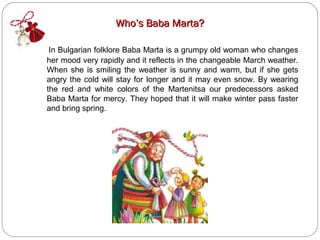
 In Bulgarian folklore Baba Marta is a grumpy old woman who changes
her mood very rapidly and it reflects in the changeable March weather.
When she is smiling the weather is sunny and warm, but if she gets
angry the cold will stay for longer and it may even snow. By wearing
the red and white colors of the Martenitsa our predecessors asked
Baba Marta for mercy. They hoped that it will make winter pass faster
and bring spring.
The Martenitsa is made of twined red and white threads - woolen, silk,
or cotton. The white is a symbol of strength, purity and happiness. The
red is associated with health, blood and fertility.
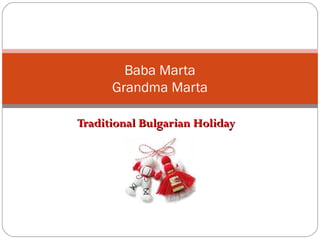
The most typical Martenitsa represents two small wool dolls - Pizho and
Penda. Pizho is the male doll, usually dominating in white color. Penda
is the female doll, usually dominating in red color .
   Out of twined red and white threads are also made bracelets,
necklaces, tassels, pompons, balls, squares, human or animal figures.
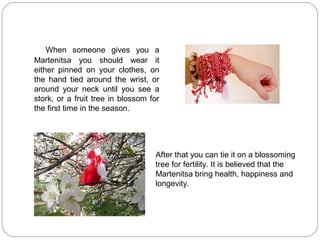
When someone gives you a
Martenitsa you should wear it
either pinned on your clothes, on
the hand tied around the wrist, or
around your neck until you see a
stork, or a fruit tree in blossom for
the first time in the season.


                                   After that you can tie it on a blossoming
                                   tree for fertility. It is believed that the
                                   Martenitsa bring health, happiness and
                                   longevity.
Like kind of amulet, Martenitsa was attributed a magic power
believed to protect folks from "ill fortune", diseases and an evil
eye.
Happy Grandma Marta!

Baba marta

  • 1.
    Baba Marta Grandma Marta Traditional Bulgarian Holiday
  • 2.
    On the 1stof March Bulgarian people celebrate a traditional holiday called Baba Marta (or Grandma Marta in English) and it is related to welcoming the approaching spring. On that day, we exchange, so called "Martenitsi" and tell each other, "Chestita Baba Marta!" (Happy Grandma Marta!). This custom is essentially to wish great health, good luck, and happiness to family and friends.
  • 3.
    Who’s Baba Marta? In Bulgarian folklore Baba Marta is a grumpy old woman who changes her mood very rapidly and it reflects in the changeable March weather. When she is smiling the weather is sunny and warm, but if she gets angry the cold will stay for longer and it may even snow. By wearing the red and white colors of the Martenitsa our predecessors asked Baba Marta for mercy. They hoped that it will make winter pass faster and bring spring.
  • 4.
    The Martenitsa ismade of twined red and white threads - woolen, silk, or cotton. The white is a symbol of strength, purity and happiness. The red is associated with health, blood and fertility.
  • 5.
    The most typicalMartenitsa represents two small wool dolls - Pizho and Penda. Pizho is the male doll, usually dominating in white color. Penda is the female doll, usually dominating in red color . Out of twined red and white threads are also made bracelets, necklaces, tassels, pompons, balls, squares, human or animal figures.
  • 6.
    When someone givesyou a Martenitsa you should wear it either pinned on your clothes, on the hand tied around the wrist, or around your neck until you see a stork, or a fruit tree in blossom for the first time in the season. After that you can tie it on a blossoming tree for fertility. It is believed that the Martenitsa bring health, happiness and longevity.
  • 7.
    Like kind ofamulet, Martenitsa was attributed a magic power believed to protect folks from "ill fortune", diseases and an evil eye.
  • 8.