















B2C Social Media Isn’t Rocket Science

          @BossyWeb      #SocialB2C


 Michelle Magoffin
 Founder, Bossy Interactive
 michelle@bossyinteractive.com
 Facebook.com/BossyInteractive
 LinkedIn.com/in/magoffin
Raise your hand if I interrupted you in the
middle of posting to a social network.

Raise your hand if you’ve already posted to
a social network since you sat down.

Raise your hand if you will post to a social
network as soon as I stop asking you to
raise your hand.
If this room was your pool of potential
customers, we’d have 100% social media
saturation, which is completely unrealistic.

We’re hardly representative of the average
consumer but, they’re catching up.
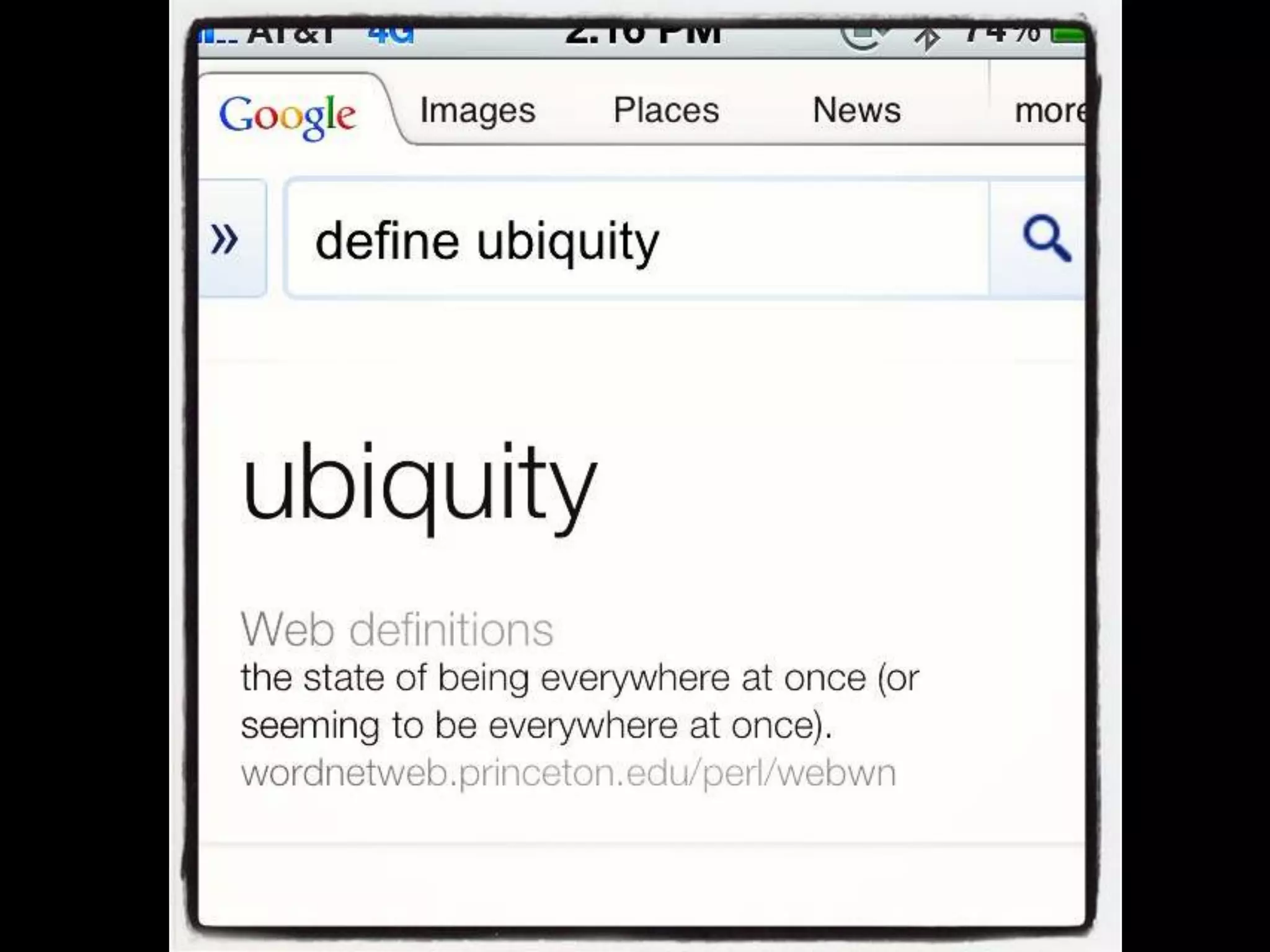
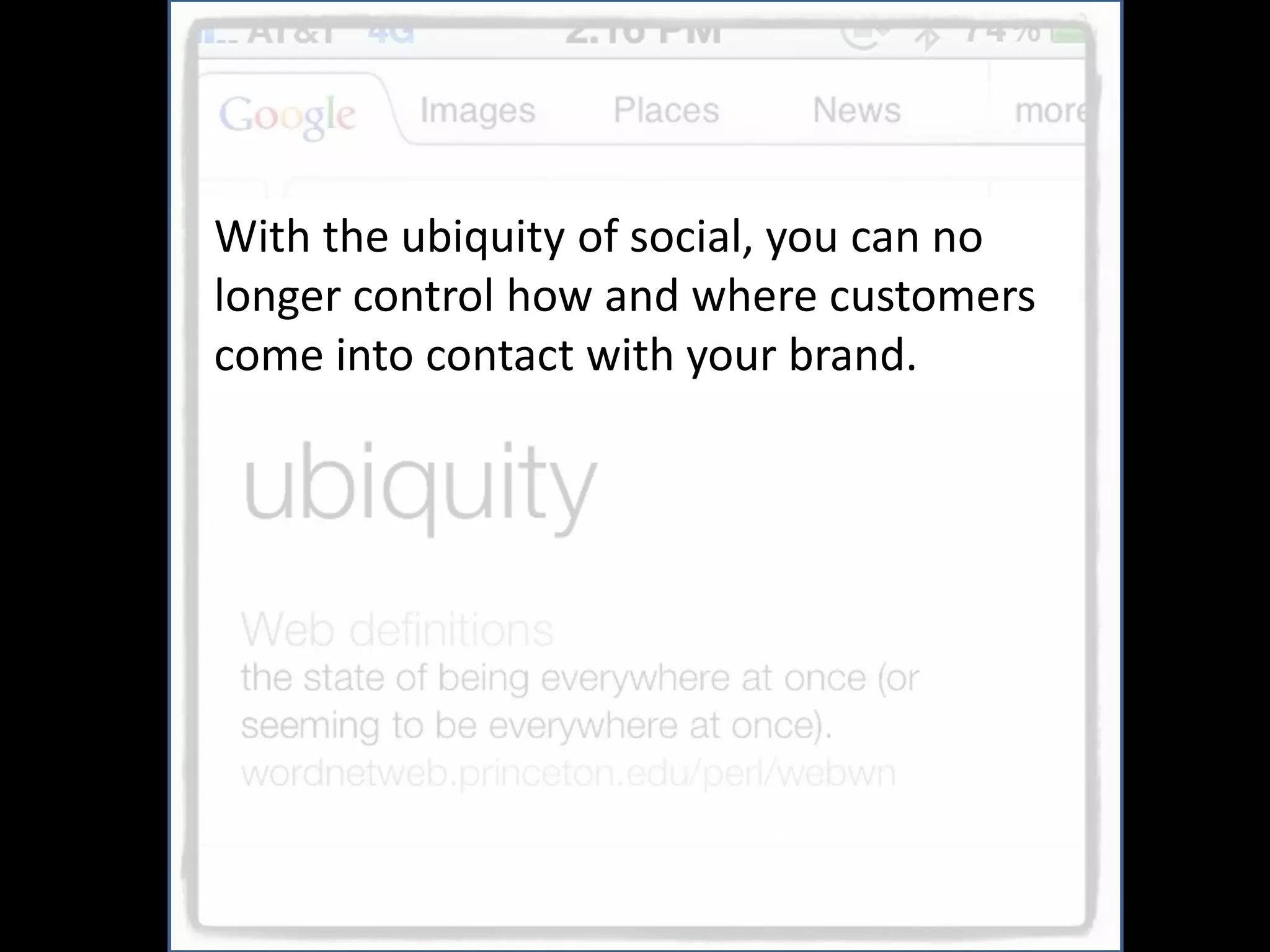
With the ubiquity of social, you can no
longer control how and where customers
come into contact with your brand.
It’s this knowledge that inspires the frenzy
and fear around social.

Fear of the loss of potential clients, and
the loss of market share, to competitors
who you think are doing more or better in
social.

This fear drives businesses to jump into
social media, and to act without a plan.
Take a deep breath and step back from the
ledge.

Let’s look at social media as part of a
bigger picture.
When I‘m working with a new client, I
don’t ask what their social media goals
are, I ask what their business goals are.

Social media is just one part of your
complete digital strategy

You digital strategy is just one tool you use
to help you meet your overall business
goals.
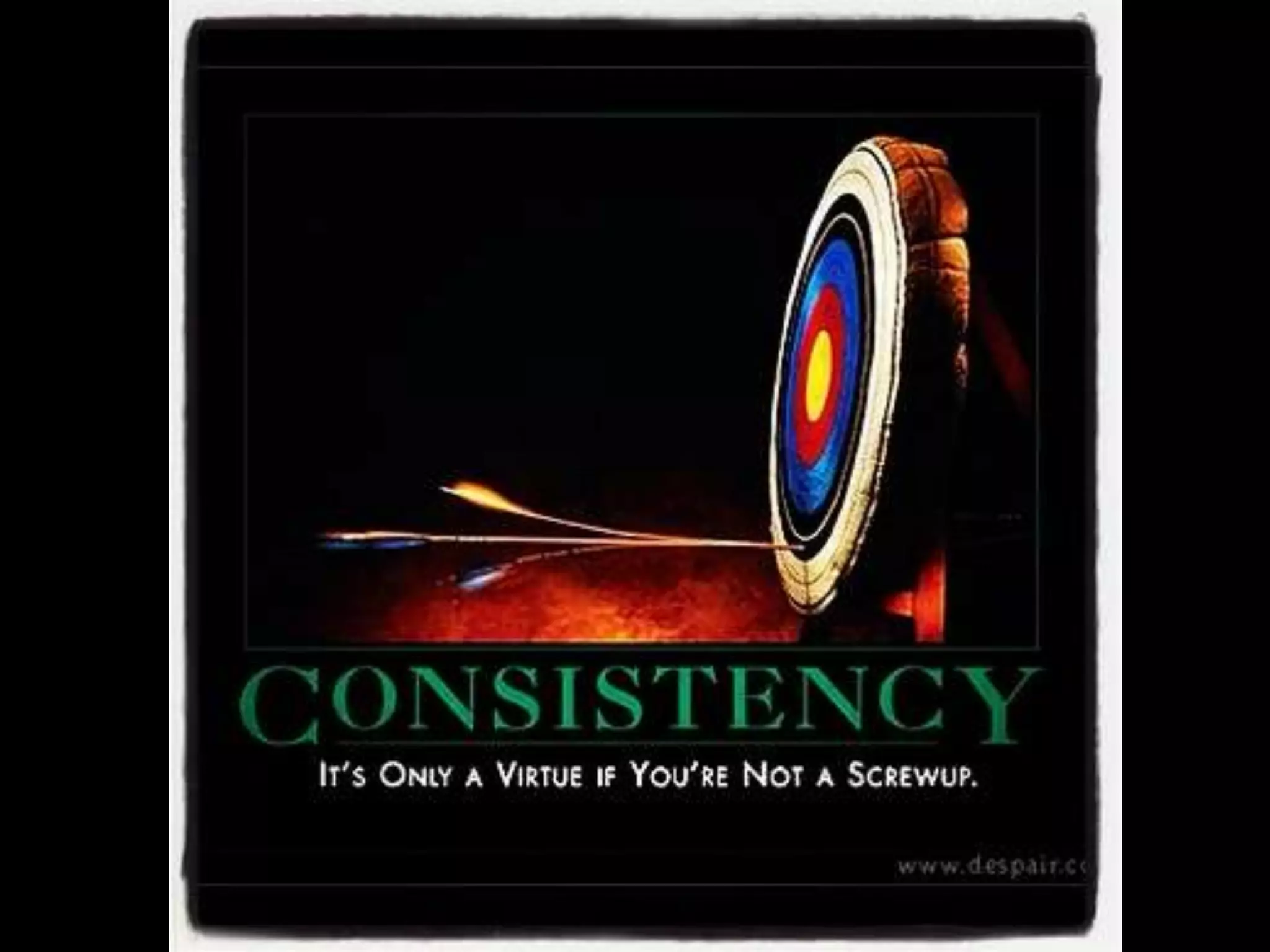
Because you can’t control how and where
your customers first come into contact
with you, you have to control what they
see when they do.

No matter how your customers find you,
they need to be presented with:
• a consistent look
• a consistent message
• and a consistent level of service


It is your top priority to deliver a consistent
brand experience.
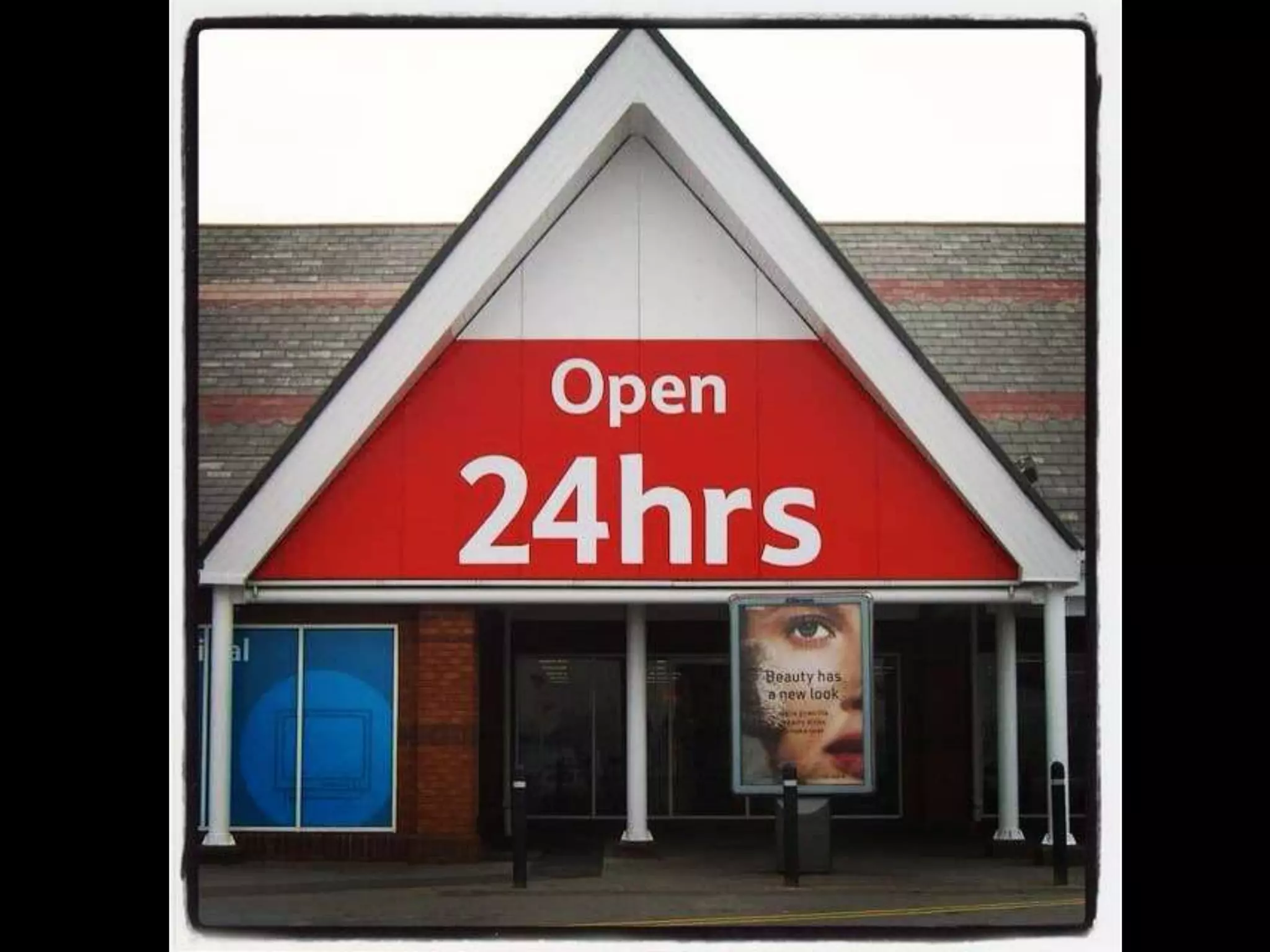
Don’t expect your customers to come to
your web site or even to your front door.


 Your customers are out there, online.

  GO WHERE YOUR CUSTOMERS ARE.
You’ve done your homework. You know
that your social customers are a subset of
your total customer base.

Now, you need to figure out who they are
and which social networks they’re using.
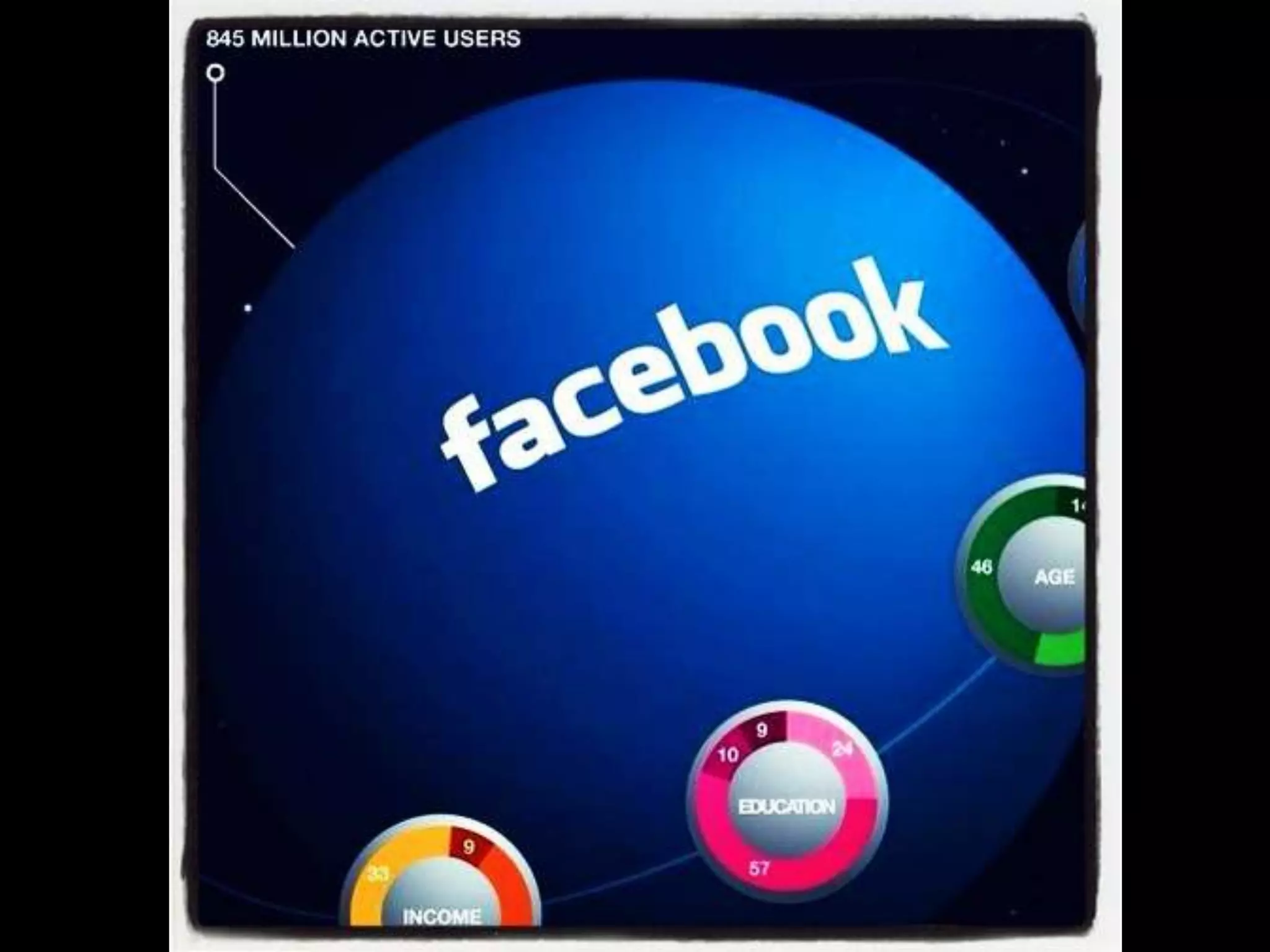
On Facebook, the demographics skew
younger than the other networks, with
nearly half of users under the age of 25,
but it has a broader reach.
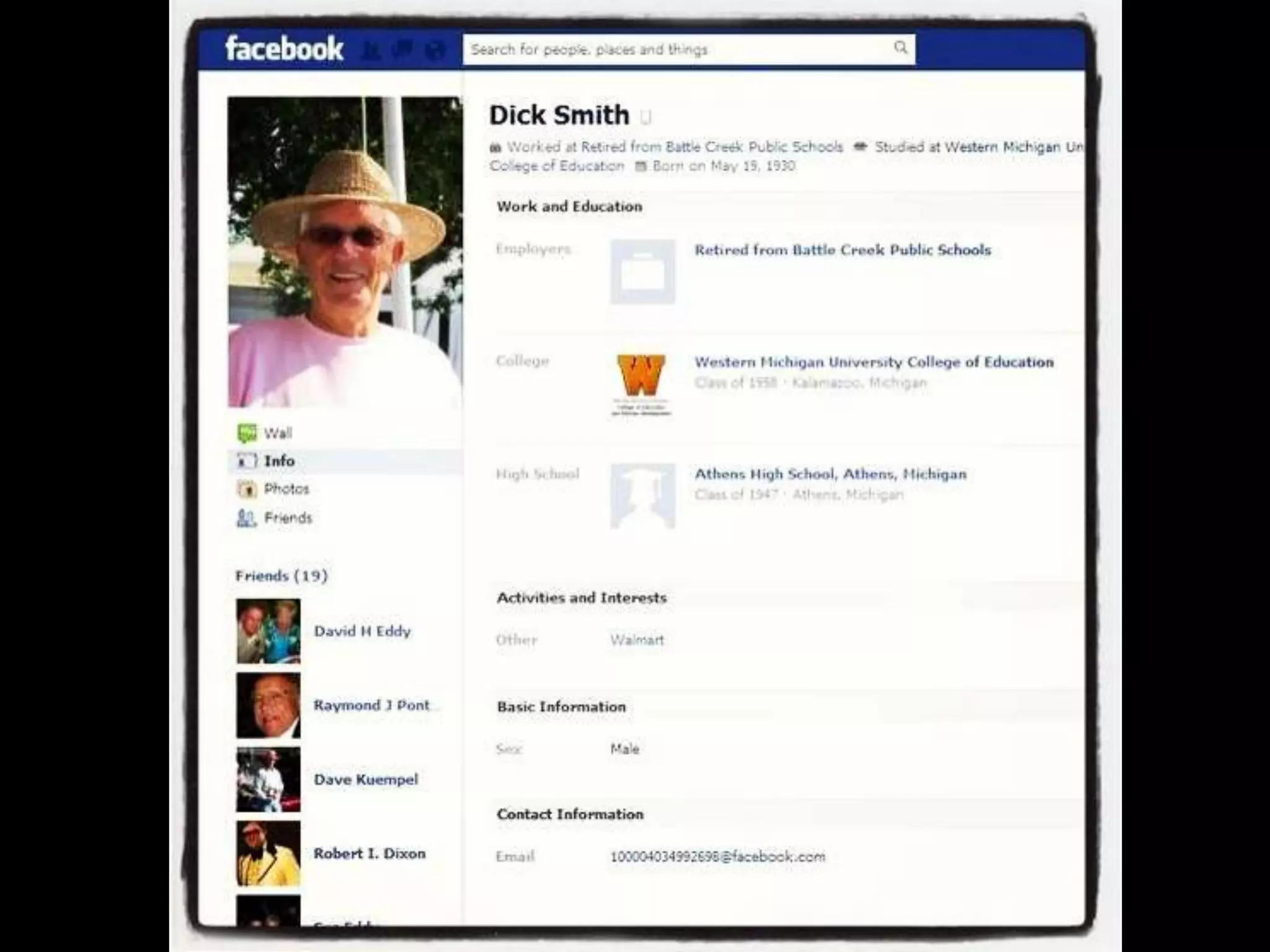
My 82-year-old father-in-law is on
Facebook…
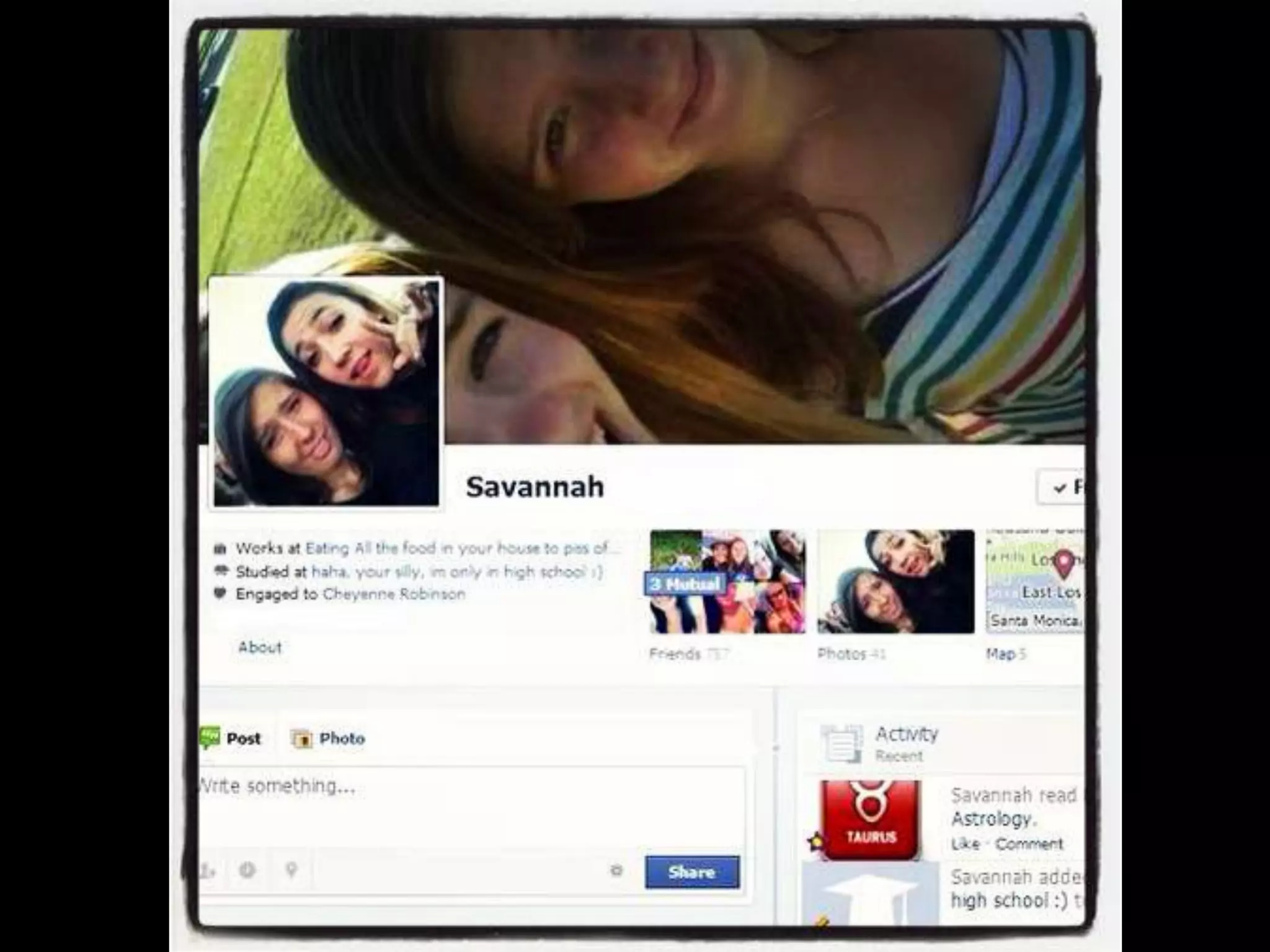
…so is my 14-year-old cousin.
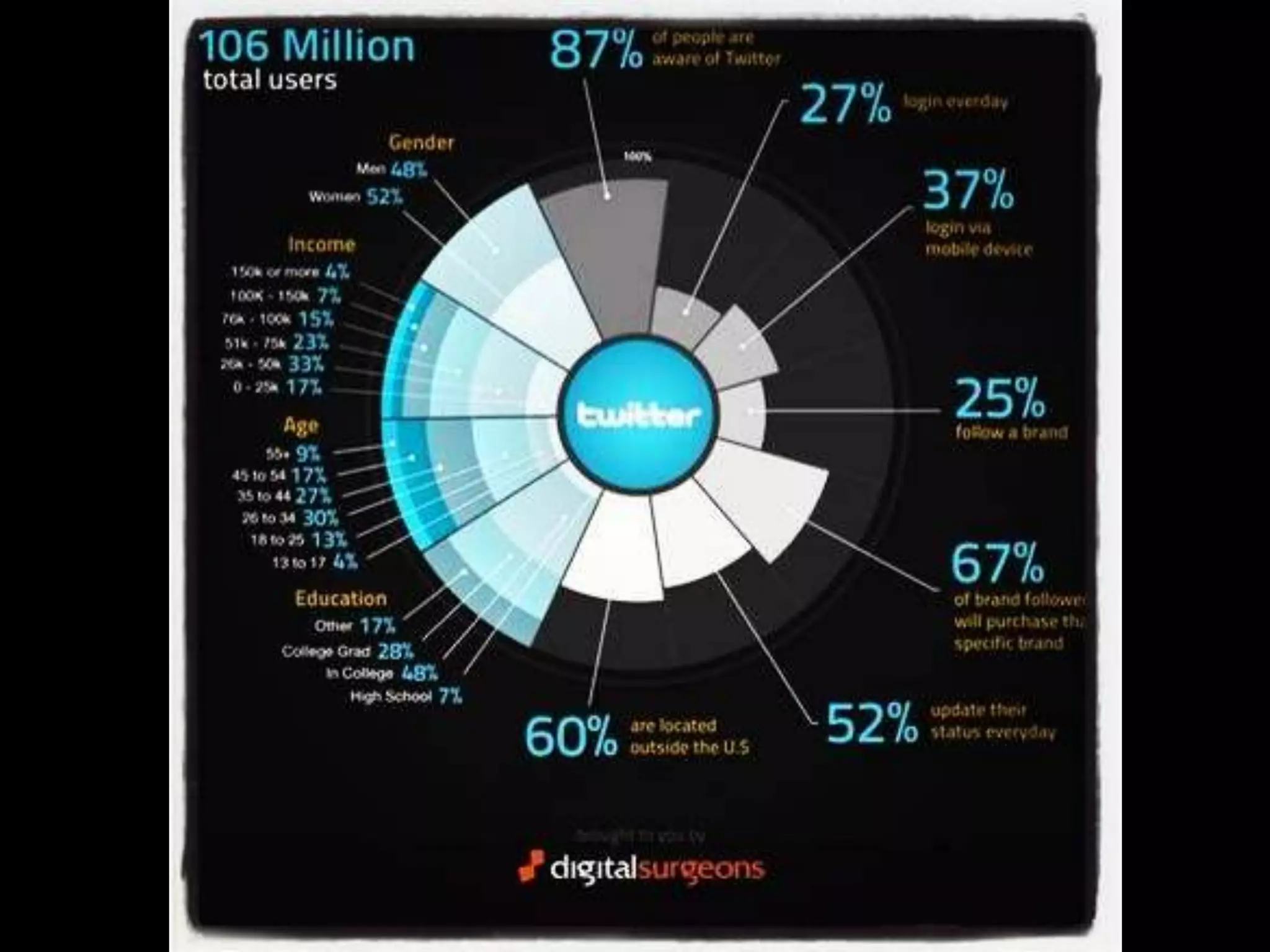
Twitter skews a little older, a little more
educated, and with a little more cash in
the bank.
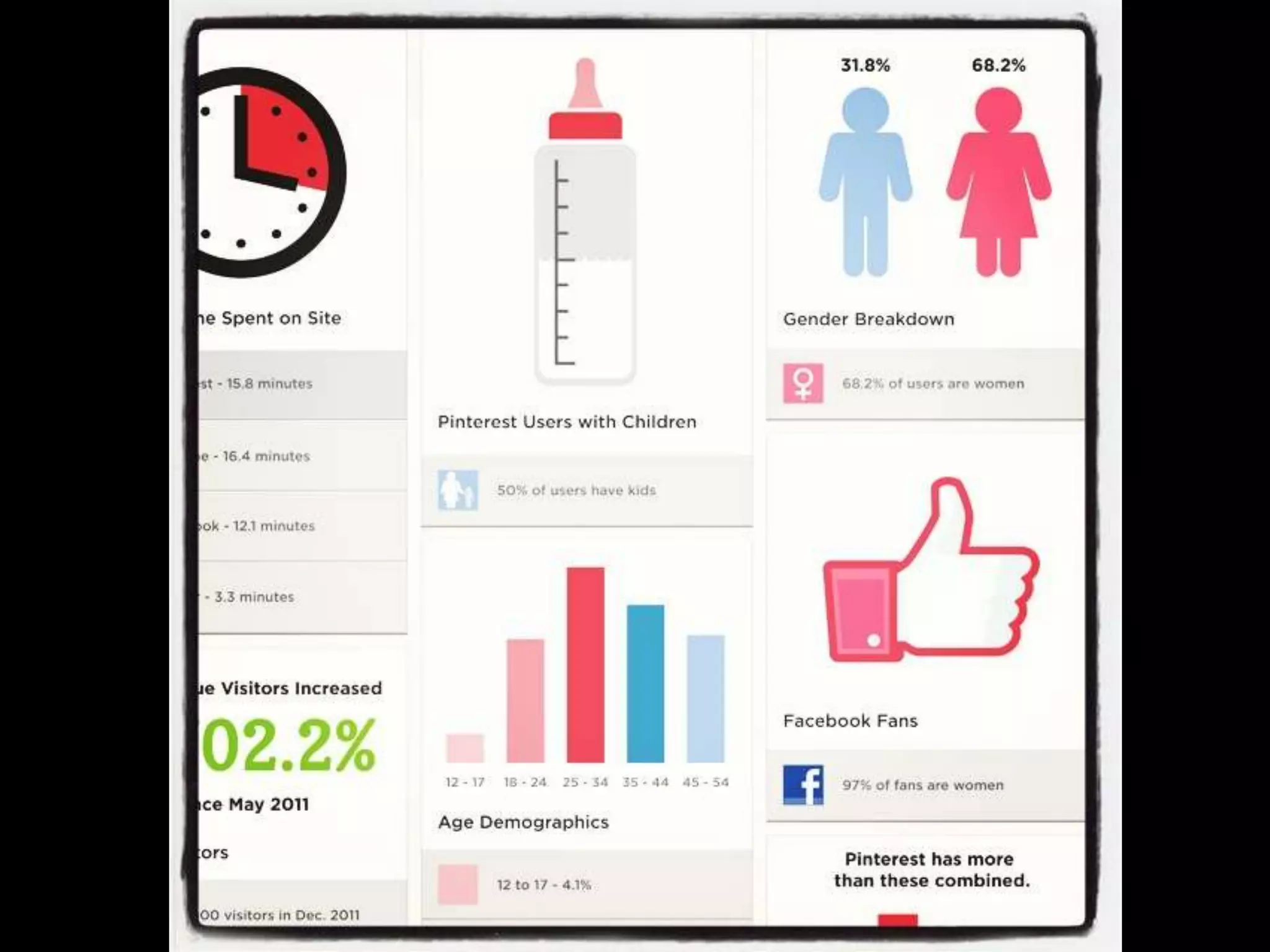
Pinterest is changing rapidly. It’s not all
women anymore. 30% of users are men.
Half are parents. The age breakdown is
very similar to Twitter.
Every B2C company needs to be on these
three platforms. I can’t imagine a single
company that doesn’t have a portion of
their customer base represented on each
of these networks.
Raise your hand if you’re wondering about
Google+.

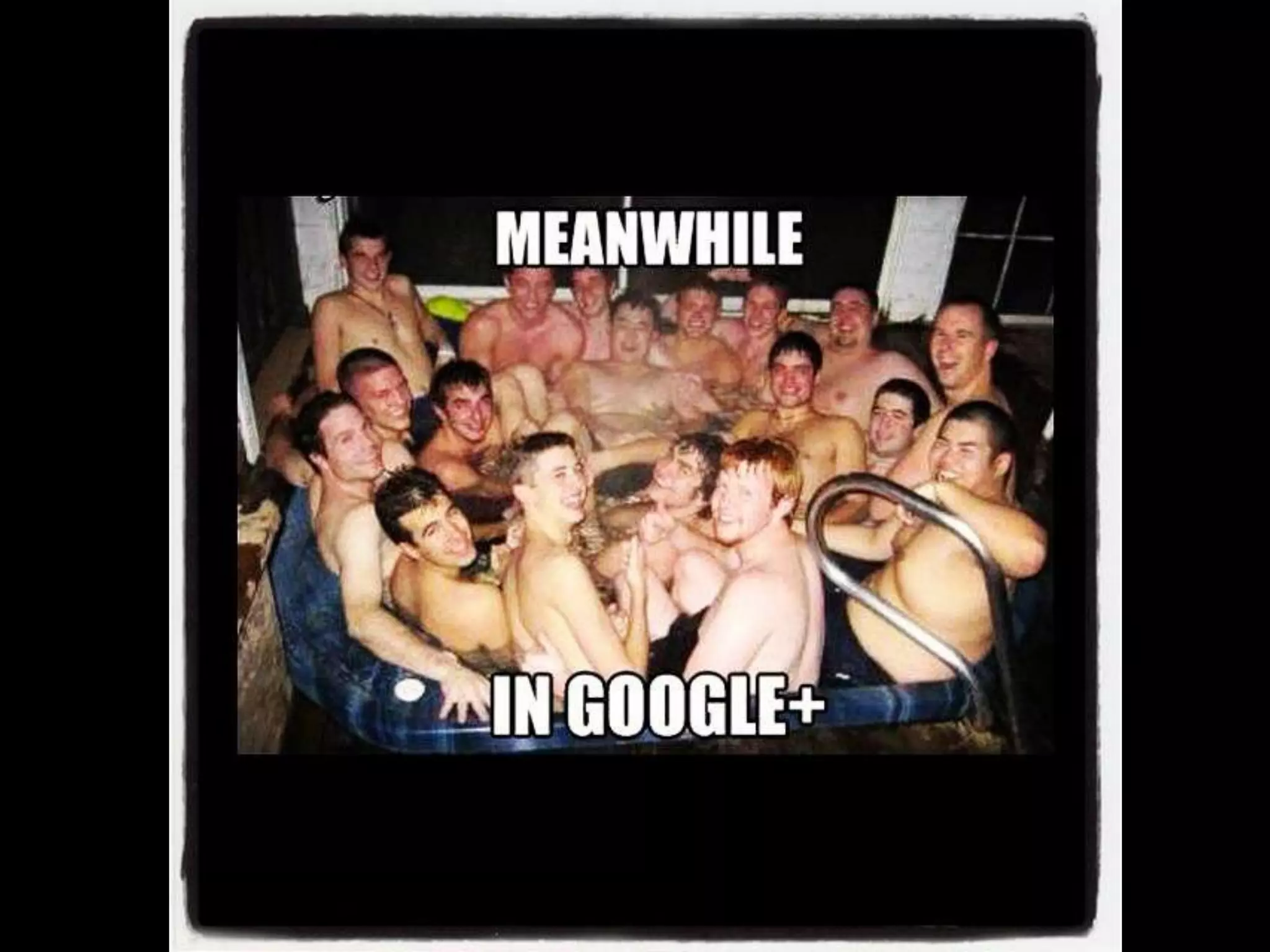
You absolutely need to be on Google+, but
not because your customers are.
Maybe they are, maybe they aren’t.

You need to be on Google+ for the search
benefit.

Create a page, link it to your URL, fill out
your profile, pop in once or twice a week
to post and engage, then forget about it.

Maybe my advice will change in the future
but, for now, your time is better spent
elsewhere.
Social media isn’t rocket science.

Your goal, as a B2C company is to sell your
   products or services to consumers.

Social media serves those goals, indirectly.
Social media is a long game. It’s about
establishing connections and building
relationships.


By deepening your relationships with your
current customers, you can turn them into
advocates for your company or your
product.
Your customers will spread your message
to their networks, adding a level of trust
and authority to it.
That is the pot of gold in social media.

The word of mouth.

The reach.

The friends of friends.

THAT is what’s going to help you reach
new customers and sell more products.
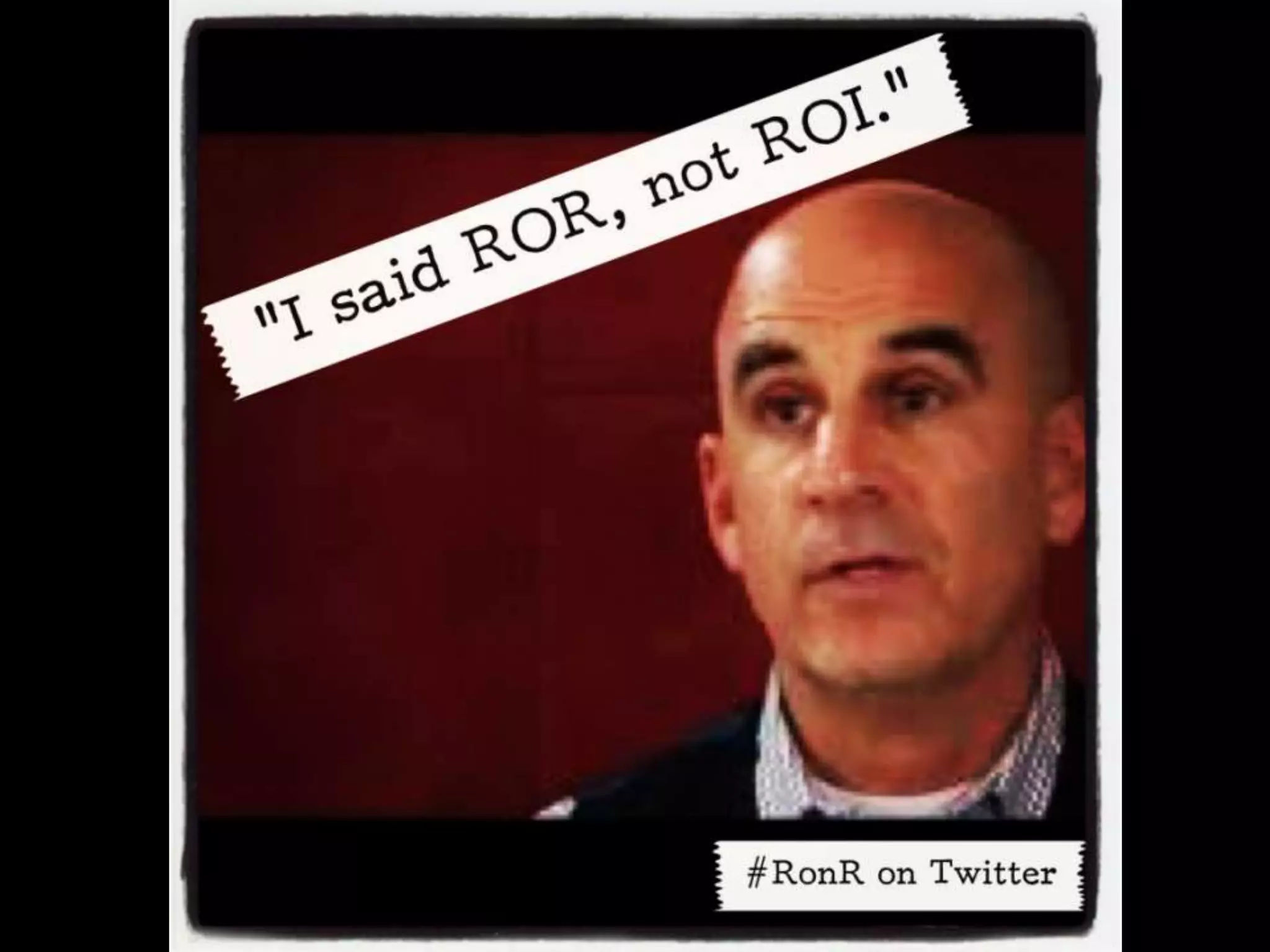
Social media is about ROR, not ROI.


Ted Rubin, a thought-leader in social
marketing, coined the phrase, “Return on
Relationship,” which he defines as “the
value that is accrued by a brand due to
nurturing a relationship. ROI is simple
dollars and cents. ROR is the value that will
accrue over time through connection,
loyalty, recommendations, and sharing.”
What Ted Rubin said is quotable and
meaningful, but how do you make it
            actionable?
First, I want you to think about something.

What is the one big thing your company is
about?

It’s bigger than your product

It’s bigger even your business goals.

This is your brand ideal.
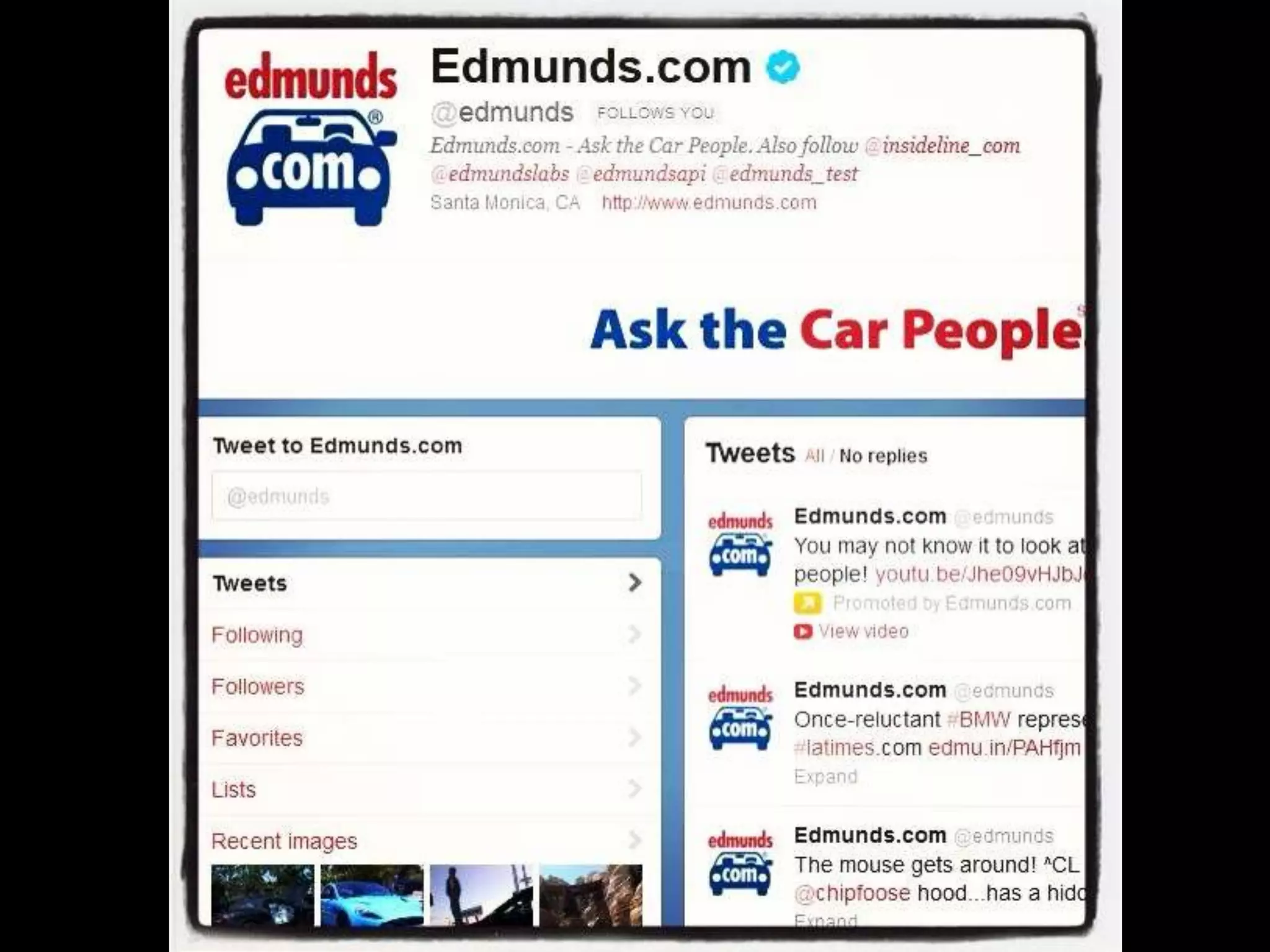
When I was running social media in-house
at Edmunds.com, company activities were
starting to form around the new brand
ideal.

Edmunds provides automotive research to
consumers, but the brand ideal isn’t even
about cars.
Edmunds’ brand ideal is, “Simplifying life’s
big decisions.”

When they thought about WHY people are
in the market for a new car, they realized
that it usually coincided with a big decision
or change in their lives: a new baby, a new
job, moving across the country.

Edmunds is there not just to help you buy
a new car, but to help you through a big
change in your life.
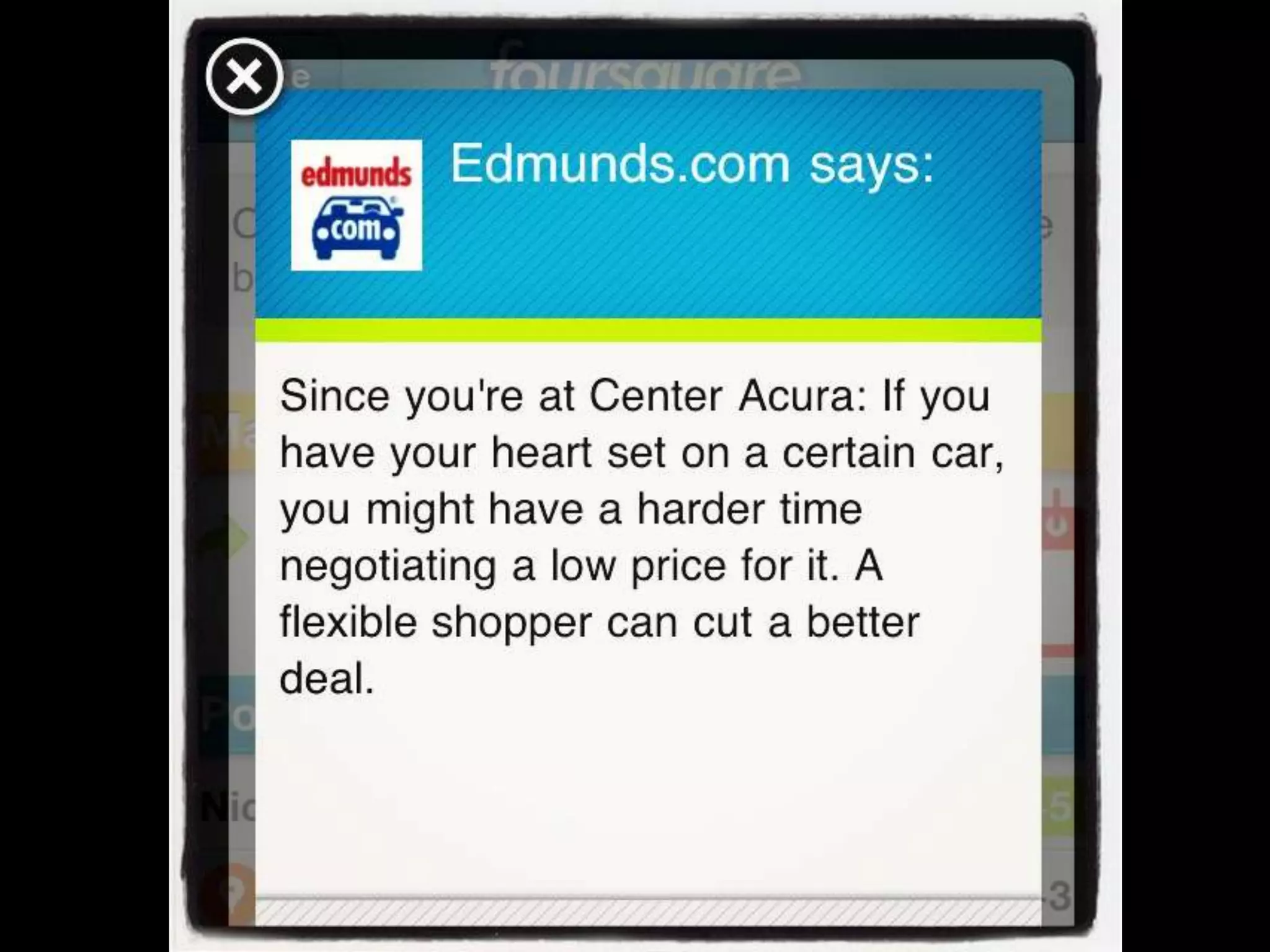
With the social media strategy that I laid
out for Edmunds, I kept that brand ideal in
mind.

What were we doing on each platform,
with each post, to serve that ideal?

It’s easy to deliver a consistent brand
message when you have that one big idea
in mind.
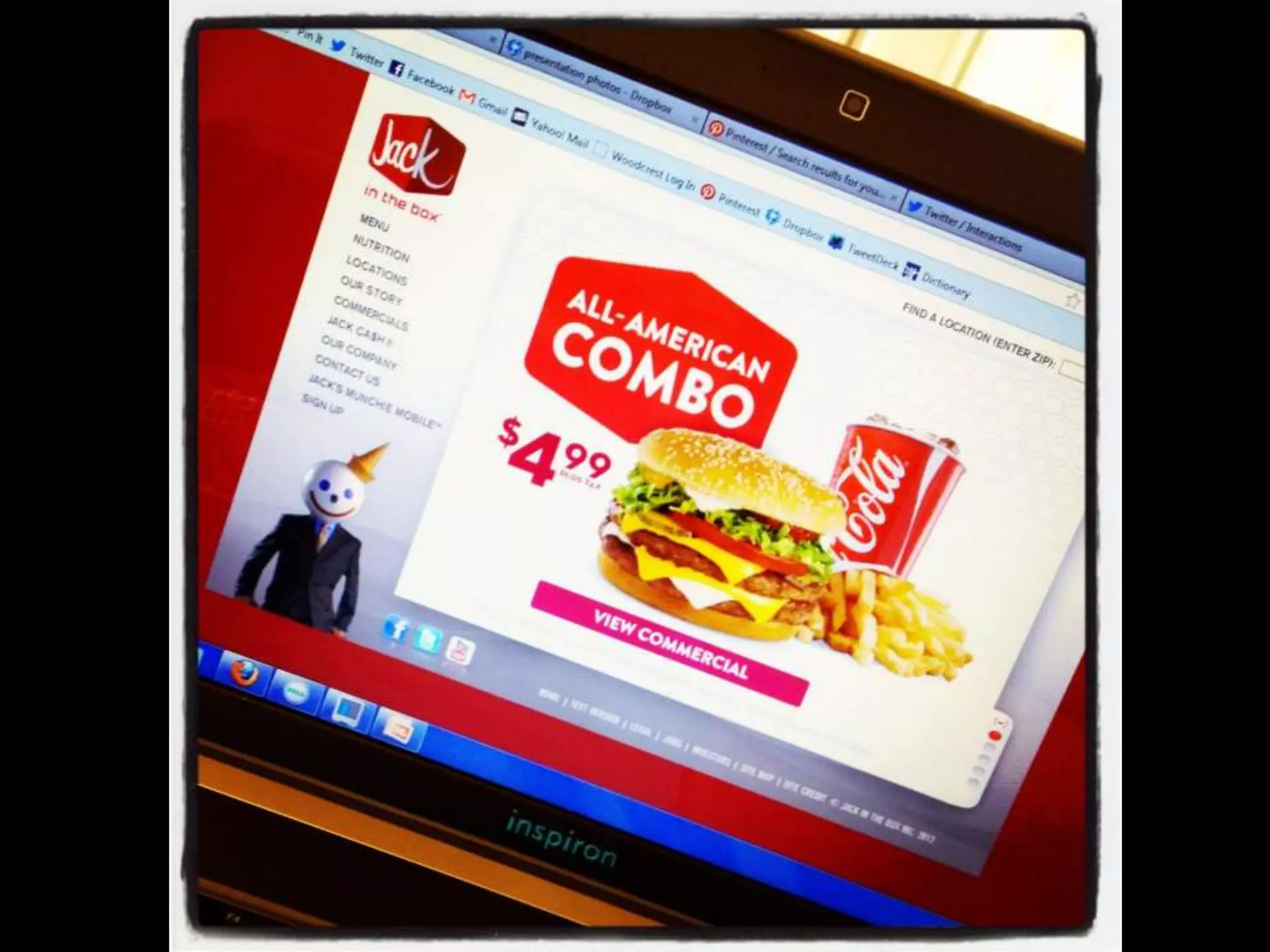
This carries over from offline activities as
well.

For example, if you’re running a television
ad campaign, I should see that copy and
that message wherever I find you online.

I should be able to get that exact offer.

I should be able to find an easily shareable
digital version of the commercial.
The brand ideal serves as the foundation
for the actions you to take in social media.


Those actions fall into three categories:
-Engagement
-Conversation
-and Reciprocity
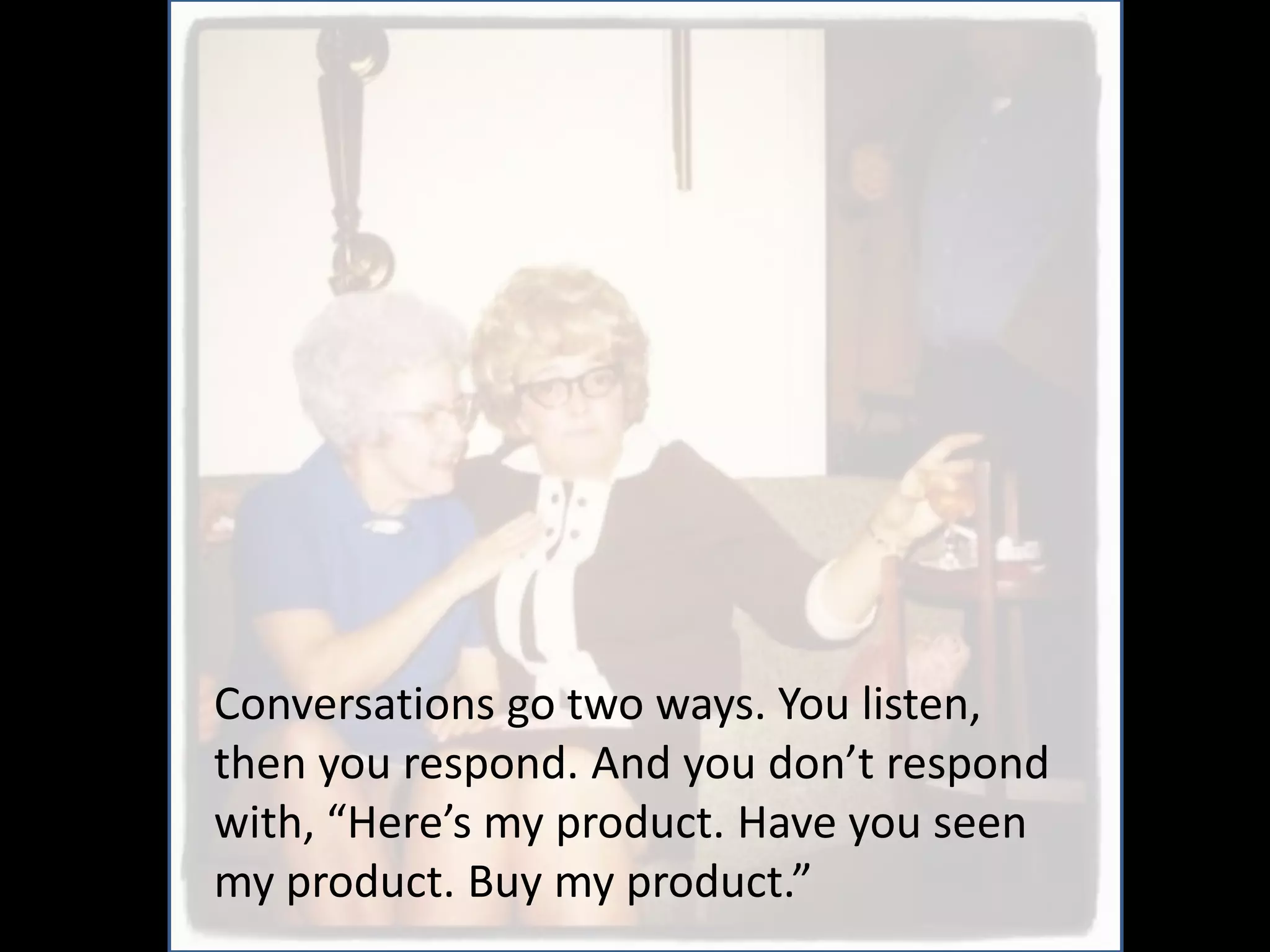
Conversations go two ways. You listen,
then you respond. And you don’t respond
with, “Here’s my product. Have you seen
my product. Buy my product.”
If your customers are saying they love your
product, you are thanking them for using
it.

You are telling them how to get more value
out of it, better ways to use it, how to
maintain it.

You are returning the favor by publicly
thanking people and partners.

You are helping others to spread their
messages, when it is relevant to your own
and useful to your followers.
If your customers are saying they hate
your product, you are reaching out to
them to ask them why they hate it, and
how you can improve it, and if there is
anything you can do for them RIGHT AT
THIS MOMENT to fix the situation.

Then you do it.
If your customers aren’t really talking
about your product at all, then you are
paying attention to what they ARE talking
about, and finding a way to continue to
add value to their lives.

You’re sharing relevant content from other
sources, not just your own.
You don’t have to remind your followers
that your product exists by continually
trying to sell to them.

By keeping your content interesting and
relevant to what is going on in their lives,
you’re continually reminding them that
YOU exist and that YOU are valuable to
them.

THEN, when it’s time to make a purchase
or a referral, your brand is there, top of
mind.
And
And
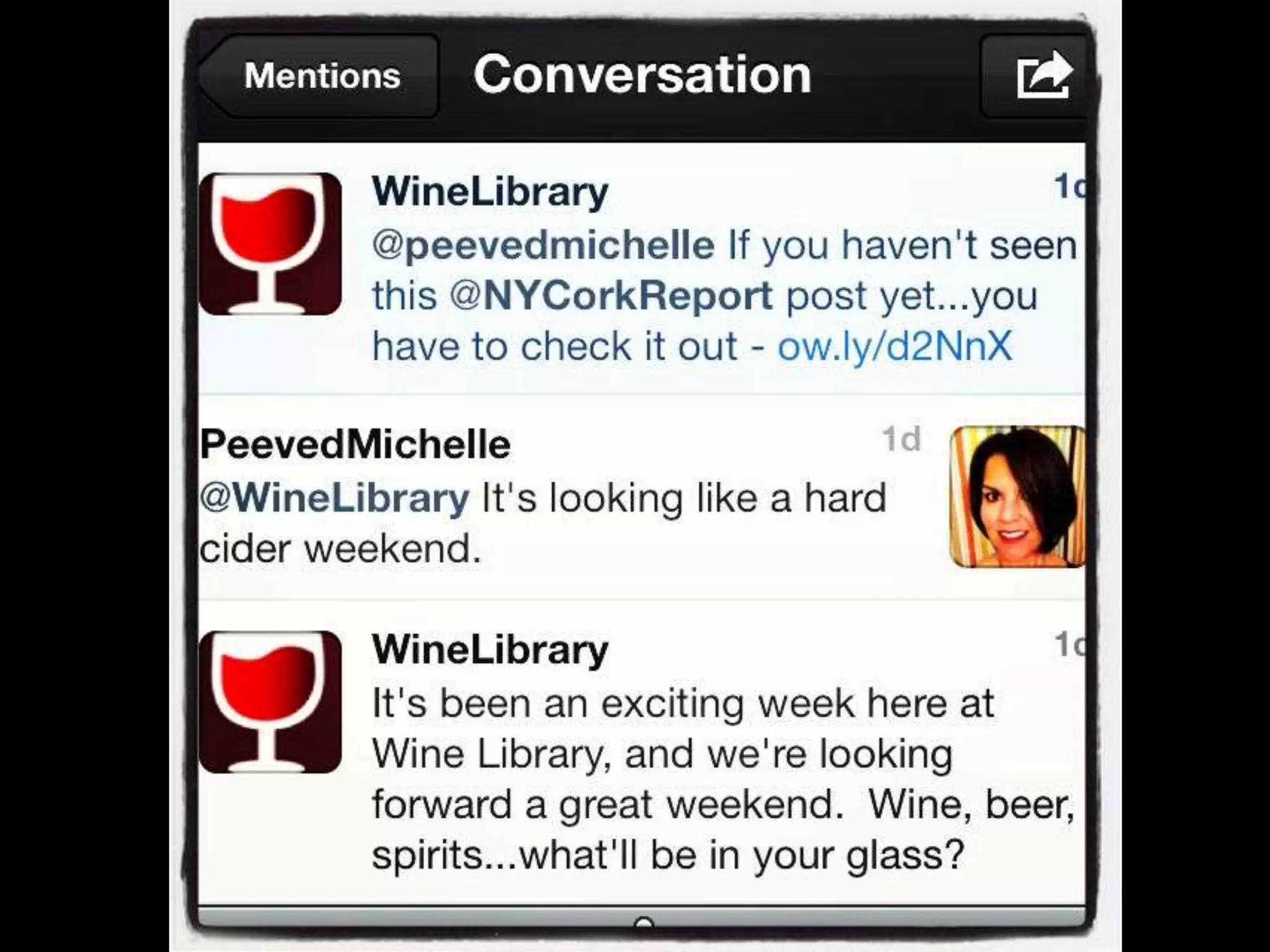
Here is such a simple example of this. Wine
Library posted a question asking what people
would be drinking that weekend. I answered hard
cider – not wine – but they quickly responded
with information they knew would be valuable to
me but which, in no way, helped them to sell me
some wine, or to drive me to their web site.

But, look what they got out of it as a result. I
publicly thanked them, which had the potential
to be seen by my 2000 followers. I’m talking
about it to you. You might repeat this example to
others. I’m also going to put this presentation on
Slideshare. It cost Wine Library nothing to send
me that tweet. They’re doing it right.
And
And
Some brands are doing it wrong.


This is where I present YOU with a
consistent brand experience for Bossy
Interactive by bossing you around and
telling you what not to do.
And
And
Do not use RSS feeds!

Every tweet and Facebook post must be
written individually by a person.

Schedule some (but not all) of them in
advance if you like, but no automated
feeds!

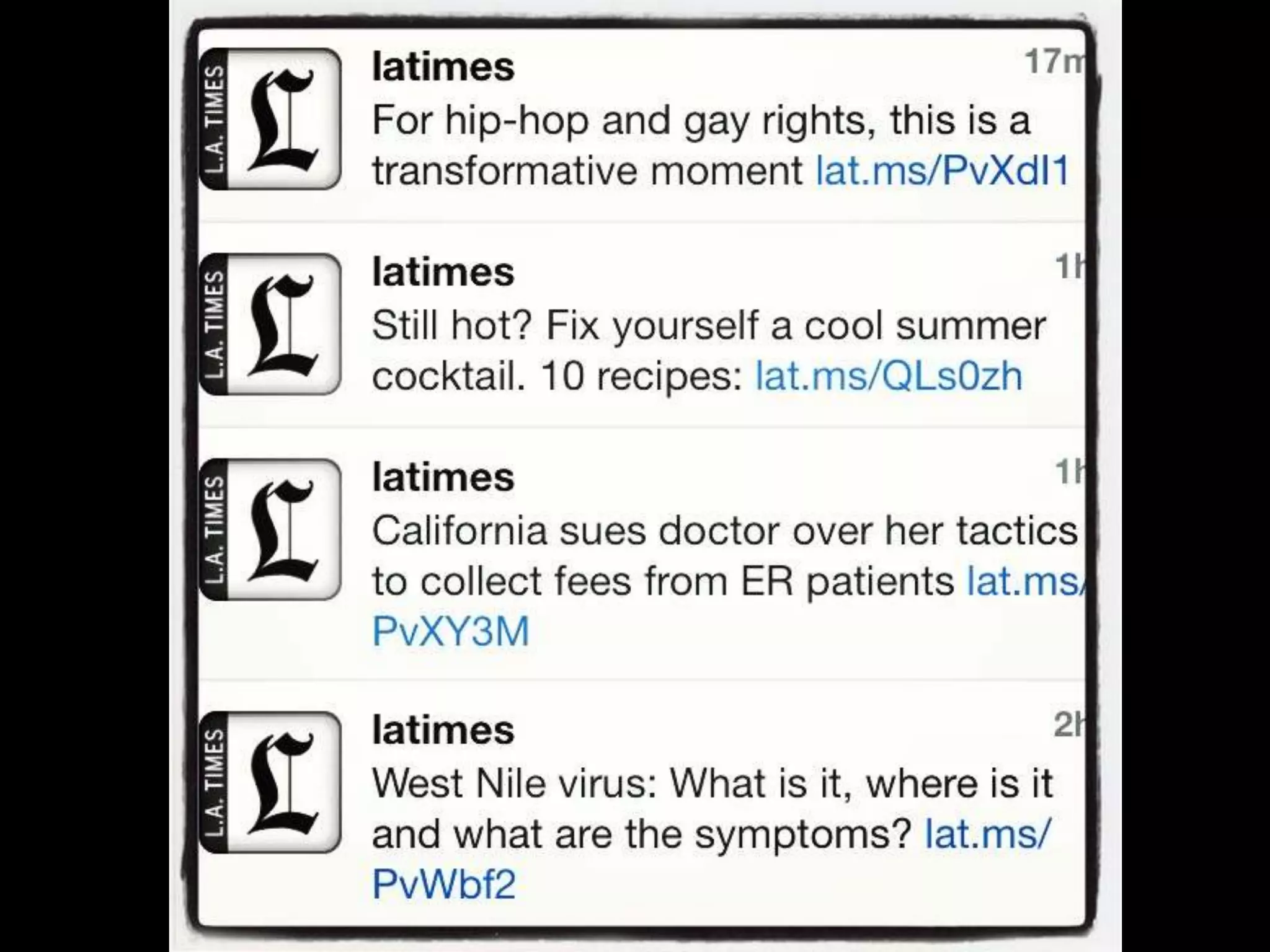
The LA Times Twitter feed is nothing but a
sea of links as far as the eye can see. Later,
check out CNN for an example of how to
do the same thing better.
And
No broadcasting!      And
If you’re broadcasting, your feed is all you, you,
you, with no conversation and no engagement.

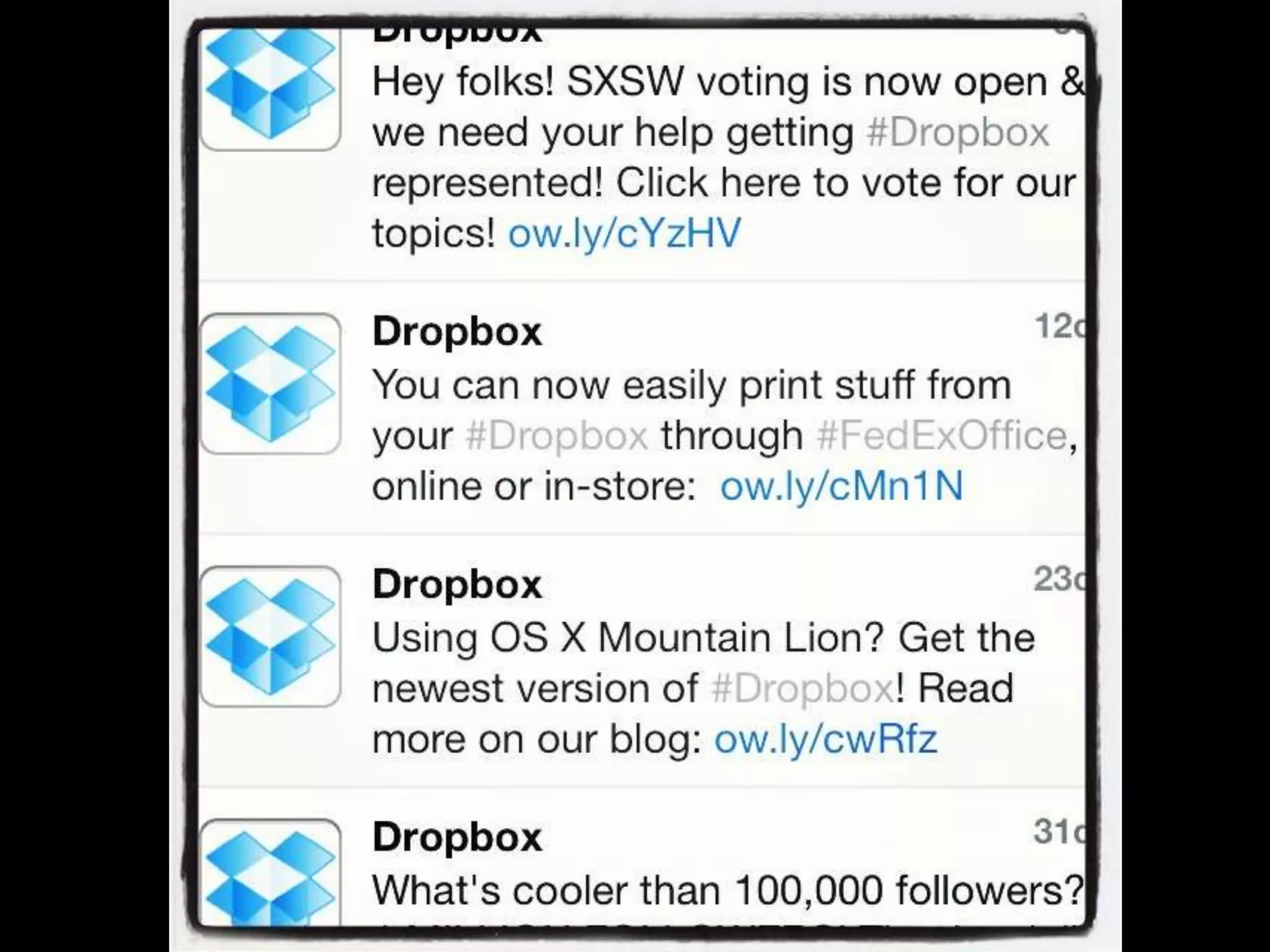
Dropbox has over a million Twitter followers,
partly because they incentivize customers to
follow them by offering additional free storage
space if they do, but also because they have a
popular product, but their social media strategy
stinks.

They do write the tweets individually, but this is
one-way communication. There is no customer
interaction at all.
No cross-posting!

Don’t post the exact same thing on Facebook that
you post on Twitter, and vice versa.

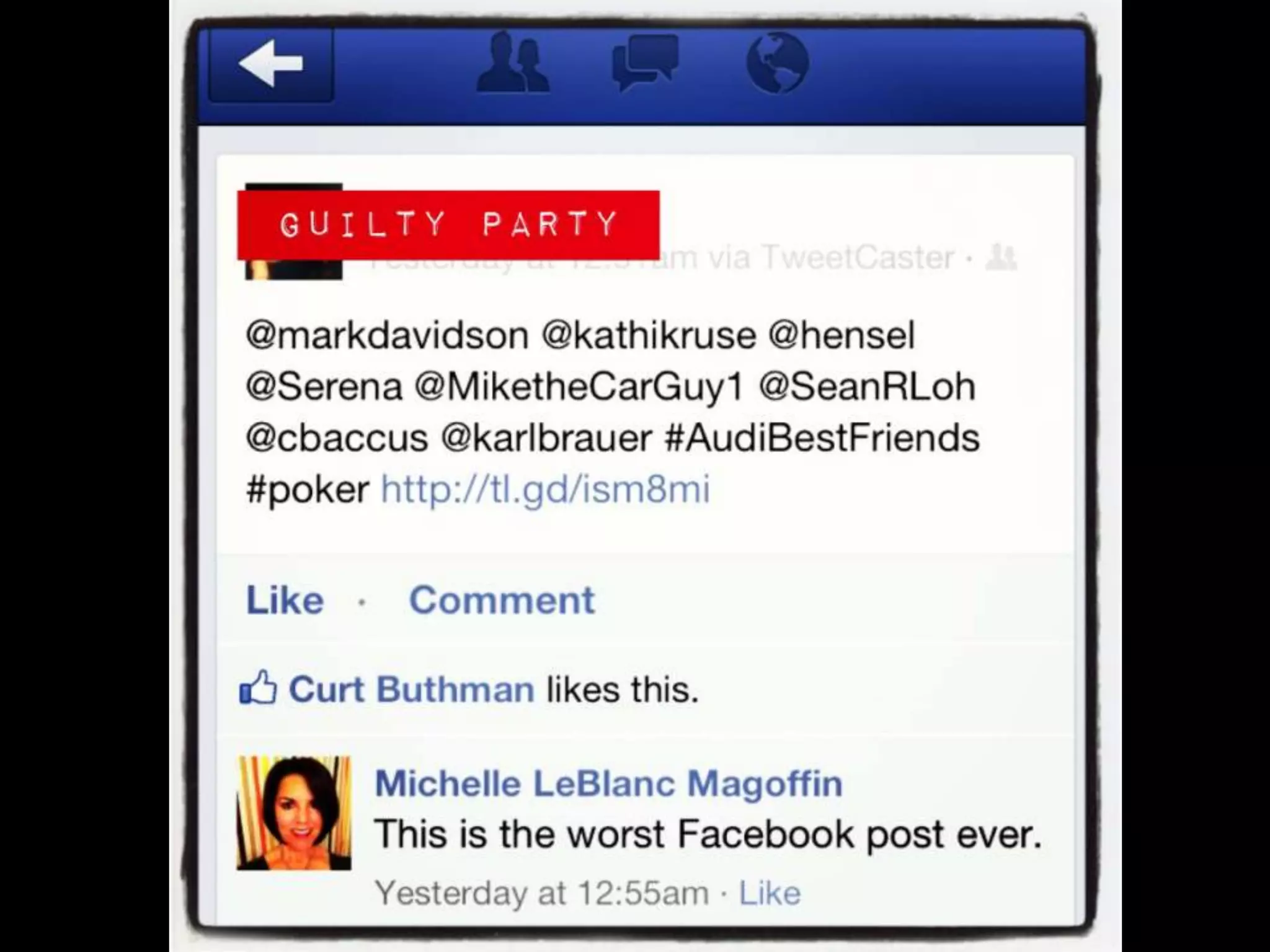
This is an example of how ugly it can get. A friend
of mine accidentally posted a tweet to Facebook
through a third-party tool. The post @ replies to
eight people, contains two hashtags, and a link,
and it looks like crap.

In case you can’t read the comment at the
bottom, I told him that this is the worst Facebook
post ever. It really is.
And
No blitzes!
                     And
Spread out your posts over time so that you reach
more of you audience and you don’t overwhelm
and annoy them.

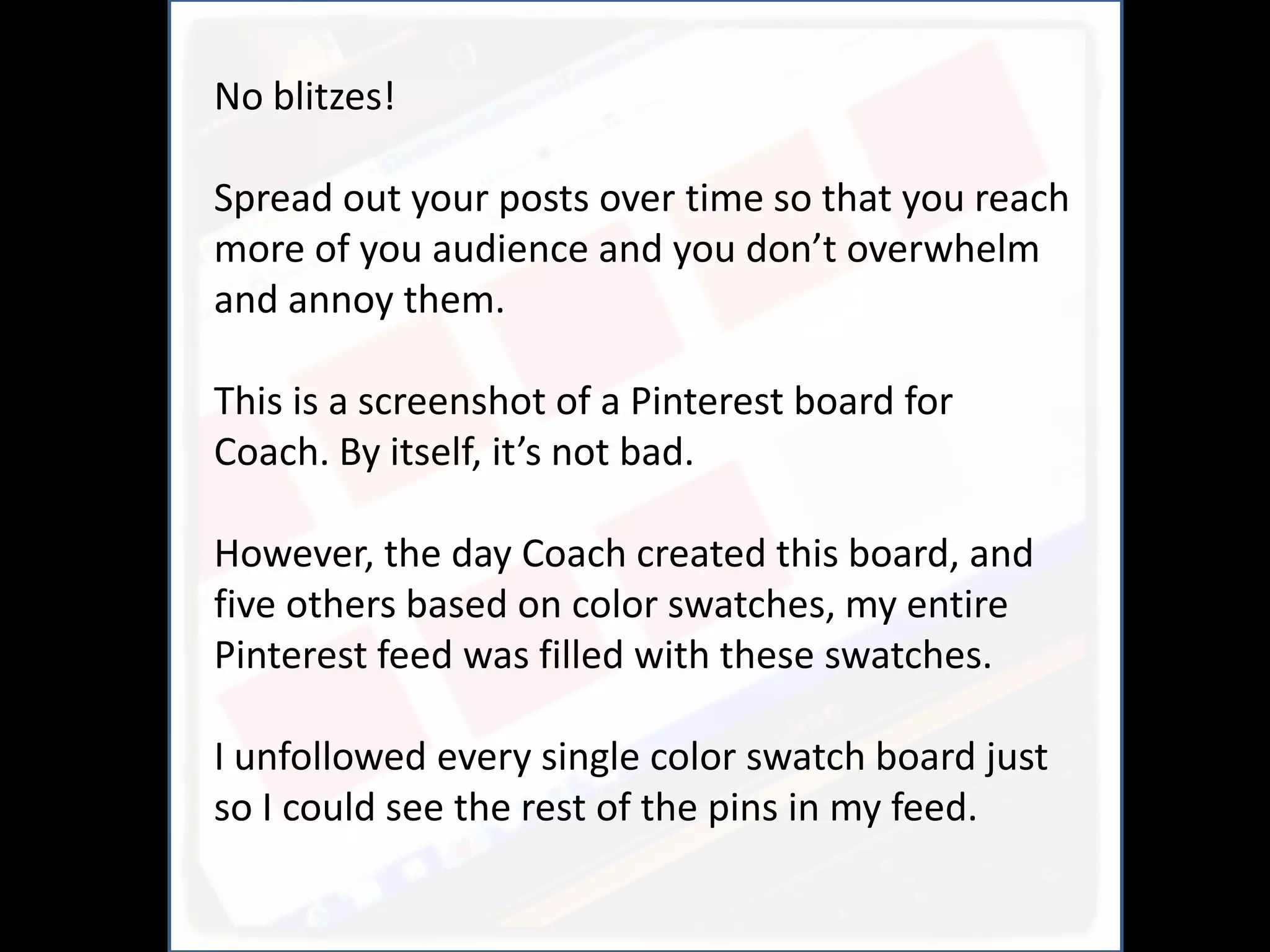
This is a screenshot of a Pinterest board for
Coach. By itself, it’s not bad.

However, the day Coach created this board, and
five others based on color swatches, my entire
Pinterest feed was filled with these swatches.

I unfollowed every single color swatch board just
so I could see the rest of the pins in my feed.
And
And
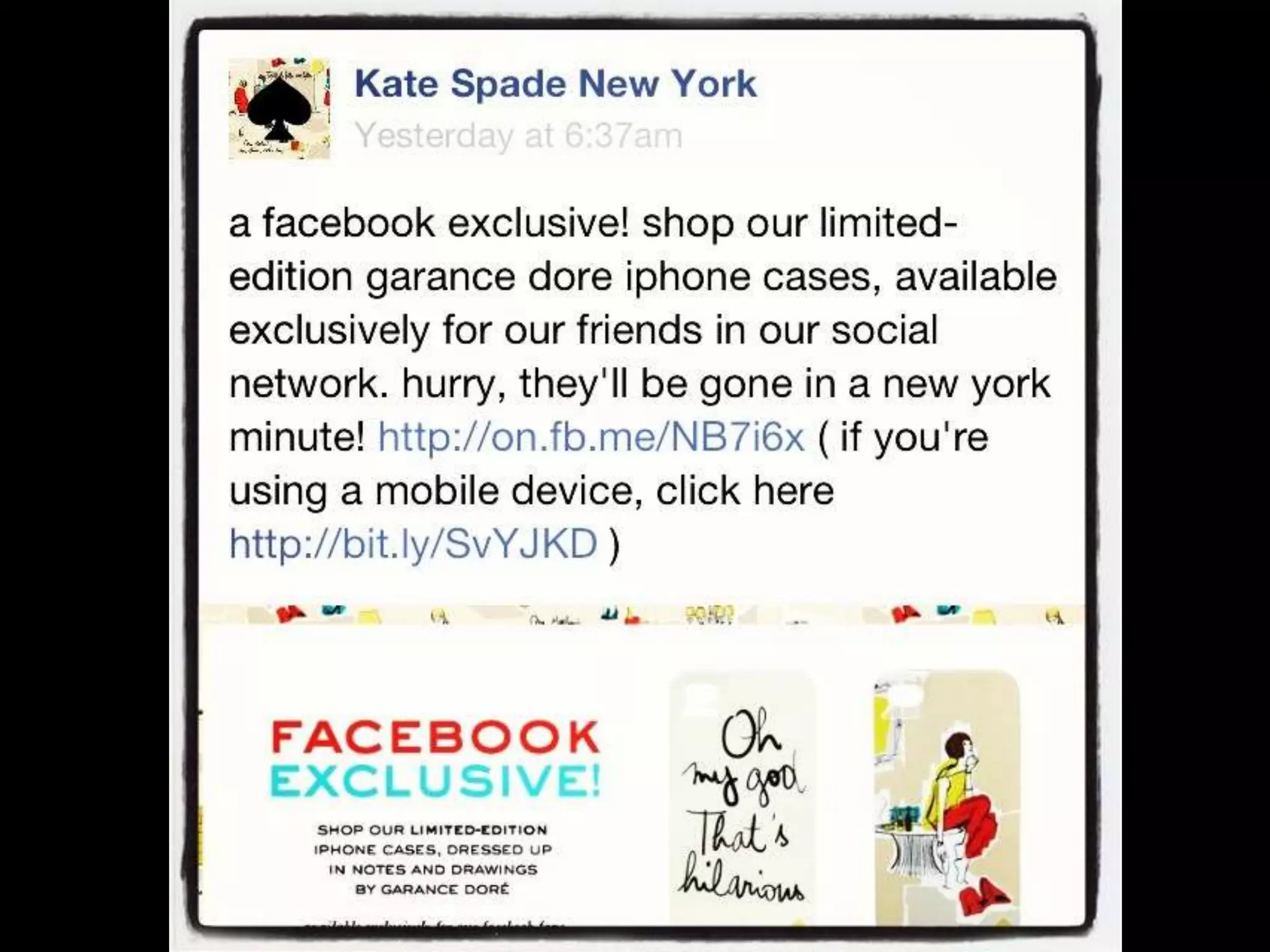
No selling!

I really can’t stress that enough.

The only time I want to hear about your products
is when you have something new, you’re giving
me a great discount, you’re giving me an offer
exclusive to that social network, or…
And
And
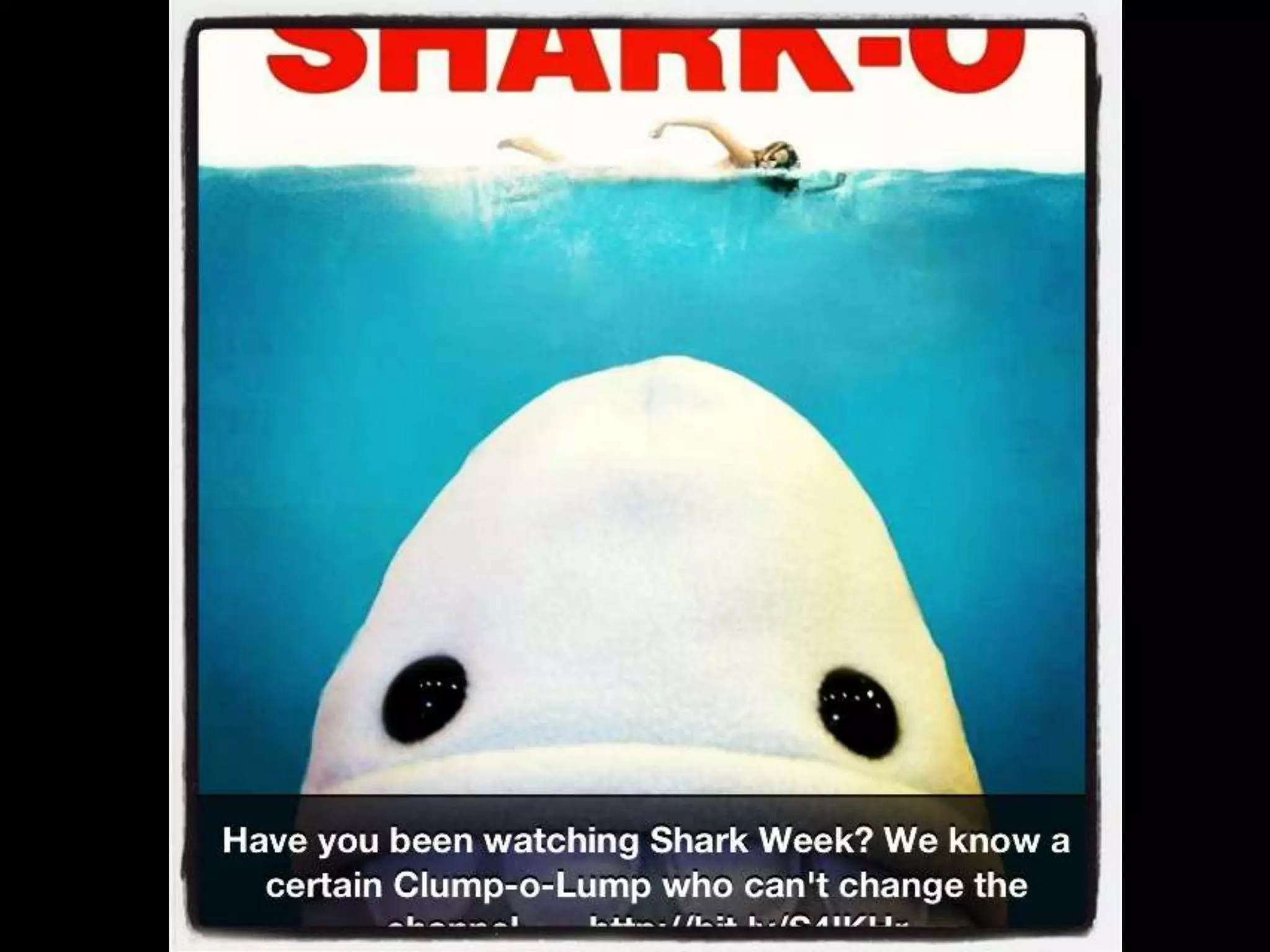
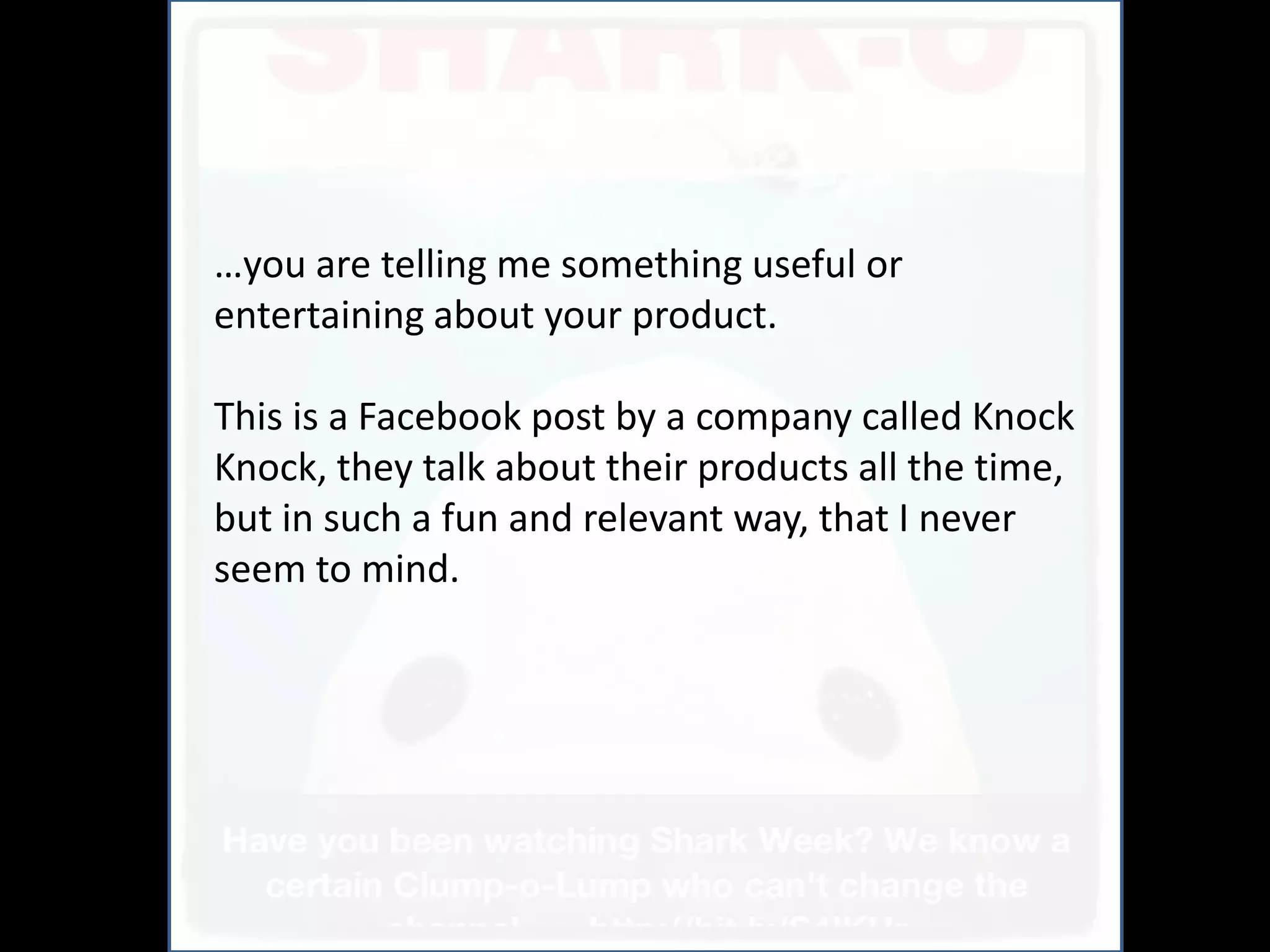
…you are telling me something useful or
entertaining about your product.

This is a Facebook post by a company called Knock
Knock, they talk about their products all the time,
but in such a fun and relevant way, that I never
seem to mind.
And
And
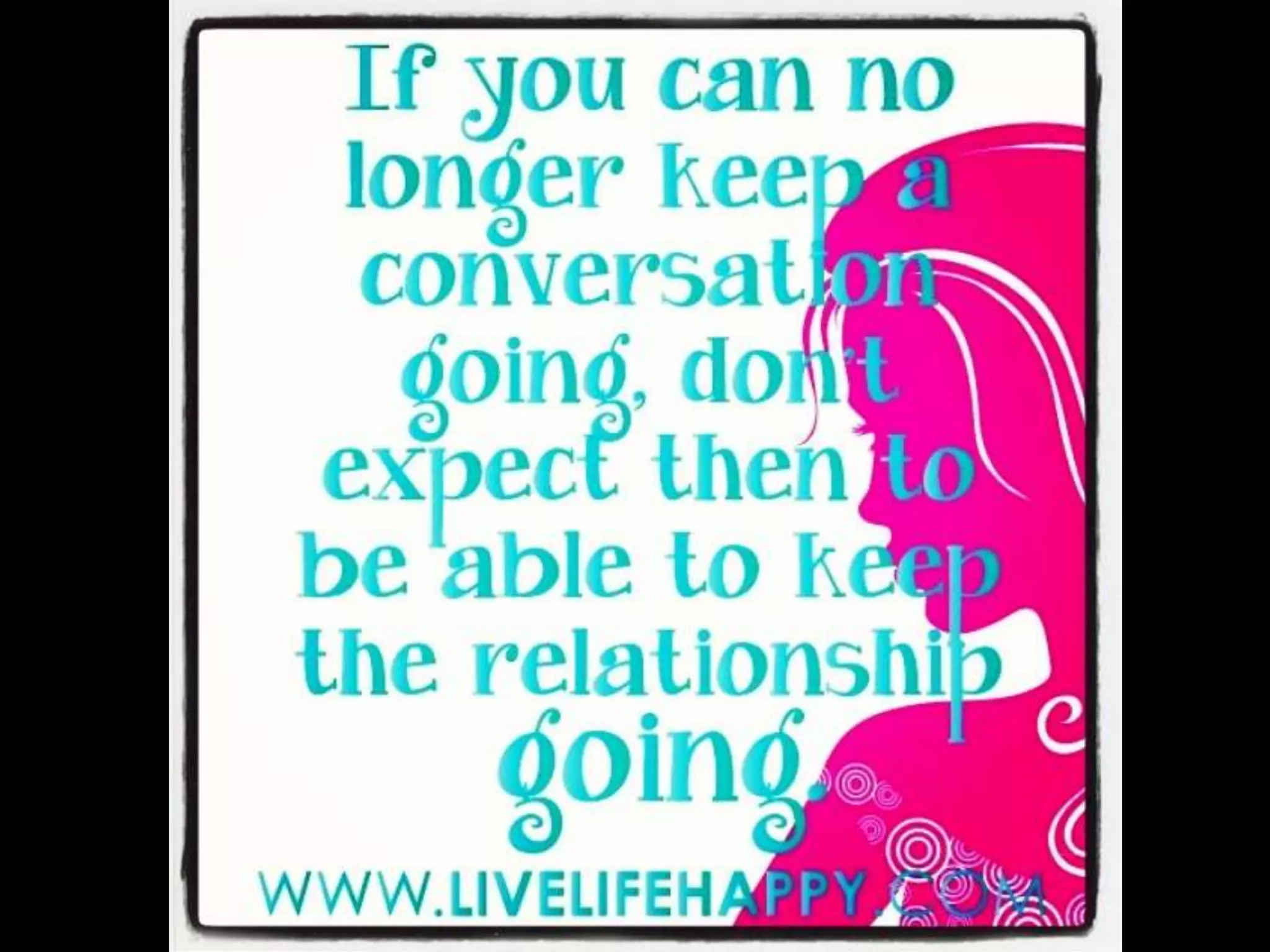
One last reminder…

Social media is about deepening relationships
with your customers.

Start from that place and build upon it with every
action.
And

B2C Social Media Isn't Rocket Science

  • 1.
    B2C Social MediaIsn’t Rocket Science @BossyWeb #SocialB2C Michelle Magoffin Founder, Bossy Interactive michelle@bossyinteractive.com Facebook.com/BossyInteractive LinkedIn.com/in/magoffin
  • 3.
    Raise your handif I interrupted you in the middle of posting to a social network. Raise your hand if you’ve already posted to a social network since you sat down. Raise your hand if you will post to a social network as soon as I stop asking you to raise your hand.
  • 5.
    If this roomwas your pool of potential customers, we’d have 100% social media saturation, which is completely unrealistic. We’re hardly representative of the average consumer but, they’re catching up.
  • 7.
    With the ubiquityof social, you can no longer control how and where customers come into contact with your brand.
  • 9.
    It’s this knowledgethat inspires the frenzy and fear around social. Fear of the loss of potential clients, and the loss of market share, to competitors who you think are doing more or better in social. This fear drives businesses to jump into social media, and to act without a plan.
  • 11.
    Take a deepbreath and step back from the ledge. Let’s look at social media as part of a bigger picture.
  • 13.
    When I‘m workingwith a new client, I don’t ask what their social media goals are, I ask what their business goals are. Social media is just one part of your complete digital strategy You digital strategy is just one tool you use to help you meet your overall business goals.
  • 15.
    Because you can’tcontrol how and where your customers first come into contact with you, you have to control what they see when they do. No matter how your customers find you, they need to be presented with: • a consistent look • a consistent message • and a consistent level of service It is your top priority to deliver a consistent brand experience.
  • 17.
    Don’t expect yourcustomers to come to your web site or even to your front door. Your customers are out there, online. GO WHERE YOUR CUSTOMERS ARE.
  • 19.
    You’ve done yourhomework. You know that your social customers are a subset of your total customer base. Now, you need to figure out who they are and which social networks they’re using.
  • 21.
    On Facebook, thedemographics skew younger than the other networks, with nearly half of users under the age of 25, but it has a broader reach.
  • 23.
  • 25.
    …so is my14-year-old cousin.
  • 27.
    Twitter skews alittle older, a little more educated, and with a little more cash in the bank.
  • 29.
    Pinterest is changingrapidly. It’s not all women anymore. 30% of users are men. Half are parents. The age breakdown is very similar to Twitter.
  • 31.
    Every B2C companyneeds to be on these three platforms. I can’t imagine a single company that doesn’t have a portion of their customer base represented on each of these networks.
  • 33.
    Raise your handif you’re wondering about Google+. You absolutely need to be on Google+, but not because your customers are.
  • 35.
    Maybe they are,maybe they aren’t. You need to be on Google+ for the search benefit. Create a page, link it to your URL, fill out your profile, pop in once or twice a week to post and engage, then forget about it. Maybe my advice will change in the future but, for now, your time is better spent elsewhere.
  • 37.
    Social media isn’trocket science. Your goal, as a B2C company is to sell your products or services to consumers. Social media serves those goals, indirectly.
  • 39.
    Social media isa long game. It’s about establishing connections and building relationships. By deepening your relationships with your current customers, you can turn them into advocates for your company or your product.
  • 41.
    Your customers willspread your message to their networks, adding a level of trust and authority to it.
  • 43.
    That is thepot of gold in social media. The word of mouth. The reach. The friends of friends. THAT is what’s going to help you reach new customers and sell more products.
  • 45.
    Social media isabout ROR, not ROI. Ted Rubin, a thought-leader in social marketing, coined the phrase, “Return on Relationship,” which he defines as “the value that is accrued by a brand due to nurturing a relationship. ROI is simple dollars and cents. ROR is the value that will accrue over time through connection, loyalty, recommendations, and sharing.”
  • 47.
    What Ted Rubinsaid is quotable and meaningful, but how do you make it actionable?
  • 49.
    First, I wantyou to think about something. What is the one big thing your company is about? It’s bigger than your product It’s bigger even your business goals. This is your brand ideal.
  • 51.
    When I wasrunning social media in-house at Edmunds.com, company activities were starting to form around the new brand ideal. Edmunds provides automotive research to consumers, but the brand ideal isn’t even about cars.
  • 53.
    Edmunds’ brand idealis, “Simplifying life’s big decisions.” When they thought about WHY people are in the market for a new car, they realized that it usually coincided with a big decision or change in their lives: a new baby, a new job, moving across the country. Edmunds is there not just to help you buy a new car, but to help you through a big change in your life.
  • 55.
    With the socialmedia strategy that I laid out for Edmunds, I kept that brand ideal in mind. What were we doing on each platform, with each post, to serve that ideal? It’s easy to deliver a consistent brand message when you have that one big idea in mind.
  • 57.
    This carries overfrom offline activities as well. For example, if you’re running a television ad campaign, I should see that copy and that message wherever I find you online. I should be able to get that exact offer. I should be able to find an easily shareable digital version of the commercial.
  • 59.
    The brand idealserves as the foundation for the actions you to take in social media. Those actions fall into three categories: -Engagement -Conversation -and Reciprocity
  • 61.
    Conversations go twoways. You listen, then you respond. And you don’t respond with, “Here’s my product. Have you seen my product. Buy my product.”
  • 63.
    If your customersare saying they love your product, you are thanking them for using it. You are telling them how to get more value out of it, better ways to use it, how to maintain it. You are returning the favor by publicly thanking people and partners. You are helping others to spread their messages, when it is relevant to your own and useful to your followers.
  • 65.
    If your customersare saying they hate your product, you are reaching out to them to ask them why they hate it, and how you can improve it, and if there is anything you can do for them RIGHT AT THIS MOMENT to fix the situation. Then you do it.
  • 67.
    If your customersaren’t really talking about your product at all, then you are paying attention to what they ARE talking about, and finding a way to continue to add value to their lives. You’re sharing relevant content from other sources, not just your own.
  • 69.
    You don’t haveto remind your followers that your product exists by continually trying to sell to them. By keeping your content interesting and relevant to what is going on in their lives, you’re continually reminding them that YOU exist and that YOU are valuable to them. THEN, when it’s time to make a purchase or a referral, your brand is there, top of mind.
  • 70.
  • 71.
    And Here is sucha simple example of this. Wine Library posted a question asking what people would be drinking that weekend. I answered hard cider – not wine – but they quickly responded with information they knew would be valuable to me but which, in no way, helped them to sell me some wine, or to drive me to their web site. But, look what they got out of it as a result. I publicly thanked them, which had the potential to be seen by my 2000 followers. I’m talking about it to you. You might repeat this example to others. I’m also going to put this presentation on Slideshare. It cost Wine Library nothing to send me that tweet. They’re doing it right.
  • 72.
  • 73.
    And Some brands aredoing it wrong. This is where I present YOU with a consistent brand experience for Bossy Interactive by bossing you around and telling you what not to do.
  • 74.
  • 75.
    And Do not useRSS feeds! Every tweet and Facebook post must be written individually by a person. Schedule some (but not all) of them in advance if you like, but no automated feeds! The LA Times Twitter feed is nothing but a sea of links as far as the eye can see. Later, check out CNN for an example of how to do the same thing better.
  • 76.
  • 77.
    No broadcasting! And If you’re broadcasting, your feed is all you, you, you, with no conversation and no engagement. Dropbox has over a million Twitter followers, partly because they incentivize customers to follow them by offering additional free storage space if they do, but also because they have a popular product, but their social media strategy stinks. They do write the tweets individually, but this is one-way communication. There is no customer interaction at all.
  • 79.
    No cross-posting! Don’t postthe exact same thing on Facebook that you post on Twitter, and vice versa. This is an example of how ugly it can get. A friend of mine accidentally posted a tweet to Facebook through a third-party tool. The post @ replies to eight people, contains two hashtags, and a link, and it looks like crap. In case you can’t read the comment at the bottom, I told him that this is the worst Facebook post ever. It really is.
  • 80.
  • 81.
    No blitzes! And Spread out your posts over time so that you reach more of you audience and you don’t overwhelm and annoy them. This is a screenshot of a Pinterest board for Coach. By itself, it’s not bad. However, the day Coach created this board, and five others based on color swatches, my entire Pinterest feed was filled with these swatches. I unfollowed every single color swatch board just so I could see the rest of the pins in my feed.
  • 82.
  • 83.
    And No selling! I reallycan’t stress that enough. The only time I want to hear about your products is when you have something new, you’re giving me a great discount, you’re giving me an offer exclusive to that social network, or…
  • 84.
  • 85.
    And …you are tellingme something useful or entertaining about your product. This is a Facebook post by a company called Knock Knock, they talk about their products all the time, but in such a fun and relevant way, that I never seem to mind.
  • 86.
  • 87.
    And One last reminder… Socialmedia is about deepening relationships with your customers. Start from that place and build upon it with every action.
  • 88.