Lyticsware
technologies
AWS MIGRATION STRATEGIES
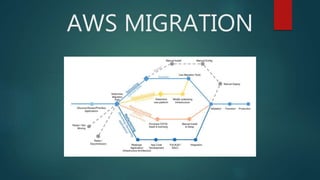
AWS MIGRATION
BEST PRACTICES
Rehosting, or lift and shift
 Can you imagine some old 3 level applications of year 2000 that is still
working unchanged?
 No SOA/Web services!
 No Virtualisation!
 No Infrastructure as a Code automation (no Puppet, No Jenkins..)
 No Microservices !
 Maybe …. even no HA/DR concepts either
 You can still migrate it as is into a Cloud …. and this is a strategy of
rehosting / lift and shift!!!
Rehosting, or lift and shift (2)
 So you have just your old database architecture,
OLTP/ETL/DataMarts/Datawarehouse
 You can migrate it as-is into a Cloud
 And only then start to apply some new features!
 Datalake (see https://aws.amazon.com/fr/big-data/datalakes-and-
analytics/what-is-a-data-lake/)
 AutoScaling OLTP (see What is Amazon EC2 Auto Scaling? - Amazon
EC2 Auto Scaling (amazonaws.cn))
 Egde locations, see What is an Edge Location in AWS | Edureka
Community
 Data centers: What are data centers? How they work and how they are
changing in size and scope | Network World,
Rehosting, or lift and shift (3)
 If legacy servers are already virtual machines, then you can use the
following tool:
 VM Import/Export (amazon.com)
Replatforming, or lift and reshape
 Some things are not necessary anymore to be done by your teams, it can
be done directly by the Cloud support team. For example, some databases
can become just Database as a Service (see
https://www.stratoscale.com/blog/dbaas/what-is-database-as-a-service/)
 For database administrators, no need to manage tablespaces, users
anymore…..
 Also, replacing some licence cosly application server
(Websphere/WebLogic) with some Apache server which is open source,
can also be seen as the part of the Replatforming strategy!!
Repurchasing
 Simply defined, replace the internal CRM with the product inside a Cloud,
which then becomes a SaaS (Software as a Service) (see
https://en.wikipedia.org/wiki/Software_as_a_service) , for example using
Salesforce (which is a true CRM inside a Cloud)
Refactoring/Rearchitecting
 OK, OK, OK … now it is time to explain the full migration from On-premise
to the Cloud, with the complete changing of the architecture!
Refactoring/Rearchitecting (2)
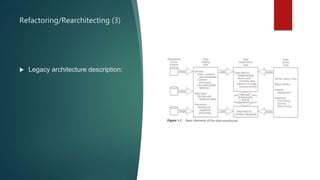
 Legacy architecture description:
 Oracle database for OLTP and the Data warehouse, Informatica as an
ETL, Weblogic as the application server.
 The data is transfered by the nightly job into the Data Warehouse and is
available on day +1 for being used by OLAP and BI teams.
Refactoring/Rearchitecting (3)
 Legacy architecture description:
Refactoring/Rearchitecting (4)
 If we migrate our application to the Cloud
 Amazon RDS database (see https://aws.amazon.com/fr/rds/) (can be
Postgresql, as an open-source for example) ,
 We divide our SOA intro Micro-services architecture and finally all
 Data is inserted at the same time in the OLTP Postgresql database and
some Data Lake which holds the unstructured data as well (MongoDB) ,
 Both OLTP DataLake database are horizontally scalable, then the data
become immediately available and…
 Can be analyzed by some AI tools IN REAL TIME !!!
Refactoring/Rearchitecting (5)
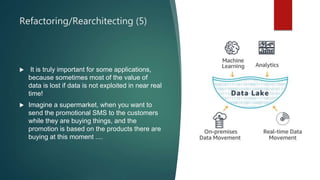
 It is truly important for some applications,
because sometimes most of the value of
data is lost if data is not exploited in near real
time!
 Imagine a supermarket, when you want to
send the promotional SMS to the customers
while they are buying things, and the
promotion is based on the products there are
buying at this moment ....
Refactoring/Rearchitecting (6)
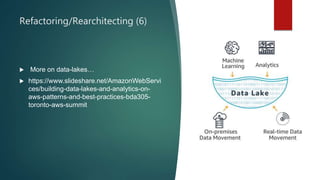
 More on data-lakes…
 https://www.slideshare.net/AmazonWebServi
ces/building-data-lakes-and-analytics-on-
aws-patterns-and-best-practices-bda305-
toronto-aws-summit
AWS MIGRATION
https://aws.amazon.com/fr/blogs/enterprise-strategy/6-
strategies-for-migrating-applications-to-the-cloud/
Lyticsware
 Lyticsware is a young innovative
company that can help you to
tune your databases
 We are also partners of Amazon
Web Services and we are
helping our clients to migrate
their databases /informations
systems to cloud architectures

Aws Migration Strategies

  • 1.
  • 2.
  • 3.
    Rehosting, or liftand shift  Can you imagine some old 3 level applications of year 2000 that is still working unchanged?  No SOA/Web services!  No Virtualisation!  No Infrastructure as a Code automation (no Puppet, No Jenkins..)  No Microservices !  Maybe …. even no HA/DR concepts either  You can still migrate it as is into a Cloud …. and this is a strategy of rehosting / lift and shift!!!
  • 4.
    Rehosting, or liftand shift (2)  So you have just your old database architecture, OLTP/ETL/DataMarts/Datawarehouse  You can migrate it as-is into a Cloud  And only then start to apply some new features!  Datalake (see https://aws.amazon.com/fr/big-data/datalakes-and- analytics/what-is-a-data-lake/)  AutoScaling OLTP (see What is Amazon EC2 Auto Scaling? - Amazon EC2 Auto Scaling (amazonaws.cn))  Egde locations, see What is an Edge Location in AWS | Edureka Community  Data centers: What are data centers? How they work and how they are changing in size and scope | Network World,
  • 5.
    Rehosting, or liftand shift (3)  If legacy servers are already virtual machines, then you can use the following tool:  VM Import/Export (amazon.com)
  • 6.
    Replatforming, or liftand reshape  Some things are not necessary anymore to be done by your teams, it can be done directly by the Cloud support team. For example, some databases can become just Database as a Service (see https://www.stratoscale.com/blog/dbaas/what-is-database-as-a-service/)  For database administrators, no need to manage tablespaces, users anymore…..  Also, replacing some licence cosly application server (Websphere/WebLogic) with some Apache server which is open source, can also be seen as the part of the Replatforming strategy!!
  • 7.
    Repurchasing  Simply defined,replace the internal CRM with the product inside a Cloud, which then becomes a SaaS (Software as a Service) (see https://en.wikipedia.org/wiki/Software_as_a_service) , for example using Salesforce (which is a true CRM inside a Cloud)
  • 8.
    Refactoring/Rearchitecting  OK, OK,OK … now it is time to explain the full migration from On-premise to the Cloud, with the complete changing of the architecture!
  • 9.
    Refactoring/Rearchitecting (2)  Legacyarchitecture description:  Oracle database for OLTP and the Data warehouse, Informatica as an ETL, Weblogic as the application server.  The data is transfered by the nightly job into the Data Warehouse and is available on day +1 for being used by OLAP and BI teams.
  • 10.
  • 11.
    Refactoring/Rearchitecting (4)  Ifwe migrate our application to the Cloud  Amazon RDS database (see https://aws.amazon.com/fr/rds/) (can be Postgresql, as an open-source for example) ,  We divide our SOA intro Micro-services architecture and finally all  Data is inserted at the same time in the OLTP Postgresql database and some Data Lake which holds the unstructured data as well (MongoDB) ,  Both OLTP DataLake database are horizontally scalable, then the data become immediately available and…  Can be analyzed by some AI tools IN REAL TIME !!!
  • 12.
    Refactoring/Rearchitecting (5)  Itis truly important for some applications, because sometimes most of the value of data is lost if data is not exploited in near real time!  Imagine a supermarket, when you want to send the promotional SMS to the customers while they are buying things, and the promotion is based on the products there are buying at this moment ....
  • 13.
    Refactoring/Rearchitecting (6)  Moreon data-lakes…  https://www.slideshare.net/AmazonWebServi ces/building-data-lakes-and-analytics-on- aws-patterns-and-best-practices-bda305- toronto-aws-summit
  • 14.
  • 15.
    Lyticsware  Lyticsware isa young innovative company that can help you to tune your databases  We are also partners of Amazon Web Services and we are helping our clients to migrate their databases /informations systems to cloud architectures