Amazon Web Service – Key Management
AWS Key Management
AWS Key Management Service (KMS) is a managed
service that makes it easy for you to create and control
the encryption keys used to encrypt your data, and
uses FIPS 140-2 validated hardware security modules
to protect the security of your keys.
Algorithm Suites in the AWS Encryption SDK
• The algorithms used in AWS Encryption SDK
are the Advanced Encryption Standard (AES)
algorithm in known as AES-GCM.
• The SDK supports 256-bit, 192-bit, and 128-bit
encryption keys. The length of the initialization
vector (IV) is always 12 bytes; the length of the
authentication tag is always 16 bytes.
Other supported algorithm suites
• AES-GCM with Key Derivation Only
The AES-GCM algorithm uses a key derivation
function, but lacks the ECDSA signature that provides
authenticity and nonrepudiation.
• AES-GCM without Key Derivation or Signing
The AES-GCM algorithm uses the data encryption key
as the AES-GCM encryption key, instead of using a key
derivation function to derive a unique key.
AWS Encryption SDK Programming Languages
• Java
• Python
• Command Line interface
AWS - Data Key Caching
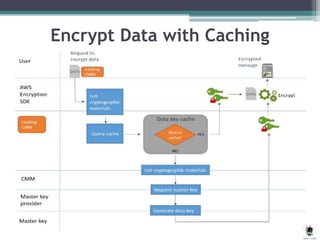
Data key caching stores data keys and related
cryptographic material in a cache. When you encrypt or decrypt
data, the AWS Encryption SDK looks for a matching data key in
the cache. If it finds a match, it uses the cached data key rather
than generating a new one.
Benefits of Data Caching
• It leads to reuse of the data key
• It generates the numerous data keys
• Your cryptographic operations are unacceptably
slow, expensive, limited, or resource-intensive.
The AWS Encryption SDK helps you to
create and manage your data key cache. It
provides a Local Crypto Material Cache and
a caching cryptographic materials manager that
interacts with the cache and enforces security
thresholds that you set
• Plaintext data key
• Encrypted data keys (one or more)
• Encryption context
• Message signing key (if one is used)
• Algorithm suite
• Metadata, including usage counters for enforcing
security thresholds
Data key caching stores data keys and related
cryptographic materials in a cache. Each entry includes
the elements listed below
Cached Entries for Decryption Requests
The entries that are added to a data key cache as a result of
a decryption operation include the following elements:
• Plaintext data key
• Signature verification key (if one is used)
• Metadata, including usage counters for
enforcing security thresholds
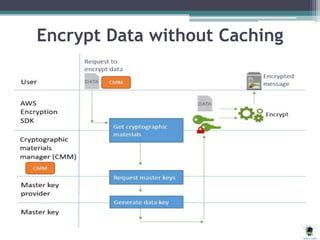
Encrypt Data without Caching
Encrypt Data with Caching
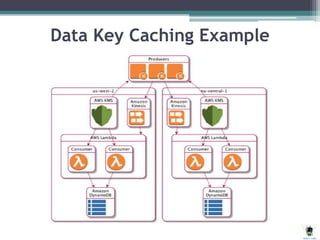
Data Key Caching Example
Data Encryption in Amazon S3
Cloud storage services such as Amazon
S3, the need for encryption is clear. Encrypting
data-at-rest in almost any solution has long
become best practice, and most IAAS providers
offering storage will also offer encryption.
There are five ways to implement the data
encryption in Amazon S3
• Server-Side Encryption with Amazon S3-Managed Keys
• Server-Side Encryption with AWS KMS-Managed Keys
• Server-Side Encryption with Customer-Provided Keys
• Client-Side Encryption with an AWS KMS–Managed
Customer Master Key
• Client-Side Encryption with a Client-Side Master Key
Server-Side Encryption with Amazon S3-Managed Keys
Server-side encryption with Amazon S3-
managed encryption keys (SSE-S3) uses strong
multi-factor encryption. Amazon S3 encrypts each
object with a unique key.
Amazon S3 server-side encryption uses
one of the strongest block ciphers available,
256-bit Advanced Encryption Standard (AES-256),
to encrypt your data.
Server-Side Encryption with AWS KMS-Managed Keys
AWS Key Management Service (AWS KMS)
is a service that combines secure, highly available
hardware and software to provide a key management
system scaled for the cloud.
You use AWS KMS via the Encryption Keys
section in the IAM console or via AWS KMS APIs to
centrally create encryption keys, define the policies
that control how keys can be used, and audit key
usage to prove they are being used correctly.
Highlights of SSE-KMS
• You can choose to create and manage encryption keys yourself.
• The data keys used to encrypt your data are also encrypted and
stored alongside the data they protect.
• Auditable master keys can be created, rotated, and disabled from
the IAM console.
• The security controls in AWS KMS can help you meet encryption-
related compliance requirements.
Server-Side Encryption with Customer-Provided Keys
Server-side encryption with customer-
provided encryption keys (SSE-C) allows you to
set your own encryption keys.
With the encryption key you provide as
part of your request, Amazon S3 manages both the
encryption, as it writes to disks, and decryption,
when you access your objects.
Highlights of SSE-C
• You must use https protocol service only.
• You manage a mapping of which encryption key was used to encrypt
which object. Amazon S3 does not store encryption keys. You are
responsible for tracking which encryption key you provided for
which object.
Client-Side Encryption with an AWS KMS–Managed
Customer Master Key
Client-side encryption is the act of
encrypting data before sending it to Amazon S3.
To enable client-side encryption, you have the
following options:
• Use an AWS KMS-managed customer master key
• Use a client-side master key
Thank You……,
Presented By;
Nantha Kumar Rajasekaren,
To Follow Me ;
Facebook; https://www.facebook.com/profile.php?id=100016683103655
Nantha Kumar Rajasekaren.
Twitter ; https://twitter.com/NRajasekaren
Nantha Kumar Rajasekaren.
LinkedIn; https://www.linkedin.com/in/nantha-kumar-rajasekaren-502211148/
Nantha Kumar Rajasekaren.

AWS Key Management

  • 1.
    Amazon Web Service– Key Management
  • 2.
    AWS Key Management AWSKey Management Service (KMS) is a managed service that makes it easy for you to create and control the encryption keys used to encrypt your data, and uses FIPS 140-2 validated hardware security modules to protect the security of your keys.
  • 3.
    Algorithm Suites inthe AWS Encryption SDK • The algorithms used in AWS Encryption SDK are the Advanced Encryption Standard (AES) algorithm in known as AES-GCM. • The SDK supports 256-bit, 192-bit, and 128-bit encryption keys. The length of the initialization vector (IV) is always 12 bytes; the length of the authentication tag is always 16 bytes.
  • 4.
    Other supported algorithmsuites • AES-GCM with Key Derivation Only The AES-GCM algorithm uses a key derivation function, but lacks the ECDSA signature that provides authenticity and nonrepudiation. • AES-GCM without Key Derivation or Signing The AES-GCM algorithm uses the data encryption key as the AES-GCM encryption key, instead of using a key derivation function to derive a unique key.
  • 5.
    AWS Encryption SDKProgramming Languages • Java • Python • Command Line interface
  • 6.
    AWS - DataKey Caching Data key caching stores data keys and related cryptographic material in a cache. When you encrypt or decrypt data, the AWS Encryption SDK looks for a matching data key in the cache. If it finds a match, it uses the cached data key rather than generating a new one.
  • 7.
    Benefits of DataCaching • It leads to reuse of the data key • It generates the numerous data keys • Your cryptographic operations are unacceptably slow, expensive, limited, or resource-intensive.
  • 8.
    The AWS EncryptionSDK helps you to create and manage your data key cache. It provides a Local Crypto Material Cache and a caching cryptographic materials manager that interacts with the cache and enforces security thresholds that you set
  • 9.
    • Plaintext datakey • Encrypted data keys (one or more) • Encryption context • Message signing key (if one is used) • Algorithm suite • Metadata, including usage counters for enforcing security thresholds Data key caching stores data keys and related cryptographic materials in a cache. Each entry includes the elements listed below
  • 10.
    Cached Entries forDecryption Requests The entries that are added to a data key cache as a result of a decryption operation include the following elements: • Plaintext data key • Signature verification key (if one is used) • Metadata, including usage counters for enforcing security thresholds
  • 11.
  • 12.
  • 13.
  • 14.
    Data Encryption inAmazon S3 Cloud storage services such as Amazon S3, the need for encryption is clear. Encrypting data-at-rest in almost any solution has long become best practice, and most IAAS providers offering storage will also offer encryption.
  • 15.
    There are fiveways to implement the data encryption in Amazon S3 • Server-Side Encryption with Amazon S3-Managed Keys • Server-Side Encryption with AWS KMS-Managed Keys • Server-Side Encryption with Customer-Provided Keys • Client-Side Encryption with an AWS KMS–Managed Customer Master Key • Client-Side Encryption with a Client-Side Master Key
  • 16.
    Server-Side Encryption withAmazon S3-Managed Keys Server-side encryption with Amazon S3- managed encryption keys (SSE-S3) uses strong multi-factor encryption. Amazon S3 encrypts each object with a unique key. Amazon S3 server-side encryption uses one of the strongest block ciphers available, 256-bit Advanced Encryption Standard (AES-256), to encrypt your data.
  • 17.
    Server-Side Encryption withAWS KMS-Managed Keys AWS Key Management Service (AWS KMS) is a service that combines secure, highly available hardware and software to provide a key management system scaled for the cloud. You use AWS KMS via the Encryption Keys section in the IAM console or via AWS KMS APIs to centrally create encryption keys, define the policies that control how keys can be used, and audit key usage to prove they are being used correctly.
  • 18.
    Highlights of SSE-KMS •You can choose to create and manage encryption keys yourself. • The data keys used to encrypt your data are also encrypted and stored alongside the data they protect. • Auditable master keys can be created, rotated, and disabled from the IAM console. • The security controls in AWS KMS can help you meet encryption- related compliance requirements.
  • 19.
    Server-Side Encryption withCustomer-Provided Keys Server-side encryption with customer- provided encryption keys (SSE-C) allows you to set your own encryption keys. With the encryption key you provide as part of your request, Amazon S3 manages both the encryption, as it writes to disks, and decryption, when you access your objects.
  • 20.
    Highlights of SSE-C •You must use https protocol service only. • You manage a mapping of which encryption key was used to encrypt which object. Amazon S3 does not store encryption keys. You are responsible for tracking which encryption key you provided for which object.
  • 21.
    Client-Side Encryption withan AWS KMS–Managed Customer Master Key Client-side encryption is the act of encrypting data before sending it to Amazon S3. To enable client-side encryption, you have the following options: • Use an AWS KMS-managed customer master key • Use a client-side master key
  • 22.
  • 23.
    To Follow Me; Facebook; https://www.facebook.com/profile.php?id=100016683103655 Nantha Kumar Rajasekaren. Twitter ; https://twitter.com/NRajasekaren Nantha Kumar Rajasekaren. LinkedIn; https://www.linkedin.com/in/nantha-kumar-rajasekaren-502211148/ Nantha Kumar Rajasekaren.