

Avoid Single Point of Failure in Cloud-
native Application
Phuong Le - Thang Chung
Dec 2018
$ whoami
• Phuong Le
- Engineering Manager at NashTech
- Over 15-years’ experience in the full life-cycle of the software. I have
passion on people development and help them grow in their career
path
• Thang Chung
- Solution Architect at NashTech
- Over 10 years in software development industry, mainly focus on
modern software architectures such as n-tiers, microservices, and
cloud-native application.
- https://github.com/thangchung
- https://medium.com/@thangchung
• Key Takeaways
- Cloud Native Fundamentals
- Single Point of Failure in Cloud-native Apps
• Q&A
Cloud Native Fundamentals
“It is the first step that is troublesome” - proverb
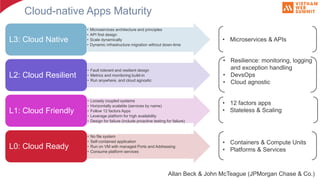
Cloud-native Apps Maturity
• Microservices architecture and principles
• API first design
• Scale dynamically
• Dynamic infrastructure migration without down-time
L3: Cloud Native
• Fault tolerant and resilient design
• Metrics and monitoring build-in
• Run anywhere, and cloud agnostic
L2: Cloud Resilient
• Loosely coupled systems
• Horizontally scalable (services by name)
• Follow 12 factors Apps
• Leverage platform for high availability
• Design for failure (include proactive testing for failure)
L1: Cloud Friendly
• No file system
• Self-contained application
• Run on VM with managed Ports and Addressing
• Consume platform services
L0: Cloud Ready
Allan Beck & John McTeague (JPMorgan Chase & Co.)
• Microservices & APIs
• Resilience: monitoring, logging
and exception handling
• DevsOps
• Cloud agnostic
• 12 factors apps
• Stateless & Scaling
• Containers & Compute Units
• Platforms & Services
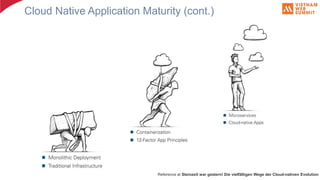
Cloud Native Application Maturity (cont.)
Reference at Steinzeit war gestern! Die vielfältigen Wege der Cloud-nativen Evolution
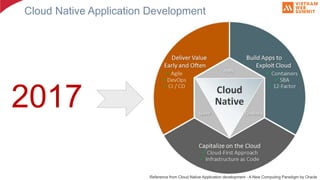
Cloud Native Application Development
Reference from Cloud Native Application development - A New Computing Paradigm by Oracle
2017
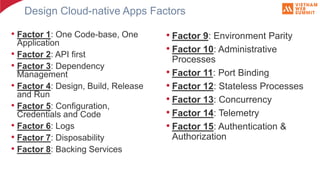
Design Cloud-native Apps Factors
• Factor 1: One Code-base, One
Application
• Factor 2: API first
• Factor 3: Dependency
Management
• Factor 4: Design, Build, Release
and Run
• Factor 5: Configuration,
Credentials and Code
• Factor 6: Logs
• Factor 7: Disposability
• Factor 8: Backing Services
• Factor 9: Environment Parity
• Factor 10: Administrative
Processes
• Factor 11: Port Binding
• Factor 12: Stateless Processes
• Factor 13: Concurrency
• Factor 14: Telemetry
• Factor 15: Authentication &
Authorization
Single Point of Failure in Cloud-native Apps
“Every man is the architect of his own fortune” - proverb
Kubernetes High-Availability
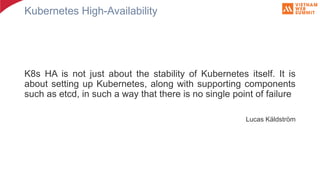
K8s HA is not just about the stability of Kubernetes itself. It is
about setting up Kubernetes, along with supporting components
such as etcd, in such a way that there is no single point of failure
Lucas Käldström
“Multi-master” vs “High-availability”
Factors can lead the single point of failure
•Load balancer to cluster
•Kube-dns
•Etcd
•A single master cluster
Achieve Kubernetes HA
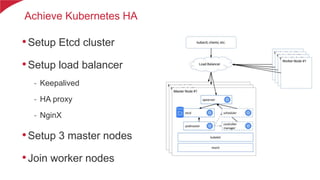
•Setup Etcd cluster
•Setup load balancer
- Keepalived
- HA proxy
- NginX
•Setup 3 master nodes
•Join worker nodes
THANK YOU
www.nashtechglobal.com
Q&A

Avoid SPOF in Cloud-native Apps

  • 1.
    Avoid Single Pointof Failure in Cloud- native Application Phuong Le - Thang Chung Dec 2018
  • 2.
    $ whoami • PhuongLe - Engineering Manager at NashTech - Over 15-years’ experience in the full life-cycle of the software. I have passion on people development and help them grow in their career path • Thang Chung - Solution Architect at NashTech - Over 10 years in software development industry, mainly focus on modern software architectures such as n-tiers, microservices, and cloud-native application. - https://github.com/thangchung - https://medium.com/@thangchung
  • 3.
    • Key Takeaways -Cloud Native Fundamentals - Single Point of Failure in Cloud-native Apps • Q&A
  • 4.
    Cloud Native Fundamentals “Itis the first step that is troublesome” - proverb
  • 5.
    Cloud-native Apps Maturity •Microservices architecture and principles • API first design • Scale dynamically • Dynamic infrastructure migration without down-time L3: Cloud Native • Fault tolerant and resilient design • Metrics and monitoring build-in • Run anywhere, and cloud agnostic L2: Cloud Resilient • Loosely coupled systems • Horizontally scalable (services by name) • Follow 12 factors Apps • Leverage platform for high availability • Design for failure (include proactive testing for failure) L1: Cloud Friendly • No file system • Self-contained application • Run on VM with managed Ports and Addressing • Consume platform services L0: Cloud Ready Allan Beck & John McTeague (JPMorgan Chase & Co.) • Microservices & APIs • Resilience: monitoring, logging and exception handling • DevsOps • Cloud agnostic • 12 factors apps • Stateless & Scaling • Containers & Compute Units • Platforms & Services
  • 6.
    Cloud Native ApplicationMaturity (cont.) Reference at Steinzeit war gestern! Die vielfältigen Wege der Cloud-nativen Evolution
  • 7.
    Cloud Native ApplicationDevelopment Reference from Cloud Native Application development - A New Computing Paradigm by Oracle 2017
  • 8.
    Design Cloud-native AppsFactors • Factor 1: One Code-base, One Application • Factor 2: API first • Factor 3: Dependency Management • Factor 4: Design, Build, Release and Run • Factor 5: Configuration, Credentials and Code • Factor 6: Logs • Factor 7: Disposability • Factor 8: Backing Services • Factor 9: Environment Parity • Factor 10: Administrative Processes • Factor 11: Port Binding • Factor 12: Stateless Processes • Factor 13: Concurrency • Factor 14: Telemetry • Factor 15: Authentication & Authorization
  • 9.
    Single Point ofFailure in Cloud-native Apps “Every man is the architect of his own fortune” - proverb
  • 10.
    Kubernetes High-Availability K8s HAis not just about the stability of Kubernetes itself. It is about setting up Kubernetes, along with supporting components such as etcd, in such a way that there is no single point of failure Lucas Käldström
  • 11.
  • 12.
    Factors can leadthe single point of failure •Load balancer to cluster •Kube-dns •Etcd •A single master cluster
  • 13.
    Achieve Kubernetes HA •SetupEtcd cluster •Setup load balancer - Keepalived - HA proxy - NginX •Setup 3 master nodes •Join worker nodes
  • 14.
  • 15.