Pharmacology and Therapeutics:1
11/22/2025
DR GOHAR ALI, ASSISTANT PROFESSOR
DEPTT OF PHARMACY, UOP
1
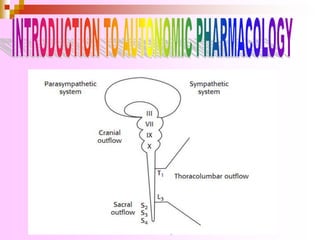
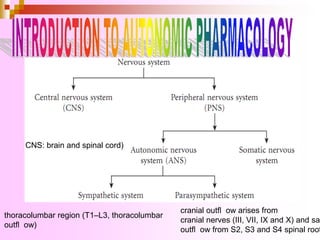
CNS: brain and spinal cord)
thoracolumbar region (T1–L3, thoracolumbar
outfl ow)
cranial outfl ow arises from
cranial nerves (III, VII, IX and X) and sac
outfl ow from S2, S3 and S4 spinal root
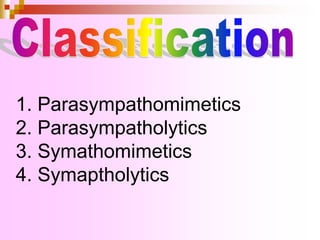
1. Parasympathomimetics
2. Parasympatholytics
3. Symathomimetics
4. Symaptholytics
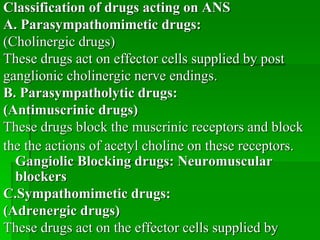
Classification of drugs acting on ANS
A. Parasympathomimetic drugs:
(Cholinergic drugs)
These drugs act on effector cells supplied by post
ganglionic cholinergic nerve endings.
B. Parasympatholytic drugs:
(Antimuscrinic drugs)
These drugs block the muscrinic receptors and block
the the actions of acetyl choline on these receptors.
Gangiolic Blocking drugs: Neuromuscular
blockers
C.Sympathomimetic drugs:
(Adrenergic drugs)
These drugs act on the effector cells supplied by
Post ganglionic adrenergic nerve endings.
D. Sympatholytic drugs:
(Adrenergic receptor blocking drugs)
These drugs block the adrenergic receptors and
prevent the actions of adrenaline and Nor adrenaline.
Parasympathomimetic drugs:
(Cholinergic drugs)
Acetylcholine receptor stimulants and cholinesterase
inhibitors together comprise a large group of drugs
that mimic acetylcholine (cholinomimetic agents).
They are also classified by their mechanism of action
because some cholinomimetic drugs bind directly to
(and activate) cholinoceptors while others act
indirectly by inhibiting the hydrolysis of endogenous
acetylcholine.
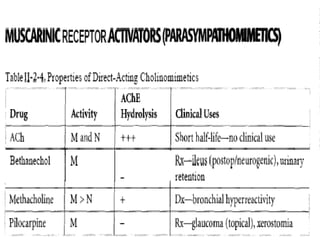
A. Direct acting Cholinergic drugs
These donot require the presence of cholinergic nerve
ending for their pharmacological action. These drugs
act on effector cells supplied by post ganglionic
cholinergic nerve endings and are further classified
chemically as:
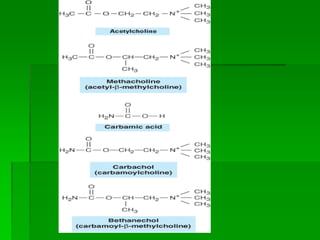
1.Choline esters:
Acetylcholine
Carbachol
Methacholine
Bethanechol
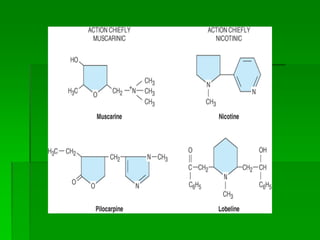
2.Alkaloids:
Pilocarpine
Muscarine
Arecoline
3. Miscellaneous
Oxotremorine
Metochlopramide
Cisapride
Taclifensine (M1-selective agonists, used in dementia)
Cevimeline (M3 receptor agonist, used in xerothermia)
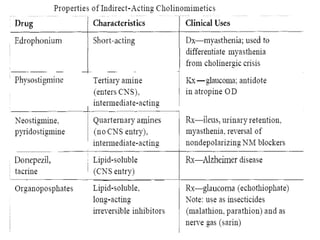
B. Indirect acting Cholinergic Drugs:
(Anticholinestrases/ Cholinestrase Inhibitors)
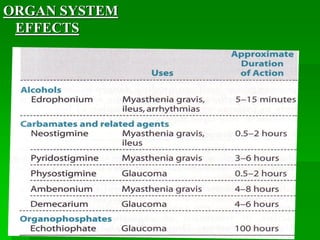
1.Reversible Anticholinestrases (Carbamates)
These drugs inhibit the Anticholinestrase enzyme for a
short period. Their duration of action varies from 5
minutes to 8 hours and enzyme become active after
this period.
A.Tertiary Amines:
Physostigmine (Eserine)
B.Quaternary Ammonium Compounds:
Neostigmine
Pyridostigmine
Ambenonium
Edrophonium
Demecarium
C. N-Methyl Carbamates esters (Insectcides)
Carbaryl
Aldicort
Propoxur
Carbofuran
Ambenonium
Edrophonium
Demecarium
C. N-Methyl Carbamates esters (Insectcides)
Carbaryl
Aldicort
Propoxur
Carbofuran
2.Irreversible Anticholinestrases:
These drugs inhibit the cholinestrase enzme
permanently and new enzyme has to be formed to
activate acetyl choline. The drugs of this group are
used in agriculture as insecticides and in war as ‘Nerve
gas’.
A. Therapeuticlly useful agents:
Dyflos (DFP)
Echothiopate
B.Insecticides:
Parathion
Malathion
Dimethoate
C. War Gases:
Soman
Sarin
Tabun
3.INHIBITING CHOLINE CARRIER -
Hemicholinium
4. INHIBITION OF VESCICULAR STORAGE -
Vesamicol
5. INHIBITION OF RELEASE – Botulinium toxin
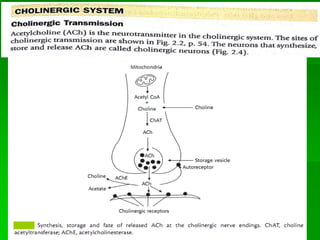
MECHANISM OF ACTION OF
CHOLINOMIMETIC
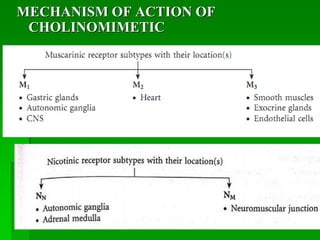
MECHANISM OF ACTION OF
CHOLINOMIMETIC
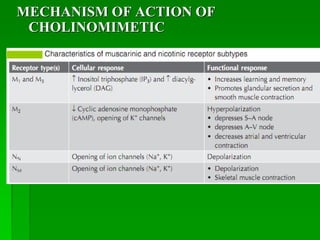
MECHANISM OF ACTION OF
CHOLINOMIMETIC
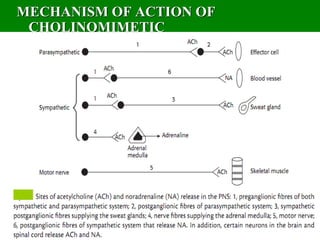
MECHANISM OF ACTION OF
CHOLINOMIMETIC
DRUGS (Both direct & Indirect)
Direct-acting cholinomimetic agents bind to and
activate muscarinic or nicotinic receptors. Indirect-
acting agents produce their primary effects by
inhibiting acetylcholinesterase, which hydrolyzes
acetylcholine to choline and acetic acid. By inhibiting
acetylcholinesterase, the indirect-acting drugs increase
the endogenous acetylcholine concentration in
synaptic clefts and neuroeffector junctions. The excess
acetylcholine, in turn, stimulates cholinoceptors to
evoke increased responses. These drugs act primarily
where acetylcholine is physiologically released and are
thus amplifiers of endogenous acetylcholine
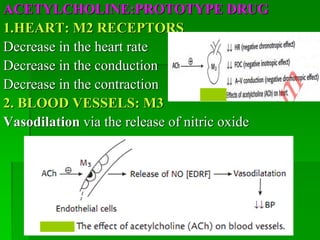
ACETYLCHOLINE:PROTOTYPE DRUG
1.HEART: M2 RECEPTORS
Decrease in the heart rate
Decrease in the conduction
Decrease in the contraction
2. BLOOD VESSELS: M3
Vasodilation via the release of nitric oxide
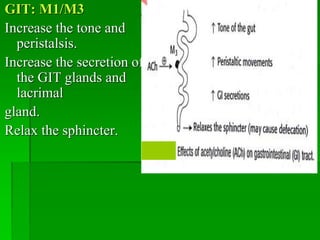
GIT: M1/M3
Increase the tone and
peristalsis.
Increase the secretion of
the GIT glands and
lacrimal
gland.
Relax the sphincter.
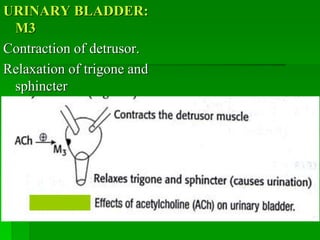
URINARY BLADDER:
M3
Contraction of detrusor.
Relaxation of trigone and
sphincter
.
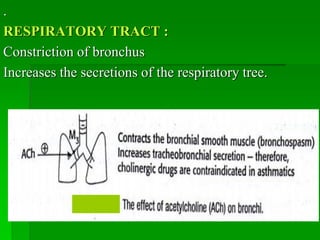
RESPIRATORY TRACT :
Constriction of bronchus
Increases the secretions of the respiratory tree.
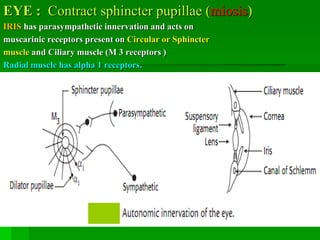
EYE : Contract sphincter pupillae (miosis)
IRIS has parasympathetic innervation and acts on
muscarinic receptors present on Circular or Sphincter
muscle and Ciliary muscle (M 3 receptors )
Radial muscle has alpha 1 receptors.
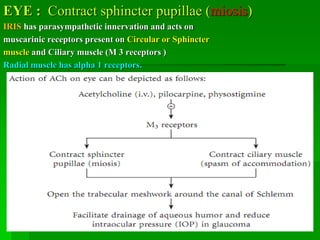
EYE : Contract sphincter pupillae (miosis)
IRIS has parasympathetic innervation and acts on
muscarinic receptors present on Circular or Sphincter
muscle and Ciliary muscle (M 3 receptors )
Radial muscle has alpha 1 receptors.
ORGAN SYSTEM
EFFECTS
END

AUTONOMIC-CHOLINERGIC ONLINE LECTURE (2).pdf

  • 1.
    Pharmacology and Therapeutics:1 11/22/2025 DRGOHAR ALI, ASSISTANT PROFESSOR DEPTT OF PHARMACY, UOP 1
  • 2.
    CNS: brain andspinal cord) thoracolumbar region (T1–L3, thoracolumbar outfl ow) cranial outfl ow arises from cranial nerves (III, VII, IX and X) and sac outfl ow from S2, S3 and S4 spinal root
  • 5.
    1. Parasympathomimetics 2. Parasympatholytics 3.Symathomimetics 4. Symaptholytics
  • 6.
    Classification of drugsacting on ANS A. Parasympathomimetic drugs: (Cholinergic drugs) These drugs act on effector cells supplied by post ganglionic cholinergic nerve endings. B. Parasympatholytic drugs: (Antimuscrinic drugs) These drugs block the muscrinic receptors and block the the actions of acetyl choline on these receptors. Gangiolic Blocking drugs: Neuromuscular blockers C.Sympathomimetic drugs: (Adrenergic drugs) These drugs act on the effector cells supplied by
  • 7.
    Post ganglionic adrenergicnerve endings. D. Sympatholytic drugs: (Adrenergic receptor blocking drugs) These drugs block the adrenergic receptors and prevent the actions of adrenaline and Nor adrenaline.
  • 8.
    Parasympathomimetic drugs: (Cholinergic drugs) Acetylcholinereceptor stimulants and cholinesterase inhibitors together comprise a large group of drugs that mimic acetylcholine (cholinomimetic agents). They are also classified by their mechanism of action because some cholinomimetic drugs bind directly to (and activate) cholinoceptors while others act indirectly by inhibiting the hydrolysis of endogenous acetylcholine.
  • 10.
    A. Direct actingCholinergic drugs These donot require the presence of cholinergic nerve ending for their pharmacological action. These drugs act on effector cells supplied by post ganglionic cholinergic nerve endings and are further classified chemically as: 1.Choline esters: Acetylcholine Carbachol Methacholine Bethanechol
  • 11.
  • 12.
    B. Indirect actingCholinergic Drugs: (Anticholinestrases/ Cholinestrase Inhibitors) 1.Reversible Anticholinestrases (Carbamates) These drugs inhibit the Anticholinestrase enzyme for a short period. Their duration of action varies from 5 minutes to 8 hours and enzyme become active after this period. A.Tertiary Amines: Physostigmine (Eserine) B.Quaternary Ammonium Compounds: Neostigmine Pyridostigmine
  • 13.
    Ambenonium Edrophonium Demecarium C. N-Methyl Carbamatesesters (Insectcides) Carbaryl Aldicort Propoxur Carbofuran
  • 14.
    Ambenonium Edrophonium Demecarium C. N-Methyl Carbamatesesters (Insectcides) Carbaryl Aldicort Propoxur Carbofuran
  • 15.
    2.Irreversible Anticholinestrases: These drugsinhibit the cholinestrase enzme permanently and new enzyme has to be formed to activate acetyl choline. The drugs of this group are used in agriculture as insecticides and in war as ‘Nerve gas’. A. Therapeuticlly useful agents: Dyflos (DFP) Echothiopate B.Insecticides: Parathion Malathion
  • 16.
    Dimethoate C. War Gases: Soman Sarin Tabun 3.INHIBITINGCHOLINE CARRIER - Hemicholinium 4. INHIBITION OF VESCICULAR STORAGE - Vesamicol 5. INHIBITION OF RELEASE – Botulinium toxin
  • 18.
    MECHANISM OF ACTIONOF CHOLINOMIMETIC
  • 19.
    MECHANISM OF ACTIONOF CHOLINOMIMETIC
  • 20.
    MECHANISM OF ACTIONOF CHOLINOMIMETIC
  • 21.
    MECHANISM OF ACTIONOF CHOLINOMIMETIC DRUGS (Both direct & Indirect) Direct-acting cholinomimetic agents bind to and activate muscarinic or nicotinic receptors. Indirect- acting agents produce their primary effects by inhibiting acetylcholinesterase, which hydrolyzes acetylcholine to choline and acetic acid. By inhibiting acetylcholinesterase, the indirect-acting drugs increase the endogenous acetylcholine concentration in synaptic clefts and neuroeffector junctions. The excess acetylcholine, in turn, stimulates cholinoceptors to evoke increased responses. These drugs act primarily where acetylcholine is physiologically released and are thus amplifiers of endogenous acetylcholine
  • 22.
    ACETYLCHOLINE:PROTOTYPE DRUG 1.HEART: M2RECEPTORS Decrease in the heart rate Decrease in the conduction Decrease in the contraction 2. BLOOD VESSELS: M3 Vasodilation via the release of nitric oxide
  • 23.
    GIT: M1/M3 Increase thetone and peristalsis. Increase the secretion of the GIT glands and lacrimal gland. Relax the sphincter.
  • 24.
    URINARY BLADDER: M3 Contraction ofdetrusor. Relaxation of trigone and sphincter
  • 25.
    . RESPIRATORY TRACT : Constrictionof bronchus Increases the secretions of the respiratory tree.
  • 26.
    EYE : Contractsphincter pupillae (miosis) IRIS has parasympathetic innervation and acts on muscarinic receptors present on Circular or Sphincter muscle and Ciliary muscle (M 3 receptors ) Radial muscle has alpha 1 receptors.
  • 27.
    EYE : Contractsphincter pupillae (miosis) IRIS has parasympathetic innervation and acts on muscarinic receptors present on Circular or Sphincter muscle and Ciliary muscle (M 3 receptors ) Radial muscle has alpha 1 receptors.
  • 33.
  • 34.