Introduction & Whatis AutoML?
• AutoML automates the process of building ML
models—data preprocessing, feature
engineering, model selection, and
hyperparameter tuning—making ML
accessible to non-experts.
3.
Traditional ML vsAutoML
• Traditional ML: Manual processes, requires
expertise, time-consuming.
• AutoML: Automated, user-friendly, fast and
efficient.
• | Task | Traditional | AutoML |
• |------|-------------|--------|
• | Preprocessing | Manual | Automated |
• | Model Tuning | Grid Search | Bayesian Opt.
4.
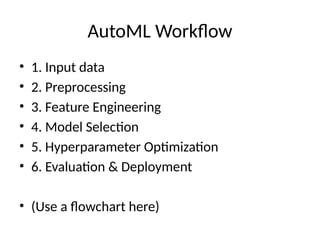
AutoML Workflow
• 1.Input data
• 2. Preprocessing
• 3. Feature Engineering
• 4. Model Selection
• 5. Hyperparameter Optimization
• 6. Evaluation & Deployment
• (Use a flowchart here)
My Experience withAutoML on
Kaggle
• Used [AutoML tool] for a
[classification/regression] problem
• Process: Preprocessing → AutoML Pipeline →
Evaluation
• Outcome: Competitive model, great learning
experience
9.
Pros & Consof AutoML
• **Advantages:**
• - Time-saving
• - No ML expertise required
• - High-performing models
• **Limitations:**
• - Black-box behavior
• - Less control
• - Resource-heavy
10.
Conclusion & Q&A
•AutoML democratizes AI by reducing
complexity and accelerating development. It's
transforming industries by making machine
learning more accessible.
• Thank you! Any questions?
![AutoML: Automating the Future of
Machine Learning
• Presented by: [Your Name]
• Reg No: [Your Reg No]
• Department of AIML, [College Name]
• Date: [Seminar Date]
• Guide: [Faculty Guide Name]](https://image.slidesharecdn.com/automlseminarpptcondensed-250425123955-ccda34da/85/AutoML_Seminar_PPT_Condensed_presentation-pptx-1-320.jpg)
![AutoML: Automating the Future of
Machine Learning
• Presented by: [Your Name]
• Reg No: [Your Reg No]
• Department of AIML, [College Name]
• Date: [Seminar Date]
• Guide: [Faculty Guide Name]](https://image.slidesharecdn.com/automlseminarpptcondensed-250425123955-ccda34da/75/AutoML_Seminar_PPT_Condensed_presentation-pptx-1-2048.jpg)

![My Experience with AutoML on
Kaggle
• Used [AutoML tool] for a
[classification/regression] problem
• Process: Preprocessing → AutoML Pipeline →
Evaluation
• Outcome: Competitive model, great learning
experience](https://image.slidesharecdn.com/automlseminarpptcondensed-250425123955-ccda34da/85/AutoML_Seminar_PPT_Condensed_presentation-pptx-8-320.jpg)