Unit 4: Automation
Bloodcell analyzer: Introduction, working principle,
components, applications.
Arterial blood gas analyzer and its applications.
Applications of computer in automation.
2.
Blood cell analyzer
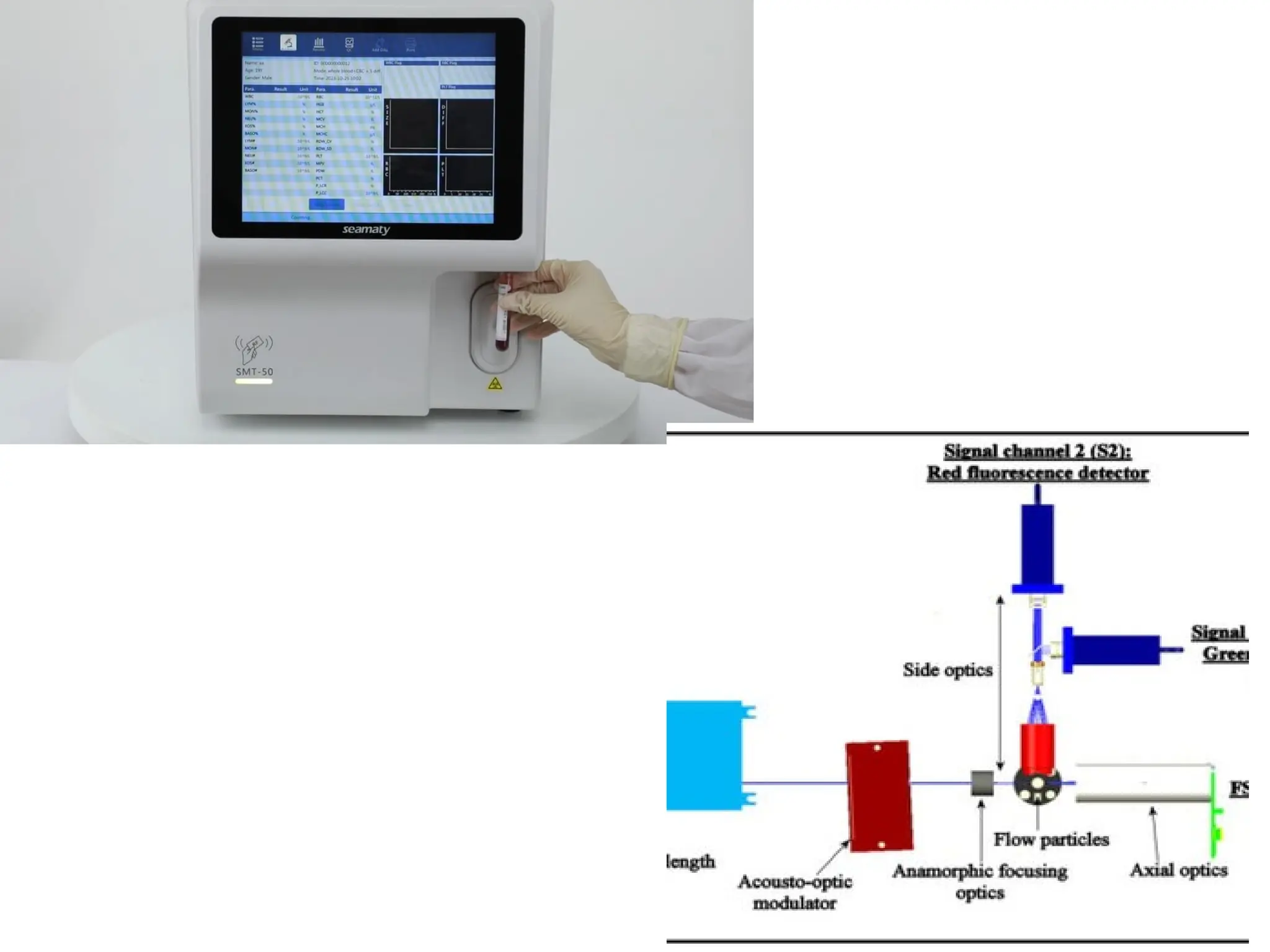
•A blood cell analyzer, also known as a hematology
analyzer, is a laboratory instrument that
automatically counts and categorizes blood cells,
such as red blood cells, white blood cells, and
platelets.
• These analyzers play a crucial role in diagnosing
and monitoring various medical conditions by
providing detailed information about the cellular
components of blood.
4.
Working principle
• Principleuse combination of electrical impedance
and optical methods to count and analyze blood
cells.
• Electrical impedance measures cell size and count
as cells pass through a small aperture, while optical
methods like light scattering and flow cytometry
differentiate cells based on their properties and
surface markers.
5.
Components
• 1. SampleHandling System: This system is responsible for
receiving, preparing, and introducing the blood sample into
the analyzer. It may include a sampling probe, diluting
apparatus, and mixing mechanisms.
• 2. Reagent System: Hematology analyzers utilize various
reagents to prepare the sample for analysis. These reagents
can include diluents to reduce the concentration of blood
cells, lysing agents to break open red blood cells for white
blood cell counting, and staining solutions for flow cytometry
analysis.
• 3. Cell Counting Chamber: This is the area where the diluted
and treated blood sample is introduced for analysis. Different
technologies can be used in the counting chamber to
differentiate and count cells.
6.
4. Detection System:
•This system utilizes various technologies to detect and
differentiate blood cells. Common methods include:
• Impedance (Coulter Principle):
• Measures changes in electrical resistance as cells pass through
a small aperture, allowing for cell counting and sizing.
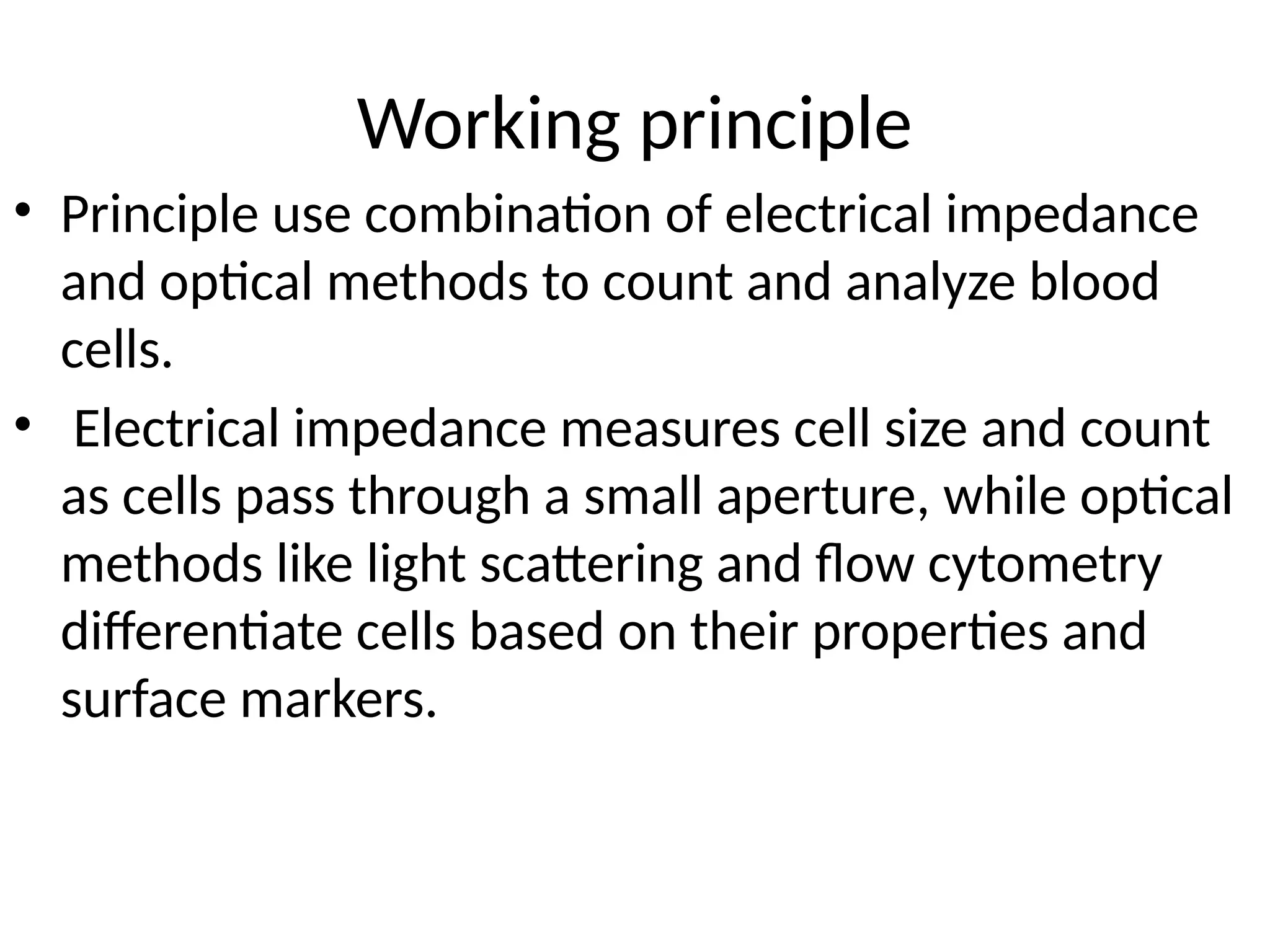
• Optical (Flow Cytometry/Light Scattering):
• Uses laser beams and detectors to analyze cells based on light
scattering patterns, providing information on cell size,
granularity, and other characteristics.
• 5. Data Analysis Unit: This unit processes the data obtained
from the detection system, performing calculations and
generating results such as cell counts, cell size, cell
morphology, and hemoglobin concentration.
7.
6. Other ImportantComponents:
• Power Source: Provides the necessary energy for the
analyzer to operate.
• Control Unit: Manages the overall operation of the
analyzer, including controlling the flow of reagents,
sample processing, and data analysis.
• Data Storage: Stores the results of analyzed samples
for future reference and reporting.
• Interface and Display: Allows for user interaction with
the analyzer, including inputting sample information,
viewing results, and controlling settings.
• Printer: Generates hard copies of the analysis reports.
8.
Applications
• Diagnostic testing:Hematology analyzers are essential in diagnosing and
monitoring hematologic disorders like anemia, leukemia, and thrombocytopenia.
By providing rapid and accurate results, these instruments enable healthcare
providers to make timely, informed decisions regarding patient care.
• Blood screening: Hematology analyzers are utilized in blood banks and
transfusion services to screen donated blood for infectious diseases, such as HIV,
hepatitis, and syphilis. By ensuring the safety and compatibility of blood
products, these analyzers help prevent transfusion-related complications and
ensure the optimal management of patients requiring blood transfusions.
• Treatment monitoring: For patients undergoing chemotherapy or other forms of
cancer treatment, hematology analyzers are used to monitor hematologic
parameters and assess treatment response. By tracking changes in blood cell
counts and morphology over time, these instruments enable oncologists to
adjust treatment regimens as needed and optimize patient outcomes.
• Research and development: Hematology analyzers play a crucial role in scientific
research and drug development, providing researchers with valuable data on
blood cell biology, disease mechanisms, and therapeutic interventions. By
facilitating high-throughput screening and analysis, these instruments accelerate
the pace of discovery and innovation in the field of hematology.
9.
Arterial blood gasanalyzer
• Arterial blood gas (ABG) analyzer automation refers
to the integration of automated processes and
technologies into the traditional methods of
analyzing arterial blood samples for determining
oxygen and carbon dioxide levels, pH, and other
related parameters.
• This automation streamlines the process, enhances
efficiency, and improves the accuracy of results,
particularly in critical care settings.
11.
Automated Sample Handling:
•Automated systems can handle the entire process from sample
aspiration to result delivery, minimizing manual intervention and
reducing the risk of errors.
• Electrode-based Measurement:
• Modern ABG analyzers utilize electrodes to measure parameters like
partial pressure of oxygen (PaO2), partial pressure of carbon dioxide
(PaCO2), and pH directly from the blood sample, providing real-time
data.
• Integrated Data Management:
• Automated systems often include software for data storage, analysis,
and reporting, facilitating efficient management of patient information.
• Point-of-Care Testing:
• Automation enables rapid analysis at the patient's bedside, which is
crucial in emergency situations where quick decision-making is
essential.
12.
Working principle
• Arterialblood gas (ABG) analyzers use
electrochemical sensors to measure the partial
pressures of oxygen (pO2) and carbon dioxide
(pCO2), as well as pH, in a blood sample.
• These measurements are crucial for assessing a
patient's respiratory and metabolic status.
• The analyzer then uses these measurements to
calculate other parameters like oxygen saturation,
bicarbonate levels, and base excess.
13.
Applications
1. Assessing RespiratoryFunction:
• Blood gas analyzers measure partial pressures of oxygen (PaO2) and
carbon dioxide (PaCO2) in the blood.
• These measurements help evaluate the lungs' ability to oxygenate blood
and remove carbon dioxide, aiding in the diagnosis of respiratory
diseases like pneumonia, COPD, and asthma.
• They also help assess the severity and progression of respiratory
conditions.
2. Evaluating Acid-Base Balance:
• Blood gas analysis includes measuring pH, bicarbonate (HCO3-), and
base excess, which are critical for determining the body's acid-base
balance.
• This helps diagnose conditions like metabolic acidosis (often seen in
kidney failure or diabetic ketoacidosis) and metabolic alkalosis.
• Accurate assessment of acid-base balance is crucial for guiding
appropriate treatment strategies.
14.
3. Monitoring PatientConditions:
• Blood gas analysis is used to monitor patients with severe
illnesses or injuries, particularly in critical care settings like the
ICU.
• It helps assess the effectiveness of interventions like
mechanical ventilation and oxygen therapy.
• Regular monitoring allows for timely adjustments to treatment
plans to optimize patient outcomes.
4. Supporting Surgical Procedures:
• During surgery, especially in cardiac and pulmonary
procedures, blood gas analysis is essential for monitoring the
patient's respiratory and metabolic status.
• It helps ensure adequate oxygenation and acid-base balance
during anesthesia and surgical interventions.
15.
5. Guiding TreatmentDecisions:
• Blood gas analysis results provide crucial information for
clinicians to make informed decisions about patient care.
• For example, it helps determine the need for
supplemental oxygen, mechanical ventilation, or other
therapies.
6. Evaluating Circulatory Function:
• Blood gas analysis can also provide insights into
circulatory function by measuring central venous oxygen
saturation (ScvO2).
• This is particularly useful in conditions like sepsis, septic
shock, and after major surgery to assess the body's
ability to deliver oxygen to tissues.
16.
Applications of computerin automation.
• Computers play a vital role in automating various
processes within medical laboratories, enhancing
efficiency, accuracy, and safety.
• They manage data, control instruments, and
automate tasks like sample handling, analysis, and
reporting, ultimately improving turnaround times
and reducing human error.
17.
1. Data Managementand Reporting:
• LIS/HIS Integration:
• Computers connect with Laboratory Information Systems
(LIS) and Hospital Information Systems (HIS) to manage
test requests, track specimens, and store patient data.
• Report Generation:
• Automated systems generate detailed reports,
eliminating manual data entry and reducing the time
required for result compilation.
• Data Analysis:
• Computers analyze test results, identify anomalies, and
provide statistical data for research and quality control.
18.
2. Instrument Controland Automation:
• Automated Analyzers:
• Computers control sophisticated automated analyzers
used in hematology, chemistry, and other lab disciplines,
enabling high-throughput testing.
• Robotics and Sample Handling:
• Robotic systems handle sample preparation, pipetting,
dilution, and other repetitive tasks, improving accuracy
and reducing manual effort.
• Equipment Calibration:
• Software can track equipment calibration schedules and
even automate calibration checks, ensuring instrument
reliability.
19.
3. Enhanced Efficiencyand Accuracy:
• Reduced Turnaround Time:
• Automation streamlines workflows, enabling faster
sample processing and result delivery.
• Minimized Human Error:
• By automating repetitive tasks and reducing manual
handling, computers minimize human error,
increasing the reliability of test results.
• Increased Throughput:
• Automated systems can process a larger volume of
samples in a shorter time, improving overall lab
efficiency.
20.
4. Improved Safety:
•Hazardous Material Handling:
• Automated systems can handle hazardous materials and
reagents, minimizing lab personnel's exposure to potential
risks.
• Safety Limits and Alarms:
• Software can set safety limits and trigger alarms or
automated shutdowns in case of deviations, enhancing lab
safety.
• Error Prevention:
• Automated systems minimize the chances of human error,
which can be critical when dealing with hazardous
substances.
21.
5. Specific Applications:
•Molecular Diagnostics and Genetics:
• Automation is crucial in molecular diagnostics for tasks
like DNA sequencing, PCR amplification, and gene
analysis.
• Microbiology:
• Automated plate readers, digital imaging, and robotic
systems aid in bacterial identification and antibiotic
susceptibility testing.
• Hematology and Blood Banking:
• Automated cell counters, blood typing systems, and
coagulation analyzers are widely used in hematology
labs.
22.
Clinical Chemistry:
• Automatedchemistry analyzers perform a
wide range of biochemical tests on blood,
urine, and other bodily fluids.
• Pathology and Histology:
• Digital pathology and automated staining
systems are transforming the field of
pathology.