Automating drug target discovery
with machine learning
Enrico Ferrero, PhD, Associate GSK Fellow
Scientific Leader, Computational Biology, Target Sciences,
GSK
ODSC Europe
13.10.2017
@enricoferrero
Data is the new oil
Yahoo Finance & Forbes, 2017
The Economist, 2017
Data + AI = drugs?
BBC News, 2017 Nature Biotechnology, 2017
The pharma AI space is getting crowded
Partner
Partner
Developing a new drug: 15+ years, $2B+
Challenging times for pharma R&D
So, what’s wrong?
Harrison, Nat Rev Drug Discov, 2016
Cook et al., Nat Rev Drug Discov, 2014
Late phase failures cost (a lot) more
Manhattan Institute, 2012
Rethink the drug discovery pipeline
But how do we find good targets?
Nelson et al., Nat Genet, 2015
Open Targets
Koscielny et al., 2016
Could it be as easy as spotting spam emails?
▪ Is it possible to predict novel therapeutic targets using available
gene – disease association data?
▪ Is Open Targets just a catalogue of gene – disease associations
or can we learn from it what makes a good target?
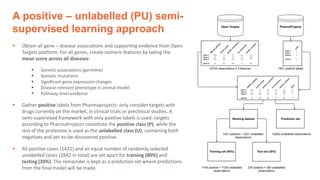
A positive – unlabelled (PU) semi-
supervised learning approach
▪ Obtain all gene – disease associations and supporting evidence from Open
Targets platform. For all genes, create numeric features by taking the
mean score across all diseases:
▪ Genetic associations (germline)
▪ Somatic mutations
▪ Significant gene expression changes
▪ Disease-relevant phenotype in animal model
▪ Pathway-level evidence
▪ Gather positive labels from Pharmaprojects: only consider targets with
drugs currently on the market, in clinical trials or preclinical studies. A
semi-supervised framework with only positive labels is used: targets
according to PharmaProjects constitute the positive class (P), while the
rest of the proteome is used as the unlabelled class (U), containing both
negatives and yet-to-be-discovered positive.
▪ All positive cases (1421) and an equal number of randomly selected
unlabelled cases (2842 in total) are set apart for training (80%) and
testing (20%). The remainder is kept as a prediction set where predictions
from the final model will be made.
14
Finding structure in the data
Hierarchical clustering PCA t-SNE
Identifying most important features
Chi-squared test and information gain Decision tree classification criteria
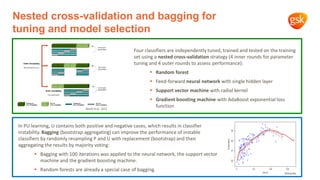
Nested cross-validation and bagging for
tuning and model selection
Bischl et al., 2012
Wikipedia
Four classifiers are independently tuned, trained and tested on the training
set using a nested cross-validation strategy (4 inner rounds for parameter
tuning and 4 outer rounds to assess performance):
▪ Random forest
▪ Feed-forward neural network with single hidden layer
▪ Support vector machine with radial kernel
▪ Gradient boosting machine with AdaBoost exponential loss
function
In PU learning, U contains both positive and negative cases, which results in classifier
instability. Bagging (bootstrap aggregating) can improve the performance of instable
classifiers by randomly resampling P and U with replacement (bootstrap) and then
aggregating the results by majority voting:
▪ Bagging with 100 iterations was applied to the neural network, the support vector
machine and the gradient boosting machine.
▪ Random forests are already a special case of bagging.
Assessing classifier performance
Neural network classifier
achieves 71% accuracy
(0.76 AUC) on test set
Investigating results across the pipeline
Successful and more advanced targets have higher
disease association evidence
Validation of predictions with literature mining
Significant overlap between neural
network predictions and text mining
results (p = 5.05e-172)
Automating drug target discovery
with machine learning
▪ The gene – disease association data from Open Targets contains enough
information to predict whether a protein can make a therapeutic target or
not with decent accuracy.
▪ According to our model, the most informative evidence types are animal
models showing disease-relevant phenotypes, dysregulated gene
expression in disease tissue and genetic associations between gene and
disease.
▪ The ability to predict late stage targets with greater accuracy confirms that
clear linkage between target and disease is essential to maximise chances
of success in the clinic.
▪ Limitations:
▪ Lack of prediction on indication;
▪ No tractability considerations.
Thank you!
▪ Philippe Sanseau
▪ Ian Dunham
▪ Gautier Koscielny
▪ Giovanni Dall’Olio
▪ Pankaj Agarwal
▪ Mark Hurle
▪ Steven Barrett
▪ Nicola Richmond
▪ Jin Yao

Automating drug target discovery with machine learning

  • 1.
    Automating drug targetdiscovery with machine learning Enrico Ferrero, PhD, Associate GSK Fellow Scientific Leader, Computational Biology, Target Sciences, GSK ODSC Europe 13.10.2017 @enricoferrero
  • 2.
    Data is thenew oil Yahoo Finance & Forbes, 2017 The Economist, 2017
  • 3.
    Data + AI= drugs? BBC News, 2017 Nature Biotechnology, 2017
  • 4.
    The pharma AIspace is getting crowded Partner Partner
  • 5.
    Developing a newdrug: 15+ years, $2B+
  • 6.
  • 7.
    So, what’s wrong? Harrison,Nat Rev Drug Discov, 2016 Cook et al., Nat Rev Drug Discov, 2014
  • 8.
    Late phase failurescost (a lot) more Manhattan Institute, 2012
  • 9.
    Rethink the drugdiscovery pipeline
  • 10.
    But how dowe find good targets? Nelson et al., Nat Genet, 2015
  • 11.
  • 12.
    Could it beas easy as spotting spam emails? ▪ Is it possible to predict novel therapeutic targets using available gene – disease association data? ▪ Is Open Targets just a catalogue of gene – disease associations or can we learn from it what makes a good target?
  • 13.
    A positive –unlabelled (PU) semi- supervised learning approach ▪ Obtain all gene – disease associations and supporting evidence from Open Targets platform. For all genes, create numeric features by taking the mean score across all diseases: ▪ Genetic associations (germline) ▪ Somatic mutations ▪ Significant gene expression changes ▪ Disease-relevant phenotype in animal model ▪ Pathway-level evidence ▪ Gather positive labels from Pharmaprojects: only consider targets with drugs currently on the market, in clinical trials or preclinical studies. A semi-supervised framework with only positive labels is used: targets according to PharmaProjects constitute the positive class (P), while the rest of the proteome is used as the unlabelled class (U), containing both negatives and yet-to-be-discovered positive. ▪ All positive cases (1421) and an equal number of randomly selected unlabelled cases (2842 in total) are set apart for training (80%) and testing (20%). The remainder is kept as a prediction set where predictions from the final model will be made.
  • 14.
    14 Finding structure inthe data Hierarchical clustering PCA t-SNE
  • 15.
    Identifying most importantfeatures Chi-squared test and information gain Decision tree classification criteria
  • 16.
    Nested cross-validation andbagging for tuning and model selection Bischl et al., 2012 Wikipedia Four classifiers are independently tuned, trained and tested on the training set using a nested cross-validation strategy (4 inner rounds for parameter tuning and 4 outer rounds to assess performance): ▪ Random forest ▪ Feed-forward neural network with single hidden layer ▪ Support vector machine with radial kernel ▪ Gradient boosting machine with AdaBoost exponential loss function In PU learning, U contains both positive and negative cases, which results in classifier instability. Bagging (bootstrap aggregating) can improve the performance of instable classifiers by randomly resampling P and U with replacement (bootstrap) and then aggregating the results by majority voting: ▪ Bagging with 100 iterations was applied to the neural network, the support vector machine and the gradient boosting machine. ▪ Random forests are already a special case of bagging.
  • 17.
    Assessing classifier performance Neuralnetwork classifier achieves 71% accuracy (0.76 AUC) on test set
  • 18.
    Investigating results acrossthe pipeline Successful and more advanced targets have higher disease association evidence
  • 19.
    Validation of predictionswith literature mining Significant overlap between neural network predictions and text mining results (p = 5.05e-172)
  • 20.
    Automating drug targetdiscovery with machine learning ▪ The gene – disease association data from Open Targets contains enough information to predict whether a protein can make a therapeutic target or not with decent accuracy. ▪ According to our model, the most informative evidence types are animal models showing disease-relevant phenotypes, dysregulated gene expression in disease tissue and genetic associations between gene and disease. ▪ The ability to predict late stage targets with greater accuracy confirms that clear linkage between target and disease is essential to maximise chances of success in the clinic. ▪ Limitations: ▪ Lack of prediction on indication; ▪ No tractability considerations.
  • 21.
    Thank you! ▪ PhilippeSanseau ▪ Ian Dunham ▪ Gautier Koscielny ▪ Giovanni Dall’Olio ▪ Pankaj Agarwal ▪ Mark Hurle ▪ Steven Barrett ▪ Nicola Richmond ▪ Jin Yao