Automatic generation control or Load frequency control
1.
Automatic generation Control
Presentedby
Dr. Maloth Ramesh
Assistant Professor
Department of Mechatronics Engg.
1
Sharad Institute of Technology College of Engineering
Yadrav (Ichalkaranji)-416121, Dist. – Kolhapur
2.
2
Flow of Presentation
➢Introduction of AGC
➢ Functions of AGC
➢ AGC Control mechanism
➢ Time Frame of AGC
➢ System structure
➢ References
3.
➢ Imagine wehave a power grid. On one side, we have a electricity generation through the power plants, and on
the other, we have a demand in terms of homes, businesses, industries. For the whole system to be remain
balanced, the weight on both sides needs to be equal moment to moment, point to point, at all times. This is
where AGC comes in.
➢ The interconnections of power systems evolve in the interests of improved economy, reliability, flexibility and
performance. The attainment of these goals is dependent to a large extent upon the performance of so-called
load frequency, or supplementary controls located in the various control areas.
➢ The prime function of these controls is to maintain system frequency and tie-line power flows at the scheduled
values during both normal operation and system circumstances. It is desirable that these supplementary
controls carry out their function rapidly, smoothly and with a minimum of interactions.
Introduction
4.
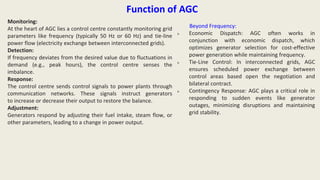
Monitoring:
At the heartof AGC lies a control centre constantly monitoring grid
parameters like frequency (typically 50 Hz or 60 Hz) and tie-line
power flow (electricity exchange between interconnected grids).
Detection:
If frequency deviates from the desired value due to fluctuations in
demand (e.g., peak hours), the control centre senses the
imbalance.
Response:
The control centre sends control signals to power plants through
communication networks. These signals instruct generators
to increase or decrease their output to restore the balance.
Adjustment:
Generators respond by adjusting their fuel intake, steam flow, or
other parameters, leading to a change in power output.
Function of AGC
Beyond Frequency:
➢ Economic Dispatch: AGC often works in
conjunction with economic dispatch, which
optimizes generator selection for cost-effective
power generation while maintaining frequency.
➢ Tie-Line Control: In interconnected grids, AGC
ensures scheduled power exchange between
control areas based open the negotiation and
bilateral contract.
➢ Contingency Response: AGC plays a critical role in
responding to sudden events like generator
outages, minimizing disruptions and maintaining
grid stability.
5.
5
Primary frequency control
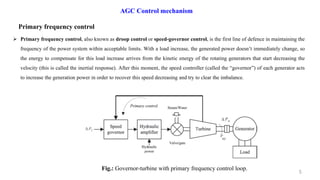
➢Primary frequency control, also known as droop control or speed-governor control, is the first line of defence in maintaining the
frequency of the power system within acceptable limits. With a load increase, the generated power doesn’t immediately change, so
the energy to compensate for this load increase arrives from the kinetic energy of the rotating generators that start decreasing the
velocity (this is called the inertial response). After this moment, the speed controller (called the “governor”) of each generator acts
to increase the generation power in order to recover this speed decreasing and try to clear the imbalance.
Fig.: Governor-turbine with primary frequency control loop.
AGC Control mechanism
6.
6
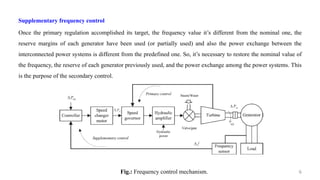
Supplementary frequency control
Oncethe primary regulation accomplished its target, the frequency value it’s different from the nominal one, the
reserve margins of each generator have been used (or partially used) and also the power exchange between the
interconnected power systems is different from the predefined one. So, it’s necessary to restore the nominal value of
the frequency, the reserve of each generator previously used, and the power exchange among the power systems. This
is the purpose of the secondary control.
Fig.: Frequency control mechanism.
7.
7
Tertiary frequency control
Tertiaryfrequency control, also known as manual or restoration frequency control, is a slower process than primary and
secondary frequency control, and it is typically used to restore the grid's frequency to its nominal value after it has deviated
significantly due to an unexpected or prolonged event, such as a large disturbance, equipment failure, or sudden changes
in load or generation. Unlike primary and secondary frequency control, which are automatic and use pre-determined control
strategies and algorithms to adjust generation output and restore frequency, tertiary frequency control is typically a manual
process that involves human intervention and decision-making. It may involve actions such as dispatching additional
generators or load shedding, depending on the nature and severity of the frequency deviation (refer Fig. 3). It may also
involve coordinating with neighbouring grids and transmission system operators to share resources and restore the balance
between generation and load.
Fig. 3: Load shedding [2].
8.
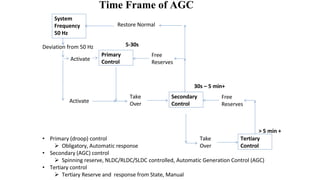
System
Frequency
50 Hz
Primary
Control
Secondary
Control
Tertiary
Control
• Primary(droop) control
➢ Obligatory, Automatic response
• Secondary (AGC) control
➢ Spinning reserve, NLDC/RLDC/SLDC controlled, Automatic Generation Control (AGC)
• Tertiary control
➢ Tertiary Reserve and response from State, Manual
Take
Over
Free
Reserves
Take
Over
Free
Reserves
5-30s
30s – 5 min+
> 5 min +
Restore Normal
Activate
Activate
Time Frame of AGC
Deviation from 50 Hz
10
References
1. Wood AJ,Wollenberg BF. Power generation operation and control. New York: John Wiley &
Sons; 1996.
2. Padhan DG, Majhi S. A new control scheme for PID load frequency controller of single-area and
multi-area power systems. ISA Trans 2013;52:242-51.
3. Tan, W.: ‘Unified tuning of PID load frequency controller for power systems via IMC’, IEEE
Trans. Power Syst., 2010, 25, (1), pp. 341-350.
4. R. Roy, P. Bhatt, S.P. Ghoshal, Evolutionary computation based three-area automatic generation
control, Int. J. Electr. Power Energy Syst. 37 (8) (2010) 5913-5924.
5. S. Panda, B. Mohanty, P.K. Hota, Hybrid BFOA-PSO algorithm for automatic generation control
of linear and nonlinear interconnected power systems, Appl. Soft Comput. 13 (2013) 4718-4730.
6. L.C. Saikia, J. Nanda, S. Mishra, Performance comparison of several classical controllers in AGC
for multi-area interconnected thermal system, Int. J. Electr. Power Energy Syst. 33 (2011) 394-
401.
7. Nise, N. S., Control System Engineering, Sixth ed. Pomana, John Wiley & Sons, 2006.
8. Ogata, K.: ‘Modern Control Engineering’, (Second Ed., Printice Hall International; India: 1995)


![7
Tertiary frequency control
Tertiary frequency control, also known as manual or restoration frequency control, is a slower process than primary and
secondary frequency control, and it is typically used to restore the grid's frequency to its nominal value after it has deviated
significantly due to an unexpected or prolonged event, such as a large disturbance, equipment failure, or sudden changes
in load or generation. Unlike primary and secondary frequency control, which are automatic and use pre-determined control
strategies and algorithms to adjust generation output and restore frequency, tertiary frequency control is typically a manual
process that involves human intervention and decision-making. It may involve actions such as dispatching additional
generators or load shedding, depending on the nature and severity of the frequency deviation (refer Fig. 3). It may also
involve coordinating with neighbouring grids and transmission system operators to share resources and restore the balance
between generation and load.
Fig. 3: Load shedding [2].](https://image.slidesharecdn.com/agc1-250306130218-d83f1c08/85/Automatic-generation-control-or-Load-frequency-control-7-320.jpg)