Julie Roche, Cert PFS, Cert CII(MP) Automatic Enrolment the employer duties and NEST The information in this presentation does not constitute financial advice. Anson IFA Ltd is authorised and regulated by the Financial Services Authority. The seminar is based on our understanding of the rules and legislation, some of which is still in draft format and maybe subject to change. Whilst efforts have been made to ensure the accuracy, Anson IFA Ltd do not accept any responsibility or liability whatsoever in relation to the contents of the presentation.
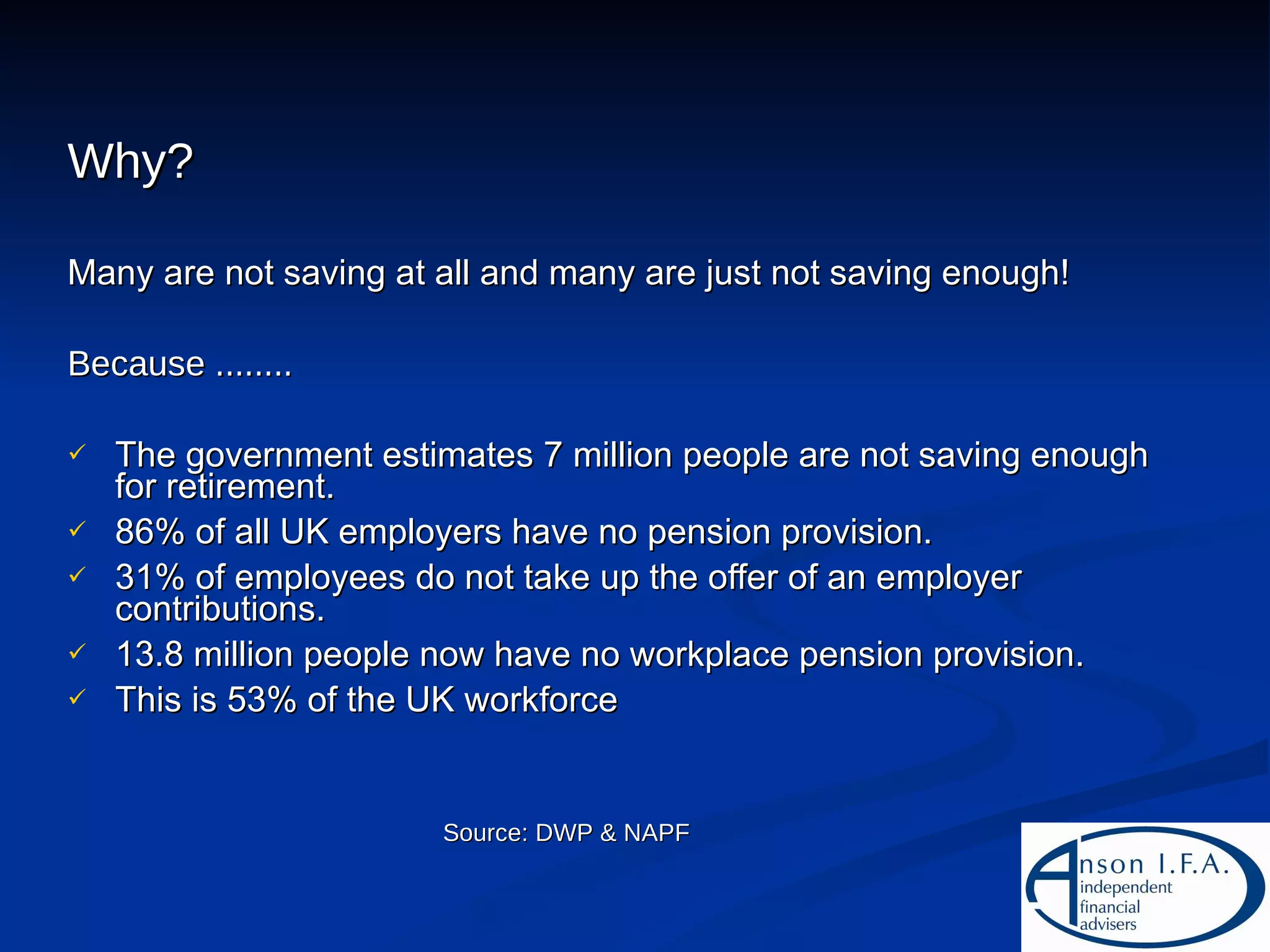
Why? Many are not saving at all and many are just not saving enough! Because ........ The government estimates 7 million people are not saving enough for retirement. 86% of all UK employers have no pension provision. 31% of employees do not take up the offer of an employer contributions. 13.8 million people now have no workplace pension provision. This is 53% of the UK workforce Source: DWP & NAPF
What are we going to review? Auto-enrolment: The Basics Who do you need to auto-enrol? When do you need to auto-enrol? What do employers and employees need to pay? Which schemes can you use? Action points for employers How we can help
Auto Enrolment: The basics C omes into force from 1st October 2012 Employers will have to enrol eligible workers into a  qualifying workplace pension arrangement Employers will need to pay contributions for eligible  jobholders in the scheme
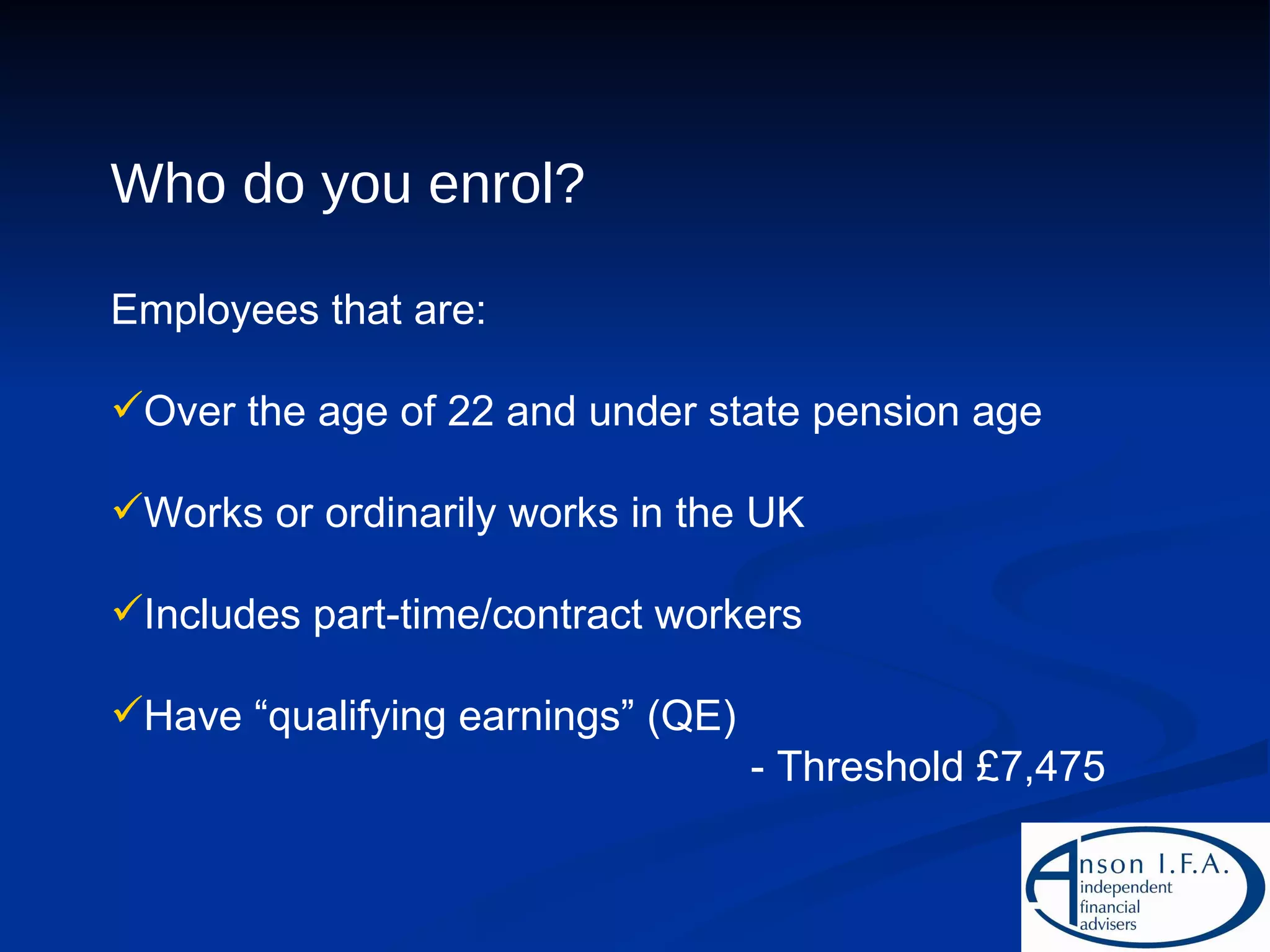
Who do you enrol? Employees that are: Over the age of 22 and under state pension age Works or ordinarily works in the UK Includes part-time/contract workers Have “qualifying earnings” (QE) - Threshold £7,475
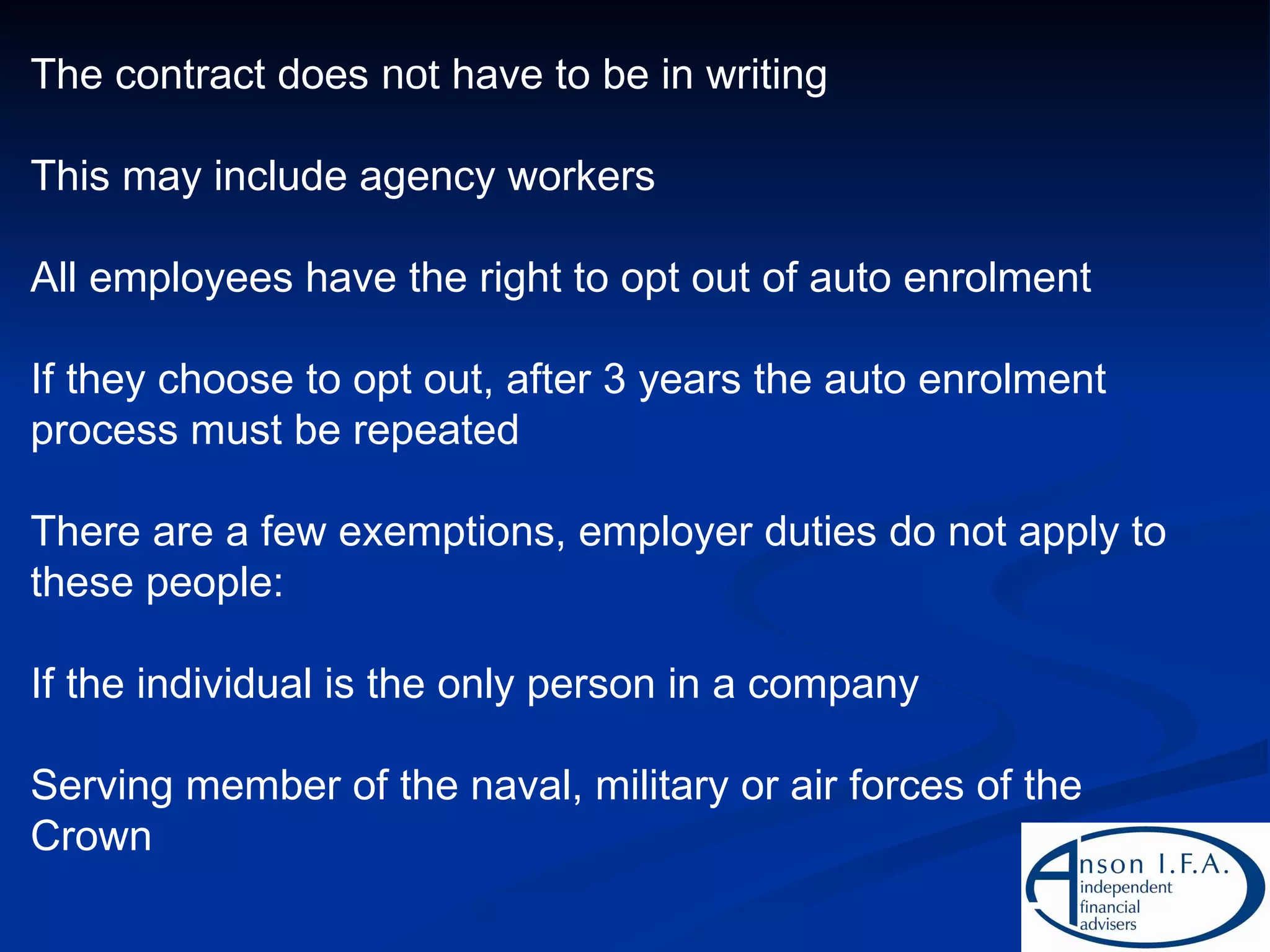
The contract does  not  have to be in writing This may include agency workers All employees have the right to opt out of auto enrolment If they choose to opt out, after 3 years the auto enrolment process must be repeated There are a few exemptions, employer duties do not apply to these people: If the individual is the only person in a company Serving member of the naval, military or air forces of the Crown
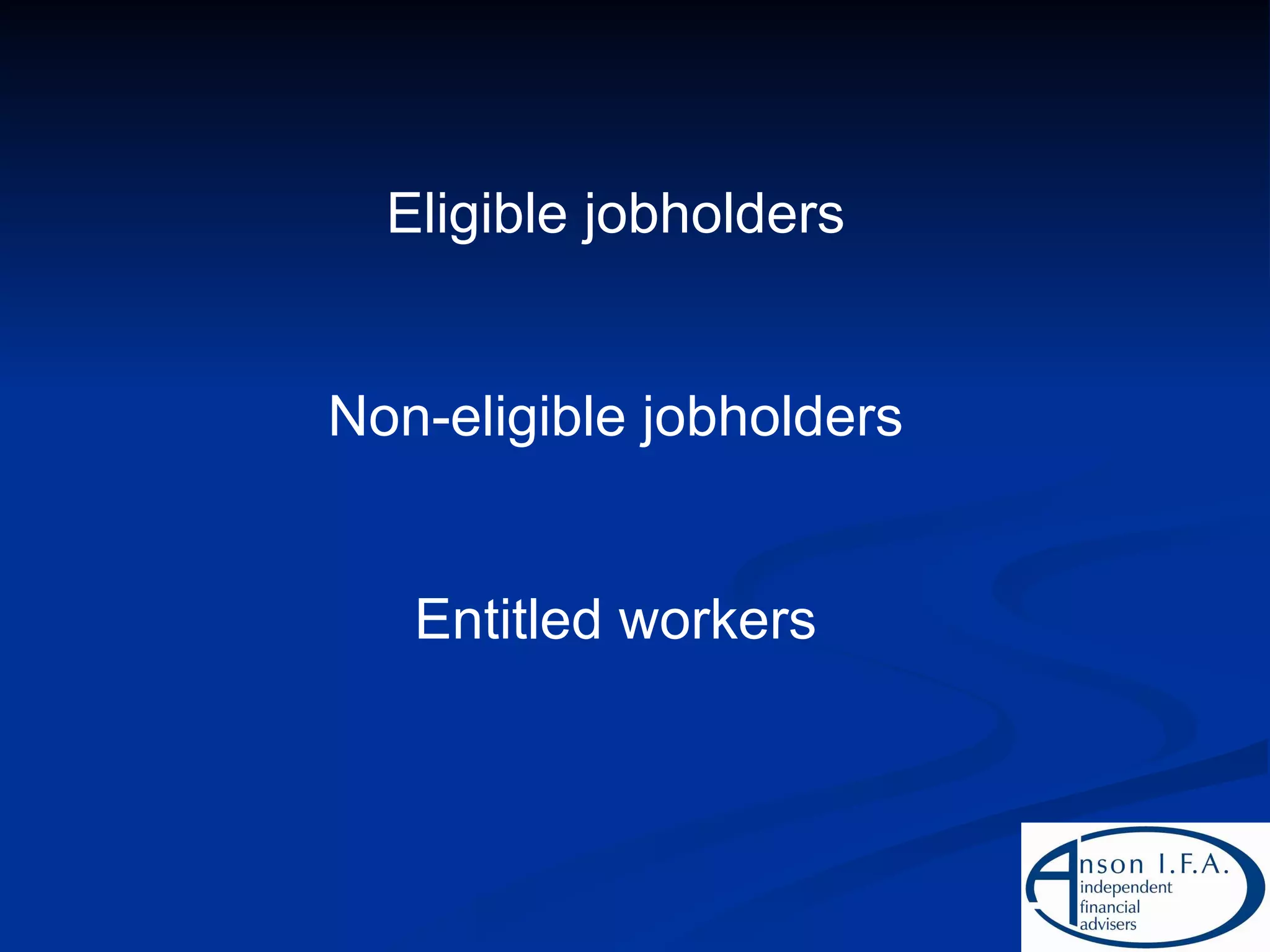
Eligible jobholders Non-eligible jobholders Entitled workers
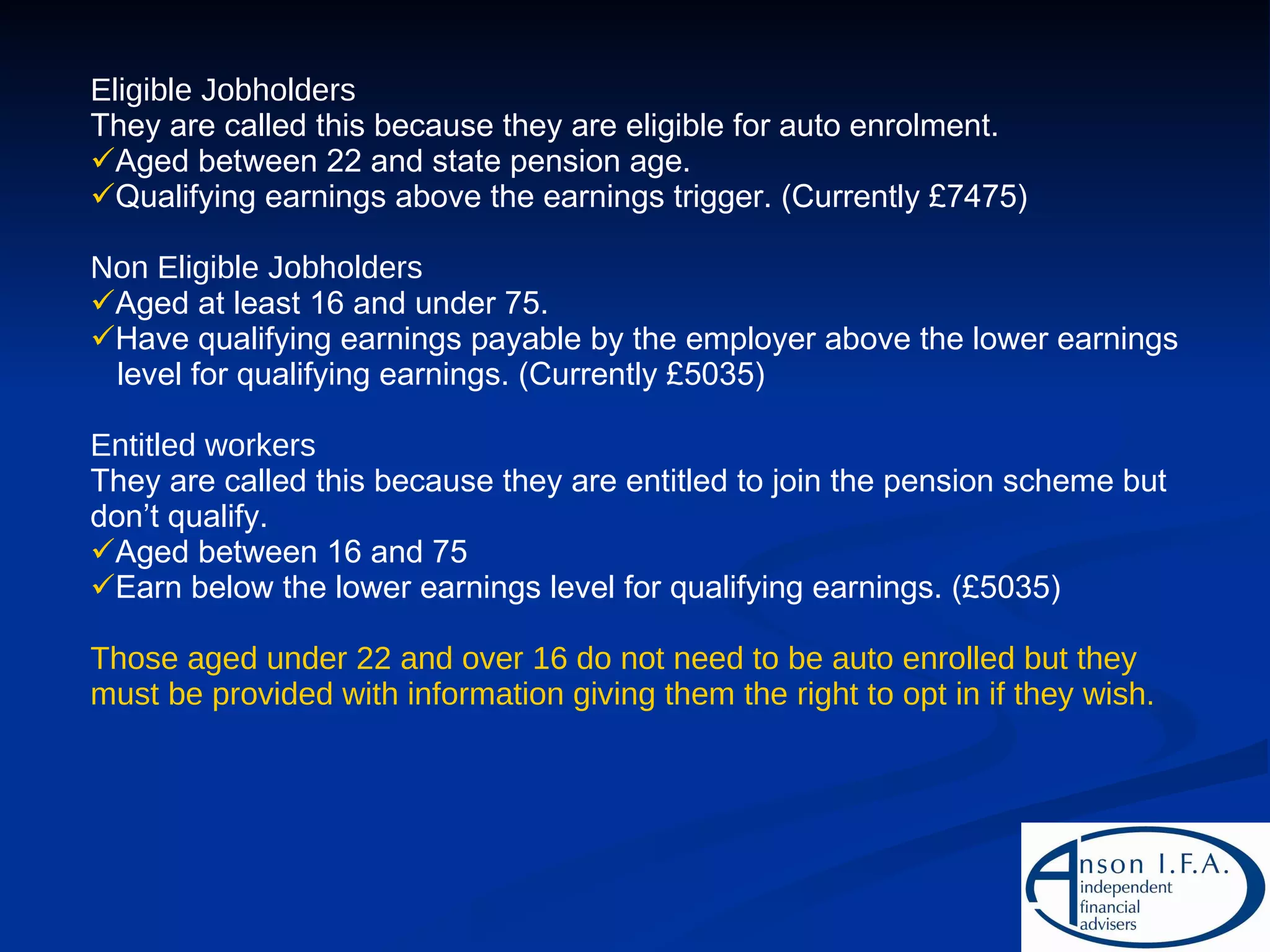
Eligible Jobholders They are called this because they are eligible for auto enrolment. Aged between 22 and state pension age. Qualifying earnings above the earnings trigger. (Currently £7475) Non Eligible Jobholders Aged at least 16 and under 75. Have qualifying earnings payable by the employer above the lower earnings level for qualifying earnings. (Currently £5035) Entitled workers They are called this because they are entitled to join the pension scheme but don’t qualify. Aged between 16 and 75 Earn below the lower earnings level for qualifying earnings. (£5035) Those aged under 22 and over 16 do not need to be auto enrolled but they must be provided with information giving them the right to opt in if they wish.
When do you need to auto-enrol? Each employer will be given a date from which the changes will have to be in place. This is known as the staging date. This will be phased in over 4 years, starting with the largest employers. The first staging dates will be October 2012 and will continue until 2016. The starting date for most employers will be based on the number of employees on payroll at 1 April 2012. For employers with fewer than 50 employees, the date will be determined by the employers PAYE reference number. For more details on staging dates you can check on: www.dwp.gov.uk/docs/staging-dates-by-employer.pdf
What do employers and employees need to pay? Employers are required to base their minimum contributions for auto enrolment on qualifying earnings. These are earnings between £5,035 and £33,540 and include Basic Salary Commission Bonuses Overtime The lower limit each year will increase in line with the threshold at which National Insurance starts to be paid. The upper limit will increase each year in line with average earnings.
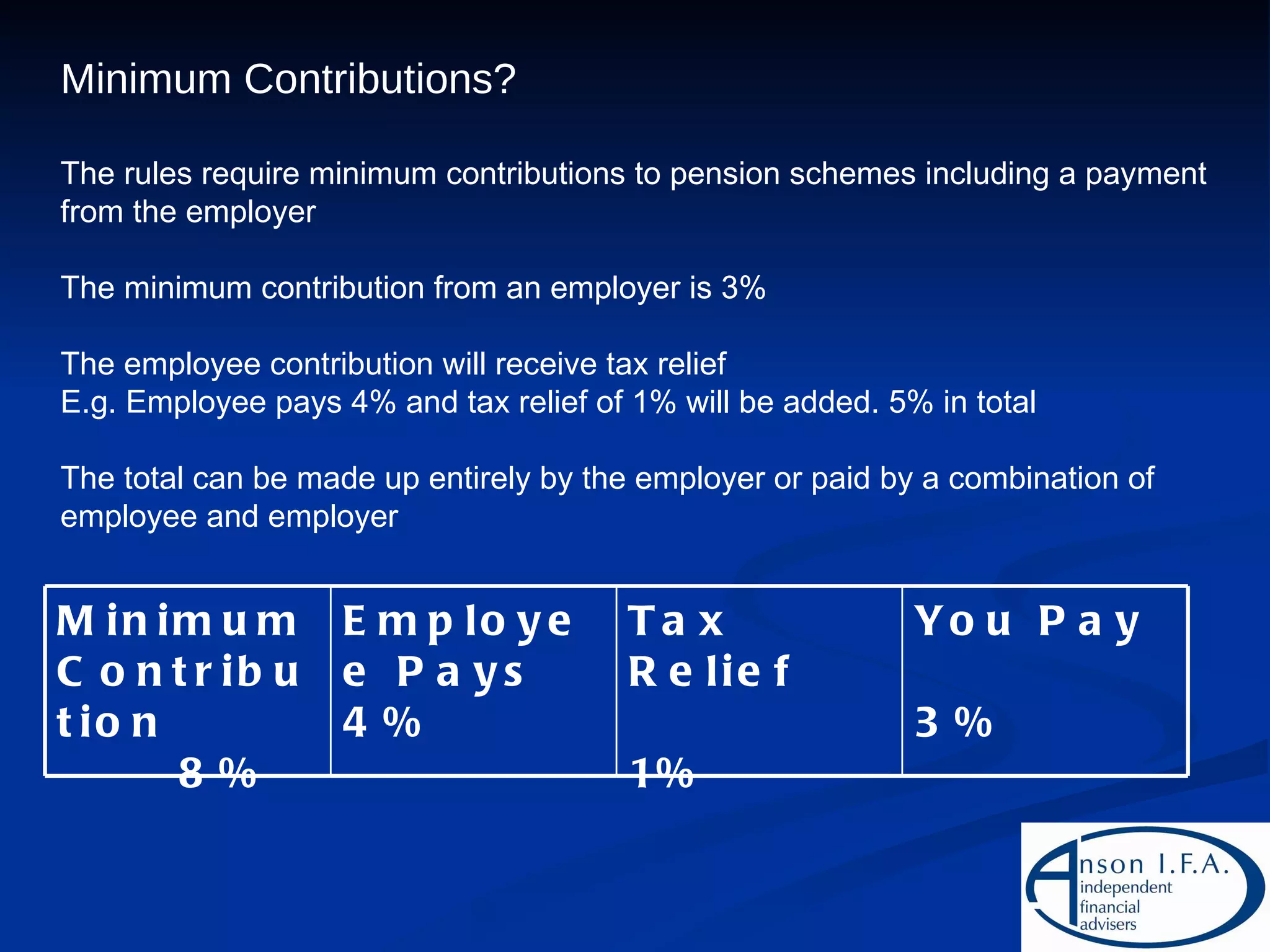
Minimum Contributions? The rules require minimum contributions to pension schemes including a payment from the employer The minimum contribution from an employer is 3% The employee contribution will receive tax relief E.g. Employee pays 4% and tax relief of 1% will be added. 5% in total The total can be made up entirely by the employer or paid by a combination of employee and employer Minimum Contribution 8% Employee Pays 4% Tax Relief 1% You Pay 3%
What schemes can you use? Occupational trust based schemes Group Stakeholders Scheme. Group Personal Pension Schemes Group SIPP NEST – National Employment Savings Trust
NEST NEST National Employment Savings Trust Established by Government Employers can use  NEST National Employment Savings Trust It is aimed at those who don’t have a good quality pension  scheme Option to use it as an entry level scheme for a particular group of workers
Action Points for Employers Check your staging date. Assess the workforce to identify employees that need to be auto Enrolled Conduct a review of any existing pension arrangements in place Conduct a review of a new scheme Consider additional costs of pension contributions Consider administration costs & record-keeping requirements Consider changes to the payroll system Consider setting up a scheme in advance of your staging date
You must not: Encourage employees to opt out. Use recruitment practices that will benefit job applicants who indicate they are prepared to opt out. Treat an employee unfairly or put them at a disadvantage because of auto enrolment. Employers that fail to comply will be issued a fixed penalty of £400. Followed by penalties from £50 - £10000 depending on the number of employees and scales of offence.
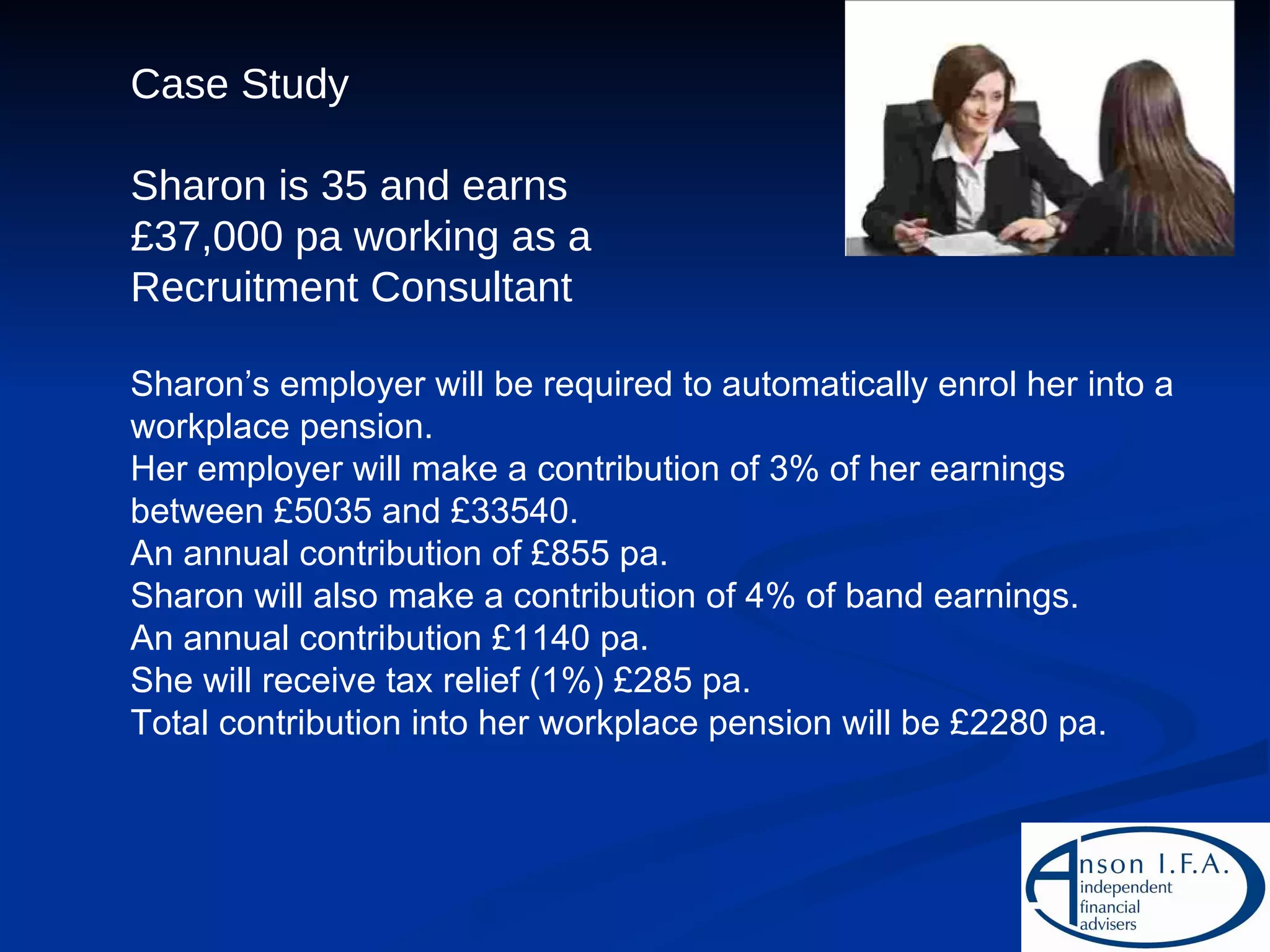
Case Study Sharon is 35 and earns £37,000 pa working as a Recruitment Consultant Sharon’s employer will be required to automatically enrol her into a workplace pension. Her employer will make a contribution of 3% of her earnings between £5035 and £33540. An annual contribution of £855 pa. Sharon will also make a contribution of 4% of band earnings. An annual contribution £1140 pa. She will receive tax relief (1%) £285 pa. Total contribution into her workplace pension will be £2280 pa.
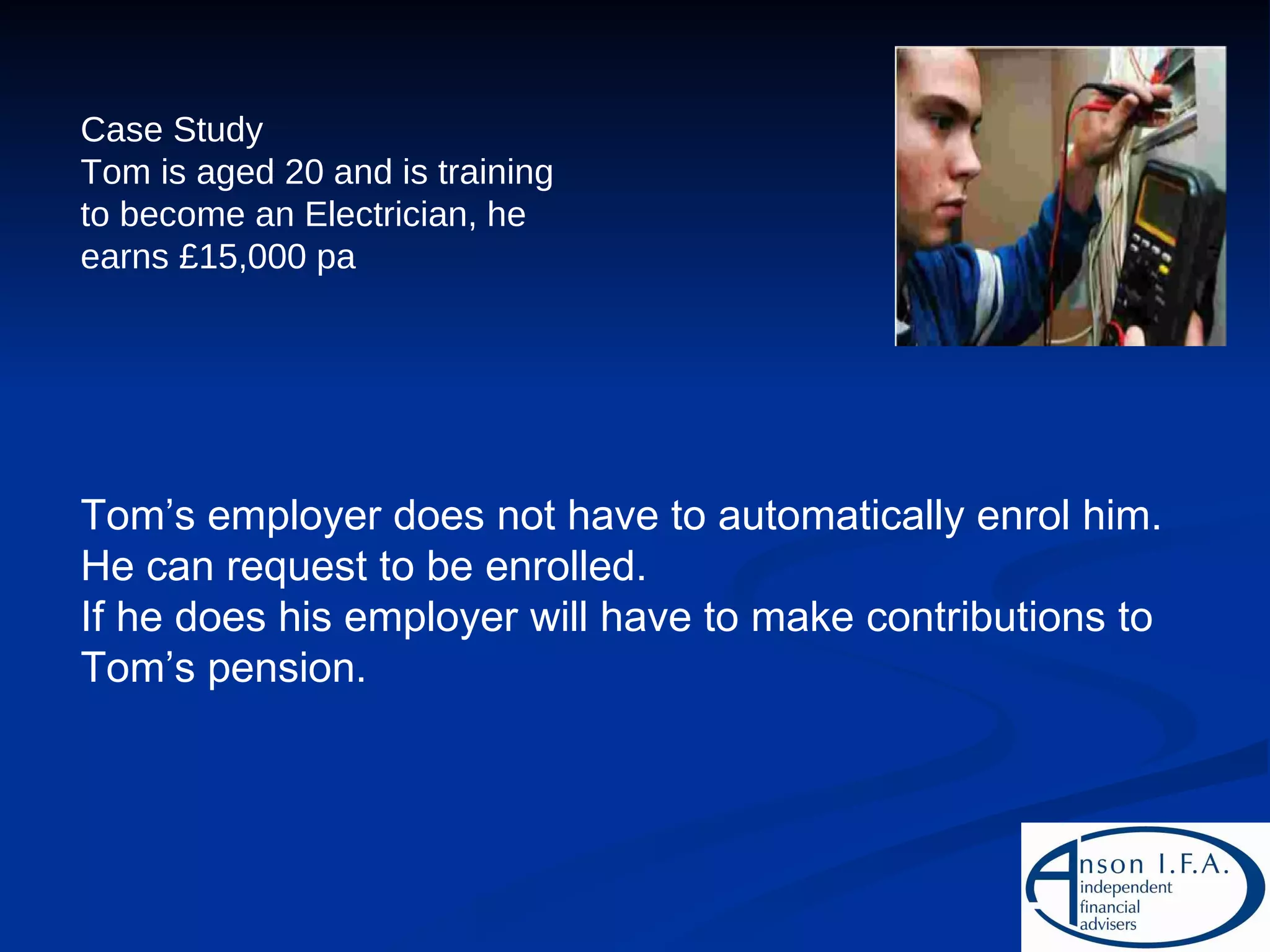
Case Study Tom is aged 20 and is training to become an Electrician, he earns £15,000 pa Tom’s employer does not have to automatically enrol him. He can request to be enrolled. If he does his employer will have to make contributions to Tom’s pension.
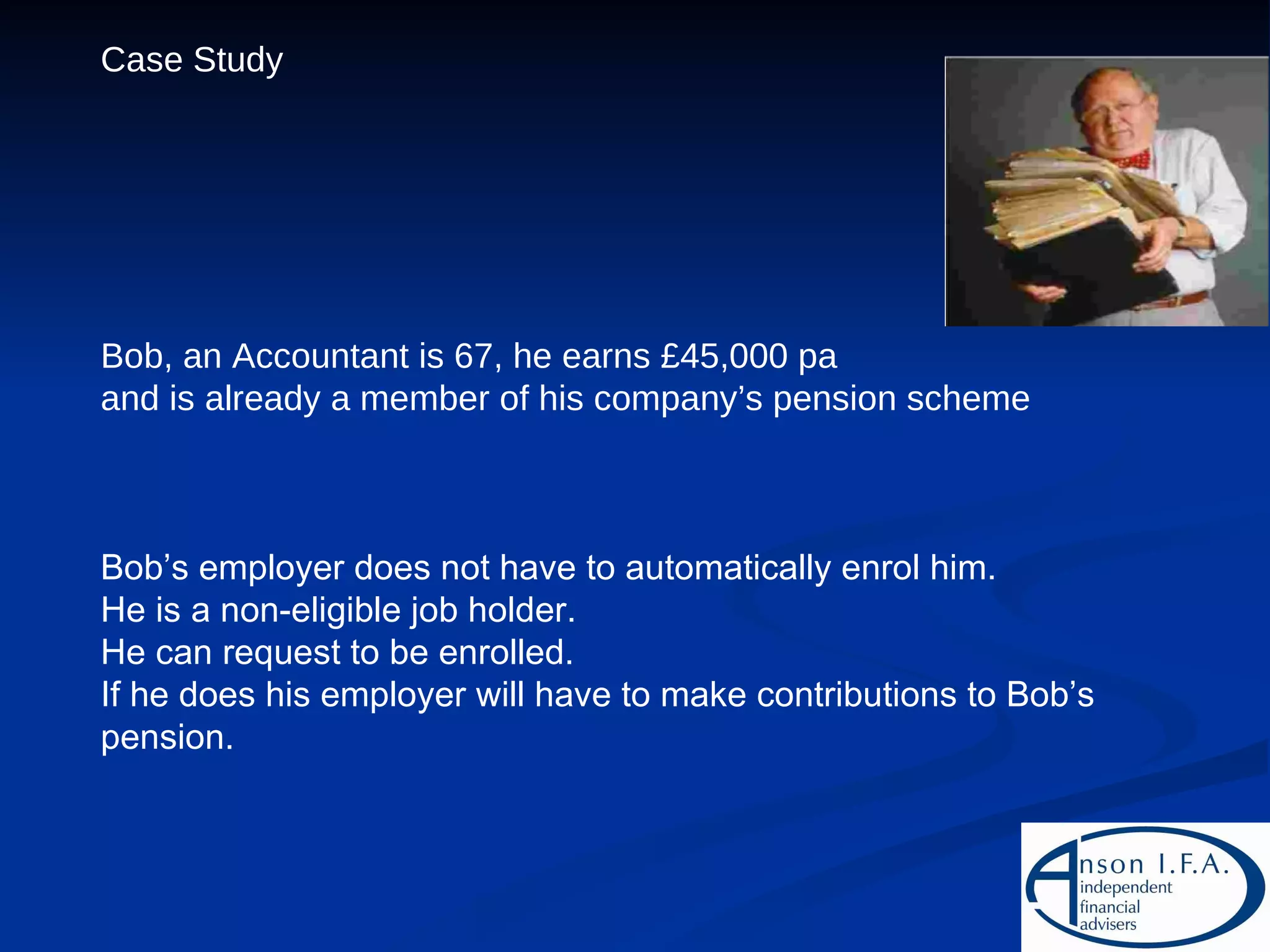
Case Study Bob, an Accountant is 67, he earns £45,000 pa  and is already a member of his company’s pension scheme Bob’s employer does not have to automatically enrol him. He is a non-eligible job holder. He can request to be enrolled. If he does his employer will have to make contributions to Bob’s pension.
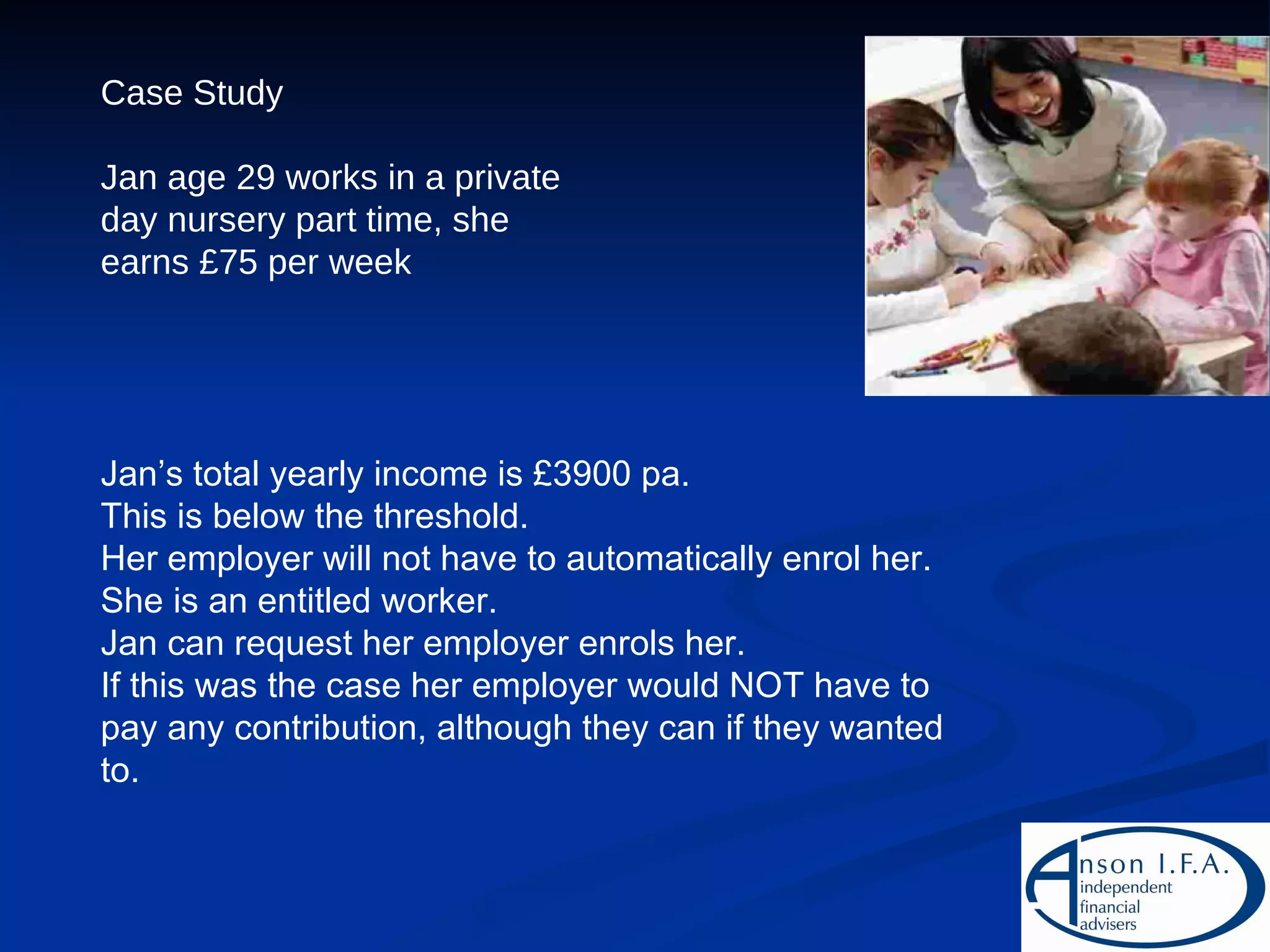
Case Study Jan age 29 works in a private day nursery part time, she earns £75 per week Jan’s total yearly income is £3900 pa. This is below the threshold. Her employer will not have to automatically enrol her. She is an entitled worker. Jan can request her employer enrols her. If this was the case her employer would NOT have to pay any contribution, although they can if they wanted to.
How can we help? Get to grips with what you need to do to comply We can prepare a Pension Review Report We will work with your other professional advisers We will provide support to help implement changes to your current scheme Enrol your employees Help with communicating changes to all employees We provide support to your employees in helping with the choices available
Thank you Further information is available on request Contact: Julie Roche Cert PFS, Cert CII(MP) [email_address] Suite 26, Century Building Tower Street Brunswick Business Park Liverpool L3 4BJ 0151 707 8848

Automatic Enrolment

  • 1.
    Julie Roche, CertPFS, Cert CII(MP) Automatic Enrolment the employer duties and NEST The information in this presentation does not constitute financial advice. Anson IFA Ltd is authorised and regulated by the Financial Services Authority. The seminar is based on our understanding of the rules and legislation, some of which is still in draft format and maybe subject to change. Whilst efforts have been made to ensure the accuracy, Anson IFA Ltd do not accept any responsibility or liability whatsoever in relation to the contents of the presentation.
  • 2.
    Why? Many arenot saving at all and many are just not saving enough! Because ........ The government estimates 7 million people are not saving enough for retirement. 86% of all UK employers have no pension provision. 31% of employees do not take up the offer of an employer contributions. 13.8 million people now have no workplace pension provision. This is 53% of the UK workforce Source: DWP & NAPF
  • 3.
    What are wegoing to review? Auto-enrolment: The Basics Who do you need to auto-enrol? When do you need to auto-enrol? What do employers and employees need to pay? Which schemes can you use? Action points for employers How we can help
  • 4.
    Auto Enrolment: Thebasics C omes into force from 1st October 2012 Employers will have to enrol eligible workers into a qualifying workplace pension arrangement Employers will need to pay contributions for eligible jobholders in the scheme
  • 5.
    Who do youenrol? Employees that are: Over the age of 22 and under state pension age Works or ordinarily works in the UK Includes part-time/contract workers Have “qualifying earnings” (QE) - Threshold £7,475
  • 6.
    The contract does not have to be in writing This may include agency workers All employees have the right to opt out of auto enrolment If they choose to opt out, after 3 years the auto enrolment process must be repeated There are a few exemptions, employer duties do not apply to these people: If the individual is the only person in a company Serving member of the naval, military or air forces of the Crown
  • 7.
    Eligible jobholders Non-eligiblejobholders Entitled workers
  • 8.
    Eligible Jobholders Theyare called this because they are eligible for auto enrolment. Aged between 22 and state pension age. Qualifying earnings above the earnings trigger. (Currently £7475) Non Eligible Jobholders Aged at least 16 and under 75. Have qualifying earnings payable by the employer above the lower earnings level for qualifying earnings. (Currently £5035) Entitled workers They are called this because they are entitled to join the pension scheme but don’t qualify. Aged between 16 and 75 Earn below the lower earnings level for qualifying earnings. (£5035) Those aged under 22 and over 16 do not need to be auto enrolled but they must be provided with information giving them the right to opt in if they wish.
  • 9.
    When do youneed to auto-enrol? Each employer will be given a date from which the changes will have to be in place. This is known as the staging date. This will be phased in over 4 years, starting with the largest employers. The first staging dates will be October 2012 and will continue until 2016. The starting date for most employers will be based on the number of employees on payroll at 1 April 2012. For employers with fewer than 50 employees, the date will be determined by the employers PAYE reference number. For more details on staging dates you can check on: www.dwp.gov.uk/docs/staging-dates-by-employer.pdf
  • 10.
    What do employersand employees need to pay? Employers are required to base their minimum contributions for auto enrolment on qualifying earnings. These are earnings between £5,035 and £33,540 and include Basic Salary Commission Bonuses Overtime The lower limit each year will increase in line with the threshold at which National Insurance starts to be paid. The upper limit will increase each year in line with average earnings.
  • 11.
    Minimum Contributions? Therules require minimum contributions to pension schemes including a payment from the employer The minimum contribution from an employer is 3% The employee contribution will receive tax relief E.g. Employee pays 4% and tax relief of 1% will be added. 5% in total The total can be made up entirely by the employer or paid by a combination of employee and employer Minimum Contribution 8% Employee Pays 4% Tax Relief 1% You Pay 3%
  • 12.
    What schemes canyou use? Occupational trust based schemes Group Stakeholders Scheme. Group Personal Pension Schemes Group SIPP NEST – National Employment Savings Trust
  • 13.
    NEST NEST NationalEmployment Savings Trust Established by Government Employers can use NEST National Employment Savings Trust It is aimed at those who don’t have a good quality pension scheme Option to use it as an entry level scheme for a particular group of workers
  • 14.
    Action Points forEmployers Check your staging date. Assess the workforce to identify employees that need to be auto Enrolled Conduct a review of any existing pension arrangements in place Conduct a review of a new scheme Consider additional costs of pension contributions Consider administration costs & record-keeping requirements Consider changes to the payroll system Consider setting up a scheme in advance of your staging date
  • 15.
    You must not:Encourage employees to opt out. Use recruitment practices that will benefit job applicants who indicate they are prepared to opt out. Treat an employee unfairly or put them at a disadvantage because of auto enrolment. Employers that fail to comply will be issued a fixed penalty of £400. Followed by penalties from £50 - £10000 depending on the number of employees and scales of offence.
  • 16.
    Case Study Sharonis 35 and earns £37,000 pa working as a Recruitment Consultant Sharon’s employer will be required to automatically enrol her into a workplace pension. Her employer will make a contribution of 3% of her earnings between £5035 and £33540. An annual contribution of £855 pa. Sharon will also make a contribution of 4% of band earnings. An annual contribution £1140 pa. She will receive tax relief (1%) £285 pa. Total contribution into her workplace pension will be £2280 pa.
  • 17.
    Case Study Tomis aged 20 and is training to become an Electrician, he earns £15,000 pa Tom’s employer does not have to automatically enrol him. He can request to be enrolled. If he does his employer will have to make contributions to Tom’s pension.
  • 18.
    Case Study Bob,an Accountant is 67, he earns £45,000 pa and is already a member of his company’s pension scheme Bob’s employer does not have to automatically enrol him. He is a non-eligible job holder. He can request to be enrolled. If he does his employer will have to make contributions to Bob’s pension.
  • 19.
    Case Study Janage 29 works in a private day nursery part time, she earns £75 per week Jan’s total yearly income is £3900 pa. This is below the threshold. Her employer will not have to automatically enrol her. She is an entitled worker. Jan can request her employer enrols her. If this was the case her employer would NOT have to pay any contribution, although they can if they wanted to.
  • 20.
    How can wehelp? Get to grips with what you need to do to comply We can prepare a Pension Review Report We will work with your other professional advisers We will provide support to help implement changes to your current scheme Enrol your employees Help with communicating changes to all employees We provide support to your employees in helping with the choices available
  • 21.
    Thank you Furtherinformation is available on request Contact: Julie Roche Cert PFS, Cert CII(MP) [email_address] Suite 26, Century Building Tower Street Brunswick Business Park Liverpool L3 4BJ 0151 707 8848