Download to read offline

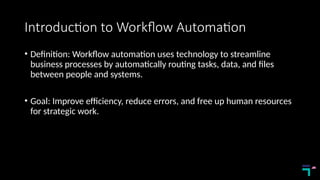
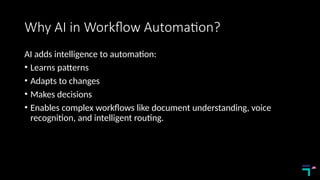
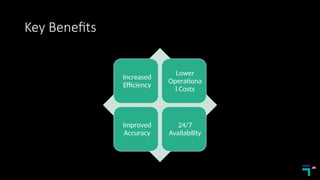
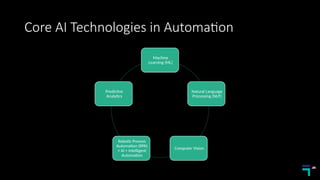
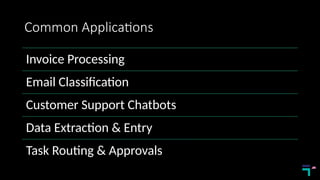
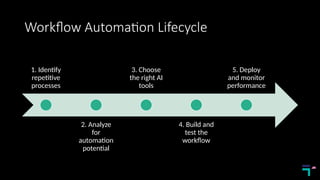
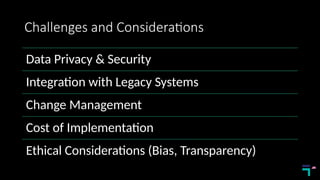
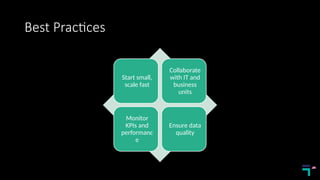
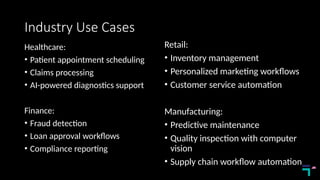
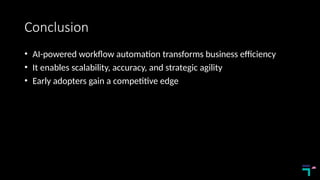


Workflow Automation with AI: Unlocking the Future of Business Efficiency In the modern digital landscape, organizations face growing pressure to streamline operations, reduce costs, and increase agility. Traditional manual processes are no longer sustainable in the face of increasing data volumes, customer expectations, and operational complexity. This is where Workflow Automation powered by Artificial Intelligence (AI) becomes a game-changer. Workflow automation refers to the use of technology to create rule-based logic that automates business processes, routing tasks, data, and files between people and systems with minimal human intervention. When enhanced with AI, this automation becomes dynamic, intelligent, and adaptable. AI enables systems to not just execute tasks, but to learn from data, identify patterns, make decisions, and continuously improve workflows over time. This powerful combination leads to significant benefits: improved accuracy, reduced operational costs, faster turnaround times, and enhanced customer experiences. Organizations are increasingly adopting AI to manage routine workflows such as invoice processing, customer service queries, email classification, and task approvals. These applications not only speed up execution but also ensure 24/7 availability with fewer errors. Key AI technologies powering this transformation include Machine Learning (ML) for predictive insights, Natural Language Processing (NLP) for understanding text and speech, Computer Vision for interpreting visual data, and Robotic Process Automation (RPA) that integrates with AI to deliver intelligent automation. However, implementing workflow automation with AI is not without its challenges. Issues such as data privacy, system integration, change resistance, and ethical considerations like algorithmic bias must be carefully managed. Best practices include starting with small, high-impact processes, ensuring cross-functional collaboration, monitoring KPIs, and investing in ongoing model training and governance. Use cases across industries highlight the real-world impact of AI automation: Healthcare organizations automate appointment scheduling, streamline claims processing, and support diagnostics with AI-assisted analysis. Finance teams leverage AI for fraud detection, loan approvals, and real-time compliance workflows. Retailers enhance inventory control, personalize marketing campaigns, and use AI chatbots to improve customer service. Manufacturers implement predictive maintenance, automate quality inspections, and optimize supply chain operations. In conclusion, AI-driven workflow automation is not just a technical upgrade—it’s a strategic imperative. It empowers businesses to operate faster, smarter, and at scale. Organizations that embrace this shift early are positioning themselves for long-term resilience and competitive advantage in the AI-powered future of work.


![[DSC Europe 25] Vid Stimac.pptx](https://cdn.slidesharecdn.com/ss_thumbnails/eqlepagzqp2rhg3gbluh-dsc-stimac-251120-251205090438-059e7f54-thumbnail.jpg?width=640&height=640&fit=bounds)


![[DSC Europe 25] Marko_Pantic - AI-Powered Process Intelligence The Future of ...](https://cdn.slidesharecdn.com/ss_thumbnails/r9lk74obrhuj5lw8uy0h-7-251203091808-2c3f4ec5-thumbnail.jpg?width=640&height=640&fit=bounds)


