Post Machine
Objective:
• Introduction.
• History
• Properties
• Example
• Explaination
Post Machine:
A Post–Turing machine is a "program
formulation" of an especially simple type of
Turing machine, comprising a variant of
Emil Post's Turing-equivalent model of
computation.
History:
In 1936 introduced the Turing machine , Emil
Leon Post (1897-1954) created the Post
Machine, which the hoped would prove to be
the “universal algorithm machine ”. One
condition must b satisfied by such a “universal
algorithm machine “ is that any language
which can b precisely defined by humans
should be accepted by some version of this
machine.
Properties:
1. The alphabet of input letters plus the
special symbol #.
2. A linear storage location called the Store or
Queue, which initially contains the input
string(using FIFO and LIFO stack).
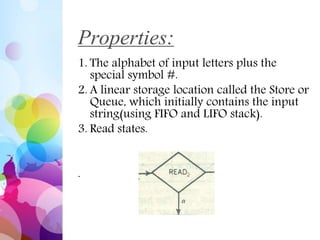
3. Read states.
.
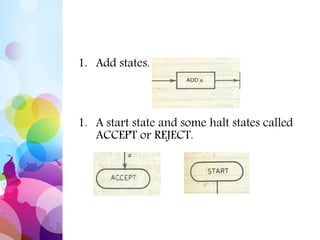
1. Add states.
1. A start state and some halt states called
ACCEPT or REJECT.
Example:
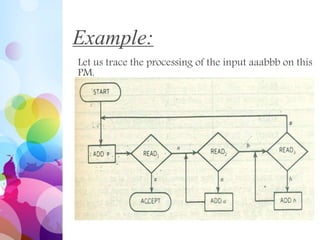
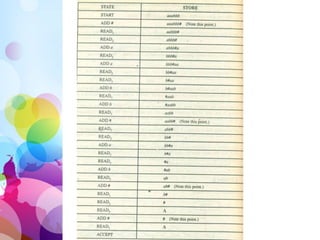
Let us trace the processing of the input aaabbb on this
PM.
Explanation:
The # is used as an end-of-input string signal. In
READ1 we check to see weather we are out of output;
we reading the end-of- input signal #. if we accept
the string .if we read ab , the string crashes. So
nothing starting with ab is accepted. If the string start
with an a, this letter is consumed by READ1 :the trip
from READ 1 to READ2 cost one a that is not replaced.
The loop at READ2 puts the rest of the a’s from the
front cluster of a’s behind the #.the first b read is
consumed in the trip from READ2 to READ3.At
READ3 the rest of the first cluster of b’s is stripped off
the front and appended onto the back , behind the a’s
that are behind the #.Therefore , the language
accepted by the PM.
Automata

Automata

  • 1.
  • 2.
    Objective: • Introduction. • History •Properties • Example • Explaination
  • 3.
    Post Machine: A Post–Turingmachine is a "program formulation" of an especially simple type of Turing machine, comprising a variant of Emil Post's Turing-equivalent model of computation.
  • 4.
    History: In 1936 introducedthe Turing machine , Emil Leon Post (1897-1954) created the Post Machine, which the hoped would prove to be the “universal algorithm machine ”. One condition must b satisfied by such a “universal algorithm machine “ is that any language which can b precisely defined by humans should be accepted by some version of this machine.
  • 5.
    Properties: 1. The alphabetof input letters plus the special symbol #. 2. A linear storage location called the Store or Queue, which initially contains the input string(using FIFO and LIFO stack). 3. Read states. .
  • 6.
    1. Add states. 1.A start state and some halt states called ACCEPT or REJECT.
  • 7.
    Example: Let us tracethe processing of the input aaabbb on this PM.
  • 9.
    Explanation: The # isused as an end-of-input string signal. In READ1 we check to see weather we are out of output; we reading the end-of- input signal #. if we accept the string .if we read ab , the string crashes. So nothing starting with ab is accepted. If the string start with an a, this letter is consumed by READ1 :the trip from READ 1 to READ2 cost one a that is not replaced. The loop at READ2 puts the rest of the a’s from the front cluster of a’s behind the #.the first b read is consumed in the trip from READ2 to READ3.At READ3 the rest of the first cluster of b’s is stripped off the front and appended onto the back , behind the a’s that are behind the #.Therefore , the language accepted by the PM.