GraphTalk 2024 | Barcelona | October 29th, 2024
How Knowledge Graphs and
Generative AI Revolutionise
Biopharma and Life Sciences
Exploring the transformative potential of Knowledge
Graphs and Generative AI in Biopharma and Life
Sciences, and how they are already revolutionising Drug
Discovery, Data Connectivity, and Biomedical Research
Antonio Fabregat, PhD
Knowledge Graph Lead
Enterprise Data Office (AZ)
Agenda
‱ Graph, Knowledge Graphs and Graph Databases
‱ From data to FAIR data and Wisdom
‱ A Glimpse into the Future of Graphs in AZ
‱ Stronger together (Federated Queries)
‱ Talking to your Knowledge Graphs
Graphs
-
Knowledge Graphs
-
Graph Databases
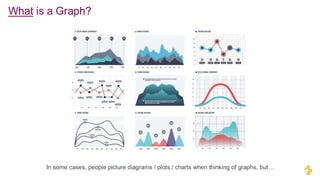
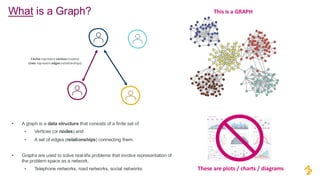
In some cases, people picture diagrams / plots / charts when thinking of graphs, but

What is a Graph?
What is a Graph?
‱ A graph is a data structure that consists of a finite set of
‱ Vertices (or nodes) and
‱ A set of edges (relationships) connecting them.
‱ Graphs are used to solve real-life problems that involve representation of
the problem space as a network.
‱ Telephone networks, road networks, social networks
Circles represent vertices (nodes)
Lines represent edges (relationships)
These are plots / charts / diagrams
This is a GRAPH
Circles represent vertices (nodes)
Lines represent edges (relationships)
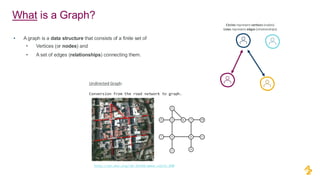
Undirected Graph:
Conversion from the road network to graph.
http://dx.doi.org/10.15598/aeee.v11i5.890
‱ A graph is a data structure that consists of a finite set of
‱ Vertices (or nodes) and
‱ A set of edges (relationships) connecting them.
What is a Graph?
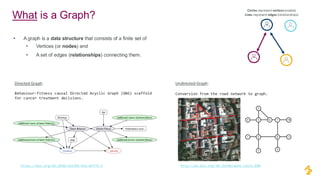
Undirected Graph:
Conversion from the road network to graph.
Directed Graph:
Behaviour-fitness causal Directed Acyclic Graph (DAG) scaffold
for cancer treatment decisions.
https://doi.org/10.1038/s41598-022-09775-9 http://dx.doi.org/10.15598/aeee.v11i5.890
Circles represent vertices (nodes)
Lines represent edges (relationships)
What is a Graph?
‱ A graph is a data structure that consists of a finite set of
‱ Vertices (or nodes) and
‱ A set of edges (relationships) connecting them.
Knowledge Graphs representation alternatives
* Adapted from documentation at W3C https://www.w3.org/
Two ways of representing/storing a Knowledge Graph
RDF-star (Resource Description Framework)
Semantic Web: Good for common standards and data exchange
Data model based on 3 parts: subject, predicate and objects
Nodes’ properties added as predicates. Edges with properties are “triple-resources” (like “meta-nodes”)
Storage: “Triple/Quad Stores” Graph Databases
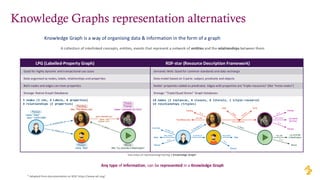
Any type of information, can be represented in a Knowledge Graph
18 nodes (5 instances, 4 classes, 8 literals, 1 triple-resource)
19 relationships (triples)
Knowledge Graph is a way of organising data & information in the form of a graph
A collection of interlinked concepts, entities, events that represent a network of entities and the relationships between them
LPG (Labelled-Property Graph)
Good for highly dynamic and transactional use cases
Data organised as nodes, labels, relationships and properties
Both nodes and edges can have properties
Storage: Native Graph Databases
5 nodes (5 ids, 4 Labels, 8 properties)
4 relationships (2 properties)
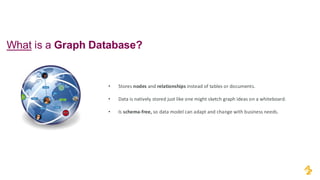
What is a Graph Database?
‱ Stores nodes and relationships instead of tables or documents.
‱ Data is natively stored just like one might sketch graph ideas on a whiteboard.
‱ Is schema-free, so data model can adapt and change with business needs.
What is a Graph Database?
WISDOM
INSIGHT
KNOWLEDGE
INFORMATION
DATA
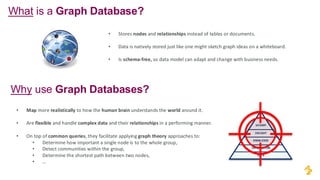
Why use Graph Databases?
‱ Map more realistically to how the human brain understands the world around it.
‱ Are flexible and handle complex data and their relationships in a performing manner.

‱ Stores nodes and relationships instead of tables or documents.
‱ Data is natively stored just like one might sketch graph ideas on a whiteboard.
‱ Is schema-free, so data model can adapt and change with business needs.
‱ On top of common queries, they facilitate applying graph theory approaches to:
‱ Determine how important a single node is to the whole group,
‱ Detect communities within the group,
‱ Determine the shortest path between two nodes,
‱ 

WISDOM
INSIGHT
KNOWLEDGE
INFORMATION
DATA
Why use Graph Databases?
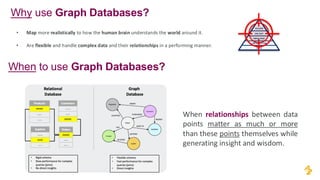
When to use Graph Databases?
When relationships between data
points matter as much or more
than these points themselves while
generating insight and wisdom.
‱ Map more realistically to how the human brain understands the world around it.
‱ Are flexible and handle complex data and their relationships in a performing manner.
Fraud Detection
‱Anti-money laundering
‱Insider trading
‱Know your customer
Supply Chain Management
‱Farming
‱Refining
‱Design
‱Manufacturing
‱Packaging
‱Transport
Digital Twin
‱Maps
‱Vehicles
‱Manufacturing
‱Success prediction
‱Biological pathways
‱Immune system
Real-Time Recommendations
‱Product
‱Customer
‱Inventory
‱Supplier
‱Logistics
‱Socialsentiment data
Cyber Security
‱Critical infrastructure security.
‱Application security.
‱Network security.
‱Cloud security.
‱Internet of Things (IoT) security.
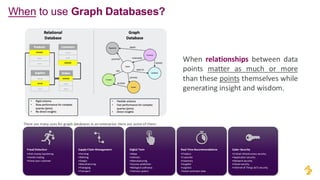
There are many uses for graph databases in an enterprise. Here are some of them:
When to use Graph Databases?
When relationships between data
points matter as much or more
than these points themselves while
generating insight and wisdom.
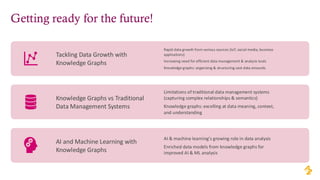
Getting ready for the future!
Tackling Data Growth with
Knowledge Graphs
Rapid data growth from various sources (IoT, social media, business
applications)
Increasing need for efficient data management & analysis tools
Knowledge graphs: organizing & structuring vast data amounts
Knowledge Graphs vs Traditional
Data Management Systems
Limitations of traditional data management systems
(capturing complex relationships & semantics)
Knowledge graphs: excelling at data meaning, context,
and understanding
AI and Machine Learning with
Knowledge Graphs
AI & machine learning's growing role in data analysis
Enriched data models from knowledge graphs for
improved AI & ML analysis
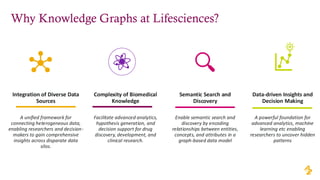
Why Knowledge Graphs at Lifesciences?
Integration of Diverse Data
Sources
A unified framework for
connecting heterogeneous data,
enabling researchers and decision-
makers to gain comprehensive
insights across disparate data
silos.
Complexity of Biomedical
Knowledge
Facilitate advanced analytics,
hypothesis generation, and
decision support for drug
discovery, development, and
clinical research.
Semantic Search and
Discovery
Enable semantic search and
discovery by encoding
relationships between entities,
concepts, and attributes in a
graph-based data model
Data-driven Insights and
Decision Making
A powerful foundation for
advanced analytics, machine
learning etc enabling
researchers to uncover hidden
patterns
From data
to
FAIR data and
WISDOM
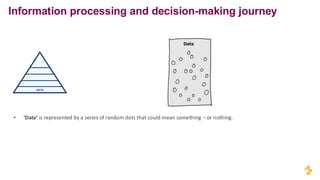
Information processing and decision-making journey
DATA
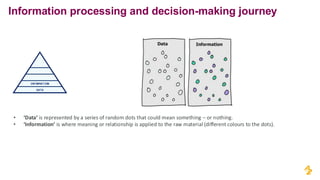
‱ ‘Data’ is represented by a series of random dots that could mean something – or nothing.
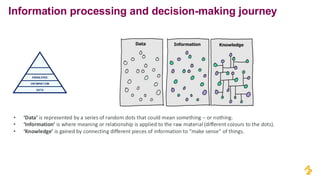
‱ ‘Information’ is where meaning or relationship is applied to the raw material (different colours to the dots).
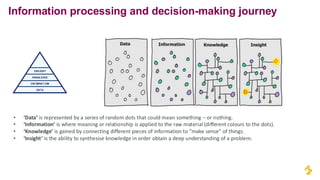
‱ ‘Knowledge’ is gained by connecting different pieces of information to “make sense” of things.
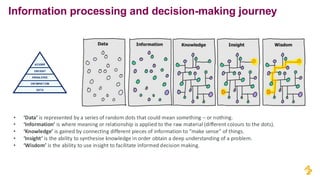
‱ ‘Insight’ is the ability to synthesise knowledge in order obtain a deep understanding of a problem.
‱ ‘Wisdom’ is the ability to use insight to facilitate informed decision making.
Information processing and decision-making journey
INFORMATION
DATA
‱ ‘Data’ is represented by a series of random dots that could mean something – or nothing.
‱ ‘Information’ is where meaning or relationship is applied to the raw material (different colours to the dots).
‱ ‘Knowledge’ is gained by connecting different pieces of information to “make sense” of things.
‱ ‘Insight’ is the ability to synthesise knowledge in order obtain a deep understanding of a problem.
‱ ‘Wisdom’ is the ability to use insight to facilitate informed decision making.
Information processing and decision-making journey
KNOWLEDGE
INFORMATION
DATA
‱ ‘Data’ is represented by a series of random dots that could mean something – or nothing.
‱ ‘Information’ is where meaning or relationship is applied to the raw material (different colours to the dots).
‱ ‘Knowledge’ is gained by connecting different pieces of information to “make sense” of things.
‱ ‘Insight’ is the ability to synthesise knowledge in order obtain a deep understanding of a problem.
‱ ‘Wisdom’ is the ability to use insight to facilitate informed decision making.
Information processing and decision-making journey
INSIGHT
KNOWLEDGE
INFORMATION
DATA
‱ ‘Data’ is represented by a series of random dots that could mean something – or nothing.
‱ ‘Information’ is where meaning or relationship is applied to the raw material (different colours to the dots).
‱ ‘Knowledge’ is gained by connecting different pieces of information to “make sense” of things.
‱ ‘Insight’ is the ability to synthesise knowledge in order obtain a deep understanding of a problem.
‱ ‘Wisdom’ is the ability to use insight to facilitate informed decision making.
Information processing and decision-making journey
‱ ‘Data’ is represented by a series of random dots that could mean something – or nothing.
‱ ‘Information’ is where meaning or relationship is applied to the raw material (different colours to the dots).
‱ ‘Knowledge’ is gained by connecting different pieces of information to “make sense” of things.
‱ ‘Insight’ is the ability to synthesise knowledge in order obtain a deep understanding of a problem.
‱ ‘Wisdom’ is the ability to use insight to facilitate informed decision making.
WISDOM
INSIGHT
KNOWLEDGE
INFORMATION
DATA
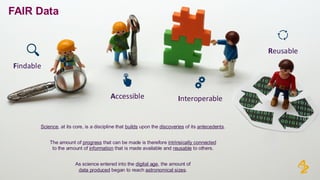
FAIR Data
Science, at its core, is a discipline that builds upon the discoveries of its antecedents.
The amount of progress that can be made is therefore intrinsically connected
to the amount of information that is made available and reusable to others.
As science entered into the digital age, the amount of
data produced began to reach astronomical sizes.
Findable
Accessible Interoperable
Reusable
WISDOM
INSIGHT
KNOWLEDGE
INFORMATION
DATA
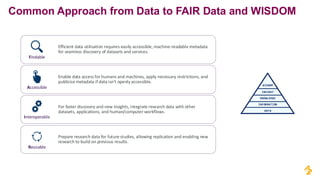
Common Approach from Data to FAIR Data and WISDOM
Findable
Accessible
Interoperable
Reusable
Graph Database Instantiation
Efficient data utilisation requires easily accessible, machine-readable metadata
for seamless discovery of datasets and services.
Enable data access for humans and machines, apply necessary restrictions, and
publicise metadata if data isn't openly accessible.
For faster discovery and new insights, integrate research data with other
datasets, applications, and human/computer workflows.
Prepare research data for future studies, allowing replication and enabling new
research to build on previous results.
WISDOM
INSIGHT
KNOWLEDGE
INFORMATION
DATA
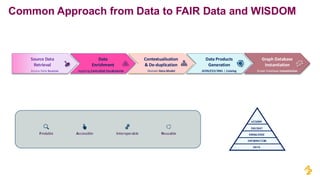
Common Approach from Data to FAIR Data and WISDOM
Findable Accessible Interoperable Reusable
Data Products
Generation
Source Data
Retrieval
Data
Enrichment
Graph Database
Instantiation
Contextualisation
& De-duplication
Access Data Sources Domain Data Model JSON/CSV/XML | Catalog
Applying Controlled Vocabularies Graph Database Instantiation
A Glimpse
into the Future
of Graphs in AZ
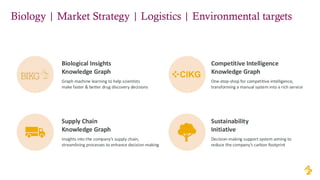
Biology | Market Strategy | Logistics | Environmental targets
Biological Insights
Knowledge Graph
Graph machine learning to help scientists
make faster & better drug discovery decisions
Competitive Intelligence
Knowledge Graph
One-stop-shop for competitive intelligence,
transforming a manual system into a rich service
Supply Chain
Knowledge Graph
Insights into the company’s supply chain,
streamlining processes to enhance decision-making
Sustainability
Initiative
Decision-making support system aiming to
reduce the company’s carbon footprint
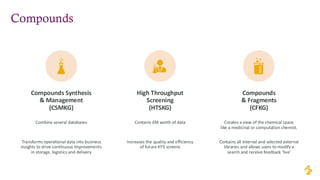
Compounds
Compounds Synthesis
& Management
(CSMKG)
Combine several databases
Transforms operational data into business
insights to drive continuous improvements
in storage, logistics and delivery
High Throughput
Screening
(HTSKG)
Contains ÂŁM worth of data
Increases the quality and efficiency
of future HTS screens
Compounds
& Fragments
(CFKG)
Creates a view of the chemical space
like a medicinal or computation chemist.
Contains all internal and selected external
libraries and allows users to modify a
search and receive feedback ‘live’
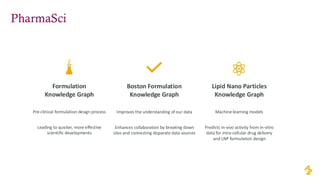
PharmaSci
Formulation
Knowledge Graph
Pre-clinical formulation design process
Leading to quicker, more effective
scientific developments
Boston Formulation
Knowledge Graph
Improves the understanding of our data
Enhances collaboration by breaking down
silos and connecting disparate data sources
Lipid Nano Particles
Knowledge Graph
Machine learning models
Predicts in-vivo activity from in-vitro
data for intra-cellular drug delivery
and LNP formulation design
Federated Queries
-
Graphs are
Stronger
Together
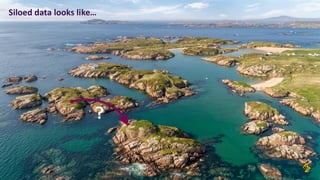
Siloed data looks like

?
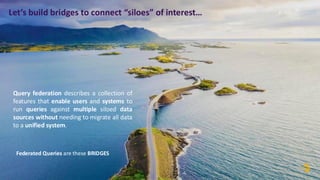
Let’s build bridges to connect “siloes” of interest

Query federation describes a collection of
features that enable users and systems to
run queries against multiple siloed data
sources without needing to migrate all data
to a unified system.
Federated Queries are these BRIDGES
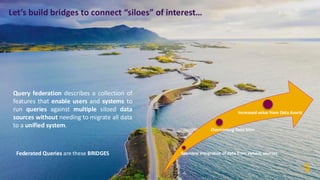
Let’s build bridges to connect “siloes” of interest

Query federation describes a collection of
features that enable users and systems to
run queries against multiple siloed data
sources without needing to migrate all data
to a unified system.
Federated Queries are these BRIDGES Seamless integration of data from various sources
Overcoming Data Silos
Increased value from Data Assets
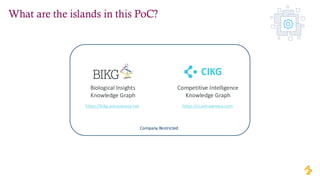
CIKG
https://ci.astrazeneca.com
Competitive Intelligence
Knowledge Graph
https://bikg.astrazeneca.net
Biological Insights
Knowledge Graph
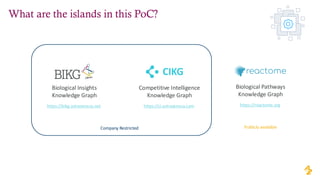
What are the islands in this PoC?
Company Restricted
CIKG
https://ci.astrazeneca.com
Competitive Intelligence
Knowledge Graph
https://bikg.astrazeneca.net
Biological Insights
Knowledge Graph
https://reactome.org
Biological Pathways
Knowledge Graph
Company Restricted Publicly available
What are the islands in this PoC?
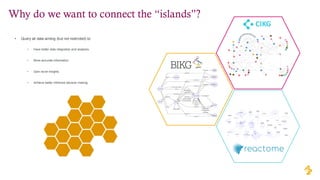
Why do we want to connect the “islands”?
CIKG
‱ Query all data aiming (but not restricted) to:
‱ Have better data integration and analytics.
‱ More accurate information.
‱ Gain novel insights.
‱ Achieve better informed decision making.
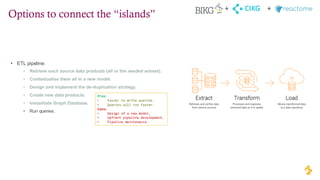
Options to connect the “islands”
‱ ETL pipeline:
‱ Retrieve each source data products (all or the needed subset).
‱ Contextualise them all in a new model.
‱ Design and implement the de-duplication strategy.
‱ Create new data products.
‱ Instantiate Graph Database.
‱ Run queries.
Pros:
‱ Easier to write queries.
‱ Queries will run faster.
Cons:
‱ Design of a new model.
‱ Upfront pipeline development.
‱ Pipeline maintenance.
CIKG
+ +
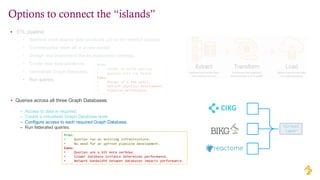
Options to connect the “islands”
‱
CIKG
Virtual
Layer
‱ Queries across all three Graph Databases:
– Access to data is required.
– Create a virtualised Graph Database layer.
– Configure access to each required Graph Database.
– Run federated queries.
Pros:
‱ Queries run on existing infrastructure.
‱ No need for an upfront pipeline development.
Cons:
‱ Queries are a bit more verbose.
‱ Slower database instance determines performance.
‱ Network bandwidth between databases impacts performance.
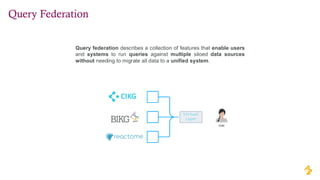
Query Federation
Query federation describes a collection of features that enable users
and systems to run queries against multiple siloed data sources
without needing to migrate all data to a unified system.
CIKG
Virtual
Layer
Federated
queries in
action
composite
Federated queries in action (i)
CIKG
+
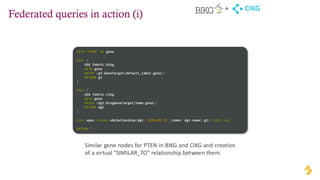
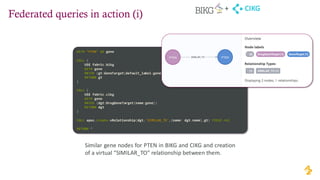
Similar gene nodes for PTEN in BIKG and CIKG and creation
of a virtual “SIMILAR_TO” relationship between them.
WITH "PTEN" AS gene
CALL {
USE fabric.bikg
WITH gene
MATCH (gt:GeneTarget{default_label:gene})
RETURN gt
}
CALL {
USE fabric.cikg
WITH gene
MATCH (dgt:DrugGeneTarget{name:gene})
RETURN dgt
}
CALL apoc.create.vRelationship(dgt,'SIMILAR_TO',{name: dgt.name},gt) YIELD rel
RETURN *
Federated queries in action (i)
CIKG
+
Similar gene nodes for PTEN in BIKG and CIKG and creation
of a virtual “SIMILAR_TO” relationship between them.
WITH "PTEN" AS gene
CALL {
USE fabric.bikg
WITH gene
MATCH (gt:GeneTarget{default_label:gene})
RETURN gt
}
CALL {
USE fabric.cikg
WITH gene
MATCH (dgt:DrugGeneTarget{name:gene})
RETURN dgt
}
CALL apoc.create.vRelationship(dgt,'SIMILAR_TO',{name: dgt.name},gt) YIELD rel
RETURN *
Federated queries in action (ii)
WITH "PTEN" AS
CALL {
USE fabric.bikg
WITH gene
MATCH (gt:GeneTarget{default_label:gene})-[r:HAS_LINK]->(a:SideEffect{default_id:"HP:0002089"}) //Pulmonary hypoplasia
RETURN r,a
}
CALL {
USE fabric.cikg
WITH gene
MATCH (trial:TrialRecord)<-[tit:testedInTrial]-(dr:DrugRecord)-[hdgt:hasDugGeneTarget]->(dgt:DrugGeneTarget{name:gene})
RETURN trial, tit, dr, hdgt
}
RETURN *
CIKG
+
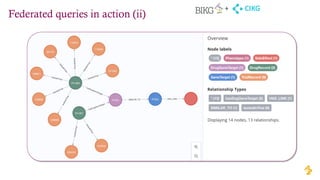
Bound gene nodes for PTEN and side effect nodes for pulmonary
hypoplasia in BIKG to find all related trials in CIKG.
Federated queries in action (ii)
CIKG
+
Bound gene nodes for PTEN and side effect nodes for pulmonary
hypoplasia in BIKG to find all related trials in CIKG.
WITH "PTEN" AS
CALL {
USE fabric.bikg
WITH gene
MATCH (gt:GeneTarget{default_label:gene})-[r:HAS_LINK]->(a:SideEffect{default_id:"HP:0002089"}) //Pulmonary hypoplasia
RETURN r,a
}
CALL {
USE fabric.cikg
WITH gene
MATCH (trial:TrialRecord)<-[tit:testedInTrial]-(dr:DrugRecord)-[hdgt:hasDugGeneTarget]->(dgt:DrugGeneTarget{name:gene})
RETURN trial, tit, dr, hdgt
}
RETURN *
Federated queries in action (ii)
CIKG
+
Federated queries in action (iii)
CIKG
+
CALL {
USE fabric.bikg
MATCH (gt:GeneTarget)-[hl:HAS_LINK]->(se:SideEffect{default_id:"HP:0002089"}) //Pulmonary hypoplasia
RETURN gt, hl, se
}
WITH gt, hl, se, gt.default_label AS gene
CALL {
USE fabric.cikg
WITH gene
MATCH (trial:TrialRecord)<-[tit:testedInTrial]-(dr:DrugRecord)-[hdgt:hasDugGeneTarget]->(dgt:DrugGeneTarget{name:gene})
RETURN trial, tit, dr, hdgt
}
RETURN *
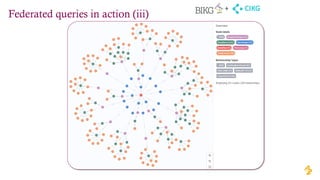
Bound only side effect nodes for pulmonary hypoplasia in BIKG to find
all genes involved in BIKG and travers to CIKG to find all related trials.
Federated queries in action (iii)
CIKG
+
CALL {
USE fabric.bikg
MATCH (gt:GeneTarget)-[hl:HAS_LINK]->(se:SideEffect{default_id:"HP:0002089"}) //Pulmonary hypoplasia
RETURN gt, hl, se
}
WITH gt, hl, se, gt.default_label AS gene
CALL {
USE fabric.cikg
WITH gene
MATCH (trial:TrialRecord)<-[tit:testedInTrial]-(dr:DrugRecord)-[hdgt:hasDugGeneTarget]->(dgt:DrugGeneTarget{name:gene})
RETURN trial, tit, dr, hdgt
}
RETURN *
Bound only side effect nodes for pulmonary hypoplasia in BIKG to find
all genes involved in BIKG and travers to CIKG to find all related trials.
Federated queries in action (iii)
CIKG
+
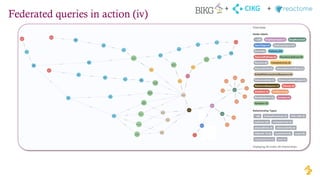
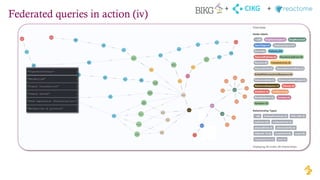
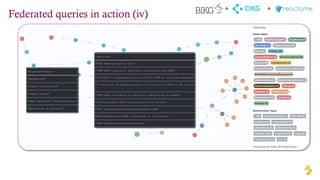
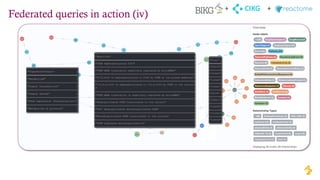
Federated queries in action (iv)
CIKG
+ +
WITH "PTEN" AS gene
CALL {
USE fabric.bikg
WITH gene
MATCH (gt:GeneTarget{default_label:gene})-[hl:HAS_LINK]->(se:SideEffect{default_id:"HP:0002089"}) //Pulmonary hypoplasia
RETURN hl, se
}
CALL {
USE fabric.cikg
WITH gene
MATCH (trial:TrialRecord)<-[tit:testedInTrial]-(dr:DrugRecord)-[hdgt:hasDugGeneTarget]->(dgt:DrugGeneTarget{name:gene})
RETURN trial, tit, dr, hdgt
}
CALL {
USE fabric.reactome
WITH gene
MATCH path=(p:TopLevelPathway{isInDisease:False})-[:hasEvent*]->(rle:ReactionLikeEvent),
(rle)-[:input|output|catalystActivity|physicalEntity|regulatedBy|regulator|hasComponent|hasMember|hasCandidate*]-
>(pe:PhysicalEntity),
(pe)-[:referenceEntity]->(re:ReferenceSequence)
WHERE gene IN re.name
RETURN nodes(path), relationships(path)
}
RETURN *
Bound nodes for both PTEN and side effect for pulmonary hypoplasia in BIKG to find all genes involved in BIKG
and travers to CIKG to find all related trials and all biological physical entities from Reactome as well as
reactions, pathways and areas of biology plus the role the gene plays in these events.
Federated queries in action (iv)
WITH "PTEN" AS gene
CALL {
USE fabric.bikg
WITH gene
MATCH (gt:GeneTarget{default_label:gene})-[hl:HAS_LINK]->(se:SideEffect{default_id:"HP:0002089"}) //Pulmonary hypoplasia
RETURN hl, se
}
CALL {
USE fabric.cikg
WITH gene
MATCH (trial:TrialRecord)<-[tit:testedInTrial]-(dr:DrugRecord)-[hdgt:hasDugGeneTarget]->(dgt:DrugGeneTarget{name:gene})
RETURN trial, tit, dr, hdgt
}
CALL {
USE fabric.reactome
WITH gene
MATCH path=(p:TopLevelPathway{isInDisease:False})-[:hasEvent*]->(rle:ReactionLikeEvent),
(rle)-[:input|output|catalystActivity|physicalEntity|regulatedBy|regulator|hasComponent|hasMember|hasCandidate*]-
>(pe:PhysicalEntity),
(pe)-[:referenceEntity]->(re:ReferenceSequence)
WHERE gene IN re.name
RETURN nodes(path), relationships(path)
}
RETURN *
CIKG
+ +
Bound nodes for both PTEN and side effect for pulmonary hypoplasia in BIKG to find all genes involved in BIKG
and travers to CIKG to find all related trials and all biological physical entities from Reactome as well as
reactions, pathways and areas of biology plus the role the gene plays in these events.
Federated queries in action (iv)
CIKG
+ +
Federated queries in action (iv)
CIKG
+ +
Federated queries in action (iv)
CIKG
+ +
Federated queries in action (iv)
CIKG
+ +
Talking to your
Knowledge Graphs
AWAKE!
‱ When an AI generates unrealistic or nonsensical outputs.
‱ Could lead to wrong decisions, misinformation, or dangerous
situations.
‱ Becomes critical in domains with strategic/sensible decisions
(medical diagnosis, financial forecasting or self-driving cars, etc.)
‱ How to avoid hallucinations?
‱ Train models with exhaustive and updated information as well as
regularly check results to find inconsistencies.
‱ AI to write database queries, based on the user’s question, and
treat the result of these as the answer.
AI Hallucinations
Tackling AI
Hallucinations
Using AI to write queries to our database

Mitigate hallucinations bias using AI-generated queries
‱ Query an existing, reliable database as a source of truth.
‱ Ensure the database is up-to-date and accurately
represents the domain.
‱ Use a well-designed AI system for:
‱ Generating meaningful queries .
‱ Interpreting results.
‱ This approach is not applicable to creative tasks or
scenarios lacking a strict source of truth.
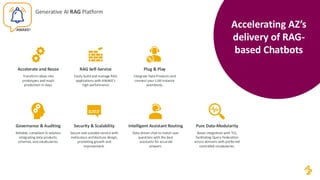
Accelerating AZ’s
delivery of RAG-
based Chatbots
Accelerate and Reuse
Transform ideas into
prototypes and reach
production in days.
RAG Self-Service
Easily build and manage RAG
applications with AWAKE’s
high performance.
Intelligent Assistant Routing
Data-driven chat to match user
questions with the best
assistants for accurate
answers.
Plug & Play
Integrate Data Products and
connect your LLM instance
seamlessly.
Security & Scalability
Secure and scalable service with
meticulous architecture design,
promoting growth and
improvement.
Governance & Auditing
Reliable, compliant AI solution
integrating data products,
schemas, and vocabularies.
Pure Data-Modularity
Boost integration with TLS,
facilitating Query Federation
across domains with preferred
controlled vocabularies.
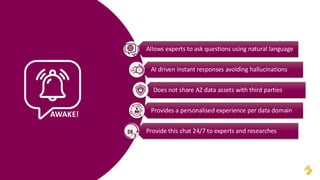
AWAKE!
Generative AI RAG Platform
Allows experts to ask questions using natural language
AI driven instant responses avoiding hallucinations
Does not share AZ data assets with third parties
Provides a personalised experience per data domain
Provide this chat 24/7 to experts and researches
AWAKE!
Generative AI RAG Platform
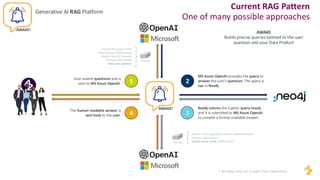
User submit questions and is
sent to MS Azure OpenAI. 1
4
The human readable answer is
sent back to the user.
MS Azure OpenAI provides the query to
answer the user’s question. The query is
run in Neo4j.
2
Neo4j returns the Cypher query result,
and it is submitted to MS Azure OpenAI
to compile a human readable answer.
3
* All steps are run in each chat interaction
Generic rules to generate human readable answers
Previous interactions
Cypher query result (JSON format)
Prompt
View of the graph model
Rules (Generic and Domain)
Domain specific concepts
Previous interactions
New user question
Prompt
AWAKE!
Current RAG Pattern
One of many possible approaches
AWAKE
Builds precise queries tailored to the user
question and your Data Product
Acknowledgments
‱ Joe Depeau
‱ Job Maelane
‱ Yuen Leung Tang
‱ Jesus Barrasa
‱ Morgan Senechal
‱ Cinthia Willaman
‱ Sangeetha Natarajan
‱ Andy Stafford-Hughes
‱ Andriy Nikolov
‱ Cristina Mihetiu
‱ MichaĂ«l Ughetto
‱ Wolfgang Klute
‱ Preetha Mutharasu
‱ Santanu Biswas
‱ Suzy Jones
‱ Sophia Axillus
‱ Karen Roberts
‱ Michael Lainchbury
‱ Daniel Addison
‱ Justin Morley
‱ Nikil Kunnappallil
‱ Johannes Zimmermann
‱ Nick Iles
‱ Ian Dix
‱ Brian Dummann
‱ Rob Hernandez
‱ Sree Balasubramanyam
‱ Sandra Carrasco
‱ Miquel Monge
‱ NĂșria XifrĂ©
‱ Pascual Lorente
‱ Pallavi Marathe

Autodesk Netfabb Ultimate 2025 free crack

  • 1.
    GraphTalk 2024 |Barcelona | October 29th, 2024 How Knowledge Graphs and Generative AI Revolutionise Biopharma and Life Sciences Exploring the transformative potential of Knowledge Graphs and Generative AI in Biopharma and Life Sciences, and how they are already revolutionising Drug Discovery, Data Connectivity, and Biomedical Research Antonio Fabregat, PhD Knowledge Graph Lead Enterprise Data Office (AZ)
  • 2.
    Agenda ‱ Graph, KnowledgeGraphs and Graph Databases ‱ From data to FAIR data and Wisdom ‱ A Glimpse into the Future of Graphs in AZ ‱ Stronger together (Federated Queries) ‱ Talking to your Knowledge Graphs
  • 3.
  • 4.
    In some cases,people picture diagrams / plots / charts when thinking of graphs, but
 What is a Graph?
  • 5.
    What is aGraph? ‱ A graph is a data structure that consists of a finite set of ‱ Vertices (or nodes) and ‱ A set of edges (relationships) connecting them. ‱ Graphs are used to solve real-life problems that involve representation of the problem space as a network. ‱ Telephone networks, road networks, social networks Circles represent vertices (nodes) Lines represent edges (relationships) These are plots / charts / diagrams This is a GRAPH
  • 6.
    Circles represent vertices(nodes) Lines represent edges (relationships) Undirected Graph: Conversion from the road network to graph. http://dx.doi.org/10.15598/aeee.v11i5.890 ‱ A graph is a data structure that consists of a finite set of ‱ Vertices (or nodes) and ‱ A set of edges (relationships) connecting them. What is a Graph?
  • 7.
    Undirected Graph: Conversion fromthe road network to graph. Directed Graph: Behaviour-fitness causal Directed Acyclic Graph (DAG) scaffold for cancer treatment decisions. https://doi.org/10.1038/s41598-022-09775-9 http://dx.doi.org/10.15598/aeee.v11i5.890 Circles represent vertices (nodes) Lines represent edges (relationships) What is a Graph? ‱ A graph is a data structure that consists of a finite set of ‱ Vertices (or nodes) and ‱ A set of edges (relationships) connecting them.
  • 8.
    Knowledge Graphs representationalternatives * Adapted from documentation at W3C https://www.w3.org/ Two ways of representing/storing a Knowledge Graph RDF-star (Resource Description Framework) Semantic Web: Good for common standards and data exchange Data model based on 3 parts: subject, predicate and objects Nodes’ properties added as predicates. Edges with properties are “triple-resources” (like “meta-nodes”) Storage: “Triple/Quad Stores” Graph Databases Any type of information, can be represented in a Knowledge Graph 18 nodes (5 instances, 4 classes, 8 literals, 1 triple-resource) 19 relationships (triples) Knowledge Graph is a way of organising data & information in the form of a graph A collection of interlinked concepts, entities, events that represent a network of entities and the relationships between them LPG (Labelled-Property Graph) Good for highly dynamic and transactional use cases Data organised as nodes, labels, relationships and properties Both nodes and edges can have properties Storage: Native Graph Databases 5 nodes (5 ids, 4 Labels, 8 properties) 4 relationships (2 properties)
  • 9.
    What is aGraph Database? ‱ Stores nodes and relationships instead of tables or documents. ‱ Data is natively stored just like one might sketch graph ideas on a whiteboard. ‱ Is schema-free, so data model can adapt and change with business needs.
  • 10.
    What is aGraph Database? WISDOM INSIGHT KNOWLEDGE INFORMATION DATA Why use Graph Databases? ‱ Map more realistically to how the human brain understands the world around it. ‱ Are flexible and handle complex data and their relationships in a performing manner. ‱ Stores nodes and relationships instead of tables or documents. ‱ Data is natively stored just like one might sketch graph ideas on a whiteboard. ‱ Is schema-free, so data model can adapt and change with business needs. ‱ On top of common queries, they facilitate applying graph theory approaches to: ‱ Determine how important a single node is to the whole group, ‱ Detect communities within the group, ‱ Determine the shortest path between two nodes, ‱ 

  • 11.
    WISDOM INSIGHT KNOWLEDGE INFORMATION DATA Why use GraphDatabases? When to use Graph Databases? When relationships between data points matter as much or more than these points themselves while generating insight and wisdom. ‱ Map more realistically to how the human brain understands the world around it. ‱ Are flexible and handle complex data and their relationships in a performing manner.
  • 12.
    Fraud Detection ‱Anti-money laundering ‱Insidertrading ‱Know your customer Supply Chain Management ‱Farming ‱Refining ‱Design ‱Manufacturing ‱Packaging ‱Transport Digital Twin ‱Maps ‱Vehicles ‱Manufacturing ‱Success prediction ‱Biological pathways ‱Immune system Real-Time Recommendations ‱Product ‱Customer ‱Inventory ‱Supplier ‱Logistics ‱Socialsentiment data Cyber Security ‱Critical infrastructure security. ‱Application security. ‱Network security. ‱Cloud security. ‱Internet of Things (IoT) security. There are many uses for graph databases in an enterprise. Here are some of them: When to use Graph Databases? When relationships between data points matter as much or more than these points themselves while generating insight and wisdom.
  • 13.
    Getting ready forthe future! Tackling Data Growth with Knowledge Graphs Rapid data growth from various sources (IoT, social media, business applications) Increasing need for efficient data management & analysis tools Knowledge graphs: organizing & structuring vast data amounts Knowledge Graphs vs Traditional Data Management Systems Limitations of traditional data management systems (capturing complex relationships & semantics) Knowledge graphs: excelling at data meaning, context, and understanding AI and Machine Learning with Knowledge Graphs AI & machine learning's growing role in data analysis Enriched data models from knowledge graphs for improved AI & ML analysis
  • 14.
    Why Knowledge Graphsat Lifesciences? Integration of Diverse Data Sources A unified framework for connecting heterogeneous data, enabling researchers and decision- makers to gain comprehensive insights across disparate data silos. Complexity of Biomedical Knowledge Facilitate advanced analytics, hypothesis generation, and decision support for drug discovery, development, and clinical research. Semantic Search and Discovery Enable semantic search and discovery by encoding relationships between entities, concepts, and attributes in a graph-based data model Data-driven Insights and Decision Making A powerful foundation for advanced analytics, machine learning etc enabling researchers to uncover hidden patterns
  • 15.
  • 16.
    Information processing anddecision-making journey DATA ‱ ‘Data’ is represented by a series of random dots that could mean something – or nothing. ‱ ‘Information’ is where meaning or relationship is applied to the raw material (different colours to the dots). ‱ ‘Knowledge’ is gained by connecting different pieces of information to “make sense” of things. ‱ ‘Insight’ is the ability to synthesise knowledge in order obtain a deep understanding of a problem. ‱ ‘Wisdom’ is the ability to use insight to facilitate informed decision making.
  • 17.
    Information processing anddecision-making journey INFORMATION DATA ‱ ‘Data’ is represented by a series of random dots that could mean something – or nothing. ‱ ‘Information’ is where meaning or relationship is applied to the raw material (different colours to the dots). ‱ ‘Knowledge’ is gained by connecting different pieces of information to “make sense” of things. ‱ ‘Insight’ is the ability to synthesise knowledge in order obtain a deep understanding of a problem. ‱ ‘Wisdom’ is the ability to use insight to facilitate informed decision making.
  • 18.
    Information processing anddecision-making journey KNOWLEDGE INFORMATION DATA ‱ ‘Data’ is represented by a series of random dots that could mean something – or nothing. ‱ ‘Information’ is where meaning or relationship is applied to the raw material (different colours to the dots). ‱ ‘Knowledge’ is gained by connecting different pieces of information to “make sense” of things. ‱ ‘Insight’ is the ability to synthesise knowledge in order obtain a deep understanding of a problem. ‱ ‘Wisdom’ is the ability to use insight to facilitate informed decision making.
  • 19.
    Information processing anddecision-making journey INSIGHT KNOWLEDGE INFORMATION DATA ‱ ‘Data’ is represented by a series of random dots that could mean something – or nothing. ‱ ‘Information’ is where meaning or relationship is applied to the raw material (different colours to the dots). ‱ ‘Knowledge’ is gained by connecting different pieces of information to “make sense” of things. ‱ ‘Insight’ is the ability to synthesise knowledge in order obtain a deep understanding of a problem. ‱ ‘Wisdom’ is the ability to use insight to facilitate informed decision making.
  • 20.
    Information processing anddecision-making journey ‱ ‘Data’ is represented by a series of random dots that could mean something – or nothing. ‱ ‘Information’ is where meaning or relationship is applied to the raw material (different colours to the dots). ‱ ‘Knowledge’ is gained by connecting different pieces of information to “make sense” of things. ‱ ‘Insight’ is the ability to synthesise knowledge in order obtain a deep understanding of a problem. ‱ ‘Wisdom’ is the ability to use insight to facilitate informed decision making. WISDOM INSIGHT KNOWLEDGE INFORMATION DATA
  • 21.
    FAIR Data Science, atits core, is a discipline that builds upon the discoveries of its antecedents. The amount of progress that can be made is therefore intrinsically connected to the amount of information that is made available and reusable to others. As science entered into the digital age, the amount of data produced began to reach astronomical sizes. Findable Accessible Interoperable Reusable
  • 22.
    WISDOM INSIGHT KNOWLEDGE INFORMATION DATA Common Approach fromData to FAIR Data and WISDOM Findable Accessible Interoperable Reusable Graph Database Instantiation Efficient data utilisation requires easily accessible, machine-readable metadata for seamless discovery of datasets and services. Enable data access for humans and machines, apply necessary restrictions, and publicise metadata if data isn't openly accessible. For faster discovery and new insights, integrate research data with other datasets, applications, and human/computer workflows. Prepare research data for future studies, allowing replication and enabling new research to build on previous results.
  • 23.
    WISDOM INSIGHT KNOWLEDGE INFORMATION DATA Common Approach fromData to FAIR Data and WISDOM Findable Accessible Interoperable Reusable Data Products Generation Source Data Retrieval Data Enrichment Graph Database Instantiation Contextualisation & De-duplication Access Data Sources Domain Data Model JSON/CSV/XML | Catalog Applying Controlled Vocabularies Graph Database Instantiation
  • 24.
    A Glimpse into theFuture of Graphs in AZ
  • 25.
    Biology | MarketStrategy | Logistics | Environmental targets Biological Insights Knowledge Graph Graph machine learning to help scientists make faster & better drug discovery decisions Competitive Intelligence Knowledge Graph One-stop-shop for competitive intelligence, transforming a manual system into a rich service Supply Chain Knowledge Graph Insights into the company’s supply chain, streamlining processes to enhance decision-making Sustainability Initiative Decision-making support system aiming to reduce the company’s carbon footprint
  • 26.
    Compounds Compounds Synthesis & Management (CSMKG) Combineseveral databases Transforms operational data into business insights to drive continuous improvements in storage, logistics and delivery High Throughput Screening (HTSKG) Contains £M worth of data Increases the quality and efficiency of future HTS screens Compounds & Fragments (CFKG) Creates a view of the chemical space like a medicinal or computation chemist. Contains all internal and selected external libraries and allows users to modify a search and receive feedback ‘live’
  • 27.
    PharmaSci Formulation Knowledge Graph Pre-clinical formulationdesign process Leading to quicker, more effective scientific developments Boston Formulation Knowledge Graph Improves the understanding of our data Enhances collaboration by breaking down silos and connecting disparate data sources Lipid Nano Particles Knowledge Graph Machine learning models Predicts in-vivo activity from in-vitro data for intra-cellular drug delivery and LNP formulation design
  • 28.
  • 29.
    Siloed data lookslike
 ?
  • 30.
    Let’s build bridgesto connect “siloes” of interest
 Query federation describes a collection of features that enable users and systems to run queries against multiple siloed data sources without needing to migrate all data to a unified system. Federated Queries are these BRIDGES
  • 31.
    Let’s build bridgesto connect “siloes” of interest
 Query federation describes a collection of features that enable users and systems to run queries against multiple siloed data sources without needing to migrate all data to a unified system. Federated Queries are these BRIDGES Seamless integration of data from various sources Overcoming Data Silos Increased value from Data Assets
  • 32.
    CIKG https://ci.astrazeneca.com Competitive Intelligence Knowledge Graph https://bikg.astrazeneca.net BiologicalInsights Knowledge Graph What are the islands in this PoC? Company Restricted
  • 33.
    CIKG https://ci.astrazeneca.com Competitive Intelligence Knowledge Graph https://bikg.astrazeneca.net BiologicalInsights Knowledge Graph https://reactome.org Biological Pathways Knowledge Graph Company Restricted Publicly available What are the islands in this PoC?
  • 34.
    Why do wewant to connect the “islands”? CIKG ‱ Query all data aiming (but not restricted) to: ‱ Have better data integration and analytics. ‱ More accurate information. ‱ Gain novel insights. ‱ Achieve better informed decision making.
  • 35.
    Options to connectthe “islands” ‱ ETL pipeline: ‱ Retrieve each source data products (all or the needed subset). ‱ Contextualise them all in a new model. ‱ Design and implement the de-duplication strategy. ‱ Create new data products. ‱ Instantiate Graph Database. ‱ Run queries. Pros: ‱ Easier to write queries. ‱ Queries will run faster. Cons: ‱ Design of a new model. ‱ Upfront pipeline development. ‱ Pipeline maintenance. CIKG + +
  • 36.
    Options to connectthe “islands” ‱ CIKG Virtual Layer ‱ Queries across all three Graph Databases: – Access to data is required. – Create a virtualised Graph Database layer. – Configure access to each required Graph Database. – Run federated queries. Pros: ‱ Queries run on existing infrastructure. ‱ No need for an upfront pipeline development. Cons: ‱ Queries are a bit more verbose. ‱ Slower database instance determines performance. ‱ Network bandwidth between databases impacts performance.
  • 37.
    Query Federation Query federationdescribes a collection of features that enable users and systems to run queries against multiple siloed data sources without needing to migrate all data to a unified system. CIKG Virtual Layer
  • 38.
  • 39.
    Federated queries inaction (i) CIKG + Similar gene nodes for PTEN in BIKG and CIKG and creation of a virtual “SIMILAR_TO” relationship between them. WITH "PTEN" AS gene CALL { USE fabric.bikg WITH gene MATCH (gt:GeneTarget{default_label:gene}) RETURN gt } CALL { USE fabric.cikg WITH gene MATCH (dgt:DrugGeneTarget{name:gene}) RETURN dgt } CALL apoc.create.vRelationship(dgt,'SIMILAR_TO',{name: dgt.name},gt) YIELD rel RETURN *
  • 40.
    Federated queries inaction (i) CIKG + Similar gene nodes for PTEN in BIKG and CIKG and creation of a virtual “SIMILAR_TO” relationship between them. WITH "PTEN" AS gene CALL { USE fabric.bikg WITH gene MATCH (gt:GeneTarget{default_label:gene}) RETURN gt } CALL { USE fabric.cikg WITH gene MATCH (dgt:DrugGeneTarget{name:gene}) RETURN dgt } CALL apoc.create.vRelationship(dgt,'SIMILAR_TO',{name: dgt.name},gt) YIELD rel RETURN *
  • 41.
    Federated queries inaction (ii) WITH "PTEN" AS CALL { USE fabric.bikg WITH gene MATCH (gt:GeneTarget{default_label:gene})-[r:HAS_LINK]->(a:SideEffect{default_id:"HP:0002089"}) //Pulmonary hypoplasia RETURN r,a } CALL { USE fabric.cikg WITH gene MATCH (trial:TrialRecord)<-[tit:testedInTrial]-(dr:DrugRecord)-[hdgt:hasDugGeneTarget]->(dgt:DrugGeneTarget{name:gene}) RETURN trial, tit, dr, hdgt } RETURN * CIKG + Bound gene nodes for PTEN and side effect nodes for pulmonary hypoplasia in BIKG to find all related trials in CIKG.
  • 42.
    Federated queries inaction (ii) CIKG + Bound gene nodes for PTEN and side effect nodes for pulmonary hypoplasia in BIKG to find all related trials in CIKG. WITH "PTEN" AS CALL { USE fabric.bikg WITH gene MATCH (gt:GeneTarget{default_label:gene})-[r:HAS_LINK]->(a:SideEffect{default_id:"HP:0002089"}) //Pulmonary hypoplasia RETURN r,a } CALL { USE fabric.cikg WITH gene MATCH (trial:TrialRecord)<-[tit:testedInTrial]-(dr:DrugRecord)-[hdgt:hasDugGeneTarget]->(dgt:DrugGeneTarget{name:gene}) RETURN trial, tit, dr, hdgt } RETURN *
  • 43.
    Federated queries inaction (ii) CIKG +
  • 44.
    Federated queries inaction (iii) CIKG + CALL { USE fabric.bikg MATCH (gt:GeneTarget)-[hl:HAS_LINK]->(se:SideEffect{default_id:"HP:0002089"}) //Pulmonary hypoplasia RETURN gt, hl, se } WITH gt, hl, se, gt.default_label AS gene CALL { USE fabric.cikg WITH gene MATCH (trial:TrialRecord)<-[tit:testedInTrial]-(dr:DrugRecord)-[hdgt:hasDugGeneTarget]->(dgt:DrugGeneTarget{name:gene}) RETURN trial, tit, dr, hdgt } RETURN * Bound only side effect nodes for pulmonary hypoplasia in BIKG to find all genes involved in BIKG and travers to CIKG to find all related trials.
  • 45.
    Federated queries inaction (iii) CIKG + CALL { USE fabric.bikg MATCH (gt:GeneTarget)-[hl:HAS_LINK]->(se:SideEffect{default_id:"HP:0002089"}) //Pulmonary hypoplasia RETURN gt, hl, se } WITH gt, hl, se, gt.default_label AS gene CALL { USE fabric.cikg WITH gene MATCH (trial:TrialRecord)<-[tit:testedInTrial]-(dr:DrugRecord)-[hdgt:hasDugGeneTarget]->(dgt:DrugGeneTarget{name:gene}) RETURN trial, tit, dr, hdgt } RETURN * Bound only side effect nodes for pulmonary hypoplasia in BIKG to find all genes involved in BIKG and travers to CIKG to find all related trials.
  • 46.
    Federated queries inaction (iii) CIKG +
  • 47.
    Federated queries inaction (iv) CIKG + + WITH "PTEN" AS gene CALL { USE fabric.bikg WITH gene MATCH (gt:GeneTarget{default_label:gene})-[hl:HAS_LINK]->(se:SideEffect{default_id:"HP:0002089"}) //Pulmonary hypoplasia RETURN hl, se } CALL { USE fabric.cikg WITH gene MATCH (trial:TrialRecord)<-[tit:testedInTrial]-(dr:DrugRecord)-[hdgt:hasDugGeneTarget]->(dgt:DrugGeneTarget{name:gene}) RETURN trial, tit, dr, hdgt } CALL { USE fabric.reactome WITH gene MATCH path=(p:TopLevelPathway{isInDisease:False})-[:hasEvent*]->(rle:ReactionLikeEvent), (rle)-[:input|output|catalystActivity|physicalEntity|regulatedBy|regulator|hasComponent|hasMember|hasCandidate*]- >(pe:PhysicalEntity), (pe)-[:referenceEntity]->(re:ReferenceSequence) WHERE gene IN re.name RETURN nodes(path), relationships(path) } RETURN * Bound nodes for both PTEN and side effect for pulmonary hypoplasia in BIKG to find all genes involved in BIKG and travers to CIKG to find all related trials and all biological physical entities from Reactome as well as reactions, pathways and areas of biology plus the role the gene plays in these events.
  • 48.
    Federated queries inaction (iv) WITH "PTEN" AS gene CALL { USE fabric.bikg WITH gene MATCH (gt:GeneTarget{default_label:gene})-[hl:HAS_LINK]->(se:SideEffect{default_id:"HP:0002089"}) //Pulmonary hypoplasia RETURN hl, se } CALL { USE fabric.cikg WITH gene MATCH (trial:TrialRecord)<-[tit:testedInTrial]-(dr:DrugRecord)-[hdgt:hasDugGeneTarget]->(dgt:DrugGeneTarget{name:gene}) RETURN trial, tit, dr, hdgt } CALL { USE fabric.reactome WITH gene MATCH path=(p:TopLevelPathway{isInDisease:False})-[:hasEvent*]->(rle:ReactionLikeEvent), (rle)-[:input|output|catalystActivity|physicalEntity|regulatedBy|regulator|hasComponent|hasMember|hasCandidate*]- >(pe:PhysicalEntity), (pe)-[:referenceEntity]->(re:ReferenceSequence) WHERE gene IN re.name RETURN nodes(path), relationships(path) } RETURN * CIKG + + Bound nodes for both PTEN and side effect for pulmonary hypoplasia in BIKG to find all genes involved in BIKG and travers to CIKG to find all related trials and all biological physical entities from Reactome as well as reactions, pathways and areas of biology plus the role the gene plays in these events.
  • 49.
    Federated queries inaction (iv) CIKG + +
  • 50.
    Federated queries inaction (iv) CIKG + +
  • 51.
    Federated queries inaction (iv) CIKG + +
  • 52.
    Federated queries inaction (iv) CIKG + +
  • 53.
  • 54.
    ‱ When anAI generates unrealistic or nonsensical outputs. ‱ Could lead to wrong decisions, misinformation, or dangerous situations. ‱ Becomes critical in domains with strategic/sensible decisions (medical diagnosis, financial forecasting or self-driving cars, etc.) ‱ How to avoid hallucinations? ‱ Train models with exhaustive and updated information as well as regularly check results to find inconsistencies. ‱ AI to write database queries, based on the user’s question, and treat the result of these as the answer. AI Hallucinations
  • 55.
    Tackling AI Hallucinations Using AIto write queries to our database

  • 56.
    Mitigate hallucinations biasusing AI-generated queries ‱ Query an existing, reliable database as a source of truth. ‱ Ensure the database is up-to-date and accurately represents the domain. ‱ Use a well-designed AI system for: ‱ Generating meaningful queries . ‱ Interpreting results. ‱ This approach is not applicable to creative tasks or scenarios lacking a strict source of truth.
  • 57.
    Accelerating AZ’s delivery ofRAG- based Chatbots Accelerate and Reuse Transform ideas into prototypes and reach production in days. RAG Self-Service Easily build and manage RAG applications with AWAKE’s high performance. Intelligent Assistant Routing Data-driven chat to match user questions with the best assistants for accurate answers. Plug & Play Integrate Data Products and connect your LLM instance seamlessly. Security & Scalability Secure and scalable service with meticulous architecture design, promoting growth and improvement. Governance & Auditing Reliable, compliant AI solution integrating data products, schemas, and vocabularies. Pure Data-Modularity Boost integration with TLS, facilitating Query Federation across domains with preferred controlled vocabularies. AWAKE! Generative AI RAG Platform
  • 58.
    Allows experts toask questions using natural language AI driven instant responses avoiding hallucinations Does not share AZ data assets with third parties Provides a personalised experience per data domain Provide this chat 24/7 to experts and researches
  • 59.
    AWAKE! Generative AI RAGPlatform User submit questions and is sent to MS Azure OpenAI. 1 4 The human readable answer is sent back to the user. MS Azure OpenAI provides the query to answer the user’s question. The query is run in Neo4j. 2 Neo4j returns the Cypher query result, and it is submitted to MS Azure OpenAI to compile a human readable answer. 3 * All steps are run in each chat interaction Generic rules to generate human readable answers Previous interactions Cypher query result (JSON format) Prompt View of the graph model Rules (Generic and Domain) Domain specific concepts Previous interactions New user question Prompt AWAKE! Current RAG Pattern One of many possible approaches AWAKE Builds precise queries tailored to the user question and your Data Product
  • 60.
    Acknowledgments ‱ Joe Depeau ‱Job Maelane ‱ Yuen Leung Tang ‱ Jesus Barrasa ‱ Morgan Senechal ‱ Cinthia Willaman ‱ Sangeetha Natarajan ‱ Andy Stafford-Hughes ‱ Andriy Nikolov ‱ Cristina Mihetiu ‱ MichaĂ«l Ughetto ‱ Wolfgang Klute ‱ Preetha Mutharasu ‱ Santanu Biswas ‱ Suzy Jones ‱ Sophia Axillus ‱ Karen Roberts ‱ Michael Lainchbury ‱ Daniel Addison ‱ Justin Morley ‱ Nikil Kunnappallil ‱ Johannes Zimmermann ‱ Nick Iles ‱ Ian Dix ‱ Brian Dummann ‱ Rob Hernandez ‱ Sree Balasubramanyam ‱ Sandra Carrasco ‱ Miquel Monge ‱ NĂșria XifrĂ© ‱ Pascual Lorente ‱ Pallavi Marathe