Creative Commons
Licensing
Licenciatura en Lenguas Extranjeras con Énfasis en
Inglés
Ambientes Virtuales de aprendizaje
Concept
•Creative commons are the group of
licenses developed to protect the
authorized uses of someone’s
production, specially for artistic,
online and educational materials.
Rationale
In a world where the internet has allowed people to directly
access millions of resources for uses other than commercial, the
legislation is forced to advance into protecting author rights
including some flexibility for material use.
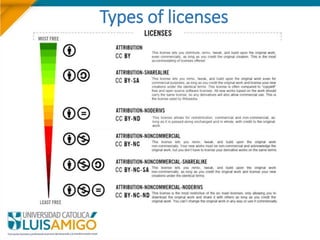
Types of licenses
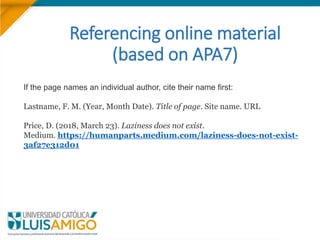
Referencing online material
(based on APA7)
If the page names an individual author, cite their name first:
Lastname, F. M. (Year, Month Date). Title of page. Site name. URL
Price, D. (2018, March 23). Laziness does not exist.
Medium. https://humanparts.medium.com/laziness-does-not-exist-
3af27e312d01
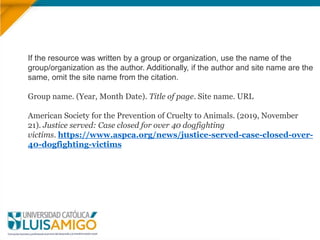
If the resource was written by a group or organization, use the name of the
group/organization as the author. Additionally, if the author and site name are the
same, omit the site name from the citation.
Group name. (Year, Month Date). Title of page. Site name. URL
American Society for the Prevention of Cruelty to Animals. (2019, November
21). Justice served: Case closed for over 40 dogfighting
victims. https://www.aspca.org/news/justice-served-case-closed-over-
40-dogfighting-victims
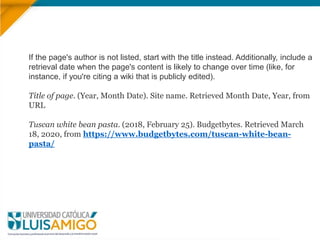
If the page's author is not listed, start with the title instead. Additionally, include a
retrieval date when the page's content is likely to change over time (like, for
instance, if you're citing a wiki that is publicly edited).
Title of page. (Year, Month Date). Site name. Retrieved Month Date, Year, from
URL
Tuscan white bean pasta. (2018, February 25). Budgetbytes. Retrieved March
18, 2020, from https://www.budgetbytes.com/tuscan-white-bean-
pasta/
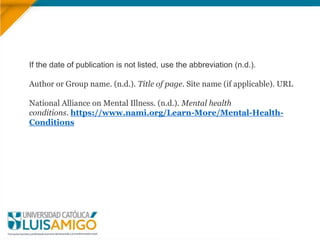
If the date of publication is not listed, use the abbreviation (n.d.).
Author or Group name. (n.d.). Title of page. Site name (if applicable). URL
National Alliance on Mental Illness. (n.d.). Mental health
conditions. https://www.nami.org/Learn-More/Mental-Health-
Conditions
Graphic Data (e.g. Interactive Maps, Infographics, and Other Graphic
Representations of Data)
Give the name of the organization or individual followed by the date and the title.
If there is no title, in brackets, you should provide a brief explanation of what type
of data is there and in what form it appears. Include the URL and the retrieval
date if there is no publication date.
HatchMed. (2017). 8 ways to improve patient satisfaction [Infographic].
HatchMed.com. https://www.hatchmed.com/blog/2017/1/30/8-ways-to-
improve-patient-satisfaction
Google. (n.d.). [Google Map of Purdue University]. Retrieved January 12, 2020,
from https://www.google.com/maps/@40.4237095,-86.9233886,17z
Blog Post
Lastname, F. M. (Year, Month Date). Title of post. Publisher. URL
Axelrod, A. (2019, August 11). A century later: The Treaty of Versailles and its
rejection of racial equality. Code Switch,
NPR. https://www.npr.org/sections/codeswitch/2019/08/11/7422933
05/a-century-later-the-treaty-of-versailles-and-its-rejection-of-
racial-equality
YouTube or other Streaming Video
Last Name, F. M. [Username]. (Year, Month Date). Title of video [Video].
Streaming Service. URL
Lushi, K. [Korab Lushi]. (2016, July 3). Albatross culture 1 [Video].
YouTube. https://www.youtube.com/watch?v=_AMrJRQDPjk&t=148s
Note: The person or group who uploaded the video is considered the author. If
the author’s name is the same as the username, you can omit the [Username].
Podcast Episode
Host, A. A. (Host). (Year, Month Date). Title of episode (No. if provided)
[Audio podcast episode]. In Name of podcast. Publisher. URL
Prime, K. (Host). (2019, March 29). For whom the cowbell tolls [Audio
podcast episode]. In Radiolab. WNYC
Studios. https://www.wnycstudios.org/story/whom-cowbell-
tolls

Author rights

  • 1.
    Creative Commons Licensing Licenciatura enLenguas Extranjeras con Énfasis en Inglés Ambientes Virtuales de aprendizaje
  • 2.
    Concept •Creative commons arethe group of licenses developed to protect the authorized uses of someone’s production, specially for artistic, online and educational materials.
  • 3.
    Rationale In a worldwhere the internet has allowed people to directly access millions of resources for uses other than commercial, the legislation is forced to advance into protecting author rights including some flexibility for material use.
  • 4.
  • 5.
    Referencing online material (basedon APA7) If the page names an individual author, cite their name first: Lastname, F. M. (Year, Month Date). Title of page. Site name. URL Price, D. (2018, March 23). Laziness does not exist. Medium. https://humanparts.medium.com/laziness-does-not-exist- 3af27e312d01
  • 6.
    If the resourcewas written by a group or organization, use the name of the group/organization as the author. Additionally, if the author and site name are the same, omit the site name from the citation. Group name. (Year, Month Date). Title of page. Site name. URL American Society for the Prevention of Cruelty to Animals. (2019, November 21). Justice served: Case closed for over 40 dogfighting victims. https://www.aspca.org/news/justice-served-case-closed-over- 40-dogfighting-victims
  • 7.
    If the page'sauthor is not listed, start with the title instead. Additionally, include a retrieval date when the page's content is likely to change over time (like, for instance, if you're citing a wiki that is publicly edited). Title of page. (Year, Month Date). Site name. Retrieved Month Date, Year, from URL Tuscan white bean pasta. (2018, February 25). Budgetbytes. Retrieved March 18, 2020, from https://www.budgetbytes.com/tuscan-white-bean- pasta/
  • 8.
    If the dateof publication is not listed, use the abbreviation (n.d.). Author or Group name. (n.d.). Title of page. Site name (if applicable). URL National Alliance on Mental Illness. (n.d.). Mental health conditions. https://www.nami.org/Learn-More/Mental-Health- Conditions
  • 9.
    Graphic Data (e.g.Interactive Maps, Infographics, and Other Graphic Representations of Data) Give the name of the organization or individual followed by the date and the title. If there is no title, in brackets, you should provide a brief explanation of what type of data is there and in what form it appears. Include the URL and the retrieval date if there is no publication date. HatchMed. (2017). 8 ways to improve patient satisfaction [Infographic]. HatchMed.com. https://www.hatchmed.com/blog/2017/1/30/8-ways-to- improve-patient-satisfaction Google. (n.d.). [Google Map of Purdue University]. Retrieved January 12, 2020, from https://www.google.com/maps/@40.4237095,-86.9233886,17z
  • 10.
    Blog Post Lastname, F.M. (Year, Month Date). Title of post. Publisher. URL Axelrod, A. (2019, August 11). A century later: The Treaty of Versailles and its rejection of racial equality. Code Switch, NPR. https://www.npr.org/sections/codeswitch/2019/08/11/7422933 05/a-century-later-the-treaty-of-versailles-and-its-rejection-of- racial-equality
  • 11.
    YouTube or otherStreaming Video Last Name, F. M. [Username]. (Year, Month Date). Title of video [Video]. Streaming Service. URL Lushi, K. [Korab Lushi]. (2016, July 3). Albatross culture 1 [Video]. YouTube. https://www.youtube.com/watch?v=_AMrJRQDPjk&t=148s Note: The person or group who uploaded the video is considered the author. If the author’s name is the same as the username, you can omit the [Username].
  • 12.
    Podcast Episode Host, A.A. (Host). (Year, Month Date). Title of episode (No. if provided) [Audio podcast episode]. In Name of podcast. Publisher. URL Prime, K. (Host). (2019, March 29). For whom the cowbell tolls [Audio podcast episode]. In Radiolab. WNYC Studios. https://www.wnycstudios.org/story/whom-cowbell- tolls