OBJECTIVES
• Define authenticand created materials
• Differentiate authentic and created materials
• Determine the advantages and disadvantages of
using authentic and created materials
3.
Authentic
Materials
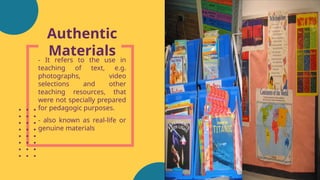
- It refersto the use in
teaching of text, e.g.
photographs, video
selections and other
teaching resources, that
were not specially prepared
for pedagogic purposes.
- also known as real-life or
genuine materials
4.
AUTHENTIC MATERIALS
Nunan (1988)defines authentic materials as
the materials "which have been produced for
purposes other than to teach language“
Nunan (1999) defines authentic materials as
spoken or written language data that has
been produced in the course of genuine
communication, and not specifically written
for purposes of language teaching.
5.
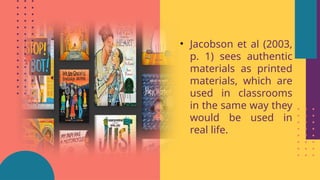
• Jacobson etal (2003,
p. 1) sees authentic
materials as printed
materials, which are
used in classrooms
in the same way they
would be used in
real life.
6.
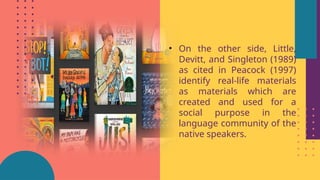
• On theother side, Little,
Devitt, and Singleton (1989)
as cited in Peacock (1997)
identify real-life materials
as materials which are
created and used for a
social purpose in the
language community of the
native speakers.
7.
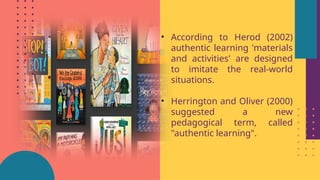
• According toHerod (2002)
authentic learning 'materials
and activities' are designed
to imitate the real-world
situations.
• Herrington and Oliver (2000)
suggested a new
pedagogical term, called
"authentic learning".
8.
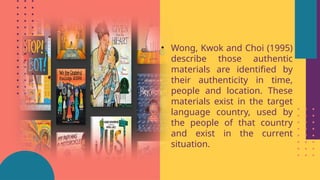
• Wong, Kwokand Choi (1995)
describe those authentic
materials are identified by
their authenticity in time,
people and location. These
materials exist in the target
language country, used by
the people of that country
and exist in the current
situation.
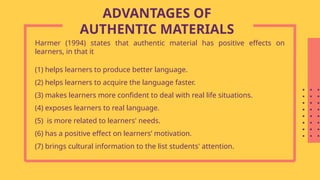
Harmer (1994) statesthat authentic material has positive effects on
learners, in that it
(1) helps learners to produce better language.
(2) helps learners to acquire the language faster.
(3) makes learners more confident to deal with real life situations.
(4) exposes learners to real language.
(5) is more related to learners' needs.
(6) has a positive effect on learners’ motivation.
(7) brings cultural information to the list students' attention.
ADVANTAGES OF
AUTHENTIC MATERIALS
19.
• It supportsa more creative approach to teaching.
• It relates closely to the interests of many language
learners.
ADVANTAGES OF
AUTHENTIC MATERIALS
20.
• Miller (2005)states that authentic materials are "too difficult
and time consuming to select, edit and prepare.“
• In addition, Martinez (2002) argues that authentic materials are
regarded too culturally biased and difficult to comprehend by
learners in the classroom.
• He adds concerning the cultural effect, that "authentic texts
from one culture may give a false impression to students from
another.
DISADVANTAGES OF
AUTHENTIC MATERIALS
21.
• Klickaya (2004)believes that using authentic materials with
weak learners frustrate and demotivate them.
• Using authentic materials is a burden for teachers.
DISADVANTAGES OF
AUTHENTIC MATERIALS
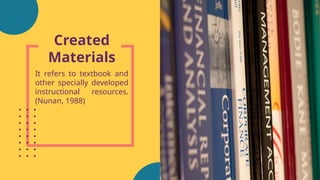
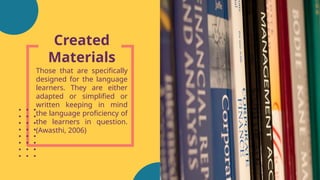
Created
Materials
Those that arespecifically
designed for the language
learners. They are either
adapted or simplified or
written keeping in mind
the language proficiency of
the learners in question.
(Awasthi, 2006)
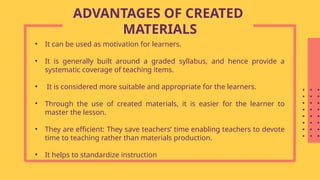
• It canbe used as motivation for learners.
• It is generally built around a graded syllabus, and hence provide a
systematic coverage of teaching items.
• It is considered more suitable and appropriate for the learners.
• Through the use of created materials, it is easier for the learner to
master the lesson.
• They are efficient: They save teachers’ time enabling teachers to devote
time to teaching rather than materials production.
• It helps to standardize instruction
ADVANTAGES OF CREATED
MATERIALS
27.
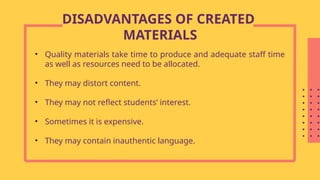
• Quality materialstake time to produce and adequate staff time
as well as resources need to be allocated.
• They may distort content.
• They may not reflect students’ interest.
• Sometimes it is expensive.
• They may contain inauthentic language.
DISADVANTAGES OF CREATED
MATERIALS
28.
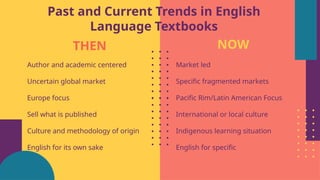
Author and academiccentered
Uncertain global market
Europe focus
Sell what is published
Culture and methodology of origin
English for its own sake
Past and Current Trends in English
Language Textbooks
Market led
Specific fragmented markets
Pacific Rim/Latin American Focus
International or local culture
Indigenous learning situation
English for specific
THEN NOW
29.
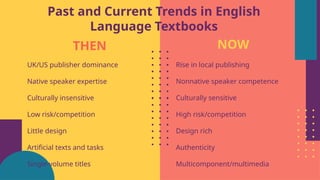
UK/US publisher dominance
Nativespeaker expertise
Culturally insensitive
Low risk/competition
Little design
Artificial texts and tasks
Single-volume titles
Past and Current Trends in English
Language Textbooks
Rise in local publishing
Nonnative speaker competence
Culturally sensitive
High risk/competition
Design rich
Authenticity
Multicomponent/multimedia
THEN NOW
30.
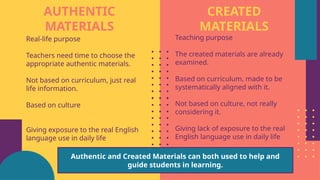
Real-life purpose
Teachers needtime to choose the
appropriate authentic materials.
Not based on curriculum, just real
life information.
Based on culture
Giving exposure to the real English
language use in daily life
AUTHENTIC
MATERIALS
CREATED
MATERIALS
Teaching purpose
The created materials are already
examined.
Based on curriculum, made to be
systematically aligned with it.
Not based on culture, not really
considering it.
Giving lack of exposure to the real
English language use in daily life
Authentic and Created Materials can both used to help and
guide students in learning.
31.
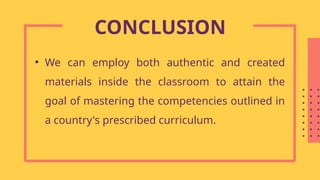
• We canemploy both authentic and created
materials inside the classroom to attain the
goal of mastering the competencies outlined in
a country's prescribed curriculum.
CONCLUSION
32.
REFERENCES
Richards, J. (2022).Advantages and disadvantages of using instructional
materials in teaching ESL. Professor Jack C. Richards.
https://www.professorjackrichards.com/advantages-and-
disadvantages-
of-using-instructional-materials-in-teaching
esl/#:~:text=Cost%3A%20Quality%20materials%20take%20time,
same%20image%20as%20commercial%20materials
Florendo, J. [Doc Jeff TV]. (2020, November 21). Authentic vs Created
Materials [Video]. Youtube.
https://www.youtube.com/watch?v=8xNCVu_FVaw
Vargas, J. (2009). Authentic Materials versus Non-Authentic
Materials.
Editor's Notes
#4 Purpose
It can be used to give information, instructions and many more which related to real life.
#5 In other words, Stubbs (1996) defines authentic texts as "actual, attested, and such that they that they have real authentic instances of use."
#6 In other words, Stubbs (1996) defines authentic texts as "actual, attested, and such that they that they have real authentic instances of use."
#9 Teaching materials are a very essential part of teaching and learning a foreign language. These days, the resources for days, teaching materials are available for everybody. The internet is regarded as a very important and rich source for authentic materials.
According to Carter & Nunan (2001, p. 68) authentic materials are "ordinary texts not introduced specifically for language teaching”
#10 Teaching materials are a very essential part of teaching and learning a foreign language. These days, the resources for days, teaching materials are available for everybody. The internet is regarded as a very important and rich source for authentic materials.
According to Carter & Nunan (2001, p. 68) authentic materials are "ordinary texts not introduced specifically for language teaching”
#20 using authentic materials is a burden for teachers. In order to develop learning resources around authentic materials, teachers have to be prepared to spend considerable amount of time locating suitable sources for materials and developing activities and exercises to accompany the materials.
#27 However, as non-authentic materials are designed and simplified by teachers, it makes non-authentic materials seem unnatural. Textbooks and simplified learning materials are considered giving lack of exposure to the real English language use in daily life. Thus, it is argued that giving the learners authentic materials should be encouraged. Brosnan, Brown, and Hood (1984) as cited in Oura (2001) argue that authentic materials reflect the naturalness of a language. Learners should be exposed to the variety of language form and vocabulary. He claims that simplification of non-authentic teaching materials will increase the difficulty of the task. The focus is on the comprehensive process which takes place when the students extracting the information and knowledge from the materials and make use of them. Therefore, the complexity of the materials should not be a constraint. Unedited authentic materials are suitable for learners to improve their English. As the materials expose various grammatical rules and language features, the learners will keep extracting new knowledge of the language. Gilmore then adds that learners will not be able to learn new things if they are not being exposed to it.
Once they get used into the complicated world of the language features, their language proficiency will be more likely to improve.
#31 However, as non-authentic materials are designed and simplified by teachers, it makes non-authentic materials seem unnatural. Textbooks and simplified learning materials are considered giving lack of exposure to the real English language use in daily life. Thus, it is argued that giving the learners authentic materials should be encouraged. Brosnan, Brown, and Hood (1984) as cited in Oura (2001) argue that authentic materials reflect the naturalness of a language. Learners should be exposed to the variety of language form and vocabulary. He claims that simplification of non-authentic teaching materials will increase the difficulty of the task. The focus is on the comprehensive process which takes place when the students extracting the information and knowledge from the materials and make use of them. Therefore, the complexity of the materials should not be a constraint. Unedited authentic materials are suitable for learners to improve their English. As the materials expose various grammatical rules and language features, the learners will keep extracting new knowledge of the language. Gilmore then adds that learners will not be able to learn new things if they are not being exposed to it.
Once they get used into the complicated world of the language features, their language proficiency will be more likely to improve.


![REFERENCES
Richards, J. (2022). Advantages and disadvantages of using instructional
materials in teaching ESL. Professor Jack C. Richards.
https://www.professorjackrichards.com/advantages-and-
disadvantages-
of-using-instructional-materials-in-teaching
esl/#:~:text=Cost%3A%20Quality%20materials%20take%20time,
same%20image%20as%20commercial%20materials
Florendo, J. [Doc Jeff TV]. (2020, November 21). Authentic vs Created
Materials [Video]. Youtube.
https://www.youtube.com/watch?v=8xNCVu_FVaw
Vargas, J. (2009). Authentic Materials versus Non-Authentic
Materials.](https://image.slidesharecdn.com/authenticvscreatedmaterials-260203080728-17f5f70d/85/authentic-vs-created-materials-by-deped-teacher-pptx-32-320.jpg)


