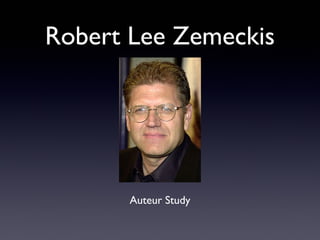
Robert Lee Zemeckis


      Auteur Study
About Zemeckis
 Robert Lee Zemeckis - (born May 14, 1951)
First came to public attention after Directing “Back
          to the Future Part 1” in 1985


  "the truth was that in my family there was no
   art. I mean, there was no music, there were
   no books, there was no theater....The only
      thing I had that was inspirational, was
          television—and it actually was."
Auteur Theory
 “Auteur Theory suggests that a director can use the
  commercial apparatus of film-making in the same
 way that a writer uses a pen or a painter uses paint
   and a paintbrush. It is a medium for the personal
      artistic expression of the director. The film
  theorotician, André Bazin, explained that: auteur
theory was a way of choosing the personal factor in
   artistic creation as a standard of referencce, and
then assuming that it continues and even progresses
                from one film to the next.”
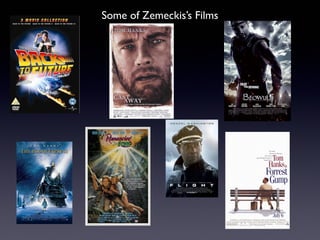
Some of Zemeckis’s Films
"Marty where he's isolated.
        [McFly] is [also] in
 a land another time zone,"
He's indirector explains.
    the
My Problematic

How does Robert Zemeckis portray isolation and
          loneliness within his films?
The Films I’am going to
        Study

• Cast Away
• Back to the Future 1
• Forrest Gump
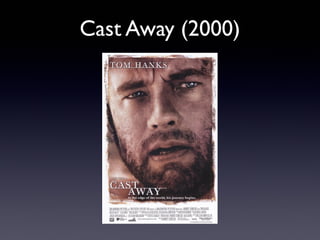
Cast Away (2000)
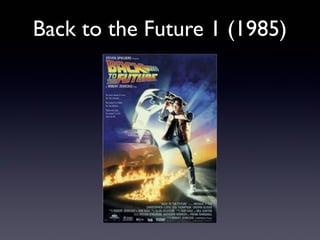
Back to the Future 1 (1985)
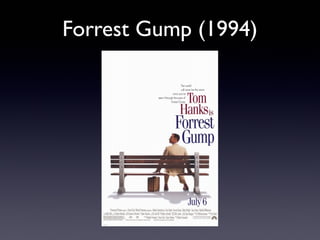
Forrest Gump (1994)
Linking his life to
       problematic
• Did not have a lot of ways of expressing
  himself as a child
• Viewed the world through a TV screen.
• When they first got a video camera he
  would use it all the time.
Cast Away

• Chuck is stranded on the island completely
  isolated from civilisation
• Shown also to feel lonely as he misses Kelly
  the love of his life
Analysis of scene


• 30.02 - 36.40 minutes
Sound

• There is no non-diegetic sound throughout
  this sequence or any time on the island
• The ambient sounds are amplified
• Almost no dialogue in this sequence
Camera Work


• Starts with close ups revealing more with
  each shot
• 360 degree pan from where he is standing
Editing


• Very long shot timings
• Slow paced
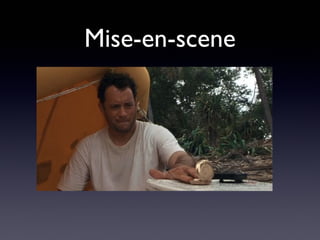
Mise-en-scene
Significant points in the
           film
•   Creation of Wilson

•   Maths equation

•   Whale

•   Opening packages

•   Top of the cliff

•   Getting angry at wilson

•   Quote from near the end “I couldn't even kill myself the way I wanted to. I
    had power over nothing”
Back to the future
Forrest gump

Auteur study 2

  • 1.
  • 2.
    About Zemeckis RobertLee Zemeckis - (born May 14, 1951) First came to public attention after Directing “Back to the Future Part 1” in 1985 "the truth was that in my family there was no art. I mean, there was no music, there were no books, there was no theater....The only thing I had that was inspirational, was television—and it actually was."
  • 3.
    Auteur Theory “AuteurTheory suggests that a director can use the commercial apparatus of film-making in the same way that a writer uses a pen or a painter uses paint and a paintbrush. It is a medium for the personal artistic expression of the director. The film theorotician, André Bazin, explained that: auteur theory was a way of choosing the personal factor in artistic creation as a standard of referencce, and then assuming that it continues and even progresses from one film to the next.”
  • 4.
  • 5.
    "Marty where he'sisolated. [McFly] is [also] in a land another time zone," He's indirector explains. the
  • 6.
    My Problematic How doesRobert Zemeckis portray isolation and loneliness within his films?
  • 7.
    The Films I’amgoing to Study • Cast Away • Back to the Future 1 • Forrest Gump
  • 8.
  • 9.
    Back to theFuture 1 (1985)
  • 10.
  • 11.
    Linking his lifeto problematic • Did not have a lot of ways of expressing himself as a child • Viewed the world through a TV screen. • When they first got a video camera he would use it all the time.
  • 12.
    Cast Away • Chuckis stranded on the island completely isolated from civilisation • Shown also to feel lonely as he misses Kelly the love of his life
  • 13.
    Analysis of scene •30.02 - 36.40 minutes
  • 14.
    Sound • There isno non-diegetic sound throughout this sequence or any time on the island • The ambient sounds are amplified • Almost no dialogue in this sequence
  • 15.
    Camera Work • Startswith close ups revealing more with each shot • 360 degree pan from where he is standing
  • 17.
    Editing • Very longshot timings • Slow paced
  • 18.
  • 19.
    Significant points inthe film • Creation of Wilson • Maths equation • Whale • Opening packages • Top of the cliff • Getting angry at wilson • Quote from near the end “I couldn't even kill myself the way I wanted to. I had power over nothing”
  • 20.
  • 21.

Editor's Notes

  • #3 Robert was born in chicago, illinois. His family was working class Roman Catholic, his mother was Italian American and farther Lithuanian American. He attended Fenger High school, In film school, he won a Student Academy Award. And had his first break through film with Romancing the Stone. As the quote from the director above states he grow up in a family that did not have any creative elements and was very isolated from the outside world giving him very little exposure to anything that may inspire him. He did however have television. This may well be the reason he became a director.
  • #4 This explanation of the auteur theory helped me greatly. As I am a artist myself and have done studies on different painters and sculptures before it helped me understand it in my own terms. The auteur theory states that a film maker that is classed as an auteur can be shown to have followed similar themes and/or techniques throughout a number of their films. This is similar to how a artist may stick to a certain underlying theme or painting technique and most of the time if you know the artist or have seen some of their work before it is easy to distinguish wether or not a piece is theres or not. A good example of this is the street artist Banksy who’s distinctive style of large single layered stencils usually presenting political or social issues. This underlying similarity or “signature” can often be linked to the directors personal life or cultural background.
  • #5 Zemeckis has directed 25 different titles. These nine are in my opinion are his best.
  • #6 This is a quote that Robert Zemeckis gave in and interview he did for Hollywood Reporter Magazine. This quote made me look at his films with Isolation in mind and I found that in most of his films Zemeckis portrays the main protagonist in a isolate or lonely way. A few examples are, in Flight
  • #7 I have reviewed all the nine films that I mentioned before and found that they all link with the idea of isolation. This is why I have chosen to have this as my problematic.
  • #9 Cast Away is about a normal man (Chuck Noland) who is happy with his job and family prospects with his girlfriend Kelly whom he is very much in love with. He works for the FedEx company traveling the world making sure packages arrive in the correct time. When traveling to Malaysia his plane crashes in a storm that plants him on a deserted island completely isolated from civilisation and completely alone. Armed with only a few objects washed ashore from the plane crash that have no relevance to his situation and a small old fashioned pocket watch broken from the crash which contains a picture of Kelly, he is forced to completely re-shape his life to stay alive and get back to her.
  • #10 Back to the Future is about a boy (Marty McFly). He is a typical high-school boy, plays guitar, skateboards and has a beautiful girlfriend. Despite all of this he decides to spend most of his time with a mad scientist called Dr. Emmett Brown. Dr. Brown, or “Doc” as he is referred to regularly in the film, discovers the secret to time travel (The Flux Capacitor) after falling and hitting his head on the sink. After unforeseen circumstances Marty is transported back in time to November 5 th 1955 where he accidentally bumps into his younger mother and father altering his future so that his parents never fall in love at high-school. He must reunite them and find a way to get back to his own time or he will cease to exist.
  • #11 Forrest Gump is man with a very low IQ who stumbles through life finding himself in extraordinary situations. His mother is very loving to him when he is a child teaching him the ways of life in terms that he can understand. On the first day of school he meets Jenny who he falls in love with and who helps him through the social issues that life in-tails. Despite not being as clever as those around him he has a good heart and the amazing ability to take orders exactly as they come. This ability sparks a series of events in his life that change others lives around him without him fully understanding the impact he has. All this irrelevant to Forrest however as he is set on finding Jenny his childhood sweet hart who is slowly destroying her life.
  • #12 Growing up he did not have and creative thing in his family and they did not encourage any creativity. He was fascinated by TV but this can very easily isolate people from the real world. Making them think that they are isolated viewing the world through a TV screen, creating a fake reality and distorting your view on the world. It can however be very educational and I think that he saw it as a way out. When his family got their first video camera he found it fascinating and began filming
  • #13 Cast Away is a film in my opinion all about loneliness and isolation. Even the name is suggesting it, its interesting how Robert Zemeckis decided to name it “Cast Away” which is the verb phrase meaning “cast aside” or “discard” rather than “Castaway” the noun meaning somebody stranded on an island. This could be because even though he is a castaway when he manages to return to civilisation he is cast aside by Kelly who was the reason he kept himself alive throughout the 4 years he was stranded.
  • #14 I have chosen to analyse this sequence in detail as it is when Chuck is first washed up on the island. The film has this huge change in pace going from a horrifying plane crash where Zemeckis brings you right into the action filming it from inside the plane, to this this calm beach with no action at all. I have chosen this scene because it is the point in the film where Zemeckis uses the cinematography to put across to the audience just how isolated this place is.
  • #15 At the start of the sequence we see a long shot of the entire island obscured by darkness with the dingy that we see Chuck on in the previous shot just visible on the shoreline. In this shot the rainfall is amplified perhaps to express how exposed to the elements Chuck is. It then cuts to chuck lying in the dingy on the shore line with the waves hitting him. Here the sound of the waves is very loud and and as he walks around we here the sound of sand falling to the fall and the slapping noise of his sodden and sand ridden socks on the beach. When chuck is collecting his stuff around the palm trees we also hear the sound of the trees creaking in the wind amplified. All the sounds we hear amplified make us focus on them more when usually it would be a non- diegetic soundtrack or sound effects that our hearing focuses on. This is used by Zemeckis to make the audience feel more involved with the situation Chuck has found himself, creating an atmosphere of isolation. All of these sounds are coming from a very small vicinity and we as audience can see where most of them are coming from. If this was anywhere near any civilisation we would probably hear background noises such as cars, planes, or voices instead we are restricted to only these. Within this sequence there is almost no dialogue. This is because there is nobody around for him to talk to. The only lines of dialogue we hear are that of Chuck crying “Helllllooo!” “Helllloo Anybody!” and “Help!” said once then repeated louder. When no reply is heard we pretty much know that he is on his own. These are pleads for help from Chuck connoting how lonely he is.
  • #16 In this sequence Zemeckis begins by showing a close up shot of Chuck lying in his dingy on the beach. This is used to show his reaction when he first wakes up on the island. This give the audience a sense of what he is feeling. He does not how ever restrict us to just a reaction shot we are also given some viewing space with a shore line visible. This tells us that he is stranded on a unknown beach somewhere contributing to his feelings of isolation. He could be anywhere. There are only 4 shots in the first 3 minutes of this sequence. In each shot the camera does not move at all and is held for a long time before cutting to the next one. This still camera could connote how little Chuck can move and by restricting our view it could be suggesting how isolated this place is. The first time the camera moves it begins with a long shot of the beach with Chuck picking up some packages he then begins to walk up the beach and the camera begins to follow him round then begins a very slow 360 degree pan from the point that Chuck. This is showing to the view the fact that the is nothing anywhere insight. This and the fact that it pans quite slowly gives the sense that this place is truly a lonely island in the middle of no where showing how isolated Chuck must feel at this point.
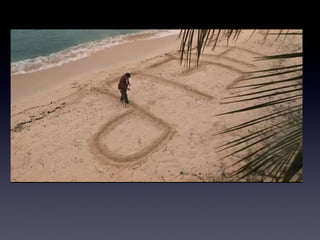
  • #17 This shot is interesting how he used a high angle shot of Chuck digging HELP in the sand. This high angle connotes how powerless he is at this moment. It also shows us how lonely he is its almost he is calling out for help to the heavens and wishing that somebody will answer. After this shot we see a extreme close up of the pocket watch with Kelly’s picture in it while Chuck is holding it and almost stroking it. This close up right after the shot of him digging HELP into the sand shows is how lonely he is and he has resorted to thinking about his one love, perhaps hoping that she will stop at nothing to find him.
  • #18 The editing of this clip is very slow paced. Most of the shot timings are very long and includes and amazing 360 degree pan of Chucks view when he is looking around from the beach. This shot is 1 min 21 seconds long which is very long for a shot in a film. This slow paced editing my connote how long Chuck is going to be on the island and this shot is suggesting to us how long it takes for his mind to process the situation he is in. The long shot timing could also connote to us the real time of the film and again trying to bring us “the audience” closer to the world that Chuck has found himself in. The cuts are all strait cuts. This keeps the film all on one level suggesting that there really isn't much going on on this island again connoting how isolated the place is.
  • #19 One of the most interesting shots is when Chuck is sitting under his makeshift shelter made from his dingy. He has one of the boxes from the FedEx plane with his broken pager and the pocket watch with Kelly's picture in it open facing towards him. This shot signifies everything he has at that point. It also has the pager and the pocket watch in it. This is important because his life before the crash was dependent on time, Kelly and pager is what made him get on the plane in the first place. These all now lie broken in front of him and everything that he knows has been broken down. His face has a mixture of emotions on it from confusion to
  • #20 Creation of Wilson - happened when he looses it for the first time. Shows how lonely he is needs somebody to talk to. Maths equation - shows that his logical mind is still at work and shows how isolated he is as he could be anywhere Whale - visual metaphor, lonely creature Opening packages - loneliness Top of the cliff - shows how the isolation is getting to him Getting angry at wilson - right after he kicks him away he realises that Wilson is on the only thing he has that keeps him company and ties to find him as quick as possible. He looks generally worried for Wilson’s life.