Learning Intentions:
To hear and recognise the difference between singing and speaking voices.
To use a gentle singing voice.
To listen and match pitch.
To hear the difference between high and low pitch.
To keep a steady beat.
To sing in time together.
To sing using dynamics forte (loud) and piano (soft).
To hear and distinguish between loud and soft music.
To sing and hear when music is fast and slow.
To recognise rhyming words.
Hello There
This is a great song to start a music lesson with.
The teacher sings first and the children echo. It is excellent for remembering
words and for singing with dynamics as well. The teacher can sing piano
(soft) or forte (loud) and children can echo the dynamic.
Ages:
Foundation
to Year 2
Chickamy Chickamy
Craney Crow
Teacher uses a percussion instrument (claves, lollipop drum) to tap out
a different time to the class.
Students need to listen carefully and count the taps to tell the time.
The teacher could choose a student to have a turn tapping out a time for the
class to count.
Then, the teacher might like to ask a student to come point to the number on
the clock on the board.
Ages:
Foundation
to Year 2
On My Toe There is a Flea
On My Toe There is
a Flea
On my toe there is a flea,
Now he’s climbing up on me,
Past my tummy, past my nose,
On my head where my hair grows.
On my head there is a flea
Now he’s climbing down on me,
Past my tummy, past my knee,
On my toe,
Take THAT, you flea!
Ah!
The pitch of this song slowly gets higher as the flea climbs up and then
lower as the flea climbs down.
Children can use their fingers to imitate fleas crawling up and down
their bodies.
Ages:
Foundation
to Year 2
This is a great song for children to hear and recognise the change in
pitch matching with the actions. The teacher can also change the tempo
and sing faster or slower.
At the end, clap your hands on "That!"
Lirum Larum
While singing, children have their hands flat on the floor and need to move the
fingers that they are singing about up and down on each hand.
The song repeats for each of the fingers.
In the last verse, all fingers can move together when the lyrics change to:
“Lirum Larum everybody dance. No more fingers sitting still, no more
waiting patiently. Lirum Larum everybody dance.”
Pointer
finger
Little
thumbkin
Tall
man Ring
man
Pinky
finger
Ages:
Foundation
to Year 2
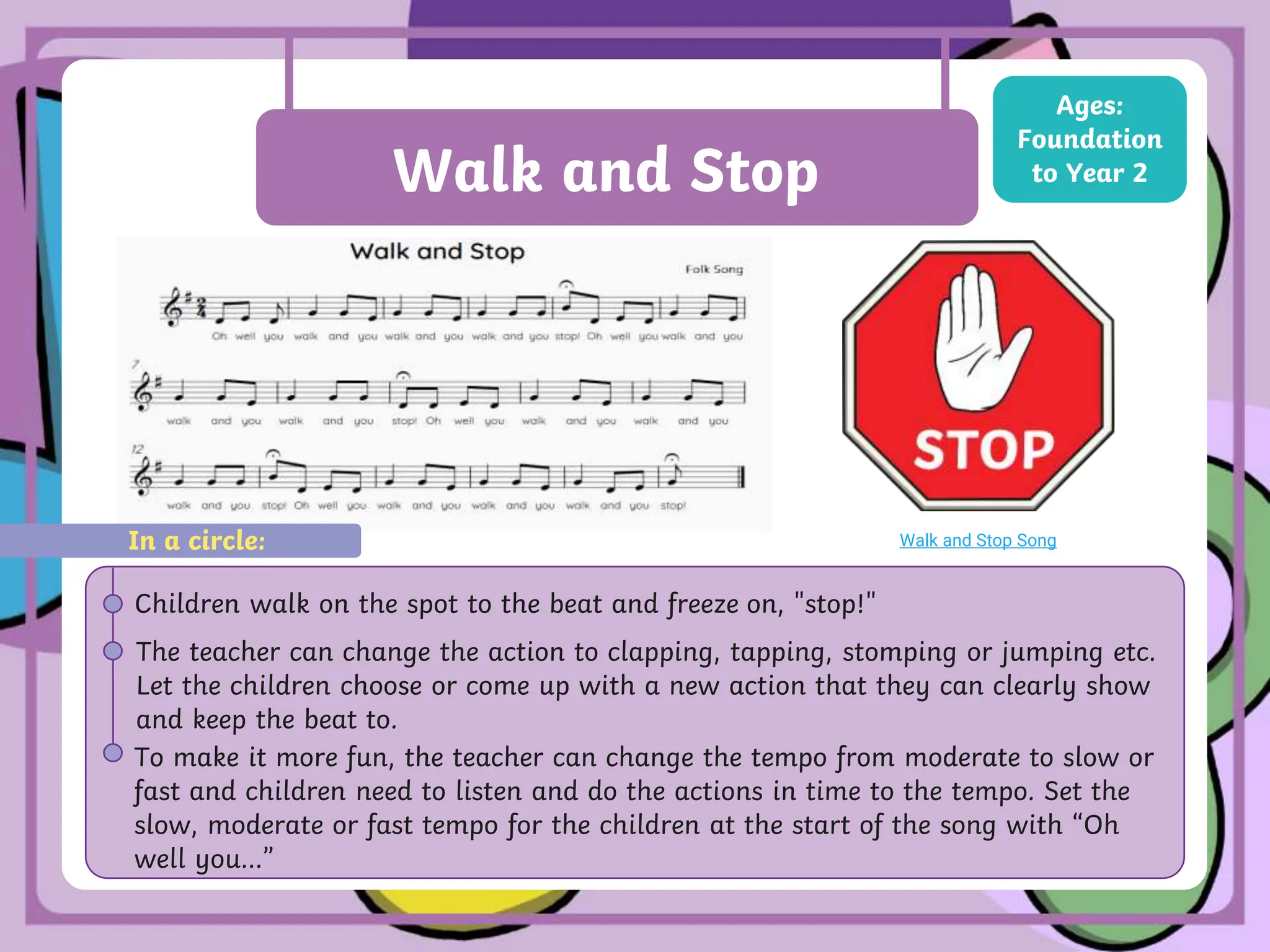
Walk and Stop
In a circle:
Children walk on the spot to the beat and freeze on, "stop!"
The teacher can change the action to clapping, tapping, stomping or jumping etc.
Let the children choose or come up with a new action that they can clearly show
and keep the beat to.
To make it more fun, the teacher can change the tempo from moderate to slow or
fast and children need to listen and do the actions in time to the tempo. Set the
slow, moderate or fast tempo for the children at the start of the song with “Oh
well you…”
Ages:
Foundation
to Year 2
Walk and Stop Song
Bluebells
In pairs:
Ages:
Foundation
to Year 2
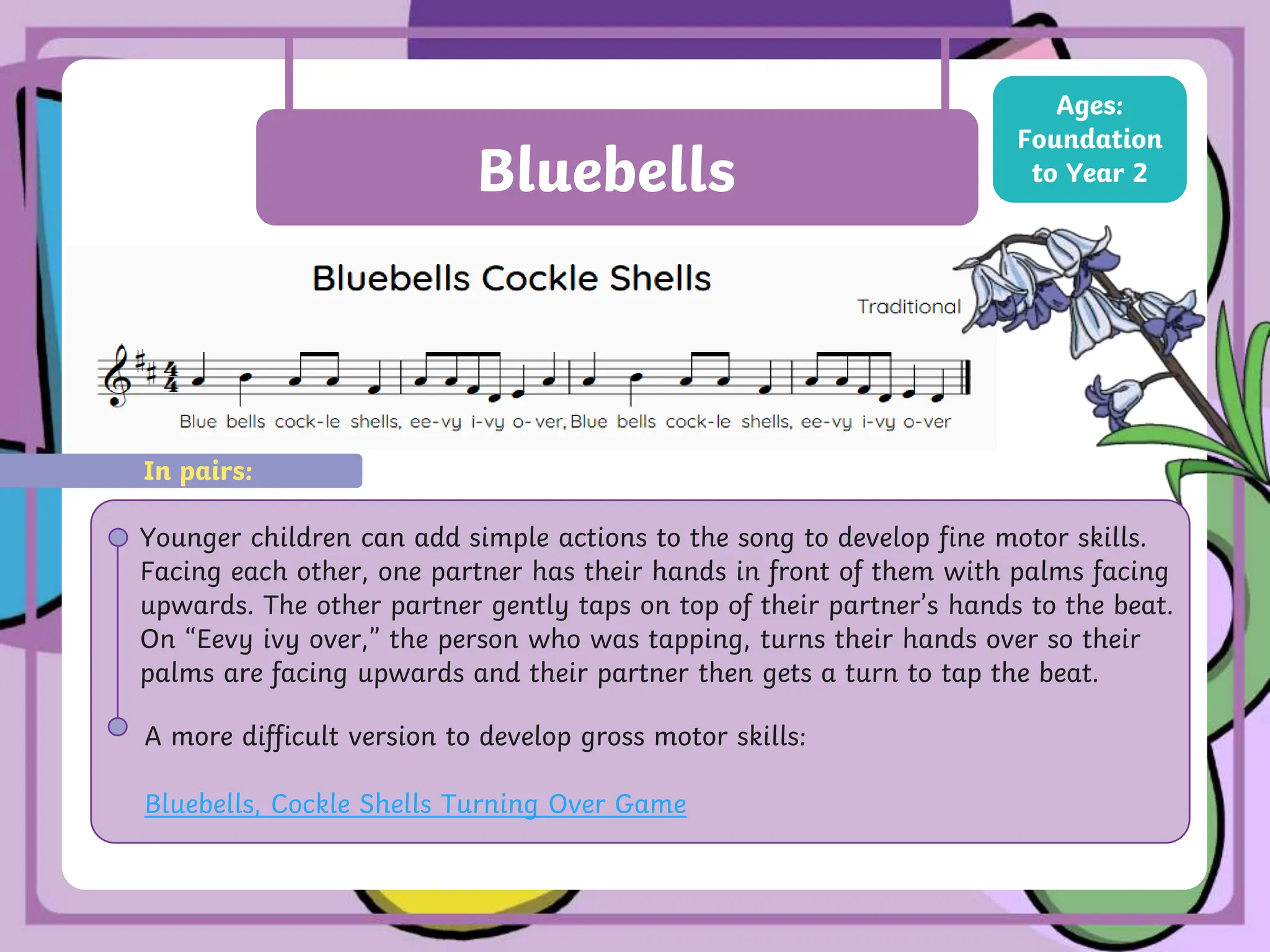
Younger children can add simple actions to the song to develop fine motor skills.
Facing each other, one partner has their hands in front of them with palms facing
upwards. The other partner gently taps on top of their partner’s hands to the beat.
On “Eevy ivy over,” the person who was tapping, turns their hands over so their
palms are facing upwards and their partner then gets a turn to tap the beat.
A more difficult version to develop gross motor skills:
Bluebells, Cockle Shells Turning Over Game
Engine, Engine
A great rhyme to practise using different dynamics piano (soft) and forte (loud).
To practise keeping the beat, students follow the teacher around in a 'train’ line.
The teacher taps claves to help children hear the beat and gradually taps faster.
The students need to listen carefully and keep walking to the beat. Then, the
teacher gradually taps slower until the train stops. This also helps students to
recognise different tempos, fast and slow.
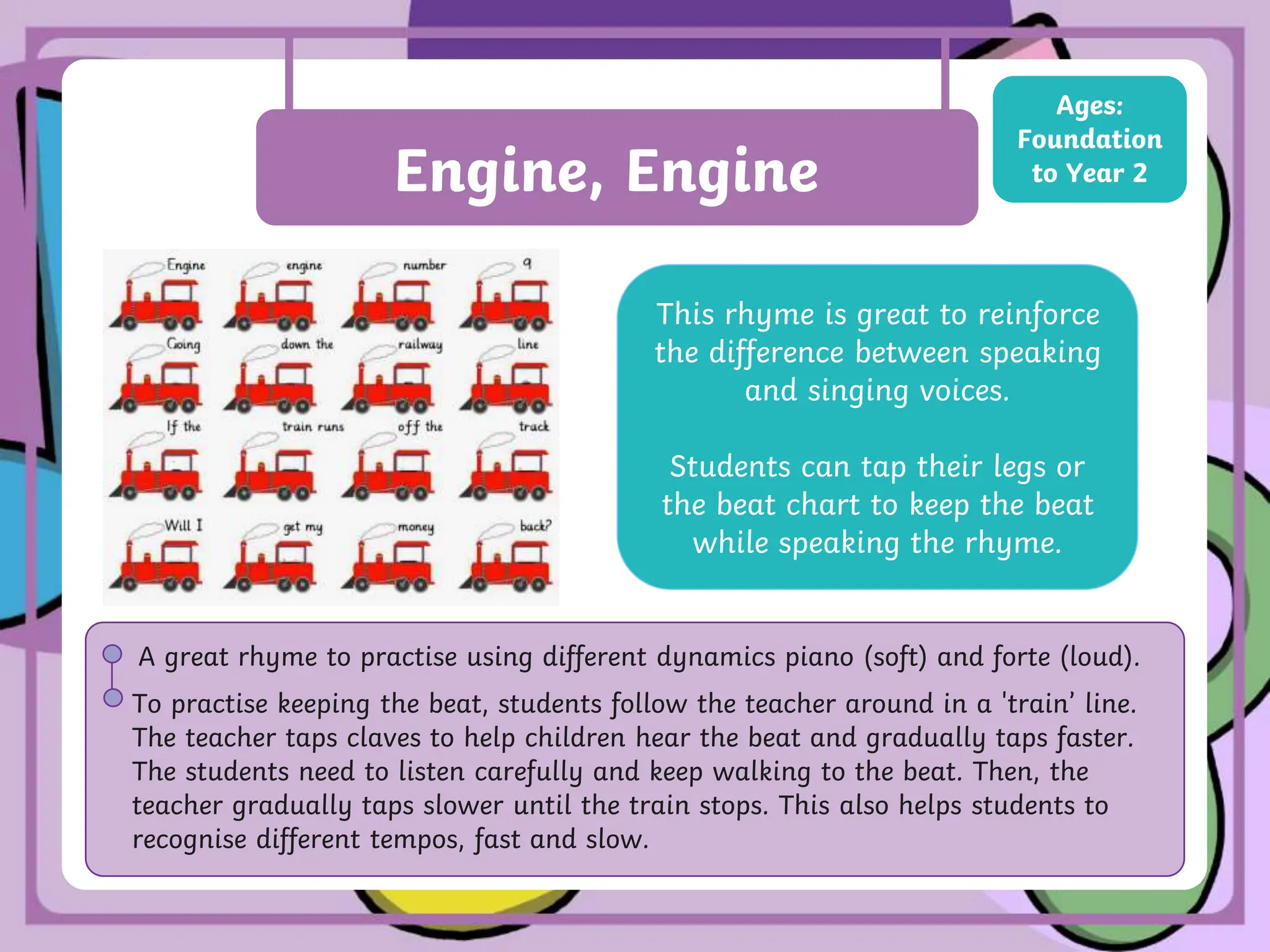
This rhyme is great to reinforce
the difference between speaking
and singing voices.
Students can tap their legs or
the beat chart to keep the beat
while speaking the rhyme.
Ages:
Foundation
to Year 2
Apples, Peaches,
Pears and Plums
In a circle:
Sing the song as a class. Then, sing the months of the year. Students can stand up
when their birthday month is sung.
A fun game to learn the months of the year and their order!
Ages:
Foundation
to Year 2
Apples, Peaches,
Pears and Plums
Where is Thumbkin?
Students hide their hands behind their back and reveal one hand at a time when
they sing "here I am”. They then wiggle the corresponding fingers on their hands
pretending that they are talking to each other.
When they sing "run away," each hand is hidden behind their back one at a time.
Pointer
Thumbkin
Tall
man Ring
man
Pinky
Ages:
Foundation
to Year 2
Round and Round
the Village
In a circle:
Choose a child to start. Everyone else holds hands to form a circle. Begin singing the song.
The child chosen then performs the actions sung.
1. Round and Round the Village (child walks around the circle).
2. In and out the windows (child weaves between the children in the circle).
3. Stand and face your partner (child stops at someone).
4. Shake hands before you leave them (child shakes hands with the person they have stopped at).
5. Follow them to London (the child they have shaken hands with now follows them around the
circle).
Round and Round the Village
Song Demonstration
Ages:
Foundation
to Year 2
We’re Going
to Kentucky
In a circle:
Add actions to match the words of the song. The teacher can decide on actions
with the children.
Slowly get faster each time you sing the song. This is a great way for children to
learn to hear and recognise different tempos (speeds).
We're Going to Kentucky Song
Ages:
Foundation
to Year 2
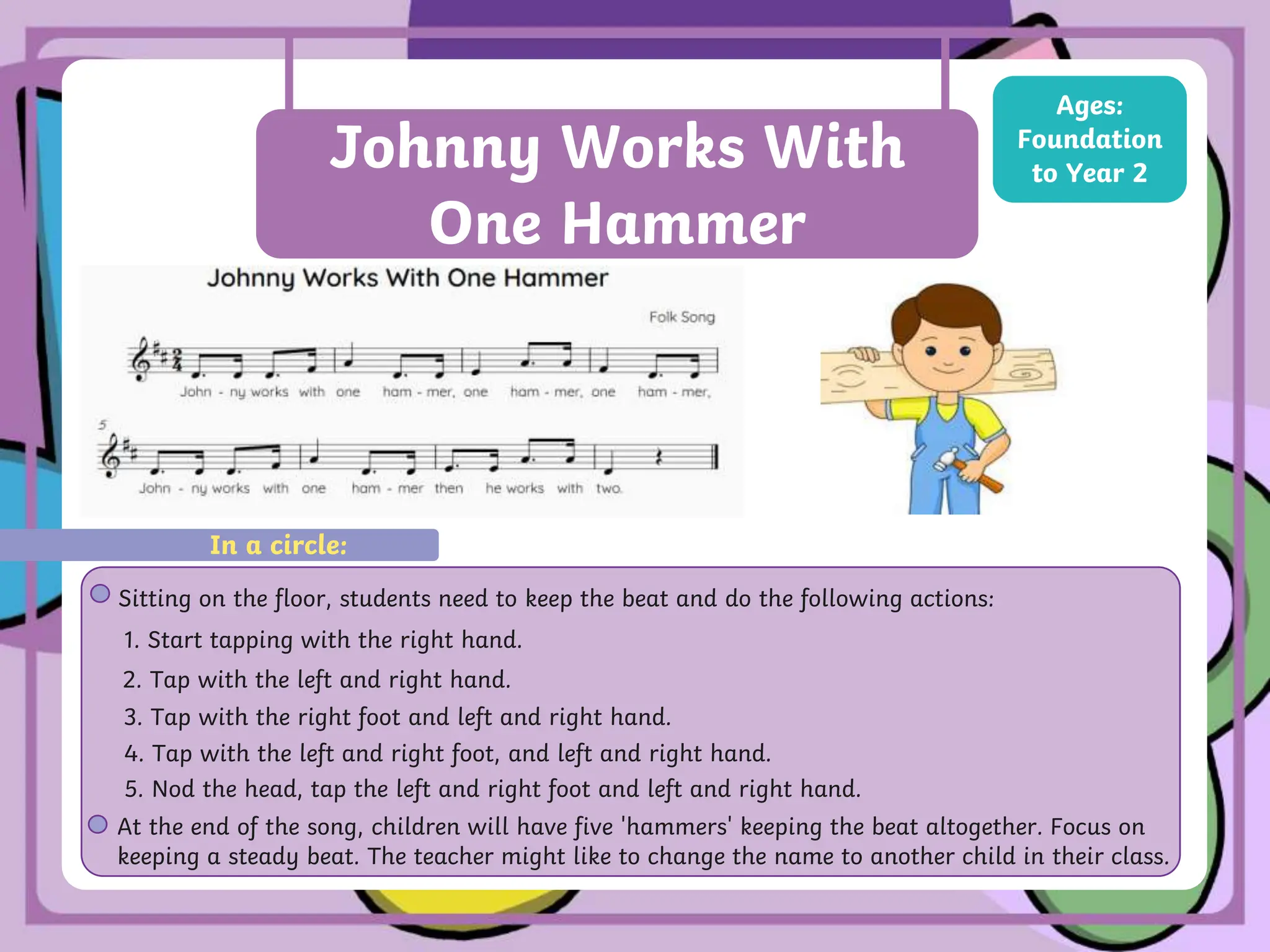
Johnny Works With
One Hammer
In a circle:
Sitting on the floor, students need to keep the beat and do the following actions:
1. Start tapping with the right hand.
2. Tap with the left and right hand.
3. Tap with the right foot and left and right hand.
4. Tap with the left and right foot, and left and right hand.
5. Nod the head, tap the left and right foot and left and right hand.
At the end of the song, children will have five 'hammers' keeping the beat altogether. Focus on
keeping a steady beat. The teacher might like to change the name to another child in their class.
Ages:
Foundation
to Year 2
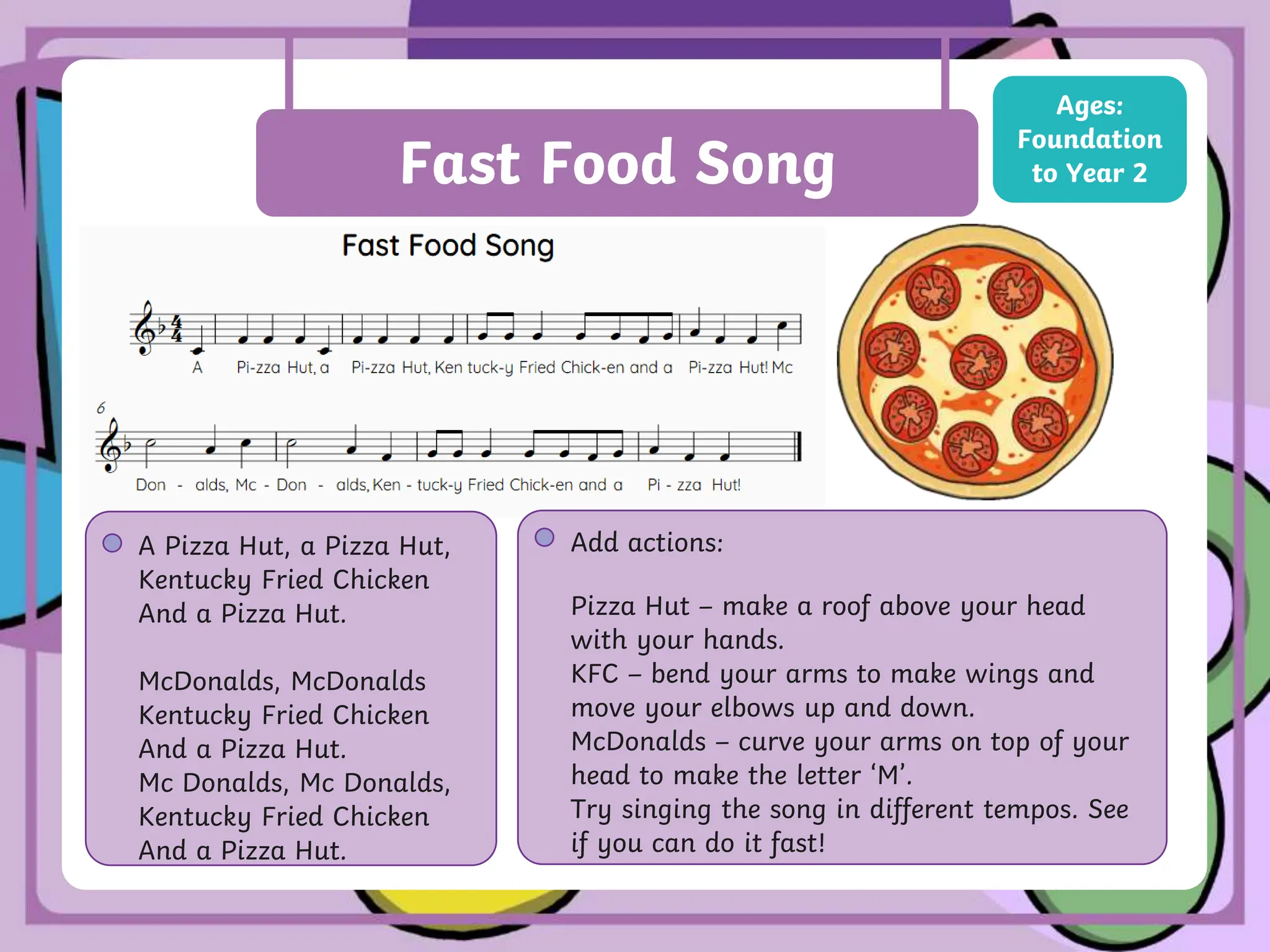
Fast Food Song
A Pizza Hut, a Pizza Hut,
Kentucky Fried Chicken
And a Pizza Hut.
McDonalds, McDonalds
Kentucky Fried Chicken
And a Pizza Hut.
Mc Donalds, Mc Donalds,
Kentucky Fried Chicken
And a Pizza Hut.
Add actions:
Pizza Hut – make a roof above your head
with your hands.
KFC – bend your arms to make wings and
move your elbows up and down.
McDonalds – curve your arms on top of your
head to make the letter ‘M’.
Try singing the song in different tempos. See
if you can do it fast!
Ages:
Foundation
to Year 2
Mulberry Bush
In a circle:
The teacher may like to begin by asking the children what things they do in
the morning to get ready for school.
The class then walks around in a circle while singing the “Here we go round
the mulberry bush,” chorus. Then, everyone stops to sing the verse about a
different activity to get ready for school in the morning. For example, “This
is the way we brush our teeth”.
Children can do the action to match the activity. Then repeat the chorus and
walk around the circle again. The teacher can decide how many new verses
to sing.
Ages:
Foundation
to Year 2
Wave Goodbye
To the tune of 'Skip to My Lou'.
Wave, wave, wave goodbye.
I hope to see you soon.
A great song to end a music
lesson while students are
packing up,
lining up to leave or at the end
of every school day.
Ages:
Foundation
to Year 2
Nursery Rhymes
Five Little Ducks - develops counting using role play puppets.
Twinkle Twinkle Little Star – great for piano (soft) singing.
Five Little Speckled Frogs - develops counting using role play puppets.
Five Currant Buns – role play the story using role play puppets.
If You’re Super and You Know It – demonstrates changing lyrics to a song.
Incy Wincy Spider – fine motor skills through actions.
Ten Fat Sausages – develops counting using role play puppets.
The Wheels on the Bus - fine motor skills through actions.
Heads, Shoulders, Knees and Toes – develop timing and listening by omitting words!
Many Twinkl resources include backing tracks to sing along with and
also have puppets that can be used to role play the story in the songs.
Ages:
Foundation
to Year 2
au-t-1664323778-songs-and-games-for-early-years-and-lower-primary_ver_2.pptx

au-t-1664323778-songs-and-games-for-early-years-and-lower-primary_ver_2.pptx

  • 2.
    Learning Intentions: To hearand recognise the difference between singing and speaking voices. To use a gentle singing voice. To listen and match pitch. To hear the difference between high and low pitch. To keep a steady beat. To sing in time together. To sing using dynamics forte (loud) and piano (soft). To hear and distinguish between loud and soft music. To sing and hear when music is fast and slow. To recognise rhyming words.
  • 3.
    Hello There This isa great song to start a music lesson with. The teacher sings first and the children echo. It is excellent for remembering words and for singing with dynamics as well. The teacher can sing piano (soft) or forte (loud) and children can echo the dynamic. Ages: Foundation to Year 2
  • 4.
    Chickamy Chickamy Craney Crow Teacheruses a percussion instrument (claves, lollipop drum) to tap out a different time to the class. Students need to listen carefully and count the taps to tell the time. The teacher could choose a student to have a turn tapping out a time for the class to count. Then, the teacher might like to ask a student to come point to the number on the clock on the board. Ages: Foundation to Year 2
  • 5.
    On My ToeThere is a Flea On My Toe There is a Flea On my toe there is a flea, Now he’s climbing up on me, Past my tummy, past my nose, On my head where my hair grows. On my head there is a flea Now he’s climbing down on me, Past my tummy, past my knee, On my toe, Take THAT, you flea! Ah! The pitch of this song slowly gets higher as the flea climbs up and then lower as the flea climbs down. Children can use their fingers to imitate fleas crawling up and down their bodies. Ages: Foundation to Year 2 This is a great song for children to hear and recognise the change in pitch matching with the actions. The teacher can also change the tempo and sing faster or slower. At the end, clap your hands on "That!"
  • 6.
    Lirum Larum While singing,children have their hands flat on the floor and need to move the fingers that they are singing about up and down on each hand. The song repeats for each of the fingers. In the last verse, all fingers can move together when the lyrics change to: “Lirum Larum everybody dance. No more fingers sitting still, no more waiting patiently. Lirum Larum everybody dance.” Pointer finger Little thumbkin Tall man Ring man Pinky finger Ages: Foundation to Year 2
  • 7.
    Walk and Stop Ina circle: Children walk on the spot to the beat and freeze on, "stop!" The teacher can change the action to clapping, tapping, stomping or jumping etc. Let the children choose or come up with a new action that they can clearly show and keep the beat to. To make it more fun, the teacher can change the tempo from moderate to slow or fast and children need to listen and do the actions in time to the tempo. Set the slow, moderate or fast tempo for the children at the start of the song with “Oh well you…” Ages: Foundation to Year 2 Walk and Stop Song
  • 8.
    Bluebells In pairs: Ages: Foundation to Year2 Younger children can add simple actions to the song to develop fine motor skills. Facing each other, one partner has their hands in front of them with palms facing upwards. The other partner gently taps on top of their partner’s hands to the beat. On “Eevy ivy over,” the person who was tapping, turns their hands over so their palms are facing upwards and their partner then gets a turn to tap the beat. A more difficult version to develop gross motor skills: Bluebells, Cockle Shells Turning Over Game
  • 9.
    Engine, Engine A greatrhyme to practise using different dynamics piano (soft) and forte (loud). To practise keeping the beat, students follow the teacher around in a 'train’ line. The teacher taps claves to help children hear the beat and gradually taps faster. The students need to listen carefully and keep walking to the beat. Then, the teacher gradually taps slower until the train stops. This also helps students to recognise different tempos, fast and slow. This rhyme is great to reinforce the difference between speaking and singing voices. Students can tap their legs or the beat chart to keep the beat while speaking the rhyme. Ages: Foundation to Year 2
  • 10.
    Apples, Peaches, Pears andPlums In a circle: Sing the song as a class. Then, sing the months of the year. Students can stand up when their birthday month is sung. A fun game to learn the months of the year and their order! Ages: Foundation to Year 2
  • 11.
    Apples, Peaches, Pears andPlums Where is Thumbkin? Students hide their hands behind their back and reveal one hand at a time when they sing "here I am”. They then wiggle the corresponding fingers on their hands pretending that they are talking to each other. When they sing "run away," each hand is hidden behind their back one at a time. Pointer Thumbkin Tall man Ring man Pinky Ages: Foundation to Year 2
  • 12.
    Round and Round theVillage In a circle: Choose a child to start. Everyone else holds hands to form a circle. Begin singing the song. The child chosen then performs the actions sung. 1. Round and Round the Village (child walks around the circle). 2. In and out the windows (child weaves between the children in the circle). 3. Stand and face your partner (child stops at someone). 4. Shake hands before you leave them (child shakes hands with the person they have stopped at). 5. Follow them to London (the child they have shaken hands with now follows them around the circle). Round and Round the Village Song Demonstration Ages: Foundation to Year 2
  • 13.
    We’re Going to Kentucky Ina circle: Add actions to match the words of the song. The teacher can decide on actions with the children. Slowly get faster each time you sing the song. This is a great way for children to learn to hear and recognise different tempos (speeds). We're Going to Kentucky Song Ages: Foundation to Year 2
  • 14.
    Johnny Works With OneHammer In a circle: Sitting on the floor, students need to keep the beat and do the following actions: 1. Start tapping with the right hand. 2. Tap with the left and right hand. 3. Tap with the right foot and left and right hand. 4. Tap with the left and right foot, and left and right hand. 5. Nod the head, tap the left and right foot and left and right hand. At the end of the song, children will have five 'hammers' keeping the beat altogether. Focus on keeping a steady beat. The teacher might like to change the name to another child in their class. Ages: Foundation to Year 2
  • 15.
    Fast Food Song APizza Hut, a Pizza Hut, Kentucky Fried Chicken And a Pizza Hut. McDonalds, McDonalds Kentucky Fried Chicken And a Pizza Hut. Mc Donalds, Mc Donalds, Kentucky Fried Chicken And a Pizza Hut. Add actions: Pizza Hut – make a roof above your head with your hands. KFC – bend your arms to make wings and move your elbows up and down. McDonalds – curve your arms on top of your head to make the letter ‘M’. Try singing the song in different tempos. See if you can do it fast! Ages: Foundation to Year 2
  • 16.
    Mulberry Bush In acircle: The teacher may like to begin by asking the children what things they do in the morning to get ready for school. The class then walks around in a circle while singing the “Here we go round the mulberry bush,” chorus. Then, everyone stops to sing the verse about a different activity to get ready for school in the morning. For example, “This is the way we brush our teeth”. Children can do the action to match the activity. Then repeat the chorus and walk around the circle again. The teacher can decide how many new verses to sing. Ages: Foundation to Year 2
  • 17.
    Wave Goodbye To thetune of 'Skip to My Lou'. Wave, wave, wave goodbye. Wave, wave, wave goodbye. Wave, wave, wave goodbye. I hope to see you soon. A great song to end a music lesson while students are packing up, lining up to leave or at the end of every school day. Ages: Foundation to Year 2
  • 18.
    Nursery Rhymes Five LittleDucks - develops counting using role play puppets. Twinkle Twinkle Little Star – great for piano (soft) singing. Five Little Speckled Frogs - develops counting using role play puppets. Five Currant Buns – role play the story using role play puppets. If You’re Super and You Know It – demonstrates changing lyrics to a song. Incy Wincy Spider – fine motor skills through actions. Ten Fat Sausages – develops counting using role play puppets. The Wheels on the Bus - fine motor skills through actions. Heads, Shoulders, Knees and Toes – develop timing and listening by omitting words! Many Twinkl resources include backing tracks to sing along with and also have puppets that can be used to role play the story in the songs. Ages: Foundation to Year 2