AUSTRIA


 By: Casey Tarbell
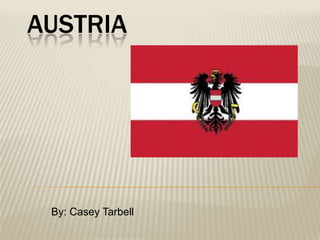
AUSTRIA
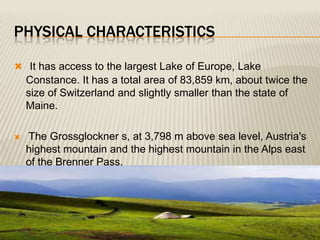
PHYSICAL CHARACTERISTICS

 It has access to the largest Lake of Europe, Lake
    Constance. It has a total area of 83,859 km, about twice the
    size of Switzerland and slightly smaller than the state of
    Maine.

   The Grossglockner s, at 3,798 m above sea level, Austria's
    highest mountain and the highest mountain in the Alps east
    of the Brenner Pass.
CUSTOMS AND TRADITIONS
   The traditional men clothing consisted of clothing made from
    leather , linen, and wool. And for women it consisted of a
    closefitting bodice combined with an apron.
   There are many societies dedicated to tracht revivals. Often,
    those efforts coincide with an interest in traditional crafts,
    like porcelain, glass-making or wood carving and traditional
    folk music and dancing
CULTURE
   Austria's main religion is roman catholic but other religions
    are practiced also. The Austrian culture was greatly
    influenced by Italy, Poland, Germany, Hungary, and
    Bohemia. Wolfgang Amandeus Mozart, Ludwig van
    Beethoven and Johann Strauss, Jr. are Austrian musicians
ECONOMY
   Austria is one of the 12 richest countries in the world in
    terms of GDP per capita, has a well-developed social
    market economy, and a high standard of living.
    Until the 1980s, many of Austria's largest industry firms
    were nationalized; in recent years, however,
    privatization has reduced state holdings to a level
    comparable to other European economies.
   Next to a highly developed industry, international tourism is
    the most important part of the national economy.
HISTORY
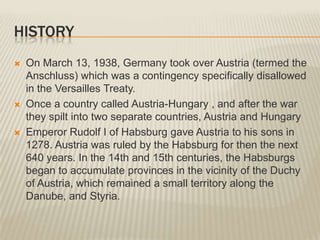
   On March 13, 1938, Germany took over Austria (termed the
    Anschluss) which was a contingency specifically disallowed
    in the Versailles Treaty.
   Once a country called Austria-Hungary , and after the war
    they spilt into two separate countries, Austria and Hungary
   Emperor Rudolf I of Habsburg gave Austria to his sons in
    1278. Austria was ruled by the Habsburg for then the next
    640 years. In the 14th and 15th centuries, the Habsburgs
    began to accumulate provinces in the vicinity of the Duchy
    of Austria, which remained a small territory along the
    Danube, and Styria.
AFTERMATH OF WWII
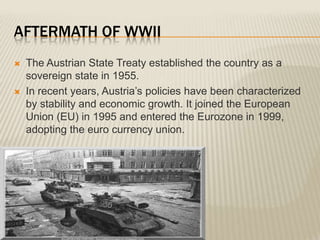
   The Austrian State Treaty established the country as a
    sovereign state in 1955.
   In recent years, Austria’s policies have been characterized
    by stability and economic growth. It joined the European
    Union (EU) in 1995 and entered the Eurozone in 1999,
    adopting the euro currency union.

Austria

  • 1.
  • 2.
  • 3.
    PHYSICAL CHARACTERISTICS  Ithas access to the largest Lake of Europe, Lake Constance. It has a total area of 83,859 km, about twice the size of Switzerland and slightly smaller than the state of Maine.  The Grossglockner s, at 3,798 m above sea level, Austria's highest mountain and the highest mountain in the Alps east of the Brenner Pass.
  • 4.
    CUSTOMS AND TRADITIONS  The traditional men clothing consisted of clothing made from leather , linen, and wool. And for women it consisted of a closefitting bodice combined with an apron.  There are many societies dedicated to tracht revivals. Often, those efforts coincide with an interest in traditional crafts, like porcelain, glass-making or wood carving and traditional folk music and dancing
  • 5.
    CULTURE  Austria's main religion is roman catholic but other religions are practiced also. The Austrian culture was greatly influenced by Italy, Poland, Germany, Hungary, and Bohemia. Wolfgang Amandeus Mozart, Ludwig van Beethoven and Johann Strauss, Jr. are Austrian musicians
  • 6.
    ECONOMY  Austria is one of the 12 richest countries in the world in terms of GDP per capita, has a well-developed social market economy, and a high standard of living.  Until the 1980s, many of Austria's largest industry firms were nationalized; in recent years, however, privatization has reduced state holdings to a level comparable to other European economies.  Next to a highly developed industry, international tourism is the most important part of the national economy.
  • 7.
    HISTORY  On March 13, 1938, Germany took over Austria (termed the Anschluss) which was a contingency specifically disallowed in the Versailles Treaty.  Once a country called Austria-Hungary , and after the war they spilt into two separate countries, Austria and Hungary  Emperor Rudolf I of Habsburg gave Austria to his sons in 1278. Austria was ruled by the Habsburg for then the next 640 years. In the 14th and 15th centuries, the Habsburgs began to accumulate provinces in the vicinity of the Duchy of Austria, which remained a small territory along the Danube, and Styria.
  • 8.
    AFTERMATH OF WWII  The Austrian State Treaty established the country as a sovereign state in 1955.  In recent years, Austria’s policies have been characterized by stability and economic growth. It joined the European Union (EU) in 1995 and entered the Eurozone in 1999, adopting the euro currency union.